As the global direct sales industry matures, the criteria used to define leadership have evolved. Where the sector was once shaped largely by growth narratives and income-driven messaging, today’s most respected organizations are increasingly evaluated through a different lens: structural clarity, operational discipline, regulatory alignment, and long-term scalability. Within this more measured framework, certain companies begin to stand out not through promotion, but through execution.
It is in this context that JIFU is often discussed among the top direct sales companies operating today.
To understand why, it is first necessary to clarify what “top” actually means in a modern direct selling environment. Leadership in this category is no longer defined by short-term expansion or headline growth figures. Instead, it is reflected in how consistently a company operates across markets, how effectively its systems scale, and whether its model is designed to endure regulatory, economic, and technological change.
Structure as a Foundation, Not an Afterthought
One of the most reliable indicators of a top-tier direct sales organization is structural clarity. Companies built for longevity operate with clearly defined systems governing onboarding, product access, compensation logic, and leadership development. These systems reduce ambiguity and create predictability, allowing distributors to operate within a professional and repeatable framework.
JIFU reflects this system-driven approach. Rather than relying on individual interpretation or personality-led momentum, the company emphasizes standardized processes across its operations. This shift away from charisma dependency is a hallmark of more mature organizations and one that has historically correlated with durability in network marketing.
Structure, in this sense, is not about rigidity. It is about establishing guardrails that protect both the brand and its community as scale increases.
Product Relevance at Global Scale
Another defining characteristic of leading direct sale companies is product relevance that extends beyond a single market or short-term trend. JIFU’s ecosystem spans three globally significant sectors: travel and lifestyle, health, and financial education. Each of these industries operates independently at a multi-trillion-dollar scale and continues to demonstrate sustained global demand.
What differentiates JIFU is not simply the breadth of its offering, but the way these verticals are integrated within a single membership-based model. Rather than functioning as isolated products, they form an interconnected ecosystem designed to support ongoing engagement. This integration encourages retention and long-term participation—both critical factors in sustainable direct selling organizations.
Platform Integration and Operational Leverage
The evolution of direct sales increasingly mirrors broader shifts in business infrastructure. Today’s leading organizations function less like informal sales networks and more like technology-enabled platforms. Centralized systems, digital access, and unified tools are no longer optional; they are foundational.
JIFU’s digital infrastructure reflects this reality. By consolidating products, education, communication, and business tools into a single environment, the company reduces friction for users across regions. This level of integration creates operational leverage, allowing scale without fragmentation or dilution of standards.
For experienced operators, platform cohesion is often viewed not as a competitive advantage, but as a prerequisite for global viability.
Compliance as a Strategic Priority
As regulatory oversight continues to intensify worldwide, compliance has become one of the clearest dividing lines between short-term ventures and organizations built for longevity. Companies operating across multiple jurisdictions must demonstrate alignment with local regulations, payment systems, and governance requirements.
JIFU’s international footprint suggests an operational commitment to working within regulatory frameworks rather than attempting to navigate around them. Leading direct sales companies do not treat compliance as a constraint; they treat it as infrastructure. This mindset signals long-term intent and reduces structural risk as organizations expand.
Consistency Across Markets
Consistency is another trait commonly observed in category-leading organizations. In global direct sales companies, fragmented execution often points to weak central coordination. By contrast, strong organizations maintain uniform standards in branding, messaging, and operations across markets.
JIFU demonstrates this internal alignment. Consistency strengthens trust internally among distributors and externally with consumers, while reinforcing brand stability as scale increases. Over time, this discipline becomes a structural advantage rather than a marketing point.
Leadership Through Execution
Ultimately, what places JIFU among the top direct sales companies is not a single feature or claim, but the convergence of structure, product relevance, platform integration, compliance, and consistency. These are the same indicators analysts and experienced leaders use when assessing long-term organizational viability.
As the industry continues to professionalize, leadership is increasingly defined by how companies operate rather than how they promote themselves. In that environment, JIFU’s positioning reflects an organization aligned with sustainability, execution, and measured growth—rather than overstatement.
As nearshore models reshape global operations, business leaders are rethinking outsourcing as a long-term partnership rather than a transactional service.
For much of the past three decades, business process outsourcing was defined by efficiency. Companies delegated discrete functions to third-party vendors, negotiated service-level agreements, and measured success primarily through cost reduction and delivery speed. That model worked in a predictable operating environment. But today, it is increasingly out of step with how organizations actually function, a shift that leaders such as Amalga Group Founder and CEO Jens Erik Gould have described as a structural turning point in the BPO industry.
Across industries, BPO relationships are shifting away from transactional outsourcing toward long-term, embedded partnerships. This change reflects broader pressures on modern enterprises, including persistent talent shortages, the accelerated adoption of AI, and the growing complexity of global operations. Nearshore BPO has emerged as a crucial part of this transition, offering a balance between operational proximity and scalability.
Why the Traditional Outsourcing Model Is Losing Relevance
The vendor-centric approach to outsourcing assumed stability. Work was clearly defined, processes remained largely unchanged, and handoffs between internal teams and external providers were minimal. That assumption no longer holds.
Organizations today operate in environments shaped by regulatory change, digital transformation, and continuous disruption. Under these conditions, rigid outsourcing arrangements often create friction rather than efficiency. When business needs shift, vendors optimized for narrow scopes struggle to adapt.
Jens Erik Gould has spoken about this inflection point in the outsourcing industry. “The question is no longer who can execute a task at the lowest cost,” he says. “It’s who can stay aligned with the business as that work evolves. That requires partnership, not distance.”
The Emergence of Embedded BPO Partnerships
In response, many organizations are redefining what they expect from BPO relationships. Rather than outsource isolated tasks, they are integrating external teams into their operating models. These partners participate in planning cycles, align with internal governance, and evolve alongside the business.
This approach is visible across sectors. Financial services firms rely on nearshore partners for compliance and risk operations that demand constant coordination with internal teams. Healthcare organizations increasingly outsource analytics, revenue cycle management, and patient support functions that require deep contextual understanding. Technology and professional services firms depend on BPO partners for knowledge-based work that changes as products and markets mature.
In each case, Jens Erik Gould maintains that the value of the relationship lies in continuity and shared accountability rather than volume or speed alone.
Nearshore as a Strategic Advantage
Geography plays a central role in enabling this partnership model. Nearshore BPO offers time zone alignment, cultural familiarity, and closer collaboration than traditional offshore arrangements. These factors become critical when outsourced work touches core operations or requires frequent interaction with internal stakeholders.
Nearshore teams are better positioned to support real-time decision-making, participate in cross-functional discussions, and adapt quickly when priorities change. As AI becomes further embedded in enterprise workflows, proximity also matters for governance, oversight, and iterative improvement.
Jens Erik Gould and Amalga Group prioritize a nearshore-first philosophy that emphasizes integration over scale. The broader trend extends well beyond any single firm. Nearshoring is increasingly viewed not as a compromise, but as a strategic operating choice.
AI Is Accelerating the Shift, Not Replacing It
Artificial intelligence is often framed as a threat to outsourcing, but in practice, it is reshaping it. As automation takes over routine tasks, the human component of BPO becomes more important, not less. Organizations need partners who can manage exceptions, validate outputs, and ensure that automated processes align with regulatory and ethical standards.
“AI does not remove complexity from operations,” Jens Erik Gould says. “It changes where that complexity lives. The enabling work still must be done by people who understand the business.”
This reality favors long-term BPO partnerships built on institutional knowledge and trust. Short-term vendors struggle to keep pace in environments where systems and data are constantly evolving.
Redefining Value in Modern BPO
As outsourcing relationships mature, value is increasingly measured by outcomes rather than outputs. Resilience during disruption, the ability to scale responsibly, and support for digital transformation now sit alongside cost efficiency as core performance indicators.
Contracts are evolving to reflect this shift, with longer horizons and shared success metrics. Governance models are emphasizing collaboration over enforcement. While not every BPO engagement requires this level of integration, the direction of the shift is clear.
Conclusion
The evolution from vendor to partner represents a fundamental change in how organizations think about outsourcing. In a volatile, technology-driven economy, operational capacity is no longer something that can be cleanly outsourced and forgotten. It must be built, maintained, and adapted over time.
Nearshore BPO, supported by embedded partnerships and informed by AI-enabled operations, is increasingly central to that effort. As leaders like Jens Erik Gould continue to frame outsourcing as a strategic capability rather than a procurement decision, the future of BPO looks less transactional and far more collaborative.
About Jens Erik Gould
Jens Erik Gould is the Founder & CEO of Amalga Group, a Texas and Latin America-based nearshore outsourcing company specializing in providing highly qualified talent and managed services for the legal, financial services, retail and technology industries. Previously, Gould worked in the financial sector, contributing his skills to firms like Apollo Global Management.
About Amalga Group
Amalga Group delivers nearshore BPO, shared services, and operations solutions, helping organizations scale with customer service, sales, intake, accounting, and software engineering support from Latin America. Its model emphasizes skill alignment, cultural proximity, and efficiency, supporting clients in legal, engineering, healthcare, and operational functions.
President Donald Trump’s warning of immediate 25% tariffs on countries that continue doing business with Iran has injected new uncertainty into already delicate U.S. China trade relations, raising the risk of renewed economic confrontation between the world’s two largest economies.
Trump said late Monday that Washington will impose a 25% tariff on imports from nations that maintain commercial ties with Iran. The measure is “effective immediately,” he wrote in a post on Truth Social, offering no exemptions or timeline for implementation.
The announcement puts pressure on a fragile interim trade agreement reached between the United States and China in late October. That deal eased months of tension by rolling back some U.S. tariffs on Chinese goods, while Beijing paused sweeping export controls on rare earth materials critical to global supply chains.
China, Iran’s largest trading partner, quickly pushed back against the threat. A spokesperson for the Chinese Embassy in Washington said Beijing “firmly opposes any illicit unilateral sanctions and long-arm jurisdiction,” adding that China would take “all necessary measures” to safeguard its interests.
Trade analysts warned the move could trigger a sharp escalation. Deborah Elms, head of trade policy at the Hinrich Foundation, said a 25% tariff would represent a significant jump from current levels. She cautioned that retaliatory steps could follow, derailing hopes for stability and even jeopardizing U.S. agricultural exports.
“The last time we played this game, we ended up with tariff levels at 145%,” Elms said, referring to the peak of earlier trade disputes.
China’s economic ties with Iran remain central to the issue. As the world’s largest oil importer, Beijing has long purchased crude from Iran and other U.S. sanctioned producers, providing Tehran with a critical economic outlet. Iranian oil shipments to China more than doubled from 2017 to 2024, reaching over 1.2 million barrels per day, according to estimates from commodity intelligence firm Kpler.
Fuel accounted for more than half of China’s imports from Iran as of 2022, based on World Bank data. However, that relationship has cooled under tighter U.S. sanctions. Chinese imports from Iran were on track to decline for a fourth consecutive year in 2025, falling 28% to $2.9 billion in the January to November period, according to official customs figures. Full year data is expected Wednesday.
Despite the pressure, Beijing signaled it will not scale back cooperation with Tehran. Cui Shoujun, an international studies professor at Renmin University of China, said China would not alter its Iran policy due to U.S. tariff threats.
“The Iran situation has certainly entered a very dangerous period. We should all pay closer attention,” Cui said, adding that Trump’s focus on Iran is closely tied to energy resources as U.S. electricity demand surges to power artificial intelligence infrastructure.
While Cui declined to directly assess the fallout for U.S. China relations, he noted that high level meetings remain a key indicator of diplomatic intent. Trump is expected to visit Beijing in April, with a return visit by Chinese President Xi Jinping planned later in the year.
That schedule reflects a tentative thaw after Trump and Xi agreed to a one year trade truce following talks in South Korea last fall. Under that arrangement, tariffs on Chinese exports to the U.S. stabilized around 47.5%, down from peaks above 100% earlier in the year.
Analysts say the Iran tariff threat risks undermining that progress. Dan Wang, China director at Eurasia Group, said the move weakens already limited trust between the two sides.
“Trump is eroding the thin trust built around the trade truce,” Wang said, adding that the U.S. president is widely viewed in China as inconsistent.
Both countries have a history of escalating pressure ahead of major diplomatic meetings. Prior to the October Trump Xi talks, Beijing expanded rare earth controls and launched antitrust probes into U.S. chipmaker Qualcomm, while Washington reportedly considered restricting chip design software exports to China.
“There will likely be several rounds of similar tit for tat, leading up to April meeting,” Wang said.
Possible Chinese responses could include sanctions on U.S. companies linked to Taiwan arms sales or new antitrust investigations into American technology firms operating in China, analysts said. Additional rare earth restrictions appear less likely for now.
It also remains unclear whether Trump’s tariff threat will fully materialize. The U.S. Supreme Court is expected to rule Wednesday on the legality of Trump’s use of broad tariff powers, a decision that could limit or reinforce his authority.
Scott Kennedy, a senior adviser at the Center for Strategic and International Studies, said the Iran related tariff threat appears driven by Trump’s shifting priorities rather than a coordinated strategy aimed at Beijing.
Still, Kennedy warned that China stands ready to respond forcefully. “China will not hesitate to retaliate in a way that imposes serious costs on the U.S. and it has prepared for a variety of scenarios, including this one,” he said.
A silent reshuffle is unfolding across corporate America. Office towers are refilling with men, while women continue tapping at keyboards from their kitchen tables. Far from a balanced rebound, the return-to-office push has become unmistakably gendered.
Fresh data from the U.S. Bureau of Labor Statistics reveal a striking split: “the share of men who spent some time working at home decreased from 34 percent in 2023 to 29 percent in 2024, while the share of women who did so remained the same (36 percent).” The trend is clear—RTO is happening for men, not for women.
The Numbers Show a One-Sided Return
Percentage points tell only part of the story. A closer read of BLS tables shows that 29.1 percent of employed men worked at home on an average day in 2024 versus 36.4 percent of employed women. A year earlier those shares were 34 percent and 36 percent, respectively, meaning women’s remote habits held steady while men’s fell by five points.
Employers tacitly recognize that reality by tolerating women’s flexibility while nudging men to reclaim cubicles.
These figures sit atop an historic surge in women’s labor-force engagement. Brookings researchers note that prime-age female participation reached “77.7 percent, slightly below the highest level on record” in May 2025. Much of that momentum comes from mothers who can remain in the workforce precisely because remote options still exist.
Structural Reasons Men Are Heading Back In
Corporate policy explains only part of the divergence. Three structural forces amplify the effect.
One is optics. Managers still equate physical presence with ambition, and annual performance reviews still reward the employee whose face is most often visible in the conference room. Men, socialized to chase visible advancement, respond to those cues by booking the earliest train and the latest return, ensuring their badges swipe first and last. The message may sometimes be unspoken, yet it’s unmistakable: the corner-office track still runs through the lobby turnstile. Women, balancing caregiving or simply valuing autonomy, often weigh the same cues differently. Many have learned that a polished deliverable submitted at 6 a.m. from the breakfast table travels just as far as a handshake in the bullpen, and they refuse to sacrifice the flexibility that underpins that efficiency.
Moreover, male-dominated occupations in finance, tech infrastructure, and heavy industry face louder calls to repopulate headquarters. Earnings calls routinely feature CEOs assuring investors that “culture and innovation happen in person,” language that filters down through layers of middle management as mandatory desk days. Women cluster more heavily in functions such as HR, marketing, and design: roles that proved remote-friendly during the pandemic and remain so because collaboration happens in cloud-based suites rather than on whiteboards bolted to drywall. These divisions reinforce the gender split every quarter a new RTO memo hits inboxes.
Finally, social expectations. The domestic load still skews female despite modest progress since 2020. Remote work remains the most practical way to integrate school pickups, therapist appointments, and elder-care errands into a salaried day. Employers tacitly recognize that reality by tolerating women’s flexibility while nudging men to reclaim cubicles. The result is a quiet re-segregation of labor: women secure autonomy at the cost of in-office visibility, while men win face-time but surrender a slice of work-life balance they briefly enjoyed—an imbalance that now shapes careers, household dynamics, and ultimately the leadership pipeline itself.
What Persistent Female Remote Work Means for the Workforce
Stable female remote rates are not a curiosity; they are reshaping power inside firms. Retention data in the WFH literature link hybrid options to higher job satisfaction and lower turnover. If women keep that benefit while men lose it, companies risk re-segregating career paths along flexibility lines.
Career-progression research warns that remote workers, many of them women, already face proximity bias in the form of reduced visibility, fewer promotions, and limited mentorship. A scenario in which men gain office face-time and women do not could deepen those promotion gaps.
Conversely, male re-entry may backfire for firms hunting scarce talent. The Brookings analysis shows female participation now exceeds its pre-pandemic peaks, suggesting flexible roles attract a crucial share of the workforce. Requiring men to sacrifice that flexibility may push some to greener, hybrid pastures, compounding turnover.
Finally, the personal angle: remote work narrowed gender inequities in unpaid labor, but not enough to erase them. When male remote days drop, the domestic rebalancing achieved since 2020 may erode, pulling women back into disproportionate housework—an outcome squarely at odds with corporate inclusivity pledges.
Conclusion
The evidence is unmistakable. Remote work in 2025 remains standard for more than a third of working women, as it was last year, yet it is rapidly slipping for men. Promotion politics, industry composition, and entrenched social norms have funneled the genders down separate post-pandemic paths.
Remote work in 2025 remains standard for more than a third of working women, as it was last year, yet it is rapidly slipping for men.
Employers crowing about successful return-to-office mandates should look closer: they have engineered a return-to-office for men only, reshaping talent pipelines and, potentially, future leadership ranks. Until advancement metrics truly reward results over chair-time and genuine hybrid options extend to all employees, this new, subtler form of workplace inequality will persist.
Redefining commitment—valuing output wherever the laptop sits—is no longer an HR talking point. It is the frontline of gender equity in the post-COVID labor market, and the stakes rise each time another man swipes a building badge while his female colleague logs into the morning stand-up from home.
Cuba’s government has firmly pushed back against President Donald Trump’s demand that the island nation “make a deal” with Washington, following his announcement that Venezuelan oil and financial support would be redirected to the United States. President Miguel Díaz-Canel wrote on X Sunday, “No one dictates what we do,” signaling defiance in the face of mounting pressure.
Trump’s warning came after U.S. forces captured Venezuelan leader Nicolás Maduro, with Trump claiming Venezuela would transfer 30 million to 50 million barrels of oil to the United States. “Cuba lived, for many years, on large amounts of OIL and MONEY from Venezuela. In return, Cuba provided ‘Security Services’ for the last two Venezuelan dictators, BUT NOT ANYMORE!” Trump posted on Truth Social. He added, “THERE WILL BE NO MORE OIL OR MONEY GOING TO CUBA – ZERO!” but did not specify the terms of a potential deal.
Cuban officials disputed the U.S. portrayal. Foreign Minister Bruno Rodriguez insisted that Cuba maintains an “absolute right” to import fuel from economic partners without interference. He called the Trump administration’s claims “criminal” and accused the United States of threatening peace in the hemisphere. Díaz-Canel also rejected accusations of external influence, stating, “Cuba does not aggress; it is aggressed upon by the United States for 66 years, and it does not threaten; it prepares, ready to defend the Homeland to the last drop of blood.”
The Cuban government confirmed that 32 of its citizens were killed during U.S. operations targeting Maduro. Despite Trump claiming to be “talking to Cuba,” Díaz-Canel said there have been no government-to-government negotiations, only “technical contacts” related to migration issues. He stressed the need for discussions to be based on “sovereign equality, mutual respect, principles of International Law, reciprocal benefit without interference in internal affairs.”
Trump’s stance has been influenced by Secretary of State Marco Rubio, a prominent advocate of regime change in Cuba. Rubio, son of Cuban immigrants, has long pushed for stronger U.S. pressure on the communist government. Washington has historically sought to reshape Cuba’s socialist system, which has operated under a one-party structure since 1961.
Residents in Havana expressed mixed reactions to the potential loss of Venezuelan oil. Paola Perez told Reuters that Cuba would be “affected, quite a lot,” but said the U.S. could not simply take control of the island. Luis Alberto Jimenez said he was unafraid, noting, “We are prepared for anything, any situation that may arise.” Others, like Maria Elena Sabina, highlighted immediate hardships, noting shortages of electricity, gas, and fuel, and urged authorities to take swift action.
With the U.S. moving to cut Havana off from a crucial source of energy and financial support, the standoff underscores a growing confrontation between the United States and Cuba, raising questions about how the Caribbean nation will navigate its economic and political future.
Iran’s anti government protests have intensified into one of the most serious challenges to the country’s leadership in years, with demonstrators and medical workers describing a brutal crackdown that has left hospitals overwhelmed and families rushing to bury the dead. Rights groups say dozens have been killed and thousands arrested as unrest spreads nationwide despite an ongoing internet blackout.
The US based Human Rights Activists News Agency said Saturday that at least 78 protesters have been killed in the past 14 days, bringing the total death toll linked to the demonstrations to at least 116 people, including 38 members of the security forces. The group said at least seven of those killed were under the age of 18 and that 2,638 people had been detained. HRANA reported protests at 574 locations across 185 cities in all 31 provinces since demonstrations began on December 28. CNN said it could not independently verify the figures.
Iranian authorities have acknowledged unrest while urging calm. Interior Minister Eskandar Momeni admitted “some shortcomings” but told state television that a “better economic future” awaits Iranians. The head of the Iranian Army, Amir Hatami, called on citizens to “remain vigilant” and appealed for unity to prevent what he described as hostile interference.
Supreme Leader Ayatollah Ali Khamenei has continued to post on social media despite the blackout, dismissing protesters as “a bunch of people bent on destruction” and criticizing President Donald Trump. Trump, meanwhile, reiterated Friday that the United States could intervene if Iranian security forces use lethal violence against civilians. Secretary of State Marco Rubio said Saturday that Washington supports the Iranian people.
On the ground, witnesses describe scenes of chaos and fear. Several protesters in Tehran told CNN that security forces opened fire Friday night using military rifles, killing “many people.” A woman in her mid 60s said she later saw “bodies piled up on each other” inside a hospital. A 70 year old man who also witnessed the violence said people of all ages had filled the streets before the crackdown turned deadly.
Medical workers across the country reported harrowing conditions. In Shiraz, staff treated a woman shot in the head. “I have never seen such scenes in my life,” one medical worker said in a video shared with IranWire. A doctor in Neyshabur said security forces fired on protesters from rooftops, hitting a family of six and killing an elderly woman’s nurse. In Najafabad, hospital staff said families rushed to collect the bodies of their children and buried them without traditional rites.
Doctors say hospitals are struggling to cope. Mohammad Lesanpezeshki, a Chicago based physician educated in Tehran, told CNN that friends working in Iranian emergency rooms described dozens of patients shot in their limbs. He said Farabi Eye Hospital in Tehran saw roughly 200 to 300 patients with pellets lodged in their eyes.
Protesters also described acts of extreme brutality. An Iranian social worker who attended a demonstration in Tehran said authorities fired “bullets, who knows, tear gas, whatever you can think of.” She said she saw a young woman shocked in the neck with an electric device until she lost consciousness and confirmed that her co worker’s son was among those killed.
Despite the violence, demonstrators say momentum is building. One Tehran resident said the internet shutdown has backfired, pushing more people into the streets. “People of all ages men, women and children participate,” he said, describing chants from windows and nighttime gatherings. Another protester called the scenes “unbelievably beautiful and hopeful” before the crackdown intensified after Khamenei’s televised speech.
The protests began over soaring inflation in Tehran’s bazaars but have since evolved into broader anti regime demonstrations across more than 100 cities. Even as unrest grows, residents say prices for basic goods such as eggs and milk continue to climb, deepening public anger and uncertainty over what comes next.
College tuition keeps sprinting ahead of everyday prices. According to EducationData.org, published tuition has climbed about 3.9 percent a year since 2000—roughly forty percent faster than overall inflation. Leave college money in a plain savings account, and it falls behind.
The good news: you can outpace costs. In the guide that follows, we unpack the highest-impact inflation fighters, show you how to layer them by time horizon, and reveal the small tweaks that turn today’s planning into tomorrow’s tuition.
How we ranked the tools
You need a clear playbook, not a guessing game. We graded each option on five yardsticks:
Inflation power: how reliably the tool keeps pace with college-cost inflation
Safety: risk of losing principal
Liquidity: how quickly you can tap the money when tuition is due
Tax efficiency: federal or state breaks that boost net return
Ease of use: account setup and ongoing upkeep
To keep the focus where it belongs, we weighted the factors as follows: inflation power 40 percent, safety 25 percent, liquidity 15 percent, tax perks 10 percent, and convenience 10 percent. Each tool earned a one-to-five score in every category, and the weighted totals produced the final ranking.
The outcome is a practical pecking order you can plug into real numbers instead of guessing.
Bright Start 529’s 529 College Savings Calculator lets you enter your child’s age, college preference, and a proposed monthly deposit.
Using roughly 5 percent annual tuition inflation and a 6 percent investment return—figures drawn from recent College Board data—the tool projects what share of future costs that contribution could cover.
You see which moves deliver the biggest inflation punch first and which work better as supporting players, so every step you take feels both logical and confident.
Quick comparison at a glance
The table below scores each strategy on the five yardsticks using a one-to-five scale (five is best, one is worst).
Tool
Inflation hedge (1–5)
Risk level (1–5)
Liquidity (1–5)
Tax benefits (1–5)
Best use case
Series I savings bonds
5
5
2
4
Mid-term safety with CPI-linked growth
Prepaid tuition plans
4
5
1
4
Lock in future in-state tuition today
TIPS inside a 529
4
4
3
5
Protect the bond slice of your plan
Stock allocation tweaks
4
2
5
5
Long runway growth to beat tuition
High-yield savings
3
5
5
2
Money needed in the next one to two years
529-to-Roth flexibility
3
3
3
5
Backup plan for unused 529 funds
Inflation-indexed contributions
3
5 (behavioral)
5
1
Keep pace when costs jump
1. Series I savings bonds: your inflation-linked shock absorber
When inflation jumps, most assets race to catch up. Series I savings bonds rise in tandem with the Consumer Price Index, so real value stays intact even when stocks or nominal bonds sag. The composite rate resets every May 1 and November 1, combining a fixed rate with the latest CPI reading. For bonds issued November 2025 to April 2026, the composite rate is 4.03 percent, while the fixed portion (0.90 percent) keeps earning even if inflation cools.
Why we rank them first
Inflation guarantee. Each CPI uptick lifts your principal, preserving purchasing power.
Treasury-backed safety. Your money carries the full faith of the United States government.
Tax perks. Interest is state tax-free and can be federally tax-free if the bonds are redeemed for qualified higher-education costs and your modified AGI falls below the IRS phase-out (198,800–228,800 dollars for married filing jointly in 2025). Cash out, then roll the proceeds into a 529 plan within 60 days to keep the interest sheltered.
Key rules to know
Minimum holding period: 12 months
Cash out before five years: forfeit the last three months of interest
Purchase cap: 10,000 dollars per Social Security number each calendar year electronically, plus up to 5,000 dollars in paper bonds through your tax refund
Action step: Open a free TreasuryDirect account and schedule automatic purchases each January. Buying bonds three to five years in a row builds an inflation-proof pool of cash for sophomore and junior-year tuition, without market-risk headaches.
Think of a prepaid plan as inflation insurance on tuition. You buy semesters at today’s price, and the program absorbs every increase until enrollment. If tuition climbs five percent a year, a four-year contract can deliver a 27 percent real return over eight years without touching the stock market.
How the promise works
Your contract is backed by the sponsoring state or the Private College 529 network.
The plan redeems credits at whatever in-state tuition costs when your child enrolls, whether that is 30 percent or 100 percent higher.
If your student goes elsewhere, most plans pay the average in-state rate or refund your contributions with modest growth.
Where you can still enroll in 2025
Florida, Maryland, Massachusetts, Michigan, Mississippi, Nevada, Pennsylvania, Texas, and Washington remain open to new investors. Other states run legacy programs but no longer accept fresh money.
Taxes and funding risk
Earnings grow tax-deferred and come out tax-free when used for tuition, just like a 529 savings plan. Before you sign, read the plan’s latest actuarial report. Well-funded programs (Florida is more than 100 percent funded) pose less risk than those with gaps.
Smart combo play
Use a prepaid contract to lock tuition, then save for room and board in a traditional 529. The pairing shields you from runaway costs yet keeps flexibility for housing, books, or an unexpected college pivot.
3. TIPS inside your 529: inflation insurance wrapped in a tax shelter
Treasury inflation-protected securities, or TIPS, are U.S. bonds whose principal rises with the Consumer Price Index. If inflation hits four percent, a 1,000-dollar TIPS grows to 1,040 dollars and the next interest check lands on that larger amount. Hold the same security inside a 529 plan and every CPI adjustment compounds tax-free, creating a double shield.
Mind the tuition gap. Over the past decade, private-college prices beat CPI by 1.9 percentage points a year and public in-state tuition by 2.2 points. TIPS may not close that entire spread, but they protect the conservative bucket far better than cash or nominal bonds.
How to add them
About 30 of the 52 major 529 plans now offer an “inflation-protected” portfolio; a quick switch in your dashboard does the job.
If your plan lacks one, a low-cost TIPS ETF in a taxable account is another path, though you will owe tax on the yearly CPI adjustments, sometimes called phantom income.
Placement strategy
Increase TIPS weight as college approaches. A sample glide path could shift from 10 percent TIPS at age 10 to 40 percent by freshman year, smoothing volatility while still earning a modest real yield. In late 2025, the five-year TIPS real yield hovered near 1.8 percent above CPI. Growth assets lift the load early; TIPS hold the ground they gain.
Result: a steadier ride and a bond sleeve that does not quietly deflate when prices surge.
4. Keep growth alive with a smarter stock mix
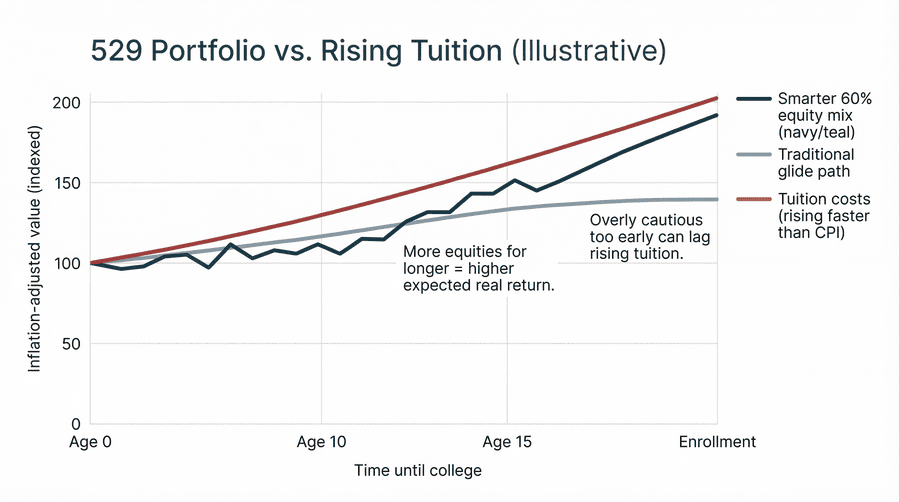
Inflation does its worst damage over decades, not months, and equities remain the only asset class with a proven long-run edge. From 1926 through 2023, the S&P 500 delivered an average real return of seven percent a year after inflation, according to an analysis by Dimensional Fund Advisors. Leave stocks too early and tuition growth can outrun your portfolio.
A steadier 60% equity allocation can help 529 savings keep closer pace with fast-rising tuition costs
Right-size the timeline
Ages 0–12: An equity-heavy 529 (about eighty to one hundred percent stocks) gives contributions time to rebound from inevitable dips.
High-school years: Many age-based glides drop to thirty percent stocks by age fifteen. Independent research from Gatewood Wealth Solutions suggests a steadier path—around 60 percent equities until senior year—maintains more purchasing power without a notable jump in volatility.
Build a diversified equity sleeve
Balance large-cap United States funds, international shares, and a dash of real-estate or natural-resource exposure. These segments often zig when others zag during inflationary spurts, giving returns multiple engines.
Stage your withdrawals
Tuition arrives over four years. Pay freshman bills from bonds and cash while letting junior-year money stay in stocks to recover. This layered approach keeps the growth engine running even after the acceptance letter lands.
Result: a college fund that races alongside rising costs instead of trailing them.
5. Park near-term cash in high-yield savings
When college is less than two years away, preservation beats growth. A sudden market dip right before tuition is a risk you can skip. High-yield savings accounts (HYSAs) and money-market funds solve that problem.
Online banks paid 4.5 to 5.1 percent APY in December 2025, roughly ten times the national savings average of 0.39 percent reported by the Federal Deposit Insurance Corporation. At that yield, cash nearly matches today’s three to four percent inflation and stays accessible any morning you need it.
Rates float, so if the Federal Reserve cuts aggressively, yields can fall. Check your HYSA each quarter and be ready to move cash or shift money into your 529’s stable-value option if returns lag inflation.
Rule of thumb: Move one semester’s projected cost into cash each spring of high school, then refill from your 529 as terms pass. You lock in certainty, dodge sequence-of-return risk, and still earn a modest real return.
Tax tip: Interest in a taxable HYSA counts as income. If your 529 offers a money-market portfolio yielding within half a point of your bank, keeping short-term funds inside the plan preserves the tax break.
6. Give your savings a cost-of-learning raise
Colleges raise prices almost every year. In the 2025–26 cycle, published tuition climbed 2.9 percent at public four-year schools and 4.0 percent at private nonprofits before inflation, according to the College Board. If your 529 contribution stays flat, you fall behind.
Treat your deposit like a paycheck and give it an annual raise. Suppose you save 400 dollars a month and boost that amount by the same three to four percent many colleges just posted. After ten years, you would put in about 5,700 dollars more in nominal terms yet end up with roughly ten percent greater real buying power because each raise compounds on the last.
Most plans let you pre-schedule percentage bumps every January. If yours does not, sync the change with your own raise or bonus: the day new money hits your paycheck, redirect a slice to the 529. Matching tuition’s pace year after year turns inflation from a lurking threat into just another line item you have already handled.
Quick check: some 529s allow only two allocation or contribution changes per calendar year. Verify your plan’s rules so your raise goes through without a hitch.
7. Turn leftover 529 dollars into a Roth retirement jump-start
Worried about over-saving? SECURE 2.0, effective 2024, lets you roll unused 529 money into the beneficiary’s Roth IRA tax- and penalty-free within strict guardrails:
Fifteen-year rule. The 529 must be at least fifteen years old, and contributions (plus earnings on them) made in the last five years are ineligible.
Annual cap. Each rollover counts toward the beneficiary’s yearly Roth limit—7,000 dollars for 2025, subject to cost-of-living increases. The beneficiary needs earned income equal to the amount transferred.
Lifetime cap. Total rollovers cannot exceed 35,000 dollars.
Income limits do not apply. Even if the beneficiary’s income would normally phase out Roth contributions, the rollover still qualifies.
Why it matters: You can now save boldly, knowing any extra tuition money can power decades of tax-free retirement growth. Parents also retain flexibility, because the original Roth contributions—not the earnings—remain available if tuition overruns the 529.
Key move: Check your 529’s start date. When it turns fifteen, set calendar reminders to transfer up to the Roth limit every January until you reach the 35,000-dollar lifetime ceiling or your student’s senior year, whichever comes first.
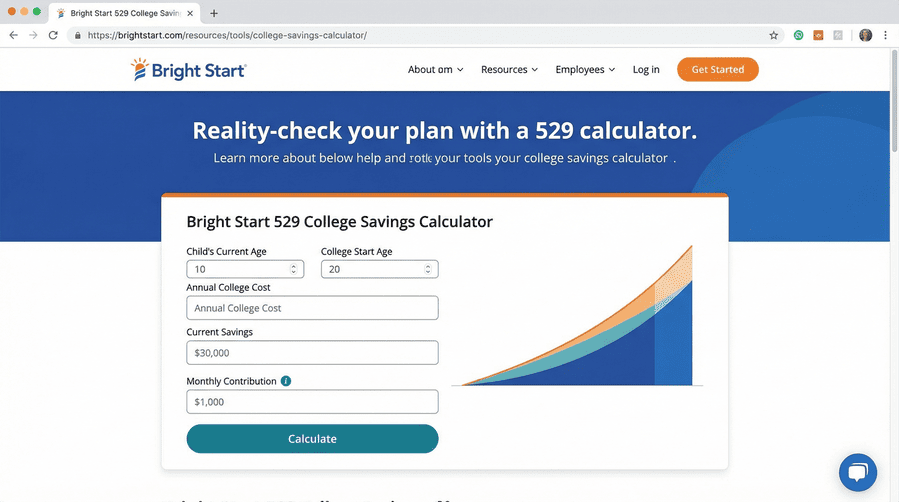
8. Reality-check your plan with a 529 calculator
The smartest portfolio still misses if the target is wrong. A dedicated college-cost calculator shows line by line how inflation will swell your child’s bill and whether today’s savings rate keeps up.
Bright Start 529 College Savings Calculator Interface
Why most parents are surprised: Fidelity’s annual College Savings Indicator finds that families hope to cover 69 percent of future costs but are on track for only 27 percent.
What to plug in
Child’s age and college type (public versus private)
Expected investment return
Latest published tuition increase (public four-year schools averaged 2.9 percent for 2025–26; private nonprofits, 4.0 percent)
Special factors such as a gap year, graduate school, or an early payoff plan
Run “what-ifs” for higher inflation, lower returns, or a scholarship windfall, then adjust your monthly transfer before the shortfall hurts.
Treat the calculator like an annual check-up. Update each spring; if rising prices or weak markets open a gap, boost deposits, add I bonds, or tweak your glide path. Data replaces guesswork and keeps every other strategy in proper proportion.
Common pitfalls and easy ways around them
Even with the right tools, families often stumble on a few repeatable mistakes. Dodge them early and your inflation shield stays intact.
Waiting for “extra” money to fund a 529. Inflation never pauses. Starting fifty dollars a month today beats five hundred dollars a year from now once compounding and rising tuition kick in.
Treating the age-based glide path as set and forget. Plans rely on averages, not your child’s exact start date. Review the mix each spring; adjust if the equity share feels too timid or too bold.
Parking big balances in cash years before college. Cash loses roughly three to four percent of purchasing power in a typical inflation year. Keep only the next twenty-four months of expenses in a high-yield account; invest the rest.
Ignoring state tax perks. Thirty-four states, plus Washington, DC, offer a deduction or credit for 529 contributions. Skipping it is like leaving a small scholarship on the table.
Thinking calculators are one and done. Update figures annually. If tuition jumps or returns lag, a quick recalculation exposes the gap while the fix is still painless.
Your action checklist
Buy this year’s I bonds. Open (or sign in to) TreasuryDirect and schedule up to 10,000 dollars per person before December 31.
Compare prepaid options. In one sitting, check your state plan or the Private College 529 network to see if locking tuition now fits your child’s likely path.
Review your 529 allocation. If you have less than ten to fifteen percent in an inflation-protected option (TIPS fund), shift that slice today.
Run a fresh calculator check. Feed in the latest College Board tuition-inflation figure, then raise your auto-contribution to the new target. Schedule this recalculation every April.
Fund next-year cash. Set a calendar alert to move one semester of costs into a high-yield savings or 529 money-market twelve months before each bill.
Plan Roth rollovers. Note your 529’s opening date; once it turns fifteen years old, move up to the annual Roth limit (7,000 dollars for 2025) each January until you reach the 35,000-dollar lifetime cap.
Give deposits a raise. Every January 1, increase your monthly contribution by last year’s published tuition-inflation rate (see the College Board’s Trends in College Pricing report).
A clear seven-step roadmap turns high-inflation college planning into a manageable to-do list
Work through the list in order; each action strengthens the next, creating a layered defense against rising college costs.
Integrating Generative AI (Gen AI) into organizational workflows offers transformative potential, yet the transition often encounters skepticism and resistance. One effective strategy to mitigate these challenges is leveraging early adopters—team members who enthusiastically embrace new technology—to facilitate communication, boost efficiency, and drive adoption. By empowering these champions, organizations can establish a peer-driven communication model that reduces fear, fosters trust, and accelerates the learning curve.
Why Early Gen AI Champions Are Key to Rollout Success
Early adopters are not just users of new technology; they are multipliers of its potential. By advocating for Gen AI within their teams, these individuals influence adoption rates and attitudes across the organization.
Early adopters are not just users of new technology; they are multipliers of its potential.
Building Trust and Relatability: Colleagues often perceive early adopters as credible because they experience the same organizational dynamics. Their firsthand demonstrations of Gen AI benefits—such as faster workflows or enhanced accuracy—resonate more deeply than theoretical presentations from leadership. For example, in a healthcare company, an early adopter showed how Gen AI reduced paperwork errors, directly impacting patient outcomes. This kind of practical, relatable evidence builds trust.
Encouraging a Collaborative Culture: By acting as mentors and addressing concerns in real time, early adopters foster an environment of mutual learning. A team member struggling with integrating Gen AI into their workflow can turn to a colleague champion for tailored advice, reducing frustration and building confidence.
Driving a Bottom-Up Adoption Model: Involving early adopters sends a message that employee voices matter in the adoption process. This inclusive approach boosts engagement, as workers feel more involved in shaping how technology integrates into their routines. A study by LTIMindtree reported in Forbes highlights that organizations with strong peer-driven adoption models see 40% cost savings.
Client Case Study: A Retail Company’s Gen AI Transformation
In one consulting engagement, I worked with a mid-sized retail company aiming to implement Gen AI for inventory management and customer service. The company’s goals included reducing overstock, improving customer experiences, and automating routine tasks. However, the workforce initially resisted the changes, citing fears of job loss and complexity in using Gen AI tools.
First, we used surveys and focus groups to identify staff concerns about the changes, and we also used these tools to identify 15 early adopters from various roles, including store managers, warehouse staff, and customer service representatives. These individuals were known for their openness to innovation and held influence among their colleagues, and all of them used Gen AI in their personal lives, with many also using it in their work. Their diverse perspectives ensured the initiative addressed the needs of different departments.
Next, we invested in comprehensive training for the champions. This included:
Gen AI Tool Mastery: A hands-on understanding of how to use the new tools effectively. That included uncovering best practices from those early adopters already using Gen AI tools in their job at that company, and sharing these best practices. Likewise, I brought in my experience of use cases from other retail company clients. Together, we developed a toolkit of use cases most relevant to this company and its individual departments and roles.
Communication Strategies: Training on how to explain benefits, address concerns, and present success stories in relatable terms.
Access to Resources: Providing step-by-step guides and direct access to experts for troubleshooting.
Then, after the champions experimented with these tools for a month, we launched peer-led initiatives, as part of a broader communication and education campaign for Gen AI rollout. The champions helped facilitate a range of activities to support adoption, such as:
Workshops and Demonstrations: Hosting informal sessions to showcase how Gen AI optimized tasks like inventory forecasting and customer query management.
One-on-One Mentoring: Offering tailored support to colleagues struggling with the technology.
Sharing Quick Wins: Regular updates highlighting efficiencies gained through Gen AI to build momentum.
Public Recognition: We publicly recognized, praised, and celebrated early Gen AI adopters, through highlighting them in the company newsletter, at town halls, and through innovation awards.
Within six months, the organization achieved:
70% Adoption Rate: A majority of employees actively used Gen AI tools.
Improved Operational Efficiency: Inventory management accuracy increased by 25%, and customer service resolution times dropped by 30%.
Enhanced Employee Morale: Staff transitioned from apprehension to enthusiasm, seeing Gen AI as an enabler rather than a threat.
This case underscores the power of leveraging early adopters to drive technological change.
How to Maximize the Impact of Gen AI Champions
Organizations aiming to replicate these successes should follow a structured approach to empower their Gen AI champions.
Select the Right Champions: Identify individuals who are enthusiastic about technology, respected by their peers, and adept at communicating. Consider representatives from multiple departments to ensure broad relevance.
Invest in Comprehensive Training: Equip early adopters with a thorough understanding of Gen AI tools, as well as the skills to teach and advocate for them. Provide ongoing access to resources and experts.
Encourage Peer-Led Learning: Support early adopters in hosting workshops, one-on-one mentoring, and informal “lunch-and-learn” sessions. Create opportunities for them to demonstrate real-world applications of Gen AI.
Promote Success Stories: Highlight early wins achieved through Gen AI. Encourage champions to share personal anecdotes and practical examples of how the tools have made their work more efficient or rewarding.
Recognize Contributions: Acknowledge the efforts of early adopters publicly to reinforce their value and encourage others to embrace the technology.
The Bigger Picture: Building a Culture of Innovation
Gen AI offers extraordinary potential, but its success depends on more than the technology itself.
Leveraging early adopters is not just a tactical move; it’s a strategic approach to fostering a culture that embraces innovation while ensuring risk management. By involving employees at every level in Gen AI adoption, organizations can break down resistance and build a workforce that sees change as an opportunity rather than a threat.
The Role of Leadership: Leadership plays a critical role in supporting early adopters. By providing them with the necessary tools and autonomy to lead, managers signal their commitment to a collaborative and inclusive transition.
Future-Proofing the Workforce: As technology continues to evolve, the skills and confidence gained from Gen AI adoption will prepare employees for future changes. Early adopter programs create a template for rolling out other innovations, ensuring the organization remains agile and competitive.
Key Takeaways
Gen AI offers extraordinary potential, but its success depends on more than the technology itself. The people within the organization—especially early adopters—are the true drivers of meaningful change. By empowering these champions to lead the way, businesses can create a ripple effect of trust, collaboration, and enthusiasm that ensures a smoother, more successful transition.
The article explores the link between geopolitics and economic performance in the context of the Russia-Ukraine war. It argues that, if the conflict is to be ended on terms favourable to Ukraine, and the world economic system restored to its pre-war equilibrium, Europe must lead the ceasefire negotiations.
The gathering storm
Wars have a habit of re-ordering the world economic system, with some nations gaining and others losing. While the Second World War enriched the United States, it nearly bankrupted the United Kingdom, with the country’s national debt rising from £760 million to £3,500 million. Following the cessation of hostilities, Britons suffered almost a decade of rationing and austerity.
The Second World War confirmed the Twentieth Century as The American Century. Like the Second World War, the Russia-Ukraine war is restructuring the world economic system. Two economic blocs have emerged. One bloc serves the interests of states organised along authoritarian lines, for example, Russia, China, Iran, North Korea and Venezuela, the other serves the interests of states organised along democratic lines, for example, France, Germany, Australia and the United Kingdom. Global ideological polarisation, expressed in proxy wars such as that being fought in Ukraine, has fostered economic polarisation.
It is predicted in some quarters that Europe will find itself at war with Russia in the next five to ten years, possibly over the Baltic states, which Russia covets. Mark Rutte, NATO Secretary General, has issued a stark warning: “We are Russia’s next target …. Russia has brought war back to Europe, and we must be prepared for the scale of war our grandparents … endured”. By rehabilitating Putin – witness Trump’s sycophancy during the August, 2025 Alaska summit – Washington has increased the likelihood of a wider European war. It is interesting to note how America’s recently-published National Security Strategy studiously avoids criticising Russia. Should a wider European war come to pass, the world economic system will receive its biggest jolt since the 1939-45 war. It goes without saying that Europe will again be the biggest loser. Economies will be significantly degraded.
A new world order?
There is little doubt that America’s neutralism (that borders on amorality) is encouraging Putin, perhaps to the point where he feels he can attack western Europe with impunity. The origins of America’s neutralism lie first, in a rejection of so-called forever wars, such as the Afghan and Iraq wars, and secondly in Donald Trump’s world view and mind-set. Understanding Trump is the key to understanding today’s chaotic world.
Security guarantees have a chequered history. The security guarantee extracted by British Prime Minister Neville Chamberlain from Adolf Hitler proved worthless. Hitler signed the Munich Agreement in 1938 only to invade Poland in 1939. In the final analysis, security flows not from security guarantees but from military hardware and the will to use it. Security flows from boots on the ground.
Given Trump’s perfidy only Europe can guarantee Ukraine’s security. Europe must negotiate a peace treaty that sees European peacekeepers – armoured brigades supported by warplanes based in Ukraine – deployed to the Donbas to defend the current line of contact. Ukraine should not be required to cede any land to Russia. It should defend those areas of the Donbas still under its control and negotiate the return of those areas illegally occupied by Russia. Only if Ukraine’s 1991 borders are restored can Kyiv, Paris, Berlin, London and Europe’s other capitals rest easy.
A chronically unreliable ally
America is an unreliable ally. It was late to the fight in both the Great War and the Second World War. Despite the fact that British scientists were involved in the Manhattan Project (that saw the United States detonate the first atomic bomb) Washington refused to share its nuclear secrets with Britain post-war. During the Vietnam War, Washington proposed a settlement that allowed insurgent North Vietnamese troops to remain in South Vietnam, against the wishes of South Vietnam’s elected government. In the Doha Agreement of 2020, Washington handed Afghanistan to the Taliban, a duplicitous Islamist terror group, behind the back of Afghanistan’s elected government. Today, the Americans are willing to accept Russia’s illegal occupation of circa 20% of sovereign Ukrainian territory, thereby rewarding Russian aggression.
America forfeited its moral authority and traction over Europe when Trump rolled out the red carpet for Putin in Alaska. Europe’s failure to cut Trump adrift at that low ebb has led us to the current impasse. Europe must create its own Realpolitik. It should:
stop humouring Trump. Obsequiousness invites contempt, as evidenced by Washington’s hostile characterisation of Europe in its National Security Strategy
insist that it and Ukraine lead the peace negotiations with Russia
ensure that Europe has the men and matériel to sustain an army capable of eliminating the Russian army in the field. That will get Putin’s attention
admit Ukraine to both the EU and NATO
frame the United States as a partially, if not a fully lapsed ally.
A wider European war would plunge the global economy into turmoil. To avoid it Europe must act unilaterally. The Pax Americana is dead. Trump will not honour America’s NATO Article 5 commitment. Europe must equip itself militarily to act independently of the United States. It must frustrate Putin’s militarised colonialism by arming itself to the point where it is indigestible to him. Free Europe must transform itself into a steel porcupine. Quickly.
Dr Simon Ashley Bennettteaches risk management at the University of Leicester, England. He researches the social, economic and political origins of risk, including groupthink, political instability and armed conflict. His recent books include Atomic Blackmail? (Libri Publishing) and The Russia-Ukraine War – Security Lessons (Peter Lang International Academic Publishers).
Trend vs range is not technical analysis, it’s decision quality
The most expensive trading mistake is not a “bad entry.” It’s entering the wrong kind of market with the wrong expectations. A trend-following approach can bleed in a range. A mean-reversion approach can get steamrolled in a clean continuation. And in transitional regimes, almost everything underperforms, not because strategies are flawed, but because the market isn’t paying for conviction.
This is why professional traders quietly obsess over a single question before they care about setups:
Is the market in a trend regime or a range regime, and is that regime stable enough to trade?
If you skip this question, you end up doing what most participants do: trading movement, then blaming execution when that movement fails to follow through.
The two regimes that matter (and the third that hurts you)
Most markets spend time in three practical states:
1. Trend regime: progress is measurable
A trend regime is not “price moving.” It’s price making net progress over time. You see:
Breaks that hold instead of instantly reclaiming
Pullbacks that respect structure instead of slicing through it
Continuation that doesn’t require constant correction
In trend regimes, you can be imperfect and still be right often enough to survive, because the environment supports follow-through.
2. Range regime: rotation is the edge
Range regimes aren’t “bad.” They’re just different. The market is rotating rather than progressing. You see:
Levels repeatedly tested and defended
Moves that reverse back into the box
“Breakouts” that frequently fail and return
A range can pay very well — but only if you trade it as a range. Trend logic inside a range is how traders get chopped.
3. Transitional regime: movement without payoff structure
This is the regime traders confuse with opportunity. Transitional conditions are where:
The market looks like it’s about to trend, but doesn’t
Range behavior breaks down, but trend behavior doesn’t stabilize
Timeframes disagree and narratives flip every hour
Transitional regimes are where decision load explodes: more checking, more entries, more re-entries, and more “maybe this time.” This is where consistency dies.
The fastest way to detect regime (without overcomplicating it)
You don’t need ten indicators to determine regime. You need a few observable behaviors.
A simple “progress test”
Ask:
1. Do breaks hold?
Or does price reclaim immediately?
2. Do pullbacks behave?
Or do they whipsaw through key areas?
3. Is there net progress after the impulse?
Or does it stall and drift back?
If the answer is “reclaim, whipsaw, stall,” you don’t have a clean trend regime — you have churn.
The structure test (range vs trend)
If price repeatedly returns to a midpoint and fails to expand: likely range
If price repeatedly establishes new territory and holds it: likely trend
If it alternates between both behaviors: transitional (stand down)
These are not abstract ideas. They are environment filters: they determine whether your next trade is a real opportunity or an unnecessary decision.
Why most traders lose in ranges (and think it’s bad luck)
In a range, the most common loss pattern is:
A breakout looks clean
The trader enters
Price returns into the range
The trader re-enters because “the setup still looks valid”
The market repeats the same rotation and the trader gets recycled
This isn’t bad luck. It’s regime mismatch. The range did exactly what ranges do: rotate, trap trend logic, and punish impatience.
Why trend attempts fail: “right direction” but wrong timing layer
Trend attempts often fail for a different reason: timeframe mismatch.
A lower timeframe can look directional while the higher context is still:
rotating,
fading the move,
or compressing.
That mismatch produces a fragile trend attempt — the kind that moves “just enough” to tempt entries, then resets and forces correction. In those conditions, traders either hesitate too long or jump too early, and both lead to the same outcome: frustration and overtrading.
The decision rule that fixes 80% of this
If you want one rule that improves consistency fast:
Only trade when the regime you think you’re in is stable enough to keep paying.
In practice:
If you can’t tell whether it’s trend or range, it’s not a trade — it’s a question.
If the market keeps switching behavior (break → reclaim → break → reclaim), it’s not a setup problem — it’s a regime problem.
If you need constant management to survive, you’re paying the wrong environment.
This is why elite traders treat “no trade” as an active decision, not a passive one.
A practical framework: decide regime first, then choose what you’re allowed to do
Instead of asking “what’s the best entry,” do this:
Classify the regime: trend / range / transitional
Select the only valid playbook for that regime
Stand down if transitional dominates
If you want a clean, structured guide you can reference quickly, use this:
Final thought: your edge is not prediction, it’s selection
Markets don’t pay for activity. They pay for disciplined participation in the right conditions.
Most traders want a better trigger. Professionals want a better filter.
When you internalize the trend vs range question as a gate, you stop donating attention and risk to environments that don’t reward them — and you become dramatically harder to shake out.
By Danny Leipziger
China cannot continue to rely on exports to drive its growth, but what are the alternatives?
China ran a $1.2 trillion trade surplus last year, and despite admonitions from the IMF to rely...
The World Financial Review uses cookies to improve site functionality, provide you with a better browsing experience, and to enable our partners to advertise to you. Detailed information on the use of cookies on this Site, and how you can decline them, is provided in our Privacy Policy and Terms and Conditions. By clicking on the accept button and using this Site, you consent to our Privacy Policy and Terms and Conditions. ACCEPT
Privacy & Cookies Policy
Privacy Overview
This website uses cookies to improve your experience while you navigate through the website. Out of these cookies, the cookies that are categorized as necessary are stored on your browser as they are essential for the working of basic functionalities of the website. We also use third-party cookies that help us analyze and understand how you use this website. These cookies will be stored in your browser only with your consent. You also have the option to opt-out of these cookies. But opting out of some of these cookies may have an effect on your browsing experience.
Necessary cookies are absolutely essential for the website to function properly. This category only includes cookies that ensures basic functionalities and security features of the website. These cookies do not store any personal information.
Any cookies that may not be particularly necessary for the website to function and is used specifically to collect user personal data via analytics, ads, other embedded contents are termed as non-necessary cookies. It is mandatory to procure user consent prior to running these cookies on your website.








 Dr. Gleb Tsipursky PhD