The Italian Engineering & Construction company positions itself at the center of the European steel transition with new contracts for zero-emission plants.
The global steel industry is at a turning point. Decarbonization is no longer an option but a strategic necessity that is reshaping the entire sector. In this highly innovative scenario, an Italian company, OM Siderurgica, is positioning itself as a key engineering partner for the transition.
The company, specializing in the Engineering & Construction of material handling systems for steel mills, recently announced the acquisition of contracts worth over 10 million euros linked to the global “Green Steel” transformation program. These projects—which include feeding systems for CDRI (Cold Direct Reduced Iron), ferro-alloys, and additives in the primary EAF (Electric Arc Furnace) in Germany, large-scale conveyor lines in Sweden, and new slag treatment plants in Italy—mark a decisive step for the company into the heart of the new sustainable steel industry.
An Engineering Legacy Projected into the Future
Founded on know-how that dates back to 1964, OM Siderurgica has established itself as a benchmark in the design and supply of “turnkey” plants. Although steelmaking remains its primary market, the company also operates successfully in the mining, cement, glass, food, chemical, and recycling sectors.
The company’s strength, as shown in its company profile, lies in its ability to combine solid professionalism with highly efficient equipment, managing the entire supply chain: from design and installation to start-up and after-sales service.
The Vision of CEO, Pierluigi Tomasi
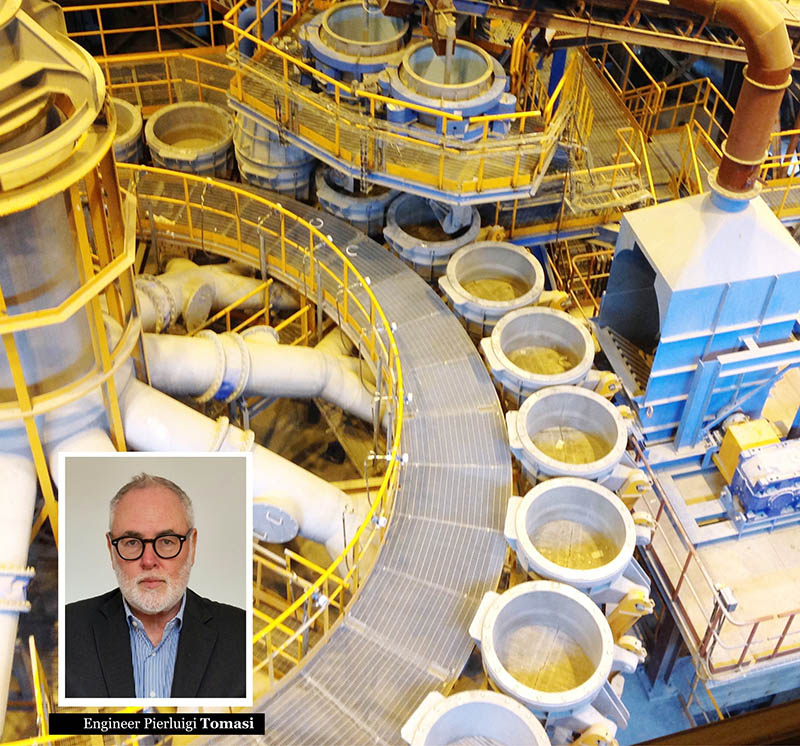
To understand this strategic evolution, we spoke with the CEO of OM Siderurgica, Engineer Pierluigi Tomasi.
Mr. Tomasi, OM Siderurgica has a long history. How has the company evolved to meet today’s sustainability challenges and position itself as a partner for the green transition?
“The sensitivity to move towards more environmentally friendly products, even in steelmaking, in addition to following a general direction set by the European Community in the last decade, is based on our long-standing presence in different industrial fields, such as food, chemical, or mining, where these concerns were already mandatory since the last century. Therefore, the acceleration required by the steel industry found us ready and culturally prepared. This applies to both material handling and our dedusting and fume abatement systems”.
At the Center of the “Green Steel” Transformation
The focus is clear: the present and future of OM Siderurgica are linked to the green transition. The steel industry is responsible for a significant share of global CO2 emissions, and the push for carbon neutrality is leading to the replacement of traditional coal-fired steel mills with plants powered by hydrogen or based on Electric Arc Furnaces (EAF) using pre-reduced raw materials (like DRI).
This is where OM Siderurgica’s expertise becomes crucial. The company designs and builds the complex handling and feeding systems necessary for these new production processes, which demand a different level of precision and technological reliability compared to traditional plants.
The company has secured significant contracts. Can you describe the specific role OM Siderurgica plays in facilitating low-impact steel production?
“Our role is that of recognized specialists, capable of ensuring the distribution and feeding of the mineral, DRI, and HBI mixes required for the casting of new Green technologies with absolute precision, both in volume and weight. This means being involved by our partners in the necessary engineering teams two or three years before supply and installation.
After this phase, the process moves on to the supply of absolutely reliable and heavy-duty machines and plants, complete with automation capable of following the rhythms dictated by the project’s casting cycle like clockwork, without ever deviating from the strict tolerances of the recipes that the new technologies require.
It also means ensuring zero material loss in the complex feeding routes, using techniques for both bulk material transport and fine powders for direct injection into the furnace via pressurized lances. At the same time, controlling dust dispersion from transport with our abatement technologies, even in Atex environments, therefore with varying degrees of explosiveness or hazard. All this, while optimizing the total installed electrical power, thanks to both the high energy efficiency of our solutions and the advantages of smarter automation”.
Circular Economy: Turning Waste into Resources
For OM Siderurgica, sustainability doesn’t stop at reducing emissions. A fundamental pillar of its technological offering is the treatment of slag, an unavoidable by-product of the steelmaking process. Following a “Zero Waste” philosophy, the company designs plants that transform what was once costly waste into a resource.
Through crushing, screening, and magnetic separation processes, OM plants recover the valuable ferrous component to be reintroduced into the production cycle. The remaining inert material is valorized as high-quality aggregate for bituminous conglomerates, cement, or road subgrades.
Beyond emissions, steelmaking generates tons of slag. How central is the circular economy to your business model?
“The circular economy linked to slag recycling is definitely the most important heritage of our long history. OM, born in the 60s, developed, especially in its first 30 years, a very complete Know How in the extraction and processing of natural aggregates. The move into Steelmaking and the other sectors where we are active today began in the 80s, but OM’s technology for crushing, separation, screening, and washing of inert materials has never stopped.
Therefore, for about two decades, a large part of this DNA has been applied to the processing, I would say ‘ennobling’, of artificial aggregates produced as slag from steel plants, obviously with greater attention to the chemical-physical characteristics and the environmental risks involved. These are plants we supply on a turnkey basis, and they include all necessary phases, up to the training of end-users and/or support during their first months of production”.
Innovation in the DNA: From 3D Plants to Pneumatic Systems
To manage projects of this complexity, OM Siderurgica‘s technical office has been operating for decades with the most modern engineering systems, as seen, for example, in this 3D Material Handling System Plant.
The company has developed specific technologies for every need of the production cycle, including pneumatic conveying systems (for powdery materials, essential for environmental control) and complete dedusting plants. This approach, combined with a solid organizational structure and forecasts for revenue growth, positions the company as a solid actor ready for future challenges.
Looking to the future, what are the next technological frontiers for OM Siderurgica?
“In the last five years, our engineering investments and technological developments have primarily focused on new steel mills in Europe and the United States that had the advantage of being ‘born from Zero’ with all specifications for low-emission final production, and therefore where the Vision was clear from the beginning and not hindered by potential compromises. An ideal situation from an engineering and budget perspective. These have always been large new settlements.
But these new productions will not be sufficient to meet global steel demand before they are all completed and operational, so for at least the next ten years they will continue to coexist with the old generation steel mills. I believe our task is to intervene in the most sustainable way possible in these old plants as well, introducing, with a revamping philosophy, all or many of the new solutions designed for ‘Green Steel’ plants. And this, believe me, will be the real challenge due to the difficulties of adapting existing systems.
We hope that policymakers will support these efforts by smaller or at-risk-of-obsolescence steel mills with appropriate economic support (bonuses) for the sector. Also because converting new virgin land into new industrial poles would be a very ‘Gray’ Green”.
The global push for “Green Steel” is not just about furnace chemistry; it’s about the entire infrastructure that feeds them. As major producers invest billions to move away from coal, the technological challenge shifts to internal logistics: handling new materials like DRI and managing slag in a circular way. It is in this complex engineering arena, and its integration with new production processes, that the real game for the future of sustainable steel will be played.