Home Blog Page 501

How Digital Innovation and AI Will Continue to Reshape Businesses in 2023

AI

Digital transformation has impacted businesses of all sizes over the past year. Virtually all businesses small and large now have a significant online presence. Many business leaders are experimenting with new technologies like automation, AI, and virtual reality.

While the fate of the global economy in 2023 remains uncertain, there’s one thing most business owners will agree on: the pace of digitization is likely to continue accelerating. So how will digital innovation and AI impact businesses in the year ahead and what do businesses need to do to succeed? We highlight 4 trends to watch.

1. Data Will Dominate

Enterprise-scale businesses have relied on data to make decisions for the past several years. But many small and medium-sized businesses have held out, relying on gut instinct to plot their path through the COVID-19 pandemic and last year’s economic uncertainty.

In 2023, look for many hold-outs to finally embrace data as a key factor in decision-making. Small business owners now have access to a wide range of easy-to-use software tools for analyzing their customers’ priorities, employees’ productivity, supply chain inefficiencies, and more.

Many businesses already have the data they need to begin using these platforms effectively. However, as more small businesses come to rely on data, the value of that data will also grow. 

As a result, we expect to see businesses offer more incentives to customers to share data about their experiences and behaviors. In addition, a growing number of small businesses may begin working with data consultants to get more information out of the data they already have.

2. More Businesses Will Try Out Virtual Worlds

Augmented reality and virtual reality are still in their infancy, but these technologies could become widespread more quickly than many people realize. When a company as big as Meta (formerly Facebook) throws its weight behind metaverse technology, it’s worth taking notice.

Many companies in addition to Meta are already experimenting with virtual experiences. Gambling companies – which were among the first businesses to embrace the Internet in the 1990s – are at the leading edge of virtual reality. Many online and crypto casinos now have their own virtual environments, enabling players to experience something akin to the Las Vegas Strip from the comfort of their own homes.

Retailers are also investing in the metaverse, setting up shops in virtual worlds like Decentraland. The metaverse has also proven attractive to musicians and event promoters, as evidenced by a recent deal between Roblox and Sony Music.

While small businesses might not jump into the metaverse in 2023, look for enterprises to begin exploring this new technology more seriously. Businesses could hold meetings in the metaverse or use virtual reality to train new recruits over the coming year.

3. AI Will Transform Content Creation

AI is quickly having an impact on every aspect of business operations, but the most profound impact in 2023 could be on content creation. New AI-powered tools like ChatGPT and DALL-E 2 are making it possible for anyone to create authoritative text and images in a matter of minutes.

The impact of these tools could be profound. Google’s CEO Sundar Pichai reportedly issued a ‘Code Red’ because of the potential impacts of ChatGPT on the company’s search engine business. Any realignment in the way the world searches for information online would be significant in today’s world given that an estimated 93% of US businesses are online.

Small businesses could stand to benefit greatly from these AI-powered tools, particularly when it comes to marketing. If it’s cheap, fast, and simple to create new content, small businesses could soon compete with much larger brands online.

There’s also a dark side to better AI-generated content. These tools are expected to help cybercriminals develop more sophisticated phishing attacks and even write malicious code. So, there will also be more pressure on businesses of all sizes to invest in cybersecurity.

4. No Code Automation Will Continue to Spread

Until recently, automation was the domain of enterprise-scale businesses. Even relatively simple automations required heavy investment in IT infrastructure and in-house development teams.

That’s changing thanks to low and no-code automation software. Now, small and medium-sized businesses can benefit from the same types of automations that have led to massive jumps in productivity at large companies.

As business owners embrace automation, we could see a huge increase in productivity after several years of stagnation. Productivity gains could help offset the negative impacts of inflation and labor shortages in 2023, as well as open new doors for businesses that have been lacking in human resources.

Digital Transformation in 2023 and Beyond

The business world has been utterly transformed by technological innovation over the past decade. In 2023 and beyond, it will no longer be enough for businesses to simply be present online. To succeed in today’s world, businesses need to take advantage of data, harness the power of AI, prepare for a virtual future, and increase their productivity through automation.

Becoming a Manager: 7 Tips to Help You Enjoy Success in Your New Role

Enjoy Success

If you’ve just been promoted to manager of a business, either internally or externally, congratulations! You’ve just `taken a huge step up the career ladder, and you should take a moment to enjoy the view from the top and reflect on such a worthwhile achievement. 

dominic fitch

Before you get stuck in your duties, you should equip yourself with as much knowledge and guidance as possible. You’ve made it this far, so why not ensure you have everything you need to be the best possible manager from the get-go?  

Here, with some insights from Dominic Fitch, Head of Creative Change at Impact International, we explore seven tips to ensure you enjoy success in this new role.

1. Listen to your staff

Have you ever heard the saying, “employees don’t leave companies, they leave managers”? Your first duty as a manager should be getting to know your employees and putting their needs first. Even if you’re already familiar with your team and have perhaps known them for years, becoming their manager can significantly change your relationship. 

A recent poll discovered that more than two in five British employees have quit a job because of a bad manager, citing respecting and listening to staff and treating people well as the most important attributes of a good boss. Keep this firmly in mind as you navigate your new responsibilities as a manager; a business is nothing without its employees!

2. Never stop learning

As a manager, you’re bound to have a lot of knowledge, but that doesn’t mean you know everything. You should understand that you’ll never stop learning – about your business, industry, competitors – and therefore, you should always be open to absorbing new information. 

In a similar way, you should encourage your employees to push themselves and expand their skill set by getting involved in different training courses and seminars. Not only should this increase your chances of being a great new manager, but it will also aid team development

3. Learn how to prioritise

In this new, important position, you may feel obligated to try and tackle everything at once to make the best impression on your superiors and employees. Here’s some helpful advice: Don’t bother! Take a step back, take a deep breath, and look at your tasks and responsibilities with the aim of prioritising. You are not a superhero, and nobody expects you to be.

Keep in mind that there’s a difference between a task that’s ‘urgent’ and a task that’s ‘important’; start by listing your tasks in order of importance and address them one by one, delegating duties across your team where necessary. If you try to do everything at once, you will likely burn yourself (and your employees) out, which doesn’t deliver the long-term, sustainable results that a business needs to be successful.

4. Adopt different approaches for different people

The type of manager you should be to your employees is not a ‘one size fits all’ process, and a good, successful manager recognises that different people need different approaches. While your beliefs, values, and overall managerial style shouldn’t change from person to person (that would be unfair), you should be alert to factors such as language barriers and age groups.

For example, if a staff member doesn’t speak the best English, you should keep your vocabulary simple and speak clearly and slowly. In a similar way, an employee that’s older than you might not respond well to being ‘told’ what to do as opposed to ‘asked’, so it would be courteous (and effective) here to adjust the way you assign responsibilities.

5. Lead by example

Nobody likes a hypocrite, especially when that hypocrite in question is supposed to be managing a workforce. To keep employee morale, productivity, and loyalty at a high level, you should be everything you expect your staff to be. How can you discipline a team member for failing to keep a promise when you have five outstanding pledges to action? 

Lead by example and watch how your new team flourishes under your command. By demonstrating your own devotion, reliability, and hard work, you’ll build trust with your staff which should motivate them to be the best version of themselves, too. 

6. Build (genuine) relationships 

Not only does building relationships with your staff, clients, and stakeholders drive better results for the business, but it also creates a more enjoyable working environment for everyone involved. In order to strengthen your relationships with those around you, you need to be genuine, make sure you’re really listening instead of just hearing, and focus on truly understanding as opposed to just responding.

Arranging regular one-to-one interactions is just as important as team-building exercises and could help you achieve stronger relationships with each individual at a faster rate. These one-to-one interactions could look like informal catch-ups over coffee or structured meetings in your office, whatever works for you and that specific employee.

7. Set realistic goals with clear plans

“A goal without a plan is just a wish.” – Antoine de Saint-Exupéry.

As a new manager, you probably have all these exciting ideas to improve the business and increase employee satisfaction, but how do you intend to bring these ideas to fruition? To be successful in your new role, you need to have a set of (realistic) goals with a clear plan on how to reach each one. Doing this will ensure that you’re constantly on track with meeting your objectives.

Don’t be afraid to consult others before launching into a new process; your decisions as a manager impact the wider team, not just yourself. Plus, getting opinions and assistance from your employees should fill them with a sense of importance and help them feel valued, which in turn could help strengthen your relationship with them.

The journey has only just begun…

This is your time to shine! You’ve worked incredibly hard to reach this milestone, so give yourself a chance to take it all in. Becoming a manager can be a little daunting, especially if you’re entering a business externally, but clearly, someone thinks you’re worth it, so take that as a positive.

Be open to the advice and guidance other people are willing to give you as it’ll only help increase your chances of success and, in turn, really enjoy your role. We wish you the very best of luck in this new journey.

References

How Small Businesses Can Improve Their Marketing Email Click through Rates

Small Businesses Can Improve

Despite being one of the oldest forms of digital marketing methods, email, even today, delivers the best return on investment. According to Forbes, email marketing is among the most cost-effective. However, to get lucrative returns, marketers need to ensure they send emails to highly-targeted audiences containing content of high interest, presented compellingly. Some of the biggest challenges include making emails stand out in the clutter of a typical overcrowded Inbox, ensuring the emails don’t end up in the spam folder, and recipients opening the email but not clicking through. Check some of the handy tips for email marketers to improve the performance of their marketing campaigns. Here are some tasks to perform while developing a startup marketing plan:

Avoid Buying Email Addresses

Acquiring email addresses to feed your marketing campaign can be a challenge in the early days of your business because not too many people have subscribed to your newsletter. It can be hard to resist the temptation of buying email addresses in bulk to try to get your marketing campaign off the ground quickly. However, such exercises represent a waste of time, effort, and money because these email addresses usually do not fit your target profile, and you do not know their interest levels because they did not subscribe to you. Most likely, the recipients will ignore the emails, and importantly, you will violate General Data Protection Regulation (GDPR) that protects people from unsolicited emails.

Have a GDPR-Compliant Opt-In Process

If your email marketing campaign targets people in Europe, you must comply with the General Data Protection Regulation (GDPR) formulated to protect the personal data of internet users. You cannot have the opt-in checkbox pre-checked if you encourage users to visit your website page that solicits personal information to enable them to receive updates and special offers. Instead, users should have the opportunity to opt to receive the email newsletter if they wish. While this rule can make subscriber acquisition difficult, it can improve your open and click through rates because you will send your email newsletter only to the people who have expressed interest in receiving communication from you. 

Respond Promptly to Prospect Emails

When an email recipient sends you, an email expressing interest in your products or seeking clarification, you can improve your chances of converting them by responding promptly, preferably the same day or at least within 24 hours. You will get better results because of better top-of-the-mind recall, and customers will appreciate your promptness. A quick reply also allows you to boost brand awareness and set customer expectations. You must make it easy for recipients to reply to your emails. You must remember to keep your Inbox clean since too many emails in it can force you to repair outlook periodically.

Make the Email Sender a Real Person, Not a Faceless Company

Many marketers make the mistake of using the company name as the email sender. However, they will invariably get better results if they use a name of a person along with the name of the company. For example, if the email sender is “Rebecca Brown@ ABC Corporation”, you will get a better open and click through rate than if you had used only “ABC Corporation” as the sender name. According to studies, most people trust personalized senders more than generic ones. They assume emails from a person are better than those from a faceless organization. 

Configure the Preview Text

Some of the most popular email clients like Outlook, Gmail, and the iPhone Mail app display the first few lines of your email along with the subject line. The number of words displayed depends on both the user setting and the email client. The email client will pull the text automatically from the email body if you do not configure the preview text. Apart from looking messy, it also represents a wasted opportunity of engaging your target audience. Ideally, you should restrict the preview to 50 characters and provide a crisp synopsis of your communication.

Craft Compelling Subject Lines

It is only by making the subject lines compelling you can ensure they catch the attention of recipients. Some of the most effective ways of ensuring recipients notice and click on your emails are to make the subject line clear, and comprehensible, restrict the length to less than 50 characters to prevent truncating, and use language intended to create excitement among the recipients. Further, you should try to create a sense of urgency and include an exclusive offer like a discount or a freebie. It is a good policy to avoid spam triggers like ‘Save”, “Quote”, “Cash”, etc. Personalizing the subject line with the name of the recipient can help to boost open rates, however, you should do it sparingly to avoid being intrusive or repetitive.

Make Your Emails Crisp and Concise 

With hundreds of emails lying unopened in a user’s Inbox, you will not want to trouble users fighting a shortage of time with long-winded emails. Users in a hurry, often accessing their emails using smartphones on the go can be notoriously impatient and will abandon an email if it is not short and comes to the point immediately. Moreover, long emails can trigger spam filters. It is best to compose the email as if you were having a conversation with the reader. If you must include a lot of details, you should try to break up the content into multiple paragraphs, each with a heading to make it easier to skim and read.

Ensure You Include a Powerful CTA

Getting recipients to notice your email is an achievement but getting them to act on it is another thing altogether. You can increase your conversion rate by including a powerful call-to-action button. Without a compelling CTA, even the best emails may remain unproductive. The trick to boosting your response rate is placing the CTA button in a place that readers cannot miss. You also need to pay attention to the design of the CTA button and the landing page the user will visit after clicking on it.

Conclusion 

Even though email marketing is relatively easy and inexpensive, you must keep monitoring the performance of your email campaigns, especially the open, click through, and conversion rates, to make your campaigns succeed.

Cost of Traveling to Turkey

Cost of Traveling

It’s no wonder that you’re planning a trip to Turkey. Evidently in the past few years, Turkey has become a very sought-after and popular travel destination. 

Not only is Turkey a country rich with culture, cuisine, and attractions for tourists, but Turkey has also been dubbed one of the world’s best budget travel destinations. Consequently, the cost of traveling to Turkey can be very low if you plan it particularly well.

The cost of traveling is usually a big determining factor for tourists when they decide where to travel.

Fortunately, this blog will make it very easy for you to navigate the average cost of food per day while traveling, unforeseen costs, and just the general cost of living for Turkey as a tourist. 

Beautiful vivid orange sunset over a beautiful city in Turkey on a cloudy day.

How To Estimate The Cost Of Traveling?

The cost of traveling will greatly be affected by the type of holiday you’re planning on taking. For instance, will you be traveling alone or will the whole family be going on a family vacation? A family vacation will be much more expensive than someone vacationing alone. 

The type of accommodation you prefer will also significantly affect your budget. For instance, will you be camping, or staying in hotels, or are you one of the lucky travelers that will get free accommodation because you know someone in Turkey? 

All these types of things will greatly affect your cost to travel. 

Interestingly enough according to Budget your trip these are the key vacation cost statistics:

  • A solo one-week vacation in the US has an average cost of $1578.
  • A couple on a week’s vacation in the US can expect to pay an average cost of $3156.
  • A two-week European vacation for one person has an average cost of $4000.

According to Earthtrekkers, the cost of traveling the world in a year is around $25 000 – $35 000 per person.

The best way to estimate the cost of traveling to Turkey or any other destination is to set up an itinerary of everything you would like to do and where you would like to stay and to use Budget your trip to work out the cost of travel. 

What are the expenses involved in traveling to Turkey?

Firstly when deciding to travel to Turkey the first two things you need to sort out are your airline ticket and your visa to Turkey and then you can start with the nitty gritty things in Turkey.

Flights To And Back From Turkey

On average during the low season, a round-trip airfare will cost you approximately $650. And during Turkey’s peak season, you can expect to pay up to $900 for a round-trip ticket. 

However here are some tips to get the cheapest flights:

  • Use the website Skyscanner, it can show you monthly trends of the prices for your destinations, and even better it has a ‘price alert button’ that can notify you when the price of your desired flight begins to fall. 
  • Flights booked on weekdays are usually cheaper than flights booked on weekends. 
  • Be flexible with your dates. This allows you to explore which months are the best time to travel. For instance, don’t travel during major holidays as airlines will automatically increase their flight tickets.

Visa For Turkey

All US citizens require a visa to enter Turkey. Therefore make sure to check out how exactly to obtain your visa to Turkey from Atlys. 

You can expect to pay around $50 for your Turkey evisa. 

Accommodation In Turkey

As we mentioned before, the type of accommodation you decide on will significantly affect your budget. Hopefully, you know someone in Turkey that is offering you free accommodation. In that case, you can skip this section.

According to Budget your trip the average hotel price per evening is $65. However, the average hotel price for a budget hotel is around $32 and a hostel is around $9.5. 

Food In Turkey

According to Budget your trip the average cost of food per day while traveling is $7.5.

Remember that a lot of things can influence your budget for food. For instance, if you have breakfast included in your accommodation that is one less meal to pay for when in Turkey. 

Eating locally will be much less expensive than eating at a restaurant.

Entertainment In Turkey

According to Budget your trip the average budget for entertainment in Turkey is an average cost of $9 per day.

These are some of the actual costs of some of the attractions you might want to visit:

  • Entrance into Hagia Sofia Mosque is around $1.9
  • Traditional Turkish bath is around $3.75
  • Goreme open-air museum tickets are around $1
  • Castle entry tickets are around $0.5

Transportation In Turkey

According to Budget your trip the average budget for transportation in Turkey is an average cost of $3.5 per day.

In Turkey, the cheapest mode of transportation are buses, metro, trams, and ferries. Overnight-train rides are also a trendy option for budget travel. 

Overview Of An Entire Turkey Budget

According to Budget your trip the average daily cost per day per person is $24. 

This is also their recommended budget for holidays in Turkey:

  • One week trip per person is around $163
  • Two-week trip per person is around $326
  • One week for a couple is around $326
  • Two weeks for a couple is around $652

Two weeks for a couple is around $652

Beautiful colorful hot-air balloons ready for take-off during a beautiful pink sunrise in Turkey.

What does it cost to reschedule your trip/flight/hotel?

Unfortunately, it does happen that you might have to reschedule some of your plans. Due to the uncertainty that the Covid-19 pandemic caused, rescheduling has become a regular part of some travelers’ lives.

Hopefully from 2023 traveling can become a bit more stable and safe to do. 

With accommodation bookings, if you have a refundable reservation, you may opt to cancel the booking in the app and rebook your stay for your new preferred dates. Other times they might require a fee equivalent to a one-night stay to reschedule your dates. 

If you are flying with Turkish airways you can change your flight with no penalty up to 12 hours before your flight, however within less than 12 hours before your flight you will be subjected to paying a fine of $27.

However, this will be subject to each accommodation or airline’s own rules and regulations. However, this will be subject to each accommodation or airline’s own rules and regulationsBeautiful ruins of heads and eagles on mount Arat during a beautiful vivid orange sunset in Turkey.

Conclusion

Turkey is the perfect destination for budget travel. The cost of traveling to Turkey can be significantly affected by your accommodation when you plan to fly, and things like where you eat.

The cost of traveling to Turkey can be very affordable if you follow the tips for booking flights.

According to Budget your trip the average daily cost per day per person in Turkey is $24. This is one of the cheapest average daily costs for a country in the world.

However, you can create an itinerary and use Budget your trip to work out the estimated cost of travel for your trip to Turkey.

Pros and Cons of Arbitration That You Need to Know

arbitration

Arbitrators are neutral third parties chosen by the parties involved in a dispute and may help bring a swift conclusion.

Pros of Arbitration

Privacy

In arbitration, all proceedings are confidential, and the public cannot view the evidence presented. Keeping some details out of the public eye is helpful for several reasons, including preventing public humiliation and reputational harm. Furthermore, privacy might be vital when trade secrets or confidential contractual terms are in dispute.

Flexibility and Speed

Unlike a judge in a court of law, an arbitrator is not required to follow the same rules of evidence, procedure, or other procedural requirements. Furthermore, the parties control the resolution time frame, which means they can settle far more quickly than they would in court. A case can move through more quickly if the parties agree to restrict the amount of time spent on discovery and the number of hearings.

Chicago is the third most populated city in Illinois and is also home to various businesses and industries. Hiring arbitration lawyers in Chicago is a wise decision for anyone who is involved in a dispute that needs to be settled through arbitration.

Simplified Rules of Evidence and Procedure

In arbitration, the rules of evidence and process are more relaxed than in a court of law. This facilitates using evidence that might not be admissible in a court of law in making decisions. It also frees the arbitrator from being bound by legal precedent and allows them to make decisions based on the evidence.

Cons of Arbitration

No Appeals

The arbitrator’s decision is final and cannot be challenged in court. This is a significant drawback since it implies the decision cannot be reversed if the parties think it was arrived at incorrectly or unfairly after it has been made.

Lack of Discovery Rights

The discovery procedure is used in a trial to gather evidence from the other party, such as documents and witness statements. However, there are no discovery privileges in arbitration, so parties may need help to get all the evidence they need to win. It might be difficult for one side to offer a fair and balanced case, resulting in biased decisions.

Limited Remedies

One major drawback of arbitration is that the available remedies are typically less generous than those that could be granted in a court of law. In many cases, courts can only provide monetary compensation, ruling out more drastic measures like punitive damages or a right to compel a party to abandon an action.

This can be especially difficult when the plaintiff seeks a non-monetary remedy, such as an order or injunction requiring the defendant to change a particular behavior or practice. Further, the arbitrator’s limited authority may prevent awarding some remedies, such as attorneys’ fees, that would otherwise be available in court.

Bias

A single arbitrator decides the case’s resolution and is immune from further inquiry or rebuttal. Thus, the arbitrator may have a predisposition toward one of the parties, which could lead to an unjust decision.

Conclusion

If you and the other party can’t agree on resolving your dispute, arbitration is a viable alternative to going to court. However, before deciding to arbitrate a dispute, the parties ought to weigh these pros and cons and those related to the specific transaction and the parties’ respective needs.

How Long Does a Motorcycle Accident Claim Take?

Motorcycle

If you are a motorcycle rider, you know that there is an element of risk involved in riding. You also know that if you are in an accident, it is likely that you will suffer serious injuries. If you are injured in a motorcycle accident, it is important to understand how the claims process works and how long it will take to receive compensation for your injuries. 

Steps in Filing a Motorcycle Accident Claim

Contact Your Insurance Company

After being injured in a motorcycle accident, you first need to report the claim to your insurance company. This should be done as soon as possible so they can begin their investigation and help you get the compensation you deserve. 

Gather Evidence

When filing a claim, providing evidence of the accident and your injuries is important. It would be best if you took pictures of the scene of the accident and collected witness statements and other information that can support your claim. Collecting and presenting evidence is very important in a motorcycle accident claim. Collecting evidence alone is very hard, and that is why it is important to hire a lawyer to help you collect the evidence needed to support your claim. 

Submit Your Claim

Once you have gathered all the necessary documents, you must submit them to your insurance company. This process can take a couple of weeks, depending on the case’s complexity and how quickly your insurance company responds. 

Negotiate a Settlement

After submitting your claim, you may need to negotiate with your insurer or the other party’s insurer to get a fair settlement amount. This negotiation process can be long and complex and can take several weeks or even months.

Factors that Affect the Length of a Motorcycle Accident Claim

Extent of Damage

The extent of damage caused by an accident can have a significant impact on the length of time it takes to settle a motorcycle accident claim. If there is extensive property damage or if a serious injury has occurred, then it is likely that the settlement process will take longer. 

Complexity of Case

Motorcycle accident cases can be complex and require a thorough investigation. If multiple parties are involved or there are conflicting reports of what happened, it will likely take longer to settle the claim. 

Insurance Company

Every insurance company has its process for handling claims, which can affect how long the process takes. Some insurers may be more efficient at processing claims than others. 

Litigation

If both parties cannot agree on a settlement amount, the case may go to court. Litigation can be long and expensive, so it is important to do all you can to reach an agreement with the other party’s insurer before taking your case to court. 

The time it takes to settle a motorcycle accident claim can vary depending on the circumstances. However, it is important to understand all the steps involved in the process and be prepared for how long each step may take. If you have been injured in a motorcycle accident, contact an experienced attorney who can help guide you through the claims process and ensure that you receive fair compensation for your injuries. 

Holiday Lets: How is the UK Hospitality Sector Evolving?

holiday lets

Beyond the usual lines for security and waiting for your bags after the flight, in many areas of the UK, we have been seeing huge queues and backlogs at airports throughout the year.

A perfect storm of staff shortages and a pent-up demand for trips abroad have all contributed to the chaotic scenes. This, coupled with the current cost of living crisis, has meant many families have been choosing to save themselves the pain and the money of flights by spending their holidays in the UK instead.

This continued high demand for staycations has resulted in an ever-increasing number of holiday lets available in the UK. In England alone, there has been a 40% rise over the past three years. Nationally, according to the CPRE (Campaign to Protect Rural England), between 2015 and 2021, there was a 1,000% increase in short-term lets.

Converting a second home for investment

Converting a second home, annex, or even a spare room into a holiday rental has become a second source of income for many. According to a recent survey conducted by Airbnb, over a third of current UK Hosts responded that they had decided to become Hosts to help combat the cost of living crisis. The average Airbnb also generates around £6,000 a year, so it’s not difficult to see why more people are signing up. 

The Sykes Staycation Index 2021 from Sykes Holiday Cottages reported that enquiries from second-home owners looking to convert their property into a holiday let were up by 91%.

Airbnb occupancy rates are also going up in the UK. This suggests that the popularity of these types of holiday lets is only growing – but what impact is this having on the hospitality industry?

The impact on hospitality

There’s no doubt that the hospitality industry is already facing huge challenges. Whether it’s staff shortages, soaring costs of food and energy, or tax rises, hospitality’s post-pandemic recovery is being hampered.

Despite this, revenue for businesses is expected to rise by 30%, according to the recent UK Hospitality Challenges report. Most of this is expected to come from food and drink outlets such as restaurants, pubs, and bars.

More holiday lets can mean more visitors in certain areas who will go on to spend money at local businesses, restaurants, attractions and so on. So, in some ways, more rentals can give the hospitality industry a boost. 

For more traditional accommodation such as hotels and bed and breakfasts, however, the rise in short-term holiday lets could see more of a negative impact. Currently, the number of holidaymakers staying in hotels versus holiday rentals is roughly equal. However, if more people choose rentals, hotels will feel the impact of less income. 

The impact on local economies

Apart from the benefits listed above, a growing number of holiday rentals can also have a positive impact in other areas. They can create jobs not only in other hospitality sectors but also in services that those rentals will require, including cleaners, tradespeople, and decorators to spruce up properties. In fact, in employment terms, tourism has been the fastest-growing sector since 2010. It is predicted to be worth £257.4 billion by 2025, according to Visit Britain

However, holiday rentals have been receiving more negative attention recently as their increased number can lower the amount of available housing. This then pushes up property prices, which residents struggle to afford. Outside of tourist seasons, it can also leave small villages emptier than they would otherwise be. This has a negative impact on local businesses.

Because of this, calls are growing for more regulation of the holiday rental market.  Scotland, Northern Ireland, and Wales have already begun to implement new regulations, and they are currently under consideration in England

How will hospitality look in the future?

Since its inception in California in 2008, Airbnb has been a huge disruptor in the hospitality industry. It has grown into the third most used online travel agency (OTA) after Booking.com and Expedia. 

One of the main reasons customers choose rentals like Airbnb is because it offers a more local experience. Hosts will commonly chat with the visitors and give recommendations for places to go. 

Taking lessons from Airbnb, the hospitality sector is beginning to diversify its offerings. Premium services, meal kits from restaurants, and more locally-sourced produce are just some of the ways hospitality is attempting to recover in the post-pandemic world.

Hospitality is shifting more towards creating memorable experiences for guests. So before getting out the step ladders and painting, it’s worth considering what value a refurbishment can bring. Does it create a more personalised, localised experience for guests? Can it be made more customisable for those seeking more luxury staycations? 

These are the questions that the hospitality industry will find itself asking going into the future.

References:

Is It Good to Do SIP in Cryptocurrency?

Crypto

SIPs are popular methods of investing in India. In payment terms, SIP is a method where you invest a fixed amount every month. The idea is to stay invested long-term and get the benefits of Rupee Cost Averaging. You can do SIPs even for gold or bitcoin. 

Cryptocurrency SIP is an investment plan that allows a person to invest small amounts in cryptocurrencies regularly. The idea behind investing in cryptocurrency through Systems Investment Plans is to average the price over time and eliminate any drastic impacts on the portfolio’s performance due to market volatility. 

One can start investing as low as INR 100 per month in cryptocurrencies. Top cryptocurrency investments today are Bitcoin, Ethereum, Lite coin, Ripple and many others. Cryptocurrency SIP is similar to investing in stocks or mutual funds but with lower fees and fewer restrictions on withdrawal. 

You can use a crypto SIP calculator to determine your total investment if you intend to undertake SIP in cryptocurrencies. This calculator allows you to estimate the potential return on your present investments.

One of the primary benefits of investing via SIP is that it helps you to diversify your portfolio over time. You don’t have to invest all your money at once; instead, you can set aside a fixed amount from each paycheck and invest it automatically into crypto assets like Bitcoin or Litecoin (LTC). This could be it if you’re looking for an opportunity to grow your money long-term without worrying about market fluctuations or sudden swings. 

Bitcoin, Ethereum, Litecoin, and Ripple are some of the most popular cryptocurrencies. On a technical level, Bitcoin is considered the most popular cryptocurrency, and Ethereum is the second most popular. Litecoin and Ripple follow closely behind them.

Cryptocurrencies can be bought through a SIP method using a cryptocurrency derivative. The DAA is a basket of cryptocurrencies, meaning all are weighted at 1%. If Bitcoin’s price goes up by 10%, then your DAA will increase by 10%.

The benefit of this approach is that you can avoid purchasing specific cryptocurrencies and regularly monitor their exchange rates. So you just have to make one investment into an actively managed portfolio with professional traders doing all the work for you! 

This way, you can sleep peacefully knowing that your money isn’t going down in flames because of any individual coin crashing out of existence overnight—something that has happened before with several coins like Dogecoin and Auroracoin (to name just two).

Is it good to do SIP in cryptocurrency?

Yes, it is good to do SIP in cryptocurrency. Cryptocurrency is a good investment and diversification of your portfolio. You can begin with just INR 100 every month, a small investment amount. 

If you have already invested in mutual funds or stocks and are looking for your next investment option, cryptocurrency should be on top of your list. If you are afraid of investing all your money in cryptocurrency through SIP, you can use a crypto SIP calculator to check your future profit and make a final decision. 

Conclusion

Investing in cryptocurrency through Systems Investment Plans is a great way to build wealth. You can do SIP for equity mutual funds, gold, and bitcoin. The returns will be taxable at the time of redemption. If you hold your bitcoins until maturity or sell them before the end of this financial year, you will have to pay taxes. 

6 Tips on How to Effectively Manage a Remote Development Team

Remote-Development

Can you imagine a corporation that remotely employs more than 2,000 employees located in 99 countries and speaking 124 languages? Such a distributed company exists – it is a well-known creator of WordPress.com, WooCommerce, Jetpack and other Automattic platforms. For more than 17 years, this unique company has been able to unite developers from different parts of the world into project teams and create high-quality products. Do you also want to? Then you need to learn how to manage a remote development team. Here are some tips on how to master this skill.

Statistics of remote work in IT and other areas

In the pre-pandemic time, remote work was considered an exception. The home office was a kind of luxury. But in the context of social distancing and quarantine measures provoked by the coronavirus, employers had to reconsider their views. Forced to transfer the entire staff of employees to “home mode”, managers realized the advantages of remote work and began to actively support it after the weakening of pandemic restrictions.

According to Statista, if 16% of IT professionals worked from home before Covid-19, then in 2022 this figure increased by 29%. Moreover, 29% of IT specialists hope that they will “settle down” in the home office forever. Also, 29% of employees work on a hybrid model, and 36% of them plan to continue partial visits to the office.

Taking into account such employee attitudes, managers invest in technologies and tools that support a virtual workspace. Managers see how the home office environment has a positive effect on efficiency, so they try to provide employees with the proper level of productivity and security.

Employees like remote and hybrid work formats because they can freely plan their personal schedule, choose a workplace, spend less time on the way to the office and spend more hours with their family. For 48% of specialists, the possibility of remote work becomes one of the priority points for employment.

Top custom software development companies have previously practiced remote cooperation with customers from other countries. With the pandemic, the proportion of remote workers has increased. Firms not only allow full-time specialists to work from home, but also offer a Remote Development Team for external projects.

It turns out that the teams are distributed not only by country, but also by home and corporate offices within their state. Manage a remote development team to meet customer requirements on time and within budget is the ultimate skill. IT firms that have managed to grasp the art of management and debug remote collaboration processes are becoming leaders in their business niche.

Managing-Teams

6 tips for managing remote development teams 

To skillfully organize a remote software development team, it is worth following the general practices formed by experienced managers. Here are the six main methods of work:

Eliminate problems at the start: Prescribe the requirements of the project and assemble the right team

In order for a remote development team to consistently interact even at a distance, it must have clearly formulated project instructions. Therefore, it is important to determine the software requirements, the scope of the project and its goals. Try to describe the final product in detail so that the software development partner chooses the necessary team. And also calculated how many specialists and in what roles will be required to implement the project in full and on time.

Such a tactic is reasonable. After all, if there are enough personnel for all tasks, there is no need to waste time searching for missing specialists. Or vice versa, to overpay employees whose presence on the project is optional.

Turn the difference in time zones into an advantage 

In search of more budget-friendly software development options, customers often turn to outsourcing IT services abroad. Financially profitable in this regard are developers from Eastern Europe and Asia. No matter in which region you find a software development partner, it is important to take into account the difference in time zones.

For example, if the customer is located in Washington (USA), and remote software developers are partly in India and in Britain, then the time difference is from 5 to 10.5 hours. How to organize cooperation when the customer is just “waking up”, part of the team is already in the middle of the working day, and the rest of the employees are finishing work?

To optimize collaboration, it is worth planning meetings, assigning tasks and calculating team performance taking into account the time difference. You need to do the following:

  • find intersecting working hours for all employees;
  • shift schedules to increase collaboration time;
  • implement a flexible software development methodology for which the time difference is not an obstacle;
  • use a universal KPI for the number of completed tasks, not hours worked;
  • if possible, set up round-the-clock development, when programmers from one time zone pass the baton at the end of the day to developers from another time zone, whose working day is just beginning.

By rationally planning meetings, briefings, task setting and group assessments, you will achieve the same level of productivity as when working in internal teams.

How to Manage Remote Developers: Set clear work instructions

To avoid chaotic situations and confusion on a software development project, it is worth establishing clear working rules. Remote employees will be able to use these algorithms when the manager is unavailable. The regulations should explain to developers what to do if they encounter any problem.

The rules should also introduce the corporate culture and company values that remote employees should follow. So that they avoid disagreements and conflicts on the project. And they also knew the sequence of actions in emergency situations: for example, when the server crashes or a critical error occurs in the application. It’s not a bad idea to note small details, up to how long an employee should respond to emails if he/she is at the workplace.

The project manager should promptly respond to emails and transmit project information to the team. But if the PM is in a different time zone, clear work instructions can save the situation until the manager gets in touch.

Communication is oxygen for a distributed team

Lack of communication is one of the 10 reasons for the failure of software development projects. Documentation and correspondence via e-mail and messengers should be complemented by active video communication. This is important to make sure that each team member understands the essence of the upcoming tasks, the goals of the project and is on the same wavelength with colleagues.

Therefore, it is worth planning regular meetings and online conferences in order to maintain active communication with each member of the team. It is necessary to understand the level of involvement of team members, to see the progress of each of them, and also to take into account concerns about individual tasks. This will allow you to subtly feel the mood of the team and stimulate the activity of employees.

Short, dynamic and regular meetings establish personal connections between participants, maintain team spirit and enhance the sense of value of each employee.

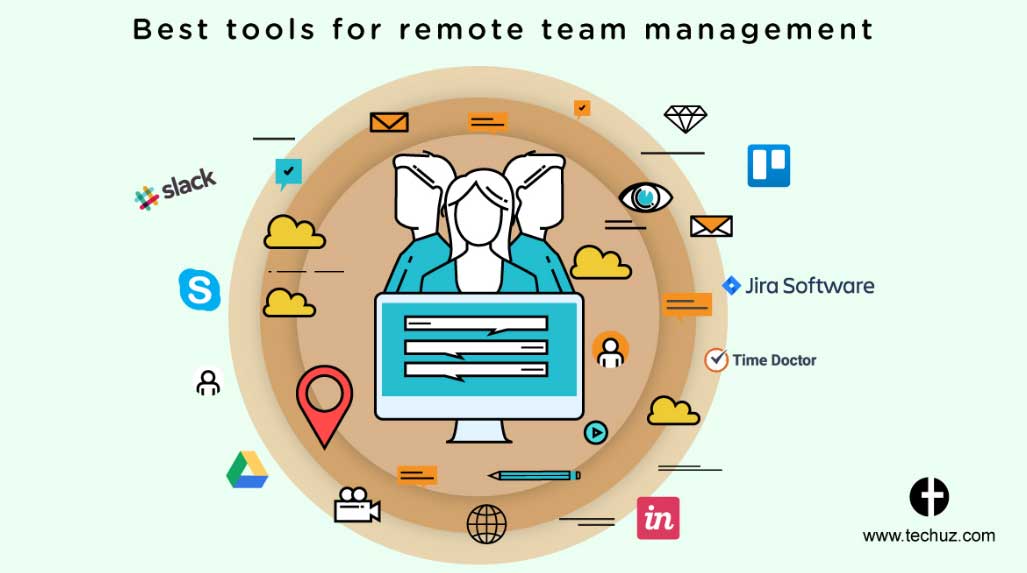
Use suitable tools for remote collaboration

72% of American executives invest in virtual collaboration tools to improve communication in the remote software development team. As a rule, messengers and video conferencing software that support synchronous communication are the most popular. This means that all employees are available online and instantly answer questions from colleagues.

Since the remote team works in different time zones, it is worth providing it with a set of tools that structure the work of the team. The necessary digital tools consist of the following:

  • email client (Gmail, Outlook, Zimbra);
  • file sharing software (iCloud, Google Диск,  Bit.ai);
  • messenger (Slack, Skype, SocialChorus); 
  • project management platform (Trello, Jira, Twoodo, Wrike);
  • application for online conferences (Zoom, Jitsi, Videomost) and other useful programs. 

These tools will help you track the progress and performance of both an individual employee and a team. They will highlight which specialists have problems with completing tasks so that colleagues can help the “laggard”.
Management-Tools

Do not create emergency situations on the project by hastily hiring self-managed employees

A self–managed specialist is an employee who is able to perform duties efficiently without excessive management. Such an employee independently controls his/her actions, results, KPIs and deadlines. This is a well-organized specialist who is interested in increasing productivity.

To find such a specialist in the labor market, it is worth personally conducting interviews. It will take more time to carefully select candidates, but this minor sacrifice will bring results. Highly organized employees are able to work effectively both independently and in a team. They are stress-resistant and easier to navigate in difficult situations. These are the specialists who support the remote software development team and who ensure the reliability of the IT project.

5 mistakes in managing remote development teams

To ensure that cooperation with a remote team does not differ in quality from working with internal specialists, the following five common management mistakes should be avoided:

1. Inability to share product vision

In order for the team to move in the right direction and not make mistakes at every step, it must be familiar with the vision of the product. It is necessary to prepare project documents that will serve as a guide for remote software developers.

2. Overdo with micromanagement

If the team works remotely, you should not overdo it with total control of employees. Constant “surveillance” creates a stressful atmosphere and affects productivity to a lesser extent. It is better to establish reasonable management: think over KPIs, use the right software tools and trust your staff.

3. Neglect the difference in time zones

When a manager does not take into account the time difference with a remote development team, this generates a number of misunderstandings and conflicts. General disorganization affects the pace and success of the project. Therefore, it is important to take time to plan a joint schedule, taking into account the intersection of working hours. So that the necessary information comes to the right people in time, and the execution of project tasks is not delayed.

4. Limit communication by email or messenger

If the development team is located elsewhere, it means that it needs more attention than internal employees. The practice of “one online meeting a week and correspondence by mail” is not enough for the effective work of the team. Regular video conferences on work tasks and team building are really important. In this case, employees are on the same wavelength, understand the state of affairs on the project and receive constructive feedback from the manager.

5. Ignore tools for remote collaboration

Do not underestimate software solutions for remote collaboration. They have valuable functionality for assigning tasks, tracking progress, and managing a project. They include useful features that managers may not know about, but which significantly optimize work with a remote team.

Advantages---Remote-Team

Advantages of a remote development team over your own one

Every businessman who plans a software development project faces the question of how to implement it. Should the employer hire staff or turn to outsourcing remote software developers? The answer in this case is influenced by a number of factors:

  • the purpose and complexity of the project;
  • budget;
  • availability of personnel with the necessary skills and knowledge in the local IT market;
  • time limits and so on.

The search and hiring of full-time employees is advisable if the customer has enough time and money to do the following:

  • allocate a place in the office or rent an apartment for the development team;
  • equip workplaces by purchasing equipment, necessary software and furniture;
  • hire employees with relevant work experience, which is difficult to do without a technical background;
  • configure workflows within the team;
  • take on the costs of utilities, office rent and payroll.

In this case, the manager will receive his/her own full-time team, with a common culture, a single time zone and the possibility of personal communication. But this option is economically advantageous for stable companies that regularly launch remote software development projects and who need to constantly work on improving and scaling their own software product.

personal communication

A developing business that needs digitalization of internal processes and temporary projects may not need full-time developers. More often, growing firms have short-term cooperation with specialists who are able to quickly implement a project with lower costs. In this case, the customer applies for outsourcing of a remote team, getting experienced developers for less money.

At the same time, a businessman does not need to deal with organizational issues, spend money on renting premises and purchasing equipment, as well as other overhead costs. It is only necessary to establish cooperation in a remote team so that it works productively, despite the difference in time zones and cultural differences. In other words, skillfully manage a remote development team.

Conclusion

A remote team needs attention no less than full-time employees. The team spirit and success of the project depends on how rationally the process of interaction between the manager and remote specialists is configured. Planning, regular feedback, team building and accounting for time zone differences speed up teamwork. Be genuinely passionate, do not spare detailed feedback, and you will manage a remote development team at the highest level.

7 Features the Best CRM for Nonprofits Offers

7 Features the Best CRM for Nonprofits Offers

As a nonprofit leader, you probably know the advantages of using a Constituent Relationship Management (CRM) solution. With CRM software, you can ditch those pesky, unsecured, and inefficient spreadsheets in exchange for a more sophisticated system that allows you to manage your relationships with your volunteers, staff, donors, and clients more efficiently.

Using top CRM software will boost your workflow, productivity, people management, and donation campaigns.

Of course, not all CRM software is made equal. Some CRM for nonprofits can be clunky, challenging to learn, and pose privacy or security risks.


When looking for CRM solutions for your nonprofit, search for the following features:

1. Data Security

Data security is under the spotlight. The Personal Identifying Information (PII)nonprofits utilize is being targeted by hackers for malicious purposes. Due to rising complaints, countries are applying stricter laws. Violating these laws can result in heavy fines and even expensive penalties in civil courts.

Rather than risk expensive consequences, your nonprofit should invest in CRM technology that uses secure servers to protect data. Your CRM tools should also be PA-DSS compliant to protect sensitive information. Additionally, it should be HIPAA & PIPEDA compliant to satisfy local laws.

2. Multifunctional

Top CRM solutions offer multiple useful tools to help your nonprofit with its tasks and goals. For example, the easy-to-use yet incredibly powerful nonprofit CRM software by Sumac offers the following facilities:

  • Case management
  • Donation management
  • Memberships
  • Calculator
  • Fundraising thermometer
  • Integrations
  • And more

3. Competitive Pricing

The best developers of nonprofit CRM realize that their clients need competitively priced products. That’s why top CRM solutions are reasonably priced despite offering an array of functionality.

4. EasyToUse

Before selecting a CRM for your nonprofit, try it out. Get input from your staff and long-term managers too. Your new CRM software should be robust but easytouse with an intuitive interface. Of course, the advanced features may take time to master, but the learning curve for basic functionality should be low.

5. 24/7 Support

No user is perfect. We all need help sometimes, even if the software is stable and intuitive. Look for a CRM solution that provides support via message, email, or phone. In addition, your CRM solution provider should offer tutorials, seminars, and other teaching mechanisms to help you learn the system inside and out.

6. Niche Support

Advanced CRM solutions offer niche support to nonprofit entities, such as transitional housing, shelters, hospices, palliative care, and other organizations. For example, to transitional housing organizations, it may offer:

  • Resident data, service, and status management
  • Caseworker, caregiver, volunteer, and donor tracking
  • Key metrics reporting
  • Real-time data capture for resident admission, discharge, and service delivery
  • Personalized client email integration
  • Task scheduling with reminders
  • Progress, outcomes, and history recording

7. Event Management

A modern CRM solution wouldn’t be complete without event management tools. Such tools help you control your event by streamlining event tracking, donation collection, event registration, and much more. Using a robust CRM’s event management tools, you can pull off successful nonprofit events that generate revenue, develop your brand, and increase your donor base.

While there are many CRM solutions on the market, only a few have the right features for a modern nonprofit’s needs. Take the time to try several CRM solutions before picking the best one for your organization.

EDITOR'S PICK OF THE WEEK

CFO's new mandate. CFO explaining the presentation

The Performance and Transformation Orchestrator: The CFO’s New Mandate in the Age of AI

By Terence Tse CFOs are evolving into AI-driven transformation orchestrators, balancing finance, technology, and strategy while upskilling teams, managing risks, and driving measurable business value. A key insight from this year’s AI for CFOs event, organized...

WISE DECISION MAKER GUIDE

POWER INFLUENCERS

Emerging Trends

The Future of Global Trade