Home Blog Page 475

Estate Planning Checklist: 5 Must-Have Documents

Estate Planning

Estate planning often reflects a person’s life with the assets they own and the beneficiaries they choose. Over the years, these things keep changing as your assets increase and your beneficiaries change.

Throughout life, a person keeps updating estate planning, but the documents required for estate planning will always remain the same.

So, for a smooth transfer of assets, here is the checklist of 5 must-have documents for estate planning.

Last Will & Testament

The starting point or the foundation of any estate plan is the last will and testament. It is crucial because it dictates how your assets should be distributed when you pass away. 

It ensures your assets are transferred as per your wish after you die. It includes your physical assets like real estate and possessions and intangible ones like bank, investment accounts, and insurance policies. You also choose a guardian of your minor kids and pets, also an executor to carry out any last wish if you have. It can all be done with the help of a will and trust attorney.

Living Will

A living will is a legal document that states certain scenarios where a certain medical condition makes you incapable of drafting the last will and testament. It states what happens to your assets and wishes after you die without a will after a health condition prevents you from creating one. 

It helps in a smooth transfer of property without the need to go through probate court proceedings. It makes the entire process easier and minimizes the confusion and pressure on your beneficiaries and loved ones, as you have already documented everything. 

Durable Power Of Attorney

A durable power of attorney is a very important aspect of estate planning. It is a document designed to designate an agent or individual who will act on your behalf to make significant real estate, financial, business, or legal decisions when you are incapable of doing so due to a medical condition or death. 

In most cases, people name their spouse or someone in their family, a friend, or an advisor capable of handling business decisions, as you are not limited to naming your spouse or family members. The agent or designated person acts on your behalf and makes crucial decisions to ensure the business stays afloat. That is why choosing someone with business acumen is important rather than someone solely based on relationship or closeness. 

Medical Power Of Attorney

A healthcare power of attorney (HCPA) designates another person to act on your behalf to make healthcare decisions for you in case of your incapacity. For such a document, you need to choose someone you wholeheartedly trust and share the same mindset, as they will have your life in their hands in the most literal sense. The medical POA will step in when you are incapacitated, be it from a medical condition or accident. Choosing an agent can save you and your loved ones from many hassles. Also, have a backup agent if the first one is unavailable to perform their duties. 

Beneficiary Designations

Without a beneficiary, a court can decide how to distribute your assets and investments. That is why it is important to clearly state beneficiary designations to avoid the situation above from arising. 

If the beneficiary cannot serve or has died, it will be up to the court to decide the fate of your tangible and intangible assets. The court doesn’t know you personally, so their chances of making the right decisions on your behalf seem highly unlikely. 

Final Words

These are five of the most crucial documents in estate planning that you cannot ignore at any cost. Hiring a professional Will and Trust Attorney is very important for smoother estate planning. It is necessary to plan ahead to avoid any confusion or stress among your loved ones after your passing. So, call a professional probate lawyer and leave your worries behind.

Looking To Start Trading? Here Are 6 Things You Should Know

Ever dreamed of trading stocks but felt unsure about where to begin? Wall Street can be a tricky business, yet don’t worry—we’ve got your back. In this post, we’ll provide you with 6 essential tips every beginner needs to know before entering the stock market’s dynamic world. By the time you finish reading it, you will be prepared to take action like an experienced investor!

1. Define your goals – What do you hope to achieve by trading stocks?

Trading stocks is a great way to define and work towards your financial aspirations. Although there is always some risk involved, the potential rewards can be huge! The first step to successful stock trading is deciding on your goals. Whether you’re looking for long-term capital growth, short-term profits, or both, it’s important to define profit targets in order to make informed decisions. Doing this will minimize risk and help you maximize gains by giving you a better understanding of the individual stock and overall market trends. Ultimately, define your goals and use that knowledge to reach success with stock trading!

2. Do your research – Read books, and articles, and take courses on the subject

Taking the time to read about your desired course of study and gathering knowledge is fundamental. Doing research on the subject can involve reading books, especially those written by experts in the field, as well as finding relevant articles online. Taking a class or workshop related to the subject matter is also beneficial in equipping you with the necessary information and practice to reach your goals. Researching thoroughly enables you to make well-informed decisions. As with any advanced endeavor, arming yourself with an appropriate level of education and training can prove essential to success in this venture.

3. Consider using a broker – They can provide guidance and expertise

If you’re having difficulty navigating the real estate market, I would highly recommend utilizing the expertise and guidance of a real estate broker. A broker can act as your personal advocate: they will understand what you’re looking for in the perfect home and work tirelessly to bring those dreams to fruition. From conducting market analyses that provide insight into what homes are worth in certain areas, to handling all of your paperwork needs, a broker goes above and beyond in ensuring that you get the most out of your real estate experience. Bottom line: don’t go it alone – make sure you have a knowledgeable professional on your side!

4. Start small – Don’t risk too much money at first

If you’re new to the world of investing, it’s best to start small. Don’t be tempted to throw a large sum at the stock market right away; as tempting as it may be, you can also risk more than you’d like if things don’t go your way. By starting modestly and building up your understanding of the market through research and expert analysis, you’ll be in far better stead when it comes time for larger investments. If possible, lay down some ground rules or restrictions on what types of stocks you’ll invest in at first; this will give you focus and something solid to work from. In short, a slow and steady approach always makes better sense than making big bets with minimal knowledge or understanding.

5. Have a plan – Know when to buy and sell, and stick to it

Understanding the basics of financial planning is crucial for anyone wanting to ensure their long-term prosperity. One key piece of advice I’ve picked up over the years is to always have a plan when it comes to investing. By staying informed and planning your buys and sells, you can increase your odds of success dramatically. When seeking out multiple sources of income, having an organized plan helps assess the risk involved with each potential opportunity. As Benjamin Franklin once said, “If you fail to plan, you are planning to fail”! You don’t want to rush into any decision just because it looks lucrative; instead, make sure you understand every detail of your proposed move so that you can make prompt decisions as required. With a detailed plan in place, investing isn’t such a daunting task after all!

Success in trading takes time

6. Be patient – Success in trading takes time and patience

When it comes to trading and investment success, there’s no getting around the fact that it takes time and patience. You may read or hear stories of people getting lucky with quick successes and becoming tempted to duplicate their feat, however, most of your efforts, and even those of experienced traders will not materialize into extraordinary returns overnight. What true experts will tell you is that there is a lot of hard work and discipline required in building the kind of confidence that truly sets you up for long-term investing success. So be patient, study the markets carefully, start small, and only invest what you can afford to lose—this approach may take more time in producing results but when done correctly provides the foundation for sustainable profits.

Trading stocks can be a great way to make money, but it’s important to approach it carefully. Define your goals and do your research before getting started. You may want to consider using a broker, and start small so you don’t risk too much money. Have a plan for when to buy and sell, and stick to it. Be patient – success takes time!

Top 5 Bitcoin Documentaries to Add to Your Watchlist

bitcoin documentaries

Documentaries about Bitcoin and other cryptocurrencies could help spread the word about them and get more people to use and accept them.

Bitcoin documentaries are a great way to teach people about the cryptocurrency industry and give them information about it. They could help more people understand and use ideas and technologies that are hard to understand. Movies can also show how Bitcoin and the industry that supports it have changed over time. This can help you know what’s going on with recent events and trends.

Also, Bitcoin documentaries can get people, businesses, and governments to use and accept Bitcoin and other cryptocurrencies. This can be done by showing real-world uses for Bitcoin and other cryptocurrencies.

Here are five movies that have something to do with Bitcoin that you should watch:

There are zero obstacles on Bitcoin’s path to the top (2014)

The Rise and Rise of Bitcoin is a 2014 documentary that looks at the history and growth of Bitcoin and how the cryptocurrency industry has changed over time. The video looks at how Bitcoin started, including the mystery of how Satoshi Nakamoto came up with the first Bitcoin and how the Bitcoin community grew after that. If you want to know more about trading, then you can go to this website called Tesler.

There are also interviews with well-known Bitcoin business owners, software developers, and investors. In these interviews, different people talk about Bitcoin’s history, culture, and what could happen in the future. This documentary talks about how Bitcoin could change how banks and other financial institutions work. People also discuss the problems and risks of using digital currencies like Bitcoin.

What Bitcoin Means for the Future of Money (2015)

Money is about to change how it works. The 2015 movie is a documentary about how Bitcoin (BTC) has changed the international monetary system and what this might mean for the future of money. In this video, what makes Bitcoin different from other currencies is talked about. For example, Bitcoin is a decentralized digital currency that uses blockchain technology.

“Putting money into Bitcoin” (2016)

In the 2016 film Banking on Bitcoin, we learn more about the early days of Bitcoin (BTC) and the people who helped it grow. People say that Satoshi Nakamoto, a mysterious person, came up with the idea for Bitcoin. This is the story of the movie. Also, it shows how much the Bitcoin community has grown since then. It also talks about the first Bitcoin transaction, the first Bitcoin exchange, and the rise and fall of the first BTC markets

This article examines how Bitcoin is becoming more attractive to businesses and investors (BTC). It also looks at the legal and governmental problems that the Bitcoin industry is facing right now. The documentary talks in depth about Bitcoin’s early days, from when it was first made to how quickly it spread worldwide. 

“Magic Money: The Bitcoin Revolution” (2017)

The Bitcoin Revolution is a 2017 documentary examining how Bitcoin and other cryptocurrencies could change how money is handled. This video looks at what makes Bitcoin different from other types of cash, such as that it is not controlled by a single group and uses blockchain technology.

The documentary has a lot of good and bad information about Bitcoin. These benefits include that anyone can get money and that traditional financial middlemen are no longer needed. People might do things against the law if there aren’t enough rules. 

 “Bitcoin, Blockchains, and the Future of the Internet” (2018)

A documentary film called Bitcoin, Blockchains, and the Future of the Internet came out in 2018. It looks at what blockchain technology can do and how it will affect the future of the internet. In this video, we look at the features of blockchain technology, like how it is decentralized, secure, and open. We also look at how it could be used to create new apps and services that don’t have a central location.

In the documentary, blockchain developers, business owners, and academics talk about the technology, its potential, and the problems it is having right now. There are also videos of conferences, meetings, and other events. These videos show how blockchain technology is becoming more popular and could change the future.

What is the Best Outsourcing Model?

outsoucing model

As technology advances, businesses in the United States are seeking ways to streamline their processes and increase efficiency. Many of these businesses have turned to outsource to save time and money. But with so many different models of outsourcing available, it can take time to decide which is best suited for your business. Let’s explore some of the more popular outsourcing models and how they could benefit US businesses.

Offshoring Model

One popular outsourcing model is offshoring, which involves transferring work or operations to countries where labor costs are lower than those in the US. This model is particularly attractive for US companies because it allows them to reduce their overhead costs while still having access to skilled professionals who can help them complete projects quickly and efficiently. The downside of this model is that communication and collaboration can be difficult when working with people in other countries who may need help understanding the same cultural references or speaking the same language. Quality assurance can also become an issue if there is insufficient oversight or communication between teams.

Nearshore Model

An alternative to offshoring is nearshoring. Nearshore outsourcing means that services are being outsourced from one country to another that is geographically close. This model has several advantages over offshoring, including increased communication and collaboration due to the proximity between teams, shared cultural references, and a better understanding of language differences. Additionally, nearshore companies often provide higher quality services since they can provide more oversight on development projects throughout their lifecycle. By working with a nearshore company, US businesses can reduce costs without sacrificing quality or efficiency while retaining control over their projects.

Onshore Model

The final model we will discuss today is onshore outsourcing, which involves partnering with software development companies in the United States. Onshoring offers several benefits over offshoring, such as quicker turnaround times due to shorter distances between teams; improved communication due to shared language and cultural references; more significant control over projects; and easier access to intellectual property protection laws since both parties are based in the same country. However, this model does come with its own set of challenges, such as higher labor costs compared to offshoring or nearshoring models due to prevailing wages within the United States, as well as potential legal issues related to employee status and compliance regulations that must be taken into consideration when agreeing with an onshore partner.

Your Ideal Outsourcing Model

With so many options for outsourcing software development projects, it can be difficult for US businesses to decide which option best suits their needs and budget constraints. While that stands, the nearshore model is quickly becoming the preferred model of choice for software development and other technology-related tasks.

If your business is looking for an effective way to save time and money while tapping into a global talent pool, then nearshore outsourcing may be just what you need! By working with professionals in nearby countries, you’ll have access to highly skilled labor without worrying about added costs associated with international travel or communication delays due to different time zones – all while taking advantage of cultural alignments that allow collaboration between teams more efficiently than ever before! With all these benefits combined, it’s easy to see why many businesses choose nearshore outsourcing as their preferred method for software development projects!

Need to learn more on what is the best outsourcing model? Visit Sonatafy Technology (www.sonatafy.com) a premier nearshore software development company.

How to Get the Most Out of Your Bank

getting the most out of your bank

Banks are both an integral part of our national economies, and an important institution for private individuals to handle their money. Using banks can be somewhat of a pain, but banking can also be incredibly beneficial to you as a customer. 

In this text, we’re going to share some of the best tips to employ to get the most out of your bank. Even if these tips might not help you save money in the same way that coupon codes might, it’s still going to be beneficial to you as a customer with a bank. 

Know what the competitors offer 

If you have a service that you would like to receive from the bank, regardless of what this might be, it’s important to know what the banks’ competitors can offer. Say for example that you would like to finance a purchase of a vehicle. Being aware of what the competitors can offer is a good way of having something to stand on when it comes to bartering with the bank. If you’ve called up a competitor and gotten the offer for a better rate, telling your bank this can put them in a position where they need to either match the rate or lose you as a customer.  

Check what requirements there are for special perks  

A lot of banks offer up different perks for their customers depending on a wide variety of factors. These things can be everything from free credit checks or deposit boxes. This isn’t something that is going to massively impact your personal finances, but if it’s something that is available it is wise to use them. 

Be aware of what different fees the bank has and how to avoid these 

Banks often have different fees associated with different services. This can be everything from overdraft fees and transfer fees and knowing what these different costs are and how to avoid them can be an excellent way of getting the most out of your bank. These fees can often add up to unnecessary costs given enough time but are generally easy to avoid as long as you’re aware of them.

Set up digital alerts 

Most banks nowadays offer apps that are technologically advanced and that can offer you a ton of information in the palm of your hand. Through apps, you can do everything from check your balance to set up alerts for when you spend money. This way you can easily keep track of everything, and you also notice straight away if something gets charged from your account.
[su-divider]

Will the ISA Allowance Increase in 2023/24 in the UK?

personal savings account

Currently, the benchmark for ISA allowance stands at a point of £20,000, while that for junior ISAs is £9000 a year, and to say the least, it’s been like that for a while now.

With inflation on a roll, and the number of people that invest in an ISA, a tax-free interest entity, going low every fiscal year, it’s hard to determine where the limit is headed, and whether or not there’s a chance of an increase in the coming year.

Though there’s a lot that can be speculated after the government’s decision not to increase the limit for the year 2022/23, and we’ll break it down to better understand the events that can happen in the next few months.

When Did The ISA Allowance Chance Last?

Reading historical patterns regarding ISA (Individual Savings Account) is a no-brainer and common way to predict whether the allowance will increase or not, and that’s what we’ll present to you, in an easy-to-grasp way.

Roughly put, the last time the ISA allowance increased was 6 years ago, and not being increased for that long can be read as an indicator of change in the next year. Before being increased to £20,000, the ISA allowance sat at £15,240, which, in turn, was increased from  £15,000.

Unlike other accounts, ISA allows investors and savers to shield their money from the capital gains tax, and at the same time, maximise the returns on their investment. Over the past couple of years, despite the frozen allowance price point, capital gains allowance and the dividends have been shrinking, and it sure doesn’t look good. 

Inflation and ISA Allowance Go Hand In Hand

Inflation has played a major role in previous ISA allowance increases, and unless you’ve been living under a rock for a good while, you’ll notice that inflation is at an all-time high, especially in the UK. 

The annual inflation rate for the UK dropped to 10.1% in December 2022, from a high of 10.5%, and you don’t need to be a finance major to know that that percentage is too high for your good.

Nevertheless, the one good thing about the increasing percentage of annual inflation is that it’s almost always coupled with an increase in the ISA allowance. 

That, and with the upcoming taxation burden coming with an increase in National Insurance, an increase in ISA allowance might be presented as a perfect break for taxpayers amidst a troubled economy.

It’s Not All Sunshine and Rainbows

Though there’s an increase in the speculation of ISA allowance increase, not all evidence points in that direction, and as mentioned before, there are a lot of factors at play.

Sure, increasing inflation might lead to an increase in the allowance, but with this increase, the overall number of people investing or maxing out in ISA is becoming significantly lower.

Let’s analyse this report from the UK government. According to the latest trends, approximately 20% of people maxed out their ISA allowance for the previous tax year, but that’s not all. More than 40% of these people are the ones that are earning £125,000 or above. 

With the current economic conditions, ISA is tailing more towards rewarding the already wealthy than the lower-income people at the bottom, and some would say that it’s one of the reasons why the allowance might not go up.

How Much Can The Allowance Increase?

Nothing can be said for sure, but some maths can be done. We know that like in previous times, ISA allowance might be in line with the inflation rate of its current tax year. 

The United Kingdom has seen some of the worst economic inflation rates in its history, going as much as 10.5% at one point. If we assume an inflation rate of 8% for the current tax year, you can expect the allowance increase to be anywhere from £22,000 to 25,000. 

Though, this is completely a calculated prediction and not a written-in-stone range that the allowance might fall into, if it decides to increase.

So, Will The ISA Allowance Increase?

As mentioned before, there are a lot of factors at play when we talk about an increase in ISA allowance, and while it’s a good idea to know what can be expected, predicting whether the allowance will increase, from an outside perspective, is downright impossible.

Previously, ISA allowance has been in line with inflation, and while that was six years ago, it had a massive increase of almost £5000 the last time it went up. Even before this big jump, we’ve seen similar smaller jumps the allowance limit has made over the years. 

In the end, we’ll just have to wait around for the Autumn budget, as that’s when the UK government decides the amount of ISA allowance for the next tax year, which will occur anytime in October.

Top Home Upgrades And Improvements That Really Pay Off

Making improvements to your home can be a great way to add value and increase its marketability. But with so many options available, it can be hard to know which upgrades are worth the time and money. Fortunately, there are some renovations that have been proven to make a big difference both in terms of increasing the value of your property as well as improving your own quality of life. From updating key features like kitchens and bathrooms, to making energy-saving changes or adding luxurious amenities, these top home upgrades will pay off for years down the road.

Home Energy Efficiency Improvements

Making small, energy-efficient modifications to your home is one of the most cost-effective ways to improve its value. For instance, installing insulation and sealant can help reduce your utility bills while also making your home more comfortable. Replacing inefficient appliances such as air conditioners or water heaters can save you money on energy costs over time and help provide a return on your investment. On the other hand, replacing windows with more efficient models or adding solar panels to your roof can be a larger expense, but also offer greater financial rewards down the road.

Kitchen and Bathroom Upgrades

The kitchen and bathrooms are two of the most important rooms when it comes to increasing the value of your home. Installing new countertops, cabinets, appliances, and fixtures can help make the space look more modern and inviting. If you’re looking to invest in a larger renovation, you might consider adding an island or extra storage solutions for better function. Likewise, giving your bathroom a facelift with new tiles, countertops, and fixtures can transform the room into something special.

When it comes to kitchen or bathroom remodeling, it’s essential to work with a reputable company that can bring your vision to life. With so many options to choose from, it can be challenging to know where to start. Look for companies with experience, positive reviews, and a portfolio of completed projects that align with your style and needs. If you are located in California, click here for bathroom remodeling in San Jose to find a team of experts who can help you transform your space.

Infographic on Kitchen and Bathroom Upgrades to Boost Your Home’s ValueBy HomeLight Homes 

Outdoor Features

Adding outdoor living space is a great way to make your home more attractive. Building a deck or patio can provide additional entertaining areas for family and friends, while also increasing the square footage of your property. Installing a firepit or adding low-maintenance landscaping can help make your yard look more inviting, while also providing a boost in curb appeal. Furthermore, investing in a swimming pool by Reliant Pools pool builders in Austin TX or hot tub can be a great way to increase your home’s value and make it stand out from the competition. 

house with pool

Adding Smart Technology and Security Systems

Technology has come a long way in recent years, and many homeowners are choosing to invest in “smart” features that make their homes more secure and convenient. Adding automated lighting, thermostats, security systems, and surveillance cameras can give you peace of mind while also enhancing the safety of your home. Likewise, installing voice-controlled assistants like Alexa or Google Home can make everyday tasks easier and give your home a modern touch.

Working on Landscaping/Hardscaping

Curb appeal is important when it comes to selling your home, and making improvements to your landscaping or hardscaping can be a great way to increase its value. Adding shrubbery, trees, flowerbeds, and other plants from the best landscapers in West Chester Ohio, can spruce up the exterior of your property, while also providing added privacy. Installing a walkway or driveway made of stone, brick, or pavers can provide a more inviting look while also increasing the value. Furthermore, building retaining walls can help create structure and definition for your property. 

These are just a few of the many home upgrades that can pay off in the long run. Working with a professional contractor can help ensure that your project is done correctly and efficiently, while also providing added peace of mind. Ultimately, the right home upgrades can make your property more attractive to potential buyers and increase its resale value. By focusing on these top improvements that really pay off, you can enjoy the benefits for years to come.

5 Reasons All Product-Based Businesses Need An Invoice & Inventory Software

Inventory Software

All product-based businesses need to have a good inventory management software package. The reason is simple: they need to be able to track their products and make sure that they’re getting paid for what they sell. 

This means that if you’re running an eCommerce store or any kind of online business where deals involve physical goods being shipped from warehouses worldwide, then having an invoice & inventory software package is vital for your success! So here are some reasons why all product-based businesses should be using one:

1. Easily Track Invoices

An invoice and inventory management software is a great way to help you work more efficiently and be more proactive. They can also make it easier for your customers to pay their invoices and access their inventory.

An all-inclusive invoice and inventory software allows businesses to track each invoice, bill, or payment in real-time so they know when it’s due or paid. This makes it easier for them to see who owes them money, the due date, and how much was owed each month at any given time. 

When it comes to invoicing software, there are plenty of options out there that can help you create professional-looking invoices effortlessly. You can also use this software to automatically generate invoices for your customers by uploading transactions into their system or scanning them into the app on their mobile devices!

It’s also crucial for all businesses who have employees or contractors working on projects together (even if they don’t bill directly) because it helps them track their expenses properly, so they don’t have any surprises later down the road when trying to figure out what happened during those months where nothing was spent yet but still needs paying back.

2. Billing

Billing is an integral part of any business, and it’s the first thing customers see when they make a purchase. If you can’t provide adequate billing functionality, your customers will have no way to pay for their products or services.

A good invoice software should be able to import all data from your accounting system into the software (including sales tax information). Moreover it should export all invoices in one PDF file per invoice line item (for example, customer name and item number).  What’s more, you can consider introducing a white label billing software into your workflows to offer more custom functionalities for invoicing to your customers.

3. Improved Inventory Management

Inventory management is one of the most essential processes for any business. It helps you to track your inventory and helps you know when to reorder products. With a credible inventory management software, you can certainly evaluate what products are selling the most so that you can focus on those areas where sales are lagging. 

Moreover, you can also determine how much to order by evaluating the sales of your products. A good practice could be to reorder more for the top selling products and less for the products having minimal sales. In the longer run, it is important to analyze why some of your products are not selling well and employ strategies to augment their sales.

4. Customer Relationship Management (CRM)

Customer Relationship Management (CRM) is a platform that helps track and manage customer data. This can manage your customer relationships, sales and marketing activities, lead generation, sales pipeline development, and activity reporting.

It’s important to have an effective CRM solution on hand if you’re looking to increase customer satisfaction rates or improve the overall experience of your business with existing clients. If it isn’t already in place, adding CRM software will ensure that all relevant information about each client is available at any time—and make it easy for anyone within your organization who needs access.

5. Advanced Tax Information For Each State And Country

Taxes are a big part of doing business, but they’re significant when operating in multiple countries. Whether it’s the United States or Canada, dozens of local tax laws apply to your business and can make things difficult for you if you don’t know about them.

Tax software can help with this by providing insight into how taxes work at different levels: state level (and/or province), country level (and/or continent), etc. Tax software will also show you what information is required from each jurisdiction so that when someone asks, “what should I do?” Your answer will be clear & concise!

It also helps manage your inventory by allowing you to quickly calculate how much inventory needs to be purchased daily or monthly. In addition, the software will help you keep track of the items that have been sold so far for them not only to be included in future invoices but also so they can be marked as sold by using barcodes or labels attached to products themselves if needed (such as marking bags).

As well as being able to run reports on what’s going on within the business at any given time (which can then be used by other people within that company), this type of software allows businesses to manage multiple departments effectively – namely HR/Payroll/Taxes etcetera:

The TakeAway 

All businesses should be using a good inventory software package. Inventory management is not just about counting and taking care of your inventory but also about keeping track of bills and invoices. With invoice & inventory software, you can easily manage your business finances in one place—allowing you to stay organized while reducing paperwork and paper costs.

ZarMoney provides an affordable invoice & inventory software that is tailored to your business needs. Their inventory management software helps to streamline business operations and is especially beneficial for growing businesses. Contact them today and acquire the best invoice and inventory software for your business.

NFT: Beyond the Hype, There is the Future

NFT 8BIT

By Terence Tse, Andrea Maria Cosentino and Mark Esposito

Non-fungible tokens – much has been said and written about them, but what is the truth? Do they have potential as a valuable commodity or is it all just digital smoke and mirrors? Maybe the success – or otherwise – of NFTs hinges on putting them to use in novel new ways, as this article explores.

It was not supposed to turn out like this. However, as repeatedly shown in the past, many novelties frequently see their spectacular rise in popularity matched by a quick decline soon after. Indeed, if the Gartner Hype Cycle is to be applied, it can be expected that the “trough of disillusionment” immediately follows the “peak of inflated expectations”. The questions are often how swift the fall is and whether a technology can ever move to the next stage of the cycle – the “slope of enlightenment”.

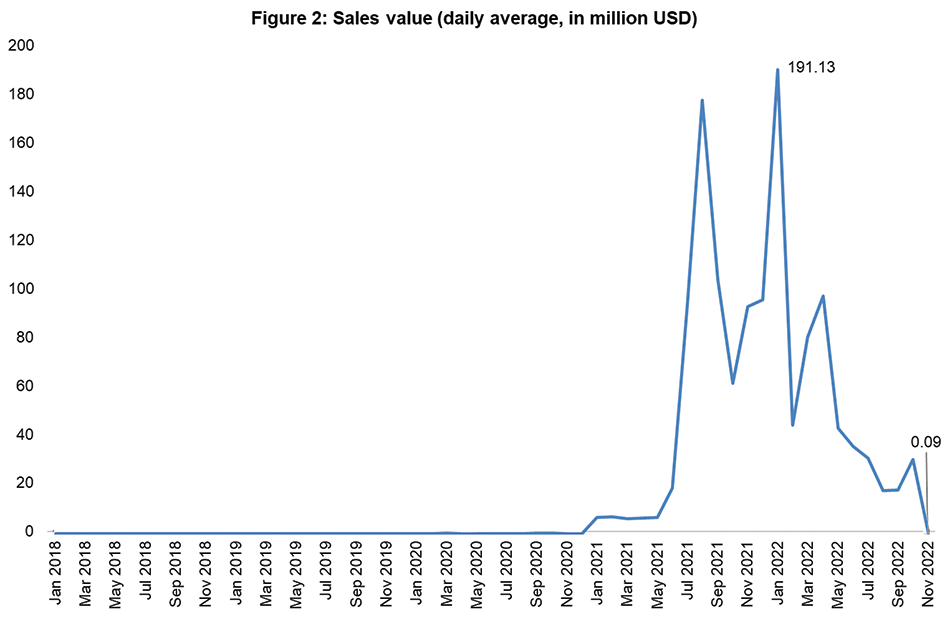
These questions are really relevant and timely for NFTs, or non-fungible tokens. Although they were once a darling for many investors, data drawn from Statista reveal that NFTs may have lost their appeal. Figures 1 and 2 show that NFTs are now trading at a small fraction of their historical high, in both sales number and value terms1.

figure 1

figure 2

So, where are NFTs going? There is evidence that they could further decline, or return to rise from the ashes again.

Decline: wash trading

Despite the emergence of new NFT use cases, the path for NFT to regain their stellar popularity may be about to be hampered by wash trading. “Wash trading” refers to the action of a trader buying and selling the same asset repeatedly to manipulate the trading volumes, and it is an illegal practice.

The goals of the perpetrators are twofold. The first is to create an impression that there is demand for that asset, when in fact there isn’t. The second is to inflate the value of an asset. A prospective buyer will be more inclined to pay top money for an NFT based on its (very active) transaction history. The result: the wash trading seller makes a profit, while the buyer ends up with an ordinary, overpriced NFT.

This has become common practice in NFT trading. As much as 58 per cent of all NFT trading in 2022 was thought to be wash trades. Indeed, January 2022 saw wash trading accounting for 80 per cent of the total NFT trading volume.2 Perhaps this should not be surprising, given that wash trading is found to be rampant in unregulated cryptocurrency exchanges. Recent research has suggested that 70 per cent of the reported volume of these exchanges was the result of wash trading.3 Wash trading is a lucrative business. It is estimated that, in 2021, 110 wash traders collectively made nearly US$8.9 million in profit from unsuspecting buyers who believed that the NFTs they were purchasing had been growing in value, and had been sold by one distinct collector to another.4

Such wash trading practice has serious consequences. Not only have these buyers lost out, but the whole industry is likely to be negatively impacted. Potential buyers are likely to become more cautious, which could lead to lengthier decision-making processes and also lower trading volumes. Artists and other NFT users, such as restaurants, often depend on the data embedded in their NFT smart contracts to track their reputation and credibility over time, a process based on transparency. Wash trading is likely to have deleterious effects on such credibility over time. Indeed, compounding with the collapse of FTX, cryptocurrencies as a whole – a market that relies heavily on trust – is probably going to get an even colder reception from potential investors and the general public in the near future. This, in turn, would only make it even more difficult for this already struggling nascent blockchain industry to expand beyond speculation and leverage, let alone going mainstream.

8BIT CAT

Rise: a new use for NFTs

Admittedly, the drop in popularity of NFTs is rather unexpected, considering that there was no shortage of speculation about the use of NFTs in real life. Films, music, gaming, and fashion have all been identified as areas where the use of NFTs could become widespread and hugely popular. However, up to now at least, such speculation has yet to turn into reality.

In fact, these tokens can potentially be used as a form of identity, certification, governance, licensing as a kind of “soulbound NFT”, a non-transferable token that is specific to a particular person (or address), representing a “social identity in a decentralised society”.

Of course, this doesn’t mean that NFTs will slip into oblivion. New services to assemble and distribute NFTs are still being introduced. For example, Meta has just rolled out features that enable creators to sell NFTs on Instagram. Indeed, NFTs may now have found another new application: restaurants. The Flyfish Club in New York is scheduled to open this year. In its own words, it is a “members only private dining club where membership is purchased on the blockchain as NFT and owned by the token-holder to gain access to our restaurant and various culinary, cultural and social experiences”.5 Essentially, NFTs have now turned into a tradable and digital membership card.

Others, such as NFTable, allow the NFT owners to be “on the list” and have “their own table” for every visit at partnered restaurants. Another is Front of the House, which helps restaurants sell “digital collectibles” (i.e. NFTs) that grant special access to holders. So, instead of having to put up with queuing or booking way in advance for very sought-after restaurants, one can pay $1,000 for the privilege of booking once a week with only 24 hours’ notice. In effect, owners of these NFTs are paying to jump the queues.

TOKEN FILES

Complicated but (not) promising

Is there hope for the non-fungible market? Perhaps the devil is in the detail. In July 2021, Damien Hirst, arguably Britain’s richest artist, launched his first NFT collection, “The Currency”. Each NFT corresponds to a physical painting featuring his signature multicoloured dots, made from enamel paint on handmade paper. The tokens were initially available for $2,000, which was considered affordable compared to Hirst’s other output.

Fast forward to October 2022, when he threw hundreds of his artworks into a fire, including “The Currency” with 10,000 NFTs attached. Now, the token owners had to make a choice: take the painting and lose the NFT or hold onto the NFT to witness the painting bought for a handsome sum being burned live. The result was almost an even split – 5,149 opting to trade their NFT for the original painting, and 4,851 choosing the NFT.

Regardless of whether it was a publicity stunt or act of genius, NFTs are transforming the way artists can use blockchains and smart contracts, enabling more of them to sell and distribute their works – both digital and non-digital – as well as making the art market more accessible. The biggest benefit of linking physical artworks to NFT is that sellers and buyers can easily prove that the art piece is genuine, or not.

Films, music, gaming, and fashion have all been identified as areas where the use of NFTs could become widespread and hugely popular. However, up to now at least, such speculation has yet to turn into reality.

Yet it is not without complications. For instance, an artist could create a physical painting, then sell the digital print as an NFT to one buyer (or buyers) while selling the physical copy to another. Another issue is that, in most cases, buyers cannot display their NFT to the public, given that they own only the artwork, but not the copyright. Unless the copyright is embedded into the terms of the NFT, the owners do not have the right to share or distribute the artwork. Until these kinks are ironed out, it may remain difficult to inspire investors with confidence.

Enthusiasts believe that NFTs can also extend their application to real estate. This is particularly the case, as many would argue, with the arrival of the metaverse. As in the real environment, in this digital world it is possible to buy and own NFT houses, NFT flats in NFT buildings, and NFT lands. Indeed, some virtual real estate NFTs are even tied to physical properties in the real world. Other times, real-life real estate NFT can be created by registering a physical asset on a blockchain and creating a record of ownership, making it easier for the NFT to change hands and to keep records of the transaction.

As these use cases in the art and real estate markets illustrate, in theory at least, NFT has created a bridge that hybridises real life and virtual assets. This is arguably one of the best uses of NFTs. In fact, these tokens can potentially be used as a form of identity, certification, governance, licensing as a kind of “soulbound NFT”, a non-transferable token that is specific to a particular person (or address), representing a “social identity in a decentralised society”.6

However, with so many uncertainties still surrounding NFTs, it remains to be seen where they are heading. There are arguments as to whether it is the headwind or tailwind that is getting stronger. Either way, the non-fungible market is far from being a commonly used item in our daily life.

About the Authors

terence TseTerence Tse is professor of finance at Hult International Business School. He is also a co-founder and Executive Director of Nexus FrontierTech, an AI scale-up. Terence has appeared on television, in radio shows and in periodicals. He has given seminars, workshops, and speeches for and to some 50 organisations. Terence has written three books, with the next to be published by MIT Press in 2024. He is on the board of various entities, including Nexus FrontierTech, Thyreality, Tolar HashNET, and Circular Economy Alliance. Previously, he was in investment banking and consulting. Terence has a PhD from the University of Cambridge, UK.

Andrea Maria CosentinoAndrea Maria Cosentino, MSc, IMC is the founder and CEO of Impact Fundry, a venture capital studio and strategic consulting boutique that accelerates start-ups, SMEs and corporate enterprise to enable growth and sustainable value creation. He is a finance, digital transformation and entrepreneurship expert at the ESCP Business School and an advisor to several start-ups and accelerators, including Barclays Rise and Level 39 in London. He lectures at various universities around the world and speaks at multiple conferences, with publications on LSE Tech Review, World Economic Forum, and MIT Tech Review. He contributed to the book The Internet of Value published by the Blockchain Center at UCL.

mark espositoMark Esposito is a professor of business and economics at Hult International Business School. He is an entrepreneur who co-founded Nexus FrontierTech, and a bestselling author and a senior advisor to governments. In 2016, he was listed as one of the 30 prominent business thinkers by Thinkers50 Radar. Mark has written hundreds of articles between peer and non-peer review magazines, 11 books, including two bestsellers, and his next books on The Great Reset Ahead Of Us are due in 2022 with MIT University Press and Cambridge University Press. Since 2011, he has taught courses in business, government and society, and economic strategy and competitiveness, at Harvard University’s Division of Continuing Education. Mark holds a doctoral degree in Business and Economics and works across Phoenix, Boston, and Dubai.

References

  1. https://www.statista.com/statistics/1265353/nft-sales-value/
  2. https://nftnewstoday.com/2022/12/25/nft-wash-trading-rampant-in-2022/
  3. https://papers.ssrn.com/sol3/papers.cfm?abstract_id=4312030
  4. Chainanalysis (2022) The 2022 Crypto Crime Report Original data and research into cryptocurrency-based crime, February
  5. https://www.flyfishclub.com/
  6. https://www.coindesk.com/learn/what-are-soulbound-tokens-the-non-transferrable-nft-explained/

Formal Relational Contracting: The New Paradigm for Long-Term Strategic Business Relationships

Strategic Business Relationships

By Kate Vitasek

While 2019 will go down in history as the year the global pandemic started, 2022 will likely go down in history as being the year global supply chain systems had a meltdown. If you are at a breaking point with your supply chain partners, perhaps it is time to rethink your approach. Specifically, rethink your contracting approach to use formal relational contracts, especially with your more strategic suppliers where you do a significant amount of repeat business.

The concept of relational contracts is not new. Legal scholars Ian Macneil and Stewart Macaulay advocated for relational contracts in the 1960s. Relational contracts embrace the fact that many business dealings are not once-and-done deals but rather consist of ongoing business relationships where trading partners have a series of interactions over a long period. The idea is that business is dynamic and that the parties need to create a flexible contract framework where trading partners put the relationship first, rather than have a rigid, inflexible, and “complete contract”.1

Macaulay and Macneil’s concept of relational contracts never really gained traction in practice. One reason is that lawyers eschewed relational contracts as “fluffy” and akin to a “handshake deal”. Most lawyers think of handshake deals and relational contracts and immediately think RISK! In fact, over the years, lawyers have been indoctrinated with the idea to write contracts that protect their clients at all costs. The result? A virtual negotiations tug of war of contract clauses. A case in point is that today’s contracts are longer, more rigid, and more packed with legalese than ever before.

In her book Rules for the Flat World, Gillian Hadfield articulates how the transactional dimension of many business relationships dovetails with the legal boom beginning in the late 1960s. For example, in 1968 there were only 20 law firms in the United States that had over 100 lawyers. But Hadfield writes, “The 1970s saw the number of lawyers grow by 75% and lawyers per 100,000 people jumped over 250 – a 60% increase in just ten years. The 1980s saw the number of lawyers per 100,000 people pushed up another 20% to over 300. By the end of the twentieth century, there were almost 400 lawyers per 100,000 Americans.”

With intensified attention to asserting legal protections, contracts became increasingly transactional. This transactional mentality has since dominated the business lexicon.

But is there a better way?

This is the question that University of Tennessee researchers began to ask as part of a large research project funded by the United States Air Force. At the same time – and unrelated – Harvard University’s Oliver Hart began exploring ways to address incomplete contracts. In 2018, their work collided with a collaboration with Swedish attorney David Frydlinger and the trio wrote a thought-provoking article in Harvard Business Review entitled “A New Approach to Contracts: How to Build Better Long Term Strategic Partnerships”.2

formal relational contract

The premise? Use formal relational contracts.

A formal relational contract is a legally enforceable written contract establishing a commercial partnership within a flexible contractual framework based on social norms and jointly defined objectives, prioritising a relationship with the continuous alignment of interests before commercial transactions.

In other words, a formal relational contract lays a foundation of trust, specifies mutual goals, and establishes governance structures to keep the parties’ expectations and interests aligned over time. It stands as an alternative to traditional methods that ensures protection for both parties and allows room for a genuine partnership to develop. It pools the merits of the antiquated but neighbourly “handshake deal” of bygone eras with the legally protective elements of traditional sourcing to create a more modern, progressive method: the formal relational contract.

A formal relational contract lays a foundation of trust, specifies mutual goals, and establishes governance structures to keep the parties’ expectations and interests aligned over time.

Formal relational contracting has already been successfully implemented by major corporations and entities, including (but not limited to) the Canadian government, Dell, Intel, AstraZeneca, and the Swedish telecommunications firm Telia. Most recently, bp and supplier Jones Lang LaSalle made the shift to shift to a formal relational contract for global facilities and real estate management operations. Wendy Cuthbert – bp Global Head of Workplace Solutions – challenges organizations to rethink their traditional approaches to outsourcing. “The traditional way of working with suppliers, I’d like to think as has had its day now and that people will start seeing the real benefits of working alongside business partners in a mutual win-win relationship rather than it being one-sided.” 3

The central aim of this model seeks (1) to best meet the respective needs of both the buyers and suppliers and (2) to create value with strategic supplier relationships.

If, perhaps, you are in a struggling business relationship, read on to learn how your traditional transactional contracts may be holding you back and how you can shift to formal relational contracting.

formal relational contract

The Problem with Traditional Contracting

Traditional purchasing contracts don’t work in complex strategic relationships where the parties are highly dependent on each other, future events can’t be predicted, and flexibility and trust are required. Instead of promoting the partnership-like relationships needed to cope with uncertainty, conventional contracts undermine them.

Companies have traditionally used contracts as protection against the possibility that one party will abuse its power to extract benefits at the expense of the other. This adversarial mindset creates a downward spiral of negative tit-for-tat behaviours.

Three common contracting obstacles that stand in the way of a successful relational contract are:

  • The hold-up problem
  • Incomplete contracts
  • Shading

The hold-up problem is a fear that one party will be held up by the other. Companies spend an unimaginable amount of time ensuring they are not taken advantage of by the other party. However, in doing so, they might curtail their own opportunities. The fact that virtually all contracts contain gaps, omissions, and ambiguities – despite companies’ best efforts to anticipate every scenario – only exacerbates hold-up behaviour.

Companies have traditionally used contracts as protection against the possibility that one party will abuse its power to extract benefits at the expense of the other. This adversarial mindset creates a downward spiral of negative tit-for-tat behaviours.

Leaders employ a range of tactics to try to ensure that they are not taken advantage of by a powerful partner. These include contracting with multiple suppliers, forcing suppliers to lock in prices, using termination-for-convenience clauses, or obligating suppliers to cover activities that might arise after the initial contracting phase. In addition, some companies go so far as to install a “shadow organisation” to micromanage the supplier. This primes the company to make distorted investments that produce poor outcomes. For example, using multiple suppliers instead of only one increases costs, and so does operating a shadow organisation.

Incomplete contracts (or ambiguous contracts) reduce accountability that the contract will be upheld. Correspondingly, when one or both parties view the other as likely to walk, they invest less energy and motivation toward achieving mutual goals. It creates friction.

Some contractual clauses can also induce perverse incentives. For example, a ”60-day termination for convenience” clause indicates that this partner can legally walk after 60 days without explanation. It’s the equivalent of a 60-day contract – a highly problematic situation if shareholders must wait longer than two months to see any returns. Who would invest in innovation with such risks?

“Shading” is a retaliatory behaviour where one party stops cooperating, ceases to be proactive, or makes countermoves. The aggrieved party often cuts back on performance in subtle ways, sometimes even unconsciously, to compensate. This may make one party vulnerable to being blind-sided when they don’t receive an expected outcome. In long-term, complex deals, shading can be so pervasive that the tit-for-tat behaviour becomes a death spiral.

Breaking the Cycle: The Five Steps for Creating a Formal Relational Contract

Researchers at the University of Tennessee developed a simple five-step process for creating formal relational contracts. The five steps are:

  • Step 1: Lay the foundation
  • Step 2: Co-create a shared vision
  • Step 3: Adopt guiding principles
  • Step 4: Align expectations and interests
  • Step 5: Stay aligned

Combined, the steps shift the focus on negotiating from “this deal” to how the parties can collaborate to create success in the relationship. A lynchpin for success? Before you ever start negotiating any aspects of the deal (step 4), slow down and negotiate the foundation of your business relationship.

Step 1: Lay the foundation

This phase focuses on negotiating the foundation of the relationship first and then proceeding to the details. Establishing a partnership mentality is pivotal to sustainable cooperation. When both parties begin the negotiations with genuine partnership as a formal (written) feature of the contract, it creates room for trust, transparency, and high-level aspirations to flourish – rather than an inherently adversarial mindset. Laying this foundation focuses on outcomes, not transactions, in the earliest phase of the partnership.

Step 2: Co-create a shared vision and objectives

This starts with identifying specific goals and concerns. These specific desired outcomes are complemented by clearly defined relationship-management processes. Both parties (not just the one with the upper hand) need the space to explain their desired outcomes and goals as well as tactical and measurable objectives. This can be thought of as focusing on the “what”, not the “how”. Essentially, in step 1, negotiating parties agree to go on a journey together; in step 2, they’re drafting a roadmap for where they both want to go.

Step 3: Adopt guiding principles

Once parties have clearly defined a set of measurable outcomes, adopting guiding principles can help pre-emptively steer away from potential potholes. These principles are designed to avoid value-eroding friction in the partnership at all costs. No one wants to be treated unfairly – or leave themselves open to exploitation. Likewise, the more unknowns there are in the picture, the higher the risk. Another phase of the negotiation tries to head off tit-for-tat behaviour and pre-emptively rewards reciprocity.

Step 4: Align expectations and interests

While we can think of the Guiding Principles as a compass telling us which direction we’re going in, aligning expectations and interests demands more instruction. We need more detail than an arrow pointing north, south, east, or west; it’s time to hammer out the details. This demands full transparency and applies to all terms and conditions of the relational contract, such as responsibilities, pricing, metrics, etc. It also underlines a problem-solving mentality instead of a negotiation mentality.

Step 5: Stay aligned

Staying aligned requires creating robust governance mechanisms that provide insight, not oversight, while holding the contracting parties accountable to living into the intentions. Staying aligned applies to all contributing teams on all levels of each party. This can involve regular check-ins, follow-ups, and feedback to keep tabs on shared vision and goals. In this phase, we focus on outcomes and measures with the understanding that, over time, successfully meeting these expectations can yield greater trust and honesty.

Theory to Practice

From Theory to Practice

While the HBR article was published in 2019, the concept of using formal relational contracts was being tested in practice as early as 2010. David Frydlinger, a practising Swedish attorney, had been a fan of the University of Tennessee’s work in the area of Vested Outsourcing agreements. The concept of Vested Outsourcing was the brainchild of UT’s research; it promoted a methodology whereby buyers and service providers collaborated to co-create a win-win outsourcing contract based on Five Rules and ten contractual elements. As part of the Vested methodology, the parties develop a formal relational contract.

Since 2010, over 100 organisations have developed formal relational contracts using the Vested methodology taught at the University of Tennessee. Frydlinger has been at the forefront of helping companies create formal relational contracts.

You might be asking yourself, “Sure, it sounds good, but can formal relational contracts really help me navigate today’s dynamic business environment?” The answer is yes.

Relying on win-win formal relational contract features to overcome unprecedented circumstances actually sets the foundation for a closer business relationship than before, because it puts to the test each party’s commitment to shared value.

For example, a formal relational contract helped a pharmaceutical company and its facilities management supplier.4 When the pandemic forced the pharma company to send employees home, the need for services such as cleaning and dining virtually evaporated. Had the pharma company and facilities services company had a conventional contract, the former would have undoubtedly slashed payments to the latter. But their formal relational contract led them to try to find tailored solutions that would balance the needs of both. For example, one win-win idea to prevent the furloughing of dining service employees was to have them provide tailored meal services for the scientists who were working around the clock to develop a COVID-19 vaccine. Another solution included pulling forward required maintenance initiatives that had been budgeted for, but not yet been scheduled. As a result, the two companies will emerge from the pandemic with a stronger, not a weaker, relationship.

Relying on win-win formal relational contract features to overcome unprecedented circumstances sets the foundation for a closer business relationship than before, because it puts to the test each party’s commitment to shared value – and shared risks.

The Bottom Line

The bottom line on formal relational contracts? Traditional transactional contracts will always remain an option on the table. Still, in a business world where strategic, long-term relationships are critical to competitive advantage, leaders have no choice but to overturn the status quo.

About the Author

Kate VitasekKate Vitasek is an international authority on the art, science and practice of highly collaborative business relationships. Kate’s award-winning research at the University of Tennessee has led to the Vested® business model for highly collaborative relationships and has been featured on CNN International, Bloomberg, NPR, and Fox Business News. She is the author of seven books and her work has been featured in over 300 articles including Harvard Business Review, Chief Executive Magazine, and Forbes.

References

  1. https://en.wikipedia.org/wiki/Complete_contract
  2. https://hbr.org/2019/09/a-new-approach-to-contracts
  3. Visit the University of Tennessee’s dedicated research site at www.vestedeway.com to download the Dell, Intel and bp case studies.
  4. https://hbr.org/2020/10/an-innovative-way-to-prevent-adversarial-supplier-relationships?registration=success

EDITOR'S PICK OF THE WEEK

CFO's new mandate. CFO explaining the presentation

The Performance and Transformation Orchestrator: The CFO’s New Mandate in the Age of AI

By Terence Tse CFOs are evolving into AI-driven transformation orchestrators, balancing finance, technology, and strategy while upskilling teams, managing risks, and driving measurable business value. A key insight from this year’s AI for CFOs event, organized...

WISE DECISION MAKER GUIDE

POWER INFLUENCERS

Emerging Trends

The Future of Global Trade