Everyone from computer scientists to politicians to AI CEOs seem to agree thatgenerative AI needs to be regulated, but we’re only just starting to see thecontours of what regulation might look like. This article delves into the keyarguments for regulating generative AI and explores who leads the race toregulate.
Earlier in 2023, Sam Altman, head of OpenAI, along with CEOs of four other AI companies, had a private meeting with American Vice President Kamala Harris. The conversation centered around how the American state can regulate AI.
“Ultimately, who do you think were the most powerful people in that room – the people from the government side or the people heading the tech companies?” a journalist from the New Yorker subsequentlyasked Altmanabout the meeting.
“I think the government certainly is more powerful here in the medium term, but the government does take a little bit longer to get things done, so I think it’s important that the companies independently do the right thing in the very short term,” Sam Altman replied.
Consensus to regulate with little action
A few months earlier, in May, Sam Altman won over Congress with his pro-regulation approach to his AI hearing. “I sense there is a willingness to participate here that is genuineand authentic,” Democratic Senator from Connecticut, Richard Blumenthal, said to Altman.
Despite Altman’s willingness to regulate – Altman, who, more than anyone, personifies the wave of generative AI – from an American perspective, very little regulation is happening. Before we look into who leads AI regulation globally, let’s have a look at some of the arguments for regulating generative AI.
Maintaining ethical standards
“I think if this technology goes wrong, it can go quite wrong,” Altman said to Congress. AIsystems are capable of independent decision-making to reach a set goal, but they lack moraland ethical judgment. Without proper regulation, these systems could potentially be utilizedin ways that breach ethical standards and even human rights. It seems evident that regulation
needs to take place as a part of a broader, democratic conversation rather than asself-regulation inside a few powerful tech companies.
Safeguarding democracy and human rights
Both individuals and societies can be hurt by generative AI. Deepfake technology can ‘undress’ celebrities and normal people alike, just like it can produce images for fake news. While the American presidential election in 2016 was scarred by social media misinformation, the 2024 election is likely to be one of the first elections where deep fakes and fake news made by generative AI influence votes.
An evident solution is watermarking material generated by AI.
Avoiding monopolization
Generative AI is quickly becoming an everyday technology for individuals and companies. In a very near future, generative AI can easily become a must-have in a competitive world. Thatcan centralize unthinkable power and wealth in the hands of a few gatekeepers. Withoutregulation, larger entities could monopolize AI technology, stifling competition andinnovation. Regulation can ensure an even playing field, allowing smaller companies andstartups to compete and contribute to the AI landscape.
One way to ensure fair distribution is to make sure that the creators of the data that generative AIs are trained on – without which generative AI couldn’t produce anything – are fairly compensated.
Protecting creators and artists
Generative AI currently poses a double threat to creators and artists: musicians, painters, writers, graphic designers, and more. On the one hand, they risk having their work used to train AIs without warning or compensation, on the other hand, they risk being made redundant by AI that might have been trained on their work.
We’re in for a long copyright battle between creators and AI companies. The EU is currently working on laws that would force companies that deploy generative AI tools to disclose the use of any copyrighted material.
Ensuring transparent communication
Google famously had to withdraw their freakishly human-sounding AI, Duplex, that would trick people into thinking they had a phone conversation with a human. An AI system has been developed togenerate fake quotes from real peopleand publish them online. News, journalism, and full news sites are created by AIswith little to no human editing. We’re just starting to see the deceptive effects of AI. It’s essential for people to know if they’re communicating with humans or AIs.
An apparent approach to regulation is to create laws that require explicit disclosure when a person is communicating with an AI or interacting with content generated by an AI.
With some of the main arguments for regulation of AI established, let’s have a look at regulatory efforts outside of the US.
EU and China lead AI regulation
In mid-June, EU lawmakers agreed on a draft of the EU AI Act, which regulates the diverseuse cases of AI, ranging from chatbots to surgical procedures and fraud protections at banks.The AI Act is the first in the world that sets rules for how companies can use artificialintelligence. The new legislation groups use cases of AI into three different categories.Unacceptable risk– cognitive behavioral manipulation of people or specific vulnerablegroups, social scoring, and real-time biometric identification systems – high risk and limitedrisk.
Further, the Act looks into regulating generative AI. If the new AI Act is approved,generative AI services will have to comply with the following transparency requirements:
“Disclosing that the content was generated by AI”
“Designing the model to prevent it from generating illegal content”
“Publishing summaries of copyrighted data used for training”
In a classic EU versus Big Tech show-off, the otherwise pro-regulation Sam Altman has sounded the alarm over the EU’s planned intervention. In the current iteration of large language models such as ChatGPT and GPT-4 might be designated as “high risk”, which would force a company like OpenAI to “comply with additional safety requirements”. “Eitherwe’ll be able to solve those requirements or not,” Altman recently said of EU’s regulatory plans. “If we can comply, we will, and if we can’t, we’ll cease operating… We will try. Butthere are technical limits to what’s possible,” Altman said.
The EU expects to approve the AI Act later this year. Shortly after the publication of the EU’sAI act, China entered the race to regulate generative AI with a new set of rules. The new setof rules means that China has the lead in AI regulation – even ahead of the EU, which expectsto approve the AI Act by the end of 2023.
The Cyberspace Administration of China has led the regulatory process, which will takeeffect from August 15. In the regulatory efforts, the Chinese rule closely pays attention to thefact that generative AI can create content that contrasts the views and ideology of the Chinesestate. The Cyberspace Administration of China announced that generative AI services have toconform to the “core values of socialism” and are obliged to take measures to avoid “illegal”content. To enforce the regulations, generative AI services have to obtain a license from theChinese state to operate.
Beyond the regulation versus innovation dichotomy
While censorship-based regulation is evidently a hindrance to innovation, could regulationalso foster innovation? At least the EU seems determined to let regulation and innovation gohand in hand. A new paper from the European Parliament’s Scientific Foresight Unit asks the
question, “What if AI regulation promoted innovation?”. The paper promotes the perspectivethat well-crafted regulation is not just compatible with AI innovation but also is its essential precondition. It is argued that regulation can help level the playing field, ensuring a moredynamic ecosystem. Furthermore, according to the paper regulation can promote synergiesand it is argued that short-term restrictions on certain developments can stimulate long-terminnovation.
Adding to the list of arguments, the shortcomings of Big Tech in the past decade make it clearthat a new approach is needed with this new wave of revolutionary tech. Social media platforms, which were once seen as powerful tools to unite people around the world, have inthe past years proven more efficient in creating societal division. Not until the creation ofsemi-monopolies or the interference in democratic elections did big tech find itself under theregulatory lens. This time, with generative AI, there are good reasons to be proactive.
It’s easy to assert that there is always a good time to get a boat, but 2023 might be a great year to start boating. Due to many factors, such as a desire for outdoor activities, the rising popularity of water sports, and a better awareness of a boat’s value, many people have recently bought recreational boats. A boat offers countless options for fun, exploration, and spending time with loved ones.
The National Marine Manufacturers Association projects that the boating sector will expand by about 4% in 2023, making this the ideal time to buy a boat. As a result, we have written this blog post to explain why investing in a boat could be a wise decision both this year and in the future. To learn more about this coveted investment, kindly keep reading.
Learn New Skills
It takes a lot of practice to become an expert sailor, but with a top wake surf boat, you’ll pick up many new skills in no time. You may have used only a few abilities before buying a boat, from discovering new knots and mooring techniques to navigating and boat maintenance.
Not only do you pick up new abilities and skills related to sailing and types of boats, but some of them are also useful in everyday life. For example, mending broken electronics and using anti-fouling paint can be helpful when fixing things around the house.
Family Bonding
A boat is a terrific purchase since it provides the ideal setting for family time together. Water-related pursuits like fishing, cruising, or water skiing frequently call for cooperation and coordination, which helps families connect and create wonderful memories.
Alternatively, you might travel with your fishing companions and look for fresh fishing locations inaccessible from the coast. You may even land the biggest fish you’ve ever caught!
Discover New Destinations
Owning a jet boat allows you to travel to a variety of new places that were previously unimaginable. We think this is a good idea. A boat owner always has somewhere new to explore because there are only a few boats capable of traveling in the world’s deepest waters.
With your new investment, you can travel to any shoreline, river, lake, bay, or ocean you have always wanted to see. Before setting sail on your new purchase, we advise you to consult your neighborhood marina to determine the closest body of water and its destination.
Relaxation And Stress Relief
Owning a wakeboard boat allows you to appreciate Mother Nature and escape the strains of everyday life, which is one of the main benefits. Your mental health can benefit from time spent on the water by promoting relaxation and reducing stress. Additionally, the feel of the breeze on your face and the sound of the waves might aid your search for peace with your loved ones.
The sheer sound and sight of water promote wellness and a clear mind by boosting serotonin, lowering cortisol, and promoting relaxation. When we log off from our daily activities and enter the blue mental state, we leave screens behind, put all our technology away, and head out onto the ocean. You may relax and forget about your daily stress thanks to this.
Increase Your Income
Investing in a boat can greatly increase your income. You can even launch your own side business. There are exciting and profitable methods to create a consistent income when purchasing a new boat, whether you want to charter your newly purchased boat when you’re not using it or set up a boat business (anything from offering nature trips to operating as a fishing boat).
Bottomline
In conclusion, although having a boat can provide special opportunities and recreational advantages, it’s crucial to consider your financial condition and personal preferences carefully. Everyone’s financial situation differs, so people should base their selections on their unique circumstances and long-term objectives.
Purchasing a boat may not be for everyone. A financial advisor should be consulted if you’re considering making a big purchase, like a yacht or a surf boat, to ensure it fits into your overall financial strategy.
In the vast landscape of social media platforms, YouTube stands out as one of the most influential and popular platforms for sharing videos. With billions of users and an ever-growing audience, YouTube has become a powerful tool for content creators, businesses, and individuals alike to reach a global audience. However, getting noticed in this massive sea of content can be challenging, and that’s wherebuy youtube views come into play.
The quantity of YouTube views indicates how frequently a video has been seen. It is a metric used to measure a video’s popularity and reach. The higher the view count, the more likely it is to attract new viewers and gain exposure in search results and recommendations.
The Influence of High View Counts
YouTube’s algorithm takes various factors into account when determining which videos to promote and recommend to users. High view counts signal to the algorithm that a video is engaging and relevant, making it more likely to appear in the top search results and suggested video sections.
Social Proof and Credibility
Perception is essential on social media, and YouTube is no exception. A video with a high number of views is often perceived as more credible and trustworthy. People tend to be more inclined to watch content that others have already enjoyed, creating a ripple effect that attracts even more views.
The Benefits of Buying Views on YouTube
Jumpstarting Your Channel’s Growth
Starting from scratch on YouTube can be daunting, as new channels often struggle to gain visibility. Buying views can give your channel the initial boost it needs to get noticed by a wider audience. As your video gains traction, organic viewership is likely to follow.
Enhancing Your Social Proof
As mentioned earlier, social proof plays a vital role in how users perceive your content. When potential viewers see that your video already has a significant number of views, they are more likely to view, like, and subscribe to your channel.
Attracting Organic Views and Engagement
Buying views not only boosts your view count but also increases the likelihood of organic viewers discovering your content. YouTube’s algorithm favors videos with higher engagement rates, such as likes, comments, and shares. When you Buy youtube likes from reputable sources, the chances of attracting genuine engagement increase.
Avoiding Pitfalls: Choosing the Right Provider
While buying views can be beneficial, it is essential to avoid falling into the trap of purchasing fake or bot-generated views. Such views not only violate YouTube’s terms of service but also pose a risk of account suspension or termination.
To ensure real, high-quality views, research and choose trustworthy service providers with positive reviews and a track record of delivering authentic views. Reputable providers offer views from real users who are genuinely interested in your content.
Tips for Optimizing Your YouTube Strategy
Purchasing views is a strategy to amplify your reach, but it is crucial to back it up with compelling content that resonates with your target audience. Focus on creating videos that entertain, inform, or solve a problem for your viewers.
An eye-catching thumbnail and a compelling title are crucial for attracting clicks and views. Make sure your thumbnails are visually appealing and relevant to your content, while your titles are engaging and descriptive.
Leverage Social Media and Collaborations
To increase traffic to your YouTube channel, promote your content on other social media sites. Additionally, consider collaborating with other YouTubers to tap into their audiences and gain more exposure.
FAQs
Is buying views on YouTube safe?
While buying views can be safe if done by reputable providers, purchasing fake views can lead to account issues. Choose reliable sources for genuine views.
Can buying views guarantee success on YouTube?
Buying views can enhance your visibility, but long-term success requires consistent, valuable content and audience engagement.
How do YouTube views impact monetization?
YouTube monetization depends on several factors, including watch time and engagement. Youtube views alone may not directly impact monetization.
Are there alternatives to buying views on YouTube?
There are alternative strategies, such as optimizing your content, collaborating with other creators, and promoting your videos on social media.
What should I look for in a reputable view provider?
Look for providers with positive reviews, transparent practices, and a history of delivering real views from engaged users.
Conclusion
Buying views on YouTube can be a strategic approach to kick-starting your channel’s growth and attracting organic viewership. However, it is essential to choose reputable providers and complement your views with high-quality, engaging content. With the right strategy and a commitment to delivering valuable content, buying views can be a stepping stone to YouTube’s success.
This article examines the reasons behind the successful economic development and industrialisation in East Asia, which began its modernisation process after the Second World War, when these countries gained independence from colonial rule. On the other hand, the Latin American countries, with the exception of Cuba and Puerto Rico, received independence in the 1820s, after more than three centuries of colonial rule by Spain and Portugal.
Even though Latin America began modernisation and industrialisation more than a hundred and twenty-five years earlier than the East Asian countries, it failed miserably to achieve steady higher growth rates and, thus, was unable to raise the living conditions of its inhabitants. The Latin American economies witnessed steady growth, but all that ended in the 1980s, when they experienced debt crises, rising external debts, and falling living conditions, so that this period also became known as the “lost decade” (Siddiqui, 1996; also 1995).
There has been debate among economists and policymakers on whether the better performance of the agriculture sector is a prerequisite for industrialisation, and whether the performance of the agriculture sector will have a major impact on development of industries in Latin America (Toye, 1987; Siddiqui 2019a). In contrast to Latin America, in East Asia, all the indicators show that, in a very short period between 1950 and 1980, the economy performed better, and successfully improved the peopleʼs living conditions. The analysis includes the economic performance of both regions on the basis of economic growth, agricultural productivity, employment, industrial exports, and living conditions.
Economists have long debated the causes of the spectacular economic success achieved by the countries of East Asia within a short span of one generation. The lessons of this successful development experience could be important for other former colonies to learn.
Latin America began its modernisation more than a century earlier than East Asia but, despite witnessing initial success, it could not keep up the momentum. This study will focus mainly on two East Asia countries, South Korea and Taiwan, and two Latin American countries, Brazil and Mexico. Four countries have been chosen from these two regions, because the agriculture sector has had a considerable presence in these countries and has played an important role in the creation of revenue and employment.
The question arises as to why the economies of East Asia outperformed Latin America.
Mainstream economists and the World Bank argue that the East Asian success stems from their adoption of a “free market” and “export-oriented” policy(World Bank, 1993; Balassa, 1988), while Latin America followed the “Import Substitution Industrialisation” policy with active state intervention, which is said to be the reason for its failures. Others have challenged such narrow interpretations of the East Asian economic success (Amsden, 1994; Toye, 1987).
This research is a comparative study that can help us to understand factors that contributed to East Asiaʼs better economic performance.
This study argues that economic sovereignty is crucial for growth and industrialisation for late-developing economies, so that nations can make independent decisions favouring their long-term interests, which may antagonise existing global powers (Siddiqui, 2022). Political stability is also important for growth and investment. National self-respect is crucial for independent development, but this is undermined by current neoliberal globalisation. Since the early 1990s, more often sovereignty and economic independence has been undermined in the developing countries by interference by the US, the IMF and the World Bank. The US does not like popular, independent-minded leaders in the developing countries who perhaps would not serve its political, economic, and strategic interests (Siddiqui 2015a; also 2018a).
As a consequence of the Cold War and the geopolitical importance of East Asia, the US allowed these governments to act more independently. The East Asian countries, which then had the full support of the US, began rebuilding their economy to combat the threat of communism (Siddiqui 2015b; also 1995). At that time, the East Asian states had full autonomy and freedom to adopt economic policy suitable to increase economic growth and to improve living conditions, and the US also supported the political stability in these countries (Amsden, 1994).
The term “economic sovereignty” means the power of national governments to make decisions independently of those made by other governments. However, it is commonly asserted that globalisation has eroded national sovereignty.
In 1991, after the fall of the Soviet Union, the US emerged as the sole leader in a unipolar world. The US then attempted to integrate the world economy even closer through neoliberal globalisation. This included trade and capital liberalisation, which was fully endorsed by the international financial institutions, i.e., the IMF and the World Bank (Siddiqui, 2015c). However, market-based resource mobilisation accords more power to multinational corporations (MNCs) and undermines the sovereign government of the developing countries to chart out an independent economic policy (Bernstein, 2006).
The term “economic sovereignty” means the power of national governments to make decisions independently of those made by other governments. However, it is commonly asserted that globalisation has eroded national sovereignty. It is stated that, in a globalised world economy, governments have no alternative but to adopt neoliberal economic policies (also known as the “Washington Consensus”) of privatisation of public assets, trade and financial deregulation, and reductions in public expenditure on health and education. Removing restrictions on trade and capital flows tends to undermine interventionist domestic policies. The current appeal of the neoliberal policy relies largely on a US-centric view of the world (Siddiqui, 1994; also 2015a).
The US hegemony is accomplished through the IMF, the World Bank and the World Trade Organisation (WTO), and they impose policy that suits the MNCs and US interests in general. This is known as neocolonialism (Siddiqui 2021a; also 2020b). Neocolonialism has been broadly understood as the development of capitalism that enables capitalist powers (both nations and corporations) to dominate other countries through indirect control, rather than direct rule. The term “neocolonialism” refers to the continuing dependence of former colonies on advanced capitalism, and appears to be where the US has used power to produce colonial-style exploitation (Magdoff, 1974; Hobsbawm, 1994).
In Latin America, direct foreign rule ended in the 1820s. But soon after, in the name of aid, US-based MNCs entered the region and established colonial forms of exploitation of these economies (Siddiqui, 1998; also 2021c). Neocolonialism enhances the development of capitalism that enables capitalist powers and their corporations to dominate and subjugate other countries. It means that economic power and the political power that flows from it are still beyond their control, despite having regular elections. James OʼConnor (1970: 117) defined neocolonialism as “the survival of the colonial system despite formal recognition of political independence in emerging countries which had become the victims of an indirect and subtle form of domination by political, economic, social, military and technical forces”. I will focus on the relationship between agriculture and industry, particularly agriculture’s contribution to industrialisation. It is useful to examine the differences in agrarian structure, and the relations of production and state policy factors in explaining variations in economic performance between these regions. For example, South Korea and Taiwan undertook land reform measures soon after the Second World War. And within a generation after the implementation of land reforms, they emerged as the most successful economies, raising agricultural output and farmers’ incomes and reducing rural inequality in these two East Asian countries.
Most Latin American countries launched land reforms, but these were not fully completed, producing almost no effect on raising domestic foodgrain output and incomes, but rather widening rural inequality further.
II. Importance of Agrarian Accumulation
With the capital and trade liberalisation of the last four decades, agrarian capitalism in the developing countries underwent a huge change, and peasants have been incorporated into global production and trade. International trade is the historically unprecedented process of the concentration and centralisation of capital that has taken place at the global level. Neoliberal reform, also known as the Structural Adjustment Programme (SAP), was imposed by the IMF and World Bank in those countries that faced a balance of payments crisis. The reform facilitated trade and capital liberalisation, resulting in the integration of domestic markets into the international market and enhancing the role of big corporations (Siddiqui 2020d; also 2018b).
The WTO has also encouraged agro-based food multinational corporations to penetrate developing counties (Bello, 2009). As observed by Akram-Lodhi and Kay (2010: 178), “corporate food regime has been constructed on a dramatic social and distributional contradiction: world supplies of agricultural commodities are more than sufficient to meet global food demand, but the numbers of those living in varying degrees of calorie and protein insecurity and chronic hunger in the world’s town and the countryside are, at more than one billion, historically unprecedented. The dominance of capital over world agriculture has thus produced a systematic global agrarian crisis, in which under-consumption collides with overconsumption and in which overproduction calibrates with underproduction.”
Karl Marx envisaged that the process of capitalist development in agriculture could create both “peasant dispossession by displacement” or enclosure and “peasant dispossession by differentiation”. Marx noted (1976: 876), “The expropriation of the agricultural producer, of the peasant, from the soil is the basis of the whole process. The history of this expropriation assumes different aspects in different countries and runs through its various phases in different orders of succession and at different historical epochs. Therefore, only in England, which we take as our example, has it the classic form.” Enclosures initiated primitive accumulation in England by feudalism, which was backed by the state to physically expel serfs from the land and create a property-less class of wage labour.
International trade is the historically unprecedented process of the concentration and centralisation of capital that has taken place at the global level.
Akram-Lodhi and Kay again emphasise (2010: 193), “Agriculture can generate resources for structural transformation because it can produce physical and financial resources beyond its requirements. Peasant petty commodity producers can produce food and non-food output and generate financial resource surplus to the farm economyʼs immediate consumption and investment needs. This agriculture surplus can provide the physical, financial and wage goods needed to undertake the development project… the agricultural surplus can become the basis of the emergence of capital, both in agriculture and industry.”
Nikolai Bukharin (1921) suggested that the development of capitalism in agriculture could sustain the agricultural surplus production that is required to transform the petty-producer-based agriculture production into surplus, generating a class of capitalist farmers in the Soviet Union in the 1920s. He advocated slow transformation, to be carried out in a longer period and not forcefully. He was in favour of proceeding slowly by increasing balanced trade between agriculture and industry.
Evgeny Preobrazhensky (1965) criticised Nikolai Bukharin (1921) with regard to primitive accumulation under capitalism. On primitive socialist accumulation, he stressed accumulation in the hands of the state of material resources partly from sources lying outside the complex state economy during the structural transformation in the Soviet Union in the 1920s. Preobrazhensky advocated the appropriation of the agricultural surplus of the farmers to finance investment in industry. He suggested it could be done in two ways: through taxation and inter-sectoral terms of trade between agriculture and industry. These forced savings policies were adopted and also included voluntary savings for investment in industrial expansion in the Soviet Union.
The rise in farmers’ income could increase demand for industrial products and fuel inflation if not met by existing industrial capacity. Akram-Lodhi and Kay note (2010: 194) that “structural transformation required rapid industrialisation, which in turn needed investment obtained by diverting the excess demand of agricultural sector into industrial investment through forced savings, which could quell inflationary pressures. The principal mechanism by which the inter-sectoral terms of trade could be manipulated to pull this off was to state trading monopolies that could buy farm products at a below-market price and sell the industrial product at above-market prices; unequal exchange would capture the agricultural surplus of the Soviet peasantry for the socialist development project.”
Byres (1996) argues that for “agriculture not to pose any obstacles to capitalist transformation, the agrarian question must be resolved through successful agrarian transition”. The changes in agriculture in the developing countries may lead to the overall development of capitalism and could ultimately dominate a national social formation. Byres emphasises that agrarian transition does not necessarily mean the complete development of capitalist social relations of production in agriculture as part of the establishment of the dominance of capitalism (Siddiqui, 2015d; also 1999).
Agriculture has the potential capacity to produce food and non-food and generate surplus above its reproductive requirements, that is, agricultural surplus. This accumulation could support industrial development, that is, structural transformation.
After the Second World War, in the 1950s and 1960s, land reform was carried out with state involvement soon after developing countries became independent, aiming, besides increasing foodgrain output, to reduce rural inequality and expand the home market.
In developing countries, where the majority of the population rely on the agriculture sector, land ownership is very important to achieve justice and equity. Land reforms are said to promote equity, reduce poverty, and empower poor farmers by correcting social injustices and averting social unrest. In addition, land reform also helps to increase land efficiency and productivity due to the higher use of family labour inputs. It is associated with the redistribution of agricultural land from the large landowners to the small landholders and landless households. After the Second World War, land reforms were one of the most active areas of agricultural policy initiatives in developing countries (De Janvry, 1981).
Land reform measures are supposed to break the land monopoly by imposing a land ceiling and transferring land ownership to tenants, small farmers, and the landless poor. This initiates a process of structural transformation by which more people get land ownership rights. Such an initiative is supposed to raise agricultural output and strengthen food security, raise the incomes of poor households, and thus reduce rural poverty. Land reforms are also considered essential, as they provide social justice to small owners. The land policy that changes tenurial relations in favour of the actual cultivators means that the small farmer is assured of getting the fruits of their labour. The most common proclaimed objective of land reform is to abolish feudalism, which usually means overthrowing the landlord class and transferring land rights to small landowners.
Land reform measures are supposed to break the land monopoly by imposing a land ceiling and transferring land ownership to tenants, small farmers, and the landless poor.
This helps in raising agricultural production without involving much use of capital and it is a labour-intensive strategy for agriculture development. It is only possible when land ownership is given to the poor farmers. This means that if the cultivators are assured of the security of tenure and fair rent, and get the right of land ownership, they put more labour into production, so that family engagement is raised and, as a result, output is increased. Land reforms can establish a direct link between government and farmers by abolishing intermediaries. This creates a situation where the government can implement a plan for agricultural development in a smooth manner.
Those Latin American countries that followed ISI policies during the pre-and post-war period did not have such a disastrous experience as is portrayed. On the contrary, these developing countries did experience better performance during the ISI period than some countries that followed neoliberal policies. Latin American countries that had already adopted ISI policies had some success but, in the 1980s, were keen to adopt neoliberal policy and hoped it would help them raise exports and receive greater inflows of foreign capital and investment, especially Brazil and Mexico.
The “export-led growth” strategy and a reliance on foreign markets was to enhance accumulation. The current neoliberal globalisation has deepened agriculture integration into the global economy through agro-food commodity chains. Therefore, contemporary globalisation has brought big changes in the international forces and relations of production. Mainstream economists claim that the most effective way to enhance rates of accumulation is through neoliberal globalisation. This globalisation has transformed developmental forces and production relations worldwide.
Under current globalisation, with the availability of foreign capital for investment, there is no need for a domestic surplus from the agriculture sector for industrial development. Foreign capital does not require access to an agricultural surplus to facilitate accumulation. The involvement of finance in agriculture has dramatically increased which is not about facilitating the accumulation of surplus value, but is just reallocating existing stocks of surplus value. It is no longer necessary for capital to reorganise agriculture production, and the agrarian transition is no longer an essential precondition for the development of capitalism. But the availability of foreign capital can enhance the allocation of resources internationally to improve the surplus value generated within production and the ability to develop and control markets to realise the surplus value. Under neoliberal globalisation, agriculture transition and the development of industries do not need the accumulation of surplus from agriculture. National labour regimes do not enhance surplus value, and this also can be met by foreign capital.
Neoliberal globalisation has led to a marked increase in food imports and exports from developing countries, and many sub-Saharan African countries have become food importers. There has been a significant change in the composition of agricultural trade. In fact, in recent years, the volume of exports of traditional commodities from developing tropical countries has been stagnant. In contrast, the export of non-traditional items such as flowers, fruit, vegetables, and seafood has grown rapidly. This process is carried out by agro-food companies that have invested in developing countries.
In order to begin to industrialise, a country needs to resolve the problems associated with the transfer and use of agricultural surplus for industrialisation. What is agricultural surplus? It refers to the total value of agriculture production minus what is left after the consumption of farmers and reproduction. The net agricultural surplus is above what is being internally consumed, and this surplus needs to be invested in industrial development. There are various ways in which the agriculture surplus can be transferred to the industrial sector, and it could be compulsory or voluntary. It is also important that once the agriculture surplus is diverted to the industrial sector, it is not wasted on inefficient industrial processes, corruption, and red tape.
Comprehensive agrarian reforms and removing landlords’ grip on the rural economy were important in distributing land to small farmers and tenants. A half-hearted attempt to introduce land reforms in Brazil and Mexico did not make a dent in land ownership, and power structures remained the same after the reform.
Another major difference is that Latin America began industrialisation without agrarian reforms, while East Asia first completed land reform and then launched industrialisation. For example, land reform was launched in South Korea and Taiwan before industrialisation (Siddiqui 2016a; 2016b, also 2012). In South Korea and Taiwan, agrarian reforms had a far greater redistributive impact than in Latin America. It brought rural equity and raised farmers’ income, which led to a rise in demand for domestic industrial goods (Amsden, 1994).
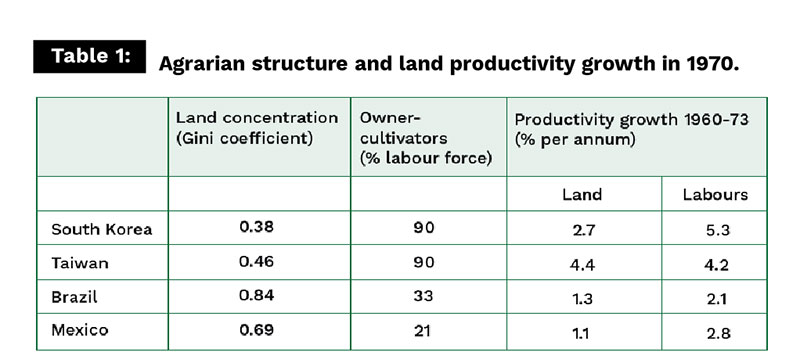
In Taiwan, the Kuomintang introduced land reforms because they came from mainland China and did not own land on the island. At the same time, in South Korea, soon after the Korean War, the US was very keen to create political stability. Land reform was viewed as helpful under such a situation, and by distributing land to the majority of the households, the new rulers could gain more respect and legitimacy. For instance, after land reform in Taiwan and South Korea, about 80 per cent and 70 per cent, respectively, of rural households were owner-cultivators in 1970 (see table 1).In Mexico and Brazil, despite some attempts at land reforms, the land monopoly was not broken, land concentration remained high and the amount of privately owned cultivated land controlled by large estates in 1970 was 84 per cent in Mexico and 60 per cent in Brazil.
Source: Jenkins (1991).
South Korea and Taiwan gained independence after the Second World War. In both South Korea and Taiwan, agriculture has been an essential source of accumulation for industries and the state supported this process to accomplish the objectives of land reform. Both these countries had little presence of landlordism before the Second World War. Agriculture was modernised in these two countries in the absence of landlords. With land reform, the government expected to increase output, which would mean keeping food prices low and, therefore, little pressure for wage increases from workers. An increase in foodgrain output would also mean lower food imports and savings on foreign exchange.
In contrast to East Asia, Latin America did not consider the importance of squeezing agricultural surplus for investment in industry, and downsizing the large landholders was not a policy priority. As a result, little savings were available for investment in industry, and these countries witnessed slow growth in employment and no increase in investment, which forced rural workers to migrate to cities. This meant that, in Latin America, the agriculture sector did not play an important role in generating accumulation for investment in industry and did not contribute significantly toward industrialisation. As Kay (2002: 1078) notes: “In the post-war period, Latin American agriculture failed to meet the demands of industrialisation, becoming an obstacle to further economic development. Agriculture’s share in the value of total Latin American exports declined from well over half in the 1950s to one-fifth in the 1990s. In contrast, the share of agricultural imports within total imports increased. In some Latin American countries, a previous positive agricultural trade balance turned negative, i.e., agricultural imports exceeded agricultural exports.”
The agriculture sector did contribute to industrialisation in South Korea. Korea was a Japanese colony from 1910 to 1945, and the country became independent after the war. In Korea, in 1946, land was concentrated in a small minority of households, i.e., 5 per cent of rural households owned 50 per cent of the total cultivated land. The rich landlords cultivated land using both tenants and hired wage labour. After the Korean War (1950-3) ended, the country was divided. By the mid-1950s, South Korea had launched land distribution with US support. Domestic officials were tasked to implement landownership transfer to the small farms.
The South Korean government showed determination and a strong will to transfer land ownership to small farmers and tenants. It was thought that reducing the power of the landed elites was necessary to counter North Korea and win the support of most rural households. The competent bureaucracy facilitated the implementation of land reform, which became a major success. As a result, agricultural output increased sharply, and rural employment rose. But also, the rural class difference was radically reduced, and political stability was established.
Moreover, food prices were kept under control due to increased food grain output. The state also provided credits, fertilisers, and water to farmers. As a result, there was a huge increase in agriculture productivity and efficiency, and investment in agriculture became more profitable for farmers. In South Korea, in the 1960s,a large proportion of the capital for industrialisation came from the agriculture sector, and the other important source was foreign aid, especially from the US. The state played a crucial role in providing foreign exchange to import technology for industry. South Korean government-owned banks intervened in financial markets and controlled foreign exchange allocations and fixed exchange rates and interest rates. The state also had a high degree of autonomy and was able to implement its policies successfully.
The government was unsuccessful in extracting surplus to fund industrialisation, as happened in East Asia. Later on, the economic crisis in Latin America deepened and paved the way for neoliberal policies.
The nationalist forces of the Kuomintang had to flee to Taiwan from mainland China after facing defeat by communist forces led by Mao. Under such circumstances, the Taiwanese government was formed. These elites migrated from the mainland and were interested in gaining support on the island. It was thought that the distribution of rural assets, especially land, would help to keep stability and gain popularity among the locals. In 1949, the Taiwanese government undertook various measures to address rural inequality, and to achieve this, land reforms were carried out, including fixing land rent from 50 per cent to 37.5 per cent, a measure which benefited tenant households.
In Taiwan, Japanese colonisers owned large farms, and in 1940 nearly 20 per cent of all arable land was owned by them. At the end of the war, with the defeat of Japan, the big Japanese landowners either left or were seen as collaborators, which provided an opportunity to implement the land reform act of 1953 fully. As a result, the land ownership monopoly was broken and, along with this, the government also subsidised irrigation, credits, and other agricultural inputs to farmers. All these efforts raised farm output and farmers’ income. The increased supply of food grains kept domestic food prices low, and thus, it helped to keep wages low while at the same time boosting industrial profits. Unlike South Korea, Taiwan had less industrial conglomerate dominance in the industrial sector. Land reform generated economic surplus, and this surplus was invested in industry in Taiwan.
In the 1950s and 60s, Latin American countries had far higher incomes than East Asian countries and higher levels of education, infrastructure, urbanisation, and industrialisation. Latin America in the 1950s and 60s had maintained higher growth rates, and performance was relatively good. However, in the 1980s, the situation changed dramatically with rising external debts and a balance of payments crisis. The region witnessed a debt crisis, poor governance, and mismanagement.
The bureaucracy in South Korea and Taiwan were more disciplined and motivated to achieve the policy set by the state, and there was very good coordination between these two state organs. And, due to the geopolitical significance of East Asia, the rulers had more policy freedom and received a greater amount of foreign aid and access to foreign markets.
Both the South Korean and Taiwanese regimes were initially very regressive and authoritarian. The share of economic growth was more widely distributed through investment in health, education, and housing than in the development states of Latin America. Moreover, South Korea and Taiwan were able to transfer land ownership, establish small family farms, and encourage entrepreneurship much better than in Latin America.
In the 1960s, the East Asian countries began promoting labour-intensive industries and exporting these products, but soon moved to high-value products. They targeted foreign markets, which was part of their long-term policy goals. In the agriculture sector, they adopted more intensive cultivation to double cropping, including a shift to higher-value-added crops, i.e., commercial crops, including fruit and vegetables. In comparison, Latin America continued the cultivation of subsistence crops, i.e., low-value crops, on a large proportion of land. Also, foreign-owned agribusiness expanded in the region.
Before launching industrialisation in South Korea and Taiwan, landlords were decimated and did not influence the rural power structure. In both countries, agricultural modernisation began during the Japanese colonial rule. In contrast to East Asia, Latin America failed to implement land reform fully. There was insignificant land transfer to small farm households in the post-reform period, and there was no substantial change in land relations compared to the pre-reform period. The big landowners remained powerful and did not witness any dent in the rural power structure. As Kay observed (2002:1089), “Landlords were invariably the direct descendants of the Spanish and Portuguese conquerors or foreign, largely European immigrants. The peasantry was mainly indigenous. Thus, the land conflict often acquired an ethnic dimension… While Korea and Taiwan had experienced Japanese colonialism, this was more short-lived, half a century, than Latin America’s three centuries of colonialism. Most Japanese landlords returned to Japan after the war. Thus, rural societies in Korea and Taiwan were more ethnically and culturally homogeneous, which facilitated the widespread adoption of innovations… While agrarian reforms in Latin America achieved some success, on the whole, the record is poor, and much of the business of agrarian reform has been left unfinished.”
In South Korea and Taiwan, land reform favoured medium and small farmers and strengthened state control over agriculture. By controlling the exchange rate and agricultural commodities prices, states were able to extract surplus, and thus agriculture made a crucial contribution to these countries. Subsidies to farmers stimulated shifts in cropping patterns in favour of high-value crops. Moreover, both countries received foreign aid during this period, which was channelled to expanding industry. Initially, industrialisation was based on rural industries, and created employment. It boosted their incomes, so that they were able to buy more industrial goods.
In Brazil, the government taxation on agricultural commodities exports, such as coffee and sugar, was an important source of revenue. But large farms contributed only 1 per cent of the state’s total revenue from income tax and still, the government provided subsidies to farmers via credits to buy inputs like fertilisers and agricultural machinery between 1970 and 1984.
The government was unsuccessful in extracting surplus to fund industrialisation, as happened in East Asia. Later on, the economic crisis in Latin America deepened and paved the way for neoliberal policies.
South Korea and Taiwan were able to raise the share of manufacturing export with their total exports to as high as 75 per cent in 1970, but Brazil and Mexico were as low as 10 per cent and4 per cent, respectively.
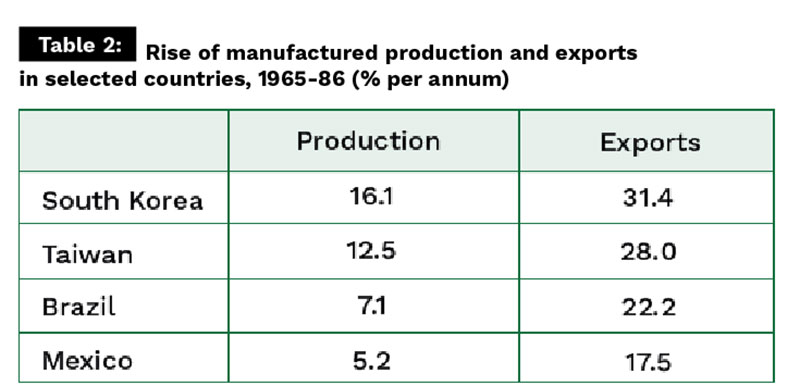
Moreover, East Asian countries, from the beginning, targeted international markets to export their industrial products, created a competitive industrial structure and made use of the cheap labour supply to produce labour-intensive products. Table 2 indicates that manufacturing production in Taiwan and South Korea almost doubled in a short period, and exports also rose.
In Latin America, only limited land reform was achieved. The land reform began much later, after industrialisation had already started. Neither of these measures helped to widen the domestic demand for industrial goods, while in East Asia, the land reform measures were undertaken before industrialisation. As a result, rising farmers’ incomes led to increased domestic demand for industrial goods.
Source: World Bank ;(1988} Jenkins (1991).
As Kay notes (2002: 1097), “Latin America engaged in a consumption binge, and capital flight, and became further entrenched in the ISI model… which has appropriately been named the ‘lost decade’ for development. Meanwhile, East Asian countries were able to continue to mobilise domestic savings. South Korea also began to borrow more capital from abroad; they could also overcome the twin problems that had blocked Latin America’s industrialisation, i.e., the foreign exchange and market constraints.”
During the Japanese colonial period, bureaucracy in South Korea and Taiwan was established, which provided very effective and disciplined organisation. In both countries, the bureaucracy enjoyed autonomy in policymaking and had little direct political pressure. While in Latin America, both big landowners and industrialists had a strong influence on the ministry of industry and government-owned banks, and used this for their narrow economic interests.
The 1973 Arab-Israeli War led to a tripling of the oil price, which resulted in the accumulation of vast foreign exchange in the hands of oil-exporting countries, most of which they deposited in Western banks. On the other hand, due to the sharp rise in oil prices, many non-oil-exporting countries, especially Latin American countries, experienced a balance of payments crisis (Siddiqui, 1996).
The availability of a huge petro-dollar at lower interest rates seemed a very attractive proposition for Latin American countries, who borrowed heavily from international financial institutions. During the 1980s, their export incomes fell, due to a fall in the price of raw materials in the international market, while in the US the rate of interest rose sharply. All these factors resulted in increased foreign debts, known as debt crises. This situation had an adverse impact on growth rates. In contrast to Latin America, East Asian countries did not experience such problems, since they relied not on borrowing, but rather on domestic savings.
III. Concluding Remarks
Mainstream economists and international financial institutions largely focus on the competitive market and virtues of the “free market”, “efficiency”, and “free trade”. But they ignore other factors such as the international environment, geopolitics, internal power dynamics, the role of the state, and cooperation between bureaucracy and the government. However, successful economic development in East Asia shows us that these factors seem to play a crucial role in the economic transformation.
The textbook stresses the importance of resource endowments, but the real-world experience of the last few decades is very different. For example, the fact that Latin America had larger resource endowments than East Asia did little to enhance their economies.
The international environment also contributed to the state’s relative autonomy in South Korea and Taiwan. Due to international tension, there was a massive inflow of US aid between the 1950s and 1960s in both countries.
The study finds that in contrast to East Asia, Latin America did not consider the importance of squeezing agricultural surplus for investment in industry, and for them downsizing the large landholders was not a policy priority. In contrast to Latin America, in South Korea and Taiwan, landlords as a class were eliminated before starting industrialisation. They could not pose any obstacle to the industrialisation and modernisation process in South Korea and Taiwan, while they continued to exercise political influence in Brazil and Mexico.
Before launching an export-oriented policy, South Korea and Taiwan started with the ISI policy. It is known now that the government protected domestic industries and, at the same time, encouraged exports of manufactured goods. The state in both countries provided directions and targeted industrial policy through their control over the allocation of resources.
The study concludes that international environments, total commitment on the part of the government, and the support of the bureaucracy made it possible to implement successful land reforms and mobilise agrarian resources, which led to radical change in agrarian structure and class relations. It also resulted in the transfer of surplus in inter-sectoral resource flows and industrialisation in South Korea and Taiwan.
Jenkins (1991: 200) emphasises, “Effective state intervention to bring about economic transformation requires the state to formulate and implement coherent economic strategies. A prerequisite for formulating a consistent strategy is a degree of autonomy of the state from the dominant classes or class fractions, which enables the state to pursue goals that do not reflect the interests of these groups and may even go against their short-term interests. The effective intervention also requires an internal structuring of the state apparatus in terms of efficient and cohesive bureaucratic machinery and effective policy instruments which gives the state capacity to implement its economic strategy.”
However, in the current international scenario, it seems that in the unipolar world, the US and its controlled IMF and World Bank have imposed neoliberal globalisation in the developing countries. Under such conditions, it is impossible for the developing countries to chart out independent economic policies suited to their specific conditions and needs. And under the IMF and World Bank, the market-based resource mobilisation is giving more power to MNCs and that will undermine the sovereignty of the developing countries.
Although Latin America began modernisation and industrialisation more than one century earlier than East Asian countries, it failed to improve the living conditions of its people. The Latin American economies witnessed steady growth, but all ended in the 1980s when they experienced debt crises, i.e., rising external debts and falling living conditions.
The study finds that the failure of land reform put obstacles in the way of industrialisation. Agrarian reforms were implemented in Latin American countries between the 1960s and 1980s, but were left incomplete, due to the governments’ lack of focus and mismanagement. In Brazil and Mexico, productivity growth in the agriculture sector was much slower than in East Asian countries, while food imports increased, particularly in Mexico, over the last three decades. Agricultural production was unable to keep pace with the increasing industrial requirements for cheap food and foreign exchange.
This article was originally published on 05 August 2022
Dr. Kalim Siddiqui is an economist, specialising in International Political Economy, Development Economics, International Trade, and International Economics. His work, which combines elements of international political economy and development economics, economic policy, economic history and international trade, often challenges prevailing orthodoxy about which policies promote overall development in less developed countries. Kalim teaches international economics at the Department of Accounting, Finance and Economics, University of Huddersfield, U.K.. He has taught economics since 1989 at various universities in Norway and U.K.
References
Akram-Lodhi, A.H. & C. Kay. (2010). “Surveying the agrarian question: unearthing foundations, exploring diversity”, Journal of Peasant Studies, 37(1): 177-202.
Amsden, A. (1994). “Why isn’t the world experimenting with the East Asian model to develop?”,World Development, 22(4): 627-33.
Bello, W. (2009) Food Wars, London: Verso.
Bernstein, H. (2006) “Is there an agrarian question in the 21st century?”,Canadian Journal of Development Studies, 27(4): 449-60.
Byres, T. (1996) Capitalism from above and Capitalism from below: an essay in comparative political economy, London: Macmillan.
De Janvry, A. (1981). “The Role of Land Reform in Economic Development: Policies and Politics”, American Journal of Agricultural Economics, vol. 63(2): 384-92.
Hobsbawm, E. (1994) Age of Extremism: the short twentieth century, 1914-1991, London: Michael Joseph.
Jenkins, R. (1991). “The Political Economy of Industrialisation: a comparison of Latin American and East Asian newly industrialising countries”, Development and Change, 22, pp. 197-231.
Kay, C. (2002) “Why East Asia overtook Latin America: agrarian reform, industrialisation and development”, Third World Quarterly, 23(6):1073-102.
Magdoff, H. (1974). “European expansion since 1763” in “Colonialism”, Encyclopaedia Britannica, vol.4, 15th Edition.
O’Connor, J. (1970). “The Meaning of Economic Imperialism” (ed.) R.I. Rhoads, Imperialism and Underdevelopment: A Reader, pp.101-52, New York: Monthly Review Press.
Preobrazhensky, E. (1965) The New Economics, Oxford Clarendon Press.
Siddiqui, K. (1985). “South-South Economic Co-operation and its Future Prospects”, Bergens
Tidende, Oct. 4, Norway.
Siddiqui, K. (1994). “World Bank: 50 Years of neo-liberalism and Diktat”, The Nation, Sep. 5 and 6.
Siddiqui, K. (1995) “Role of the State in South-East Asia”, The Nation, May 27.
Siddiqui, K. (1996). “The Debt Crisis – Need for a New Strategy”, The News, May 17.
Siddiqui, K. (1998). “The Export of Agricultural Commodities, Poverty and Ecological Crisis: A Case
Study of Central American Countries”, Economic and Political Weekly, 33(39): A128-A137, Sep. 26.
Siddiqui, K. (1999). “New Technology and Process of Differentiation: Two Sugarcane Cultivating Villages in UP, India”, Economic and Political Weekly, 34 (52): A39-A53, Dec. 25
Siddiqui, K. (2012a). “Malaysia’s Socio-Economic Transformation in Historical Perspective”, International Journal of Business & General Management, 1(2): 1-50, Nov..
Siddiqui, K. (2012b). “Developing Countries’ Experience with Neoliberalism and Globalisation”, Research in Applied Economics 4(4): 12-37, Dec.
Siddiqui, K. (2015a). “Economic Policy: State versus Market Controversy” (ed.) Adam P. Balcerzak. Contemporary Issues in Economy: Market or Government, pp. 39-63, Torun: European Regional Science Association, Poland.
Siddiqui, K. (2015b). “Trade Liberalisation and Economic Development: A Critical Review”, International Journal of Political Economy, 44(3): 228-47.
Siddiqui, K. (2015c). “Foreign Capital Investment into Developing Countries: Some Economic Policy Issues”, Research in World Economy, 6(2): 14-29.
Siddiqui, K. (2015d). “Agrarian Crisis and Transformation in India”, Journal of Economics and Political Economy, 2 (1): 3-22.
Siddiqui, K. (2016a). “A Study of Singapore as a Developmental State”, (ed.) Young-Chan Kim. Chinese Global Production Networks in ASEAN, pp.157-88, London: Springer.
Siddiqui, K. (2016b). “Experiences of Developmental State in India and Taiwan”, (ed.) D.P. Tripathi and B.R. Deepak. India and Taiwan: from benign neglect to pragmatism, pp.155-82, New Delhi: Vij Books.
Siddiqui, K. (2018a). “David Ricardo’s Comparative Advantage and Developing Countries: Myth and Reality”, International Critical Thought, 8(3): 1-28, Sep.
Siddiqui, K. (2018b). “Capitalism, Globalisation and Inequality”, The World Financial Review, Nov./Dec., pp. 72-7.
Siddiqui, K. (2019a). “India: Neoliberal Reforms and the Difficulties of Industrialisation” Alternatives Sud (in French) 26(4): 119-34.
Siddiqui, K. (2019b). “One Belt and One Road, China’s Massive Infrastructure Project to Boost Trade and Economy: An Overview”, International Critical Thought. 9(2): 214-35. Taylor & Francis, Routledge.
Siddiqui, K. (2020a). “A Comparative Political Economy of China and India: A Critical Review”, (ed.)
Young-Chan Kim, China-India Relations: Geo-Political Competition, Economic Cooperation, pp. 31-58, Switzerland: Springer.
Siddiqui, K. (2020b). “The Study of Economic History and the Importance of Understanding the Past”, The World Financial Review, Nov./Dec., pp. 46-59.
Siddiqui, K. (2020c). “Prospects of a Multipolar World and the Role of Emerging Economies”, The World Financial Review, Nov./Dec., pp. 65-77.
Siddiqui, K. (2020d). “Globalisation, International Trade and the Developing Countries”, The European Financial Review, Aug./Sep., pp. 60-71.
Siddiqui, K. (2021a). “The Political Economy of Industrial Policy”, The World Financial Review, May-June, pp. 58-66.
Siddiqui, K. (2021b). “Can 21st Century be an Asian Century?” Asian Profile, 49(1): 1-19, March.
Siddiqui, K. (2021c). “Agriculture, Sustainable Development, and the Government Policy in the Developing Countries”, The World Financial Review, Jan.-Feb. pp. 44-59.
Siddiqui, K. (2022). “Capitalism, Imperialism, and Crisis”, The European Financial Review. Forthcoming.
Toye, J. (1987). Dilemmas of Development, Oxford: Basil Blackwell.
Wade, R. (1983). “South Korea’s agricultural development: the myth of the passive state”, Pacific Viewpoint, 24 (1): 11-28.
World Bank. (1993). The East Asian Miracle: Public policy and economic growth, New York: Oxford University Press.
As a player, your experience at a casino is deeply intertwined with the legal landscape that shapes the gaming industry. This is particularly true in Canada, where the intricacies of casino laws can be somewhat complex. A clear understanding of these laws is essential for players looking to engage in gaming, whether at traditional brick-and-mortar establishments or at the best online casinos in Canada. In this article, we delve into these laws, focusing on their implications for players and highlighting the most recent changes.
Canada has a rich history of gambling that dates back centuries. However, the legislation that governs the gaming industry is relatively recent. The Canadian Criminal Code, revised in 1970, first decriminalized certain forms of gambling. Since then, it has been the cornerstone of Canadian gambling legislation.
Notably, the Code grants provinces the power to oversee and regulate gambling within their jurisdictions. This means that the legality and specifics of casino gaming can vary across provinces. For instance, the legal gambling age is 18 in Alberta but 19 in Ontario. As a player, it is essential to understand the specific laws in your province of residence.
Both offline and online casinos are legal in Canada, but they must be government-licensed to operate. Private companies are generally not allowed to run casinos or online gaming sites, with a few exceptions. This includes First Nations tribes, which, under certain conditions, are permitted to run gambling establishments on their reserves.
Online gambling presents a slightly more complicated situation. While there is no law explicitly banning Canadians from playing at international online casinos, the legal standing of such establishments can be murky. The Canadian Criminal Code does not permit any company to operate an online casino from Canada unless it is owned or licensed by a provincial government. However, the Code does not explicitly criminalize playing at an overseas online casino. As a result, many Canadians choose to play at international online casinos.
The best online casinos in Canada are typically those licensed by provincial governments. These casinos are closely monitored for fairness and security, ensuring a safe playing environment. Some of these include PlayNow (British Columbia), Espacejeux (Quebec), and PlayOLG (Ontario). By playing at these casinos, Canadians can be confident that they are gaming in a regulated environment where their rights are protected.
However, recent years have seen a push towards a more open, competitive market. A landmark decision was the 2012 amendment to the Criminal Code that allowed provinces to license and regulate online casinos. This led to the proliferation of online casinos and marked a significant step forward for the Canadian gaming industry.
One of the latest developments is the introduction of Bill C-218 in 2021, an amendment to the Criminal Code that legalizes single-event sports betting. Before this change, Canadians were only permitted to make parlay bets – wagers on multiple games. This change has significant implications for the online casino industry, with many operators now offering single-event betting options to Canadian players.
Another crucial law that Canadian players should know about is the Proceeds of Crime (Money Laundering) and Terrorist Financing Act (PCMLTFA). This law requires casinos to report all suspicious transactions to the Financial Transactions and Reports Analysis Centre of Canada (FINTRAC). This law is particularly important for high rollers, as casinos must report any transaction over C$10,000.
Finally, it’s essential to note that winnings from gambling are generally not considered taxable income in Canada, unless one is considered a professional gambler. The Canada Revenue Agency states that gambling winnings are taxable when they are “income from a business, profession or occupation, carried on for profit or gain.” Casual players, therefore, can enjoy their winnings tax-free.
To conclude, Canadian casino laws are designed to ensure fair, safe gaming experiences while mitigating risks associated with money laundering and problem gambling. Whether you prefer traditional casinos or find your thrill in the best online casinos in Canada, it’s crucial to be aware of these laws. After all, a knowledgeable player is a confident, responsible player. As the landscape continues to evolve, with potential for further liberalization of online gaming and sports betting, it will be interesting to see how Canadian gaming laws adapt to meet these changes. It’s a safe bet to say that the future looks bright for Canadian players.
Canada’s housing market is notoriously expensive, with homeownership remaining an elusive dream for many of the city’s residents.
However, an innovative housing strategy known as shared-equity housing is starting to become a viable alternative, offering some hope for aspiring homeowners struggling with the current housing crisis.
It’s a powerful tool that could be used to help many Canadians, said Adam Gant, a Victoria real estate expert and an advisor for REAfe Advisory, which assists real estate investment and development companies with growth and strategy.
Gant believes shared-equity housing could be a turning point.
“This model could advance access to equity in our housing market,” he said. “It presents a tangible solution to the affordability crisis, stabilizes communities, and helps create a more equitable society.”
What Is Shared-Equity Housing?
Shared-equity housing is a model that allows buyers to build equity in a home starting with a small amount to begin with rather than having to purchase the whole property up front, dramatically reducing the financial barriers to homeownership.
The remaining equity stays with a housing fund, which subsidizes the initial purchase and shares in the potential risk or reward of property value fluctuations.
According to data from the Canadian Real Estate Association, the average price of a residential property in fall 2022 was $644,643, CTV News reported. That’s an increase from previous years, and the upward trend shows little sign of slowing down — underpinning the urgent need for affordable housing solutions, Gant said.
With shared-equity housing, potential homeowners who were previously unable to enter the housing market can often afford a home.
“Canada needs fresh approaches to housing, and this innovative model reduces the initial down payment needed without making the market unstable like excessive debt would, and often enables participants to live in areas with access to better schools, safer neighborhoods, and more employment opportunities,” Gant said.
A Tough Market in Canada
Critics of Canada’s current housing market claim it is increasingly out of reach for many residents, particularly first-time buyers or other kinds of blended families. One recent poll even suggested that many Canadians have “given up” on ever owning a home.
As a result, shared-equity housing presents a solution to the “rent trap” many Canadians find themselves in — when a significant portion of their income is poured into rent without building equity or ownership.
Through shared equity housing, these residents can invest in their future and gradually increase their home equity over time, Gant said.
“While shared equity won’t solve every housing issue, it is a promising start,” Gant said. “It provides a lifeline to homeownership for those left out in the cold by the traditional housing market.”
Successes and Challenges
Several shared-equity housing programs are already making significant strides across Canada. In Calgary, the Attainable Homes program helps moderate-income households purchase homes, offering down-payment assistance and sharing the home price appreciation to keep homes affordable for future buyers.
But despite its potential, shared-equity housing is not without challenges. Questions remain about how to scale up these initiatives to address the enormity of Canada’s housing affordability problem, Gant said.
Its success will depend on continued innovation, funding, and commitment from both policymakers and the public, or more broad adoption and support within the capital markets, he added.
“But for many Canadians, this model offers more than just a home – it provides a path to stability, security, and a brighter future,” Victoria’s Adam Gant said.
Are you tired of walking into a chaotic warehouse or distribution center, where items are scattered haphazardly and finding what you need feels like searching for a needle in a haystack? Well, look no further! Introducing pallet racking systems – the ultimate storage solution that will revolutionize the way you organize your space. With their sleek design and efficient functionality, these systems are guaranteed to bring order and efficiency to your operations.
Picture this: shelves upon shelves neatly stacked with pallets of products, all easily visible and accessible at a glance. No more wasting precious time rummaging through cluttered aisles or struggling to find that one elusive item buried deep within the chaos. Thanks to pallet racking systems, your warehouse or distribution center will become an oasis of organization. From selective racks that allow easy access to individual items, to drive-in racks that maximize storage density, there is a solution tailored specifically for your needs.
But it doesn’t stop there. Implementing a pallet racking system brings with it numerous benefits that go beyond just tidying up your space. Imagine improved inventory management, increased productivity levels, and reduced risk of accidents caused by falling objects. These ingenious systems not only optimize storage capacity but also enhance overall operational efficiency – saving both time and money in the long run. So why settle for disorder when you can embrace the wonders of pallet racking systems? Get ready to transform your warehouse into a haven of efficiency and ease with these revolutionary storage solutions!
Types of Pallet Racking Systems
Get ready to discover the different types of pallet racking systems that will revolutionize your warehouse and distribution center! One popular type is selective racking, which is designed for easy access to every pallet. This system consists of upright frames, beams, and wire decking. The upright frames are vertical columns that provide support and stability for the entire structure. Beams are horizontal bars that connect the upright frames and hold the pallets in place. Wire decking is a grid-like surface that sits on top of the beams, providing additional support for the stored items.
Another type of pallet racking system is drive-in racking, which maximizes storage space by allowing forklifts to enter the racks and load or unload from one side only. This system uses fewer aisles than other types of racking systems, making it ideal for warehouses with limited space. Drive-in racks consist of rails that guide the forklifts into position, as well as upright frames and beams similar to those used in selective racking.
Now that you have learned about some types of pallet racking systems like selective racking and drive-in racking, let’s explore their benefits in more detail. These systems not only optimize storage space but also improve inventory management by providing easy access to each pallet. By implementing a pallet racking Queensland system in your warehouse or distribution center, you can streamline operations, increase efficiency, and ultimately enhance productivity throughout your facility.
Benefits of Implementing a Pallet Racking System
There’s a multitude of advantages to incorporating a pallet racking system, making your operations more efficient and maximizing available space. One of the main benefits is increased efficiency. With a pallet racking system, you can organize your warehouse or distribution center in a way that allows for easy access and retrieval of goods. This means that your employees can quickly locate and retrieve specific items, reducing the time spent searching for products. Additionally, the use of pallet racking systems allows for better inventory management. By organizing your products on pallets and utilizing racks, you can easily track inventory levels and ensure accurate stock counts. This helps prevent overstocking or understocking situations, allowing you to optimize your supply chain processes.
Furthermore, implementing a pallet racking system also maximizes available space in your warehouse or distribution center. By utilizing vertical space effectively, you can store more goods without expanding the physical footprint of your facility. Pallet racking systems allow for high-density storage solutions where multiple levels of racks can be stacked on top of each other. This not only increases storage capacity but also facilitates better organization and accessibility to different SKUs (Stock Keeping Units). With improved space utilization, you can make the most out of every square foot of your facility.
As you consider implementing a pallet racking system in your warehouse or distribution center, it’s important to take into account various factors such as load capacity requirements, available floor space, design flexibility, and future expansion plans. These considerations will help guide you in choosing the right type of pallet racking system that aligns with your specific needs and goals for increased efficiency and improved inventory management.”
Factors to Consider When Choosing a Pallet Racking System
When choosing a pallet racking system, it’s crucial to consider factors like load capacity, available space, design flexibility, and future expansion plans. Firstly, you need to evaluate your warehouse layout and determine the most efficient way to utilize the space. Consider the height of your facility and whether you can take advantage of vertical storage with high-density racking systems. Additionally, analyze the dimensions and weight of your inventory to ensure that the chosen pallet racking system can accommodate your specific load capacity requirements.
Another important factor is the design flexibility of the pallet racking system. You want a solution that can be easily adjusted or reconfigured as your storage needs change over time. Look for systems that offer adjustable beam heights or interchangeable components that allow for customization. This will enable you to optimize your storage space and adapt to any changes in inventory sizes or quantities.
Furthermore, it’s essential to consider your future expansion plans when selecting a pallet racking system. Evaluate if the chosen system can be easily expanded or scaled up in case you need additional storage capacity in the future. This will save you from having to invest in a completely new system when your business grows.
Choosing a suitable pallet racking system involves careful consideration of factors such as warehouse layout and load capacity requirements. It’s important to assess available space, design flexibility, and potential for future expansion before making a decision. By doing so, you can ensure an efficient storage solution that meets all your current needs while allowing room for growth.
Moving on to the next section about ‘installation and maintenance of pallet racking systems,’ let’s explore how these systems are set up and what measures should be taken for their proper upkeep without compromising safety standards.
Installation and Maintenance of Pallet Racking Systems
Looking to efficiently install and maintain your pallet racking? Let’s delve into the ins and outs of setting up and caring for these essential storage structures. When it comes to pallet racking safety, there are several factors to consider during installation. First and foremost, it is crucial to ensure that the racking system is installed by qualified professionals who have experience in this specific area. Common mistakes in pallet racking installation can lead to serious accidents and injuries, so it is vital to follow industry standards and guidelines.
During installation, attention should be paid to the weight capacity of each rack level, ensuring that it matches the intended use. Overloading a rack can cause it to collapse or become unstable, posing significant risks not only to personnel but also to stored products. Additionally, proper anchoring of the racking system is essential for stability. Neglecting this step can result in racks tipping over or shifting under load, jeopardizing the integrity of the entire structure.
Maintenance plays a critical role in prolonging the lifespan of pallet racking systems and ensuring their continued safe operation. Regular inspections should be conducted by trained personnel who can identify any signs of damage or wear on components such as beams, uprights, and connectors. Any damaged parts should be replaced promptly to prevent further deterioration that could compromise structural integrity.
Transitioning into the subsequent section about ‘case studies: successful implementation of pallet racking systems,’ understanding the importance of proper installation and maintenance lays a solid foundation for achieving optimal performance from your storage solution. By following recommended procedures and avoiding common mistakes during setup, you can greatly minimize potential hazards associated with pallet racking systems while maximizing their efficiency in warehouse operations.
Case Studies: Successful Implementation of Pallet Racking Systems
To successfully implement pallet racking, envision your warehouse transformed into a well-organized space where products flow seamlessly, utilizing every inch of available vertical storage. Case studies have shown that following best practices during the implementation process can lead to significant improvements in efficiency and productivity.
One case study involved a distribution center that implemented a pallet racking system with careful planning and attention to detail. The first step was conducting a thorough analysis of their inventory and storage needs. By understanding the specific requirements of their products, they were able to design a racking system that maximized storage capacity while ensuring easy access to items. They also took into account future growth projections, allowing for scalability in their design.
Another successful case study involved a large warehouse that implemented pallet racking systems as part of their expansion project. They followed best practices by involving all stakeholders in the decision-making process. This ensured that different departments had input on the layout and design of the racking system, resulting in increased collaboration and satisfaction among employees. Additionally, they conducted regular maintenance checks and trained their staff on proper usage and safety protocols, minimizing the risk of accidents or damage to goods.
By studying these case studies and implementing best practices such as careful planning, stakeholder involvement, regular maintenance checks, and employee training, you can ensure a successful implementation of pallet racking systems in your warehouse or distribution center. Transform your space into an efficient hub where products are stored securely and easily accessible for streamlined operations.
In recent years, the popularity of cryptocurrencies as investment assets has greatly surged. The growing demand for digital coins accompanied by the increasing number of these coins makes many crypto enthusiasts confused about their investment decisions. Things become even more complicated when they explore how volatile these assets are and what losses they might potentially lead to.
In order to simplify this investment journey for you, we decided to write this short guide on cryptocurrencies that are good to invest in this year. We also would like to warn you, that this is just a recommendation based on our insights but not an analytical review and investment advice. Before making your final investment decisions, make sure to conduct your own research.
Let’s get down to business!
BNB
If you are thinking about investing in cryptocurrencies, you probably already have an account on a crypto exchange platform or are going to register a new one. When choosing a crypto platform, you must have considered Binance as one of the most popular options. Except for being one of the best exchanges right now, Binance also offers its own cryptocurrency traded under the BNB ticker symbol.
Currently, with more than $37.5 billion in market capitalization, BNB is the third-largest cryptocurrency. In addition to having strong fundamentals, BNB is known to be a resilient digital asset during the period of uncertainty in the crypto market. When the entire industry was going through one of the most severe bear rallies in history, BNB fall only to $240, while $371 was its highest price ever. This is a great result compared to BTC, for instance, which lost around 50%. This resilience is a good reason to consider BNB for investing this year.
Cosmos
Cosmos is designed as a decentralized network of interconnected blockchains, enabling seamless communication and data exchange between different blockchain platforms. This interoperability allows for the creation of scalable and customizable decentralized applications (DApps) that can interact with multiple blockchains. By investing in Cosmos, you can tap into the potential of this interoperable ecosystem, benefiting from the growth of various blockchain projects within the Cosmos network.
Cosmos utilizes a unique consensus algorithm called Tendermint, which provides fast transaction processing and high throughput. This scalability and performance make Cosmos well-suited for applications that require quick and efficient processing of transactions, such as financial services, supply chain management, and gaming platforms. As more projects leverage the capabilities of Cosmos, its value as a cryptocurrency is likely to increase.
With its focus on interoperability and scalability, Cosmos is well-positioned to address the challenges faced by existing blockchain networks. As the demand for efficient and interconnected blockchain solutions continues to grow, Cosmos has the potential to become a leading player in the industry. Investing in Cosmos allows you to be part of this journey and potentially reap the rewards of its long-term success.
Decentraland Coin
Decentraland is a platform that leverages the power and capabilities of NFT technology to enhance the gaming experience. You can invest in this project by buying its native token traded under the MANA ticker symbol, which is believed to be the top gaming crypto to invest in 2023. The platform gained its popularity thanks to an innovative concept that can change the entire gaming industry: by leveraging NFT technologies, Decentraland provided gamers with the possibility to gain real ownership over their in-game assets. Thanks to this, gamers’ efforts won’t be useless even if something happens to the platform — they will keep possession of their digital assets.
Currently, the MANA token, priced at $0.38, is at its bearish run. It’s expected to start gaining value as soon as the concept of NFT gains hype again and attracts numerous of gamers to the Decentraland platform. Experts predict that if it happens this year, MANA can end 2023 at the point of $1.99.
Ethereum
Despite the wide introduction of new blockchain networks represented as Ethereum killers, the second-biggest blockchain isn’t seen to lose its popularity and demand in the nearest future. Although the previous year ETH lost a significant share in value, falling from $4,844 to below $1,000, its current performance motivates analysts to expect positive changes in the future. This is because Ethereum remains a well-established crypto project and is going to present some innovations, such as Ethereum 2.0 with a brand-new burning mechanism.
Solana
Solana offers a developer-friendly environment with comprehensive tooling and support. Its architecture allows for the easy deployment of smart contracts and the creation of decentralized applications (DApps). The Solana ecosystem is continually expanding, attracting talented developers and fostering innovation. By investing in Solana, you can participate in the growth of this vibrant ecosystem and potentially benefit from the success of new and exciting projects.
Solana has been gaining significant traction in the blockchain space, attracting both developers and institutional investors. It has formed partnerships with prominent projects and platforms, expanding its reach and increasing its visibility in the crypto industry. The growing adoption and recognition of Solana could potentially contribute to the appreciation of its value over time.
In the vast landscape of our world, where over seven billion individuals dwell, the phenomenon of shared names is an inescapable reality.
You may be a Mary Johnson, one among many, or perhaps an Anthony Thomas, sharing your moniker with countless others across the globe. Having a common name, while unremarkable at first glance, carries with it unique experiences and challenges.
This article delves into the diverse dimensions of bearing a common name, from amusing mix-ups of identity to serious concerns over privacy. It seeks to shed light on the realities faced by those who navigate life bearing a popular epithet.
Understanding Common Names
Common names, by definition, are names frequently used within a specific culture, country, or globally. They emerge due to various factors like tradition, popular culture, and religious influences.
Historical figures, celebrities, and religious icons often influence the prevalence of certain names. For instance, “Muhammad” is exceedingly common in Muslim-majority countries, while “James” or “Sarah” recur frequently in Western cultures.
Experiences and Identity Mix-ups
People with common names frequently encounter unexpected instances of mistaken identity, both in their personal and professional lives. These can range from innocuous mix-ups, such as receiving a coffee meant for another individual with the same name at a café, to more critical mix-ups, like medical records getting confused at a healthcare facility.
These identity mix-ups often extend to digital platforms, particularly on social media and email services where usernames or addresses are primarily based on one’s name. Individuals with common names often receive emails meant for someone else or get tagged in social media posts by people they’ve never met.
Beyond the digital realm, common names can also cause confusion in traditional settings. People have been known to receive another person’s mail, be mistaken for another individual during a job interview, or have their hotel reservations mixed up with someone else’s.
The constant potential for such mix-ups can lead to a certain level of inconvenience or discomfort for individuals with common names. Furthermore, it can also instigate a more profound psychological impact, prompting feelings of diminished uniqueness or individuality.
The Intersection of Common Names and Modern Technology
Modern technology, particularly digital platforms, has amplified the challenges associated with having a common name. The digital world, with its vast networks of social media, emails, and online accounts, often compounds instances of mistaken identities.
Imagine the confusion when a simple Facebook search for a common name returns hundreds, or even thousands, of results. This is not just a theoretical issue, but a daily reality for those with common names, causing a deluge of friend requests or messages meant for others.
Similarly, email communication can turn into a minefield of mistaken identities. For instance, someone might intend to email a colleague, but the message accidentally lands in a stranger’s inbox because they share the same name.
Moreover, in a world increasingly reliant on e-commerce, common names can lead to misdirected orders, mixed up delivery addresses, and customer service challenges.
This intersection of common names and modern technology signifies a need for unique identifiers and rigorous verification processes to ensure accurate identity recognition, while also maintaining user-friendly interfaces. Despite the convenience of technology, for those with common names, it can often become a double-edged sword.
Privacy Concerns with Common Names
A common name can sometimes offer a veneer of anonymity, but it also comes with substantial privacy concerns. The convenience of being “one of many” can quickly turn into a privacy nightmare.
For example, individuals with common names can unintentionally become recipients of sensitive information, like bank details or private correspondence, meant for someone else with the same name. This raises significant concerns about the confidentiality of personal information, potentially resulting in distress and reputational damage.
Conversely, personal data belonging to someone with a common name can inadvertently end up in a stranger’s hands. This raises the specter of identity theft, a serious crime that can lead to substantial financial loss and legal complications.
The prevalence of common names in online platforms further complicates this issue. Digital platforms often struggle to distinguish between individuals with the same name, leading to privacy breaches that can expose personal information and communications.
Privacy is a fundamental right. Still, for those with common names, it’s a constant battle to ensure that their information is protected and that they are not unduly exposed to risks due to mix-ups. The increasing complexity of the digital world necessitates better mechanisms to protect the privacy of individuals with common names.
Navigating the World with a Common Name
Navigating life with a common name can present unique challenges, but individuals have found various strategies to differentiate themselves. These may include the use of middle names, nicknames, or initials to establish a more distinct identity, particularly in professional or online settings.
In the digital realm, these strategies can extend to using unique identifiers or personal taglines in social media profiles or incorporating numbers or unique characters into email addresses. Additionally, individuals with common names often find themselves compelled to exercise heightened diligence in managing their digital footprints, double-checking email recipients, and clarifying identities during interactions.
Alongside these proactive measures, protective strategies, such as setting up robust password protection, employing two-factor authentication, and regularly monitoring personal accounts, are also essential. Despite the challenges, it is entirely possible to navigate the world confidently and securely with a common name.
Legal and Policy Implications
Currently, there are limited legal protections or policies that directly address name-related issues. However, stronger data privacy laws and stricter regulations for businesses regarding the sharing and handling of personal information can potentially alleviate some challenges associated with common names.
Policy changes that standardize the use of additional identifiers, such as birthdates or addresses, in non-sensitive situations could also be explored to help differentiate individuals with common names.
Conclusion
Having a common name can undoubtedly present a unique set of challenges, from identity mix-ups to privacy concerns. As we navigate the complexities of our digital age, awareness and understanding of these realities become crucial.
With the right strategies and potential policy changes, we can ensure a more seamless existence for those bearing the world’s most common monikers.
Being in debt can be overwhelming, especially when you have large balances accruing interest, making it more difficult to overcome. However, the good news is getting out of debt is possible – it just takes a little time.
While taking on debts can be necessary in certain scenarios, such as buying a car or home, it’s important to deal with other debts that are causing stress. The key is to take debt repayment little by little, breaking down what you owe, finding extra funds to direct toward debt payments, and avoiding unnecessary debt going forward.
Clinton Orr is Senior Wealth Advisor and Senior Portfolio Manager at Becker Orr Wealth Management, part of Winnipeg-based Canaccord Genuity Wealth Management. He has broad experience in financial planning, investing and asset management. His insights into managing debt are valuable for those looking to find their way to a better financial situation.
“The problem with our world today is that debt is so normalized that we think it’s just a natural part of life,” explains Orr. “And while in certain cases that’s true, I believe we are far more comfortable with living in debt than we should be. When it comes to actually addressing debt, an honest conversation followed by a plan is essential.”
The key is to take debt repayment piece by piece, breaking down what exactly you owe, finding extra funds to direct toward debt payments and avoid unnecessary debt as you move forward. Here are a few steps Canadian wealth advisor Clinton Orr recommends to help get yourself out of debt and remain debt-free.
List everything you owe
Take a detailed inventory of your debt to get a clearer picture of where you are, and where you’re headed financially.
Write down all of your debts – note everything you owe, including credit card balances, personal loans, auto loans, student debt, your mortgage and any other debts. If you aren’t sure exactly what you owe, check your credit report to get a clear view of your debts, including any in collections. Keep in mind that your lenders will have the most up-to-date information on all of your balances.
Next to each debt, write down the interest rate, minimum monthly payment and due date. Calculate your minimum monthly payment by adding up the minimum payments of all of your debts to find the bare minimum amount required to pay every month to stay current on your debt.
Decide how much you can pay each month
While making all of your minimum monthly payments on your debts will keep your payment history in good standing, it will also mean staying in debt longer and paying more in interest. The more you can pay above the minimum each month, the faster you can get out of debt. Of course, this is easier said than done, especially if money is tight.
“Working with a financial professional can be beneficial when it comes to breaking down your debts and planning a way to get out of them completely,” says Manitoba wealth advisor Clinton Orr. “Contrary to what people believe, financial advisors don’t just provide advice on investments, many of us are fully capable of building a complete financial plan – including managing debts.”
In calculating how much you are able to pay each bill cycle, add up your monthly expenses. Using a spreadsheet or a budgeting app, calculate how much you spend on basic expenses each month, such as groceries, cell phone bill, utilities, gas, rent/mortgage, and so on. For expenses that vary, such as your electricity payment, try taking the average over several months.
Next, compare your expenses to your income. Tally up your monthly net income, which is what you take home after taxes. Subtract your total expenses from your monthly income, including necessary expenses noted above, and discretionary expenses, such as entertainment and other nonessential expenses. If the amount you have left over isn’t enough to pay down your debt, you’ll have to take action to improve your cash flow, by cutting expenses or increasing your income.
Multiply income, subtract expenses
One of the keys to eliminating debt is to look for opportunities to save money. According to Clinton Orr, it’s important to regularly review all of your expenses and consider ways to spend less, such as by cutting back on dining out and unnecessary retail purchases.
Be creative in your cost-cutting. Does your family maintain two vehicles, but you could easily get by with one? Used car prices are at historically high levels, and selling that extra vehicle to Carmax or an established dealer can help you pay down debt quickly. Some popular late-model vehicles are actually bringing more in the used car market than they did when new, says Orr.
Once you’ve explored ways to cut expenses, the other side of the coin is to look for opportunities to supplement or increase your income. Find a side hustle, take on extra shifts at work, ask for a raise, or start your own business.
“When you create your own business, you open your future to a whole range of new opportunities,” says Orr. “And if starting your own venture is part of your family’s debt-reduction plan, there’s an added bonus: You’ve already learned the importance of limiting and managing debt, which will pay tremendous dividends down the road for your business.”
CG WEALTH MANAGEMENT IS A DIVISION OF CANACCORD GENUITY CORP., MEMBER-CANADIAN INVESTOR PROTECTION FUND AND THE INVESTMENT INDUSTRY REGULATORY ORGANIZATION OF CANADA
The comments and opinions expressed in this article are solely the work of Clinton Orr, not an official publication of CG Corp., and may differ from the opinion of CG Corp’s. Research Department. Accordingly, they should not be considered as representatives of CG Corp’s. beliefs, opinions or recommendations. All information is given as of the date appearing in this article, is for general information only, does not constitute legal or tax advice, and the author Clinton Orr does not assume any obligation to update it or to advise on further developments related. All information included herein has been compiled from sources believed to be reliable, but its accuracy and completeness is not guaranteed, nor in providing it do the author or CG Corp. assume any liability.
By Terence Tse
CFOs are evolving into AI-driven transformation orchestrators, balancing finance, technology, and strategy while upskilling teams, managing risks, and driving measurable business value.
A key insight from this year’s AI for CFOs event, organized...
The World Financial Review uses cookies to improve site functionality, provide you with a better browsing experience, and to enable our partners to advertise to you. Detailed information on the use of cookies on this Site, and how you can decline them, is provided in our Privacy Policy and Terms and Conditions. By clicking on the accept button and using this Site, you consent to our Privacy Policy and Terms and Conditions. ACCEPT
Privacy & Cookies Policy
Privacy Overview
This website uses cookies to improve your experience while you navigate through the website. Out of these cookies, the cookies that are categorized as necessary are stored on your browser as they are essential for the working of basic functionalities of the website. We also use third-party cookies that help us analyze and understand how you use this website. These cookies will be stored in your browser only with your consent. You also have the option to opt-out of these cookies. But opting out of some of these cookies may have an effect on your browsing experience.
Necessary cookies are absolutely essential for the website to function properly. This category only includes cookies that ensures basic functionalities and security features of the website. These cookies do not store any personal information.
Any cookies that may not be particularly necessary for the website to function and is used specifically to collect user personal data via analytics, ads, other embedded contents are termed as non-necessary cookies. It is mandatory to procure user consent prior to running these cookies on your website.