This article offers thought-provoking perspectives on South Korea’s economic development and introduces a new innovative model, through which any actors (especially in developing countries) can gain a competitive advantage. The new model details four factors, agility, benchmarking, convergence, and dedication, or namely, the ABCDs.
A New Framework for Explaining Korea’s Economic Success
In the 1960s, Korea was one of the world’s poorest countries that heavily depended on foreign aid. Over the span of 50 years, however, Korea rapidly upgraded its industrial structure, transforming itself from a poor agricultural nation into a global leader in multiple advanced industries, including electronics, automobiles, steel, machinery, and petrochemicals. Today, Korea is one of the G20 countries leading the global economy. Along with economic development, Korea has been one of the few Asian countries to achieve democratisation and expand its cultural influence (e.g., Korean Wave) around the globe.
While scholars have attempted to single out the factors of Korea’s success based on existing theories, they have not been able to holistically explain Korea’s “miraculous” growth. In analysing competitiveness, Western theories, in particular, place an emphasis on factors such as advanced technologies as the source of growth for developed countries and cheap labour for developing countries. For example, they attribute the leading position of the United States to its advanced technologies and the initial economic success of Korea to its cheap labour. However, what existing theories cannot explain is why certain countries experience greater or faster growth compared to their counterparts that have similar factor conditions. The ABCD model that is introduced in this article provides a clear analytical framework that answers this fundamental question.
Western economics also emphasises the importance of innovation, based on raw intelligence and brainpower, to gain competitiveness among similar advanced countries. This article will show that raw intelligence and innovation are not “requirements” for creating sustainable competitiveness. In fact, many of today’s most successful firms are neither the “first movers” nor the retainers of “state-of-the-art technologies” in their industries. Through the analysis of the Korean case, this article reveals that economic success is not attributed to a mysterious, genetically engineered recipe of innovation or a naturally inherited resource.
The ABCD factors – agility, benchmarking, convergence, and dedication – are the main pillars that weaved Korea’s present competitiveness. While the ABCD model was originally created to identify the factors that have contributed to Korea’s economic success, I have come to realise that the model can also be applied to other countries at various levels of analysis (e.g., government, firms, and people). It can serve as a playbook to successful growth for developing countries and as a strategic framework for developed countries that are losing competitiveness.
The ABCD Model
People often misunderstand the fundamental factors that have contributed to Korea’s economic growth. Popularly mentioned factors are cheap labour, export promotion policies, perspiration with strong government guidance, and Confucian ethics, and yet these are not entirely correct because not all countries that had such factors achieved economic growth. Factors such as cheap labour were not unique to Korea, but were actually more abundantly present in other areas of Asia, Africa, and Latin America during the time of Korea’s economic take-off. Moreover, many developing countries have employed export promotion policies, and large parts of Asia share strong governments and the Confucian legacies. Yet, few of the developing countries despite those commonalities have achieved significant economic success to parallel Korea’s, showing that major factors for economic growth are to be found somewhere else. The following section unveils Korea’s strategy for its economic success, using the newly constructed ABCD model, composed of four main factors, agility, benchmarking, convergence, and dedication, which can be further divided into two sub-factors(see Figure 1).
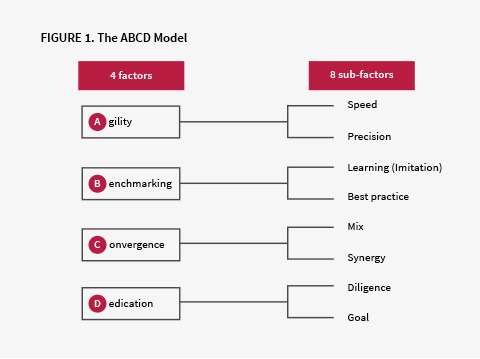
Agility: speed combined with precision for increasing productivity. First, complementing the cheap labour – or rather what the cheap labour was complementing – was the high productivity, or agility involving a good balance between speed and precision. Korean workers were speedier and yet more precise in comparison to other competitors (i.e., agility). The reason why Korean construction firms were able to win large scale business projects in the Middle East over other firms from more advanced countries during the 1970s and 1980s was not just cheap labour (other countries such as Egypt, Ethiopia, and Sri Lanka had cheaper labour and the Western multinational firms hired workers from these countries), but their ability to complete projects the fastest while maintaining a good level of quality (i.e., precision). As the Middle East countries desired to develop their infrastructure and economies quickly, they were attracted to the agile Korean firms.
Benchmarking: learning the best practices for efficient catch-up. Second, while facilitating the country’s exports to expand market, Korea focused on learning the best practices by global standards and achieving economies of scale. Adopting the proven best practices (i.e., benchmarking) was a time-efficient approach for Korean firms to catch up and compete with other international rivals. Benchmarking the global best practices is an important and positive aspect of an export-promotion policy compared to an import-substitution policy. Firms may lose competitiveness under an import-substitution policy that only focuses on domestic demand while neglecting international markets and global standards. In addition, firms will not be able to achieve economies of scale when they only serve the domestic market.
Convergence: mixing synergistically for creating new advantages. Third, Koreans undoubtedly had perspiration with strong government guidance, but more importantly, it was combined with inspiration and other productive practices (i.e., convergence). Korean workers were adept at combining the best practices of the West and Japan with their own strengths, which generated high synergies. Perspiration is crucial and it is a common characteristic of people in a growing economy. However, as a country’s economy advances it often adds its own inspiration and other practices, which enhances competitiveness. The Korean chaebol (the Korean conglomerates) are good examples that originally started with a “me too” strategy, producing low-cost products, but gradually developed into competent global players selling innovative, differentiated products.
Dedication: diligence with goal orientation for a strong commitment. Lastly, Koreans worked hard, but more importantly with a strong desire for a better life. This factor is not entirely related to the Confucian ethics, which is often misunderstood. Confucianism can either set back or promote economic development. One characteristic of Confucianism is its preference of maintaining the status quo instead of active reforms and development. The passivity and unprogressive nature can hinder fast and steady development especially at the early phases of economic development. On the other hand, Confucianism places the responsibility and reliability of leaders on the top of its value system, as well as diligence and strong goal orientation towards success. The strong emphasis placed on dedication has helped Korea strengthen and expedite the process of economic development.
Overcoming Difficulties and Creating New Advantages
Korea came to develop its ABCDs as it overcame one challenge after another. While some Asian countries, such as the four tigers (e.g., Taiwan, Hong Kong, and Singapore), experienced hardships after World War II, Korea faced even more challenges due to the subsequent outbreak of the Korean War. Koreans needed to be faster and had to work harder in order to survive their dire circumstances. Eventually, the hardships that Koreans faced were a blessing in disguise on its path for a successful, long-term economic development.
Under the continued threat from the North, South Koreans worked even harder to overcome difficulties, and this helped enhance the competitiveness of Korea’s workforce. President Park Chung-hee further improved the Korean economy with well-constructed policies. Unfortunately, there are two common misunderstandings regarding President Park’s economic policy. The first is that the intense government intervention reduced market efficiencies. However, in reality, President Park created globally competitive firms. The other misunderstanding is that he only favoured a few big chaebol, but in fact, President Park supported only the most competitive firms in order to maximise the utility of the country’s scarce resources. His criteria (e.g., export performance) were clear and fair, which is strikingly different from cronyism frequently shown in other authoritarian countries.
It is important that policymakers correctly understand the market and firms. The market is often more efficient than policymakers or scholars think, and firms do more good than harm to society. The effectiveness of the market and firms varies at different levels and situations of the economy. Other Korean presidents, who followed President Park, have also contributed to the country’s economic achievements, although some policies have been controversial. As Korea becomes a more advanced economy and needs more sophisticated solutions to intricate problems, the ABCD model may serve as a useful tool in guiding the appropriate path forward.
Challenges in the Future
Some say that Korea should change its “speedy” culture to a “precise” one in order to advance its current level of economic development. However, there is no need to sacrifice speed for precision; it is possible to have both. The Korean chaebol – for example, Samsung, Hyundai, and POSCO – continued to create sustainable competitiveness because they were fast (despite being large) and precise (despite operating in a broad industry spectrum). Speed, as the core competence of the Korean economy and business, should not be sacrificed, but complemented with enhanced precision.
Likewise, Korea should not give up its practice of “imitation” or learning by prioritising innovation. Even one of the most innovative places in the world, Silicon Valley, is not all about creating original breakthrough technologies. Silicon Valley was founded upon an entrepreneurial culture that “efficiently” promoted innovation. The region provides a collaborative environment for all people to share the best practices across different fields. This environment allows anyone to learn the global standard and add incremental “alphas (i.e., innovation)” to existing best practices. Competitiveness can be efficiently enhanced from benchmarking, which is an important message to all firms. If they continue to seek and learn the best practices across relevant industries, the incremental alpha will come naturally.
The third misconception is that Korean firms should concentrate on their specialised business areas rather than broadening their business scope. In practice, however, it is difficult to maintain competitiveness if a firm is competent in only one or very limited areas because its competitors have similar competencies. In this situation, the firm can compete more effectively if it has other strengths that its competitors do not have. Otherwise, latecomers will be able to surpass first movers by adding their own alpha to the ongoing best practices and overturn the status quo. Therefore, rather than narrowly focusing on extreme specialisation, Korean firms should continuously pursue the strategy of “mixing” the current best practices in related fields with their own unique strengths to generate higher “synergies”.
Finally, some argue that Koreans work too hard and should therefore work less and enjoy more leisure time. However, if this happens, Korea will face the risk of experiencing a similar situation of the lost decades of Japan. Sustainable success requires continuous learning and hard work, and at the most advanced stage of success, people work hard because they enjoy their work. A love for what they do is a common trait among all successful people across various areas of business, sports, and arts. While this is not easy for all individuals to achieve, if Korean firms create an enjoyable work environment and support employees to work in fields that they most enjoy, people will work harder with greater satisfaction.
This article outlines a new analytical framework that comprehensively identifies the factors behind Korea’s rapid economic growth. However, despite such growth, Korea is not without new challenging problems (e.g., aging, sociopolitical setbacks, service sector). The good news is that Korea will be able to achieve continuous growth by re-embracing the model that has brought the country to where it is today – again, the ABCDs. Korea was one of the world’s poorest countries about half a century ago, and its rapid development would not have been possible without the help of advanced nations. Now, as a country capable of helping those who are undergoing developmental challenges, Korea has a duty to pass on its experience and knowhow to other developing countries. I hope that they will find the ABCD model as an effective guideline for attaining advancement and prosperity.
This article is based on the author’s recently published book, The Strategy for Korea’s Economic Success, Oxford University Press, 2016.
About the Author
 Hwy-Chang Moon is currently a professor in the Graduate School of International Studies at Seoul National University, where he also served as the Dean. He has delivered special lectures at various institutions, including Helsinki School of Economics, Keio University, and Stanford University. Dr. Moon has also consulted several multinational companies, international organisations (e.g., United Nations), and governments (e.g., Malaysia, Dubai, Azerbaijan, and the Guangdong Province of China).