By Richard Westra
Dr. Richard Westra historically contextualises China’s 21st century meteoric growth in terms of its post World War II socialist development and the particular modalities of the post 1978 market reform process. It is argued that no state can free itself from generalised patterns of global accumulation as these have shaped the world economy from the 1980s into the present. Thus, despite decades of high growth, China will never become an advanced economy as did South Korea. Rather, China’s development path as the consumer goods assembly hub of the world has saddled it with mounting travails that portend the breakdown of its current order. How, then, will China egress from its economic girdles?
In all recorded world history, per capita GDP growth over 6 percent for an extended period has occurred only three times with each episode taking place in post World War II (WWII) East Asia. Japan’s spurt, averaging over 8 percent annually from 1955 to 1973, is the first. South Korea and Taiwan’s growth in GDP per capita in the period 1982-1996, averaging 7.4 percent and 7.1 percent respectively, is the second. Third, there is China’s post 1978 trajectory averaging around 7 percent GDP growth per capita to 2005 and beyond which is the longest in human history.1
Though Japan’s industrialisation commenced in the late 19th century, what catapulted it into the premier league of global competitiveness following WWII was the spectre of Mao Zedong’s peasant army marching triumphantly into Beijing. Besides thousands of technology patents lavished gratis upon Japan, United States (US) taxpayer booty flooding in for Japan’s support of the Korean and Vietnam War efforts spurred the near quadrupling of its industrial output. South Korea, finding itself on a Cold War fault line, was the recipient of US taxpayer dole for both civilian and military use from 1945 to 1976 amounting half of that received by all Latin America in that period.2 This enabled South Korea to solve the development “catch-22 of having to export in order to pay for imports but being unable to produce for export without first importing materials and machinery”.3
Returns of Socialism
Paradoxically, on the one hand, the deep roots of meteoric East Asian growth reside in US vehement anticommunism which impelled the encirclement of China with a bulwark of anti-communist showcase economies. On the other hand, only China’s exclusion from the “free world” international system saved it from the fate that befell the “third world”. After all, from this post WWII kaleidoscopic group only South Korea and to some extent Taiwan have attained full scale industrialisation and mass living standards commensurate with that in advanced economies (“city state”, trading entrepôts Singapore and Hong Kong do not count here). An earlier generation of so-called “miracle” economies from Latin America all foundered on shoals of indebtedness, being entrapped in perpetuity by the development “catch 22” under the dogma of “comparative advantage”.
China’s exclusion from the “free world” international system saved it from the fate that befell the “third world”.
Mao’s socialist policy initially mimicked the Soviet formula of a centralised command economy constructing a heavy industrial base. Yet, two policy divergences significantly impacted China’s future. First, in China’s predominately agrarian society, Mao set about slow socialisation of agriculture moving in stages from land-to-the-tiller to cooperatives, culminating in formation of People’s Communes by the early 1960s. Though avoiding the brutality of Stalinist collectivisation, Mao deployed a “scissors” policy which manipulated agricultural prices to support urban industrialisation. Second, China’s development proceeded under a draconian household registration or hukou system mandating access to all social services, housing and education predicated upon registered birthplace. This unique institutional impedance to urban migration was compensated by socialist state investment in rural infrastructure, health care and education.
On the cusp of its opening to the world China did not have the international debt which drove erstwhile “miracle” economies into the talons of the International Monetary Fund for “shock therapy”.
Therefore, on the cusp of its opening to the world China did not have the international debt which drove erstwhile “miracle” economies into the talons of the International Monetary Fund for “shock therapy”, and it housed a connected network of heavy industry state owned enterprises (SOEs) along with a healthy, educated, disciplined labour force.4 China further opened up in a region that had been economically pumped up on anticommunist steroids to contain it.
“Get Rich First” Reforms
Two major policy thrusts mark the post 1978 market reforms initiated by Deng Xiaoping. First, a sweeping reform of agriculture dubbed the “household responsibility system” de-communised China dividing all farmland on a per capita basis into allotments for individual households. Contracts, initially set for a few years, though soon extended to fifty, arranged for delivery of specific quantities of basic agricultural goods to the state but, beyond that, land was used for both family consumption and market sale. Agricultural productivity rose exponentially and the release of labour from staples production to variegated farming and off-farm activity spawned the economic phenomena of town and village enterprises (TVEs) which propelled China’s growth into the early 1990s. Second, Deng fastened upon the idea of special economic zones (SEZs) as “windows to the world” to attract foreign capital and know how. Commencing with 4 SEZs in China’s southern coastal provinces, by 1984 SEZs had opened across 14 coastal city regions, all attracting foreign direct investment (FDI) in joint ventures. It was in the 1986-1992 second phase of the SEZ experiment that 100 percent foreign ownership was first countenanced prompting Deng, dizzy over purported SEZ success, to officially proclaim China “a socialist market economy”.
However, it was a confluence of these policy thrusts that saddled China with a set of economic pathologies. First, due to the hukou anchoring rural masses to their villages, the fact that labour released for off-farm work by productivity increases of the household responsibility system maintained a guarantee of subsistence in agriculture, predisposed it to part-time, irregular, and contingent employment. For the expanding presence of export oriented foreign capital in SEZs, the agricultural fallback option hukou institutionalised made for repression of wages below subsistence levels and employment insecurity. The state also benefitted from a gargantuan “floating population” reaching 211 million in 2009 and estimated to rise to 350 million migrants by 2050 that lurch between contingent employments: denied state benefits in the urban areas to which they “float”, their intermittent absence from villages allows the state to turn its back on rural social investment.5 In short, compared to Japan, South Korea or Taiwan which modernised agriculture as populations shifted to permanent urban employment under conditions of overall rise in wages fostering domestic consumption, China’s development has been horribly lopsided with hourly manufacturing pay remaining below one tenth of US wages into the 21st century.6
Second, as the ostensibly collectivist planned economy accommodated private market activities, the instituting of a “dual track” pricing system in the context of nebulous property rights led to an orgy of corruption as those connected at the apex of the Communist Party-state apparatus gobbled up vast tracts of prime land as their fledgling business ventures benefitted from “buying low and selling high” in producer and consumer goods. Provincial and local elites soon jumped on the bandwagon privatising TVE collectives and “asset stripping” public companies to fund spending sprees on everything from “ivy league” educations for their offspring to Bentley’s and monster homes.7 Deng’s exhortation to China’s populace to “get rich first” was certainly taken literally by his family along with other offspring of revolutionary scions, dubbed the “princelings”, who soon gained private suzerainty over important economic sectors.8
Globalisation Matrix
In addition to their anticommunist Manna, Japan and later South Korea rocketed to the forefront of a world economy which, following WWII, had been configured to grow “economic nationalist”, full scale industrialised states. Commencing in the US by the early 1970s and spreading across the advanced capitalist world in the following decades, the combination of rising real wages and high levels of capacity utilisation which fuelled that post WWII “golden age” reached their “upper bound” pressuring profits and slowing investment.9 Supported by capital newly impelled across the globe in search of lucrative investments, whole advanced economies saw their production systems disintegrated and disarticulated to low wage areas.
Manufacturing suddenly exploded across the “third world”, particularly in the East Asian region. However, from the 1980s global production systems became sliced and diced into “value chains” with trade flows composed of “intermediate goods”. The impact upon the region was that the proportion of intermediate goods as a percent of exports along with the export dependency ratio leaped. For China, intermediate goods jumped to 59 percent of manufacturing imports as its exports turned predominately upon electronics and information and computer technologies. Instructively, as the US abdicated its production centred economy, it opened a gaping current account deficit, approximately 50 percent of the global aggregate in 2006, met by China’s large current account surplus, around 22 percent of the global aggregate, while the share of the US trade deficit accounted for by Japan and the East Asian region dropped.10
Though disconcerting for US policy makers, China’s bloating trade surplus followed from emergence of China as a major recipient of FDI and rapid expansion of China’s SEZ network. From the 1992-2001 third phase and fourth phase following China’s 2001 ascension to the World Trade Organization, FDI streamed into increasingly wholly owned foreign subsidiaries in SEZs such that by 2006 it was estimated foreign capital controlled 21 out of 28 leading economic sectors.11 Of China’s export of technology products, 80 percent derives from foreign subsidiaries. While high value added technology components enter its assembly mills from the reconfigured anticommunist region with which it runs a trade deficit, the upper rungs of the technology ladder elude China.12
With global trade and investment conducted in US dollars, economies are compelled to become externally orientated to gain means of dollar payment through either borrowing on financial markets or selling more goods for dollars than they buy.
Troubling for the world is persistence of this excrescence, referred to politely as the “global imbalance”, where the US economy with savings near zero, the world’s largest debt, gaping capital account, budget and trade deficits, remains in the global driver seat. Yet this is the essence of financialisation, the flip side of globalisation, which ultimately entails global dollarising backed by nothing but US Treasury IOUs. With global trade and investment conducted in US dollars, economies are compelled to become externally orientated to gain means of dollar payment through either borrowing on financial markets or selling more goods for dollars than they buy. Under dictates of deregulation and liberalisation Wall Street acts as the command centre managing globally dollarised banking systems by remote control. Easily terrorised by predatory financial flows unleashed by Wall Street, economies are forced to hold vast war chests of dollars as reserve. Global dollarising therefore constitutes an automatic borrowing mechanism for the US economy without which it would not grow!
No Way Out
If Japan had backstopped globalisation with its purchase of vast quantities of US Treasury IOUs in the 1990s, China bought into the game with a vengeance in the 21st century after it watched with abject fear Wall Street bring Korea to heel during the Asian Crisis. Instructively, in the 2008 throes of global meltdown, the positive net international investment position of Japan plus China covered the negative position of the US.13 China’s economy is also protected by a largely closed capital account where the moving of money in or out by businesses, banks or individuals is subject to stringent regulations. Yes, FDI and portfolio inward flows are smoothed. But getting money and investments out continues to be controlled and neither China’s recent currency swaps nor inclusion in the “special drawing rights” relic does much to change this.14 In fact, recent evidence is that oversight of the individual foreign exchange quota of $50,000 is becoming tighter.15
Proclamation of China as “a socialist market economy” was actually accompanied by centralised macroeconomic management and a deluge of state led investment.
Proclamation of China as “a socialist market economy” was actually accompanied by centralised macroeconomic management and a deluge of state led investment. Yet, due to hukou skewing the price of labour, and ambiguous land entitlements, a monumental resource misallocation followed. Predatory local officials “grabbed” land at little cost and either sold it at astronomically high prices to real estate developers (helping to blow a real estate bubble) or below market value for industrial parks. This latter, 80 percent of transfers, garnered lucrative income flows from taxes on industrial use 10 times higher than agriculture as access to undervalued land supported large scale investment projects in resource and capital intensive heavy industries. China did develop competitive capacity in steel, cement and machinery equipment, particularly in catering to construction demand of the new coastal elite. But the sheer extent of such investment further distorted a labour market where 40 percent of China’s 1.3 billion people remain rural denizens ensconced in a subsistence agriculture milieu.16
Closed capital account is another ingredient here. Topping up hukou related wage repression, financial repression of interest rates helps the state use banks as ATMs funnelling cheap money to all manner investments in infrastructure, industry (including “zombie” SOEs) and real estate. Massive dollar reserves endow China’s central bank with manoeuvrability to hold down the renminbi’s value for the benefit of exports but to the disadvantage of domestic consumption which faces higher prices.17 This feeds maintenance of the closed capital account as economic growth is driven by exports not domestic consumption.18
When the 2008 meltdown stalled China’s export engine a mammoth stimulus package was unleashed further depressing consumption and boosting fixed investment to a whopping 50 percent of GDP. Ratcheted-up spending on duplication and triplication of everything from transportation infrastructure through condos and luxury government offices sent the world of commodity markets and exporters into a synchronised boom.
In China, firstly, it produced the phenomena of “ghost” cities, malls, airports and so forth. Estimates have it that $6.8 trillion was wasted investment from 2009.19 Secondly, it helped foment China’s own stock market bubble. With its closed capital account, notwithstanding the aforementioned skewed residential land pricing, and recalling our point on financial repression, property is one of the few “safe” investments. China’s Party-state elite have shown no hesitation in marshalling “brute force” against equity market selling to sustain the bubble, engendering capital flight of over $800 billion in 2015 alone.20 Thirdly, continued fixed investment stimulus policy is made, after all, by the same Party-state elite battening on control of the heavy industries which supply the fixed investments. Hence, it is no accident that China has topped the US in number of billionaires in 2016.21
Indiscriminate lending flowing from China’s banks through a congeries of “shadow banks” has seen private debt rapidly skyrocket to well over 200 percent of GDP.
Yet the end is nigh. Indiscriminate lending flowing from China’s banks through a congeries of “shadow banks” has seen private debt rapidly skyrocket to well over 200 percent of GDP. Debt is rife in the housing market which in China constitutes approximately 20 percent of GDP as opposed to the 6 percent of GDP in the US where the 2008 bubble burst almost toppled the global economy. Then there are steel, cement (China’s use from 2011 to 2013 exceeded that of the US across the whole 20th century) and commodities firms behind the infrastructure binge. True, China’s largely closed capital account gives it wiggle room. Even Japan propped up its banks for a time following its 1990s bubble burst. But “sitting on top of the greatest accumulation of bad debt and overcapacity in history” portends a day of reckoning.22
Nor can the oft-repeated mantras of “rebalancing”, “reform” and “decoupling” be taken seriously. First, the “imbalance” China is saddled with stems from its enmeshment in patterns of accumulation euphemised as globalisation and financialisation from which China can extract in the medium term only by returning to socialist delinking. Second, reform of an economy with China’s raft of distortions and resource misallocation, not to mention entrenched interests of its billionaire species that spawned thence is a task for a generation. McKinsey Global suggests reform of the exhausted infrastructure growth model potentially hinges on productivity gains.23 But producing more consumer goods with robotics and mechanising agriculture begs the question of what China’s nearly half billion rural dwellers and over 200 million “floating population” are going to do? Third, the decoupling scenario invokes the idea of China’s renminbi replacing the US dollar as hub currency. Even if China opened its capital account over the next decade or so, in a financialised world the cumbersome civil law tradition which governs China’s banking system inhibits the necessary fluidity compared to the US and British common law ruled financial sector.24 And the sheer depth of the Wall Street based global financial architecture has been cultivated for a century.
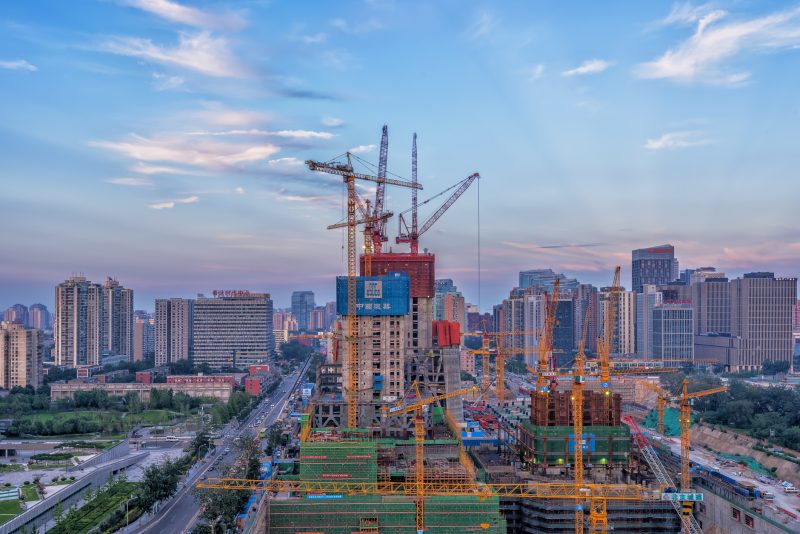
Featured image: Beijing,China-August 4th,2015. In the centre of the capital in a new commercial building construction
About the Author
 Richard Westra is Designated Professor in the Graduate School of Law, Nagoya University, Japan. His most recent books are Unleashing Usury: How Finance Opened the Door to Capitalism Then Swallowed It Whole (Clarity Press, 2016) and Exit from Globalization (Routledge, 2015).
References
1. Naughton, B., 2007, The Chinese Economy: Transitions and Growth, MIT Press, pp. 142-3.
2. Westra, R., 2012, The Evil Axis of Finance, Clarity Press, pp. 52-60.
3. Eichengreen, B., 2007, The European Economy since 1945, Princeton University Press, p. 65.
4. Hung, H., 2016, The China Boom, Columbia University Press, pp. 43-50.
5. Westra, R., 2016, “China in the crash lane”, in Yokokawa, N. et al. (eds.) The Rejuvenation of Political Economy, Routledge, pp. 303-6.
6. Hung, The China Boom, pp. 69-73.
7. Westra, Evil Axis of Finance, p. 154.
8. Brown, K., 2014, The New Emperors: Power and the Princelings in China, I. B. Tauris.
9. Webber, M. and Rigby, D., 2001, “Growth and Change in the World Economy Since 1950”, in Albritton, R. et al. (eds.) Phases of Capitalist Development: Booms, Crises and Globalization, Palgrave.
10. Hart-Landsberg, M. 2013, Capitalist Globalization, Monthly Review Press, pp. 31ff.
11. Westra, Evil Axis of Finance, pp. 154-6.
12. Aglietta, M. and Bai, G., 2013, China’s Development, Routledge, pp. 137-8.
13. Westra, Evil Axis of Finance, pp. 165-6.
14. https://ftalphaville.ft.com/2015/07/17/2134607/this-isnt-the-chinese-capital-account-liberalisation-youre-looking-for/
15. http://www.scmp.com/news/china/policies-politics/article/1974750/chinas-capital-account-opening-stable-path-economist
16. Aglietta and Bai, China’s Development, pp. 142, 213-18.
17. Hung, The China Boom, pp. 148ff. on this and below.
18. Murphy, M. and Yuan, W. J., 2009, “Is China Ready to Challenge the Dollar?” https://csis-prod.s3.amazonaws.com/s3fs-public/legacy_files/files/publication/091007_Murphy_IsChinaReady_Web.pdf
19. Vague, R., 2015, “The Coming China Crisis”, Democracy, 36, http://democracyjournal.org/magazine/36/the-coming-china-crisis/
20. http://www.telegraph.co.uk/finance/economics/11756858/Capital-exodus-from-China-reaches-800bn-as-crisis-deepens.html
21. http://www.bbc.com/news/business-37640156
22. Vague, “The Coming China Crisis”.
23. McKinsey Global Institute, China’s Choice, June 2016, http://www.mckinsey.com/global-themes/employment-and-growth/capturing-chinas-5-trillion-productivity-opportunity.
24. Murphy and Yuan, “Is China Ready to Challenge the Dollar?”



 Dr. Leipziger is Professor of International Business and International Affairs at George Washington University, where he concurrently is Managing Director of the Growth Dialogue. A former Vice President of the World Bank and Vice Chair of the Spence Commission on Growth and Development, Dr. Leipziger is a prolific author of books, journal articles, and think-pieces on economic growth, development and finance. In his book with Prof. Antonio Estache, Stuck in the Middle (Brookings, 2009), he was early to recognise the plight of the middle class and the threats to globalisation if fiscal and social policies did not deal effectively with the growing income inequality in the US. Dr. Leipziger is a Member of the WEF Futures Council on Growth and Social Inclusion, and he is a frequent media contributor.
 The Growth Dialogue is an independent think-tank, a voice dedicated to working on policies of inclusive and sustainable economic growth and aimed at providing support and advice to both governments and institutions. It is a successor to the Spence Commission on Growth and Development. Its recent work has focused on urbanisation and city-led growth, growth and inequality, and the impact of disruptive technologies on shared growth objectives. For more on its activities, see www.growthdialogue.org.