Home Blog Page 1068

Cracking the Arab World’s Development Puzzle: Oil or Politics?

By Ibrahim Elbadawi and Hoda Selim

Is the Arab World cursed by its own institutions rather than by oil wealth? These institutions, which have predated oil discoveries, have shaped economic incentives that affect how oil revenue is collected and used, and in turn influenced economic outcomes. Over time, the interaction between oil and politics became intertwined, preventing economic development in Arab countries. As low oil prices risk becoming a new normal, political reforms with checks and balances can turn the curse into a blessing.


Introduction

Despite massive hydrocarbon endowments, Arab economies have neither achieved economic prosperity nor became developed. With oil and natural gas discoveries taking place since the first half of the 20th century, Arab countries account for 7 out of the 13 members of the Organization of the Petroleum Exporting Countries (OPEC). They hold close to half of global oil reserves and a quarter of natural gas reserves. They control close to a third of oil production and 14% of natural gas production. And even though the per capita income of some Arab oil-producing economies is high, they would be considered less developed than Norway, a country with more limited oil resources and even Japan, a country without any natural resources. More worryingly, some oil exporters like Sudan and Yemen remain among the world’s poorest economies and have experienced episodes of violent conflict. More importantly, the low oil price environment, considered by some forecasters to be the new norm in the medium-term, raises the question of whether current income levels could be sustained in the future.

Many academics have attributed this disappointing performance to a “curse” which refers to the paradox that countries with an abundance of natural resources often fail to grow as rapidly as those without such resources (Sachs and Warner, 1994). The initial interpretation of the curse rested on pure economic grounds arguing that large resource windfalls lead to Dutch disease, overall macroeconomic volatility and debt overhang, among other ills. Yet this explanation fell short of explaining the successful economic performance of Norway, the world’s seventh largest oil exporter and fourteenth largest oil producer. Chile is another good example of an emerging country which is the world’s largest producer and exporter of copper. This realisation motivated a new strand of the literature that argues that “the curse is real but conditional on the presence of bad institutions” (Collier and Goderis, 2007; and, Elbadawi and Soto, 2016).


Dispelling the Oil Curse Myth

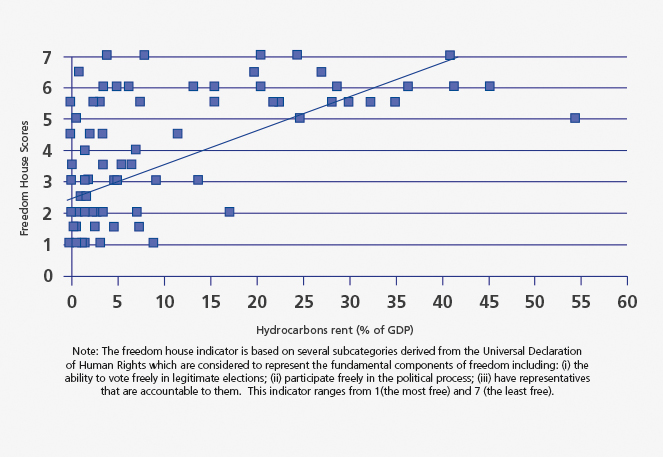
Despite their diversity in size, demographics and wealth, the macroeconomic performance of Arab countries has been generally vulnerable to the ebbs and flows of oil prices (Table 1 below). Yet, this article argues that the Arab world is cursed by weak institutions rather than by oil. In particular, weak political institutions have predated resource discoveries and over time have been able to shape economic incentives that affect how resource rents are collected, allocated and used, and therefore influenced economic outcomes (Galal and Selim, 2013). Over time, the interaction between oil and politics became intertwined, preventing these countries from embarking on a sustainable development path. In fact, there is a positive association between oil rents and limited freedom in political rights and civil liberties. More worryingly, Figure 1 (below) shows that oil-rich Arab countries lag behind using these two measures. In 2014 out of the 205 countries covered by Freedom House, 88 were considered “free”, of which none is an Arab oil-rich economy. Only one country is considered partly free, Kuwait. Moreover, most countries, especially in the GCC have not any undertaken meaningful political reform since the 1970s.


Table 1. Selected macroeconomic indicators during oil booms and busts

Source: Authors’ calculations based on WEO and WDI databases, 2014.


Figure 1. Hydrocarbon rents and Freedom House Scores, 2014
Source: Freedom House and WDI databases


As hydrocarbon revenues account for at least two-thirds of their fiscal revenues, many GCC oil-rich governments can afford not only to apply low tax rates but also efficiently redistribute these revenues through labour markets to national citizens in the form of well-remunerated public sector jobs and other generous social welfare schemes with the ultimate aim of fostering social stability and authoritarian rule.

In this weak institutional step, oil wealth turned Arab governments into rentier states by providing the means to buy off political consent with economic privileges. As hydrocarbon revenues account for at least two-thirds of their fiscal revenues, many GCC oil-rich governments can afford not only to apply low tax rates but also efficiently redistribute these revenues through labour markets to national citizens in the form of well-remunerated public sector jobs and other generous social welfare schemes with the ultimate aim of fostering social stability and authoritarian rule. The absence of significant political unrest in most GCC economies (with the exception of Bahrain) amid regional turmoil over the past 5 years speaks for that. More concretely, when political unrest mounted in 2011, oil revenues allowed GCC governments to generously appease citizens. Kuwait and Bahrain responded by giving out cash, Bahrain and Oman provided public sector jobs, and Saudi Arabia and Oman raised workers’ wages and benefits. According to Hertog (2012), Saudi Arabia approved an increase in expenditure by US$130 billion to finance the creation of 120,000 new public sector jobs, building 500,000 houses, setting a minimum wage of US$800 in the public sector, provided a one-time bonus to incumbent civil servants and created an unemployment assistance scheme. More generally, the choice of the government to provide high pay to nationals has led to high-reservation wages and creates a disincentive for nationals to invest in skills that are demanded by the private sector. This labour market segmentation crowds out private business and contributes to high unemployment (Alsheikh and Erbas, 2016).

Yet, while it is optimal for resource-rich traditional GCC rulers who govern small populations to offer investment in infrastructure and public sector jobs to effectively remove the incentive to revolt, poorer rentier states with larger populations like Algeria, Yemen and Sudan are only able to maintain political stability through a repressive security apparatus and have indeed experienced conflict, violence and social unrest at some point in time (Ali and Elbadawi, 2016).


The Economics of the Political Curse

Arab economies remain heavily dependent on oil in several aspects including domestic production and export earnings as well as fiscal revenue as mentioned before. In fact, oil exports account for above 60% of total exports. Moreover, the oil sector accounts for the majority of GDP, except in Algeria, Bahrain and Yemen and the UAE. More alarmingly, with a few exceptions being Oman, Qatar and the UAE, the manufacturing sector has either shrunk or stagnated over time, especially in countries where exchange rate overvaluation was persistent and/or significant (Selim and Zaki, 2016). And even in countries which have undertook diversification efforts, the size of the manufacturing sector remains remarkably suppressed (less than 11% of GDP) relative to their wealth. Bahrain is an exception where the manufacturing sector accounts for 15% of GDP but has slightly declined over time. More worryingly, Suliman (2016) shows that the discovery of oil in Sudan in the late 1980s quickly displaced cotton, as the leading export crop, shifting the economy from a relatively diversified agricultural base to oil dependence and almost eliminating its manufacturing sector.

Meanwhile, economic performance was disappointing. On the one hand, GCC growth was more severely affected by oil volatility but large oil wealth has maintained the financial sector quite liquid which in turn has been able to allocate ample resources for investments, particularly in infrastructure. On the other, limited resources may have somewhat shielded growth in the populous economies from significant volatility but they have contributed to devastating economic consequences, whether in terms of excessive borrowing, Dutch disease and limited savings (table 1). Unlike the GCC countries, they have failed to use their natural capital to develop the required physical capital to promote much needed economic diversification. As a result, these economies suffer from massive deficiencies in infrastructure investments and an underdeveloped financial sector.


Escaping the Curse

In order to escape the curse and achieve sustained growth and development, first and foremost, Arab countries must introduce effective political reforms accompanied by strong system of political checks and balances to limit abuse of political power and hence the misuse of resource rents.

Large oil resources, like those present in the Arab world, are a blessing. They have contributed to better standards of living and have most certainly widened the set of policy choices: they did better than they would have done without resource rents. Notwithstanding this improvement, the economic performance of Arab oil-rich countries has been disappointing, even in the absence of a counterfactual. The modest economic progress made cannot be blamed only on the way the economy was managed or simply on the abundance of oil. It can however be blamed on weak political institutions. In order to escape the curse and achieve sustained growth and development, first and foremost, Arab countries must introduce effective political reforms accompanied by strong system of political checks and balances to limit abuse of political power and hence the misuse of resource rents. As a second best, the adherence to the Extractive Industries Transparency Initiative (EITI) which provides a global standard for transparency in the oil industry and the National Resource Charter (NRC) which offers more comprehensive principles for governments and societies on how to best harness the opportunities for development generated by extractive commodity windfalls, can serve as anchors for enhancing transparency and accountability.

Second, the reform of fiscal institutions would improve resource management, achieve more savings, and release resources for the diversification of the non-oil sector. Because oil is an exhaustible resource, oil countries need to save. Collier (2016) estimates that the GCC must save 30% of their hydrocarbons fiscal revenues starting 2013 which needs to rise to 100% by 2083. The investment of these revenues in financial assets abroad (given few opportunities for domestic investments) through sovereign wealth funds (SWF) is sufficient to ride out revenue volatility. Populous economies which have shorter resource horizons need to save 50% of their hydrocarbons fiscal revenues which needs to rise to 100% by 2043. These countries need both a SWF and a Sovereign Development Fund (SDF) to invest the majority of their wealth in domestic infrastructure either in the form of physical assets or in human capital through improving health care and education of citizens, a process sometimes called “investing in investing” (Collier, 2016). These countries would also greatly benefit from implementing more effective public spending programs to ensure that resources are allocated towards high-quality public investment projects and avoid white elephant wasteful projects.

Moreover, the adoption of fiscal rules would allow governments to determine how much of their resource revenues they can safely spend through the annual budget with the aim of smoothing revenue volatility and potentially mitigating discretionary interventions by governments (Schmidt-Hebbel, 2016). To this end, countries would benefit from setting a target for the structural budget balance on the basis of an estimate of the long-term oil price.

Third, current exchange rate levels are considered to be overvalued in most oil-rich Arab economies, suggesting targeting a competitive real exchange rate to promote non-oil exports. Fourth, another challenge specific to the GCC is to raise educational quality, skills development to raise productivity in order to make nationals more competitive for private sector hiring. As for the populous countries, they need to initiate an aggressive program to encourage economic diversification. To this end, governments should focus on simplifying the complex doing business procedures and improving infrastructure.

To conclude, the best way to turn the curse into a blessing in the Arab World is to improve on the prevailing political institutions, which form the deep roots of the curse and have contributed to poor economic outcomes. Current low oil prices present a window of opportunity for policymakers to undertake many reforms that would embark their economies on a sustainable development.


About the Author

Ibrahim Elbadawi is the Managing Director of the Economic Research Forum as of January 2017. Previously, he was Director at the Economic Policy & Research Center, the Dubai Economic Council and Lead Economist at the Development Research Group of the World Bank. He was Research Director of the African Economic Research Consortium (Nairobi). He published on macroeconomic and development policy and the economics of civil wars and post-conflict transitions. He holds a PhD in economics and statistics from North Carolina State and Northwestern universities.

Hoda Selim is a Senior Economist at the Dubai Economic Council since 2016. Previously, she worked at the Economic Research Forum in Cairo and the World Bank’s Cairo Office. Her recent research focuses on the macroeconomics of oil management and the political economy of development. She holds a PhD from Sciences Po Paris in France.


References
1. Ali, Omer and Ibrahim Elbadawi. “The Political Economy of Public Sector Employment in Resource Rich Countries.” In I. Elbadawi and H. Selim, eds., Understanding and Avoiding the Oil Curse in Arab Resource-rich Economies. New York: Cambridge University Press and the Economic Research Forum.
2. Alsheik, Hend and S. Nuri. 2016. “The Oil Curse and Labor Markets: An Illustration from Saudi Arabia.” In I. Elbadawi and H. Selim, eds., Understanding and Avoiding the Oil Curse in Arab Resource-rich Economies. New York: Cambridge University Press and the Economic Research Forum.
3. Collier, Paul. 2016. “Savings and Investment Decisions from Natural Resource Revenues: Implications for Arab Development.” In I. Elbadawi and H. Selim, eds., Understanding and Avoiding the Oil Curse in Arab Resource-rich Economies. New York: Cambridge University Press and the Economic Research Forum.
4. _________ and Benedikt Goderis. 2007. “Commodity Prices, Growth, and the Natural Resource Curse: Reconciling a Conundrum.” Economics Series Working Papers WPS/2007-15, University of Oxford, Department of Economics.
5. Elbadawi, Ibrahim and Raimundo Soto. 2016. “Resource Rents, Political Institutions and Economic Growth.” In I. Elbadawi and H. Selim, eds., Understanding and Avoiding the Oil Curse in Arab Resource-rich Economies. New York: Cambridge University Press and the Economic Research Forum.
6. Galal, Ahmed and Hoda Selim. 2013. “The Elusive Quest for Economic Development in the Arab Countries.” Middle East Development Journal 5(1):1-33.
7. Hertog, Steffen. 2012. “Redesigning the distributional bargain in the GCC”. Paper presented at the BRISMES Annual Conference 2012 on Revolution and Revolt: Understanding the Forms and Causes of Change. London. 26-28 March.
8. Sachs, Jeffrey, and Andrew Warner. 1995. “Natural Resource Abundance and Economic Growth”. NBER Working Paper 5398. Cambridge, Mass.
9. Selim, Hoda and Chahir Zaki. 2016. “The Institutional Curse of Natural Resources in the Arab World.” In I. Elbadawi and H. Selim, eds., Understanding and Avoiding the Oil Curse in Arab Resource-rich Economies. New York: Cambridge University Press and the Economic Research Forum.
10. Schmidt-Hebbel, Klaus. 2016. “Fiscal Institutions in Resource-Rich Economies: Lessons from Chile and Norway.” In I. Elbadawi and H. Selim, eds., Understanding and Avoiding the Oil Curse in Arab Resource-rich Economies. New York: Cambridge University Press and the Economic Research Forum.
11. Suliman, Kabbashi. 2016. “Understanding and Avoiding the Oil Curse in Sudan.” In I. Elbadawi and H. Selim, eds., Understanding and Avoiding the Oil Curse in Arab Resource-rich Economies. New York: Cambridge University Press and the Economic Research Forum.


Where Next for Syria?

By James Denselow

The conflict in Syria has been going on for almost six years and despite events in Aleppo would appear to have the potential to go on for even longer. This piece examines the state of play in the country and examines the current trends arguing that the Syria of the past is unlikely to return and a far weaker, fragmented entity is likely to emerge in future.


On the 15th of March 2017, Syrians will mark the sixth anniversary of the crisis that engulfed their country. Many Syrians will mark the date far away from their former homes and the country of their birth. Some have successfully crossed into Europe and are building new lives, others have died trying, yet the vast majority of the nearly five million Syrian refugees remain in the region. Often, these families will be a matter of hours travel from where their lives were once based, but they know the Syria they once knew is gone.

Towards the end of 2016 and the Russian-backed and often Lebanese-Hezbollah led offensive on opposition-held east Aleppo led many to speculate that Assad could be on the verge of “winning” the war, but what “winning” in Syria looks like is important to qualify.

Syria has suffered the most dramatic collapse in terms of state and society of the twenty-first century. The numbers are staggering and create an enormity that is sometimes difficult to process. In addition to the nearly 5 million refugees are the over 6.5 million internally displaced, meaning that roughly half the country has been forced from their homes due to the crisis. Estimates of the dead vary from 200,000 to nearly half a million. The forensic evidence based art of counting casualties has become almost impossible in the black hole that the conflict has created and academics admit they simply don’t know accurately how many have lost their lives.

Whilst the number of dead people may be obscured, the wounded are better understood. The UN assessment published towards the end of 2016 estimated that roughly 30,000 Syrian people were wounded by violence each month and some 9,000 suffered from a permanent disability. The country’s economy has been halved and the World Bank’s conservative estimate is that reconstruction costs alone would add up to some $180bn.

The latest UN and Arab League envoy, Staffan de Mistura, the man with arguably the hardest job on the planet, counted twelve countries and 89 armed groups involved in the fighting on the ground.

So any “victory” has to be put in the context of the cost to date and what sort of country the nominal victor would inherit. Meanwhile Syria still remains a playground for regional and international interests. The latest UN and Arab League envoy, Staffan de Mistura, the man with arguably the hardest job on the planet, counted twelve countries and 89 armed groups involved in the fighting on the ground.


Just as Syria is no longer a unitary state, its civil war has many facets and conflicts within conflicts. In December 2016, there were three active offensives evolving simultaneously; the most high profile was the Regime and its allies against opposition groups in Aleppo, Idlib and the Damascus suburbs in particular. Meanwhile “Operation: Euphrates Shield” was a far less reported but still very important push by Turkish-backed forces against ISIS in the north of the country, whilst “Operation: Euphrates Anger” put US-backed mainly Kurdish forces against ISIS in Raqqa, the supposed capital of the “Caliphate”.

The movement of these offensives have been tracked by the Institute for the Study of War whose indispensable maps show the fault lines of the Syria of today and perhaps hint at what the Syria of tomorrow could look like.

The Regime is worth examining closer. Despite the ubiquitous presence of President Assad and his amazingly consistent narrative of the plucky nationalist leader of a country under attack from a conspiracy comprised of enemies from abroad, the reality of where power lies in Syria is more complex.

The loss of so much blood and treasure, whether in terms of the manpower of the army of the resources of the state, forced Assad to compromise in order to survive. Such a compromise did not come at the various Geneva peace conferences that have come and gone but rather to his allies inside the country and crucially in Tehran, Moscow and elsewhere.

Internally, the devolution of power to the National Defense Forces and to groups like the notorious “Shabiha” was a policy born out of necessity. For an authoritarian state to surrender such powers over its monopoly of violence was the only means to hold territory in key areas. The corruption that existed in the regime before 2011, in terms of racketeering and profiting from the informal economy, became something that others could now exploit in a wartime setting. The most dramatic form this took was control of checkpoints, and the bribes and extortion that was required to deal with them. Checkpoints are a manifestation of a crisis in sovereignty and their proliferation in Syria was a symptom of the rapid retreat of the state.

By the end of 2016, a clear picture was emerging in how the regime, bolstered by Russian airpower, Iranian financial support and Iraqi and Lebanese militias, was looking to restore a more assertive posture. Simply put areas that were home to opposition forces would be sealed off and isolated, almost as if the country was identifying diseased parts of its body to remove. These areas, whether large parts of cities like east Aleppo, towns like Madaya or suburbs like Yarmouk, would then be indiscriminately hammered by artillery and air strikes, with the “barrel bomb” becoming symbolic of the levels that the conflict had descended to.

Where there appeared to be the most directed targeting was against civilian infrastructure and hospitals and bakeries in particular. In order to ensure that the tactic of “starve or surrender” worked, the sieges didn’t discriminate between fighters and civilians living within them, they would all suffer together. Occasional glimpses of the consequences of such a slow death emerged as social media showed emaciated children or relayed stories of people resorting to eating grass to survive. Meanwhile schools and medical facilities were being forced underground as the laws that govern such protected spaces seemed unable to penetrate the darkness that had enveloped the country.

In December 2016, the UN revised its estimations of Syrians living under siege to almost a million people; double what is was from the year previous. As abhorrent and illegal the collective punishment was, it was a tactic that undoubtedly worked as opposition groups agreed time and again to accept being transferred out to other parts of the country.

The international community was divided at the UN Security Council about how to handle the Syrian conflict. Even agreements around upholding humanitarian law and principles haemorrhaged legitimacy as resolutions made in New York failed to cut through on the ground. Despite nominal agreements to allow aid to reach the millions of Syrians who needed it, the push back of a shadowy bureaucratic system thwarted it time and time again. Things got so bad in the middle of 2016 that suddenly states started pushing for air drops of aid, expensive and impractical methods but at least symbolic of an attempt to show Syrians living in cut off areas that they were not alone.

In December, as the opposition-held areas of east Aleppo collapsed in on themselves in the face of the sheer weight of firepower aligned against them, even more innovative methods of aid delivery began to be discussed. These included edible drones and remote controlled parachutes that could be directed into targeted locations from outside of Syria’s airspace.

Yet it isn’t technical solutions that will solve Syria’s humanitarian dilemmas but rather political will, and Western powers have to date showed both war weariness and a lack of clarity as to what they should bring to the table. Such indecision was perhaps best typified by the Obama White House, whose rhetoric around “red lines” and a desire to see Assad “transition” out of power informed both the tactics and strategy of certain facets of opposition forces. Such misunderstandings were in contrast to Moscow’s commitment to the regime in Damascus a legacy of historic relations – former President Hafez Assad once trained in Russia as a pilot whilst the then Soviets were responsible for much of the country’s infrastructure during the Cold War period – and opportunity to move into a space seemingly ceded by Washington.

Thus as 2017 begins the momentum is clearly heading in one direction, but as described earlier, the course of the Turkish expansion in the north and what happens if ISIS collapses to the east remain huge unanswered questions. Predictions as to how the conflict will evolve are prone to a huge margin of error considering the chaotic nature of events to date but it would still seem realistic to envisage a fragmented and weak state deeply penetrated by foreign actors and presiding over a hugely divided society. One observer once quipped to me that a Syria of the future would look like “Lebanon on crack” as in addition to sectarian cleavages serious questions remain as to the future of the ethnic Kurdish population in the Arab Republic of Syria.

Whether Trump is ready for Syria, or Syria is ready for Trump is perhaps the most interesting question to examine as we enter the 7th year of the Syrian crisis.

The most unpredictable element in this complicated and bloody equation is of course trying to imagine the foreign policy of President Trump. Whilst some speculate he will fully cede space to Moscow, others wisely hold their judgement on an individual who has made much of actively being unpredictable as a means of achieving results. Whilst Obama’s more lawyerly approached to foreign affairs was masked by his rhetorical skills, Trump is a property magnate who knows that in transactional deals, it doesn’t hurt if your opponents can’t predict what you’ll do next. Whether Trump is ready for Syria, or Syria is ready for Trump is perhaps the most interesting question to examine as we enter the 7th year of the Syrian crisis.

Featured image courtesy: Hosam Katan/Reuters


About the Author

James Denselow is a writer on Middle East politics and security issues and a Director of the New Diplomacy Platform (NDP). He has worked extensively in the Middle East, including research for foreign policy think tank Chatham House, writing and reporting for several media publications and for communications and advocacy work with international NGOs. He is a contributing author to An Iraq of Its Regions: Cornerstones of a Federal Democracy? and America and Iraq: Policy-making, Intervention and Regional Politics Since 1958 and has advised the British Government on its policy towards the Arab Spring. He is a Research Associate at the Foreign Policy Centre (FPC) and a Fellow at the Centre for Syrian Studies (CSS).


Understanding India as a Rising Power: An Open Economy and Interdependence* Framework

By Aseema Sinha

India’s global priorities have changed and it seeks power and status and acts more actively at regional and global levels. This article offers an open economy and inter-dependence framework that pays equal attention to the changing nature of the global order but also how internal constituencies within India favour a more engaged and activist agenda.


On August 18, 2016, Venezuela’s Foreign Minister, Delcy Rodriguez, visited India on a strange assignment. Venezuela’s foreign minister’s brief was to convince India’s Prime Minister, Narendra Modi, to attend the Nonalignment summit. She did not succeed although India’s Vice President – Hamid Ansari – did attend the summit. India was the founding member of the nonalignment movement and took strong ownership of the movement in the post-war period. In contrast, recently, S. Jaishankar, India’s foreign secretary, is reported to have said: “Blocs and alliances are less relevant today and the world is moving towards a loosely arranged order.”1 Pushpesh Pant, former Professor of International Relations at the Jawaharlal Nehru University reflected on India’s decision not to send the PM in a larger historical context: “We have been aligned with the Americans post-globalisation. And it’s not just happened under Modi. Even the UPA (United Progressive Alliance) did it. They staked their government over the nuclear deal. India’s engagement with the US has been a continuous process; in fact, we can even say PM Modi is reaping the harvests of previous regimes.”2 How do we understand these decisions by many Indian leaders to eschew leadership of the developing world? What are the global and domestic sources for this change in India’s behaviour to seek closeness with the United States and adopt a more distant attitude towards the NAM (Non-aligned movement)?

Now, India, acknowledged by many, is a rising power. Its actions at the global level speak of a slow but sure confidence in its economic prowess, and ability to engage with established powers.

In the cold war era, India was largely bypassed by larger powers and was happy to be isolated. It boasted of its ability to say no to the US and spoke of carving a new third way. At that time, India was an active nonalignment member. Now, India, acknowledged by many, is a rising power. Its actions at the global level speak of a slow but sure confidence in its economic prowess, and ability to engage with established powers. Now, Indian negotiators negotiate more strongly in global institutions such as the IAEA (International Atomic Energy Agency), the WTO (World Trade Organization), and seek to change the rules of the game of the IMF (International Monetary Fund). As an Indian negotiator said to me: “In the old days, India was a free-rider, now it’s a negotiator.”3 India engages with global players on a case-to-case basis and is hesitant to take the leadership of the developing world without a careful analysis of its changing alliances with countries such as the US, or China. India’s changing behaviour needs to be understood in the context of larger global changes but also by understanding how India’s domestic priorities have shifted and become more externally oriented.


India’s rising global ambitions and actions have been accompanied by changes at the systemic level and greater activism of other emerging powers such as China. The decline of the Former Soviet Union and Russia has led to a powerful United States alongside with other powers such as the EU, and Japan but also the BRICs: Brazil, India, China and Russia. The G-7 has been replaced by the G-20, which is a larger grouping. These changes in the larger global environment have created more space for regional powers such as India to make claims to a larger global role and argue for increased voice and status. This is most evident in the IMF reform proposed by emerging powers in 2010. In 2010 the International Monetary Fund (IMF) started a comprehensive “quota reform” ultimately shifting approximately 6.41% of the quota shares to the Emerging powers. These quota increases were implemented January 26, 2016.4 China’s SDR share increased from 3.8% to 6% placing it as the 3rd top IMF member. Brazil’s share has increased to 2.32%, India’s SDR quota is now 2.76%, and Russia is now 2.71% – placing all the BRICs nations within the top 10 IMF members, in terms of SDR shares.5 The US’s share is 17.45% still retaining its position as the largest member.6

While emerging powers have become more active at the global level, and the structure of the global system has also become more open and accommodating to the rise of these powers, we also need to explore the domestic changes within countries like India. India’s rise has deeper sources and causes. My research shows that globalisation has begun to shape India in powerful ways. Recently, I published a book titled, Globalizing India. Some of its findings help us understand these developments. I summarse the main findings of this book below.

How has globalisation changed and shaped India? India was a slow reformer and started economic reforms later than usual. In 1990, Indian leaders and diverse actors – not only politicians, and civil servants but also media elites and societal actors – were hesitant about open borders and global trade. A strong consensus in favour of self-reliance and worries about import competition and dangers of the outside world kept India largely closed and inward looking. India trade in goods (merchandise trade) as a share of the GDP was a minuscule 12.7% in 1990. By now (2016), trade in goods and services constitutes almost half of GDP and India’s exporting basket has changed significantly. India now exports engineering goods, chemicals and pharmaceuticals, and has revived its textile and garment industries. Figure 1 below shows this remarkable change.

FIGURE 1. Merchandise Trade as % GDP

Source: Author’s calculations from World Bank, World Development Indicators, 2015.


How did this change in India’s activities and priorities happen? India’s growth story is now being written by a wide variety of non-state and state actors and many of these diverse actors have begun to act at the global level or be more active supporters of globalisation within India. Indian MNCs have interests tied to export markets and they may lobby and work at the EU or in Geneva at WTO or WIPO (World Intellectual Property Organization). Interestingly India’s global growth story has been pursued with vigor by political actors such as Narasimha Rao, Atal Bihari Vajpayee, and now Narendra Modi but also regional and national politicians such as Kashiram Rana, Arun Jaitley, Arun Shourie, Jairam Ramesh, Yashwant Sinha, Digvijaya Singh, Piyush Goyal and many others. While the role of technocrats and economists has been well-recognised, recent research reveals the power of political actors in leading the way towards a more open-economy strategic calculus by politicians of varied stripes.7 Transformation amongst India’s political actors is the story beneath the story that we must pay attention to.

It is important to bridge an analysis of global forces with a deep, fine-grained study of different Indian sectors, actors and state agents.

Indian state and private actors have begun to shape India’s global integration in powerful ways, modifying the terms of globalisation, and seeking as much autonomy as possible. Indian actors vigorously seek greater global reach and power in economic forums across the world. Yet, some of India’s strengths have been activated and mobilised in response to global effects. It is important to bridge an analysis of global forces with a deep, fine-grained study of different Indian sectors, actors and state agents.

What does globalisation do? Global forces empower exporters and create new coalitions within a domestic context. They also create new political and economic interests, with stronger ties to the global economy. Where globalisation acts as a constraint, it does so within global markets. There, global rules of the game impose standards and sanctions, which may reveal new information, but also provide hard incentives for business firms to discipline themselves and upgrade. So, global effects should not be viewed as unilateral, or static or deterministic. The external forces of globalisation can no longer be conceptualised only as pressure or threats. The power of globalisation is based not on coercion, but rather on Indian consent and Indian ambitions, which have been awakened by global interactions.  

This idea is different from the dominant consensus running through comparative politics and particularly within the study of Indian political economy, which stresses the homegrown character of India’s reform trajectory. Scholars of India believe that domestic debates and pressures should be analysed independently of global interactions. I, in contrast, argue that domestic and international forces are intertwined and shape India’s newfound ambitions and capacities.

Yet, globalisation is not all positive. One possible negative consequence for Indian consumers is that many of India’s firms’ economic decisions are shaped by their global profits rather than oriented towards the welfare of the citizens. These effects are most visible in the field of health where India is the pharmacy of the world but prices its HIV/AIDs drugs within India at higher than global prices.8 So, in this new globalised world the Indian government needs to be even more vigilant and flexible in crafting its national interest and protecting the welfare of its citizens. In order to do so they have to both defend their companies but also bargain with those companies to provide cheaper drugs and goods for the Indian population.

What are the implications of this analysis for global developments and for how we understand countries like India? Economic changes in the global system intersect with traditional security concerns in a more integral way. But importantly, global institutions such as the International Monetary Fund, the World Bank, the World Trade Organization, and the International Atomic Energy Agency have both geo-political and geo-economic implications. Rising powers such as India are beginning to evolve development-security linked strategies in each of their forums, aiming to enhance their domestic growth and development agendas but also seeking to link their participation in these global forums with their strategic calculations about the role of hegemonic powers such as the US and China. Economic goals and aims have begun to intersect with security concerns and both are played out not only in security arenas at the global level but also within global economic institutions. Studies of economic policies and foreign policies need to study the role of non-state and economic actors as foreign policy agents. Foreign policy and national interest have become broader and encompasses foreign engagement, security policies, economic policies, and society-to-society interchange. We need to see the world through an interdependence framework9 and see India’s security actions through an open economy framework.

Featured image courtesy: CNNMoney

About the Author

Dr. Aseema Sinha is an Associate Professor and the Wagener Chair of South Asian Politics and George R. Roberts Fellow at Claremont McKenna College. She previously taught at University of Wisconsin-Madison and was a Fellow at the Woodrow Wilson Center in DC. Her research interests relate to political economy of India, India-China comparisons, International Organizations, and the rise of India as an emerging power. She has authored a book, The Regional Roots of Developmental Politics in India: A Divided Leviathan (Indiana: Indiana University Press, 2005), which received a book prize titled, Joseph Elder Book Prize in the Indian Social Sciences. Her book, Globalizing India: How Global Markets and Rules are Shaping India’s Rise to Power was just published with Cambridge University Press.


References

* Henry Farrell and Abraham Newman,” Domestic Institutions Beyond the Nation-State: Charting the New Interdependence Approach,” World Politics, Vol. 66, issue 2, April 2014, 331-363.
1. Special Correspondent, “Global Blocs are less Relevant, says Foreign Secretary,” The Hindu, August 18, 2016, accessed at: http://www.thehindu.com/news/national/global-blocs-are-less-relevant-says-foreign-secretary/article9000079.ece
2. Nikita Doval, “Nardendra Modi Skips NAM Summit, the first Indian PM to do so,” The Livemint, Octber 14, 2016, accessed at: http://www.livemint.com/Politics/ectxbpHsJ2XUmRkXXqVbpL/Hamid-Ansari-leaves-for-Venezuela-to-attend-17th-NAM-summit.html
3. Aseema Sinha, Globalizing India: How Global Rule and Markets Are Shaping India’s Rise to Power, Cambridge: Cambridge University Press, 2016.
4. “IMF Members’ Quotas and Voting Power, and IMF Board of Governors.” IMF: International Monetary Fund. Accessed at: https://www.imf.org/external/np/sec/memdir/members.aspx
5. “IMF Reforms: China, India, Brazil, Russia Get Greater Say.” The BRICS Post, January 28, 2016. Accessed October 12, 2016. http://thebricspost.com/imf-reforms-china-india-brazil-russia-get-greater-say/#.V_3HMJMrLeT
6. Ibid
7. Sanjaya Baru, 1991: How P.V. Narasimha Rao Made History, Aleph Book Company 2016.
8.Tricia Olsen and Aseema Sinha. “Linkage Politics and the Persistence of National Policy Autonomy in Emerging Powers: Patents, Profits, and Patients in the Context of TRIPS Compliance,” Business and Politics, Volume 15, issue 3, 323-356.
9. Henry Farrell and Abraham Newman, “Domestic Institutions Beyond the Nation-State: Charting the new Interdependence Approach”, World Politics, Vol. 66, issue 2, 331-363.

Stronger Ethics for Better Leadership Using Confucianism and Systems Theory

By Dr. Sunnie Giles

The lack of high ethical standards in Korea as noted in its current presidential corruption scandal destabilises its political system, produces suboptimal organisational performance, and results in high economic and human costs. Part of this phenomenon can be traced to Confucian and collectivistic sources, where speaking against authorities or group norms is viewed as disrespectful and disharmonious. However, ethical standards in Korea can be strengthened by organised leadership development programs that address current limitations, incorporate complex adaptive systems concepts, reflect neuroscience principles, and harness the Confucian principles that underpin cultural norms and societal expectations.


Much has developed since a previous article was published on the political crisis of President Park of South Korea (http://www.worldfinancialreview.com/?p=11543 and http://www.koreatimes.co.kr/www/news/opinon/2016/11/197_217694.html). Such developments include the allegation by the Prosecutor’s Office that Park not only allowed Ms. Choi Soon-sil, her personal friend of forty years, to have access to highly sensitive national intelligence, but proactively extorted contributions from top chaebols to the non-profit organisations Choi was using as a front to accumulate personal wealth. This alleged extortion incited massive public demonstrations to the tune of over one million protestors and propelled impeachment movements from the opposition parties.

According to the latest World Economic Forum Corruption Index,1 Korea is ranked the 9th most corrupt country among the world’s 35 wealthiest countries of the OECD (Organisation for Economic Co-operation and Development). These revelations of corruption at the highest levels of Korean government and business call for a critical review of:[unordered_list style=”bullet”]

  • The relationship between ethics and governmental leadership
  • The relationship between ethics and business leaders
  • Organised leadership development practices in the Korean government
  • Guidance on the implementation of such practices
[/unordered_list]

Ethical standards in Korea can be strengthened by organised leadership development programs, but these programs must:[unordered_list style=”bullet”]

  • Address the inherent limitations of current prevailing leadership development approaches
  • Incorporate the systemic nature of people and organisations
  • Reflect neuroscience principles, especially the implicit need for safety
  • Harness the deep cultural roots and social norms of Confucianism and collectivism (the current misguided application of which contributes to the lack of strong ethical standards in Korea).
[/unordered_list]

Leadership development organised with these components will not only improve ethical standards in business and government practices, but will also improve Korea’s capacity for innovation.


1. Ethics and Leadership

Although most of us agree ethics are critical to business and military leadership,2  we don’t have a clear understanding why. My recent research on global leadership for innovation, published in Harvard Business Review, revealed the reason: demonstrating strong moral and ethical values establishes safety because both parties agree on a common set of rules of how the game will be played.3  People handle losing the game a lot better than not knowing the rules.

According to neuroscience principles, our need for safety undermines any other needs we have, including those for connection and learning. Safety is established in the brain stem– the oldest, most primitive part of our brain – and is governed through the autonomic nervous system. The determination of safety happens within eight milliseconds after the incoming signal is received. That same signal takes up to 2 seconds to reach our cognitive cortex brain, where we assign meaning, and activate the amygdala if the executive decision-making function determines that our safety is threatened. Before our cognitive brain is even fully aware, we have already reacted to the threat with a suboptimal response of contracting, withdrawing, attacking, or saying what we think they are looking for with no intention of following through. These are suboptimal reactions because the best part of the human brain – the cortex, where executive decision-making and innovation happens – doesn’t even get a chance to engage when we are battling for safety in the lower, less-evolved regions of the brain. And all of this happens below our conscious awareness.

When we see leaders being inconsistent between their words and actions, and who don’t demonstrate high ethical values, our sense of safety is violated, and our brain stem working with the amygdala activates those suboptimal responses.

When we see leaders being inconsistent between their words and actions, and who don’t demonstrate high ethical values, our sense of safety is violated, and our brain stem working with the amygdala activates those suboptimal responses. Strong ethics activate a sense of safety; we can then move to the higher regions of the brain, where we form connection and use our best executive decision-making capabilities. Thus, ethical leaders create more cohesive teams and gain influence and commitment by demonstrating strong personal characteristics and values.


2. Ethics and Business Results

In 2015, one of the stories seen most frequently on the front pages of Korean newspapers was how 78 people died from using dehumidifier disinfectants sold by Oxy Reckitt Benckiser (ORB, the Korean office of Reckitt Benckiser) and three others manufacturers in Korea. Government investigators found that ORB manipulated the safety research report by bribing the professors who conducted the research to advertise the disinfectant as safe to the public. They also found evidence of false advertising of safety by other manufacturers. Subsequently, some of the leaders of these organisations have been sentenced to prison terms.

Fast forward one year, to the analysis of why Korea slid four places in a prominent international corruption report since last reported in 2015. The Korea Institute of Public Finance (KIPF) made the connection between the decline in national competitiveness and low business ethics, as well as lack of transparency, explicit.4 KIPF specifically cited the heavily publicised disinfectant scandal as they partially attributed the ranking decline to damaged business ethics.5 According to the 2016 World Competitiveness Yearbook, published by the International Institute for Management Development in Switzerland, Korea ranks 29th out of 61 countries evaluated in overall competitiveness.6

Studies have shown that countries with higher levels of corruption have lower levels of human development, as measured in terms of education, health, and gross national income.7 An increase of corruption by one index point dampens GDP growth by somewhere between 13 and 90 basis points (.13 – .90%) and lowers per capita GDP by $425.  These are important indicators that call for organised development programs to strengthen moral and ethical behaviours and improve transparency in business dealings.


3. Organised Leadership Development Programs

Given that all seven South Korean presidents preceding Park have been embroiled in some sort of corruption scandals, that many corporate corruption scandals have plagued the Korean economy, and that corruption has a direct link to human development and national income, a different approach to leadership development is called for in Korea: that of an organised leadership development program in both public and private sectors.

This leadership development program must address the following four limitations of the current prevailing leadership development approaches:[unordered_list style=”bullet”]

  • Current leadership development efforts focus only on what is visible, and only on certain parts of the system as opposed to the whole. Accordingly, the results are temporary and limited in scope. All living organisms – people, termites, trees, economies, and organisations – are complex systems. Because we are systems, any change must be approached at the systemic level to be effective. Any individual change isolated from the system s/he is part of runs into the system’s resistance; hence, the effect of change is limited and short-lived. Current learning models aim to change individual components in isolation from the system and its environment, and so are ineffective.
  • Most current leadership development approaches do not consider the rapidly changing business environment. They are primarily about the individual behaviour and/or belief systems of the leader, including personal leadership, and his/her relationship with followers. This approach is flawed because what is happening in the environment sets the criteria for effective leadership competencies. For example, the leadership development programs in Circuit City and Borders Books didn’t protect the companies from their demise partly because the goal of the programs was not tied to winning in the rapidly changing environment.
  • Leadership development efforts must focus on changing the beliefs and behaviours of individuals. Organisational change happens when individuals change beliefs and behaviours. Problems and desired behaviours must be clearly defined; individuals must understand tangible actions they can take to improve.
  • Most current leadership development approaches provide no quantitative mechanism to understand the bottom-line impact of the necessary change. This is where an ethical dilemma is likely to turn into an ethical lapse. Clearly establishing the bottom-line impact of desired leadership competencies helps leaders understand that being good produces good business. For instance, if leaders are given change goals to improve their leadership competencies and they are up against a quarterly close, without a solid understanding of the bottom-line impact of the change they are trying to bring about, they are all too likely to fall into the trap of “Just this once” or “Once I have met my quarterly goals, then I will…”[/unordered_list]

To address these limitations, a leadership development approach must reflect the systemic nature of people and organisations in the context of an environment.

We are not islands; we work and live in a context of team, organisation, society, country, world, and universe, all of which work as systems that influence and are influenced by each other. Therefore, any leadership development efforts that do not address this systemic, constructive nature of complex adaptive systems will likely produce suboptimal results. Systemic thinking and considering consequences of their decisions many steps ahead and on other constituencies, not just the immediate rewards, will likely strengthen ethical behaviours.

A leadership development program must be based on neuroscience principles of hierarchical input processing of safety, connection, and executive decision-making (in that order). Leaders must be taught what constitutes a sense of safety among their employees, and that safety trumps all other needs: all goals are likely to be underachieved if safety needs are not met. Leaders must be taught that demonstrating high ethical and moral standards and consistency between words and actions is critical for establishing safety. These neuroscience principles also help us understand that some of the defences we build in response to past perceived threats to safety tend to outlive their usefulness, producing suboptimal, often irrational over-reactions.

When people recognise how their previous misguided beliefs affect their interactions with others, and consciously choose more adaptive beliefs, the result is a dramatic transformation of interpersonal dynamics, leading to breakthrough growth at both individual and organisational levels. A holistic pattern emerges, in which two people or teams can create a whole much greater than the sum of their parts.

Effective leadership development programs must also specify the bottom-line impact of each tangible behaviour or belief change. For example, when leaders understand the impact of the behaviour they are attempting to change (eg: consistency between words and actions) in terms of turnover of the employees they oversee, which translates into operating expense, they are much more likely to prioritise the change, even if they face a higher level of stress at quarter end.


4. Cultural Norms and Social Expectations

Confucian principles of filial piety, kinship, loyalty, and righteousness have subtle but far-reaching influence over culturally accepted business practices in Korea. Collectivism prioritises group goals before individual goals; individual needs are sacrificed for the good of the group. These beliefs set the norms and expectations for how relationships are governed, such as between ruler and follower, father and son, older brother and younger brother, husband and wife, and friends. Part of what makes it challenging to establish strong business ethics in Asian countries is rooted in the deep Confucian and collectivistic belief that challenging the hierarchal order and confronting the behaviour of those in power is viewed as disrespectful and disharmonious. This belief makes the whistle-blower wrong. The Confucian principle that reciprocation is expected when kindness is offered is also distorted in practice, as people in authority expect something in return when they make decisions that benefit others.

Due to their ubiquitous influence over societal norms and cultural expectations, effective design and implementation of leadership development programs must harness Confucianism and collectivism to establish strong ethics.

Due to their ubiquitous influence over societal norms and cultural expectations, effective design and implementation of leadership development programs must harness Confucianism and collectivism to establish strong ethics.

Confucianism presents two archetypal leaders – gunja (gentleman) and soin (small person). Gunja refers to a leader who possesses moral scruples, strong personal characteristics, political capabilities, and cultured humanistic viewpoints.1 He is a leader who constantly censors himself and aims to perfect his moral compass. His ultimate goal, in all his dealings with others and self, is in (mercy). He fulfils his duty as a leader, follower, parent, child, husband, older brother, younger brother, and friend. He practices the Confucian Golden Rule: he does not force on others something that he himself dislikes. Gunja is also characterised by ye (courtesy, or proprieties of behaviour).

On the other hand, soin literally means a small person, and refers to a leader who seeks personal gain even if it means harming others in the process. Soin does not practice mercy or courtesy.

Unfortunately, somewhere along the process, some of these Confucian principles have been distorted and other parts exaggerated out of balance, resulting in the current lapse of strong ethics in leaders in high office. Returning to these Confucian roots, which underpin the Korean collective subconscious, and bringing them to the forefront of leadership development, can raise the overall ethical standards.


Conclusion

The recent presidential corruption scandal in Korea calls for organised leadership development programs that address some of the inherent limitations of current practices in both business and government. These programs must incorporate complex adaptive systems principles which factor in the current environment as well as the interactions between the members of a unit. They must also utilise neuroscience principles, especially the primal need for safety, to unleash the full potential of the human brain. Although part of the corruption observed in Korea can be traced to its Confucian roots, returning to core Confucian principles and capitalising on the concept of the Confucian Golden Rule and gunja can be a powerful tool in restoring the high ethical standards originally intended in Confucianism.


About the Author

Dr. Sunnie Giles, is President of the Quantum Leadership Group, which is based in the United States. She works as an executive coach, leadership development consultant, and organisational scientist. She has an MBA from the University of Chicago and Ph.D. in Marriage and Family Therapy from Brigham Young University. She worked as an executive in several Fortune 500 companies, including Samsung, IBM, and Accenture. For more information, visit www.sunniegiles.com.


References

*In this section, gunja and soin are referred to as third-person male to be true to the original text, written 2,500 years ago when leadership positions were held almost exclusively by men
1. http://www.businessinsider.com/wef-corruption-index-the-most-corrupt-countries-in-the-oecd-2016-9/#10-poland-2
2. Ciulla, Joanne B., ed. Ethics, the heart of leadership. ABC-CLIO, 2014.
3. https://hbr.org/2016/03/the-most-important-leadership-competencies-according-to-leaders-around-the-world?
4. http://www.kipf.re.kr/TaxFiscalPubInfo/TaxFiscalPubTrends_DomTrends-View/2016%EB%85%84-IMD-%EA%B5%AD%EA%B0%80%EA%B2%BD%EC%9F%81%EB%A0%A5-%ED%8F%89%EA%B0%80-%EA%B2%B0%EA%B3%BC/523928
5. https://ko.wikipedia.org/wiki/%EA%B0%80%EC%8A%B5%EA%B8%B0_%EC%82%B4%EA%B7%A0%EC%A0%9C_%EC%82%AC%EA%B1%B4
6. http://www.imd.org/uupload/imd.website/wcc/scoreboard.pdf
7. Rose-Ackerman, Susan, and Bonnie J. Palifka. Corruption and government: Causes, consequences, and reform. Cambridge university press, 2016.


Better Capitalised Banks Lend More and Lend Better

By Stephen G. Cecchetti & Kermit L. Schoenholtz

Are higher capital requirements really a drag on economic growth? Many people seem to think so. We disagree. In this essay, we describe how better capitalised banks experience lower funding costs, and how undercapitalised banks have an incentive to “evergreen” loans to low-quality firms. Our conclusion is that higher capital requirements are good for economic growth, resulting in both more lending and better lending.


Many people seem to think that when capital requirements increase, banks lend less. Adherents of this view go on to argue that, since credit is essential for economic growth, we should not impose overly tough constraints on banks. This is the basis for the conclusion that we have gone too far in making the financial system safe and the cost is lower growth and employment.

US Treasury Secretary-designate Steven Mnuchin appears to share the view that financial regulation has restrained the supply of credit: in a recent interview, he is quoted as saying “The number one problem with Dodd-Frank is that it’s way too complicated and cuts back lending.”1 One interpretation of this is that Secretary-designate Mnuchin will support proposals like House Financial Services Chair Jeb Hensarling’s Financial CHOICE Act to allow banks to opt for a simple capital standard as an alternative to strict regulatory scrutiny.2

Our reaction to this is three-fold. First, for most US banks, which are very small and pose little threat to the financial system, a shift toward simpler capital requirements – so long as they are high enough – may be both effective and efficient; for the largest, most systemic intermediaries, higher capital requirements should still be accompanied by strict oversight. Second, we see no evidence that higher bank capital is associated with lower lending. In fact, quite the opposite. Third, given that the 2007-09 financial crisis was the result of too much borrowing, not all reductions in lending are bad. We take each of these points in turn.3

Recently, we wrote about the Minneapolis Plan to End Too Big to Fail and its proposal to sharply increase required equity in the 13 largest US banks.4 Specifically, the Minneapolis Plan calls for a pure leverage ratio – the ratio of common equity to total assets – of at least 15% and possibly as high as 24%. The current requirement is 6%, and the CHOICE Act would require only 10%. Unlike the CHOICE Act, the Minneapolis Plan also embraces important aspects of current regulation (including stress tests and living wills) to contain the systemic risks of the largest, most complex, and most interconnected banks, while simplifying regulatory compliance for small banks that do not pose a threat to the financial system. We believe that the Minneapolis Plan provides a solid basis for legislation that would advance the public goal of making the financial system safe in a cost-effective way.


Important in this conclusion is our judgment that higher capital does not hamper the aggregate supply of credit. The alternative view appears to posit a choice between bank balance sheet consolidation, on the one hand, and credit growth, on the other. In fact, there is no inconsistency between making banks safer and ensuring long-run growth of credit. To see why, recall that from the bank’s perspective, equity capital is one of the sources of funds while loans and securities acquisitions are uses of funds. That is, the former is a liability while the latter are assets. In theory, an increase in bank equity can be used to fund an increase in credit provision.

But that’s theory, what about experience? Here, the evidence is compelling: strong banks lend to healthy borrowers, weak banks don’t. On the quantity of lending, countries with better capitalised banking systems prior to the start of the crisis in 2006, experienced stronger lending growth during and after the crisis.5 That is, higher capital did not slow recovery. Furthermore, research at the BIS has established that better capitalised banks experience lower funding costs, higher growth of debt funding, and higher growth of lending volumes.6

Turning to the quality of loans, scholarly studies examine both Japan and Europe. Caballero, Hoshi and Kashyap describe how, in the 1990s, regulatory forbearance delayed a thorough recapitalisation of Japan’s banks for more than a decade.7 Instead, insolvent Japanese banks made loans to keep insolvent Japanese borrower afloat. In their study of the impact of the ECB’s recent actions, Acharya et al. conclude that extremely accommodative monetary policy had a similar impact.8 That is, undercapitalised euro-area banks had an incentive to evergreen loans to
“low-quality” firms.

These results rely on data from a range of countries. What happens in the United States when bank capitalisation rises and falls? To answer this question at an aggregate level, we have plotted below bank credit (relative to GDP) on the vertical axis and bank capital (relative to assets) on the horizontal axis. The filled-red circle at the top right is the most recent observation from the third quarter of 2016.


Source: Federal Reserve Board, H.8 and Bureau of Economic Analysis, National Income and Product Accounts.

The results are striking: rather than the downward-sloping relationship that critics of higher bank capitalisation anticipate, the relationship is strongly positive. That is, greater reliance of banks on equity funding is associated with an increase of credit!

Finally, there is the fact that decreases in lending are not necessarily bad. In fact, quite the opposite. That is what the studies of Japan and Europe highlight: loans to zombie firms made by weak banks reflect an inefficient allocation of savings and lead to slower economic growth. And surely no one wishes to see a return to the over-indebtedness of US households that contributed to the vulnerability of the financial system in 2007.

We also believe that, given the experience of the financial crisis, it is essential to ensure that borrowers are able to repay, both to protect the financial system and to protect taxpayers.9 The latter concern applies to mortgage borrowing, which is now effectively guaranteed by the US government through the government-sponsored enterprises (GSEs). It also applies to student loans, which (in addition to being guaranteed by the federal government) account for nearly half of consumer credit and create decades-long financial burdens that are virtually impossible to escape even through personal bankruptcy. And then there is payday lending, which, while frequently beneficial, can also be exploited to prey on the least well-off in the United States and has been a focus of both the US Department of Defense and the Consumer Finance Protection Bureau.

So, what has happened to US indebtedness since the financial crisis? BIS data show that aggregate credit to the US private non-financial sector peaked at the height of the crisis (the third quarter of 2008) at 169.3% of GDP; the latest reading (first quarter of 2016) puts it at 150.1%. Virtually all of this drop is accounted for by the decline of credit to households – from 97.1% to 78.4%. And, since only a bit more than one fourth of the decline reflects a fall in bank credit, most of it arises from the behaviour of nonbank intermediaries.

Data from the Federal Reserve Bank of New York highlight this changing mix of intermediation that, in our view, has made the financial system more resilient and less vulnerable since the crisis. The following chart depicts the evolution since 1960 of the liabilities of three important components of the financial system: commercial banks; broker-dealers and bank holding companies (BHCs); and shadow banks (net of their own holdings of other shadow banks’ liabilities). While the commercial banking system has grown since 2007, the other segments have shrunk. Specifically, over this nine-year period, shadow banking has plunged from 120% of GDP to 76% of GDP (that’s from a peak of $18.0 trillion to a current level of $13.4 trillion). A substantial portion of this correction occurred before the July 2010 enactment of the Dodd-Frank Act, reflecting the crisis-driven demise of the underlying business model of wholesale banking without deposit insurance or a lender of last resort.


BHC Bank holding company. Source: Financial Accounts of the United States; Adrian, Tobias, Daniel Covitz, Nellie Liang (2013) Financial Stability Monitoring, Federal Reserve Bank of New York Staff Report 601. Updates courtesy of the FRBNY.


We conclude: (1) higher capital levels are associated with more lending, with better lending, or with both; and (2) to the extent that enhanced regulation hampers lending, it is often of the type that makes the financial system less safe and can leave taxpayers on the hook.
From this evidence, we conclude: (1) higher capital levels are associated with more lending, with better lending, or with both; and (2) to the extent that enhanced regulation hampers lending, it is often of the type that makes the financial system less safe and can leave taxpayers on the hook.

To be clear, we do see great scope for improving and simplifying US financial regulation. Among other things, the system could use massive streamlining; the GSEs still need restructuring; living wills and the resolution mechanism should compel systemic intermediaries to self-insure (in order to avoid bailouts); government guarantees need to be properly priced; and the financial infrastructure could be more resilient.10 But, if we’re to make the financial system both safe and efficient, we need not only much higher capital requirements, but also a strict regulatory regime that makes credible the government’s (and legislators’) promise not to bail the most systemic intermediaries.


About the Author

Stephen G. Cecchetti is Professor of International Economics at the Brandeis International Business School, Research Associate at the NBER, and Research Fellow at the CEPR, former Chief Economist at the Bank for International Settlements, and former Director of Research at the Federal Reserve Bank of New York.

Kermit L. Schoenholtz is Professor of Management Practice in the Department of Economics of New York University’s Leonard N. Stern School of Business, Director of NYU Stern’s Center for Global Economy and Business, a member of the Financial Research Advisory Committee of the U.S. Treasury’s Office of Financial Research, and former Global Chief Economist at Citigroup.

References
1. Schlesinger, Jacob M., “Trump Treasury Choice Steven Mnuchin Vows to ‘Strip Back’ Dodd-Frank,” Wall Street Journal, 30 November 2016.
2. See http://financialservices.house.gov/choice/
3. See Schularick, Moritz and Alan M. Taylor, “Credit Booms Gone Bust: Monetary Policy, Leverage Cycles and Financial Crises, 1870-2008” American Economic Review, Vol. 102, No. 2, April 2012, pp. 1029-61.
4. See Cecchetti, Stephen G. and Kermit L. Schoenholtz, “Ending Too Big to Fail,” www.moneyandbanking.com, 28 November 2016 and The Minneapolis Plan to End Too Big to Fail, Federal Reserve Bank of Minneapolis, 16 November 2016.
5. See Cecchetti, Stephen G. and Kermit L. Schoenholtz, “Higher capital requirements didn’t slow the economy,” www.moneyandbanking.com, 15 December 2014.
6. Cecchetti, Stephen G. and Kermit L. Schoenholtz, “Bank Capital and Monetary Policy,” www.moneyandbanking.com, 20 June 2016; and Gambacorta, Leonardo and Hyun Song Shin, “Why Bank Capital Matters for Monetary Policy,” BIS Working Paper No. 558, April 2016.
7. See Caballero, Ricardo J., Takeo Hoshi and Anil K Kashyap, “Zombie Lending and Depressed Restructuring in Japan,” American Economic Review, Vol. 98, No. 5, December 2008, pp. 1943-77.
8. See Acharya, Viral A., Tim Eisert, Christian Eufinger, and Christian W. Hirsch, “Whatever It Takes: The Real Effects of Unconventional Monetary Policy,” unpublished manuscript, October 2016.
9. See Cecchetti, Stephen G. and Kermit L. Schoenholtz, “Rolling the dice, again,” www.moneyandbanking.com, 21 October 2014.
10. For a broader list and discussion of Dodd Frank’s accomplishments and failings see Cecchetti, Stephen G. and Kermit L. Schoenholtz, “Dodd-Frank: Five Years After,” www.moneyandbanking.com, 15 June 2015.


Tax Avoidance: Between Temptation and Trouble

By Matthias Kasper and Erich Kirchler

Fostering tax compliance is a key challenge for global politics. Public revenues need to be protected, and confidence needs to be restored in a system that is deemed ineffective.


Conservative estimations indicate that the revenue loss from profit-shifting, a form of corporate tax planning, amounts to USD 100 to 240 billion annually. This is 4 to 10% of global corporate income tax (CIT) revenues (OECD, 2015).1 For developing countries, which rely strongly on revenues from CIT, this ratio is even higher. Consequently, fostering tax compliance is a key challenge for global politics in order to protect public revenues and to restore confidence in the system. But as compliance behaviour is a complex, multi-faceted phenomenon, this is not an easy task.

Multinational corporations have several opportunities to reduce their tax burden. One common and highly effective practice is to shift profits to low tax jurisdictions. Dyreng et al. (2008)2 show that more than a quarter of US multinationals pays less than 20% in corporate income taxes and Oxfam, a UK based not for profit organisation, estimates that the 50 largest US companies hold USD 1.4 trillion in cash offshore to avoid paying taxes in the US (Oxfam, 2016).3 In theory, the law distinguishes between legal tax avoidance and illegal tax evasion, but in practice this distinction is often blurred. Global firm structures and complexity in tax law make the allocation of profits an extremely difficult task and many countries lack capacity to protect their tax bases from profit shifting. But moreover, corporate tax avoidance weakens the payment morale of non-corporate taxpayers who perceive that multinationals are not paying their fair share.

With their reputation at stake, firms become increasingly careful around the pitfalls of international tax planning. Graham et al. (2014),4 for instance, analyse the effects of reputational concerns and the risk of adverse media attention on corporate tax planning. 70% of the executives in their sample state that reputation is an “important” or “very important” factor in their decision not to engage in aggressive tax planning strategies. Their findings indicate that particularly large, profitable public firms are concerned about the reputational effects of tax planning. This is in line with findings from Hanlon and Slemrod (2009)5 who find that stock prices of multinational firms respond negatively to revelations about their involvement in tax shelters. But as corporations are still struggling to find the “optimal” level of tax avoidance, the fight against aggressive tax planning is gaining momentum and clearly, tax transparency is on the rise. To establish a framework for the allocation of corporate income, the G20 have joined forces with the OECD and developed an action plan to reduce base erosion and profit shifting (BEPS, OECD 2013).6 Likewise, the European commission is urging for a common consolidated corporate tax base (CCCTB) based on formula apportionment, which would limit multinationals’ opportunities to artificially reduce their tax payments. But while research indicates that documentation requirements successfully mitigate profit shifting (Beer & Loeprick, 2015)7 and the CCCTB might further impede corporate tax planning, the revenue effects of tax harmonisation within the EU remain to be seen (Devereux & Loretz, 2008).8

In order to curb aggressive tax planning, it is crucial to build a sense in society that tax avoidance has severe consequences. A social norm of cooperation needs to be established and taxpayers’ identification with this norm needs to be strengthened.

In any case, changing the rules of international tax will not be enough to restore and maintain high levels of compliance. Social psychological research shows that social norms have a significant impact on behaviour (Fehr et al., 2002)9 and particularly peers shape our compliance choices (Alm et al., in press).10 In order to curb aggressive tax planning, it is thus crucial to build a sense in society that tax avoidance has severe consequences. A social norm of cooperation needs to be established and taxpayers’ identification with this norm needs to be strengthened. To achieve this, a sound understanding of the determinants of taxpayer behaviour is crucial. Psychological research indicates that tax authorities’ power to enforce the law as well as taxpayers’ trust in authorities drive compliance behaviours. Against this background, policy makers and revenue bodies need to understand the dynamics between trust and power in order to establish a climate that promotes trust and fosters cooperation.


Attitudes Towards Taxes

Tax revenues fund public goods. They are used to stimulate or impede certain behaviours and allow redistributing wealth. But while taxes are imperative, taxpayers’ attitudes towards taxation are, at best, mixed. Sussman and Olivola (2001)11 show in a series of experiments that many consumers are tax averse: they rather avoid paying taxes than avoiding equally large, or even larger, non-tax costs. This tendency showed to be particularly strong among individuals who identify with political parties that favour less taxation. However, their tax aversion diminished when asked to consider positive effects of taxation, suggesting that policy makers should highlight the positive implications of taxes in order to increase compliance.

Undoubtedly, the vast majority of taxpayers are willing to pay their taxes correctly (Frecknall-Hughes & Kirchler, 2015).12 Unfortunately, however, most tax systems are incredibly complex and tax system complexity is one of the most serious impediments to voluntary compliance. The US tax code, for instance, comprises more than 4 million words. Its’ volume has increased steadily since 1955 (Owens & Hamilton, 2004)13 and the Taxpayer Advocate Service, a federal institution that assists taxpayers in solving their issues with the IRS, stresses that, on average, more than one provision is added to it daily. Tax law complexity imposes substantial compliance costs on corporate taxpayers. Moreover, it undermines taxpayers’ ability to understand their payment obligations. This, in turn, challenges fairness perceptions and stimulates misunderstandings, breeding suspicion, fear, and mistrust. Consequently, it is not surprising that many taxpayers find tax avoidance acceptable.

Two studies conducted in Austria (Kirchler, 199815; Kasper et al., in press16) asked taxpayers to describe and evaluate tax evaders, honest taxpayers, and typical taxpayers. The more recent study also incorporated taxpayers legally avoiding taxes. Results from the 1998 study, depicted in Figure 1 (below), show that tax evaders were evaluated neutrally and perceived as intelligent, and rather hard-working. Honest taxpayers, on the other hand, were evaluated positively and described as hard-working, but less intelligent than tax evaders. Surprisingly however, typical taxpayers were judged negatively, relatively lazy, and not very intelligent. As the recent data shows, the evaluation of these types of taxpayers has not changed much over the last two decades. And despite the ongoing debate on corporate tax planning, taxpayers who legally avoid paying taxes are perceived as hard-working and intelligent.


Figure 1a: Evaluation and description of different types of taxpayers. Kirchler (1998)

Figure 1b: Evaluation and description of different types of taxpayers. Kasper et al. (2016)


Refining these results, a study from Germany17 shows that the majority of taxpayers finds it important and necessary to comply. However, many taxpayers perceive their tax burden to be high and the tax system to be unfair. They criticise complexity in tax law, compliance costs, and poor effectiveness of public spending. In order to increase taxpayers’ willingness to comply, it is thus crucial to reduce tax law complexity, to provide sound taxpayer services, but also to invest public funds more sustainably.


Coercion or Voluntary Cooperation?

On a theoretical level, taxpayers’ choices to pay their taxes honestly or to evade is a decision under risk, where compliance certainly reduces the gross income, while the consequences of evasion depend on the audit probability and fines for non-compliance. Indeed, various studies indicate that audit rates and punishment for non-compliance impact on compliance. But as audit probabilities are often low while aggregate compliance levels show to be relatively high, other factors seem to matter too.

A substantial body of evidence from economic psychology and behavioural economics finds that audits and fines are less effective than theoretically expected. For instance, a recent study shows that tax audits may have negative effects on reported income of sole proprietors, if they do not result in additional tax assessments (Beer et al., 2015),18 indicating that reliability in detecting non-compliant taxpayers is a crucial feature of effective audit schemes. On the other hand, audits may lessen taxpayers’ willingness to comply, if they perceive audits as arbitrary. Linking audit frequencies to different measures of tax compliance, Mendoza et al. (2015)19 find that that audits might weaken voluntary compliance when they are conducted excessively. This line of research suggests that breaching the psychological contract between citizens, authorities, and the state has negative effects on tax compliance behaviour.20 Taken together, these findings show that promoting a cooperative relationship between revenue bodies and taxpayers is crucial. Instead of relying exclusively on audits and fines to increase compliance, tax authorities should aim to provide comprehensive taxpayer services and to build trust.

Both trust and power are important to establish high levels of compliance and the framework predicts lowest compliance levels if taxpayers do not trust the authorities and agencies lack capacity to detect and prosecute non-compliance.

The slippery slope framework formalises research on the determinants of tax compliance behaviour.21 As indicated in Figure 2 (below) it assumes that tax authorities’ power, that is their capacity to enforce the law, can elevate compliance levels. In this case, however, taxpayers comply because they fear punishment rather than because they are convinced of doing the right thing. Conversely, trust in tax agencies stimulates voluntary cooperation. Both trust and power are important to establish high levels of compliance and the framework predicts lowest compliance levels if taxpayers do not trust the authorities and agencies lack capacity to detect and prosecute non-compliance. If trust levels and revenue bodies’ power are high, on the other hand, taxpayers cooperate voluntarily because they believe paying taxes is the right thing to do and because they feel protected from free-riders.


Figure 2: The slippery slope framework of tax compliance


A series of laboratory and survey studies confirms the assumptions of the slippery slope framework. Kogler et al. (2015),22 for example, find strong correlations between compliance levels and trust, respectively power among 500 self-employed taxpayers in Austria (Figure 3 below). Trust in authorities shows to be closely linked to voluntary cooperation, while perceptions of high power translate to enforced compliance. As expected, lack of trust and power decrease compliance levels to a minimum.


Figure 3: Enforced compliance and voluntary cooperation


Implications and Outlook

Psychological research indicates that tax compliance behaviour is a complex, multifaceted phenomenon. Policy makers begin to realise that deterrence and coercion alone are not enough to establish high compliance levels. Instead, they develop cooperative relationships with multinational corporations aiming to reduce compliance costs and increase legal certainty. But sound legal frameworks and a more service-oriented approach to tax administration are not only crucial for businesses. They also impact on perceived fairness in taxation, which in turn has positive effects on tax morale and taxpayers’ willingness to pay.

Research on taxpayer behaviour indicates that modern tax administration needs to take a nuanced approach. First, most tax laws are overly complex and simplification is much needed. Second, it is essential to provide comprehensive taxpayer services, because many people do not understand the intricacies of tax law and consequently find it hard to comply with their payment obligations. Third, various studies show that a trustworthy relationship between authorities and taxpayers promotes voluntary compliance. It is therefore important that taxpayers perceive revenue collection, but also the redistribution of public funds transparent and fair. Fourth, because social norms shape compliance behaviour, it is necessary to strengthen taxpayers’ identification with the community in order to stimulate cooperation.

Featured image courtesy: Flickr/Dominic Alves

About the Author

Matthias Kasper is Assistant Professor at the University of Vienna, Austria. His research analyses financial decision-making and the determinants of tax compliance behaviour.


Erich Kirchler is Professor of applied psycology at the University of Vienna, Austria. His research focuses on tax behaviour and money management in households.


References
1. OECD (2015). Measuring and Monitoring BEPS, Action 11 – 2015 Final Report, OECD/G20 Base Erosion and Profit Shifting Project, OECD Publishing, Paris.
2. Dyreng, S. D., Hanlon, M., & Maydew, E. L. (2008). Long-Run Corporate Tax Avoidance. The Accounting Review, 83 (1), 61-82.
3. Oxfam (2016). Oxfam Media Briefing April 14, 2016. https://www.oxfamamerica.org/static/media/files/Broken_at_the_Top_FINAL_EMBARGOED_4.12.2016.pdf
4. Graham, J. R., Hanlon, M., Shevlin, T., and Shroff, N. (2014). Incentives for Tax Planning and Avoidance: Evidence from the Field. The Accounting Review, 89 (3), 991-1023.
5. Hanlon, M., and Slemrod, J. (2009). What does tax aggressiveness signal? Evidence from stock price reactions to news about tax shelter involvement. Journal of Public Economics, 93, 126 – 141.
6. OECD (2013). Action Plan on Base Erosion and Profit Shifting, OECD Publishing, Paris.
7. Beer, S., & Loeprick, J. (2015). Profit shifting: drivers of transfer (mis)pricing and the potential of countermeasures. International Tax and Public Finance, 22 (3), 426-451.
8. Devereux, M., & Loretz, S. (2008). The Effects of EU Formula Apportionment on Corporate Tax Revenues. Fiscal Studies, 29 (1), 1-33.
9. Fehr, E., Fischbacher, U., and Gaechter, S. (2002). Strong reciprocity, human cooperation, and the enforcement of social norms. Human Nature, 13 (1), 1-25.
10. Alm, J., Bloomquist, K. M, McKee, M. (in press). When You Know Your Neighbor Pays Taxes: Information, Peer Effects, and Tax Compliance. Fiscal Studies, in press.
11. Sussman, A. B., & Olivola, C. Y. (2011). Axe the Tax: Taxes Are Disliked More than Equivalent Costs. Journal of Marketing Research, 48 (SPL), 91-101.
12. Frecknell-Hughes, J. & Kirchler, E. (2015). Towards a general theory of tax practice. Social and Legal Studies, 24 (2), 289-312.
13. Owens, J., and Hamilton S. (2004). Experience and innovations in other countries. In H. J. Aaron and J. Slemrod (eds.), The Crisis in Tax Administration (pp. 347-388). Washington, DC: Brookings Institution Press.
14. Taxpayer Advocate Service (2012). Annual Report to Congress 2012, Volume 1, v.
15. Kirchler, E. (1998). Differential representations of taxes: analysis of free associations and judgments of five employment groups. Journal of Socio Economics, 27, 117-131.
16. Kasper, M., Olsen, J., Kogler, C., Stark, J., & Kirchler, E. (in press). Attitudes and social representations about taxation, tax avoidance and tax evasion. In N. Hashimzade & Y. Epifantseva (Eds.), Routledge Companion to Tax Avoidance. London: Routledge.
17. Forschungsstelle für empirische Sozialökonomik (2014). Steuerkultur und Steuermoral in Deutschland 2014. Bund der Steuerzahler Nordrhein-Westfalen e.V. http://deutsche-wirtschafts-nachrichten.de/wp-content/uploads/2014/07/Statement_2014_Folien1.pdf
18. Beer, S., Kasper, M., Kirchler, E., and Erard, B. (2015). Audit Impact Study. Taxpayer Advocate Service Annual Report to Congress 2015, Volume 2. http://www.taxpayeradvocate.irs.gov/Media/Default/Documents/2015ARC/ARC15_Volume2_3-AuditImpact.pdf
19. Mendoza, J. P., J. L. Wielhouwer, and Kirchler, E. (2015). The backfiring effect of auditing on tax compliance. http://ssrn.com/abstract=2597479
20. Rousseau, D. (1995). Psychological Contracts in Organizations: Understanding written and unwritten agreements. Newbury Park, CA: Sage.
21. Kirchler, E. (2007). The Economic Psychology of Tax Behaviour. Cambridge: Cambridge University Press.
22. Kogler, C., Muehlbacher, S., & Kirchler, E. (2015). Testing the “slippery slope framework” among self-employed taxpayers. Economics of Governance, 16(2), 125-142.


Expatriates Changing Societies: The Case of Russia

By V. Karacharovskiy, O. Shkaratan and G. Yastrebov

Expatriates are admitted to analytics, decision making or strategic control in foreign (or partially foreign) companies. In Russia, such companies account for roughly one third of domestic turnover. The article discusses the role expatriates play in transforming Russia’s business and work culture, and the complex character of cross-cultural interactions between expatriates and local workers


Russia and the West: The Pulse of Relationships

“We need Europe for a few decades, and then we must turn our back on it”1 – this phrase attributed to the famous Russian tzar Peter the Great perfectly characterises Russia’s approach to modernisation in the past. Ironically though, the history has proven that Russia’s crush with Western culture, Western institutions and technologies (in state administration, military affairs, industry and science) was not simply a temporary devotion, but a persistent feature of its many attempts in modernisation ever since Peter the Great.

Russia’s impressive economic growth in the beginning of the 20th century (in fact, the fastest at that time) was highly dependent on foreign capital and highly skilled foreign specialists. Many foreign companies, including Siemens & Halske, Siemens-Schuckertwerke, Rosenkrantz, Lessner, Parviainen, Langensiepen, set up their factories and offices in Russia. Many Russian military factories, such as Obukhovsky, Baltiysky, Izhorsky, Petrogradsky and others, also actively employed foreign engineers.

However, the revolution of the 1917 has forced many foreign companies and specialists to leave Russia. Between 1897 and 1926 the number of specialists from English speaking countries has decreased by almost 10 times, from France and Sweden – by 6-7 times, Germany and Italy – by 1.5-2 times.2 But the Soviet leadership has soon recognised that it needed Western technologies and expertise to conduct its massive industrialisation, and pragmatically benefitted from the Great Depression by “sheltering” many companies and specialists who were seeking opportunities outside of the Western world. Furthermore, after the end of the Second World War as part of post-war reparations USSR willingly adopted Western equipment and technologies that was necessary for advancing its industry.

Obviously, foreign influence on Russian society depended to a large extent on the state of relationships between the USSR, Europe and the USA. Surprisingly though, even during the mutual political isolation of the Cold War and Iron Curtain period, Russia and the Western world did not remain that far from each other. The Soviets strived to assimilate with the West not only in the technological domain: ordinary Soviet people endorsed Western and particularly American culture through movies, music and books. Ironically, the superficial taboos imposed by political elites could not withhold an idealised romantic perception of the Western civilisation among Soviet Russians.

As these taboos waned in the 1990s following Russia’s transition to market economy, the country was flooded with foreign mass culture, as well as foreign companies and expatriates. Later with the economic upswing in the beginning of 2000s and booming GDP growth (from 6% in 2001-2005 to 7% in 2006-2008) Russia became particularly attractive to foreigners. The number of expatriates continuously increased since 2000. Between 2000 and 2008 the number of expatriates from the US increased by 2.7 times, from UK, Germany, France and Italy by 3.4-3.7 times, and EU countries in general by 1.6 times.3 


In multinational companies, the clash of abstract romanticised values was replaced by the clash of specific labour and management practices. This forced Russians and expatriates to step over their habits and stereotypes, because in the context of competitive market economy economic efficiency was at stake.

And yet as the first decade of 2000s was coming to an end, the tendency has reversed again. Following the economic crisis and then the stagnation of economic situation in Russia, many expatriates fled the country. Since 2009 the inflow of expatriates from Western countries has been continuously decreasing (from UK and USA it decreased by 5-7 times, from Germany and France  by 3-4 times). And although in 2014-2015 the net outflow has again been replaced by the inflow of expatriates, the current number – around 12 thousand people from EU and US – remains far below even the level of 2000. The current cooling of political relationships and economic sanctions against Russia also work against this tendency.

As Samuel Huntington wrote it in his famous book The Clash of Civilizations, “initially, Westernisation and modernisation are closely linked, with the non-Western society absorbing substantial elements of Western culture and making slow progress toward modernisation. As the pace of modernisation increases, however, the rate of Westernisation declines and the indigenous culture goes through a revival.”4   Could this be exactly what is happening in Russia now? Or could it be that expatriates have already fulfilled their task of transforming the Russian society and that it is now following its own path of development? But what kind of path is it?


“Russians Are Not A Welcoming Society” Vs. “Russia Is An Adventure”: Heterogeneity Among Expatriates and Their Influence On Russians

We have identified three groups of expatriates in Russia, which differ in terms of their integration in the Russian society and their perception of Russians. This diversity also implies distinct relationship with the local culture, including the capacity to transform it. We labeled these three groups as “ideologists”, “utilitarians” and “modernisers”.

Ideologists. These are foreign professionals and managers who came to Russia usually with the specific purpose of implementing Western models of management and work organisation in Russian companies. They form a relatively isolated stratum of expatriates, who “stay out of the society” and strive to maintain their essentially Western identity. Interestingly, for them keeping identity and distance with the locals is not only a matter of personal choice, but sometimes a part of contract with employers. Such expatriates are characterised by what we labeled as Cold War type of perception: they perceive Russia largely as a hostile culture that needs to be rectified: “Russians are not a welcoming society. <…> Russians are aggressive generally” or “If they [the Russians] fear, they will do it, but if you ask them, they will think that you are weak” (UK, adviser to the chairman of the board of a bank).

Expatriates with such type of perception can be effective in implementing their tasks, especially if their companies explicitly set the goal to assimilate with Western business models for the purpose of attracting foreign investment, expanding on the international (Western) markets, etc. To fulfill this task “ideologists” do not need to establish the common grounds with the locals, rather they are required to impose a certain type of labour and management discipline according to a predefined template. The less connected are such expatriates with the local culture, the better they will be able to carry out their tasks. The disadvantage of this approach, however, is that it increases the risk of internal conflict between local and expatriate workers. Such conflict, often in a latent form, forces local workers to imitate rather than adopt the new Western discipline imposed by managers, and hence the intervention only has a temporary effect.

Utilitarians. These are expatriates who came to Russia for pragmatic reasons, i.e. as part of their effort in building careers in transnational companies or in search for new business opportunities: “Currently expatriates are here [in Russia] simply for the sake of earning money. They have no other goals. <…>. In the past, however, they were more open to other things like culture. <…> They were falling in love with Russia in the 1980-1990s. But now they seek nothing, but money” (UK, chief editor of a journal, citation translated from Russian). Unlike “ideologists” they more often positively evaluate their experiences in Russia or simply keep neutral: “It took me a long time to decide whether I really want to switch a stable good job in Germany for an ‘adventure’ in Russia” (Germany, top manager of a recruiting agency, citation translated from Russian). But even if they do recognise certain negative and inefficient aspects of the local culture, they are either reluctant to influence the situation or express pessimism about the capacity of the local culture for any positive evolution: “There are many ways to make it more efficient [speaking of business organisation]. But it is futile. This is not going to happen. It’s been like this over a thousand years.” (USA, analytical reports editor at a Russian bank).

Russia is considered to be a promising market; there are business and career development opportunities here. I am here for this…

“Utilitarians” can, nevertheless, succeed in transforming the local culture of companies and Russian workers they work with, if, rather than keeping distance, they try to keep a reasonable balance between their approaches to task solving and their understanding and knowledge of the local context (we called them the Balancing type). However, they rarely set an explicit goal of improving the system, especially when they see that they can be quite effective simply by exploiting their knowledge of the local specifics. In that sense their positive influence on the local culture is more an unintentional one.

A different, peculiar kind of “utilitarians” is represented by expatriates, who almost completely replace their Western identity with the Russian one (the Assimilated type). These, however, rarely include top managers and other higher rank expatriates in major companies, and mostly comprise of professionals and small entrepreneurs, most of which have already had connection with Russia in the past as part of earlier experiences (such as travels, education, romantic affairs, etc.). They often think and act almost like Russians and therefore have the weakest potential to influence the local culture. Nevertheless, they can be a source of positive influence for the locals in the sense that they set a certain benchmark of market conduct and efficiency for their competitors.

Modernisers. We found this the most valuable stratum of expatriates, which enables the true evolutionary transformation of the local culture. “Modernisers” perceive Russia neither as a static, nor as a corrupt system, rather they clearly recognise its specifics and try to approach them constructively. Instead of seeking pragmatic balances with the local culture (like “utilitarians”) or imposing Western worldview and mindset on the locals (like “ideologists”), they act both as teachers and learners with respect to the local culture, and seek out the ways, in which the strengths of Western and Russian cultures can be combined to create new, more effective models of work organisation.

They often positively perceive Russians and their experiences in Russia: “They [Russians] are drivers for results. If you give them a task, they will have it done” (USA, manager, research and development department, an FMCG company) or “I like it here. It was my choice. The country is interesting, and I find that the people are interesting, good, and kind. I am never bored here. The city is lively and the people are lively” (The Netherlands, head of the Russian office of a consulting company). Such expatriates also often perceive Russia as a more challenging environment as contrasted with the context of their countries of origin: “I think I will never live in America again. I love being American. I’m definitely American, I’ve been American all my life, but America for me is very boring” (USA, editor and columnist of an on-line newspaper).

Importantly, “modernisers” are not naïve idealists, because they do not expect the local culture to be easily transformable. Just like “utilitarians” they identify the culture’s weaknesses and adequately evaluate its capacity to resist external pressures. What makes them valuable though is that they endorse the challenge of changing it and changing themselves.


Changing-By-Collaborating: Does It Work?

The situation in multinational companies in Russia is characterised by a high level of ambiguity.

On the one hand, Russians and expatriates mutually criticise each other for possessing the traits that they find counter-productive. Expatriates often note that their Russian colleagues lack motivation, are unwilling to take initiative, have poor self-organisation and poor time management, and often push the guilt towards somebody else rather than accept responsibility and resolve problems on their own. In turn, Russians criticise expatriates for thinking in templates, excessively high self-opinion and assurance, and excessive reliance on pre-defined rules and regulations even when this is deemed inefficient and unreasonable. A frequent point of criticism is also such quality of expatriates as “impersonal” attitude to work, their unwillingness to consider various “personal circumstances”, as well as “personalities” when dealing with business. Interestingly, this situation is fundamentally different from the orthodox perception of “Western” values and “Western” experience as universal and absolute categories – a trend that had formed in Russian culture back in the 1990s.

On the other hand, Russians and expatriates mutually evaluate many of each other’s business qualities as positive and worth adopting. For instance, Russians are frequently attracted by such qualities of expatriates as their persistent faith in success (as opposed to more wide spread skepticism and pessimism among Russians), exceptionally good organisation and time management, diplomatic skills and political correctness (even in the most routine business issues), high enthusiasm (as opposed to regarding work as an inevitable “burden”) and professional integrity (as opposed to oriental “professional cunning”). Furthermore many of them explicitly state that they try to adopt and develop these qualities in themselves. Expatriates also appreciate and try to adopt certain qualities of their Russian colleagues. These often include higher tolerance for stressful and extreme situations, ability to reach compromises, back-up planning, and more individualised and personalised approach to teamwork. Moreover, they find these qualities useful not only within the specific Russian context, but also for their future international careers.

However, not everything can be changed. Our analysis reveals that many current judgments of expatriates about the business qualities of Russians are consistent with much earlier observations by several other scholars about the qualities of an “average” Russian worker (dating back more than 30 years ago). We thus hypothesise that there exists an invariant set of characteristics, i.e. a specific core of the Russian work culture, which will continue to persist in spite of external influences. One such quality is Russians’ general passivity and indifference in carrying out routine work. This is, however, very different from the extreme enthusiasm, with which they approach problems of either very personal or very global (i.e. state or societal level) concern. Their second persistent feature is the emergency-style manner of work, which can actually explain the paradoxical combination of “laziness” and hard work: most of the times Russians prefer to remain idle, but they apply incredible effort to deliver their work on time in the last moment. Finally, Russians remain highly conservative in their attitudes towards power and authority in the sense that they are always “ready to be given direction” (as cited from one of our interviews with expatriates).

Unlike their Western counterparts Russians put far greater emphasis on individual interests than on collective ones.

More formal measurements of cultural differences (we relied on the CVSCALE approach, which is a variant of the famous Hofstede’s methodology) have also shown that a typical Russian professional is consistently different from typical Europeans and Americans. Unlike their Western counterparts Russians put far greater emphasis on individual interests than on collective ones (which is not surprising – the dualistic and syncretic nature of collectivism in Russia is already well studied in the literature). In addition to that, they are also characterised by a much lower level of uncertainty avoidance (i.e. disrespect for regulations and control) and a much higher power distance (i.e. respect for power). A formal analysis has also shown that this cultural profile also appears to be persistent irrespective of duration of cross-cultural interactions with expatriates.


The Fortunes of Westernisation

As history often shows, sooner or later westernisation comes across a stable core of the national culture, after which further change is deemed highly unlikely. However, we believe that the transformation of the local non-Western cultures does not necessarily end here; rather it sets the stage for new models of cross-cultural cooperation, and quite possibly – asymmetrical ones with respect to the classical westernisation scenario. By drawing on the case of cross-cultural interactions between Western expatriates and Russian professionals we have tried to show that it is indeed possible, as it appears to be already taking place in Russia.


About the Author

Vladimir V. Karacharovskiy, Associate Professor, Deputy Head of the Laboratory for Comparative Analysis of Development in Post-Socialist Countries, National Research University Higher School of Economics.

Ovsey I. Shkaratan, Tenured Professor, Head of the Laboratory for Comparative Analysis of Development in Post-Socialist Countries, National Research University Higher School of Economics.


Gordey A. Yastrebov, senior research fellow at the Laboratory for Comparative Analysis of Development in Post-Socialist Countries, National Research University Higher School of Economics, deputy editor-in-chief of the Mir Rossii journal.

References

The results of original studies were published in Karacharovskiy V. V., Shkaratan O. I., Yastrebov G. Towards a New Russian Work Culture. Can Western Companies and Expatriates Change Russian Society? Stuttgart: ibidem-Verlag, 2016. It is based on a series of in-depth and structured interviews with expatriates and Russians working in multinational environments in several Russian cities conducted between 2013 and 2014 (see the book for more details on methodology). These studies were gratefully supported by Khamovniki Foundation for Social Research, the Russian Foundation for Humanities and the Basic Research Program of the National Research University Higher School of Economics in Moscow.
1. Cit. ex Gumilev L.N. From Rus’ to Russia: Essays on ethnic history. M.: Ecopros,1994. p. 287.
2. According to Russian censuses. Data taken from Demoscope Weekly (http://demoscope.ru).
3. From here onwards we rely on official statistical data published by the Federal Statistics Service.
4. Huntington, Samuel P. The Clash of Civilizations and the Remaking of World Order, New York, Simon & Schuster, 1996. pp.75–76.


TRUMPIN’ AND THUMPIN’ BACK TO THE 1930s

By Dan Steinbock

With the Trump White House, America and a global economy will enter a highly divisive period – as evidenced by the debate about his economic, trade and infrastructure plans.


As long as Republicans sustain some unity in and between the White House, the Senate and the House of the Representatives, Trump will benefit from an unprecedented execution power.

To get the economy back on track, Trump’s economic objective is to create 25 million new jobs in the next decade, return to 4% annual economic growth, lower and reform US tax codes. But truth to be told, the growth objective will be undermined by his own trade, tax and immigration policies.

To former President George W. Bush, American security meant that “either you are with us or against us”. US economy has the same significance to Trump – his trade policy is an extension of his domestic economic policy.


Trumping Trade – and the Fed

The Trump administration’s “America First” mantra is predicated on a withdrawal from the Trans-Pacific Partnership (TPP) and a renegotiated North American Free Trade Agreement (NAFTA). If Canada and Mexico cannot see Trump eye to eye in the coming talks, the President will simply give notice of the US intent to withdraw from NAFTA.

The new White House intends to crack down all nations that violate trade agreements, as the Trump team sees it. Working together with his top trade executives – who are vehemently against free trade and tend to hold strong anti-China views – Trump has already targeted the biggest US deficit contributors, particularly China, Japan, Canada and Mexico.

The new White House’s trade initiatives have major consequences not just internationally, but for US domestic economy.

According to US Treasury data, major foreign holders of US treasury securities – China, Saudi Arabia and Russia – have reduced their holdings by almost $250 billion since last March. The effect of foreign selling of US treasuries looks like the kind of foreign liquidation that Washington has feared for years. It is also adding to the Fed’s challenges.


Here’s the dilemma: If Trump will trigger a $1 trillion debt tornado, which is required by his infrastructure program, when the Fed hopes to accelerate tightening with three new 25 basis points rate increases in 2017, he can no longer rely on the Fed to ease and thus to monetise the debt issuance.

Trump needs trade wars to keep US dollar lower than the Fed would like.


Impending Circles of Vicious Nationalism

Nevertheless, as world trade and investment have plateaued, globalisation has ground to a halt. As a result, the proposed Trump tariffs increase the potential of elevated global risks.

The new White House’s trade initiatives have major consequences not just internationally, but for US domestic economy.

There is a historical precedent. In 1930, the US Congress passed the notorious Smoot-Hawley Tariff Act, which sharply raised the cost of foreign imports. While it seemed to work initially, it soon caused other nations to retaliate, which paved the way for the Great Depression and, eventually, for another world war. Such precedents should make us all cautious.

In the coming months, most Trump initiatives – including the administration’s proposed tax cuts, trade policy, manufacturing plans, infrastructure investment, stricter immigration, climate change reversals, balancing power games, military spending and so on – are likely to contribute directly or indirectly to elevated global risks.

The early signs suggest that the Trump administration will, at least initially, shun sober realism and walk the talk. And that, unfortunately, translates to a series of potential shocks to a world economy that can only bear so much.

The original, slightly shorter commentary was released by Shanghai Daily on February 7, 2017.


About the Author

Dan Steinbock is the founder of the Difference Group and has served as the research director at the India, China, and America Institute (USA) and a visiting fellow at the Shanghai Institutes for International Studies (China) and the EU Center (Singapore). For more, see http://www.differencegroup.net.


Is Trump’s True Agenda Starting to Show Shades of Brown? – The Million Dollar Question

By Peter Koenig

What is really on President Trump’s agenda, what is trustworthy, and what is sheer farce and eventually killed by its own weight of controversy? The million-dollar question on where President Trump is headed is still a door to a dark room.
Where is Mr. Trump coming from and where is he going to? What is really on his agenda, what is trustworthy, and what is sheer farce and eventually killed by its own weight of controversy? – While out there, the different agenda items are spun around by the presstitute as anti-Trump and pro-establishment propaganda. Left and right do no longer exist. The so-called liberal elitist intellectual “left” has sold its soul to the neocons, they may not even realise to what extent. The benefits they cash-in have blinded them to the disaster politics being propagated by the globalist-Atlantists. They are now fully in the realm of the Netanyahu-and-his-Zionist-cronies directed western mass-media. After all, the lush western comfort zone is difficult to leave – while it lasts; key sentence – “while it lasts”. Thereafter the deluge – which may mean eradication of life on earth as we know it.

In comes Trump, thinking he doesn’t need the establishment; a multi-billionaire who doesn’t need the approval or the money from the establishment. In a symbolic gesture, he renounced his salary as President of the United States. – If it only were that simple.

In a historic move, President Trump has signed in the first ten days in Office an impressive number of Presidential Decrees and Executive Orders, has initiated long phone calls with friends and foes – and even received the Prime Minister of Washington’s closest ally, Mme. Theresa May from the UK. To be sure, she came with her own agenda, a trade deal and a promise to keep NATO alive. In the light of everything else that is going on, did she get what she came for, or is it yet another make-believe propaganda event?

Among the Executive Orders, Presidential Decrees and Controversies, is the objective of achieving a peaceful alliance with Russia, jointly fighting terrorism in the Middle East, notably eradicating ISIS and affiliated terror groups like Al-Nusra, Al-Qaeda and other belligerent mercenaries, eventually to finding peace in Syria, Iraq and the Middle East as a whole – as well as in Ukraine.

Mr. Trump also considers NATO “obsolete” and outdated – and rightly so. Since 1991, the official role of NATO, to defend Europe from a possible intrusion of the Soviet Union has disappeared. Never mind, that NATO has since then be reborn, namely as a constant aggressor of Russia, against all agreements made between the “allies”, winners of WWII in 1991, expanding its military bases from 12 in 1991 to over 30 today, all encircling and threatening Russia – willingly provoking possibly an all-devastating WWIII. It is clear that western promises, agreements and diplomacy count for nothing. The US/Western military industrial complex calls the shots – or enunciated differently: lucrative destructive military production and war overrule peace; they buy politicians and diplomats.


The “obsolete NATO” statement, was quickly interpreted by his cabinet appointees and military advisors as meaning that Europe has to chip in more – reminding of Obama’s request that European NATO members should contribute with at least 2% (of GDP) military budget, thereby reducing the funding gap which now stands at 70% US vs. 30 % other members.

Trump’s campaign pledges were genuinely addressing the peoples’ concerns. Not only of the American people, but the vast majority of the world’s population wants peace. Contrary to what one would believe, reading, listening and watching the MSM.

While Mr. Trump talked on Saturday, 28 January, for over an hour with Mr. Putin on the phone (https://www.rt.com/news/375416-putin-trump-telephone-call/), seeking harmonious relations, establishing a person-to-person contact between the two leaders, even projecting a personal meeting soon for closer discussions on how to address Syria, Ukraine – the fight against (Washington-made) ISIS and other associated Middle-Eastern terror groups, the ever ongoing anti-Russia drum-beat must be ringing in his ears.

Mr. Trump’s own Cabinet appointees were berating and demonising Russia, following the establishment’s (Deep State) script, with false and toothless accusations. These are the proclamations of Mr. Mattis, Secretary of Defense – “I would consider the principal threats, starting with Russia”; Rex Tillerson, Secretary of State-designate: “Russia today poses a danger”; Mike Pompeo – the new Tea-Party Republican CIA Director: “Russia has reasserted itself aggressively”. Of course, no evidence, just negative propaganda.

All the while, Madame May is warning Mr. Trump on the risks associated in dealing with Mr. Putin and that utmost caution was in order. This may have been one of the reasons for not talking about lifting of sanctions during his conversation with Vladimir Putin. There were serious rumours circulating that in a good will gesture, Mr. Trump may lift the useless and illegal sanctions against Russia.

Of course, this may have made Europe look ridiculous, including the UK under Theresa May, holding on to sanctions which were imposed in the first place only because as vassals to Washington they were unable to resist and refuse the sanctions mandated by Obama, three years ago – and which were doing more harm to Europe than to Russia. And now, what to do, if Trump abolishes them? Do they, the Master puppets of Europe also rescind them, showing publicly that they are nothing but a spineless bunch of stooges?

Also, the only reasoning for the sanctions were two gross and flagrant western lies, (i) Russia interference in Ukraine, and (ii) Russia annexation of Crimea. Lifting the sanctions would mean the justification for them has gone – basically admitting to the lie. The west has literally dug itself in a hole of worms, or worse, a nest of tarantulas.

Now, where does Trump stand? – Here are some of the controversial decrees and executive orders, domestic as well as international.


Keystone XL and Dakota Access Pipelines

As part of the many decrees he signed last week, Mr. Trump reversed Mr. Obama’s ban on the Keystone XL pipeline, as well as the Dakota Access pipeline. It is an abrogation of the native Americans’ civil rights living in this area.

As part of the many decrees he signed last week, Mr. Trump reversed Mr. Obama’s ban on the Keystone XL pipeline, as well as the Dakota Access pipeline. It is an abrogation of the native Americans’ civil rights living in this area. He said there would be renegotiation, between whom and whom was not clear. The pipeline projects would follow a quick environmental assessment process. But the main reason for doing so, he said, was creating jobs – creating jobs building the pipelines, but also in manufacturing the steel pipes in the US.

The Sierra Club and other environmentalists immediately denounced Mr. Trump’s decision and announced huge protests, much larger than those which brought Obama to put a freeze on these controversial projects.

According to the Native Online News (http://nativenewsonline.net/currents/trump-white-house-takes-native-americans-web-page-website/), Mr. Trump took down the Native Americans Web Page from the White House web pages, as well as the web pages on civil rights, people with disabilities and climate change, all of which were part of the White House Intranet during the last eight years of Obama’s White House. – Is this indicative on how Mr. Trump feels towards minorities?


Transpacific Partnership (TPP) Trade Agreement

One of the new President’s first moves was canceling the Obama-negotiated TPP. This was just a formality, as the trade deal between 11 Pacific countries and the US was already dead during the last months of Obama’s White House tenure. Nothing new there. But this “formality” could pave the way for an equal or even more important trade deal prevention, the TTIP (Transatlantic Trade and Investment Partnership) with the European Union – the deal that would be so bad, it needed to be negotiated in secret and behind closed doors. The same for TiSA, the Trade in Services Agreement that involves 50 countries (49 + US) and would lead the way to privatising all service systems, from water supply to health, to education and on by international corporations, mostly American corporations.

Cancelation of these trade agreements is a good thing. They are all lopsided in favour of American corporations’ rent-seeking activities abroad. They are nefarious for Europeans and Americans alike, if their puppet leaders accept them, like the submissive Brussels technocrats, and their tooth- and spineless member countries. However, that was not Mr. Trump’s worry. His worry is, “America First” – bring back these overseas jobs and manufacture at home, creating jobs at home. This conforms with the deglobalising principle of “local production for local markets, creating local jobs…” – actually supporting the American working class which has been miserably neglected over the past few decades of relentless outsourcing to cheap-labor countries..


The Mexican Border Wall

Trump had promised throughout his campaign he would build a wall (Israel style) along the Mexican border to stem the flow of illegal immigrants – and that the cost of the wall had to be borne by Mexico. Mexico’s President, Enrique Peña Nieto said Mexico would not pay for the border wall. Escalating the conflict, President Trump accused Mexico of “burdening the United States with illegal immigrants, criminals and trade deficit”. If Peña Nieto would refuse, The US would pay for the wall with a 20% import levy on all goods and services from Mexico. The argument has come to a standstill, as Mexico’s President, under public pressure, has come forth strong, canceling the meeting with Donald Trump scheduled for this week in Washington.

In his anti-immigrant zeal, Trump did not consider the economic disaster a ban on (illegal) immigrants would mean for western US economies that depend on them – agriculture, hostelries, and small manufacturing.

On the other hand, inventive Mexican business wizards are circulating rumours that Mexico might want to convert the wall into a tourist attraction, equipped with hotels, restaurants, parks, shops and even a museum telling the visitors the true story of the piece of land where the United States has built a wall, to whom that land originally belonged and who stole it and under what circumstances. A bit of history along with the wall could indeed do no harm.


Banning Immigration from Muslim Countries

President Trump also signed a controversial Executive Order banning immigration notably from Middle East countries, like Afghanistan, Iraq, Libya, Pakistan, Syria and Yemen.

President Trump also signed a controversial Executive Order banning immigration notably from Middle East countries, like Afghanistan, Iraq, Libya, Pakistan, Syria and Yemen. This created havoc at airport border controls throughout the US and the world, as hordes of refugees and travellers from Middle Eastern countries were blocked, after Trump’s signing of the Executive Order. According to the NYT, a Brooklyn judge ruled to prevent the government from deporting some of the refugees back into their home countries, as they might be exposed to harsh and inhuman treatment. He stopped short, however, from declaring Trump’s action as constitutionally illegal – and did not go as far as letting the stranded crowds into the country. So, the chaos prevails. – What else is new? The Masters of Chaos just added a new dimension to the never-ending chaos of the war on terror.


Syria Safe Zones

President Trump last week gave the Pentagon and the State Department 90 days to come up with a plan to establish “safe zones” within Syria. This is akin to the Obama / Hillary desire, implying “no-fly zones” (for Syria military) and potential mid-air conflicts between Russian and US/NATO planes, both allegedly “fighting” terrorists. According to Trump, the “safe zones” were meant to “protect Syrian war-stricken refugees”. This latest idea is a stark departure from his earlier campaign pledge to “make peace” in Syria and cooperate with Russia in eradicating ISIS and other terrorists, and to abandon the policy of US foreign interference. Needless to say, neither Syria or Russia have been consulted. – Kremlin spokesman Dmitry Peskov called on Washington to reconsider such a move in a “conflict-ridden Syria, where both sides are engaged in aerial military campaigns.”

Is it possible that this latest Trump contradiction is in response to Netanyahu’s request and long desire to destabilise Syria and to establish “safe zones” – so that gradually Syria could be infiltrated with US, NATO and Israeli ground troops to “protect” the Syrian population – and eventually advance towards Damascus to force a “regime change”?

With this order to his Pentagon colleagues, Trump breaches his campaign promise of non-interference in other countries. Is he poised to become a traitor only few days into his Presidency?

Surprisingly, Britain’s Foreign Secretary, Boris Johnson has said that “Syrian President Bashar al-Assad should be allowed to run for re-election in the event of a peace deal in Syria.” This is a drastic reversal of the UK position which until recently was a carbon copy of Washington’s “regime change” objective. Johnson added, “We have been wedded for a long time to the mantra that Assad must go, and we have not been able at any stage to make that happen, and that has produced the difficulty we now face. We are getting to the stage where some sort of democratic resolution has got to be introduced … and if there is a political solution, then I don’t think we can really avoid such a democratic event. I think that is the way forward.”

Let’s see how that chives with Mr. Trump’s idea to please Mr. Netanyahu.


Torture and Water Boarding – Plus

Already back in February 2016, Trump said, “torture works, water boarding will be back; it will be soft in the light of other interrogation enhancement tactics – we will do much worse – water boarding is fine, but it is not really tough enough.”

Under a three-page draft order, titled “Detention and Interrogation of Enemy Combatants”, Trump would also bring back “rendition” and dark prisons (i.e. CIA’s “black sites”), which Obama banned. If signed, the draft order would also revoke Mr. Obama’s directive to give the International Committee of the Red Cross access to all detainees in American custody. The new Trump rule might lead to a blatant infringement against the Geneva Convention of Prisoners of War.

“These practices of torturing detainees and ‘disappearing’ them in “black sites” are serious crimes which must never be repeated,” Ian Seiderman, Legal and Policy Director of the International Commission of Jurists (ICJ) stated.

Much worse, according to Michel Chossudovsky (http://www.globalresearch.ca/trump-bans-muslims-from-entering-the-united-states-launches-holy-war-against-radical-islam/5570770), Mike Pompeo, the new head of the CIA, favours the reinstatement of “waterboarding, among other torture techniques”. He views Muslims as a threat to Christianity and Western civilisation. He is identified as “a radical Christian extremist” who believes that the “global war on terrorism” (GWOT) constitutes a “war between Islam and Christianity”.

War and destruction are highly profit-oriented; believe it or not, the US economy depends on it. If there was peace tomorrow, the US economy would collapse.

The GWOT is not just fought abroad; it will continue being a major task for the Homeland Security Department, hence guaranteeing their work for years to come. – It is already now hard to believe that anything regarding the absurdly paranoid US security position will change under Trump. He receives orders from above. And the “above”, or the “Deep State” has an absolute interest in preserving the status quo. This is the one way towards the extremely lucrative aim of Full Spectrum Dominance. War and destruction are highly profit-oriented; believe it or not, the US economy depends on it. If there was peace tomorrow, the US economy would collapse.
Moving the US Embassy from Tel Aviv to Jerusalem

Early on in his campaign – and obviously pleasing one of his Deep State masters, Israel’s Netanyahu, Mr. Trump let it be known that he intends to transfer the US Embassy from Tel Aviv to Jerusalem.

As recently reported by Al Jazeera and Information Clearing House (ICH), and against all historic background, preparations are well under way for that move which would be a disaster for US diplomacy, not just in the Middle East but all over the world. The last shred of US credibility would be flushed down the drain.

When France and Britain signed the Skype-Picot Agreement a hundred years ago (May 1916), dividing Ottoman territories among themselves, Jerusalem’s status was designated as an international area, due to its shared religious significance. That status was adhered to throughout the 70 years of almost continuous Israeli – Palestinian conflict.

Trump, under pressure from pro-Israeli Zionist lobbies, also says he may cut funding to the UN, if the international body recognises Palestine. It is clear, Netanyahu pulls the strings on puppet Trump.

And why does Mr. Trump, the strong-minded, financially, politically and, yes, morally independent new President of the United States, voted for by the people, by the common people, by the working-class people, those who have had enough of the promises and lies of the Washington establishment – why does he fall to the pressure of the Zionists?

These are but some of Mr. Trumps starkly controversial and often contradictory policy decisions; many of them pleasing some, but terrifying others – and this not just domestically, but throughout the international arena. The million-dollar question on where President Trump is headed is still a door to a dark room.

One worthwhile agenda item, not yet mentioned but should be considered by Mr. Trump – as suggested by Paul Craig Roberts (http://www.veteransnewsnow.com/2017/01/29/1013784-the-media-is-now-the-political-opposition/), is breaking into hundreds of pieces the six mega-media corporations that own [and control] 90% of the US [and western] media and selling the pieces to separate independent owners who have no connection to the ruling elites. Then America would again have a media that can constrain the government with truth rather than use lies to act for or against the government.”

This might actually fit Mr. Trumps own outrage with the “fake news” MSM. It might help cutting the monster octopus’s tentacles that currently span and usurp the globe, by feeding the people the truth. However, the monster’s tentacle-amputations would need to be sealed off with a collective consciousness, so they could never grow back.


About the Author

koenig-webPeter Koenig is an economist and geopolitical analyst. He is also a former World Bank staff and worked extensively around the world in the fields of environment and water resources. He lectures at universities in the US, Europe and South America. He writes regularly for Global Research, ICH, RT, Sputnik, PressTV, The 4th Media, TeleSUR, TruePublica, The Vineyard of The Saker Blog, and other internet sites. He is the author of Implosion – An Economic Thriller about War, Environmental Destruction and Corporate Greed – fiction based on facts and on 30 years of World Bank experience around the globe. He is also a co-author of The World Order and Revolution! – Essays from the Resistance.


The Issue is Not Trump, It is Us

By John Pilger

On the day President Trump is inaugurated, thousands of writers in the United States will express their indignation.  “In order for us to heal and move forward…,” say Writers Resist, “we wish to bypass direct political discourse, in favour of an inspired focus on the future, and how we, as writers, can be a unifying force for the protection of democracy.”


And:  “We urge local organisers and speakers to avoid using the names of politicians or adopting ‘anti’ language as the focus for their Writers Resist event. It’s important to ensure that nonprofit organisations, which are prohibited from political campaigning, will feel confident participating in and sponsoring these events.”

Thus, real protest is to be avoided, for it is not tax exempt.

Compare such drivel with the declarations of the Congress of American Writers, held at Carnegie Hall, New York, in 1935, and again two years later. They were electric events, with writers discussing how they could confront ominous events in Abyssinia, China and Spain. Telegrams from Thomas Mann, C Day Lewis, Upton Sinclair and Albert Einstein were read out, reflecting the fear that great power was now rampant and that it had become impossible to discuss art and literature without politics or, indeed, direct political action.

“A writer,” the journalist Martha Gellhorn told the second congress, “must be a man of action now… A man who has given a year of his life to steel strikes, or to the unemployed, or to the problems of racial prejudice, has not lost or wasted time. He is a man who has known where he belonged. If you should survive such action, what you have to say about it afterwards is the truth, is necessary and real, and it will last.”

Her words echo across the unction and violence of the Obama era and the silence of those who colluded with his deceptions.

That the menace of rapacious power – rampant long before the rise of Trump – has been accepted by writers, many of them privileged and celebrated, and by those who guard the gates of literary criticism, and culture, including popular culture, is uncontroversial. Not for them the impossibility of writing and promoting literature bereft of politics. Not for them the responsibility to speak out, regardless of who occupies the White House.


Today, false symbolism is all. “Identity” is all. In 2016, Hillary Clinton stigmatised millions of voters as “a basket of deplorables, racist, sexist, homophobic, xenophobic, Islamaphobic – you name it”. Her abuse was handed out at an LGBT rally as part of her cynical campaign to win over minorities by abusing a white mostly working-class majority. Divide and rule, this is called; or identity politics in which race and gender conceal class, and allow the waging of class war.  Trump understood this.

“When the truth is replaced by silence,” said the Soviet dissident poet Yevtushenko, “the silence is a lie”.

This is not an American phenomenon. A few years ago, Terry Eagleton, then professor of English literature at Manchester University, reckoned that “for the first time in two centuries, there is no eminent British poet, playwright or novelist prepared to question the foundations of the western way of life”.

No Shelley speaks for the poor, no Blake for utopian dreams, no Byron damns the corruption of the ruling class, no Thomas Carlyle and John Ruskin reveal the moral disaster of capitalism. William Morris, Oscar Wilde, HG Wells, George Bernard Shaw have no equivalents today. Harold Pinter was the last to raise his voice. Among today’s insistent voices of consumer-feminism, none echoes Virginia Woolf, who described “the arts of dominating other people… of ruling, of killing, of acquiring land and capital”.

There is something both venal and profoundly stupid about famous writers as they venture outside their cosseted world and embrace an “issue”. Across the Review section of the Guardian on 10 December was a dreamy picture of Barack Obama looking up to the heavens and the words, “Amazing Grace” and “Farewell the Chief”.

The sycophancy ran like a polluted babbling brook through page after page. “He was a vulnerable figure in many ways …. But the grace. The all-encompassing grace: in manner and form, in argument and intellect, with humour and cool… [He] is a blazing tribute to what has been, and what can be again … He seems ready to keep fighting, and remains a formidable champion to have on our side… The grace… the almost surreal levels of grace…”

I have conflated these quotes. There are others even more hagiographic and bereft of mitigation. The Guardian’s chief apologist for Obama, Gary Younge, has always been careful to mitigate, to say that his hero “could have done more”: oh, but there were the “calm, measured and consensual solutions…”

None of them, however, could surpass the American writer, Ta-Nehisi Coates, the recipient of a “genius” grant worth $625,000 from a liberal foundation. In an interminable essay for The Atlantic entitled, “My President Was Black”, Coates brought new meaning to prostration. The final “chapter”, entitled “When You Left, You Took All of Me With You”, a line from a Marvin Gaye song, describes seeing the Obamas “rising out of the limo, rising up from fear, smiling, waving, defying despair, defying history, defying gravity”. The Ascension, no less.

One of the persistent strands in American political life is a cultish extremism that approaches fascism.

One of the persistent strands in American political life is a cultish extremism that approaches fascism. This was given expression and reinforced during the two terms of Barack Obama. “I believe in American exceptionalism with every fibre of my being,” said Obama, who expanded America’s favourite military pastime, bombing, and death squads (“special operations”) as no other president has done since the Cold War.

According to a Council on Foreign Relations survey, in 2016 alone Obama dropped 26,171 bombs. That is 72 bombs every day. He bombed the poorest people on earth, in Afghanistan, Libya, Yemen, Somalia, Syria, Iraq, Pakistan.

Every Tuesday – reported the New York Times – he personally selected those who would be murdered by mostly hellfire missiles fired from drones. Weddings, funerals, shepherds were attacked, along with those attempting to collect the body parts festooning the “terrorist target”. A leading Republican senator, Lindsey Graham, estimated, approvingly, that Obama’s drones killed 4,700 people. “Sometimes you hit innocent people and I hate that,” he said, but we’ve taken out some very senior members of Al Qaeda.”

Like the fascism of the 1930s, big lies are delivered with the precision of a metronome: thanks to an omnipresent media whose description now fits that of the Nuremberg prosecutor: “Before each major aggression, with some few exceptions based on expediency, they initiated a press campaign calculated to weaken their victims and to prepare the German people psychologically… In the propaganda system… it was the daily press and the radio that were the most important weapons.

Take the catastrophe in Libya. In 2011, Obama said Libyan president Muammar Gaddafi was planning “genocide” against his own people. “We knew… that if we waited one more day, Benghazi, a city the size of Charlotte, could suffer a massacre that would have reverberated across the region and stained the conscience of the world.”

This was the known lie of Islamist militias facing defeat by Libyan government forces. It became the media story; and Nato – led by Obama and Hillary Clinton – launched 9,700 “strike sorties” against Libya, of which more than a third were aimed at civilian targets. Uranium warheads were used; the cities of Misurata and Sirte were carpet-bombed. The Red Cross identified mass graves, and Unicef reported that “most [of the children killed] were under the age of ten”.

Under Obama, the US has extended secret “special forces” operations to 138 countries, or 70 per cent of the world’s population. The first African-American president launched what amounted to a full-scale invasion of Africa. Reminiscent of the Scramble for Africa in the late 19th century, the US African Command (Africom) has built a network of supplicants among collaborative African regimes eager for American bribes and armaments. Africom’s “soldier to soldier” doctrine embeds US officers at every level of command from general to warrant officer. Only pith helmets are missing.

It is as if Africa’s proud history of liberation, from Patrice Lumumba to Nelson Mandela, is consigned to oblivion by a new master’s black colonial elite whose “historic mission”, warned Frantz Fanon half a century ago, is the promotion of “a capitalism rampant though camouflaged”.

It was Obama who, in 2011, announced what became known as the “pivot to Asia”, in which almost two-thirds of US naval forces would be transferred to the Asia-Pacific to “confront China”, in the words of his Defence Secretary. There was no threat from China; the entire enterprise was unnecessary. It was an extreme provocation to keep the Pentagon and its demented brass happy.

In 2014, the Obama’s administration oversaw and paid for a fascist-led coup in Ukraine against the democratically-elected government, threatening Russia in the western borderland through Hitler invaded the Soviet Union, with a loss of 27 million lives. It was Obama who placed missiles in Eastern Europe aimed at Russia, and it was the winner of the Nobel Peace Prize who increased spending on nuclear warheads to a level higher than that of any administration since the cold war – having promised, in an emotional speech in Prague, to “help rid the world of nuclear weapons”.

Obama, the constitutional lawyer, prosecuted more whistleblowers than any other president in history, even though the US constitution protects them. He declared Chelsea Manning guilty before the end of a trial that was a travesty. He has refused to pardon Manning who has suffered years of inhumane treatment which the UN says amounts to torture. He has pursued an entirely bogus case against Julian Assange. He promised to close the Guantanamo concentration camp and didn’t.

Following the public relations disaster of George W. Bush, Obama, the smooth operator from Chicago via Harvard, was enlisted to restore what he calls “leadership” throughout the world. The Nobel Prize committee’s decision was part of this: the kind of cloying reverse racism that beatified the man for no reason other than he was attractive to liberal sensibilities and, of course, American power, if not to the children he kills in impoverished, mostly Muslim countries.

This is the Call of Obama. It is not unlike a dog whistle: inaudible to most, irresistible to the besotted and boneheaded, especially “liberal brains pickled in the formaldehyde of identity politics,” as Luciana Bohne put it. “When Obama walks into a room,” gushed George Clooney, “you want to follow him somewhere, anywhere.”

William I. Robinson, professor at the University of California, and one of an uncontaminated group of American strategic thinkers who have retained their independence during the years of intellectual dog-whistling since 9/11, wrote this last week:

“President Barack Obama … may have done more than anyone to assure [Donald] Trump’s victory. While Trump’s election has triggered a rapid expansion of fascist currents in US civil society, a fascist outcome for the political system is far from inevitable …. But that fight back requires clarity as to how we got to such a dangerous precipice. The seeds of 21st century fascism were planted, fertilized and watered by the Obama administration and the politically bankrupt liberal elite.”

Robinson points out that “whether in its 20th or its emerging 21st century variants, fascism is, above all, a response to deep structural crises of capitalism, such as that of the 1930s and the one that began with the financial meltdown in 2008… There is a near-straight line here from Obama to Trump… The liberal elite’s refusal to challenge the rapaciousness of transnational capital and its brand of identity politics served to eclipse the language of the working and popular classes… pushing white workers into an ‘identity’ of white nationalism and helping the neo-fascists to organise them”..

The seedbed is Obama’s Weimar Republic, a landscape of endemic poverty, militarised police and barbaric prisons: the consequence of a “market” extremism which, under his presidency, prompted the transfer of $14 trillion in public money to criminal enterprises in Wall Street.

Perhaps his greatest “legacy” is the co-option and disorientation of any real opposition. Bernie Sanders’ specious “revolution” does not apply. Propaganda is his triumph.

The lies about Russia – in whose elections the US has openly intervened – have made the world’s most self-important journalists laughing stocks. In the country with constitutionally the freest press in the world, free journalism now exists only in its honourable exceptions.

The obsession with Trump is a cover for many of those calling themselves “left/liberal”, as if to claim political decency. They are not “left”, neither are they especially “liberal”.  Much of America’s aggression towards the rest of humanity has come from so-called liberal Democratic administrations – such as Obama’s. America’s political spectrum extends from the mythical centre to the lunar right. The “left” are homeless renegades Martha Gellhorn described as “a rare and wholly admirable fraternity”. She excluded those who confuse politics with a fixation on their navels.

While they “heal” and “move forward”, will the Writers Resist campaigners and other anti-Trumpists reflect upon this? More to the point: when will a genuine movement of opposition arise? Angry, eloquent, all-for-one-and-one-for all. Until real politics return to people’s lives, the enemy is not Trump, it is ourselves.

This article was first published on counterpunch on 17 January 2017


.

About the Author

johnpilger-webJohn Pilger has been a war correspondent, author and documentary film-maker. He is one of only two to win British journalism’s highest award twice, for his work all over the world. He received the United Nations Association Peace Prize and Gold Medal, and the prestigious Sophie Prize for ‘thirty years of exposing deception and improving human rights’.


EDITOR'S PICK OF THE WEEK

CFO's new mandate. CFO explaining the presentation

The Performance and Transformation Orchestrator: The CFO’s New Mandate in the Age of AI

By Terence Tse CFOs are evolving into AI-driven transformation orchestrators, balancing finance, technology, and strategy while upskilling teams, managing risks, and driving measurable business value. A key insight from this year’s AI for CFOs event, organized...

WISE DECISION MAKER GUIDE

POWER INFLUENCERS

Emerging Trends

The Future of Global Trade