Home Blog Page 1012

Best Ways To Repair Your Credit Score

If you are trying to improve your credit score, it can sometimes seem like an impossible task. If you have a long history of poor credit then it may be difficult to improve your score, but thankfully there are some simple tips that may be able to help you. 

Here are some of the best tips that you should follow if you are trying to repair your credit. 


Lower your credit card utilization rate 

If you want to improve your credit score you will need to make sure you learn about something called credit card utilization rate. Your credit card utilization rate is a metric used by credit because to help determine what your credit card score is. It is calculated by dividing the current amount of outstanding credit card debt by the total amount of credit available to you. Generally, the lower your credit card utilization rate the better as it will show lenders that you are responsible enough to handle having a large amount of credit available to you at any given time. If you want to improve your credit score you will want to make sure that your rate is low and this can be achieved by charging less to your credit card and paying off your balance regularly before your payment is due. If you can do this you will help improve your credit score. 


Catch up on late payments 

One of the most common reasons why your credit card score will remain low is due to having outstanding credit card payments. If you want to increase your score you will have to reduce the amount of your outstanding credit balance, A good way to do this is by using your credit card less, and making sure to put extra payments on your card so that you can eliminate your outstanding balance and improve your score. 

Avoid hard credit checks 

One of the best ways to help repair your credit is by avoiding hard credit checks. If you are new to the world of credit cards, then you may be wondering what a hard credit check is. When you apply for a bank loan, mortgage, or new line of credit, the banks will perform something called a hard credit check. When they do this, they will pull a full credit report from various credit bureaus and they will detail your credit history. Lenders do this so that they can determine your creditworthiness and this will help them determine if they should loan you more money. The one thing that you want to remember is that these hard credit checks can also happen when you check your credit score and they can temporarily decrease your score. This is why if you are trying to find out what your score is you should try and use an application that only performs soft checks as this will not have a negative impact on your credit score. 


Credit repair companies 

If you have already tried all of these options and you have not noticed any charge to your credit score then you may want to consider reaching out to a company that specializes in credit repair. Often times it can be hard to repair your score if you have had a long history of late payments or significant debt. In these instances, you will want to use a company that has experience dealing with these types of situations because it will be the best bet when it comes to repairing your credit. One thing that you will want to remember when reaching out to a credit repair company is that there are many different companies out there and you will want to do your research so that you can hire the best one. The good thing is that generally these credit repair companies are affordable and they will normally see improvements in your score within a few months or even weeks. 

If you have a poor credit score it may affect your ability to get new credit cards or apply for a mortgage. If you are at the point in your life where you are looking to purchase a home it is very important to make sure that your credit score is in good standing so that you can get approved for a mortgage and take advantage of lower interest rates. When you are trying to repair your credit remember that there are many simple tricks that you can use to help repair your score. Also, if you have tried lowering your credit card utilization rate, catching up on late payments, and avoiding hard credit checks, and neither of those seems to have worked, make sure you speak to a credit repair company. 


Spiritual Tourism: Tourists First, Tour Operators Second, And Destinations Third

By Professor M.S. Rao, Ph.D.

“The world is a book and those who do not travel read only a page.” —Saint Augustine

With a growing number of tourists globally, there is an increased emphasis on spiritual tourism than ever before. Spiritual tourism is to travel to find purpose and meaning to your life. It elevates your physical, mental, and emotional energies. It develops, maintains, and improves your body, mind, and spirit. In a nutshell, it connects your body, mind, and soul. Hence, spiritual tourism can be defined as traveling on pilgrimage to acquire enlightenment, entertainment, and education to leave your footprints and take your memories back to your home by expressing your gratitude to God. 

Spiritual tourism is to travel to find purpose and meaning to your life. In a nutshell, it connects your body, mind, and soul. Spiritual tourism is not connected with any specific religion.

Spiritual tourism is not connected with any specific religion. It is different from religious tourism. Spiritual tourism is to connect your body, mind, and soul while religious tourism is to seek blessings from God based on your religious faiths and beliefs and attain salvation. Spiritual tourism is a broader perspective than religious tourism. Religious tourism is a subset of spiritual tourism. 

There are various types of tourism such as spiritual tourism, adventure tourism, cruise tourism, eco-tourism, event tourism, medical tourism, sex tourism, special interest tourism, volunteer tourism, wedding tourism, and rural tourism to name a few.


The Significance of Spiritual Tourism

Spiritual tourism falls in the services sector. It increases employment opportunities and contributes to a nation’s GDP growth. There are innumerable advantages of spiritual tourism. It brings inner peace and happiness. It provides purpose and meaning to your life. It encourages local cultures and their traditions. It protects their natural gifts, talents, and arts. With the rapid growth in technology, there is more disturbance to locals and natives. But with increased spiritual tourism, there are opportunities to protect the nature and the natural talents of local communities.  

The local communities are fortunate to see various people and observe their cultures, and customs by staying in their native places. They feel empowered because they take pride in their cultures and customs. They become more interested to protect their history, traditions, and environment. They become more engaged and integrated with mainstream society. 

Spiritual tourism encourages foreign investment indirectly as tourists bring foreign exchange. However, there are several demerits with spiritual tourism. It increases sexual exploitation and crimes. It destructs nature and disturbs the ecology. Overall, the merits outnumber the demerits. Hence, spiritual tourism must be encouraged to enhance empathy, compassion, peace, and prosperity. 

There is a growing number of employees globally going for spiritual vacations. It helps them reflect and acquire peace, solitude, and relaxation. It improves their decision-making and leadership abilities and skills. 


Be a Traveler, Not a Tourist

Some people confuse between a traveler and a tourist. In fact, there are differences between them. The World Tourism Organization defines tourists as people “traveling to and staying in places outside their usual environment for not more than one consecutive year for leisure, business, and other purposes.” There is a difference between a tourist and a traveler. Most people are tourists while only a few people are travelers. Tourists follow the road traveled while travelers follow the road less traveled. Tourists observe locals and stay away while travelers gel with locals and integrate with them. Tourists eat their own taste of food while travelers eat local foods and cuisines. Tourists emphasize their native language while travelers empathize with the locals’ language. Tourists often remain in their comfort zones while travelers come out of their comfort zones and enter into effective zones. 

Tourists are time conscious and sensitive as they have to travel the destinations as per their schedule. Hence, they don’t mix and interact with locals unless they have specific needs. In contrast, travelers have a luxury of time and take time to mix and interact with locals. It is obvious that tourists plan an itinerary and follow it meticulously while travelers are wanderers with ample amount of time without any itinerary. Tourists are the jack of all trades while travelers are master of a few trades. Tourists intend to know something about everything while travelers intend to understand everything about something. Tourists are ordinary people while travelers are extraordinary people with a passion for traveling. 

Tourists take selfies while travelers take photos with locals and nature. Tourists often ask, ‘what are the prominent places to see here?’ while travelers often ask ‘what are the unique and interesting places to see here?’ Tourists proceed with a purpose while travelers travel to search meaning for their lives. Tourists go for various reasons including education and enlightenment while travelers go for entertainment. Tourists follow the brochures while travelers go beyond the brochures whenever and wherever they travel. Tourists travel occasionally while travelers travel frequently. Tourists are missionaries while travelers are visionaries. Over a period of time, tourists can transform into travelers. Succinctly, tourists are subsets of travelers. 

There are employees who take sabbatical leave to travel to various destinations to unwind themselves and explore the world. There are global organizations that encourage their employees to proceed on business travel to overcome their pressure, enjoy the pleasure of traveling and improve the organizational bottom lines.  It is obvious that there is an increased emphasis on travel globally by all stakeholders. With the rapid growth in technologies, it has become easier for people to travel as everything is thrown open.


Traveling and Leadership

Traveling has innumerable advantages. One of them is to build leadership skills to lead people effectively. Traveling helps you discover yourself. It makes you emotionally more intelligent to excel as a leader. Traveling is essential to excel as a well-rounded personality. It helps you plan and organize well. It inculcates self-discipline. It helps you encounter new challenges and overcome the fear of failures and unknown.

Traveling helps you discover yourself. It helps you to be open-minded, offers a break to your routine life, and provides patience. It relieves stress and unwinds your mind. You will discover your strengths and weaknesses.

Traveling broadens your horizons.  It helps you to be open-minded, offers a break to your routine life, and provides patience. It relieves stress and unwinds your mind. You can make new friends. You will discover your strengths and weaknesses. You can observe the behavior of the people around you. 

Traveling makes you confident. When you travel independently, you learn how to make decisions in volatility, uncertainty, complexity, and ambiguity. You become an effective leader. It is one of the reasons, traveling is encouraged in educational institutions to enable students to see the outside world, understand the practical challenges, and develop tolerance and empathy.  

When you travel, you come out of your comfort zone and think more because you have to manage your time and finances. If you go with a group, you learn to get along with others and develop team-building skills because you have to coordinate with the team members. You organize and plan well. You adapt to new environments. You observe different people and their practices and start respecting them. You become a risk-taker and a better decision-maker. You encounter setbacks and failures and become resilient. You think creatively to come out with innovative ideas. You look at commonalities and ignore differences. You excel as a global leader. 


A Blueprint to Develop, Brand, and Market Spiritual Tourism

There are some countries that depend solely on tourism because tourism contributes to a major portion of their GDP. For instance, countries including Thailand, Malaysia, and Maldives depend heavily on tourism. But there are no effective strategies to brand and market spiritual tourism currently. Hence, there is an urgent need to brand and market spiritual tourism globally. 

United Nations World Tourism Organization (UNWTO) identified spiritual tourism as one of the fastest-growing travel segments. Therefore, it is essential to brand and market spiritual tourism. Branding creates desired perceptions on specific destinations and helps to recall tourist destinations and spread through the word of mouth. A successful branding process goes in the direction from the location to a destination and from the product to a brand. The destination must be clearly differentiated from others to enhance its brand image. Nations must convert their locations into destinations through the right branding and marketing tools and techniques. Here are some strategies to brand and market locations into destinations. Do research to identify whether the locations are ideal for a shorter period or longer period. Carve a niche area to invite the attention of others.  Highlight the unique features. Showcase the products and services to the target audience. Coin a unique slogan that is catchy and easy to remember by tourists globally. Provide package tours and tailor-made tours to attract a varied segment of travelers. Organize fairs and exhibitions. Distribute brochures. Contact through foreign agencies. Connect with the agents in other countries. Encourage and inspire the local tourist operators because they connect with audiences directly. Provide basic infrastructure and amenities for tourists. Offer adequate accommodation facilities in the destinations. Align the expectations of travelers with their experiences to attain credibility and visibility globally. Ensure proper coordination between tourism department and tour operators. Offer incentives to tour operators to motivate them. Ensure that the destinations are not in the news for negative reasons. Harness digital technology to enhance travel and tourism competitiveness. Use digital platforms including Instagram, Facebook, Snapchat, Twitter, and LinkedIn to enhance online image positively. Adopt the philosophy of ‘tourists first, tour operators second, and destinations third’ to achieve the desired outcomes. Scholars, practitioners, and academicians must collaborate to draw a blueprint to brand and market spiritual tourism. 

Don’t get into the rat race. Follow the road less traveled. Provide training and development to the employees regularly. Offer additional services and several leisure options to tourists. Ensure easy access to information for tourists. Create high-potential tourism products and services. Harness technology judiciously. Travel agencies must be encouraged to provide tourism products. Explore options to improve the quality of tourism services. Ensure adequate infrastructure and development of tourism resources. Break bureaucratic bottlenecks to ensure better service. Remember not to promote destinations excessively to ensure ecological balance and sustain spiritual tourism.


Adopt the Philosophy of ‘Tourists First, Tour Operators Second, And Destinations Third’ 

Tourists are the people who provide bread and butter to tour operators when they travel to tourist destinations. Hence, tourists come first. It is the tour operators who work hard, identify and elevate tourist destinations through various means including online and offline. Hence, they come second. It is the tourist destinations the tourists visit to spend their precious time on vacation. Hence, tourist destinations come third. There are many such tourist destinations which are still lying untapped due to the dearth of publicity by tour operators and the tourism department. 

Tourists have various roles and responsibilities while traveling to different tourist destinations. Although spending leisure time is the main thing, they must understand and respect local traditions and cultures. They must keep the environment safe by not polluting. They must empathize with locals and respect them. They must encourage locals. They must purchase locally made goods and avail the facilities of hotels and accommodations by paying reasonable prices. In this way, tourists can promote destinations and sustain tourism. 

Tour operators provide information to the tourists about tourist destinations, plan, and coordinate with various agencies to create customized packages and services. Hence, they serve as the bridge between the tourists and the destinations. They must provide genuine and accurate information to the tourists. They must plan in such a way that the tourists save their time and enjoy the destinations. They must also charge prices reasonably to the tourists because all the tourists are not rich. Some of the tourists maybe with a low budget but are passionate about traveling. The tour operators must educate tourists about the local customs and cultures and ensure safety. If tourists are satisfied, they hire the same tour operators to visit the destinations. They can also refer to others through the word of mouth. 

The local people in the tourists’ destinations must treat tourists as guests and welcome them wholeheartedly. They must be warm and friendly with the tourists. At the same time, they must take adequate precautions because all tourists may not be good intentions. They must showcase their local cultures and customs to attract tourists and enable the latter to return with sweet memories. They must provide safety to the tourists and keep them in good humor. They must guide tourists in the right direction and cooperate with the tour operators who work hard to bring the tourists to the destinations. Above all, they must not compromise with their cultural identity. 

United Nations World Tourism Organization (UNWTO) identified spiritual tourism as one of the fastest-growing travel segments. But there are no effective strategies to brand and market spiritual tourism currently.

Conclusion

If tourist destinations are improved and elevated by tour operators, tourists provide repeated business to tour operators by posting online reviews and spreading through word of mouth. If tourists are satisfied with the services of tour operations, they stay for a longer duration in tourist destinations. Therefore, it is essential to prioritize tourists over tour operators, and tour operators over tourist destinations. To summarize, there must be coordinated and integrated efforts between the tourists, tour operators, officials from the tourism department to promote tourism globally. To conclude, adopt the philosophy of tourists first, tour operators second, and destinations third to promote spiritual tourism globally.


Note: This article is an adapted excerpt from my book, “Spiritual Tourism: Tourists First, Tour Operators Second, And Destinations Third.”

Professor M.S. Rao, Ph.D. is the Father of “Soft Leadership” and Founder of MSR Leadership Consultants, India. He is an International Leadership Guru with 38 years of experience and the author of over 45 books including the award-winning ‘21 Success Sutras for CEOs’ URL: http://www.amazon.com/21-Success-Sutras-Ceos-Rao/dp/162865290X. He is a C-Suite advisor and a sought-after keynote speaker globally. He brings a strategic eye and long-range vision given his multifaceted professional experience including military, teaching, training, research, consultancy, and philosophy. His vision is to build one million students as global leaders by 2030 URL: http://professormsraovision2030.blogspot.in/2014/12/professor-m-s-raos-vision-2030-one_31.html. He advocates gender equality globally (#HeForShe). He can be reached at [email protected].

Affordable Housing in Emerging Economies and The Case for Steel

By Akbar Imran Butt

July the 16th, 2019 commemorates the 50th Anniversary of NASA spacecraft Apollo 11’s  moon landing. Astronaut Neil Armstrong, accompanied by Buzz Aldrin, descended from the lunar orbit to be the first human to ever set foot on the moon. During the 20th Century the pace of technological advancement was such that it took only 66 years for man to learn how to fly and then to land a spacecraft on a distant celestial body. However exponential growth in technology wasn’t the only thing that characterized this period, the 20th century culminated in an explosion of human population and mass urbanization.

During the 1960’s the population of the world was close to over 3 billion people. At the turn of the previous century, in the year 2000, it had swelled to over 6 billion. In a period of mere 40 years the population had almost doubled the size it was for all previous history. According to a report published by the United Nations Department of Social and Economic Affairs (see figure 1), the population of the world is expected to grow from 7.7 billion in 2019 to somewhere between 9.4 and 10.1 billion in 2050. As people started to move to urban areas in search of greener pastures, cities began to expand at an unprecedented rate. While 60 percent of people worldwide are projected to be concentrated in urban areas by 2030, cities around the world are finding it increasingly difficult to provide safe, adequate and affordable housing to a vast majority of its low and middle income populations. The McKinsey global institute estimates that if current trends in urbanization persist, a third of urban dwellers – 1.6 billion people – could struggle to secure decent housing by 2025.

Figure 1


Crises in the Developing World

Although the scarcity of affordable housing in cities is a global phenomenon, it is the emerging economies that suffer the most. This is partly due to the fact that almost 90 percent of the growth in the world’s urban population is expected to take place in low- and middle-income countries of Asia and Africa where cities will need to absorb close to 2.3 billion people by 2050.

According to the Bloomberg Global Housing Affordability Index (see figure 2), of the top 20 cities with least-affordable housing relative to income, seven are in Asia and six are in Latin America.

Cities around the world are finding it increasingly difficult to provide safe, adequate and affordable housing to a vast majority of its low and middle income populations.

This means that in countries of the developing world like India, Pakistan, Bangladesh and Nigeria, building affordable and sustainable accommodation is one of the biggest urban challenges of modern times. Mumbai, one of the largest cities in India has close to half a million vacant houses. This is despite the fact that demand for urban housing has skyrocketed in recent years. Reason, most of the incoming migrants find themselves unable to afford these housing units. Alternatively, they have to settle for informal settlements around the city. In Pakistan’s most densely populated metropolis Karachi, almost half of its 15 million residents live in slums. In recent years, the governments of these countries have taken initiatives to make affordable housing accessible for all. In India, the government expects to build 20 million affordable housing units by 2022 under the “Pradhan Mantri Awas Yojana (PMAY)”. A publically funded housing project. Similarly in Pakistan, where the country faces a backlog of around 10 million housing units, the government has introduced the “Naya Pakistan Housing scheme” under which it plans to build 5 million low cost homes in a period of five years. Even though efforts such as these are commendable, policy makers and key government figures need to completely understand the dynamics of the issue. At its core, affordable housing crises is a multifaceted problem. A new report by the world economic forum “Making Affordable Housing a Reality in Cities” sheds some light on the demand and the supply side aspects of the issue. An important highlight of the report is that even though the cost of land accounts for a major chunk in the overall cost of housing, design and construction costs do not lag far behind and can significantly affect affordability. This is especially valid for developing countries like India and Pakistan where the use of ground only traditional brick and mortar structures is the preferred form of housing construction. Innovations in design, construction and productivity can play a significant role in alleviating some of the major costs involved and can have positive social, economic and environmental impacts.

Figure 2


Steel, No Less Than a Miracle. 

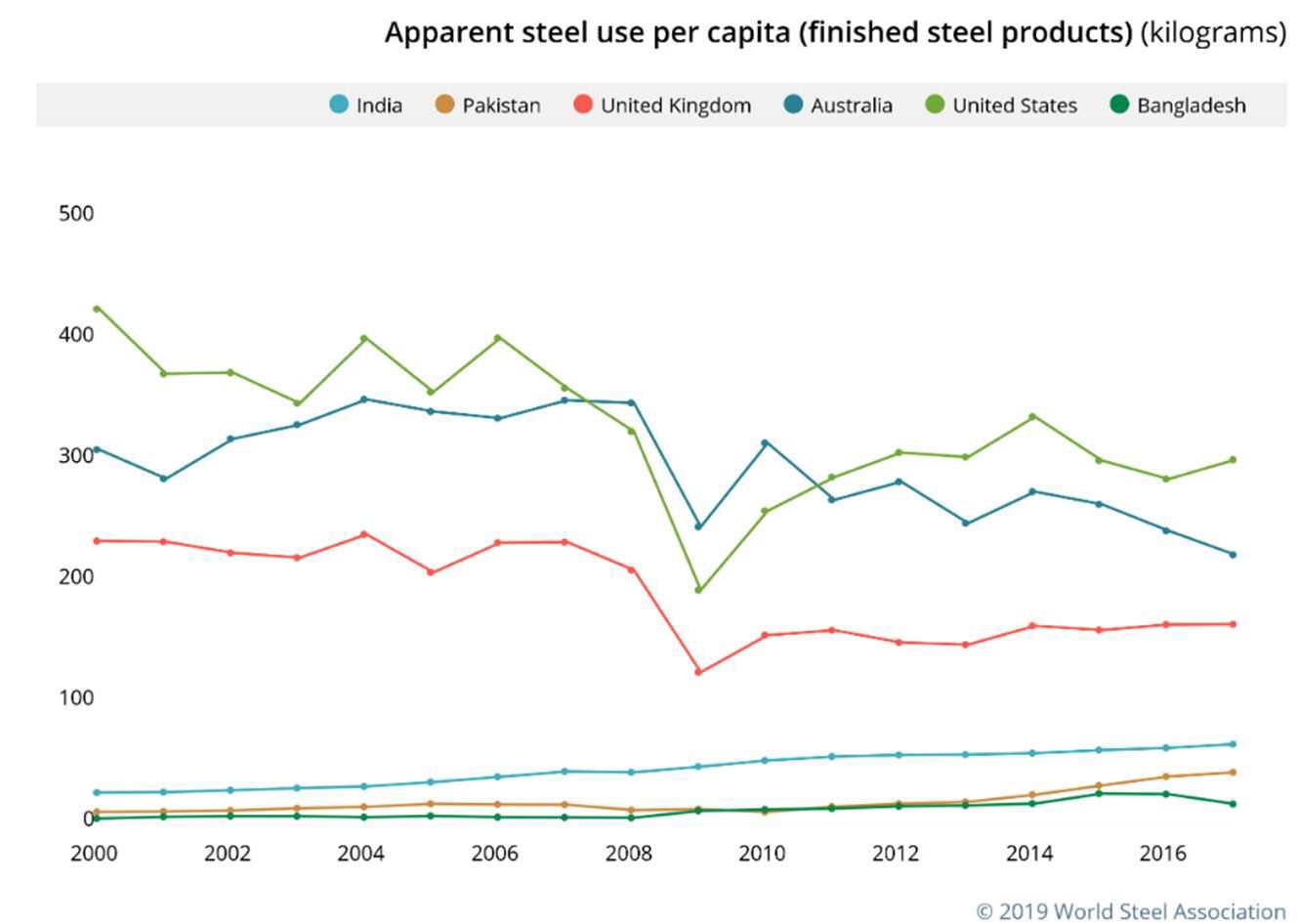
Iron – first discovered by the people of Egypt and Mesopotamia as a gift of the gods falling from the sky – was initially used for making exquisite weapons and ornaments. Thousands of years later, iron workers discovered an accidental by product, steel. Infinitely recyclable, strong, durable and sustainable, its discovery helped shape the modern world. Today, steel is the fourth most commonly used metal in the world. From building construction to automobiles and home appliances it has become an irreplaceable part of our daily lives. So important, its per capita consumption is often considered a measure of economic success of a country.

Although the per capita consumption of steel in Pakistan is quite low compared to the developed world, the use of pre-engineered steel structures for large scale industrial buildings has taken off since recent years. This is primarily pertaining to the economic benefits that come along with the use of steel particularly for large span buildings. However, in residential construction, use of steel is still a novelty or rather something unheard of in Pakistan as in other developing economies of the region.

Although the per capita consumption of steel in Pakistan is quite low compared to the developed world, the use of pre-engineered steel structures for large scale industrial buildings has taken off since recent years..

Light gauge steel, also known as cold formed steel is a tried and tested construction material used in developed countries such as UK and Australia since decades. The technology involves use of off-site prefabricated panels made of steel studs that are ready to be assembled once they reach site. This enables manufacturers to standardize structural elements such as walls, floors etc. and achieve economies of scale while increasing productivity. With its innate properties such as a high strength to weight ratio, non-combustibility, termite resistance and cost effectiveness, Steel appears to be a good antidote to the very high design, construction and maintenance costs associated with the traditional brick and mortar structures. The use of light gauge steel can cut build times by up to 30 percent that can lead to indirect financial savings.

The realization that cold formed steel is the answer to growing need for efficient, safe and cost effective housing units in cities has led to an increase in popularity among professionals related to the construction industry. In October last year, the Indian Institute of Technology Hyderabad organized a workshop on ‘Affordable housing for all’ where experts spoke about the need to promote steel as a sustainable alternative to conventional construction practices. Emphasis was laid on the importance of light gauge steel for cost reduction and the positive impacts of its use on the environment. While there is an infinite potential to harness these properties to address the issue of affordable housing in emerging economies, there are certain barriers that need to be overcome first.


Challenges Unique To Emerging Economies

While countries worldwide are adopting different approaches to address the issue of affordable housing, there are challenges unique to emerging economies that intensify the severity of the crises. The governments of emerging economies find themselves financially and logistically incapable to do so much in so little time, they cannot deal with the crises on their own. If private sector can come up with innovative solutions, we can hope to address the issue through public private partnerships. However, for the technology to appear promising to private sector entrepreneurs, it needs to be accepted by the public.

The barriers to public acceptance of new technologies and materials particularly in the construction sector are more cultural and social rather than economic. It is an established fact that the mere availability of technology isn’t enough to motivate people to embrace it. This is despite the fact that there might be a substantial monetary benefit to gain from it. Since time immemorial, brick and mortar structures are the pre dominant way of housing construction here in the developing world. People have no patience with fancy materials that are contradictory to their previous ways of living. For them, building a house means making a once in a lifetime investment and they are certainly not prepared to risk it by adopting an approach different from their forefathers and better off peers. One reason behind the success of steel in the industrial sector is that instead of general population, the end users happen to be well informed national and multinational co operations competing with each other to give best value to their customers while keeping expenditure at bare minimum. With obvious benefits, steel is the material of choice.

Figure 3


This issue is further augmented by the presence of Institutional voids. A term coined by Harvard University professors Tarun Khanna and Krishna G. Palepu in their article which refers to the absence of credible intermediary institutions, regulatory systems, accessible while dependable sources of communication, redress and contract enforcement mechanisms that are essential for businesses to operate and thrive and are often taken for granted in the developed world. This coupled with turbulent market conditions provides poor ground for profits especially for tech based firms. It boils down to the absence of one fundamental element that is vital for businesses to thrive, a relationship of trust between prospective buyers and sellers.


The Way Forward

While Governments of developing countries are inevitably going to rely on the private sector to address this issue, policy makers need to draft policies to create conditions that will encourage entrepreneurs to venture in the field of new technologies. Priority should be given to institution building to make it easier for people to do business in the country.

On part of the entrepreneurs, they need to finds ways around the barriers that might exist. There is a need to understand that in emerging economies, people have well defined norms which they seldom deviate from and before technology can become useable, a whole bunch of stuff has to happen. This basic understanding of the functioning of a society is often what distinguishes a successful entrepreneur from an unsuccessful one. The key lies in adopting a business strategy and planning that is tailored to the underlying conditions of a particular economy. For now, increasing awareness among people about potential benefits of new technologies particularly steel construction can help pave the way.

There are many socioeconomic benefits that come along with a well-managed urbanization, with that being said if entrepreneurs can come up with a way to develop the adoptive and absorptive capacity of emerging markets while addressing the functional fixedness of the society, it would be – as Neil Armstrong said when he first set foot on the moon – “One small step for man, one giant leap for mankind”

About the Author

Akbar Imran Butt is a civil engineer by profession who is working in the industrial steel buildings sector for the past few years in Pakistan. Apart from being a steel enthusiast, his research interests include entrepreneurship and use of technology to solve real world problems. He can be reached at: [email protected]

The Climate Crisis Dilemma

By Graham Vanbergen

The climate crisis is now changing global finance – Graham Vanbergen asks the question do we want to pay for it now – or pay for it later.

In 2019, analysis found that the world’s largest investment banks provided more than $700bn of financing for the fossil fuel companies that were most aggressively expanding into new coal, oil and gas projects since the Paris (climate) Agreement in 2016.

Thirty-three powerful financial institutions have, between them provided an estimated total of $1.9tn to the fossil fuel sector between 2016 and 2018. For context, this is enough money to eradicate global poverty for a decade.

And one of the most prominent of those financiers has been led by the Wall Street giant JPMorgan Chase. It provided $75bn (67bn Euro) to companies expanding in energy sectors such as fracking and Arctic oil and gas exploration. But Barclays, one of the most heavily invested, has provided $85bn (£65bn) of funding to fossil fuel firms and carbon-intensive projects. 


Wind of change

In January, Barclays was formally challenged by some of its shareholders to stop financing fossil fuel companies that are driving the climate crisis, in the first resolution of its kind filed against a European bank.1

Eleven pension funds managing £130bn have filed the motion calling on Barclays to bring its activities into line with the Paris Agreement.

This is just the start of the ‘uncoupling’ of big finance and the fossil fuel industry. 

Mark Carney, the outgoing Governor of the Bank of England recently said — financial firms had been too slow to reduce investment in fossil fuels and warned that many assets were at risk of being rendered “worthless” by the climate crisis. In December, the Bank of England then became the first central bank in the world to announce what it terms a banking stress test on climate change. If, for instance, a British bank loans money to a company building a coal-fired power plant, the BoE will require the bank concerned to hold a substantial amount of additional capital to cover the risks of the project being abandoned because of new regulations or other climate change-related factors.2

In the same way, if an insurance company has granted cover to houses on a flood plain, or to coastal properties which could be subject to rises in sea level, or mortgages granted on them — additional money needs to be set aside.  

Echoing BoE warnings — environmental concerns dominated long-term global risks for business leaders, investors and policy-makers at Davos for the first time. Its annual risks survey put climate and other other environmental threats ahead of risks posed by geopolitical tensions and cyberattacks. Even its 81-year-old founder Klaus Schwab, said the world is facing “a state of emergency”.

After more than a year of grim scientific projections, environmental disasters and growing activism, world leaders and the public alike are increasingly recognising the severity and urgency of the climate crisis. Tipping the scales are organisations like Extinction Rebellion (XR), the fastest-growing political pressure group in the world and climate activist rockstars such as Greta Thunberg.


Climate change counterweight

However, weighing heavily on the side of fossil fuel use is a global population that continues to grow. A population the size of Germany (80m or 1.1% pa) is added each year to our planet – putting even more pressure on energy resources. And research shows that we are on track to produce 120% more fossil fuels in 2030 than in 2020. At the same time, a recent survey found that climate breakdown is viewed as the most important issue facing the world, ahead of migration, terrorism and the global economy, in seven out of the eight countries surveyed. 

This is the dilemma. Do we kill the patient before coming up with a cure — or die waiting for it.

XR’s motives are seemingly moral and justified. But climate pressure groups are more likely to galvanise investor-led change if they acknowledge the bitter truth. As the FT recently remarked — “Without fossil fuel energy — societal collapse and mass death is equally likely to occur if fossil-fuel producers are deprived of financing too quickly.” And here’s another truth — the global energy consumption trend is very closely aligned with global GDP growth and renewables simply can’t keep up. Worse still is that the climate crisis problem will never be resolved with existing renewable technology. Therefore, the real crisis to human existence is that even doing too much could lead to global societal collapse.

This is the dilemma. Do we kill the patient before coming up with a cure — or die waiting for it. From the competing predicament posed by fossil fuel use and the climate crisis, global economic losses from a rise in temperatures of 4 degrees celsius, the current trajectory, has been estimated at $23 trillion per year. Again, for context, this staggering number is twelve times current global military defence spending.3


Physical risk to financial risk

Inevitably, this asset-cum-environmental catastrophe will soon pose two kinds of risks to the financial system: physical risk from natural disasters, and financial risks from transitioning away from fossil fuels.

Even if every country were to fulfil their current emissions reduction pledges from the Paris Agreement, we are still heading for a 3.2c increase in global temperatures. This is double the threshold before the climate crisis becomes a daily crisis for millions with trillions needed to be spent combating it.

According to the International Energy Agency, a third of the Earth’s electricity will come from renewables by 2024 (a surge by 50% globally in the next five years) – but we will still be “well short” of what’s required to meet anything like the targets set.

While nations are quickly adopting solar and wind, the IEA said coal is still expected to be the largest source of power globally in 2024. However, China is expected to overtake the EU as early as 2021 as the leader in solar panel use.

It’s worth remembering that at least 16 insurance companies were bankrupted after Hurricane Andrew hit the USA in 1992 because they didn’t anticipate the magnitude of the damage.

While the physical risks are calculable, it’s worth remembering that at least 16 insurance companies were bankrupted after Hurricane Andrew hit the USA in 1992 because they didn’t anticipate the magnitude of the damage. And mother nature has more lessons to teach us for our global indifference to her needs.

When Hurricane Dorian hit the Bahamas (population 395,000) last year, it was the worst natural disaster in that country’s history and is expected to cost $4bn ($10,125 per person) in insurance payouts. But this is dwarfed by the Australian bushfires. As at mid-January, economist John Quiggin at the University of Queensland put the total (tangible) cost at $100 billion, the costliest natural disaster in its history. Like Hurricane Andrew – both disasters were anticipated, the scale of them was not.

Columbia professor Adam Tooze estimated last year that of the total equity and fixed income assets in the world, as much as one-third are exposed as carbon-sensitive, and investors have increased their holdings in these assets significantly over the past three years. Potential losses from the value of carbon-sensitive assets are now estimated to be valued at $18 trillion.4 Whatever happens, the transition either now or when it’s too late will be painful and extremely costly. One could argue, not as costly as the loss of human life, but reality tells us that won’t win the debate. Part of the problem is that what we are facing is unknown and therefore its calculations are estimates, not foregone conclusions, which fuels the rhetoric of the climate science deniers.

World leaders and financial regulators can play a significant role in protecting the planet by helping to provide a workable solution in preventing systemic risk. In so doing, the transition to renewables would be quicker and ultimately less painful.

The question is, do we want to pay for it now – or pay for it later?

About the Author

Graham Vanbergen is the founder and contributing editor of
TruePublica.org.uk and author of Brexit – A Corporate Coup D’état.


References
1 https://www.theguardian.com/environment/2019/oct/13/top-investment-banks-lending-billions-extract-fossil-fuels
2 https://truepublica.org.uk/united-kingdom/world-first-bank-of-england-unveils-climate-stress-test-to-banks-and-insurance-companies/
3 https://www.independent.co.uk/news/business/news/barclays-bank-shareholder-climate-change-resolution-fossil-fuels-a9275926.html
4 https://prospect.org/environment/the-biggest-threat-to-financial-stability-is-the-climate/

Everyday Leadership: Influencing Your Company’s Culture and Strategy As An Individual Contributor

By Mostafa Sayyadi

In the absence of effective leadership, organizations are not capable of effectively implementing changes at the competitive level. In this article, the author places a new emphasis on leadership and its implementation by executives at all organizational levels in companies. The implementation of leadership enables organizations to cultivate an effective corporate strategy coupled with cultural changes to remain competitive.


Executives are faced with challenging economic conditions today with global competition increasing and the need to be number one or two in an industry or fail to keep up with the market place. This new economic environment may have a negative emotionality that can seriously reduce people’s capabilities in changing and overcoming challenging situations. To offset the negativity associated with widening the gaps of success and failure, executives that act as leaders can manage a firm’s internal resources (corporate culture and corporate strategy) and use them as an important driving force for business success. This may be the answer executives need but may also lack the fundamental fortitude necessary to be an all-encompassing model to predict customer satisfaction, employee or follower satisfaction, and financial profitability. Executives that embrace leadership around the globe realize that they have a positively impact on corporate culture and corporate strategy and play a critical role to achieve the best climate for implementing strategic changes that create learning and growing the organization.1 This effective leadership will be covered in-depth throughout the rest of the article with the main focal point being introduced here as the simple application of leadership, which is describes in the following sections.


How Can Leaders Leverage the Power of a Strategic Approach?

In the military, leaders often provide what is called “Top Cover” flying above their followers to ensure their mission is a success. Submarines travel with pilot ships to guide them. This is what you and executive need to do. Leadership, being the core of management, is crucial to organization’s success – both from a performance and management level. However, leaders across the globe have found that corporate strategy is critical to business success. Corporate strategy could be the most important component of success in this ever changing business environment of today. This, by far, is why some organizations are successful and some are not. The key take-away for executives is that corporate strategy is a resource that enables organizations to solve problems and create value through improved performance and it is this point that will narrow the gaps of success and failure leading to more successful decision-making.2,3

Executive that implement corporate strategy as an important driving force for business success find their organization to be more competitive and on the cutting edge. However, corporate strategy implementation in large corporations is determined by a set of critical success factors, one of which is the strategic dimension of leadership.4 Thus, one tool for executives to use when considering on lessoning the gaps between success and possible failure, is to adopt leadership and implement corporate strategy. One that can be immediately applied to limit the gaps between success and possible failure. Thus, the burden of success when effective implementation of corporate strategy is concerned is heavily dependent on the capabilities of the organization’s leaders. Therefore, the outcome is success which narrows the gap between success and failure and this can be achieved by corporate strategy and facilitated by an executive acting as a facilitative-leader.

Executives evaluate the success of corporate strategy. Corporate strategy reflects the degree to which a company can expand and determine the right pathway to success. The key function of corporate strategy is to help executives use it for goals achievement.5 In this context, corporate strategy is becoming the forefront to success in corporations worldwide. Success, therefore, is dependent upon how executives formulated their organization’s strategy. Thus, corporate strategy has been a focal point of executive span of control but has not been associated with leadership enough to make it an integral part of organizational success. Leaders, in fact, positively impact corporate strategy implementation through enhancing the dynamic relationships among employees and departments, but most importantly, through satisfying customer needs and adding to financial success. However, financial success does not come overnight, it encompasses consistent hard work and absorbing several useful pointers from various financial coaching experts. One outcome of corporate strategy is to connect knowledge with other companies that want to share successes and failures. It is about getting the information needed to be successful in the right hands of executives worldwide. Leaders can inspire organizational members to network with more successful competitors by sharing successes to build alliances and not only enhance competition but communicate best practices as a way of keeping the highest standard of operation in the industry and being the go-to organization for successful modeling of profitability, customer service, and employee satisfaction. In doing this, leaders implement corporate strategy to develop relationships with external environments to identify new opportunities that occur in an ever-changing hypercompetitive marketplace. Leaders, in fact, implement corporate strategy to expand the growth opportunities available to organizations that may be challenging but important to close the gap between success and failure. This leads to converting acquired knowledge into organizational processes and activities to improve or discontinue processes that contribute success. Therefore, leadership is pertinent to corporate strategy implementation and an organization’s success.


Does Corporate Strategy Really Build Corporate Culture?

Executives focus on individuals as the major source of knowledge, and show how follower’s ties together so that they can affect the sharing, storage, transfer, and apply knowledge within organizations. Executives, therefore, see these connections, and the related shared knowledge and memory, as central to the effectiveness of corporate culture. Executives know that corporate strategy through sharing individual knowledge around the organizations can positively contribute to build a strong corporate culture. Therefore, executives should build an atmosphere of trust and openness and use corporate strategy to convert individual knowledge into valuable resources for their organization to close the performance gap and help organizations prosper.6,7 The key is for executives to inculcate corporate culture within organizations so that information can be found and used instantaneously. Corporate culture enables organizations to promote the depth and range of knowledge access and sharing within companies.

Executives can now see how leadership not only can directly support corporate strategy, but it can also cultivate an effective strategic decision making process, which will enable corporate culture within organizations.

Corporate culture is enhanced though providing further opportunities and information sharing. Executives can enhance knowledge sharing by providing access to knowledge, and stimulate new ideas and knowledge generation, transfer an individual’s knowledge to other members and departments, and improve knowledge capturing, storing, and accumulating, aiming at achieving organizational goals. Executives that employ corporate strategy can propel knowledge sharing in the company to generate more innovative ideas and solutions for new and demanding issues that come up constantly in our hypercompetitive economic environment. In doing this, executives can employ corporate strategy though implementing coaching and mentoring practices by sharing experiences gained by imitating, observing and practicing. Executives that use corporate strategy have found that it builds a strong corporate culture through facilitating knowledge sharing throughout all levels of the organization. Corporate strategy focuses on defining and recognizing core knowledge areas, coordinating expert opinions, sharing organizational knowledge, and scanning for new knowledge to keep the quality of their products or services continuously improving. Corporate strategy, therefore, is an essential requirement of corporate culture by which knowledge is shared among people.

However, executives may lack the required corporate strategy to interact with other organizations or distrust sharing their knowledge.8,9  Executives are, therefore, clearly the right focal point for developing networking with environmental components by adopting corporate strategy to develop relationships and interactions. They key here is to inspire their organizations as a whole to develop networking with more effective enterprises through employing corporate strategy directed at connecting knowledge with other companies. Executives are finding that corporate strategy creates a shared understanding about problems which can develop an effective corporate culture that enhances the knowledge sharing process. Through the corporate strategy, executives could build a climate inspiring followers to share their knowledge, and facilitate the knowledge sharing process. Thus, executives can apply corporate strategy to enhance knowledge sharing among human capital and stipulate knowledge to be shared around the organization and with other companies.


In Conclusion

Executives can now see how leadership not only can directly support corporate strategy, but it can also cultivate an effective strategic decision making process, which will enable corporate culture within organizations. Leadership has a significant effect on organization’s internal resources. Executives can also see that cultivating an effective strategic plan coupled with cultural issues requires developing leadership within organizations – not only at the higher echelons of the organization but at every level. Thus, in light of the increased pressures of the global workplace that inspires leaders to exert effective change at the organizational level, this article points out the vital importance of leadership in reshaping an organization’s internal resources to have access to more effective strategic initiatives and higher performing culture within organizations. This article also suggests that both internal resources of corporate strategy and corporate culture constitute the foundation of a supportive workplace to improve business success and reduce operational risk. Standing on the shoulders of scholars before us, I indicate that corporate strategy and corporate culture are major internal resources for business success and support the positive impact of these two vital factors on business success.

About the Author

Mostafa Sayyadi, CAHRI, AFAIM, CPMgr, works with senior business leaders to effectively develop innovation in companies, and helps companies – from start-ups to the Fortune 100 – succeed by improving the effectiveness of their leaders. He is a business book author and a long-time contributor to HR.com and Consulting Magazine and his work has been featured in these top-flight business publications.

References
1 Avolio, BJ, Waldman, DA, & Yammarino, FJ (1991). Leading in the 1990s: The Four I’s of Transformational Leadership. Journal of European Industrial Training, 15(4), 9-16.
2 Cohen, M.D., & Sproull, L.S. (1996). Organizational Learning. Thousand Oaks, CA: Sage Publications.
3 Talke, K. (2007). Corporate mindset of innovating firms: Influences on new product performance. Journal of Engineering and Technology Management, 24, 76-91.
4 Bass, B.M., & Avolio, B.J. (1997). Full range leadership development: Manual for the Multifactor Leadership Questionnaire, California: MindGarden.
5 Zheng, W., Yang, B. & Mclean, G. N. (2010). Linking organizational culture, structure, strategy, and organizational effectiveness: Mediating role of knowledge management. Journal of Business Research, 63(7), 763-771.
6 Lee, H., & Choi B. (2003). Knowledge management enablers, processes, and organizational performance: an integrative view and empirical examination. Journal of Management Information Systems, 20(1), 179-228.
7 Fugate, B.S., Stank, T.P., & Mentzer, J.T. (2009). Linking improved knowledge management to operational and organizational performance. Journal of Operations Management, 27(3), 247-264.
8 Jianbin, C., Yanli, G., & Kaibo, X. (2014). Value Added from Knowledge Collaboration: Convergence of Intellectual Capital and Social Capital.  International Journal of u- and e- Service, Science and Technology, 7(2),.15-26.
9 Zehua, Z. (2012). Knowledge Collaboration (KC) and the relationship between KC and some related concepts. Library and Information Service, 8, 107–112.

Greater Innovation Ahead: Global Social Development Through Blended Finance Structures

By Ranajoy Basu

Impact finance heralds a new frontier for finance: one in which an investor’s drive for financial return is coupled with a key motivating factor (commonly referred to as the “double bottom line”) to generate and maximise a social impact. This innovative and growing market of bringing together public and private sector funding for targeted social interventions aligns with the scale of funding required to achieve the United Nations’ 2030 Agenda for Sustainable Development, which provides a common pathway for a better and more sustainable future by identifying seventeen global sustainable development goals (“SDGs”).


The International Finance Corporation, part of the World Bank Group‚ has created a new framework of nine principles to bring greater transparency‚ comparability and rigour to the impact finance market (the ‘Operating Principles for Impact Investing’). Sixty fund managers managing over $350 billion in assets have signed up to these principles. The Impact Investing Institute, an independent non-profit organisation (supported by the UK government) is also one example of a recently established taskforce which aims to accelerate the growth and improve the effectiveness of the impact investing market in the UK and globally.

There has also been an exponential growth of consumer and general public interest in impact investing. A clear message is being delivered‚ especially from millennials: corporates need to be more socially responsible. As a result‚ many forward-looking companies are responding positively to this consumer-led demand‚ with one example being the Beyond Meat post-initial public offering performance.

This article aims to explore the spectrum of impact investing, its various forms and structures‚ and the challenges as well as opportunities for investors who are looking to participate in this what is now truly emerging as a mainstream asset class.


What is “impact investing”?

Impact investing is “an approach used by investors to harness the power of their investment capital to actively contribute to improvements in people’s lives and the health of the environment.”1 What differentiates impact investing from other forms of investment is the positive social or environmental impact that the investor seeks to achieve, alongside its financial return. This includes both ‘finance first’ investing‚ which looks to achieve a social impact while generating competitive financial returns‚ and ‘impact first’ investing‚ which looks to achieve a social impact while accepting lower financial returns.

What differentiates impact investing from other forms of investment is the positive social or environmental impact that the investor seeks to achieve, alongside its financial return.

It is this duality in social and financial return, that sets apart impact finance from traditional finance structures at one end of the spectrum‚ that target competitive risk-adjusted financial returns with no expectation to enhance social value, and philanthropic funding at the other end, which addresses social impact with the expectation of full capital loss.

Within the impact finance space, however, exists a myriad of impact investing structures. This reflects both the lack of consistency in approach in impact investing and‚ perhaps more so‚ the level of innovation within the market space. Impact investing structures include, amongst others:

  1. Results-based financing instruments that enables investors to finance development or other social programmes for the achievement of specific target outcomes
  2. Green or environmental, social and corporate governance (“ESG”) bonds that are capital market issuances enabling investors to finance climate-related or other social projects backed by the issuer’s balance sheet
  3. Funds financing solutions that blend public‚ private and grant funding which can be leveraged to generate additional funds

Although more commonly associated with developing markets, some of the greatest innovation in impact investing structuring emanates from developed markets. The Royal Bank of Scotland’s recent bond issuance under its green‚ social and sustainability framework is the first by a British financial institution, which it said would boost lending to small firms in disadvantaged areas.

A further example of a unique impact financing structure relates to an investment facility for education, which is being set up to deliver improved multilateral development bank financing in the education sector. The international finance facility for education (“IFFEd”) aims to unlock significant new funding for education from the global community. The funding will be used to fill a gap in the international financial architecture where currently lower-middle-income countries are unable to mobilise sufficient funding to achieve SDG 4 (i.e. to ensure inclusive and equitable quality education and promote lifelong learning opportunities for all).


Results-based structures

The appetite for results-based financing instruments such as government-backed social impact bonds (“SIBs”) has been growing since the first SIB launched in 2011 by Peterborough Prison. That SIB raised £5 million from 17 social investors to fund a project with the objective of reducing recidivism rates of prisoners who had served custodial sentences of up to one year. Development impact bonds (“DIBs”), the close cousins of SIBs backed by non-governmental entities, have seen a concomitant rise in popularity, with the first DIB being launched in 2014 aimed at reducing the gender gap in education in rural India by increasing the school attendance of girls. SIBs and DIBs (which, confusingly, do not necessarily include an issuance of ‘bonds’ at all) seek to channel money to projects with a positive social impact while only providing a repayment or return to investors once the desired results have been achieved.

While there are several ways of structuring the contractual framework of a DIB or SIB, the basic concept involves a risk investor providing upfront capital to an intermediary in order to achieve pre-agreed target outcomes for the benefit of a specified target population. The intermediary acts as a project manager by coordinating and managing the ongoing implementation of the project and brokering relationships between the key transaction parties. The service providers execute the actual intervention and coordinate with the intermediary on the implementation of the project. An independent evaluator is engaged to evaluate and confirm whether, and to what extent, the success metrics, as agreed between all key stakeholders at the outset, have been met. To the extent that such target outcomes have been achieved, the outcome funder will make a payment to the risk investor commensurate with the extent to which the target outcomes have been achieved. Depending on these outcomes, the risk investor may receive more or less than its initial investment in the DIB or SIB. A simple impact bond structure is outlined below:

DIBs and SIBs transfer the risk and upfront capital commitment required for social impact projects from governments and philanthropic organisations (who may already be too thinly stretched, as well as being constrained by bureaucratic red tape) to private investors that have broader investment capabilities and greater appetite for risk. It also means that, unlike traditional philanthropic activity, it measures actual ‘outcomes’ rather than just ‘inputs’.


Innovations and market trends

Pilot projects

A SIB or DIB may be used to fund innovative and untested interventions, therefore appropriate due diligence of the funding mechanism, the implementation framework and the evaluation process needs to be undertaken to reduce the risk of potential pitfalls when the actual project is implemented on the ground. Where there is a lack of underlying baseline performance data, which makes it difficult to evaluate and measure the success of the social impact and hence calculate the financial return, pilot projects can be undertaken to measure the baseline against which the results of the social impact can be evaluated. Such pilot projects are increasingly being utilised to help fine-tune the proposed intervention to provide further assurance of the success of the project for investors. A properly designed SIB or DIB can allow innovative concepts, which would otherwise never have even been tested, to be implemented with little or no track record whatsoever.


Debt issuances

Although green and ESG bonds are typically done through debt issuance and most funding of SIBS or DIBs is done by way of grant funding, a recent innovation in the impact finance sector is the use of privately placed or publicly issues listed bonds and securities to raise funding for results-based SIB or DIB structures. Driven by the need to increase the scalability of impact investing (the funding gap to meet the SDGs is estimated to be USD 2.5 trillion annually), participants in the sector are increasingly developing structures involving debt issuances to access loan or capital markets for funding. While this introduces additional costs and takes time to launch, the goal for market participants is to establish SIBS or DIBs that can be marketed to institutional investors much like any capital markets offering. From an investor perspective, this approach allows funding to be channelled into the social impact directly, taking risk solely on the success of the intervention, unlike investors in ESG or green bonds who must take issuer credit risk by de facto purchasing corporate bonds.


An interesting market trend is the establishment of funding vehicles to aggregate funding either at the risk investor, outcome funder or issuer level.

Funding vehicles

An interesting market trend is the establishment of funding vehicles to aggregate funding either at the risk investor, outcome funder or issuer level. Although such an approach introduces additional complexity and incurs higher costs (due to, for instance, the need for specialist advice in relation to the management of the fund as well as tax and regulatory law), it could lead to cost savings over the long term if the fund is set up as a programme to enable participation in multiple SIBS or DIBs. For example, funding vehicles which provide for funding streams from different impact investments to be compartmentalised supports the scalability of SIBs or DIBs, driving demand and increasing standardisation in structure and contractual documentation. Funding vehicles at the outcome funder level reduces the cost of funding for participation in SIBs or DIBs and also allows greater sized SIBs or DIBs to be issued.


Governance

Whether it be in relation to businesses engaged in the delivery of ESG products or services, or in the context of an impact bond, the core governance structure responsible for the manner in which capital is used is arguably the backbone of successful impact investing. A strong governance model is one in which financial resources are managed with a view to maximising the value of the social impact while balancing the efficient and responsible use of capital. Impact investors will require transparency and appropriate checks and balances in the form of, for example‚ corporate finance policies and strategies‚ steering committees‚ budgeting of capital deployed and the strict measurement and reporting of any impact achieved. It is common‚ for example‚ for impact investors to restrict the ability of the business or project manager of any impact bond to raise any further funding for a particular intervention‚ in order to prevent an inefficient allocation of capital relative to the social impact.


Can you really make money while doing good?

A key challenge for the impact finance market is dispelling any perception that investments that generate both financial return and social impact are mutually exclusive. This includes the work required to educate the financial sector‚ including investors‚ financial professionals and policy-makers, as to the potential and proper use of impact investing. Despite the lack of a globally accepted definition for or approach to impact finance‚ measuring the extent of the social impact is already a fundamental requirement for impact investors. As a result of this‚ the use of impact finance for the sole purpose of public relations is becoming increasingly harder.

Methodologies designed to identify, measure, track and report the wider benefits of the social impact is a key requirement of any impact investment. From a documentation perspective‚ this means that it is vitally important to have clearly defined and measurable success metrics in place. Impact investors should be particularly careful that underlying documentation clearly defines the parameters for the actual outcome or impact and also outline a reporting system for various stages of the project upon achieving key milestones. The level of information can significantly vary between projects and jurisdictions and this is one of the biggest challenges in achieving consistency of data. The provision of clarity in reporting between different projects will ultimately help build investor and market confidence.

]

About the Author

Ranajoy Basu is a partner in Reed Smith’s Structured Finance group and the head of the firm’s Social Impact Finance group. He is widely recognised as one of the world’s leading impact investment lawyers. He regularly advises on complex, cross-border social impact finance structures, including social and development impact bonds, renewable energy, “green” structured finance transactions and other capital market solutions in the social impact space.

As a true pioneer in adaptive sustainable development and impact finance, Ranajoy has made a significant contribution through structuring impact bonds and other cutting-edge impact finance solutions. Ranajoy is one of the lead architects of the International Finance Facility for Education (IFFEd), a ground-breaking financing mechanism designed to deliver funding for the education of millions of children around the world and target the United Nations Sustainable Development Goals for Education (SDG 4). He also advised on the Educate Girls Social Impact Bond, the Utkrisht Bond and more recently advised The British Asian Trust on the world’s largest impact bond for education. Ranajoy is extremely passionate and driven to create a positive social impact around the world using the law and finance as an instrument of innovation.

References
1. GIIN, “Core Characteristics of Impact Investing”, available at https://thegiin.org/assets/Core%20Characteristics_webfile.pdf.

How A Life Insurance Agent Helps With Your Priorities

A lot of unexpected things seem to happen when we least need it in life. Things could be going your way when all of a sudden you are hit with something out of the blue that messes all your plans. This is why it is very important to be prepared and to always have a backup plan because this is the only way you’ll ever be able to take life’s blows and keep going. One of the better ways to do that is getting a life insurance agent to help you set a policy that will do you more good than you could possibly imagine. Here’s how they can help you.


A safety net for the family

A lot of people’s most important financial priority is making sure their families are well taken care of when they are gone, especially if you are the primary caretaker. This is exactly what a life insurance agent could help you do. They will set up a life insurance policy that ensures that your family will comfortably be able to pay any funeral or other medical expenses. More importantly, they would be able to have enough money to keep them going for quite some time, as beneficiaries of your policy. The death benefit they receive will support your family long after you are gone, which is why most people get life insurance policies in the first place.


Paying off debt

After having secured your family’s financial future when you are gone, there comes another financial priority for most people, and that is paying off debt. But how can your life insurance policy help you do that? Well, you invest money in your policy by paying premiums every month, and, fortunately, you can tap into that money in case of emergencies and take out a loan so you could settle some urgent debt or pay for an unexpected medical operation. As you can see in articles from StateRequirement, helping people like that is actually the reason why a lot of people become life insurance agents, though there are several steps entailed here. Back to the debt, you are basically borrowing from your own money here, but it won’t happen overnight, though. You need to have actually been paying premiums for some time before you can start taking a considerable amount.

Still, borrowing money from your life insurance policy has a lot of pros –– and cons. The money you borrowed won’t show on your credit reports, and the initial access to the funds is quite easy and straightforward because there are no credit checks or long approval processes. Because it is your money, you can pay back the amount taken as you please, without any actual deadlines. If there are interest rates, they will most definitely be less than a typical bank loan. The biggest downside, though, is the fact that you are taking from the death benefit you’re leaving your beneficiaries, which means they will receive less money if you don’t pay it back.


Settling inheritance

Settling inheritance is another reason why you will need the help of a life insurance agent. There doesn’t have to be a beneficiary in its traditional meaning. Some people do get life insurance policies with the goal of leaving the death benefit as some form of inheritance to one of your loved ones. They don’t even need to be a direct relative if that is what you choose. By doing this, you will be making sure that your life insurance money will go to the person you intended and not someone else.


Tax benefits

One of the greatest things about life insurance policies is the tax benefits that come along. The death benefit that the beneficiary receives is tax-free, which is something very important to the people getting the money and to you, as you’ll basically be leaving them more money without the need to pay any taxes.


Additional income

Assuming you make it to old age, you will find that expenses are piling up and your pension isn’t covering your financial needs. This is when you can access your permanent life insurance policy to get some extra retirement income, which does come in handy and could save you a lot of nuisance in your old age.

A life insurance agent will help you take care of your financial priorities, and you will be able better able to relax when you retire. The ultimate goal is making sure that your family is taken care of when you die, and having a source of money on the side to tap into in case anything goes wrong, and a life insurance agent will help you sort that out.

How to Successfully Start a Small Business

We’ve almost reached the new year, a time to reflect on the past, and put necessary changes in place for the future. It’s natural to fall into habits that don’t exactly suit us, simply because they’re easy, especially when it comes to careers. Worryingly, one 2018 study found that 53 percent of Americans are unhappy at work, and for many of us, the only way to feel true job satisfaction is to quit and set up our own business.

Starting a business is something that requires a lot of thought, time and effort. Even taking the first few steps can prove incredibly daunting, because there’s likely so much that you’re putting on the line to make things work – your career, your finances, and your spare time. If you fail, it’s doubtful that you’ll get any of those back.

But you only have to look at the hundreds and thousands of businesses that currently exist to know that you can create a success story out of your business start-up, and there are things you can do to sway the whole process in your favour.

To get inspired, take a look at the 4 practical tips below on how to successfully start a small business: For more tips and ideas on how to run a business successfully, Click here.


1.  Make a plan

No good business can begin without a plan. You don’t need to plan to extensively to begin with, but you definitely need to consider a few things from the get-go. For starters, what problem are you aiming to solve with your business? What are your core values? Do you want to own a physical store or do you prefer the idea of online-only? These first few considerations will become the foundations for your business, so don’t be hasty to work through them. Check out some trending products, simplify the processes, and write attainable goals on your business plan.  


2.  Take out a loan

Ironically, while your business is still in its very early stages, you’ll find it incredibly difficult to take out a small business loan to get things started. Instead, you’ll have to take out a personal loan, which is considered the most flexible and secure funding option. You could also rely on credit cards to get you started, but you’d have to be certain you could stay on top of your payments. Visit LetMeBank for more useful info on your loan options.


3.  Register a business name

If there’s one way to make your small business venture feel real, it’s to register your chosen business name. You need to register your name so that your business officially exists, and the simplest way to do so is by filing a DBA at your state or county clerk’s office. Paperwork and filing fees come at a cost, but it’s an essential investment for your business.


4.  Look at licences and permits

Starting a business is rarely as simple as registering and getting going. Depending on the services or products you plan to offer, you may need to sort a licence or permit to legally do so. Insurance is another element to consider at this time – you want to cover your back in as many ways as possible, and it’s always better to sort sooner rather than later. 

How to Beat a DUI Charge in Canada

Section 320.14(1)(a) of the Canadian Criminal Code is unique among common law jurisdictions in that a defendant may be charged with a DUI if his/her “ability to operate it [the vehicle] is impaired to any degree by alcohol or a drug or by a combination of alcohol and a drug.” There is no required minimum blood alcohol content (BAC) in Canada, although, crown prosecutors may use a defendant’s BAC level as proof of operation while impaired, even retroactively. Canada prosecutors have the burden of proving a defendant’s operating ability was impaired by drugs or alcohol beyond a reasonable doubt, not simply that drugs or alcohol was present in the defendant’s system. Here are three ways to beat a DUI charge in Canada. 


1. Challenge the Sufficiency of Impairment Evidence 

For Section 320.14(1)(a) impaired driving charges, witness testimony must corroborate operative impairment. This means police witnesses, first responders, or civilian witnesses must provide detailed, sworn testimony that the defendant’s driving was impaired. Sufficient evidence of impairment typically includes testimony that: 

  • The vehicle was behaving dangerously and/or abnormally by swerving, driving too slow or fast, or braking suddenly  
  • The defendant lacked coordination and focus after exiting the vehicle 
  • There was a strong odor of alcohol on the driver’s breath 
  • The driver was not able to clearly answer police questions 
  • The defendant was seen consuming alcohol and/or drugs immediately prior to operating a vehicle 

A lack of admissible evidence that (1) the defendant was seen operating the vehicle; (2) the vehicle was being operated in a dangerous or illegal manner, and (3) the defendant had some level of drugs/alcohol in his system at the time of operation may result in dismissal of Canada DUI charges. The veracity and admissibility of witness testimony may also be challenged. 

The defendant may challenge the scientific accuracy or method of collection if charged with driving over the legal limit pursuant to a breathalyzer or retroactively applicable BAC test. For example, a BAC test conducted more than 2 hours after the defendant ceased operating the vehicle is per se invalid under Canadian law. The evidence obtained thereby must be excluded from consideration during an impaired driving prosecution. 

In such circumstances, seeking advice from a skilled criminal lawyer Mississauga becomes crucial. A competent attorney can effectively challenge the sufficiency of impairment evidence. For instance, they might question the reliability of the eyewitness accounts or the accuracy of the observations made by law enforcement officers. If the evidence was collected inappropriately or if there are inconsistencies in the testimony about the defendant’s behavior or the manner in which the vehicle was being driven, a criminal lawyer in Mississauga can seek to have this evidence dismissed. This can significantly weaken the prosecution’s case and potentially result in the charges being dropped.


2. Challenge the Constitutionality of the Stop and/or Medical Testing 

Whether the defendant has been charged with impaired driving under § 320.14(1)(a) or driving over the legal limit in violation of § 320.14(1)(b-d), any evidence obtained must have been gathered in accordance with Section 8 of the Canadian Charter of Rights and Freedoms. This right protects Canada residents from unreasonable searches and seizures. Both vehicular stops and BAC testing (breathalyzer or blood) are types of “seizures” in Canada and must be done in accordance with the law. This may mean obtaining a warrant and/or articulating a valid reason to conduct a warrantless seizure. 

Any evidence of the defendant’s impairment or BAC obtained upon false evidence or in violation of § 8 must be excluded from consideration during court proceedings. For example, police officers may not arbitrarily wait near a local bar and pull drivers over to see if they are impaired. The police must actually witness illegal and/or dangerous driving behaviors to justify the stop, i.e., seizure of the defendant and his vehicle. 


3. Raise a Reasonable Doubt as to an Essential Element of the DUI  

Prosecutors have the initial burden of submitting evidence as to each element of a DUI charge during a DUI trial. If they fail to do so, an Edmonton DUI lawyer may move for a dismissal of all charges due to failure of proof. These motions are rarely granted, however, and the burden will then shift to the defendant to raise a reasonable doubt as to one or more of the essential elements of a DUI offence. This typically means focusing on the weakest element of the crown prosecutor’s case. For example, a defendant may submit evidence that: 

  • She was not the operator of the vehicle 
  • She was not under the influence of drugs and/or alcohol 
  • Her driving was not impaired and/or any impaired driving witnessed was not the result of the drugs/alcohol 
  • The witnesses had a reason to fabricate their testimony 

Canada DUI defendants need only raise a reasonable doubt as to the prosecution’s case. They do not have to prove their defence beyond a reasonable doubt, but the evidence submitted must be such that a reasonable jury could question the sufficiency of the prosecution’s evidence. 

In rare circumstances, a defendant may have a valid defence to otherwise valid DUI charges. These common-law defences include necessity, self-defence, and involuntary intoxication. A woman unknowingly slipped the date rape drug at a bar may assume she’s merely tired, not impaired by drugs, when she starts driving home. Further, driving under the influence may be excused if the danger was minimal and the action necessary to prevent greater harm. This may include fleeing immediate danger from a potential shooting or sexual assault or transporting an injured restaurant patron to a local hospital. Provided the defendant didn’t drive further than necessary to avoid the danger, this is a rarely used but valid defence to DUI charges in Canada. 

Are You in the Business of Taxes? Here are 5 Tools You Need to Make Your Job Easier

Taxes can be a very stressful and tedious thing for even the most experienced accountant. Paper trails can be annoying to trace and if a business loses any of its receipts, it becomes a tedious process to figure everything out. As an accountant, you generally aren’t just doing taxes for one company, but getting involved with many companies and often the personal taxes of others as well. You don’t have the time to waste digging around making sure you have everything. Luckily, there are tools that can make your job a lot less stressful and ensure that you stay on top of things. To attempt to go into the business of taxes without proper tools would be like a painter trying to paint without his brushes. While certainly doable, it would lead to a very messy and disorganized process. Don’t be one of those accountants scrambling to meet deadlines at the end of the tax season. Get yourself some tools to make your life much easier. 

Here are 5 tools that you will not regret using in your tax practice.

1. A Management Program

As you’ll be working for many people and companies, you can often forget deadlines and who needs what from you. A management program will allow you to input all your jobs into a calendar along with descriptions and deadlines. This will ensure that you don’t forget anything that your customers have asked from you and that you are always on top of the ball. Don’t miss a deadline and look like an amateur. Get a management program to help you deal with all that work and allow you to focus on the actual tax portion of your job.

2. A Tax Program

Once you’ve collected all of your clients’ information. It’s time to get down to the tax work. Getting yourself the proper tax program is vital for successfully doing the taxes of companies and people. Certain programs work best with companies, while other tax programs are best for people. Get an idea of who you are going to be working with and from there make the decision on what tax program is best for you. Don’t get stuck trying to do this all on paper, these programs are created to help you breeze through everything. Pick up a tax program today and start crunching all of those numbers.

3. A Communication Program

You’ve started to work on the first client you have listed in your calendar and you’ve turned on your program and started to crunch numbers only to find that you’re missing some information from the client. A communication program will help ensure that you are able to consistently get in touch with your customer and get the information required. According to https://messente.com/, communication programs can also be used to confirm transactions with your customers ensuring that not only are you getting the information you need to complete the job, but also getting transaction proof behind it as well. In the world of taxes, communication is vital, ensure that you are able to keep in touch with your client with a good communication program.

4. Storage Drives

Tax programs and their files can quickly add up on your hard drive and fill it up. Unfortunately, unlike other files, you are required not to delete any tax files from the previous five years, therefore you must always have space available to hold them and also any new files you create. Getting a large hard drive for your computer will make sure that you can keep working without worrying about cluttering up that hard drive. Don’t let your work be limited by space, get a larger hard drive to keep you working. Nevertheless, if you are in with the new technology, you can definitely use cloud computing.

5. A Place to Build Clients

While a communication program will help you talk with your existing clients, they will struggle to help you get new clients. Getting a website will allow people who are looking for their taxes to be done to find you and begin the initial connection. If you find yourself needing more clients, why not get yourself one of these websites. They are quick and easy to setup and will allow you to make more money, and who doesn’t like more money?


Good tax tools will help you stay on top of your work and expand your business. If you’re in the tax business, it means you are expected to provide top quality service to paying customers. Don’t fall behind on your dates and get yourself a calendar. Get a program from CalculatorBee.com to help you input all the numbers. Never fail to communicate with them with a good communication program. Make sure you have enough storage for them, and finally always give yourself room to build new clients. Get out there and become the next top accountant!

EDITOR'S PICK OF THE WEEK

CFO's new mandate. CFO explaining the presentation

The Performance and Transformation Orchestrator: The CFO’s New Mandate in the Age of AI

By Terence Tse CFOs are evolving into AI-driven transformation orchestrators, balancing finance, technology, and strategy while upskilling teams, managing risks, and driving measurable business value. A key insight from this year’s AI for CFOs event, organized...

WISE DECISION MAKER GUIDE

POWER INFLUENCERS

Emerging Trends

The Future of Global Trade