Home Blog Page 1006

Can Young People With No Credit Get Installment Loans Online?

Are you a young person looking to get started on your financial future? If you’re looking to get a loan or a line of credit, you’ve probably read about how difficult it can be for young people who have no credit history to get apply for a credit card or find access to a decent loan.

You don’t need to worry too much about the problem, though. While many financial institutions and credit card companies might make it difficult for young people to get access to the money they need because of no credit history, other resources are waiting to help.

Many internet lending platforms offer online installment loans instant approval so that people of any age and with any type of credit history, young people included, have a shot at getting the loan they need.

Why do some companies not want to give young people a chance, though? Don’t they know that most young people fresh out of school probably don’t have a credit history just yet?


Why Can’t Young People Get Credit or a Loan?

You’ve probably read about it online from financial sites or heard about it from your older family members at some point: It’s hard for younger people to get loans or credit cards! This, sadly, is correct in a lot of cases. Why, though, you may be wondering? Why won’t the financial companies and credit card issuers take a chance on young people who just need some money?

The answer is pretty simple, no matter disheartening it may be. The main reason why many businesses won’t give loans or credit cards to people with no credit history is they have no way to verify how trustworthy they are with borrowed money.

You see, your credit score and credit history act as a sort of financial trust rating. A high credit score shows financial companies and credit issuers that you have a great history of paying back what you’ve borrowed. This makes credit card companies and financial institutions far more likely to approve you for credit cards or loans.

If you have a low credit score (or even no credit score at all), on the other hand, many of the financial companies and credit card issuers might not be inclined to work with you. If you have bad credit, it is because your score reflects that you haven’t been able to pay your bills off on time. No score at all shows that you haven’t had any experience in borrowing or credit just yet.


How Can Young People Get a Loan?

If lenders or card issuers won’t work with young people who have no credit, then who will? You’ll be happy to know that you still have options to consider to get the money you need. Consider some of these options if you’re a young person needing money now.


  • Look for online installment loans

Many online lenders are willing to work with anyone who has the ability to pay the loan back. Instead of using your credit score to decide if you’re approved or not, they will use your employment status and bank account to decide if you are able to pay the loan back. An online installment loan differs from a payday loan in that you won’t have to worry about paying the whole sum back at one time.


  • Use a cosigner

If you’re trying to get a loan for a vehicle or a home of your own, then one option you always have is to try and use a cosigner. A cosigner can be a parent or any other responsible adult you know. It is important to remember never to mess up on payments when you use a cosigner, because if your payments aren’t made, your credit won’t be the only one getting affected. Your cosigner will also see negative remarks on their credit score if you can’t make your payments, so use this only as a last-resort option if you have doubts.


  • Try a secured credit card

If you’d prefer a credit card type of setup to a loan, you can always apply for a secured credit card. Instead of getting a line of credit based on your credit score, secured credit cards have a credit limit determined by how much money you put down on them. When you pay the balance on these cards back, your payments are reported to the financial companies and will reflect on your credit score.


You’re Not Out of Options

Don’t feel at a loss if you are a young person struggling with finding a loan. As you can see, you still have options to consider when you need money now. Do all the research you need to do, and when you’re ready, try to look for an installment loan online or use one of the other options available to you. When you start building your credit score up, you’ll see your options expanding more and more.

5 Options to Consider if Your Credit Rating is Holding You Back From a Business Loan

Starting your own small business is a very exciting endeavour. Maybe it’s a new business idea that you’ve come up with recently and couldn’t wait to get started, or perhaps running your own company and being your own boss is something that you’ve been hoping to do for years and have only just been able to take the plunge and get the ball rolling. Either way, one thing that you definitely need in order to start and run a successful business is money. The good news is that since running a business from home is more accessible than ever before, many business ideas no longer need a huge amount of startup capital. 

On the other hand, if you need to open an office, store, or another workplace for your business to operate from, you’re probably going to require more financing. Most new entrepreneurs will get the money that they need in the form of a business loan. TRUiC provides key details on how Net 30 Accounts can help build business credit in a quick and efficient manner

To get a business loan, you’ll need to apply to the bank and have a solid business plan in place. But, getting a business loan isn’t always easy, and in many cases, your personal credit rating will be taken into account since your business is brand new and doesn’t yet have any financial accounts to consider. If you have a poor personal credit rating, your chances of being accepted for a business loan are slim. Here are some strategies you can use to improve your credit rating and get your business off to the best start.

Learn More About Your Score

First of all, you will need to know exactly what your credit rating is, why it’s at this level, and what you can do to improve it. You can do this by using a credit checking site that allows you to see your credit score and determine what it is that brokers see when they run a credit check on you. You will be able to see any loans, credit cards and other credit lines that you currently owe, along with any missed payments, late payments, and defaults that could be affecting your score. Many tools will also allow you to compare your score with the average in your area or the UK average, so you can see where you stand.

Along with getting as much information as you can in order to improve your credit score, another important step to take when using a credit checking site is to look for any errors and mistakes that could be causing your credit score to drop lower than it should be. Simple mistakes, such as a payment listed as missed when it wasn’t, could have a significant detrimental effect on your score, so you should petition to have them removed as early as possible.

Repay Current Debts

Debt is inevitable for many people who decide to start their own business, but don’t make it harder for yourself by starting your business when you are in a lot of personal debt. Of course, if your business becomes successful you might end up earning more than enough to repay your debts and then some, but it’s important to bear in mind that most businesses don’t break even for the first year or two, so the more financially stable you are when you start, the better. And, being in a lot of personal debt can seriously impact your ability to get business finance. Paying off your debts now will be a weight off your shoulders as you embark on your new business venture and will improve your chances of getting the funding that you need to invest in your new company and make it succeed. You might want to consider using the debt snowball method, which involves repaying your debts from the smallest to the largest, in order to become debt-free quickly.

Responsible Borrowing

If you are already debt-free but have a poor credit rating due to past financial issues, borrowing money and repaying it responsibly can help you rebuild your credit score. The key here is to borrow small amounts of money that you are able to easily repay on time and in accordance with the agreements set out when you applied. Loans for people with bad credit are available from authorised brokers such as New Horizons, which are often small, short-term credit lines that you can easily repay in one go or in a few instalments to start seeing improvements on your credit score.

New Horizons is an online broker offering a variety of options to suit every type of borrower, including poor credit loans. In addition to loans for bad credit, you might also want to think about getting a credit building credit card. You can use this card to pay for items that you would purchase normally, such as fuel or groceries, and then repay it in full to help improve your credit score.

Consider Alternative Borrowing Options

Of course, not everybody is in the position to wait a while to repay all their debts and improve their credit rating before starting a new business. Perhaps you want to get started right away or have a product or service to sell that needs to be on the market as soon as possible. Thankfully, there are many alternative options to business loans that you might want to consider if your chance of being accepted by the bank is slim. Government-backed small business lenders are an ideal option as they are less stringent than bank loans and have a high acceptance rate for new entrepreneurs. And, you can often apply for smaller amounts of funding compared with a bank loan, which can be ideal if you don’t need a huge amount of capital to get started.

Find an Investor

Finally, if you’d rather not borrow money in order to get your business started, finding an angel investor can be an ideal alternative to a loan that will not require you to worry about your credit score. Investors work with businesses to help them get started by offering money in return for a share of the company. There are many ways to find potential investors in your business; ask around in your network or search online investor sites and networks to find people who have money to invest and are looking to put it to good use with a business like yours. Once you have shortlisted some potential investors, the next step is to pitch your business idea to them. Remember that the investor will be purchasing a share of your business, and the main factor for them is whether or not you expect your business to turn a profit that leads to them getting a good ROI.

Deciding to start your own business is exciting for anybody who wants to be their own boss and make a living on their own terms. However, your poor credit score could hold you back from getting the funding that you need to get your new company off the ground and headed towards success. Keep these tips for improving your credit score in mind before applying for a business loan from the bank or consider alternative borrowing and investment options that won’t take your personal credit score into account.

How Low-Code Helps Accelerate Digital Transformation?

The ratio of customer’s expectations and the market pace should be equal to market transformation. However, the customers’ demands are too high and growing fast, thus pushing companies and organizations to the edge. They are forced to make a significant transformation in terms of speed and technology. Though willing to respond fast, organizations are pulled down by the convolution of technology. The inability to make swift changes due to a lack of digital systems. Companies need to incorporate diverse ecologies to achieve digital transformation.

To accelerate the transformation companies, have to implement low-code development. The system improves customer’s experiences and relationships. Companies using low-code development technology have reported an increase in production. The platform doesn’t need any hand-coding and helps developed business applications quickly. Its more Cost-effective, fast, and flexible, thus addressing all clients’ needs. Here we several ways on how Low-code accelerates digital transformation.


Three methods of low-code development that accelerates digital transformation

  • Cost-effective and saves time.

A low-code development platform is a more natural way of developing business applications. It requires fewer IT skills to handle, unlike the coding syntax. Low-code focuses more on visual display for the graphical interface. The software doesn’t require IT, experts, or developers, to develop a business application. The traditional method of coding took months to build, thus delaying transformation. The new platform takes a few days or weeks to create an app.

Business owners are saving more through the software and saving time and resources. Now entrepreneurs can work together with the developers to solve and develop the app. They can create an application by visit site and adopting the system to their business. The small business and startups don’t have to hire developers but can use their existing workforce to do a fantastic job. The resources are channeled to other business activities, which help in business growth.


  • Transparency

The traditional coding method only involved IT experts. Working for long hours and taking months to develop a single application. The process didn’t mean business owners. The hand codding method had no room for business users. Now the low-code software links the two parties to develop a new application. The platform has pre-built features that give a clear picture of what to expect. The low-code platform has more engaging templates. Business owners can question any activity and also can work on the application without much help.


  • Flexible and meets client needs

The new digitalized low-code platform proves to be the best in customer experience. Today customers expect fast action and have personal experience with companies. Something the traditional methods couldn’t offer. Low-code software improves the customer’s relationship with more than 90%compared to the conventional way.

The platform help implement new application fast without many resources. It’s flexible, working for all types of businesses. The short time used to develop a new application helps in retaining customers. Now companies can make changes fast without any need to hire a modern workforce. These reduce the chances of losing clients to competitors. Now customers have channels they can view their concerns helping companies rectify or add to the demands. The process takes days or weeks, producing customer-friendly applications according to the feedback from clients.

In conclusion, low-codes play as customer-centric platforms. They help in narrowing the gaps between business and customers. It helps develop fast applications saving time and resources. The transparency in the business gives IT managers and business users a common goal in business development. Thus offering opportunities to small companies and startups who can work with smaller budgets and fewer workforce. Directing their resources to other significant matters.

4 Features to Look For In Virtual Data Room Providers

If you are looking for virtual data room providers, then you already know that VDRs are another form of file storage where you can manage and share your data in a safe way. It is especially useful when it comes to storing and sharing sensitive client information, confidential material and financial documents. Having Virtual data room for your business makes sure that your data is always protected and will never fall in the wrong hands. But when it comes to choosing a virtual data room provider you will see that there are a lot of options available out there, and it can be confusing to choose the right one. In this article I have mentioned a few features that you should look for when hiring a virtual data room provider; let’s take a look:


Strong Security

The main reason for which people go for virtual data rooms is security, so it is only sensible that you double-check it. Ask your Electronic Data Room Provider what kind of security their virtual data room provides and what are the additional features that set them apart. A good VDR company will offer you security features like 256b or 128 data encryption, data backups, watermarks, SAS certification, Audit logs, and different access levels. Also, you must make sure that they are providing the additional features your business needs. For example, if you want to set up two-factor authentication for better security, then you may ask it if they can add that feature too.


Simple User Interface

Software for running a virtual data room has too many functions and commands on it, which can get complicated at times. If your employees are dealing with complex software with a confusing user interface, then their productivity will drop dramatically as they will be wasting their time navigating through the software. That is why it is highly recommended that you take a good look at the software before finalizing a virtual data room provider. The software must have an easy to use interface, and yet it should not lose any of its functions. Small things like bulk uploading and drag and drop feature can make a huge difference.


Pricing

The next thing you need to look for is the pricing structure. Now here, you need to make sure that you are choosing a plan that is suitable for your business. Also, if you are sure that you are going to stick with the data room for a long time, then pay for the subscription annually instead of monthly as it can save you a good amount of money. Also, ask them beforehand if there are any additional fees, so you don’t get any surprises in the future.


Client Support

No matter what kind of digital tool you are using and how good it’s quality is, you will face glitches and errors at times. The same is the case with virtual data rooms, you will need technical support every now and then, and that is why you need to make sure that the provider you are hiring offers 24×7 client support. You don’t want to lose access to your data in the middle of the day and out that you are having trouble contacting the provider.

Your Lender Should Be Offering You These 7 Things

Applying for a loan? There’s a lot to read in the small-print but it’s well worth doing because not all loans are equal! What makes a suitable loan can be much more than the interest rate. Here are seven things that your lender should be offering you.


1. Your application shouldn’t leave a record on your credit score.

When you apply for any type of loan or other financial product, your credit history is normally checked to make sure you are a good borrower. Bad borrowers result in loss for the lender. But many lenders use a credit checking process that leaves a permanent imprint on your credit history. The risk with that is if your lender rejects your application because of a problem with your credit history, the rejection is recorded on your credit file. And then any further applications are likely to be rejected because of this blot on your record!

Not all lenders do this. Some lenders understand that a bad mark on your credit history only makes it worse for people who are financially vulnerable, so they use a different method known as a ‘soft search’ (or sometimes these are referred to as a ‘smart search’). If for some reason your application is rejected, it won’t appear on your credit history and you’ll then be able to approach a different lender, applying different acceptance criteria, without any additional worry.


2. A free application

Believe it or not, some companies actually charge for a loan application. The reason for that is that an application does cost the lender money to process (no matter if the loan is taken up or rejected), so these lenders pass that cost on to consumers. The obvious problem is that if your loan application is rejected, you’re out of pocket with nothing to show for it.


3. A quick decision

Most people need a loan because something unexpected has happened and an urgent solution is required. Because of that, a very important consideration should be the time the lender takes to make their decision. Make sure your lender offers a quick conditional decision – same day is good, but in a few minutes is ideal – because if you’re rejected than you can get on and find another lender. Be wary of lenders who don’t publish their decision time frames – you may be kept waiting!


4. Concise and readable terms and conditions

It’s not unreasonable to expect the terms and conditions and the application form to be easy to read and only as long as they need to be. If you can’t read it or understand it, how can you know that the loan is suitable for you, and that you can meet all the requirements to have your application accepted?

If you’re applying for a loan and have received pages and pages of long words that you don’t understand, then you should probably stop right there, and look at the next two items.


5. A telephone number, to speak to a human being

If your lender doesn’t offer you a telephone number to actually speak to someone, then you might want to think again. Many lenders offer an email address to get in touch, but with email you never really know when the lender will respond. Some lenders use online chats to interact with – but often it’s not even a human being on the other end – it’s an AI-based chatbot. If you have a complex problem, speaking to a human being is the only option. Don’t forget, a phone number should be available for you to use after your loan has been accepted.


6. Assistance with completing your application

You may need assistance in completing your application form, particularly if some of the words are not familiar to you. There is no shame in asking for help with your application, and your lender should offer it. If they don’t, then try a different lender.


7. Option to pay off the loan early, without high penalties

Financial circumstances can change for the better, as well as for the worse. So if you come into money that could be used to pay off the balance of the loan, you should have the option to do this without being subject to high early-repayment penalties. Make sure your lender offers this so that you don’t get stuck with a loan that you can’t get out of.

How To Save Money During A Recession

As the global economy begins to shrink, people are going to be tightening their belt. Jobs will be lost, wages low and money will need to stretch a lot further in order to survive.

Eventually things will turn around and the economy will rebound. In the meantime, people are looking for ways to not spend as much money so they can get through these lean times and be ready for when the economy does start back up again.

Saving money is important no matter the economy but when there is a recession, it’s vital.

In this article, I will go over several ways that you can make your dollar last longer during a recession.


Look for deals

You have to spend money no matter how much money you have or make. There are plenty of essentials that you need for your daily life.

Since you have to buy these things, you should be looking for bargains. In other words, you have to do some old fashioned coupon clipping. Weekly flyers stuff our mailboxes and now is the time to start really poring over them to see where you can shave some off of the price of goods you already need.

If you prefer using tech, then your smartphone can help you save money in a click or two. Apps like Ibotta will give you cash back when you shop online for things you would have been buying anyway. This will help you keep your hard earned money.


Get frugal

Frugal living is not as austere as you had thought. There are plenty of ways of getting more with less and not needing to feel like you are living in the Great Depression.

For instance, buying in bulk is very frugal. You should set up a pantry and fill it with dry goods. Don’t get tinned beans, but buy dried beans in bulk and you will save quite a bit of money.

Look for like-new clothing on upcycling sites for your kids. Kids clothes are expensive and they grow out of them quickly. Buying them for pennies on the dollar is the way to go.

Learn to fix things instead of replacing them when they don’t work. Even a smartphone screen can be replaced at home yourself by watching some Youtube videos and buying a kit.

There are a lot of ways to spend less by living more frugally and not giving in to immediate gratification.


Shop around

You are probably paying for more insurance than you need for your cars. Shop around and get some quotes from other companies and you may end up saving hundreds per month.

Likewise with your phone provider. If you are not locked into a long contract, your mobile phone provider can be replaced. If you have to finish a contract or pay a fee to get out of it, then look for better plans to replace what you have when it is finished. Switching to a pay as you go model could save you money.


Betting the Stock Market is a Thing? Yes, it Is

For all of you data-driven people who love doing research, then investing in sports wagers, political futures, or horses, there is something new to hold your attention during the worldwide sports lockdown.

It’s been a long couple of months without sports. And those of us who supplement our income through sports investments are not only bored … but have very well taken a financial hit.

Our wagering opportunities have been relegated down to PlayStation simulations of Madden Football, MLB the Show, and NB2K, entertainment props such as competitive eating, and eSports. But now you can bet on the stock market’s daily movements at Bookmaker.


What’s the Deal with Betting Stocks

For the most part, you are assessing the price that you think a particular market will close at and then making an educated wager on OVER or UNDER the price that Bookmaker lines out. The S&P 500, Dow Jones, and NASDAQ are all up for grabs.

But on top of that, you can do LIVE mobile betting on hourly stock indexes. This is where it gets really fun and can be quite profitable if you know what you’re doing.


The DOW

WHAT WILL THE DOW JONES INDUSTRIAL CLOSE AT THE END OF THE TRADING DAY (4PM EST) 04/30/2020 (MARKETWACH.COM)
LIVE
Over    o24300 -115
Under u24300 -115

Above is an example of betting lines for the DJIA, or Dow Jones Industrial Average. As you can see, it’s rather simple. At the time of writing, the DOW is at 24,323.24 and is 1.26% down. The previous close was 24,633.86. And the DOW is on track to nail its best close in 45 years. A headline stating that question went out in the morning on April 30th, so I would be inclined to think that it will close OVER 24,350 on April 30th, just because how well the DOW is doing is getting printed all over the media. This should bolster investments for the day to close out the month.

While I was writing this article, the 4 PM EST close of OVER/UNDER 23,000 was adjusted to OVER/UNDER 24,400. So, those that got in at 23,000 are sitting pretty. And the daily close of 23,350 is looking even more attractive.


The S&P 500

WHAT WILL THE S&P 500 CLOSE AT THE END OF THE TRADING DAY (4PM EST) 04/30/2020 (MARKETWACH.COM)
LIVE
Over   o2910 -105
Under u2910 -125

The S&P struggled early on in 2020 due to the global crash and price wars between Russia and Saudi Arabia. It should be noted that this is the worst quarter the S&P has seen in 12 years. The S&P 500 is known for being more volatile than the DOW. But why? Well, the S&P tends to lean towards manufacturing and there are many more companies in its index than Dow Jones’. Because of this, it’s harder to monitor the S&P 500.

The S&P is favored to close under 2910, but at 3:59 it’s up to 2916.56. Right at 4 PM, it moved to 2911.97. So, it’s looking like those who backed the over at -105 are going to pick up a little extra spending cash. But man, talk about a close line, right?


NASDAQ

Common stocks and securities from the NASDAQ Composite are also wagerable at Bookmaker – although there were no early afternoon lines on its closing price. Top NASDAQ stocks are Apple, Citrix Systems, Liberty Global, and Gilead Sciences.

The NASDAQ Composite is down day over day .28% at the time of writing but it’s up around $300 over the last 5 days, from $8530 to $8879.

If you have dabbled in day trading, Bookmaker may have just given you a niche betting market to earn some extra quarantine cash while we’re all still stuck inside. Heck, they just might continue lining stock market odds if their handle is significant enough.

Gold Markets: Ready To Hit All-Time Highs?

By Richard Cox

Gold prices continue to show incredibly impressive market trends, as the yellow metal has gained by more than 17% since March 19th, 2020, and investors are now wondering about how much higher market valuations can travel. When assessing potential price trends in gold and silver, I think it is generally important to monitor the market’s ETF activity because they give us real inflow data that can be used to identify emerging price trends. Inflow data coming from exchange-traded funds with exposure to precious metals suggest these recent bullish trends can continue, as the SPDR Gold Trust (NYSEARCA: GLD) has shown inflows of $5.9 billion in just the last month. During the same period, the iShares Silver Trust (NYSEARCA: SLV) also benefited from impressive inflows of more than $300 million.

Overall, these are truly astonishing inflow figures that go well beyond the historical averages of each of these funds and this activity suggests that the market’s highest-volume precious metals ETFs might be ready to lead the broader market higher. If these bullish price forecasts turn out to be true, the most likely suggestion would be that this the market’s emerging trend momentum could send gold and silver prices to levels that exceed the prior all-time highs from 2011.

Chart Analysis: Author via Tradingview

Priced in terms of the U.S. dollar, market valuations in both gold and silver have recently shown the potential to break out once important resistance supply levels are removed from the market. Specifically, many investors have been watching the $1,660 price level as a central pivot point and as an indicator of potential bullish or bearish trend direction going forward. On a broader scale, macroeconomic developments continue to favor both gold and silver assets (relative to the U.S. dollar), as central banks around the world are likely to maintain accommodative monetary policies in the wake of the COVID-19 pandemic and in dealing with the economic ramifications of these unprecedented events.

From a fundamental perspective, negative revisions to annualized GDP forecasts are likely to continue to be noticeable for at least the next few quarters. Of course, all of this could put pressure on global currency values and regional equities markets. While it is true that stocks in some regions have performed better than others within this rise of global uncertainties. For example, the German DAX has managed to avoid some of the losses that ultimately became visible in the French CAC 40 stock index.

Furthermore, stock market losses in China were large but they were much more subdued when compared to the utter collapse that was visible in the S&P 500 from the end of February to the end of March. During this period, the SPDR S&P 500 Trust ETF (NYSEARCA: SPY) fell by more than 34% as sentiment began to turn and risk aversion became the market’s dominant theme. However, we have now entered into the new earnings season and several notable disappointments have already been reported by important blue-chip companies.

Chart Analysis: Author via Tradingview

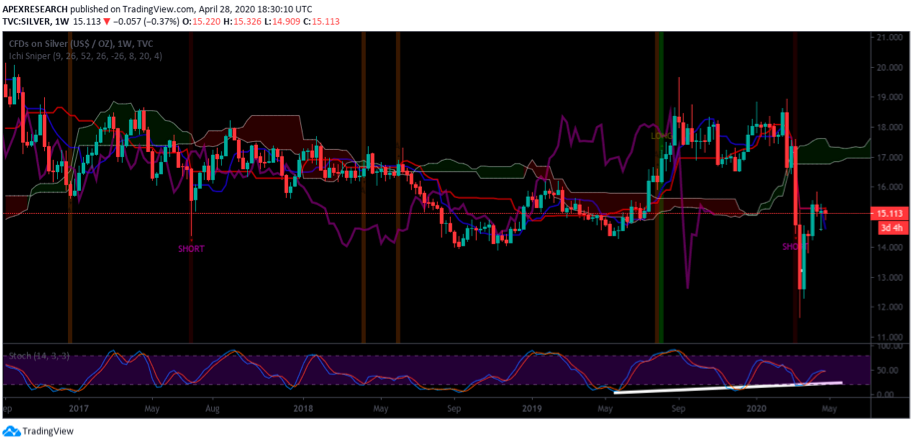
If earnings season continues to disappoint investors while failing to live up to the previous expectations of equities analysts, precious metals assets could resume prior rallies based on safe haven protection advantages. Of these two selections, silver markets appear to have the greatest potential for upside with key areas of resistance to be found at $15.85. On the downside, negative retracements from here could put recent demand levels back into focus, where support has moved up to the $14.60 region. Under both scenarios (bullish and bearish), we can see that the Ichimoku Cloud structure has flattened while Stochastic indicator readings are rolling higher. This price divergence should be notable for medium-term traders, as it suggests that sluggish price momentum in recent trading sessions might be ready to make a decisive price move.

Chart Analysis: Author via Tradingview

On the silver weekly charts, it has become increasingly likely that most of the market’s prior short positions have already been closed, based on the massive inflow readings that are currently visible in the high-volume GLD and SLV ETFs. At current market valuations, the price of gold is trading just 6.5% below its all-time highs (which were established in August 2011). In these charts, we can see that the price of silver has not yet performed in ways that are quite as impressive. However, it stands to reason that a new record high in the price of gold may prove to be a catalyst that turns sentiment and makes it clear that safe haven assets still have the potential to outperform global equities markets during the remainder of 2020.

About the Author

Richard Cox is an active investor with more than two decades of experience in the financial markets. He is a syndicated writer, with works appearing on CNBC, NASDAQ, Economy Watch, Motley Fool, and Wired Magazine. Market commentaries implement advanced technical analysis techniques to trade macroeconomic trends in foreign exchange, global index benchmarks, options, and the entire precious metals complex. Follow his investment commentaries at https://AskTraders.com.

Post COVID-19 Globalization: Will Translation and Localization Still Be Relevant?

Translation and localization serve as underrated bedrocks of 21st-century globalization. Businesses rely on translation and localization to make a name for themselves in foreign markets and among global audiences. But now that the COVID-19 pandemic is sweeping across the globe and forcing governments to close borders and prioritize domestic industries, this begs the question as to how the COVID-19 pandemic will impact globalization?

Many pundits argue that globalization will roll back as countries continue to close their borders to travel and trade. Indeed, these are necessary steps to curb the pandemic, but some pundits argue that some of these policies might stick longer than usual. And with a rollback in globalization, how will it impact the need for translation and localization? Will the post-COVID-19 economy result in less demand for translation services and localization services? Will we see less business conducted globally as more countries are now seeking to rely on their own domestic industries and gain more control over their supply chains?


The Status of the Global Economy Under COVID-19 (As of April 2020)

The COVID-19 pandemic has already brought forth wide-sweeping changes to global economies and our way of life in unprecedented ways within just one month. The IMF and World Economic Forum’s April report forecasted that the GDPs of all world economies are expecting to shrink by -3%. The prices of commodities such as oil continue to decrease to an all-time average low of $35 per barrel due to dried up demand from consumers and industries, particularly the travel industry.

The travel industry has been taking a cliff dive ever since the outbreak as domestic and international travel continues to stay restricted. From travel, airlines, to the hospitality industry and even local business communities that rely on foot traffic, many are expected to go bankrupt with critical relief from banks and their governments. However, there are industries that are faring better off than others, to say the least.

That’s not to say that they’re going through this crisis unscathed. Rather, the nature of industries’ operations is largely digital which makes them better prepared overall. The digital service sector has proven to be largely resilient; an area wherein translation and localization services belong. Even in times of crisis, the need to communicate across borders still exist. But a global crisis such as the COVID-19 pandemic requires an unprecedented level of global cooperation and coordination, in which case translation and language services serve as the foundation to it all.


The Importance of Translation and Localization in a Globalized Economy

Let’s take a brief step back in time to look at how important translation and localization was and still is to our globalized economy. As you know, the advent of digital communication technologies aided in ballooning the pace of globalization to where it is today. But language services such as translation as well as localization often take the back seat when people talk about globalization. Instead, we mostly hear of the importance of investments, loan interest rates, and so on.

As essential as they are, familiar global brand names would not have reached their eminence now without language translation services. You can think of it as another example of the Pareto Principle a.k.a the 80/20 rule This can apply to many situations of course, but the 80/20 principle can conveniently explain the importance of language services to our modern economy. The global economic engine cannot run without global communications being translated.

Of course, business growth is more than just breaching language barriers, but translation, in general, is a highly underrated pillar in global business. The translation is necessary to build trust across geographic, cultural, and linguistic borders. It’s a notion that was true in the past and still is today. However, even translation has its limits as language barriers are not the only obstacles in global business. Cultural barriers exist as well. In that case, localization is the right answer.

If you need a refresher, localization is the applied concept of curating content until it adheres to the preferences and nuances of a target market or audience. It’s mainly employed in global business strategies as it forces businesses to rethink their approach to specific markets. Instead of adopting a one-size-fits-all approach, localization calls for adjusting to the target market’s culture relative to the product and marketing message at hand. Localization is the reason why McDonald’s has different menus for each country as it acknowledges each of their market’s different culinary tastes.


What Will the Post-COVID-19 Economy Look Like

Although the IMF and World Economic Forum made grim predictions for the world’s economy in 2020 as mentioned earlier, they nonetheless forecasted that countries will rebound in 2021 with an average GDP growth rate of 5.8%. Again, it’s still subject to change as the COVID-19 pandemic and recession continue to unfold. But one thing is certain; that the world will recover but we shouldn’t expect it to be the same as the one we just left. Here are some generations predictions of what the post-COVID-19 economy will lookout;


More Businesses Will Move A Chunk Of Their Operations Online

Many had to hastily come up with telecommuting schemes overnight to comply with government directives and to protect their employees. Granted, telecommuting isn’t new since, in 2019, there already were 57 million Americans working in the ‘gig economy’ according to Upwork’s latest freelancing report. The only difference now is that everyone has no choice but to work online. But even with the pandemic over, many businesses will take this experience as a benchmark for them to decide which operations can be moved online. That way, they can save more office space and rental fees.

Of course, not many people are on-board with telecommuting. Maintaining company morale and strong work relationships between colleagues is difficult without routine face-to-face contact. Also, there are some operations that just can’t be moved online such as those that require access to critical company equipment and regular on-site supervision. But as social distancing measures are expected to still be in effect for the latter half of 2020, it’ll only be a matter of time before some policies such as telecommuting and remote video conferencing will stick indefinitely.


More Businesses Will Expand Globally

The pandemic has proven that small to medium businesses that relied on local customer bases and on-site transactions are highly vulnerable to both health crises and economic shocks. In that case, many business owners will have taken this as a hard lesson on why it’s imperative to diversify their customer base to markets outside their locality and country through eCommerce

It’ll take some additional investments indeed from businesses since they have to prepare their operations to be able to accommodate global audiences. They’d have to develop multilingual websites and prop up multilingual customer support centers to name a few. Indeed, eCommerce is now the new normal, but with COVID-19 hitting local business communities hard, going global will serve as a hedge against future crises and also as an avenue for growth in times of economic prosperity.


Manufacturers Will Seek to Diversify Their Supply Chains

The current global supply chain model, one which overwhelmingly holds China as the world’s manufacturing hub, proved to be highly vulnerable. Businesses will now seek to diversify their supply chains by scattering them throughout other countries than just China. But keep in mind that businesses have already been slowly moving out of China for some years now due to higher labor costs and much recently, due to losses linked with the US-China trade war.

In 2019, QIMA reported a decrease of 13% in demand for inspections and audits from US companies in China but also reported a spike in demand for such in other economic regions i.e. Southeast Asia, South Asia, and Latin America. This meant that many U.S businesses were already looking to diversify their sourcing way before the pandemic. Rather, the pandemic must have only accelerated the already ongoing capital outflow.

But even so, many still chose to stay since China has the human capital and resources for the mass manufacturing of complex goods such as consumer and industry electronics. More points could be added here but that’s a discussion for another time. Again, all of these are still predictions as with the growth forecasts. However, there are trends in the current economic situation that makes some of the predictions stated above unavoidable.


Adjusting to the Post-COVID-19 Economy With the Help of Translation and Localization

Given these predictions, it’s quite easy to see where translation and localization can fit into the picture of the post-COVID-19 economy. Global industries are keen to resume their operations, which means we won’t likely see any significant rollbacks in globalization. In turn, the need to localize, and more so the need for translation, will remain. In fact, you can definitely see a significantly increased demand for language services as industries are looking to rebound and dig themselves out of the economic cesspit.

Although the demand for translation services is quite clear, what about localization? Global communications can be fulfilled with translation alone, for the most part, so what needs can localization fulfill in the post-COVID-19 economy. It’s actually the same way it has always been even before the pandemic.

As you know, businesses employ localization to ensure that their products, services, content, and brand resonate well in foreign markets. But if we take into account that more businesses are looking to go global as well industries planning to diversify their supply chain models, then we will also see an uptick in demand for both translation and localization services.

More industries are expected to set up shop in South Asian, Southeast Asian, and Latin American countries due to lower labor costs and fresh market opportunities. In that case, translation and localization will serve their new global ambitions well as it always has been.


The Need for Quality Translations and Effective Localization Strategies Also Remains the Same

Although we have been talking about translation and localization in general, the truth is they’re not painted under the same brush. Poor translations and ineffective localizations exist and are a common problem. If you’re planning to go global for the first time and you want to make a lasting impression, then the importance of quality translations and proper localization can’t be stressed enough.

In regards to translation, a common mistake businesses make is that they rely on Google Translate for most, if not all of their translation work. Yes, it is free and very convenient to use, but it’s only capable of churning out general translations. Business material is laden with specific terminologies and marketing collateral heavily incorporates creative expressions.

Free online translators and machine translation (MT) systems, in general, are still not equipped with any algorithms to decode, let alone translate natural nuanced speech. In that case, you need a human translator to take care of your translation needs. If you think about it, it’s the same situation wherein you needed to seek advice from a business consultant to help you get started, or a professional web developer to set up your business website.

As for localization, cultural barriers are their own challenges as stated in the beginning. If you think of language barriers as fences, cultural barriers are more like minefields. In that case, you need someone to chart a path for you into these unknown areas. Localization services are fulfilled by localization experts and are highly knowledgeable in specific markets. They’ll help you configure your brand image along with your products and services so that you can have higher chances of success abroad.

All in all, you need people with the proper set of skills onboard to help you along if you’re looking for proper results abroad. A strong and meaningful introduction to foreign markets is what you need in the new post-COVID-19 economy as your competitors might also have the same idea of employing translation and localization to the fullest.


Final Word

Globalization simply takes a new form as it always has for millennia. All in all, it’s unlikely that there will be any significant rollbacks to globalization and with it, no decreased demand for translation services and localization services. Many businesses and global industries will have a greater need for them as they now plan on how to re-establish their market positions in the post-COVID-19 economy.

Why You Should Minimize Your Down Payment on a Lease

A hefty down payment can be a significant advantage when you’re buying a car. Among the many and varied reasons this is true are lower interest charges, staying out in front of depreciation and easier loan approval. However, none of these factors come into play when you’re leasing a car, which is just the beginning of why you should minimize your down payment on a lease in many cases.


Overall Lease Price Is the Same Regardless

While it’s true the down payment will make your monthly payments lower, the overall amount you’ll pay remains the same. CarsDirect.com illustrates this as follows:

“Let’s say your lease costs $5,000 for 24 months including taxes. If you make a $1,500 down payment, you’re going to pay $3,500 over that 24-month lease term, which makes your monthly payment $145.84. If you make a $500 down payment, you’re going to pay $4,500 over 24 months, or $187.50 per month. Either way, you’re still paying $5,000 total.”

This is because interest charges are computed into the lease payment up front. You’ll find them listed in the contract as the “money factor” amount you submit with each monthly payment.


You Won’t Get That Money Back

Let’s say you go into a lease with a $5,000 down payment. However, rather than a down payment, it’s called a capital cost reduction. This because its true purpose is to reduce the amount of money the leasing company has to put forth on your behalf to acquire the car from the dealer.

Now, let’s say the car is involved in an accident one year later and declared a total loss. Your insurance company steps in and pays the leasing company what the car is worth on the open market. Gap insurance will cover the difference between what’s owed and the car’s actual market value if there’s a disparity between that value and the payoff amount.

However, all of that money will go to the leasing company. Your $5,000 is gone forever. You’ll have no car and you’ll have to come up with drive-off costs once again to lease another one.


 

That Money Will Serve You Better Used Differently

Rather than putting so much money into your car lease to lower your payment only slightly, consider using it to pay off a high-interest credit card instead. Invest the cash in a money market fund or use it to beef up your emergency reserves in an interest-bearing checking account if you’re debt-free. You’ll be better served with either of those choices than tying the money up in a leased vehicle.


There Are Some Exceptions

The points above apply when your lease has a low money factor, as the best lease deals generally do. However, if you’re after a high-value model and the money factor is also high, a larger down payment can make the lease payment more affordable.

Again though, the leasing company will get all of the insurance payout if something goes sideways and the car is crashed or stolen, so that’s a decision you’ll need to make. Bottom line, though: While a larger down payment makes good sense when you’re buying a car to keep, it can be a mistake when you’re leasing a car for a few years.

It’s important to stop and review the situation carefully before you make that final decision. The cash you save will be your own, which is why you should minimize your down payment on a lease (in most cases).

EDITOR'S PICK OF THE WEEK

China economic growth

China’s Challenging Search for a New Model of Economic Growth

By Danny Leipziger China cannot continue to rely on exports to drive its growth, but what are the alternatives? China ran a $1.2 trillion trade surplus last year, and despite admonitions from the IMF to rely...

WISE DECISION MAKER GUIDE

POWER INFLUENCERS

Emerging Trends

The Future of Global Trade