By Julia Croce
War disrupts societies and economies long after violence ends, making business, human rights, and institution-building essential to sustainable peace.
War does not end when the fighting stops. Its effects can persist through damaged economies, disrupted institutions, displaced communities, and unresolved psychological trauma, making peace building a long-term social and economic challenge. Julia Croce, an academic specializing in human rights and business ethics, argues that sustainable peace requires more than the absence of violence. It depends on rebuilding institutions, protecting rights, restoring economic stability, and creating the conditions for societies and businesses to contribute to lasting peace.
Victims, Allies, and Enemies
If we could turn back time, we will delete the mistakes, align the missteps, and breathe the happiness. Time structures the rhythms and interruptions of human life. In the context of war, however, it often appears suspended, as memories of violence remain enduringly present for victims, allies, and enemies alike. Armed conflict frequently obscures these categories, rendering their boundaries unstable and contested. Contemporary war-crimes proceedings place increasing emphasis on victims’ rights, including legal representation and access to reparations. Instead, during the Nuremberg Trials following the Second World War, relatively few survivors provided testimony, and the prosecution relied predominantly on documentary evidence.
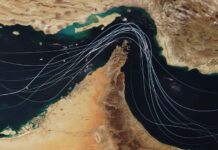
War is shaped by a complex interplay of impulse, strategy, compassion, and violence. Within wartime settings, victims, allies, and enemies are connected through both shared suffering and conflicting experiences. Armed conflict produces bombing and widespread destruction, rendering civilian homes unsafe and disrupting essential services. Food and water supplies often become scarce or inadequate, while damage to medical infrastructure increases the risk of disease. Education is interrupted, and long-term social stability becomes uncertain. In contemporary warfare, advanced technologies have assumed a central role for both allied and opposing forces. Airports, once associated with mobility, renewal, and reunion, have increasingly become targets of drone warfare. Iran’s March drone attack on Dubai airport, together with strikes on Fujairah, the United Arab Emirates’ largest port and oil storage facility, underscored the fragility of regional peacebuilding efforts. Although the United Arab Emirates has achieved substantial welfare provision and macroeconomic stability, conflict in the Middle East has nevertheless affected its security environment and service sectors, including tourism.
Forms of War
War, like violence more broadly, assumes multiple forms. In general terms, it may be understood as a phenomenon that disrupts the prevailing status quo and the socio-political order. Three principal types may be identified (see the table below). A global conflict involves multiple states, often operating through coalitions such as the North Atlantic Treaty Organization (NATO); the First and Second World Wars constitute prominent examples. A civil conflict emerges when a government confronts a violent challenge from one or more rebel groups seeking political transformation. Myanmar, for instance, has experienced a protracted ethnic civil conflict. A bilateral conflict, by contrast, occurs between two states that each assert legitimate authority over the same territory. Russia’s invasion of Ukrainian territory provides an example of such a bilateral conflict.
Table 1. Types of Conflict
| CLASSIFICATION OF CONFLICT | SUPPORT TO THE CONFLICT |
Examples:
|
Purely domestic
Internationalized internal (See foreign military assistance to an ongoing conflict. Such type of assistance to a conflict is provided, for instance, by the United States to Ukraine since Russian’s first invasion. This includes air defence, fairs, ground manoeuvre, aircraft and unmanned aerial systems, small arms, and maritime). Coalition or intra‐allied defensive intervention (See military assistance provided by allies within a coalition to a state member of the same coalition which is under military attack. This type of conflict support was typical during the Cold War, with over 690 military interventions conducted by all world states between September 1945 and December 1991). |
Examples:
|
|
Examples:
|
Beyond traditional categories of conflict, there is also a psychological dimension of war that affects victims, allies, and enemies. This form of conflict unfolds internally, as survivors of war struggle with the enduring effects of their thoughts, memories, and actions.
Johan Galtung, a foundational figure in peace studies, frequently emphasises psychological factors in explaining the implementation of peace agreements. Violence, often associated with the breakdown of peace, can also be understood as part of a broader psychological process, particularly in territorial negotiations and the resolution of ethnic civil conflicts. Karl Weick’s concept of sensemaking[1] describes these cognitive processes through which individuals and groups interpret novel, unexpected, or confusing events such as war. Sensemaking thus refers to efforts to understand how people think, make decisions, maintain reliability, and develop socialization and identification as newcomers. Victims of conflict often seek to understand their experiences by asking why violence occurred and why they were affected: why this did happen to me? In this sense, reflection on the temporal experience of war helps the international community refine International Humanitarian Law (IHL), strengthen protections for victims, allies, and enemies, and further develop conceptual understandings of war and peace.
Conflict typologies may also be classified according to the degree of violence involved: non-violent conflict, in which the use of armed force is absent; minor armed conflict, in which the use of force is limited; major armed conflict, in which armed force is employed with significant adverse effects on civilians; and war, in which military force is used extensively, resulting in substantial casualties among both civilians and combatants.
The Construction of Peace
Peace cannot be understood merely as the absence of war, often described as “negative peace” or “limited peace.” Defining peace solely in terms of the absence of conflict reduces it to a temporary condition. Peacebuilding is instead a socio-economic and political process that connects the idea of peace per se with a social order grounded in social justice, humanism, human rights, democratic institution-building, and material well-being. Accordingly, “sustainable” or “positive” peace consists of multiple, ongoing interactions that unfold over the long term. From this perspective, peace is better understood as a continuum along which relationships vary, rather than as a simple binary opposite to war. Peace is most fully expressed in democratic systems of government, where the negotiated consent of citizens in the exercise of state power helps sustain stability and reduce the likelihood of war.
In wartime, countries face social, economic, and political vulnerabilities, with harmful effects that often extend to allies and neighbouring states. Arab oil-producing countries, for example, are especially exposed to price volatility, with repercussions felt across Western economies. The geopolitical risks associated with oil have been repeatedly evident since the 2003 Iraq War.
Economic recovery and the prevention of renewed conflict therefore become central priorities during and after war. The challenge is that, although economic development is widely seen as crucial to reducing the risk of conflict recurrence, leaders of post-conflict states often face major obstacles in attracting international investment, including foreign direct investment (e.g., FDI). The pace of peacebuilding depends largely on the intensity of the conflict: the greater the violence, the longer it takes to rebuild the affected country’s or region’s social and economic systems.
The construction of peace generally unfolds in two phases. The first focuses on stabilising the country through humanitarian assistance, disaster relief, infrastructure reconstruction, and economic recovery, often in cooperation with other states or international organisations such as UN peacekeeping missions. Under Resolution 1035 (1995), the UN Security Council established the United Nations International Police Task Force (IPTF) and a UN civilian office in Bosnia and Herzegovina for an initial one-year mandate. These measures were implemented under the Peace Agreement signed on 14 December 1995 by the leaders of Bosnia and Herzegovina, Croatia, and the Federal Republic of Yugoslavia. The Bosnian War (1992–95) was one of the most brutal ethnic conflicts in Bosnia and Herzegovina, a former Yugoslav republic with a multi-ethnic population of Bosniaks (Bosnian Muslims), Serbs, and Croats. The UN mission in the territory initially focused on securing a ceasefire and subsequently deploying peacekeepers.
The second phase of the construction of peace involves establishing self-sustaining political and economic institutions that enable democratic governance and long-term prosperity. This transformation is also supported by the expansion of socio-economic rights, including the rights to work, education, health care, adequate housing, and social security. These rights are often understood as helping to balance the power of the market within society. In this context, the welfare state—of which socio-economic rights are a key expression—provides social protection within capitalist systems. Reflecting this view, the Commission on the UK’s Future, chaired by Gordon Brown, recommended new constitutionally protected socio-economic rights. These rights should include stronger labour protections, safeguards against sex and gender discrimination, and measures to advance gender equality.
War and Business
War has its time, reflecting the actions of victims, allies, and enemies. They serve to make our present, the global history, inspire reflection on questions of temporality and historicity.
Peaceful societies aim to:
- Promote the economic benefit of peace;
- Facilitate peaceful conflict solutions within and outside societies;
- Protect minorities;
- Ensure inclusion and a culture of peace in society and in multilateral fora.
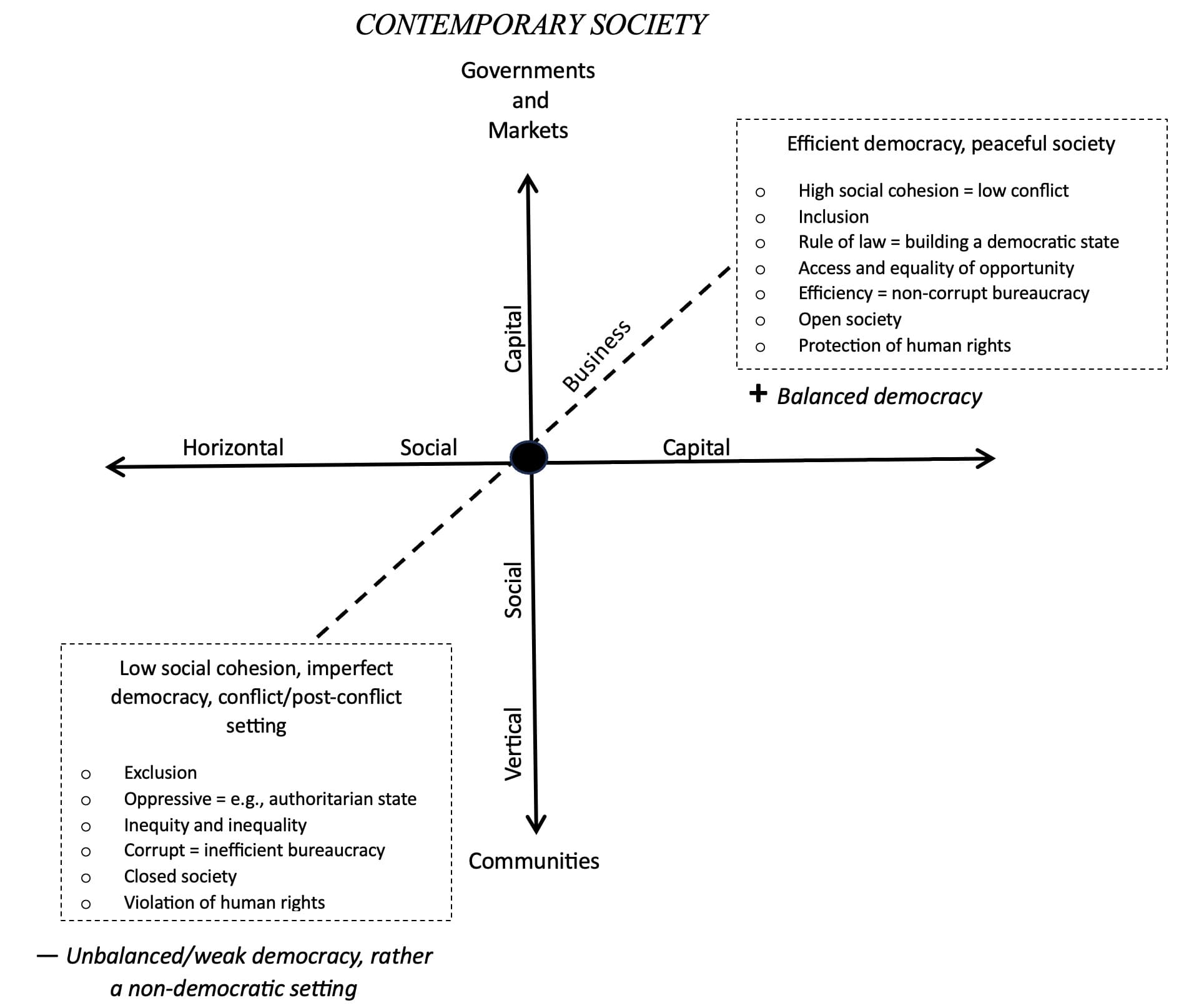
Businesses engaged in peacebuilding processes can foster social cohesion through the development of horizontal social capital[2]—meaning the growth of trust and civic involvement among similar or diverse groups (such as employees or local communities) after a conflict—and vertical social capital, which refers to interactions between the state, market, and civil society. This dual approach can help address social fragmentation and violent conflict during democratic transitions. Horizontal relationships exist among equals, while vertical ones involve parties with differing power or resources (see the Figure below).
How business fosters social cohesion using both vertical and horizontal social capital
Existing frameworks by Fukuyama,[3] Putnam,[4] and Coleman[5] provide valuable metrics for assessing social cohesion and trust fostered by businesses operating in fragile environments. Additional parameters may be developed, such as:
- The structure and organization of assistance, mutual aid, and cooperation (including the shared use of essential resources such as water);
- The types, nature, and organization of exchanges and interdependence between communities and businesses;
- Social protection, welfare systems, and collective responsibility;
- Channels and mechanisms for information exchange;
- The existence and purpose of (business) associations;
- Availability and effectiveness of infrastructure.
Recommendations for Businesses in Contemporary Times
Businesses contribute to economic growth and efficient governance, supported by strong civil engagement (i.e., solidarity, integrity, and participation). Multinational corporations (MNCs) must adapt their industrial strategies and competitive positioning to align with the complex and multidimensional realities of contemporary global business.
South Korea, for instance, has pursued both vertical and horizontal industrial policies throughout the 1960s and 1970s. Many South Korean workers face rigid schedules imposed by employers, limiting autonomy and decision latitude, which can adversely affect job satisfaction and wellbeing. Unlike European labour markets—where collective bargaining and regulatory standards moderate disparities—Korea’s institutional design perpetuates differences. The emergence of chaebol conglomerates, supported by government resources and preferential access, enables them to offer superior conditions compared to small and medium-sized enterprises (SMEs). Chaebols have expanded both horizontally and vertically, integrating new industries and consolidating ownership, often remaining under family control—as seen with Samsung Group’s succession strategy in the 1990s involving Samsung Everland.
In contemporary times, the promotion of social capital within organizations correlates with strengthening the quality of interpersonal relationships among employees. Workplace social capital develops through interactions: (a) among colleagues within teams, (b) across different teams, (c) between employees and direct supervisors, and (d) between staff and upper management. Businesses accordingly should (re)structure work environments to reduce stress and promote civility, emphasizing managerial support for positive psychosocial climates—mutual trust, shared objectives, and common understanding.
Conclusion
Political institutions and business leaders face a decisive opportunity to shape societies that preserve peace and strengthen social capital through sustained collaboration. When directed toward constructive goals, business, for instance, can be a powerful force for inclusion, stability, and social progress in post-conflict societies. Yet it can also intensify exclusion, marginalization, and the conditions that give rise to violent conflict. This makes the deliberate cultivation of social capital especially vital for SMEs and MNCs operating in contexts where legal and political institutions remain fragile.
About the Author

Julia Croce is an academic specializing in human rights and business ethics. Her work focuses on the growing responsibility of businesses in defining and respecting peace and democracy. She is the author of the book Peace, Business, and Democracy: Corporate Responsibility in Peace and Governance. In 2024, she was honoured with the prestigious Prix William Rappard. Julia received a PhD in Management Studies from the University of Geneva, Switzerland.