By Imran Khalid
Simultaneous disruptions in the Strait of Hormuz and the Red Sea threaten European industrial survival by choking essential energy supplies and component manufacturing inputs.
On July 22, the European Union’s naval mission in the Red Sea advised merchant vessels with Israeli, American, or Saudi links to stay clear of high-risk corridors, while Yemen’s Houthis declared a naval blockade targeting Saudi shipping. With Brent crude climbing toward ninety-six dollars, market commentary predictably fixates on energy price spikes and stagflation. Yet, focusing strictly on pump prices misses the lasting structural damage facing Europe. As Saudi Arabia’s western bypass via Yanbu comes under direct attack, Europe faces a dual supply shock: it imports both the energy to run its factories and the components that move through them.
What Has Changed in Middle Eastern Supply Routes?
The commentary went where it always goes during Middle Eastern naval crises. Oil reached a seven-week high, a senior Houthi official promised two hundred dollars a barrel on Iranian state television, and economists dusted off the word stagflation. That is the wrong place to look for the lasting damage. A driver in Milan pays more at the pump and grumbles. A car plant in Lower Saxony that cannot get a wiring harness out of Shenzhen sends its entire shift home. The deeper wound from a two-corridor squeeze is industrial, and Europe is the continent least able to absorb it.
Start with what actually changed this week, because the obvious objection is that container traffic between Asia and Europe has already been rounding the Cape of Good Hope since late 2023. What changed sits on the western side of the Arabian Peninsula. With the Strait of Hormuz shut, Saudi Arabia had been pushing crude westward through Yanbu on the Red Sea, with flows reaching roughly 4.6 million barrels a day in June against about 1.3 million at the start of the year. That detour was the mechanism that made the first closure survivable. It is now the exact pipeline under threat, along with roughly 230,000 barrels a day of Saudi diesel reaching Europe through Suez from refineries sitting within Houthi strike range.
Why Is Europe Exceptionally Vulnerable to Maritime Blockades?
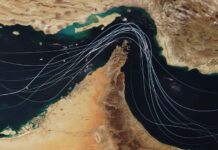
Geography decides who bleeds in a maritime crisis. Europe sits at the far end of both routes. Hormuz carries close to a fifth of the world’s seaborne oil and liquefied natural gas, while Bab el-Mandeb is the Suez gateway that lands Asian manufactured goods on European docks. The United States has shale reserves and its own export terminals and can ride out a Gulf shock. Asian buyers can outbid rivals for whatever spot cargoes are moving. Europe imports both ends of its industrial base at the same time: the energy that powers the factory and the components that pass through it.
Since Iran’s Revolutionary Guard sealed the strait in early March, traffic has run nowhere near the hundred-plus ships a day of the pre-war norm. CSIS counted 187 successful transits in the three months after 4 March—compressing a quarter’s worth of Gulf trade into what the strait used to handle in two days. Meanwhile, the freight market tells a complicated story. Rates have risen hard without going vertical, but six months of stop-start shipping has delivered the worst of both worlds: no reliable short route, and no settled long one either. This is a scheduling event, and just-in-time manufacturing runs on schedules.
How Do Shipping Bottlenecks Paralyze European Assembly Lines?
The precedent for what that scheduling chaos does to a factory is only two years old. In January 2024, with vessels newly diverted round the Cape, Tesla and Volvo stopped work at Grünheide and Ghent within days of each other—Tesla for two weeks, Volvo for three days over a late gearbox delivery. Neither plant was short of money or workers. Each was short of one box on one delayed ship.
The traffic runs both ways, and Europe is now on the receiving end. The EU imported over one million Chinese-made cars in 2025, representing seven percent of the market. Those vehicles and the components feeding European assembly lines travel the same corridor. A blockade does not only starve European factories of inputs; it strands the finished goods European consumers intended to buy.
Metals show how the damage compounds. When Hormuz closed, smelters in Bahrain declared force majeure because metal sat stranded at ports while facilities remained undamaged. Requalifying a new supplier of aluminum, a specialty chemical, or an engineered plastic for a safety-critical part takes months, often longer. Shipping disruptions quickly mutate into long-term manufacturing bottlenecks.
Can Warships and Minesweepers Protect European Industry?
Gas is where the timing turns particularly cruel. Europe had barely finished climbing out of the shock that followed Russia’s invasion of Ukraine when Iranian drones struck key Middle Eastern natural gas infrastructure, sharply curtailing deliveries. American cargoes now make up most of what arrives in European ports, and European buyers are bidding for them against Asian utilities at the top of the spot market. Every euro added to a power bill lands directly in the cost of making anything at all.
Brussels has answered this compounding crisis primarily with warships. European leadership is weighing whether to add minesweeping to the Aspides mandate and redeploy coalition vessels to the Red Sea. Minesweepers are worth having, but they will not smelt aluminum, shorten the Cape route, or conjure an LNG cargo out of a sealed strait.
The instruments that would matter are industrial and diplomatic: strategic reserves of critical metals, alternative suppliers pre-qualified before emergency strikes, faster permitting for domestic smelters, and sustained diplomatic pressure on regional powers to keep at least one waterway open. Bab el-Mandeb is eighteen miles across at its narrowest. A continent whose factories can be halted by a few drones and sea mines at that pinch point lacks strategic sovereignty. Frigates are the cheap answer, but the expensive answer—a resilient industrial base nobody else can switch off—is the bill that comes due this winter.
About the Author

Imran Khalid is a geostrategic analyst and Senior Fellow at Foreign Policy In Focus. He writes extensively on global macro-strategy, international trade architectures, energy security, and supply chain geopolitics. His commentaries appear frequently in leading international publications, including The Atlantic, Newsweek, Nikkei Asia, The Hill, South China Morning Post, and The Japan Times.