With its growing market, a wide range of industries, and blooming spending power, China is no doubt a top choice for a Canadian seeking to invest offshore. However, it is important to take a closer look and understand the available opportunities before setting off to incorporate a business in China as a Canadian entrepreneur.
This post highlights the top three investment opportunities that you should consider as a Canadian. However, before we get to the list of the three sectors, it is important that we briefly analyse the advantages of Canadian investors and businessmen looking to invest in China.
Why Investing in China is a Great Option for Investors?
In recent years, China has experienced vast economic growth. It has also created wealth for foreign investors in different sectors, ranging from manufacturing to IT services. With the world’s largest skilled population, easy business norms, and low taxation policies, China is emerging as one of the world’s largest markets for FDI investments.
There is a reason why businessmen in countries like the United States, Australia, United Kingdom and others have shifted their manufacturing facilities to China. They have been able to drastically bring down the costs of-
Raw materials
Labour costs
Business overheads
Electricity and power consumption charges
Undue interference from governmental authorities
All this means that in addition to the money factor, businessmen have been able to heavily save on time, energy and effort. It also means that they have been able to expand business operations to other growing markets in Asia, including Thailand, Indonesia, India and others.
List of the Three Major Investment Sectors that can deliver Strong Results for Investors
1. Agri-Food and Consumer Goods
The potential of agri-food and consumer goods niches are correlated to the fast growth of the middle class in China. Today, China’s consumer tastes are becoming more complicated with a strong bias to premium offerings.
As you work on the details for company registration in China, you need to appreciate that the lower segment is pretty overcrowded with a lot of local products. Therefore, consider introducing high-quality products and market them as premium products.
When drawing your strategy, it is also crucial to think about China’s e-commerce market. It is one of the largest in the world, accounting for over 40% of the total e-commerce spending on the globe. Therefore, it will be a great idea to leverage e-commerce platforms to reach more Chinese.
2. Automotive Industry
China has one of the largest automotive industries in the world. Indeed, all Original Equipment Manufacturers (OEMs), from Toyota to Ford, have some presence in China.
So, if you are already selling to any of the OEMs back in Canada or in another country, it will be a good idea to consider doing business in China.
Today, there is a huge push for electric vehicles to address the problem of air pollution. Therefore, there is heavy research & development in areas such as connectivity, autonomous driving, and smart vehicles. Canada possesses strengths in these areas and a focus into the niche would be a great idea for your business.
3. Gas and Oil Technology Services
In 2019, China surpassed the US as the largest oil importer. To address the serious problem of pollution, China is promoting the use of gas as an alternative source of fuel. Again, China has well-established supply chains in areas of clean energy, and you can thrive as a service provider or equipment supplier.
To grow faster, it is advisable to avoid direct competition with local equipment manufacturers, but focus on working with them.
A number of the companies in the gas and oil firms actively source some of the parts and products abroad and resell in the market. So, if you can provide them with the products they want, they might prefer to source the products from your company in China instead of abroad.
The Bottom Line
If you are a Canadian entrepreneur, China is a land full of potential. Once you have identified the best opportunity, move to the next step, which is registering a company in China.
To make the process easier, faster, and more convenient, consider working with an agency. These are firms of experts that specialize in company registration and will also come in handy to help you during the early period of business establishment.
Bandung Conference (1955) in Indonesia was the first large meeting of leaders from newly independent countries from Asia and Africa, where a declaration was submitted, which included opposing colonial and neo-colonial policies, to improve cooperation among the newly independent countries. It was also said to improve the living conditions of their people by safeguarding economic sovereignty and raising agricultural output to avoid occurrences of famines, which killed millions of people in the pre-independence period (Siddiqui, 2020a; 2020b). However, the strategy adopted to raise agricultural output was through land distribution i.e. allocating land to the tillers. It aimed, firstly, to remove rural inequality and increase output and incomes of the rural poor. Secondly, by increasing rural incomes, it was intended to expand markets for industrial goods. In most of East Asia, such as Japan, South Korea, and Taiwan, and also in Vietnam and China, land was re-distributed to the tillers, which dramatically reduced rural inequality and increased agricultural outputs. Moreover, the state took a number of measures in the industrial sector both to encourage investments and joint-ventures, and also to encourage exports. As a result, these countries emerged as successful and economically powerful nations.
However, in contrast to East Asia, land reforms in South Asia and in Africa either did not take place or were incomplete. It did not make any dent on rural inequality. For instance, land reform measures in India only removed big urban-based absentee landowners and did not touch village-based big-landlords. (Siddiqui, 2019b) Thus, rural inequality continued and domestic markets for industrial goods remained sluggish. However, to increase food production in the late 1960s, a technological solution was initiated, where the government subsidised new agricultural inputs such as fertilizers, pesticides, power, and irrigation, which was known as the ‘green revolution’. By the early 1990s, these policies were exhausted and the farmers’ frustration rose to new heights. However, by 1991, the economic crisis deepened and the government had to borrow money from the International Monetary Fund (IMF) and accepted IMF conditionality by adopting a ‘Structural Adjustment Programme’ (SAP). This resulted in the gradual withdrawal of agricultural subsidies and which sharply increased input prices.
At present, Indian agriculture is facing a deep crisis and farmers’ distress and suicides have risen sharply since the early 1990s. Nearly thirty years have passed since the neoliberal reforms were launched in India, but until recently, inadequate attention was paid to the agricultural sector. The economic liberalisation first ignored agriculture and treated it as if it were just another industry. The policy framework for agriculture largely continued as laid out during the ‘Green Revolution’ i.e. it provided credit for investment in new technologies, and the output was purchased by the government via the Food Corporation of India (FCI) and sold through the Public Distribution System (PDS). Until recently this system served well to buy surplus foodgrains from agriculturally developed regions like Punjab, Haryana and western Uttar Pradesh, and distribute the output to food deficient regions like Bihar, Orissa, Madhya Pradesh and elsewhere in the country.
Indian agriculture is facing a deep crisis and farmers’ distress and suicides have risen sharply since the early 1990s. Nearly thirty years have passed since the neoliberal reforms were launched in India, but until recently, there inadequate attention was paid to the agricultural sector.
Internal pressures on state support for agriculture occurred at a time when there were more fundamental strains emerging in this sector. With a rising population and divisions of land between members of a family, farms became smaller. At the same time, the growth of manufacturing was very slow and employment opportunities stagnated in this sector due to advancements in technology and automisation. Services provided very few job opportunities and overall unemployment soared to a very high level. Since 1991, the services sector of the economy had begun to grow at a higher rate. As a result, the share of agriculture in the GDP had more than halved from 33% in 1991 to merely 13% in 2019. While on the other hand, still more than two-thirds of India’s population relied on agriculture for their livelihoods, which had not changed in the last thirty years. The recent ‘Farm Laws’ are the instruments that will open up agriculture to the market and corporatisation. Farmers also know from experience that if the international market could offer higher prices in some years, then the farmers will benefit, however, at a time of global foodgrains surplus, prices would crash. Without MSP (Marginal Support Prices) guaranteed by the government for their products, they would be left with large unsold stocks that would bankrupt them and increase their debts.
Therefore, the ‘New Farm’ laws brought by the BJP government constitute a major change favouring the entry of agro-business capitalism and that of increased centralised control of agriculture in India. The economic distress leads the overwhelming majority of farmers to suicide. Farm income has been dwindling over the past many years, and farmer debt has been increasing since 1991 (Siddiqui, 2014; 2018b). Furthermore, the de-regulated agricultural markets often raise problems related to uncertainty, equity, collusion, quality control, asymmetric information, contract enforcement and abuse of non-economic power, among other possible sources of so-called ‘market failure’.
Farmers shout slogans during their ‘Delhi Chalo’ protest march against the Centre’s new farm laws, at Singhu border on December 2, 2020 in New Delhi, India. (Sonu Mehta | Hindustan Times via Getty Images)
This study will also emphasise the importance of small-scale farms and the importance of food sovereignty in developing countries. In recent years, some big multinational companies bought land in poor countries, which could be environmentally destructive. We must learn from Central American experiences, where the US fruit companies took over lands to produce fruits and cash crops to be sold on US and European markets (Siddiqui, 1998). Several decades later, studies found that such policies did not benefit the local population, fewer jobs were created due to increased mechanisation, and a high level of use of fertilizers and pesticides has brought ecological and environmental problems to the region. Thus, the agrarian model pursued by the developed countries is capital-intensive and labour-saving, and is based on excessive use of chemical fertilizers and pesticides and average farm size is much larger than the developing countries. Such agrarian solutions are not viable and suitable for developing countries.
II. The Debate
In recent years in some developing countries, foreign companies have bought land and displaced local farmers to increase agricultural output. In the past, commercial farming has often opted for policies that were environmentally destructive and policies that undermined local farmers but largely benefited multinational agribusiness. This shows the rise of a global ‘corporate industrialised agriculture’, and indicates a ‘changing relationship to food imposed by the ‘industrialization of agricultural production and the globalization of agricultural trade’, resulting in ‘food insecurity, fossil-fuel dependence and global warming’.
The International Forum on ‘Food Sovereignty’ in 2007 in Mali was a very important policy discussion. The conference was represented by 500 academics and farmer leaders from 80 countries that discussed future polices and strategies to provide directions for farmer movements for the importance of food sovereignty and how to strengthen it. The Declaration of Nyéléni in Mali (2007) encapsulates the vision of the conference: “Food sovereignty is the right of peoples to appropriate food produced through ecologically and sustainable methods. It puts those who produce, distribute and consume food at the heart of food systems and policies rather than the demands of markets and corporations”.
Food sovereignty emphasizes ecologically appropriate production, consumption, and distribution with socio-economic justice and more reliance to local food systems as ways to solve problems of hunger and guarantee sustainable food security for all peoples. It empowers local community control of productive resources; argues for agrarian reform and tenure security for small farmers; promotes biodiversity; and respects the local knowledge of indigenous peoples in developing countries.
Food sovereignty emphasizes ecologically appropriate production, consumption, and distribution with socio-economic justice and more reliance on local food systems as ways to solve problems of hunger and guarantee sustainable food security for all peoples.
Increasing dependence on industrial food has reduced smallholder incomes in local markets, and seems to have served to undermine the viability and livelihood of small-scale farms. Such development has led to increased food import dependency and has also increased the consumption of unhealthy diets, such as fewer varieties of wheat, maize and rice, along with a range of highly processed foods. It has also increasingly displaced native food in favour of genetically modified crops. It has made a number of developing countries increasingly rely on food imports, which has an adverse impact on the balance of payments. The availability of cheap imported food is gradually destroying local food production because the local cost of production based on small farms is relatively higher than imported subsidised food from developed countries, and this is described as ‘food dumping’. This situation has led to small farmers abandoning farming and migrating to towns as unemployed and underemployed, who often settle in slums in big cities. Moreover, poorer countries are especially threatened by conditions they have done little to cause and could become still more dependent upon food imports from developed countries that are part of these countries’ extremely disproportionate contribution to climate change.
Food sovereignty is inherently a multidimensional concept. The only way to be a food sovereign is to improve food production and distribution, which should be linked to other sectors of the economy. Food sovereignty discourses should focus on food production, but the policy should strengthen food producers and consumers and facilitate making them truly sovereign, then both will have to be supported by and incorporated into a variety of social, economic and political policies related to the agriculture sector that go well beyond the food itself. In short, food sovereignty requires a healthy, sustainable and diverse rural economy that goes well beyond food production.
To understand the complex socio-economic situation of the peasantry, nearly a century ago in Russia, Chayanov presented the ‘theory of peasant economy’. Chayanov’s family household model in agriculture had focused on the internally generated needs and resources of the peasant family. According to him, the aim of peasant households is to meet the needs of (simple) reproduction while minimising ‘drudgery’ (of labour). His model of ‘peasant economy’ is centred on the organisation of ‘family labour’. On the other hand, the imperatives of reproduction in family labour enterprises mean that labour costs are discounted in adverse conditions, generating peasant ‘self-exploitation’. In effect, peasants tend to farm more intensively than capitalists, albeit at lower levels of labour productivity; similarly they are often constrained to buy or rent land at higher prices, and to sell their product at lower prices, than capitalist farmers are prepared to do. He assumed that the logic of a peasant economy (simple reproduction) excludes the capitalist imperative of accumulation for its own sake (expanded reproduction). Increasing dependence on industrial food has reduced smallholder incomes and seems to have served to undermine the viability and livelihood of small-scale family farms in the developing countries (Bernstein, 2009).
The agricultural sector in developing countries suffers from historical legacies that favoured the industrial sector, known as ‘urban-bias’. Policy-makers have contended that agriculture generates only limited backward and forward linkages and that development, therefore, necessarily means the rapid transition from rural economies to urban ones. Particular industries and urban areas were targeted for development while the farmers, especially small holders, were seen as sources of cheap labour, and the large land holders were seen as producers of raw materials and cheap food. The current agrarian crisis in rural areas has less to do with a rejection of farming per se than with a rejection of farming under the negative, insecure conditions fostered by ‘urban-bias’.
The commodity production in the full sense occurs when the product which is both a use-value and an exchange value for the buyer, is only an exchange value, just so much money, for the seller; which is determined by the market. But it leads to destruction of small farms by the corporate. The withdrawing of the state support that had prevented the destruction of small size farms by corporate capital, which will make them increasingly unviable and will further increase in farmer’s suicides. In fact, under commodity production in developing country like India, with the State not interfering in the functioning of the agricultural markets will bring enormous changes in the rural society and economy. Such as, it would open up Indian agriculture to the dictates of the world market. Moreover, the demand of the developed countries has risen for tropical crops and fruits, which means a diversion of land away from foodgrain production. This would further mean the country will become food-import dependent. So, when world food prices fall, the farmers’ debts will increase. Then many farmers will be forced migrate to cities in search of jobs, swelling the number of unemployed (Siddiqui, 2012a; 2017c).
A number of researchers have found that industrial agriculture is the biggest single contributor to a loss of biodiversity, and is profoundly shaped by contemporary capitalism, not least because only a handful of “commodity” species are deemed to have any value, and because, in the sole pursuit of profit and growth, “externalities” such as pollution and species loss are ignored. Agro-exporting systems leave rural populations increasingly deprived of land, and in developing countries, create an increasingly food dependent large population. The neoliberal policy of market deregulation across the world has intensified the marginalization of small farmers in developing countries. It has been found that the adverse impact of climate change is disproportionately felt by the poorest people in developing countries, who are contributing to it the least. Identifying these inequalities matters because inequality is endemic to capitalism (Siddiqui, 2019a).
However, neoclassical economists argue that to improve efficiency, the demise of the agriculture sector and in particular small farmers is seen as necessary for economic progress. However, this is fundamentally incorrect in the present era of global climate change, where sustainable agriculture is central to a new sustainable development paradigm. The neoclassical economists’ belief regarding the one-size-fits-all approach to measuring and understanding complex investment environment issues is very problematic, especially when based on the interests and priorities of particular institutions and powers.
We must then move into a new realm of creative thinking, collective democratic policy-making, respect for local and indigenous people’s knowledge and experiences, and involving them in long-term planning to develop ecologically friendly and sustainable agriculture. This is the only way to deal with the challenges that agriculture, economy, ecology and society currently face in developing countries.
The neoclassical economists’ solution to the contemporary environmental crisis is more market not less market. For this solution, there is a need to change the market-led economic policy to address the contemporary agricultural crisis. They see in monetary terms, and the loss of nature is very difficult to monetise. They favour using market prices for all these irreplaceable commodities. The contemporary corporate-led food regime, from the concentration of power in food chains to genetically modified seeds is consolidating global markets in the name of market freedoms and efficiency. The critique such as, Naomi Klein (2015), a Canadian author, notes: “The market has not and cannot fix the climate crisis but will instead make things worse, with ever more extreme and ecologically damaging extraction methods accompanied by the rampant disaster capitalism.”
In the world generally, there seems to be increased trade and capital liberalisation, (Siddiqui, 2020b; 2020c) especially in agricultural commodities, which means a greater amount of trade, and thus could result in a loss of biodiversity and environmental crisis. Reducing tariffs and removing domestic regulations against multinational companies could have a much wider impact on local economies, without foreign agro-companies sharing any responsibilities. It is viewed that due to access to more information, low wages, and relaxed environmental regulations, these global food companies would find it attractive to invest in agriculture in developing countries, as it increases their markets and profits.
III. The Issue of Food Sovereignty
There is a strong case that a new phase of global capitalism with new modalities of accumulation started to emerge for the last three decades which, among other things, changed inherited conceptions of the agrarian question centred on the ‘national’ paths of the development of capitalism in the countryside. The current globalisation and increased trade in agricultural commodities will have a longer lasting impact on developing countries. Under the WTO (World Trade Organization), trade liberalisation will create a shift in the global trade patterns of agricultural commodities, (Siddiqui, 2018d) and would affect the world market prices of agricultural commodities. (Siddiqui, 2019c; 2018a) This will lead to the increased involvement of global food companies in the developing countries which would focus on global consumers rather than local markets. Speculation in foodgrains will lead to increased ‘financialisation’ (Siddiqui, 2017d).
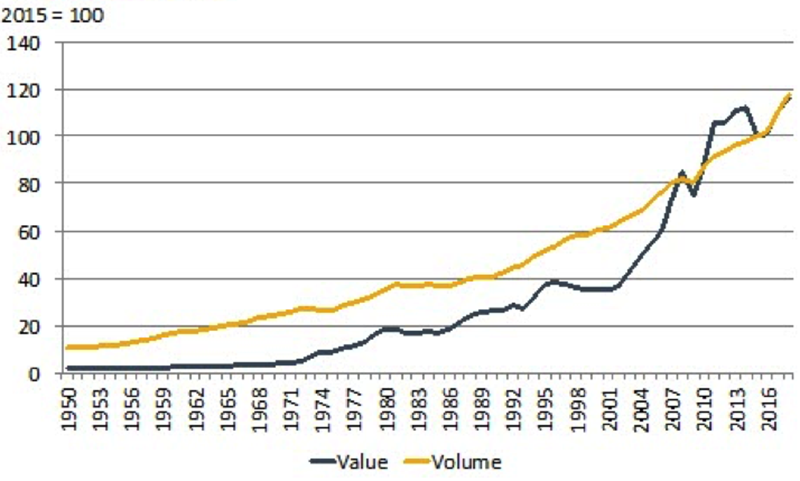
Under WTO pressure, the neoliberal reforms in developing countries, required to remove government subsidies and other forms of government support to small farmers in developing countries. This will reduce government investment and aid budgets for farming and will promote ‘export platforms’, especially of animal feeds and high-value commodities. This will lead to neglect of food production, and shortages will lead to increased food prices and will adversely affect food consumption and access to food for the poor. Moreover, the increasing concentration of global corporations in both agricultural inputs and agro-food industries, marked by mergers and acquisitions, and the economic power of fewer corporations commanding larger market shares, will reduce competition. In recent decades agricultural exports have increased sharply both in terms of value and volumes, as shown in Figure 1. The developed countries namely, the US and the European Union are among the world’s top agricultural export countries (See Figure 2). Moreover, the big corporations along commodity chains have increased their control from farming through processing and manufacturing to retail distribution. Such development will further encourage specialisation in the cultivation of fewer crops i.e. ‘monoculture’ and it will contribute to the loss of biodiversity.
The tendencies of capitalist agriculture, including the pace of technological change in farming with the increased use of chemicals, and in its upstream and downstream industries, is driven by the accumulation strategies of agricultural input and agro-food corporations. Large-scale mechanization, which has intensified production in the name of achieving economies of scale, and keeping food prices low, is booming. Such policies will lead to a sharp fall in small-scale family farming and a rise in rural unemployment. While the manufacturing sector is either stagnant or growing very slowly, and thus, unable to provide jobs, it will lead to increased joblessness and poverty. If half of a developing country’s population was pushed out of the countryside and into the cities to rely on cheap imported food, this could have a devastating long-term impact and could further destabilise many countries. This is a central threat running through the political economy of capitalism and agriculture with implications for food sovereignty.
The challenge of regulating multinational agribusiness and international trade is important in order to ‘protect’ ‘domestic food production’ and small farmers as ‘guardians of the commons’ and to support resistance to ‘land grabbing’ for commercial food farming, and mining. There can be serious contradictions between the key features of the food sovereignty vision, such as between the goals of national and local food self-sufficiency; between promoting food crops and a farmer’s freedom to choose to what extent to farm, which crops to grow, and how to grow them; between strengthening family farming and between collective and individual rights, especially over land ownership.
IV. The Importance of Food Self-Sufficiency
A dramatic rise in food prices in 2007-2008 shook the world out of its complacency. There was nearly a 40% rise in the food price index relative to 9% in 2006. Wheat prices almost quadrupled and maize prices almost tripled between 2000and 2008. The adverse effects of this price rise fell on foodgrain importing developing countries and on net buyers of foodgrains within countries.
In 2018, Asian farmers produced 90% of the world’s rice and around 40% of its wheat and total cereals. But most Asian countries consume what they produce – the exports come from only a few. For instance, although over 80% of rice exports came from Asia in 2018, the exporters were primarily Thailand, Vietnam, India and Pakistan and, beyond Asia, the US. Similarly, 85% of wheat exports came from only four regions – North America, Russia, the EU and Australia; and 81% of maize exports came from North America and Latin America especially Argentina and Brazil. Taking all cereal exports together, 65% came from North America and Europe (see Figure 3).
Foodgrain output and supplies will fall and prices rise, for example, if the exporting countries shift large areas earlier devoted to foodgrains to biofuels, or fail to control speculative hoarding. Adverse weather conditions can add to these negative effects. Such factors were important in the 2007-2008 price rises. In that year, almost 100 million tonnes, or 4.8% of all cereals produced, went into ethanol production. Thirty-three percent of the corn production in the US in 2008-2009 was similarly used. Facilitated especially by government subsidies for growing energy crops, the US farmers shifted large areas from soybean and wheat to maize for biofuel.
Seeing the vulnerability in global food production, the goal of food self-sufficiency for developing countries becomes extremely important. For instance, the government policy should aim at reducing vulnerabilities arising from the dependency on food imports. Many of the developing countries depend on food imports from developed countries, and only a few developing countries, to fulfil their food needs. Given the uncertainties arising from such dependence, such as rising and volatile food prices, and the effects of climate change, national efforts are needed to achieve food self-sufficiency and move towards low chemical, environmentally sustainable agriculture.
Figure 3: Production, Exports and Imports of Total Cereals by the World’s Regions, 2018, (%).
Source: Based on FAO Statistics (http: /faostat.fao.org).
But national self-sufficiency goals cannot translate simply into local or household self-sufficiency goals. Nations have to provide food for all their citizens, many of whom are in non-farm or urban jobs, and without government support, farmers may not make choices that move a country towards food self-sufficiency.
In the agrarian transitions we are currently witnessing, an increasing proportion of small farmers are abandoning agriculture in developing countries, especially since the neoliberal policy was launched. The WTO promotes trade liberalisation and the role of multinational corporations in agriculture (Siddiqui, 2019d; 2016a). Such policies contribute to the demise of small producers in developing countries. Earlier, agricultural production was centred on use-values, simple reproduction and quality foods that were environmentally and ecologically friendly to local soils and locally consumed. But mechanical agriculture has focused on exchange-values and big corporations’ profits and trade; it is ‘the global market-driven paradigm’.
As in Mexico and elsewhere, good land was devoted to export crops, imports of foodgrains increased and the local markets were driven by import prices. In China, the increased production of meat for the Chinese diet requires heavy imports of soybeans as feedstuffs for livestock. China joined the WTO in 2001; it resulted in increased food dependency and increased grain imports. However, China has no foreign exchange crisis due to increased agricultural imports as it has a huge manufacturing export surplus, but such is not the case for many developing countries. However, in China too, there are ecological limits due to water scarcity, governments funds for research and development have declined, and also millions of hectares of agricultural land have been lost to urban-industrial uses.
In the US, agro-fuels have aggravated food-price volatility, and contribute to global warming. The US received US $92billion in subsidies in 2006-2013. The main beneficiaries were transnational corporations like Cargill and ADM, and big financial companies like George Soros and Bill Gates, who have invested heavily in agro-fuels. Worse, at least for the EU, where 58% of biodiesel is imported, it will cause further deforestation in developing countries like Brazil, Malaysia, and Indonesia. These countries are regarded as the most efficient producers of agro-fuels, mostly from sugarcane. Moreover, the US government, for instance, spends nearly US$20 billion on farm subsidies annually, ranging from insurance, price loss coverage, land improvement, marketing, and research and extension support. In Japan, with an agricultural economy dominated by small farms, the government support for producers is more than 40% of gross farm receipts.
V. The Deepening Crisis in Indian Agriculture
The ‘Green Revolution’ was launched in Indian agriculture by the government in the mid-1960s, when it had acute food shortages and the country was forced to resort to foodgrain imports. (Siddiqui, 1999; 1997) This was made possible due to government investment in areas like irrigation and power and also government set-up of agricultural universities, marketing networks and provision of cheap credit from institutional sources (Siddiqui, 2014b; 1992). As a result, the state played a critical role in enabling its farmers to pursue the path of capitalist production in agriculture. This policy did manage to raise output and productivity and made India self-sufficient in foodgrains (Siddiqui, 2019d; 2018b). Moreover, besides raising incomes for big landowners, it also benefited small and medium farmers to a lesser extent. However, by the late 1980s, the agricultural crisis deepened and productivity and investment slowed down so the incomes of the farmers fell as well.
To find solutions, the neo-liberal reforms were launched in 1991, which changed the role of the Indian state towards agriculture. For the last thirty years, the private corporate sector has begun to grow rapidly. The size of the GDP increased, but the corporate economy was largely focused on the service sector, and it did not create employment. (Siddiqui, 2018c; 2017c) The share of the agricultural sector declined sharply, but the workforce remained employed in agriculture at the same proportion. The relative decline of the agrarian economy in terms of its value addition has produced many imbalances beyond the sphere of income and employment. The growing size of the services and corporate sectors has further marginalised India’s agriculture sector.
In India, in September 2020 the farm laws were passed by Parliament and the government did not seek advice from farmers’ organisations. There three laws associated with agriculture regarded issues such as hoarding, minimum support prices, and contract farming. The growing size of the urban middle class, and demand for processed food has risen sharply in recent years. Also, processed food could also be exported to other countries. The ruling elites have considered the neo-liberal policy to be the best option and a desirable solution for Indian agriculture. It is hoped that it will increase corporate investment in the agricultural sector.
The ‘new farm laws’ will gradually remove the government regulation of agricultural markets and will remove limits on stockpiling of agricultural commodities, and deregulate minimum support prices. In agriculture, the withdrawal of government support prices will dampen prices of agricultural commodities during the harvest period and the hoarders will be able to raise prices later on. Not only the farmers have to sell at lower prices, but consumers have to buy food at higher prices from the market. As a result, this will leave the agriculture sector at the mercy of corporations, and undermine, if not destroy, the public food distribution system and small scale family farms cultivation and will have long-term severe consequences on India’s rural population.
Moreover, nearly 70% of India’s 1.3 billion people depend on agriculture for their livelihoods and 800 million of them have relied on public food distribution during Covid-19. India’s agrarian economy has already been in crisis for over a decade due to rising farmers’ suicides, and indebtedness of farmers to banks and private money lenders. The agriculture sector is also currently severe under-invested and suffers from low farm prices. Under neoliberal reforms, the government started reducing support to the agriculture sector gradually. The reforms also reduced the support to health and education, which affected farmers as well. When agriculture became capital-intensive, the fixed costs for mechanised agriculture increased sharply. The small farmer could not afford this and went into a debt crisis.
Naseemo Kaur (left) shouts slogans during a protest in the Moag area of Punjab, India, on Oct. 1.
The main reason for high indebtedness in rural Punjab seems to be the increasing gap between incomes and costs. For small farmers the main source of income is what they receive after agricultural produce is sold at the MSP, but because the produce is usually not procured at the ‘guaranteed’ prices, farmers’ tend to face losses. While withdrawal of government subsidies has led to an increase in the prices of agricultural inputs. And if the government regulated MSP is removed, the recent study on small farms (Wire 2021) notes: “this will affect the incomes of the farmers. With a rise in input costs and a fluctuating income, farmers will be forced to take more loans… Big corporations may not snatch land away from small farmers directly, but an economic system could get created which will be detrimental to small and medium farmers.” In India, for example, according to official data, only 4% farmers have land holdings, which are more than 10 hectares and 86% farmers have a landholding size of less than 5 hectares and the remaining are what are called medium farmers, who have a land holdings of 6 to 8 hectares.
Private businesses have already invested in supplying seeds and pesticides; they began to expand their operations to consumer goods, ranging from potato chips and tomato sauce to processed cereals and dairy products. Both Indian and foreign big businesses like Adani, Reliance, Tata Rallis, Hindustan Unilever Group, and foreign companies such as Nestlé, and Monsanto have increased their operations in Indian agriculture. The farm laws will “override and undermine” the role of State government and violate principles of Indian federalism. The new laws, meant to promote contract farming, fail to take into account the “huge asymmetry” between small farmers on the one hand and companies on the other. Contract farming will increase the power of big businesses and offer no protection to the peasants. These will “consolidate… the market and the value chains in agricultural commodities in the hands of a few big players, as has happened in other countries such as the U.S. and Europe.”
The absence of any mention of MSP in the legislations should be interpreted as a quiet withdrawal of the government from the public procurement system. The MSP involvement in agricultural markets by the government has facilitated India’s transformation from an import-dependent country to one that has large food grains stocks. The government procurement of foodgrains has the following advantages: providing incentives for farmers in the form of assured returns, and will dampen food price volatilities in India, which is a common occurrence in global markets. It has helped to build food grains stocks for sustaining the public distribution system (PDS). If the government stops procuring food grains by offering the MSP, the PDS will collapse.
However, according to data, only 6% of the farmers in India are fully covered by the MSP, and 84% are located in the states of Punjab and Haryana. It is a widely known fact that farmers in Punjab, Haryana and Western UP are better off compared to other regions in India. Therefore, MSP needs to be widely available to farmers in other states rather than dismantling it. Farmers across the country are demonstrating against it. The new laws have the potential to restructure Indian agriculture in areas of production, procurement, marketing, pricing, stocking and land ownership. The government is arguing that since small farms are non-profitable it is necessary to opt for corporate farming. The law will lead to large-scale landlessness, unemployment and further impoverishment of rural India. As per the 2011 census, there are 494.9 million landless individuals in villages, who are directly or indirectly dependent on cultivation for their livelihoods.
Moreover, the researchers have demonstrated that vegetable and fruit cultivation does not mean a rise in the incomes of small farmers. For example, experiences in Africa and Latin America show that no clear benefits accrue to small and marginal farmers from contract farming. Small and marginal farmers constitute the majority of agricultural producers in India, and these Acts can impact their welfare adversely. This growing crisis was further exacerbated by the entry of multinational and corporate agri-businesses. These factors had a detrimental impact on emerging capitalist farmers who owned fewer than 4 hectares. Increased costs for inputs and technology mired them in loan cycles, which culminated in a suicide wave that took the lives of nearly 20,000 farmers in the last two decades in Punjab alone. We should mention here that the number of farmer suicides in India since 1994 is more than 350,000 (The Wire, 2021).
A misconception is created that farmers’ income would increase earned per acre, and shifting an acre from foodgrains production to some cash crop for export would double the income for the farmers. However, it is ignored that it will halve the employment generated on that acre compared to producing cereals, rice and lentils. This would mean less employment, and could increase destitution and unemployment in rural India. Big corporations would bid down their purchase prices, increase contract farming, and increase poverty among small farmers, while big companies who engage in exports would increase their profits through exporting fruits and vegetables to developed countries. It is therefore not the apparent income gain, but adverse impact on employment that will be severe; also, a large populated country like India will become dependent on food imports.
It could be argued of course that if the MSP and procurement prices are raised, then that would raise food prices for consumers. This is a misconception, and procurement prices can be raised without raising issue prices through an increase in the food subsidy. All this is quite apart from the fact that what appears at first sight as an easy way to raise peasants’ income, through a shift towards more lucrative cash crops, can make them pauperized when the prices of these crops crash in the world market, as they inevitably would since they are subject to wide fluctuations.
Members of All India Kisan Sangharsh Coordination Committee (AIKSCC) and activists of left parties and trade unions participate in a nationwide protest in Hyderabad, India, Friday, Sept. 25, 2020. Hundreds of Indian farmers took to the streets on Friday protesting new laws that the government says will boost growth in the farming sector through private investments, but they fear these are likely to be exploited by private players for buying their crops cheaply. (AP Photo/Mahesh Kumar A.)
The government’s minimum support price for farmers and the public procurement system are indispensable for India’s food security, public distribution system, farmer livelihood and agricultural growth. But the ‘New Farm Laws’ will facilitate a policy, which is based on the laissez-faire i.e. neoliberal approach that will undermine farmers’ interests. Moreover, India’s stride towards food self-sufficiency and agricultural growth, supported by the ‘Green Revolution’, was reinforced by institutional and policy support. The primary components of the wide-ranging policy support of farmer welfare since the mid-1960s have been the MSP and the public procurement system (PPS). However, the ‘new farm laws’ will introduce an environment wherein the MSP and PPS are likely to become redundant.
Developed capitalist countries led by the US and EU have been demanding access to agricultural production and markets in developing countries including India. Through the WTO’s ‘agriculture agreement’ of which India is a signatory they have been opposing India’s system of minimum support prices, and public stockholding of foodgrains essential for the public distribution system. The ‘Agreement on Agriculture’ regulates domestic subsidies in agriculture. Under this, subsidies such as the MSP would have to be capped at 10 % of the total value of the product. The idea behind the agreement was to get farmers to cultivate something other than wheat, sugarcane and rice. However, the ‘agreement on agriculture’ does not allow for any kind of subsidies like on water, power, MSP etc. The government also does not want to makes a law on MSP. Recently, the IMF’s chief economist, Ms Gita Gopinath supported India’s new ‘farm laws’ on the name of market liberalisation and she claimed that India’s new agriculture laws have a potential to raise farms income (The Economic Times).
In fact, a major feature of the 1991 neoliberal economic reforms was to increase private corporate involvement in the Indian economy including the agriculture. In the initial phases of liberalisation, the multinational companies were allowed to expand their control over the production and supply of farm inputs, such as seeds, fertilisers and pesticides. The new farm laws are intending to expand the hold of big companies into the sphere of agricultural marketing. The three Farm Laws will weaken the local traders, shut down the FCI and end government procurement. These would imply that the entire agricultural surplus will be available for the multinational companies to control and sell. Thus, corporate firms would gradually increase their control of the entire value chain and ultimately dominate it. The central government has undermined the powers of the states to enact laws related to agriculture and to make executive interventions in the interests of the people. The laws have been created solely with the objective of facilitating corporate penetration in agriculture, which are against the interests of farmers and people at large. To protect farmers, the government needs to be bold enough to reject the pressure from the WTO.
For India, the corporatisation of agriculture would mean the Latin Americanisation of agriculture sector in India where increased market based exploitation of natural resources have resulted in rise of rural inequality and violence. It must be rejected and alternatives must be found. At present, in India much of agricultural produce, especially food grains and vegetables, is sold at rates that do not reflect the real value of these commodities. There is a huge self-exploitation by farmers (of themselves and their family labour), and the real value of natural resources (of soil, water and biodiversity) are underestimated. The government should assist farmers in terms of payment for conservation activities and eco-services and for larger parity payments to rural and agricultural sectors in terms of better infrastructure and regulatory and supportive institutions.
Farmers need to have assured access and control over basic resources, which include land, water, credit and insurance, technology and knowledge management, and markets. The Congress government did set up a commission in 2004 (known as the Swaminathan Commission) to study the distress of farmers and to provide suggestions for improvements to the agricultural sector. The Swaminathan Commission presented its findings in 2006, and suggested “faster and more inclusive growth” for farmers, and contained suggestions for the inclusive growth of farmers and the agriculture sector. It aimed for a system of food and nutrition security, sustainability in the farming system, enhancing the quality and cost competitiveness of farm commodities and also recommended measures for credit and other marketing related steps. However, nearly fourteen years have passed since its findings were presented to the government, and still its recommendations have not been implemented.
Farmers need to have assured access and control over basic resources, which include land, water, credit and insurance, technology and knowledge management, and markets.
The present Bharatiya Janata Party (BJP) government policy is guided by the ideologues of the Rashtriya Swayamsevak Sangh (RSS), which is an upper caste Hindu extremist organisation of which Mr Modi and the previous Prime Minister Mr Vajpayee were lifelong members. The RSS and its affiliates are merely interested in playing with people’s emotions and using religion to organise people, thus trying to divert attention from the agricultural crisis. For example, ‘Love-Jihad’ and the laws against ‘religious conversions’ are rooted as much in this as the Islamophobia which is now rampant. In fact, Islamophobia too took firm roots in Mr Vajpayee’s time at the top. He was not against Mr Advani’s polarising march towards Ayodhya for the demolition of Babri Mosque and BJP’s drive for political power, which ultimately culminated in the demolition of the Babri Mosque in 1992. Mr Modi was an earlier RSS leader, who became chief minister of Gujarat state; under his watch in February 2002 a massacre of thousands of Muslims, which continued for four days, took place in several districts of the state, including the capital city of Ahmedabad, and the police and security officials were either absent or joined the mob.
Aakar Patel, a well known Indian author, says that the BJP government wants to create a Hindu Rashtra (i.e. Hindu Nation), which is the core of Hindutva: “is purely about the exclusion and persecution of India’s minorities, particularly Muslims … that is all there is to Hindu Rashtra.” He adds Modi’s record, both as chief minister of Gujarat for 13 years and as India’s Prime Minister for 7 years, shows that Modi “encourages anti-Muslim prejudice”. He further points out that “India does not have a Muslim chief minister in any of its 28 states … this is the deliberate exclusion of 200 million people”. According to him, “whilst the BJP talks of appeasement of Muslims, the truth is that in almost every sphere Muslim representation is way below their proportion of the population. For instance, they should have 74 seats in the Parliament but only have 27. They are nearly 15% of India’s population but only 4.9% of state and central government employees, 4.6% of the paramilitary services, 3.2% of the elite administrative services such as IAS, IFS and IPS and perhaps as low as 1% of the army”. Commenting on India’s Supreme Court, he says: “In the Babri Mosque judgement, after accepting the mosque was wrongly and illegally demolished, the Supreme Court still gave the site to the people who demolished it.” (The Wire, 2020)
Furthermore, the BJP government’s determination to ensure that those who are accused of communal attacks against Muslims in the last February Delhi riots, which resulted in the massacres of Muslims, goes unpunished. Other recent unpopular polices includes the abrogation of Article 370 after brutally crushing political and civil society activity in the Jammu and Kashmir and the determination to push so-called illegal Muslim immigrants out of Assam and India. The government declared lockdown against COVID-19 without even realising that this would destroy hundreds of millions of workers livelihoods, and force more than 12 million persons to start walking or cycling home from big cities to their villages thousands km away in the heat of summer. There is a lot of concerned both at international and national levels about the rise in divisiveness of the Indian society such as Citizenship Amendments Act, love-Jihad, beef lynching and the general attacks against Muslims. The government on the name of protection of cow which affects among other things besides eating habits but also the livelihoods of many Dalits and Muslims in hide and leather industry. The other, anti-conversion laws directed against inter-faith marriage has the primitive intent of maintaining the ‘purity’ of bold. This certainly will hold back investments. The problem is that these tensions may surface, but the most important thing is, how the government handles it. This needs to be tackled, if India wants to develop a decent society.
VI. Conclusion
This study has found that economic self-sufficiency and sovereignty in food production and the removal of poverty, which was emphasised by the leaders of developing countries at the Bandung Conference (1955), is still very relevant, and to achieve it, state involvement in the economy is very important and relying on market-forces as suggested by the multinational corporations and developed countries will only deepen the agrarian crisis further. Therefore, the developed countries’ agrarian model i.e. capital-intensive and labour-saving with average very large farm-size is not suitable for the developing countries.
In the US, for instance, the big retailers such as Walmart do not have stock limits. They also have adopted contract farming, and the US farmers on average receive a subsidy of US$ 62,000 annually. Then the question can be asked, if open markets are really that efficient, then why the US government pumps money into the agriculture sector. The developed countries pump billions of dollars into agriculture every year by way of direct income support or subsidies. The EU today is giving about US$ 100 billion of agricultural subsidies each year and about 50% of it goes as direct income support to farmers. Therefore, it is clear that agriculture is sustainable and viable in the developed countries notbecause the markets are efficient, but because of the government subsidies.
In fact, corporate industrialised agriculture could bring environmental and social devastation. There is a need to help ‘small-scale’ or family farming. The virtues of small-scale farming are that it is more labour intensive, provides greater employment and it is proven that it is socially more equitable and a more ecologically sustainable way of farming. Therefore, the priority of the developing countries should be to overcome food deficits and move towards self-sufficiency, to promote small family farms and to increase government investments in agriculture.
The neoclassical model i.e. ‘market solution’ for Indian agricultural development has problems, namely that prices for agricultural commodities will rely on the free-market and will be socially disastrous. Land-use would be left to the free market, not socially required. An inevitable consequence of leaving agriculture to the operation of the free-market would be a shift of land areas away from foodgrain production towards the production of vegetables and fruits that are demanded by consumers in developed countries. It will result in undermining the self-sufficiency in foodgrains that has been developed over the years and will make India food-import dependent and also increase hunger.
The destruction of self-sufficiency in foodgrains means that the country now would not produce the foodgrains it requires, but have to depend on food imports to meet domestic needs. Adequate quantities of foodgrains may not always be available in the world market when the country needs them; this is particularly important in the case of a large country like India. The real-life world market may be different from that presented by neoclassical economists, who assume that there are large numbers of buyers and sellers who have a totally impersonal relationship. However, the world food market depends upon the goodwill of developed countries like the US and the EU, who happen to be large food exporters. Therefore, for developing countries like India, state support is crucial for small farms, which is labour-using and labour intensive and hence creates more jobs. There is also a need to increase domestic food production and to strengthen food-sovereignty, while at the same time sustainability and ecological aspects should not be ignored. To achieve all these, the role of the state is very important, and market forces alone could not accomplish it.
In India, the BJP government suggests that farmers should move away from producing foodgrains towards other crops – this has also been suggested by developed countries in recent years. Developed countries have huge over-production of foodgrains, of which they have a surplus, and in the name of diversification it is suggested they should reduce foodgrains production. There seems to be a paradox here, despite the surplus food-grain production, still nearly a quarter of India’s population is malnourished.
Recently, millions of Indian farmers have marched and protested against new ‘Farm Laws’ in New Delhi, under these laws, big corporate investment and control will increase and gradually reduce state involvement in the agriculture sector. Hoarding at a large scale will be permitted and agricultural commodities such as food grains being stored has been legalised, enabling the manipulation of food prices for the benefit of big corporations, while the other two laws aim to eradicate MSP, and to promote contract farming. Finally, the ‘Farm Laws’ will make farmers more dependent on market forces and big corporations, and gradually state involvement in agriculture will be withdrawn. This market-driven policy will have long term disastrous consequences both for the environment and also for small and poor farmers in India and will also increase rural inequality and poverty.
Dr. Kalim Siddiqui is an economist, specialising in International Political Economy, Development Economics, International Trade, and International Economics. His work, which combines elements of international political economy and development economics, economic policy, economic history and international trade, often challenges prevailing orthodoxy about which policies promote overall development in less developed countries. Kalim teaches international economics at the Department of Accounting, Finance and Economics, University of Huddersfield, U.K.. He has taught economics since 1989 at various universities in Norway and U.K.
References
Bello W. (2002). De-globalisation: Ideas for a New World Economy. London: Zed Books.
Bernstein, H. (2009). “V.I. Lenin and A.V. Chayanov: looking back, looking forward”, Journal of Peasant Studies, 36(1):55-81.
The Economic Times. (2021) 27th January.
Girdner, E.J. and K. Siddiqui. (2008). “Neoliberal Globalization, Poverty Creation and Environmental Degradation in Developing Countries”, International Journal of Environment and Development 5(1):1-27, January-June.
Klein, N. (2015). This Changes Everything: Capitalism vs. the Climate, London: Penguin.
Patel, A. (2020). Our Hindu Rashtra: What It Is. How We Got Here, Chennai: Westland Publications.
Siddiqui, K. (2020a). “The Political Economy of Famines under Colonial India: A Critical Analysis”, World Financial Review, July/August, pp.56-70.
Siddiqui, K. (2020b). “Britain’s Trade with China in the Eighteenth and Nineteenth Century: A Review of the Opium Wars”, Asian Profile, forthcoming.
Siddiqui, K. (2020c). “Globalisation, International Trade and the Developing Countries”, European Financial Review, August September, pp.60-71.
Siddiqui, K. (2020d). “The Study of Economic History and the Importance of Understanding the Past”, World Financial Review, January/February.
Siddiqui, K. (2019a). “The Political Economy of Global Inequality: An Economic Historical Perspective”, Argumenta Oeconomica Cracoviensia, 21(2):11-42.
Siddiqui, K. (2019b). “Economic Transformation of China and India: A Comparative Political Economy Perspective”, Asian Profile, 47(3):243-259.
Siddiqui, K. (2019c). “Agriculture, WTO, Trade Liberalisation, and Food Security Challenges in the Developing Countries”, World Financial Review, March-April, pp. 31-40.
Siddiqui, K. (2019d). “The Economic Performance of Modi’s Government in India: The politics of Hindu right”, World Financial Review, July/August, pp. 12-26.
Siddiqui, K. (2018a). “The Political Economy of India’s Economic Changes since the last Century” Argumenta Oeconomica Cracoviensia, 19: 103-132.
Siddiqui, K. (2018b). “David Ricardo’s Comparative Advantage and Developing Countries: Myth and Reality”, International Critical Thought, 8(3): 1-28, September. Taylor & Francis Group.
Siddiqui, K. (2018c). “The Political Economy of India’s Post-Planning Economic Reform: A Critical Review”, World Review of Political Economy,9(2): 235-264, summer, Pluto Journals.
Siddiqui, K. (2017). “Globalization, Trade Liberalisation and the Issues of Economic Diversification in the Developing Countries”,Journal of Business & Economic Policy 4(4):30-43.
Siddiqui, K. (2016a). “International Trade, WTO and Economic Development”, World Review of Political Economy, 7(4): 424-450, winter, Pluto Journals.
Siddiqui, K. (2016b). “The Economics and Politics of Hindu Nationalism in India”, Asian Profile 44(6):497-507.
Siddiqui, K. (2015a). “Economic Policy: State versus Market Controversy” in edited Adam P. Balcerzak. Contemporary Issues in Economy: Market or Government, pp.39-63, Torun: European Regional Science Association, Poland.
Siddiqui, K. (2015b). “Perils and Challenges of Chinese Economic Development”,International Journal of Social and Economic Research 5 (1):1-56.
Siddiqui, K. (2015c). “Agrarian Crisis and Transformation in India”, Journal of Economics and Political Economy 2 (1):3-22. ISSN: 2148-8347,
Siddiqui, K. (2014a). “Modernisation and Displacement of Rural Communities in India”, Journal of Social Business 4(2-3):3-27.
Siddiqui, K. (2014b). “Contradictions in Development: Growth and Crisis in Indian Economy”, Economic and Regional Studies 7(3):82-98. ISSN 2083-3725.
Siddiqui, K. (2014c). “Flows of Foreign Capital into Developing Countries: A Critical Review”, Journal of International Business and Economics 2(1):29-46, March.
Siddiqui, K. (2013). “A Review of Pakistan’s Political Economy”, Asian Profile 41 (1):49-67.
Siddiqui, K. (2012). “Developing Countries’ Experience with Neoliberalism and Globalisation”, Research in Applied Economics 4(4):12-37, December.
Siddiqui, K. (1999). “New Technology and Process of Differentiation: Two Sugarcane Cultivating Villages in UP, India”, Economic and Political Weekly 34 (52):A39-A53, December 25.
Siddiqui, K. (1998). “The Export of Agricultural Commodities, Poverty and Ecological Crisis: A Case Study of Central American Countries”, Economic and Political Weekly 33(39):A128-A137, September 26.
Siddiqui, K. (1997). “Credit and Marketing of Sugarcane: A Field Study of Two Villages in Western Utter Pradesh”, Social Scientist 25(1-2):62-93, January/February.
Siddiqui, K. (1995). “Food Security and Sustainable Agricultural Development”, The Nation, September 2.
Siddiqui, K. (1994). “Global Hunger and Policy Initiative’ Morgenbladet (in Norwegian), September 13 & 16, Norway.
You might think the best gift you can give your child is what they have asked for on their birthday and Christmas wish lists. While material gifts are bound to put a smile on their face, there is a long-term gift that can be even better: access to education. While not every parent can afford to pay for their children’s post-secondary education as those costs arise, they can put a plan in place to cover them in the years to come. More specifically, parents, caregivers, friends, and family can set aside some of their earnings into aRegistered Education Savings Plan (RESP).
What Is an RESP?
An RESP is a savings tool that allows your children to take advantage of government grants, investment income, and tax-sheltered growth by making regular contributions that can help pay for their post-secondary studies. While there aremany savings options out there, this is one of the few set up expressly for post-secondary education. You can open a plan and begin contributing at any time. It will then remain open until you close it, use the funds, or until it has been open for 36 years.
Why Open an RESP?
Post-secondary education can be costly, especially when you’re trying to come up with annual tuition fees for more than one child. Having an RESP for your child or children can mean that they can tap into the available funds when the time is right, without it affecting your bank balance. We’ve included a few of the many benefits of an RESP below.
Government Grants
Family contributions can make a great deal of difference to a student’s college life experience. However, it’s not just your family and friends contributing – it’s also thegovernment. When you open an RESP, you may become eligible for the Canada Education Savings Grant (CESG). With this grant, the Canadian government matches 20% of your contributions up to $500 per year and a lifetime maximum of up to $7,200 per child.
The Canada Learning Bond is also available for lower-income families, alongside provincial government incentives for those residing in British Columbia and Quebec. Post-secondary costs are rising, so having government grants available may make a world of difference to your child’s educational opportunities.
Tax-Free Investment Earnings
While your investment earnings remain in your RESP, they grow tax-free. By not paying any tax on those earnings, you may be able to grow your child’s post-secondary savings faster.
Various Plans
Every family dynamic is different, which is why there are a variety ofRESP options to suit each unique situation. Families with more than one child, stepchildren and adopted children included, may benefit from a family plan. With this plan, you can name one or more children to receive the savings. However, it can only be opened by a blood relative, such as a parent or grandparent. If you are not related to the child for which you’re opening an RESP, you can select the individual plan. You can name one beneficiary on this plan, and you don’t have to be related to them.
Anyone who wants to make regular contributions to a single child may do so through a group plan. This plan includes several people and their children who invest their funds to benefit all in the group.
Easy Withdrawal Process
When the time comes for your child to commence their post-secondary education, you can tap into your RESP with ease to pay for tuition, books, rent, meals, and more. However, suppose your child decides not to pursue post-secondary education. In that case, you can withdraw your contributions or transfer them to another child. You may even be able to withdraw investment earnings, although they may be subject to tax and other conditions, or transfer it to an Registered Retirement Savings Plan (RRSP).
The Importance of Saving for Post-Secondary Education
According to the Public Agenda,70% of students who drop out of university do so because of financial concerns. By starting the savings journey early, placing importance onbudgeting, and considering grants, scholarships, and saving plans, students may feel more confident to enrol in a college, trade school, university, or another academic program.
Saving for post-secondary education can also reduce the need to take out hefty loans that can be a significant burden later in life. Even though there are several student loan options available, many of them carry interest rates of at least 2.5% plus prime, with prime referring to the average bank prime rate at the time.
When you consider the ever-rising cost of post-secondary education, high interest rates of student loans, and the significant stress associated with financial woes, having a savings plan can be a lifeline. Giving your child the gift of education in the form of an RESP may be one of the best things you ever do for them.
Whether you are a crypto investor or not, you have surely seen the news of Bitcoin’s price flying through the roof, with the coin reaching an all time high of $50,000. But why the sudden surge? What caused the world-famous cryptocurrency to reach heights we haven’t seen before?
One of the major things that have happened recently is Elon Musk and Tesla purchasing $1.5 billion worth of Bitcoin. Not only did this send the price of the coin flying, the announcement that Tesla will be accepting Bitcoin as a payment method for their vehicles was a seriously big moment.
For years now, there was the constant belief that Bitcoin, and cryptocurrencies in general, will eventually replace fiat currency. Investors, big and small, are banking on the idea that the Dollar, Pound, Yen and all other “regular” currencies will become obsolete.
This massive purchase and announcement from Tesla is the start of that. Yes, there are some stores and brands that currently accept crypto’s as payment, but Tesla is easily the biggest of those brands.
Clearly, buying so much Bitcoin will make the price soar, but it is also confirmation that investors and crypto experts were right, crypto’s are now being seen as a real payment option, and therefore, millions of people want to get involved.
Another reason for the surge is that more and more people are realising how easy it is to get involved. Those in the know are clearly aware that it is simple to buy and trade crypto’s, but now people who knew nothing before, know exactly what is needed to become, and stay involved.
The ease of access has been a driving force, more people are seeing that all it takes is a few clicks to sign up to a trade platform, and then a couple more clicks to own some Bitcoin or other crypto currencies. It takes a few minutes of your time to be in the game.
Combine the news of the prices surging, and the fact that getting involved is as easy as ever before, you get another aspect that is driving the price up, the fear of missing out. Yes, FOMO is a driving force behind the recent price surge.
Every day we see news of people making hundreds of thousands, sometimes millions of dollars off the back of Bitcoin and cryptocurrencies, and you want to get your piece of the pie.
Bitcoin and other cryptocurrencies being used as a hedge against inflation has also played a part in more people buying, and therefore driving the price up. More and more people are realising that having all their investments in fiat currency are built on the strength of that currency, and that inflation doesn’t weaken it over time.
Cryptocurrencies don’t suffer from this, your crypto’s are part of their own system that isn’t attached to the economy, therefore inflation won’t lessen their worth and weaken their strength.
As mentioned already with regards to Tesla accepting Bitcoin as payment, the increased legitimacy of cryptocurrencies is currently driving the prices up, and will continue to be a reason in the future.
Whether it’s Tesla allowing you to buy a car with your Bitcoin, or even a small shop allowing you to buy a sandwich with whichever crypto, this turn into accepting crypto’s as a legitimate means to pay for goods and services is what the future is going to look like.
Even back in the day when Bitcoin first came around, people were spending thousands of them on a pizza and a six-pack of beer, Bitcoin has always been accepted in some way, but never on a large scale, and never regularly.
Paypal announced a few months back that you will be able to use their service to purchase and trade crypto’s using their service, making it even easier now to get into the crypto game, this also adds to the legitimacy of cryptocurrency.
Paypal integrating cryptocurrency into their system is also a good sign towards other financial institutions, showing that it is possible and obviously a good move with regards to how people now view cryptocurrency in a way more positive light.
One of the last aspects that is driving the price ties into a couple of previous points. Many people once thought they had missed out, they thought they had missed the massive boom and that it was too late to get involved.
As time has moved on, it has been proven that this isn’t the case. It isn’t too late to get involved, because this is only the beginning of the so-called “Crypto Revolution”. There are thousands of coins and projects to invest in that will allow you to make money, not just Bitcoin or Ethereum.
Cryptocurrency is well on its way to being the future of currency. It is very possible that people alive today will see it start to overtake fiat currency in some parts of the world, and be the reason regular currency becomes less and less needed.
All these factors have contributed to the recent, incredible surge in price of Bitcoin, but this really is only the beginning, and as the months and years pass, we will see the real power of cryptocurrencies, and how they can change the world.
There are plenty of ways to earn money online, but did you know there is a way to do that and have some fun? Yes, we are talking about online gambling. There are plenty of games available, as well as various different online casinos, and they all offer ways of earning some money while experiencing the thrill of gambling and playing games. So, let’s see how to do it.
Set a Budget
Before you even start looking for an online casino, you need to figure out how much money you can devote to gambling. You do want to earn some money, but you need to have spare money in order to play. Look into your accounts and figure out how much you can spare on this and remember to never tap into rent, bills, and food money. By setting a budget you can manage your cash and better organize it in order to win more in the future and control when and how much to bet.
Research Casinos and Games
Once the budget is set, it’s time to do some research. There are thousands of online casino sites, and you need to be careful when choosing the right one. First, look into the most popular ones and read what people are saying in the reviews and on forums. Also, check the licenses of the casino to make sure they are legit and research the games they offer.
If you already have a game you want to play to earn the money, check if the chosen casino has that game. If you don’t know which game you’d like to try, familiarize yourself with a few of them or find great casino online games here. Once you’ve picked the game it is time for a bit more research.
The secret to winning money you need to know how to play the game and understand all the rules. If possible, develop a strategy that will help you lower the risks of losing, especially if you are playing against other players. If it’s about the games that rely more on luck, such as slots, make sure to play them properly and take advantage of bonuses.
Look for Bonuses and Loyalty Rewards
Almost every trustworthy online casino will offer great bonuses for new players. And for their regular players, they will offer loyalty rewards and even free bets. These are great chances to win extra money if you are either a newcomer or an old player. But, these bonuses and deals will greatly vary between casinos, both in amounts and terms and conditions.
That is why before taking advantage of the bonuses and deals, make sure to study them and understand how they work, and read the terms and conditions. This is important so you can actually avoid unpleasantries before being able to withdraw the money you earned. You should even consider reading the small print and calculating bonuses and compare them between a few casinos in order to decide on the most profitable ones.
Know When to Quit
Even if you are on a roll and you are winning a lot, it is important to know when to stop playing and cash out. There will be times when luck won’t be on your side, so after a few losses consider quitting for the day and never chase your losses. Quit while you’re ahead and you will manage to still earn some money, or save more for playing the next time. If you do continue betting even after you keep losing, you will only lose all the money, which means you can’t bet the next day.
Gambling is certainly fun and you can win great amounts of money. But there are precautions and rules you need to follow in order to keep winning. So, do the research, set the budget, and good luck!
Money laundering costs the government a lot of money. It circumvents tax obligations and enables many damaging crimes. A great way to reduce these crimes is to mitigate vulnerabilities in payment methods.
However, the cost of fighting this financial crime is high. The cost of anti-money laundering (“AML”) compliance is approximately $23.5 billion per year in the U.S alone. Coming second is European banks which spend around $20 billion every year.
However, the shocking fact is that these figures have made little difference in alleviating the problem. In the past 10 years, 90% of European banks have been fined for AML-related breaches. Worldwide, banks have been fined around $26 billion in the past decade alone.
AML is a significant challenge for many financial institutions, which are actively looking for new and effective solutions to this problem. Below, learn about how AI is becoming one of the newest ways to detect illegal money laundering activity, as well as its advantages and limitations.
Money Laundering and AI
Money laundering is a type of financial fraud. Funds that were acquired through criminal acts are passed through an intermediary to conceal their origin. Money laundering is often done in the modern age using crypto-currency.
Artificial Intelligence (AI) is a computing method that tracks huge amounts of data to find patterns. AI monitors trends across large batches of data; it is commonly used to monitor credit and track suspicious borrowing.
AI is increasingly being used in various industries to combat fraud. AI can use data regarding a customer’s previous spending habits to flag potentially fraudulent activities. When a proper system is in place, AI can be much more efficient than having internal auditors manually review transactions.
Fighting Money Laundering
By adopting AI, huge amounts of data and financial transactions can be combed to find inconsistencies. These inconsistencies are often indicative of financial fraud. For money laundering, AI can take a retrospective look through data.
Data can include transactions and their origins to find potential fraud. However, this change is slow to adopt. It is difficult for many to fully understand AI. This is why many firms are hesitant to utilize this modern technology.
Current Use Cases
Financial regulators hesitate when it comes to using AI for money laundering. Often, the reliability and integrity of AI are called into question. But AI is already used in finance for other operations, as detailed below. These current use cases will make it easier to approve its adaptation for detecting money laundering.
Loans
In the finance industry, loan applications need to be assessed for risk. Historically, loan risk assessments were performed by humans. Currently, AI is used to assess and approve loan applications.
Using AI to evaluate loan applications has great benefits. By removing the human element, the computer is more likely to make a pragmatic decision. The bank also benefits when it comes to insuring the loan, as they can rely on hard data and algorithms instead of individual discretion.
Credit
AI is currently used largely to monitor credit. By going through loan applications and consumer spending habits, AI can identify unusual transactions. Credit monitoring projects with AI have thus far proven their value in fighting financial fraud.
Advantages of Using AI to Fight Money Laundering
AI is a much more efficient system to fight money laundering than traditional methods. Some of the advantages of using AI to fight money laundering include:
Speed
AI can sort through large volumes of complex data to identify problem transactions and to drive insight.
Adaptability
The more information that AI is given, the more it can learn on its own. It can quickly respond to adapting landscapes, which allows financial firms to stay up to date with the latest changes in the financial industry.
Cost
In the long run, AI is much more cost-efficient of a solution than assigning humans to complete repetitive tasks.
Accuracy
Studies have shown that machines are better at classifying data than humans.
Challenges to Using AI to Combat Money Laundering
Despite the many advantages of using AI, its adoption to combat money laundering. This is likely due to several key reasons.
One reason is that many people simply do not understand or trust AI technology.
Another is that regulators are concerned that AI technologies are not transparent enough and that consumers do not understand them. However, increased transparency can also mean a decrease in security since a thorough explanation of how AI algorithms work can give hackers the information they need to manipulate the systems.
The Future of AI in the Finance Industry
The history of the finance industry and fighting fraud has been an arms race. Once a hacker identifies a new technology, it is up to institutions to adapt and avoid falling victim.
AI is good at predicting trends, which means fraudsters need to become more unpredictable. Future advances in AI will have these types of platforms “thinking” like humans. Financial fraud will likely see itself going offline as AI is deployed to detect it.
Future Predictions with the Industry
Increasing the use of AI to track spending habits and credit monitoring will likely see a cashless society in the future. Cash is the last technology-free haven for those committing financial fraud.
It is likely that banks and even government and insurance companies will push for a cashless society. Once this is done, fraudsters will need to innovate new ways to hide the origin of ill-gotten gains. Alternatively, society could move closer to near-universal compliance with legal requirements.
Conclusion
The best way to reduce crime is to make it harder for criminals to gain access to money. Criminals rely on the ability to hide the source of ill-gotten financial gains in order to operate. Current anti-money laundering measures incur massive costs, despite doing relatively little to curb the crime. By using AI, money laundering and financial transactions can be monitored easily and detected quicker. It is vital that the industry gain a stronger understanding of AI in order to incorporate it into its operations.
David Lukić is an information privacy, security and compliance consultant at IDstrong.com. The passion to make cyber security accessible and interesting has led David to share all the knowledge he has.
There were approximately 1.7 million fraud complaints in the United States, according to national data from the Federal Trade Commission (FTC). Financial fraud was the most common type of consumer complaint received by the FTC. Financial scams can deprive a person of their savings and often target the most vulnerable, including children and seniors.
Below, we discuss some of the most popular financial scams and ways you can save yourself from falling for them.
Recognizing Financial Scams
One of the best ways to avoid becoming the next victim of a financial scam is to be able to spot one. Here are some of the most popular financial scams:
Bank Fraud
Bank fraud can take on many forms, but central to this crime is the illegal and unauthorized access to another person’s financial account for another’s benefit. Bank fraud may be committed by:
Stealing checks from mailboxes or out of a person’s purse or wallet
Phishing emails that steal a person’s credentials
Account takeover that causes changes to a person’s financial account so that the legitimate owner can no longer access the account
Stealing account information to make unauthorized wire transfers
Investment Scam
In an investment scam, consumers are often promised a high return for an investment without financial risk. Investment scams can take many forms, including:
Pyramid schemes like Bernie Madoff’s or Ponzi schemes
Complex financial products that financial experts may not understand
Investments that are recommended by financial advisors only to secure a broker fee
Investments that are recommended by financial advisors that are not suitable for the consumer
Unmet promises of large returns if you help someone transfer money
Medicare Scam
Because every American citizen or permanent resident is eligible for Medicare once they turn 65, scammers sometimes try to take advantage of this by targeting older adults. They pretend to work for Medicare and contact older adults to get or “confirm” their confidential information.
In some scams, the thief will steal the person’s Medicare information and sell it on the black market to a person who is not currently eligible for the program.
Insurance Scam
In an insurance scam, a person or business approaches a person who has sustained damage that is likely covered by insurance, such as homeowner’s or auto insurance. The person promises to repair the damaged property at a discount. They may get the property owner to sign a contract or make an upfront cash deposit, never to be heard from again. Any work that the supposed contractor completes is often shoddy and will need to be fixed by a real professional, costing you even more money in the process.
Free Pension Review Scam
Some scammers will offer “free” reviews of your current pension or retirement. They may try to get you to sign over your pension benefits in exchange for giving you access to investments with purported high returns. After you cash out your pension and hand the money over to them, the “advisor” may run off with your money or use it to fund a pyramid scheme. Sadly, in many of these scams, victims may lose their entire life savings.
Internet Fraud
Internet fraud extracts consumers’ information by tracking their keystrokes, encouraging consumers to click on phishing emails with compromised links or download attachments, or clicking on pop-up ads that have viruses.
One way to potentially avoid this particular type of financial scam is to use a reverse email lookup tool that lets you plug in a particular email address to determine if it is a legitimate email or simply a trap to try to steal your information.
8 Ways to Protect Yourself from Fraudsters
Fortunately, there are many ways that you can protect yourself from financial scammers, including:
Check Your Statements
Review your financial statements periodically for any fraudulent charges or signs that your account has been infiltrated. Do the same with any investment statements.
Don’t Impulse Buy
As online shopping continues to increase in popularity, so too do the number of fraud cases. Consumers might click on an on-screen ad or pop-up window that appears, often at a reduced cost. They may be so delighted to see the deal that they don’t check to see if the sight is really legitimate. Sometimes scammers may steal consumers’ information or install dangerous malware on their devices.
Use Mobile Banking
With mobile banking, you can avoid someone getting a hold of your physical checks or cards. This can also help cut down on paper documents that fraudsters might use to steal your identity.
Additionally, many banks and financial institutions have apps that can alert you if there is any suspicious activity on your account so that you can immediately restrict fraudulent transactions.
Use Strong Passwords
Use strong passwords that can avoid being guessed by fraudsters or password stuffing. A strong password should consist of:
At least eight characters
Upper and lower case letters
Numbers
Special characters
Also, periodically change your password and avoid using the same password for multiple accounts to minimize the potential harm if your password is hacked.
Don’t Share Financial Information
Do not share financial information over the phone or Internet, if possible. Especially avoid doing this if you did not initiate the contact.
Make Sure the Websites You Use for Shopping Are Safe
Shopping sites are one of the biggest sources of financial scams because they typically collect all of a person’s information, including their contact details, address, and financial information. Avoid a nefarious site from getting your personal data by only doing business with companies that you are familiar with.
Do a little bit of research if you are using a new site, such as checking if there are any complaints with it. You might also want to check the Better Business Bureau’s website for any complaints.
Don’t Click on Hyperlinks in Emails
Phishing emails and social engineering attacks are some of the biggest culprits behind financial scams today. These communications often contain hyperlinks that have dangerous malware or viruses attached to them so that once you click on them, your device and personal information can be compromised.
Install Antivirus and Spyware Protection
Along with keeping your devices running on the most recent version and updating them with the latest security patches, installing antivirus and spyware protection can help you avoid having a vulnerable system that hackers can infiltrate.
Bottom Line
Today, there are more online threats than ever. However, you can protect yourself by using the eight tips listed above.
They teach us many things during the course of our education but learning about integrity is something that we ultimately learn on our own. We are taught to respect our teachers, obey the authority while accepting their judgments as proper and sincere. As we develop critical thinking, we might start questioning the moral integrity of our superiors while forming our own sense of academic integrity in this process. Our university days usually shape our moral fiber when it comes to understanding what does integrity means. It means being honest toward yourself, your colleagues, and being impartial and objective in your studies as a student.
Challenges That Young Students Face
Young students will become young leaders of tomorrow so we have to ask ourselves what kind of leaders do we need in these times? We certainly do not need those who have no integrity or moral compass which guide us into a better future. Reading some free essays on academic integrity might help you understand what academic integrity really is, and it may inspire you to form your own if you haven’t already. Great things in our academic sphere are archived only by those who know how to stand for themselves and their core values. The most common problems that each young student faces in his college days are plagiarism or being sabotaged by their teacher or fellow students.
These are tough moments with hard lessons to learn for a young student who wants to do things the right way. This means avoiding that urge to paraphrase someone’s thoughts and make your own opinions about any subject matter. It may seem hard at times but this is how one forms healthy working habits and that core of his academic integrity. When that pressure to take the easy way of cheating or plagiarism is high, that is when you need to stand for yourself and your values. Having a strong character when it’s hard is what separates men from boys and honest students from cheaters.
International Studies Instigate Academic Integrity
The knowledge went viral these days and it knows no boundaries, so any international exchange of students is an everyday occurrence. These young minds break prejudices and connect us through their love of discovery and learning. They represent their countries and hopefully spread the message of academic integrity as they soak up other cultures and meet different people. This kind of mindset is needed for ensuring the academic success of our whole generation by following most of the 6 keys to academic success. These include hard work, dedication, plus time management among others, and are great guidance on how to become a better student and a better person.
We are in all this together so being positive role models to each other is important for building trust in our academic community. Important discoveries of the next generation will come as a joint effort of students who believed in academic integrity plus trust and cooperation between colleagues. Perhaps we need to include more ethics in our conventional education so pupils can be aware of its importance from an early age. This way all controversies regarding plagiarism or similar transgressions won’t come as a shock once they face them in real life. It is important to keep that spirit of proper moral conduct in the international academic community so that we all can feel some benefit.
It is not always easy to do the right thing, especially if it demands personal sacrifice or doing things the hard way. As much as a simple copy/paste technique may seem tempting when writing your assignment papers, try having a bigger picture in your mind. Maybe you can get away with some plagiarism but in the long-term, it is your academic integrity that will separate you from the crowd. Think about your future and the example that you send to other students. Doing the right thing is always better.
Graduating from college is a massive accomplishment that signifies a step out of adolescence and into adulthood. New graduates are often overwhelmed by fruitless job hunts, menial day-to-day tasks, and monetary strain. While there are numerous exciting opportunities and an increase in independence, adjusting to a post-college lifestyle can be challenging without a proper foundation. Financial insecurity is typical among recent graduates who often struggle to form responsible, reliable spending habits post-college life.
Laying down-solid financial groundwork is critical for college grads looking to take strides towards a brighter financial future. Post-grads should develop a realistic budget focusing on loan repayments and monthly income to avoid unexpected fees and expenses. Open a savings account and regularly add funds from paychecks or consider investing in a money market account where your money can earn interest throughout. With these strategies in mind, you’ll be able to take advantage of interest-building opportunities.
Setting clear financial goals begins with a firm understanding of your credit score. It’s not uncommon to have less than excellent credit as a young adult, and raising your score is easier than you think. With these five credit-building strategies in your back pocket, you can race down the fast track to financial freedom.
What to do with your student credit card post-graduation
Leaving higher education behind doesn’t mean you have to ditch the student credit card. Most companies will allow you to keep using the card as long as you want. Take advantage of student-friendly rewards programs and grow your credit score as you make monthly payments on time. Even if you don’t use the card regularly, hold onto your account to build a positive credit history.
Creditors appreciate a sustained history as it exhibits your ability to manage credit responsibly. For students approaching graduation without a student credit card, it’s never too late to apply. Cards like those from 1st Financial Bank USA feature cashback rewards and consumer protections that allow you to maximize savings and earnings safely. With modest credit limits, you can dip your toes into a low-pressure credit experience.
Become an authorized user
Take advantage of your parent’s excellent credit by becoming an authorized user on their line of credit. By adding your name to their card and setting clear boundaries around usage, you can benefit from their long-standing credit history without the financial risk of independent applications.
Get credit for every payment
Building your credit doesn’t have to rely solely on your spending habits. Take advantage of pesky rent payments and bothersome utility bills by reporting them to credit bureaus. Rent reporting services like LevelCredit send your positive payment history to creditors such as Experian, which can boost your score for future endeavors.
Apply for a credit-building loan
Modest credit-building loans allow you to build savings while you work on your credit. Unlike traditional loans, lenders place the decided balance into a sealed savings account. The payments you make over a set time—usually six to 24 months—will be reported to the credit bureaus. After you’ve paid in full, you’ll gain access to money incurred as well as a portion of the interest returned to you.
Maintain the optimal ratio
To build decent credit, you’ll have to spend money. As you utilize your card, pay close attention to payment dates, missed deadlines, and credit line guidelines to maintain a healthy score. If you reach your maximum allotted credit limit each month and only make minimum payments, your credit score will decrease significantly. The ideal utilization ratio uses no more than 30% of your available credit and keeps balances below 10% to boost your credit score to new heights.
Bottom line
Entering into adulthood comes with freedom and responsibility. Reduce financial stress by utilizing helpful financial tips and tricks to maintain and boost your credit score and propel yourself into a fruitful future.
The main reasons for using a Virtual Private Server (VPS) in Forex trading are obvious. A VPS helps a lot with getting around the technical limitations associated with Forex trading. Some of the main limitations that are commonly experienced by Forex traders include power issues and prohibitions by law. However, with a VPS from https://www.vpsforextrader.com/, you can always overcome such issues and be successful in your trading experiences.
With endless options available as far as VPS Forex solutions are concerned, you have to pay attention to ensure that you choose the right VPS for greater chances of successful trading. Of course, there have to be some factors that you should consider when choosing such a VPS to ensure that you get everything right. In that light, here are some of the main tips for picking the right VPS for your Forex business:
1. Get a platform with unlimited latency
When purchasing or subscribing to a VPS hosting package, be sure to confirm that the service provider allows unlimited access to the different MT4 instances as well as other platforms. If a VPS limits your access to different instances and platforms, you will have trouble and may end up not being on good terms with brokers and the different institutions connected to Forex trading. In that light, always ensure that you go for a Forex VPS option that gives you unlimited latency.
2. Should have an easy and optimized OS
Different kinds of Virtual Private Servers operate on different kinds of Operating Systems. While some operate on the Windows platform, there are others that operate on Linux. As such, be sure to confirm beforehand that the kind of OS that your preferred server option is running on is an OS that you are comfortable using. In addition to ease of use, be sure to choose an OS that has enough RAM space, reliable data transfer speed, as well as backup control.
3. Stability and maintenance
When picking a VPS service provider, you have to ensure that the kinds of servers that you are entitled to give you peace of mind in terms of being stable and having proper maintenance to reduce downtimes. That way, you can rest assured that your trading process will run uninterrupted. Be sure to choose a VPS that offers the best uptime for the price, so that you won’t have to worry about servers crashing or unstable signals.
4. Security
Of course, you don’t want to risk either your money or privacy when trading on different Forex platforms. As such, it’s vital to ensure that the VPS of your choice is safe from viruses and hackers alike. When choosing a VPS for Forex trading, be sure to go for the one that uses solid security options such as firewalls and others. You don’t want to risk exposing your vital information to hackers and viruses, even less so when your money is at risk.
5. Complements
Your VPS may or may not have complementary programs that accompany it to give you an easier time and a better experience. As such, you will want to pay attention to the options that your VPS service provider is offering, and whether they offer any complements to improve your overall experience. At the very least, a good VPS should allow you to install software that will provide you with a better user experience.
6. Customer support
Since the Forex market is always open, you will want to choose a VPS service provider that offers their customers satisfactory customer support to reduce the risk of investment. This is especially critical when you cannot afford to have interruptions that can put your investment at risk. Given that even the best services present some issues from time to time, you want to be sure that there will be someone to help when such issues arise.
In summary
The above are the main tips to consider when choosing a VPS for your Forex business. It goes without saying that you should also consider the pricing of the VPS service to ensure that you are getting the best deal for what you are paying. Before settling for a VPS service, it’s also vital to consider customer reviews and ratings, as these are from real experiences and will give you an idea of what might happen if you choose the service. Keep in mind that choosing a good Forex VPS shall increase your chances of making good profits, so don’t settle for less.
By Terence Tse
CFOs are evolving into AI-driven transformation orchestrators, balancing finance, technology, and strategy while upskilling teams, managing risks, and driving measurable business value.
A key insight from this year’s AI for CFOs event, organized...
The World Financial Review uses cookies to improve site functionality, provide you with a better browsing experience, and to enable our partners to advertise to you. Detailed information on the use of cookies on this Site, and how you can decline them, is provided in our Privacy Policy and Terms and Conditions. By clicking on the accept button and using this Site, you consent to our Privacy Policy and Terms and Conditions. ACCEPT
Privacy & Cookies Policy
Privacy Overview
This website uses cookies to improve your experience while you navigate through the website. Out of these cookies, the cookies that are categorized as necessary are stored on your browser as they are essential for the working of basic functionalities of the website. We also use third-party cookies that help us analyze and understand how you use this website. These cookies will be stored in your browser only with your consent. You also have the option to opt-out of these cookies. But opting out of some of these cookies may have an effect on your browsing experience.
Necessary cookies are absolutely essential for the website to function properly. This category only includes cookies that ensures basic functionalities and security features of the website. These cookies do not store any personal information.
Any cookies that may not be particularly necessary for the website to function and is used specifically to collect user personal data via analytics, ads, other embedded contents are termed as non-necessary cookies. It is mandatory to procure user consent prior to running these cookies on your website.