Online casinos are a source of entertainment and they can also be seen as a way to make extra cool cash. Ever since their introduction to the world, online casinos have managed to surpass their land-based counterpart in terms of popularity.
One of the reasons for the rise in popularity is the extensive digital marketing that was carried out over the years, the variety of games, and the multiple forms of payment that are accepted at all online casinos. There are different types of payment methods that can be found at an online casino and they always vary depending on your region or country. In this article, we will be listing out the most popular payment method accepted at online casinos.
Cryptocurrencies
Cryptocurrency is one of the most popular and attractive currencies across the world right now. It is a digital or virtual currency based on blockchain technology. With it being protected by cryptography, it is quite hard for it to get hacked or counterfeited. This is what makes a popular payment method in not just online casinos but also any other platforms.
For regions where online gambling is restricted, cryptocurrencies can be used by the players to bypass those rules. The most popular cryptocurrencies are Bitcoin, Ethereum, Litecoin, and Monero. A good reason cryptocurrencies are accepted at online casinos is that it is fast and secure for depositing and withdrawing.
E-Wallets
E-wallets, which are also known as digital payments, have become a popular method of payment for players. There are several companies in the digital payment industry and it is should be quite easy to pick one. E-wallets can be considered as online sites or applications that allow a user to store cash in a digital account for easy transactions. Digital payments are safe and secure, and it is one of the best ways to deal with bank and exchange rates. Some of these digital payments offer bonuses to their loyal customers. The most popular e-wallets are PayPal, Skrill, Neteller and PaySafeCard.
In Canada, Interac is the most popular digital payment being used in casinos which you can visit on the internet. Having been founded back in 1984, the payment service company has managed to stay at the top in Canada as almost 60% of the country’s population uses the service. And just like every other digital payment accepted across the world, it is also fast, safe and secure, otherwise, it won’t be at the top.
Credit & Debit Cards
Credit and debit cards remain one of the most popular forms of payment across the world, so it is no surprise that they can be found on this list. Credit and debit cards have similar looks as they both possess the 16-digit card number, expiration date, and EMV chips. While these two cards can be used for online transactions, there is a difference between them: Debit cards use the money from the owner’s saving account in the bank, while credit cards uses borrowed money with a credit limit.
Even before digital payments and cryptocurrencies became popular, credit and debit cards are frequent payment methods being used by gamblers at online casinos. It is also fast and secure for depositing and withdrawing. Visa and MasterCard are the most popular cards accepted across the world.
Conclusion
There are many factors to watch out for when it comes to picking the right payment method for your online casino journey, this includes the cost of transactions, security, speed, customer support and the availability of depositing and withdrawing.
SEO is the acronym for search engine optimization, if you don’t already know. An optimized website is much more likely to be found during an internet search. Likewise, local SEO helps your business in local searches.
If you’re already maintaining your website, you can do some local SEO yourself as a small business owner. However, this is doubly true if you’re writing your blog and social media posts. This article will go over some of the things you can do yourself to boost your local website to the top.
If you have some extra time, you can begin to get your local business website optimized for the search engines. But, keep in mind your SEO efforts can take months to kick in. It won’t happen overnight.
However, according to SEO Sydney experts, there are four things that a local business owner can do to improve their SEO:
Optimize your Google My Business listing
Fix your web page titles and meta descriptions
Optimize your blog posts and other content
Pay attention to business directories
Once you understand the concepts, it’s not hard to do. However, it can be pretty time-consuming. If you don’t have the time, you can always hire a local marketing agency to help you. Make sure to visit site First Rank one of the best SEO agencies.
First Thing: Google My Business
You could set up a business page on Google if you didn’t know. While this may not help boost your website searches, it can put you on the local search map.
A local search includes a location. For example, “fry bread Taos NM” or “breakfast the Loop Chicago” is a local search. When someone does a local search on Google, a map also shows on the right-hand side. Businesses with a Google business page that match the search phrase appear as pins on the map. Click on a pin, and that business’ Google listing pops up.
The left sidebar shows businesses that match that search; these listings also can be sorted by review stars, price, and location. As you can see, this can drive a lot of business right to your door.
If you haven’t done so already,take control of your Google My Business page. Be sure to include keywords, photos, your address, and your website. This data is by far the fastest way to quickly boost your local SEO.
Optimize Your Website Titles and Meta Descriptions
Metadata optimization isn’t complicated, but it can be time-consuming if you have a lot of posts. The process involves going back and updating or changing your post titles and adding a meta description.
Changing the titles is straightforward, but meta descriptions can be tricky. On platforms like Wix or Squarespace, you might find that option under “settings” or “SEO.” With WordPress, you can add a plugin like Yoast.
The meta description is a snippet that will appear as the description on search results. If you don’t have a meta description, the search engine may use the first sentence or two on the blog post. If you can’t find a way to add a meta description, make sure the first sentence is optimized.
Before you begin changing anything, know what your main keywords are. To optimize for local SEO, you’ll also need to include your general location. For example, if you run a restaurant in Charleston, SC, specializing in traditional Lowcountry cuisine, work that into your titles and meta descriptions.
Not only do search engines love titles and meta descriptions, so do internet users. If they see one that looks like what they want, they’ll click it. However, don’t overuse your keywords or exclusively use them in your titles and meta descriptions; these need to read logically, like a mini advertisement.
Optimizing Your Content for Local SEO
Yourcontent is your blog posts, product descriptions, and restaurant menus. It’s also beneficial for small businesses to regularly add blog articles related to their business. For example, a restaurant could post recipes, or a hardware store could post DIY projects.
Whether you’re going back and fixing old posts or writing new ones, there are a few things to keep in mind.
Headings
Image names and Alt tags
Internal and External Links
Headings
Divide blog posts into sections, each with 300 words or less, and each of these sections need a heading. Moreover, titles count heavily with search engines, so you need to include relevant keywords into these headings.
You can write your posts with Microsoft Word and highlight your headings there. Then, if you’re using WordPress, paste that document into the base using “Visual” rather than “Text.” The heading tags will automatically upload into the post.
Image Tags
Images are important, but they can also slow down your website’s load time. Reducing the pixels in your photos won’t seriously ruin their appearance online.
Also, you need to include “alt image tags” with each photo; this is a short description of the picture. Search engines also love keywords in alt image tags. So, if you run a hotel in Moab, Utah, you could include a photo of rock climbers with an alt image tag of “rock climbing near our hotel in Moab, UT.”
Linking
Search engines like to see both internal and external links. An internal link goes to another page on your site, while an external link goes to another website. These links should be “authoritative,” meaning that they should further educate your reader on the subject at hand. You can use Link Whisper to speed up the process of internal linking in order to help increase search engine rankings, click here for more info.
For example, if you run a custom offroad shop in Lake Havasu, you could write a blog post on the pros and cons of lifting a Jeep. Then, internally link to your lift kits and link to related blog posts. However, don’t overdo it, and make sure it’s all relevant.
Search engines like links to relevant, “high-authority” websites when it comes to external links. High authority generally means a significant newspaper or a government website. So, using our Lake Havasu off-road shop as an example, you could link to an article on Lake Havasu Magazine or the Arizona State Park website. Be sure that each link is relevant, with similar keywords to your blog post.
Business Directories
Websites like Yelp, Yellow Pages, and TripAdvisor often come up on the top of local search results. There are hundreds of local business directories online, but only a few stand out.
Be sure to claim your business listing on all leading business directories. Upload as many good photos as possible, write an optimized description, and ensure all details are correct.
Your business might show up in a Yelp or Yellow Pages search, so you might as well take control the best you can. While you can’t control the reviews, you can politely respond to bad ones. A calm, reasonable response can relieve some of the damage of a negative review.
All of this can take time, and the results are not immediate. But, if you start now, you could see a significant improvement in your local SEO results within the following year.
Both teachers and students rely on writing services. Some use their assistance for references when writing a paper, while others depend on them when struggling to meet deadlines.
But not everything is rosy when using a professional writing service. Factors like writer’s inexperience could cost you dearly when you order essay writing services.
In this article, we’ll discuss the pros and cons of using an essay service for your projects and assignments.
Pros of Using a Professional Essay Service
When you work with a reliable essay writing service like Paperwritingservice.com, you won’t have to worry a lot because they place a lot of value on their reputation. Here are the benefits of using an essay service like that.
Saves Time
Students often struggle with time management in college because they have a lot of activities to cover. Varsity athletes must find a balance between their training schedule and academic work. Similarly, students with part-time jobs also struggle to meet their project deadlines.
If you fall into one of these categories, buy essay papers from an essay writing service to complete your project before the deadline. But before that you definitely should check essay-reviews.com to read reviews of the best essay writing services (such as WritePaper review). With the help of experienced pros, you can turn in your paper in time, even if the deadline is tight.
Provides Top Quality
Quality in academic writing goes beyond the absence of typos and grammatical errors. The broad definition of paper quality includes the following:
Logical flow
Tone appropriateness
Adherence to instructions
Lack of plagiarism
Every paper you get from an essay company will follow the professor’s instructions to the letter. The writer will format your paper using the proposed style guide. Besides, you can also specify custom editing instructions to add a personal touch to the final draft.
Gives You Access to Qualified Pros
Since top-notch services rely on their reputation, they never compromise paper quality. They always assign your work to qualified writers, most of whom have post-graduate degrees in their respective fields.
In some cases, you can choose your preferred writer based on their track record and experience in the field. You can also chat with the writer to determine if they have the required knowledge base to deliver optimum quality.
Guarantees and Revisions
Students always worry about safety when using essay writing services. They worry about poor quality work and other issues. But when you work with a trustworthy agency, they will offer you guarantees to protect your privacy and your money.
If you are not satisfied with the final draft, you can request a revision within a specific time frame. In some cases, you can request a full refund.
24/7 Support
You can reach out to any professional essay service at any time of the day. Even if the operator doesn’t reply instantly, they will get back to you as soon as possible.
Also, these live support agents provide quality assistance and serve as intermediaries between you and the writers.
Cons of Using an Essay Service
Despite the benefits of using an essay service, there are still limitations to worry about. Here are the disadvantages of buying an essay.
Introduces a High Risk of Plagiarism
When you pay for an essay, you run the risk of receiving a paper with a high plagiarism count. Even if you provide clear-cut instructions, some writers will still cut corners to deliver the paper on time.
Consequently, you’ll end up submitting a plagiarized paper — and risk penalty points on your essay.
Services Cost a Lot
Most paper writing companies charge for everything, from references lists to plagiarism reports. So the more add-ons in your paper, the higher the cost.
Some agencies also charge premium fees for their essay writing services. Although career professionals can afford this pricing range, students without a stable income could struggle to pay for these services.
Essentially, buying a multiple-page paper — like a dissertation or coursework — can place a massive dent in your pocket.
Hidden Fees
Writing agencies always provide an online calculator that shows the total cost of your order in real time. However, low-grade companies manipulate this calculator not to display hidden fees.
If you are in a hurry to get your paper done, you won’t notice these hidden fees. And as a result, you’ll end up paying more for your essay.
Communication Is Terrible
Paper writing agencies often use external communication channels like emails to connect with clients, which delays communication. Some companies provide a platform with a live chat feature for writers and customers.
However, writers are often unreachable due to time zone differences. You’ll end up waiting days to get a reply from them.
Contains Many Errors
This problem is common with agencies that assign essays to writers at random. Since the client cannot check the writer’s qualifications, they can only hope the person working on their paper delivers the best quality work possible.
How to Enjoy the Best of an Essay Writing Service
Through years of experience, we’ve identified the best practices to follow when working with any essay writing service:
Always read independent reviews about the company beforehand (you can read it for example on this website NoCramming.com);
Make sure the calculator doesn’t add hidden fees on checkout;
Provide custom instructions for the writer;
Choose your preferred writer based on their track record and availability;
Read the terms and services of cooperation before buying your paper;
Don’t share your personal information with anybody online;
Check the quality of the final draft before accepting it;
Request updates from the writer to make sure they are on track;
Don’t buy ready-made essays;
Apply for refunds within one week of receiving a low-quality paper.
Conclusion
Working with an essay writing service comes with several benefits. You get to manage your time better in order to maintain a school-work-life balance. Also, you’ll meet all your paper deadlines without compromising the paper quality. When working with a reputable service, you’ll get 24/7 support, as well as privacy guarantees to protect your personal data.
But buying essays from random writing services comes with several risks. If you are not careful, you’ll end up with a generic, plagiarized essay. Also, watch out for hidden fees and high pricing.
Most importantly, read user reviews to determine if the company you intend to work with is reliable.
In times of nervousness and instability, the notion of living in an island paradise with a fascinating cultural heritage and a strong community spirit will surely appeal to many. The Mediterranean island of Malta offers both a Permanent Residence Programme and a Nomad Residence Permit. Charles Mizzi, CEO of the Residency Malta Agency, tells us more.
Hello, Mr Mizzi! It’s lovely to speak with you today. Can we begin with a few words on why Malta, in particular, holds a special place in your heart?
I believe that most, if not all, people hold a sense of national pride when they think of the country where they were born and raised. This is especially true for Malta. It is just a small island in the middle of the Mediterranean Sea, but it has had such a great impact, be it historically, geographically, commercially, or politically. There is a lot to be proud of. I have mentioned points of importance and success.
However, if I had to choose my favourite thing about being Maltese, it would be the character of Malta’s people. Being a small island, Malta has a very strong sense of community. Solidarity is among the core values on which our nationality is built, and we are very quick and eager çiğli çiçek to welcome others into the fold. Our rich and colourful history has imbued our culture with great variety and many riches, and has also instilled in us a predisposition to seek and thirst for diversity and positive change.
The Malta Permanent Residence Programme is the latest from the Residency Malta Agency. How does this differ from its predecessor?
We believe that the new programme presents an improved proposal and will give more added value to applicants. Similarly to its predecessor, the MPRP is open to third-country nationals and continues to keep family at the centre. The programme accepts four generations in one application. Like I said, community is very important to us, and family is at the very heart of it.
Approved applicants will be entitled to permanent residency from the first day and will benefit from visa-free travel across Schengen for 90 days every 180 days.
The MPRP is open to third-country nationals and continues to keep family at the centre. The programme accepts four generations in one application.
The programme offers access to our property market and is one of the few programmes that offers both leasing and purchase as an option. Beneficiaries can also choose to purchase an additional property in special designated areas as a rental investment. Those who choose to purchase real estate will enjoy a lower contribution fee of €68,000, whereas those who choose to rent will pay a contribution of €98,000. There is a slightly higher fee for dependants, as well, over the old programme, and the beneficiary’s health insurance now covers Malta rather than the whole EU. The EU component is replaced by a travel insurance.
We have also introduced a new initiative: a donation of €2,000 to a Maltese charity or NGO. We want to foster a strong sense of belonging between the beneficiaries and the local community.
Our agency is now committing to a time frame of 4 to 6 months from submission of a complete and correct application, a very competitive time frame, and we take pride in the level of our customer care service. At the same time, due diligence will remain at the top of our list of priorities.
Another difference between the programmes is that the Agency will invest a portion of received funds directly in CSR projects to make benefits more tangible to local citizens and residents. We have removed investments in stocks and bonds, and instead we are directing the investment to the Government’s Consolidated Fund.
This new programme boasts a four-tier due-diligence process coupled with a meticulous screening process. Can you briefly walk us through the processes?
Yes, due diligence is a crucial element of our programme and we seek to lead by example. In the case of the MPRP, the process begins with the KYC, which is conducted by the agent at application stage. Once the application reaches us, we check the validity of each document and check out anything that may be missing or incomplete.
This is followed up by police clearance and conduct investigations, as well as the commissioning of background verification reports from international due-diligence companies. This helps to create a complete picture.
Once all of this information is at hand, case officers compile a final report and present it to the board of approvals for their final decision. Once this has been concluded, applicants will be requested to settle programme requirements, and they will be invited to visit Malta to begin the residence card process with the capturing of biometric data.
How has this programme been performing in the past year during the pandemic? In particular, how has it contributed to Malta’s economic stability over this time?
The programme has been performing well, despite the effects of COVID, and we have seen an increase in application submission towards the end of last year. To date, the programme’s contribution to the Government’s Consolidated Fund and the National Development and Social Fund is €32.2 million. This is a direct injection into our economy, not to mention the fact that when new residents come to Malta, they also become contributors to our local economy.
Why do you believe there has been a considerable increase in people applying for residency programmes?
Countries that have navigated through the pandemic more successfully and who can offer excellent healthcare services are undoubtedly going to fare better in this market.
The pandemic has painted a frightening picture of what restricted movement looks like, of what poor healthcare can look like in a state of emergency. Those who are seeking second residency are considering these factors now more than ever. Countries that have navigated through the pandemic more successfully and who can offer excellent healthcare services are undoubtedly going to fare better in this market. Apart from this, interested applicants consider opportunities for education, lifestyle, safety and economic stability, which are all things Malta can offer. The geopolitical volatility of a country of origin or domicile also remains a solid reason for seeking such programmes.
Could you provide some tips for applicants and agents to improve the processing time of applications?
Submit a complete and correct application from the outset. This will decrease the probability of the agency asking questions to clients, and so stalling the process. If questions are issued by the Agency, the file processing stops and it will impinge on the 4 to 6 month timeline the Agency is committed to keeping.
The Agency has also recently launched a Nomad Residence Permit. How is this faring and what was the idea behind it?
Yes, we are very happy with the performance of this permit. We’ve had more than an application a day to date, hailing from all over the world, with the majority originating from the UK and US. The idea behind this permit is to offer an opportunity to third-country nationals who do not enjoy the same freedom of movement as EU nationals, and who wish to work remotely while exploring other countries and cultures. Malta is a very attractive destination for entrepreneurs and individuals who can work remotely from any location. We wanted to facilitate the process with this temporary permit, which can be granted for a period of one year with the possibility of renewal.
You have mentioned that at the heart of your operations is your country. What Malta characteristics and unique features appeal to applicants?
Let’s start with the fact that Malta can offer an ideal blend of contemporary and forward-looking metropolitan life and a more relaxed Mediterranean island lifestyle. In a brief thirty minutes, one can travel from the busy business centre in St Julian’s to the quiet, picturesque fishing village of Marsaxlokk.
The culture is another strong point. We are known for our hospitality and our strong sense of community, and our history has coloured our localities with beautiful architectural treasures, a twist on traditional Mediterranean cuisine and a great love of community celebration with our traditional village feasts and national celebrations like Carnival and Easter.
For digital nomads and other entrepreneurs who want to live and work on our island, we offer an excellent broadband infrastructure, connectivity, an existing digital nomad community, countless business opportunities that may inspire future investment and growth, and a country that operates using English as one of its two official languages.
What are three things everyone who visits Malta should see, eat or do?
There is a reason Valletta was chosen as the 2018 European Capital City of Culture. Malta’s capital is a national treasure and a UNESCO World Heritage site, built by the Order of St John and home to the Presidential Palace and Parliament building, as well as the Co-Cathedral of St John. By day, Valletta is a treasure trove for lovers of architecture, public squares and beautiful gardens. By night, it is a vibrant city for wining, dining and music.
The Maltese don’t joke around when it comes to food. For a simple snack, I would suggest trying our traditional pea or ricotta pastizzi, which are inimitable and cannot be found elsewhere in the world. Another popular snack is the Hobz biz-Zejt – local sourdough bread with oil and tomato spread. Then the traditional fenkata – fried rabbit – is definitely the go-to for a full Sunday lunch, not to be missed.
Although Malta is well known for its nightlife, there is plenty more to do for the visitor with adventure in their heart. The Maltese coastline is a goldmine for rock climbers and hikers, and snorkelling around one of our beautiful bays is definitely a must during the summer months. My family and I also go kayaking in the summer months and nothing beats the view of the islands from the sea. There are plenty of reasons why we are so proud to be Maltese. Our island’s natural beauty is among them.
Residency Malta AgencyCompany Profile
Residency Malta Agency is the Government entity responsible for managing and promoting the Malta Permanent Residence Programme. The programme grants beneficiaries from third countries the right to settle permanently in Malta and travel visa-free across Schengen for 90 out of 180 days. Beneficiaries can enjoy residency in a safe and stable country boasting excellent educational opportunities and economic prosperity. All applications submitted through licensed agents undergo a rigorous due diligence process to ensure that only fit-and-proper individuals are granted residency. The Agency also manages the Nomad Residence Permit – a one year residency permit for digital nomads and remote workers.
Charles Mizzi, Chief Executive Officer Residency Malta Agency. Mr Mizzi began his career in the banking sector and worked with a number of local banks, occupying several roles in marketing and business development. In October 2014, he became Executive Director Media and Marketing of the Maltese Presidency for the European Council. In 2017, he joined the Individual Investor Programme Agency as Chief Officer for Communications and Business Development, garnering important ankara escort experience in the sector. Charles Mizzi graduated with a Masters in Business Administration from the Henley Business School.
Society is made up of men and women. During the patriarchal period, men were seen as the leading members of a family and had been ordained certain civil rights when it came to being the “provider”. They had autonomy on all matters of income and decision making for the entire household, delegating women to household work and upbringing of children. These were the norms from over a century ago – and precisely why, today, it’s not that easy to shake off.
If one were to assess our entire sector, then research says that women’s issues are either focused on her reproductive role and her body or on her economic role as a worker. But none of them is focused on empowering women.
What does “women’s empowerment” mean? It refers to the process of giving women control over their choices and access to the opportunities and resources that allow them to thrive. While there’s been progress, gender inequality remains a persistent issue in the world. Empowering women politically, socially, economically, educationally, and psychologically helps narrow the gap.
There is no one single way for women to empower themselves. This can be in the form of deciding which career path she wants to take, what college to go to, what shoes to wear, or what words to say; modern feminist movements have lent women the agency of choice, granted finally after decades of being silenced. Women are now fighting to be given equal opportunities in every field, irrespective of gender.
Here are five essays that may convince you why we should all be feminists:
1. Women’s Movements and Feminist Activism (2019) by Amanda Gouws & Azille Coetzee
This editorial from the “Empowering women for gender equity” issue of the journal Agenda explores the issue’s themes. Gouws and Coetzee offer a bigger picture in to the topics within that deal with intersectional feminism and how it comes into play in the modern landscape of social justice. The issue is dedicated to women’s movements and activism primarily in South Africa, but also other African countries. New women’s movements focus on engaging with institutional policies and running campaigns for more female representation in government. Some barriers make activism work harder, such as resistance from men and funding, If you’re interested in the whole issue, this editorial provides a great summary of the main points, so you can decide if you want to read further.
2. The Side Of Female Empowerment We Aren’t Talking About Enough (2017) by Tamara Schwarting
In this era of female empowerment, women are being told they can do anything, but can they? It isn’t because women aren’t capable. There just aren’t enough hours in the day. As this article says, women have “more to do but no more time to do it.” The pressure is overwhelming. Is the image of a woman who can “do it all” unrealistic? What can a modern woman do to manage a high-stakes life? This essay digs into some solutions, which include examining expectations and doing self-checks. Written by CEO of 1628 LTD, a co-working community, Tamara Schwarting wasn’t afraid to dive deep into the nitty-grity of performative justice and shed light on matters that have been overshadowed by the glory of modern feminism.
3. Empowering Women Is Smart Economics (2012) by Ana Revenga and Sudhir Shetty
If you want to know what are the benefits of women’s empowerment, read this. This article presents the argument that closing gender gaps doesn’t only serve women, it’s good for countries as a whole. Gender equality boosts economic productivity, makes institutions more representative, and makes life better for future generations. This piece gives a good overview of the state of the world (the data is a bit old, but things have not changed significantly) and explores policy implications. It’s based on the World Bank’s World Development Report in 2012 on gender equality and development.
4. The Key to Improving Women’s Health in Developing Countries (2019)
Because of gender inequality, women’s health is affected around the world. This essay illuminates the strings of intersectionality that closely parallels themes of capitalism, labor, and feminism. Factors like a lower income than men, more responsibilities at home, and less education impact health. This is most clear in developing countries. How can this be addressed? This essay states that empowerment is the key. When giving authority and control over their own lives, women thrive and contribute more to the world. It’s important that programs seeking to end gender inequality focus on empowerment, and not “rescue.” Treating women like victims is not the answer.
5. 5 Powerful Ways Women Can Empower Other Women (2020) by Pavitra Raja
Originally published during Women’s History Month, this piece explores five initiatives spearheaded by women in the Schwab Foundation for Social Entrepreneurship community. Created by women for women, these innovations demonstrate what’s possible when women harness their skills and empower each other. The initiatives featured in this article embrace technology, education, training programs, and more.
Conclusion:
There’s no one size fits all when it comes to women empowerment. Women can be empowered in various ways. It can be done through government schemes as well as on an individual basis. At the individual level, we should start respecting women and start giving them opportunities equal to men. We should promote and encourage them to take up jobs, higher education, business activities, etc.
Apart from these schemes, we as individuals can also empower women by abolishing social evils like the dowry system, child marriage. These small steps will change the situation of women in society and make them feel empowered.
To Russia and Ukraine, the crisis is an existential issue. To the US and NATO, it’s a regime-change game. To Europe, it means the demise of stability – in the world economy, lost years (and that’s the benign scenario).
This crisis did not come out of the blue. It was allowed to happen. NATO expansion led to the Ukraine conflict, the new Cold War, energy and commodity crises, nuclear alerts and dented global recovery.
But if the war was unwarranted, why did it happen? And what will follow afterwards?
NATO expansion: “the great blunder”
In his TV address of 24 February, Russian President Vladimir Putin denounced three decades of NATO expansion and the many pledges that were betrayed to Russia. He said that Moscow did not intend to occupy Ukraine but wanted to “demilitarise and de-nazify Ukraine”. When bombs exploded in Ukrainian cities, Putin’s speech was condemned in the West as a paranoid fantasy, even as Facebook reversed its ban on users praising the Azov Battalion, a Ukrainian neo-Nazi military unit.[1]
As declassified files show, a series of security assurances were given to Mikhail Gorbachev and other Soviet leaders against NATO expansion at the turn of the 1990s, starting with President George H.W. Bush (whose presidential campaign had leaned on the Ukrainian far right in America)[2] and his chief of CIA, Robert Gates, followed by a cascade of assurances by German, French, British and NATO leaders (Figure 1).[3]
Figure 1: The path to tragedy
Empty pledges … preceded by ties with neo-Nazis
Source: Vice President Bush, President Reagan and Soviet leader Gorbachev in New York City in 1988 (Source: Wikimedia commons)
“To the honorable Yaroslav Stetsko,” signed by (then-vice president) George H.W. Bush” in 1983. In his 1988 campaign, Bush was supported by Eastern Europe’s far-right networks (Source: Wikimedia commons)
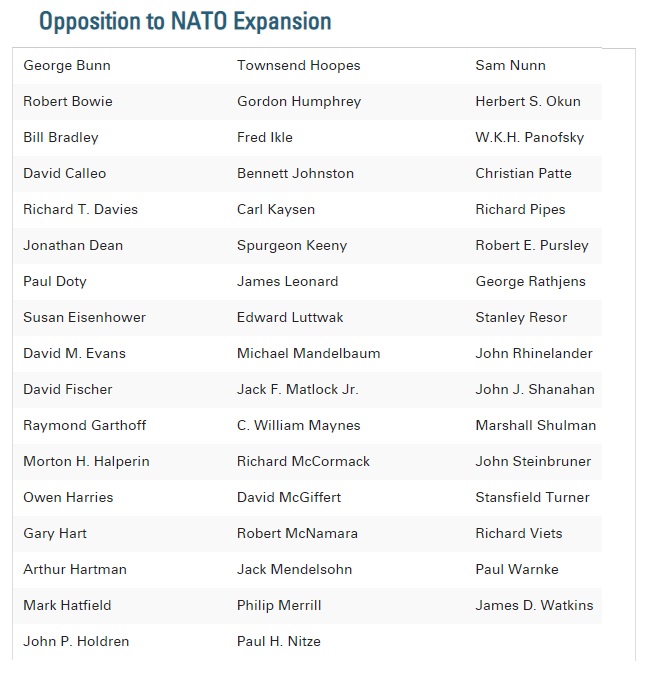
What ensued was three decades of NATO expansion, today portrayed as an inevitable sequence of the “end of history”. Yet, it was widely condemned in 1997, by 50 leading US foreign policy experts in an open letter to President Clinton. They feared it would derail the future of US-Russian trust and nuclear arms control – as it did, while denting Eastern Europe’s future. Recently, Michael Mandelbaum, one of the signatories, called NATO expansion “one of the greatest blunders in the history of American foreign policy” (Figure 2).[4]
Figure 2: US foreign policy NATO opposition in 1997
SOURCE: Open letter to President Clinton, 26 June 1997
In April 2008, NATO announced that Ukraine and Georgia would become parts of the Treaty Organisation, which Russia denounced as an existential threat, drawing its red line. By 2014, when Russia annexed Crimea, some leading international relations practitioners charged the US and its European allies with most of the responsibility for the crisis. Today, some military experts blame the US “war lobby” – the Pentagon and the defence contractors – for the crisis escalation.[5]
The NATO expansion boosted the return of the Ukrainian far right, reinforced by a scandalous UN vote. In November, Russia presented a motion against the “glorification of Nazism”. Before Christmas, more than three out of four UN member countries passed the resolution. Despite its wartime devastation and the Holocaust, EU members abstained en masse from the resolution. Worse, Ukraine, the United States, even Canada rejected the motion.
It was an unparalleled insult against the Russians, who lost 27 million lives in the Second World War, ensuring the Allied victory against Hitler. But the UN vote was perfectly aligned with US covert activities since the 1940s.
Expansion of the Ukrainian far right, with clandestine US support
During the Second World War, Ukraine’s far-right forces collaborated with Nazi Germany. Some 1.5 million Holocaust victims came from Ukraine, while 100,000 Poles were slaughted by the same far-right. During the Cold War, they cooperated with the US, which eventually led to “the role of domestic fascist networks in the Republican Party and their effect on US Cold War politics”.[6] These ties date from the heroes of Ukrainian far right Stepan Bandera and Yaroslav Stetsko (see Figure 1) to US anti-Communist think-tanks today.[7] Nor are these ties history or Putin’s fantasy. Since the 2014 Maidan, Ukraine has enacted new monuments, plaques and renamed streets – including a major Kyiv boulevard leading to Babi Yar, a site of one of the largest wartime Nazi massacres of Jews – nearly every week to “Nazi collaborators and Holocaust perpetrators.”[8]
In February 2014, Victoria Nuland, then-assistant secretary of state for European Affairs, played a key role in the overthrow of the democratically elected government of Ukrainian, President Viktor Yanukovych, while selling US mainstream media the pro-democracy tale, “without weighing the likely chaos and consequences”. That legitimised the Ukrainian far right, its massacres of ethnic Russians in eastern Ukraine, while burying the European-guaranteed compromise plan with Yanukovych and early elections. The coup led to Russia’s annexation of Crimea and Sevastopol’s strategic naval base – as noted by the highly regarded investigative journalist Robert Parry, who exposed the Iran-Contra debacle in the 1980s.[9]
Hence, the neoliberal “reforms” and the IMF interventions, which almost collapsed the Ukrainian economy and the “deep degree of US involvement in affairs that Washington officially says are Ukraine’s to resolve”.[10]
Since 2014, the Ukrainian stay-behind networks have been dominated by far-right, neo-Nazi and white supremacist paramilitaries, with the commander of the notorious Azov Battalion, Andriy Biletsky, a self-proclaimed “White Führer”.[11] At the time, these groups were tacitly supported by then-vice president Biden, deputy national security advisor Blinken, and Biden’s top security aide Jake Sullivan. Nuland, too, is back in the game. As secretary of state Blinken’s right hand since May 2021, she has pushed for the Biden administration’s elevated anti-Russian sanctions to “punish Putin” and “fuel Russian unrest”.[12] As a board member of the National Endowment for Democracy, the US funder of “colour revolutions”, she’s promoting regime change and another collapse of the Russian economy. From Iraq to Afghanistan, they have supported all U.S. post-9/11 wars, which cost $8 trillion to U.S. economy alone.[13]
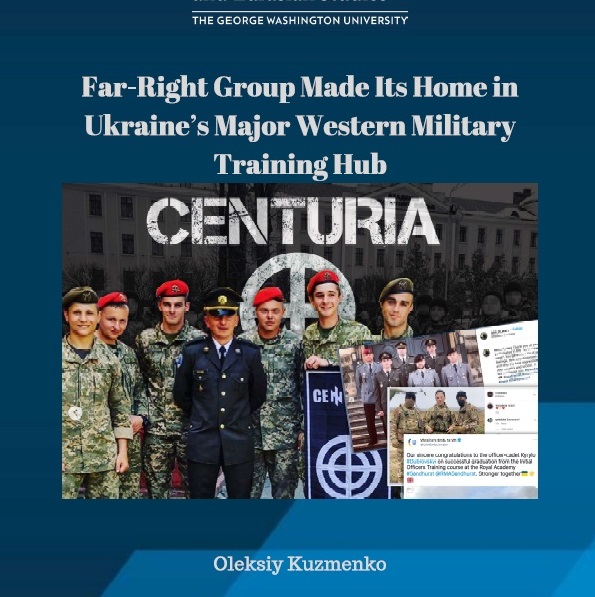
According to a 2020 West Point counter-insurgency analysis, the “common preoccupation” for both neo-Nazi and white supremacist groups in the US and Europe “has been the conflict in Ukraine, where a well-established far-right extremist movement and its associated militia have consistently engaged with and welcomed far-right ideologues and fighters from other parts of Europe and North America”.[14] In fall 2021, a US extremist-watch group reported that the Ukrainian far-right group Centauria had made its home in Ukraine’s major Western military training hub, built ties with the Azov movement, and infiltrated the armed forces. The State Department knew the extent of the problem but purposely ignored it (Figure 3).[15]
Figure 3: Expansion of Ukrainian far right with US support since 2014
(a) Flags of NATO, Azov and Hitlerjugend (b) Far Right in the Western military Hub
Members of the Azov Battalion holding the flag of the Azov Battalion, NATO flag and a Nazi Hitler Jugend flag in 2014. (/Wikimedia Commons).
IERES report on the infiltration of Western military hubs in Ukraine by the far-right paramilitaries (Sep 2021)
Energy, commodities and global nuclear risks
Since Ukraine’s contribution to the world economy is fractional and Russia represents less than 2 per cent of the global economy, the geopolitical risk of a Ukraine crisis was discounted for years. In reality, those risks have vital energy, commodity and nuclear ramifications.
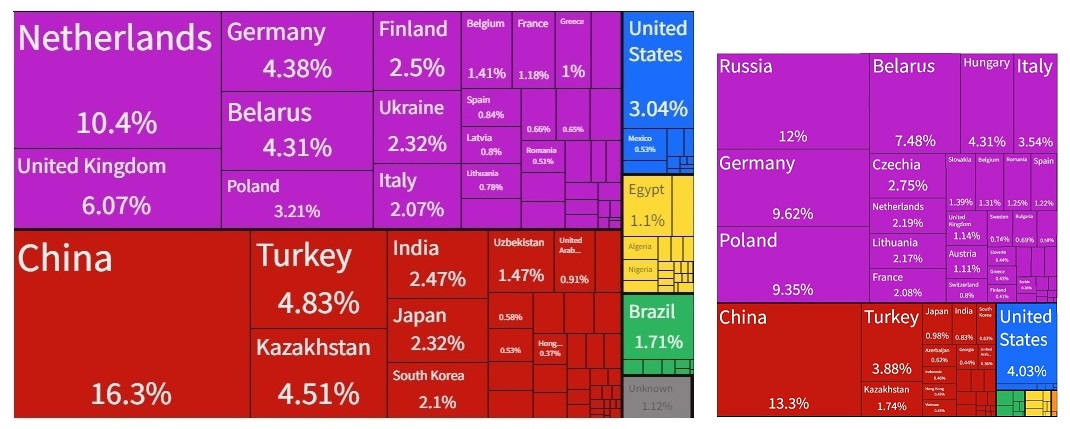
Russia is the world’s second-largest oil exporter. After two years of COVID-19 economic and human devastation, the oil market is no longer well equipped for major supply disruptions, due to low inventories and diminished spare capacity. As supply concerns spur oil stockpiling, price increases escalate. Russia is also the world’s largest natural-gas exporter. As the sanctions hit Russia, they will suppress supplies and drive up prices worldwide. Russian gas is vital to US NATO allies Germany (49 per cent of gas supply), Italy (46 per cent), and France (24 per cent). It accounts for 42 per cent of Europe’s gas imports via pipeline alone. Overall, energy makes up two-thirds of Europe’s imports from Russia, even as EU countries already grapple with the spectre of high inflation (Figure 4a).
Figure 4: Major trading partners, 2021
(a) Russia (b) Ukraine
Source: The Observatory of Economic Complexity
Ukraine and Russia also play a major role in the global agricultural market. Together, the two countries account for a quarter of global wheat exports. The crisis is likely to have a lingering adverse impact in the poorest developing economies, particularly in Africa, while emerging economies, particularly in Southeast Asia, will have to cope with increasing energy and commodity prices amid inflation spikes. Predictably, the benchmark gauge for world food prices soared in February, reaching an all-time high. But worse is still ahead.[16]
With rising tensions and open hostilities, crude oil has already hit the highest since 2008 at above $130 per barrel, a 14-year high. The Commodity Index is almost 50% per cent up since the beginning of 2022. Both could climb significantly higher.[17]
Worse, there are heightened global nuclear threats. Recent fears of potential nuclear disasters at the Zaporizhzhia plant and elsewhere in Ukraine are just a glimpse of challenges looming ahead. Some 90 per cent of all nuclear warheads are owned by Russia (5,977) and the US (5,426). Only weeks ago, the symbolic Doomsday Clock, maintained since 1946, was set at just 100 seconds to midnight, for the second year. It was the worst-possible accomplishment at the worst-possible time.
Today, the risks are significantly higher.
Undermining China’s economic development with Ukraine
The Ukrainian crisis was avoidable but a geopolitical trajectory was manoeuvred, at least in part so that peace, stability and development would be pre-empted. Even as tensions have progressively escalated in the past half a decade, trade ties between Ukraine and Russia have steadily increased since President Viktor Yanukovych’s state visit to China in 2013. Four years later, Ukraine, now under President Poroshenko, joined China’s Belt and Road Initiative. And in 2019, China overtook Russia as Ukraine’s biggest single trading partner (Figure 4b).
In 2020, Kyiv and Beijing signed a deal to strengthen cooperation in multiple areas, particularly in infrastructure financing and construction.[18] And last year, overall trade boomed to $19 billion, having soared 80 per cent since 2013.[19]
To President Zelensky, the BRI meant an alternative future that would be more peaceful and stable. Or, as he said in his phone conversation with President Xi Jinping, Ukraine might become a “bridge to Europe” for Chinese investments.[20]
In just a year, major Chinese companies started operations in construction (CPCG, CHEC), food (COFCO) and telecommunications (Huawei). Huawei, which the US has struggled to neutralise for a decade, helped Ukraine to develop mobile networks, won the bid to install a 4G network in Kyiv’s subway and was selected in 2020 to improve Ukraine’s cyber-defence and cybersecurity.
Washington has worked for three decades to transform Ukraine into a client state. Hence the penchant for ignoring Russian pleas for diplomacy, the crisis escalation, and the deliberate neglect of Austrian-style options for neutrality in the region.
And when Zelenskyy flirted with the idea of reconciliation with Russia in 2019, the far right torpedoed it quickly.[21] It wanted revenge, which has been shrewdly exploited.
From Prince to Biden: The plan to militarise Ukraine
From 1991 to 2014, the US provided Ukraine with $4 billion in military assistance, even though it is not a NATO member. Over $2.7 billion has been added since then, plus over $1 billion provided by the NATO Trust Fund, which is only a part of the total military investments in Ukraine. To Erik Prince, it was a great business opportunity, Iraq déjà vu.
As the founder of the private US contractor Blackwater (renamed Academy), he had long supplied mercenaries to the CIA, the Pentagon and the State Department for covert operations, including torture and assassinations.
In early 2020, as Washington struggled to keep China and economic development out of Ukraine, Prince outlined a “roadmap” for the creation of a “vertically integrated aviation defence consortium” that could bring $10 billion in revenues and investment and compete with “the likes of Boeing and Airbus” (Figure 5).[22]
Figure 5: Iraq déjà vu?
Paul Bremer, leader of the US coalition after the unwarranted $3 trillion 2003 Iraq War, escorted by Blackwater Security guards (Wikicommons)
Time exposé of Erik Prince’s $10 Ukraine plan on 7 July 2021 (screen capture)
Prince also wanted the Motor Sich factory that the Chinese had already acquired.[23] As the Trump administration was busy suppressing China’s presence in Ukraine, Prince promoted himself as the “American option” with support from his mighty Republican family dynasty, and his sister Betsy DeVos, Trump’s education secretary.
But the plans fell apart when Prince’s Ukrainian partners fell under criminal investigation for alleged efforts to sway the 2020 presidential election (the investigation also involved President Biden’s son and his stakes in Ukraine).
Instead of a private entity, the Biden administration seems to favour the idea of another major US military base, right at the Kremlin’s backdoor, as a platform for operations. As a common enemy, Russia could “make America united again”. Hence, Biden’s new approvals for $350 million of military arms to Ukraine, the largest such package in US history.[24]
It was neither philanthropy nor a free lunch, but a sale in exchange for money. NATO refused to participate directly in the fighting. Pentagon took its provision. Defence contractors rejoiced their big win. Ukrainians were free – free to die.
Political reverberations in Washington and Kremlin
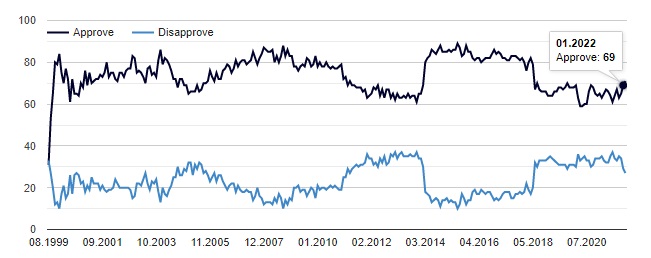
As long as most Americans approved of Biden’s performance, the White House had touted mainly diplomatic measures in Ukraine. But as most Americans turned against Biden, a dramatic change ensued. Hence, the hawkish push, and eventually threats and warnings about “imminent Russian invasion”, which the Kremlin slammed as “provocations”.[25] Nonetheless, the hawkish stance has not reversed Biden’s ratings, which have been plunging since summer 2021 (Figure 6).
Figure 6: The crisis escalation: Presidential ratings in the US and Russia
(a) Biden’s sagging ratings
(b) Putin’s rising ratings
Source: (a) Screen capture of Biden ratings, Fivethirtyeight. (b) Putin’s approval ratings, Levada Center (Russia); Difference Group Ltd., 3 March 2022
There’s worse ahead, starting with Republican senators’ public demand to have Putin assassinated and a bipartisan bill to ban Russian oil, which could dent the Biden administration’s attempt to avoid a backlash in oil markets that could severely harm the US economy, as Goldman Sachs recently suggested.[26] With impending elections, political populism may drive global prospects toward a stagflation recession.
In the West, the international media offers daily feeds of Russian protests against “Putin wars”. In reality, after Putin managed to stabilise the Russian economy, his approval rating soared to 80 per cent. When the far right threatened eastern Ukraine in 2014, the same recurred. And despite great tensions, his ratings exceeded 70 per cent prior to the crisis. Russians debate politics passionately, but they haven’t forgotten the post-Soviet economic devastation, which the West’s reforms made a lot worse.
Oligarch monies, regime change
In fall 2019, Zelenskyy won the elections as a populist who positioned himself as an anti-establishment, anti-corruption figure against his predecessor Poroshenko; and one that would finally end Ukraine’s prolonged conflict with Russia.
But Zelenskyy’s landslide did not fit the plans of the oligarchs, who hated his efforts to undercut their economic dominance; or the US State Department under Pompeo and then Blinken, who had other goals for Ukraine; or the far-right paramilitaries who’d been preparing for mobilisation since 2014; or Ukraine’s parliament, which opposed his efforts at greater centralisation. To many of them, he was replaceable.
So, in October 2021, like manna from heaven, files obtained by the International Consortium of Investigative Journalists (ICIJ) indicated that Zelenskyy and his partners established a network of offshore companies back in 2012. What made the Pandora Papers politically embarrassing was that his offshore firms had received an alleged $41 million between 2012 and 2016 from firms belonging to Igor Kolomoisky, a billionaire whose TV channel screened Zelenskyy’s popular shows.[27]
Kolomoisky has been a major funder of Azov since 2014, while bankrolling private militias, such as the Dnipro and Aidar Battalions, to protect his economic interests. It’s a symbiotic threesome. Reportedly, “Zelenskyy has ceded to neo-Nazi forces and now depends on them as front-line fighters”, while the far right has shrewdly used his Jewish heritage to refute allegations of Nazi influence in Ukraine.[28] Other oligarchs sponsor their respective private militias.
The ICIJ does important work, but the timing of the disclosures is intriguing and some of the major sponsors of the Consortium itself are also key architects of “colour revolutions” (e.g., Open Society Foundations, Ford Foundation).
Ever since the end of the Cold War, Ukraine has struggled for democracy. Of the myriad threats facing Ukraine since 2014, the return of the oligarchs has been prominent, even if their economic dominance has diminished. A solid democracy will “require the growth of stronger state institutions”.[29] Yet, that is not the goal of those that seek to turn Ukraine into a fully fledged client state.
Despite repeated efforts to capture the parliament, the far-right groups enjoy only fringe (less than 2.5 per cent of the vote) support in Ukraine.[30] Hence their reliance on extra-parliamentary measures and oligarchs. In the US, firms working for Ukrainian interests “inundated congressional offices, think tanks, and journalists in 2021″. To put the Ukraine lobby’s campaign into perspective, “the Saudi lobby – known for being one of the largest foreign lobbies in DC – reported 2,834 contacts, barely a quarter of what Ukraine’s agents have done.”[31]
Lobbying requires money, which is the oligarchs’ speciality. They want to sustain their supremacy in the kind of Ukraine the US prefers. Besides, Ukraine holds the second-biggest known gas reserves in Europe, right after only Norway and largely untapped.[32] A poor but resource-rich economy is an attractive target for regime change. Perhaps hence, too, the likely use of the neo-Nazi paramilitaries as stay-behind forces for “sabotage in a multipolar world”. In the postwar era, the CIA backed such Ukrainian insurgents for similar purposes, with disastrous results.[33]
Ordinary Ukrainians want peace and development. But that’s not what they’re getting.
Ukraine’s decades of plunging living standards and millions of refugees
Ukraine has the highest number of politicians named in the Pandora Papers. Poor economies that are resource-rich, with fragile institutions, oligarchs, and extremist paramilitaries are highly vulnerable to corruption, particularly when they are targeted as “client states” by major powers. And those powers use weak institutions and corruption for their agendas. Ukraine is a prime example.
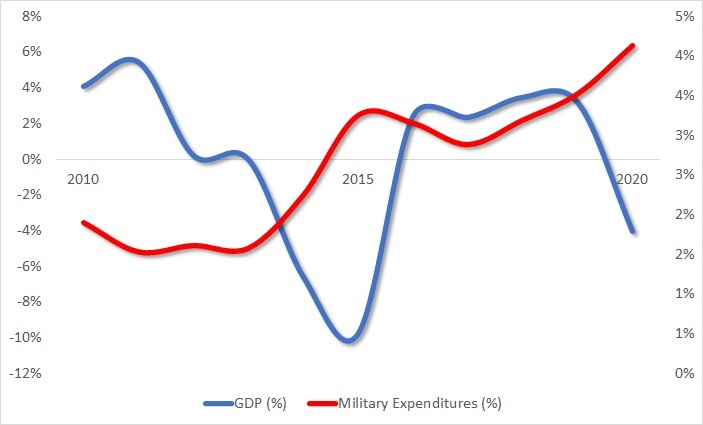
Between 1991 and 2021, the US military assistance, coupled with that by the UK and NATO, amounts to some $10 billion or more. But, as Iraq and Afghanistan evidence, military aid and economic aid, whether it is disguised for military purposes or not, seldom boosts consumer welfare – quite the reverse. In 2014, Ukrainian military spending was about 3 per cent of GDP, increasing to 6 per cent in 2022, corresponding to more than $11 billion. In brief, Ukrainian military expenditures have doubled since the 2014 regime ploy. Meanwhile, its economic growth has tanked. After the implosion of the Soviet Union, Ukrainian per capita incomes were almost on a par with Poland. Today, they are more than 60 per cent behind the Poles (Figure 7a).
Figure 7: Ukraine’s economic growth and military expenditures, 1990-2021
Source: Data from SIPRI, IMF; Difference Group, 5 March 2022
Ukraine’s population of 44 million people has been declining since the 1990s, because of a high emigration rate and high death rates, coupled with a low birth rate.[34] And by 8 March, some 2 million Ukrainians were estimated to have left their country in the fastest exodus of people since 1945.[35] Millions more could follow. Before the crisis, Ukrainian per capita incomes were barely ahead of Libya, which Western intrusions have turned into a failed state. Now worse is ahead.
From the unwarranted war to elevated economic and geopolitical risks
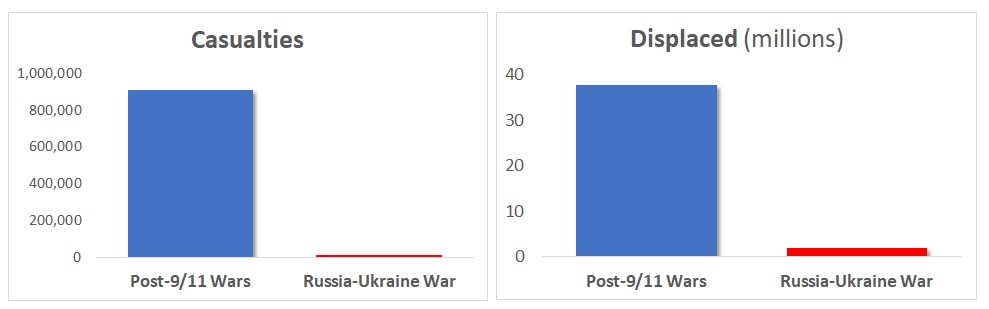
The Russia-Ukraine War has already resulted in more than 11,000 casualties, while some 2 million people have been displaced and these figures will increase. In a matter of days, that prompted a war crimes investigation by the International Criminal Court (ICC) and unprecedented economic sanctions, including the Russian central bank’s $643 billion of forex reserves, which aim to collapse Russia’s $1.7 trillion economy; the 11th largest in the world – despite the prewar pledge by the White House to use only targeted sanctions that would not hurt Russian people.
To put these things in context: In the past two decades, the U.S. has waged half a dozen post-9/11 wars (some under false pretense), with and without its allies, which have caused at least 1 million deaths and 38 million displaced. Yet, all efforts to prosecute the US have been derailed by the White House. Nor have there been any major economic sanctions against the U.S. (Figure 8).
Figure 8: U.S. Post-9/11 Wars and the Russia-Ukraine War
* U.S. Post-9/11 Wars from Sept. 2001 to Sept. 2021; Russia-Ukraine War (Febr. 24 to March 8, 2022
Sources: Costs of War (Watson Institute); UN.
The ongoing crisis was avoidable and unwarranted. Worse, in the past, world leaders sought to end wars. Now wars are seen as business opportunities. The consequent economic sanctions are grossly disproportionate and, coupled with Biden’s ban of oil and gas imports to U.S., they will dramatically penalize the ailing global economy.
Elevated economic and geopolitical risks
In the dire international landscape, global recovery has remained elusive since 2017, due to the US and the pandemic depression.[36] In a matter of weeks, global economic risks will accelerate as the Fed will begin rate hikes and, in due time, shrink its balance sheet (even if the pace and scope will be slower and lower than initially anticipated).
The hoped-for global recovery is now history, while the risk of stagflationary recession has increased. Moreover, the Ukraine-related geopolitical tremors, which could turn into broader existential threats if nuclear threats escalate further, have only begun.
Three scenarios remain after the hostilities diminish.
The trap scenario. In the 1980s, President Carter’s security adviser Zbigniew Brzezinski incited the Soviet Union into Afghanistan to weaken the Kremlin. Some believe Ukraine is the trap scenario déjà vu. While Russia may win the war in Ukraine, it can’t avoid another collapse of its economy. Ukraine will have a liberal future. America’s unipolar hegemony will prevail. A new generation of pro-Western oligarchs will loot Russian assets, again. The West will gain over time.
The trap in the trap scenario. President Putin knows Biden’s traps. He will “de-nazify and demilitarise” Ukraine. Sanctions will crumble over time, but not before more debt-taking by the US, which will result in a new debt crisis, and the weakening of the EU, whose leaders will be more flexible after the war. The new Ukraine will thrive in Russia’s near abroad. Global recovery will ensue in a more multipolar world economy.
The mutually assured trap scenario. Despite the planned trap scenarios in Washington and Kremlin, the geopolitical reverberations will turn the hybrid proxy war into a direct confrontation with fatal geopolitical contagion, or generate accidental conflicts which trigger exaggerated military responses. Rounds of sanctions and counter-sanctions will penalise the Russian and US economies and thus overall global prospects. A split Ukraine will emerge as a failed state. The US dollar as a major reserve currency will be shaken. The world economy will be neither unipolar nor multipolar, but devastated.
The real trajectory will be none of the three, but a combination of each. It is not that difficult to start a war; an exit from the war is a different story. Unwarranted wars among nuclear powers, proxy conflicts or not, will only drive humanity – all of us – ever closer to the abyss.
Dr Dan Steinbock is an internationally recognised strategist of the multipolar world and the founder of the Difference Group. He has served at the India, China and America Institute (US), Shanghai Institutes for International Studies (China) and the EU Centre (Singapore). For more, see https://www.differencegroup.net/
NOTES
[1] “Facebook Allows Praise of Neo-Nazi Ukrainian battalion if it fights Russian invasion.” The Intercept, 25 February 2022.
[2] Bellant, Russ. 1989. Old Nazis, the New Right, and the Republican Party. 3rd ed. Boston, 1991.
[3] In 2017, the declassified assurances were posted online by the Washington-based National Security Archive. See Savranskaya, Svetlana and Blanton, Tom. 2017. “NATO Expansion: What Gorbachev Heard.” Briefing Book #: 613. NATIONAL Security Archive, 12 December
[4] “Opposition to NATO Expansion.” Arms Control Association, 26 June. 297.
[5] Chotiner, Isaac. 2022. “Why John Mearsheimer Blames the U.S. for the Crisis in Ukraine.” The New Yorker, 1 March 1; see also Mate, Aaron. 2022. “US war lobby fuels conflict in Russia, Ukraine, and Syria: ex-Pentagon advisor.” The Grayzone, 6 January.
[6] Bellant 1989, op. cit; and “Seven Decades of Nazi Collaboration: America’s Dirty Little Ukraine Secret.” An Interview with Russ Bellant. The Nation, 28 March 2014.
[7] On Bandera, Stetsko and their organizations and U..anti-Communist think-tanks, see Grzegorz, Rossolinski. 2014. Stepan Bandera: The Life and Afterlife of a Ukrainian Nationalist: Fascism, Genocide, and Cult. Stuttgart; Snyder, Timothy. 2001. To Resolve the Ukrainian Question Once and For All: The Ethnic Cleansing of Ukrainians in Poland, 1943-1947. Working Paper, Yale; “Far-right exploitation of genocides” in Steinbock, Dan. 2021. “Playing Genocide Politics: The Zenz-Xinjiang Case.” The European Financial Review, 11 June
[8] Golinkin, Lev. 2022. “The Nazi Monument Project: How many monuments honor fascists, Nazis and murderers of Jews? You’ll be shocked.” The Forward, January. 26.
[9] Parry, Robert. 2015. “The Mess That Nuland Made.” The Consortium News, 13 July.
[10] Gearan, Anne. 2014. “In the recording of U.S diplomat, blunt talk on Ukraine”. The Washington Post, 6 February.
[11] “Ukraine’s National Militia: ‘We’re not neo-Nazis, we just want to make our country better’.” The Guardian, 13 March 18.
[12] Since May 2021, Nuland has served as under-secretary of state for political affairs for secretary of state Blinken. On her role, see Wong, Edward and Crowley, Michael. 2022. “With Sanctions, U.S and Europe Aim to Punish Putin and Fuel Russian Unrest.” The New York Times, 4 March.
[13] Costs of War project by the Watson Institute, Brown University.
[14] Lister, Tim. 2020. “The Nexus Between Far-Right Extremists in the United States and Ukraine.” CTC Sentinel, April, pp. 30-43.
[15] Ibid; “Neo-Nazis Not Top of Mind for Senate Democrats Pushing Weapons for Ukraine.” The Intercept, 19 February 22.
[16] “FAO Food Price Index rises to record high in February.” Food and Agriculture Organization, UN, 4 March 2022.
[21] As the West Point report puts it, “these groups have bitterly opposed any suggestion of compromise with Russia over Donbas through the Normandy negotiating process… and oppose concessions floated by President Volodymyr Zelensky.” See Lister 2020, op. cit.
[22] Shuster, Simon. 2021. “Exclusive: Documents Reveal Erik Prince’s $10 Billion Plan to Make Weapons and Create a Private Army in Ukraine.” TIME, 7 July.
[23] “Chinese firm’s stake in Ukraine military aircraft engine maker ‘frozen'”. South China Morning Post, 16 September 2017 China’s Beijing Skyrizon Aviation bought a 41% er cent holding in Motor Sich. The Chinese planned to invest $250 million in the Ukrainian plants until American pressure killed the deal.
[24] Remarks of President Joe Biden – State of the Union Address as Prepared for Delivery. The White House Briefing Room, 1 March 22.
[25] “Biden, Putin Discuss Ukraine as Kremlin Slams ‘Provocations’.” AFP, 12 February 21.
[26] “Bipartisan bill banning Russian oil sets up clash with White House.” Politico, 3 MarchMa022; “Sen. Lindsey Graham’s apparent call for Putin to be assassinated draws backlash.” NPR, 4 March 22; The Russia Risk. Goldman Sachs Global Investment Research, February, p.13.
[27] “Political and business links to Pandora Papers roil parliaments, anti-corruption and tax authorities as global fallout swells.” Pandora Papers Impact, ICIJ, 12 October 21. See also “Revealed: ‘anti-oligarch’ Ukrainian president’s off shore connections.” The Guardian, 3 October 21.
[28] Rubinstein, Alex and Blumenthal, Max. 2022. “How Ukraine’s Jewish president Zelensky made peace with neo-Nazi paramilitaries on front lines of war with Russia.” The Grayzone, 4 March.
[29] Minakov, Mikhail. 2016. A Decisive Turn? Risks for Ukrainian Democracy After the Euromaidan. Carnegie Endowment for International Peace. 3 February
[30] “Ukraine’s CEC announces official results of parliamentary elections,” UNIAN, 3 August 19.
[31] According to an analysis of the Foreign Agents Registration Act (FARA), filings for a forthcoming report from the Quincy Institute. See Freeman, Ben. 2022. “Ukrainian Lobbyists Mounted Unprecedented Campaign on U.S lawmakers in 2021.” The Intercept, 11 February
[32] Amelin, Anatoliy et al. 2020. “The Forgotten Potential of Ukraine’s Energy Reserves.” Harvard International Review, 10 October
[33] Meegan Daniel. 2020. Breaking Other People’s Toys: Sabotage in a Multipolar World. Naval Postgraduate School, Monterey California, December. Rogg, Jeff. 2022. “The CIA has backed Ukrainian insurgents before. Let’s learn from those mistakes.” Los Angeles Times, 25 February
[35] Data from the UNHCR. See also Global Trends in Forced Displacement – 2020, UNHCR, 21 June 21.
[36] Steinbock, D. 2017. The Great Shift: The Shift of Globalization from the Transatlantic Axis to China and Emerging Asia. China Quarterly of International Strategic Studies Vol. 03, No. 02, pp. 193-226; and Steinbock, D. 2018. U.S-China Trade War and Its Global Impacts. China Quarterly of International Strategic Studies, Vol. 04, No. 04, pp. 515-54.
Technology is revolutionizing the operations strategies of construction teams around the world. The last couple of years have seen a rise in the popularity of digital transformation in construction, and for good reason. Digital solutions are helping construction companies reduce costs, improve safety, and work with unparalleled efficiency.
The benefits of technology are even creating a more collaborative work environment while allowing more freedom for many team members. Digital solutions are transforming the way that construction teams operate, work, and communicate. Here’s how.
Operational Efficiency
With the industry’s persistent staffing shortage, construction companies need to make the most of every employee they have by working as efficiently as possible. Digital solutions are the key to making this happen. In the past, construction has remained among the least digitized fields in the world. However, this is changing in the face of new challenges and benefits brought about by advancements in technology. Nowadays, civil engineers and architects are increasingly relying on a variety of specialized tools and software to enhance their work processes and deliver more accurate results. Among these tools are moment of inertia calculators, truss calculators, and energy modelling applications, which have significantly improved the design, analysis, and execution of construction projects. By incorporating these advanced digital resources, construction professionals can ensure that their projects are structurally sound, energy-efficient, and in compliance with modern building standards.
For example, choosing to digitize the office and move from paper documents to digital will allow employees to work more productively on the job. A secretary can locate any file they need with a few simple clicks. Payroll and employee time tracking are much more manageable and can even be automated.
In the field, a variety of digital solutions, such as AI, virtual reality, drones, and digitization, can help site workers do their jobs more efficiently. A subcontractor can easily pull up any digital equipment manual they need from a tablet. Maintenance is easier and more cost-effective with Internet of Things (IoT) sensors on equipment and machinery.
Increased Financial Savings
An estimated 80% of construction projects go over budget every year. Financial constraints in the shadow of the COVID-19 pandemic are making it less acceptable for construction projects to exceed their budgets. Construction companies need a solution that will reduce costs without sacrificing work quality. Digital solutions are the key.
One of the largest areas where technology is helping construction companies operate more affordably is fleet maintenance and management. It’s no secret that construction equipment is expensive, whether it is owned or rented. Maintenance costs can pile up quickly, especially when something has a major breakdown. Digital solutions are helping construction companies prevent such costly repairs and operate their fleets more effectively.
For example, fleet management software is helping teams monitor equipment performance, save on fuel, and improve operator handling. All of these benefits help reduce costs by keeping construction teams closely connected with the gear they work with.
With fewer breakdowns, efficient routes, and optimized fuel consumption, equipment maintenance costs can drop significantly with the help of digital solutions like this. Even simple digitization measures like a paperless office will save thousands of dollars in the long term.
Better Safety Standards
Health and safety is top of mind in the construction industry, considering its ranking as one of the riskier fields for worker safety. Fortunately, digital solutions are improving site safety on countless projects, making a difference in risk management and employee safety tracking.
One of the best benefits of digital safety solutions is their sheer versatility. There is immense room for customization in construction safety technology, so individual construction teams can create a unique system that works for them.
For example, AI can be used to analyze a site for things like fall hazards quickly and in greater detail than a traditional risk assessment. AI can also be used to monitor site security feeds around the clock, keeping workers and project resources safe from theft or damage even when no one is on-site. Individual safety devices are becoming more popular as well.
There are numerous wearable construction safety devices available today, from a smartwatch that detects falls to smart work vests that detect environmental hazards. These devices help ensure that each individual employee is staying safe and make it easy for them to alert others in the event of an emergency.
Unlocked Opportunities For Collaboration
Digital solutions unlock a whole new level of connectivity and communication between construction team members, whether in the office or the field. Finding ways to use technology to improve collaboration is a great place to start for construction teams that are new to digitization.
Many teams have already been using digital solutions for things like video conferencing ever since the COVID-19 pandemic kept in-person meetings to a minimum. Even after work stoppages due to the pandemic subsided, construction teams are finding that digital solutions like this allow them to stay more connected with one another.
For example, a team of planners, designers, and stakeholders can have a meeting from completely different locations. A project manager can give a tour of the site without anyone else having to take the time and money to travel. Designers can share drawings and BIM projects with one another quickly and easily through the cloud.
This level of collaboration and unrivaled digital tools has made BIM software incredibly popular within the industry recently. Even something as simple as digital communication channels can help improve collaboration between the office and field teams.
Digitizing Construction for the Future
The construction industry is facing numerous challenges today, but digital solutions are quickly proving themselves the key to moving the industry forward. Digitization is changing operations for the better for countless construction teams, keeping them safer and allowing them to work smarter.
With incredible potential for collaboration and total control of budget optimization, teams all over the world are realizing the benefits technology has to offer. Digital solutions are moving the construction industry into an era where the building process is connected, collaborative, and cutting-edge.
Evelyn Long is a construction writer and the founder of Renovated. Her work on construction training and management has been featured by the Building Performance Association, Training Journal and other industry publications.
The term training module can mean anything from a simple PowerPoint presentation to an actual textbook; there is no standard or official definition, making it hard to define what should go into one and what shouldn’t.
However, if you’re interested in creating your training module or have already started and want to know if it’s on the right track, there are some key things you should consider including in your design and creation process that will help ensure the result is efficient and effective.
What is a Training Module used for?
Training modules are commonly used to help employees learn how to do their jobs better and more efficiently or learn how to do new jobs that they have been hired to do. Whatever the case may be, you must take time to create a practical training module that will help your employees learn the information you want them to know.
Before you start creating the actual module, you should consider what should be included in it and how it should be presented and what type of information should be included.
Your training module should be able to teach your customers the information they need to know about your product or service, whether it’s how to use it or how to set it up. If you want it to be effective and helpful for your customer, it should contain these elements, so make sure you consider them as you write your module.
How to develop the best training module, step by step
A well-designed training module will answer each of your reader’s questions before they even think to ask. It’ll take them through every phase of whatever project you’re training them for, and it will include tips, tricks, and relevant real-world examples.
It will be logical, easy to follow, and—yes—it will work. In other words: You can win over your new audience by designing an exceptional training module that takes their pain points into account from start to finish.
Whether you’re creating tutorials or other multimedia resources, keep these core elements in mind as you plan out what to say and how to say it:
Define The Problem
First, begin with a clear statement of what your training module is about. What’s the problem you’re trying to solve? Who will be involved, and what kind of deliverables are expected from them?
You don’t need to focus on why you want to solve it—get clear on what needs solving. For example, We want our customer service team to handle inbound calls more effectively and efficiently by automating as much of their phone workflow as possible.
Then describe who should attend (anyone who works for or interacts with customer support), when (during business hours), where (location and facilities requirements), how long (2-3 days), what’s included (lunch/coffee/breakfast and snacks), etc. The purpose here is just to lay out expectations.
Create An Outline
Now that you know what type of solution you want to create, start creating an outline that explains in detail each step required for attendees to reach success. The purpose here isn’t necessarily structure or logic but rather just getting all ideas out so they can be refined later–you can refactor them here at any time before launch.
Ensure it answers all questions asked earlier: Write down everything you feel needs addressing and ask yourself if they were answered above. If not, go back and rework until they are.
Write a SMART Objective
When creating training, it’s important to have specific and measurable objectives in mind. Why? Because if you don’t know where you’re going, how will you know when you get there? And if your objectives aren’t specific enough, your chances of success drop—and so does employee engagement.
Think about what exactly you want people to do after they complete training. Then break that down into smaller chunks: make those objectives SMART (specific, measurable, attainable, relevant, and time-bound).
This way, everyone has clear goals they can use as their roadmap throughout their learning experience. Being specific with your objectives also ensures employees focus on only one or two things at once instead of juggling five or six.
That way, you avoid fatigue and improve retention rates for content learned; but most importantly, you ensure employees stay engaged because they understand how all their hard work relates to big picture company goals.
Create the Right Type of Training Module
It’s crucial to understand your training audience’s needs, aspirations, and job descriptions. You can only create modules that will provide them with what they need most by identifying these. If you’re creating internal training modules for your business, it’s important to consider: What do your staff want to learn about? Which of their skill sets is lacking? And how does that fit into their job descriptions?
By thinking through all these factors, you’ll be able to create tailor-made training materials designed for your team. Plus, don’t forget that video is an excellent medium for communicating quickly—especially when compared to long blocks of text!
Collect Feedback and Revise
Once you’ve developed your training module, you’ll want to give it to several different people and ask them to provide honest feedback. For example, do they understand what you are saying? Do they feel that it is applicable in their role or department?
How could you better explain or teach what is needed? If they had one piece of advice, what would it be? Most importantly, do they feel empowered after reading your material? Use these responses to make revisions based on constructive criticism.
Your goal should be for others to walk away with a new skill or renewed confidence to perform at their highest level. To ensure that you have done just that, keep working at it until you receive consistently positive feedback. When no further revisions can be made, then your work is complete—but don’t forget about keeping up with updates throughout your company as well!
Stay Up-to-date
Keeping training modules up-to-date and thorough is essential to avoid confusion in today’s complex world. Staying organized will help you to get things done more quickly and efficiently. It also makes it easy for people new to your company or organization to navigate through training materials when they start their jobs. For tips on keeping training updated, stay tuned for our next tip sheet on Staying Organized as an Employee. Happy training!
In October of 2021, Boston’s most vulnerable residents began receiving notices to vacate a tent encampment at the intersection of Massachusetts Avenue and Melnea Cass Boulevard (also known as ‘Mass and Cass’). The mainstream local media covered the story from different angles, though similarly at different times, including coverage of Acting Mayor Kim Janey’s executive order which called for the clean-up of the encampment citing public health and public safety concerns. Janey’s executive order was issued on October 19, 2021. On the same day, a new temporary court was set up at the Suffolk County jail for those failing to comply with the executive order.
In the following weeks, clean-up efforts ensued, tents were taken down, and personal belongings, such as shopping carts, sofas, and other household items were tossed. Subsequently, on November 4, 2021, the mainstream media reported that the American Civil Liberties Union (ACLU) filed suit with the Massachusetts Supreme Judicial Court (SJC) seeking injunctive relief, and actual and punitive damages for the destruction of personal property as a part of the displacement process. On November 5, 2021, Mayor-Elect Michelle Wu, who was voted in by Boston on November 2, 2021—during the clean-up effort—told news sources that she would make changes to the handling of the encampment and that she believed that “no one should be arrested while waiting for treatment.”
Wu, who took office on November 16, 2021, stated that she is “working to quickly hire a ‘Mass and Cass’ chief to oversee efforts in the neighborhood.” On November 17, 2021, the SJC denied the ACLU’s request to stop the municipal government’s clean-up and clear-out efforts. It’s unclear where things stand presently, but the SJC has denied relief to those living in the encampment and at risk for incarceration or further institutionalization under the original executive order.
Media Coverage of the Encampment’s Removal
During October 2021, local news media sources covered the story of the homeless encampment in Boston mainly from the perspective of justifying why the clean-up was necessary with regard to public health. Headlines such as these ran: “Boston begins clearing homeless camp, citing opioid crisis,” and “Camps near ‘Methadone Mile’ given Monday deadline to leave.” The media focused on Acting Mayor Kim Janey’s efforts to clean up the public space by removing tents and belongings of those who resided there. News articles referred to notices posted by Janey on tents and in the area, and flyers which were distributed stating that “[d]ue to health, environmental and sanitary concerns … the City of Boston will conduct a clean-up of this public space … warning tent-dwellers all property left at that time would be thrown out by city workers.” During this cycle of news, photographs of the homeless encampment appeared showing tents with notices taped on them, some looking colorful, yet dilapidated, with personal belongings strewn about in the street or in shopping carts. Some news outlets mentioned that Janey’s notice provided assurances for those who were being displaced, but the details regarding the execution of her plan were not specified. The plan simply provided that “[n]o unsheltered individual will be required to remove their tent unless shelter, housing, or treatment is available.”
News reports which followed just one week later told another story. Outlets during this next week focused on Janey’s creation of special courts for arrests at Mass and Cass. The Boston Globe stated that a “new court for people arrested in the vicinity of a sprawling homeless encampment in Boston began hearing cases Monday … three men [were] detained … just steps from the makeshift proceeding.” The same report went on to describe a dire situation for these three people who were living in the encampment stating: “All three men were brought in on warrants ranging from drug possession, to larceny, to breaking and entering. They were led one by one in handcuffs and marched from police vehicles in the street past protesters who held signs and chanted, ‘Healthcare, housing, stop the sweeps!’” These follow-up news reports had a different tone and attitude than previous ones. What was initially depicted as a public health crisis posed by those who were living in the encampment was subsequently described by the media as a humanitarian crisis, citing rogue efforts by the local government to criminalize homelessness.
At least one media source acknowledged that the shelter option was not a viable one, even though it was touted by Janey and media sources at the outset of the clean-up as an alternative to encampment. Another news source claimed that criminal justice advocates said exaggerated concerns regarding public health were pretextual and being used to arrest and detain people. Referring to the Boston Globe, NBC News declared that the city needs to hold court in a jail facility because the homeless people living in the camps are medically compromised.
Media Coverage of Legal Challenges
Subsequently, media outlets began to report yet another development: the ACLU had stepped in and wanted to stop Boston’s plan to remove the Mass and Cass encampments. However, despite the ACLU’s efforts, many of the tents in the encampment had already been removed. The ACLU filed suit with the SJC on November 5,2021 seeking injunctive relief and monetary damages on behalf of those being displaced. The complaint alleges that it violates the Constitution and disability discrimination laws for the city to threaten criminal sanctions for those failing to comply with the clean-up. Second, it alleges that by removing people and destroying their personal property, the city violates the Fourteenth Amendment and the guarantee of due process.
On November 17, 2021, almost three weeks from the time Janey initiated the clean-up, the SJC denied the ACLU’s request to stop the removal of the tents. One media source summarized the status of the situation, stating: “The city has been giving homeless people an eviction notice[s] of 48 hours and providing bins for people to put their belongings in if they are forced from tents, citing concerns over substance abuse, fires, motor vehicle accidents, sexual assaults, robberies, and homicides.” After the judge’s ruling denying temporary injunctive relief, there was a consensus among media outlets that the rollout of Janey’s plan missed the mark and that more needed to be done to avoid incarceration of those living in and around the area of Mass and Cass.
Media Coverage of Government Officials
Boston’s new Mayor, Michelle Wu, who was voted in on November 2, 2021 (the same day as the eviction deadline for the homeless encampment), spoke in response and promised to pause the dismantling of the encampment until the court proceedings ended, but it is unclear what would happen after the ruling was made. The local media sources covering the developments failed to sufficiently address and question why neither Janey, the governor, nor Mayor Wu had anticipated these challenges prior to issuing the Executive order. Further, the media’s coverage never reconciled claims later made by public officials expressing an intent to avoid incarceration or institutionalization of those in the encampment with their blatant earlier efforts to establish a make-shift special court at a local jail.
Why was the special court necessary if there was no intent to criminalize the victims being displaced by Janey’s Executive order? The local media outlets almost unanimously failed to cover many of the “why” questions in their reporting of the government’s position from the start.
Assessment of Overall Media Coverage
The media’s coverage of the Boston homeless encampment situation presents many conflicting values and principles. Those working in media face deadlines and limits on their time, and on the resources available to investigate, develop, and produce a story. News agents must consider running stories which will inform and interest an audience while also considering the need to generate revenue from advertisers. Additionally, stories reporting on issues that are of public concern are of higher news value and hold more currency, however, it’s not always possible to cover every angle because of the scarcity of space and time. Thus, deciding which angle to cover and at which time should be subject to enormous ethical scrutiny, as the selection process potentially narrows the lens through which the audience will construct reality. In the case of the homelessness crisis, local media sources almost uniformly covered the story using different angles at different times, begging the question of whether the media ethically reported the events or whether it’s selection of related content and timing of its release drove a particular narrative.
Although the homelessness crisis and clean-up could have been told in many ways, at the outset, media outlets mainly focused heavily on the sensational aspects of it, citing the problem of drugs, addiction, sexual assaults, and the spread of disease within the vicinity of the encampment. News media providing detailed information about an emergency executive order to remove tents on Mass and Cass should have further sought to balance the subjects’ privacy rights with the public’s ‘need to know’ principle and the freedom of the press under the First Amendment.
Despite efforts of conscientious journalists to be objective and accurate, news reports are often unintentionally distorted, and thus flawed beliefs can provide the basis for public opinions. In turn, public opinion guides the formation of potentially flawed public policy which might have steep costs for society. Did the news media fall short of its responsibilities in this case, and if so, how did it impact public opinion? Was it ethically justifiable to select the most tantalizing aspects of the homeless encampment clean-up story and publish photos of the tents and personal belongings of those living in the encampment? Are news agencies morally liable for omissions of pertinent information which could have changed how a vulnerable population was treated if that information had been shared in a timely manner? Is it ever justifiable for news agencies to serve an agenda of the government despite the appearance of a conflict of interest which erodes public trust?
The Moral Agents of Media Coverage
The moral agents in this case are the editors of the news agencies. The news editors of local news agencies covered the story, including the more enticing aspects of it, such as drug abuse, crimes, arrests, violence, and disease, all which likely had the greatest appeal to the largest audiences. Because the public enjoys these themes in media content, news agents might have felt compelled to lower their ethical and moral standards to meet their audience’s desire for entertainment. Further, the media operates within a competitive business environment in the United States, and therefore, media practitioners must be cognizant of what content will drive profits.
Freedom of the press and the public’s right to know afford practitioners great latitude in making choices regarding content. With the protection of the First Amendment, there is little hope of preventing a creeping cycle of sensationalism, not to mention desensitization to certain issues among news consumers. Moreover, the public has the right to know the truth even if it offends moral sensibilities. Indeed, people’s right to know even the more gruesome or scandalous aspects of stories arguably remains a legitimate reason for media practitioners to publish and distribute content that disregards privacy rights, is morally offensive, and/or harms subjects or others.
The moral agents in the present case would have weighed all these factors quite heavily against the need to balance truth, accuracy, fairness, and the right of privacy of those featured in their reports. Also, the pictures used arguably depict the situation more accurately than words alone, which might have been deemed yet another reason to use them.
However, the news agency editors in the local media did not behave fairly when they did not tell the entirety of the story, which should have explained why so many had lost their former homes in Boston, and also should have highlighted the perspectives of the homeless subjects. Closer scrutiny of the selection of the perspectives shared and the timing of the content should have been given to avoid the harm that ensued to subjects.
Additionally, the moral agents did not act fairly when they published and disseminated the most sensational aspects of the story, and they did not behave justly when they shared personal information including pictures of tents and the personal belongings of those in the encampment. The pictures arguably added a level of entertainment, but was it necessary to inflict additional harm on an already vulnerable population to drive profits? The story could have been told without these attributes and there were alternative ways to pique interest in the story. Certainly, running headlines about drugs and addiction might have been the easiest and most profitable route, but in this instance, perhaps other attributes of those living on the streets could have been spotlighted, such as their courage, perseverance, resilience, and adaptability.
Moral Liability in Media Coverage
As to whether news agencies should be morally liable for omissions of pertinent information and whether it is ethically justifiable for news agencies to serve an agenda of the government, one must consider other competing values. Among these are values such as journalistic integrity, independence, harm to subjects and others, the appearances of conflicts of interest, erosion of public trust, as well as harmony and the greater good. In this instance, the media practitioners responsible for the homeless encampment clean-up story failed to provide proper context and omitted information early on which could have led to greater social activism by those in the community who wished to prevent the government’s abrupt ultimatum to those living at Mass and Cass.
With an election looming, the news media had an obligation to clarify information which they received from public officials to better inform the public about the candidates and their views about the encampment clean-up. As watchdogs, the news media should have demanded answers from public officials and sought to reconcile conflicting messages from Acting Mayor Janey and others. Instead, the news agents regurgitated these conflicting messages by government officials. There was pertinent information which was known but not reported until after the clean-up began and after Michelle Wu was elected to be the new mayor of Boston. Wu, who had been consistent with Janey on her plans for the encampment prior to the election, softened her approach afterwards, but did not take issue with the SJC denial of the ACLU’s request to enjoin the clean-up efforts. This arguably led to an appearance of a conflict of interest because the press, whose role it is to monitor the government for examples of overreach, plausibly aided the government in its effort to remove those living in the homeless encampment without any real push back until it was too late.
The questionable reporting of the events, the change in tone, the failure to ask tough questions of public officials and seek additional content, as well as the shift from a public health crisis to a humanitarian one within just a few weeks raises questions about journalistic integrity and independence. The harm to the subjects and the harm to the institutions which the news agents represent should have been deemed more important in order to avoid undermining public trust in the media.
External Factors
To be fair, there are significant external factors to consider, as well. The most obvious external factor in this case would be the imminent election for the mayor of Boston. The news editors, as moral agents, might have arguably deviated from general precedent of how local media would usually cover a homelessness crisis in the past because there was more at stake with an upcoming election. Perhaps, the typical watchdog role of the local media regarding human rights issues and social responsibility was subordinated to the goal of election integrity and voter turnout.
It’s long been accepted that mass media impacts public opinion and in turn, public opinion impacts public policy and elections. That being the case, it behooves editors to scrutinize more carefully what is at stake and who is harmed by their decisions, and to accurately convey such by being as transparent and as accountable as possible. The lack of any clear instruction in law, codes of conduct, or guidelines was another external factor which could have contributed to how the homeless encampment story was initially depicted by the local Boston media.
Another external factor might be the dissatisfaction in nearby communities of those impacted negatively by the encampment. Perhaps there was pressure on editors to report the clean-up efforts as highly necessary in the beginning to appease community members who were also consumers of the news and financial donors of the local news agencies, candidates for Boston mayor, and others in political arena. Did pressure from the local non-encampment community—where more members might vote—steer a narrative in the media leading to distortions of the truth? If so, then it is possible that ulterior motives, even bad intent, existed in the media’s early portrayal of events.
Conclusion
As moral agents, news editors may have initially appeared motivated by genuine concerns about addiction, crime, and unsanitary conditions. In contrast, they arguably later appeared more influenced by politics when they released information about Acting Mayor Janey’s make-shift court at a jail which went unexamined in any meaningful way as the tents in the encampment were being tossed. Perhaps it was the media’s duty to the general public surrounding the encampment which prevailed and fostered reports that negatively depicted the encampments and those living in it. What is clear is that the local media did not press public officials for answers to some of the most obvious questions regarding a special court for those who failed to comply with Janey’s ultimatum.
The media did cover the ACLU’s effort to stop the removal of the tents, but initially there was little, if any, effort to highlight the foreseeable and pertinent legal and ethical issues with respect to it. Also, the media’s coverage of the homeless and their feelings about the clean-up was not as in-depth as one would have expected given that the media has a social responsibility to expose government overreach and dubious dealings with its citizens. Criminalization further subjects an already vulnerable population to greater difficulty finding shelter, brings them into more frequent contact with law enforcement, and potentially results in incarceration and an increased risk of violence perpetrated during arrests. Moreover, deference should be given to innocent subjects of any story. Government efforts to rid cities of homeless tents and spaces where homeless people can sit or sleep, and the media’s coverage of such, together send a disturbing message to the public that the homeless are not innocent victims, which is a distortion of the truth in many cases. The duty owed by the media to these subjects should have weighed heavily in favor of their protection at all costs, first, as innocents, and second, as being the more at-risk group when compared to other societal groups to which a duty was owed.
As to the photos, the private lives of citizens should not be exposed in a public way unless the benefit to doing so would outweigh any invasion of privacy. The photos of the encampment depicted personal belongings and were of an intrusive nature, but arguably, the public’s need to know trumped other considerations. Perhaps in order to shape public opinion about the encampment and justify the clean-up, it was preferable for news editors to capture the gravity of the circumstances through photos, which often convey a richer picture than simple words.
As the mayoral election in Boston grew closer, the homeless encampment at Mass and Cass suddenly became an urgent public health crisis, though the details explaining the timing of why were left out by the media. Some questioned the emergency nature of the order to remove the encampment, which had already existed for a while and throughout the duration of COVID pandemic. Only after the clean-up commenced and after some were arrested did the tone of media reports soften, and the humanitarian issues surrounding the criminalization of those who were displaced receive significant media attention.
The Boston mayoral election occurred on November 2, 2021, the same day which served as the deadline for all tents to be removed. That left those living in the area seriously distraught about finding housing and at risk for being arrested and incarcerated. The humanitarian issues and the risks for criminalizing homelessness should have been covered at the outset and prior to the mayoral election so candidates could have been vetted about these issues. The media outlets had access to Janey’s roll-out plan for the clean-up and knew it involved a special court for those who were noncompliant with her executive order. When news editors acting as moral agents behave in ways which compromise their credibility and create appearances of a conflict of interest, this damages their reputation and the reputation of the media generally, who is supposed to act independently from government and serve the public interest.
Celeste Hedequist is a lawyer and advocate in Massachusetts. As a self-motivated individual, and someone who values education, Celeste holds a Bachelor’s of Science in Biology from Boston College, a Master’s of Public Health in Environmental Sciences from Columbia, and a Juris Doctor from the Boston University School of Law. She combines her passion for law, advocacy, and the environment to assist in opportunities for locally and abroad.
Alongside her professional achievements, Celeste is also an avid traveler and has ventured across the United States and various parts of the globe with her husband and children. Her travel blog recounts her family’s experiences with the different people and cultures they have encountered on their visits.
The mining industry has long had to deal with sustainability issues and compliance with the “green” agenda for environmental stewardship.
Thanks to the ESG criteria, many mining companies have been able to improve and balance processes to balance the benefits to the planet, better manage their relationships with employees, suppliers and communities where they operate, as well as the way they lead the company.
ESG criteria have also gained relevance thanks to investors, who increasingly prefer to invest in companies that involve environmental, social and governance issues. Socially responsible investors put ethics before financial returns, which leads them to consider and prioritize ESG aspects in their investment decisions.
ESG is undoubtedly a key factor in the acceleration of investment flows.
One of the companies that have outperformed other companies in the same sector in their efforts and investment to comply with the requirements in this area has been Trillium Gold Mines (TSXV:TGM). According to the company “Modern exploration and mining require modern approaches”. The company has focused its efforts on fostering sustainability values at the core of its operations, which has attracted the attention of investors.
Trillium Gold’s ESG strategy is based on the following criteria:
Safety & Company Culture
Health, safety, and wellbeing
Equal opportunities
Skills training
In 2020, the COVID-19 crisis accelerated changes in corporate behaviour by focusing on governance and social aspects rather than environmental ones. This is due to the need to prioritize and guarantee public health.
However, strategies to take care of the environmental aspect are not being left aside. ESG-focused funds are rapidly increasing globally and investors are increasingly valuing sustainability strategies and are more and more oriented to invest in companies with a more favourable and regulated ESG environment.
In fact, during 2020, the ESG fund universe grew by more than 100% with total ESG assets estimated at $7.2 trillion versus $3 trillion in 2019. Although the U.S. saw the largest increase in adoption, sustainable assets are mostly coming from Europe, hence the relevance of Canadian companies such as Trillium Gold standing out in ESG aspects.
Trillium Gold Mines has always had a strong presence in the Canadian gold mining sector and has demonstrated with great effort a great fervor for compliance and resolution to social, environmental and governmental issues.
Health, safety, welfare, equal opportunity, vocational training, and environmental awareness top Trillium Gold’s list of business priorities as its projects in Ontario’s Red Lake mining district move forward.
The company recently acquired land in the Birch-Uchi greenstone belt, which includes about 17,000 contiguoushectares between the Confederation North andSouth properties. This acquisition, together with its ESG plan, has made Trillium Gold’s district scale land assemblage among Canada’s leading gold mining plays.
With this, it is clear how Trillium Gold is positioned for the future. Its ESG commitment and strategy is imperative to the mining industry as a whole and to the sector’s best practices.
At a time when billions are being invested in ESG funds, it is imperative that other companies continue to adopt and improve in this area because as ESG practices become stronger, more and more investors are monitoring their performance and execution.
2021 was a positive year for ESG, sustainability professionals finally saw that their field is getting more attention at the executive level. This means that standards will become more rigorous every day, especially for the mining industry.
By Terence Tse
CFOs are evolving into AI-driven transformation orchestrators, balancing finance, technology, and strategy while upskilling teams, managing risks, and driving measurable business value.
A key insight from this year’s AI for CFOs event, organized...
The World Financial Review uses cookies to improve site functionality, provide you with a better browsing experience, and to enable our partners to advertise to you. Detailed information on the use of cookies on this Site, and how you can decline them, is provided in our Privacy Policy and Terms and Conditions. By clicking on the accept button and using this Site, you consent to our Privacy Policy and Terms and Conditions. ACCEPT
Privacy & Cookies Policy
Privacy Overview
This website uses cookies to improve your experience while you navigate through the website. Out of these cookies, the cookies that are categorized as necessary are stored on your browser as they are essential for the working of basic functionalities of the website. We also use third-party cookies that help us analyze and understand how you use this website. These cookies will be stored in your browser only with your consent. You also have the option to opt-out of these cookies. But opting out of some of these cookies may have an effect on your browsing experience.
Necessary cookies are absolutely essential for the website to function properly. This category only includes cookies that ensures basic functionalities and security features of the website. These cookies do not store any personal information.
Any cookies that may not be particularly necessary for the website to function and is used specifically to collect user personal data via analytics, ads, other embedded contents are termed as non-necessary cookies. It is mandatory to procure user consent prior to running these cookies on your website.