Home Blog Page 570

Promoting a Healthy Lifestyle at the Workplace; What You Need to Do

Healthy-Lifestyle

We are in the “working age,” meaning that we spend most of our waking hours at work, either sitting at desks or using computers for extended periods. Therefore, employers are responsible for influencing various areas of employee health and lifestyle, from eating habits to physical activity.

Employees who work in an atmosphere that fosters health and well-being enjoy healthier lives. A healthy workplace is one in which individuals succeed in their job assignments, feel fulfilled, and maintain their physical and mental health.

In this piece, we’ll look at some ideas for keeping the workplace healthy and some benefits of working in a healthy lifestyle. Let’s dive in.

What do you need to do?

As the employer, you must assess your safety and health system to determine which components are solid and which require improvement. In this part, we will look at some strategies you might use at work to adopt a healthy lifestyle.

  • Make a decision.

Put as much effort into your dedication to safety and health as you do to your other company operations. Include workplace safety and health measures in your company strategy and ensure you integrate them into all aspects of the organization.

Encourage employee involvement in safety and health training courses to understand what to do in the event of an injury. Before delivering suitable medication, they must be able to provide basic first aid. Either way, it’s advantageous to have your team enrolled in a first aid and CPR course to cover all bases and be ready if accidents occur.

  • Teamwork.

Reducing loneliness and isolation at work boosts morale and keeps productivity stable. And you can do this by making excellent cooperation a corporate culture. Making all resources available to employees who are feeling isolated will assist you in reducing the effects on corporate performance.

  • Take frequent breaks.

Taking frequent pauses, even when you are busy, is a crucial thing you can do to stay focused and productive. Working smart entails taking regular breaks, which allows you to leave the workplace on time and improves your work-life balance.

  • Take medical leave if you need it.

Forcing your staff to work when they are unwell is selfish, and you risk transferring germs to your coworkers and lengthening their healing time. Make sure your team has medical allowances or is covered by medical insurance so they may have affordable medical consultation and treatment.

  • Identify and eliminate dangers.

To discover dangers before you can control, analyze accident and sickness data or look for trends in the kind of injuries or illnesses, equipment, and time of day or shift. After identifying the dangers, devise a strategy to address them, and ultimately, assess the adjustments to ensure that you have resolved the problem.

What are the benefits of a healthy lifestyle at the workplace?

Offering your employees resources to assist them better all aspects of their lives through an employee health and well-being program has many advantages, including:

  • Increased productivity.

Employees who are physically and psychologically better frequently have less anxiety about their health issues, they feel their best, and they can do their jobs at their best, enhancing total productivity.

  • Assist in decreasing healthcare expenses.

A healthy lifestyle at work contributes to decreased healthcare expenses, promotes employee physical activity, and offers opportunities for healthy food and workplace health rewards. Furthermore, employees are sick and injured less frequently, resulting in cheaper insurance expenses for the organization.

  • Improve employee retention.

As an employer, caring for your staff increases their likelihood of staying with your firm, which is a benefit. This is because they understand that the firm is concerned about their well-being and strives to keep them psychologically and physically well.

  • Encourage a healthy way of life.

A workplace healthy living program provides incentives and means to track many aspects of employees’ health, from what they eat to their medicine. Following all of these aspects of an employee’s health allows them to see where they need to adjust to maintain a healthy lifestyle.

  • Boost employee engagement.

Providing a healthy lifestyle allows employees to participate more actively in their careers. While providing the opportunity stimulates engagement with one another since they feel better and can focus more easily.

Conclusion

Promoting a healthy lifestyle at work helps a firm flourish by assisting its workers in adjusting to their new working environment and increasing productivity. Furthermore, encouraging a healthy lifestyle at work makes them feel appreciated and understand their value to your organization.

Closing the Market Gap Through BNPL: An Interview With The Founders of Hokodo

An Interview with Louis Carbonnier, Richard Thornton, and Sami Ben Hatit, Founders of Hokodo

Hokodo provides “buy now, pay later” solutions to the B2B market, enabling business customers to benefit from instant, frictionless, interest-free payment terms. A leader in the field in the UK, Hokodo is currently expanding into continental Europe. Here, co-founders Louis Carbonnier, Richard Thornton, and Sami Ben Hatit reveal how three friends came together to set up and operate the company.  

What brought you to the idea of Hokodo and what other experiences led up to your founding Hokodo, along with your co-founders? 

”Hokodo was created because there was a glaring gap in the market,” explains Louis. ”Having worked with Richard (Thornton, co-founder and co-CEO) for several years in the embedded finance space, helping big banks and insurers to sell financial services at the point of need, I moved on to join Allianz Trade (fka Euler Hermes), the leading provider of trade credit insurance. Euler Hermes provides a great product for supporting credit terms but, after a while, I began to notice a few shortcomings. 

“Firstly, it’s so complex that a sophisticated finance department is required to manage the product, and so only large corporates can benefit from it. Secondly, working on a 48-hour cycle, it’s designed for offline trade, so it excludes the e-commerce market by default. At this point, I began investigating whether there was an alternative, a financing or lending model for B2B that all businesses could access.

”I mentioned it to Sami (Ben Hatit, co-founder and CTO) and we started to prototype some BNPL APIs. Then Richard came on board and, once we’d agreed we were on to something new and exciting, Hokodo was born.” 

Hokodo has multiple co-founders. To some entrepreneurs, this can be difficult, as they may want full control over the vision of the company. How did your founders come together and how do you work well together?  

“Louis and I met and became friends while studying at college,” explains Sami. “We had shared interests and remained friends as we went our separate ways into the world of work, sharing experiences and ideas. So, for us, starting a business together was almost a natural progression.”  

“We had shared interests and remained friends as we went our separate ways into the world of work, sharing experiences and ideas. So, for us, starting a business together was almost a natural progression.”

“And I met Richard later on when we were both employed at Oliver Wyman,” adds Louis. “As a young professional, Richard’s work ethic and attitude made a huge impression on me. I recall a particular consulting engagement where we had finished nearly all the work our client had requested in a much shorter time than had been allocated. Many of Richard’s peers would have stretched out the final tasks in order to squeeze every penny from the client but, instead, he chose to return some of their cash and move on to the next job.   

“When it came to setting up Hokodo, deciding to bring Richard and Sami on board wasn’t a difficult choice for me. We all have different skill sets and experiences, and any Hokodian will tell you we are very different people! But this works in our favour, rather than against it, allowing us to focus on the areas where we excel, while knowing the other areas are well taken care of.” 

There has been a lot of noise recently around BNPL. What makes Hokodo stand out from the rest of the BNPL space?   

“Our real point of differentiation is that Hokodo meets all the requirements of B2B merchants,” says Louis. “So, they have one provider managing the end-to-end process – from checkout, through credit scoring and fraud detection, to financing, payment, and collections. This means that merchants don’t have to worry about the admin or the credit checking. They can simply concentrate on business growth, leaving Hokodo to handle the rest. Our other advantage is the geographical reach of our platform, which already serves the six largest European markets – with more to come very soon.”  

Hokodo has recently raised funding. As an entrepreneur and, more specifically, a tech entrepreneur, what advice would you give to other entrepreneurs who are wanting to raise investment in their startup? 

“At Hokodo, we’re lucky to have completed our raise when we did,” says Richard. “Given the current economic climate and impending recession, tech entrepreneurs everywhere should be aware that raising investment is going to be very tough for the foreseeable future. Investors are going to be much more conservative with their money. Therefore, being able to demonstrate profitability will be more important than ever.”

“As investors continue to tighten their purse strings, only the startups with the best tech and a unique proposition are going to have what it takes to survive,” adds Louis. “My advice for any entrepreneur is to ensure that you invest in your tech stack and make sure that the product you’re taking to market has a unique edge which pushes it ahead of the competition or incumbents.” 

Innovations in technology are constant in almost every industry, but what changes have you seen specifically in the fintech/paytech space in recent years? How has this changed the way you run your business? 

“We’ve seen many marketplaces and e-commerce operators in the B2C space turn to various forms of embedded finance in recent years,” says Sami. “They’re looking to satisfy the financial needs of their customers in a streamlined way. And they have a range of options to choose from now – digital wallets, PayPal, and “buy now, pay later” options, as well as the more traditional methods.   

This is turning the payments space into an entry point for many additional financial services, and you can take Hokodo as an example of that.

“As consumers, we are all used to seeing and using these embedded finance tools at the point of purchase, but they’ve been absent in B2B trade until very recently. Now we’re beginning to see them come through, often connected to the checkout via an API. The more businesses that see these solutions when making trade purchases, the more receptive they become to products like ours. 

“Embedded finance works by coming in at the point of need, adding value to the buyer journey. This is turning the payments space into an entry point for many additional financial services, and you can take Hokodo as an example of that. While clients perceive us as a deferred payment method, we actually aggregate many services. 

“To manage deferred payments, we need to provide instant credit checks, fraud detection, collections, insurance against non-payments (aka credit insurance), and financing. Previously, these have been services that would operate independently. But by amalgamating them, we are streamlining the entire system for sellers, as well as their customers. We give our clients one single API to manage the whole trade credit cycle.” 

There are many companies that have made big names for themselves in the consumer BNPL space. Do you believe it’s harder to be heard in the B2B space? What particular challenges do you face? 

“Being heard in the B2B space isn’t necessarily harder than in the B2C space,” says Louis. “But the challenges around marketing, communications, and PR are certainly very different in B2B. At Hokodo, we think of ourselves as a ‘B2B2B’ because our clients are businesses (merchants and marketplaces), but their clients – the ones choosing to pay using Hokodo’s solution – are also businesses. So, we need to create communications and content which speak to two different groups of customers.

“One of the main reasons that B2C BNPL providers like Klarna have made such a huge name for themselves and created such strong brands is just the fact that they’ve been operational for longer than Hokodo and its peers, so have been able to spend more time and resources on their marketing than we’ve yet had the chance to do.”  

What are you most proud of about Hokodo? What have been some stand-out moments and successes?  

“For me, it’s the Series B fundraise,” says Richard. “Securing €37 million in funding at what has been something of a turbulent time in terms of global finance, was a real show of confidence in our product and our team.”

“Yes, it’s the team that has to take a lot of credit for the strength of Hokodo,” says Louis. “So that’s probably what I’m most proud of at this stage. We’ve built a team – currently of about 80 people – all of whom are exceptional in their own way. And they’ve all shown such commitment to the business.” 

“It’s the solution itself for me,” adds Sami. “Creating an end-to-end tech, credit, and analytics stack that has proven so effective is a massive achievement.” 

Lastly, what do you see for the future of B2B BNPL and what does this mean for Hokodo?  

“We don’t claim to have a crystal ball,” says Richard. “However, we can make an educated guess about where B2B BNPL is heading. In the short term, things are going to be tough – in B2B BNPL, in B2C BNPL, and for businesses in general. You’ll have seen that many B2C BNPL players are currently struggling to stay afloat financially. These hits are going to be made worse by the fact that we’re almost certainly heading towards a recession and that fintech funding has rapidly dried up over the first half of 2022.  

“As if that isn’t enough to deal with, government scrutiny is also increasing and, while this is mostly focused on protecting consumers who are using B2C BNPL, it remains to be seen how impending regulation might impact B2B lenders like Hokodo. However, this is not entirely bad; these conditions will result in consolidation and the disappearance of weak business models.” 

“Longer term, things look brighter,” adds Louis. “Trade credit has been the payment method of choice in B2B trade for hundreds of years, and it’s here to stay, optimised for e-commerce in the form of B2B BNPL. The continued need for innovative, digital-first payment solutions will support the growth of BNPL companies – as long as they are able to operate on a global scale.” 

Executive Profiles 

Louis Carbonnier

Louis Carbonnier is a co-founder and co-CEO of Hokodo where he leads the commercial strategy and product development of the company’s B2B “buy now, pay later” solution. Louis was previously the head and founder of the Digital Agency at Euler Hermes, the world’s leading trade credit insurer and part of the Allianz Group. Louis started his career in strategy consulting at Oliver Wyman, where he was a principal in the financial services practice.  

Richard Thornton

Richard Thornton  is a co-founder and co-CEO of Hokodo, where he leads the back office functions, including risk analytics, operations, finance, and legal. Richard was previously the Group Chief Risk Officer and then Group COO at the global (re)insurer Aspen. Richard started his career working as an economist at the Bank of England before spending 14 years working in strategy consulting at Oliver Wyman’s financial services practice.   

Sami Ben Hatit

Sami Ben Hatit is a co-founder and CTO at Hokodo, where he leads and oversees the technical architecture and engineering team. Sami was previously the CTO at Euler Hermes digital agency after a career in software engineering.  

Is a Global Economic Recession Looming?

prospects of a global recession

By Kalim Siddiqui

I. Introduction

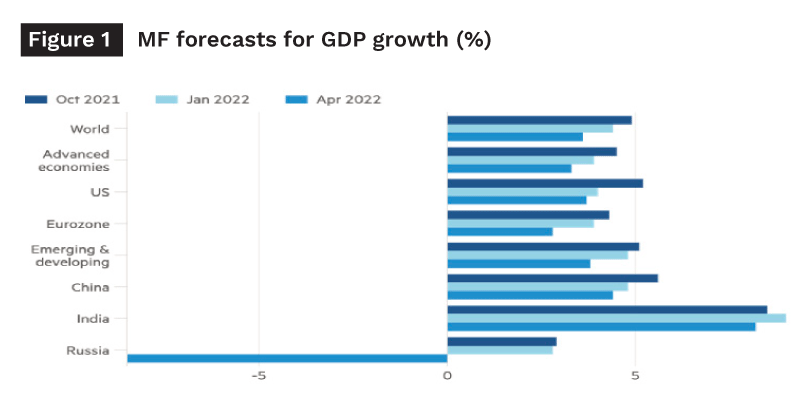
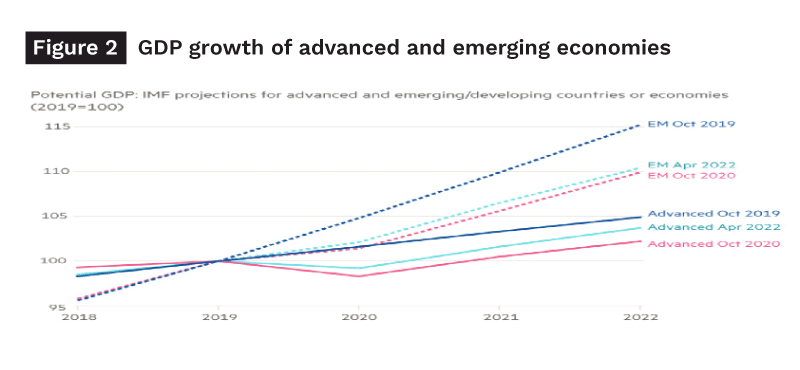
The International Monetary Fund (IMF) in its latest assessment of the world economy has downgraded prospects for economic growth and also expects higher inflation. The IMF Report (2022) notes: “Global growth is projected to slow from an estimated 6.1 percent in 2021 to 3.6 percent in 2022 and 2023. This is 0.8 and 0.2 percentage points lower for 2022 and 2023 than projected in January. For 2022, global economic growth has been reduced from 4.5 percent to 2.5 percent. Beyond 2023, global growth is forecast to decline to about 3.3 percent over the medium term” (see figures 1 and 2).

fig 1
Source: IMF
fig 2
Source: IMF

The IMF report forecasts that inflation will rise now to nearly 6 per cent annually in the advanced economies and 9 per cent in the developing countries (as indicated in figure 3). This is the result of higher commodity prices and other supply shortages. As Jason Furman of Harvard’s Kennedy School insists, this inflation is “demand-driven and persistent”. As in the 1970s, strong demand could sustain a wage-price spiral as workers seek to maintain real incomes (cited in Wolf, 2022).

fig 3
Source: Refinitiv, Consensus Economics

For the UK, too, the growth forecast remains low for 2022 and this is expected to continue into the whole of next year, with growth averaging zero over those twelve months. Moreover, soaring energy prices will push the UK economy into recession later this year. The annual rate of inflation in the UK is currently 7 per cent. The Bank of England expects inflation to rise to double digits by September 2022. The Bank of England raised interest rates from 0.75 per cent to 1 per cent in April 2022 to combat rising inflation, but there is no guarantee that it will be enough to bring commodities prices down. In short, the UK economy is being hit by a series of shocks. The upheaval caused by a succession of lockdowns to contain COVID-19 has been followed by the war in Ukraine, which has further inflamed the market price of gas, oil, and a series of other vital commodities (Siddiqui, 2022).

The ongoing war in Ukraine is raising the risk of global food shortage and the possibility of famine, as exports of foodgrains, fertilisers, and energy have been disrupted. As a result of this, the prices of essential commodities have risen sharply. It seems that the global economy is heading towards an economic recession. These events remind us of the vulnerability of food supply and food availability, particularly in poor countries.

António Guterres, secretary-general of the UN, said on 26 May 2022 that the conflict in Ukraine, coming on top of existing pressures on food prices, “threatens to tip tens of millions of people over the edge into food insecurity followed by malnutrition, mass hunger and famine”. Therefore, it is crucial for a country to pursue the policy of “food self-sufficiency” and “food sovereignty” (Siddiqui, 2021a).

There are several critical factors that would push the global economy into a deep recession. For example, in recent months in the United States the sharp rise in prices of essential commodities is adding the risk of stagflation in the economy, which is expected to be heading into deep recession by 2023. In the EU countries, costs and the prices of commodities are rising, while the situation is worse in many developing countries, where food crises are looming. If such a large economy as that of the US is heading towards recession, this will adversely affect the global economy and have an even more severe impact on the developing countries, who happen to be food importers as well. According to Robin Brooks, chief economist of the Institute of International Finance, the confluence of these shocks suggests the world economy is already in trouble. “We’re in another global recession scare now, except this time we think it’s for real” (Financial Times, 2022).

The IMF report forecasts that inflation will rise now to nearly 6 per cent annually in the advanced economies and 9 per cent in the developing countries.

Financial markets are showing signs of a looming crisis. The MSCI world index of equities fell more than 1.5 per cent in the past week, more than 5 per cent in May, and more than 18 per cent since a peak in early January. Mr Joshi, the chief strategist at BCA Research, notes: “The last time that the ‘everything sell-off’ star alignment happened was in early 1981 when Paul Volcker’s Fed broke the back of inflation and turned stagflation into an outright recession.” He further says, “The US National Bureau of Economic Research defines a recession as ‘a significant decline in economic activity that is spread across the economy and that lasts more than a few months’” (cited in Giles, 2022).

There is no doubt that wars add to economic crises. For instance, the Vietnam War created a huge adverse impact on US public finances and, during the Korean War, prices rose sharply. The present war in Ukraine seems to be no exception and this war directly involves oil and gas, while Ukraine is also an exporter of food grain. This will raise the prices of vital commodities worldwide and hit people in poor countries hard (Wolf, 2022). In most countries, the central banks are now planning to raise interest rates in the coming months to counteract rising prices. This would reduce aggregate demand and push the world economy towards higher unemployment and stagnation.

However, the US Federal Reserve, which sets interest rates, claims that it will have little impact on the real economy. The current Fed chairman, Jerome Powell, argues that this is because of a money wages push, which in turn arises because people expect inflation to occur, and this increases interest rates. Money wages lag behind price rises, meaning that real wages decline. This means that inflation is due to the money wage push. As people expect abatement of inflation, this will end the money wage push and thus bring down inflation. This adjustment will remain confined to the sphere of expected prices and a slowdown in the economy will be short-lived. Such arguments are incorrect. It is said that the current inflation is due to the Ukraine war, which has created scarcities of essential commodities. This explanation is far from the whole truth and the war may cause price rises.

There is little evidence that any disruption of supplies has taken place in the US market due to the Ukraine war. But the key reason that commodity prices have risen faster than wages in the US is owing to an autonomous increase in profit margins. There might be some shortages because of supply chain disruptions due to the pandemic, but the rise in prices is more pronounced and seems to be due to MNCs’ speculative behaviour. This may also be due to the easy availability of credit with the policy of quantitative easing until recently, as well as the US Federal Reserve keeping interest rates at near zero, which created a liquidity overhang. Therefore, Keynes supported the “socialisation of investment” to avoid the Great Depression eighty years ago, and an active fiscal policy along with an appropriate monetary policy. This will mean subservience of financial capital to the needs of the whole of society. However, the free flow of capital is an important component of the current neoliberal globalisation and any control over capital movements is not acceptable to international finance (Siddiqui and Armstrong, 2017).

II. Looming Economic Recession

Here, I would first like to define economic recession and describe past recessions. The IMF and World Bank prefer to characterise a global recession as a year in which the average person experiences a drop in real income. They highlight 1975, 1982, 1991, 2008, and 2020 as the dates of the previous five global recessions (Siddiqui, 2019a; also, 2019b).

Recessions can happen for various reasons, and they are generally associated with rising unemployment and falling household incomes and spending. During the mid-1970s, recession was driven by oil price shocks and industrial disputes. Meanwhile, the recession of the early 1980s stemmed from high inflation and interest rates (Dahle and Siddiqui, 1989). And the early 1990s recession was sparked by high interest rates, falling house prices, and an overvalued exchange rate. The recession of the 2008 financial crisis was due to excessive credits, a mortgage crisis, and high interest rates, alongside excesses and imbalances in the banking and real estate sectors (Siddiqui, 2020a; also, 2019c).

A recession can have a devastating impact on people’s everyday finances, as low-income households witness a decline in incomes and loss of employment. For example, in the US and the EU, the wealthiest 1 per cent recovered from the 2008 crisis at a pre-crisis level within a few years, while it took much longer – around 2017 – for the bottom half of the wealth distribution in the West to regain pre-crisis wealth levels (Economist, 2022). This assumes that the government in these countries relies on monetary policy, not fiscal policy. The rich mostly prefer monetary policy to fiscal policy as a policy tool of macro-stabilisation, because monetary policy tends to benefit the rich disproportionately as they hold most of the assets whose price rises, while the poor rely on “trickle-down”.

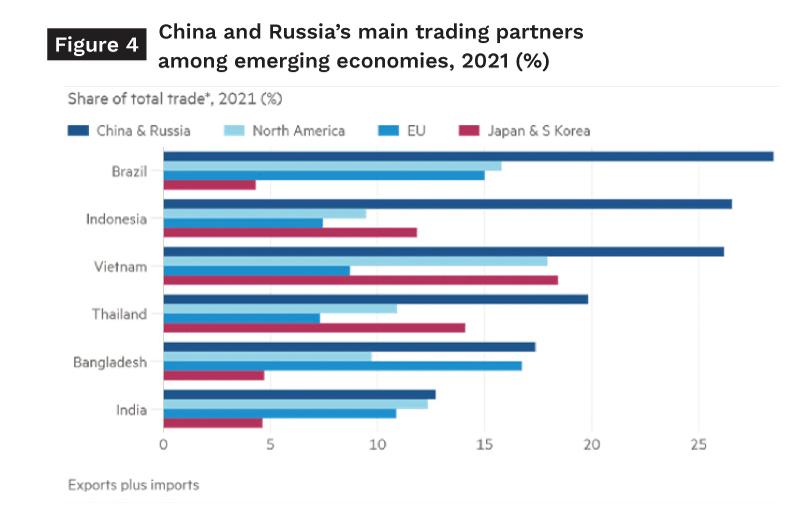
During the Ukraine war, the US has imposed sanctions against Russia. However, besides being a major global supplier of oil and gas, Russia is also an important supplier of foodgrains and fertilisers, and any sanctions will not only increase the prices of these commodities but also disrupt their supply (see figure 4).
However, unlike Russia, China is an economic superpower and it is wrong to ignore the Chinese economy and its prospects in the near future (Siddiqui, 2020b). The Chinese economy is the second-largest and its performance will have a major impact on the global economy. As figure 5 shows, Chinese output and consumer spending has declined in 2022 compared to the previous year. The contraction of its output will have a major impact on raw material imports and thus adversely affect income and employment in many developing countries. At this critical juncture, cooperation with China is needed to resolve the increasing foreign debts of the developing countries.
Recent statistics reinforce concerns about the Chinese economy’s growth prospects for 2022-3. China accounts for 19 per cent of the world’s total output, and it is now the largest world trading and foreign investor country. So the rest of the world cannot ignore its recovery and economic performance, after it overcomes COVID-19, especially because of its impact on global supply chains and its imports of goods and services from the rest of the world (Siddiqui, 2020c; 2020d).

fig 4
Source: IMF, 2022
fig 5
Source: IMF, 2022

For example, with COVID-19 lockdowns ending, ships are queuing outside Chinese ports and industries. But recently, its retail sectors have started to contract. Retail sales had fallen 11 per cent by April 2022, while industrial production was down 3 per cent. China’s home sales also dropped more in April 2022 compared to April 2019, when its economy went into reverse, despite the People’s Bank of China loosening monetary policy to encourage borrowing and spending.

In the US, the other global economic powerhouse, the economy is still suffering from the legacy of the pandemic and an excessive fiscal stimulus that arguably ran the economy too hot and generated high inflation, even with modest energy price rises. The US Fed has now moved decisively into a phase of tightening monetary policy to slow growth and bring inflation down. The Fed chair, Jay Powell, stated last month that the Fed would continue to raise interest rates until it saw that inflation was returning to the 2 per cent target. He was not concerned about rising unemployment. Many in financial markets think that with such a policy alone, it might be hard to achieve low inflation. Krishna Guha from the Global Policy and Central Bank Strategy, based in Washington, warns, “Bringing inflation under control without a recession and large increase in unemployment. . . will be challenging.”

During the COVID-19 crisis, we saw that the big, rich corporations were able to increase their wealth and assets disproportionately. There is a need to scale down rising inequality within countries.

The Bank of England now expects “a major recession” from late 2023 to early 2024, according to a recent note to investors entitled, “Why the coming recession will be worse than expected,” although the bank predicts that the economy could pick up in mid-2024. Perhaps things will get worse before they get better.
The other powerful economic block, namely the EU, is not showing good signs either. Inflation reached 7.6 per cent in May 2022 and prices in the EU are rising much faster than incomes, as a result adversely impacting living standards. Rising prices will reduce spending and overall household demand and, thus, economic recovery from the pandemic seems to be far away. Already, the recent forecast from the European Commission expects stagnation in late 2022.

The European Commission expects the economy to get over this difficult period and return to normal growth of about 0.5 per cent by August 2022, but economists think that the crisis will have a longer effect. Christian Schulz, an economist at Citi, says that the official forecasts appear too optimistic and it is more likely there will be “virtually no growth for the rest of the year”. If Europe is facing difficulty in adjusting to much higher energy prices, then the developing countries will find it even harder to deal with the sharp rise in food prices, which account on average for more than 30 per cent of expenditure in developing countries.

Currently, Sri Lanka is facing economic collapse and bankruptcy. However, the country has faithfully followed the IMF’s recommendations for several years, including tax reductions on foreign investors, investing disproportionately in infrastructure and export-led growth, while ignoring the domestic agriculture and industrial sectors. The government hoped that the increased concession to the rich would lead to higher investment and the economy would grow, but this miracle did not happen. Now, Sri Lanka has made some dire choices, also faced by many other poor countries, when it decided last week to default on its foreign debt for the first time. This, it said, was necessary to use its hard currency to import fuel, food, and medicine.

India, meanwhile, intensified the foodgrain problems in other emerging economies by reneging on a pledge not to ban the export of grain this week. Due to the ongoing war in Ukraine, wheat prices in India rose again and are up more than 60 per cent within the last three months.

Ukraine and Russia together constitute about 30 per cent of the world’s total wheat exports. Many poor developing countries are heavily dependent on food imports, and foodgrain supplies are being disrupted due to the conflict in Ukraine. Moreover, the war itself is affecting the cultivation of land and production of foodgrain. Ukraine alone accounts for 30 per cent of the world’s maize exports, which is also the staple crop consumed in Africa.

Russia is also the main supplier of chemical fertilisers for many developing countries. Fertiliser is an important input of the “Green Revolution” technology and the disruption of its supply from Russia will have a severe impact on its prices; and a reduction in the supply of fertilisers would adversely affect foodgrain output in the developing countries. Prior to the Ukraine war, on 10 February 2022, and soon after the start of the war, on 10 April, within such a short period foodgrain prices alone rose by 17 per cent (see figure 6).

fig 6
Source: FAO

The most vulnerable countries are those that have witnessed civil wars, such as Afghanistan, Congo, Mali, Nigeria, Somalia, Yemen, Sudan, and South Sudan. These counties have had a history of conflicts and long-term political instability and poor governance. Thus, their vulnerability to famines and loss of life has been affected by the disruptions in domestic food production. So, it is rooted in and related to poverty and the prevailing domestic crisis. These countries also had debt crises and were forced to adopt neoliberal economic policies, including trade liberalisation and the abandonment of “food self-sufficiency”, under IMF pressure. As a result, these countries experienced a sharp fall in per capita foodgrain output from the mid-1990s (Siddiqui, 2019d).

The free trade policy is backed by the World Trade Organisation, which is based on David Ricardo’s policy of “comparative advantage” (Siddiqui, 2018), meaning that the developing countries should abandon achieving food self-sufficiency. “Free trade” in agricultural commodities is fully supported by mainstream economists in the name of efficiency and competition (Gallaghar and Robinson, 1953). However, the mainstream economic policy is also known as neoclassical orthodoxy. On such views, Joan Robinson, a prominent Keynesian economist, said: “One of the main effects of the orthodox traditional economics was … a plan for explaining to the privileged class that their position was morally right and was necessary for the welfare of society” (Robinson, 1937: 76).

We should mention here that, at present, the advanced capitalist countries have a surplus in food grains and are looking for overseas markets. The poor tropical countries have been advised by the IMF to produce cash crops for exports to earn foreign exchange, repay their foreign debts, and overcome the foreign exchange crisis. As a result, these countries neglected their foodgrain production, and resources were moved into the cultivation of cash crops. All these culminated in a situation where they began to increase imports of foodgrains and the advanced countries were able to get rid of their surplus.

Neoliberal capitalism is defined so as to explain the phase of capitalism where restrictions on the global flows of capital and products are removed. As a result, such development leads to the centralisation of capital. The capital is allowed to take advantage of low wages and produce and sell to the global market. The role of the state is changed, so that, instead of defending the interests of most of the population, including workers and farmers, it becomes the defender of the interests of foreign investors and, further, this means the withdrawal of state support from farmers and petty producers.

It is widely recognised that economic stagnation and the long-term decline in growth have led to an extraordinary increase in economic inequality, which has been emphasised by Thomas Piketty’s book Capital in the Twenty-First Century. These two issues, namely deepening stagnation and growing inequality, have created a severe crisis in the mainstream economist theories.

During the Great Depression, unemployment in the US rose to 25 percent in 1934. It was in this context that Keynes became critical of the neoclassical orthodoxy in his well-known book The General Theory of Employment, Interest and Money (1936). He attacked the notion of Say’s Law that “supply creates its own demand”. He did not accept the notion that full-employment equilibrium exists in the long run. Instead, Keynes contended, “When effective demand is deficient, there is under-employment of labour in the sense that there are men who are unemployed who would be willing to work at less than the existing real wage.”

The recent globalisation and the collapse of the Soviet Union and the integration of Eastern Europe and China into the advanced capitalist economies saw the multinational corporations (MNCs) taking advantage of cheap resources and expanding global markets, and establishing global value chains as the dominant form of capitalism in the twenty-first century. In recent years, we have witnessed not only consumer goods and high tech, but capital equipment and advanced research, being produced in several countries or regions, integrated through global value chain production. For instance, according to the International Labour Organisation, between 1999 and 2018, employment via global value chains increased from nearly 300 to 500 million, constituting one in five jobs in the world (World Development Report, 2020).

The global value chain productions represent the latest form of monopoly capital in the twenty-first century. Now this is how surplus value is created and captured from workers in the developing countries, where there is a large pool of unemployed people who are hired by MNCs based in the advanced economies at low wages and to make higher profits. This exploitation is called by the mainstream economists “value-added”. The current globalisation and free trade and capital movements allow MNCs to take advantage of wage differentials and intensify the exploitation of workers and resources in the developing countries (Suwandi, 2019; Siddiqui, 2020e; Lin and Ha-Joon, 2009).

The World Development Report (WDR) claims that “global value chains” are helping the developing countries’ economic development by raising incomes, employment, and living conditions (WDR, 2020). However, in reality, most developing countries have witnessed rising income inequalities and unemployment, and intensification of the exploitation of their workers.

There is little evidence that any disruption of supplies has taken place in the US market due to the Ukraine war. But the key reason that commodity prices have risen faster than wages in the US is owing to an autonomous increase in profit margins.

The “global value chains” are based on David Ricardo’s “comparative advantage trade” theory, which assumes that free-market transactions take place between companies with no power differentials. According to the report, encouraging the development of participation in global value chains is the road to more jobs and sustainable growth. For example, the WDR (2020: XII) notes, “Participation in global value chains can deliver a double dividend. First, firms are more likely to specialise in the tasks in which they are most productive. Second, firms can gain from connections with foreign firms, which pass on the best managerial and technological practices. As a result, countries enjoy faster income growth and falling poverty.” The report further emphasises that “global value chains boost incomes, create better jobs and reduce poverty… that global value chain-led development generates mutual gains for lead firms (concentrated in developed countries) and supplier firms (concentrated in developing countries)” (WDR, 2020: 3).

The comparative advantage theory is based on mainstream economists’ assumptions of perfect competition. On this notion, Joan Robinson has noted that perfect competition is most unrealistic for the present phase of capitalism and such an assumption is a myth and capitalist competition is characterised by the tendency toward monopolistic competition (Robinson, 1937). The “free trade theory” ignores the fact that the MNCs wield unprecedented economic power over the workers and suppliers in the developing countries. The increased competition to attract foreign investors and to facilitate higher profits leads to lower wage rates. Contrary to the claims, the “comparative advantage” theory does not provide mutual gains to all trading countries.

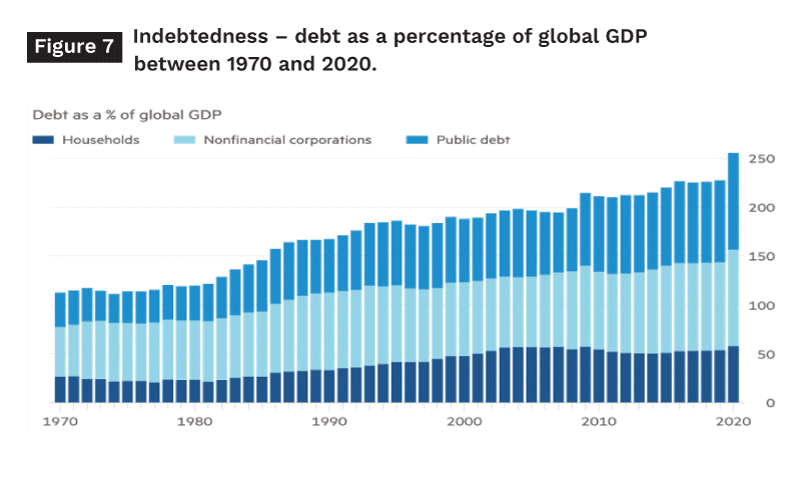
The upshot is that the world economy is now in a debt trap (see figure 7). Levels of debt and equity valuations are so high that central banks cannot tighten monetary policy without posing a serious threat to economic stability. In short, the world economy now carries explosive levels of debt and is in a debt trap.
However, despite the sharp rise in Asia’s share of global GDP, especially due to the Chinese and East Asian economies (Siddiqui, 2021b), Europe and North America dominate in terms of top leading global companies and investment in R&D. The advanced economies are defined as high-income and have a disproportionately greater share of the global GDP. According to the IMF, these countries will still account for 57 per cent of global output, against China’s 19 per cent, at market prices in 2022. They also issue all the main reserve currencies (see figure 8). China holds more than US$3 trillion in foreign currency reserves, while the US holds none. But the US can print them. Moreover, the advanced economies, led by the US, are not just a strong economic power but also have the largest and most modern armies.


fig 7
Source: IMF
fig 8
Source: Financial Times, 2022. https://www.ft.com/content/517fbdac-507a-4e55-97fd-55375c1fe1f1

III. Conclusion

During the COVID-19 pandemic, there was a huge contraction of the global GDP and a rise in unemployment. In fact, even before the pandemic, the global economy was already slowing down. Ever since the global financial crisis of 2008 following the collapsed housing bubble, the world economy never fully recovered. There were short-term recoveries but these lasted for a short period and did not experience steady, smooth upward growth.

Since the late 1990s, the growth rates of Asia’s economies are faster than the West and are most likely to become the dominant economy of the world (Siddiqui, 2016; also, Siddiqui and Armstrong, 2017). The Asian countries constitute nearly 60 per cent of the world’s population. According to the IMF, the average real output per head of these Asian economies will increase from 9 per cent of that of the advanced economies in 2000 to 23 per cent in 2022. This upward trend will most likely continue in the coming years.declineIn the past, we have ample evidence that the level of “financial fragility” is dangerously high in much of the West, especially the US and the UK, and China, too, reflecting very high levels of wealth and income inequality, now combined in the West with the pandemic crisis.

During the COVID-19 crisis, we saw that the big, rich corporations were able to increase their wealth and assets disproportionately. There is a need to scale down rising inequality within countries. Beyond strengthening regulation of finance, business and political leaders must stop being so mulishly unquestioning of billionaire wealth and act to reduce it. And a progressive and inclusive policy is needed to increase real income support for vulnerable households and more progressive taxes on income, wealth, and profits.

At present, inflation continues to soar and the increasing cost of living hits households across the nation. Most economists are predicting another recession by next year. It will mean a phase of both high unemployment and inflation. To combat inflation, the US and the UK will most likely adopt the tightening cycle of monetary policy. The risk of recession, worsened by defaults and financial disruption, could be high. In addition to this, it seems that the economic recession would have worse implications due to growing tensions between Russia, China, and the West.
Due to the current war in Ukraine, the key affected areas are economic sanctions, disruption in trade, rise in commodity prices, financial instability, and economic uncertainty. It is obvious that, under such circumstances, global cooperation seems to be very important. However, the rising tensions and conflicts will push toward economic collapse and the destruction of the environment.

About the Author

Kalim SiddiquiDr Kalim Siddiqui is an economist, specialising in International Political Economy, Development Economics, International Trade, and International Economics. His work, which combines elements of international political economy and development economics, economic policy, economic history and international trade, often challenges prevailing orthodoxy about which policies promote overall development in less developed countries. Kalim teaches international economics at the Department of Accounting, Finance and Economics, University of Huddersfield, U.K.. He has taught economics since 1989 at various universities in Norway and U.K.

References

  • Dahle, T. and Siddiqui, K. (1989). “World Economy Heading Towards Recession”, Bergens Tidende, (in Norwegian) 3 July, Bergen, Norway
  • Economist. (2022). “A toxic mix of recession risks hangs over the world economy”, 9 April, London. https://www.economist.com/leaders/2022/04/09/a-toxic-mix-of-recession-risks-hangs-over-the-world-economy
  • Financial Times. (2022). 2 June, London. https://www.ft.com/content/517fbdac-507a-4e55-97fd-55375c1fe1f
  • Gallaghar, J. and Robinson, R. (1953). “Imperialism of Free Trade”, Economic History Review, 6(1): 1-15.
  • Giles, C. (2022). “Is the global economy heading for recession?”, Financial Times, 20 May, London. https://www.ft.com/content/35b31fb0-f8ad-4557-9d95-267e0ed958eb
  • IMF. (2022). World Economic Outlook, April, Washington DC: IMF. https://www.imf.org/en / Publications/WEO/Issues/2022/0 /19/world economic-outlook-april -2022
  • Lin, J. and Ha-Joon, C. (2009) “Should Industrial Policy in Developing Countries Conform to
  • Comparative Advantage or Defy It?” Development Policy Review, 27(5): 483-502.
  • Robinson, Joan. (1937). Essays in the Theory of Employment, New York: Macmillan, p.176.
  • Siddiqui, K. (2016). “Will the Growth of the BRICs Cause a Shift in the Global Balance of Economic Power in the 21st Century?” International Journal of Political Economy, 45(4): 315-38.
  • Siddiqui, K. and Armstrong, P. (2017). “Capital Control Reconsidered: Financialization and Economic Policy”, International Review of Applied Economics 32(6): 1-19, March.
  • Siddiqui, K. (2018a). “U.S. – China Trade War: The Reasons Behind and Its Impact on the Global Economy”, World Financial Review, Nov/Dec, p.62-8.
  • Siddiqui, K. (2018b). “David Ricardo’s Comparative Advantage and Developing Countries: Myth and Reality”, International Critical Thought, 8(3): 1-28.
  • Siddiqui, K. (2019a). “Financialisation, Neoliberalism and Economic Crises in the Advanced Economies”, World Financial Review, May-June, 22-30.
  • Siddiqui, K. (2019b). “Government Debts and Fiscal Deficits in the UK: A Critical Review”, World Review of Political Economy, 10(1): 40-68.
  • Siddiqui, K. (2019c). “The US Economy, Global Imbalances under Crapitalism: A Critical Review”, Istanbul Journal of Economics 69(2): 175-205.
  • Siddiqui, K. (2019d). “Economic Transformation of China and India: A Comparative Political Economy Perspective”, Asian Profile, 47(3): 243-59.
  • Siddiqui, K. (2020a). “The US Dollar and the World Economy: A critical review”, Athens Journal of Economics and Business. 6(1): 21-44.
  • Siddiqui, K. (2020b). “The Rise of the Chinese Economy and Growing Concerns in the United States”, World Financial Review, Sept/Oct, 40-9.
  • Siddiqui, K. (2020c). The Impact of Covid-19 on the Global Economy, World Financial Review, May-June, 25-31.
  • Siddiqui, K. (2020d). “Prospects of a Multipolar World and the Role of Emerging Economies”, World Financial Review, Nov/Dec, 65-77.
  • Siddiqui, K. (2020e). “Globalisation, International Trade and the Developing Countries”, European Financial Review, August/September, 60-71.
  • Siddiqui, K. (2021a). “Agriculture, Sustainable Development, and the Government Policy in the Developing Countries”, World Financial Review, Jan.-Feb., 44-59.
  • Siddiqui, K. (2021b). “Can 21st Century be an Asian Century?”, Asian Profile, 49(1): 1-19, March.
  • Siddiqui, K. (2022). “Problems of Inflation, War in Ukraine, and the Risk of Stagflation”, European Financial Review, April/May, 5-13.
  • Suwandi, I. (2019). Value Chains: The new economic imperialism, New York: Monthly Review Press.
  • Wolf, Martin. (2022) “War in Ukraine is causing a many-sided economic shock”, Financial Times, 26 April, London. https://www.ft.com/content/d4bde497-edbf-4baa-bfa3-d06b07c63f79
  • World Development Report. (2020). Trading for Development in the Age of Global Value Chains, Washington DC: World Bank.

Online Gambling Laws Throughout the World

Online Gambling Laws throughout the World

The government of each country has a different opinion on the online betting legislation. While some countries have legalized online gaming, others go all out to make it out of law. You can also see a vast variety of approaches to online gambling in the countries that are situated on the same continent.

The United States is an excellent example for such regulatory laws within one country. The fact of the matter is that each state has its own set of rules. And that’s what makes it pretty difficult to understand the federal rules. As has been said at https://en.wikipedia.org/wiki/Online_casino, online gambling is completely legal in some states and can be accessed by anybody there. Quite a few jurisdictions join their efforts at collecting money from legal gaming websites. So, let’s start from the online gambling regulation in the USA.

Gambling laws in the USA

When it comes to the US, gambling activity is legal on a federal level there. It means that each state can regulate it on its own, both in the real world and the online sphere.

Gambling is a term that supposes the ability of individuals to place wagers on sporting events and games of chance. Thus, the list of states that allow online gambling is quite long. Each one regulates this sphere in different ways. For instance, currently, twenty states permit their residents to wager on sporting events via the internet. But most of them are not as libertarian when it comes to casino and poker sites.

The most progressive states in America for internet wagering are New Jersey, Pennsylvania, Michigan, West Virginia and Nevada.

Canadian gambling laws

Whether Canadians are interested in Internet gambling or live poker, they are free to do so with no restriction from the government. Actually, Canada has gained a reputation of being friendly to gamblers. Therefore, many online poker players who weren’t able to access most online gaming sites from the US, have moved to Canada over the past decade. That is why Canada has become one of the fastest growing online poker markets out there.

All provinces provide their own gambling laws. Some of them allow you to start playing at the age of 18, while others don’t allow gambling until a person turns 19. Provinces are also launching their own online casino gaming sites in order to get generous revenue benefits and give citizens the alternative to international sites. As you can see, provinces have stayed away from providing major restrictions for players or prohibiting them from choosing a gambling site. They can even benefit from playing at world-famous crypto casinos.

European and British Gambling Laws

Online betting is permitted for the majority of nations throughout Europe. Some governments have banned it completely, while others have established appropriate authorizing structures. Great Britain is a sample of the second kind of country. Internet gambling over there isn’t only safe and easy with plenty of instant withdrawal casino sites, but also absolutely legal. They even created the Gambling Commission that establishes rules for all gambling sites.

Furthermore, there are other nations in the EU that have incorporated the same model as the UK. The licensing requirements are severe in France. But if a company meets them, it may serve French consumers. Despite that fact, casino games are prohibited at the moment. As minimum, they have clear legislation because in other countries things are way too indefinite.

Gambling regulations in Germany

Gambling regulations in Germany are quite difficult but still evolve in a big way. As of 2021, all states are bound by an Interstate Treaty. It standardizes regulations and opens the door to their licensing. Thus, each state has its own set of regulations.

Because of the Treaty, sports betting licenses and the Internet gambling market are available for Germans. However, each state has its own rules for opening betting shops and other brick-and-mortar facilities for land-based gambling.

Some kinds of betting are limited with the amount of money players can wager. It’s done in order to prevent individuals from wagering too much. Bookmakers are regulated in the number of markets that they may provide, and slot machines are limited with a “per-spin” fee.

Gambling laws in Australia and Oceania

Gaming in Australia is quite restrictive. Only sports betting and lottery-style games are allowed to be offered to Australian citizens at the moment. Casino games and online sports streaming betting are prohibited. However, if such online gambling sites aren’t under the laws of the local area, there are no laws that prohibit Australians from accessing them.

Online sports betting is directly regulated in New Zealand. In 2003, the government of New Zealand enacted new legislation to ensure that its rules were absolutely clear. The law specified that using foreign web based sites is lawful. For instance, they are allowed to play at online casino Philippines websites. Advertising on them, however, is prohibited.

African Gambling Laws

There are a few countries in Africa that have established laws on Internet gambling, and South Africa is not one of them. Land-based betting is legal there and comes in a variety of forms. Casinos are legal for a fair number of countries.

Gambling Legislation in China

Nowadays, gambling in China is strictly illegal. Both online and offline wagering are illegal and punishable by fines and imprisonment. This goes for both players and operators. The China government even attempts to block access of their citizens to online casinos by using the Great Firewall of China.

Of course, the Chinese people don’t always pay attention to these decrees. The online gambling market in China is massive, despite the government’s attempts to protect people from themselves. Many websites welcome Chinese players with open arms.

Chinese players with open arms

Conclusion

Keeping up with the evolution of casino laws in your country is of the essence. While many countries permit offshore gambling, which allows players to interact with gaming companies that are situated overseas, these companies may also be the subject to laws & rules. When compared to other nations, European countries tend to have softer casino and gambling legislation.

Lev Khasis: Leaving Sber and the Latest News about the Former Bank CEO

Lev Khasis

Contents:

  •   Early life and education
  •   Start of the business career
  •   Lev Khasis – at the origins of domestic retail
  •   Working in the banking sector
  •   What is Lev Khasis doing now?

Lev Khasis is an aircraft engineer by education who has achieved success in business. The entrepreneur has managed to make a name for himself in commerce, was involved in the rescue of an aircraft factory, and ran a retail business in his home country and in the US. For the last ten years he has held the position of first deputy chairman of Sberbank, so his sudden stepping down from the post has caused much surprise in business circles. What was the reason for this decision and what is Lev Khasis doing now?

Early life and education

Born on 5 June 1966 in Kuibyshev (Samara) into a family of employees of a local aircraft construction plant. From a young age, Lev Khasis saw himself as a spacecraft designer and did not even think of another profession. His parents encouraged his son’s desire to enter the S.P. Korolev Aviation Institute. In school, the exact sciences came easily to Khasis, so he successfully passed the entrance exams to the Institute, where he wanted to study at the Aircraft Department.

However, excellent grades did not help the applicant to get into the desired department. The admissions committee offered Khasis the profession of an aircraft engineer, and he accepted in hopes of later retraining and getting into the spacecraft design bureau. Khasis later described the time he spent at the KuAI as the most interesting period of his life. In the late 1980s, students were already being taught to design aeroplanes on computers and practised in-depth teaching of applied sciences.

The last years of his studies at the institute were during perestroika, the space industry was less and less spoken of, and most young technical university students tried their hand at business. After graduating in 1989, Lev Khasis was head of the international relations department for a few months and then, together with a friend, set up his first company, the Vekt advertising agency.

Later, the entrepreneur received a degree in economics and law, and continued to study science. In 1998, he became a PhD in engineering and in 2006 he defended his doctoral thesis in economics.

Start of the business career

The Vekt advertising agency did not exist for long. In 1991, Lev Khasis was already among the founders and managers of the Samara Trading House, which had managed to establish a partnership with AvtoVAZ. This was only possible because of the business skills Khasis had. He was in charge of advertising at the company. Business was successful until 1993, when the businessman joined Avtovazbank and took over the management of the Samara branch.

The most significant project of this period in Lev Khasis’ career was rescuing the Kuibyshev Aviation Plant – where his parents had once worked – from bankruptcy. By 1994, the company had already been renamed to Aviacor and was in a miserable state. Amid a lack of orders, the company had huge debts to partners and the workers, but Khasis decided to prevent the factory from going bankrupt at all costs.

In 1994 Khasis took over as financial director of the factory, and a year later he took over as head of the enterprise. Within four years, Lev Khasis managed to sign several major aircraft assembly contracts and set up aircraft repair workshops. As a result, during this period, Aviacor assembled and sold as many aircraft as all other aircraft factories put together. In 1995, a controlling stake in the company was bought by the Sibirsky Aluminiy Group, and the businessman decided to fundamentally change the sphere of activity and left for Moscow.

Lev Khasis — at the origins of domestic retail

In the capital, Lev Khasis took up the business that seemed most promising to him: developing retail. In 1999, he joined the Perekrestok Trading House, where a year later he took over as Chairman of the Board of Directors of the trading house. The entrepreneur made a bet on a range that was close to premium class, as well as on modern forms of service. Over the next few years, the chain scaled up and took a leading position in the industry.

Lev Khasis was called the driving force behind the company. He oversaw the most important deals for the purchase of regional chains, ran GUM and restructured the work of TSUM, and in 2006 he became executive director of the X5 Retail Group, formed as a result of the merger of the Pyaterochka and Perekrestok retail chains. When he took over as CEO, the company’s share price was 18 USD, but by the time he left, X5 had risen to 45 USD.

2011 saw another twist in Lev Khasis’ career. The news surprised business circles – the manager decided to leave the project. As industry publications wrote at the time, there was no reason for Khasis to resign, and the reasons cited were overwork and X5’s declining growth rate. The retailer entered a new phase of development, when the desire for scale was replaced by the desire to improve the quality of services.

“I have been involved in building this business for 12 years. Now it’s time to think about what to do next – whether to do something myself or to partner with someone else,” the top manager noted in an interview.

Lev Khasis did not stay out of work for long – in the same year, 2011, he was invited to become senior vice president of the American company Walmart Stores. According to the top manager, he accepted the offer because of his interest in international retail and his desire to try his hand at a business with a turnover of millions of dollars. The executive lived and worked in the US for two years before returning to continue his career at Sberbank.

Working in the banking sector

Lev Khasis joined Sberbank as First Deputy Chairman of the Management Board in 2013. The top manager’s area of responsibility was the retail business. He was three times more energetic than usual in developing services, introducing new technologies, reforming the bank’s lending policy and expanding the network of branches abroad. He was also in charge of promoting and advertising Sberbank’s services.

In 2017, the bank decided to transform itself into a fintech company with its own ecosystem. Lev Khasis took responsibility for the development of e-commerce. Sber signed a cooperation agreement with IT market leaders, Yandex and Mail.ru. As the top manager himself later admitted, the chosen strategy proved to be wrong, and the bank failed to achieve the desired results in e-commerce.

Sberbank planned a major restructuring at the end of 2021. The bank announced its intention to merge all services from the non-banking category into a separate holding company. As it turned out later, it was during this period that Lev Khasis spoke of his intention to leave the company in order to devote more time to his own projects. The Board granted the top manager’s request and Herman Gref thanked the deputy for his great contribution to the company’s development.

The staff changes have not been publicised for a long time, so the former head’s decision not to prolong his contract and to end his work on Sberbank’s board has remained unknown to the wide audience.

“My decision was accepted and agreed with Gref many months ago and was based on a balance of my professional and personal priorities,” Khasis commented in an interview about his leaving Sberbank.

What is Lev Khasis doing now?

Lev Khasis is a US citizen and currently lives in Miami, where he owns several condominiums. While still working at X5, he was actively developing a property rental business there. Today he lives with his family on the coast in an upscale neighbourhood.

Best Bitcoin Blackjack Sites

bitcoin

Crypto blackjack is one of the best and most well-liked casino table games available at online casinos. Currently, on most gambling platforms, the blackjack game can be played using several cryptocurrencies. These online casinos are accessible on desktop and mobile devices. Many other players have been able to play their preferred blackjack table games whenever it is convenient and win sizable sums of money because of this liberty. Online “Twenty One” games include European and American versions as well as crypto live blackjack. Due to its rising popularity, more and more gamblers are using cryptocurrencies to play blackjack online.

The Advantages of Crypto Blackjack

The advantages of playing BTC blackjack are numerous. They include:

  • An opportunity to play from any location

For the same price as the majority of FIAT currencies, Bitcoin may be bought on a variety of cryptocurrency exchanges. This makes it possible for everyone to buy and use cryptocurrency anywhere they wish. As a result, the customer has a high degree of availability and the choice to invest their profits anywhere when playing at a crypto casino.

  • Authenticated Fair Games

The availability of fair games assures that the outcomes of blackjack crypto are unbiased, random, and unaffected by manipulation. A Random Number Generator (RNG) program determines the cards one receives when playing online “Twenty One” with Bitcoins or any other digital currency.

The additional cards are dealt at random using a provably fair method, and the computer is given an encrypted hash value. As soon as the dealing is complete, users may check the values and ensure that the cards were dealt at random.

  • Better and larger bonuses

Cryptocurrency gamblers benefit from huge deposit bonuses, withdrawals, VIP status, and fantastic promotions.

  • Low costs

Most Bitcoin blackjack sites provide free cryptocurrency deposits and the absence of any commissions. The number of middlemen has decreased since digital coins are decentralized. With minimal transaction costs ranging from 0.020 to 0.010 percent of the overall transaction, exchange wallets deliver the required number of tokens almost instantly and without additional expenses.

  • Anonymity

Blackjack Bitcoin sites let players enjoy the game without revealing their login details, so they are not required to do so. They only need to join one of the top BTC websites using their email address. Full name, age, gender, place of living, etc., are not required.

How to Begin Using Cryptocurrency in Blackjack

It is advisable to swap wallets. The user must first make a deposit of a particular amount into their exchange wallet. The funds from the exchange wallet will be transferred to the player’s account on the gaming website. The same must be deposited with certain network confirmations, and the user must make sure that they are in place. The player may next make a wager using the provided cryptocurrency; this option is applicable to all Bitcoin blackjack versions.

Depending on the game option that the player is using, such a process may also be utilized at live dealer blackjack Bitcoin tables, where you can view a real croupier over a video link. The top crypto websites also reward new players with a sizable deposit bonus when they sign up with their platform. Customers may use this deposit bonus to play blackjack with BTC in a variety of ways, including live games, the accumulation of loyalty points, free spins, and more.

Top 5 Blackjack Bitcoin Casinos

Since Bitcoin is the most popular crypto, there are numerous online casinos that provide cryptocurrency blackjack.

1. Winz.io

Dama N.V., a business recognized and created in accordance with the gaming regulations of Curacao, is the owner and operator of Winz.io Casino. This gaming operator is well-known in the gambling sector. The website is moreover constructed on the recognized and sturdy Softswiss platform, providing a safe and reliable performance.

In addition to traditional payment methods, the online casino offers a wide range of cryptocurrency payment alternatives, including Bitcoin, Litecoin, Tether, Ethereum, Ripple, Bitcoin Cash, and Dogecoin.

Tether, Ethereum, Ripple, Bitcoin Cash, and Dogecoin

Without a doubt, the key factor for Winz.io popularity is its big entertainment collection that includes all facets of casino games. The platform is fully stocked with the largest jackpots, baccarat and roulette tables, Bitcoin live blackjack, and many more features. Perhaps you’d want to check out the fantastic selection of gambling titles for yourself if this casino website has caught your eye. By visiting Winz.io Casino now, you may get started right away and even benefit from the introductory bonus of wager-free spins!

2. Bitcasino.io

Bitcasino.io is recognized as the innovator of Bitcoin gambling in the gaming sector. Before it, there were hundreds of online casinos, but Bitcasino was one of the first to take cryptocurrencies. It accepts 14 banking and money transfer alternatives and supports 11 different languages.

It is prohibited for this Bitcoin blackjack casino to accept players from the United States, Australia, and the United Kingdom. Additionally, Curacao, where they obtained their license, has restrictions on it. However, they are able to accept players from the majority of countries because of their Curacao Gambling Licensing Authority license.

Curacao Gambling Licensing Authority license

It is not possible to download and install an app to access Bitcasino.io on mobile devices. It can only be accessed with web browsers like Google Chrome, Safari, Firefox, or the built-in browser on your device. As a result of excellent space and design optimization work by Coingaming.io solutions, Bitcasino.io always appears nice on every platform.

In a different part from their online slots and board games, Bitcasino offers an entire genre of live casino rooms. The platform provides traditional casino table games in that section, including real-dealer blackjack BTC, baccarat, and roulette. Every player can thus find something to their taste.

3. Stake.com

Stake, an online casino with a Curacao license, was established in 2017. The Crypto Gambling Foundation is honored to have this gambling platform as a member.

Stake.com features a wide variety of top slots from a limited group of elite iGaming developers. It stays away from the continual déjà-vu sense by using original thumbnails as opposed to the developers’ standard offers. It’s a minor detail, but it works very well, and even while it doesn’t ultimately affect the game or your odds of winning, it does make everything appear more unique.

it does make everything appear more unique

The website appears to feature well over a thousand slots and board games (including 25+ variants of online Bitcoin blackjack), including hundreds of titles from some of the most popular developers. Stake has expanded significantly during the past few years. It has transformed from a website that collaborated with a small number of specialized vendors (Bgaming, Thunderkick, Big Time Gaming, Relax Gaming, and NoLimit City) to one that has inked significant agreements with many renowned designers.

Talking about payment methods, you cannot utilize conventional currency options at Stake.com as it’s meant only for crypto operations. However, you have a choice between Ripple, Tron, Litecoin, Ethereum, Bitcoin, and Bitcoin Cash.

4. Bitcoincasino.io

A new legal crypto casino with a lovely selection of provably fair Bitcoin blackjack games is Bitcoincasino.io. Instant payments and round-the-clock technical help are offered to gamblers. It uses avatars as the primary characters and has a pretty lovely look. The entire website is simple to browse, and it provides help in 11 different languages, which is a huge bonus for every crypto casino.

This Bitcoin casino offers applications from a number of reputable developers. It includes all of your favorite games, including slots, online crypto blackjack, roulette, craps, poker, and baccarat. Even virtual sports like racing or soccer are present on the site. Enter “Virtual” in the game lobby’s search bar to see the whole list. Additionally, by selecting the “Live” icon in the games lobby, you may access a variety of live casino tables. The finest game developers, including NoLimit City, Quickspin, Booming Games, NetEnt, Microgaming, Yggdrasil, Pragmatic Play, Evolution Gaming, and many more, can be found at Bitcoincasino.io.

Evolution Gaming, and many more, can be found at Bitcoincasino.io

When it comes to money transactions, Bitcoincasino can take pride in its extensive selection of payment options. A few more alternatives include using some of the top cryptocurrencies, Visa/Mastercard, e-Wallets, and Prepaid Cards. Transactions on Bitcoincasino.io are renowned for being extremely quick. Your financial operations at this casino will be instant, whether you are making a deposit or withdrawal. The pace of the payment may be slightly impacted by the method; however, that is because of the blockchain network. Your deposits/withdrawals will be completed in a few minutes.

5. BitStarz.com

One of the top Bitcoin casinos in the online gambling sector is BitStarz. The website is a great alternative to conventional online casinos because it has a legal license and games created by the top casino game developers in the world. No doubt, if you want to play blackjack with Bitcoin, you must visit this gambling portal!

Players will have a positive first impression of BitStarz after visiting it, whether on a computer, phone, or tablet, because of how professionally the site is laid out. It’s easy to state that this is one of the top Bitcoin casinos globally because of its continually expanding library of games, multi-decide compatibility, and the constant addition of new bonuses to the site.

and the constant addition of new bonuses to the site

At the BitStarz Casino, there appears to be something for everyone. A library of approximately 2,300 games across all of the site’s categories is available on the website, which has games created by over 70 different game developers, including a small but high-quality selection of BitStarz original titles.

You may choose to play one of their “top” games from a list that contains many well-known names to those who have been playing at online casinos for a long time, or you can choose to test out one of the site’s newest arrivals. The selection of John Hunter books, Book of Dead, Wolf Gold, and other titles may all be found here.

Gamblers will also find a superb range of live Bitcoin casino blackjack, roulette, and baccarat games, all of which can be played using cryptocurrency and were created by top-tier companies like Evolution Gaming. But make sure to check out the website’s bonus area; it will make your time at BitStarz much more enjoyable!

How to Choose the Best Blackjack Crypto Casino

You may easily identify the best Bitcoin blackjack casino with the aid of our brief advice. There are a few factors you should keep an eye on:

  • Promotions and special offers

Nowadays, the majority of Bitcoin blackjack casinos provide at least a welcome bonus, which frequently includes several initial deposits. Various weekly and monthly promos are also prevalent, but always check the bonus terms and conditions to ensure a deal is worthwhile.

Additionally, if you want to use an online casino frequently, you should choose one with a VIP or loyalty program. Some companies provide VIP gamblers with extremely uncommon benefits (extra bonuses, personal managers, and even special events held around the globe).

  • Website design and navigation

This might not be the most important aspect. Even so, while playing blackjack for Bitcoin, it’s good to see a well-designed page with a layout that isn’t distracting. The majority of websites make an effort to keep things simple, but others are too ambitious and try to draw in as many players as possible by placing all of their material on the homepage, which results in a cluttered design. Basically, search for online casinos with a recognizable search bar, a pleasing color design, and simple navigation.

  • Game collection

If you play only one game at a time, you might not be interested in the other titles available on the platform. However, many people like exploring their preferred casino and trying out other game types. In that situation, we recommend looking for online casinos with a robust portfolio. This entails having the opportunity to test your skills in poker, slots, roulette, etc., in addition to many variations of blackjack with Bitcoin.

  • Complaints and testimonials

Words spread quickly today because so many people have access to the Internet. They have easy access to praising and criticizing various service providers.

Everyone has their own tastes, but a lot of favorable feedback is always a good indicator. Similar to this, if an online casino receives many complaints, you should consider such concerns and decide if they annoy you.

  • Customer service

It’s very reassuring to have an expert provide a helping hand while facing challenges in life. The same is true when playing at online casinos.

Most blackjack casino Bitcoin websites offer live chat around-the-clock. However, not all live chat agents are equally knowledgeable and competent. Therefore, evaluating the service level before formally enrolling can be a good idea.

  • Licensing

If you want to get the most out of your blackjack experience, be sure that the platform you select has current licenses in your location. Some regions do not allow Bitcoin payments for online casinos. Others could only have access to particular games that use a specific payment method. Always carefully read terms and conditions before selecting a casino to play blackjack with Bitcoin in order to avoid disappointment.

FAQ

How to Play Blackjack with Bitcoin?

As you are surely aware, the dealer is your opponent while playing traditional blackjack. The objective is to receive cards that have a greater value than the dealer’s up to but not including 21. Players are dealt two cards, and they have the option of keeping them or asking for more. Any player or dealer who receives more cards than 21 loses the hand. The type of cash you deposit into your account is the sole distinction between playing traditional online blackjack and placing bets with Bitcoins.

Can I Play Live Bitcoin Blackjack?

Yes, the majority of cryptocurrency-accepting online casinos provide live dealer games. Blackjack is one of the most played games, and BTC is the largest cryptocurrency, so that pretty much always covers it.

What Does “Provably Fair” Blackjack Mean?

Simply put, provably fair gambling is when participants may use an algorithm to confirm that online blackjack Bitcoin games are legitimate and that the results are accurate.

Do Big Crypto Bonuses Exist in Bitcoin Blackjack?

This heavily depends on the website the user selects for the numerous benefits or promotions it gives, such as the sign-up bonus, deposit bonus, and other offers.

How Much Money Can I Bet on Crypto Blackjack?

The casino player should place a high priority on the stake amount. Since the payouts increase with the bet size, gamblers should seek appropriate stake amounts that suit their budget. Yet, it’s easy to enjoy crypto blackjack even with the lowest wagers.

Supply Chain Process States After Covid-19

supply chain

During the 1990s, just-in-time (JIT) inventory techniques became increasingly popular. JIT allows firms to retain a limited quantity of inventory on hand. Stock expenses were reduced by employing JIT techniques. Everything needed to be altered.

The majority of trade conflicts in the late 2010s were between China and the United States. More and greater protectionist levies are now in effect. It has been demonstrated that JIT systems may be relied on. COVID-19 had already arrived at the time this was written.

COVID-19 swept around the planet in May of that year. Lockdowns, “remain where you are” orders, and travel restrictions all have a negative impact on the economy. While demand for some items increased, desire for others decreased.

Businesses were struggling, and the individuals in charge realized that if they wanted to continue in business, they needed to modify the way they delivered their goods. More than 93% of senior global logistics and supply chain management executives questioned from various sectors and locations of the world agreed that supply networks needed to be more flexible.

The same strategy was used to poll supply chain senior managers again in the second quarter of 2021. This time, we asked firms how they had improved their supply chain visibility software in the previous year, how these improvements compared to their initial preparations for the crisis, and how they expected these networks to alter in the next months and years.

The Impact of COVID-19 on Supply Chains

The Cold War, which lasted through the 1980s and 1990s, concluded with the Soviet Union’s demise. The world’s peace and security have improved. The maintenance of strong multinational alliances aided the globalization of international supply chain management.

Getting affordable insurance is similar to stockpiling goods. Investing in inventory is a waste of money unless there is a greater demand than supply chain logistics strategy. You don’t need to keep extras when you always have enough of anything. When there isn’t widespread disturbance, it seems like a waste not to employ inexpensive labor.

Capitalism ruled the globe. Market and democratic reforms were implemented under communist dictatorships such as China’s. In the former communist area of China, there are more millionaires than only Jack Ma. In China and Russia, both communism and capitalism have failed.

Jack Ma vanished after criticizing the Chinese government. The absence of Jack Ma was highlighted in the business press. Putin’s opponents in Russia are disappearing.

They were both opposed to globalization. Wars erupted in the corporate sector. The folks who pay taxes make new levies conceivable.

Authoritarian governments were not only unpredictable, but often brutal. Political instability may occur in prosperous countries as well.

There were several connections connecting distribution centers all around the world. COVID-19 then appeared. The supply chain process automation in the car sector did not operate effectively together.

Supply Chain Disruptions in 2020–2022

The most recent epidemic impacts raw materials used to manufacture final items. It examines how successfully multinational corporations can withstand storms in their organizations, budgets, operations, and economies. COVID-19 discovered flaws in several firms’ security and preparedness. Sixty-seven percent of CEOs indicated they want to spend more money on technologies that help them identify and solve problems.

How can companies ensure that the COVID-19 does not disrupt the global supply chain? Here are some of the most prevalent supply chain process automation concerns and the solutions that industry leaders are utilizing to make their systems more flexible and robust.

Transport Disruption

The 19 manufacturing delays for COVID were the subject of public attention. Stockouts and delayed deliveries happen as a result of producers’ competition for a finite supply of raw materials and delivery options. Life is a world of opportunities. The epidemic stimulated more research and enhanced supply chain visibility importance networks. Due to the outbreak, businesses are reviewing and reinvesting in their supply networks.

Manufacturing Snags

Despite the risks, many businesses depend heavily on a single supplier, customer (or export market), or other supply chain partner. Many companies are exploring at other trade agreements to make sure their logistics and supply chain software are prepared because COVID-19 has been postponed. Their network of vendors, clients, and logistical partners must grow. The supply chain management team keeps an eye on risks associated with online shopping and fake goods.

Excessive Reliance on a Small Number of outside Parties

Large sums of money have been spent over the past 18 months automating key supply chain elements including stores, warehouses, factories, and corporate offices. By utilizing cutting-edge track-and-trace and blockchain technology as well as more advanced digital enablers like cognitive planning and AI-driven predictive analytics, businesses will improve the integrity and visibility of secure supply chains in 2022.

Investing Twice as Much in Technology

Large sums of money have been spent over the past 18 months automating key logistics and supply chain software elements including stores, warehouses, factories, and corporate offices. Investments are anticipated to rise in 2022 as firms work to strengthen their fundamental supply chain planning capacities through the application of more sophisticated digital enablers like cognitive planning and AI-driven predictive analytics, as well as advanced track-and-trace and blockchain technologies to enhance the transparency and integrity of secure supply chains.

Cost of Commodities

Experts in supply chain management and procurement who are capable of more than just haggling are in high demand. If you have extensive knowledge of commodities, you’ll be able to negotiate the greatest price.

Employment and Labor

Due to the state of the labor market right now, many businesses are finding it challenging to project a recovery after COVID-19. Both white-collar and blue-collar workers are in limited logistics software programs. Businesses may also have to deal with issues unrelated to COVID-19 in addition to the scarcity of people brought on by rising demand following COVID-19.

Resources are impacted by population growth and changing topography. As Generation Z gets ready to enter the workforce, businesses need rethink how they hire and keep employees. Find out what motivates and inspires the millennial worker.

Resilient Global Supply Chains

As we adjust to our new normal, modifications to the supply chain will be required. Any plan for managing the supply chain must include an examination of the potential hazards. As a result, you may need to upgrade your software. These systems examine a large amount of data in order to identify faults in the supply chain.

Too many companies have thrown all they have at the East Asian market. Pandemics are diseases that spread all over the world. When a disease epidemic occurs, the production process is slowed.

Before COVID-19, China saw a few coronavirus epidemics this century. SARS killed out China in 2002, while Korea was attacked in 2012. In comparison to earlier pandemics, this one did not cause as much economic harm.

It is dangerous to rely just on one location, given the possibility of future pandemics and COVID-19 mutations. Risks in the supply chain must be distributed globally.

There have been several significant developments in shipping logistics software, such as tighter inventory control and increased production capacity.

How to Improve Supply Chain Process Now

Supply chain management, or SCM, is the process of planning and controlling a product’s production and distribution from the time it is manufactured until it is discarded when it is no longer usable.

SCM encompasses planning, sourcing, manufacturing, inventory management, and transportation in order to improve the flow of goods, information, and costs. Companies that utilize software to design and manage their supply networks may gain a significant competitive edge.

Supply chain management is a complex process that requires assistance from suppliers, producers, and the end users of the product. SCM focuses on managing change, working as a team, and managing risks in order to improve partner collaboration and engagement.

There are several issues with the supply chain visibility importance. According to surveys, 21% and 19% of supply chain professionals find it difficult to fulfill customer requirements and increase operational visibility, respectively. Both a competitive market and growing corporate costs stymie advancement.

VFR.ai Secures $10M in Funding as the Start-up Takes Aim at The CTV Advertising Industry

The VFR.ai Team
The VFR.ai Team

The CTV (connected TV) industry is about to go through a big shake-up. For a long time now, the vast majority of CTV services, such as Netflix, Hulu, and Amazon Prime Video, have primarily offered ad-free content in exchange for a pricey monthly subscription. However, this is about to change.

As of November this year, Netflix will launch a cheaper ad-supported subscription tier, which will allow viewers to watch TV shows and movies with limited commercials. This move comes as no surprise since many of the streaming giants have lost millions of subscribers over the past 12 months and must take action to recoup these losses. 

Whether it be competition, recession, or inflation, it seems as though people are cutting back on their spending, and streaming services are no exception. Be that as it may, these companies aren’t just going to sit there and watch their profits go down the drain, which is why they are switching to “Plan B” – ads.

Introducing VFR.ai

VFR.ai is a Tel Aviv-based start-up that has developed innovative CTV tech to deliver native advertising experiences across CTV platforms in a way that no other competitor in the industry has yet been able to achieve. 

To put it simply, VFR.ai’s technology allows for the delivery of non-intrusive ads that provide a better user experience and result in higher retention rates. Additionally, the embedded presentation of the ads reduces drop rates, which in turn increases revenue for the advertiser. 

Armed with $10M capital, this startup is now looking to expand its reach and consolidate its position as an innovator of CTV tech.

CTV marketing: A growing industry

According to TVision’s “State of CTV Advertising” Report, the average CTV ad now commands 34.5% attention, up from 31% in 2021, and viewability also increased from 60% to 64% in the same time period. Furthermore, a Statista study found that 41% of respondents expressed they would prefer free ad-supported streaming content, rather than having to pay to get ads removed.

And while this is not strictly the business model that CTV companies such as Netflix and Disney+ will be applying, it goes to show that consumers are willing to accept ads if it means there is an ad-saving element involved. 

Tal Melenboim, Founder & Chairman at VFR.ai, says, “At VFR, we see the CTV market today as where the mobile market was a few years ago, and we are trying to establish ourselves as the CTV tech market leaders.”

The right place at the right time

With the CTV space about to embark on something of a transformation, VFR.ai couldn’t have arrived at a better time. Thanks to its new native ad solution, the start-up is perfectly placed to help advertisers take advantage of this new trend by reaching consumers in a way that is non-intrusive and, most importantly, effective. 

It will be interesting to see how VFR.ai develops over the coming months and years as the CTV industry continues to grow. For now, though, it seems safe to say that the startup is off to a very promising start.


Renovate Your Home on a Budget With Easy Loans

easy loans

When it comes to home renovation, the possibilities are endless. You can add a fireplace, replace the flooring with tile, or even build an addition to your house. However, these big projects don’t come cheap, and they will take time. Consider applying for home improvement loans to start your renovation project as soon as possible. As per experts like SoFi, “A home improvement loan is a personal loan used to pay for home repairs or renovation projects.”

An easy home loan lets you borrow money from a lender at an affordable rate while also giving you flexibility in how you want to use that money.

Create a budget

Before you start a renovation project, you need to create a budget. This includes figuring out how much money you can afford and how long it will take for you to save up for the renovation. You may want to borrow money from a bank or your parents for this purpose. You will then need to pay off the loan when the project is complete, which will require careful planning.

Research loan options

If you’re considering renovating your home, you may be wondering what loan options are available. Luckily, various loans are available for different types of renovations. These include:

  • Home improvement loans. These can be used for repairs and upgrades for the exterior and interior of your home or for the renovation of an additional room in your house (like an extra bathroom). The funds from these loans go toward improving structures on your private property, such as fences, decks and patios.
  • Business improvement loans are used to improve the appearance or functionality of commercial properties such as shopping centers and office buildings by adding amenities like new lighting fixtures or improved landscaping.
  • Auto improvement loans allow car owners to purchase new tires for their vehicles or replace damaged parts with brand new ones like windshield wipers or headlights so that they can keep driving safely while also keeping up appearances!

Get a quote

When you get your quote, the lender will ask for some information regarding your home and finances. This includes:

  • The value of your property
  • The amount you need to borrow
  • What do you plan to use the money for
  • Your credit score (if you have one)

Prepare your documents and apply

If you’re ready to get started, here’s what you need to know:

  • Prepare your documents. You’ll need a few official documents when applying for a home loan, such as a paycheck stub and proof of identity.
  • Apply online or over the phone. If you want to apply without going in person, enter your information into an online form and submit it for review by one of our loan officers.

  • Visit one of our branches in person. Our friendly associates will be happy to help you with any questions or concerns during this process—and they’ll even have some free pens for everyone who applies!

Renovation complete

If you’re in the market to renovate your home, there are plenty of loans out there to choose from. So put together is a guide to help you find the right one for your needs.

  • Get quotes and compare them
  • Prepare and sign documents
  • Apply online

With these tips, you can get a renovation loan that meets your needs and fits your budget. The payoff is worth it: a home you love to live in daily!

Benefits of Hiring an Electrical Contractor For Your Commercial Property

electrical contractor

Knowing how to choose the right contractor for your commercial property can be challenging. It may seem like a daunting task, but many articles and resources can help you make the right choice. For instance, employing an electrician will provide you with the assurance that your facility complies with safety regulations and is secure for both employees and guests. When looking for an electrical contractor for a commercial property, you must get in contact with a certified electrical supplier because they are capable of handling all types of electrical issues with the highest degree of expertise and safety.

Why do You need to Hire an Electrical Contractor?

Electricians are typically hired for commercial properties for a variety of reasons. Primarily, electrical contractors like Cowley Narooma electricians are skilled in installing and repairing electrical systems. Additionally, electricians are familiar with the codes and regulations governing commercial properties, which can come in handy when making repairs or changes. Finally, electricians often have the knowledge and experience to handle other specialized tasks that may be required for a commercial property, such as lighting or security. When hiring an electrician for your commercial property, make sure to ask about the contractor’s specific skills and experience. It’s also important to be aware of the codes and regulations governing commercial properties, so you can ensure that any repairs or changes are done in a lawful manner. Finally, be sure to budget appropriately for the electrical work that will be performed on your property; an experienced electrician can save you money in the long run.

The Different Types of Commercial Electrical Contractors

When you’re looking to invest in a commercial property, it’s important to know the different types of contractors you can hire. Electrical contractors are one type of contractor that can help make your property more efficient and comfortable. Here are some of the benefits of hiring an electrical contractor for your commercial property: 

  • Electricity is one of the most important aspects of running a commercial property. Electrical contractors can help keep your buildings up and running by ensuring that the electricity is flowing properly and that there are no power outages.
  • Electrical contractors are experts in installing and repairing electrical systems. They know how to use various tools and equipment, which means they can quickly fix any problems with your electrical system.
  • Electricity is essential for heating and cooling systems in commercial properties. Electrical contractors can install and repair these systems quickly and efficiently.
  • Electrical contractors are certified professionals in the field of electricity. This means they have undergone rigorous training in order to be able to provide quality services to businesses.

The Safety and Health Implications of a Commercial Building

Electrical contractors are experienced in working with electrical systems in commercial properties. Many times, these systems are more complex than those in residential properties. This can lead to safety and health concerns if not properly handled. Here are some of the benefits of hiring an electrical contractor for your commercial property:

1. Proper Electrical Systems Maintenance. A properly maintained electrical system can help reduce the risk of power outages and other malfunctions. Electrical contractors are trained to identify problems and work to fix them as soon as possible.

2. Safe Work Conditions. Properly wired and maintained electrical systems can lead to safer working conditions for employees. If there is a power outage, for example, employees will not be able to access dangerous areas or equipment. Additionally, proper wiring can help prevent fires from occurring in commercial buildings.

3. Reduced Costs on repairs and replacements. Electrical contractors are often familiar with the specific needs of commercial properties, which can result in reduced costs when it comes to repairs or replacements. This is particularly true if the contractor has experience with the specific type of electrical system present in the building.

Company Activities & Risks Involved in the Work Process

Commercial property owners frequently underestimate the advantages that come with engaging the services of a licensed electrical professional for the maintenance of their property. It is important for them to recognize and appreciate the benefits they can gain by understanding the advantages of hiring a professional electrical contractor who holds the appropriate license and qualifications. Here are three reasons why contracting out is a good idea for commercial properties:

1. Increased Efficiency – When a commercial property owner employs a professional electrician, they can expect to see increased efficiency in their operations. Electricians are experts at working with high-powered equipment, and they know how to keep buildings running smoothly and efficiently.

2. Reduced Costs Hiring an electrical contractor can help reduce costs associated with maintaining commercial property. By hiring an expert, you can avoid costly mistakes and unnecessary repairs. In addition, contractors typically charge by the hour, so you can plan your work accordingly without having to worry about overspending.

3. Faster Response Times – When something goes wrong with an electrical system in a commercial building, it can quickly become a major headache. That’s because commercial properties tend to be busy places, and there’s often a lot of traffic going through the building at any one time. A professional electrician will be able to respond quickly to any problems, minimizing the amount of disruption that occurs.

Conclusion

Hiring an electrical contractor to service and maintain your commercial property can be a great investment. Not only will they ensure your buildings are running smoothly, but they may also recommend additional improvements or upgrades that you hadn’t considered. A well-researched electrical contractor will have a good understanding of the codes in your area and can help you save money on repairs and upgrades down the road.

EDITOR'S PICK OF THE WEEK

CFO's new mandate. CFO explaining the presentation

The Performance and Transformation Orchestrator: The CFO’s New Mandate in the Age of AI

By Terence Tse CFOs are evolving into AI-driven transformation orchestrators, balancing finance, technology, and strategy while upskilling teams, managing risks, and driving measurable business value. A key insight from this year’s AI for CFOs event, organized...

WISE DECISION MAKER GUIDE

POWER INFLUENCERS

Emerging Trends

The Future of Global Trade