Home Blog Page 347

AI in Journalism: Navigating Algorithms, Robo-Reporters, and New Powers of Discovery 

AI journalism

By Emil Bjerg, journalist and editor 

AI is changing the media industry at a dizzying pace. Should journalists be concerned or excited about the new tools and knowledge opportunities it presents? Let’s take a look at the past, present, and future of AI in journalism. 

Robo-reporters: First wave of AI journalism 

The media industry is highly susceptible to change from new tools and technologies. A decade after people started using social media, by the mid-10s, more people consumed their news via social media than through any other type of media, with algorithmic curation defining their news intake. 

AI’s role in news and journalism is expanding, not just in curating news but also in its creation. AI – or robo-reporters – have been used in news and journalism for around ten years, especially in financial news and sports reporting. Bloomberg was one of the first outlets to experiment with AI, using their Bloomberg Cyborg to write financial news, giving them a competitive edge over their competitor, Reuters. As of 2019, around one-third of the content produced by Bloomberg is generated by AI. When news bureau AP brought in robo-reporters in 2019, they went from producing 300 quarterly articles on company earnings to 3,700. Today, AP’s AI automatically generates 40,000 articles per year. 

It’s not coincidental that AI excels at financial reporting. The global market trades 24/7 and involves an astonishing volume of data. The tireless, pattern-finding qualities of AI perfectly align with the constant, data-intensive nature of global finance. 

2023: Generative AI versus writers 

After the release of GPT 3.5, things sped up as generative AI became a household talking point. Several large media outlets – Buzzfeed, CNET, and the German Bild – have already attempted to replace journalists with AI. In Hollywood, scriptwriters are on strike, fearing to get replaced by AI. The first half of 2023 gave us a peek at what happens in the media industry when writers and generative AI collide rather than collaborate. 

A reason for writers, journalists, and content creators to stay hopeful? The attempts to replace human writers with generative AIs have, so far, for the most part, been less than fruitful. 

Issues with factuality and originality 

The tech media outlet CNET was an early experimenter with generative AI. The result was articles full of factual errors that somehow passed through editorial checks. The series of

factual errors made Hany Farid, a professor of computer science at the University of California at Berkeley, wonder “if the seemingly authoritative AI voice led to the editors lowering their guard and [be] less careful than they may have been with a human journalist’s writing.” 

Factual errors have been one issue. Another is the crafting of original arguments and perspectives on current events. The writer Kyle Chayka hired a company called Writer to train an AI to mimic his style. Trained on more than 150,000 of his words, the AI version of Chayka tended towards tropes and banalities and struggled to provide value in terms of originality. 

What does it all mean for the reader? 

Algorithms and AI change how we produce, curate, and intake news and journalism. This evolution poses new challenges to the reader. While established media houses will continue to fact-check what they publish carefully, more opportunistic sites, fuelled by hopes of making a quick buck on content produced by generative AI articles, are popping up around the web. NewsGuard, a company that tracks online misinformation, recently identified 49 sites “almost entirely written by artificial intelligence software.” A journalist from The Guardian who visited the AI-generated sites writes A tour of the sites, featuring fake facts and odd wording, left me wondering what was real.” 

The same challenges extend to social media. In the past months, malicious use of generative AI has created pictures of a bombed Pentagon and of Trump fighting with police officers. The broad accessibility of generative AI means that everyone can generate pictures like this in a matter of seconds – and share them even faster on social media. 

While radio, television, and newspapers have journalists and editors trained to evaluate news truthfulness, relevance, and importance, fact-checking on social media happens post-publishing – if it even happens. With the rise of generative AI, it has become even more important for the average media consumer to stay critical of news stories found on social media. Cautiousness before sharing stories and double-checking tabloid content on social media is more critical than ever. 

New powers of discovery, creation, and connection 

As AI continues to evolve, it is sure to enter new arenas of journalism and, in doing so, compete with journalists. Charlie Beckett, Director of the media think tank Polis at the London School of Economics, isn’t fearful of robot reporters overtaking the work of journalists. Speaking to the Goethe Institute, Beckett expresses his belief that artificial intelligence, machine learning, and data processing will endow journalists with “new powers of discovery, creation, and connection.” 

He’s backed by Lisa Beckett, Director of News Partnerships and AI News Lead at AP, who says: “It frees our journalists from routine tasks, to do higher-level work that uses their

creativity; allows us to create more content that serves new audiences more efficiently; and improves our ability to discover news.” 

So collaboration rather than competition: Besides using generative AI, what are some ways that journalists can collaborate with AI? 

Journalists are already using machine learning to navigate large data sets with programs like Quill by Narrative Science and Wordsmith by Automated Insights. Tools such as Trendsmap, News Tracer, made by Reuters, or CrowdTangle, made by Meta, are designed to help journalists stay on top of what’s happening by “alerting journalists to breaking news, viral stories, and anomalous data trends”. 

Quill and Wordsmith are advanced platforms that specialize in natural language generation. They analyze complex datasets and transform data entries into readable narratives. These tools are used in the aforementioned finance and sports reporting but also in fields like investigative journalism and elections coverage. In those contexts, they are used to assist journalists in analyzing large sets of data to uncover hidden patterns, trends, or irregularities. 

News Tracer uses machine learning to look into clusters of tweets that focus on similar events. Subsequently, the tool generates a ‘newsworthiness rating’. According to Reuters, their News Tracer gives them a headstart on 8 – 60 minutes while also helping them verify news. Using Tweets Trendsmap provides real-time tracking of trending hashtags and topics from anywhere in the world. It visualizes these trends on a map, allowing journalists to identify local or global trends. 

Awareness of AI bias 

As the role of AI pattern recognition is expected to grow in curating the stories we hear, it’s important to be aware of AI biases. Just like journalists have biases, AI isn’t objective, even if its authoritative representation can make it seem like it. 

The output of AI systems is never more diverse or inclusive than the data they are trained on. In using so-called “event detection systems” to recognize and curate news, it’s important to be aware of where the data comes from. Relying solely on event detection systems is also relying solely on communities who report events and phenomena on social media like X, formerly known as Twitter. That can have implications for communities that are less represented online and in the media. 

The future of journalism according to a generative AI 

Asking ChatGPT to co-produce articles about AI quickly became a trope after GPT’s mainstream release. The language model’s mix of data overview and creative forecasting makes it a good and fun sparring partner. We’ll let the imaginary abilities of GPT-4 have the last words about the future of AI in journalism:

GPT-4 envisions a future of content creation, where stories become interactive and told with readers as co-authors. It writes:AI-driven platforms can adapt narratives based on reader input, effectively making readers co-authors of the story. By merging narrative forms with AI, we create an immersive storytelling experience where the line between author and audience blurs.” 

“Another innovative use case for AI in journalism,” GPT-4 writes, “could involve utilizing AI’s ability for deep, semantic understanding and context-awareness. GPT-4 asks us to imagine a system that can provide individualized “context layers” for every news article you read: 

“For instance, when you’re reading an article about a major new breakthrough in artificial intelligence by a tech company, the AI could provide you, in real-time, with a tailored summary of the history of AI advancements, previous similar breakthroughs by other tech companies, and the specific implications this development could have on the broader tech industry. These context layers would be adapted to your previous knowledge and interests based on your reading history and preferences. So, if you’re a software engineer with a deep understanding of machine learning, the AI might skip the basic explanation and offer more in-depth technical context. In this way, complex stories become more relevant and personalized to each reader.” 

Further, the use of augmented reality (AR) might become a thing in journalism – at least, if we are to trust the predictive power of GPT-4. It imagines that “a feature on Mars exploration could let you walk on the red planet’s surface without leaving your home. By enabling readers to live the story rather than just read it, AI-augmented journalism can offer an unprecedented level of immersion and understanding.”

JM Bullion Review

JM Bullion Review

JM Bullion is one of the largest online precious metals retailers in the U.S., Founded in 2011. Their mission is simple: provide individuals with a trusted platform to invest in gold and silver.

Over the years, JM Bullion has grown tremendously, offering everything from bullion bars and rounds to numismatic coins. With competitive prices, a huge selection, and exceptional customer service, they’ve become the go-to source for precious metals buyers and sellers alike.

Whether you’re new to precious metals or an experienced investor, JM Bullion makes the entire process easy. Their intuitive website lets you shop at your own pace and compare prices with just a few clicks. You’ll find live market prices on all products so you can confidently buy and sell.

JM Bullion’s success stems from its dedication to transparent business practices, competitive pricing, and a seamless customer journey. If you’re looking for a reputable precious metals company you can trust, JM Bullion should be at the top of your list. They offer precious metals in an approachable way so you can start investing on your terms. Here is a detailed JM Bullion review.

How Does JM Bullion Work?

So how does JM Bullion work exactly? It’s pretty straightforward. You can browse their selection of precious metals and coins on their website and place an order for whatever catches your eye. They have a huge inventory with popular options like American Gold and Silver Eagles, Canadian Maples, and South African Krugerrands.

Once you’ve decided what to buy, the checkout process is simple. Just provide your payment and shipping info, and your order will be on its way. JM Bullion accepts major credit cards like Visa and Mastercard, paper checks, bank wires, and PayPal.

After placing your order, JM Bullion will verify your payment and ship your items within one business day. Most orders arrive within 3 to 5 days. They also offer expedited shipping if you need your items quickly.

JM Bullion is dedicated to providing great customer service and the best deals. They frequently run sales and promotions to offer the lowest prices. And their team is available to answer any questions about buying or selling precious metals.

What are The Different Product Offerings From JM Bullion?

JM Bullion offers a wide range of gold, silver, platinum, and copper products to suit any precious metals investor.

Gold

Popular gold coins like the American Gold Eagle, Canadian Gold Maple Leaf, and South African Gold Krugerrand will be found. Gold bars and rounds from renowned refiners PAMP Suisse, Valcambi, and Perth Mint are also available.

Silver

For silver, JM Bullion provides coins such as the American Silver Eagle, Canadian Silver Maple Leaf, and Austrian Silver Philharmonic. They also offer silver bars and rounds in various sizes.

Platinum and Palladium

You can find platinum and palladium coins, bars, and rounds from well-known mints and refineries, including Credit Suisse, Valcambi, and the Royal Canadian Mint.

Copper

JM Bullion features copper bars, rounds, and bullets in different sizes and designs. Copper products are an affordable and unique way to expand your precious metals collection.

Collectible Coins

JM Bullion caters to coin collectors with limited-edition coins, commemorative issues, and proof sets from mints worldwide.

Whether you’re looking to invest in physical precious metals or add to your coin collection, JM Bullion likely has what you need. Check out their website for the full range of gold, silver, platinum, palladium, copper, and collectible coin products.

Does JM Bullion Have Buybacks?

JM Bullion is not just an online retailer for buying precious metals—they also offer buybacks for metals purchased through them.

You’re in luck if you’ve bought gold, silver, or other metals from JM Bullion before. They will repurchase these items from you so you can cash in on your investment. However, the exact buyback prices fluctuate based on the current market value of the metals. You’ll need to contact their customer service team directly to get an accurate quote.

According to JM Bullion, they offer the “highest buyback rates in the industry.” Of course, comparing their rates against other major retailers is wise to ensure you get the best deal possible. Research the current market prices for whatever metal you want to sell before finalizing the transaction.

What are the Different JM Bullion Services?

JM Bullion offers several useful services to make buying and selling precious metals easy.

Charts and Analysis

You can view up-to-the-minute charts for gold, silver, platinum, and palladium to see current prices and spot trends. JM Bullion also provides an overview of chart timeframes, technical analysis, and dollar-cost averaging to help you make informed buying and selling decisions.

Precious Metal IRAs

JM Bullion allows customers access to precious metal IRAs—the company partners with New Direction IRA to help clients establish self-directed IRAs and enjoy tax benefits. You can fund your IRA with physical gold and silver bullion bars and coins.

Loans Against Gold and Silver

Need cash but don’t want to sell your precious metals? You can borrow against your gold or silver bullion with a collateral loan through JM Bullion and Collateral Finance Corp. This provides liquidity without requiring you to sell your assets. Loans are available for up to 70% of the value of your precious metals.

Does JM Bullion Offer Education and Market Insights?

Yes, JM Bullion offers a wealth of educational resources and market insights to help investors make informed decisions.

JM Bullion’s Precious Metals Guide teaches you the basics of investing in gold, silver, platinum, and palladium. You’ll learn the differences between metals and what influences their prices. Their Beginner’s Guide to Coin Collecting introduces you to coin grading, rarity, and building a valuable collection.

Worried about counterfeits? JM Bullion’s guide shows you how to spot fake coins and bars so you can protect your investments. JM Bullion also regularly posts articles and analyzes on their blog to provide valuable market insights. To help you act on opportunities quickly, you can set price alerts for your favorite metals.

With all these useful resources, JM Bullion is an excellent source for education and staying on top of the latest market news. Check out their website or subscribe to their newsletter to keep learning and stay informed.

JM Bullion Pros and Cons

JM Bullion is one of the largest online precious metals dealers, but as with any company, it has pros and cons. Here are some JM Bullion pros and cons based on online reviews.

Pros

  • Precious Metal Variety: The service provides access to a wide range of precious metals, offering diversified investment options.
  • Buy, Sell, and Take Loans: Users can conveniently buy and sell precious metals while also having the option to take loans against their holdings.
  • Secure Storage Offer: On orders over $3,000, the service offers free secure storage for the first six months, ensuring peace of mind for investors.
  • Coins and Bars Availability: Users can choose from a selection of coins and bars, catering to different preferences and investment strategies.
  • BBB Accreditation: The service holds the Better Business Bureau accreditation, reflecting its commitment to business integrity and customer satisfaction.
  • Crypto Integration: The service accepts cryptocurrencies like Bitcoin as a form of payment, offering flexibility and convenience to users.
  • Free Shipping Threshold: Users can enjoy free shipping on orders above a certain amount, enhancing cost-effectiveness for larger transactions.

Cons

  • Limited Shipping Area: The service only ships within the United States, which might restrict access for international customers.

JM Bullion Review Overview

JM Bullion has come a long way. Early JM Bullion reviews did shine the best light, but they’ve worked hard to become a highly-rated bullion dealer today. They offer an impressive selection of gold and silver at highly competitive prices.

The ordering process is straightforward, shipping is fast and discreet, and their customer service team ranks among the best. JM Bullion should be at the top of your list for newbies or seasoned stackers. What are you waiting for? Head on over to JMBullion.com and place your first order.

Before you know it, you’ll be well on your way to building that precious metals portfolio you’ve always wanted. And with JM Bullion as your trusted partner, you really can’t go wrong. If you want to join JM Bullion, click here to get started. Or, if you are already on JM Bullion, you might want to check out APMEX or BGASC.

SurgeTrader Coupon: Unleash Your Trading Potential and Reap the Profits

SurgeTrader Coupon Unleash Your Trading Potential and Reap the Profits

Have you ever dreamt of trading with a larger capital while maximizing your profits? This SurgeTrader review might be the game-changer you need! Their funded trading accounts amplify your returns, letting you keep up to 90% of the profits. And here’s the cherry on top – we’ve got a SurgeTrader coupon code for you. Let’s dive into this detailed SurgeTrader review!

SurgeTrader: An Introduction

SurgeTrader is a proprietary trading firm that offers funded trader accounts to individuals who demonstrate their trading skills and discipline through a qualifying exam. This firm, which was created by an FX broker, an institutional trader, and a venture capitalist, was established with the goal of simplifying trader funding and providing straightforward trading rules.

Traders working with SurgeTrader can access up to $1,000,000 in funding, and upon demonstrating their trading skills and discipline in an audition, can achieve a profit split of 75% up to 90% if paid $360 fee on a profit split add-on.

SurgeTrader is backed by Valo Holdings, a venture capital firm that has provided a solid financial foundation for its operations. Overall, SurgeTrader has emerged as a unique player in the proprietary trading space, attracting traders with its simple and straightforward rules, lucrative funding opportunities, and a culture that encourages traders to succeed in their careers.

The SurgeTrader Audition

So how can you get in on SurgeTrader and the rise of prop trading firms? To become a funded trader, you need to demonstrate your skills and discipline through a qualifying exam known as the SurgeTrader Audition.

The SurgeTrader Audition is a one-stage assessment with simple, unambiguous trading rules. The goal is to identify traders with sound risk management strategies and the talent for navigating the markets. Once successful in the audition, traders are given the opportunity to manage significant capital – up to $1,000,000, according to the firm’s rules.

Benefits of Trading with SurgeTrader

There are a variety of Surgetrader pros and cons. Here are some notable ones:

  • To mitigate risk and ensure disciplined trading, SurgeTrader provides a clear structure of profit share, profit target, daily loss limit, leverage, and maximum trailing drawdown. The standard profit share is 75%, but traders can increase this to 90% with an add-on purchase.
  • Unlike some other prop firms, SurgeTrader does not impose restrictions on trading strategies. This means that traders are at liberty to employ any strategy that suits them. This could include hedging, automated or algorithmic trading, or even fundamental analysis. This degree of flexibility is instrumental in allowing traders to tailor their approach to align with their individual skill sets and market understanding.
  • To streamline traders’ operations and provide real-time updates, SurgeTrader offers a user-friendly trader portal. This comprehensive platform provides a simple-to-use dashboard where traders can keep track of all their trading activities. With this portal, traders can easily monitor their trades and progress at their convenience.
  • The trustworthiness and security of SurgeTrader are further emphasized by its partnership with EightCap, an ASIC-regulated broker. This partnership demonstrates SurgeTrader’s commitment to providing a secure and regulated trading environment, thereby further enhancing the confidence and safety of its traders.

Established in 2021, SurgeTrader, despite its relatively short existence, has witnessed significant global growth. This growth is attributed to the firm’s transparency and the simplicity of its trading rules. Based in Florida, the firm is expanding rapidly, earning a reputation in the trading community for its trader-friendly policies and straightforward approach.

Potential Drawbacks

One of the potential shortcomings of the platform that should be mentioned in any SurgeTrader review could be its strictness as a prop firm. SurgeTrader is known for its transparency and simplicity in terms of its trading rules, but it also stands out for its rigorous evaluation process, which can be perceived as overwhelming for some traders. This may create challenges for newcomers or those unfamiliar with the firm’s trading style.

The trading rules at SurgeTrader are clear but strict, with uniform trading conditions and requirements across all account levels. This includes a 4% daily loss limit, a 5% maximum drawdown, and a 10% profit target. These firm rules could pose challenges for traders who are not disciplined or accustomed to working within such parameters. However, it also protects legitimate traders from losses.

Final Thoughts on SurgeTrader Coupon

SurgeTrader, in its relatively short existence, has seen worldwide growth, and it’s easy to see why. They offer reliable, flexible, and uncomplicated trading solutions that can enhance your trading experience and profits. The SurgeTrader coupon applies added benefits, allowing you to optimize your trading profits further. For ambitious traders looking to manage large capital and keep up to 90% of their profits, SurgeTrader is worth considering.

So what are you waiting for? A SugarTrader coupon code gives you 10% off any funded account access fee of your choice. This bonus is a brilliant way to start your trading journey with SurgeTrader. It’s time to take the leap and embark on a rewarding trading journey with SurgeTrader today- click here to get started!

Why Car Rental in Dubai Is Worth It and What Type of Car to Rent for Leisure and Business Trips

car rental in Dubai

When it comes to travelling to Dubai, a lively and cosmopolitan city that blends tradition and modernity, visitors often face the problem of transportation. While public transport is easily accessible and efficient, choosing to rent a car in Dubai can greatly enhance your overall travel experience, whether you’re travelling for leisure or business. Luckily, modern car rental companies offer excellent exotic car rental conditions without paying a deposit. Thus, you get all the benefits of moving by rental car without freezing your money, which you can use for entertainment or solving business issues. When choosing a rental company, you should pay attention to this point and choose Lamborghini hire Dubai with the best conditions.

In this article, we will look at the reasons why you should rent a car in Dubai and discuss the ideal types of cars for different purposes.

Why Choose Car Rental in Dubai?

Self-sufficiency

The independence that renting a car in Dubai offers is one of its key benefits. Travellers enjoy the freedom to plan their own routes, take their time seeing the city’s attractions, and visit less well-known locations that would be difficult to reach by public transportation.

Travel pleasure

Dubai can get scorching hot during the summer months, and having a rental car with air conditioning provides a comfortable way to move around the city. Additionally, having your own vehicle means no waiting in lines for buses or taxis, ensuring you can reach your destinations swiftly.

Availability of trips outside the city

Dubai’s allure extends beyond its urban landscape. With a rental car, travellers can venture out to the nearby deserts, mountains, and coastal areas, unlocking the natural beauty and cultural gems the UAE has to offer.

Cost-Effective for Groups

For families or groups of friends travelling together, car rental can be more cost-effective than relying on individual public transport or taxi fares. The per-person cost tends to be lower, making it an attractive option for larger groups.attractive option for larger groups

Privacy and Security

Car rental provides a sense of privacy and security, particularly for business travellers who may need to carry sensitive documents or valuable equipment.

24/7 Roadside Assistance

Reputable car rental companies in Dubai offer 24/7 roadside assistance, ensuring that travellers are well-supported in case of any emergencies on the road.

Choosing the Right Car for Leisure Trips:

SUVs

For those planning to explore the desert or venture into the rugged terrains surrounding Dubai, an SUV is the perfect choice. These vehicles offer ample space for passengers and luggage, making them ideal for families or groups travelling together.

Convertible

Dubai’s pleasant weather during the cooler months makes it a great destination for a convertible experience. Cruising along the palm-fringed streets with the top down is an exhilarating way to enjoy the city’s skyline and soak in the warm Arabian sun.

Luxury Cars

If you’re looking to indulge in a lavish experience, Dubai offers an array of luxury cars for rent. From high-end sedans to prestigious sports cars, travelling in style becomes an unforgettable part of your leisure trip.

Eco-Friendly Cars

For environmentally-conscious travellers, several car rental companies in Dubai now offer eco-friendly vehicle options, such as hybrid or electric cars. These options allow you to explore the city responsibly, reducing your carbon footprint while enjoying the sights.

Choosing the Right Car for Business Trips:

Sedans

Business travellers often prefer sedans for their professional appearance and comfortable interiors. Sedans provide ample space for carrying documents, laptops, and other essentials, making them perfect for corporate trips.

Compact Cars

For solo business travellers or those with minimal luggage, a compact car can be a practical and budget-friendly option. It is easy to manoeuvre through traffic and find parking spaces in the city.

Chauffeur Services

Some business travellers prefer to focus on their work and leave the driving to professionals. In Dubai, many car rental companies offer chauffeur services, allowing travellers to sit back, relax, and arrive at their meetings in style and on time.

Conclusion:

Car rental in Dubai is undoubtedly a worthwhile choice for both leisure and business trips.

The freedom, comfort, and convenience it offers allow travellers to explore the city and its surroundings at their own pace while maintaining privacy and security. Whether you opt for an SUV to delve into the desert or a sleek sedan for your corporate meetings, Dubai’s car rental services cater to all preferences and needs. So, the next time you plan a trip to Dubai, consider renting a car to make your journey even more memorable and enjoyable.

Discover the Finest Minimum $10 Deposit Casinos in Australia​

Discover the Finest Minimum 10 Deposit Casinos in Australia_

Welcome to our guide on discovering the best minimum $10 deposit casino Australia! Planning a trip down under and want to enjoy some of the amazing pokies the country has to offer? You’ve come to the right place. We have done all of the hard work for you, scouring through numerous sites, reviews, and casinos. After extensive research, we have compiled a list of reliable and reputable Australian online gaming sites that allow players to make deposits as low as just $10. Not only are these sites secure but they also provide an extensive selection of games like slots, blackjack, roulette, and more! So get ready for a thrilling ride as we uncover some of minimum $10 deposit casino Australia.

Benefits of Low Deposit Casinos

Online casinos are a popular form of entertainment for many people around the world. They offer an exciting and convenient way to win real money without having to leave the comfort of your own home. One of the most attractive features of online casinos that accept $5 deposits is that you can play without making a large deposit. Low-deposit online casinos allow players to get started in gaming with minimal risk or investment. Here are just a few of the benefits that come with playing at low-deposit online casinos: 

1. Convenience: The best $10 deposit online casino Australia games are incredibly convenient because they allow players to make small deposits and start playing quickly. This eliminates the need for cumbersome paperwork, trips to brick-and-mortar establishments, or extended wait times for withdrawals when playing in traditional settings. 

2. Cost Effective: By allowing you to make smaller deposits, low deposit options help ensure that your gaming budget goes further than it would at other sites where higher minimums may be required. As such, affordable deposits let you stretch your gaming bankroll further while still enjoying some great rewards and bonus opportunities from top providers like NetEnt and Microgaming! 

3. Variety & Accessibility: Smaller deposits give gamers access to a larger variety of titles as well as more providers than what would otherwise be available if they were required to pay full price upfront for each game or title they’d like to explore! Low deposit requirements also mean that some sites are now offering no deposit bonuses so gamers have even more ways to try out different titles before committing funds upfront! 

4. No Strings Attached Play: By allowing lower sums on initial transactions, players don’t have to worry about being ‘locked into’ one particular site or provider after making an initial large payment – thus giving them more freedom over their own decisions regarding future gaming sessions! 

How to Choose the Right Low Deposit Casino

Choosing the right minimum $10 deposit casino Australia is a challenge for many players. With so many sites to choose from, it can be hard to know which one will give you the most bang for your buck. Fortunately, by following this simple guide, you’ll be able to easily find the best low-deposit casino that fits your specific needs:

  • Check Out Their Welcome Offers: One of the main factors to consider when looking for a low-deposit casino is their welcome offer. Different sites provide different incentives and bonuses upon signing up, so make sure to read through these offers before committing to any one site. This way, you can make sure that you are getting the best value out of your limited resources. 
  • Research Their Reputation: Before signing up with any online casino site, it’s essential that you do some research in order to determine their reputation among other players and industry experts alike. Look into reviews shared on forums or social media pages in order to get an idea of what kind of experience other members have had playing at the particular site that interests you. 
  • Check For License & Regulation Compliance: When playing at an online casino – or any gambling website for that matter – always check their credentials first before depositing money into their bankrolls! A good indicator is if they hold valid licensing from gaming authorities such as eCOGRA or GamCare; this ensures that they abide by stringent laws and regulations when it comes to handling customer deposits and player information in general. 
  • Review Payment Methods Supported: When choosing a reliable low-deposit casino, review payment options for peace of mind. Consider Boku, which allows customers to pay with mobile phone bills instead of credit cards, avoiding unsecured networks where data could be intercepted.

Uncover the Range of Payment Options at Low Deposit Casinos

Are you looking for an online casino with low deposits? Look no further! Here’s a comprehensive list of payment options that you can explore when it comes to low deposits at the best $10 deposit online casino Australia. 

Credit Card Many online casinos accept major credit cards such as Mastercard and Visa, making them a popular choice for low deposits. Most transactions occur instantly, so there’s no long wait time before playing your favorite games. 
E-wallets E-wallets are great if you want to maintain separate accounts between different currencies or even between different websites when making payments from the same source. You can also expect fast transaction speeds, meaning less waiting around and more time enjoying the games! 
Debit Cards Debit cards are becoming increasingly popular amongst players since they offer fast transaction times and don’t require any additional forms of verification as some credit card companies do. Plus, if your debit card is connected to your bank account, the funds will be deducted directly instead of leaving you in debt like a credit card might do! 
Cryptocurrencies Cryptocurrencies such as Bitcoin and Ethereum have become popular across most industries due to their secure nature and potential for anonymity. The best $10 deposit online casino Australia allow players to make deposit transactions using cryptocurrencies which could be ideal for those who prefer this type of payment method or live outside traditional banking systems locally available within their country’s domain boundaries restrictions/ sanctions etc.  
Bank Transfer Depositing via bank transfer may take longer than other methods but this is usually dependent on the speed and efficiency of local banking institutions in processing payments internally – however most banks nowadays have improved tremendously in this regard, which means other places where they need more improvement, bank transfers remains reliable way deposit money into your casino account safely.

Receiving Bonuses at Low Deposit Casinos

Are you looking to maximize your gambling bankroll without needing to deposit hundreds of dollars? If so, then Australian online casino $10 deposit are the perfect choice for you. With these types of casinos, players can reap the benefits of bonuses and rewards with minimal deposits. This makes it possible for anyone to enjoy their favorite games without having to break the bank. Here’s a list of what you should know about receiving bonuses at low-deposit online casinos:

Types of Bonuses

Low-deposit online casinos typically offer several different types of the best $10 dollar deposit bonus offers, including welcome bonuses, reload bonuses, cashback promotions, and more. Depending on the casino, there may also be special offers available strictly for VIP members or high-rollers. 

Wagering Requirements

Most casino bonuses will come with certain wagering requirements attached to them. These specify how many times a player must play through their bonus funds before they can withdraw any winnings from it as cashable money. Make sure to read these requirements carefully so that you understand what needs to be done in order to access the best $10 dollar deposit bonus winnings down the line! 

Loyalty Programs

Many low deposit sites have loyalty programs in place where players can collect rewards points each time they make a wager or play at their casino site regularly over long periods of time. These reward points usually translate into extra chips or free spins and other exciting prizes like t-shirts and other swag items! 

Promotions & Offers

Low deposit sites also often host regular promotional events where players can take part in tournaments or daily missions for additional bonuses and rewards such as free spins on slot machines or best $10 dollar deposit bonus cash deposited directly into one’s account balance! Be sure to keep an eye out for special offers like this when playing at these types of sites too!  

Enjoy Exciting Gaming with Low Deposit Casinos

Do you love playing online casino games but don’t have the funds to make a large deposit? Low-deposit casinos are a great way to enjoy gaming without having to break the bank. With these types of casinos, you can often get started with just a few dollars and still take advantage of exciting gaming options. Here’s what you need to know about 10 dollar deposit casinos Australia:

  • You Can Get Started for Little or No Money: Australian online casino $10 deposit typically allows players to start off with only a few dollars, so it doesn’t require much of an upfront investment. This is great for anyone who isn’t sure if they want to commit more money in order to play. 
  • Many Bonuses Are Offered: When you sign up at one of these types of online casino sites, there are often plenty of bonuses that will help you get extra value when playing the games. These can include match bonuses, free spins on slot machines, and even cashback offers on losses! 
  • A Variety Of Games Available: Just because these 10 dollar deposit casinos Australia offer lower deposits doesn’t mean the selection is any less impressive than other online platforms – there are plenty of slots, table games, and even specialty titles like virtual sports available for play here as well! 
  • Choose From Different Payment Options: Whether you want to use your debit card or prefer paying by e-wallet services such as PayPal and Skrill – most low deposit sites will offer different payment methods so that players can find one that works best for them. 
  • Benefit From Mobile Play As Well: The mobile versions of these websites usually provide all the same features as their desktop counterparts too – so whether accessing from a laptop or smartphone device, there should be no shortage in usability or game selection when playing at any low minimum deposits casino site!

Keeping Security a Priority at Low Deposit Casinos

At 10 dollar deposit casinos Australia, security should be a priority for all customers. Security measures such as secure banking systems with secure cashouts, multi-level firewall protections, and strong encryption protocols help keep users’ money and data safe. Ensuring that all transactions are made through reliable online payment providers can also help guarantee the safety of your funds. Additionally, low-deposit casinos should have comprehensive customer support policies in place so that players can quickly and easily get assistance with any issues or questions they may have. Finally, taking every measure to protect gamers’ personal information is of paramount importance to protecting their identities from hackers and malicious actors. By keeping these things in mind, players can rest assured knowing their funds are safe at Australian online casino $10 deposit.

Understanding the Responsible Gambling Rules at Low Deposit Casinos

Gambling can be an enjoyable experience but only if it’s done responsibly. Casinos that accept $5 deposits offer players the opportunity to place smaller bets while still enjoying the thrill and entertainment of casino games, so understanding responsible gambling is important for all gamers. Responsible gambling applies to low-deposit casinos just as much as any other form of online gaming, which is why here we outline some basic rules you should adhere to when playing:

Set Bets and Loss Limits Before starting your gaming session, set both a betting limit and a maximum amount you can afford to lose – this helps prevent chasing losses in an attempt to win back previous funds lost.
Know When To Stop Always take regular breaks from gaming – these help give you perspective on how much you are spending, allow time for reflection on your decisions made, and ensure that gaming won’t start taking over your life. 
Manage Your Money Ensure that money used for playing games comes only from disposable income rather than essential bills or rent payments – this way any losses will not disrupt day-to-day life or cause financial distress in the future. 
Seek Help If Necessary Don’t hesitate to reach out if needed – organisations such as GambleAware provide valuable resources like self-exclusion options which ensure players making use of their services don’t become vulnerable or addicted through irresponsible play at casinos that accept $5 deposits.

Conclusion

With the rise of online gambling in Australia, more and more players are looking for minimum $10 deposit casino Australia to gain access to exciting games and higher bonus offers. These types of casinos provide an ideal way to get into the world of online gambling without risking large amounts of money. Many different payment methods can be used to make a small deposit, allowing players from all economic backgrounds and locations to participate in great online casino gaming experiences. All that’s left for you is to take advantage of these great bonus opportunities and start playing your favorite casino games today!

Source: australiaone.info

How Flawed Thinking Limits America’s National Industrial Strategy

By Robert D. Atkinson

The United States is one of the only developed nations without a national industry competitiveness strategy. Some of this failure stems from a hyper-partisan political environment; but the main culprit is groupthink. Few policymakers, pundits or economists understand U.S. competitiveness problems in ways that lead them to support such a strategy. Too many policymakers, pundits, and purported experts deny there is a problem. And most view the problem and solutions in a way that precludes needed action from being taken. 

To be sure, this “deficit of the mind” has gotten decidedly better in the last few years as it has become clearer to many on both sides of the aisle that the federal government needs to act, if only to counter the technology challenge from of China. But altering U.S. economic policy is like turning an ocean tanker. In this case the first step reprogramming the intellectual logic chain that has held Washington on the same, faulty course for so long.

Changing policies requires changing minds. What follows are the nine most important flawed concepts that must be dispelled. 

Five Reasons Policymakers Fail To Recognize They Should Do Anything To Address Competitiveness

Before policymakers can act, there needs to be a consensus that there is a problem, and a role for policy in solving it. When it comes to competitiveness, too many in Washington don’t recognize this.

Flawed Concept #1: 

There Is No Problem

The first step toward restoring America’s advanced-industry competitiveness is to admit that the United States has lost ground. Unfortunately, the consensus view among many policy elites is that America is still number one. 

There are two main strains of triumphalist sentiment. The first comes from the U.S. foreign policy establishment, which cannot envision decline under its watch. In its view, while there may be occasional bumps in the road – such as the Trump presidency – nothing can keep the United States from fulfilling its pre-ordained destiny. Harvard’s Joseph Nye, with his claim that “America may not actually be declining, but those predicting it are ascending,” is the patron of this group.1 Larry Summers reinforced this view when he wrote, “In many ways, U.S. concerns over China and technology parallel concerns over the Soviet Union in the post-Sputnik missile gap… or over Japan in the late 1980s and early 1990s.”2

The second group is bankers and investors who view the U.S. economy through a financial lens and see nothing but success. They ignore production in favor of financial metrics, especially the strength of the dollar and the stock market. In his Foreign Affairs, article “Comeback Nation: U.S. Economic Supremacy Has Repeatedly Proved Declinists Wrong” Ruchir Sharma, argued during the 2010s, the United States not only staged a comeback as an economic superpower but reached new heights as a financial empire, driven by its relatively young population, its open door to immigration, and investment pouring into Silicon Valley … the 2010s turned out to be a golden decade.

A golden decade if you are a shareholder or Wall Street trader—since stock market values boomed—but not a golden decade for the trade deficit, productivity growth, or wage growth. 

If America is booming and past concerns about competitiveness were nonsense, why do anything?

Flawed Concept #2: 

The Massive U.S. Trade Deficit Is Our Fault (i.e., We Don’t Save Enough)

One key indicator of America’s competitiveness challenge is its chronic trade deficit; close to $1 trillion dollars in 2021. If the U.S. was more competitive, it would export more and import less. But the defenders of the status quote taken off the table one of the most important indicators of declining competitiveness: the trade deficit. Conventional economists say that low U.S. savings requires overseas borrowing, which by definition requires running a trade deficit. Even the Council on Competitiveness claims that the trade deficit “stem[s] from global financial imbalances rather than from the inability of American companies or American workers to compete in global marketplaces.”3 But as economist Robert Blecker stated, “This identity does not prove causality, and is consistent with other causal stories about the trade deficit.”4 In other words, low savings are a function of the trade deficit.

Flawed Concept #3: 

The United States Is Not in Competition With Other Nations

By definition, countries put in place competitiveness policies to compete with other nations. But if you don’t believe economies compete, a competitiveness policy would have as much use as an inflatable dartboard. Remarkably, a large share of U.S. elites refuse to believe that the United States competes with other nations. Paul Krugman reflected this consensus when he wrote, “The notion that nations compete is incorrect … countries are not to any important degree in competition with each other.”5 But the reality is that as the United States has lost high-value-added sectors due to falling competitiveness, sectors with lower value added have taken their place, lowering wage and productivity growth. 

Flawed Concept #4: 

Potato Chips, Computer Chips: What’s the Difference?

Perhaps no canard has been more damaging to the prospects for putting in place a national innovation and competitiveness strategy than the belief that America should be indifferent to what industries comprise the economy. Reflecting this view, President George H.W. Bush’s economic advisor Michael Boskin memorably quipped, “Potato chips, computer chips, what’s the difference? A hundred dollars of one or a hundred dollars of the other is still a hundred dollars.” But there is a difference, and it is profound. Hollowing out advanced manufacturing sectors, like computer chips, means U.S. adversaries such as China will be able to gain a sustainable advantage over the United States, both economically and militarily. This is why both chambers of Congress have passed the CHIPS Act legislation to support the semiconductor industry. 

Flawed Concept #5: 

Unshackled Entrepreneurs Are Enough

It’s one thing to acknowledge the problem and admit the United States is in stiff competition; it’s quite another to argue that the United States needs a proactive strategy. And many who are willing to acknowledge a problem think the solution is for government to largely get out of the way. In the Wall Street Journal, Former Republican Senator Phil Gramm and American Enterprise Institute scholar acknowledge the economic challenge from China, but argue that America’s success “has come from the relative absence of government planning and subsidies.”6

In fact, historically the federal government’s strategic support for new technologies has been a critical feature that has enabled entrepreneurs and enterprises to take these technologies to market commercialization.7

Four Ways Washington Misunderstands What Should Government Do

Even if the Washington policy community were to agree that the United States faces a serious competitiveness challenge and needs a proactive federal policy, the key question is what kind of policy? Many fall short of supporting strategic industry policy because of flawed ideas of innovation and competitiveness. 

Flawed Concept #6: 

Capital Accumulation Is the Key

In an environment where there is a surplus of capital and record-low interest rates, it is increasingly difficult to keep up the fiction that the supply of capital is the key driver of investment.

For many economists, the single most important driver of growth is “capital accumulation” (e.g., higher amounts of investment), and since investment requires savings, the single most important thing government can do to spur growth is to enact policies that boost national savings. For conservatives, this means boosting private savings through tax cuts on top marginal rates and capital (capital gains and dividends). For moderates, it means boosting public and private savings, reducing budget deficits, and helping low-income people save more.8 However, it is not the amount of capital that drives growth, but the demand for capital–and that demand comes from innovation. As U.C. Berkeley economist Brad Delong has explained, “Growth accounting studies in the tradition of Solow have found that capital deepening is responsible for only a small part of advances in labor productivity.”9 Moreover, in an environment where there is a surplus of capital and record-low interest rates, it is increasingly difficult to keep up the fiction that the supply of capital is the key driver of investment. 

Flawed Concept #7:

Start-Ups and New Technologies Are Enough

Many believe that American can succeed if it only supports entrepreneurial activities, and that extending the lives of existing firms and technologies is not required. That is, it’s all about “new,” not “renew.” As such, the favored policies focus on speeding this introduction of front-end innovation through programs and policies to spur firm start-up and commercialization of new technology breakthroughs, as well as tough antitrust enforcement. 

The reality is no matter how many new firms are started, if we don’t slow down firm death and contraction we will find ourselves like Alice in Wonderland, where it takes “all the running you can do, to keep in the same place,” creating new firms, only to see other nations, especially China take over the market. 

Flawed Concept #8: 

All We Need Is Better Innovation Inputs

Among those who recognize the need for government to act, many believe this role should be limited to supporting factor conditions (e.g., free trade, a good regulatory system, and intellectual property protection) and inputs that all firms can benefit from (e.g., basic research, an educated workforce, and infrastructure). For them, the problem is not within enterprises, it’s that enterprises lack the necessary inputs for successful innovation. Emblematic was a 2006 report from the Council on Competitiveness, which argues “Education is perhaps the single biggest threat to future American prosperity.”10

But while government surely needs to do more to support “factor conditions,” this is woefully inadequate. As a 2010 report from the McKinsey Global Institute explains, “Global competitiveness of industry sectors in countries such as Japan, Korea, and Finland vary immensely, despite the fact they all exist under the same macroeconomic policy rubric … sectoral policy factors largely explain these differences in outcomes.”11

Flawed Concept #9: 

We Can Win Without Helping Big Corporations, Especially Multinationals

Finally, even when some recognize there is a problem and see government as having a key role, it has become increasingly popular among progressives to reflexively oppose policies that help large multinational corporations. 

The idea that America can be competitive with strong companies producing cars, jet aircraft, computers, software, Internet applications, and pharmaceuticals—and that policies can ignore helping these firms be more competitive–is completely unrealistic. 

Conclusion

Getting to a new “Washington consensus” that supports the need for a robust strategic industry policy will require more policy makers, experts and pundits changing their ideas. As Keynes once said, “when the facts change, I change my mind.” We need more people like Keynes.

This means jettisoning out-of-date, anachronistic ideas and proceeding along a series of logical steps laid out here. If one accepts the validity of the claims at each of these steps, then the only logical conclusion is that maximizing U.S. economic welfare requires a national advanced-industry strategy. Most of America’s economic competitors “intervene” in their economies to help their traded-sector enterprises be more competitive. It’s time for the United States to do the same.

This article was originally published on 30 May 2022

About the Author

Robert D. Atkinson is founder and president of the Information Technology and Innovation Foundation (ITIF), the world’s leading think tank for science and technology policy. He is an internationally recognized scholar, a widely published author, and a trusted adviser to policymakers, with expertise in the broad economics of innovation. 

Twitter: @robatkinsonitif

References
1. Joseph S. Nye, “Declinist Pundits,” Foreign Policy, October 8, 2012, https://foreignpolicy.com/2012/10/08/declinist-pundits/.
2. Lawrence H. Summers, “No trade deal can dictate our relationship with China,” The Washington Post, February 4, 2019, https://www.washingtonpost.com/opinions/no-trade-deal-can-dictate-our-relationship-with-china/2019/02/04/ff5ea754-28c4-11e9-8eef-0d74f4bf0295_story.html.
3. Council on Competitiveness, Competitiveness Index, 30.
4. The Causes of the Trade Deficit, Before the U.S. Trade Deficit Review Commission (1999) (statement of Robert A. Blecker, Professor of Economics, American University).
5. Paul Krugman, “Competitiveness: A Dangerous Obsession,” Foreign Affairs 73, no. 2 (1994): 28–44.
6. Phil Gramm and Mike Solon, “Peace Through Strength Requires Economic Freedom,” The Wall Street Journal, March 1, 2022, https://www.wsj.com/articles/peace-through-strength-economic-freedom-open-trade-china-ccp-economy-america-competes-act-antitrust-biden-11646154226?page=1.
7. Michael Lind, Land of Promise: An Economic History of the United States (New York: HarperCollins, 2012).
8. Gene Sperling, The Pro-Growth Progressive: An Economic Strategy for Shared Prosperity (New York: Simon & Schuster, 2005).
9. J. Bradford DeLong, “Productivity Growth and Investment in Equipment: A Very Long Run Look” (working paper, Harvard University, 1991), 4.
10. Richard McCormack, “Council on Competitiveness Says U.S. Has Little to Fear, but Fear Itself; By Most Measures, U.S. Is Way Ahead of Global Competitors,” Manufacturing and Technology News, November 30, 2006, http://www.manufacturingnews.com/news/06/1130/art1.html.
11. James Manyika et al., How to Compete and Grow: A Sector Guide to Policy (New York: McKinsey Global Institute, 2010), http://www.mckinsey.com/mgi/publications/competitiveness/index.asp.

How Do AI Image Editing Tools Help with Your Business?

Artificial Intelligence

Discover the power of AI image enhancers and upscalers to enhance and upscale images for your business. Improve the image quality, and save time and cost with these cutting-edge tools.

In today’s digital era, visual content plays a crucial role in captivating audiences and driving business success. From captivating advertisements to engaging social media posts, high-quality images are essential for effective marketing. Fortunately, with the advent of AI image editing tools, businesses can now elevate their visual content to unprecedented heights. In this article, we will explore the incredible potential of the AI-powered photo enhancer and upscaler and how they can revolutionize your business’s visual presence.

The Power of Visuals in Business

Visuals have a unique ability to grab attention and communicate messages swiftly. Studies show that content with relevant images gets 94% more views than plain text. Furthermore, high-quality images leave a lasting impression, increasing brand recall and customer engagement. In today’s competitive landscape, businesses cannot afford to overlook the significance of visuals in their marketing strategies.

Understanding AI Image Editing Tools

AI image enhancers and upscalers leverage advanced algorithms to analyze and enhance images. These tools can automatically adjust colors, contrast, and sharpness, resulting in remarkable improvements in image quality. Additionally, a high-quality AI image upscaler can intelligently increase the resolution of images without sacrificing clarity.

Advantages of Using AI Image Enhancers

Improved Image Quality

AI-powered image enhancers can work wonders on your images. By analyzing the content and applying intelligent adjustments, these tools enhance fine details, improve color accuracy, and sharpen images, making them visually appealing and impactful.

Time and Cost Efficiency

Gone are the days of manual image editing that consumes valuable time and resources. AI image enhancers significantly speed up the editing process, allowing you to create stunning visuals effortlessly. This efficiency translates into cost savings, making AI-powered tools a smart investment for any business.

Upscaling Images with AI

Upscaling the images with AI

The Need for Upscaling

There are various instances where businesses require high-resolution images, such as printing large banners, posters, or billboards. AI upscalers come to the rescue by effectively increasing image resolution without losing image quality, enabling you to use images across various platforms.

How AI Upscalers Work

AI upscaling algorithms utilize deep learning models to analyze patterns and enhance the image’s resolution. By extrapolating information from the existing image data, these tools produce high-resolution images that appear natural and visually appealing.

Benefits of AI Image Upscalers for Businesses

Enhancing Print and Advertising Materials

High-resolution visuals are crucial for printed marketing materials, where every detail matters. AI upscaling ensures that your print materials stand out and leave a lasting impression on your audience.

Enhancing Website and Social Media Images

On the digital front, having visually appealing images on your website and social media channels is essential for attracting and retaining online visitors. AI upscalers enable you to showcase your products and services in the best possible light, garnering more interest and interaction.

Integrating AI Image Editing into Your Business

Available Tools and Platforms

Numerous AI image editing tools and platforms are available in the market. From standalone software to cloud-based services, businesses have a range of options to choose from. One notable AI image editing platform worth considering is VanceAI, which offers a user-friendly interface and a wide array of powerful image enhancement and upscaling features. With VanceAI, businesses can seamlessly enhance their visual content and optimize their marketing efforts with ease.

Considerations for Choosing the Right Tool

Selecting the most suitable AI image editing tool requires careful consideration. Factors such as ease of use, compatibility with existing workflows, and pricing should be evaluated to make an informed decision.

Implementation and Training

Successfully integrating AI image editing into your business requires proper implementation and employee training. Ensuring that your team is proficient in utilizing these tools optimally can maximize the benefits they offer.

Overcoming Challenges and Limitations

While AI image editing tools are incredibly powerful, they may have certain limitations, such as difficulty handling highly complex images or limited editing capabilities for certain tasks. It is essential to be aware of these challenges and plan accordingly.

Conclusion

In conclusion, AI image editing tools have emerged as indispensable assets for modern businesses. From enhancing image quality to upscaling visuals to high resolution, these tools can significantly elevate your visual content and marketing efforts. Embrace the power of AI image editing and give your business a competitive edge in the visual-driven world. Take this opportunity to try AI image editing tools and unlock the full potential of your business’s visual communication. How was it? Embrace the future of visual marketing with AI today!

Fitch Lowers US Rating: Empires Fall Slowly

Fitch Lowers US Rating

Fitch Agency has decided to lower the credit rating of the USA. What does this mean for the markets?

Fitch Agency surprised everyone at the beginning of August by deciding to lower the US’s credit rating from the highest possible AAA, down to AA+. This marks the first time in just over 10 years that a second rating agency has decided to downgrade the credibility of American debt, causing limited market movements but at the same time significant outrage among US authorities. What stands behind Fitch’s decision? Will other agencies decide to review their ratings? What does it mean for markets and should other countries also fear potential problems?

Fitch’s Decision Preceded by Earlier Warning

Fitch issued a warning in May this year that there might be a credit rating cut if the United States did not address the debt ceiling issue. This problem was resolved by raising the debt limit until the projected 2025 year, but it doesn’t change the issues that Fitch’s agency was focusing on. The institution pointed to deteriorating management standards in the USA over the last 20 years, potential fiscal issues in the next three years, and a massive increase in interest costs in recent years. In 2020, after the first hit from the pandemic, the annualized interest cost on American debt was just over $500 billion. Now it’s almost $1 trillion, nearly twice as much!

The Fitch decision, of course, met with disapproval from American authorities, particularly Treasury Secretary Janet Yellen and President Joe Biden. They emphasized the strength of the American economy, though forecasts concerning the debt point to it growing from its current level of slightly over 100% of GDP to nearly 200% by 2050!

What Does History Teach Us?

In 2011, the United States lost its “crown” of triple AAA. That’s when S&P decided to lower the rating, and it has not raised it since then. That was a sort of milestone. The United States suddenly became not risk-free. The Financial Times wrote that the S&P decision highlighted the weakening financial position of the world’s most powerful country. Meanwhile, Time magazine showed George Washington with a black eye on the cover, and the cover headline read “The Great American Degradation.” The market reacted with a tremor in the stock market, though context should be remembered – especially Europe’s fiscal problems and fears of a breakup of the Eurozone. However, the debt market largely ignored this warning, and bond prices even gained! This was associated with capital inflows into safe havens, and despite the credit rating downgrade, U.S. debt is still considered one of the safest in the world. Gold benefited greatly, with its prices reaching record levels at that time.

The state of the economy was obviously different then. Interest rates were still at zero, and the Fed was between one asset purchase program (QE) and another. Additionally, the European debt crisis was ongoing, positively impacting U.S. assets, and ultimately, the U.S. S&P 500 index gained about 20% within 12 months of the S&P decision.

The market always reacts violently the first time. When something happens a second, third, or subsequent time, the market reaction is no longer as violent. Moreover, the situation in 2011 showed that the cost of incurring new debt in the USA did not essentially rise, and a more significant reaction occurred in the stock, currency, or commodity markets. So, do we have any reason to worry now?do we have any reason to worry now

In 2011, the S&P 500 index reacted the worst, and gold was the biggest beneficiary, although that resulted from a bond price rally. A month after the decision, we had a yield drop of over 50 basis points! As can be seen, the currency situation was stable, although it also resulted from European problems. Although there is no debt crisis in the Eurozone now, we can see significant problems with economic slowdown. Source: Bloomberg Finance L.P., XTB Research

Did Rating Cuts in Other Countries Matter?

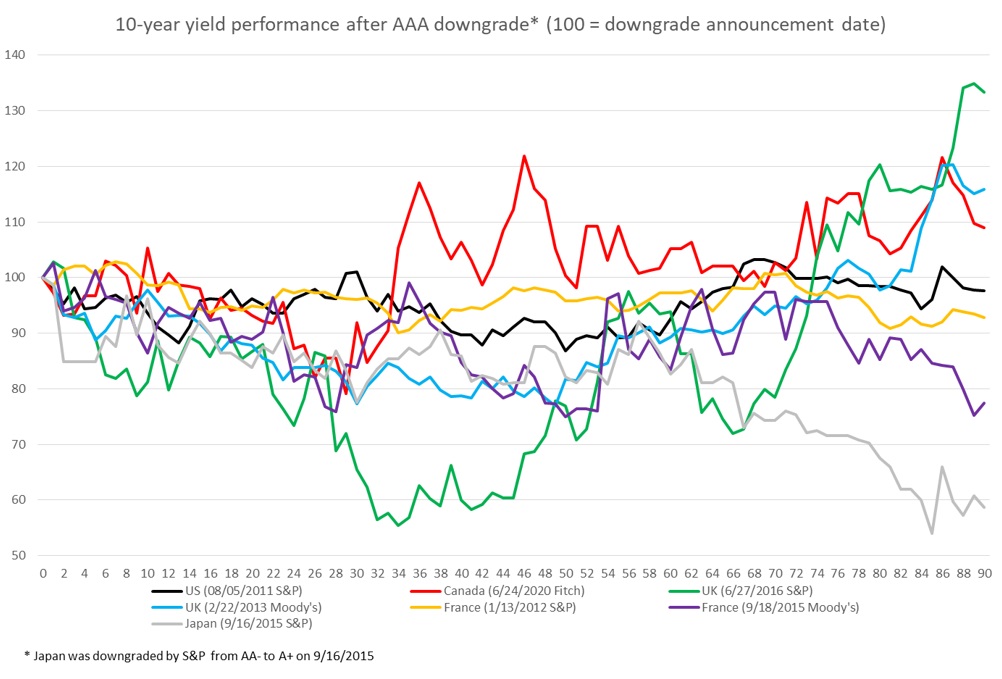
There are some economies that have never dropped from a triple AAA rating, including Australia, Sweden, or Germany. On the other hand, there have been negative rating changes in recent history caused by various factors. In Canada’s case, there was a significant increase in spending and thus debt during the Covid-19 pandemic, whereas, for the United Kingdom, it was related to the Brexit referendum. However, it turns out that within a few dozen sessions after the rating downgrade, we did not observe a negative impact; very often, these bonds gained! Of course, we don’t want to say that a rating downgrade is positive for the issuer. However, such decisions often merely reflected gradual changes and were treated by investors as a sort of confirmation rather than a new “shocking” piece of information.piece of information.

The chart shows changes in yield, normalized to 100 on the date of the decision to lower the rating. As can be seen, yields dropped in the initial few dozen sessions! Source: Bloomberg Finance L.P., XTB Research

Will There Be an Escape Outflow from American Debt?

Fitch showed in its decision rationale that fiscal policy management has significantly deteriorated over the last 20 years. Such warnings occurred already in 2011 from S&P, and Moody’s also suggested in May that it might decide on such a move. It is worth mentioning that the investment policy of some funds shows that money can be invested only in the safest debt with an AAA rating. Usually, then, as investment committees, they pay attention to the prevailing rating, and from this perspective, it might seem that Fitch’s decision is key, as the prevailing rating for the USA is not AAA but AA+. However, there’s a “problem”. The current U.S. debt market is almost five times larger than the total market of all other government issuers with an AAA rating from all agencies and nearly four times larger considering countries with a prevailing AAA. So where would money from U.S. debt go if managers mechanically wanted to move it? Even if U.S. debt doesn’t have special status for a given institution (which often is the case), it would be easier to change the provisions than to actually leave U.S. bonds. By the way, this fact also means that the debt of governments that have retained AAA may be particularly valued by investors (since there’s so little of it left).since there's so little of it left

The U.S. debt is almost 4 times larger than that of countries with the highest credit rating (at least twice AAA). If the U.S. loses the status of the safest debt, will fund managers have nowhere to transfer their funds? Source: IMF, UN, Bloomberg Finance L.P., Macrobond, XTB Research.

So what is the significance of Fitch’s decision?

Empires fall slowly. Fitch’s decision may not currently trigger large market movements, and even those we see, are the result of a surprising moment in which it appeared, not the reasoning behind it. However, it is a kind of seal of non-acceptance for U.S. economic policy. Will Washington immediately have a problem with financing the deficit? Absolutely not. Will the dollar lose its reserve currency status through Fitch? This certainly won’t happen for many years. The decision should be seen as a warning signal that, without changes, the financial hegemony of the U.S. will decline. This may even be the case with sound economic policy in the face of growing competition from Asia. Fitch, on the other hand, points to risks that could accelerate the passing of the leadership baton. This is how we believe this decision should be viewed.

Thomas Peter Maletta Explores The Psychology Behind Consumer Buying Decisions

Consumer Decision

Consumer buying decisions have always been a complex and fascinating phenomenon. They are influenced by everything from external market forces to internal emotional states of mind. Thomas Peter Maletta shares his thoughts to gain further insights. He shares his thoughts on why people choose when purchasing goods and services. This will explain the potential business implications of understanding how shoppers think and feel about certain products or brands. 

Consumer Psychology and the Need to Understand

Consumer psychology is a fascinating area of study that deserves our attention now more than ever. In today’s fast-paced world, businesses need to understand their customers deeper to meet their needs and remain competitive. Thomas Peter Maletta notes that understanding consumer behavior and decision-making is crucial to creating successful marketing strategies. By digging deeper into the psychology of the consumer, businesses can gain valuable insights into what drives them to make a purchase, what motivates them to engage with a particular brand, and what factors influence their decision-making process. With this knowledge, businesses can tailor their marketing efforts to create meaningful connections with consumers, build trust and loyalty, and, ultimately, drive revenue growth.

Analyze How It Shape our Purchasing Decisions 

We are bombarded with advertisements telling us what products and services to buy. But have you ever thought about how these messages shape our purchasing decisions? Consumer behavior experts suggest various factors, including our personal preferences, values, and expectations, play a role. For example, a luxury car commercial might convince us that owning a vehicle would enhance our social status. At the same time, an eco-friendly cleaning product ad might appeal to our desire to lead a more sustainable lifestyle. External factors such as peer pressure, cultural norms, and economic conditions can also impact our shopping choices. It’s important to closely examine the underlying mechanics to understand how our decisions are influenced.

Examine Different Types of Consumers

Consumers come in all shapes and sizes, each with a unique set of factors influencing their purchasing decisions. From budget-conscious shoppers to those who prioritize eco-friendliness, every consumer has their priorities and needs. Factors such as age, gender, income, and lifestyle all play a role in determining which products and services interest consumers. Additionally, factors such as marketing tactics, brand loyalty, and personal values also have a significant impact on consumer behavior. By understanding the diverse factors that influence different types of consumers, businesses and marketers can create tailored marketing strategies that resonate with their target audience. Ultimately, the key to success lies in recognizing and addressing the unique needs of each consumer.

Highlight the Role of Marketing and Advertising in Influencing Buying Behavior 

Marketing and advertising are powerful tools that can influence our buying behavior. From catchy slogans to persuasive ads, these methods promote products and services to capture our attention and entice us to purchase. Marketing and advertising are crucial in our consumer-driven society, as businesses compete to capture our hearts and minds. According to Thomas Peter Maletta, the key to successful marketing is understanding what motivates consumers and creating a message that resonates with them. Businesses can establish a strong relationship with their customers and remain relevant in a highly competitive market. Ultimately, the role of marketing and advertising in influencing our buying behavior cannot be overstated, as it shapes how we consume goods and services.

Explore How a Company’s Reputation Impacts Consumer Decision Making 

When purchasing decisions, reputation matters, a company’s reputation can heavily influence consumers and their choices. A positive reputation can increase loyalty, while a negative reputation can drive potential customers away. In today’s digital age, a company’s reputation can be easily spread through online reviews and social media, making it essential for companies to prioritize their reputation management. Consumers trust and buy from a company with a positive reputation, making it a valuable asset for any business. So, companies must maintain a positive reputation to attract and retain consumers.

Discuss Practical Tips for Understanding Your Target Customer’s Needs and Preferences

Understanding your target customer’s needs and preferences is crucial when offering the right product or services. It’s not enough to simply know basic demographic information; delving deeper into their behaviors and preferences can help to tailor your approach and build brand loyalty. One practical tip is to conduct surveys or focus groups to gather feedback on what works and what doesn’t. Social media is also a valuable tool for observing and understanding customer interactions. Take note of what they are saying, what they are sharing, and what they are buying. By listening and analyzing this information, you can better understand your target customer, leading to a stronger brand and increased customer satisfaction.

Final Thoughts

Understanding consumer psychology is an invaluable tool to help companies grow their customer base and create successful marketing campaigns. By recognizing how emotions, culture, experience, and values influence buying decisions of different types of consumers, businesses gain the knowledge to tailor to meet the needs of their target customers. Additionally, companies must focus on building a positive reputation among consumers to win the trust of current and potential customers. Lastly, by utilizing practical tips for understanding target customers’ needs and preferences, as discussed in this post, companies can make better-informed decisions on how to structure their advertising strategies and deliver superior value to their customers. Ultimately, companies need to recognize opting into consumer psychology as a core part of their business development strategy to remain competitive in today’s marketplace.

Maximising Returns: The Potential of Multi-Family Homes Investment

Maximising Returns

Real estate has been the cornerstone of many successful wealth-building strategies for ages. The prospect of owning tangible assets like property and garnering substantial returns on your investment is an attractive proposition. However, with the myriad options to choose from – such as single-family homes, commercial real estate, and vacant land – finding the perfect fit for your investment portfolio can be overwhelming. In this piece, we will hone in on the unique benefits of investing in multi-family homes, understanding its potential pitfalls, and exploring strategies to optimize your investment returns.

The Allure of Multi-Family Homes Investment

Multi-family homes, often called multi-dwelling units (MDUs), are types of residential housing where multiple distinct housing units exist within one or several buildings within a single complex. Structures like duplexes, townhouses, apartments, and condominiums fall into this category.

Investing in multifamily homes can present an array of advantages over other types of real estate investments. These advantages extend beyond simple profitability and delve into factors affecting ease of management and market stability. Let’s break down these benefits:

Streamlined Management

Regarding multi-family homes, you can manage several units under one roof, considerably simplifying property management. Whether you’re an experienced investor who prefers self-management or a novice who is comfortable delegating to a property management firm, managing one multi-family building typically presents fewer complications and more cost-effectiveness than managing several single-family homes dispersed across diverse locales.

Higher Income Potential

Multi-family homes generally pave the way to higher income potential. The logic here is simple: more tenants translate to more income streams. When you own a single-family rental, and your tenant vacates, you lose 100% of your rental income until you secure a new tenant. Conversely, with multi-family properties, you continue to draw income from the other occupied units, even if one is vacant. This aspect significantly reduces the risk of total income loss.

Increased Demand

An ongoing cultural shift towards urban living and an increased desire for community-centric environments have substantially boosted the demand for multi-family housing. Today, many people are enticed by the amenities, strategic locations, and sense of community that multi-family homes offer. This trend of increasing demand naturally lends more stability and profitability to multi-family home investments.

Navigating the Challenges: Potential Pitfalls and How to Avoid Them

Just as with any other investment, multifamily home investments come with their unique set of challenges. The intricacies of managing multiple units, the substantial initial investment required, and market volatility can pose potential roadblocks. Let’s discuss how to navigate these challenges effectively:

High Initial Investment

Given their nature and scale, multi-family homes typically require a larger initial investment than single-family homes. A potential solution to overcome this challenge is syndication – pooling resources with other investors. Syndication allows you to acquire a larger property than you could afford individually, effectively spreading the associated risks and potential rewards among all stakeholders.

Managing Multiple Tenants

The task of managing multiple tenants can be daunting, especially for investors who are new to this arena. Engaging a professional property management company can significantly simplify this task. Such firms are equipped to manage tenant relations, collect rent, handle property maintenance, and address various other tasks, allowing you to devote time to strategic decision-making and other activities.

Market Risks

Market risks are inherent in any investment, and multi-family homes are no exception. These risks can be minimized through thorough market research before purchasing a property. Focus on areas with robust rental demand, steady economic growth, and low vacancy rates to mitigate potential losses.

Making the Most of Your Multi-Family Home Investment

Investing in multi-family homes is not just about buying a property and waiting for the returns to flow in. It requires a strategic approach, careful planning, and sound management practices. Let’s explore some strategies that can enhance the profitability of your multi-family home investment.

Buy in the Right Location

The location of your multi-family home plays a pivotal role in determining its profitability. It’s important to prioritize areas with robust job growth, high-quality schools, low crime rates, and other desirable amenities. Such factors can significantly enhance the demand for your rental units, allowing you to command higher rents and maintain low vacancy rates. In addition, the proximity to shopping centers, healthcare facilities, and public transportation can also significantly increase the appeal of your property, thereby helping ensure steady rental income.

Prioritize Regular Maintenance

Regular maintenance is crucial in keeping your property in top-notch condition, reducing the frequency of costly repairs, and helping preserve property values. It’s essential to keep in mind that well-maintained properties not only attract but also retain quality tenants. By addressing minor issues promptly, you can prevent them from turning into major, costly repairs. Regular maintenance also contributes to tenant satisfaction, reducing tenant turnover and associated costs. Happy tenants are likelier to take care of the property and stay longer, leading to a more stable income.

Diversify Your Portfolio

Diversification is a well-regarded risk management strategy in any form of investment. The same applies to real estate. Consider investing in multi-family homes in different locations with unique economic and market dynamics. Moreover, explore properties of different sizes and price points. This way, if one investment underperforms due to local market conditions or other factors, others in your portfolio can help offset the loss. Diversification minimizes risk and provides multiple avenues for growth and profitability.

Stay Informed

Real estate is a dynamic sector with continuously evolving market conditions, trends, and laws. Keeping current with the latest developments can help you make informed decisions, capitalize on opportunities, and avoid pitfalls. Consider joining real estate investment groups where you can connect with other investors and industry professionals, sharing insights and experiences. Attend seminars, webinars, and workshops to broaden your knowledge. Reading industry publications and subscribing to real estate newsletters can keep you abreast of the latest trends and developments. The more informed you are, the better equipped you’ll be to make sound investment decisions.

Conclusion

Real estate investment, particularly in multi-family homes, can be a rewarding journey but requires more than just financial investment. It demands your time, strategic thinking, continuous learning, and adaptability. With a well-informed approach and diligent management, you can navigate potential challenges and capitalize on opportunities, reaping substantial financial gains.

Remember, there’s no one-size-fits-all strategy in real estate investment. Your journey will be as unique as your financial goals and personal circumstances. At ‘The Multifamily Mindset‘, we believe in the potential of multifamily home investment and are here to guide you every step of the way. We offer resources, advice, and insights to help you navigate your investment journey, making your dream of financial success a reality.

EDITOR'S PICK OF THE WEEK

CFO's new mandate. CFO explaining the presentation

The Performance and Transformation Orchestrator: The CFO’s New Mandate in the Age of AI

By Terence Tse CFOs are evolving into AI-driven transformation orchestrators, balancing finance, technology, and strategy while upskilling teams, managing risks, and driving measurable business value. A key insight from this year’s AI for CFOs event, organized...

WISE DECISION MAKER GUIDE

POWER INFLUENCERS

Emerging Trends

The Future of Global Trade