Do Israel’s ongoing military actions in the territory of the Gaza Strip have parallels in classic colonial behaviour, including the apartheid regime of South Africa? For Kalim Siddiqui, the evidence is clear.
I. Introduction
On 7 October 2023, Hamas militants broke out of the blockaded Gaza Strip, broke through the supposedly impregnable barriers, and attacked Israeli military bases and Jewish settlements, leading to the death of 1,200 people. This is what is now known about this horrific attack and massacre by Hamas militants. The Netanyahu government’s reaction has been full of revenge, rather than soul-searching. It seems that his government was looking for an opportunity to attack people in Gaza. We must understand that the occupiers cannot fight for self-defence against occupied people.
More than 1.8 million people, which is about 80 per cent of the Gaza population, have been driven from their homes, 20,600 Palestinians, including 8,000 children and 4,000 women, have been killed since October 7, and about 40,000 have been injured and 300 families have lost 10 or more members of their families. Over 6,000 are missing, many buried under the rubble. Israel has dropped more than 25,000 tonnes of explosives on Gaza, equivalent to the atomic bombs dropped on Hiroshima and Nagasaki in 1945. In the West Bank, more than 280 Palestinians have been killed since 7 October, and more than 3,000 injured, although the area is not controlled by Hamas. A leaked Israeli Ministry of Intelligence document of 13 October 2013 calls for the forcible and permanent transfer of 2.3 million Gaza residents to Egypt’s Sinai Desert.
In the mainstream US media, Israel is immune from criticism, for example on June 8, 1967, the USS liberty, an unarmed navy research ship, was attacked by Israeli fighter jets. The media coverage of attack was very little and lacked any critical analysis on the incident. Israeli attack resulted in the death of 34 people and 171 injured. The USS liberty was attacked by Israeli fighters and soon afterwords also torpedoed by the Israeli gunboats, while the USS liberty was in international waters, outside Egyptian coast in the Mediterranean Sea. It was a clear sunny day, whether conditions were very good. The US media did not criticise Israel for this incident, which could have provoked US attacks against Egypt.
Killing innocent people cannot be condoned, but we must understand the behaviour of caged people who have been dehumanised for decades, living under occupation and siege. In 2005, Israel withdrew from Gaza, but supported division among Palestinians and allowed money to be transferred from Qatar and others to Hamas in Gaza. Afterwards, Hamas was elected in Gaza and wanted to have an airport and a seaport, but Israel would not allow it.
The prime objective of the 7 October attack by Hamas was to break the blockade and to reignite the debate on the Palestine issue as, prior to this, there was a move to accept Israel by Saudi Arabia and other countries by ignoring the key issue in the region. And now the two-state solution is back in the international news. Another objective was to free thousands of Palestinians from Israeli prisons, especially women and children. A further factor was the desecration of the Al-Aqsa Mosque, the third-holiest shrine of Islam, by Israeli soldiers. They started beating the Palestinian worshippers while they were praying inside the mosque. It seems that the Hamas attack was well planned and achieved all of its key goals. Israel is fully exposed, with their mass killing of women and children and relentless dropping of bombs on Gaza.
Intellectual honesty is crucial to reaching the truth. In occupied land, Israel is making life extremely difficult for Palestinians and hopes they will finally leave. Let us briefly explain Gaza. Gaza is a narrow coastal strip where about 2.3 million people live between the Mediterranean, Israel, and Egypt, with an area measuring 365 square kilometres, or 141 square miles. In 2005, the Israeli army is said to have formally dismantled settlements and withdrawn from the Gaza Strip. But instead of having actual occupation, Israel imposed a blockade and exercised effective control of Gaza. All access points to the Gaza Strip are controlled by Israel, with the exception of the Rafah crossing with Egypt, which coordinates with Israel to manage it. Gaza’s entire population depends on Israel for their basic supplies of food, water, and electricity. Their ability to travel, within and outside Gaza, depends on Israeli permits. That is why the Gaza Strip is often referred to as “the world’s largest open-air prison”. People are trapped and brutalised, and nearly 60 per cent of children in Gaza are malnourished and living under inhuman conditions, so that the residents of Gaza have every right to break this siege (Amnesty International, 2022).
Israel’s attack is the last desperate measure of a settler colonial project that foolishly thinks, as many settlers’ colonial projects have in the past, that it can crush the resistance of an indigenous population with genocide. But even Israel will not get away with killing on this scale. A generation of Palestinians, many of whom have seen most, if not all, of their families killed and their homes and neighbourhoods destroyed, will carry within them a lifelong thirst for justice and retribution.
Israel is the world’s tenth-largest arms exporter, while its high tech and weapons are sold to an estimated 130 nations, including military dictatorships in Asia and Latin America. Israeli had weapons sales of US$12.5 billion last year. It has built a close relationship between its military internal security surveillance, intelligence gathering, and law enforcement agencies and many countries, which explains the support Israel receives for its genocidal campaign in Gaza.
At present, Israel is the strongest military power in the region and its conventional forces are far superior to its Arab neighbours. The US always makes sure to do everything to support Israeli military superiority over its neighbours. And it is the only country with nuclear warheads. Egypt and Jordan have signed peace treaties with Israel. Gulf monarchies have already normalised relations with Israel, and Saudi Arabia is trying find any excuse to recognise Israel, despite Israel’s continued occupation of land taken in the 1967 Israel-Palestine war and increasing human rights violations in the occupied territories. Saudi Arabia and other Gulf monarchies fear that annoying the US could lead to freezing their dollar assets, which amount to trillions of dollars in the US banks (Siddiqui, 2020a), and hostility with the West could endanger their hold on power and the status quo, while Iraq and Syria have been devastated by US invasions and civil wars.
We must examine the Palestinians’ plight and suffering since the Zionist settler project was installed in the first quarter of the 20th century. The neighbouring Arab dictatorial regimes were created and supported by the British as neocolonial outposts in the naturally rich Middle East region. Arab countries’ reaction to the Palestine misery and desperation has been limited to mild condemnation and mere lip service, rather than any concrete measures to end the Israeli blockade of Gaza (Chomsky, 2015). All Arab rulers have long abandoned the Palestinian people. Egypt wants the status quo, so the country continues to receive US aid. The Arab states are very dubious about their commitment to Palestine. Their words and deeds do not match, their condemnation of Israeli aggression is largely rhetorical, and they are quite happy to compromise the Palestinian struggle. There is a lot of animosity and conflict among them. For instance, Egypt hates Hamas because Hamas was born out of the Muslim Brotherhood, and General Sisi took power in Egypt with the full blessing of the US and the neighbouring Arab countries, and it was seen by them to be essential to prevent a Muslim Brotherhood government from running Egypt.
The Palestinian conflict could become a regional war and may turn into a world war, leading to mutually assured self-destruction (MAD). Therefore, it is important to critically examine this conflict and provide an alternative policy for peace. Looking at the past hundred years of experience of the developed countries (i.e., the North), there is little hope. But the Global South (former colonies) can stand up in support of Palestinian people (Siddiqui, 2020b; also Siddiqui, 2024) and their struggle for self-determination and the return of refugees (Pappé, 2006). Although UN Resolution 194 clearly says that Palestinian refugees have the right to return home, in 1948 and 1967 Palestinians were forced to leave their homes. As Pappé argues, “Denying people the right of return to their homeland, and at the same time offering this right to others who have no connection to the land, is a model of undemocratic practice” (Pappé, 2017). Israel was created by then-imperialist power Britain to serve imperial interests in the region, and later the US extended its full financial and military support in favour of the colonial settler project. Of course, instability and war in the Middle East also benefited greatly the defence industries in the West to sell and test their weapons, who have gained strong lobby groups and corrupted the Western governments and institutions.
Moreover, the genocide in Gaza is a century-long policy of ethnic cleansing of Palestine, and it is true for all settler colonial projects to steal land, water, and natural resources. Genocide lies at the core of Western imperialism. It is the dominant block of Western domination, and it is not unique to Israel or the earlier Nazi regime, but it is a building block and key ingredient of Western domination. When those under occupation do not submit and continue to resist occupation, then Israel claims the moral superiority to be doing good to all and claiming to spread democracy, freedom, and equality to all, but in reality never meant to grant these to the oppressed. Israel’s colonial project was founded on lies that Palestine was an empty land. At present, Israel’s stealing of natural resources includes land, water, and natural gas on the Gaza marine coast, which could contain 1 trillion cubic feet of gas, and it does have other, huge natural resources.
During the early 20th century, the British wanted to establish a little “Ulster”, loyal to serve imperial interests in the Middle East region, which had the shortest land route to South Asia, to control naturally rich resources in the region. The British divided Palestine without asking the native people who lived there (Said, 1980).
The Oslo peace process did not promise to create a viable sovereign Palestinian state, but instead accepted the creation of a regional autonomy for Palestinians in which they would have autonomy over the territories of 21 per cent of the West Bank. The Palestinians were given power to look after their security and policing the population, but with no sovereignty (Khalidi, 2013). Over the past two decades, the Palestinian authority has been concerned with policing and had the responsibility to maintain law and order, but the Israeli police can raid Palestinian houses any time without any consent from Palestinian authority (Pappé, 2017).
The continuous rise in the settler population in the occupied lands of the West Bank and East Jerusalem and the construction of a 709-km separation wall, which divides the Palestinian territories into 12 disconnected geographical areas, had destroyed any prospect of establishing a viable Palestinian state. Moreover, on the West Bank, the Israelis have built 100 checkpoints and 400 temporary obstructions to make Palestinian mobility nearly impossible. And hence the territorial fragmentation has destroyed any possibility of the emergence of a viable Palestinian state.
Figure 1: Palestinian map – disappearing Palestine.

Figure 2: Israeli settlers in the Occupied Territories.

Figure 3: Illegal Israeli Settlements, 1972-2018.

For more than a decade, the long negotiations between Israel and Palestine have remained at a stalemate, but even during the 1990s Oslo peace, Israel continued to expand settlements in the occupied lands (see Figure 1 and Figure 2). Even former President Jimmy Carter (2006) emphasised that the Oslo interim agreement was an apartheid solution, not for an independent Palestinian state. The US has talked about a two-state solution but has so far been unwilling to put any pressure to end the expansion of settlements and remove separation barriers on Palestine lands or dismantle check points and remove bypass roads only for settlers (see Figure 3). “And therefore, we should acknowledge that the Oslo process was not a fair and equal pursuit of peace, but a compromise agreed to by a defeated, colonised people” (Pappé, 2017).
Israeli democracy is only for Jews, not for Arabs who are Israeli citizens and face discrimination. Moreover, these Israeli Arabs constitute 22 per cent of the country’s population within Israel. Another four million Arab Palestinians live in occupied lands and regularly face discrimination and even attack and harassment by settlers. “The litmus test of any democracy is the level of tolerance it is willing to extend towards the minorities living in it. In this respect, Israel falls far short of being a true democracy” (Pappé, 2017).
Israeli’s siege, discrimination, and apartheid policy had made Palestinian life miserable and in 2021, the West Bank and Gaza per capita income was less than 13% compared to Israel and since then their income has even fallen further (See Figure 4). Furthermore, many years of isolation has left the Gaza’s per capita income even much less than the West Bank’s, due to the Israeli-imposed blockade and bombings. (See Figure 5).
Figure 4: Per capita income in Israel and West Bank/Gaza, 1995-2023

Figure 5: Economic Differences between the West Bank and Gaza.

At Camp David, Israel offered the Palestinian delegation the very small and vague promise that most settlers would be allowed to stay under Israeli jurisdiction, while Israel would be able to retain all of East Jerusalem and de facto control over Masjid-Aqsa, and also most of the water aquifers and productive lands in the West Bank. The Palestinians were offered a fragmented West Bank, no access to water, and the land would be divided into three regions separated from each other by Israeli territories (Carter, 2006). Even after the failure of Camp David in 2000, Arafat was flexible and continued to talk with Israel, but it ended when Ariel Sharon came to power.
The misery and hardship began for the Palestinian people in 1948 with the expulsion and flight of the 750,000 Arab population (Pappé, 2006), which has been described as “Nakba”, or catastrophic. European colonies, too, have experienced dramatic change in people’s lives after colonisation. For example, India, Indonesia, Vietnam, Egypt, and Kenya have been profoundly affected by colonialism (Siddiqui, 2022a), and not colonisers or their society.
British intervention began with Sykes-Picot Agreement (1916) and the Balfour Declaration (1917) were aimed to serve imperial interests, which completely ignored the Palestinian peoples and their rights (Siddiqui, 2019). In 1922, League of Nations formally approved British Mandate to control over Palestine, this Mandate incorporated the Balfour Declaration which provided an opportunity to the establishment of a Jewish home in Palestine. Moreover, Britian had concerned over the security of the Suez Canal and sea route to India. In the 1920s it was viewed that Zionist settlers would best serve the British imperial interests.
While in the US, on 10 November 1945, the Arab diplomats from four countries met with the US President Truman and drew his attention to the growing crisis in British-administrated Palestine in the Middle East. President Truman responded to their concerns over US policy regarding Palestinian and said, “I am sorry, gentleman, but I have to answer to hundreds of thousands who are anxious for the success of Zionism: I do not have hundreds of thousands of Arabs among my constituents” (Said, 1980). Prior to the Second World War, US presidents did not lift a finger to save those Jews who could have been saved before they were murdered by the Nazis.
Since the discovery of oil, Saudi Arabia has been too dependent on the US for its security, defence, and diplomatic support and was unable to raise questions about US policy in the Middle East. Saudi Arabia remained a staunch supporter of the US, irrespective of what it has done to the Palestinians (Siddiqui, 2019).
In December 1948, the US voted with a large majority in favour of General Assembly Resolution 194, which promised that the 750,000 Palestinian refugees who had fled their homes due to Israeli militia terror would have the right to return, and they would be compensated for their losses. However, since then, the US has never made any serious effort or put pressure on Israel to see that this resolution is implemented.
II. Israeli Aggression Against Innocent Civilians
It makes little sense when Israel is massacring Palestinians and starving them and bombing their schools and hospitals. Israel’s response to 7 October is not selective to go after Hamas, rather than punishing the whole Palestinian population. Gaza is a very densely populated area and Hamas is integrated within the population and it has no land to build military bases away from Gaza. They have built tunnels under the whole of Gaza. This is a way to protect themselves from Israeli bombing. It is due to the small geographical area (The Guardian, 2023).
Israel claimed that underneath Al Shifa hospital a Hamas command centre was located and operated through network of tunnels but, once they occupied the hospitals, they could not prove it and no such network was found, and their claim was a big lie. Under the pretext of Hamas using these facilities, Israel has bombed several hospitals and schools and thousands of civilians have died (The Financial Times, 2023).
The US is shipping huge amounts of US weapons to Israel to be dropped to kill Palestinians. Youth views on Palestine and Israel are changing and the American people are taking part in rallies in large numbers to oppose Israel’s bombing on Gaza. President Biden’s approval rate fell sharply during the Gaza war, with people disapproving of his uncritical support of Israel. Israel claims that if Hamas is eliminated, then there will be peace between Israelis and Palestinians, but why there was no peace before 1987 when Hamas was not there?
Israel should not be seen as a democratic state, as its policy towards Palestine is far from democratic norms and the world ought to consider taking concrete measures to impose economic, financial, and diplomatic sanctions against Israel’s inhuman and undemocratic policy towards the indigenous population, i.e. Palestinians, as was the case with apartheid South Africa in the 1980s.
The world in general and Arab countries in particular have failed to stand up to Israel’s aggression against occupied people through concrete actions. The deep-seated Palestinian tragedy encapsulates almost all forms of human suffering that oppressors could possibly inflict on their victims and, thus, it is a sort of textbook written in victims’ blood. These crimes vary from settler colonialism, uprooting the indigenous population, military occupation, racism, and the daily humiliation of Palestinians, which naturally evokes violence against injustice and oppression.
Under such circumstances, a two-state solution is not a realistic possibility. Israel is determined to create a Greater Israel that includes Gaza, the West Bank, and East Jerusalem, only for Jews. The problem Israel is facing that there are nearly 7.3 million Israeli Jews and also there are approximately 7.3 million Palestinians inside the Greater Israel. And that creates huge difficulties for Israel to achieve its goal of making the country exclusively for Jews. They cannot have a meaningful democracy when there are the same number of Palestinians as Jews, so that Israel is unwilling to accept a two-state solution. The current Netanyahu government is not in favour of pursuing a two-state solution. In fact, Israel is not interested on such an idea after the Camp David talk between Arafat and Barak failed in 2000. The crisis can only be solved politically, not militarily. Israel is an apartheid state, as Human Rights Watch, Amnesty International, and leading human rights organisations inside Israel produced major reports referring to Israel as an apartheid state. It cannot claim to be democratic when Palestinians, half of its population, do not have equal rights.
The United Nations Declaration of Human Rights on equality is celebrating 75 years this year, but irony is that, in the same year, Nakba and apartheid were legalised in Israel with the full support of Western countries, while hypocritically talking about equality and the rule of law for all. Human Rights Watch notes, “About 6.8 million Jewish Israelis and 6.8 million Palestinians live today between the Mediterranean Sea and Jordan River, an area encompassing Israel and the Occupied Palestinian Territory (OPT), the latter made up of the West Bank, including East Jerusalem, and the Gaza Strip. Throughout most of this area, Israel is the sole governing power; in the remainder, it exercises primary authority alongside limited Palestinian self-rule. Across these areas and in most aspects of life, Israeli authorities methodically privilege Jewish Israelis and discriminate against Palestinians. Laws, policies, and statements by leading Israeli officials make plain that the objective of maintaining Jewish Israeli control over demographics, political power, and land has long guided government policy. In pursuit of this goal, authorities have dispossessed, confined, forcibly separated, and subjugated Palestinians by virtue of their identity to varying degrees of intensity” (Human Rights Watch, 2021).
Since 1967, Israel has facilitated the transfer of Jewish settlers to occupied territories and granted them a superior status compared to Palestinians living in the same area, for instance regarding civil rights, access to land, and freedom to move, and to build extend houses. While Palestinians have a limited degree of self-rule in parts of the occupied territories, in fact Israel retains full control over the borders, airspace, the movement of people and goods, security, and the registry of the entire population (Chomsky and Pappé, 2010).
The Israeli Knesset in 2018 passed a law with constitutional status affirming Israel as the “nation-state of the Jewish people”. The government also took measures to ensure Jewish domination, including a state policy of “separation” of Palestinians and Jews between the West Bank and Gaza, which prevents the movement of people and goods for Palestinians within the occupied territories and “Judaisation” of areas with significant Palestinian populations, including Jerusalem, as well as Galilee and the Negev. The aim is to maximise Jewish control over land, push Palestinians outside, and restrict their access to land and housing (Amnesty International, 2022).
Hamas is a group which operates within Greater Israel, and Gaza has been under siege and totally under Israeli control for more than 17 years. Hamas is a resistance movement, not a state, and operates as a group inside Israel. Hamas is not a threat to Israel’s existence as portrayed by the Western media (Finkelstein, 2018).
III. Lobby and Interest Groups
The US has a special relationship with Israel that has no parallel in the recent past, and no matter what Israel does, the US endorses it. Without US military and economic aid and diplomatic support, Israel cannot survive. The pro-Israel lobby group is very powerful in the US and works very hard to push the US to support Israel. The lobby group has enormous financial power and, because of this, they are able to formulate the US policy to benefit Israel. The American Israel Public Affairs Committee (AIPAC) is the largest pro-Israel influence in the US and has been effectively lobbying the US political elites, government officials, and media. Another major lobby group, Christians United for Israel (CUFI), expresses unequivocal support for US security assistance to Israel.
These pro-Israeli lobby groups in the US are very powerful and push policy exclusively to favour Israel, preventing the US from taking a firm stand in support of a two-state solution. Mearsheimer and Walt (2007: 311) argue that in the US, government officials compete to “outdo their colleagues by showing that their pro-Israel credentials are stronger than the next guy’s”. US officials who worked in the White House, such as Dennis Ross, Martin Indyk, and many more, are known to be Zionists and staunch supporters of Israel’s expansionist policy. These very people were appointed as top advisors in the White House and also to negotiate with the Palestinians. The lobby is to convince individuals and organisations to push US policy in a pro-Israel direction and to support Israel no matter what the country does (Mearsheimer and Walt, 2007).
The Israel lobby even encouraged the US to go to war with Iraq and sought to convince the Bush administration to attack Iraq well before the 9/11 attack. Israeli lobbying to influence US policy has been very successful, as Khalidi (2013: 45) states: “Both Israeli and its outspoken American supporters have gone so far to the right that American ‘support for Israel’ is now taken by them to mean unquestioning support for expanding colonisation of West Bank and Arab East Jerusalem.”
Since the 1973 Arab-Israeli War, Israel has been the largest recipient of US direct military and economic assistance, receiving US$3 billion in direct assistance annually, nearly 20 per cent of total US foreign aid and worth more than $500 annually for every Israeli citizen. This is striking, since Israel is a developed country with a per capita income higher than that of Spain. The US subsidises Israel with billions of dollars of annual aid and Israel uses this money against Palestinians in occupied territories, reducing the indigenous Arab population through forcing them to leave their homes, transferring the Arab population and crushing their national uprising.
Moreover, the US aid is given to recipient countries for military purposes, which requires that the aid should be spent in the US, but Israel is allowed to use 25 per cent of the aid to subsidise its own defence industry. Israel is not supposed to provide accounts for where the money is being spent and has used the US money to fund building settlements in occupied lands in West Bank, which the US has recognised as illegal. Israel has also access to top weapon technology from the US, such as Black Hawk helicopters and F-16 jets. The US also gives Israel access to intelligence which it even denies to NATO allies and turned a blind eye to Israel’s acquisition of nuclear weapons.
Now that a large proportion of Gaza’s population is starving and there is no international pressure or any sort of accountability, there is no evidence that the US is putting any pressure on Israel to change its policy. Regarding influencing and shaping US policies on the Middle East, two prominent US academics, namely Mearsheimer and Walt (2007), argue that Israeli lobbying dominates US Middle East policy. They emphasise that US support for Israel is destructive and serves little to safeguard its interests. The Israeli lobby group spends a huge amount of money in the form of electoral contributions, and they also have a huge influence on the mass media and ensure that the mainstream Western media coverage on Israel favours Israeli government views. Prominent US-based think tanks such as the American Enterprise Institute, Brookings, and others always project Israel as a democratic state and try to hide its crimes against Palestinians. These institutions are very biased against Palestinians, and they dominate public discourse in the US. Moreover, there are a large number of Jews in the US Congress and Senate, and top government advisors in the White House who are known for their sympathies for Israel.
It seems that Israel needs a strong lobby in the US to protect the country’s existence during the growing support for Palestinians, especially in the Global South. Israel still has support among the elites in the Global North.
During the peace talks in Oslo, it was revealed that the US is not a neutral broker. Edward Said (2007) was very critical of peace talks between the Palestinian leader Yasser Arafat and the Israeli Prime Minister, Yitzhak Rabin. He denounced the accord as “an instrument of Palestinian surrender, a Palestinian Versailles”. In his view, an old, exhausted, and weak Palestinian leadership had succumbed to American and Israeli blandishments and pressure. Said (2007) wrote, “This was a declaration made by a European power … about a non-European territory … in a flat disregard of both the presence and wishes of the native majority resident in that territory.” Edward Said argued that criticism of Zionism should not be equated with anti-Semitism, nor the struggle for Palestinian rights conflated with support for the Saudi royal family and other Arab tyrannies (Said, 2007).
Indeed, the US has cemented its alliance even closer with Zionists and become a junior partner. The Oslo peace process was an attempt to incorporate the conquered land taken during the 1967 Arab Israeli War into Israel, while giving a limited autonomy and self-governance to the Palestinians, without any provision of sovereignty. The Oslo process failed but created an illusion of something genuine taking place, but it was simply helping to restructure the Israeli occupation. The aim was to place the Palestinians nominally outside of Israeli responsibility, though Israel would maintain control of the land and the supposedly “autonomous” areas (Khalidi, 2013).
The Palestinian Authority was to administer in the education and health of Palestinians while acting as their main interface with the Israeli state and army. Israel’s approach was, thus, to quote Israeli economist Arie Arnon, “neither two nor one”. They wanted neither a one-state solution, where Israelis and Palestinians would be part of a single political entity, nor the emergence of an independent Palestinian state alongside Israel. Instead, there was constant vacillation between the two alternatives. It seems that, under the current circumstances, a one-state solution, in which all citizens have equal rights in a single polity rather than struggling for a separate state, is the only democratic solution available to resolve the conflict between the Palestinian and Israeli people.
IV. A Century-Long Colonial Settler War
Settler colonialism is a form of exogenous domination typically organised or supported by an imperial authority. Settler colonialism was especially prominent in the colonial empires of the European powers between 1600 and 1945. The settling of the Boers in South Africa, and European colonialisation and expansion in the Americas are classic examples of settler colonialism. Settler colonialism is an ongoing system of power that perpetuates the genocide and repression of indigenous peoples and cultures. Essentially hegemonic in scope, settler colonialism employed violence to establish continuous settler occupation, exploiting lands and resources with which indigenous peoples had had a long relationship. Settler colonialism includes interlocking forms of oppression, including racism, ethnic supremacy, and superior weapons. This is because settler colonisers are Euro-centric and assume that European values are inevitably morally superior to those of the Palestinian ethnic population.
The 18th and 19th centuries had witnessed the emergence of two different paradigms of colonialism. The first of these, of which India was the classic example, involved the conquest of countries which then was the world’s largest economy and exporter of cotton textiles and spices, had a history of established central administrations that were sustained by established systems of surplus extraction, and the replacement of those old administrations by colonial regimes. The essence of this colonialism was, apart from finding a market for European goods at the expense of local craftsmen, the expropriation of this surplus and its shipment back to the metropolis (i.e., Britain) in the form of commodities that the metropolis needed. There was very little migration of European population to India and other colonies which were already well populated and whose location in the tropics discouraged such migration from the temperate location of the metropolis.
The other paradigm, of which the US was the classic example, involved the conquest of territories where the local population was driven out of their land, which was occupied by settlers from the metropolis. The essence here was migration from the metropolis and the taking over of the land (and other assets) from the local inhabitants, who were either decimated or herded into “reservations”, such as in North America. I shall call these paradigms “expropriative colonialism” and “settler colonialism” respectively.
The difference between the two consisted in the fact that, in one case, colonialism took away the products of the land; in the other case, it took away the land itself. This, however, had an important implication: in the first case, it needed the local population to work on the land; if it expropriated too large a portion of the products of the land, then the local population got starved, as occurred in British India in the form of the recurring famines. But then it also had to take some ameliorative measures so that enough people survived to produce the surplus that it needed to expropriate. In the case of settler colonies, however, there was no such compelling need to preserve a local population, especially if the scale of immigration from Europe was large enough. Settler colonialism, therefore, was typically associated with ethnic cleansing, and often with genocidal ethnic cleansing.
There was another important feature of settler colonialism. It tended to be expansionary, in the sense that the land occupied by the settlers kept expanding. This happened when there was continuing immigration into the region; but it happened even otherwise, until either a natural limit was reached to the land that could be occupied, or the boundaries of a strong adjacent state presented an obstacle to any further occupation.
All this, one would have normally thought, belonged to the past. While imperialism remains a reality under capitalism, colonialism is no longer a brutal occupation, as was the case in the 18th and 19th centuries in the Global South (Siddiqui, 2018). However, Israel is a classic example of settler colonialism in the contemporary period. The Jews had been a persecuted religious and ethnic minority for centuries in Europe, and Britain passed the Aliens Act in 1905 to deny entry to Jewish immigrants escaping persecution from Eastern European countries. In contrast, Jews had lived for thousand years in the Arab countries in peace and harmony, and they were always considered to be part of Arab land and culture. Historically, Jews had lived among Arabs as equal citizens, without any fear and some Jews even were part of the ruling elites in Morocco and other Arab countries. The persecution of Jews reached its horrendous proportions in the Holocaust in Germany by the Nazis. They were encouraged by the British to migrate to Palestine and were able to set up the Zionist state of Israel in 1948. Soon, immigrant Jews started to display all the features of settler colonialism, from its intrinsic expansionary tendency, with armed settlers from the country being encouraged to move to newer areas like the West Bank and the Gaza Strip, to its propensity for ethnic cleansing and, now, even resorting to genocide.
All settler colonialism is characterised by a regime of apartheid. Israeli settler colonialism would not have taken off without the solid backing of Western imperialism. For imperialists, it is first of all a way of overcoming all sense of guilt over centuries of persecution of Jews. Imperialist countries are absolving themselves of guilt at the expense of the Palestinian population. And for the Israeli Right, the centuries of persecution, and above all the Holocaust, provide a kind of cover for settler colonialism. Any criticism of this colonialism and its associated phenomena, like apartheid, expansionism, ethnic cleansing, and even genocide, is immediately branded as “antisemitism”, which makes it obviously abominable because of its association with the history of pogroms and, more recently, with Nazism.
The conflict between the Palestinians and Israel, which has reached a terrifying crescendo with the savage obliteration of Gaza, is the outcome of a 100-year colonial occupation by Jewish Zionists in Israel backed by major imperial powers, starting with the British and, a century later, with the United States. This century-long assault by Israel has one objective – to force an indigenous people from their land. According to Khalidi (2021), the first is the British support for Jewish Zionists during the British occupation of Palestine from 1917 and 1939. The second declaration of war is the 1947-48 Nakbeh, or catastrophe, when Zionist militias ethnically cleansed 750,000 Palestinians from historic Palestine and carried out a series of massacres. The third is the 1967 war, when Israel seized the West Bank, East Jerusalem, and Gaza and expelled another 250,000 Palestinians. The fourth declaration of war on Palestine was Ariel Sharon’s invasion of Lebanon and the siege of Beirut, followed by the departure of the Palestine Liberation Organisation (PLO) fighters to Tunisia and the 1982 massacre at the Sabra and Shatila refugee camps. Arab leaders failed to offer meaningful support to the Palestinians. In fact, these leaders often colluded with Israel to weaken the Palestinian resistance movement (Khalidi, 2021).
In December 2000, US President Bill Clinton invited both Israel and Palestinian leaders to a meeting to resolve the Palestinian-Israeli conflict. There were few major issues between Israel and Palestine to be resolved. Where was the border line to be drawn between Israel and Palestine? The Palestinians accepted the UN position that the border line should be drawn where it was before June 1967, meaning that the whole of the West Bank, Gaza, and East Jerusalem would form an independent Palestinian state beside Israel. All international bodies including the International Court of Justice and UN General Assembly accepted, while Israel rejected this proposal and wanted to keep all these occupied lands. Israel did not accept the right of the Palestinian refugees and descendants since 1948 and 1967 to return home. International law states that refugees have the right to return to their homes after the cessation of hostilities. On these major issues, the Palestinians were ready to make concessions, but not the Israelis. Bill Clinton and his wife Hillary do not tell the truth about the negotiations between Israel and Palestine. Every year in the UN General Assembly, the Palestine issues are brought up and the whole world, i.e., 190 countries, vote in favour of the Palestinian position, while a handful of member countries such as Israel, the US, Pulao, and tiny Pacific islands vote in favour of Israel. Israel and the US are totally isolated in the UN General Assembly.
Indeed, Israel is not an imperialist power like Britain, France, Germany, or the US, but it is very much an outpost and a product of imperialism. Unless we understand the historical background of Israel and Palestine, we will not be able to comprehend what is happening today in the current round of the Israel-Palestine conflict. The brief account from Marx’s analysis of capitalism to Lenin’s theory of imperialism may serve as a useful backgrounder, to bring forth the awareness that imperialism is still alive and kicking in the world today. What we are witnessing in Gaza or are going to witness in Gaza is another destructive war launched by imperialism, just as imperialism launched its war against Afghanistan, Iraq, Syria, Libya and destroyed these countries and reduced it to rubble.
Israeli aggression is ideologically motivated and aimed at driving the Palestinians from their lands. So, Israel systematically cut down their olive trees, as they are the source of livelihoods throughout Palestine. They force Palestinians off their land and homes, occupying and illegally using them. This process has accelerated. They have little choice but either to face daily humiliation and live in poverty or stand up and fight. After 7 October in the West Bank, within eight weeks, 270 Palestinians, including 56 children, were killed by the Israeli security forces and armed settlers.
I would like to state that Palestinians are occupied and the Israelis are occupiers and colonisers. The US itself was British colony and the American people fought to free their countries in 1776. British had enriched themselves by plundering the colonies in the past. When Europeans invaded America, they annihilated the natives, as Israel is doing in the 21st century and it is all before the media and press.
Zionism is based on an ethnic supremacy state. Ethnic cleansing is an operation where one ethnic group is replaced by force by another group. Zionism wants to have as much of the Palestinian territories with as few native inhabitants as possible. The Palestinian struggle is for liberation and the fight against occupation. There is a difference between the violence of a colonising power and the violence of colonised people. Israel was created by force of colonialism and imperialism (Chomsky and Pappé, 2010).
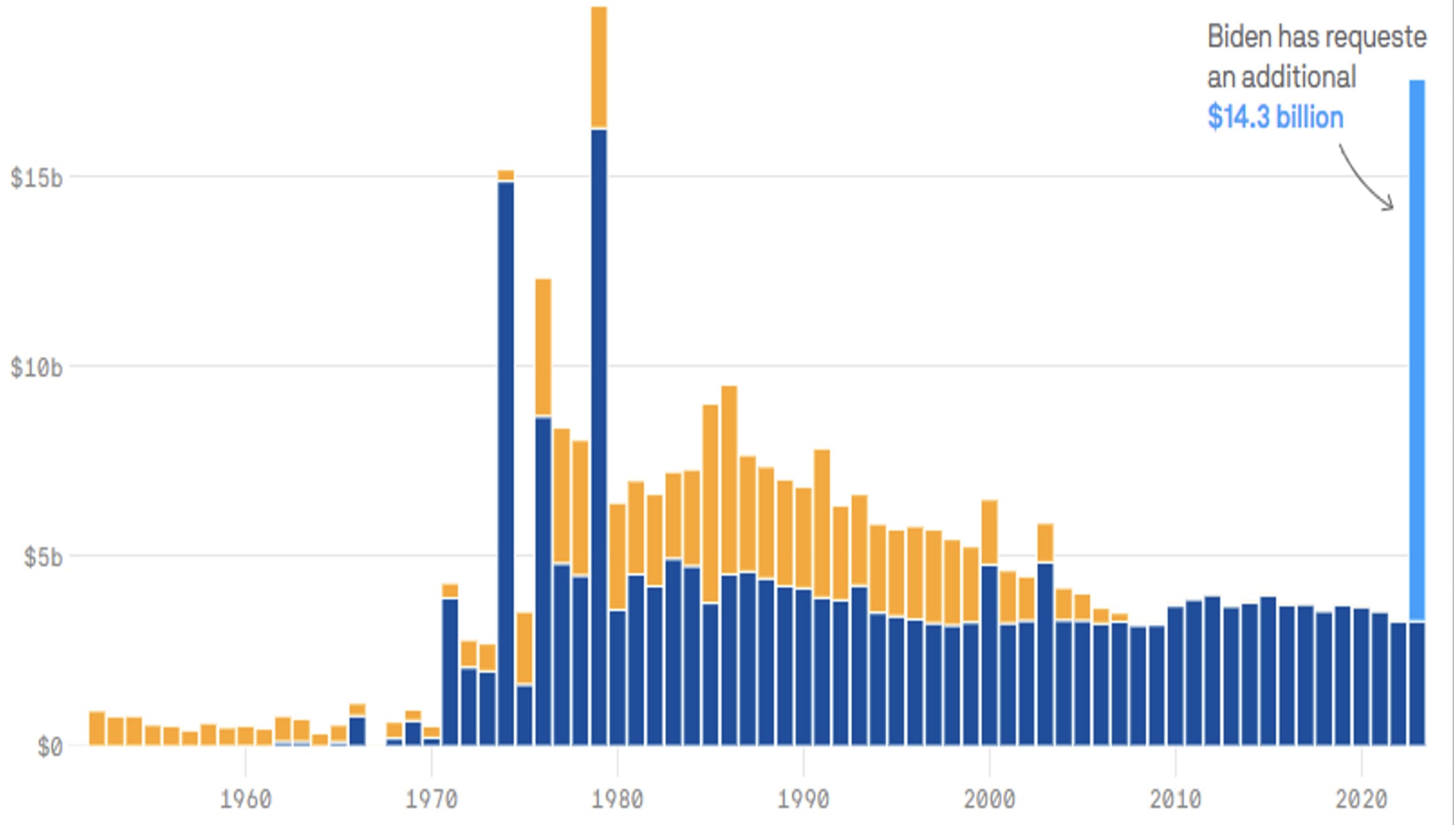
The stacked column Figure 6 shows the annual US aid to Israel from 1951 to 2022, categorised by whether it was economic or military aid. The majority of aid given since the 1960s has been military aid, which is around $3.3 billion per year, except in 1974 and 1979, when it was more than $15 billion. Economic aid has historically been less than $5 billion per year, and has fallen to less than $1 billion per year since 2004. In 2023, Biden requests an additional $14.3 billion in aid.
Figure 6: US economic and military aid to Israel, 1951–2023
V. Militarism, Detention, and Criminal Injustice
Israel’s two-tier criminal injustice system is itself one of the most blatant examples of its version of apartheid. Only Jewish Israelis, including settlers, are subject to ordinary civilian or even criminal law; all Palestinians are subject instead to a separate system of military law, in which soldiers and military tribunals become judge, jury, and executioner. The documented conviction rate for Palestinians post-arrest is 99 per cent. Moreover, under Israel’s military law, any Palestinian, including children, can be seized for pre-trial “administrative detention” and held for up to 75 days without being charged. During this time, detainees are vulnerable to physical and verbal abuse, including torture, beatings, solitary confinement, forced confessions, and being denied visitors for weeks or months on end.
Since 1967, the Israeli military has arrested and detained nearly 800,000 Palestinians, equivalent to 20 per cent of the entire Palestinian population and 40 per cent of all males. This means that virtually every Palestinian family has members who are currently, or have been, imprisoned, and that the struggle against the insidious Israeli penal system is indistinguishable from the Palestinian struggle for freedom. As a result, periodic hunger strikes by prisoners have long been one of the most common and widely practised forms of Palestinian popular resistance, with mothers and other family members, activists, and organisations expressing solidarity through protest marches (Khalidi, 2013).
Regarding the arrest of children by Israel, it is a unique human rights abuse. Israel is the only country in the world that systematically prosecutes, each year, between 500 and 700 children as young as 12 in military courts. Children in detention are subjected to physical and psychological torment, separation from parents or lawyers, beatings, solitary confinement, and forced confessions. Indeed, Israel’s criminal injustice system permeates Palestinian families, making their daily lives a state of siege. The process of carrying out detentions normalises human rights violations that brutalise entire families and communities. Soldiers routinely make raids at night, enter houses with dogs and lasers looking for “suspects”, traumatise children, and take people away to unknown detention sites. In one case in 2021, a 17-year-old Palestinian boy with life-threatening medical conditions was ordered rearrested by the military prosecutor and sentenced to six months of administrative detention for allegedly throwing stones.
Israel has advanced and technological surveillance – cameras, biometrics, spyware embedded in social media apps, drones – to control dissent and what it sees as the pervasive threat of terrorism. However, the important customer for these technologies seems to be often authoritarian governments and also being used on Palestinians by local militarised police forces. This surveillance and the militarisation of daily life haunt Palestinian children at every turn: the constant fear of night raids or the arrest of parents, siblings, and friends; the confinement to restricted neighbourhoods or crowded streets of refugee camps, without any space to play; above all, the need for constant vigilance. Soldiers, for instance, can harass girls walking to school and even enter their classrooms and arrest their teachers.
VI. Conclusion
The real issue is not what Hamas did on 7 October 2023, but what the source of the violence is. Millions of Palestinians have been oppressed for years, and they are fighting with whatever means they have. This will go on unless we ask why violence erupted in the first place. This is a massive plan of killing and ethnic cleansing. The pretext of Israel is to take revenge for what Hamas did on 7 October and to create a new reality for the Palestinians, i.e., a new Nakba, and a horrifying chapter for the ongoing Nakba the Palestinians are suffering. During the on-going bombing of Gaza, the Israel troops are also attacking aggressively into the West Bank to carry out Nakba in the Occupied Palestinian Territory. Tanks have been moved into Palestinian towns such as Jenin, intimidating the Palestinian population to encourage them to give up the possibility of building a peaceful life in the West Bank.
Israel’s indiscriminate bombing of Gaza has continued for more than eight weeks now, including hospitals, ambulances, schools, university, and water cleaning facilities, indicating that Israel wants to destroy infrastructure.
The study has found that Israel’s aggression on the occupied territories shows how the colonisers ignore all human norms and increase terror with the hope that the colonial people will end their resistance against occupation. I am confident that the Israeli colonisers will be forced to end their occupation and the Palestinian people will be victorious to achieve freedom, peace, and sovereignty, where all people can live in peace, harmony, and prosperity, irrespective of their faiths. History has proved that the occupiers were wrong and that their brutal military force to intimidate the people will fail. The same military terror was adopted by colonisers in India, Indonesia, Vietnam, Algeria, South Africa, Afghanistan, Iraq, and many more. But, in the end, they were forced to end their occupation. Palestine is a tragedy for all the Global South and shows the brutality of imperialism and colonialism imposed by the North (Siddiqui, 2018).
The African National Congress in South Africa struggled for equal political rights for all its inhabitants, irrespective of their colour, when the white racist minority government wanted to segregate black people into Bantustans that would be declared “sovereign states”, but Nelson Mandela firmly rejected it. Mandela served 27 years in jail and Western countries described him then as a terrorist. Now we all know that it is completely wrong and incorrect to describe his struggle for freedom and equal political and civil rights for all who live in South Africa as terrorists.
The Palestinian civil society began campaigning to Boycott, Divestment and Sanctions (BDS) against Israel in 2005 and it has gained strength globally. It is argued that Israel has created an apartheid state that needs to be dismantled, which requires international support in favour of building equal rights for all its citizens.
Arab leaders have sold out to the US in terms of security, finance, and economy and seek Western support for their survival and the stability of their regimes. The rich Arab countries deposit their money and invest in property in the West. At present, the US has 27 military bases in Arab countries and these countries cannot afford to kick the US military bases out and take action in support of the Palestinian struggle for sovereignty and self-determination.
About the Author

Dr. Kalim Siddiqui is an economist specialising in International Political Economy, Development Economics, International Trade, and International Economics. His work, which combines elements of international political economy and development economics, economic policy, economic history and international trade, often challenges prevailing orthodoxy about which policies promote overall development in less-developed countries. Kalim teaches international economics at the Department of Accounting, Finance and Economics, University of Huddersfield, UK. He has taught economics since 1989 at various universities in Norway and the UK.
References
- Amnesty International (2022) “Israel’s Apartheid Against Palestinians”, 1 February, London. https://www.amnesty.org/en/latest/campaigns/2022/02/israels-system-of-apartheid/
- Carter, Jimmy (2006) Palestine: Peace not Apartheid, Simon & Schuster.
- Chomsky, N. (2015) Fateful Triangle: The United States, Israel and the Palestinians, Chicago: Haymarket Books.
- Chomsky, N. and Pappé, I. (2010) Gaza in Crisis: Reflections on Israel’s War Against the Palestinians, Chicago: Haymarket Books.
- Finkelstein, N. (2018) Gaza: An Inquest into Its Martyrdom, California: University of California Press, Oakland, California.
- Human Rights Watch (2021) “A Threshold Crossed: Israeli Authorities and the Crimes of Apartheid and Persecution”, 27 April.
- https://www.hrw.org/report/2021/04/27/threshold-crossed/israeli-authorities-and-crimes-apartheid-and-persecution
- Khalidi, R. (2013) Brokers of Deceit: How the US Has Undermined Peace in the Middle East, Boston: Beacon Press.
- Khalidi, R. (2021) The Hundred Years’ War on Palestine: A History of Settler Colonial Conquest and Resistance, 1917-2017, New York: Metropolitan Books.
- Mearsheimer, J. and Walt, S. (2007) The Israel Lobby and U.S. Foreign Policy. New York: Farrar, Straus, and Giroux.
- Pappé, I. (2006) The Ethnic Cleansing of Palestine, Oxford: Oneworld Publications.
- Pappé, I. (2017) Ten Myths about Israel, New York: Verso Books.
- Said, E. (1980) The Question of Palestine, Routledge & Kegan Paul.
- Said, E. (2007) The End of the Peace Process: Oslo and After, New York: Vintage Book.
- Siddiqui, K. (2018) “Imperialism and Global Inequality: A Critical Analysis”, Journal of Economics and Political Economy, 5(2): 266-91.
- Siddiqui, K. (2019) “Challenges and Importance of Institutions in the Developing Countries”, World Financial Review, May-June, 56-65.
- Siddiqui, K. (2020a) “Can Global Imbalances Continue? The State of the United States Economy”, Argumenta Oeconomica Cracoviensia, 23(2): 11-32.
- Siddiqui, K. (2020b) “Prospects of a Multipolar World and the Role of Emerging Economies” World Financial Review, November-December, p.65 – 77.
- Siddiqui, K. (2021) “The Study of International Political Economy”, World Financial Review, July-August, 46-56.
- Siddiqui, K. (2022a) “British Imperialism, Religion, and the Politics of ‘Divide and Rule’ in the Indian-Subcontinent”, World Financial Review, January-February, 89-109.
- Siddiqui, K. (2022b) “Capitalism, Imperialism, and Crisis”, European Financial Review, June-July, 16-32.
- Siddiqui, K. (2023) “The New Cold War: Struggle for Global Domination” (parts 1 and 2), World Financial Review, July-August, 6-17.
- Siddiqui, K. (2024) “Neocolonialism: An analysis of international factors on the development of the Global South”, World Financial Review, December-January, 2-11.
- The Financial Times (2023) “How the loss of entire families is ravaging the social fabric of Gaza”, 13 December, London.
- The Guardian (2023) “The war in Gaza has been an intense lesson in western hypocrisy”, 27 November, London.
- The US Congressional Research Service (2023) US Aid to Israel, 1 March, Washington DC: CRS. https://sgp.fas.org/crs/mideast/RL33222.pdf