Over ten years ago, when Danny Popescu was transitioning from an exit as a partner in a buyout, he was considering how to create the ideal atmosphere for wealth advisement – ideally, free of constraints on pursuing non-traditional assets for investment.
Danny Popescu saw a path to success in having true independence to do what’s best for the client, and ultimately, for the firm – as having a shared-equity model was built into that ideal atmosphere.
Now, Danny Popescu’s firm, Harbourfront Wealth Management, has grown to over 30 branches with a workforce of nearly 300 people. He attributes this growth to his ability to attract “entrepreneurial advisors” who want to pursue investments beyond traditional stocks and bonds.
That lure has proven powerful, as attested by the 22% growth his advisor team experienced this past year. To accommodate such sustained and significant growth, Popescu’s Transitions team has been tasked with developing what he calls a “true concierge” experience for advisors to transition into his firm.
“We are a fast-growing firm,” says Geoff Pilgrim, Harbourfront’s Director of Operations and Transition Services. “We’ve recently doubled our capacity, and we’ve developed a seamless transition experience. We’ve learned to handle anything, any province, any size of book. It’s white-gloved all the way through.”
There are indeed several layers involved with making this kind of transition as a financial advisor.
But Pilgrim believes Harbourfront’s transition process will alleviate most anxieties for advisors.
“The goal is seamless,” says Pilgrim. “We want our advisors up and running full speed within a month or two of their arrival. We bring over their assets, their personal business modes. We handle all the service, marketing, legal aspects of transition, and of course administration. We succeed with clear messaging, and we have a strong duty of care.”
Danny Popescu’s financial advisory model has proven to be attractive for entrepreneurial advisors. But this transition process is making a jump to his firm seem more and more irresistible for a certain caliber of wealth managers.
“[At Harbourfront] one of the big attractions for successful advisors and portfolio managers is the cash and equity opportunity as they join,” says Brian Mennis, Head of Corporate Development with Harbourfront Wealth Management. “With us, you own three businesses. You own your practice, you own shares in Harbourfront and you own shares in Willoughby Asset Management, our investment manufacturing arm. And you have true independence in offering the best products for your clients while using the best technology tools.”
Leonard Trigg, Harbourfront’s Chief Technology Advisor, adds: “[Advisors] don’t want to spend time duplicating the same request into three different systems. We use a data lake that we built over the last couple of years, which helps give us kind of an independence and put best-of-breed modern solutions on top of that. It’s designed to work with the advisor and to help deliver solutions that they need for their clients in their practice.
As pension-style investments continue to grow in popularity among retail investors, firms like Harbourfront Wealth will continue to see exponential growth.
“Our team sees the growth we’re experiencing, and there’s a shared sense of accomplishment in what we’re all doing together. It’s a fun place to be.”
Discover 10 unmissable attractions across the globe, from the serene beaches of Bali to the historic wonders of Europe. Dive into the vibrant underwater world of the Great Barrier Reef, explore the ancient ruins of Machu Picchu, and marvel at the architectural brilliance of the Eiffel Tower. Embark on a safari adventure in the Serengeti, gaze in awe at the Grand Canyon’s majestic vistas, and trace the footsteps of ancient emperors along the Great Wall of China. These iconic destinations promise unforgettable experiences and lifelong memories for adventurous travelers.
1.The Colosseum, Rome, Italy – A Glimpse into History
Step into the ancient world as you stand before the Colosseum, an architectural marvel that once hosted gladiatorial contests and theatrical performances. Imagine the roar of the crowd as you explore its towering arches and underground chambers. Take a guided tour to learn about its fascinating history, from its construction in AD 70-80 to its eventual transformation into a symbol of Roman engineering prowess. For those considering Europe trip packages, the Colosseum is a timeless testament to the grandeur of ancient Rome.
2. Bali, Indonesia – The Island Paradise
Bali, with its lush rice terraces and pristine beaches, is a haven for relaxation and adventure. Explore the cultural heart of Ubud, where ancient temples and traditional arts thrive. Dive into the vibrant underwater world off the coast of Amed or surf the legendary waves of Uluwatu. Don’t miss the breathtaking sunset views from Tanah Lot temple, or indulge in a Balinese massage to rejuvenate your spirit. For those planning Bali packages, Bali’s beauty and charm will leave you enchanted and longing to return.
3. The Great Barrier Reef, Australia – Dive into a World of Wonder:
Descend into the mesmerizing depths of the Great Barrier Reef, where a kaleidoscope of coral reefs and marine life awaits. Snorkel alongside graceful sea turtles, colourful clownfish, and majestic manta rays in this underwater paradise. Dive deeper to discover vibrant coral gardens teeming with life, or simply float on the surface and soak in the beauty of this UNESCO World Heritage Site. Whether you’re an experienced diver or a first-time snorkeler, the Great Barrier Reef offers an unforgettable aquatic adventure.
4. Machu Picchu, Peru – Lost City of the Incas
Perched high in the Andes Mountains, Machu Picchu beckons adventurers to unravel its ancient mysteries. Trek along the legendary Inca Trail, passing through cloud forests and mountain vistas, to reach this awe-inspiring citadel. Explore its intricate stone structures and terraced gardens, and marvel at the ingenuity of its Inca builders. Whether you arrive at sunrise or sunset, Machu Picchu’s breathtaking beauty and enigmatic aura will leave an indelible mark on your soul, connecting you to the ancient civilizations that once thrived here.
5. The Eiffel Tower, Paris, France – A Timeless Icon
Rising majestically above the Parisian skyline, the Eiffel Tower is a symbol of romance, elegance, and architectural brilliance. Ascend to its observation decks for panoramic views of the city’s iconic landmarks, from the Arc de Triomphe to the Seine River. Visit at night to witness the tower illuminated in a dazzling display of lights, casting a magical glow over the City of Light. Whether you’re savouring a picnic in the park or dining in one of its elegant restaurants, the Eiffel Tower promises an unforgettable Parisian experience.
6. Serengeti National Park, Tanzania – Safari Adventure of a Lifetime
Embark on a safari adventure in the Serengeti National Park, where the rhythm of the African wilderness pulses through the savannah. Witness the spectacle of the Great Migration, as millions of wildebeest and zebras journey across the plains in search of fresh grazing grounds. Keep your eyes peeled for sightings of lions lounging in the shade, elephants roaming the grasslands, and giraffes gracefully stretching for leaves. Whether you’re camping under the stars or staying in luxury lodges, the Serengeti promises an unforgettable wildlife experience.
7. The Taj Mahal, Agra, India – A Monument to Love
Marvel at the ethereal beauty of the Taj Mahal, a testament to eternal love and architectural brilliance. Built by Mughal Emperor Shah Jahan in memory of his beloved wife, Mumtaz Mahal, this white marble mausoleum is adorned with intricate carvings and precious gemstones. Visit at sunrise or sunset to witness its radiant beauty bathed in soft hues of pink and gold, reflecting the ever-changing colours of the sky. The Taj Mahal’s timeless elegance and romantic allure make it a must-visit destination for travelers from around the world.
8. Grand Canyon, Arizona, USA – Nature’s Masterpiece
Marvel at the sheer magnitude of the Grand Canyon, a natural wonder carved over millions of years by the mighty Colorado River. Hike along its rugged trails to discover hidden waterfalls and ancient rock formations, or embark on a thrilling helicopter ride for a bird’s-eye view of this vast canyon landscape. Camp under the stars on the canyon rim, listen to the echoes of nature’s symphony or take a leisurely boat ride down the tranquil waters of the Colorado River. The Grand Canyon’s breathtaking beauty will leave you humbled and inspired by the power of nature.
9. The Great Wall of China – A Monument to Human Ingenuity
Trace the footsteps of ancient emperors along the iconic Great Wall of China, a testament to human perseverance and ingenuity. Stretching over rugged mountains and verdant valleys, this UNESCO World Heritage Site spans more than 13,000 miles across northern China. Marvel at its towering watchtowers and fortified battlements, and imagine the ancient soldiers who once stood guard along its ramparts. Whether you’re hiking along remote sections or exploring well-preserved segments near Beijing, the Great Wall offers a journey through history unlike any other.
10. Petra, Jordan – The Rose City
Discover the ancient wonders of Petra, a UNESCO World Heritage Site nestled in the desert canyons of Jordan. Carved into rosy-hued sandstone cliffs by the Nabataeans over 2,000 years ago, this archaeological marvel is steeped in mystery and intrigue. Wander through its narrow siq, or canyon, to emerge at the breathtaking Treasury, adorned with intricate carvings and towering columns. Explore ancient tombs and temples hidden amidst the rocky terrain, and marvel at the ingenuity of the Nabataean architects who built this desert oasis. Petra’s timeless beauty and enigmatic allure make it a must-visit destination for history buffs and adventure seekers alike.
Succession planning is as important to business continuity as breathing is to life. In this article, Patrick Esposito outlines the key to integrated emergency and long-term succession planning as well as the steps to ensure that your business remains stable and successful, whether you are there or not.
Fewer thoughts are more difficult for leaders to contemplate than how their business or businesses will function without their knowledge, energy, and capabilities. Perhaps that is why a staggering number of business owners and executives tend to ignore succession planning or fail to take it beyond a narrow view of emergencies. Yet, succession planning is key to the long-term survival and success of any company.
I had the opportunity to work with and advise leaders at various organisations, from two-person partnerships to exchange-listed giants. The best-performing of these companies — the ones that had the happiest teams and the best profitability — were the ones that understood that emergency and long-term succession planning were two equally important components of their operations and were most effective when implemented from integrated playbooks. Both emergency and long-term succession planning merit a little more explanation before we examine how to build truly integrated succession plans.
Emergency Succession Plans
When you want to make sure that your business has a long future, the process of creating and advancing long-term succession plans requires far more work than emergency succession plans.
Emergency succession plans are usually fairly simple — especially when compared to long-term succession plans. These emergency plans are meant to be temporary in their application as a bridge to a more permanent solution (which could also be part of your long-term succession plans). These plans are invoked when something abrupt happens — a death, a disability, an immediate resignation, and the like — and some roles and functions need to be filled and well-performed urgently.
For many organisations, their emergency plans consist of which current team member will be called upon to fill the role of a second team member — for a short period — if that second team member becomes unavailable. Other organisations take a more nuanced approach in which the functions of an unavailable team member are shared by multiple people who are each knowledgeable in certain areas under the purview of the absent team member.
Long Term Succession Plans
Long-term succession plans are far more complex. When you want to make sure that your business has a long future, the process of creating and advancing long-term succession plans requires far more work than emergency succession plans.
The businesses that develop and carry out long-term succession plans with the greatest success know there is a critical difference between conducting simple assessments and preparing for transitions by gradually supporting implementations to make the handoff to the next set of leaders. If you do long-term succession planning in an organised and rational way, your emergency succession plans will become part of your long-term succession plans and vice versa.
Integrated Plans
The value of an integrated succession plan is that it allows you to guide both the short-term responses to emergency or unplanned events and the long-term gradual transitions you hope to achieve — absent the drama and trauma. As a result, these plans allow organisations to avoid having future plans derailed by near-term issues.
There are three elements critical to forging successful integrated and comprehensive succession plans:
Identify business needs, assess options and gaps, and determine a viable pathway
Prepare your succession plans and determine the associated required actions
Move forward with your plans and actions, review plans, and update as needed
Needs, Options, Gaps, and Pathways
When you start the process of integrated succession planning, it is important to remember that succession is not about you — or even just replacing you. It is about what (and who) is needed to fill the key roles and functions in the business that you and other members of your team perform, both temporarily and long term. As much as possible, try to leave emotions and sentimental thoughts out of the planning and thinking process.
As much as possible, try to leave emotions and sentimental thoughts out of the planning and thinking process.
Trusting yourself and your team is a key part of this approach. And because succession planning is about your team, I recommend that this process be conducted by the management team and that the governance team reviews the management team’s analysis. If you do not have a formal governance team (or even if you do), you likely will want to engage your top outside advisors, too.
This assessment process may require a mental reset — not just to consider your own mortality and its consequences if you have not done succession planning previously, but also to reassess the roles and functions that should be vested in one individual within a business. Consider what roles and responsibilities — either in emergency circumstances or in the future — should be split among multiple team members. The fact is, it might take a team to replace you or some of your most talented team members.
That is where the assessment work begins — with a determination of what your business needs in terms of roles and functions, both today and tomorrow, and the associated knowledge and skills to fill those roles and functions.
After you document the roles and functions, it is time to assess the composition of your existing team compared to the documented needs for roles and functions. This will help determine the emergency and long-term succession options. In performing this assessment, you will also need to assess the interests of the team members in either the temporary or long-range opportunities.
When you are conducting this analysis, you will no doubt find there are gaps between the existing roles and functions and the current capabilities of your team. For this reason, it is important to consider the potential future capabilities of your team, including what gaps can be filled through growth with training and knowledge transfer. This road map for developing future capabilities can support not just succession planning but also improve your operational outcomes today. Sometimes, not all of the gaps can be filled by training. In those circumstances, it is important to decide how to achieve the temporary succession needs with your team and outside advisors, while you consider how to potentially recruit new talent to the organisation to improve the odds of success for your long-term succession plan. Depending on the financial position of your business, it may or may not be practical to pursue these recruitment activities today. And, if it is not practical, it is quite reasonable to simply turn your focus towards potential future hires.
Document Plans and Actions
After you and your team have completed your assessment, it is important to thoroughly document both the emergency and long-term succession plans, as well as the actions that are needed. Such actions might include training, knowledge transfer, mentorship, ownership opportunities, other compensation incentives, or recruitment of new team members for significant functional succession gaps to ensure these plans can be implemented successfully when needed.
There should be clear communication with the members of your team about their parts (or lack thereof) in both the near-term and long-term succession plans.
In addition to the formal documentation, there should be clear communication with the members of your team about their parts (or lack thereof) in both the near-term and long-term succession plans. For the team members who are important to the integrated succession plan, you may want to consider new or additional ownership opportunities and sustained duration incentive plans to ensure these most valuable team members are willing to stay for the foreseeable future. For the team members who may not be currently projected to play significant parts in the succession plans, you need to be prepared for departures, because their exclusion from or small parts in the plans may not align with their vision for their future at your business. It may be important to consider how to provide additional opportunities or incentives to keep them happy and engaged if they are important members of your team.
Implement Plans and Actions (and Updates)
With your integrated succession plan — consisting of emergency and long-term elements — finalised, you can begin the process of the training, knowledge transfer, and mentorship necessary to effectuate it. With your foresight, you should be able to make any transition of responsibilities for the long-term succession incremental. This process, in all likelihood, should be able to support better performance if temporary succession plans are triggered in the interim.
As you advance these actions to support the plans, you also should continually assess how the training, knowledge transfer, and mentorship activities are proceeding. If things are not going well and it looks like your plans may have been a little optimistic on potential future capability development among the team for certain roles or functions, you may need to update your plans. Most companies reexamine their succession plans no less than annually, and as circumstances warrant, to ensure the needs and potential fits are still valid and aligned, but the companies that are positioned for success always focus their succession planning activities on an integrated model uniting both emergency and long-term needs.
Patrick Esposito, author of THE STRUCTURE OF SUCCESS, is the CEO of Initiative Labs and President of ACME General Corp. He also serves as counsel with Spilman Thomas & Battle law firm. Esposito has helped found, lead, and advise businesses in technology, consulting, and other sectors. He was co-founder of Augusta Systems, Inc., which was acquired by Intergraph Corporation, and was co-founder of Resilient Technologies LLC, which was acquired by Polaris Inc. His latest venture, Initiative Labs, helps leaders apply the approaches and tools in his new book. You can learn more at www.patrickesposito.com.
The rise of generative AI is reshaping the media landscape, as exemplified in the lawsuit by The New York Times against Open AI. Yet such opposition isn’t the only way to handle the threat of generative AI in the media, as revealed in my conversation with Jill Koziol, co-founder of Motherly. Motherly, a digital platform empowering tens of millions of women monthly, grapples with the challenges and opportunities that AI presents. The platform’s dual engagement with AI – as a tool for innovation and a threat to content integrity – is emblematic of the broader challenges facing the media industry today.
AI as a Disruptor of Intellectual Property
AI’s role in content scraping represents a significant threat to intellectual property. AI can effortlessly replicate and distribute content, often without proper attribution or respect for copyright laws. This presents a dire challenge: how to protect the hard-earned intellectual property that is the backbone of expert-driven platforms.
Motherly’s response – a free registration wall around their expert parenting content – is both innovative and indicative of a broader trend. By implementing this strategy, they’re not just shielding their content, they’re elevating its value. This approach underscores the importance of verified, trustworthy content, especially in an age where misinformation can rapidly spread. It sets a precedent, signalling that quality content deserves protection and recognition.
The influence of AI on the way consumers access information marks a significant shift in the media landscape. In our current era, characterised by an overabundance of information, the ability of audiences to discern credible content is ever more crucial. AI complicates this process by introducing an array of content sources, some reliable and others not so much.
AI can effortlessly replicate and distribute content, often without proper attribution or respect for copyright laws.
This shift requires a robust response from publishers and content creators. They must find a balance between, on the one hand, harnessing AI for broader reach and engagement and, on the other, maintaining the integrity and credibility of their content. It’s a complex dance of leveraging advanced technology to enhance content delivery and engagement, without compromising on the authenticity and reliability that is the hallmark of expert-driven platforms.
Harnessing AI for Enhanced User Engagement
The strategic vision of Koziol for Motherly demonstrates a proactive and forward-thinking approach to AI, transcending mere defensive tactics. Their adoption of AI, particularly through their AI-powered parenting coach, Quin, is a prime example of how technology can be harnessed to not only enhance user engagement but also to personalise the user experience in unprecedented ways.
Quin, developed in collaboration with Verneek, is more than just an AI tool; it’s a groundbreaking approach to user interaction and engagement. By drawing from Motherly’s extensive library of expert articles, Quin offers personalised advice and support to its users, all in Motherly’s approachable voice and tone. This level of customisation is significant. It signifies a shift from generic, one-size-fits-all content to a more tailored experience, addressing the specific concerns and questions of individual users.
The implementation of Quin is a strategic move that aligns with the evolving expectations of digital consumers. In today’s digital landscape, users seek content that resonates with their unique experiences and challenges. Quin meets this need by providing targeted, reliable information, including relevant product recommendations, thereby enhancing the overall user experience on the Motherly platform.
The integration of AI in Motherly’s strategy also reflects a broader trend in media – the use of AI for more efficient content creation and curation. AI tools like Quin don’t just automate processes, they provide insights that can inform content strategy, helping to identify trending topics, user preferences, and gaps in existing content. This ability to analyse and respond to user data in real time allows platforms like Motherly to remain relevant and responsive to their audience’s evolving needs.
Moreover, AI’s role in content creation is not just about efficiency; it’s about maintaining quality while adhering to brand guidelines. AI can assist in ensuring content consistency, aligning with the tone, style, and values of the brand. This synergy between AI capabilities and brand integrity is crucial in building trust and loyalty among users.
Perhaps the most significant aspect of Motherly’s use of AI is its focus on understanding and addressing the unique needs of their audience segment – in this case, mothers. By leveraging AI, Motherly can provide content and resources that are specifically tailored to the stages and challenges of motherhood. This level of personalisation fosters a deeper connection between the platform and its users, making the content more relevant and valuable.
The AI-driven approach to user engagement taken by Motherly is indicative of a larger shift in the media industry. It’s a shift towards a more user-centric model, where the focus is on delivering not just content, but value, relevance, and personalisation. As technology continues to evolve, the ability to understand and cater to the specific needs of distinct audience segments will become increasingly vital for the success and sustainability of digital platforms.
AI and Motherhood: Beyond Media
Koziol not only highlights the transformative role of AI in the media landscape, but also illuminates the impact of AI on motherhood. This intersection of technology and parenting presents both remarkable opportunities and significant challenges.
In a world where the majority of mothers experience burnout, AI emerges as a potentially valuable ally. The daily demands of parenting, compounded by professional responsibilities and personal aspirations, create a perfect storm for stress and fatigue. AI, with its capacity for efficiency and personalisation, offers a pathway to ease some of these burdens.
The ability to understand and cater to the specific needs of distinct audience segments will become increasingly vital for the success and sustainability of digital platforms.
Imagine AI-powered tools that can provide personalised parenting advice, shopping recommendations, schedule management, or even educational content tailored to the developmental stages of children. These applications of AI could act as virtual assistants, helping mothers manage the juggling act of modern parenthood. By automating routine tasks and providing on-demand support, AI can give mothers some much-needed breathing space.
However, as Koziol astutely observes, AI is not a magic bullet. The challenges faced by mothers are deeply rooted in societal structures and cultural norms. Issues like the lack of affordable childcare, the gender pay gap, and societal expectations around motherhood cannot be solved by technology alone. While AI can provide practical support, addressing these foundational issues requires systemic change.
This recognition does not diminish the value of AI; rather, it frames AI as part of a larger solution. Technology, policy, and cultural shifts must work in tandem to create a more supportive environment for mothers. AI can be a catalyst for change, raising awareness and offering innovative solutions, but it must be complemented by broader societal efforts.
As we look to the future, the role of AI in motherhood and media is laden with ethical considerations. Issues like data privacy, algorithmic bias, and the digital divide come into play, especially when AI is used in personal and sensitive areas like parenting. Ensuring that AI systems are ethical, equitable, and transparent is crucial.
Koziol’s optimism suggests a future where AI can significantly contribute to the well-being of mothers. This future envisions AI not just as a technological tool, but as a part of a holistic approach to supporting and empowering mothers. It’s about leveraging technology to enhance the quality of life, while also pushing for societal changes that address the root causes of the challenges faced by mothers.
AI and Motherhood: Navigating Cognitive Biases
In discussing the impact of AI on motherhood and media, it’s crucial to consider the influence of cognitive biases. Two biases, in particular, stand out in this context: optimism bias and empathy gap.
Optimism bias, the tendency to believe that we are less likely to experience negative outcomes compared to others, plays a significant role in how we perceive AI’s potential in easing the burdens of motherhood. Mothers and industry professionals alike might fall prey to this bias, overestimating the positive impact of AI and underestimating its limitations or potential risks.
For instance, while AI can offer personalised parenting advice or efficient scheduling, optimism bias might lead one to overlook issues such as data privacy concerns or the impersonal nature of AI interactions, and even the serious threat of AI existential risks, where humanity loses control over its destiny, including the possibility of AI wiping us out. Believing overly in AI’s positive potential might also cause mothers and decision-makers in the media to undervalue the importance of human elements in parenting support, like empathy and understanding, which AI cannot replicate.
The empathy gap, the tendency to underestimate the influences of emotional states on behaviour and preferences, is particularly relevant when considering AI’s role in motherhood. Developers and implementers of AI solutions might not fully grasp the emotional complexities of motherhood, leading to solutions that are technically sound but emotionally inadequate.
For example, an AI tool designed without considering the empathy gap might provide efficient responses to a mother’s queries about child-rearing but fail to offer the emotional support or understanding that a human advisor could. This gap in understanding can lead to AI solutions that, while efficient, lack the warmth and empathy essential in parenting support.
The interplay of optimism bias and empathy gap highlights the necessity of a balanced approach in leveraging AI for motherhood. While optimism about AI’s potential drives innovation, it’s crucial to temper this with realistic assessments of AI’s limitations. Similarly, recognising the empathy gap can lead to more emotionally intelligent AI solutions that better meet the needs of mothers.
Conclusion
My discussion with Koziol underscores a pivotal moment in the media landscape. As AI continues to evolve, it challenges us to rethink how we create, protect, and consume content. For expert-driven platforms like Motherly, it’s a journey of adaptation and innovation. By embracing AI’s capabilities while safeguarding their content’s integrity, they’re setting a precedent for the media industry. In this era of rapid technological advancement, one thing is clear: AI is not just reshaping media, it’s redefining the very essence of expert-based content creation and consumption. As we navigate these uncharted waters, our ability to leverage AI responsibly and creatively will dictate the future of media and, by extension, our society.
Dr. Gleb Tsipursky helps leaders use hybrid work to improve retention and productivity while cutting costs. He serves as the CEO of the boutique future-of-work consultancy Disaster Avoidance Experts. He is the best-selling author of 7 books, including the global best-sellers Never Go With Your Gut: How Pioneering Leaders Make the Best Decisions and Avoid Business Disasters and The Blindspots Between Us: How to Overcome Unconscious Cognitive Bias and Build Better Relationships. His newest book is Leading Hybrid and Remote Teams: A Manual on Benchmarking to Best Practices for Competitive Advantage. His cutting-edge thought leadership was featured in over 650 articles and 550 interviews in Harvard Business Review, Forbes, Inc. Magazine, USA Today, CBS News, Fox News, Time, Business Insider, Fortune, and elsewhere. His writing was translated into Chinese, Korean, German, Russian, Polish, Spanish, French, and other languages. His expertise comes from over 20 years of consulting, coaching, and speaking and training for Fortune 500 companies from Aflac to Xerox, and over 15 years in academia as a behavioural scientist at UNC-Chapel Hill and Ohio State. A proud Ukrainian American, Dr Gleb lives in Columbus, Ohio.
Options trading offers a malleable approach to shorting Bitcoin. It involves buying or selling options contracts, which give you the right, but not the obligation, to buy or sell Bitcoin at a predetermined price on a specific date.
One way to short Bitcoin using options is by buying put options. A put option gives you the right, but not the obligation, to sell Bitcoin at a predetermined price, known as the strike price, on or before a specified date.
Put Options
A put option gives you the right to sell Bitcoin at a predetermined price on or before a certain date. This can be profitable if you expect Bitcoin’s price to decrease. The strike price for a Bitcoin put option is the price at which you have the right to sell Bitcoin.
When determining the strike price for a Bitcoin put option, it is important to consider factors such as your risk tolerance and market expectations.
Selecting the Right Strike Price and Expiration Date
The strike price and expiration date are crucial factors in options trading. The strike price is the price at which you can buy (for call options) or sell (for put options) Bitcoin. When selecting the strike price, consider your prediction of Bitcoin’s price movement, your willingness to pay for the option, and the level of risk you’re comfortable with.
The expiration date is the date at which the option expires. For Bitcoin options trading, options may expire on a monthly basis or on specific dates, depending on the platform. The expiration date can impact the expected price swings and trading volumes. Therefore, it’s important to carefully select the expiration date based on your trading strategy and market analysis.
Prediction Markets: Wagering on Bitcoin’s Price Movements
Prediction markets propose an alternative channel for speculated on Bitcoin’s price fluctuations. These markets allow users to predict and bet on the outcomes of specific events related to Bitcoin and earn rewards for accurate predictions.
Just like in futures and options trading, you can use prediction markets to speculate on whether the price of Bitcoin will rise or fall. These markets offer a unique way to engage with the crypto market and can offer insights into the collective perception of the likelihood of an event taking place.
Betting on Price Declines
If you believe that Bitcoin’s price will fall, you can place a bet on this outcome in a prediction market. The process involves buying contracts that predict a decrease in Bitcoin’s price. It is very similar to playing roulette in 777Bet casino as you not always can predict what will happen.
The return on such bets is determined by the difference between the initial and final prices of the bet. If the bet is placed on the reduction of Bitcoin’s price and the prediction comes true, the profit is equivalent to the difference between the opening and closing prices.
Platforms for Prediction Markets
There are several platforms where you can participate in prediction markets, including:
Augur
eth
PlotX
Polymarket
These platforms operate on blockchain technology and allow users to make predictions on a variety of events, including the future price of Bitcoin.
To start trading on these platforms, you need to purchase and sell outcome tokens for a prediction market, provided that the associated Automated Market Maker (AMM) is operational.
Risk Management Strategies for Shorting Bitcoin
Regardless of your chosen method to short Bitcoin – be it margin trading, futures contracts, options trading, or prediction markets, a robust risk management strategy is indispensable when dealing with the underlying asset. This can involve using stop-loss orders and diversifying your investments across different assets or strategies.
Stop-loss orders help limit potential losses by automatically closing your position if the market moves against you. Diversification, on the other hand, can help spread the risk across different assets, reducing potential losses if the price of Bitcoin goes up.
Setting Stop-Loss Orders
Traders utilize a stop-loss order as an instrument to manage risk. It automatically sells a cryptocurrency when it reaches a predetermined price, which helps limit losses from adverse price movements.
However, it’s important to note that while stop-loss orders can help protect you from major losses, they can also lead to premature selling due to short-term price fluctuations. Therefore, it’s crucial to set your stop-loss at a level that gives your trade room to breathe while still protecting you from major losses.
Diversification
Diversification stands as a pivotal risk management strategy. By spreading your investments across a range of financial instruments and crypto assets, you can effectively control portfolio volatility and gain more comprehensive market exposure.
To achieve optimal diversification, consider allocating investments across various cryptocurrency projects that cater to different industries. This can help balance potential losses in Bitcoin with gains in other cryptocurrencies.
Summary
In conclusion, while short selling Bitcoin can be highly profitable, it also carries significant risks. Whether you choose to short sell through margin trading, futures contracts, options trading, or prediction markets, it’s important to have a solid understanding of the market and to use risk management strategies to protect your investments. And remember, the crypto market is highly volatile, so always trade responsibly.
Frequently Asked Questions
Is it possible to short Bitcoin?
Yes, it is possible to short Bitcoin, as investors can short cryptocurrencies due to their volatile nature.
Is there an ETF to short Bitcoin?
Yes, you can consider investing in ProShares Short Bitcoin ETF, which is the only SEC-approved ETF aiming to trade the inverse of Bitcoin’s daily performance. This provides an opportunity to profit from Bitcoin’s decline.
What app can I short Bitcoin?
You can use platforms such as Covo Finance, Bybit, Kraken, Binance, and KuCoin to short Bitcoin. It’s important to research and compare different platforms based on your individual needs and preferences.
How to short crypto?
To short a cryptocurrency, you can borrow it and sell it at the current market price with the hope of buying it back later at a lower price. This difference will be your profit.
How does margin trading work in short selling Bitcoin?
Margin trading allows traders to borrow funds to increase their trading positions, enabling them to buy or sell more Bitcoin than they could with just their own capital. This can amplify potential gains, but it also increases the potential for losses.
Since June 2023, Finland has been led by the most far-right government of its postwar history. The past economic success is past. The NATO membership is increasing security costs and risks. Risks hover over and above the “last welfare state standing”.
Recently, the Finns voted to elect their president for a six-year term. The presidential race followed Finland’s volatile NATO accession, which was to make the country more secure and more prosperous. It didn’t. And the new conservative president, despite eloquent rhetoric, has long supported more conservative economic policies and intimate NATO ties.
Although S&P Global Ratings has applauded Finland’s “energy diversification away from Russia”, it expects economic activity in Finland to be “broadly flat” and not pick up until 2026. Worse, when Economist asked which economy did the best in 2023, Finland ranked at the very end of the 35-country comparison – a new, embarrassing low for the ex-top performer.[i]
In the past, the tiny Nordic country of 5.5 million people was seen as a bastion of stability, unity, and neutrality; a sort of frosty Santa Claus-land. Today, the tensions in Finland and its borders are rising. In part, this is an outcome of long-standing structural challenges in the Finnish economy. In part, it is a spillover of the proxy war in Ukraine. In part, it is also a result of purposeful political maneuvrings; that is, maneuvred “strategic tension”. In such cases in other countries, the objective has been to use a general sense of insecurity against targeted groups to buttress repressive government. As geopolitics replaces development, welfare suffers, but the perceived common enemy is expected to “unite the nation”.[2]
Most far-right government since 1945
Led by Prime Minister Petteri Orpo, the cabinet is dominated by conservatives and far-right Finns, coupled by the small Swedish and Christian Democrat parties. As soon as it started its work, political turmoil ensued (Figure 1).
Figure 1: Finland’s most far-right cabinet since 1945
The official picture
Orpo Cabinet in June 2023
The unofficial picture
Finnish march against racism and fascism in September 2023 Source: Wikimedia Commons
At first, the far-right Minister of Economic Affairs Vilhelm Junnila got caught for statements proposing “climate abortions” in “underdeveloped Africa”. He was replaced by the far-right Wille Rydman, who was amid a sexual harassment scandal and had texted racist messages about Arabs as “desert monkeys”, and Jewish names as “kike things” that “we Nazis don’t really like”.[3]
Things got worse last summer when the media discovered that the far-right ministers Mari Rantanen (Interior), Leena Meri (Justice), Ville Tavio (Foreign Trade) and Riikka Purra (Finance and PM deputy) had suggested in the Parliament and social media for years that ethnic Finns are being demographically replaced through large-scale immigration. Presumably, they took seriously the racial “great replacement” theory, in which “dark Muslims” substitute for white Europeans. Also, an old blog by PM Deputy Purra was found. It was about a confrontation with young immigrants: “If they gave me a gun,” she wrote, “there’d be bodies on a commuter train.”[4]
The racist debacle was deeply embarrassing to most Finnish, including many conservatives. But the latter need the far right to govern. By fall 2023, Foreign Minister Elina Valtonen, a conservative whose campaign finance features the big donors who also fund Stubb, acknowledged that the Nordic country’s “EU partners have been equally concerned for Finland’s economic growth as they have been of its racism debacles”.[5]
But there was still worse ahead.
Toward labour turmoil
As the cabinet was struggling for credibility and struggling to contain realities, its supporters shrank to barely 24 per cent of Finns and mass strikes ensued. Workers protested against government plans to reject centralised work accords, limit the right to strike, and cut unemployment benefits. After a Christmas truce, some 290,000 Finnish workers – every eighth adult employee – began two days of strike action against the cabinet’s proposed labour reforms and planned cuts to social welfare. In the past, tough talk might have been followed by pragmatic reconciliation. Now government ministers called the unions “mafia”[6], as in Finland’s dark 1930s.
Meanwhile, the conservative presidential campaign sold Alexander Stubb as the “uniting factor”, despite his close ties with the Orpo cabinet and its policies. And right after the first round of the presidential race, Stubb was courting the far right he needed to win. The costly campaign has shrewdly distanced Stubb from the policies of Orpo’s cabinet, which was only implementing what he himself demanded already in 2015: “Structural reforms, structural reforms and more structural reforms.”[7]
In the end, the NATO process was speeded up by Finland’s president, Sauli Niinistö, a veteran conservative, and the young prime minister, Sanna Marin, a social democrat. But as the risks and costs of the Finnish NATO membership are likely to increase, Niinistö is leaving the presidency. In turn, Marin retired abruptly from Finnish politics in the middle of her term last September. She cashed out and joined the controversial but money-rich Tony Blair Institute, although some of its financiers are the same Russian oligarchs she, as Finnish premier, pledged to fight, and lobbies for the kind of states that she has charged for human rights violations. In the process, her Social Democratic Party lost its status as the largest party, which paved the way for the far-right government.
Meanwhile, as challenges have increased on Finland’s 1,340 km border with Russia and the US-led NATO, both economic and geopolitical risks are on the rise. The new president can make or break Finland’s future.
Election 2024
In January, nine candidates ran for the Finnish presidency. The conservative former prime minister Alexander Stubb (55) led the first round with 27 per cent of the votes, while Pekka Haavisto (65), Finlands top diplomat in 2019-23, took second place with 26 per cent. The final race was between the two (figure 2). And on February 11, Stubb won against Haavisto, though barely (51.6% – 48.4%).
Figure 2: Presidential rivals
Source: Wikimedia Commons
Haavisto was gaining fast until the 2nd round, when homosexuality was turned into a voting issue in a TV debate by the Finnish Broadcasting Corporation, a key member of the Finnish mass media. While Stubb conducted himself gentlemanly during the race, some of his background forces, supporters and political journalists chose a more aggressive stance. The last-minute “good cop, bad cop” campaign paid off. It was a lesson from U.S. Republicans that many Finnish conservatives admire.
Most conservatives and the far-right were expected to vote for Stubb, but not all. A Green League politician, Haavisto battled twice for the presidency against conservative Sauli Niinistö. Despite past failures, his broad support steadily increased in the current race, particularly among Finnish youth and women. Openly gay, the Finnish top diplomat has represented the UN in multiple tasks since 1999 and many hot spots. Seen as consensus-seeking and very knowledgeable, he enjoyed great regard across the Finns. But as the country has shifted toward the far right, his constituencies weren’t as powerful as those behind Stubb.
Nonetheless, Haavisto garnered influential supporters, such as Erkki Liikanen, a veteran Social Democrat and former EU commissioner and central banker, and Sixten Korkman, one of the country’s leading economists, EU expert and a long-time influencer in the private sector.
Haavisto likely garnered significant support from the Social Democrats and the Left Alliance, and from the Centre Party, as evidenced by the last-mile joint photo-ops with the former PMs Matti Vanhanen (Center) and the Sanna Marin (Social Democrats). But to win, he would have needed just a little more.
By contrast, Stubb has a seemingly strong track record, but it has its cracks, repeated allegations of favouritism, disconcerting gaffes, and personal promotion. Critics claim that experienced officials downplay Stubb’s credentials and find it embarrassing.[8] In the mid-2010s, when he joined the European Investment Bank (EIB), his conservative precursor Jan Vapaavuori, the ex-mayor of Helsinki, said in a comment reportedly referring to Stubb that “even leading job posts are sometimes open also to pathological narcissists who view the substance of politics as only instrumental to their public image”.[9]
The criticism hasn’t gone away. In 2019, another fellow conservative Pertti Rosila, ex-head of the Parliament’s accounting office, described Stubb as the greatest flop of the political decade, with “fully unrealistic views of himself.” As he became the PM, Stubb knew little about Finnish domestic politics and appointed ministers on the basis of loyalty, such as current PM Orpo. Hence, the concern over Stubb’s “mix of incompetence and narcissism.”[10]
Credibility gaps, CIA stories
After holding several offices as a minister, Stubb served briefly as the prime minister in the mid-2010s. In summer 2017, he became one of the vice presidents of the EIB. Until the 2024 election race, he served as a professor and unit director at the European University Institute (EUI).
But the official story has holes. While acknowledging that he “probably has no refereed scientific articles”, Stubb has claimed to have published some 30 academic articles and nearly 20 books.[11] Yet his own EUI home page features mainly his “big name” video talks and podcasts, a few journalistic columns, and several blogs. He did co-author one chapter article, but it’s from 2003. There are no “research outputs” in 2004-19. Some articles are written in Italian, which he does not speak. The irony is that, in the Finnish government, he defended heavy cuts in the national innovation system and criticised loudly academic tenures without actual output.[12]
Then there is the odd “CIA debacle”. Stubb graduated from high school in Florida and studied in the private liberal arts Furman University in South Carolina in 1989-93. His brother had been an exchange student in the family of the Furman professor William J. Lavery, specialising in Russian studies and reportedly linked with the CIA. In the dormitory, his roommate was Lavery’s son. “In honour of the CIA,” he writes ambiguously in his memoirs, “it can be said that it has good agents that know to put their claws into a guy who would later become Finland’s prime minister.”[13]Yet Laverne was hardly unknown at the CIA. In 1988, Robert Gates, then deputy director of the CIA, wrote to him a warm personal letter – declassified only partially two decades later – “to catch up on the last 20 years”.[14]
Stubb then studied at the College of Europe in Brugge, where he became friendly with “an interesting American woman called Valerie Plame”. By his admission, the two kept in touch for years.[15] From 1999 to 2001, Stubb served among Finns in the European Union in Brussels. Afterwards, he became an adviser to Romano Prodi, President of the European Commission. According to Plame, after the Persian Gulf War in 1991, the CIA sent her first to the London School of Economics and then the College of Europe in Brugge, Stubb’s parallel locales. Working undercover in Brussels, her task was to recruit informers and gather intelligence in various covert positions (Figure 3).
Figure 3: The CIA femme fatale
Source: Wikimedia Commons
In Stubb’s story, the contact ended when “some Republican” decided to disclose Plame’s real identity. Actually, Plame was exposed in 2003 when her identity as a CIA officer was leaked to The Washington Post. The leak originated from the US Department of State, while Dick Cheney’s right-hand Scooter Libby was convicted of lying to investigators. In the Fair Game (2010), based on Plame’s book, Naomi Watts starred as Plame and Sean Penn as her husband, Joe Wilson, who in real life played a role in famously discrediting the idea that Saddam Hussein had weapons of mass destruction.[16]
The winding path to the presidential race
Last year, Prime Minister Orpo and Stubb, the two conservatives, manoeuvred Stubb’s return to the national limelight. It looked democratic, but it didn’t happen democratically. Reportedly, the two wanted to avoid an internal party vote. Orpo “invited” Stubb to be the conservative candidate. The problem was that many in the party, especially the youth, supported Antti Häkkänen, Finnish defence minister. So, he was played out in the name of “party unity”.[17]
Neither all of the young nor the old liked the show. Raimo Ilaskivi, the conservatives’ 95-year-old veteran Mahathir, thundered: “Instead of a seemingly dictatorial decision, I had expected that the party would have relied on a vote by the party’s members.”[18] Ilaskivi blamed Orpo and Stubb for suppressing party democracy and the youth vote. Stubb agreed on the candidacy on the condition that there would be no membership vote, and that in the case of failure he would be given the post of an EU commissioner.[19]
It was shrewd, unethical, but effective.
Overshadowed by the NATO process, recent Finnish electoral campaigns have been dominated by geopolitics.[20]With elevated strategic tension, most candidates compete on hawkish stances. But, unlike Haavisto, Stubb supported the deployment of nuclear weapons in Finland.[21]
But why and how did geopolitics “hijack” the 2024 election?
From NATO pledges to soft “coup”
Through the Cold War, Finland maintained a stance of neutrality and military non-alignment. The idea of NATO membership became a topic of debate only after the end of the Cold War, following the country’s accession to NATO’s Partnership for Peace (PfP) programme and the European Union (EU) in the mid-1990s, participating in nearly all PfP sub-areas. Finland maintained close relations with NATO and, by 2014, defence minister Carl Haglund was in talks of a memorandum of understanding with NATO, which led to joint exercises. While the government said it was not a step toward membership, it was. NATO proponents were pushing Finland into NATO step by step. Then, each step was used to legitimize the next one as “necessary”
Yet, public support for NATO accession remained low.[22]Even the 2014 Ukraine war did not change the Finns’ opposition against NATO.
So, what did? The standard story is that the 2022 Russian invasion of Ukraine marked a turning point in the debate, swinging public opinion in favour of NATO membership. But there is a bit more to the story.
The conservative push for the membership intensified after the mid-2000s, as exemplified by the Selin debacle. After the Iraq war, the US State Department issued terror warnings also in the Baltic and Nordic areas. As Jyrki Katainen became the chairman of the conservatives, the then-opposition leader stated that rising terrorism makes NATO increasingly important to Finland.
When Paavo Selin, then-head of Finland’s counter-terrorism unit, was asked about the matter, he said that “the NATO focuses on the military dimension associated with terrorism. From the perspective of anti-terrorism in Europe, it isn’t meaningful.” The statement was in line with the stated position of the government, and the heads of the Finnish Security and Intelligence Service (SUPO). Yet, Katainen saw it as a ploy against himself as the conservatives’ chair. What ensued was half a decade of bullying against and marginalisation of Selin at SUPO. The rising star of Finnish anti-terrorism was scapegoated, for all the wrong reasons. As critics charged, it was pitiful politics at the expense of national security.[23]
But the political games had only just begun. In February 2011, the leading Finnish daily reported that, according to Wikileaks, the Finnish conservative party had promised the US Embassy, which had been “urging” Helsinki to become a NATO member, that Finland would join NATO soon. As Stubb’s special assistant Jori Arvonen told the US Embassy, “[the conservatives’] leadership sees the party leading the next government and taking Finland into NATO.”[24]
Only a month later, another revelation indicated that these efforts had entered a new level, when state councillor Risto Volanen warned about a “coup” in Finland. As he saw it, “the army and police have strayed from government’s oversight.” It was a stunning wakeup call from a moderate Centre Party veteran. Having served for seven years as the right hand of Prime Minister Vanhanen, Volanen charged Finnish military and police leaders for disloyalty. Grabbing power from democratically elected politicians, they were leading themselves without overview. “This can give rise to a sort of Finnish version of the military-industrial complex that President Eisenhower once warned about in the United States.”[25]
Volanen foresaw the NATO membership and the process leading to it a decade in advance.[26]Yet, the accession process intensified fast.
Along with neighbouring Sweden, Finland applied to join NATO in May 2022. During the year-long accession process, the debate of the Finnish foreign policy and security elite was framed so that the focus was on the opportunities of the NATO membership, but not on its potential risks.
When Finland joined the European Union in the mid-1990s, it gave away much of its fiscal and monetary sovereignty. As a result, an advisory referendum had been held on the membership. When Finland joined NATO, it gave away much of its military and security sovereignty. Yet, no referendum was held. Democratic institutions were available, but they were bypassed.
As Finland became a member of NATO in April 2023, it basically “doubled the military alliance’s border with Russia”.[27]
Media as prime influencer
In summer 2022, the veteran Social Democrat Erkki Tuomioja, former minister of foreign affairs, argued that although “Finland should have an opportunity to apply for NATO membership, this opportunity should not be used now.” As in many other countries, he also lamented that Finnish tabloids were “analysing Russia in a deliberately conflict-driven Manichean way of good and evil, Russia representing the evil.” In the process, NATO supporters were “aided by many actors in media and some officials of foreign ministry and defence forces.” There should be a referendum on any accession proposal, he stressed. Certainly, NATO would not make Finland more secure. It would escalate hybrid threats.[28]
Indeed, critics argue that dissenting views about the NATO membership were marginalised in Finnish media. The sidelining prevails. In early January 2024, when professor of world politics Heikki Patomäki was interviewed by a major tabloid, he argued that “Ukraine should stay outside NATO; and Finland should have done the same.” That prompted some 1,500 comments, coupled with personal emails, including hate speech and threats.[29]
As NATO opposition was subdued, dissent came to be penalised. In 2008, some 60 per cent of the Finns had still opposed NATO membership, with just 28 per cent for it. Even after Russia’s annexation of Crimea in 2014, that figure prevailed, climbing to 64 per cent. It was only in 2020-1 that things began to change. Before Russia’s “special military operation” in Ukraine in February 2022, NATO opposition remained dominant against the supporters (43 per cent-30 per cent). But by late 2022, there were over 80 per cent NATO supporters.[30]
In the process, the media has had a central role. According to the World Press Freedom Index (WPFI), Finland ranks at the top with other Nordic countries.[31] But the index may not be quite as transparent as it claims to be. In addition to high media concentration, Finland’s ranking excludes the role of the Finnish “Mediapool” (Mediapooli), whose members include all dominant media. It is funded by the state through the National Emergency Supply Fund to “safeguard the operating conditions and free and diverse media”.
As Finnish critics stress, the creation of Mediapool coincided with the Helsinki launch of the European Centre of Excellence for Countering Hybrid Threats, which Mauno Saari calls a “spy centre”. The veteran Finnish editor has served in Finland’s leading media companies. “An unsaid censorship prevails here,” he laments, “even as Finland heavily criticises countries where media is state-owned.”[32]
As the activities of the Mediapool have broadened, the numbers of the NATO opposition have steadily declined. In parallel, a wave of new history books has swept across Finland. In many cases, Finland and many of its leaders are portrayed as having been “compromised” toward Moscow. The publishers include the dominant media and publishers of the Mediapool. Proponents claim the wave is testimony of new openness. Critics argue it is more reminiscent of old Finlandisation, with new sugardaddies. Orwellian terms have proliferated. In the West, NATO is described as a “peacetime military alliance” or a “security alliance”. In Finnish media, the term “defence alliance” reigns. Meanwhile, Russia is seen as synonymous with “risks,” “threats,” and “evil.” So, when the Finnish parliament members were asked in 2022 whether “Putin’s Russia is a military threat to Finland”, nine out of ten responded positively (Figure 4).
Figure 4: “Putin’s Russia is a military threat to Finland”
In Finland, NATO proponents deem the military alliance an “existential necessity”. They have triumphed. In late 2023, polls suggested more than half of the Finnish population were convinced the country has to prepare for war in the next few years.[33] And even at the eve of Christmas, foreign minister Elina Valtonen warned that “Russian attack is possible”.[34]
Economic erosion
In Finland, the expected strong post-COVID recovery has faltered, due to long-standing structural challenges, compounded by the spillovers from Russia’s invasion of Ukraine. Higher energy prices passed through to core prices, sustaining inflation. While wage growth remained moderate, public-sector pressures resulted in waves of strikes. After stalling in 2023, economic activity is expected to further erode. Instead of a recovery, the economic landscape is dire, reflecting an ageing population and low productivity growth. Moreover, the steadily widening fiscal deficit is likely to put public debt on a riskier path.[35]
These adverse trends are aggravated by higher “security-related” spending (read: increasing military expenditures), due to the NATO membership, that are likely to persist in the medium term.
Prior to the 2008 financial crisis and the subsequent debt crises, Finland’s competitiveness and innovation was still world-class. As the headquarters of Nokia, the leading global mobile manufacturer, the country benefited from an entire ecosystem of suppliers, operators, and service providers. In turn, Nokia benefited hugely from Finland’s political neutrality and strong position in the fastest-growing emerging economies. Unlike all its rivals, it made over 99 per cent of its revenues outside the home base.[36]
Today, Finland is no longer among the top-10 most competitive economies. Innovation expenditures have been penalised. Nokia was undermined by an ex-Microsoft executive and restructuring that effectively dismantled the company, with Microsoft eventually buying the leftovers.[37]At the same time, Finland’s trade surpluses morphed to deficits. A decade ago, the country was dependent on Russia, which accounted for 18 per cent of imports and 10 per cent of exports. Today, one dependency has been replaced with another (Figure 5). As Russian imports have plunged and exports to Russia have been decimated, imports from the US have increased by some 50 per cent and exports to the US by 30 per cent in relative terms. Meanwhile, Finland’s trade with emerging economies has stagnated, except for China (although NATO loyalists have targeted this tie as well) As the West has replaced Russia, its structural challenges, particularly runaway inflation, haunt the more vulnerable Finns, whose numbers are on the rise.
Figure 5: Finland’s main trading partners
Source: Statistics Finland, author
Soaring military expenditure
In the coming years, the military dependency on the US is likely to rise. Finland’s 2024 budget puts defence spending at about €6.2 billion (US$6.6 billion), a nearly 5 per cent rise from 2023. In the past, the country restocked ICT exports; now it’s focusing on arms restocking and security on the Russian border, which used to be relatively quiet before the NATO membership.[38]
The dependency on the US is rapidly growing through progressive militarisation. During the Cold War, Finland tried to balance its aircraft purchases between East, West, and domestic producers. The US ties originate from the 1990s with costly purchases of US F/A-18C/D Hornets by McDonnell Douglas. Finland’s F-35 programme began in 2021 when it ordered 64 F-35A fighter jets from Lockheed Martin. The deal is Finland’s biggest ever. It was deemed “necessary”, despite mounting US and international criticism for the unprecedented size, complexity, ballooning costs, and delayed deliveries of the F-35 programme.[39]
Finland spent about $3.9 billion on defence in 2020. In just three years, the figure has climbed by nearly 70 per cent. The problem is that, while the expenditures soar, revenues linger. Finnish GDP grew by 0.1 per cent in 2023 and is expected to increase by 0.8 per cent in 2024.
Rising inequality
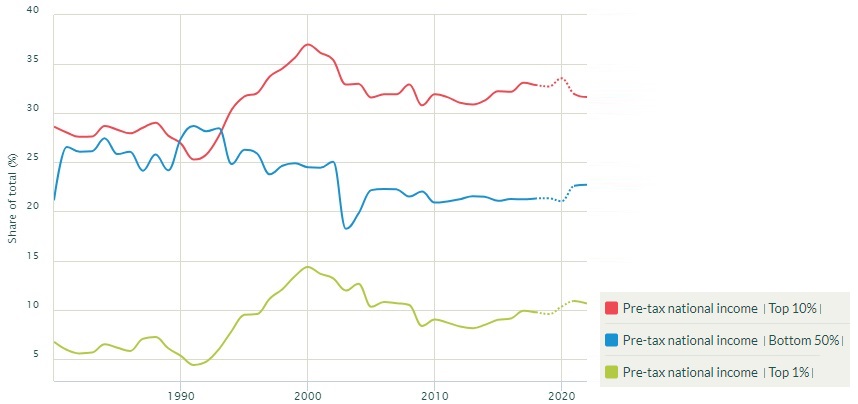
Despite egalitarian ideals and relatively low polarisation in the past, Finland has long been divided. At the end of the Cold War, the rich (top 10 per cent of the population) dominated almost half of national income. The share is about the same as that of the entire labour (bottom 50 per cent). The middle classes (middle 40 per cent) still controlled the highest share, about 40 per cent of national income.
With the turn to the West in the first post-Cold War decade, the rich enjoyed a boom, whereas the share of the labour shrank. However, that of the middle class actually increased.
Today, the rich retain 32 per cent of national income, a share they had already in 1996, whereas labour’s share remains only 23 per cent, or what it was already in 1980, that is, four decades ago. By contrast, the middle has kept its 45 per cent, or what it had two decades ago. Meanwhile, the share of the ultra-rich has stayed around 10 per cent of the total (Figure 6).
Though more stable and less volatile, wealth inequality mimics the trends of income inequality. In this view, there has been barely any change in the past four decades. The rich control over 56 per cent, the middle some 42 per cent, and the labour barely 2 per cent of national wealth. By 2000, the ultra-rich had 18 per cent of national wealth and its grip has prevailed. In relative terms, they own almost 10 times more than they earn.
Figure 6: Rising income inequality, 1980-2020
Source: WID Inequality database
In Finland, political power belonged to the centre-left (conservatives, Social Democrats and Centre Party) through the Cold War. Conservatives got into the government only thereafter. Until the 2008 crisis, the Big Four dominated. Thereafter, the far right has broken into and consolidated its position at the top, largely at expense of the centre and the left.
As the struggle is intensifying for the very future of the Finnish society, most of the rich and ultra-rich, and significant chunks of the middle classes likely united behind Stubb.
The labour, or the bottom 50 per cent of the Finns, are struggling to avoid outright poverty and to revive the country’s long-standing democratic traditions. Many of these voters likely voted for Haavisto, but those whose vote is determined by geopolitics won’t.
The critical role belongs to the middle 40 per cent. The part of the middle class idolising the upper classes likely voted for Stubb. As did those driven by geopolitics and traditionalist, anti-LGBT values. By contrast, those who see themselves squeezed between the middle classes and the working poor and who prioritise economic and ecological considerations likely went for Haavisto.
In the 2024 election, Haavisto built on democracy, green values, and ordinary people; Stubb relied on elite ties, the far-right tide and big money. Haavisto represents an inclusive future, Stubb the exclusive past. However, the latter’s campaign purse is estimated at €3 million (U.S. $3.2 million), a historical record in the tiny Nordic country, thanks to Finland’s wealthiest donors, companies and enterprises and the conservative party. Despite some very loyal and generous donors, the funds of Haavisto’s campaign pale in comparison.[40]
Days before the vote, Stubb’s lead over Haavisto now stood at 53%-47%.
Postscript
Through half a century of the Cold War – after a fatal period of far-right extremism contributing to wars against Soviet Union and ties with Nazi Germany – Finland was led by relatively tough presidents; experienced politicians who stressed national interest rather than sectarian or personal goals: the conservative banker Juho K. Paasikivi, the strong man Urho Kekkonen of the Centre Party and the cautious social-democrat Mauno Koivisto. Theirs was an era of stability: economic growth and welfare state, international neutrality and good relations with Moscow. They were succeeded by Martti Ahtisaari who pushed for NATO membership and Tarja Halonen who was more critical toward the military alliance; and the current Niinistö, the conservative transitional figure.
Those times are now gone. Stubb has proactively pushed for the new and assertive conservative trajectory, including the conservative collaboration with the far-right and himself as the “NATO president.” By contrast, Haavisto stresses caution and moderation seeking to preserve what was good in the old while embracing a more inclusive and sustainable future.
Today, Finland is a NATO member. The membership was said to bring about security and prosperity into the tiny Nordic country. Nonetheless, as border friction, hybrid threats, even nuclear risks are climbing, Finland’s economic erosion is the new reality. At the same time, the welfare state is under fire by the far-right government. Income and wealth polarisation is broadening.
With its ageing population and slowing growth, Finland should invest increasingly in social security, welfare services, economic growth and innovation, and sustainability. Internationally, the country should focus on broad-based cooperation, particularly with the Global South to benefit from its secular economic potential. Yet, the NATO membership will require further militarisation for years to come. And internationally, that compels the country to remain more euro-centric and perhaps even distanced from some large emerging economies, due to geopolitics.
The current status quo is untenable. Something has got to go.
Dr Dan Steinbock is the founder of Difference Group and has served at the India, China and America Institute (US), Shanghai Institute for International Studies (China) and the EU Centre (Singapore). For more, see https://www.differencegroup.net/
Full disclosure: In the past, Dr Steinbock has addressed, advised and consulted Finland’s leading multinationals, government agencies, parliamentary committees, financial institutions, and competitiveness and innovation organisations.
References
[1] “Finland ‘AA+/A-1+’ Ratings Affirmed., S&P Global Ratings, O0 Oct 2023; “Which economy did best in 2023?” The Economist, December 2023.
[2] See Ferraresi, Franco. 1997. Threats to Democracy: The Radical Right in Italy after the War. Princeton, N. J: Princeton University Press,
[3] Teittinen, Paavo. 2023. “‘Spreads and proliferates like a Somali’ – ‘desert monkeys make me puke’ – Minister Wille Rydman’s old text messages reveal repeated racist use of language.” Helsingin Sanomat, 27 July. [in Finnish]
[4] On the voluminous media stories, see e.g., “Interior Minister Mari Rantanen comments on her writing that has been associated with racial doctrines: ‘I believe in statistic.’” Iltalehti, 22 June; “Minister Tavio has talked about demographic replacement several times in the parliament.” Helsingin Sanomat, 3 July. [in Finnish]; “Online threats against Finnish journalist Ida Erämaa should be investigated and condemned” Council of Europe, J July 2023; “Far-right Finnish leader Riikka Purra sorry in racist posts uproar” BBC News, 1 July 2023.
[5] “Foreign minister to MTV.” MTV News, 6 September 2023.
[6] “Finnish workers on strike to protest labour reforms, welfare cuts.” F February 2024; “’Mafia’ strikes bring Finland to a standstill as unions face down government.” EuroNews, February 2024.
[7] Quoted in the interview for the commercial “Seven O’Clock News, MTV 3, F February 2016. [in Finnish]
[8] Suomi, Juhani. 2011. On this side of stars. Siltala [in Finnish]
[9] Vapaavuori, January 2016. Half-Reckless Finland. Otava [in Finnish]
[10] Rosila dedicated to Stubb tens of pages in his memoir. See Rosila, Pertti J. 2019. Herrahissin vauhdissa. Tammi [in Finnish]
[11] Finnish Broadcasting Corporation (YLE): With Alexander Stubb, 17 January.2024, 9 PM.
[12] See https://www.eui.eu/people?id=alexander-stubb
[13] Stubb, Alexander. 2017. Alex, Otava, pp. 52-3 [ebook]
[14] Gates, Robert. 1988. A letter to Prof. Lavery. 30 August. Declassified in part; sanitised copy approved for release on J1 July 2012. CIA-RDP89g00720r000300100001-6
[16] Bumiller, Elisabeth (O October 2003). “Debating a Leak: The Director: C.I.A. Chief Is Caught in Middle by Leak Inquiry” See also Wilson, Joseph. 2003. “What I Didn’t Find In Africa”. New York Times, 6 July.
[17] In 2012, Häkkänen had declared that the conservative “youth share the financial views of Republican Party in the United States”. See “Antti Häkkänen on conservatives’ presidential nomination: ‘Stop talks and together forward.’” Finnish Broadcasting Corporation, 13 August 2023. [in Finnish]
[18] “Raimo Ilaskivi scolds Orpo and the way to select Stubb as the party’s presidential candidate.” Helsingin Sanomat, 4 August 2023 [in Finnish]
[19] Ilaskivi, Raimo. 2023. “What happened to party’s presidential place?” Uusi Suomi, 8 August. [in Finnish]
[20] See e.g., “Finnish presidential election: Faced with Russia, security takes centre stage”. Le Monde. 8 January 2024.
[21] “Haavisto: Opportunity to transfer nuclear weapons through Finland would increase insecurity” – Stubb disagrees.” February 2024. [in Finnish]
[22] Steinbock, Dan. 2008. NATO and Northern Europe: From Nordic Balance to Northern Balance. American Foreign Policy Interests. The Journal of the National Committee on American Foreign Policy, V0 Volume 2008 – Issue 4, pp. 196-210.
[23] Anttila, Pekka. 2010. “Marginalised and into a sick leave.” Suomen Kuvalehti, 47. [in Finnish]
[24] “Wikileaks: The [conservative party] promised Finland into NATO.” Helsingin Sanomat F2 February 2011 [in Finnish]; Wikileaks: US Embassy Urged Finland to Join NATO”. YLE News. 11 February 2011. On the Wikileaks cable 08HELSINKI427_a, see https://wikileaks.org/plusd/cables/08HELSINKI427_a.html
[25] Lappalainen, Tuomo. 201. “Warning about a power coup: ‘Military and police have run away from government overview in Finland.” Suomen Kuvalehti 18 March. [in Finnish]
[26] “Our wisdom has always been that we will not invite to our area the kind of forces, which in crisis situation would be enemies of Russia.” See Nurmi, Eero. 2013. “Finland is being taken gradually toward NATO.” 17 June. [in Finnish]. Volanen scrutinised these challenges of high-level Finnish decisionmaking in Volanen, Risto. 2016. Prime Minister as a foreign- and security policy decision-maker.” In Kimmo Pulkkinen et al. (eds), The augurs of fatherland. Edita, pp 463-86 [in Finnish].
[27] John, Tara (4 April 2023). “Finland joins NATO, doubling military alliance’s border with Russia in a blow for Putin”. CNN.
[28] Tuomioja, Erkki. 2022. Finland and NATO. TSL [in Finnish]
[29] “Finnish expert: Ukraine should stay outside NATO; and so should have Finland.” Iltalehti, J January 2024; “A storm after the Russia comments by the Finnish professor.” Iltalehti January 2024.
[30] 17 Oct – 4 Nov 2008; 26 Sep – 12 Oct 2014; 14 Nov – 3 Dec 2019; 23–25 Feb 2022; Taloustutkimus, Advisory Board for Defence Information (Ministry of Defence)
[31] On the odd history and flawed methodology of the Index, see Steinbock, Dan. 2021. “How the World Press Freedom Index Was Politicised – Long Before the New Cold Wars.” The Street, 25 May. On the Index, see https://rsf.org/en/index
[32] Saari, Mauno. 2019. “Questions to Finland’s free media.” Personal blog, 7 March. See https://www.maunosaari.fi/blogi/?k=vastuullinen+journalismi&p=1
[33] Paananen, Veera. 2023. “Half of the people say that Finland must prepare for war in the coming years.” Helsingin Sanomat, 22 December. [in Finnish]
[34] Quoted by Nurmi, Lauri. 2023. “: “Elina Valtonen warns Finland of drifting in NATO – Russian attack is possible.” Iltalehti, 23 December. [in Finnish]
[35] Finland, Article IV/Country Report, IMF 3 January 2023
[36] On competitiveness and innovation, see the Global Competitiveness Report by the World Economic Forum (annual). On Nokia, see Steinbock, Dan. 2001. The Nokia Revolution. Amacom; and by the same author. 2010. Winning Across Global Markets. Jossey Bass.
Choosing the right embroidered workwear for your business is essential for projecting a professional image and fostering strong brand identity. The process can be overwhelming, considering the wide range of available options and the need to match each garment to the specific requirements of different roles within your business.
To help with this selection, it is important to find a reputable supplier that offers a comprehensive range of high-quality workwear at cost-effective prices, such asEmbroidered Workwear. This will ensure that your employees are provided with durable, functional and stylish uniforms that represent your brand in the best light.
In addition to quality and appearance, consider factors such as the appropriateness of the fabric, intended use of the garments, and the overall comfort of your team. Taking all these aspects into account will help you make an informed decision when choosing embroidered workwear for your business.
Identifying Your Workwear Needs
Assessing Workplace Requirements
Before selecting embroidered workwear for your business, it’s essential to assess the specific requirements of your workplace. Consider the tasks your team performs, the industry you operate in, and any safety regulations that must be adhered to. Make a list of mandatory Personal Protective Equipment (PPE) components based on industry standards and identify additional optional elements that could enhance employee safety and performance. For example:
High-visibility jackets for outdoor workers
Steel toe boots for those in construction
Flame-resistant garments for welders
Additionally, think about the climate and working environment, as these factors can influence workwear material choice.
Ensuring Employee Comfort and Fit
Employee comfort is vital for productivity and job satisfaction. When deciding on uniforms or garments for your team, consider the following factors:
Size range: Choose a supplier that offers a wide variety of sizes to accommodate all employees.
Climate-appropriate materials: Opt for lightweight fabrics in warmer climates, and provide insulating layers for colder environments.
Freedom of movement: Select garments that allow for comfortable movement during work tasks, particularly if employees perform physical labour.
Taking the time to gather feedback from your employees can also help identify specific comfort needs and preferences.
Considering Fabric and Garment Quality
Investing in high-quality embroidered workwear is crucial for presenting a professional image, ensuring durability, and providing employees with comfortable, long-lasting uniforms.
To choose quality workwear, consider the following aspects:
Fabric: Opt for durable materials that cater to your work environment and tasks. For example, moisture-wicking fabrics are ideal for active roles, while more robust materials are better suited to heavy-duty tasks.
Construction: Pay attention to the stitching, seams, and other garment construction aspects to ensure they can withstand regular wear and tear.
Embroidery: Ensure the embroidery itself is well-executed, with neat and secure stitching that remains vibrant and intact after washing. Consulting the washing instructions of the garments will help you better understand their maintenance requirements and ensure longevity.
Taking these factors into account can help you make an informed decision on the right embroidered workwear for your business. Remember, quality workwear is an investment in your brand image, employee satisfaction, and overall productivity.
Customising Your Workwear for Branding
Selecting the Right Colours and Design
Choosing the right colours and design for your embroidered workwear is crucial in creating a professional image and promoting brand awareness. When selecting colours, it’s important to consider your company’s existing branding and logo. Ensure that the colours you choose for the uniforms are consistent with your company’s identity. For example, if your logo consists of blue and white, it’s advisable to use similar shades for the workwear.
Designing a stylish embroidered logo for your custom workwear is a critical step in making your business stand out. Take time to create a visually appealing and identifiable logo that conveys your brand’s ethos. Furthermore, consider factors such as font and sizing, which should not only be legible but also consistent with your brand’s overall style.
The Process of Embroidering Your Logo
Embroidering your logo onto the workwear enhances its professional appearance, durability and brand image. The embroidery process involves a few key steps, starting with creating a digital file of your logo. This file is then converted into a format compatible with an embroidery machine.
Next, your chosen embroidered workwear supplier will use their machine to stitch the logo onto the fabric, typically using high-quality threads made from cotton or polyester. This ensures a durable and long-lasting design that won’t easily fade or peel like printed logos might.
A crucial aspect of this process is selecting the correct embroidery technique for your logo, considering factors like the size, colours and detail within the design. A skilled supplier will help you make the best choice for your desired outcome.
Choosing the Right Supplier and Materials
Partnering with a reputable and experienced embroidered workwear supplier ensures that you’ll receive high-quality products that meet your needs and reflect your brand image. When selecting a supplier, consider factors like their experience, price range, and customisation options. Requesting samples and testimonials from previous clients is a helpful method of assessing the supplier’s work and making an informed decision.
In addition to choosing a reliable supplier, be mindful of the materials used in your custom workwear. Durable, high-quality fabrics like cotton and polyester provide comfort and longevity, essential factors for uniforms that must withstand frequent use and laundering. Furthermore, investing in quality work attire guarantees a professional appearance and showcases your company’s commitment to excellence.
In Conclusion
When selecting embroidered workwear for your business, there are several key factors to consider. These include the quality of materials, embroidery work, and choosing a reliable supplier. Ultimately, these factors will contribute to a professional and cohesive brand image for your company.
Start by researching potential suppliers who offer high-quality garments and embroidery. This will ensure that your workwear is durable, comfortable, and reflects well on your business. Furthermore, consider the following factors:
Material: Choose durable, comfortable materials that can withstand daily wear and tear. Your employees’ comfort should be a priority, as this can affect their productivity and overall satisfaction.
Embroidery: The quality of the embroidery itself is crucial. Opt for high-quality embroidery that is neat, precise, and consistent to polish your organisation’s image.
Design: Work closely with your chosen supplier to create a design that represents your brand identity. Keep the design consistent across all garment types and styles.
Range of sizes: Ensure you cater to all body shapes and sizes by providing a comprehensive range of sizes.
To create the best workwear for your business, utilise bold, italic, and other formatting elements to highlight crucial information, enhance readability, and convey professionalism. By considering the above factors and selecting the right embroidered workwear, your business will be well on its way to creating a strong, consistent, and professional brand image.
Prioritizing employee wellness isn’t just important from an ethical standpoint; it’s also good business. The health and happiness of your workforce can profoundly impact performance, so investing in employee wellness sets up your company for long-term success.
Angela Ahrendts, senior vice president of Apple, said, “Everyone talks about building a relationship with your customers. I think you build one with your employees first.”
Far from having marginal impacts on the success of your business, employee wellness plays a key role in the overall productivity and engagement of your workforce. Below, five business leaders explain how employee wellness can make an impact on your business as a whole.
1. Increased Productivity
Employees who are happy and healthy are more likely to be productive. Regular exercise, a balanced diet, and sufficient rest all contribute to higher energy levels, better focus, and improved cognitive function. As a result, tasks are completed more efficiently, leading to increased productivity within the workplace.
“You may not be able to control your employees’ lives outside work, but that doesn’t mean you can’t support their wellness in the workplace,” explains Andy Khubani, CEO of Copper Fit. “In fact, as the place where your employees spend a third of each day, improving the ergonomics of your office and promoting work-life balance should be a top priority.”
Supporting employee wellness may lead to improved innovation, creativity, and problem-solving, all of which contribute to your business’s long-term success.
2. Reduced Absenteeism
Prioritizing employee wellness leads to a decrease in absenteeism. When employees take care of their physical and mental health, they are less prone to the illnesses and burnout that force them to take sick days — or even quit.
“Burnout has become a bit of a buzzword, but somehow, people are still underestimating how detrimental it can be to business performance,” warns Thomas D. Hull, PhD, Chief Clinical Officer of Hero Journey Club. “Especially post-pandemic, people need rest and support. Being able to provide that to the workforce can translate into real economic benefits.”
All in all, reduced absenteeism corresponds to fewer sick days and unplanned leaves, ensuring a consistent workforce and maintaining business continuity.
3. Improved Engagement
Well-being initiatives foster a positive work environment, promoting employee engagement. Engaged employees are more committed to their roles, leading to increased job satisfaction and a sense of purpose.
“It’s important that employees feel like their superiors and workplace care about them,” says Andrew Chen, Chief Product Officer of CommentSold, a company that helps brands succeed in their Shopify live selling endeavors. “It’s hard to be invested in an organization if that organization doesn’t invest back into you. Wellness initiatives are an effective way to show your workforce you care.”
When employees are healthy and engaged in their work, they positively impact the overall atmosphere within the organization, creating a ripple effect felt across all sectors of your company.
3. Improved Retention Rates
Companies that invest in employee wellness demonstrate a commitment to their workforce’s overall well-being. This, in turn, fosters a sense of loyalty among employees. Organizations with comprehensive wellness programs are more likely to retain top talent, saving costs associated with recruitment and training.
“Hiring and training employees is expensive,” Sid Shamim, CEO & President of Headway Capital says. “The cost might feel invisible because it comes from lost productivity, but that doesn’t mean it isn’t real.”
High retention rates translate to more efficient employees and higher profits. By supporting the health and well-being of your workforce, you can increase the likelihood that they’ll stay with your company and contribute to your business more effectively and sustainably.
4. Better Morale and Team Dynamics
A focus on wellness contributes to improved morale and stronger team dynamics. When employees feel supported in their personal well-being, they are more likely to collaborate, communicate effectively, and contribute positively to the company culture.
“Picture a workplace where everyone is coughing, sneezing, or calling in sick,” says Dr. Michael Green, Chief Medical Officer of Winona, a company known for their progesterone cream. “Not a very fun place to work, right? When everyone in the office feels well and knows their health is a priority, the morale of the whole office improves, and it generally becomes a better workplace.”
Healthy and happy employees enhance overall team dynamics and organizational cohesion, which can cut down on costly errors and pain points. Plus, it’s simply more enjoyable to work in an environment where people get along and like each other.
There are countless benefits to supporting the well-being of your workforce. A robust employee wellness plan for your workplace is one of the best ways to show your employees that you care about their health and well-being.
Unsure how to get started with an employee wellness plan? Here are some tenets of a useful employee wellness plan:
1. Encourage Regular Breaks
Despite what traditional business practices and hustle culture may say, allowing for regular breaks and downtime is important for the overall well-being and satisfaction of your workforce. Encouraging employees to take regular breaks throughout the day improves focus and reduces stress, improving their performance as well.
“Step one to creating a healthy work environment is assessing what the environment is currently like,” recommends Lioran Pinchevski, Founder and CEO of Finaloop, a company known for their ecommerce accounting software. “Are employees afraid of being seen taking breaks or socializing? If so, it might be time to reevaluate how you can create a more positive and supportive workplace.”
Breaks as simple as short walks, meditation, or brief moments of relaxation can be enough to boost morale and decrease stress. Encourage your employees to practice these small breaks to promote a more healthy workplace.
2. Provide Health Benefits
The best way to support employee wellness is by offering comprehensive health benefits that cover preventive care, mental health support, and wellness services.
“A strong benefits package is important for multiple reasons,” explains Brandon Adcock, Co-Founder and CEO of Nugenix. “First, it promotes the health and well-being of your workforce. Second, it lets you stand out and attract and retain talent.”
Accessible healthcare options contribute to employees feeling supported and cared for by the organization. Not only will this foster a positive work environment, but it also serves to make your business more competitive within your industry.
3. Allow Flexible Work Arrangements
Be open to flexible work arrangements, such as remote work options or flexible hours. Providing this flexibility acknowledges and accommodates your employees’ diverse needs, supporting their work-life balance and overall wellness.
“Post-pandemic, a lot of people won’t even consider applying somewhere without a work-from-home policy,” advises Marc Boelen, CEO of 2XU, a company known for their line of mens compression pants. “You might not be able to offer fully remote work, but having some flexibility in your hours will be a major selling point for prospective hires.”
Flexible work arrangements also make your workplace more accessible to those with disabilities, chronic illnesses, or caregiver responsibilities and can alleviate the stress associated with those conditions.
4. Create a Healthy Workplace
Whether your business primarily operates in an office, warehouse, or retail storefront, designing a healthy workplace begins with careful consideration of the physical office space. Incorporating elements that enhance the well-being of employees is essential.
“It might seem obvious, but people work better in an environment that supports their health,” says Amanda Howland, Co-Founder of ElleVet Sciences. “It’s important to do what you can to create a healthy workplace for your employees, whether that be incorporating some greenery throughout the office, investing in high-quality, adjustable furniture, or improving the ventilation of the space.”
Physical attributes collectively contribute to a workspace that supports the health, comfort, and productivity of employees, creating a positive and vibrant atmosphere within the office.
5. Foster a Positive Work Environment
Focus on creating a workplace that prioritizes positivity and inclusivity. A positive work environment reduces stress and promotes a sense of community, which can improve the well-being of your individual employees as well as the team dynamics as a whole.
“Company culture can significantly contribute to the wellness of the workforce,” Shaunak Amin, CEO and Co-Founder of SwagMagic says. “When people trust their colleagues and superiors, feel respected and supported, and know that their wins will be celebrated, it can ease everyday stress.”
Open communication, recognition programs, and a supportive culture all play crucial roles in fostering well-being. Spend some time considering what you can implement in your business culture to promote a more positive and healthy work environment.
Healthy Employees, Healthy Businesses
Recognizing the profound impact of employee wellness on business performance is crucial for organizations seeking sustained success. By investing in the well-being of their workforce, companies can enjoy increased productivity, reduced absenteeism, and improved overall workplace dynamics. In short: Demonstrating that you care about the health and well-being of your employees facilitates both fun and success.
As Andrew Carnegie put it, “There is little success where there is little laughter.”
Employees who feel supported, valued, and appreciated by their workforce are more likely to contribute to the success of the business. Implementing supportive measures ensures that employees feel valued and, in turn, contribute positively to the success of the organization. Happy and healthy employees create a healthy and successful business. It’s as simple as that.
This article is here to help you find a good software development partner by discussing important considerations along the way.
Exploring E-commerce Solutions
The quest for a suitable software development partner resembles a grocery in a supermarket. Amid the plethora of options, distinguishing one from another becomes challenging. This article delves into the intricacies of the decision-making process by examining companies online, emphasizing the importance of scrutinizing past projects and favoring those with a proven track record in your business niche.
Is the Fixed Price Worth It for a Software Project?
This section challenges the notion of fixed pricing for software projects and explores the dilemma of opting for a $5,000 solution when aspiring for a $5 million monthly return. The discussion prompts an exploration of custom software development companies, highlighting their unique approach involving planning, design, development, and maintenance. The emphasis shifts from templated solutions to a more tailored, individualized approach.
Custom Software Development Services Unveiled
This section draws parallels between manufacturing practices and custom software development and illuminates the distinct steps involved in the latter. The focus is on the variance between mass-producing identical items and creating unique, custom solutions. Budget considerations ranging from $20,000 to $50,000 are discussed, with an acknowledgment that project timelines may be extended due to uncertainties.
Creating Clear Software Requirements for Efficient Development
Understanding how essential teamwork is, this part emphasizes the need to work closely with business analysts to create a clear plan. The aim is to avoid redundancy, reduce changes during development, and expedite the project timeline. The narrative explores the challenge of aligning team members on software functionality and advocates for creating a detailed document to ensure consensus.
User Feedback: Listening to Users for Better Software
Acknowledging the inevitability of business changes, this section advocates for gathering user feedback to enhance software reliability. Comparing it to how things are made, the article proposes that software developers should pay attention to users for ongoing enhancements, just like product makers ask for opinions on new items.
Final Thoughts
In conclusion, the article underscores the pivotal role of a reliable software development partner in product creation. VT Labs is an excellent choice for e-commerce development, emphasizing its adaptability to changes and ability to keep businesses ahead of the competition.
In recent years, Leeds has become a thriving hub for entrepreneurship that is continually attracting individuals that have a passion for business and innovation.
While this makes Leeds an excellent choice for your next venture, it does mean you’ll have to work hard to stand out from the crowd.
So, if you’re thinking of starting your business in Leeds, here are just five fantastic tips that can help you to embark on the path to success.
1. Conduct Market Research
Before you decide to dive headfirst into your new business venture, it’s a good idea to take the time to conduct market research. This includes discovering the interests, preferences, and challenges of your potential challenges, as well as gaining an understanding of your competition.
Tools such as YouGov can be utilised to help you understand the needs of your customers, allowing you to position your product or service as a solution to their problems. By tailoring your product offerings, you’ll start to build a loyal customer base.
2. Create a Strong Business Plan
Your business plan is your roadmap to success; it should outline areas such as your goals, target market, marketing strategy, and financial projections. This will not only serve as a comprehensive guide for you, but can be essential when seeking to attract potential investors.
When putting together your financial projections, you should make sure that you cover startup costs, operational expenses, and revenue forecasts as this will help you manage your budgeting and ensure your business remains profitable.
3. Utilise Networking Opportunities
Networking is a key component of success and Leeds is home to a thriving business opportunity that can lead to a wide range of important connections.
Make the effort to attend local business events, join networking groups, and connect with other entrepreneurs in the area, as the relationships that you develop can open doors to collaboration, partnerships, and valuable insights.
Networking not only helps you to gain visibility for your business but also provides you with a platform for learning from the experience, and even mistakes, of others.
4. Embrace Digital Marketing and Online Advertising
We live in a digital age and this makes it essential for your business to have a strong online presence if you’re hoping to see success. Invest in a professional website that is simple and easy for your customers to use, regardless of what stage they’re at in their conversion journey. The content on your site should then be optimised for search engines using the keywords that your potential customers are searching for to ensure that it climbs the Google rankings.
Of course, while SEO is one of the best things you can do to improve your brand’s visibility, it’s a strategy that can take time. However, in the early days of your startup, you’ll want to hit the ground running. Consider working with a PPC agency in Leeds, such as Maratopia to develop a PPC campaign that converts quickly.
5. Find your Perfect Commercial Property
While many business owners are still choosing to cut costs by operating from the comfort of their own home, you might like the idea of having a commercial property.
You might have thought Rightmove was only a great way to find a new home, but the platform can also help you find your ideal office space too.
Share your tips for launching a business in Leeds in the comments below!
By Danny Leipziger
China cannot continue to rely on exports to drive its growth, but what are the alternatives?
China ran a $1.2 trillion trade surplus last year, and despite admonitions from the IMF to rely...
The World Financial Review uses cookies to improve site functionality, provide you with a better browsing experience, and to enable our partners to advertise to you. Detailed information on the use of cookies on this Site, and how you can decline them, is provided in our Privacy Policy and Terms and Conditions. By clicking on the accept button and using this Site, you consent to our Privacy Policy and Terms and Conditions. ACCEPT
Privacy & Cookies Policy
Privacy Overview
This website uses cookies to improve your experience while you navigate through the website. Out of these cookies, the cookies that are categorized as necessary are stored on your browser as they are essential for the working of basic functionalities of the website. We also use third-party cookies that help us analyze and understand how you use this website. These cookies will be stored in your browser only with your consent. You also have the option to opt-out of these cookies. But opting out of some of these cookies may have an effect on your browsing experience.
Necessary cookies are absolutely essential for the website to function properly. This category only includes cookies that ensures basic functionalities and security features of the website. These cookies do not store any personal information.
Any cookies that may not be particularly necessary for the website to function and is used specifically to collect user personal data via analytics, ads, other embedded contents are termed as non-necessary cookies. It is mandatory to procure user consent prior to running these cookies on your website.