Home Blog Page 22

Customer Experience as a Competitive Edge: Real-Time Tracking, Personalization, and Communication in Last-Mile Delivery

There is a specific kind of anticipation that comes with a delivery. You have placed the order, received the confirmation, and count the minutes to your tasty pleasure. You check the tracking page once. Then again. And again. That small window between ‘out for delivery’ and the doorbell ringing is where customer experience truly lives.

Last-mile delivery is no longer just logistics, considering the e-commerce world we are living in. It means emotion, expectation, and brand perception wrapped into one final interaction. And increasingly, it becomes the thing businesses win or lose customer loyalty.

The Last Mile: Where Experience Becomes Reality

Think about it, everything leading up to delivery is digital – product pages, checkout flows, confirmation emails. But the last mile is tangible because it is the moment your promise becomes real.

A smooth, transparent delivery can leave a lasting positive impression. In contrast, a missed order, vague tracking, or silence during delays all trigger frustration. That feeling tends to stick longer than the excitement of the purchase itself.

That is why companies are rethinking last-mile delivery. They begin to treat it as a customer experience opportunity rather than just as an operational challenge.

Real-Time Tracking: Reducing Waiting Anxiety

We have all been in a situation of staring at a tracking update that says ‘arriving today’ with no further details. It creates uncertainty, which, in turn, erodes trust. Real-time tracking changes that dynamic, so instead of guessing, customers can:

  • See where their package is at any moment
  • Get accurate, dynamically updated delivery times
  • Follow the driver’s route in real time

It seems a small shift at first sight, but it has a powerful psychological impact. Transparency replaces anxiety, while control replaces guesswork.

Looking from a business perspective, it also quietly solves a major problem of fewer messages, like Where is my order? How long should I wait? Customers don’t need to ask when they can already see.

There is something more subtle at play here, too. Real-time tracking keeps the brand present in the customer’s mind, even after checkout. Every interaction with the tracking page becomes another touchpoint, encouraging future collaborations.

Personalization: Deliveries That Fit Real Lives

It is natural that not all customers live the same way. So last-mile deliveries shouldn’t also have to be universal. Personalization in last-mile delivery is about meeting customers’ lifestyles, literally and figuratively. It recognizes that convenience looks different for everyone.

For some, it might mean choosing a precise delivery window after work. For others, it might be redirecting a package to a nearby locker or pickup point, or simply adding a note like ‘please leave behind the gate.’ These options are small, but together they create a strong sense of oversight, being a powerful driver of satisfaction.

How personalization evolves over time is even more interesting. When systems learn from customer behavior, involving preferred delivery times, locations, or communication styles, the experience starts to feel intuitive and almost effortless. It is an essential shift from just casual delivery to a service that mindfully adapts.

Communication: The Quiet Hero of Great Delivery Experiences

If real-time tracking translates to visibility, communication translates to trust. Customers don’t expect perfection. They want to be informed. A simple message at the right moment can completely transform how a delivery is perceived:

  • ‘Your order is on its way’ builds anticipation
  • ‘The driver is 10 minutes away’ brings readiness
  • ‘There is a delay, here is the new time’ shows respect

On the other hand, silence creates frustration and can kill the impression of the brand at its roots.

The most effective last-mile delivery experiences are established on proactive communication. Many misconsider it with a fast reaction when something goes wrong, but it is actually about guiding the customer through the process step by step.

That way, when issues do happen – as they inevitably will – clear, human-centered communication can turn a negative moment into a surprisingly positive journey. Customers tend to remember how they were treated, not just the mishaps, at the end of the day.

Technology Working Behind the Scenes

Things flowing smoothly for the client are often powered by complex systems behind the scenes. Route optimization tools calculate the most efficient paths. AI models adjust delivery estimates in real time. Integrated platforms ensure that updates are sent seamlessly across SMS, apps, and email. But the truth is, customers don’t see the technology. They touch the result.

  • They feel it when a delivery arrives exactly when expected.
  • They notice it when updates are timely and accurate.
  • They appreciate it when everything performs.

So the goal should be to remove friction instead of illustrating cutting-edge technology.

The Challenges: Balancing Experience and Complexity

Of course, none of this comes without challenges. Providing flexible last-mile delivery options increases complexity. Implementing advanced tracking requires a great deal of investment. Handling customer data in a responsible way demands careful attention. Maintaining consistency can be especially difficult during peak periods.

Strategy plays a significant role here. The common mistake is to offer everything instead of offering what truly improves the experience sustainably. The most successful companies prioritize thoughtful innovation over more features.

Looking Ahead: The Future Feels Personal

Customer expectations will only rise along with technological progress. We are already seeing early signs of what is next – predictive delivery windows, hyper-personalized options, even autonomous delivery methods.

However, customers seek clarity, understanding, and control beyond the innovation. Keeping that in mind, the future last-mile delivery is going to be more intuitive and human-oriented.

Bottom Line

Last-mile delivery is often the most complicated part of the supply chain. While that is true operationally, it represents the most human touchpoint in the entire customer journey. It is the moment when expectation meets real experience, with the brand’s promise either fulfilled or undermined.

Real-time tracking, personalization, and clear communication are not just functional improvements in this context. They become strategic signals of reliability, respect, and customer-centric thinking. These elements do more than improve delivery – they demonstrate that a business values the time, preferences, and trust of its customers, framing the overall brand experience in an increasingly competitive market.

From Strategy to Start-Up: How Anderson Kurunczi Domingos Structures Execution in Capital Programs

This profile is based on and a review of selected project artifacts, sanitized to protect confidentiality. Supporting materials for this type of work may include governance templates, procurement documentation, and commissioning readiness checklists.

Large capital programs rarely fail in a single dramatic moment. More often, they drift—through unclear scope, slow decisions, unmanaged change, vendor misalignment, and interface gaps that surface when commissioning is already underway. Anderson Kurunczi Domingos has built his work at the point where that drift can be contained early, before options narrow.

Domingos

Domingos is a capital programs governance and project controls leader with experience across industrial environments, including process-industry settings connected to biomanufacturing. Rather than treating execution as a downstream phase, he emphasizes controls designed to make delivery repeatable: decision-quality baselines, explicit decision cadence, disciplined change control, vendor accountability, and clear ownership of interfaces from engineering through start-up readiness and handover.

His perspective was shaped close to operations, where constraints are real and performance is visible. That grounding informs a pragmatic view of capital delivery: success is framed around safe start-up and stable operation—not mechanical completion alone. He holds doctoral-level training in chemical and biochemical process engineering, which he applies to translate technical complexity into sponsor-ready scope and execution controls.

“I materialise complex initiatives into operating assets by governing the mechanics sponsors care about,” Domingos said.

At the center of his approach is decision clarity. In sponsor-facing environments, he prioritizes making scope usable for procurement and delivery—not merely aligned in principle. Once baseline information is decision-grade, he focuses on cadence—who decides what, when, with what evidence—and ensures changes are assessed and governed rather than negotiated informally.

Micro-case 1: Execution readiness before procurement

In one multi-discipline biomanufacturing expansion, Domingos’ role centered on preparing the program for technical procurement. The work focused on execution-readiness documentation suitable for RFQs and on technical alignment so proposals could be compared on deliverability rather than narrative.

The practical outcome is a procurement process anchored in evidence: clearer assumptions, fewer interpretation gaps in vendor commitments, and decisions that move without late reversals driven by scope ambiguity. Typical supporting artifacts include sanitized RFQ packages, technical evaluation summaries (bid tabs), decision logs, and controlled-change registers. — Dr. Saiful Seraji

Dr. Saiful Seraji, PhD in Chemistry (University of Connecticut), an experienced process engineer with hands-on expertise in technology development, said: “What stood out in Anderson’s work was his insistence on decision-quality scope. Once baselines were clear, procurement discussions shifted from opinion to evidence, and decisions moved faster with less rework.”

Micro-case 2: Owning interfaces before commissioning forces the issue

In multi-contractor delivery environments, Domingos consistently emphasizes interfaces—the handoffs between disciplines, vendors, and operations where issues often surface late. His governance routines are designed to keep interface ownership explicit, define readiness criteria early, and make change visible as execution progresses in parallel.

The practical outcome is earlier exposure of integration gaps—while fixes are still manageable—so commissioning is less about surprises and more about controlled readiness. Typical supporting artifacts include interface registers/RACI, readiness checklists, handover criteria, and commissioning punchlists (all sanitized for confidentiality). — Eng. Fabrício Pereira Mota

In a separate biomanufacturing project where he worked alongside Domingos, Eng. Fabrício Pereira Mota, CEO (company administrator) at Prioridade Engenharia e Comercio Ltda, said: “From a maintenance perspective, the projects Anderson governed arrived better prepared. Interfaces were clearer, and start-up issues surfaced earlier, when they were still manageable.”

What he audits first

Across roles, Domingos’ early audits tend to focus on five elements:

  • Baseline quality: Is scope decision-quality and usable for procurement?
  • Decision cadence: Who decides what, when, and with what evidence?
  • Controlled change: Are impacts visible and governed consistently?
  • Vendor deliverability: Are commitments tied to acceptance criteria and executable constraints?
  • Interface ownership: Are handoffs owned before commissioning makes gaps expensive?

The result is a delivery rhythm that resists drift—clearer handoffs, fewer late surprises, and readiness criteria defined before start-up becomes urgent. In capital programs where complexity is normal, predictability is not a personality trait. It is a system built from mechanics that hold under pressure.

About the Author

Anderson Kurunczi Domingos is a capital programs governance and project controls leader with experience in multi-vendor delivery environments across process industries. He holds doctoral-level training in chemical and biochemical process engineering.

Half of New Entrepreneurs Work Solo: QNET’s Model Fits the Individual-Driven Trend

Entrepreneurial activity surged across 79 economies in recent years, with half of new business owners now operating without traditional employees, according to the Global Entrepreneurship Monitor.

Professor Niels Bosma, research director at GEM, characterized this development as more than temporary adaptation. “We are seeing a clear global trend toward solo entrepreneurship,” he told the International Business Times. “It’s not just a stopgap, but a fundamental redefinition of what work looks like in a digital economy.”

Direct sellers like QNET have built operational frameworks that accommodate this shift toward individualized businesses. The wellness and lifestyle company provides centralized infrastructure—inventory management, payment processing, shipping logistics—that allows distributors to build sales teams while avoiding the overhead typically required to run product-based businesses.

“It’s really micro entrepreneurship,” said Ramya Chandrasekaran, QNET’s head of communications, in a recent interview. “We give people the opportunity to build their own sales business without establishing their own company.”

Early Digital Adoption Enabled Solo Operations

Trevor Kuna, chief marketing officer at QNET, traced the company’s solo-entrepreneur compatibility to strategic decisions made decades ago.

“In the early 2000s, we made a decision that changed everything. We embraced e-commerce long before the rest of the direct selling industry saw digital platforms as the future,” he told MediaBrief. “While many companies were still relying only on door-to-door sales and in-person gatherings, we built a digital-ready business that removed borders and allowed our distributors to grow without limitations.”

That infrastructure became essential as individual entrepreneurship accelerated. QNET’s e-commerce platform handles functions that would otherwise require staff or capital investment. Distributors receive unique referral codes that track transactions automatically. Products ship directly from company warehouses to customers. Customer service operates through corporate channels rather than individual seller management.

The operational setup mirrors how gig economy platforms removed friction from solo work. Where Uber provided the app and rider network, QNET provides product sourcing, fulfillment, and compensation tracking. Independent distributors build a sales team, but they operate as individuals enabled to focus on customer acquisition and relationship management rather than operational infrastructure.

“QNET began in 1998 with a simple belief: entrepreneurship should be open to anyone with the drive to build a better life, and the products behind that opportunity must genuinely improve everyday living,” Kuna explained. “That belief has guided us for 27 years and still defines who we are.”

The model reduces what economists call entrepreneurial barriers. Startup capital remains minimal: distributors pay registration fees rather than inventory costs. And while team building is at the heart of the direct selling business, no physical storefront or warehouse space is required.

Numbers Behind the Trend

The World Federation of Direct Selling Associations estimated 104.3 million people participated in direct selling globally in 2024, with retail sales reaching $163.9 billion.

WFDSA data showed the count of independent sales representatives held steady year over year despite flat global sales, suggesting the channel retained participants even without explosive growth. Nearly half of reporting markets showed positive sales expansion in 2024, with average market growth rates returning to positive territory after pandemic disruptions.

WFDSA research identified nearly 1 billion latent entrepreneurs globally: individuals not currently operating businesses but planning to start within three years. That figure represents 18.9% of the working-age population across 49 countries surveyed.

Countries with challenging business environments showed particularly strong entrepreneurial intentions. Qatar posted the highest rate at 60.8%, while India held the largest absolute number with approximately 275 million latent entrepreneurs. These populations may face barriers that make solo, low-capital ventures more practical than traditional business formation.

Digital Infrastructure as Entrepreneurial Enabler

QNET’s digital infrastructure allows the company to scale resources without requiring distributors to invest in technology, in many cases launching businesses using only their smartphone. To prevent scammers from taking advantage of the QNET name, the company’s verified mobile app processes transactions, displays product catalogs, and provides training materials. Distributors access the same systems whether operating in Malaysia, Ghana, or India.

“In response to the evolving e-commerce landscape, QNET has implemented several strategies to stay ahead in the industry,” Kuna said in a previous interview. “Among these, our award-winning QNET mobile app takes center stage, playing a pivotal role in enhancing the overall shopping experience for our valued customers and distributors, anytime, anywhere.”

A single person can manage multiple customer accounts because the platform automates administrative work. Sales volume, rather than operational capacity, determines workload and team-building decisions.

The pandemic accelerated reliance on these digital systems. “While lockdowns slowed down traditional direct selling models, our digital ecosystem, online training, content engines, mobile-first tools, allowed our distributors to operate fully online,” Kuna noted. “What could have been a setback became a moment of acceleration.”

Competitive Positioning in the Solo Economy

Direct selling competes with other solo work models: freelancing platforms, e-commerce marketplaces, rideshare services. Each removes different friction points. Freelancing platforms match skills to projects. Marketplaces provide storefronts. Rideshare apps coordinate transportation.

QNET’s differentiation centers on product access and training. Distributors sell exclusive items unavailable through retail channels. The Bernhard H. Mayer watch collection, HomePure water systems, and Amezcua wellness devices require direct relationships with manufacturers that individual sellers couldn’t establish independently.

“Another turning point was our decision to focus deeply on wellness and home health solutions backed by research,” Kuna explained. “As global interest shifted toward preventive care and holistic well-being, we were already moving in that direction.”

The solo entrepreneur trend speaks to direct selling’s structural approach while creating new challenges. There is an increasing acceptance of flexible, independent work, particularly among Gen Z, but challenges arise from increased competition for attention and time.

Kuna acknowledged the shift in how consumers make purchasing decisions. “The funnel exists, but it is no longer a straight line. It has become a network where people enter and exit from any point based on recommendations from friends, communities, and creators they trust,” he said. “In a way, this shift validates our model, because direct selling has always been built on personal recommendations and real stories from real people.”

Some Economic Consequences of the Iran War

By Dr. Jack Rasmus

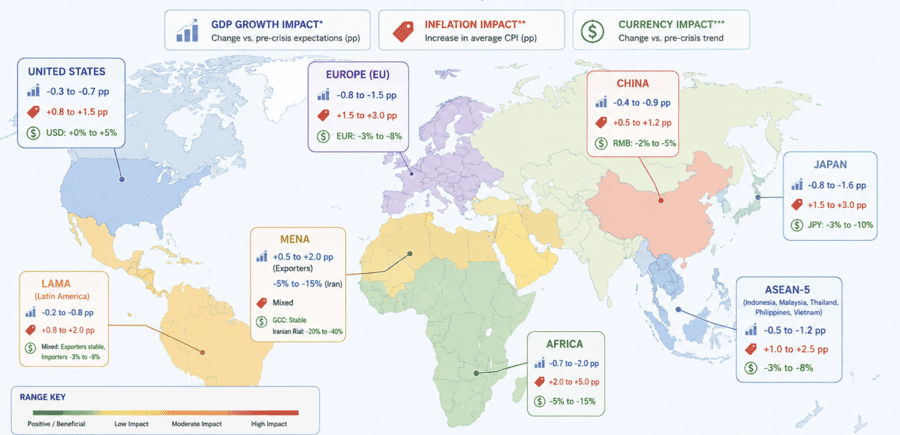
As the US-Israel war on Iran enters its third week, the outlines of the economic consequences and fallout of the war have begun to emerge. As the war continues—and by most indicators it appears it will for months longer—the War’s negative impact on the US and world economies will deepen further.

What are some of the economic dimensions for the War’s negative consequences?

First and most obvious is the current oil price shock’s effect on inflation. Not for just US prices but other countries as well. And not just for goods and services but for asset prices (i.e. stocks, bonds, forex, derivatives, gold, silver, etc.).

Another is the long term disruption of global supply chains and the volume of global trade.

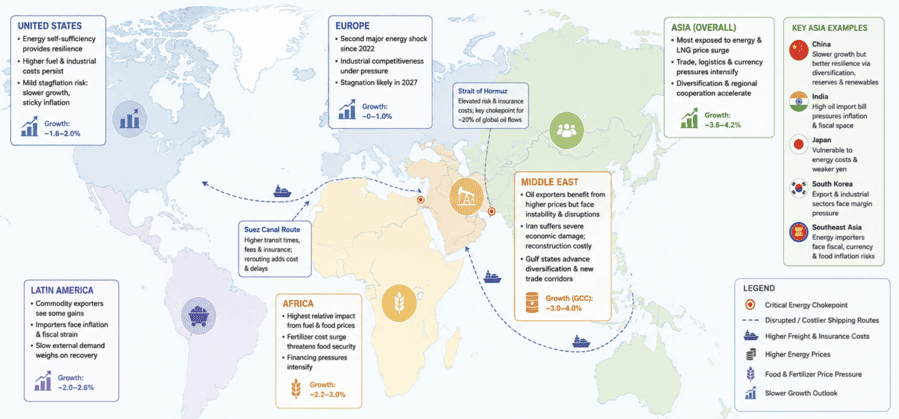
As inflation rises, central banks, led by the US Federal Reserve, will continue to raise interest rates with a corresponding negative impact on the US and other economies, many of which are already nearly stagnant or are beginning to enter recession. Most heavily impacted will be Europe, the Gulf States, and middle east energy dependent countries in east Asia like Japan and South Korea.

Another negative impact will be on global money capital flows—both real investment and financial portfolio asset markets (stocks, bonds, forex, derivatives, etc.).

Then there’s the US budget deficit and national debt. The deficit will now approach $2 trillion a year, for the third straight year. That deficit will drive the national debt to exceed $39 trillion by later this spring and possibly $40 trillion by year end.

Another negative impact will be on global money capital flows—both real investment and financial portfolio asset markets

The Iran war and its costs converge with a host of other forces driving the deficit and the debt into ever greater crisis: Trump’s escalating war spending (including his plan for $400 billion more for just the Pentagon), the current sharply slowing US real economy (that grew at a mere 0.7% rate in fourth quarter 2025), the present collapse of employment and job creation now underway in the US and Trump’s massive 2025 $5 trillion tax cuts benefiting mostly investors and corporations at the expense of US Treasury tax revenues which is estimated to reduce corporate income tax revenues by $77 billion in 2026.

Not least, the war will accelerate the current fiscal crisis of the American Empire. The costs of Empire now exceed $2.2 trillion a year when all categories of ‘defense’ in the US budget are considered, not just the Pentagon and the US Department of Defense—the latter alone which now exceeds $1.1 trillion a year.

Trump’s war in Iran will exacerbate all these negative economic trends, US and global; and the longer the war continues—which by all indicators it will—the worse the negative economic consequences.

Putting some numbers and facts around the above trends, the picture now beginning to appear in terms of economic consequences of the Iran war is as follows:

Oil Price Shock

Throughout 2025 the price of global crude oil remained at around $60 a barrel. It began to rise in late January 2026 and hit $71 just before the war began Saturday, February 28. Prices initially spiked to $118 the following Monday, March 2, but then settled down below $100 the rest of the first week. On March 9 they were still $98. At the start of the second week Trump tried to talk down the price by saying the war was “over soon”. His Energy Secretary then posted on the department’s website that US warships had begun escorting tankers through the Hormuz strait. Oil prices quickly fell to $87. But when the facts revealed the war was not about to end in a week, and that there were no escorts, the Energy Secretary quickly took down the fake claim from the department’s website and oil prices rose again. By Thursday, March 12 they were $101. On March 15, $104. On Monday, March 16 the price of benchmark Brent crude oil hit $106. The price of crude oil will fluctuate day to day with events in the war in the short run but steadily rise over time.

At the retail gasoline level in the US, the Trump administration has continued to under report the price of gasoline at the pump, after two weeks of war claiming it has risen only 15 cents a gallon. In fact, the average was closer to 70 cents, according to other official estimates, and in regions like California more than $1.50/gallon.

Strategic Petroleum Reserve Failure

Trump’s major policy response to address the crude oil supply shock during has been to announce the release of 172 million barrels from the US Strategic Petroleum Reserve (SPR). After Biden’s SPR release in 2022, the reserve was never restored. Before Trump’s recent announcement, the SPR held only 412 million barrels or about 60% of its total capacity. That’s to be reduced now by another 172 million barrels. Europe, Japan and other countries have also announced inventory releases, for a global total of around 400 million barrels of extra crude supply for the global market. But neither the 172 or 400 million barrels will have much effect on global and US prices. Here’s why:

The shutdown of the Hormuz strait results in a 20.3 million barrels a day reduction in total global oil supply, which is about 30% of all seaborn crude oil.

At 20.3 million barrels a day, 400 million additional barrels from the US SPR and global reserves provides for roughly 20 days additional supply to offset the closure of the straits. But 20 days assumes that 20 million barrels from the SPR and other inventories are released to the market immediately on day one. That cannot occur.  There’s a ‘flow rate’ limit of release from the SPR which is no more than 2 million barrels a day.  That means it will take 200 days—not 20—for the SPR and other sources to reach global oil markets. So global supply is still reduced by 18 million barrels a day due to the Hormuz closure. The SPR release will hardly dent the supply effect of the Hormuz closure and so little to dampen rising global crude prices in coming weeks. Nor will it effect much the price of US gasoline at the pump which will also keep rising—as Biden discovered when he released SPR oil back in 2022.

And there’s countervailing forces why gasoline at the US retail level will continue to rise.  Whenever there’s a jump in crude oil supply—due to SPR release or other causes—US oil companies simply reduce their output accordingly and/or US drilling companies take a number of their drilling rigs temporarily offline. The result is not a net increase in supply of gasoline even if there’s an excess of crude oil supply from the SPR.

Moreover, US oil companies control the retail price of gasoline at the pump by manipulating refinery output—not by changes in crude supply. They have purposely not built a new refinery in the US in 50 years! As a result, they can turn off the supply spigot at the pump whenever they want by simply reducing refinery output regardless of crude supply changes. That typically occurs after announcing refinery shutdowns for maintenance, repairs, fires or other such excuses. So forget the politicians’ and media talk about the global price of crude. Oil companies control gasoline prices by controlling the bottleneck of oil refinery operations.

As the war drags on—likely now for weeks if not months—the global price of crude may spike much higher than the current $100 a barrel. The Goldman Sachs bank has forecast the price can potentially rise to $200 a barrel, or more. Not coincidentally, the Iran government has indicated its target is to push the price to $200.

Global Supply Chain Disruption

The closing of the straits is not only disrupting global crude oil supply but other commodities supply as well.  20% of the world’s natural gas supply also ships through the Hormuz strait. A significant supply of fertilizer, petrochemicals, plastic packaging, and some metals also pass through the strait. Their supply will be disrupted as well, with various price impacts. The supply of fertilizer may especially have an impact on crop production and food prices in emerging markets in Asia and Africa.

There’s also the matter of the disruption of the supply of shipping containers. A significant supply of containers are locked up now in the Persian Gulf. That will have repercussions on the availability of shipping containers world wide, creating shortages in places and raising container prices.

US Dollar and Gold

The Iran war and rising oil prices will have a significant impact on the value of the US dollar and in turn on the price of Gold. The war and its effects comes on the wake of the bubble in Gold prices in 2025 which rose from $1900 an ounce to more than $5000 throughout the year. Conversely, 2025 witnessed a 10% devaluation (price decline) of the US dollar. Both assets, the dollar and gold, have surged as the War erupted, as investors seek safety havens. The Gold price surge will now continue. The US dollar recovery will not.

The dollar will resume its decline eventually as Demand for dollars to buy oil declines as 20% of the global supply of oil is taken offline. Investors will shift asset investing more to Gold, continuing to drive up its price. In turn rising gold price will further depress the value of the US dollar. Thus, longer term, the dollar will devalue further by year end while gold will rise further.

To try to accelerate the dollar’s decline, Iran has announced policies to hasten decline in its Demand and thus the value of the dollar. It has announced it will allow tankers to pass through the strait of Hormuz so long as they carry oil that is bought and sold with the Chinese Yuan.

US Inflation

Economists’ estimates are that the US consumer price level will rise by 1.3% points should the price of crude oil remain around $100/ barrel. The US CPI has hovered in the 2.5%-2.9% range. That means the CPI rises to more than 4.0%. But that’s not the full impact of inflation on the consumer. The CPI (or its cousin US price index the PCE) does not include interest rates which have already begun to spike, impacting auto loans, mortgages, and credit cards. Nor does it fully reflect prices in other categories of purchases that impact consumer budgets. The 1.3% estimate is for the direct cost on energy expenditures, primarily regular gasoline (note most US car owners buy premium but the media likes to quote regular). The CPI won’t fully reflect the coming rise in utilities (gas and electric), transport (airlines, trucking, railroad), and food prices as fertilizer and plastic packaging costs rise with global crude prices. Nor does the estimated 1.3% account for consumers’ inflationary expectations almost certainly to rise as well in coming months.

Financial Asset Price Volatility

Effects on the US dollar and gold have already been noted. But what about other financial assets like stocks, bonds, derivatives, forex, etc.?  The disruption of trade, energy, and money capital flows will likely mean a shift by investors out of certain stocks and bonds and a rise in the cost of derivatives insurance.

More instability in US stock and bond markets is already appearing, and it comes on the wake of a significant correction in February in US financial markets. The S&P 500 and Nasdaq markets have contracted 5-7% since February. The economic uncertainty unleashed by the War will dampen financial asset investment further.

And what about that sector that had driven almost all of stock price appreciation in 2025—i.e. the tech and AI boom? What will be the impact of $100 or more oil prices on energy costs on the huge investments now underway in Artificial Intelligence,  most of which is targeted for the energy hungry AI data centers being built out at present? The AI bubble was already showing signs of contraction before the war. Will sustained surging energy prices lead to further AI stock related instability?

While some asset prices will accelerate further due to the War, others may deflate due to the same. That includes certain stocks and bonds as interest rates rise, emerging market currencies, and of course the dollar.

Interest Rates

Another direct consequence of the War is the rise of interest rates in the US. Already 10 and 30 year Treasury bonds have begun to rise since the start of the war two weeks ago.  They will rise further.

The US Federal Reserve will now be even more reluctant to reduce US short term rates at its next and subsequent meetings, out of concern for rising inflation on the horizon. The Fed cut rates three times last year. Trump opened a war on the Fed to force it to reduce rates again further and faster. He needs big cuts in order to have an effect on a US real economy that is weakening fast. He needs lower rates at least six months before the US November 2026 elections. He’s running out of time. Trump just lost a major court case in which he tried to legally force Fed chair, Powell, out of office. Given the inflationary pressures generated by the War, the Fed is now less likely to bow to Trump’s pressure and reduce rates. And the longer the war, the less likely the Fed will reduce rates.

US Real Economy

The US real economy enters the War on particularly shaky ground. As previously noted, real US GDP for fourth quarter 2025 was a mere 0.7% and for all of 2025 barely 2%.  US job growth for all of 2025 was only 181,000 when 1.2m are needed just to absorb new entrants to the labor force. February’s latest job numbers showed, moreover, a contraction of 92,000 jobs. The US employment sector is already in recession.

Consumer spending has recently also slowed down. That’s 2/3s of US GDP. And the Net exports category of GDP will again now worsen due to global trade disruptions. That leaves business investment even more dependent on the AI bubble, as US government spending continues to cut social program spending to make way for more war spending.

In short, the war may well push the US economy into a condition of Stagflation—i.e. rising prices amidst declining jobs and slowing GDP.

One should not forget the role that oil price spikes can play in economic recessions. Economists generally overlook the role spiking oil prices played in the 2008-09 great recession.  It was in the spring-summer 2008 that global crude oil prices shot up to $147 a barrel—a record level which helped precipitate the great recession that year. The financial crash of 2008 played a major role in causing the recession but the oil price explosion that occurred in parallel with the financial crash contributed as well. One should therefore not overlook the potential of price shocks in precipitating recessions—whether 2026 or 2008.

Europe, Russia, Asia and Emerging Economies

Europe economies are in an even worse condition than the US. Already battered by energy costs of US LNG gas and oil six times higher than former Russian natural gas, Europe’s economies have been hovering around stagnation or mild recession, according to official statistics.  Europe political elites have exacerbated the conditions by continuing to divert critical money capital for investment in their own economies to Ukraine instead. Now the Iranian war effects will exacerbate energy cost inflation and slow growth in Europe even further.

Europe gets much of its oil and most of its natural gas from the Gulf states. With that blocked, it will have to buy more from the US—at likely even higher prices. The rising cost of energy may well push the major economies of Europe—Germany, France, UK—over the recession cliff.

The Gulf states economies are in even worse state than Europe’s. Their main money engine of oil and gas is virtually shut down or damaged. It will take months, perhaps years, to restart production and repair damages. Their economies are clearly already contracting sharply.

Asian countries like South Korea and Japan are heavily dependent on middle east oil and gas. Japan had created a significant stored reserve. But South Korea had not. That country will almost certainly have to start rationing energy use soon.

Then there are those emerging economies that are heavily dependent on the dollar, having ‘dollarized’ their economies. As interest rates rise, the price of the bonds they have issued or hold will decline sharply. Their currencies will decline and their reserves for purchasing critical imports will dry up. Some will have to borrow more again from the IMF. Others, cut social spending. They will import less food due to rising prices and their falling currencies. Serious food shortages may occur in these dollarized emerging market economies.

In contrast, Russia is a big winner economically from the Iran war. The surge in the price of crude from $60 to more than $100 a barrel is estimated to result in $150 million a day in additional revenue for Russia.

China benefits as well. While China imports a significant amount of its total oil imports from Iran, it is thus far not significantly impacted. Iran has reported it continues to export a significant volume of its oil to China. China has developed alternative global sources for its oil imports and has amassed a reserve of oil that reportedly can last five months. In addition, it can always import more from Russia.  Its net assets will rise appreciably with the rising price of gold, which it has been acquiring and storing for years.

Finally, as the war in Iran drags on, there will be a further drift from the use of the dollar to purchase oil and toward alternative currency arrangements now being prepared by the BRICS. The war and its economic dislocations will benefit the BRICS at the expense of the US dollar.

Exodus from the Gulf States

Reports abound of the growing exodus of investors and wealthy local populations from the Gulf states as the war intensifies and Iran continues to bomb their infrastructure and US military bases, from the UAE in the south of the Gulf to Kuwait in the north. As the wealthier population leaves, they take their wealth with them. That means investment projects throughout the region are on hold or even being cancelled. In addition, Western money capital is not entering the region now, and Gulf investors are moving their capital from the region and investing it mostly in Gold and other metals elsewhere. The entire economies of the region are being severely disrupted, in other words, not just the flow of crude oil and natural gas.

US Costs of Empire

A generally overlooked consequence of the Iran war is the effect it will have on an already out of control US defense spending and related costs required to maintain the US empire today in general.

The US mainstream media and politicians like the public to think that Pentagon spending represents the total costs of defense in the US budget. That Pentagon spending is now more will exceed $1 trillion in 2026. But that’s not all the US defense department spends. Its total expenditure is now more than $1.1 trillion. And that doesn’t include other obvious ‘defense’ or ‘war’ expenditures like funding the CIA and intelligence agencies, costs of past wars in veterans benefits, development of nuclear weapons in the Energy Department budget, military aid and assistance to allies, Homeland Security escalating costs, costs for secret new weapons development not indicated in the US budget, and interest payments on the national debt due to defense/war spending’s share of deficits and national debt interest payments.

Nor does the US budget$1.1 trillion authorization for the Pentagon and Defense Dept. include Trump’s 2026 current spending on what’s called ‘Overseas Contingency Operations’ for direct war actions in Venezuela and now Iran. It is estimated the US has been spending $2 billion a day on the war in Iran. And that probably doesn’t include weapons replacement costs. Deploying three aircraft carrier tasks forces is not cheap. Committing one third of US aircraft to the region isn’t either. Nor repairing eventually the damage to the US dozen plus bases in the Gulf and aid for the Gulf states to replace their destroyed air defense systems, the radars of which alone cost $1 billion each.

In short the tab for the Iran war after 20 days is at least $50 billion in OCO. And if Trump sends in the Marines and tries to have the US navy escort ships through the Hormuz straits that tab will rise by tens of billions $US more.

In addition to all that Trump is calling for an increase of another $400 billion for the Pentagon in the next budget as he obviously plans for more wars.

Conclusions

The longer the war the greater the costs to the US across multiple dimensions. Moreover, the longer the war the more likely Iran will ‘win’.

The longer the war the greater the costs to the US across multiple dimensions. Moreover, the longer the war the more likely Iran will ‘win’.

Iran is approaching the war strategically, while the US is doing so tactically. Trump thinks bombing Iran’s infrastructure will force Iranian capitulation. Iran believes if it an keep the Hormuz straight shut long enough it can create enough damage to the US and western economies that Trump will have to ‘declare victory’ regardless of the facts and discontinue the conflict.

Trump started the war in expectation he could repeat the outcome of Venezuela. His US deep state neocons, US oligarch Zionist campaign contributors, and his friend Netanyahu no doubt convinced him that was possible—even as senior US military advisors forewarned him it wasn’t.  

So now he has a wildcat in a bag and he can’t decide whether to let the cat out or drop the bag and run.

Meanwhile, the US and world economies steadily deteriorate and the November 2026 US elections grow closer and with it potential political disaster for his war plans—unless of course his plan to somehow overturn or negate the elections prove successful.

About the Author

jack_rasmusJack Rasmus is author of the recently published book, ‘The Scourge of Neoliberalism: US Economic Policy from Reagan to Trump’, Clarity Press, 2020. He publishes at Predicting the Global Economic Crisis

From Robo Tools to Real Life: Nathan Sealey on the Limits of AI in Financial Planning

The most influential financial decisions many Americans make this year will not happen in a meeting with an advisor. They will happen on a phone, between a notification and a lunch break, prompted by an auto-categorized transaction, a “smart” savings rule, or a portfolio suggestion that appears to arrive from nowhere.

Artificial intelligence has become the default understudy of personal finance. It sits inside budgeting apps and payroll platforms. It forecasts cash flow. It flags fraud. It nudges users toward debt payoff strategies. It selects model portfolios and automatically rebalances them. In many cases, it does all of this without ever announcing itself as “AI.”

The popular story about this shift is tidy: AI makes advice faster, cheaper, and more accessible. That is true, in the way most tidy stories are true, because they leave out the hard part. The real question is not whether algorithms can generate recommendations. It is whether anyone remains accountable for what happens after a recommendation becomes action.

Nathan Sealey has spent almost three decades working in financial planning, often with people who do not have the time, appetite, or margin for error that complex finance tends to assume. Through his work at Brass Ring Wealth, he has focused on blue-collar workers, pre-retires, and young professionals navigating what he calls “money in motion” moments: the life events that force financial planning to become urgent rather than theoretical.

A job change. A new child. A divorce. A layoff. A sudden inheritance. A decision to buy a home, or to move closer to family, or to finally confront a debt load that has been quietly shaping every other choice. In these moments, the financial challenge is rarely a lack of information. It is the inability to translate information into decisions that match a real life.

That translation, Sealey argues, is where the industry’s fascination with AI needs restraint.

The Quiet Invasion of AI in Personal Finance

AI is already embedded in daily financial behavior. Some of it looks like automation, such as rules that move money between accounts. Some of it looks like prediction, such as risk models that infer a customer’s tolerance from behavior rather than conversation. Some of it looks like persuasion, such as “nudges” designed to shape choices in the direction a platform believes is optimal.

This is not inherently sinister. It is also not neutral.

When finance becomes an environment of invisible prompts, the user can feel supported while gradually losing a clear sense of why decisions are being made. The conversation around AI gets oversimplified as efficiency, while avoiding the more uncomfortable topic: accountability.

If an algorithm nudges a person into a choice that is statistically sound but personally wrong, who owns the outcome?

What AI Actually Does Well in Wealth Management

AI is powerful in areas where the job is primarily pattern recognition at scale. It can rapidly parse spending behaviors, model scenarios, identify inconsistencies, and surface anomalies across large datasets. It can improve access by lowering barriers to entry, especially for people who cannot afford traditional advisory fees or who feel intimidated by financial jargon.

Sealey sees real value in AI’s ability to summarize and explain concepts, particularly for clients who need clarity before confidence. A tool that can condense information and translate definitions can reduce friction for a person who is trying to understand the basics without drowning in terminology.

AI also excels at consistency. It processes the same inputs the same way, without fatigue or mood. It can remove certain forms of emotional bias from narrow decisions, like categorization, initial projections, or routine calculations.

But the benefit has a ceiling. The ceiling appears the moment the client asks, “What should I do?”

Where AI Breaks Down: The Limits Algorithms Cannot Cross

The danger is mistaking data optimization for wisdom.

AI can draft a plan in seconds, but drafting is not advising. Sealey’s central concern is not that AI produces information. It is that people implement the information as if it were personal guidance.

“Implementation of a plan” is where he sees the highest risk, especially when the plan exists in a vacuum. Without a full picture of current accounts, liabilities, constraints, and priorities, a generated strategy can easily point a person toward actions that are misaligned with their best interest. Investment selection and account decisions become particularly fragile when someone is acting on automated confidence rather than informed understanding.

There is also the problem of life context, which does not behave like a spreadsheet. Fear, family dynamics, values, and uncertainty shape financial behavior in ways that are often invisible in a dataset. During a personal crisis, a person may need a financial decision that is imperfect mathematically but stabilizing emotionally, because stability is what allows the next decision to be made well.

Market volatility is another area where AI’s perceived power can be overstated. Sealey is blunt about the myth that technology becomes a crystal ball. Markets remain complex systems with too many moving parts and unknowns. Faster models do not eliminate uncertainty. They can simply disguise it.

The Trust Gap: Why Financial Advice Still Requires a Human Core

Financial advice is still built on trust, judgment, and responsibility. Those qualities cannot be delegated to software.

Sealey does not believe AI replaces the importance of initial discovery meetings or the “personality match” that makes a client feel safe enough to be honest. If anything, he believes AI can create new failure points after the meeting, when clients take partial recall of a recommendation and run it through a tool that generates an opposing viewpoint.

He compares it to the game of telephone: by the time an idea passes through incomplete memory and a simplified prompt, it can become a different sentence entirely. The client may not realize what was lost, and the advisor may not realize what the client thinks they heard.

This is how AI can quietly erode trust. Not through dramatic errors, but through subtle distortion.

And when a client acts on AI-generated “advice” and the outcome goes poorly, there is no clear path for recourse. As Sealey points out, you cannot complain to regulators about a generic chatbot response in the same way you can hold a licensed professional accountable for unsuitable recommendations. The accountability gap is built into the premise.

A Responsible Model: Human Judgment Enhanced by AI

Sealey’s approach is intentionally limited. He uses AI for note-taking, summaries, and task lists, applications that save time without outsourcing judgment. He does not rely on it to create financial plans because, in his view, that is the advisor’s role.

He is also wary of using AI to automate client interactions. Financial planning is not only about accuracy. It is about relationship. Outsourcing communication to an automated system risks turning guidance into a transaction, and clients can feel that shift immediately.

A responsible model, he argues, treats AI as decision support rather than decision authority. The tool can inform better conversations, but it should not dictate outcomes. The guardrails are transparency and education: clients should understand what a tool is doing, what it cannot do, and why a recommendation does or does not apply to their situation.

When clients feel pressure to trust AI because it sounds more advanced, Sealey’s response is practical: bring it into the meeting. Put the recommendation on the table. Walk through it together. Explain, in plain language, what fits and what does not, and why.

In that framing, the advisor becomes an interpreter rather than an intermediary. The goal is not to block technology, but to keep the client anchored in understanding.

The Future of Financial Advice: Precision Without Losing the Human Element

The next era of wealth management will reward clarity and restraint. Firms that blindly adopt AI risk commoditizing the very thing that makes advice valuable: trust. The more finance becomes automated, the more clients will seek professionals who can slow the moment down, translate the tradeoffs, and carry responsibility for the recommendation.

For working Americans navigating “money in motion” moments, the win is not a faster plan. It is a plan that fits. It is guidance that can be implemented without confusion. It is confidence built through comprehension, not through automation.

Sealey’s outlook is less about resisting AI and more about refusing abdication. Tools can improve the industry, but only if professionals remain accountable for the human consequences of financial decisions.

Closing Reflection: Progress Without Abdication

The real risk is not AI itself, but an unexamined dependence on it.

In personal finance, confidence does not come from an optimized output. It comes from understanding the decision well enough to live with it. AI can help explain. It can streamline. It can reduce friction. But it cannot hold responsibility, and it cannot know the weight of a choice inside a person’s life.

Accountability still belongs to humans. That is not a limitation of progress. It is the condition that makes progress worth trusting.

To get in touch with Nathan Sealey – a finance advisor you can trust – visit https://www.brassringwealth.com/

AI is Making the One-Person Creative Studio a Reality

By Dr. Gleb Tsipursky

A creative director stares at a blank page at 8:07 a.m., coffee cooling beside a half-finished brief. Ten years ago, that page would have pulled in a crowd: copy, art, strategy, maybe a junior team to feed the room. Today, the room can fit in a laptop, and the first sparks arrive in seconds.

A massive new experiment from the University of Montreal points to a clear turning point: generative AI now beats the average person on certain creativity tests, even with older models such as GPT-4 that are over a year out of date. The implication for creative work feels immediate.

Older Models Already Match The Average Brainstorm

Creative leaders already tune humans by context and constraint. They will tune models the same way.

GPT-4 already performs strongly on structured idea-generation tasks, and the study’s scale makes that point hard to dismiss. Researchers compared leading systems to more than 100,000 people and found that some models exceeded average human scores on divergent linguistic creativity, using the Divergent Association Task. In plain terms, a machine can now produce plenty of original-feeling options on demand, especially when the task rewards variety and semantic distance.

That is exactly what many professionals ask for during early-stage ideation: names, angles, taglines, hooks, framing, counterpoints, and starting structures. An older model can flood the table with options, then your judgment selects the few that fit brand voice, audience reality, and business constraints. That workflow already compresses hours into minutes, and it shows up in everyday behavior. My recent LinkedIn poll, which captures more recent models, illustrates that reality: 70% of respondents reported their primary use case for gen AI as research, analysis, and brainstorming.”

The key shift for leaders sits inside that word “primary.” When brainstorming and related creative activities become the dominant use case, the tool is no longer a novelty. It becomes part of the operating system for creative work. Teams that once depended on a large volume of human draft labor start to depend on orchestration: prompt craft, iteration discipline, and a sharp creative brief. Indeed, the University of Montreal study showed that with better prompting and directions for the model, its creative output substantially improves. Creative leaders already tune humans by context and constraint. They will tune models the same way.

Newer Models Become True Creative Partners

Assistants generate options after direction. Partners push back, reframe, and expand the search space with you. Newer models move toward partnership because they sustain longer threads, track intent more reliably, and generate richer alternatives across formats. The study extends beyond word lists into creative writing tasks such as haiku, plot summaries, and short stories, and it still finds AI matching or exceeding average human work in some cases. That matters for professional output because modern creative rarely lives in a single lane. A campaign needs narrative, product truth, performance variants, visual direction, and platform adaptations.

Partnership also changes the emotional rhythm of creative work. The hardest part often involves momentum: the dead zone between the brief and the first compelling direction. A model that can generate ten plausible campaign territories, then remix the best three into sharper versions, keeps the creator moving. You provide taste, ethics, positioning, and audience empathy. The model provides relentless iteration. That pairing raises the “creative watts” per person.

The study also underscores a ceiling for older models where top human creativity stays ahead, especially on richer work like poetry and storytelling. In practice, that ceiling becomes a map of where human advantage concentrates. The premium shifts toward high-level concepting, tonal mastery, and the ability to connect a brand to culture with precision. Those skills resemble direction more than production. As models improve, the human role grows more like a showrunner than a room full of scriptwriters.

This is where staffing changes show up. A single creative lead equipped with multiple AI collaborators can cover territory that once required several specialists for first drafts. The work still calls for humans, yet the leverage per human rises. Fewer people can ship more finished creative, and that reality ripples through agencies and in-house studios.

The Creative Org Chart Shrinks And The Bar Rises

The Mad Men image of a packed room has always been partly theater. The real engine has been a small number of people who frame the problem well, spot the surprising angle, and shape the final artifact. AI makes that truth operational. Instead of assembling a full room to generate breadth, one person can simulate breadth through multiple model “personas,” each tuned to a role: contrarian strategist, emotional storyteller, ruthless editor, and audience advocate. The new creative team becomes a human lead plus an ensemble of AI brainstorming partners.

The study’s top-line pattern supports this future: average performance rises, yet peak human creativity stays distinctive, especially among the most imaginative participants. For professional readers, that translates into a simple career equation. Routine ideation and first-pass drafting become abundant. Taste, originality, and synthesis become scarce. Scarcity drives value.

AI can generate abundance; it cannot own accountability. The creative leader owns the call.

Organizations will respond with new process design. A creative lead can run tighter loops: brief, generate, evaluate, refine, test, and ship. Fewer handoffs reduce drift. Brand consistency improves because the same director guides more output. Speed increases because iteration happens in minutes. Budget reallocates from headcount toward talent density, tooling, and review.

The practical challenge becomes governance: quality control, originality standards, and responsible use. Partnership demands a stronger brief, clearer constraints, and sharper review instincts. It also demands a human who understands audience reality, business goals, and brand stakes. AI can generate abundance; it cannot own accountability. The creative leader owns the call.

Creative work is entering an era of compression. Older models already handle much of the early ideation workload, and newer models accelerate toward true partnership. That combination boosts creative productivity so dramatically that a smaller number of creatives can cover more ground, with higher expectations for judgment and originality. The future looks less like a crowded bullpen and more like a single high-leverage creator running an AI-powered studio, shipping better ideas faster and setting a new standard for what “creative capacity” means.

About the Author

Dr. Gleb TsipurskyDr. Gleb Tsipursky was named “Office Whisperer” by The New York Times for helping leaders overcome frustrations with Generative AI. He serves as the CEO of the future-of-work consultancy Disaster Avoidance Experts. Dr. Gleb wrote seven best-selling books, and his two most recent ones are Returning to the Office and Leading Hybrid and Remote Teams and ChatGPT for Leaders and Content Creators: Unlocking the Potential of Generative AI. His cutting-edge thought leadership was featured in over 650 articles and 550 interviews in Harvard Business ReviewInc. MagazineUSA TodayCBS NewsFox NewsTimeBusiness InsiderFortuneThe New York Times, and elsewhere. His writing was translated into Chinese, Spanish, Russian, Polish, Korean, French, Vietnamese, German, and other languages. His expertise comes from over 20 years of consultingcoaching, and speaking and training for Fortune 500 companies from Aflac to Xerox. It also comes from over 15 years in academia as a behavioral scientist, with 8 years as a lecturer at UNC-Chapel Hill and 7 years as a professor at Ohio State. A proud Ukrainian American, Dr. Gleb lives in Columbus, Ohio.

Top US Intelligence Official Resigns, Challenges Basis of Iran War

A senior intelligence official in the United States stepped down this week, openly disputing the government’s justification for its war with Iran.

Joe Kent, director of the National Counterterrorism Center, announced his resignation and said he could not support the ongoing conflict. In his statement, he argued that Iran did not pose an imminent threat, directly contradicting claims made by President Donald Trump and his administration.

Kent’s exit marks one of the most high-profile internal criticisms of the war so far. His remarks have renewed debate in Washington over the intelligence used to justify military action. Lawmakers and analysts have already raised concerns about whether the threat assessment was overstated.

Before resigning, Kent met with Vice President JD Vance and Director of National Intelligence Tulsi Gabbard to explain his position. Despite the meeting, he proceeded with his decision and made his objections public.

Trump dismissed Kent’s stance shortly after the announcement, calling his views weak on national security. The administration has maintained that it acted to prevent potential attacks, although some defense briefings reportedly suggested Iran would not strike unless provoked.

The resignation highlights growing divisions within political circles over the conflict. While many Republican voters continue to support the war, several prominent voices have begun to question its rationale. Kent’s departure adds pressure on the administration to further explain its strategy and the intelligence behind it.

Related Readings:

Iran’s Supreme Leader Calls to Keep Strait of Hormuz Closed

Israel Strikes on Iran: Global Leaders React

How to Make Custom T-Shirts Look Professional

Starting a brand is hard enough without your merch letting you down. Whether you’re a solo founder outfitting your team, a small business owner building brand identity, or an event planner putting logos on shirts for a fundraiser, the decisions you make upfront determine whether your shirts build credibility or quietly damage it.

Most people jump straight into design without understanding costs, print methods, material choices, or timelines. That’s how you end up with a box of shirts you can’t hand out. This guide walks you through how to make your own shirts the right way, from blank selection to proof approval, so you get professional results on your very first order.

Why Custom Shirts Are a Real Business Decision

Branded apparel is a visual signal. Investors, clients, and event attendees form impressions quickly. A pixelated logo on flimsy fabric says something about your standards whether you intend it to or not.

The same logic that applies to a pitch deck applies here. Every detail counts. Getting your shirts right from day one means lower costs, less waste, and a finished product that works for your brand.

Who Is This Guide For?

This guide is for small business owners, startup founders, event planners, nonprofits, and brand creators placing their first shirt order. It covers fabric, design file specs, printing methods, costs, and timelines so you go in knowing exactly what to expect and what questions to ask.

If you’ve been confused about print methods, unsure what 300 DPI means, or worried about minimum order quantities, this guide answers all of it in plain terms.

Step 1: Define Your Purpose Before You Design Anything

Are Your Shirts for Business, Events, or Personal Use?

Business shirts need consistency and durability because they will be worn repeatedly and seen by clients. Event t-shirts need visual punch that photographs well. Merch shirts have more creative room. Your use case shapes every decision that follows, including fabric weight, print method, and order quantity.

A restaurant putting staff in branded uniforms needs washfast colors and pre-shrunk fabric. A nonprofit running a 5K needs bold front chest prints that read fast in photos. A startup handing out company swag needs a shirt people will actually wear again. Define the goal first, then design around it.

Step 2: Choose the Right Blank T-Shirt

Fabric Types and Why They Matter for Print Quality

The garment blank you print on affects how the design looks, how long the print lasts, and how the shirt wears. Ringspun cotton gives a smooth surface that holds ink cleanly. A cotton-polyester blend resists shrinkage. Tri-blend fabric is lightweight and soft. GSM fabric weight, or grams per square meter, tells you how heavy or light the shirt feels.

For most business use, 160 to 180 GSM hits the right balance. Bella+Canvas 3001 and Gildan 5000 are industry-standard blanks. They’re consistent, widely available, and print-tested at scale.

When ordering for groups, build a size distribution before you check out. Skipping this step is one of the most common and most avoidable first-order mistakes. Most adult groups lean heavier on mediums and larges.

Step 3: Create a Design That Looks Professional

Use the Right Design Tools

Canva’s online t-shirt maker is the most accessible starting point for beginners. Adobe Illustrator is the industry standard for vector artwork. If you already have a logo, get the vector source file before uploading anything to a printer. A JPEG won’t print cleanly at large sizes.

Typography, Color Theory, and Placement

Use bold, clean sans-serif fonts. Avoid decorative fonts that lose legibility on fabric. For color, think in terms of contrast, light ink on dark shirts and dark ink on light shirts. CMYK is the color profile used in professional printing. If your brand uses Pantone colors, match them by number to avoid color mismatch.

Placement options include front chest print, back print, left chest logo, and sleeve print. Most business shirts use a left chest logo for a clean, professional look. For events or merch, a full front design gives maximum visibility.

Design File Specs: Resolution, Format, and Bleed

Your design file needs to be at 300 DPI minimum. Low-resolution files produce pixelated designs, one of the most common beginner mistakes. Save your artwork as a PNG with a transparent background, an SVG, or a print-ready PDF. Vector artwork is always preferred because it scales to any size without quality loss.

Step 4: Pick the Right Printing Method

The right print method depends on your order size and design complexity.

Method Best For Min. Order Avg. Cost/Shirt
Screen Printing Bulk, simple designs 24+ units $5 – $10
DTG Printing Complex, full-color designs 1 unit $15 – $25
Heat Transfer / HTV At-home, small batches 1 unit $3 – $8
Sublimation All-over print, polyester only 1 unit $12 – $20

Screen printing uses mesh screens with plastisol ink per color layer and delivers durable results at scale. DTG, or direct-to-garment, prints digitally onto the fabric and handles photographic designs with no minimum order. Heat transfer vinyl and iron-on transfers using a Cricut machine give you an at-home printing option for small runs. Sublimation only works on polyester but covers the full garment surface. Embroidery adds a premium finish for logos on polos or structured caps.

For first-time business orders under 24 units, DTG is the safest starting point. Above that, with a simple design, screen printing brings your cost per unit down significantly.

Step 5: Find a Reliable Printing Partner

Ask for samples before committing to a large order. Check customer reviews for print quality and color accuracy. A reputable printing company will offer free proof approval before production starts. Never skip that step.

Standard production runs 5 to 7 business days. Shipping adds 2 to 5 days on top of that. For any event order, budget at least two full weeks from order to delivery. Red flags include printers who won’t send proofs, vague pricing, or no satisfaction guarantee. Services like Printful, Bonfire, and VistaPrint are reliable starting points for online orders.

Step 6: Approve Your Proof Before Anything Prints

Always review a digital mockup before approving production. Tools like Placeit and Printful’s mockup generator show exactly how your design sits on the shirt, including scale, placement, and color against the fabric. Check everything: alignment, spelling, color accuracy, and file resolution. Once you approve, changes cost money.

How to Care for Your Shirts So They Last

Wash printed shirts inside out in cold water. High dryer heat breaks down ink faster than anything else. For screen-printed shirts, air drying extends print life and color preservation. These aren’t optional suggestions. They’re how you protect the investment you made in professional print quality from the start.

Ready to Place Your First Order?

You now have a clear path from idea to finished product. You know which fabric holds ink best, which printing method fits your order size, what your design file actually needs to look like, and how to vet a printing partner before you spend a dollar.

The difference between shirts that look professional and shirts that sit in a closet comes down to these decisions. Make them carefully, and your first order becomes your best brand asset. When you’re ready to take the next step with custom t-shirts that represent your brand the way it deserves, look for a printer that offers free proofs, a satisfaction guarantee, and transparent pricing from the start.

Good shirts don’t just look sharp. They tell people your brand means business.

Frequently Asked Questions

How much does it cost to make custom t-shirts?

Screen printing runs $5 to $10 per shirt at 24+ units. DTG costs $15 to $25 for small runs. Cost per unit drops with higher quantities across all methods.

What’s the minimum order?

DTG, heat transfer, and sublimation have no minimum. Screen printing typically requires 12 to 24 pieces to justify setup costs.

What file format do I need?

SVG or vector PDF is best. PNG at 300 DPI with a transparent background is also accepted by most printing services.

What’s the difference between screen printing and DTG printing?

Screen printing uses physical ink screens and works best for bulk orders with simple designs. DTG prints digitally and handles complex, full-color artwork at any quantity.

Can I print shirts at home?

Yes. A Cricut machine or heat press with heat transfer vinyl lets you produce shirts at home for small batches or single pieces.

Are there eco-friendly options?

Yes. Water-based inks, organic cotton blanks, and OEKO-TEX certified materials are available through several printing services.

European Defence: The Mirage of a New Maginot Line

EU plans to develop a so-called “drone wall” across NATO’s eastern flank were recently thrown into doubt due to an on-going power struggle between national governments, the NATO alliance and the European Commission. Though such efforts can only be lauded, they must not be advanced so much as to ignore the development of offensive capabilities.

With Russian sabre-rattling continuing along NATO’s eastern flank, the European Union had begun developing a “drone wall” along the borders of members facing Russia (Finland, Estonia and Latvia).

Part of the Eastern Flank Coalition (which includes Baltic States and Poland), the Drone Defence Initiative has been conceived to provide defensive weapons to destroy drones as well as a new command-and-control network. We do not have the capability to detect [drones], or it is very limited. Our radars see aircraft, they see missiles, but they do not see very precisely drones that fly very, very low,” explained Andrius Kubilius, commissioner of defence and space for the European Commission. Indeed, the EU appeared ready to commit significant communication and financial resources to these efforts.

But the initiative has exposed tensions over who should lead, fund and control Europes next line of defence. The strategic question raised by this renewed focus is not whether such defensive systems are useful—they are—but whether Europe is again at risk of mistaking visible fortifications for a comprehensive military posture. The debate echoes a familiar historical warning: the Maginot Line was not a failure because it was poorly designed, but because it became a substitute for a balanced strategy.

A politically attractive shield

The appeal of the drone wall is easy to understand. Persistent surveillance drones, low-cost interceptors and layered air defence systems respond directly to lessons drawn from Ukraine, where cheap drones and missiles have transformed the battlefield. They are comparatively affordable, highly visible to voters, and politically easier to justify as defensive” investments. According to the European Commissions own overview of future defence initiatives, “air and missile defence, drones, and space systems” are at the forefront of Europe’s industrial push in the framework of the Readiness 2030 programme.

In this regard, a joint declaration issued at the Eastern Flank Summit in Helsinki in December 2025 called for accelerated work on shared surveillance, early warning and drone defence capabilities, framing them as urgent responses to an increasingly hostile security environment, and calls for “immediate prioritisation of the EUs Eastern Flank through a coordinated and multi-domain operational approach.”

It is also, in political terms, a good” kind of spending. It promises protection of territory and critical infrastructure, it is easier to present as a European public good, and it is comparatively legible to voters. Kubilius even emphasised the manageable headline cost, with preliminary estimates indicating that it would cost one billion euros for a drone wall covering Poland and the Baltic statesIts not tens of billions or hundreds of billions.

A modern Maginot Line? 

Historical analogies are often misused in defence debates, but the Maginot Line remains instructive when treated with nuance. Frances interwar fortifications performed their intended task: German forces largely avoided frontal assaults in the sectors they covered. The strategic failure lay elsewhere, notably in the lack of sufficient investment in mobile armoured forces, air power and operational concepts capable of taking the fight to the enemy. 

A recent War on the Rocks analysis explicitly warned against drawing simplistic conclusions, arguing that Europes emerging lines of defence are not Maginot 2.0” in technical terms, but could become strategically equivalent if they crowd out investment in offensive capabilities. It describes the Eastern Flank initiative at looking to create a “digital shield” designed to limit the human cost, but outlines how some critics see this as “technological fantasy”.

The risk is increasingly visible in current budgetary choices. Germanys decision to invest heavily in US-made Patriot systems and Israeli Arrow 3 interceptors—alongside IRIS-T—strengthens short-term protection but does little to advance Europes defensive base. These purchases amount to billions of euros flowing outside the EU while European manufacturers struggle to secure comparable political backing.

Does Europe have a DPS blind spot?

The imbalance becomes most visible in the field of deep precision strike (DPS). Long-range conventional strike capabilities are a central component of modern deterrence, allowing states to hold adversary logistics, command centres and critical infrastructure at risk well beyond the frontline. They complicate adversary planning, provide escalation control options, and reduce reliance on allies by offering sovereign response capabilities. Yet compared with the political momentum behind drone defence and air shields, DPS remains largely absent from EU-level narratives.

At the political level, awareness is nevertheless clearly present. Andrius Kubilius draws on the “Ukrainian experience” to argue that any Eastern European defence initiative must include deep-strike capabilities “in order to be ready to carry out deep-strikes into enemy territory in the case of enemy invasion.” In other words, even within the wall” narrative, the logic is not purely defensive: it assumes that denying and neutralising drones is only one layer of a wider posture that must also include the capacity to impose costs at distance.

A collective response to this concern has moreover been sought through the European Long-Range Strike Approach (ELSA), but progress has been slow and timelines extend well into the 2030s. Political ownership remains diffuse, and the project has not been elevated to flagship status, with the unexpected exception of President Macron’s address to the French armed forces on January 15.

The Land Cruise Missile (LCM) is one of the projects identified under ELSA, carried by a European manufacturer, MBDA, and technologically mature, which could offer Europe a sovereign alternative to US-supplied cruise missiles. In capability terms, it directly addresses the gap Kubilius identifies. Politically, however, it remains discreet, lacking any sort of prioritization. The same goes for other, less advanced, ELSA initiatives, such as hypersonic missile being developed by the UK and Germany. Similarly, while competing systems such as the US ERAM might be acquired by European states for Ukraine, promising European initiatives like the Franco-Italian-British Stratus programme seem absent from ELSA, without clear support from its sponsoring governments, despite the urgency of the needs. This raises questions about the coherence of the policies pursued by the participating countries.

The imbalance of having a shield without a sword 

However, Eastern European member states have become more and more vocal as they urge Brussels to increase defence spending. Back on December 16, 2025, heads of state and governments from the Eastern flank called for what Finnish Prime Minister Petteri Orpo described as “concrete measures”, with the group announcing a “coordinated operational approach” in areas such as “ground combat capabilities, drone defence, air and missile defence, border and critical infrastructure protection, military mobility and counter mobility as well as strategic enablers.” 

The persistent problem is that debates over EU defence funding are unfolding under ever tightening fiscal constraints. Defensive systems, with their visible protective logic, fit that profile. Analytical commentary from the European Leadership Network reflects the same logic. In arguing for scaling low-cost defensive technologies such as counter-drone systems, the piece frames them as a rational response to lessons from Ukraine; effective, affordable and rapidly deployable. 

Indeed, deterrence rests on the adversary’s belief that aggression will impose unacceptable costs. Europe faces a problem of balance. Today, offensive strike capabilities remain fragmented and politically uneasy. History’s lesson is clear: defence alone is never enough. Europe’s security depends on convincing adversaries that aggression will cost more than they can bear. 

The Blueprint of a Pivot: How Max Vollmer Scaled a $125M Development Platform

In 2020, the chances of Max Vollmer becoming a major player in Florida real estate seemed statistically impossible. He was 23, living in a small room in Oregon, looking at a bank balance of exactly $76. As an international student-athlete at the University of Oregon, he was legally prohibited from taking a traditional job, and his wife, Kaitlin, had just been let go from her server gig as the first COVID-19 lockdowns rolled in.

Most would look for a loan or a plane ticket home. Vollmer looked for a loophole. He spent his nights reading up on real estate wholesaling—a high-churn business model that requires almost zero capital but an absurd amount of cold-calling. He started making a hundred calls a day to homeowners, facing constant rejection and hostility. Thirty days later, though, he closed his first deal, bringing in a $45,000 assignment fee.

More than a lucky break, this became the start of Vollmer’s obsession with vertical integration. He didn’t spend the money, though. He put every dollar back into the business, eventually closing 165 wholesale deals across eight states before he even finished his degree.

Max Vollmer
Courtesy/Copyright of Max Vollmer

High Performance as a Business Model

Vollmer’s background as a world-class decathlete for Germany and Nike is often cited as the root of his work ethic, but the real link lies perhaps in his ability to handle technical complexity. The decathlon is a brutal two-day test of ten different disciplines. You can’t win by being a specialist; you have to be good enough at all of them to prevent a total collapse in your standings.

When Vollmer moved from wholesaling into the fix-and-flip market, he found himself managing 35 employees and up to seven renovations at a time. It was chaotic to say the least. He was dealing with the standard headaches of the industry: contractor disputes, missed inspections, razor-thin margins. He soon realized relying on third parties for construction and design was a fundamental weakness in his chain.

To address this, Vollmer created a vertically integrated firm that brought those functions in-house. Today, his platform includes Vollmer Real Estate Investments for strategy, Cepheus Homes for construction, and Arvaya Designs for the design and management side of things. By controlling the entire stack—from the very first land acquisition to the final interior staging—he killed the middleman overhead that typically eats away a developer’s profit.

The $125 Million Florida Pipeline

The results of this internal restructuring can be seen in Vollmer’s current pipeline, which includes  61 to 65 residential units with an estimated resale value of $115 to $125 million. His focus has now turned to high-growth Florida markets like Tampa, St. Petersburg, and Sarasota.

A major part of this is the Rosemary project in Sarasota’s Rosemary District. This $24 million development consists of 12 luxury townhomes designed for a certain type of modern buyer who craves downtown walkability as well as high-end wellness-focused amenities. The units will range from 2,075 to 2,333 square feet and include private rooftop terraces decked out with outdoor kitchens and options for cold plunges or saunas.

To fund the project, Vollmer arranged a $5.5 million preferred equity investment from Plutus Capital Partners in early 2026. Plutus, a firm backed by heavy-hitting family offices like the DeBartolos and the Shahs, looks not only for good real estate but also for operators with good systems. Matt Gough, CEO of Plutus, noted that Vollmer’s track record—over 30 successful development projects in just three years—was what made the real difference.

Handling the Burden of Scale

As a developer grows, the work itself tends to shift from sourcing deals to managing people and capital. This is perhaps where many entrepreneurs go wrong; they just can’t resist being the operator. Vollmer had to learn how to delegate without losing the quality control that built his reputation.

Today, Vollmer’s taken up a practice of meditative visualization to handle the pressure. It’s less about achieving some kind of zen state; he sees it as a tactical tool to remove himself from the noise and make clearer-headed decisions on land acquisitions or partnership terms. Vollmer knows that if he’s reactive, he’s already lost the advantage.

The Purpose of Permanence

For Vollmer, the most grounded part of his current strategy comes from his personal life. The birth of his daughter, Sofia, totally changed his timeline. He stopped chasing transactional income and started focusing on building the kinds of permanent assets that contribute to a city’s fabric. Vollmer likes to think of this as optional freedom, so to speak—to build a business that can run on its own so he can choose how he spends his time rather than being a slave to the next closing.

That $76 moment in Oregon was pretty impactful, but the real story is what happened afterward. Vollmer’s story is at bottom about the years of compounding discipline and the refusal to outsource the hard parts of the business. And for the investment community watching the Florida landscape, Vollmer perhaps represents a new generation of developers: one who values the system as much as the site.

The photos in the article are provided by the company(s) mentioned in the article and used with permission.

EDITOR'S PICK OF THE WEEK

CFO's new mandate. CFO explaining the presentation

The Performance and Transformation Orchestrator: The CFO’s New Mandate in the Age of AI

By Terence Tse CFOs are evolving into AI-driven transformation orchestrators, balancing finance, technology, and strategy while upskilling teams, managing risks, and driving measurable business value. A key insight from this year’s AI for CFOs event, organized...

WISE DECISION MAKER GUIDE

POWER INFLUENCERS

Emerging Trends

The Future of Global Trade