CFDSensei was founded by a team of European traders back in the late 20th century. It is regulated by both the AMF and the FCA. Having weathered three major financial crises, it has remained steadfastly connected to every single one of its loyal clients. Positive online reviews about CFDSensei clearly demonstrate that the broker is trusted by hundreds of thousands of users—and not just in Europe.
A Broker’s Age Is Not Just a Vanity Metric
The brokerage market features dozens of platforms registered just a year or eighteen months ago, boasting flash website designs and aggressive marketing. Some of them are legitimate, but many vanish alongside user deposits as soon as their advertising budget runs dry.
CFDSensei entered the market in 1992—decades before online trading became a mainstream phenomenon. This highlights one simple truth: CFDSensei was offering its services back when most of today’s competitors didn’t even exist as an idea.
Over Thirty Years: Not a Marketing Budget Figure, but a Lived History
The company’s history is not an abstract founding date; it is a real journey through events that defined the evolution of the global financial investment landscape.
1992: CFDSensei registers in France and begins serving its first users during an era when trading terminals were a rarity and most deals were executed via telephone.
1997–1998 Asian Financial Crisis: CFDSensei continues operations while dozens of less stable online brokers worldwide close down or undergo restructuring.
2000–2001 Dot-Com Crash: A sharp drop in the tech sector tests the resilience of the entire industry—CFDSensei emerges from this period with its client base intact.
2008 Global Financial Crisis: A time when even banks with long-standing histories shut their doors, CFDSensei continues fulfilling its obligations to clients without withdrawal delays.
2020 Pandemic & Volatility: The extreme market movements of March 2020 serve as a stress test for every broker’s investment infrastructure. CFDSensei handles peak loads without execution glitches or platform downtime.
Every single one of these periods is not merely a historical fact. It is proof that CFDSensei is capable of operating under real market stress, not just during quiet growth years.
Tier-1 Regulation
CFDSensei provides financial brokerage services under the oversight of two authoritative Tier-1 regulators—a rare combination even among major international brokers.
AMF (Autorité des Marchés Financiers): The French financial markets regulator and one of the strictest supervisory bodies in the European Union. The AMF requires brokers to maintain transparent capital structures, submit regular reporting, and comply with MiFID II directives that safeguard retail investor and trader interests.
FCA (Financial Conduct Authority): The UK regulator whose standards the international brokerage industry uses as a benchmark. Licensing from the British authority mandates segregated client funds, participation in the FSCS compensation scheme, and accountability to an independent financial ombudsman service.
CFDSensei’s dual regulation is neither a formality nor a double stamp. It means the investment firm is simultaneously accountable to two independent supervisory systems, each fully capable of initiating audits, imposing sanctions, or revoking licenses upon non-compliance. For a trader, this delivers a tangibly higher level of protection than brokers with a single license—especially an offshore one.
What the Combination of Longevity and Regulation Delivers to an Online Trader
Time-Tested Reliability, Not Empty Words: Over thirty years of operational history without regulatory scandals is a fact that marketing cannot outshine. Every year of this tenure is another year the brokerage firm fulfilled 100% of its obligations to clients.
Segregation of Client Funds: Requirements from both the AMF and the FCA oblige the broker to hold user deposits in accounts separate from the company’s operational capital. Your funds legally belong to you—not to the broker’s creditors in the event of financial difficulties.
Protection via Compensation Scheme: Participation in the FSCS provides an extra layer of security for client assets up to the regulatorily established threshold—a safety net unavailable to clients of brokers lacking a UK license.
Crisis Resilience: CFDSensei’s track record provides a definitive answer to the question: “What happens to my money if the market suddenly crashes?” The French brokerage house has successfully navigated such downturns three times already.
Testimonials from Long-Term Clients
«I have been trading via CFDSensei for almost fifteen years. During this time, I’ve seen younger and seemingly attractive investment platforms go out of business. Here, I have never experienced a single withdrawal delay.» — Philippe M., client since 2010
«When choosing who to trust with your capital, a company’s longevity matters more than a stylish website. Thirty years of experience and dual licensing outweighed any marketing promises from newer brokerage players.» — Charlotte R., user since 2015
«I weathered both 2008 and the March 2020 volatility alongside CFDSensei. Both times everything operated smoothly, even while competitors’ websites failed to open.» — Thomas B., trader since 2007
CFDSensei vs. A Typical Next-Gen Broker
Parameter
CFDSensei
Typical Broker Without Long Track Record
Year Founded
1992
Typically 2020–2023
Regulation
AMF + FCA
Single license, often offshore
Survived Crises
1998, 2001, 2008, 2020
Unproven by market stress
Segregation of Funds
Mandatory under both regulators
Varies by jurisdiction
Compensation Scheme
Yes (FSCS)
Generally non-existent
Public Track Record
Decades
A few years or less
Frequently Asked Questions
Why does the age of a brokerage platform truly matter?
An investment company’s age is not a decorative detail, but a metric of proven resilience. A broker operating in the industry for over thirty years has demonstrated its ability to engage with market participants under diverse conditions—including global financial upheavals that forced less stable entities out of business.
What advantages does dual regulation offer over a single license?
Dual regulation means accountability to two independent supervisory bodies simultaneously. If one fails to react promptly to a violation for any reason, the mandates of the second remain fully active. This significantly reduces the risk of the firm bypassing oversight.
Can the licenses be verified independently?
Yes—the AMF license can be verified in the public registry on the official website of the French regulator, and the FCA license can be checked directly within the FCA register.
Has the broker changed its name or legal structure over the years?
Never—the brand name and corporate legal structure have remained consistent throughout its operating history. Ownership structure and platform technical infrastructure have naturally evolved to keep pace with modern technology.
Is CFDSensei suitable for beginners, or is it geared exclusively toward experienced traders?
Stability and longevity are equally valuable for both categories of traders: beginners gain a reliable launchpad for their initial market experience, while seasoned traders gain a partner with proven resilience capable of handling large institutional investment volumes.
Entrust Your Capital to a Broker with Proven History
Over thirty years in the market. Dual regulation by the AMF and FCA. Three major financial crises navigated without a single lapse in client commitments—with withdrawals consistently processed according to strict protocol.
These are not marketing slogans—they are facts you can verify in public records today.
Enterprise AI is now a core growth strategy for modern companies. However, over 80% of corporate AI projects fail to deliver a clear return on investment. The primary bottleneck is rarely the algorithm itself. Instead, most algorithms struggle because they run on fragmented and unreliable enterprise data. Experienced leadership teams consult a Salesforce implementation consultant to fix these underlying data pipelines before deploying complex predictive tools.
Why Enterprise AI Starts with CRM
Artificial intelligence models rely completely on clean operational context to make accurate decisions. Without unified customer profiles, algorithms produce hallucinated insights and poor predictive outcomes. Partnering with a reliable Salesforce implementation company helps organizations establish a strong CRM implementation. This structure provides governed data and centralized history across every touchpoint.
A complete Customer 360 strategy turns raw customer interactions into real-time structured assets. Proper data maturity ensures that your system tracks behavioral patterns accurately. Executing a successfulSalesforce Data Cloud implementation helps organizations merge scattered data pipelines into one secure foundation.
Building an AI-Ready Salesforce Ecosystem
Modern enterprises should not treat Salesforce tools as isolated departmental databases. Sales Cloud, Service Cloud, and Marketing Cloud must operate as an interconnected digital motor. Executing a strategic Salesforce Marketing Cloud implementation alongside core sales tools allows predictive systems to automate complex cross-functional decisions.
An integrated corporate ecosystem relies on three core architecture layers:
Unified data ingestion powered by real-time streams across all business departments.
Contextual intelligence engines that analyze live customer interactions instantaneously.
Autonomous agent action layers like Agentforce to handle routine operational tasks.
Connecting these layers cuts average customer case resolution times by up to 30%. Custom Salesforce development services help eliminate cross-department data duplication and reduce manual administrative entry. As a result, sales reps gain immediate visibility into support histories, driving faster deal closures.
Why Enterprise AI Projects Fail
Many organizations launch AI initiatives without fixing their underlying data architecture first. Siloed databases prevent autonomous tools from understanding the full buyer journey. Furthermore, low team adoption leaves systems full of incomplete record fields.
Enterprise projects typically stumble on several recurring execution barriers:
Fragmented customer profiles stored across disconnected legacy business tools.
Weak internal data governance policies that allow duplicate records to accumulate.
Unrealistic timelines that prioritize flashy tools over core infrastructure upgrades.
Incomplete data directly leads to inaccurate algorithmic predictions and wasted software budgets. When employees encounter poor AI recommendations, internal trust drops and platform adoption stalls completely. Working with a dedicated Salesforce development company helps resolve these architecture flaws early. Otherwise, companies end up spending significantly more capital correcting underlying framework errors than on initial licensing.
Clear operational guidelines and structured data validation must precede any AI rollout. Engaging specialized Salesforce crm development services ensures proper data ownership and ongoing record accuracy across all regional teams. This foundational discipline converts raw software investments into reliable, long-term business returns.
The AI-Ready CRM Maturity Model
Transitioning through these stages prevents companies from over-investing in advanced AI before their data layer can support it. Most enterprise failures occur when businesses try to jump directly from basic spreadsheets to autonomous agents. A structured maturity model helps executives identify exact technical gaps and prioritize high-value architecture upgrades first.
Taking action through this process will provide you with a clear, measurable success at every step. Every day you eliminate roadblocks, clear up messes in collaboration between teams, and truly help to save your software investment. In the end, it transforms your CRM from a dormant database to an active engine that can contribute to actual business development.
Reaching autonomous enterprise operations requires a systematic roadmap. Organizations advance through five clear evolution phases to build sustainable technological maturity:
Stage 1: Disconnected CRM
Teams use isolated spreadsheets alongside basic databases. Manual data entry creates high error rates and zero cross-department visibility. Sales teams operate blind to ongoing customer salesforce implementation services. Executive reporting relies on slow, prone-to-error quarterly updates.
Stage 2: Standardized Processes
Core operational workflows are formally mapped across primary business teams. Data fields become consistent, though systems remain largely reactive. Standardized validation rules prevent basic duplicate entries across departments. However, data exchanges between software platforms still require manual effort.
Stage 3: Connected Customer 360
Sales, service, and marketing data flow into a central record system. Leaders gain accurate operational reporting across the entire customer lifecycle. Automated triggers replace routine manual status updates between main teams. The business achieves firm control over its internal record architecture.
Stage 4: AI-Ready CRM
Clean data pipelines feed real-time analytics platforms directly inside a modern Enterprise CRM. Predictive models start surfacing recommendations directly inside daily user workflows. Account managers receive real-time churn warnings based on dynamic usage shifts. Reps close deals faster using AI-generated next best action suggestions.
Stage 5: Autonomous Enterprise
Self-learning agentic workflows handle multi-step operational tasks dynamically. Human teams shift focus from routine execution to strategic supervision. Autonomous agents resolve common customer support cases end-to-end without manual intervention. The organization scales operational capacity while keeping overhead costs steady.
Choosing a Salesforce Implementation Partner
Selecting the right technical guide dictates whether your digital transformation succeeds. Enterprise leaders should look for Salesforce implementation partners with deep architectural expertise and proven data governance experience. You need a team that builds scalable systems rather than quick temporary patches.
Working with an establishedSalesforce implementation partner accelerates your journey toward total AI readiness. For instance, Noltic is a certified Salesforce Summit Partner featuring over 100 experts, 400 certifications, and 160 successful project deliveries. Their technical depth helps companies structure complex data architectures correctly.
The Future of Autonomous Workflows
The next era of enterprise growth belongs to agentic AI systems. These tools go beyond passive reporting to execute complex business tasks autonomously. Centralizing customer records within Salesforce Data Cloud establishes the foundation for this real-time dynamic automation. Organizations utilizing expert Salesforce data Cloud implementation services build robust data pipelines for reliable analytics.
Deploying Salesforce Agentforce enables autonomous agents to continuously analyze customer behavior and execute precise cross-channel actions. This allows your team to shift their attention from drowning in admin to building real customer relationships and making high-level strategy. Businesses that upgrade their customer platforms stay clearly ahead of the curve. Modernizing your system provides a firm basis for sustainable enterprise growth.
Key Takeaway: Car crash injuries often surface weeks later, both physical and psychological, and some laws limit how long you have to pursue compensation.
Most car crash injuries aren’t obvious at the scene. Drivers can walk away after exchanging insurance information and they believe the worst of it is over. Days or weeks later, the pain, memory lapses, or anxiety begin. Car accident lawyers can tell you that for survivors in California, that delay is still legally significant as well as medical risk. The clock on a personal injury claim starts running long before some injuries become visible.
Symptoms That Surface Later
Soft tissue and neurological injuries are notorious for delayed onset. Whiplash, caused when the head is forced rapidly backward and forward, can strain or tear neck ligaments without producing pain for hours or days. Left unevaluated, it can develop into chronic pain lasting months or years. Numbness, tingling, and radiating pain in the arms or legs can mean pressure on spinal nerves from a herniated disc, a condition that can take weeks or longer to fully manifest after a crash.
Head injuries carry a similar risk of delayed onset, since a driver can strike their head even while belted and a resulting concussion may not produce obvious symptoms right away. Left undiagnosed, it can progress into persistent headaches, memory loss, and mood changes. More severe traumatic brain injuries carry the same danger of delayed recognition, since swelling or bleeding inside the skull is not always apparent until cognitive or emotional symptoms surface.
The Psychological Weight After the Wreck
Research on hospitalized crash survivors shows the psychological toll can be just as significant as the physical one, tracking how sharply anxiety spikes immediately afterward and how slowly it fades. In one study of 62 hospitalized patients, researchers found that 55% reported moderate to severe anxiety before hospital discharge, a rate that fell to 11% at two months and 6.5% at six to eight months post-crash.
A separate meta-analysis covering more than 4,500 injured crash survivors found elevated psychological distress across whiplash-associated disorder, spinal cord injury, and mild traumatic brain injury, with the strongest effect size tied to whiplash cases.
Other researchers tracking crash survivors over five years found that a substantial minority continued to report social, physical, and psychological difficulties, and that roughly a quarter developed phobic anxiety about driving or riding as a passenger. That fear can quietly reshape a survivor’s life, limiting their ability to commute, run errands, or simply get behind the wheel without dread, and it is a documented, measurable consequence of a collision that is compensable under California law when another party’s negligence caused the crash.
Why Delay Complicates a Legal Claim
California law holds drivers to a duty of reasonable care, and a driver who breaches that duty and causes injury can be held liable for the resulting harm under Civil Code Section 1714. When an injury does not surface until weeks after a crash, insurance adjusters often seize on the gap to argue the injury was unrelated to the collision. That makes prompt medical evaluation important not only for health but for building a claim that accurately connects the injury to the crash.
California generally gives injury victims two years from the date of a crash to file a personal injury lawsuit under Code of Civil Procedure Section 335.1. When a government entity, such as a city transportation department or public transit agency, contributed to the crash, victims face a far shorter window: a claim must generally be presented to the public entity within six months under Government Code Section 911.2. Waiting to see whether symptoms resolve on their own can mean losing the right to recover compensation altogether.
What to Do After a Crash
Anyone involved in a collision should be evaluated by a medical professional even if they feel fine, and should continue tracking new symptoms in the weeks that follow. That documentation protects both physical recovery and the ability to pursue full compensation for medical costs, lost income, and the psychological toll a crash can leave behind.
Some say that Donald Trump was sent from heaven but, if that’s true, is he a blessing or simply a punishment for our sins?
Despite a long list of what many people perceive as flawed domestic initiatives, foreign policy missteps, and damage to U.S. institutions, Donald Trump continues to have a surprisingly high approval rating — the lowest of the last twelve presidents after Harry Truman. In part 3 of his analysis of the Trump phenomenon, Joseph Mazur examines the factors that have brought the 47th U.S. President this far.
The most powerful leader of the free world waves to his public, preaching lies, deceptions, accusations, and insults. We know who he is; do we comprehend his pathology, maladjustment, or illusory belief in his instincts for success? Being democratically elected twice, he feels his power yet fears his impending disgrace.
We are going to have to live with this man in the White House for the next two and a half years. Even worse, what Trump destroys with a snap of his fingers will take years to repair, except in those cases where he has broken something beyond restoration.
– H.W. Brands, Jack S. Blanton Sr. Chair in History at the University of Texas-Austin
Who is this man who breaks down America, bullies the world, and controls his rank-and-file sycophants as if they are side-by-side uncontrolled aggressors on his own battlefield as he leads the charge? I do not know him, but lengthy articles, biographies, and opinions that I pick from the cubbyholes of journal information tidbits, after intensive fact-checking, tell me all I need to know. To actually “know him” is a daunting endeavor that would take years of psychoanalysis or at least a true biography of his ontogeny, attempting to understand who he is. So many psychiatrists have shied away from diagnosing him with no direct contact because, in Senator Barry Goldwater’s 1964 run for the U.S. presidency, a large survey of psychiatrists claimed Goldwater was considered psychologically unfit to serve. The American Psychiatric Association (APA), which publishes the Diagnostic and Statistical Manual of Mental Disorders (DSM), established the Goldwater Rule, which declared opinions without personal examinations to be unethical.
The man is a confusion genius who studied amusement park mirrors early in his life, a danger to his country, a danger to everyone.
We are left with too many unknowns. The man is a confusion genius who studied amusement park mirrors early in his life, a danger to his country, a danger to everyone. Using Stalinist tactics, he manipulates instruments of law to be used against anyone he does not like – especially people who do not like him. All I can say is that this enigmatic man came from a reality warp, perhaps an aberration wormhole. For just one example of his inscrutability: Trump tells us that his gifted Qatari plane is cost-free to the U.S. when, in truth, it has so far cost taxpayers hundreds of millions of dollars. With that plane’s upgraded luxury, it will be his when he leaves office. Should we list the improper moves of self-dealing far beyond his Qatari gift? No, that would add at least a thousand words to this article, words that would not tell us anything more than what we think we know about him, but don’t. [1]Complicated, huh…?
A blessing from heaven?
Where did he come from before descending a gold-plated escalator portal to announce his intention – not to run for president, but rather to become president? Not that the election would be rigged, but rather that it would be spoiled by extraordinary misinformation coming mostly from media moguls who flipped the bill. It was, I unfortunately must say, democracy in action. So, who is he? Some evangelists claim he was sent by God to save the country by protecting religious freedom. That rhetoric favors a Christian agenda, though it stems from invoking Cyrus the Great, a Persian king who conquered Babylon and liberated those Israelites who wished to return to Jerusalem to rebuild the temple that was destroyed by the Babylonians.
From Cyrus the Great we get Donald Trump through a ludicrous biblical literalism doctrine. In an interview about a campaign video, “God Made Trump” – not kidding here – the host, George Louis Martinez on National Public Radio, begins saying, “A video making the rounds online depicts Donald Trump as a messiah-like figure.” Following up, an unidentified person says, “God looked down on his planned Paradise and said, I need a caretaker. So, God gave us Trump.” [2]
Okay, so now we should wonder if Trump is really a delivering messianic. Delivering what, you may ask, and for whom? He delivered $2.2 billion to himself. According to Ben Protess, Andrea Fuller, and David Yaffe-Bellany, three reporters at The New York Times, “The release of a mandatory financial disclosure for 2025 shows that the Trump family’s holdings, particularly the president’s crypto businesses, were stunningly lucrative.” [3]With advanced knowledge oozing out of the White House about back-and-forth changes regarding the war in Iran, Trump’s sons shift their heavy investments in defense technology toward whatever makes a profit. [4] But who, besides conservative judges that boast having canceled Roe vs Wade and Republicans who brag about tax breaks for the rich, sees his accomplishments? He’s proud of those two destructive accomplishments, though the tax breaks are the converse of Robin Hood robbery.
We know that he has delivered more than a few destructive orders. What about things he extinguished? For the moment, skip the war in Iran that killed more than three thousand Iranians and, so far, 18 U.S. service members. For simple examples, I bring in half a dozen among many that hit humanity with no sympathy:
Dismantling the U.S. Agency for International Development (USAID), officially shut down on July 1, 2025, and “has already caused the deaths of six-hundred thousand people, two-thirds of them children.” [5]USAID annual funding accounted for less than 0.00063 percent of the U.S. budget. What messiah-like person would do such a thing?
Elimination of the 1980 Refugee Act that helped refugees, some fleeing conflict or persecution, who had already passed an intensive vetting process that generally takes 36 months, and instead subjected them to detention. Often, this involves separating families, a cruelty for no reason.
Rolling back gun regulations to permit some people with mental illness to buy guns, and loosening oversight of private weapon transactions that surely leave people less safe.
Destructing Iran’s public infrastructure, schools, residential neighborhoods, and hospitals in an attempt, as Trump himself said, to “annihilate its civilization.”
Ending Temporary Protection Status (TPS), a humanitarian immigration amnesty program that had saved the lives of hundreds of thousands of people.
Ending subsidies for Medicare drug premiums so that millions of older Americans will either pay far more for prescription drug coverage or risk the consequences of life under poor health.
I could go on with the hand-in-glove list of dismantling and extinguishing. These are just a few of the disconnected, destructive orders that directly and indirectly kill innocent people. I avoid bringing up the disastrous hardships on American consumers caused by enduring inflation, listless economic growth, and the shredding of the safety net to fund his wishes. If you ask him about his achievements, he will tell you inflation is down, “jobs and factories will come roaring back into our country,” the economy is booming, the war with Iran is won, immigration enforcement has been handled with ethical and moral standards, and of course, taxes have been largely cut by doing away with those unnecessary safety nets that just cost too much money. In the real world, the U.S. Federal Reserve found that the number of men and women employed in manufacturing in Trump’s second term in office dropped by 75,000 jobs, and in 2026 the U.S. gross domestic product has so far been paltry.
None so blind?
It is difficult to understand why his followers continue to cheer him on, even when his actions run counter to their needs. “Oh, reason not the need!” He drafts a cult of a party that stubbornly sticks with him. With his impulsive behavior fueled by the noise in his head and the inspiration that drives his fantasy instincts, he invites a generational civil war while ignoring the advice in his daily intelligence briefs, thereby inviting disaster.
And disaster it has been, says Matthew Dallek, political historian at George Washington University: “Governing via conspiracy theories, personal whim and wish-casting, Trump has taken his place as the most consistently inept president of this century. At home and abroad, in many cabinet and sub-cabinet agencies, the administration’s culture is dominated by incompetence.” [6] With that, it would seem that no one would vote for him, and yet the polls for July average at just under 38 percent in favor. So, why the high of 38 percent? For those voters who do not understand him, they do not see his major faults: his chaotic instincts, vindictive style of governing, or his confusing compulsions that miss the targets of success. I agree with Dallek; it’s not the way a normal leader should lead. Every leader has governing problems to solve, but when the solution is based on faulty assumptions or – especially in Trump’s case – conspiracy theories, the problems magnify with abandoned solutions.
Though I do not know him, I think I do, from what he has been doing in his second term in office. He can swindle taxpayers, mess up government agencies, accept bribes, walk away with the gift of a $400 million plane, and a whopping $636 million Trump bitcoins while his investors collectively lose $3.81 billion, or any of his other scam activities.[7] It’s the cruelty that gets me to the horrors of an administration that accepts what he wants: bribes, retributions, a ballroom that 99.9 percent of U.S. citizens will never be invited to.
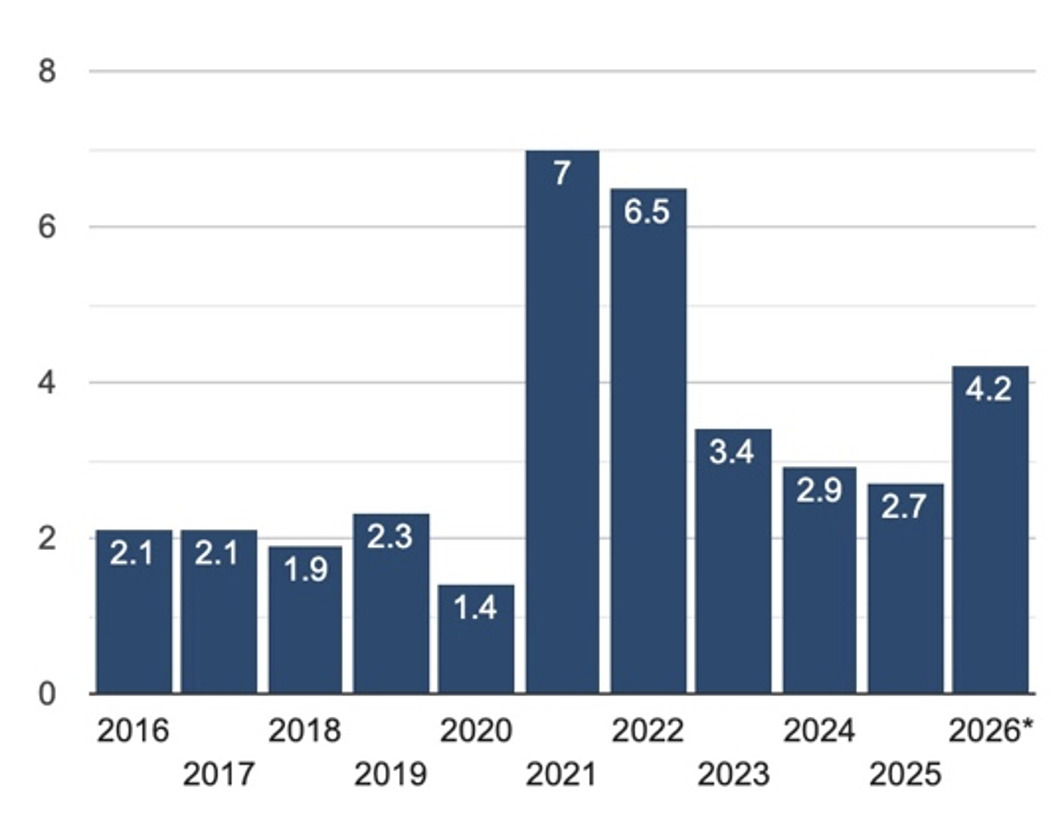
Americans know he is a consummate liar, and so does the world. Even the official White House website, at www.whitehouse.gov, tries to make us feel that what it says is true, but we know the lies coming from our daily experiences. Take these two sentences from its current posting: “In 2025, inflation moderated, job creation accelerated, and consumer confidence rebounded as businesses expanded, and wages rose. His America-First economic strategy is restoring prosperity, lowering costs, and positioning the United States for long-term growth.” You see its sneakiness, starting with “In 2025,” ignoring 2026. Actual government databases show the inflation rate, ending in May, was 4.2%, up from 3.8% in the 2025 fiscal year, according to U.S. Labor Department data.[8]
United States Annual Inflation Rates (2016 to 2026)
Does a legitimate messianic person lie? Maybe.
Let the people who believe in his messianic presence have their faith. That’s okay with me. We can take, and even ignore, the lies and swindles. By January 2029, he will have scammed tens of billions from the American people and the U.S. Treasury, but that’s okay with me if he and his cruel retinue and family will have been voted out, never to return to politics.
Okay, so maybe not a messiah or even a prophet. Does he have magical powers? Timothy L. O’Brien, a biographer of Trump, tells us that “he will walk on the stage with a giant presidential wand and end decades of Middle East warfare or prehistoric algae that defies modern chemicals.” [9]He certainly has media powers; the media continues to print and post whatever he says and does, as if he is the messiah. He feels the world is not yet his, though it will be soon. So, his ambitions are to conquer it by making one-sided deals in his favor. With no shame, as a crypto industry operator and president, he counts his cryptocurrency token windfalls; his office says that he “only acts in the best interests of the American public.” [10]You ask, Which part of the American public? Hmm. He believes that he alone can change the world for the better. However, better for him is far from what the world has waited for – a generous messiah who cares for the world public, not a pretender.
Speaking falsely, he hammers the noise in his brain
America is at the crossroads of autocracy, with a public that has welcomed refugees for centuries. Its crossing is clear, with a stop sign warning to carefully look right and left. The man in the seat behind the Resolute Desk feels he can control the world, though he cannot. He is aware of his leadership failures and being hated by some and loved by others, and so, fearful of his declining, disturbed ego, he spends his sleepless nights composing half-sentences on his safe-space Truth Social platform that he believes followers will take as policy success stories, counter to the truths of his failure. As it is with all wannabe autocrats who need safe spaces, he believes that everything he says must be accepted as true and that nobody should ever question him, even though observational evidence declares what he says as false. It is part of the standard authoritarian scheme to slash trust in everything. As Ruth Ben-Ghiat, author of Strongmen: Mussolini to the Present, put it in an interview with Ann Applebaum in The Atlantic, “It’s destroying trust, which is really trust in each other, too, because what is an election? It’s everybody casting their vote, their preference, and then based on that collective will, you can change a leadership.”
The last three elections were not rigged, though he claims that the middle one was. All, including his, were plain and simple examples of democracy. He was elected in a true spirit of democracy, a political system that he is attempting to disrupt. Add that to his list of breakages.
The grifter-in-chief
The words “grifter” or “swindler” or “scammer” are not the same as “cheater” or “crook.” In the case of Trump, his sons, and cronies, it seems they first convince people a profit could be made by following and believing lies; the victims do not sense they have been played. Autocrats are not necessarily grifters. They are generally crooks who dip into government funds and taxes, but they do not directly dip into people’s pockets, though indirectly they do. Scanning Trump’s businesses and dipping, it must be obvious to all that the grifter is scamming the public. A grifter is someone who uses other people for personal gain, whereas a crook is someone who may or may not steal from a private person, but rather from an organization or business. Trump’s endless corruption is evident, yet those that he cons continue to support him. Why? Is it stupidity or ignorance? No, there are a few followers left who, though they see the gain on his side, admire his ugly policies such as racism, misogyny, and presentation of toughness, and don’t forget the worst of them all – his brutal immigration policies.
I know that many Americans are saddened that their country has been taken, even many who thought they knew the candidate and believed that they were voting for some of the policies flagged on the campaign trail. They are reckoning with America’s ruptures and seeing that the person in the Oval Office has priorities with no interest in public welfare. We might compare what is happening in America with what has happened in Russia, Turkey, Venezuela and Nicaragua. It’s not a fair comparison, but rather a warning.
The path to autocracy
Trump very much wants to be liked by Putin, and I think sincerely admires him.
– M. Gessen, Russian-American journalist, on Trump’s fascination with Putin in 2018
ICE agent shoots an observer Credit: chaddavis.photography/sets/ice-in-minneapolis/
Here are Gessen’s rules for combating suspected autocracies:
Rule #1 – “Believe the autocrat.” He means what he says.
Rule # 2 – “Do not be taken in by small signs of normality.” It is a façade of control and manipulation.
Rule # 3 – “Institutions are useless to you.” Watch for the judiciary to repress or collapse your rights.
Rule # 4 – “Be outraged.” It shows you will not accept unconstitutional behavior and diminishing rights.
Rule # 5 – “Don’t make compromises.” Autocrats don’t negotiate the immoral powers they have. Diplomacy is a useless mirage.
And there is also rule number 6, one last one that brings some hope, at least for America. Before listing that rule, I must say that Trump is not fully disobeying laws but is spending billions of taxpayer dollars on legal fees and, in some cases, backing away, as he has with his $1.7 billion taxpayer slush fund for allies investigated under President Biden, a case he would have lost. According to the Trump Administration Litigation Tracker, of the more than 700 lawsuits brought against the Trump administration’s policies, more than 316 active cases challenge Trump’s actions, and 400 cases are active in litigation by appeal. [11] More than 150 have ended through temporary restraining orders or injunctions. [12] And of the 165 cases that ended with a final decision, 94 were dismissed, 62 were won in favor of the plaintiffs, two had mixed outcomes, and the Trump administration won seven. Of the 30 cases taken to the Supreme Court, six are pending action. Past American presidents have had many lawsuits against their administrations. Trump has had far more than most. Putin and Xi have none. America still has laws in place to hold lawbreakers accountable. There’s the hope.
Rule # 6 – “Remember the future.” Gessen tells us, “Nothing lasts forever. Donald Trump certainly will not, and Trumpism, to the extent that it is centered on Trump’s persona, will not either.” Resist and dream of awakening from the nightmare by helping those who follow the rules.
I believe American leadership, as represented by the American President, has to reflect a basic regard for human dignity and decency, not just within our own borders but beyond. … If we don’t have those things, the world can break in very bad ways.
– Former U.S. President Barack Obama
How did the US get so close to autocratizing its democracy?
Americans are bravely rising to the challenge. In my previous article “Autocratizing Democracies: A War Just For Power (Part 2),” I wrote that in the written history of the world, in the Common Era, there has never been a constitutional democracy that lasted more than 50 years and later became an autocracy for more than 25 years. America has been somewhat of a democracy for 250 years. Nothing lasts forever (think of Hungary under Viktor Orbán’s electoral autocracy that lasted 16 years), but democracy, in all its weaknesses, is tough to kill if we resist and dream.
It is difficult to understand why his followers continue to cheer him on, even when his actions run counter to their needs.
David French, in his New York Times opinion column, put it this way: “In their frustration, all too many people are attracted to the theoretical benefits of authoritarianism, and they don’t have the experience or the education to understand its actual and inevitable defects. They do not understand the link between their fashionable and transgressive ideologies and the oceans of blood that fascism and communism spilled across the globe.”[13]
America has been through auditions of toe-holders in every century since its birth. Attempts, experiments, and tests have never broken its democratic model. We are now suffering with ignorant wannabes who will not succeed with this regime. We will go through this repeatedly in the centuries that follow. Will it work for them in the end? We cannot say. That is why we will always have to guard against the endless wannabes.
This wannabe is focused on his war with Iran, and immigration, while dogging opportunities to solve America’s domestic problems – avoiding the job of presidents – housing, poverty, political unification, and inflation.
When Trump saw his poll numbers rapidly diminishing, he felt he needed a war. That can serve as a political escape route for incumbent leaders who have no better way of pleasing constituents. And so, I am ready to say that the obsessed man’s thinking is to start a war with Iran, partly to show that he can, and partly to have the thrill of feeling the immense power of his reincarnation of Cyrus the Great, who in 550 BC conquered the Iranian plateau in Persia. When Trump’s war ends, if it ever does, the noise in his brain will inspire thoughts of invading Greenland. In doing so, he will be destroying the allied balance of power to get a few hotels built in a part of the world that will someday be the best region for civilization to survive the climate change that he claims is a hoax.
The new messiah-like figure
Some people believe in reincarnation – not me – though I would welcome a reborn American President who, as former U.S. President Barack Obama said, “has to reflect a basic regard for human dignity and decency, not just within our open borders but beyond. … If we don’t have those things, the world can break in very bad ways.” [14]
Now, the world is once again leaning toward those bad ways of forgotten history. Those old forgotten wannabe inclinations have consequences. David French, an opinion columnist for TheNew York Times, illustrates that, when a church evangelizes that he – “arguably the most vulgar, most corrupt president in American history” – was sent by God to save the country, good people begin to leave the church. [15] “This is a finding that should trigger soul-searching among American evangelicals.” He wrote, “If Jesus instructed his followers to ‘go and make disciples of all nations,’ then it’s worth pondering whether the decision to so loyally support a man like Trump is worth actively repelling millions upon millions of Americans from church.”
A reincarnated Cyrus the Great now threatens substantial parts of Persia that were once ruled by his previous self. It is another attempt to threaten for personal profit. America has duly and democratically elected this pretender avatar and might again in a future cycle of rebirths to universal powers, but America – the only country in the Common Era that has been at least a representative democracy for 250 years – has its democracy reinforced. Perhaps in some future leadership, a bolt cutter will break it; not in this one.
Joseph Mazuris an Emeritus Professor of Mathematics at Emerson College’s Marlboro Institute for Liberal Arts & Interdisciplinary Studies. He is a recipient of fellowships from the Guggenheim, Bogliasco, and Rockefeller Foundations, and the author of eight acclaimed popular nonfiction books. His latest book is The Clock Mirage: Our Myth of Measured Time (Yale).
Notes
[1] His biggest grift attempt was to personally sue the U.S. Internal Revenue Service for $10 billion that would have been paid by American taxpayers. Will that overt grift stop him? Yes, he was stopped by a judge, but will he try again, and again? Sure, what his team of sycophants had laid out in scandalous lawsuit documents, demanding immunity from tax inquiries and compensating his allies with billions.
The next healthcare AI fight will center on work, not words. Jeremy Hudgeons, a senior sales specialist at GDT, points to a real operating mess: multiple EHRs, communication systems, authentication methods, and local variations in how the same patient interaction gets handled.
A chatbot can answer a question. An agentic AI system can pursue a goal with limited supervision, collect current information through APIs or databases, reason through a multi-step task, and act on external systems.
AI should make the relevant information easier to see, faster to retrieve, and simpler to act on.
The difference sounds technical, but executives should translate it into plain business terms. Google Cloud describes AI agents as systems that use reasoning, planning, memory, and autonomy to complete tasks on a user’s behalf. In a hospital, that could mean understanding why a patient called, checking the record, routing the request, scheduling the appointment, sending a reminder, and escalating when the case exceeds defined boundaries.
Patient access offers the cleanest starting point because it combines volume, cost, frustration, and measurable outcomes. Hospitals already operate in a payment environment where patient experience affects value-based incentives, efficiency measures, and quality programs. That makes scheduling, prescription refill support, inbound call routing, proactive outreach, and aftercare follow-up more than back-office conveniences. They shape how patients feel about care, how quickly staff can respond, and how much labor the organization burns on repeatable contacts.
That does not mean every scheduling desk should turn into an unsupervised automation project. The smarter path starts with a high-volume workflow, measures the current cost per interaction, defines the handoff rules, and tests whether automation lowers cost without damaging the patient relationship.
Hudgeons frames the business case around simple math: reduce time per interaction, reduce avoidable interactions, raise consistency, and measure actual output against predicted ROI. That discipline keeps healthcare automation from becoming another expensive pilot, especially as federal policy keeps pushing payers and providers toward more interoperable prior authorization and data exchange processes.
Clinical management raises the stakes. The FDA says clinical AI in software as a medical device can transform care by learning from health data, while also requiring careful lifecycle management. In practical terms, that means leaders need to separate administrative agents from clinical decision-support tools. An agent that updates a refill workflow creates one risk profile. An AI system that analyzes clinical notes, surfaces patient history, or influences a care decision creates another. Hudgeons’s point deserves emphasis: the physician still makes the decision. AI should make the relevant information easier to see, faster to retrieve, and simpler to act on.
The foundation layer decides whether any of this works. The Office of the National Coordinator says health data interoperability helps clinicians deliver safer, more effective, and more patient-centered care while giving patients and caregivers better access to electronic health information. Agentic systems depend on exactly that kind of foundation. Without trusted identity, secure data transport, clean system connections, and role-based access, the agent will either fail to complete the work or complete it in a way compliance teams cannot tolerate.
Governance therefore belongs at the front of the project, not at the end. The NIST AI governance framework gives organizations a structure for managing risks to people, organizations, and society. In healthcare, that structure has to become operational: define what the agent may access, what it may change, which tasks require human approval, when it must escalate, how logs get reviewed, and how performance gets validated. If those rules remain abstract, autonomy turns into exposure.
The ethical layer requires the same discipline. The World Health Organization says healthcare AI should place ethics and human rights at the center of design, deployment, and use. WHO guidance on large multi-modal models also warns that broad health care use has been predicted, while wide task performance remains unproven.
That principle becomes concrete when a patient shares sensitive information with an AI voice agent at 2 a.m. The patient does not care whether the system technically counts as a chatbot, agent, or orchestration layer. The patient cares whether it understands the request, protects the information, routes the need properly, and involves a human when the stakes rise.
Security controls must match the new access pattern. HHS explains that the HIPAA Security Rule requires administrative, physical, and technical safeguards to protect electronic protected health information. Agentic AI makes that obligation harder because a useful agent often needs broader access than a narrow tool. It may touch scheduling, records, call-center software, identity systems, and analytics. The more systems it can reach, the more carefully leaders must control credentials, permissions, audit trails, data retention, and incident response.
Physicians will accept this faster when leaders describe it as augmentation rather than replacement. The American Medical Association uses digital health language that emphasizes AI as assistive technology enhancing human intelligence, and its 2026 physician survey found broad professional use of AI alongside concerns about privacy and the patient-physician relationship. That combination should guide deployment.
Doctors and nurses do not need another screen that creates more work. They need agents that remove administrative drag, summarize reliable information, and leave judgment where it belongs.
They need agents that remove administrative drag, summarize reliable information, and leave judgment where it belongs.
The investment case should begin with the workflow, not the model. Hudgeons is right that much of the cost sits in the foundation: governance, advisory structure, cloud strategy, compute, bandwidth, secure transport, and integration with the applications where work actually happens. Leaders who skip that foundation may still spend heavily on pilots, model testing, and vendor demos, but they will struggle to show durable ROI. Leaders who connect strategy to workflow value can build a stronger case for responsible AI adoption by showing exactly which cost, delay, or error they intend to reduce.
The uncomfortable conclusion is that agentic AI will expose the operational truth inside healthcare organizations. Clean workflows, clear rules, interoperable systems, and disciplined measurement will create leverage. Messy processes, unclear ownership, fragmented data, and vague ROI claims will create risk.
The technology will matter, but the operating model will matter more. Healthcare leaders should stop asking whether an agent can sound human and start asking whether it can complete the work safely, measurably, and under control.
A renewal notice can sometimes bring an unexpected change: the premium shown is different from what you paid the previous year. That does not always mean your policy has changed completely or that something has gone wrong.
Health insurance pricing is reviewed from time to time, and several policy-related, age-related and market-related factors may influence the amount due. Knowing why the figure changes helps you read the renewal notice carefully, assess your cover and make a well-informed decision before paying.
Can Health Insurance Premiums Increase at Renewal?
Yes, a good health insurance premium may increase at renewal. Continuing the policy for another term does not necessarily freeze the original premium. The amount payable is calculated according to the product’s approved pricing structure, policy terms and details of the insured members at that time.
A higher renewal quote may result from:
Movement into a different age band
Revision of rates for the product
Changes to the sum insured or optional benefits
Addition of eligible family members
Applicable taxes or statutory charges
A premium revision should appear in the renewal notice or related communication. Reading it early gives you time to understand the calculation, check whether the cover has changed and seek clarification before the due date.
Why Does Your Health Insurance Premium Change after Renewal?
Premiums are designed around the expected cost of providing cover during the coming policy period. Healthcare expenses, treatment patterns and claim costs change over time, so an insurer may periodically review product pricing, subject to applicable regulatory and actuarial requirements.
Age is another common reason. Many policies use age bands, which means the premium may remain similar for a period and change when an insured person enters the next band. This becomes especially relevant while maintaining health insurance for senior citizens, where age-linked pricing may have a greater effect on the renewal amount.
Other possible reasons include:
Medical inflation is affecting hospital and treatment expenses
Overall claims experience across the insured product pool
Changes in selected benefits or coverage features
Addition or removal of a family member
Migration to another plan
An increase in the sum insured
The exact reason should be checked against the renewal schedule, policy wording and any advance communication shared by the insurer.
Factors That Can Increase or Reduce Your Renewal Premium
A renewal premium is rarely shaped by one factor alone. Some changes arise under the policy structure, while others follow choices made by the policyholder.
Factors That May Increase the Premium
A renewal amount may rise for several practical reasons, especially when your age, coverage choices or policy pricing structure changes.
Age-Band Movement: Entering a higher pricing band may increase the premium.
Product Repricing: Rates may be revised after actuarial assessment of overall costs and claims.
Higher Coverage: Increasing the sum insured may raise the renewal amount.
Added Benefits: Optional covers can increase the total premium.
Family Changes: Adding a member may alter pricing based on age and coverage.
Lower Cost-Sharing: Reducing a voluntary deductible or co-payment may increase the insurer’s share of eligible expenses.
Factors That May Reduce the Premium
Certain policy choices and rewards may bring the renewal amount down, but they should never weaken the protection you need.
Higher Cost-Sharing: A higher voluntary deductible or co-payment may reduce the premium, subject to available options.
Removing Optional Benefits: Discontinuing add-ons may lower the amount payable.
Wellness-Linked Rewards: Some policies may provide eligible renewal discounts.
Family-Member Changes: Removing a member for a valid reason may alter the premium.
Lower Coverage: Reducing the sum insured may reduce the premium, though the effect on financial protection requires careful thought.
The lowest renewal premium is not always the most suitable choice. Coverage, cost-sharing and personal healthcare needs should be considered together.
Does Making a Health Insurance Claim Affect Your Renewal Premium?
Making a claim does not automatically mean that an individual’s renewal premium will rise as a penalty. Regulatory principles generally do not allow fresh underwriting at renewal solely because a policyholder has made a claim.
However, the overall claims experience of the product pool may contribute to a broader rate revision. A claim may still affect certain policy-linked benefits, depending on the wording.
For instance:
A cumulative bonus may be reduced after a claim
A claim-free discount, where offered, may no longer apply
Benefit restoration may follow stated policy conditions
A product-wide revision may apply to both claimants and non-claimants
Checking the old and new schedules can show whether the difference comes from age, cover, discounts, member details or product repricing.
Conclusion
A health insurance premium can change at renewal, but the change should be understood in context. Age-band movement, product repricing, revised cover, family updates and selected benefits may all influence the payable amount. A past claim does not automatically justify an individual penalty, although product-wide experience may affect future rates.
Before renewing, read the notice, check the coverage retained and review any discount or cost-sharing change. The right decision balances affordability with continued protection suited to your present healthcare needs.
Many migrants who crossed into Spain’s North African enclave of Ceuta this week have started returning to Morocco, saying hunger, exhaustion and poor conditions ended their hopes of building a new life in Europe. Many said they were encouraged by social media posts suggesting the heavily guarded border could be crossed, only to find themselves stranded in Ceuta with no way to reach mainland Spain.
Several migrants told Reuters they survived with little food and water, while others claimed shops were closed and supplies were difficult to find. Some also alleged they were chased away by residents in parts of the city, although Reuters could not independently verify those claims. Spain’s Interior Ministry said two people suffered minor injuries in separate knife attacks, and one suspect had been arrested.
As the situation eased, businesses in central Ceuta gradually reopened, although security remained tight and migrant reception centres were reportedly full. While some local residents said they feared the sudden influx, others expressed sympathy for the migrants, arguing they had been misled and exploited. Despite the growing number of people returning to Morocco, some migrants remained determined to stay, saying they would rather continue trying than give up on reaching Europe.
Most companies still measure trade show spend with 30-day windows built for digital campaigns, undercounting a channel that often takes months to pay off.
Why Do Trade Show Budgets Escape the Same Scrutiny as Everything Else?
Corporate finance teams model capital expenditure down to the decimal point. Digital marketing spend gets tracked click by click. Trade shows, despite often being one of the largest line items in a B2B marketing budget, are frequently the exception.
According to the Center for Exhibition Industry Research’s 2026 Marketing Spend Decision Report, sales metrics such as lead volume and post-show closed deals now dominate how management evaluates exhibition performance, a shift toward discipline. Yet only 23 percent of B2B exhibitors have a formal process for measuring trade show ROI at all, according to CEIR data cited industry ROI research. That gap between spend and measurement is the actual blind spot, not the channel itself.
This isn’t a niche problem affecting a handful of underprepared exhibitors. It’s the default state of the industry. Companies will run a rigorous quarterly review of paid search performance while treating a six-figure trade show program as a single line item judged on gut feel and a handful of anecdotes from the sales team. The stand gets approved, the budget gets spent, and the actual return gets estimated rather than measured.
What Is the 30-Day Attribution Problem, Exactly?
Most attribution systems were built for a world of short, digital sales cycles. They were never designed for the way B2B purchases actually happen.
Roughly 73 percent of B2B organizations use a 30-day attribution window regardless of how long their actual sales cycle runs, according to Gartner’s 2025 UK Digital Marketing Survey.
The average B2B purchase now takes around 211 days from first contact to close, based on research from Dream data.
Forrester’s State of Business Buying, 2026 found that an average of 13 internal stakeholders and 9 external participants now influence a single B2B purchase decision. A trade show conversation in March that quietly shapes a decision made in October will show up in almost no standard reporting dashboard, not because it didn’t matter, but because the measurement window closed months before the deal did.
For a channel that runs on relationship-building and face-to-face credibility, a 30-day window isn’t just imprecise, it’s structurally incapable of capturing the value trade shows are actually built to create.
This matters more for trade shows than almost any other channel, because so much of what a good exhibition produces isn’t a single, trackable click. It’s a conversation with a technical buyer who won’t formally engage procurement for another five months. It’s a competitor comparison a prospect brings back to their internal team after seeing three vendors side by side on the show floor. None of that leaves the kind of digital trail a 30-day attribution model was built to catch, and none of it is any less real.
Why Does Lead Quality Get Undervalued Relative to Lead Volume?
Ask most marketing teams how a trade show performed, and the first number they reach for is the lead count. It’s the easiest metric to report, and often the least useful one on its own.
Trade-show-sourced leads close in an average of 3.5 sales calls, compared to 4.5 for a cold outbound lead, according to CEIR-cited research. That single call of difference reflects something a lead-count metric can’t: the trust and product familiarity a face-to-face conversation builds before a salesperson ever picks up the phone.
A channel that produces fewer, better-qualified leads can easily look weaker than a channel producing high volumes of low-intent contacts, purely because volume is easier to count than quality. Without a framework that weighs lead quality alongside lead count, trade shows are structurally penalized for doing exactly what they’re good at.
This is where the finance function has genuine leverage to fix a marketing measurement problem. A lead-scoring model that accounts for qualification tier, deal size potential, and time-to-close gives a far more honest picture than a raw count ever could, and it’s the same discipline already applied to evaluating a sales pipeline. Applying it to trade show leads isn’t a stretch, it’s simply extending a standard that already exists elsewhere in the business.
What Would a More Accurate Measurement Framework Look Like?
Fixing this doesn’t require abandoning attribution. It requires adjusting it to match how trade show pipeline actually behaves.
Common Approach
More Accurate Approach
30-day attribution window
90 to 180-day window matched to actual sales cycle length
Lead volume as the primary success metric
Lead volume weighted against qualification tier and time-to-close
Single closed-won attribution
Pipeline velocity and win-rate lift for marketing-influenced accounts
Booth cost measured in isolation
Total program cost, including staff time, benchmarked against the next-best channel
Extend the attribution window to match the real sales cycle, not a default platform setting.
Tag leads by qualification tier at the point of capture, not just by name and contact details.
Track pipeline velocity for trade-show-influenced accounts, not only final closed-won revenue.
Compare the total program cost, staff time included, against the next-best channel, not against zero.
It’s not rocket science. It’s just a matter of treating trade shows as a measurable investment rather than an annual habit the marketing team does.
One thing the companies that do this well seem to have in common: They put their measurement system in place before the show, not after. Knowing in advance what constitutes a strong lead, what attribution window to use, and how success will be reported to leadership eliminates the temptation to create a good tale in hindsight when the results come in. It also provides a common, agreed-upon benchmark for marketing and finance to measure the program against, rather than having to negotiate the definition of success after the fact.
Conclusion
Trade shows are not broken. They’re a long ticking clock before its value truly shows up, under estimated. As B2B sales cycles get longer and buying committees get bigger, those firms that can change their attribution windows and qualification requirements to reflect reality will be the ones who can safely say what their exhibition spend is really buying.
Aman Singh is a Digital Marketing Executive at Exhibit Elevate, a global exhibition stand design and build company operating across Dubai, the UK, Germany, Poland, and the US. He specializes in B2B marketing strategy, SEO, and event ROI measurement for exhibitors.
Sources referenced: CEIR (Center for Exhibition Industry Research) 2026 Marketing Spend Decision Report; Gartner 2025 UK Digital Marketing Survey; Forrester State of Business Buying, 2026; Dreamdata B2B purchase timeline research.
Simultaneous disruptions in the Strait of Hormuz and the Red Sea threaten European industrial survival by choking essential energy supplies and component manufacturing inputs.
On July 22, the European Union’s naval mission in the Red Sea advised merchant vessels with Israeli, American, or Saudi links to stay clear of high-risk corridors, while Yemen’s Houthis declared a naval blockade targeting Saudi shipping. With Brent crude climbing toward ninety-six dollars, market commentary predictably fixates on energy price spikes and stagflation. Yet, focusing strictly on pump prices misses the lasting structural damage facing Europe. As Saudi Arabia’s western bypass via Yanbu comes under direct attack, Europe faces a dual supply shock: it imports both the energy to run its factories and the components that move through them.
What Has Changed in Middle Eastern Supply Routes?
The commentary went where it always goes during Middle Eastern naval crises. Oil reached a seven-week high, a senior Houthi official promised two hundred dollars a barrel on Iranian state television, and economists dusted off the word stagflation. That is the wrong place to look for the lasting damage. A driver in Milan pays more at the pump and grumbles. A car plant in Lower Saxony that cannot get a wiring harness out of Shenzhen sends its entire shift home. The deeper wound from a two-corridor squeeze is industrial, and Europe is the continent least able to absorb it.
Start with what actually changed this week, because the obvious objection is that container traffic between Asia and Europe has already been rounding the Cape of Good Hope since late 2023. What changed sits on the western side of the Arabian Peninsula. With the Strait of Hormuz shut, Saudi Arabia had been pushing crude westward through Yanbu on the Red Sea, with flows reaching roughly 4.6 million barrels a day in June against about 1.3 million at the start of the year. That detour was the mechanism that made the first closure survivable. It is now the exact pipeline under threat, along with roughly 230,000 barrels a day of Saudi diesel reaching Europe through Suez from refineries sitting within Houthi strike range.
Why Is Europe Exceptionally Vulnerable to Maritime Blockades?
Geography decides who bleeds in a maritime crisis. Europe sits at the far end of both routes. Hormuz carries close to a fifth of the world’s seaborne oil and liquefied natural gas, while Bab el-Mandeb is the Suez gateway that lands Asian manufactured goods on European docks. The United States has shale reserves and its own export terminals and can ride out a Gulf shock. Asian buyers can outbid rivals for whatever spot cargoes are moving. Europe imports both ends of its industrial base at the same time: the energy that powers the factory and the components that pass through it.
Since Iran’s Revolutionary Guard sealed the strait in early March, traffic has run nowhere near the hundred-plus ships a day of the pre-war norm. CSIS counted 187 successful transits in the three months after 4 March—compressing a quarter’s worth of Gulf trade into what the strait used to handle in two days. Meanwhile, the freight market tells a complicated story. Rates have risen hard without going vertical, but six months of stop-start shipping has delivered the worst of both worlds: no reliable short route, and no settled long one either. This is a scheduling event, and just-in-time manufacturing runs on schedules.
How Do Shipping Bottlenecks Paralyze European Assembly Lines?
The precedent for what that scheduling chaos does to a factory is only two years old. In January 2024, with vessels newly diverted round the Cape, Tesla and Volvo stopped work at Grünheide and Ghent within days of each other—Tesla for two weeks, Volvo for three days over a late gearbox delivery. Neither plant was short of money or workers. Each was short of one box on one delayed ship.
The traffic runs both ways, and Europe is now on the receiving end. The EU imported over one million Chinese-made cars in 2025, representing seven percent of the market. Those vehicles and the components feeding European assembly lines travel the same corridor. A blockade does not only starve European factories of inputs; it strands the finished goods European consumers intended to buy.
Metals show how the damage compounds. When Hormuz closed, smelters in Bahrain declared force majeure because metal sat stranded at ports while facilities remained undamaged. Requalifying a new supplier of aluminum, a specialty chemical, or an engineered plastic for a safety-critical part takes months, often longer. Shipping disruptions quickly mutate into long-term manufacturing bottlenecks.
Can Warships and Minesweepers Protect European Industry?
Gas is where the timing turns particularly cruel. Europe had barely finished climbing out of the shock that followed Russia’s invasion of Ukraine when Iranian drones struck key Middle Eastern natural gas infrastructure, sharply curtailing deliveries. American cargoes now make up most of what arrives in European ports, and European buyers are bidding for them against Asian utilities at the top of the spot market. Every euro added to a power bill lands directly in the cost of making anything at all.
Brussels has answered this compounding crisis primarily with warships. European leadership is weighing whether to add minesweeping to the Aspides mandate and redeploy coalition vessels to the Red Sea. Minesweepers are worth having, but they will not smelt aluminum, shorten the Cape route, or conjure an LNG cargo out of a sealed strait.
The instruments that would matter are industrial and diplomatic: strategic reserves of critical metals, alternative suppliers pre-qualified before emergency strikes, faster permitting for domestic smelters, and sustained diplomatic pressure on regional powers to keep at least one waterway open. Bab el-Mandeb is eighteen miles across at its narrowest. A continent whose factories can be halted by a few drones and sea mines at that pinch point lacks strategic sovereignty. Frigates are the cheap answer, but the expensive answer—a resilient industrial base nobody else can switch off—is the bill that comes due this winter.
Imran Khalidis a geostrategic analyst and Senior Fellow at Foreign Policy In Focus. He writes extensively on global macro-strategy, international trade architectures, energy security, and supply chain geopolitics. His commentaries appear frequently in leading international publications, including The Atlantic, Newsweek, Nikkei Asia, The Hill, South China Morning Post, and The Japan Times.
In an age of constant digital connectivity, many people are rethinking what meaningful support looks like. Social media has made it easier than ever to access advice, motivational content, and online discussions, yet many individuals continue to report feeling isolated despite being surrounded by information.
Researchers and mental health professionals have increasingly highlighted the importance of social connection in maintaining emotional well-being and supporting long-term personal development. While inspirational content may provide temporary motivation, lasting change is often associated with consistent habits, supportive relationships, and environments that encourage accountability.
This has contributed to the growth of purpose-driven communities that bring people together around shared values and personal development goals rather than entertainment or networking alone. These groups often provide opportunities for members to exchange experiences, discuss challenges, and encourage one another through different stages of life.
Unlike traditional online forums that primarily focus on sharing information, many modern communities emphasize active participation. Members may take part in group discussions, coaching sessions, wellness activities, educational workshops, or accountability programs designed to help maintain momentum toward personal goals.
Women’s communities have become one notable example of this broader movement. Many are built around topics such as leadership, emotional well-being, financial independence, entrepreneurship, family life, or personal resilience. Their common objective is to create spaces where participants can share experiences openly while learning from others with similar interests or challenges.
One such example is Girl Hold My Hand, a women’s community founded by entrepreneur and speaker Stormy. The initiative combines coaching, wellness conversations, guided reflection, and accountability activities as part of its approach to supporting personal development. Rather than representing a standalone trend, it reflects the growing number of communities seeking to balance practical guidance with emotional support.
The popularity of these initiatives mirrors changing perceptions of success. Increasingly, personal fulfillment is being viewed through multiple dimensions that include mental health, relationships, physical well-being, purpose, and resilience alongside professional achievement. As expectations evolve, individuals are placing greater value on environments that encourage balanced growth rather than focusing on a single measure of success.
Experts in organizational psychology and behavioral science have long suggested that sustainable behavior change is influenced by social environments. Regular interaction with supportive peers can reinforce positive habits, increase commitment to long-term goals, and provide encouragement during periods of uncertainty or setbacks.
Leadership also plays an important role within these communities. Rather than simply motivating audiences through inspirational messaging, many community leaders focus on creating structures that help members develop confidence, build practical skills, and become increasingly self-reliant over time. This approach shifts attention from short-term inspiration toward long-term development.
Another factor contributing to the rise of purpose-driven communities is the increasing demand for authentic interaction. As digital platforms become more crowded with curated content, many individuals are seeking conversations that emphasize honesty, shared experiences, and constructive dialogue over polished online presentations.
The growth of these communities reflects broader cultural changes in how people pursue learning, wellness, and connection. Whether centered on entrepreneurship, education, health, faith, or personal development, they demonstrate that meaningful progress often benefits from collaboration as much as individual effort.
While every community operates differently, the broader trend suggests that people increasingly value spaces where encouragement is paired with accountability and where long-term development is supported through ongoing relationships rather than occasional inspiration.
As discussions surrounding well-being, leadership, and personal growth continue to evolve, purpose-driven communities are likely to remain an important part of the social landscape. Their significance lies not only in the resources they provide but also in their ability to foster connection, encourage resilience, and create opportunities for individuals to grow alongside others with shared aspirations.
By Danny Leipziger
China cannot continue to rely on exports to drive its growth, but what are the alternatives?
China ran a $1.2 trillion trade surplus last year, and despite admonitions from the IMF to rely...
The World Financial Review uses cookies to improve site functionality, provide you with a better browsing experience, and to enable our partners to advertise to you. Detailed information on the use of cookies on this Site, and how you can decline them, is provided in our Privacy Policy and Terms and Conditions. By clicking on the accept button and using this Site, you consent to our Privacy Policy and Terms and Conditions. ACCEPT
Privacy & Cookies Policy
Privacy Overview
This website uses cookies to improve your experience while you navigate through the website. Out of these cookies, the cookies that are categorized as necessary are stored on your browser as they are essential for the working of basic functionalities of the website. We also use third-party cookies that help us analyze and understand how you use this website. These cookies will be stored in your browser only with your consent. You also have the option to opt-out of these cookies. But opting out of some of these cookies may have an effect on your browsing experience.
Necessary cookies are absolutely essential for the website to function properly. This category only includes cookies that ensures basic functionalities and security features of the website. These cookies do not store any personal information.
Any cookies that may not be particularly necessary for the website to function and is used specifically to collect user personal data via analytics, ads, other embedded contents are termed as non-necessary cookies. It is mandatory to procure user consent prior to running these cookies on your website.




 Joseph Mazur
 Dr. Gleb Tsipursky