Home Blog Page 112

The Terror of Bio – and Chemical Weapons: Will They Be Used Again? – How Dangerous Are They?

By Joseph Mazur

A well-designed bacterial or virus strain, in contrast [to a nuclear weapon] can be produced in a garage hidden from spy satellites, transported in a thermos flask, and theoretically, has the potential to wipe out whole cities.”

– Friedrich Frischknecht,
Department of Infectious Diseases,
Heidelberg University.1

The world has changed since the two world wars and the other awful wars of the twentieth century. We no longer worry about bio- or chemical-weapon attacks in military conflicts that, thanks to the two protective treaties, control (as best they can) escapes of pathogens and intentional chemical attacks. Two landmark achievements are the Chemical Weapons Convention (CWC) and the Biological and Toxic Weapons Convention (BTWC), distinct treaties that, in the last century, brought hope to a world that could have destroyed itself almost as easily with a few nuclear bomb attacks. Our understanding of what could happen was outdated ever since ISIS and al-Qaeda were whacked, because terrorist states and organizations have found new ways to skirt laws, so a bio- or chemical weapon in the hands of a terrorist could someday be a threat or a bargaining chip that could become uncontrollable. In this article, I review facts of future concern for accidents of bio- and chemical materials and how they potentially could be used in terrorist attacks but not likely in future wars, thanks to two sharply worded treaties.

Disputed historical evidence suggests that the Black Death epidemic in Europe did not begin from communally transmitted natural germs.2 According to Gabriel De Mussis, an Italian notary who in 1348 chronicled a vivid account of Black Death origins, inhabitants of the walled city of Caffa, a Genoese colony at the eastern edge of the Crimean Peninsula, were suffering from a Black Death plague epidemic when attacked by the Golden Horde Mongols.3 He wrote that the attackers catapulted plague-infected live soldiers and cadavers over the city walls to infect defenders. That narrative is a plausible explanation of how the plague devastated the city of Caffa, because the Mongol army was heavily infected. The spread of the plague through Europe by catapulting cadavers is an unlikely stretch, but who knows?4 Caffa was a port town with heavy trade by ships and overland caravans that might have carried plague infestations along their way to Europe.5 In any case, unless other unhygienic conditions were the cause, it was one of the earliest documented cases of biological warfare.6
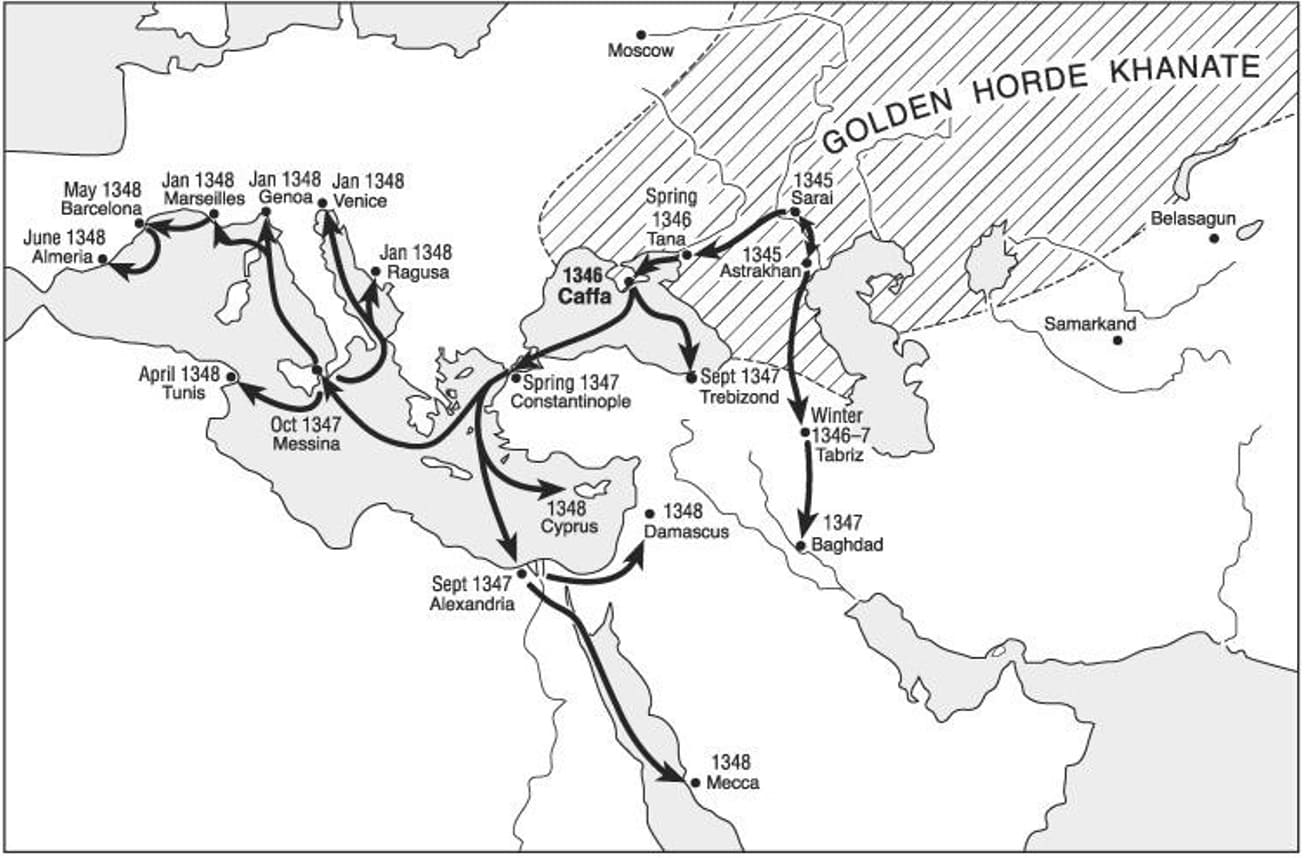
Estimated chronology of the initial spread of plague in the mid-fourteenth century (1)
Estimated chronology of the initial spread of plague in the mid-fourteenth century.7
Public Domain

There is, however, vague cuneiform testimony of biological warfare going as far back as the fourteenth century BC, when epidemics caused the dissemination of Francisella tularensis, an aerobic bacterium causing disease in wars, deliberately contaminated soldiers in Asia Minor.8 And legendary accounts suggest that the Mongol war with Caffa was not the first biological attack in history and that biological warfare has been with us since 600 BC, when Assyrian armies fighting the Medes (ancestors of modern Kurds), dumped fungi into the Medes’ wells that created Ergot, which is a biological poison that can cause seizures, cardiovascular problems, and possibly death. 

Toxic agents of war

For the six centuries after the siege of Caffa, there were a few known cases of catapulting cadavers (table 1). Then came World War I, with the initiation of sulfur mustard gas, a completely new mass-destruction warfare agent. Mustard gas is more harmful than its being a mere carcinogen. When inhaled, bleeding and skin blistering damage the mucous membranes, causing excessive fluid accumulation in the lungs – heavy contamination can also cause first- or second-degree burns. A field hospital nurse wrote:9

The poor boys were helpless, and the nurses had to take off these uniforms, all soaked with gas, and do the best they could for the boys. Next day all the nurses had chest trouble and streaming eyes from the gassing. They were yellow and dazed. Even their hair turned yellow, and they were nearly as bad as the men, just from the fumes from their clothing.10 

Another nurse wrote:

Gas cases are terrible. They cannot breathe lying down or sitting up. They just struggle for breath, but nothing can be done. Their lungs are gone – literally burnt out. Some have their eyes and faces entirely eaten away by gas and their bodies covered with first-degree burns.11

Table 1. Known cases of biological warfare.

Year Event
1155 Emperor Barbarossa poisons water wells with human bodies, Tortona, Italy.12
1346 Mongols catapult bodies of plague victims over the city walls of Caffa, Crimean Peninsula.13
1422 Holy Roman Empire attack on the Karlštejn Castle in Czech territory. Biological warfare and catapulting of cadavers were conducted by attackers and defenders.
1495 Spanish mix wine with blood of leprosy patients to sell to their French foes, Naples, Italy.14
1650 Polish troops fire saliva from rabid dogs towards their enemies.15
1710 Battle between Russian and Swedish forces in Reval (present day Estonia). Plague-infected cadavers were thrown toward enemies.
1763 British distribute blankets from smallpox patients to native Americans.16
1797 Napoleon floods the plains around Mantua, Italy, to enhance the spread of malaria.17
1863 Confederates sell clothing from yellow fever and smallpox patients to Union troops, USA.18
1914 Sulfur agents were used in the First World War.
1927 The Spanish army indiscriminately used phosgene, diphosgene, chloropicrin, and mustard gas.
1936 Italian armed forces used sulfur mustard against Ethiopian forces.
1944 Japanese military poison wells and reservoirs in China.19
1967 Egypt’s armed forces employed bombs and artillery shells filled with phosgene and mustard agents in northern Yemen.
1980 Sulfur agents were used in the Iran-Iraq War.
2017 Syria’s military airstrikes drop chemical poisons on civilian population.20

Gases are uncontrollable in war and often unanticipated by one side of the conflict. The British, fighting in WWI, were lucky that protective clothing and gas masks were quickly manufactured and sent to the battlefields. Through a stunning industrial defense mobilization, 300,000 were produced and shipped in the first week of the first gas attack, with 27 million coming off the production lines as gas attacks continued. Luck must have had something to do with the balance between the early twentieth-century basic knowledge of gas chemistry and wartime anticipation of all possible vulnerabilities. In the first few weeks of the gas war, soldiers used nose clips and breathed through their teeth or covered their mouths with handkerchiefs soaked in their urine because gases can permeate through dry cotton.

Over half a billion people have died from infectious diseases in the twentieth century. According to the Centers for Disease Control and Prevention (CDC), many thousands of these deaths were due to the deliberate release of pathogens or toxins; for example, sulfur gas suffocated enemy troops in large numbers. With enormous numbers of scary virus families and new killer pathogens floating around from host to host, grabbing cells to replicate and harm humans, animals, and plants, one wonders when the next pandemic will hit. Since viruses exist in high numbers, are easy to capture, and are difficult to manage once released, there is a danger that an escape from control could be catastrophic to human health.

At the end of the nineteenth century and again in later treaties, international declarations prohibited the use of poison weapons but without enforcement powers.

Though international treaties prohibit the use of biological weapons in warfare, bioweapons research and production continue. At the end of the nineteenth century and again in later treaties, international declarations prohibited the use of poison weapons but without enforcement powers. Aside from terrorists, who may or may not have labs for biological weapon experimentations, there is the fright that containment of transmissible pathogens could be insecure. The COVID-19 coronavirus killed more than 7 million people, havocked the world economy, and created enough social damage to set back a generation of political trust and hyped fear.21 Nathan Levine, Advisor at the Asia Society Policy Institute, and Chris Li, Research Fellow at the Harvard Kennedy

School’s Belfer Center for Science and International Affairs, tell us, “The toll from a virus genetically engineered to increase transmissibility and lethality as a bioweapon could be almost inconceivable.” 22 To put these future threats into perspective, I discuss in this article the history of biological and chemical warfare and terrorism.

After WWII, the U.S. military released bacteria in Virginia and San Francisco for pathogenic and non‐pathogenic microbe infection research on roughly 800,000 human volunteers and unsuspecting civilians at more than 200 sites, including bus stations and airports.23 In 1966, the military conducted a study on the effects of an innocuous pathogen that simulates the release of anthrax.24, 25 In 1966, the U.S. military contaminated the New York subway system to learn how pathogens spread in a big city. By the 1970s, the CIA had been covertly mixing psychoactive drugs into the drinks of unsuspecting Americans to research mind reactions. To study cholera and typhus during the Second World War, the Japanese poisoned over a thousand water wells in China by air-dropping plague-infested fleas.26, 27, 28 While it is odd that, during the seven years of WWII, Germany never considered using biological weapons, its concentration camp furnaces were as evil as, or worse than, any of the biological weapons that could have been.29

Testing bio- or chemical weapons is neither heinous nor criminal. In some cases, though, it is morally wrong. In 1928, the Soviet Ministry of Defense facilities were researching pathogenic microorganisms secretly for use as antipersonnel biological weapons, not just microbial agents aimed at livestock and plants. Later, while the Vietnam War was heating up, other attempts in U.S. military biological weapons research were expanding. Agent Orange, a tactical chemical herbicide, was used to defoliate enemy cover, but it exposed U.S. veterans to long-term health problems.

A syrian soldier in a foxhole aiming an AK47
A Syrian soldier in a foxhole aiming an AK47.
Public Domain

The big ban

In 1972, while peace settlement negotiations for the Vietnam War were finally taking place, the Convention on the Prohibition of the Development, Production, and Stockpiling of Bacteriological (Biological) and Toxin Weapons and on their Destruction (BTWC) was introduced. Signed in 1975, it banned the use of biological and toxin weapons and prohibited research on biological weapons.

Table 2 marks seven intentional biowarfare events. History, though, is filled with accusations of biological warfare with no clear definition of what that means. Catapulting plague-infected cadavers fits a deserving definition, and so does anthrax (used in two world wars of the twentieth century). Other biological warfare accounts refer to unintended spreads of diseases, such as the smallpox epidemic that infected Native Americans from the fifteenth through the nineteenth centuries. 30 That scourge, which killed almost 90 per cent of the pre-Columbian Native American population, was likely caused by contact with settlers.

Table 2. Crucial biological agents (Centers for Disease Control and Prevention, Atlanta, Georgia, USA).

Bioweapon abuses in wars 
Anthrax Bacillus anthracis (bacterium) First World War

Second World War

Soviet Union, 1979

Japan, 1995

USA, 2001

Hemorrhagic fever virus Marburg virus

Ebola virus Arenavirus

Soviet bioweapons program
Plague Yersinia pestis (bacterium) Fourteenth‐century Europe

Second World War

Tularemia Francisella tularensis

(bacterium)

Second World War

Scientific Experimentation and Production

On January 25, 2025, a CIA intelligence report was declassified and released. John Ratcliffe, the newly appointed Director, said “[The CIA] has assessed that the most likely cause of this pandemic that has wrought so much devastation around the world was because of a lab-related incident in Wuhan. And so we will continue to investigate that moving forward.’’ [1] The report, however, says with “low confidence of the outcome of its investigation, that “the available body of reporting” admits a possibility that the widely held theory that the virus emerged naturally.

The spread of SARS-CoV-2 around the globe was not intentional; it killed without regard for states. Yet, we learned a great deal from the COVID pandemic. Thanks to a 2023 U.S. Department of Defense Biodefense Posture Review, strategic guidelines are in place to connect world partners and to ensure deterrence against bio and chemical threats and mishandlings. 31 Nature, though, has its way of indiscriminately throwing random curveballs at the animal kingdom, but bioweapons have ways of escaping from labs to cause pandemics. The risk of accidental or intentional release of biochemical agents, viruses, or bacteria could be catastrophic to urban populations. Fortunately, we have another landmark humanitarian achievement, the BTWC, that prohibits any development, stockpiling, obtaining, or retaining “microbial or other biological agents that have no justification for prophylactic, protective or other peaceful purposes.” 32

Table 3. Chemical weapons that have been used in wars.

Public health endemics
Disease Pathogen
Cholera Vibrio cholerae (bacterium)
Encephalitis Alphaviruses (virus)
Food poisoning Salmonella, Shigella (bacterium)
Glanders Burkholderia mallei (bacterium)
Typhus Rickettsia prowazekii (bacterium)
Various toxic syndromes Various (bacterium)
COVID-19 SARS-CoV-2 (virus)
Influenza (flu) Virus
Respiratory Syncytial Infection (RSV) Virus
Avian influenza (Bird Flu) Virus

With 69 biolabs researching biochemical advances under the highest level of risk (BSL4), and with 51 of them in urban areas, we get a key message from Global BioLabs, an organization in King’s College London that tracks maximum containment of biolabs around the world: 33 can human cell-attacking pathogens escape by a saboteur’s release? Prisoners escape from maximum security prisons, and even classified military documents slip away from their well-guarded files. The question is answered in “The Urgent Need for an Overhaul of Global Biorisk Management,” an article in the April 2022 West Point Combating Terrorism Center (CTC) Sentinel by Filippa Lentzos, Gregory D. Koblentz, and Joseph Rodgers.34

The biological risk landscape is rapidly evolving and presents significant new challenges to preventing the accidental, reckless, or malicious misuse of biology. At the same time, oversight systems to ensure that life sciences research is conducted safely, securely, and responsibly are falling behind. An urgent overhaul to realign bio-risk management with contemporary risks is needed.35

Table 4: Biosafety levels.

Biosafety level  Characteristics  Pathogens/Disease 
 

BSL-4 

Infection aerosol transmission that may cause serious or lethal infections with no treatment available  Ebola virus, Variola virus (smallpox), Marburg virus 
 

BSL-3 

Infection aerosol transmission that may cause serious or lethal infections  Coronavirus, Mycobacterium tuberculosis, Yersinia pestis (plague), malaria 
 

BSL-2 

Infectious agents of moderate risk with injection or mucous membrane transmission  Influenza, Lyme disease, salmonella, measles, mumps 
 

BSL-1 

Low-risk agents that are not known to cause human diseases 


E. coli 

Source: U.S. Centers for Disease Control and Prevention
Public Domain

With the number of BSL4 labs rapidly increasing, security is a concern, especially in urban areas. A bio-risk management system, ISO 35001:2019, gauges laboratories with inherent risks of humanitarian catastrophe. It follows the International Organization for Standardization (ISO) in identifying, assessing, controlling, and monitoring the risks associated with hazardous biological materials. The overall intention is to reduce the risk of unintentional exposure or release of biological materials.

Twelve BSL4 labs are being built in India, Kazakhstan, the Philippines, and Singapore to study the effects of natural and bio-made biological outbreaks such as SARS-CoV-2.

Table 5. BSL-4 Lab construction.

BSL-4 Labs 
Region  Per region  Operational  Planned/in construction 
Europe  26  24 
Asia  20  11 
Africa 
North America  15  12 
Oceania 
South America 
Total  69  51  18 

Source: U.S. Centers for Disease Control and Prevension
Public Domain

The Global BioLabs system for scoring biosafety ensures pandemic preparedness. Out of 27 high scores, 21 BSL-4 labs scored highly. Table 6 shows that two countries scored medium and four scored low. To score high, a BSL-4 biolab must have “legislation, laws, regulations, administrative requirements, policies, or other government instruments in place for biosafety and a dedicated entity responsible for the enforcement of biosafety legislation and a national list of dangerous pathogens.” 36 Those with high scores (22 countries) must also follow the measures of occupational health and transportation safety. Low scores from two countries show problems with governance measures related to DNA screening, and 11 other countries show issues with information and cybersecurity protections. In 12 countries, there were signs of biosecurity risk assessment.

Table 6. Safety score (out of 20).

Country  Score   


Medium score 

Czechia  11 
Philippines 
India   


Low score 

Ivory Coast 
Gabon 
Saudi Arabia 

Source: U.S. Centers for Disease Control and Prevention
Public Domain

Should we fear? There is a potential for one of four countries that have low-score BSL-4 labs to have an accidental leak or possibly a break-in from rogue groups stealing pathogens that they could use for a terror attack. And there will be pandemics beyond those that escape from their biolab sanctuaries. We will continue to be unready but smart enough to jump ahead in the science of immunology that knows how to destroy invading pathogens and build immunities. Let’s hope our governing bodies do not ruin our medical protections by surrendering to the anti-vax movement that has gained momentum since the mid-nineteenth century and is now threatening, by elevating antivaxers to powerful government department positions, to block vaccinations reported to have saved 154 million lives since the 1970s.37

British 55th Division gas casualties
British 55th Division gas casualties, April, 1918.
Public Domain

The next big ban

If we go back far enough, we find that Thucydides recounted in his History of the Peloponnesian Wars that the Peloponnesians had tried to reduce the town of Plataea with sulfur fumes by tossing incendiaries, so-called Greek Fire weapons with sulfur and pitch, in the fifth century BC. “The consequence,” he writes, “was a fire greater than anyone had ever yet seen produced by human agency, though it could not of course be compared to the spontaneous conflagrations sometimes known to occur through the wind rubbing the branches of a mountain forest together.”38 In my guess of truth, chemical warfare goes much further back than the Third Peloponnesian War (413-404 BC), possibly back to when humans knew how to fight others and control fire, one or two million years ago. As for the future, we cannot know if our treaties and conventions will hold power to prohibit chemical weapons in future wars; however, in another guess of truth, there will always be combatants who will try to skirt military laws, treaties, and conventions.

From the end of WWI to 1997, when the Convention on the Prohibition of the Development, Production, Stockpiling and Use of Chemical Weapons and on their Destruction (CWC) was in force, there were plenty of intentional chemical attacks in international conflicts if we count napalm, an incendiary weapon that causes burns and deoxygenates to asphyxiate the enemy. Napalm has been used in the Second Sino – Japanese, Indochina, Algerian, Rhodesian Bush, Spanish Rif, Italo-Ethiopian, and South Africa Border wars, and Turkey’s operation against the Kurds. Most recently, the Syrian Civil War blatantly violated Article 1 of the CWC.39

Napalm bombing of Brunei Bay, Borneo.
Public Domain

We now have an international arms control treaty (the BTWC) administered by the Organization for the Prohibition of Chemical Weapons (OPCW), a global watchdog on chemical weapons that prohibits the use, stockpiling, and transferring of chemical weapons. 40 All signatories to the BTWC are obliged to destroy all their chemical weapons with verification. With more than 98 per cent of the world represented by 193 member states, almost all stockpiles, except those of Egypt, North Korea, Syria, and South Sudan, were destroyed. Article 1 (of 24) calls for each state party never, under any circumstances:

  1. To develop, produce, otherwise acquire, stockpile or retain chemical weapons, or transfer, directly or indirectly, chemical weapons to anyone.
  2. To use chemical weapons.
  3. To engage in any military preparations to use chemical weapons.
  4. To assist, encourage or induce, in any way, anyone to engage in any activity prohibited to a state party under this convention.

Pallets of 155 mm artillery shells containing sulfur gas at Pueblo chemical weapons storage facility in Colorado, U.S.A.
U.S. Government
Public Domain
To be found at: http://www.cma.army.mil/pueblo.aspx

               Fermentation units                                      Refrigeration units

Fermentation Unites and Refrigeration Units
Source: Monterey Institute of International Studies41

Today, there are almost no known chemical warfare stockpiles in 183 of the 193 states that have signed the CWC, according to the OPCW; however, some states have secret stockpiles under the control of nongovernmental forces.42 It is not fair to accuse Syria of using chemical weapons in war by bringing up the fact that it had done so in 256 BC during the Roman siege of Dura Europos, attacking the Persian army in the geographical boundaries of modern Syria. That siege was likely the first battle using chemical weapons other than Greek Fire. The Persians mixed sulfur and pitch to make sulfur dioxide, a lethal gas. In this century, though, we know that Syria used chemical weapons on its people and that there has been no surveillance on the matter in the last 10 years. In an emergency meeting on December 12, 2024, in the Hague, Fernando Arias González, Director-General of the OPCW, said, “Chemical weapons have been used in Syria on multiple occasions and victims deserve that perpetrators that we identified be brought to justice and held accountable for what they did and that investigations continue.” With the toppling of Assad, there is hope that all chemical weapons in possession of the new Syrian government will be permanently destroyed.

Figure 1. Chemical attacks on 21 August 2013 in Ghouta, Damascus, Syria.

Chemical attacks on 21 August 2013 in Ghouta, Damascus, Syria
Public Domain

In 1988, Saddam Hussein used a weapon of mass destruction against the Kurds. According to Jim Muir, a Baghdad correspondent for BBC News, the weapon used was “a lethal cocktail of sulfur mustard gas and the nerve agents Tabun, Sarin, and venomous agent X.” 43 Muir reported at that time that Iraqi citizens suffered over 5,000 deaths and 7,000 injuries from that attack when Iraqi jets sprayed and dropped canisters of the cocktail for five hours over Halabja, a Kurdish town at the eastern border dividing Iraq from Iran. Sarin is the deadliest of all nerve agents. It is a colorless and odorless weapon of mass destruction. Other than for warfare, it has almost no other purpose. Exposure is lethal even under very low concentrations. From respiratory paralysis, death can happen in just a few minutes. And for those who inhale Sarin gas and escape death, there is a better than even chance of suffering permanent neurological damage.

A quarter-century after the Halabja massacre, Syrian government military forces under the Assad regime launched rockets loaded with chlorine gas, a deadly nerve agent, into the Ghouta district of Damascus. That attack killed more than 1,400 and injured roughly 3,500 Syrian citizens. Chlorine gas is heavier than air, so it passes from high altitude to low, and roofs to basements in housing where families shelter from bombings. There was no escape without protection from gas masks, which most victims did not have.

Four years later, Syrian military forces launched another chemical poison attack on Khan Shaykhun, a town in northwest Syria, killing 89 citizens. A year later, again, the rebelcontrolled southeastern town Douma was attacked with chlorine gas dropped from a Syrian military helicopter that killed citizens.44 Although the Assad regime signed an agreement, under the supervision of the OPCW, to destroy all existing chemical weapons, new evidence supports a continued possession of chemical weapons.

Figure 2. Incidents of chemical weapon attacks in Syria.

Incidents of chemical weapon attacks in syria

Continued breaks from the signed agreement to abolish all chemical weapons suggest that Syria was not to be trusted with any signings. The Global Public Policy Institute claims that approximately 90 per cent of the chemical attacks in Syria took place after the Assad regime agreed to give up its chemical weapons arsenal. International monitors claim 345 credible instances where the Syrian military had attacked its citizens with chlorine gas, Sarin, Tabun, venomous agent X, and cocktails of unknowns.45

Syria, an incredibly fragile country, is now under a new government, so we have hope that inspectors will be permitted to investigate Syria’s chemical weapon stockpiles, if there are any. I say this because what goes into Syria does not stay in Syria, so many of these weapons are already in the hands of rogue states that have few avenues of advancement other than terror. A terrorist organization is not necessarily one of the 193 states that have signed the CWC. Iran signed and North Korea did not. Therefore, we know next to nothing about how many terrorist organizations have chemical weapons or are planning terror by sabotaging chemical labs to leak biomaterial that could spread to become global catastrophes.

And now, we have reports from Amnesty International accusing the Sudanese government of over 30 chemical weapons attacks in its civil war that have killed 250 civilians, including many children, with sulfur mustard, lewisite, or nitrogen mustard. Of course, Sudan denies the allegation, though we suspect that South Sudan, which seceded from Sudan in 2011, does have stockpiles and has not permitted the UN to access the region.

Chemistry, before the seventeenth century, was a theory of alchemy, a mix of religion, astrology, folklore, mythology, magic, philosophy, and mysticism, aimed at producing the elixir of life and the material world of precious metals, not an understanding of combustion. The late seventeenth century brought forward modern chemistry, though oxygen, the critical element needed for combustion, was discovered in the late eighteenth century. Oddly, the first intentional chemical weapon attack came in the twentieth century. Chemical weapons are human-constructed or discovered, but bioweapons come from nature, as far as we know, and without any terrorist biochemical engineering.

US Navy Seabees jog during an exercise with M40s worn
US Navy Seabees jog during an exercise with M40s worn.
Public Domain
Soviet chemical weapons canisters from a stockpile in Albania.
Public Domain

Source: https://commons.wikimedia.org/wiki/File:Soviet_chemical_weapons_canisters_from_a_stockpile_in_Albania.jpg
Johnston Atoll Chemical Agent Disposal System prior to demolition.
U.S. Army Chemical Materials Agency

Public Domain
Source: https://commons.wikimedia.org/wiki/File:JACADS_prior_to_demolition.jpg

The next stage of illicit weaponry

It is not easy to create a bio- or chemical weapon that could have good aim and controlled spreading. Winds are unpredictable, even in these modern times of sophisticated atmospheric science intelligence. Meteorologists can accurately forecast wind speeds under 3 mph but, at slightly higher speeds, forecasting gusts is challenging. In the nineteenth century, chemistry was well understood. Yet in all the wars after the siege of Caffa and before the twentieth century, few military leaders risked the challenge of using bio- or chemical weapons, because unpredictable wind directions were nature’s deterrent.

Modern terrorism ignores that deterrent. Some terrorists tend to believe in their cause and will stop at nothing, including their death, to advance their method of getting a seat at a peace table, a table that rarely exists. Given a chance, some would see glory in concocting and releasing to the atmosphere a chemical brew that would be extraordinarily dangerous to themselves (in unpredictable wind gusts directions) if a few thousand civilians were to feel terror. Terrorist organizations outsource operations to non-state semi-independent groups of skilled fighters who keep their distance while performing dangerously nasty work that ignores international war laws. 

Most wars are internal, not international. Methods of combat in war are not the same for all wars. Car-bombing is generally a civil war means of battle, rarely an attack scheme for state-to-state wars unless one state decides to assassinate an enemy. On Tuesday morning, December 17, 2024, a bomb in an electric scooter exploded outside Lieutenant General Igor Kirillov’s apartment in Moscow. Kirillov was Russia’s nuclear, biological, and chemical weapons chief. Ukrainian state prosecutors charged him with the alleged use of banned chemical weapons in Ukraine, particularly the toxic choking agent chloropicrin. Imagine what could happen and what could be at this moment in terrorist plans of mass destruction. Car bombs are lethal, but they cover a relatively small area and kill a few people unlucky enough to be close to explosions. Canisters carrying bio- or chemical material can quietly kill and harm thousands near and relatively far from where they spread into the atmosphere. The fright alone gives terrorists what they want, a negotiating advance that builds on shock.

The attacks of 9/11 had that purpose, but the U.S. is no longer a power to play with, at least not in terms of negotiating world political order. With significant fear build-upcreated by an event in which a thousand innocent people suffera terrorist organization will gain a negotiation advantage, especially if a second attack is planned and imminent. Just imagine the catastrophe that could come from a few, say four, scooters autonomously navigating by AI to not one but a few of the most touristy areas in London – say, Soho, the West End, Notting Hill, and Kensington. They stop to send information back to the terrorist cell in control. Soon after, at a signal from a cell, all four quietly release Sarin gas from their canisters. What then? Please, don’t continue to imagine. On March 20, 1995, members of the Japanese cult Aum Shinrikyo released Sarin in the Tokyo subway during rush hour. The attack killed 12, hospitalized 5,511, and injured 1,039.46 That was a mild case of domestic terror performed by a group of five members that carried 11 Sarin-filled plastic bags onto five different subway trains in Tokyo. Members of the group boarded trains, punctured the bags to release 159 ounces of Sarin gas, and fled. Aum was a callow group. What could a proficient group do with chemical weapons? 

Every day that passes is another flash of time when shaky experimenters of chemical technology progress with their plans to create mayhem, asphyxiation, and death to those seen as enemies.

My point is this: the old methods of terrorist activities, other than hijacking commercial airliners and ramming them into tall buildings, no longer bring states to negotiate concessions. Car bombs or suicide terrorists strapped to hand grenade explosive vests might kill 10 people or, in rare cases, significantly more. (For the last 42 years, the average number of deaths by a suicide terrorism attack, excluding 9/11, is 8.6.)47 Chemical weapons can kill hundreds or deliver lifetime injuries and health problems to thousands. Every day that passes is another flash of time when shaky experimenters of chemical technology progress with their plans to create mayhem, asphyxiation, and death to those seen as enemies. Will, then, bio- or chemical weapons sometime in the future be used with a gas-blast yield of unstable power on par with the explosion potential of nuclear weapons? I do not know the answer and, likely, neither does anyone else. Will a well-designed chemical weapon ever be produced with the potential to wipe out whole cities? Que será, será. Are we ready?

So, … what guidance do we have to prepare ourselves for possible bio or chemical weapons accidents and attacks? Not in a war zone, we tend to sympathize with combatants and vulnerable citizens while discounting any likelihood of being drawn in. So far, weapons involving biological and chemical ingredients are well under control, thanks to a very positive humanitarian treaty achievement that deserves applause. The CWC has, for half a century, guarded well against iniquitous mass chemical attacks.

Applied to international warfare, that is a celebrated extensive stretch of obedience. That treaty has had enormous success as a deterrent and a moral code. Rational, moderate governments tend to hope that their war machines obey the treaties they sign and ratify as they look forward to honest, untainted victories showing that their wars are just.

Terrorism, however, is still with us. For the first few years after 9/11, fear of another attack was part of the American public discomfort. It was a natural consequence of shock, along with grief and limited anxiety. However, recollections of disasters not far from our personal GPS coordinates tend to wane and heal naturally. ISIS is going through a dozing stage, not fully asleep and surely not dead.

States could spend their intelligence budgets on surveillance and online chatter and sweep a few cells on the verge of violent attack movements.

The October 2023 Hamas attack on Israel was, by definition, terrorism. Now, threats directed by terrorist organizations are elevated and galvanized by the Ukraine-Russia and Israel-Hamas conflicts. There are government-sponsored civilian assassins, inspired and radicalized home-grown individuals caught in extremist ideology without direct terrorist group affiliations, ready to massacre; witness the recent truck mauling in New Orleans, the attacks in Russia, Iran, and Germany, and hundreds of attacks in West Africa. The more established, closely watched groups now operate in smaller cells dispersed to diverse locations. As Brett Holmgren, director of the National Counterterrorism Center, said at an event hosted by the Center for Strategic and International Studies on November 12th, 2024, “Groups like ISIS have found ways to exploit the circumstances, especially in the Middle East and Africa, to slowly and quietly rebuild. As a result, today we are in yet another transformational phase of the global terrorism landscape, a threat that is more diverse, more complex, and more decentralized.”48 Who knows what will happen in Syria, with almost 10,000 ISIS fighters in that fragile country’s prisons?

Terror will surface again, not with guns, bombs, and trucks killing pedestrians celebrating the New Year, but rather with lethal gases that could get into the hands of a fanatical leader who cares less about humanity and more about aspiring to master-of the-world power. Will the Chemical and Biological Weapons Conventions protect us against terror? No! The International Criminal Court (ICC) could imprison perpetrators of shocking illegal offenses. States could spend their intelligence budgets on surveillance and online chatter and sweep a few cells on the verge of violent attack movements. But the sine qua non, the only way forward, is for sensible leaders and policymakers to agree that terrorism is a world issue that cannot be curtailed without understanding that there are, and will always be, large and small groups rightly or wrongly perceiving oppression, opposing political or social styles, or religious beliefs. The challenge endures.

About the Author

Joseph MazurJoseph Mazur is an Emeritus Professor of Mathematics at Emerson College’s Marlboro Institute for Liberal Arts & Interdisciplinary Studies. He is a recipient of fellowships from the Guggenheim, Bogliasco, and Rockefeller Foundations, and the author of eight acclaimed popular nonfiction books. His latest book is The Clock Mirage: Our Myth of Measured Time (Yale).

Follow his World Financial Review column at https://worldfinancialreview.com/category/columns/understanding-war/. More information about him is at https://www.josephmazur.com/

References

  1. https://www.yahoo.com/news/ciabelievescovidlikelyoriginated

204134661.html?guccounter=1&guce_referrer=aHR0cHM6Ly93d3cuZ29vZ2xlLmNvbS8&guc e_referrer_sig=AQAAAGZZOf_wn0lADvlNoj8yjzN

e31r1HX7vWkruGR9VX_xd6yD_t9gm38etRfG5HcBXhgK5yry0QZ7mShwa11pY7yHnwYR3s cbHcOGlpAN2HBv

p7C5SkvUB2yz8V9gCG96BvUhR_4W0BDLGLIihP2TVUmTnKHpS8bXxs2C5XSJ9b5

  1. “The history of biological warfare: Human experimentation, modern nightmares and lone madmen in the twentieth century”, Frischknecht, Friedrich. EMBO reports, 01 Jun 2003, Vol. 4, Issue Suppl 1, pages S47-S52.
  2. Michael Walters Dols, The Black Death in the Middle East (Princeton, NJ: Princeton University Press, 2019).
  3. Wheelis “Biological warfare before 1914”. In: Geissler, E., Moon, J. E. v. C., editors. Biological and toxin weapons: research, development and use from the Middle Ages to 1945 (London: Oxford University Press; 1999) pp. 8–34.
  4. Mark Wheelis (2002), “Biological Warfare at the 1346 Siege of Caffa”, Emerging Infectious Diseases, Vol. 8, No. 9 (September issue).
  5. https://pmc.ncbi.nlm.nih.gov/articles/PMC2732530/
  6. https://pmc.ncbi.nlm.nih.gov/articles/PMC2732530/pdf/01-0536_FinalHR.pdf
  7. Wheelis, M. “Biological warfare at the 1346 siege of Caffa”. Emerg Infect Dis. 2002 Sep;8(9):971-5. doi: 10.3201/eid0809.010536. PMID: 12194776; PMCID: PMC2732530.
  8. Trevisanato, S.I. “The ‘Hittite plague’, an epidemic of tularemia and the first record of biological warfare”. Med Hypotheses. 2007;69(6):1371-4. doi: 10.1016/j.mehy.2007.03.012. Epub 2007 May 17. PMID: 17499936.
  9. Leo van Bergen, Before My Helpless Sight: Suffering, Dying and Miliary Medicine on the Western Front, 1914-1918 (The History of Medicine in Context) (London: Routledge, 2009) p. 184.
  10. Lyn MacDonald, They Called It Passchendaele: The Story of the Third Battle of Ypres and of the Men Who Fought (London: Penquin UK, 1993) p. 87.
  11. Denis Winter, Death’s Men (New York: Penguin, 1985) p. 123.
  12. Frischknecht, F. (2003). “The history of biological warfare”. EMBO Reports, 4, S47- S52. https://doi.org/10.1038/sj.embor.embor849
  13. Dols.
  14. Frischknecht.
  15. https://pubmed.ncbi.nlm.nih.gov/12201085/#full-view-affiliation-1
  16. Christopher, G. W., Cieslak, T. J., Pavlin, J. A., & Eitzen, E. M., Jr. (1997). “Biological warfare. A historical perspective”. Journal of the American Medical Association, 278(5), 412-17. https://doi.org/10.1001/jama.278.5.412
  17. Oliveira, M., Mason-Buck, G., Ballard, D., Branicki, W., & Amorim, A. (2020). “Biowarfare, bioterrorism and biocrime: A historical overview on microbial harmful applications”. Forensic Science International, 314, N.PAG-N. P.A.G. https://doi.org/10.1016/j.forsciint.2020.110366
  18. , Frischknecht
  19. Williams, Peter, and David Wallace. Unit 731: Japan’s Secret Biological Warfare in World War II (New York: The Free Press, A Division of Macmillan, Inc.,1989).
  20. https://web.archive.org/web/20190511214551/https://www.securitycouncilreport.org/atf/ cf/%7B65BFCF9B-6D27-4E9C-8CD3-CF6E4FF96FF9 per cent7D/s_2017_904.pdf
  21. According to the World Health Organization, the number of deaths from January 2020 to January 2025 is 7,079,925.https://www.foreignaffairs.com/articles/united-states/2021-03-16/pathogens-haveworlds-attention
  22. Ed Regis, The Biology of Doom. The History of America’s Secret Germ Warfare
  23. Project. (New York: Henry Holt & Co., 1999)
  24. https://www.google.com/books/edition/Clouds_of_Secrecy/CLCTL4woX_4C?hl=en&gb pv=1&pg=PR9&printsec=frontcover
  25. Zilinskas, Raymond A. “The Biology of Doom.” Science, vol. 287, no. 5455, 11 Feb. 2000, p. 981. Gale Academic OneFile, link.gale.com/apps/doc/A59809962/AONE?u=vol_oweb&sid=googleScholar&xid=54954 933. Accessed 24 Nov. 2024.
  26. https://stars.library.ucf.edu/cgi/viewcontent.cgi?referer=https://www.google.com/&httpsr edir=1&article=3588&context=etd
  27. https://stars.library.ucf.edu/cgi/viewcontent.cgi?referer=https://www.google.com/&httpsr edir=1&article=3588&context=etd
  28. Harris, S. H., Factories of Death. Japanese Biological Warfare, 19321945, and the American Coverup, revised ed. (New York: Routledge, 2002).
  29. Geissler, E. & Moon, J. E. v. C., Biological and Toxin Weapons: Research, Development and Use from the Middle Ages to 1945. Stockholm International Peace Research Institute, Oxford UK: Oxford Univ. Press, 1999).
  30. https://www.sciencedirect.com/science/article/abs/pii/S0002962915344815
  31. https://media.defense.gov/2023/Aug/17/2003282337/-1/- 1/1/2023_biodefense_posture_review.pdf
  32. https://disarmament.unoda.org/biological-weapons/
  33. Europe has 26, Asia 20, North America 15, Oceania 4, Africa 3, and South America 1.
  34. https://ctc.westpoint.edu/wp-content/uploads/2022/04/CTC-SENTINEL-042022.pdf
  35. https://ctc.westpoint.edu/the-urgent-need-for-an-overhaul-of-global-bioriskmanagement/
  36. https://www.kcl.ac.uk/warstudies/assets/global-biolabs-report-2023.pdf
  37. https://www.scientificamerican.com/article/see-how-many-lives-vaccines-have-savedaround-the world/#:~:text=A%20May%20study%20in%20the,of%20six%20lives%20every%20minute.
  38. https://www.documentacatholicaomnia.eu/03d/-460_400,_Thucydides,_History_of_the_Peloponnesian_War,_EN.pdf.
  39. https://www.opcw.org/sites/default/files/documents/CWC/CWC_en.pdf
  40. BTWC, though, was not the first international arms control treaty. The first against the use of chemical weapons was the Strasbourg Agreement, honored by France and the Holy Roman Empire in 1675.
  41. https://nsarchive2.gwu.edu/NunnLugar/2015/49. per cent201999-06-00 per cent20Former%20Soviet%20Biological%20Weapons%20Facilities%20in%20Kazakhsta n.Past%20Present%20and%20Future%20(from%20Web).pdf
  42. https://www.opcw.org/
  43. https://www.bbc.com/news/1/hi/world/middle_east/8479115.stm
  44. https://www.opcw.org/sites/default/files/documents/S_series/2018/en/s-16452018_e_.pdf
  45. https://gppi.net/media/GPPi_Schneider_Luetkefend_2019_Nowhere_to_Hide_Web.pd f
  46. https://www.nonproliferation.org/wp-content/uploads/2016/06/aum_chrn.pdf
  47. https://web.archive.org/web/20160124204240/http://cpostdata.uchicago.edu/search_n ew.php?clear=1
  48. https://csis-website-prod.s3.amazonaws.com/s3fs-public/2024 11/241113_Holmgren_Terrorism_Landscape.pdf?VersionId=pEKEMaQBu4szxrFJv3eA DRR0w0iD1EpD

The Digital Age of Credit: How Fintech Tools Are Revolutionizing Credit-Building

Today’s hyperconnected environment implies that financial health and creditworthiness are integral to an individual’s economic well-being. Whether purchasing a home, financing a car, or even qualifying for a job, your credit score is often a decisive factor in determining eligibility and favorable terms. And the data is easy to obtain. 

Traditionally, credit-building was a cumbersome, opaque process that relied on manual monitoring of credit reports and limited interactions with financial institutions. However, fintech tools and digital platforms have revolutionized how individuals build and manage their credit, providing easier access, transparency, and faster improvements. 

Fintech tools are doing more than just facilitating essential functions like payments and saving; they are transforming the credit-building process, making it more accessible and streamlined, especially for young people and underserved communities. 

Here, we’ll dive into the importance of establishing good credit early, the privileges strong credit affords, and key features of digital credit-building tools that can give users a competitive edge.

The Fintech Revolution in Credit-Building: Disrupting the Traditional Landscape

Before fintech disrupted the scene, credit-building was mainly the domain of banks, credit unions, and credit card companies. Credit reporting agencies (CRAs) such as Experian, Equifax, and TransUnion tracked credit histories, and consumers had to regularly pull reports from these agencies to review their credit status. Disputing errors or monitoring changes often required consumers to go through manual processes, which could take weeks or months.

Additionally, individuals with limited credit histories—such as young adults or immigrants—had fewer opportunities to demonstrate their creditworthiness, making it difficult for them to access mainstream financial services. There were few opportunities to learn more about building healthy credit. 

The traditional approach left many feeling excluded or unaware of how to take actionable steps to improve their credit. However, the emergence of fintech has democratized access to financial tools, particularly in credit-building. Today, more people can learn why building good credit is vital for financial health. 

Fintech tools, including digital platforms, mobile apps, and online credit monitoring services, have emerged as transformative forces, revolutionizing how consumers build and track their credit. These tools offer several advantages over traditional methods:

Real-time credit monitoring  

Unlike the old approach, where consumers had to wait for quarterly or annual reports, fintech tools now provide real-time credit score tracking. Modern apps allow users to monitor changes in their credit scores as they happen, which enables them to take immediate corrective actions.

Credit building for the credit-invisible 

Millions of Americans, often called “credit invisible,” have little or no credit history, making it difficult to obtain loans or credit cards. Fintech platforms have developed credit-building products tailored to people new to credit. Some offer users a secured credit card that automatically reports payments to the major CRAs, building credit over time without the risk of accumulating debt.

The gamification of credit for a younger generation of users

Fintech has introduced a sense of engagement and education through gamification. Apps use gamification elements to make credit-building more interactive. Consumers can earn rewards, track milestones, and receive educational content that helps them understand credit and how to improve it. This approach is trendy among younger users who are less familiar with traditional credit-building tools.

Alternative data sources  

Traditional credit scores primarily rely on payment histories, credit utilization, and account longevity, leaving out critical aspects of a person’s financial life. Fintech companies have started incorporating alternative data—such as rent, utilities, and subscription payments—into credit scoring models. 

Some platforms allow users to add utility and telecom bills to their credit reports, instantly boosting scores. This is a game-changer for those who otherwise might not have much credit history.

Increased transparency and education

Fintech apps don’t just show you your credit score—they also break down the factors that influence it. They analyze what actions impact your score positively or negatively and suggest steps you can take to improve it. This level of transparency empowers consumers with the knowledge to make informed financial decisions.

The Importance of Building Good Credit Early

Building good credit early on in life can open doors to financial opportunities that are otherwise inaccessible. Young adults who start building their credit while in college or early in their professional careers will find that a strong credit score unlocks numerous privileges. 

Lower interest rates on loans like mortgages and credit cards

One of the primary benefits of a high credit score is getting better interest rates on home loans and credit cards. Individuals with excellent credit—specifically a FICO score of 750 and above—are eligible for the most competitive rates compared to those with poor credit, which means a FICO score below 580.

A person holding credit cards against a white background wall
Photo by Avery Evans on Unsplash

According to the Federal Reserve Bank of New York, the median credit score of newly originated mortgages in Q1 of 2024 was 770. To illustrate the point further, according to the latest averages in 2024, a FICO credit score range of 760 to 850 translates to an Average Annual Percentage Rate (APR) of 6.488 percent. Meanwhile, a rare score of 620 to 639 is 8.077 percent.

The difference in percentages translates into substantial savings over the life of the loan.

Greater access to credit

Good credit opens up opportunities for higher credit limits on credit cards and access to larger loans. This is particularly important for entrepreneurs or individuals looking to finance major life events, such as buying a home or starting a business. 

Banks and financial institutions are likelier to extend generous terms to those with responsible credit behavior.

Preferred borrower status

Lenders often reserve the best deals and promotional offers for customers with excellent credit scores. Whether it’s 0% introductory APR on credit cards, no annual fees, or cashback bonuses, good credit scores put you in a position to leverage these perks.

Easier access to housing

Good credit is also essential for securing rental housing. Some landlords and property management companies run spot credit checks on potential tenants. A favorable credit score not only improves your chances of being approved for an apartment but may also help you avoid higher security deposits.

A Paradigm Shift: Trust in Fintech is Rising

According to Plaid’s 2023 Fintech Effect Report, consumers are diversifying. Large national banks still enjoy an 87 percent comfort level. However, fintech companies aren’t far behind, with a trust level of 79 percent. 

The trust gap is narrowing rapidly. Furthermore, the report indicates a growing comfort in opening financial accounts with new or non-traditional providers. This behavior implies a radical change in how consumers perceive digital finance services. 

Harnessing the Power of Fintech for Long-Term Credit Success

The digital age has democratized financial services, particularly in credit-building, where fintech tools have become indispensable for users across the spectrum—from those with limited credit histories to seasoned credit holders looking to maintain their stellar scores. The fusion of technology and finance has eliminated many of the traditionally associated with credit-building barriers, making it easier, faster, and more transparent than ever before.

Fintech tools offer personalized, real-time insights into one’s credit profile, allowing users to take immediate, actionable steps to improve their scores. These platforms also enable consumers to leverage alternative data sources, such as utility payments or subscription services, previously not included in credit assessments. This shift has been especially significant for the “credit invisible” population, who now have more opportunities to establish creditworthiness without relying solely on traditional credit products like loans and credit cards.

Building credit early is crucial to unlocking a wide range of financial privileges, including lower interest rates, higher credit limits, and preferred borrower status. As demonstrated, individuals who actively engage with fintech platforms to monitor and improve their credit see tangible benefits, from qualifying for mortgages and business loans to securing more favorable terms on credit cards. 

Moreover, fintech tools encourage financial literacy through gamification and transparent education, empowering users to make better informed decisions that set them up for long-term financial success.

Business and AI Acumen

By Luca Collina

Business acumen, the bedrock of strategic decision-making—understanding and responding to complex business problems. This includes knowledge of critical financial indicators, market trends, operational workflows, and long-range strategic initiatives. These skills enable individuals to connect their work with the larger organizational goals, thereby adding value at all levels.

AI Acumen by contrast, gives a technological advantage to this strategic perspective. That means using machine learning, predictive analysis and automation to improve decision-making. AI-powered specialists can analyse enormous quantities of data to gain valuable insights, streamline processes, and predict trends more accurately. Whereas business acumen lays the groundwork for understanding and anticipating — AI acumen turbocharges the capacity to act on those insights with precision.

These set of abilities combine to allow a powerful interaction between intent and technology. Skills in financial data interpretation, market trend analysis, and integration of AI-driven solutions enable professionals to stay ahead in a rapidly transforming business landscape. This combination fuels performance, innovation, efficiency, and adaptability that contribute to organisations.

Beyond the Skills: A Broader Focus

Business expertise in combination with AI knowledge is no longer a room of code. It’s a whole-systems approach, a multi-pronged approach that employs other levers to help amplify it:

Interdisciplinary Awareness

It is this network of interaction that makes organizations successful. Business partners who recognize that HR, finance, marketing, operations, and other functions are interconnected can plan for the whole operation to thrive. That is where AI tools can find patterns and surface correlations — for example, between workforce engagement and operational efficiency, or between market trends and talent acquisition strategies. Inter-disciplinary collaborations allow professionals to solve problems that cut across domains.

Agility & Change Management

Change management is becoming a core skill as organizations adopt new technologies and new business strategies. The reality is that while implementing AI solutions, or infusing business savvy into new innovations, it is common to encounter resistance, skills gaps, and disorder. Those in professional roles must respond to these challenges, guiding their teams through transitions with clear lines of communication and actionable items. Success, here, means that these innovations are built to succeed, not to become a friction point.

Leadership and Influence

As business experts now drive and inspire, it’s the kind of top-down thrust needed to boost AI literacy. Most people in the workforce will have to demonstrate backlog value to multiple stakeholders in the process, be it executive stakeholders, teammates, or clients. They create trust, and through that trust they guide teams and functions to collaboration.

Ethics and Responsible Innovation

With the advent of AI, ethics has become paramount to making such decisions. Professionals must make sure that their applications of technology are consistent with organizational values and societal expectations. Transparency, data privacy and fairness are big concerns, particularly when AI is applied in sensitive areas such as hiring or targeting customers. Striking a balance between innovation and ethical responsibility is the key to sustainable and trustworthy AI in the long run.

Forever Learning and Resilience

Both the business landscape and AI are evolving quickly. Key to this journey is the ability to invest in continuous knowledge, keeping abreast of trends, technology and changes within market dynamics. The rhythm of change is constant and those who are not prepared either stay behind or falter, but resilience is a key aspect of it too. The ones who move fast, reframe adversities into opportunities and look for ways to add new value will be invaluable to their organizations.

These wider elements not only augment a person’s competence but also provide an environment where organisations can flourish amid complexity and disruption.

Summing Up

Business + AI Acumen Are Game changers Its potential goes beyond single areas, fostering a unified and  enterprise ready to navigate the complexities of the modern business sphere. But for such integration to be successful, business professionals need to learn about AI, and AI professionals must learn about business. This two-way learning helps stakeholders access a unified language, which provides alignment at relevant intersection points, mitigating the friction around adoption and implementation of AI.

The role of HR as a strategic business partner enables organizations to foster collaboration, promote learning, and seamlessly align technological trends with business strategies. Collectively, these methods allow organizations to react quickly, innovate constantly and drive sustainable growth.

About the Author

lucaLuca Collina is a transformational and AI Business consultant at TRANSFORAGE TCA LTD. York St John University awarded him the Business – Postgraduate Programme Prize and CMCE (Centre for Management Consulting Excellence-UK) for his paper in Technology and Consulting Research Prize. Author/External Collaborator of CMCE. 

It’s All About Belonging in Distributed Work

By Dr. Gleb Tsipursky

The workplace of the future is evolving rapidly, and Social Factor is at the forefront of this transformation. Marie Carroll, Vice President of People, Culture & Operations at Social Factor, shared key insights on fostering belonging and collaboration in a fully distributed workforce during our recent interview. Her reflections highlight both the opportunities and challenges of distributed work and offer actionable strategies for creating a cohesive organizational culture without a physical office.

Expanding Opportunities Through a Distributed Model

Social Factor operates as a completely distributed organization, with employees spanning time zones across the United States. This model has opened doors to a broader and more diverse talent pool. By removing geographic restrictions, the company can recruit top-tier talent regardless of location.

For employees, the flexibility of remote work has been transformative. Carroll noted that the model particularly benefits working parents, a demographic that Social Factor has supported with initiatives earning the company recognition as a top workplace for working parents. The ability to manage work around family commitments is not just a logistical benefit—it’s a retention tool and a cultural cornerstone that demonstrates Social Factor’s commitment to employee well-being.

Addressing the Connection Gap

Despite its many advantages, distributed work poses significant challenges, particularly around building human connections and fostering trust. Carroll identified the absence of spontaneous, informal interactions—those “watercooler moments”—as one of the main drawbacks of a distributed model. In a traditional office, employees can easily share updates or bond over personal stories. Replicating this in a virtual environment requires deliberate action.

Another challenge is maintaining clear and inclusive communication. In distributed settings, decision-making and collaboration must be carefully structured to ensure all relevant parties are included. However, this often leads to “Zoom fatigue” as employees navigate a sea of virtual meetings.

Building Belonging Through Deliberate Action

Social Factor has embraced innovative strategies to address these challenges and foster a sense of belonging. One key initiative is their “Culture Club,” a team dedicated to organizing activities that bring employees together virtually. From trivia nights and NFL drafts to bingo and shared playlists in a “Music Factor” channel, these initiatives offer employees a chance to connect over shared interests and experiences.

The Music Factor, in particular, has been a standout success, with employees sharing songs and reminiscing about the past. “It’s like a little window into the soul,” Carroll explained, describing how these interactions spark meaningful conversations about life experiences.

Social Factor also prioritizes leadership engagement through regular “coffee chats” with the CEO and other executives. These informal conversations allow employees to build relationships with leadership and provide a platform for open dialogue.

To ensure new employees feel supported, Social Factor introduced the “Social Factor Sidekicks” program. This initiative pairs newcomers with colleagues outside their immediate team to act as informal guides. The program encourages cross-departmental interaction, helping new hires navigate the organization while fostering connections beyond their usual circles.

Leveraging Professional Development to Drive Engagement

Career development is another key area of focus at Social Factor. Carroll described an emerging program designed to expose employees to different functions within the organization. By offering shadowing opportunities and knowledge-sharing sessions, the initiative helps employees broaden their understanding of the company’s operations and explore potential career paths.

This program, which Carroll likened to “looking under the hood,” not only supports employees in their career growth but also enhances collaboration. When employees understand how different departments work, they can communicate more effectively and deliver better results for clients.

The Future of Distributed Work

As Social Factor looks to the future, Carroll envisions a continued commitment to distributed work. The model’s flexibility aligns well with the company’s mission and industry demands. However, she acknowledges the importance of creating more opportunities for in-person interaction, especially for employees who live near one another.

“We may not be able to get everyone together,” Carroll said, “but we’re exploring ways to facilitate regional meetups and continue building virtual connections.”

These efforts extend beyond work-related activities. For example, Social Factor sends employees small gifts and celebrates milestones like birthdays and anniversaries. These gestures, while simple, reinforce the company’s dedication to fostering a culture of appreciation and inclusion.

Belonging as the Cornerstone

Ultimately, Social Factor’s approach to distributed work revolves around one central theme: belonging. By prioritizing human connection and employee well-being, the company has created an environment where people feel valued and engaged, regardless of their location. That’s key for any company that wants a flexible working model, as I highlight to clients for whom I consult about their future-of-work strategies.

Carroll’s insights serve as a powerful reminder that distributed work is not just about technology or logistics—it’s about people. In an era where remote and hybrid models are becoming the norm, organizations that invest in belonging and culture will not only adapt but thrive.

About the Author

Dr. Gleb TsipurskyDr. Gleb Tsipursky was named “Office Whisperer” by The New York Times for helping leaders overcome frustrations with hybrid work and Generative AI. He serves as the CEO of the future-of-work consultancy Disaster Avoidance Experts. Dr. Gleb wrote seven best-selling books, and his two most recent ones are Returning to the Office and Leading Hybrid and Remote Teams and ChatGPT for Thought Leaders and Content Creators: Unlocking the Potential of Generative AI for Innovative and Effective Content Creation. His cutting-edge thought leadership was featured in over 650 articles and 550 interviews in Harvard Business Review, Inc. Magazine, USA Today, CBS News, Fox News, Time, Business Insider, Fortune, The New York Times, and elsewhere. His writing was translated into Chinese, Spanish, Russian, Polish, Korean, French, Vietnamese, German, and other languages. His expertise comes from over 20 years of consulting, coaching, and speaking and training for Fortune 500 companies from Aflac to Xerox. It also comes from over 15 years in academia as a behavioral scientist, with 8 years as a lecturer at UNC-Chapel Hill and 7 years as a professor at Ohio State. A proud Ukrainian American, Dr. Gleb lives in Columbus, Ohio.

Trump Moves to Restrict Birthright Citizenship, Sparking Legal Battles

On Monday, President Donald Trump unveiled a sweeping immigration crackdown that includes an executive order reinterpreting the long-standing principle of birthright citizenship, a cornerstone of U.S. law since the adoption of the 14th Amendment in 1868.

Trump’s order declares that individuals born in the United States will not be entitled to automatic citizenship if their mother was in the country unlawfully or temporarily and their father was not a U.S. citizen or lawful permanent resident.

This reinterpretation directly challenges the Citizenship Clause of the 14th Amendment, which states: “All persons born or naturalized in the United States and subject to the jurisdiction thereof, are citizens of the United States.” Critics argue that Trump’s order misinterprets the clause’s reference to “jurisdiction,” which has traditionally been understood to include children born to parents without legal status in the U.S.

Eighteen Democratic-led states and Washington, D.C., swiftly filed lawsuits to block the order, claiming it violates the Constitution, oversteps presidential authority, and conflicts with existing immigration laws. Advocacy groups have joined the legal challenge, with many emphasizing that changes to birthright citizenship would require a Constitutional amendment, a process unlikely to succeed in today’s political climate.

Trump’s move is the most direct effort yet to curb birthright citizenship, which has been a focal point of his broader immigration agenda. The legal disputes that follow will determine whether his interpretation reshapes the definition of American citizenship—or falters under judicial scrutiny.

Related Readings:

3D illustration of Two Crossed Flags of USA and France

Plug, plant growing inside the light bulb and United States Flag

How Futures and Options Can Add Flexibility to Your Investment Strategy

Expanding your investment horizons beyond simple stock and bond investing can open up new opportunities to profit, hedge risks, and gain valuable flexibility in your portfolio. By understanding and utilising derivatives like futures and options, retail investors can now access advanced strategies previously only available to institutions.

In this article, we’ll explore the benefits of adding futures and option trading and provide practical tips for getting started.

What Are Futures?

Futures contracts allow investors to agree to buy or sell some underlying asset at a predetermined price on a set expiration date. Futures trade on exchanges like stocks and can be used by individual investors for speculation, portfolio protection, or gaining exposure to commodities. Choosing the right platform is crucial for investors looking to optimise their trading strategies. Platforms like m.Stock not only simplifies trading but also provides significant cost benefits.

What Are Options?

Options give investors the right, but not the obligation, to buy or sell an asset at a set strike price up until the expiration date. Calls provide the option to buy, while puts give the option to sell. Investors pay a non-refundable premium upfront for this flexible right. Options can be used on stocks, exchange-traded funds (ETFs), and stock market indexes.

Benefits of Adding Futures and Options

The benefits of adding futures and options are:

1. Hedging Risks

Investors can hedge against stock losses in a declining market by buying put options or shorting stock index futures. These derivatives can provide downside protection as part of an overall risk management strategy. To trade in futures and options seamlessly, it is essential to have a trading account, which enables you to access and execute these derivative transactions efficiently.

2. Speculation Opportunities

The inherent leverage in options allows investors to benefit from short-term price moves in the underlying asset. Futures also provide speculators with opportunities to profit from commodity market moves.

3. Diversification

Futures and options give investors exposure opportunities beyond stocks and bonds, allowing improved portfolio diversification. Commodity futures can counter stock volatility.

4. Leverage Benefits

The premium paid upfront for an option controls the total risk while providing leveraged exposure to the underlying asset. Investors can benefit from significant price gains with a smaller upfront investment.

5. Income Generation

Options strategies like covered calls allow investors to generate income from existing long stock positions through the premiums received from selling call options.

Strategies for Using Futures and Options

Mentioned below are the strategies to use futures and options:

1. Hedging With Futures

Investors can lock in future prices today by buying or selling the underlying commodity futures contract. For example, farmers use futures to fix a selling price for their crop before the harvest season.

2. Protective Puts

Put options allow stocks to be hedged against potential declines at a fixed cost. Puts limit downside risk while allowing investors to keep their long stock positions.

3. Bull Call Spread

Buying call options while simultaneously selling higher strike call options caps costs but allows participation in upside rallies. This can be used to speculate on bullish price sentiment.

4. Bear Put Spread

Put spreads involve buying put options and selling the same number of closer-dated or lower-strike puts to offset part of the upfront premium cost. This structure benefits from bearish declines.

5. Covered Calls

One of the most conservative income strategies involves selling call options against existing long stock positions. Investors get paid the call premium in exchange for limiting potential stock gains above the strike price.

6. Cash Secured Puts

Put options can be sold against cash reserves to generate income from the premiums. The cash acts as collateral in case the puts are exercised below the strike price, allowing investors to buy into stock positions at potentially lower prices.

7. Arbitrage Opportunities

Savvy investors can exploit small price discrepancies between related futures contracts and the underlying asset’s spot price. These futures-cash arbitrage trades aim to lock in small, risk-free profits.

Conclusion

Investing in futures and options offers unique benefits, such as hedging risks, speculating on prices, income generation, and improved diversification compared to simple stock and bond investing. Retail investors can tap into these sophisticated tools by starting small, pursuing continuous learning, and working with licensed advisors to improve their overall returns.

Trump 2.0 and Palestinians: From Reversal to Repression and Deportations

By Dr. Dan Steinbock    

The first Trump administration reversed decades of US policies regarding Palestinians. The new one shuns genocidal atrocities. It prefers cultural genocide.

In my new book, The Fall of Israel (2025), I examine the activities of all US postwar administrations regarding the Israelis and Palestinians. The first Trump administration did not just differ from its precursors. It turned upside down five decades of US policies regarding Palestinians. In the next four years, The Trump White House will build on this reversal.

The Great Reversal           

When the new administration arrived in the White House in early 2017, Trump made David M. Friedman US ambassador to Israel. Friedman advised and represented Trump and his organization in bankruptcies involving the tycoon’s Atlantic City casinos. As a revisionist Zionist donor, he had pumped millions of dollars into illegal, extremist West Bank settlements.

When Prime Minister Benjamin Netanyahu announced Israel would lift all restrictions on settlement construction in the West Bank, Trump looked the other way. In 2016, the number of Jewish settlers in the occupied territories of the West Bank exceeded 400,000. Under Trump’s “peace to prosperity plan,” all settlements would remain under Israeli sovereignty and not a single settlement would be removed. Today, thanks to Trump and Biden administrations, the number of those settlers exceeds 750,000.

Subsequently, the US recognized Jerusalem as the capital of Israel, moving its embassy from Tel Aviv to the Holy City. In 2018, Trump ordered the closure of the PLO office in Washington, D.C. and canceled nearly all US aid to the West Bank and Gaza, plus $360 million in annual aid previously given to the UNRWA.

In 2020-21, the US, Israel and the United Arab Emirates formalized Israel-UAE relations in a set of bilateral deals, followed by agreements with Bahrain, Sudan and Morocco. It was the US military and intelligence ties that united the signatories of the “Abraham Accords.” For decades, Palestine had been a second thought in US policy. Now it was fading away from the map.  

Trump’s regional aspirations undermine the Palestinian state, which the UN has recognized and which has increasing recognition by the international community.

The Trump administration will blame Biden for the genocidal atrocities in Gaza and support “reforming” a collaborationist Palestinian leadership. It is likely to allow further settlement expansion and Israel’s effective incorporation of the West Bank. It will foster the role of Jerusalem as Israeli capital. It will do what it can to shrink the UNRWA’s role. 

Frontline against barbarians     

The conventional wisdom is that Trump is a “transactional” president who is defined by unabashed opportunism. In reality, his advisors and insiders tout an odd mix of Western values, militarized policies, ultra-conservatism and biblical righteousness. His cabinet will be transactional, yet constrained by these ideologues.

Trump’s Secretary of Defense, Pete Hegseth, believes that Zionism represents American frontline amid anti-Western barbarians. Hegseth has been linked with Temple Mount groups that advocate a new Temple over the Mosque of Omar and al-Aqsa. Entrenched in violent scenarios, such measures could throw the region into flames.

Trump’s ambassador to Israel, Arkansas Gov. Mike Huckabee, opposes a two-state solution and claims “there’s really no such thing as a Palestinian.” Supporting permanent Israeli control over the occupied West Bank, he shares the Christian Evangelical belief that the return of Jews to Israel validates the biblical narrative.

Trump’s Secretary of State Marco Rubio supports a Netanyahu-style Israel and revisionist, ultra-hawkish Zionism. In the past half a decade, the top contributors of Rubio’s campaign finance feature pro-Israel America PAC and Republican Jewish Coalition. He is also a beneficiary of $1.6 million of large individual contributions. In his Wednesday talk with Prime Minister Netanyahu, Rubio underscored that “maintaining the U.S.’s steadfast support for Israel is a top priority for Trump.”

Trump’s Middle East envoy is Steve Witkoff, an aggressive real estate mogul and a close golf friend, and a fervent Zionist donor. The position favors priority. A special envoy who is also special to Trump is likely to mean that Witkoff can bypass Rubio in some critical Israel/Palestinian issues. Witkoff’s dream seems to be a Jewish unitary state in a region dominated by the Gulf empires. He is Trump’s monitor of the Gaza ceasefire and in charge of the Iran file. 

What these key actors share are ardent pro-Israel stances, intimate ties with pro-Israel groups and in several cases a theologically-bound view of Israel – and the effective willingness to recognize a Jewish unitary state with minimal Palestinian population.

Suppression and deportations 

What could prove highly controversial with the Trump administration is the proposed mobilization to crack down “pro-Palestinian” forces in America, deport Palestinian activists and use these measures as a template to crush democratic dissent.

In 2023, Elise Stefanik, a recipient of hundreds of thousands of dollars from AIPAC and the Israel lobby, gained national attention for her interrogation of leading university presidents in a televised US congressional hearing on antisemitism. Calling for students’ deportation, Stefanik claimed they “are pro-Hamas members of a mob who are calling for the eradication of Israel.” In October, she urged for a “complete reassessment” of US funding of the UN, which she accuses of fostering “extreme antisemitism.”

As Trump’s UN ambassador, Stefanik can now walk the talk, as evidenced by her confirmation hearings. When asked whether she supports Palestinian self-determination, she refused to answer. When asked if she subscribes to the viewpoint of Finance Minister Bezalel Smotrich and former National Security Minister Itamar Ben-Gvir, Israel’s far-right leaders, that Israel has a biblical right to the West Bank, Stefanik replied, “Yes.”

According to Stefanik’s campaign finance, she raised $15.3 million in 2023-24. Her top contributor was AIPAC, but her big money came from large individual contributions ($2.9m) and particularly the opaque “other” category ($8.7m). The bulk of the money was fueled by her support from prominent Jewish Republicans – including cosmetics heir Ron Lauder, asset manager mogul Marc Rowan, casino tycoon Steve Wynn, Blackstone’s executives and Trump’s ex-ambassador David Friedman – in the wake of her grilling of university presidents.

Trump’s attorney general, Pam Bondi, too, has called for a revocation of visas and condemned the campus protests. Another voice in the suppress-and-deport choir is Rep. Brian Mast, the new chair of the House Foreign Affairs Committee. Like the Israeli far-right, Mast rejects the idea of innocent Palestinian civilians championing collective punishment. An evangelical Christian, he volunteered with the Israeli military in 2015 and wore his IDF uniform in Congress after October 7, 2023. Mast’s legislation would permanently cut US funding for the refugee agency UNRWA. Shunning the cease-fire in Gaza, he wants expanded weapons sales to Israel.

Last October, Rubio wrote to then-secretary of state Antony Blinken, pushing him to “immediately perform a full review and coordination effort to revoke the visas of those who have endorsed or espoused Hamas’ terrorist activity.” In this effort, Trump’s nominees in domestic affairs have sought to make the pro-Palestinian protest movement a key issue in America.

How might these initiatives proceed?

Template for repression  

A key role belongs to Kash Patel, Trump’s hand in the FBI. The blueprint is outlined in Project Esther, the plan to presumably combat antisemitism unveiled by the Heritage Foundation. It is part of the thinktank’s Project 2025, the ultra-conservative plan to fundamentally alter the US government.

Project Esther claims that “America’s virulently anti-Israel, anti-Zionist, and anti-American ‘pro-Palestinian movement’ is part of a global Hamas Support Network.” Hence, their call to “dismantle the infrastructure… dedicated to destroying capitalism and democracy.” This movement hopes to capitalize on the highly controversial Antisemitism Awareness Act, which could conflate legitimate criticism of Israel while drastically curbing freedom of speech in America.

If Project Esther prevails, the Trump crackdown seeks to deport protesters in America on student visas and target universities’ tax-exempt status. Though crafted to “combat antisemitism,” it would serve as a blueprint for other domestic initiatives seeking to repress dissent and political activism. In this self-destructive enterprise, the Palestinians serve as a convenient scapegoat and collateral damage.

The original version of the commentary was published by Informed Comment (US) on Jan. 24, 2025.

About the Author

Dr Dan SteinbockDr. Dan Steinbock is the author of The Fall of Israel, a founder of Difference Group and has served at the India, China and America Institute (US), Shanghai Institute for International Studies (China) and the EU Center (Singapore).

Biden’s Pernicious Presidential Legacies

By Dr. Jack Rasmus

Trump’s proposals to radically transform much of US economic and social policy are being rapidly rolled out during the first week of his administration. How much he succeeds or fails in that transformation will depend on a number of factors. High on the list of such factors is the residue of conditions and policies leftover by the Biden administration—i.e. the legacies of the Biden years. Those legacies will play an important role influencing, and perhaps even determining, how Trump may fare in implementing his plans.  So what are the legacy policies and conditions?

The most obvious economic legacy Biden leaves behind is the overhang of the worst inflation since 1980-81. Both a chronic high rate of inflation as well as a general price level that has risen at least 30%-40% over the four years of Biden’s term, when accurately estimated. Inflation has not been tamed and is now rising further—on a base level and rate already too high.

A second economic legacy—a consequence of the above—is that most US households’ real weekly earnings actually declined the past four years. Like the legacy of chronic inflation, that too promises to worsen in the very near future.

Biden’s third economic legacy is that despite a massive fiscal stimulus of $3.6 trillion during his first two years in office, in the second two years the US GDP economic growth rate has been a tepid average annual rise of 2%-2.5%. Thus a mountain of fiscal stimulus has produced a molehill of real economy recovery. More business-investor tax cuts by Trump will not change the tepid US economic growth of the Biden years—just as similar cuts in 2018 by Trump failed to do.

There was no molehill recovery, however, for financial asset wealth accumulation by wealthy investors and billionaires under Biden. In contrast to the anemic real economic growth legacy during his term, Biden’s $3.6 trillion fiscal stimulus of 2021-22 produced a record surge in 2023-24 in financial asset wealth accumulation and the creation of a record number of US billionaires. Income and wealth inequality in America accelerated. It will further under Trump, now on a base of an already record level.

A fifth economic legacy results from all the preceding four: during his four year term, no less than $7.65 trillion in cumulative US budget deficits also defines Biden’s economic legacy. As a consequence of the $7.65 trillion in budget deficits, the US national debt under Biden surged from $26.9 trillion in January 2021 to $36.2 trillion at year end 2024. That in turn resulted in annual interest payments to bondholders of $.95 trillion I 2024 alone.

A sixth economic legacy Biden leaves the US economy is a chronic and rising trade deficit of approximately $1 trillion annually.

These are all ‘legacies’, not just failed policies, since their effects will continue to be felt for years to come—by the US economy in general and especially by its middle and working class households.

But these economic legacies are not the entire story. There are more political legacies Biden leaves his successors. Here are another six political legacies worth noting as well:

In the realm of domestic politics there are at least three: first, during the Biden years, American democracy continued to atrophy and do so in a number of new ways; second, a national crisis in health care services affordability deepened; third, Biden leaves a strategically weakened Democrat Party and ineffective elections contender that will fail to recover for perhaps another decade.

It is in the sphere of geo-political action and US foreign policy, however, that Biden’s most enduring political legacies will leave an indelible imprint on the USA for years to come. These include the costly, lost US proxy war in Ukraine that has irreparably damaged US European allies’ economy; his unconditional support for genocide in Israel and GAZA that has undermined US influence throughout the middle east; and his policies of economic sanctions targeting Russia and China that have accelerated the expansion of the BRICS countries and their challenge to US global economic hegemony that has prevailed for nearly a half century.

Let’s examine each critical legacy in more detail.

1. Chronic Inflation Rate & High Price Level 

As Biden leaves office it is clear that inflation has not been tamed and in fact has recently begun to rise again, leaving a base level and rate rise upon which inflation will almost certainly rise further in 2025 and beyond.

The inflation beast that arose in 2020-21 was tamed only in part and temporarily on his watch and has begun spreading its claws once more.

Inflation surged in 2021-22 to a 9% high as estimated by the US government’s official consumer price index (see BLS monthly CPI Reports, September 2021 thru December 2024 ). That rate of increase abated in 2023-24 as global energy costs and commodity prices slowed their rate of increase. However, in closing months of 2024 energy and goods prices in general have begun drifting upward once again. The inflation beast that arose in 2020-21 was tamed only in part and temporarily on his watch and has begun spreading its claws once more.

The official US estimate of the rise in the price level for consumers since 2020 is around 24% But that number obfuscates the far more severe impact on median and other working class households’ take home pay and disposable income. Prices for many basic food staples like bread, milk, eggs, chicken, etc. have risen 30%-40% since 2020. In 2024 a Wall St. Journal survey estimated the most often purchased grocery prices had risen 35% since 2020.

The true cost of shelter (home prices, rents) has risen even more. The prices for homes nation-wide are up 39% according to the Shiller home price index. But households’ mortgage costs—i.e. what households actually pay out of their monthly budgets— are up 113%! US official price indexes like the CPI do not include mortgage interest rates. Nor any interest rate hikes paid by households for that matter.  Mortgage inflation due to rising interest costs have thus risen far faster and higher at 113% than the 39% for the price of buying a house.

The inflation for shelter (houses and rents & related costs) is even higher if home insurance costs, home repairs, and other fees that define ‘shelter’ in government statistics are included. Rents for roughly 50 million renting households typically follow home prices up and in 2023-24 rents have often made up half of the monthly rise in services price inflation in the CPI. Other services prices have also risen 30% and more—i.e. for auto, home and medical insurance; for auto repairs; and for other key and often purchased services like travel or entertainment.

Interest rates in the Biden years accelerated after March 2022 and have remained chronically high ever since, severely impacting households’ budgets: for example, interest rates on credit cards rose from 16% to 24%, bank auto loans roughly doubled to 9% on average for car purchases, while student loans surged to 6.8% and more.

When interest inflation is properly accounted for—along with increases in local government property and other taxes, fees, and other charges not considered by the government’s Consumer Price Index—the true inflation experienced by US households since January 2021 is easily 35%-40% and therefore much higher than the official CPI number of 24%.

This 35%-40% is the price level legacy left by the Biden administration—the level from which the rate of inflation for goods and services and interest rates across the board promise to rise further in 2025 under Trump as he implements tariffs and implements other policy changes that will raise prices further.

The consequence of this inflation legacy is another Biden legacy: still further declining real take home pay for tens of millions of middle class and below households.

2. US Households’ Declining Real Earnings

While the mainstream media and politicians like to cherry pick wage data to try to show wages have risen under Biden they typically cite ‘wages’ that include salaries, bonuses, and other pay to CEOs, managers and the self employed; report for only full time employed workers; ignore seasonality adjustments; or cite wages unadjusted for inflation.

According to the Federal Reserve bank’s ‘FRED’ database, Median Usual Weekly Earnings adjusted for inflation actually declined during the Biden years. After rising slightly under Obama and then from $351 per week to $378 per week during Trump’s first term, during the Biden years real median weekly earnings actually declined from $378 to $373 per week.

This combination of rising prices, chronically high interest rates, and declining real earnings during Biden’s term is further reflected in the balance sheets of US households the last four years: Household balance sheets (difference between assets and debt) serve as a kind of aggregate indicator on how well those working for wages and salaries have been doing. And per the Federal Reserve’s Financial Accounts of the US, at the close of 2020 US households’ assets totaled $859 billion, and rose to only $883 billion by the second quarter of 2024. In contrast, US households’ total liabilities (i.e. debt from excess use of credit) rose from $17.1 trillion to $20.7 trillion. The latter number reflects the surging load of debt households took on during the Biden years.

3. Weak GDP Growth Despite $3.6 Trillion Stimulus

Gross Domestic Product (GDP)—the measure of how much the real economy grew—was not all that impressive, given the huge fiscal stimulus Biden introduced into the economy during his four year term. For example, his March 2021 ‘American Relief Plan’ designed to provide support to the general economy as it tried to reopen in 2021-22 from the 2020 shutdown amounted to $1.9 trillion in government spending and tax cuts.

However, that $1.9 trillion 2021 stimulus failed to quickly boost the US economy and GDP once the economy had fully reopened in 2022. The reopening in summer and late 2021 was followed by what’s called a technical recession in the first six months of 2022 when the US economy actually contracted for two consecutive quarters—or what some might legitimately call a double dip recession, despite the virtual blackout of the term at the time by the mainstream media and politicians.

As the recession unfolded in the first half of 2022, Biden’s response was to shift what remained of spending on households left over from the $1.9 trillion American Relief Plan of March 2021 (which by the way was intended to last only six months in 2021) and to transfer those funds to subsidize business investment instead of continuing households’ Covid relief.

To that unspent Covid funding was added additional funds by Congress as it passed Biden’s three business investment subsidy bills of 2022: the Infrastructure Act, the Chip & Modernization Act and the misnamed Inflation Reduction Act that subsidized energy companies, alternative and fossil fuels. Those bills amounted to another $1.7 trillion in fiscal spending and tax cuts.

Biden’s $1.9 trillion American Relief Act plus the subsequent three business investment subsidy Acts amounted to a combined $3.6 trillion fiscal stimulus in 2021-22.

Biden thus leaves the legacy of a failure to correct this apparent crisis of US traditional fiscal-monetary policies’ failure to stimulate real economic growth—or conversely, one might add, to significantly curb inflation long term as well.

The $3.6 trillion mountain of fiscal stimulus produced a molehill of real GDP growth! GDP recovered in the second half of 2022 after its first half recession, but recorded a meager 1.9% growth rate for 2022. That was followed in 2023 and 2024 with still tepid GDP growth of 2.5% and 2.3% (the latter estimated by the CBO), respectively. The $3.6 trillion total stimulus, in other words, did not result in GDP growth in 2022-24 beyond the typical long run average GDP gain for the US economy or around 2-2.5%. Where did the stimulus go if it didn’t move the dial on the growth of the economy beyond its historical average?

The stimulus picture is even more unimpressive when one adds the 2020 additional fiscal stimulus of $3.1 trillion provided by the 2020 Cares Act in March 2020 and the Consolidated Act passed in December of 2020. That’s $6.7 trillion of combined fiscal stimulus… producing only annual GDP growth 2022-24 averaging barely 2.3% a year!

The historic low GDP growth of the economy under Biden was even weaker if one adds to the $3.6 trillion fiscal stimulus the Federal Reserve bank’s additional monetary stimulus of $4 trillion more in 2020-2022.

In short, a more than $10 trillion fiscal-monetary stimulus in 2020-2022 produced nothing more than the historically average GDP growth rate during the last three years of Biden’s administration during which the US economy had fully reopened!

This fact strongly suggests that US fiscal-monetary policies are barely working any more as instruments of economic stabilization. Biden thus leaves the legacy of a failure to correct this apparent crisis of US traditional fiscal-monetary policies’ failure to stimulate real economic growth—or conversely, one might add, to significantly curb inflation long term as well. It’s a legacy Trump inherits in turn.

4. Record Asset Wealth Accumulation & Billionaire Creation

The failure to stimulate the real US economy under Biden contrasts sharply, however, with the success of those same policies in stimulating financial asset markets in the US. After a contraction in 2020 due to the Covid shutdown and a weak recovery in 2021-22, US financial markets surged to record levels in 2023-24. US Dow, S&P 500 and Nasdaq markets recorded gains of 25-29% and more in each of the last two years.  It’s not by accident the US economy created a record number of new billionaires under Biden, whose wealth is largely associated with rising financial asset prices from stocks, bonds, derivatives, and other. Record asset wealth surge is thus also a legacy of Biden’s regime.

The combination of record asset wealth amidst tepid real GDP growth, chronic inflation, and declining real earnings for a majority of Americans suggests the failure of the massive $10.7 trillion fiscal-monetary stimulus of 2020-22 might be due to the mis-allocation of that stimulus to financial markets at the expense of real growth. That’s for another analysis; however, at minimum, it’s a ‘smoking gun’.

5. US Budget Deficits & National Debt

The record $10+ trillion Biden era stimulus was diverted to asset markets nonetheless contributed in part to the record surge in the US budget deficits under Biden, and in turn to the accelerating US National Debt (which represents cumulative annual budget deficits).

Budget deficits are a function of both insufficient tax revenue collection, on the one hand, and accelerating government spending on the other.  Insufficient tax revenues are due in turn to weak economic growth and/or tax cuts (or fraud); while spending excesses are associated mostly with discretionary spending on Defense, Wars, social programs, and rising interest payments on the national debt. For a quarter century at least, the US has been exacerbating all the above.

The US Congress and presidents have together cut taxes by at least $17 trillion since 2001. Slow economic growth in the wake of the 2008-09 crash and the Covid 2020-21 shutdown also negatively impact tax revenues, which historically account for 60% of budget shortfalls. The other 40% is due to excess spending which, in turn, is comprised of defense and supplemental war spending, interest payments on the debt, and social programs including the bailouts of the economy in 2008-10 and 2020-22. Defense & War spending since 2001 for US middle east and terrorist wars has amounted to, at minimum, another $8 trillion. Bailouts account for another roughly $5 trillion.  That’s $30 trillion. Rising interest payments on the national debt, especially since March 2022, account for most of the rest of the current national debt.

Under Biden record annual budget deficits ranging from $2.7 trillion in 2021 to $1.8 trillion in 2024 for a total $7.65 trillion cumulative deficits over the past four years. From a level of $5.5 trillion in 2000, the National Debt in turn is now $36.2 trillion—having risen from$26.9 trillion at the end of 2020 just before Biden took office to the more than $36 trillion by today.

The interest payment in 2024 to bondholders who purchased US Treasuries to fund Biden’s budget deficits is now, per latest estimates, at $.95 trillion. Interest payments to bondholders  thus now costs more than funding the Pentagon each year, approximately $885 billion per latest estimates. Moreover, the CBO (Congressional Budget Office) estimates that by 2034 the National Debt will rise, if continues at its current pace, to $56 trillion with annual interest payments of $1.7 trillion to bondholders by 2034. 

With accumulated annual budget deficits over his four year term of $7.65 trillion during his term, Biden has had the highest budget deficits and has contributed more to the national debt than any prior president.

This legacy of deficits and debt means in 2025 the US Congress will almost certainly initiate a major austerity spending policy cutting social and public spending programs, foreign aid, offshore supplemental spending, layoff 100,000 federal workers, and lesser categories of spending cuts by $200 billion or more per year.

While the problem of rising budget deficits and national debt reaches back to at least 2000, the Biden legacy is its policies have severely exacerbated the longer term trend. It provided useful political ammunition for Trump and his corporate backers to slash public spending and social programs as never before.

6. Trade Deficit & Economic-Tech War with China 

One of the economic hallmarks of the Biden administration has been to continue the trade and tech war with China that the prior Trump administration initiated in early 2018. Biden embraced and continued Trump’s tariffs as instrument of economic coercion. He then went several steps further beyond just a tariff strategy. Targeting primarily China, he launched legal actions against China companies, sought to drive them from US capital markets and prohibit their joint ventures in the US economy, pressured allies to raise tariffs and to embargo Chinese imports to their economies as well, and blocked the export of certain tech & business goods to China. Under Biden, Trump’s former tariff war with China morphed into a virtual US economic war against China.

This policy forced China to pursue access to other markets abroad and to accelerate its own internal tech development. Most notably China began penetrating markets and resource access in Africa and South America.

The record of US trade relations with most of the rest of the world was no less ineffective. The US trade deficit accelerated with rising imports into the US and slowing US exports to the rest of the world. According to the Trading Economics research site, the US trade deficit in goods alone is now running at -$1.2 trillion a year in 2024 and the overall deficit in goods and services nearly $1 trillion.

Biden leaves a legacy for the Trump administration that will make Trump’s return to raise tariffs even higher more difficult to succeed. The record trade deficit is likely an important motivator behind Trump’s policy to ‘drill baby drill’ to increase US oil and gas production in order to export to Europe to offset some of the trade deficit due to rising goods imports to the US. In other words, the Biden trade deficit legacy will be used by Trump to justify more oil and gas drilling and the further environmental issues in the US that will result.

7. Decline of Democracy in America

The Biden regime added new dimensions to the decline of American Democracy—a decline that has been occurring since at least the 1990s. These dimensions have now become embedded in the US electoral and political system. Among the changes on Biden’s watch:

The Democrat party’s adoption of a policy of systematic ballot denialism. This has included marginalizing of challengers to the Democrat party’s DNC leadership’s practice of pre-selecting its presidential candidates in lieu of an open, competitive primary system. The practice began in earnest in 2016, became even more evident with the South Carolina primary in 2020, and then deepened in the 2024 party primary cycle, as challengers such as RFkjr, Tulsi Gabbard, Maryann Williamson and others were systematically excluded from an already pre-determined primary outcome. Ballot denialism was also adopted as a policy by the DNC targeting outside third party challengers like the Greens and other 3rd parties.

Another contribution to the decline of intra-party and electoral democracy under Biden was a deepening of the influence of wealthy big donors within the party—reflected in part by those donors’ $2.9B contributions in just a few months in summer 2024; and likely more than $5B in the 2024 election cycle. The deepening of wealthy donors influence within the Democrat party extended to foreign entities as well. The Israeli political action committee, AIPAC, was allowed and encouraged by the DNC to interfere in the party’s primaries, as well as the general elections, by contributing hundreds of millions of dollars to select pro-Israel party candidates.

Further indicators of democracy decline on Biden’s watch was the cynical manipulation of the US legal system (i.e. lawfare) against challengers; a policy of enabling non-citizen immigrants to vote in elections; continuing support for the gerrymandering of seats in the US House of Representatives; and an extreme abuse of the powers of the presidential pardon system as was evident in Biden’s last actions as president—including the pre-emptive pardoning of family members and himself—that has punctured the popular myth that in America no one is above the law. All these changes are now embedded in the party system in general.

The decline of democracy in America has occurred not only within the electoral system and intra-political party practices and norms. The last quarter century has witnessed the decline of the US electoral democracy along multiple legal fronts, enabled by the US Supreme Court. From the Court’s Bush v. Gore decision in 2000 when it in effect selected the president, to its 2010 Citizens United decision which ruled spending money in elections was an act of ‘free speech’ for corporations and rich donors (including foreign), to decisions legitimizing the extreme gerrymandering that has resulted in no more than 40 seats in the US House of Representatives ever being competitive, to approving the spying, surveillance and denial of 1st amendment rights as result of the Patriot and subsequent National Defense Acts.

Among the Biden administration’s political legacies is how it presided over the atrophy of democracy within the Democrat party’s primary system, how it allowed rich donors deeper influence and control of its DNC, and how it introduced questionable anti-democracy practices like ballot denialism and non-citizen voting among its election practices

8. Increasingly Unaffordable US Health Care

The failure to stem and reverse the increasingly unaffordable healthcare system in the USA is another political legacy of the Biden years. Much is made by the party elite and its associated mainstream media how the Obama Affordable Care Act has succeeded in providing affordable health insurance. But facts reveal it has not.

The average cost of private health insurance for a typical family of four is now more than $25,000 per year, according to Kaiser Family research. And that’s just monthly premiums. It doesn’t count additional copays or deductibles now averaging $1 to $5k per year. Nor do those costs include dental, hearing or vision services. Hearing aids cost $4-$5k and the cost of a single tooth implant is $10,000 or more. Then there’s the ever-accelerating cost of prescription drugs, often hundreds of dollars per pill (costing less than $10 if purchased from the same company in Canada or abroad).  A consequence has been millions of Americans are forced to forego use of health care services even if they are formally covered by bare bones insurance with unaffordable deductibles and copays.

The Biden legacy is to have allowed the crisis in affordability to continue and worsen, citing the Affordable Care Act which is financed in large party by $900 billion a year in government subsidies to Health Insurance companies. Biden introduced a few band-aid solutions, such as limiting the cost of insulin drug costs to $35/month (but just for Medicare enrollees). The vast majority of the population of millions of diabetes patients must still contend with health insurance insulin coverage denial. Another Biden token solution to escalating prescription drug prices was to limit the cost of just six of the most often purchased drugs—which will not to take effect until 2026, however.

Also left virtually unaddressed during the Biden years has been the triple Social-Healthcare crises: the escalating national suicide rate (now >48,000/yr), chronic gun deaths (averaging 45,000/yr since 2021), and accelerating drug-related deaths from opioids. At 70,000 in 2019 US drug related deaths surged to more than 100,000 in every year of the Biden administration.

The Biden legacy to allow the continuation of the Health Care affordability crisis in America. Like Medieval physician practices of centuries ago, the unaffordable health system is ‘bleeding’ American dry. And little to nothing has also been done to reduce the epidemic of deaths from suicides and addiction. The Biden legacy is to have looked away while the patient slowly succumbs leaving the health of the nation much worse off as he leaves office.

9. Crisis Within the Democratic Party

Biden leaves his own Democrat Party in political shambles, from which it is uncertain it may recover; or if it does, not soon. Insisting on running for re-election in 2024, Biden reversed a pledge made in 2020 he would not do so. His declining mental capacities revealed in the first presidential debate in the summer of 2024 for all to see, set in motion a disastrous chain of events where party elites—led by Obama and Pelosi—removed him as presidential candidate after just months earlier maneuvering to nominate him as such. The oligarchic nature of the party was thus revealed to all.  That political oligarchy then selected an alternative weak candidate in VP Harris who publicly vowed to continue the policies of the Biden administration, thus ensuring her defeat in the general election. At the core of those policies was a strategy of Identity Politics which had increasingly defined the party since 2016. Fundamental economic issues for voters were largely ignored in the 2024 election. The Democrat party now drifts, essentially leadership and without a strategy and proposals that appeal to the voters. That drift promises to continue for years to come, during which its Republican opponent may well deepen its coalition and control of government for several election cycles to come. Biden thus leaves a Democrat party deeply and perhaps mortally wounded—thereby leaving Trump and the Republicans to run roughshod over the political system with their own anti-democracy plans in turn.

10. Costly Lost Proxy War in Ukraine 

When Biden quickly ‘cleared the deck’ with a chaotic withdrawal from Afghanistan in August 2021 it was to focus on provoking a proxy war in Ukraine. That decision has proved the most disastrous US foreign policy decision since president Lyndon Johnson’s decision in 1965 to send 500,000 US troops to Vietnam.

Nearly all military analysts now admit the proxy war in Ukraine is lost. All that remains is how the US extricates itself. The political and economic fall out from Biden’s failed military adventure in Ukraine will be felt for years yet to come: Europe has been destabilized economically and politically as result; Russia has been permanently driven into a long term military alliances with China, No. Korea and Iran; US weapons inventories have been seriously depleted; Russia has war mobilized its economy and accelerated its advanced weapons development faster than the US; global trade has been restructured to the disadvantage of the USA; US ability to compete with China has been set back for years or perhaps longer; US budget deficits have been raised by at least $250 billion in US aid to Ukraine the past three years. And that’s just a short list. It’s also a Biden failed foreign policy legacy.

11. Sanctions, Rise of the BRICS & Decline of US Hegemony 

History will likely show that Biden has done more to undermine US global economic hegemony and political influence than Russian and China presidents Putin and Xi together.

The Biden sanctions on both countries, especially Russia, have been counterproductive, impacting European allies negatively more than Russia or China. More important, Biden sanctions have likely accelerated the shift of the economies of the Global South toward the BRICS, the members of which have expanded significantly since 2022.

With the BRICS’ expansion has begun an inevitable shift in the global economy: from the central, dominant role of the US dollar as a global transaction and reserve currency to alternative currencies; a move by many economies away from the US bank-managed SWIFT International Payments system; and plans by the BRICS to create an institutional alternative to the IMF.

Biden thus leaves a most difficult legacy to Trump and presidents thereafter to address how to counter and compete with the BRICS and the emergence of an alternative global financial structure. History will therefore show Biden accelerated the decline of the US global empire by weaponizing the US dollar and escalating sanctions policies.

12. Support for Genocide in GAZA

Biden’s regime will likely mark a clear turning point in the history of US global dominance and the end to the US unipolar world that existed since the collapse of the Soviet Union in December 1991.

A close second to Biden foreign policy debacles in the proxy war in Ukraine and mishandling of sanctions and the US dollar is the Biden policies supporting genocide by Israel in GAZA. The US has become inextricably associated in world opinion with allowing the genocide with its unlimited military funding support to Israel—currently amounting to around $50 billion since October 2023—and US unlimited shipments of US bombs and advanced weaponry to Israel. The result has been perhaps 500,000 Palestinians killed, maimed and homeless and the virtual loss of US political influence and soft power throughout most of the Arab and Muslim world.

The legacy of Biden policy in support of genocide will mean the continued diminishment of US political influence in the region, as well as US moral influence throughout the world.

Biden foreign policy legacies will haunt US attempts to re-establish US influence and authority in the world. Biden’s regime will likely mark a clear turning point in the history of US global dominance and the end to the US unipolar world that existed since the collapse of the Soviet Union in December 1991.

Biden’s departure on January 20, 2025 also closes the book in the latest period in the history of Neoliberalism in the USA that has defined US policy and its evolution from the late 1970s to the present. Launched initially in the closing years of the Jimmy Carter presidency around 1978, Neoliberal economic and political policies expanded and deepened throughout the 1980s and 1990s, reaching a kind of apogee of effectiveness around 2005-07. Neoliberal policy then hit a wall with the financial crash and great recession of 2008-09. Thereafter such policies recovered only partially under Obama and Trump 2017-20 before hitting another wall with the Covid shutdown and recession of 2020-21.

Throughout Neoliberalism’s ‘weak restoration period’ of 2010-20, the internal contradictions within the Neoliberal policy mix have intensified. Those internal contradictions have deepened with the failed policies of the Biden regime.

Thus the beginning of the end of the Neoliberal restructuring of America that began in the late 1970s-early 1980s—and that has continued ever since—may well be recognized in years to come as the most notable historic legacy of the Biden years.

About the Author

jack_rasmusJack Rasmusis author of the recently published book, ‘The Scourge of Neoliberalism: US Economic Policy from Reagan to Trump’, Clarity Press, 2020. He publishes at Predicting the Global Economic Crisis

Understanding Consumer Proposal Versus Bankruptcy

Financial distress is a reality for many, and understanding the options available can make all the difference. Two solutions often come to the fore: consumer proposals and bankruptcy. Each has its own set of rules, benefits, and implications. Here’s a straightforward breakdown of each.

What is a Consumer Proposal?

A consumer proposal is a legal agreement negotiated with your creditors. Simply put, it offers a way to pay back a portion of your debt over a manageable period.

Unlike bankruptcy, a consumer proposal for debt relief allows you to keep your assets. This is a big advantage if you have significant investments or property.

Your creditors get a portion of what they’re owed, and you get a chance to start over—including protection from pesky collection calls.

If your consumer proposal includes regular monthly payments, it can adjust to reflect changes in your financial circumstances. This flexibility can serve as a buffer during periods of unexpected financial strain, offering slight modifications without entirely derailing your repayment plan.

For those concerned about future financial stability, a consumer proposal reflects your commitment to paying off debts, which can be viewed favorably by creditors when you’re building your financial reputation back up.

Many find peace of mind knowing that a consumer proposal does not typically result in job loss. Unlike bankruptcy, there are no legal requirements to disclose your financial arrangement to employers, making it a discreet option that does not jeopardize your current position or career trajectory. 

Additionally, while a consumer proposal may temporarily impact your ability to secure traditional loans, it often makes other forms of borrowing, such as applying for a secured credit card, more accessible. This can be vital for individuals eager to start rebuilding their credit profile while maintaining manageable monthly payments.

Understanding Bankruptcy

Bankruptcy is often seen as a financial last resort. It’s a legal process that provides a fresh start by eliminating most of your debts.

However, bankruptcy can come at a cost. Prepare to lose non-exempt property, as assets may be sold to pay creditors. 

Declaring bankruptcy may also restrict your ability to secure loans for a significant period. It’s a decision not to be taken lightly.

Though it can offer relief, bankruptcy may impact your life in ways beyond financial. Employment prospects and personal relationships can sometimes be influenced, with employers and loved ones having varied perceptions of bankruptcy’s stigma.

In certain rare cases, creditors or lenders may even challenge a bankruptcy filing, which could prolong proceedings and add more complications to an already stressful situation. 

Despite its serious implications, bankruptcy can serve as a crucial learning experience, encouraging individuals to develop better financial habits. Prioritizing savings, creating detailed budgets, and understanding financial planning often emerge as key lessons during and after the process.

Furthermore, it’s important to explore if your jurisdiction offers alternatives like bankruptcy exemptions or relief options. Some regions provide assistance that can soften the impact, helping individuals maintain specific assets such as clothing, household goods, or personal vehicles, depending on specific local laws. 

The Process: Consumer Proposal vs. Bankruptcy

With a consumer proposal, the process typically includes meeting with a licensed insolvency trustee to draft a proposal. This proposal becomes binding once approved by the majority of creditors.

Bankruptcy, on the other hand, involves filing legal forms and surrendering assets to a trustee. It requires ongoing compliance, including attending financial counseling sessions. 

Both processes mandate careful preparation, as incorrect or omitted information can lead to rejections or delays. Being transparent with your trustee can facilitate hiccup-free proceedings.

Duration Matters

Timeframes vary between the two. Consumer proposals can last up to five years. Bankruptcy can end as quickly as nine months—if it’s your first time and you adhere to all conditions. 

With variable timelines, weigh whether quicker debt relief or longer-term stability fits better with your current scenario.

It is also crucial to keep in mind future financial goals. Think about upcoming expenses or financial milestones such as a new home purchase, starting a family, or continuing education that might align better with either a shorter or longer financial plan. 

When to Consider Each Option

Review your financial situation before choosing. Consumer proposals may suit those with regular income who wish to preserve certain assets. 

Bankruptcy becomes viable when debts have spiraled beyond control and asset liquidation seems the only pathway to relief. 

Individual circumstances and personal goals will dictate which option aligns best with your financial path forward. 

Financial Impacts and Recovery

Your credit report will be affected by both decisions. However, the impact of bankruptcy is often more severe, lasting for up to seven years.

Recovering from a consumer proposal can begin sooner, as it’s reflected on your credit history for a shorter span.

The ability to rebuild without the looming burden of past debt is imperative. Make an informed choice based on your future financial health.

Building new credit after bankruptcy entails securing small loans or credit cards with high interest. Although challenging, it’s crucial to pave the way for renewed financial credibility. 

Consulting a Professional

Engage with a trusted financial advisor or insolvency trustee. Their expertise can provide a clearer picture, preventing knee-jerk decisions. 

Professional guidance is invaluable. A fresh pair of eyes often reveals overlooked opportunities or strategies. 

Ultimately, the decision should empower you, steering you toward a stable financial future.

Understanding the Popularity Behind Live Roulette

Live casino games have taken off in the last decade or so, offering players a new format for playing classic table games online. Games like Blackjack, Baccarat and Roulette are all staples of this new format that mixes an online interface with a live dealer and physical game components.

Roulette is a straightforward game of chance, centred around wagering on which of the wheel’s numbered pockets a spinning ball will land in. Where other online Roulette games use a random number generator (RNG) to determine the outcome of a spin, live Roulette sees the dealer spinning a physical wheel instead.

So, let’s take a look at a few of the factors that have made live Roulette such a popular online format.

1. Accessibility

One of the main features of live Roulette and other online casino games is the ability to play them from any device with a suitable internet connection. This means that players no longer have to travel to a land-based casino venue in order to access a game of Roulette.

With the presence of the live human dealer through the video stream, live Roulette offers a blend between online play and elements of classic casino gameplay. This option is particularly useful for players who prefer to see a physical Roulette wheel spin, rather than watch an animation of the RNG’s result.

But whether it’s a live feed of a spinning Roulette wheel or an RNG-based spin, both have the same degree of randomness and unpredictability.

2. Options

Something else that has added to the popularity of live Roulette is the degree of options it offers. There are live games that feature either European or American Roulette wheels, allowing players to choose between two of the biggest game formats.

The game’s setup also allows for a degree of customisation, as the live Roulette studio setup features a number of different high-definition cameras. This allows players to choose which particular angle or view of the table they prefer to watch, rather than being limited to a single perspective on the spin.

Plus, as the live Roulette format continues to grow, platforms have started to offer other themed options and new variants for players to choose from.

3. Straightforward design

Unlike some other table games, Roulette has a very simple core concept and game design. Beyond the wagering stage, there is no further element of player decision-making involved in the game. This makes it a straightforward game to understand once players have an idea of the table layout and the odds of its various wagers.

This isn’t unique to live Roulette as a format, but it is undeniably something that has helped to make it one of the most popular table games online.

4. Transparency

While digital Roulette games are subject to strict regulation, some players will always prefer the transparency of playing with a physical Roulette wheel. By showing all angles of the wheel and table, live Roulette offers an even higher degree of transparency for players.

As they can see every motion of the live dealer and observe the wheel spinning in real-time, the format makes its fair nature clear.

By bringing together online players with a live dealer, live Roulette offers a different type of gameplay compared to purely digital Roulette tables. That mix of online and land-based casino elements is a big part of what has made it such a popular choice for players.

EDITOR'S PICK OF THE WEEK

CFO's new mandate. CFO explaining the presentation

The Performance and Transformation Orchestrator: The CFO’s New Mandate in the Age of AI

By Terence Tse CFOs are evolving into AI-driven transformation orchestrators, balancing finance, technology, and strategy while upskilling teams, managing risks, and driving measurable business value. A key insight from this year’s AI for CFOs event, organized...

WISE DECISION MAKER GUIDE

POWER INFLUENCERS

Emerging Trends

The Future of Global Trade