The future of venture capital calls for deeper collaboration and shared purpose. Dr Kalim Siddiqui highlights the importance of trust, transparency, and aligned values between workers and investors. He explains how these elements strengthen decision-making, foster long-term resilience, and create more meaningful, impactful partnerships in an increasingly complex investment landscape. He stresses that in India, the implementation of neoliberal economic policies has led to a sharp increase in capital intensity and a withdrawal of the state from key areas of production and distribution. These shifts have contributed to widening inequality, slowing job creation, rising unemployment, and a declining wage share in national income.
I. Introduction
As India marks its 76th year of independence from British colonial rule, the nation’s socioeconomic progress warrants critical examination. At the time of independence in 1947, India was a low-income economy facing severe developmental challenges: a literacy rate of just 7%, an average life expectancy of 32 years, widespread poverty and malnutrition, and recurring famines. Over the decades, the country has made significant progress—life expectancy now exceeds 70 years, literacy rates have risen dramatically, and economic output has expanded substantially. However, these aggregate improvements mask persistent inequities. Health care access remains inadequate for much of the population, and a substantial share of citizens still lives below the poverty line (Siddiqui, 2025).
India’s accelerated economic growth since the 1990s is widely attributed to the neoliberal reforms of 1991, which reoriented state policy toward private-sector-led development and global market integration. While these reforms spurred GDP growth, they also exacerbated income inequality, unemployment, and structural vulnerabilities. Trade and capital liberalization increased exposure to external shocks, while privatization and deregulation fostered a concentration of wealth. Notably, India’s billionaire class expanded rapidly, alongside concerns about rent-seeking behaviour and state-corporate collusion (Siddiqui, 2023a).
This period also saw an ideological shift in India’s political economy, characterized by a distinct pro-business tilt. The private sector assumed a dominant role in resource mobilization and job creation, though its composition reflects a duality: entrepreneurial dynamism coexists with rentier capitalism, where certain actors profit disproportionately from state connections. By the 1980s, segments of Indian capital had already begun advocating for deeper integration with Western economies, foreshadowing the neoliberal transition (Alonso, et al 2024).
II. Neoliberal Reforms and the Dual Faces of Indian Capitalism
The neoliberal economic reforms of the 1990s significantly expanded the private sector’s role in resource mobilization and employment generation. However, India’s business class is not monolithic; it exhibits a duality. On one hand, entrepreneurial capitalism drives innovation and productivity. On the other, rentier capitalism thrives on state connections, regulatory capture, and speculative gains rather than productive investment. This bifurcation was evident as early as the 1980s, when segments of Indian capital began advocating for deeper trade and financial integration with Western economies—a precursor to full-fledged neoliberalism.
Since the early 1990s, neoliberal globalization has systematically weakened the regulatory and redistributive functions of the Indian state, while empowering multinational corporations in investment and trade. This shift coincided with broader socio-political transformations: the neoliberal market reforms eroded traditional class and labour solidarities, which had underpinned the political legitimacy of the welfare state. Consumerism further fragmented collective identities, replacing shared economic struggles with aspirational individualism (Siddiqui, 2019).
India’s Gross Domestic Product (GDP) growth rate has exhibited significant fluctuations over the past thirty-seven years (as illustrated in Figure 1). However, the post-liberalization period (i.e. since 1991) has recorded higher growth rates compared to the pre-reform era. Since 2015, India’s economy has more than doubled in size, cementing its position as the world’s fourth-largest economy. During the 1990s, the average annual GDP growth stood at 5.7%, rising to 7.3% in the 2000s. While growth has been uneven—with variations attributed to global and domestic economic factors—the overall trajectory remains upward. In 2024–25, real GDP growth was estimated at 6.5%, a rate the Reserve Bank of India (RBI) projects will persist into 2025–26 (World Bank, 2025).
Figure 1: India’s Gross Domestic Product Growth (annual %), 1987-2024.

The neoliberal era saw the concurrent ascent of Hindu nationalist forces, particularly the Bhartiya Janata Party (BJP) and its ideological mentor, the Rashtriya Swayamsevak Sangh (RSS). These groups mobilized support along religious lines, exacerbating communal tensions. The BJP’s rise to power in 2014 marked an escalation in state-sanctioned majoritarianism. Empirical data shows a sharp increase in attacks against religious minorities, particularly Muslims, surged, often framed as “cow protection” or “love jihad” campaigns. Extrajudicial violence by vigilante groups, tacitly endorsed by the state, became a recurrent phenomenon (Siddiqui, 2024a).
Scholars have characterized the Modi regime’s ideology as neofascist, given its alignment with classical fascist traits: Systematic undermining of judicial independence, press freedom, and legislative oversight (Siddiqui, 2016). Rollback of labour protections and crackdowns on farmer protests (e.g., the 2020–21 farm laws uprising). Fusion of institutional repression with street violence by Hindutva militias. Discriminatory laws (e.g., Citizenship Amendment Act), hate speech by ruling-party leaders, and ghettoization of Muslims.
III. The Historical Role of Manufacturing in Economic Development
Industrialization has historically been the cornerstone of economic transformation in developed economies, driving productivity gains, income growth, and modernization. The experiences of East Asia and China further underscore this pattern: manufacturing expansion absorbed surplus labour from agriculture, reduced sectoral imbalances, and facilitated structural transformation (Siddiqui, 2024b). For instance, China’s manufacturing sector constitutes approximately 32% of GDP in 2024—double India’s stagnant 15–16% share over the past three decades. India’s failure to emulate this trajectory has resulted in “job-less growth,” where economic expansion fails to generate commensurate employment in the organized sector (Siddiqui, 2021a).
India’s post-1990 economic trajectory deviates sharply from classical industrialization models (Lewis, 1954; Kaldor, 1956), which emphasize labour absorption through manufacturing expansion, productivity spillovers from industry to other sectors. Unlike Western Europe, North America, or East Asia, India’s manufacturing sector has not acted as an engine of mass employment or modernization. This divergence highlights a critical structural flaw: the inability to transition labour from low-productivity agriculture to higher-value industrial activities (Siddiqui, 2018a).
Post-independence India’s developmental strategies neglected two levers pivotal to East Asian success: incomplete land and tenancy reforms (e.g., loophole-ridden Zamindari abolition) failed to fully dismantle land monopolies, perpetuating rural inequality. Contrast this with Japan, South Korea, and Taiwan, where radical land redistribution expanded the rural middle class and fuelled demand for industrial goods (Siddiqui, 2022a).
Weak rural purchasing power constrained the growth of mass-consumption industries. China’s 1980s household responsibility system, which boosted rural incomes, exemplifies an alternative approach. India’s manufacturing stagnation reflects deeper institutional and policy failures: In India, underinvestment in infrastructure and logistics costs remain 2–3 times higher than in China. Skill gaps, only 5% of India’s workforce has formal vocational training (vs. 60% in South Korea) (Siddiqui, 2020).
IV. India’s Early Development Strategies: A Departure from Colonial Legacies
At independence, India faced a low-income, low-savings equilibrium—a classic “vicious cycle of poverty” (Siddiqui, 2022b). With minimal capital accumulation and stagnant investment rates, the economy required structural breaks to transition toward self-sustaining growth (Nurkse, 1953). Lewis’s (1954) model of labour-surplus economies offered a theoretical pathway: transferring underemployed rural labour to industrial sectors at subsistence wages could fuel capital formation and infrastructure development.
India’s first Prime Minister, Jawaharlal Nehru, rejected the colonial role of primary-goods exporter, instead prioritizing: State-led industrialization, with public-sector dominance in industrial goods (e.g., steel, heavy machinery). Technological self-reliance, exemplified by institutions like the Council of Scientific and Industrial Research (CSIR). Resource sovereignty, through nationalization of minerals, banks (1969), and insurance (1956). Reduction of foreign capital’s influence, reversing colonial-era dependencies. This strategy aligned with structuralist economics, aiming to build endogenous growth capacities rather than relying on comparative advantage (Siddiqui, 2023b).
V. The 1980s Crisis and Neoliberal Turn
By the 1980s, fiscal deficits and balance-of-payments pressures culminated in a macroeconomic crisis. The 1991 reforms marked a decisive shift: from self-reliance to global integration, and liberalization prioritized foreign capital inflows over domestic savings. Public-sector dominance gave way to private and monopoly capital, often allied with global finance. While GDP growth accelerated, the strategy exacerbated inequality and eroded earlier gains in sovereignty (e.g., strategic sectors opened to multinational corporations) (Siddiqui, 2014).
Mainstream economists criticized India’s Nehruvian “inward-looking” model, advocating instead for an ‘export-led growth strategy’ modelled after East Asia and China. They argued higher growth rates in outward-oriented economies (e.g., China’s 10% annual GDP growth post-1980s vs. India’s 4% “Hindu rate of growth”). Policy prescriptions: Trade liberalization, fiscal austerity, and labour-cost suppression to attract foreign capital (Siddiqui, 2021b).
However, the critique overlooked structural differences: East Asia’s success relied on state-directed industrialization (e.g., South Korea’s chaebol system) and prior land reforms—conditions absent in India. Neoliberalism’s reliance on market forces ignored India’s agrarian dependency e.g. agriculture employs 45% of the workforce but contributes only 15% to GDP, reflecting low productivity. Without land reforms (e.g., tenancy rights, redistribution), agricultural growth failed to uplift marginal farmers or expand the domestic market for industrial goods.
The dirigiste strategy (state-led growth) faced inherent contradictions: capital-intensive industrialization (e.g., Nehru’s heavy industries) could not absorb surplus labour, perpetuating colonial-era poverty. Absent agrarian reforms, industrial growth lacked a robust home market, stifling self-sustaining expansion.
The neoliberal exacerbated vulnerabilities, withdrawal of state support means subsidy cuts and credit restrictions pushed smallholders into distress (e.g., rising farmer suicides). Global demand shocks: Post-2008, shrinking world demand intensified competition, further marginalizing petty producers. Internal disparities: Monopoly capital and MNCs gained, while informal labour (93% of India’s workforce) faced precarity (Siddiqui, 2018b).
VI. Agrarian, neoliberalism and India’s Skewed Development Path
A defining feature of contemporary neoliberal capitalism is agriculture under neoliberalism, which prioritizes global market integration over subsistence-oriented farming. One of its key manifestations is the shift toward “new agriculture”—the production of high-value, non-traditional cash crops (e.g., exotic fruits, flowers, and organic produce) for export markets, replacing traditional food crops cultivated during the colonial and early post-independence periods (Siddiqui, 2015).
Market-driven policy shift has been encouraged by corporate agribusiness, contract farming, and WTO-led trade policies, which favour export-oriented production. Marginalization of Small Farmers, while lucrative for agribusiness, this model displaces subsistence farmers, exacerbates food insecurity, and increases dependence on volatile global markets (Siddiqui, 2018c).
India’s capitalist political economy has failed to generate inclusive growth or secure livelihoods for the majority. This failure has triggered urban labour protests. Trade unions resisting precarious work, wage suppression, and privatization. Farmers protested against land grabs, debt crises, and corporate exploitation—most notably the long-standing farmers’ movement (e.g., the 2020–21 anti-farm law protests) (Siddiqui, 2024c).
VII. India’s Anomalous Development: Skipping Industrialization
Unlike classical development models—where economies transition from agriculture → industry → services—India has leapfrogged industrialization, moving directly from agriculture to a services-dominated economy. This deviation has critical consequences. Manufacturing witnessed stagnation: As noted earlier, manufacturing’s share of GDP remains stagnant at 15–16%, far below China’s 32%. The growth in services sector (IT, finance) is capital-intensive, failing to absorb surplus labour from agriculture. And without a robust industrial base, India lacks the employment elasticity seen in East Asia’s labour-intensive manufacturing boom. This truncated development traps the economy in a low-productivity equilibrium, where high GDP growth coexists with mass informality and underemployment.
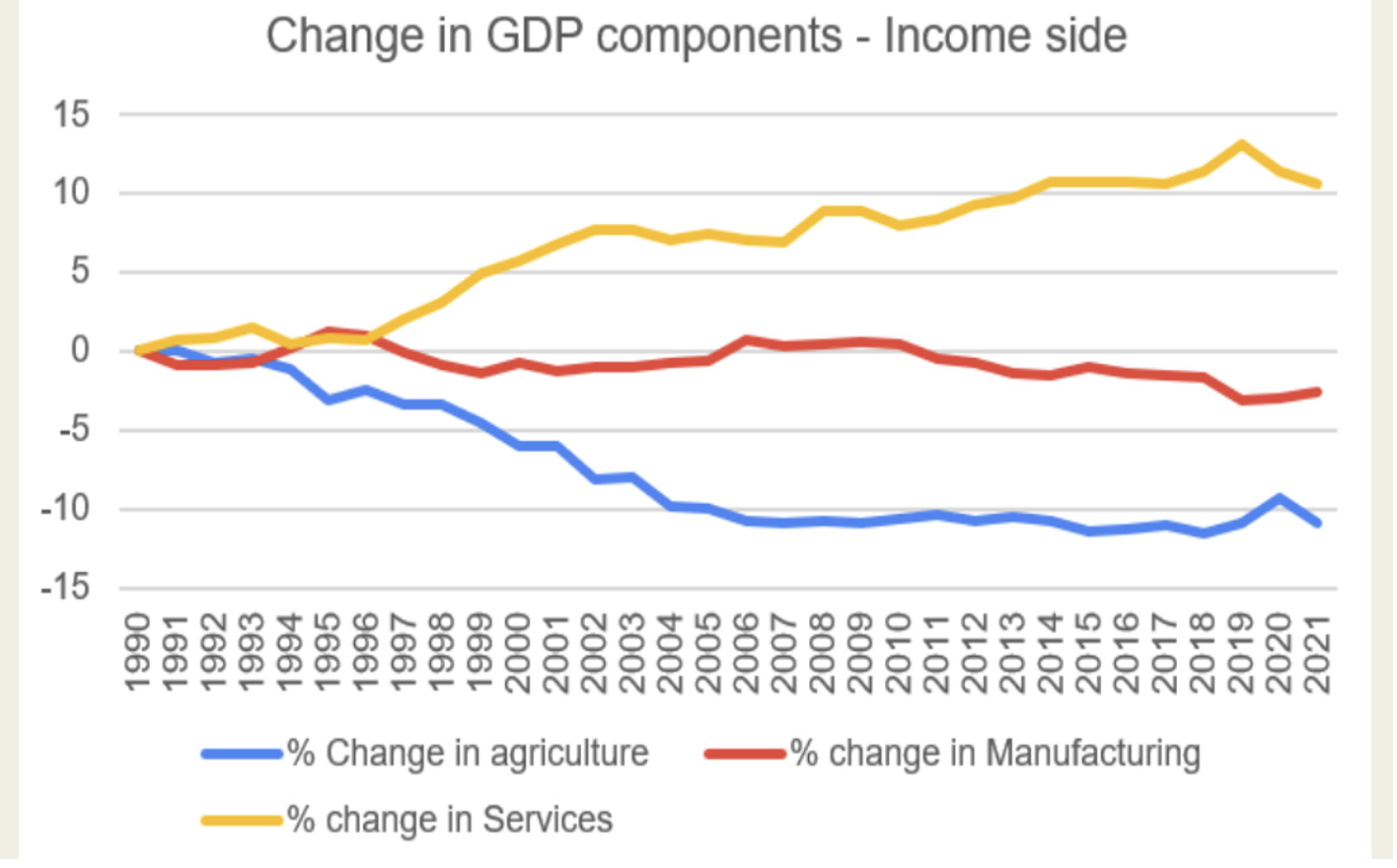
Over the past three decades, India has experienced a relative decline in its agricultural sector’s performance, both in terms of its share of GDP and growth rates (Figure 2a). Notably, the sector recorded negative growth (–1.5%) in certain periods, reflecting its diminishing contribution to the economy (Figure 2b).
India’s GDP has undergone significant structural transformation, characterized by a shrinking agricultural sector, sluggish industrial growth, and a sharp expansion of the services sector. Specifically, agriculture’s share of GDP declined from 42% in 1980 to 15% in 2022, while the services sector grew from 34.5% to 55.3% over the same period. This trend deviates from conventional structural transformation theory, which predicts that as economies develop, labour and output gradually shift away from agriculture—typically accompanied by industrial expansion. However, India’s experience has been characterized by a services-led transition, with manufacturing playing a comparatively limited role.
In manufacturing sector, China’s experience during the 1990s and early 2000s offers a counterpoint. Unlike India, China achieved rapid GDP growth driven largely by manufacturing, which accounted for approximately 30% of its GDP at its peak. This manufacturing-led growth also positioned China as the world’s leading exporter of manufactured goods—a stark divergence from India’s trajectory.
Figure 2a: Gross Domestic Product Components – Income Side (%), 1990–2022.
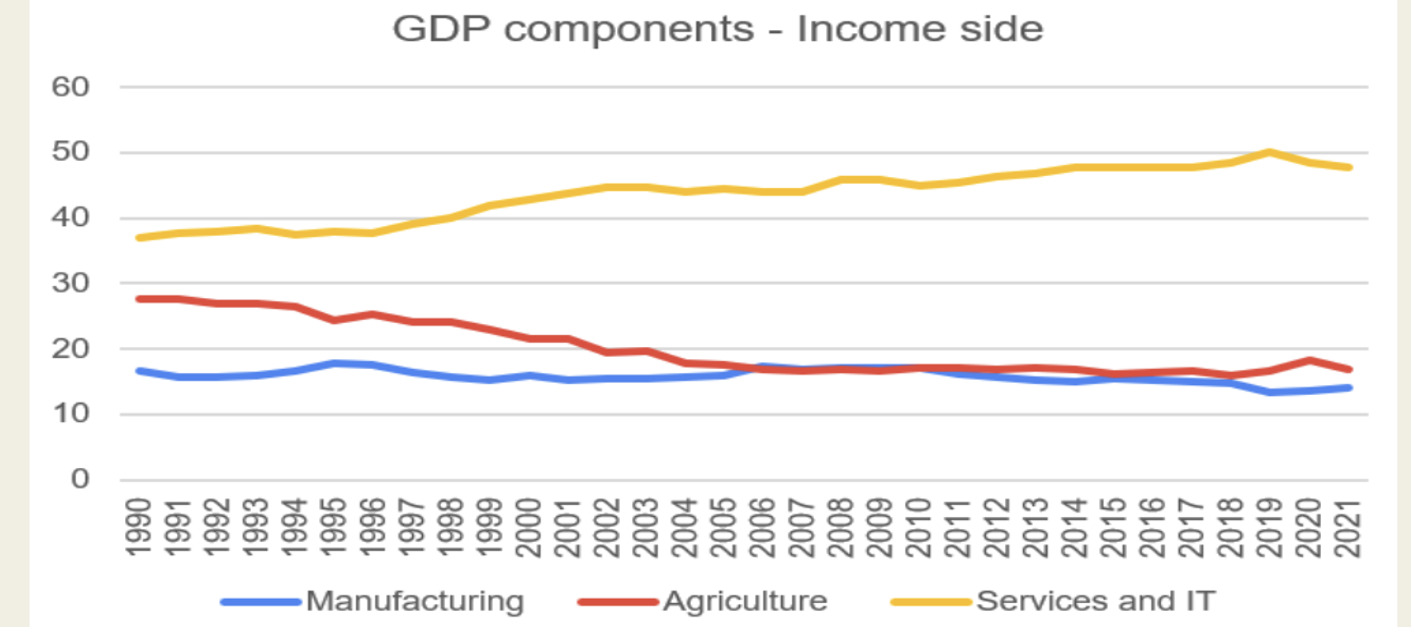
Figure 2b: Changes in Gross Domestic Product Components – Income Side (% change), 1990-2022.
The Indian state, particularly under the Modi government, has actively favoured monopoly capital—both traditional corporate elites and new “crony” capitalists—while systematically undermining petty producers, especially small farmers. Corporate intervention in agriculture remains concentrated in input markets (seeds, fertilizers, pesticides), dominated by firms like Bayer-Monsanto and Adani Agri Logistics. Post-harvest value chains (processing, retail), where Reliance and ITC control procurement and pricing. Yet, large-scale land acquisitions by corporations remain limited due to political resistance (e.g., farmer protests against the 2020 Farm Laws) (Siddiqui, 2024c).
Fragmented landholdings complicating consolidation. This partial corporatization extracts surplus from farmers without industrializing agriculture, deepening rural distress. Manufacturing in global context, in 2023, China led the world in manufacturing output, accounting for 28.9% of the global total. As shown in Figure 3a, the United States was second with 17.2%, followed by Japan (5.2%), Germany (5.1%), and India (2.8%). These five countries combined contribute a significant portion of the world’s manufacturing output (World Bank, 2024). India’s global manufacturing value added is very low and as percentage of GDP has slightly declined between 2010-2022 (see Figure 3b).
India’s post-1991 growth has been services-dominated, with severe structural imbalances. The capital-intensive and financial sectors employ only 4.5 million (0.8% of workforce) but contribute 9% of GDP. This truncated modernization—skipping labour-intensive industrialization—explains: Jobless growth. Services create only 24% of jobs despite being 55% of GDP.
Figure 3a: Global Share of Manufacturing Output in Selected Countries in 2023.

Figure 3b: Manufacturing Value Added and as Percentage of Gross Domestic Product, 2005-2022.

VIII. India’s Social Sector Crisis
India ranks 130th out of 188 countries (UNDP), reflecting severe underinvestment in social sectors. About 45% of India’s children under five are undernourished (Drèze and Sen, 2013). Despite improved literacy rates, public schooling suffers from teacher shortages and poor infrastructure. Public health spending stagnates at 1.5% of GDP (vs. 8% in Europe and 3% in China).
Key indicators reveal deepening distress since the early 2000s: Global Hunger Index (GHI): India fell to 111th/125 (2023) from 55th/120 (2014)—worse than Nepal (69th) and Bangladesh (81st). Food insecurity: 590 million faced moderate/severe food insecurity (2020–22), up from 570 million (2019–21). 230 million experienced chronic hunger (2020–22), a rise of 10 million in three years (World Bank, 2024).
Public health collapse: The COVID-19 pandemic exposed hospital bed shortages (0.5 beds/1,000 people vs. China’s 4.3) and rural healthcare deserts. Public expenditure of combined central/state on social sector averages less than 5% of India’s GDP (health + education), half of China’s allocation in 2024 (See Table 1).
Table 1: Key Data Points for Emphasis
| Indicator | India | China | OECD Average |
| Public health spending (% GDP) | 1.5% | 3% | 8% |
| Child stunting rate | 35% | 6% | <5% |
| Food insecurity (2022) | 590 million | 120 million |
India’s post-1991 economic reforms led to uneven employment outcomes, with growth disproportionately concentrated in capital-intensive and skill-dependent sectors. This pattern limited the absorption of low- and semi-skilled labour into the formal economy. High-growth of service industries—such as information technology, finance, and telecommunications—contributed approximately 15% to India’s GDP in 2024. However, they accounted for only 5.4% of total employment, highlighting a significant disparity between economic output and job creation (Siddiqui, 2025).
Despite a steady increase in higher education attainment in India, the labour market failed to provide commensurate opportunities. In 2022, 42% of degree-holders under the age of 25 were unemployed (CMIE), indicating a persistent mismatch between the skills imparted by the education system and the demands of the labour market.
Although manufacturing output expanded at an average annual rate of 7% between 1992 and 2023, employment elasticity remained low. Sub-sectors such as machinery and equipment witnessed annual growth of 11%. However, increasing automation technology curtailed employment generation. An estimated 83% of manufacturing jobs remained informal, lacking access to social security benefits. This trend not only depressed wages but also limited the sector’s capacity to offer secure livelihoods. The rapid expansion of high-productivity service sectors such as IT, finance, and business services generated limited employment relative to their contribution to GDP. This further exacerbated the structural imbalance between growth and employment generation (Alonso et al, 2024).
India’s economic liberalization since 1991 has reduced the direct role of the state in production but simultaneously expanded the influence of politically connected capitalists. This shift has led to increasing wealth concentration, regulatory capture, and uneven developmental outcomes. The post-reform period has witnessed a sharp consolidation of corporate power and wealth. By 2021, crony capitalist wealth accounted for 8% of India’s GDP, with the top 20 firms capturing 70% of all corporate profits—up from just 14% in 1990. India ranked 7th on the global Crony Capitalism Index in 2022, behind Russia but ahead of Brazil, highlighting the growing nexus between political power and private capital (Siddiqui, 2023a).
Weak regulatory institutions failed to provide adequate checks and balances: bad loans peaked at 12% of total advances in 2018, disproportionately concentrated in crony-linked sectors like infrastructure and aviation. The Insolvency and Bankruptcy Code (IBC) was criticized for favouring asset-stripping conglomerates over workers’ interests, as seen in the Essar Steel resolution, which resulted in a ₹42,000 crore write-off. Strategic sectors, including ports and energy, saw growing monopolization, particularly by conglomerates like Adani.
Despite promises of inclusive growth, liberalization failed to deliver broad-based employment gains. India recorded a youth unemployment rate of 44% among individuals aged 20–24 in 2023 (ILO)—the highest globally. Between 2012 and 2022, male rural employment declined by 15%, while female employment fell by 25% (see Figure 4). This decline coincided with mass agrarian distress, with 10 million farmers leaving agriculture annually. The widespread 2020–21 farmer protests successfully forced the Modi government to repeal controversial farm laws that would have deepened corporate control over agriculture and jeopardized food security.
The threat of investor withdrawal has discouraged progressive taxation measures, such as a wealth tax, despite the top 1% owning 40% of national wealth. Rising joblessness has been politically masked through divisive populism, with majoritarian narratives (e.g., anti-Muslim rhetoric) diverting attention from socioeconomic discontent.
Figure 4: Rural Employment Rates in India (%), 1980-2022.

The Mahatma Gandhi National Rural Employment Guarantee Act (MGNREGA), enacted in 2005, marked a historic commitment to social protection in rural India. It aimed to provide 100 days of wage employment per rural household annually, mitigate distress migration, and stabilize rural incomes. However, under India’s ongoing neoliberal trajectory, the scheme has faced systematic erosion.
Despite its proven role in cushioning rural livelihoods, MGNREGA has suffered from chronic underfunding and institutional neglect in recent years. In 2022–23, budget allocations were slashed by 30%, despite record-high levels of rural unemployment. By 2023, over ₹5,000 crore in wages remained unpaid, compelling many workers to fall into debt cycles.
As a consequence, rural wages stagnated, growing by just 1% annually between 2021 and 2023, compared to 5% in the pre-2014 period. Meanwhile, distress migration surged, with approximately 10 million rural workers moving to urban centres each year (NSSO), often in search of precarious informal employment.
India’s adherence to neoliberal principles—especially the comparative advantage doctrine—has revealed deep structural flaws when applied to agrarian contexts. While OECD countries collectively subsidize their agricultural sectors by over $800 billion annually, India remains constrained by World Trade Organization (WTO) rules that cap domestic subsidies. The average size of Indian farms is just 1.08 hectares, with 86% classified as small and marginal holdings—far below the U.S. average of 180 hectares. And only 30% of Indian farms are mechanized, compared to over 95% in the U.S. and European Union.
Under these conditions, trade liberalization in would prove catastrophic for Indian agriculture, potentially displacing over 100 million rural workers—with no corresponding expansion in industrial employment to absorb them.
IX. Rising Inequality under the Neoliberal Era
As rural welfare contracts, income and wealth disparities continue to widen. According to the World Inequality Database (WID) (Piketty et al., 2025), India has emerged as one of the most unequal countries globally, driven by the concentration of wealth among a small elite and the erosion of redistributive mechanisms. These trends have been exacerbated by policy choices that prioritize capital over labour, formal sector over informal workers, and urban over rural development.
According to a recent Oxfam report (2024), India ranks third globally in the number of billionaires, following only China and the United States. As of 2023, 98 Indian billionaires collectively held an estimated US$657 billion in wealth—an amount exceeding the combined wealth of the poorest 40% of the country’s population. This extreme concentration of wealth has significant macroeconomic implications. As Oxfam (2024:10) observes, “human capital inequality negatively influences economic growth rates because inequality transfers income from low-saving households in the bottom and middle of the income distribution, especially in countries like India, to higher-saving households at the top of the pyramid.”
The distribution of wealth in India has become increasingly skewed in favour of the elite. In 2022, the top 10% of the population controlled approximately 45% of the country’s total wealth. Even more starkly, the richest 1% alone held over 40.5% of national wealth in 2021, while the bottom 50% accounted for only a negligible share. These figures underscore a structural imbalance in India’s political economy, where upward redistribution has become a defining feature of neoliberal development (Oxfam, 2024).
This trend has intensified over the past decade. The number of Indian billionaires rose sharply from 102 in 2020 to 166 in 2022. Oxfam’s (2024) data reveals that between 2012 and 2021, more than 40% of the wealth created in India accrued to the richest 1%, while only 3% reached the poorest 50%. Such disparities not only challenge the legitimacy of growth-led development narratives but also raise pressing concerns about the long-term sustainability of India’s economic model.
In 2022, the wealth of India’s richest individual, Mr. Gautam Adani, surged by 46%, contributing to a combined net worth of approximately US$660 billion among the country’s 100 wealthiest individuals. That year, Mr. Adani was ranked the second-richest person globally on Bloomberg’s Wealth Index and was the single largest gainer of wealth worldwide. His meteoric rise underscores the intensifying concentration of economic power within a narrow elite.
India continues to exhibit persistently high—and growing—levels of income and wealth inequality. The richest 10% of the population hold a disproportionately large share of the nation’s wealth, while the bottom 50% possess only a marginal fraction. This gap has widened substantially in the post-liberalization era, especially since the 1990s, as market-oriented reforms accelerated upward wealth redistribution.
The World Inequality Report 2022 provides robust empirical evidence supporting these trends. Drawing from the WID, the report confirms a long-term pattern of rising inequality in both income and wealth. In recent years, the top 10%—and particularly the top 1%—have continued to increase their relative share of national resources, while the bottom 50% have faced enduring economic marginalization.
To understand the evolving patterns of wealth distribution in India, group-specific wealth growth rates were calculated using data from the WID. The analysis reveals that wealth accumulation has been significantly faster for the richest segments of the population—particularly the top 1% and top 10%—compared to the bottom 50%. This divergence became especially pronounced around the turn of the 21st century, a period marked by intensified market reforms and capital consolidation.
The data also capture a structural slowdown in overall wealth growth after 2010. Between 1995 and 2010, India experienced robust annual wealth growth averaging around 8%. However, this rate declined to approximately 5% between 2011 and 2020, indicating both a deceleration in wealth creation and a continuation of unequal distribution.
The WID provides long-term time-series data that allow researchers to trace the historical evolution of wealth inequality. Complementing this, the All-India Debt and Investment Survey (AIDIS) offers micro-level household data, facilitating the examination of more recent shifts in wealth ownership patterns. According to WID data, since 1981, the wealth shares of the top 10% and top 1% have steadily increased, while the share held by the bottom 50% has persistently declined.
In the most recent decade, the top 10% have consistently controlled over 60% of the country’s total wealth, whereas the bottom 50% collectively own only about 6% (see Figure 5a). This stark contrast illustrates the deepening polarization of wealth in India and underscores the systemic nature of inequality that has taken root over the past four decades. Comparing wealth inequality with other countries, in India the wealth gap between rich and poor has widened in recent decades (See Figures 5b and 5c).
Figure 5a: Wealth Inequality in India, 1961-2021.

Figure 5b: Share of Wealth Held by Top 10% of the Population, 1980-2021.

Figure 5c: Share of Wealth Held by Bottom 50%, 1980-2021.

X. Neo-fascism, Economic Crisis, and the Erosion of Democratic Institutions in India
The failure of the bourgeois state to address the needs of the masses has created fertile ground for the rise of fascistic forces in India. These forces are closely aligned with—and actively supported by—the right-wing BJP, which came to power in the 2014 general election through a combination of false promises of inclusive development and of communal hatred, particularly against Muslims. The BJP retained power in the 2019 election under similar circumstances. However, despite its claims of developmental progress, the well-being of the masses has shown little improvement, largely because the government remains committed to pro-business policies that fail to address widespread economic distress (Siddiqui, 2016).
Unlike classical fascism, contemporary neofascism is incapable of resolving the crises of economic stagnation and mass unemployment. In theory, increasing state expenditure to boost aggregate demand could alleviate these issues, but such spending must be financed either through fiscal deficits or progressive taxation of the wealthy. Expenditure funded by taxing the working class—who already consume the majority of their incomes—does not generate additional demand. In the current globalized context, however, international finance capital strongly opposes both larger fiscal deficits and higher taxes on the rich, severely limiting the state’s capacity for counter-cyclical intervention.
The emergence of fascistic tendencies also represents a striking case of ideological and political inversion. Here, the genuine class antagonism between the working masses (workers and peasants) and capital is ideologically redirected—transformed into a false antagonism between the people and constructed “enemies” such as minorities, and communists. Combating these forces requires a comprehensive struggle—not only on the economic front but also across political and ideological terrains.
The current BJP government is actively pursuing the Rashtriya Swayamsevak Sangh (RSS) agenda of communal polarization, aimed at eroding India’s secular and democratic foundations in favour of an intolerant, authoritarian vision of a “Hindu Rashtra.” This represents a direct assault on India’s constitution and on the institutional integrity of India’s parliamentary democracy. From politically motivated appointments in institutions of higher education and research to the dismantling of regulatory bodies, the government’s actions reflect a systematic effort to reshape India’s institutional landscape to align with RSS ideology. These developments mark a dangerous escalation in the authoritarian project, aimed at realizing the RSS’s vision of a majoritarian, theocratic state.
XI. Conclusion
While India has experienced strong economic growth in recent decades, its structural transformation remains incomplete. Economic activity has shifted from agriculture to services; however, agriculture continues to be the primary source of employment.
To sustain economic momentum and address demographic pressures, India must generate over 325 million jobs by 2050. Achieving this goal, along with transitioning workers into more dynamic and productive sectors, could significantly boost GDP growth. The expansion of the manufacturing sector is essential for creating high-quality employment opportunities and accelerating inclusive growth.
However, the rising of fascistic tendencies in India cannot be divorced from the trajectory of its capitalist development. These tendencies must be understood primarily as a political project of the capitalist class. The critical processes characterize this project is that the bottom 70% of India’s population continues to face severe challenges—low and insecure wages, rising underemployment, the erosion of public welfare provisions, dispossession from land and livelihoods, rural production crises, environmental degradation, and limited access to essential services such as healthcare, education, and housing. These structural problems are rooted in capitalist class relations and have been exacerbated under the neoliberal regime.
Since the early 1990s, while the majority has seen little improvement, the top 10% of wealth holders have accumulated unprecedented levels of wealth. The implementation of neoliberal economic policies has led to a sharp increase in capital intensity and a withdrawal of the state from key areas of production and distribution. These shifts have contributed to widening inequality, slowing job creation, rising unemployment, and a declining wage share in national income. Farmers, in particular, have become increasingly reliant on purchased inputs within deregulated markets at higher prices, while being forced to sell their produce in volatile and unprotected markets, with minimal state intervention through guaranteed pricing.
The neoliberal crisis became particularly evident with the introduction of the three farm laws, which aimed to dismantle the Minimum Support Price (MSP) regime for food grains. Earlier, similar support for cash crops had already been withdrawn, exposing farmers to global price volatility, increasing indebtedness, and triggering a wave of farmer suicides.
India’s neoliberal policies has exacerbated class inequality and deepen the exploitation of the working class for the benefit of capital. Neoliberalism—marked by privatization, deregulation, and an emphasis on market-led growth—primarily serves the interests of the wealthy and powerful. As a result, it has intensified poverty, economic precarity, and social unrest for the majority. In essence, the policies of liberalization and privatization have widened the gap between rich and poor. These policies favour capital accumulation by a small elite, while imposing job insecurity, wage stagnation, rising unemployment and diminished access to essential public services for the majority people.
About the Author
 Dr. Kalim Siddiqui is an economist specializing in International Political Economy, Development Economics, Trade and Economic Policy. Since 1989, he has been teaching economics at various universities in Norway and the UK. Dr. Siddiqui’s research interests encompass a wide range of topics, including political economy, international trade, and economic history, South Asia, and emerging economies. He has presented papers at international conferences across numerous countries, reflecting his global engagement in the field. His scholarly pursuits span six broad domains: Political Economy, Development Economics, Economic History, Economic Policy, Globalization, and International Trade. Dr. Siddiqui has made significant contributions to research in areas such as trade policy, globalization, and political economy. His work has been published in chapters of edited books and articles published in peer-reviewed journals. For inquiries, Dr. Siddiqui can be reached at: [email protected]
References
- Alonso, and MacDonald, M. (2024) Advancing India’s Structural Transformation and Catch-up to the Technology Frontier, July 9, Washington DC, IMF.
- Dreze, Jean and Sen, Amartya (2013) An Uncertain Glory: India and Its Contradictions, New Delhi: Allen Lane.
- Oxfam Report (2024) India: extreme inequality in numbers, Oxfam.
- Siddiqui, K., (2025) “Indian Economy at 75: Transformation and Challenges” American Review of Political Economy19(1):12-34.
- Siddiqui, K. (2024a) “Hindu Nationalism and the Rise of RSS in India” World Financial Review, September.
- Siddiqui, K. (2024b) “China’s Growth Miracle and Development Strategy Since the 1980s” World Financial Review, December.
- Siddiqui, K. (2024c) “Political Economy of Liberalisation of Agriculture in India” World Financial Review, August, Part 1 and Part 2.
- Siddiqui, K. (2023a) “From Rapid Growth to Cronyism: Explaining India’s Economic Development” Asian Profile, 51(4):313-329. December.
- Siddiqui, K. (2023b). “Developmental Challenges: Export vs Import-Substitution in Industrialisation in Developing Countries” World Financial Review, October-November.
- Siddiqui, K. (2022a) “Comparing the Economic Performance of East Asian and Latin American Countries: The Role of Agricultural Reforms in the Economic Transformation” World Financial Review, July-August.
- Siddiqui, K. (2022b) “British Imperialism, Religion, and the Politics of ‘Divide and Rule’ in the Indian-Subcontinent” World Financial Review, January-February.
- Siddiqui, K. (2021a) “The Import Substitution Policy in the Post-Colonial Countries” World Financial Review, November-December,
- Siddiqui, K. (2021b) “The Importance of Industrialisation in Developing Countries” World Financial Review, January February.
- Siddiqui, K. (2020) “A Comparative Political Economy of China and India: A Critical Review” (Edi) Young-Chan Kim. China-India Relations: Geo-Political Competition, and Economic Cooperation, p.31-58, Switzerland: Springer.
- Siddiqui, K. (2019) “The Economic Performance of Modi’s Government in India: The politics of Hindu right” World Financial Review, July-August.
- Siddiqui, K. (2018a) “The Political Economy of India’s Economic Changes since the last Century” Argumenta Oeconomica Cracoviensia, 19:103-132.
- Siddiqui, K. (2018b). “The Political Economy of India’s Post-Planning Economic Reform: A Critical Review” World Review of Political Economy, 9(2):235-264.
- Siddiqui, K. (2018c). “Development Induced Displacement: A Critical Analysis” Turkish Economic Review, 5(2):226-239.
- Siddiqui, K. (2016). “The Economics and Politics of Hindu Nationalism in India” Asian Profile 44(6):497-507.
- Siddiqui, K. (2015). “Agrarian Crisis and Transformation in India” Journal of Economics and Political Economy 2 (1):3-22.
- Siddiqui, K. (2014). “Contradictions in Development: Growth and Crisis in Indian Economy” Economic and Regional Studies 7(3):82-98.
- World Bank (2024) India Development Update, Washington DC: World Bank.