This study reinterprets sixteenth-century Portuguese expansion by challenging conventional views of early mercantilism. Dr Kalim Siddiqui argues that Portugal’s pursuit of a spice monopoly was inseparable from a religious crusade against Muslim traders in the Indian Ocean, producing a logic of violence that legitimised territorial conquest, commercial monopolisation, and ideological warfare as foundations of European expansion.
I. Introduction
The political economy of early modern Europe was profoundly shaped by the interaction of geopolitical fragmentation, religious conflict, and the fiscal demands of warfare. In the aftermath of the Reformation, Europe was divided into rival sovereign states—often small, militarised, and polarised along Catholic and Protestant lines—creating a condition of persistent insecurity. Within this competitive environment, mercantilism emerged as the dominant strategic doctrine. The accumulation of bullion was not pursued as an end in itself but as a means to finance standing armies and seen necessary for territorial defence, continental rivalry, and overseas expansion.
Trade therefore assumed a central strategic role in state formation and power projection. To maximise returns from commerce, states actively constructed and enforced trade monopolies through direct intervention. These measures included the granting of exclusive charters, the provision of naval protection, and the use of military force to secure privileged access to overseas markets and resources. The English and Dutch East India Companies exemplify this fusion of commercial enterprise and state power, revealing mercantilism as a system in which economic activity was subordinated to geopolitical and military objectives (Siddiqui, 1989).
This analysis is situated within the literature examining the militarized character of Portuguese expansion in the Indian Ocean. It interrogates the foundational era of European commercial-imperial intrusion into Asia, epitomised by Vasco da Gama’s arrival in India in 1498. As the historian Boxer (1969) succinctly observed, this expansion was propelled by “a mixture of religious, economic, and strategic and political factors.”
Portuguese and other European expansion into the Indian Ocean is often romantically portrayed as an age of discovery led by intrepid explorers. The Portuguese case, however, reveals a far more consequential reality: a project of military conquest driven by the fusion of technological advantage and religious ideology. The Portuguese did not merely trade; they systematically conquered. Their critical advantages—highly manoeuvrable, cannon-armed caravels, advanced navigational techniques, and sailors trained as naval infantry—were deployed not in peaceful competition, but in the violent seizure of key commercial nodes.
The Portuguese intrusion into the Indian Ocean appears entirely different when compared with the Ming Chinese maritime expeditions of the early fifteenth century. This comparison highlights not merely different navigational traditions, but two fundamentally divergent models of maritime power and political economy.
The Ming voyages, especially those associated with Zheng He, operated within the established structures of the Indian Ocean world rather than seeking to transform them. Although unprecedented in scale, these expeditions were embedded in a tributary and diplomatic framework that emphasized imperial prestige, ritual exchange, and the symbolic projection of authority. Trade accompanied the voyages, but it was neither their primary objective nor their organising logic. Ming naval power did not aim to monopolize routes, displace existing merchants, or impose coercive controls over commerce; instead, it reinforced a hierarchical yet pluralistic maritime order through presence rather than force.
Portuguese expansion, by contrast, introduced a markedly different and more disruptive model. From the late fifteenth century onward, Portuguese activity in the Indian Ocean was explicitly commercial, militarized, and exclusionary. Rather than integrating into existing trading networks, the Portuguese sought to dominate them through naval violence, fortified ports, and monopolistic claims over key commodities, particularly spices.
These differences are especially evident in competing conceptions of maritime space and sovereignty. Ming China treated the ocean as an arena for diplomatic performance, where power was asserted through ritualized exchange rather than permanent occupation. The Portuguese, by contrast, conceived the Indian Ocean as a divisible and governable space, subject to seizure, regulation, and exclusion. Practices such as the cartaz system exemplify this novel assertion of sovereignty over maritime movement itself.
The contrast also reflects divergent political economies. Ming expeditions were state-sponsored projects of imperial display and were readily abandoned when they lost domestic political support. Portuguese ventures, however, were sustained by a fusion of royal authority and private profit, creating durable incentives for continued expansion. In comparative perspective, the Portuguese arrival thus represents a rupture rather than a continuation of earlier Eurasian maritime interactions, introducing new logics of violence, monopoly, and oceanic sovereignty that fundamentally reshaped the Indian Ocean world.
Between 1405 and 1433, the Chinese Muslim admiral Zheng He commanded seven massive expeditions under the Yongle Emperor. The Yongle Emperor, the third ruler of the Ming dynasty, reigned from 1402 to 1424, a period marked by overseas voyages, administrative consolidation, and ambitious maritime ventures. Admiral Zheng He’s fleets—comprising hundreds of vessels, including colossal “treasure ships” that dwarfed any contemporary Portuguese carrack—traversed the same waters from the East China Sea to the African coast. As historian Geoff Wade notes, these voyages of staggering scale—involving over 27,000 men on some journeys—were unparalleled until the age of industrialized warfare. Zheng He solidified trade routes and his ships arrived at Malaysia, South India, Persian Gulf, and brought envoys from over thirty countries to pay homage at the Ming court.
Crucially, the Chinese model was one of hegemonic “soft power” within a tributary system. The treasure fleets, while capable of military action, primarily sought to demonstrate imperial magnificence, secure diplomatic recognition, and facilitate regulated exchange. Local rulers acknowledged Chinese cultural and political supremacy as formal vassals, engaging in state-sponsored commerce. The fleets were, in essence, a magnificent extension of longstanding Asian diplomatic and economic relationships. By the mid-15th century, however, the Ming Dynasty turned inward, voluntarily withdrawing from the ocean and leaving these networks to function without its direct military presence.
This historical precedent underscores the specificity of the Portuguese rupture. In contrast to Portuguese, Chinese admiral Zheng He’s fleets sought to integrate and awe within a recognized hierarchical order, the Portuguese, lacking comparable goods, relied on coercive “hard power.” They could not offer valuable commodities or claim superior civilizational status in a diplomatic sense; they could only offer violence or the threat of it. Their cartaz was the antithesis of Zheng He’s imperial edict—not an invitation to coexistence and trade, but a demand for ransom.
II. The Arrival of the Portuguese via Sea Routes and the Transformation of the Region
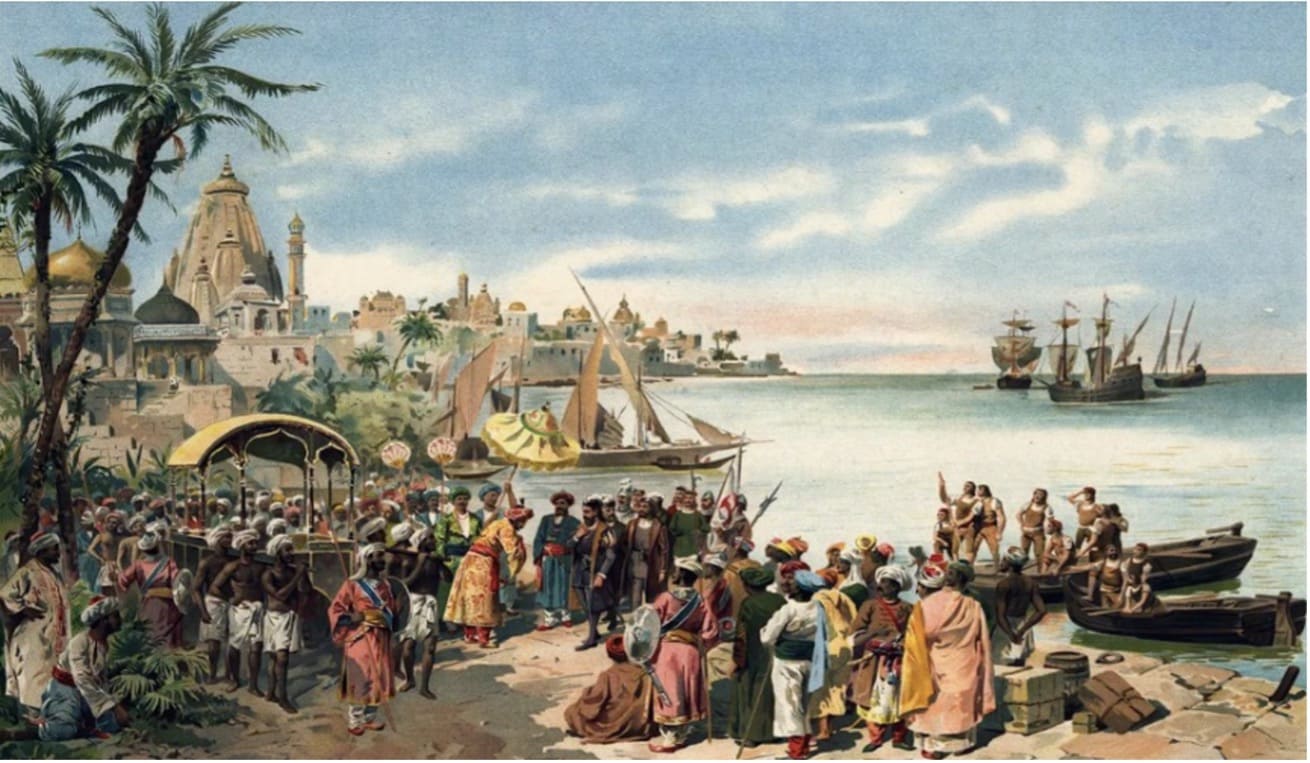
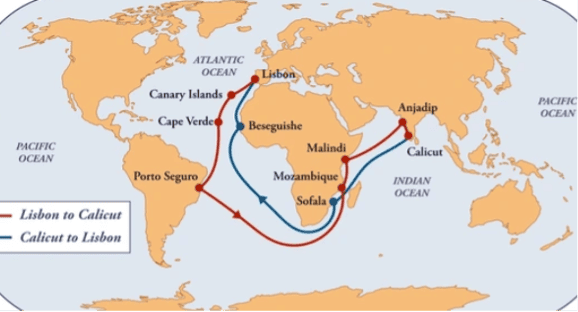
The arrival of the Portuguese fleet at India’s Malabar Coast in 1498 targeted the very heart of the global spice trade. This region was not merely a producer of Kerala’s pepper but the critical entrepôt where cloves from the Indonesian archipelago were exchanged among Arab, Gujarati, and local merchants. Significantly, Vasco da Gama’s entourage included not only sailors and merchants but also monks and priests, alongside interpreters and convicted criminals granted absolution—a microcosm of the voyage’s fused commercial, religious, and penitential motives. The architect of this strategy, Vasco da Gama (1460–1524), attained heroic status in Europe by pioneering the maritime route from Europe to India via the Cape of Good Hope. This feat of navigation was immediately weaponized. It was not merely a discovery but a strategic circumvention, designed to seize the spice trade at its source and cripple the Muslim countries economies that controlled its overland routes (Al-Salimi. and Staples, 2015).
The Portuguese presence in the Indian Ocean was a cataclysmic event, a violent irruption into a world they could scarcely comprehend. They were possessed of an iron will, born of religious fervour and a crusader’s worldview, confronting a system that had never experienced anything like it. As one chronicler recounts, they were amazed by the wealth of even minor port cities, wealth that dwarfed their own and humiliated their first trading mission to Calicut, which had brought nothing of comparable value.
Portugal’s emergence as a commanding force in the Indian Ocean represents one of the pivotal shifts in global history. From its position as a small, crisis-stricken kingdom on Europe’s periphery, it leveraged a potent combination of naval innovation, commercial ambition, and coercive strategy to violently disrupt a long-established and sophisticated trading system. Backed by a formidable fleet, commercial expertise, and sufficient capital to fund its missions, the Estado da India imposed a militarized monopoly that fundamentally altered global trading system and commodities exchange. It forcibly streamlined the flow of spices and other Asian goods into Europe, directly connecting the continents’ products and peoples in a new, though often brutal, circuit of trade (Mathew, 1979).
Through brute force, the Portuguese established a system of extortionate control. By seizing strategic chokepoints like Hormuz, Goa, and Malacca, they diverted existing trade flows through their fortified ports. They then levied the cartaz, customs duties, and outright pillage on all non-Portuguese shipping. This was not trade creation but trade coercion—a parasitic extraction from the vibrant Asian commercial web. Consequently, as historians have noted, despite a century of dominance, the Portuguese Estado da India “did not introduce a single new element into the commerce of southern Asia.” The true economic discontinuity—the systemic ‘rise of capitalism’ with its integrated production, finance, and corporate structures—was introduced later by the Dutch and English East India Companies in the 17th century (Blaut, 1989).
However, by 1517, the Ottoman Empire, under Sultan Selim I, had conquered Mamluk Egypt and secured the Red Sea coast. This was a transformative shift. The Ottomans, at the zenith of their military and administrative power following their victory over the Safavid Persians, presented a stark contrast to the internally fractured and economically weakened Mamluks. Their entry into the Indian Ocean theatre fundamentally altered the strategic calculus. No longer facing a declining power, Portugal now contended with a vast, centralised empire capable of contesting their naval dominance, protecting Muslim merchant convoys, and challenging the very monopoly upon which their wealth depended. The Ottoman ascendancy marked the beginning of a sustained, systemic rivalry that would check Portuguese ambitions and reshape the dynamics of power in the Indian Ocean for the next century (Al-Salimi. and Staples, 2015).
This mercantilist pursuit generated a self-reinforcing cycle of interstate competition. As states recognised that commercial monopoly was unsustainable without sustained military superiority—especially at sea—they redirected accumulated commercial surpluses into an intensifying arms race. Investment expanded not only in naval construction but also in the technical and institutional infrastructure that underpinned maritime power: cartography, navigational science, artillery, military training, and shipbuilding. Naval supremacy became essential for securing homeward-bound treasure fleets, blockading rival ports, and enforcing protectionist regimes such as the Navigation Acts (Chaudhuri, 1992).
It was this relentless, technological driven competition that ultimately structured the hierarchy of European power. The mercantilist system rewarded states that most effectively fused commercial capital with military innovation and the extraction of wealth from occupied territories. The rise of the Dutch Republic in the seventeenth century, followed by the protracted ascendancy of Britain and France in the eighteenth, can be traced to their relative success in mastering this mercantilist triad: monopolistic commerce, naval-technological advancement, and fiscal-military state formation. Their dominance was not primarily the result of superior commercial efficiency, but of a sustained capacity to mobilise economic resources as instruments of warfare within an intensely competitive interstate order (Acemoglu, et al 2005).
Kindleberger (1996) in World Economic Primacy: 1500–1990, analyses the cyclical rise and fall of the world’s leading economic powers. He argues that nations follow a life cycle of economic vitality, typically progressing along an S-curve: ascending from trade, maturing through industry, and ultimately declining as finance becomes dominant (Siddiqui, 2025a). Kindleberger examines historical cases—from Renaissance Venice to imperial Portugal—to identify the complex historical, social, and cultural factors behind economic leadership. However, his model has notable omissions. For instance, in explaining Britain’s primacy, Kindleberger overlooks critical drivers such as the enclosure’s movement, the Atlantic slave trade, colonial exploitation, and the role of corporations—factors that many economic historians consider essential to understanding imperial power and economic transition (Siddiqui, 2024a).
III. Portuguese Strategic Monopoly and Religious Warfare in the Early Mercantilist System
The competitive, militarized logic of European mercantilism, as outlined earlier, was not an 18th-century invention but was pioneered in its most explicit and violent form by the Portuguese Empire in the early 16th century. This case provides a crucial illustration of how geopolitical strategy and religious ideology were fused to justify and motivate the quest for commercial monopoly (Disney, 2009).
Following their 1497 maritime breakthrough to India, Portugal’s primary objective was the establishment of an armed monopoly over the lucrative spice trade of the Indian Ocean. However, the strategic campaign launched by Governor Afonso de Albuquerque in 1517 reveals a more radical ambition that transcended mere commercial control. The Portuguese aimed to seize the port of Jeddah, the gateway to the Red Sea and the Islamic holy cities. This strategy must be understood within a broader ideological and historical context. Just four years prior, in 1513, Albuquerque had written a secret letter to King Manuel I outlining a shocking military plan: a fleet would sail into the Red Sea, land forces at Jeddah, march inland to Makkah and destroy Kaaba-Islam’s holiest shrine-using artillery and gunpowder. But the King did not accept it and saw this could create animosity across all Asia and Arab countries. This proposal was not an isolated fantasy; it was the logical extension of a crusading mentality solidified by the Reconquista on the Iberian Peninsula. The 1492 fall of Granada and the subsequent brutal campaigns against Muslims and Jews had forged a state ideology that viewed commercial expansion, military conquest, and religious eradication as inseparable components of a global struggle.

Portugal’s campaign was strategically to secure a total monopoly by capturing total control of the Indian Ocean trade and ideologically, it aimed to translate Iberian religious triumph onto a global stage. The failure to capture Jeddah does not diminish the illustrative power of the attempt. It demonstrates that the mercantilist drive for monopoly, in its earliest state-sponsored form, could be conceived as total war—a campaign targeting not just rival merchants, but the very religious and economic foundations of a competing civilization (Mathew, 1979).
Portugal’s rise as the first global maritime power cannot be understood outside its profound geographic and geopolitical constraints in the mid-15th century. It was a small, poor kingdom on Europe’s periphery, endowed with poor agricultural land, negligible natural resources, and a population under one million. Its existential threat was terrestrial: the powerful and often aggressive Kingdom of Castile to its east, which would later form the core of Spain. To avoid political and economic absorption by its larger neighbour, Portugal needed to rapidly generate wealth and military power (Chaudhuri, 1992).
Crucially, all conventional routes to such power were blocked. The lucrative overland trade routes to Asia—the source of spices, silks, tea, and other luxury goods—were dominated by Muslim traders and Italian mercantile networks, effectively excluding Portugal from the world’s most profitable commerce. Faced with this systemic exclusion, Portugal’s strategy was one of radical circumvention. It would leverage its Atlantic coastline not as a barrier, but as an avenue to bypass the entire established system by finding a direct sea route to Asia.
This pursuit was a fusion of economic necessity and religious ideology. As a Catholic kingdom freshly triumphant in its own Reconquista, Portugal framed its maritime expansion as both a commercial and a front in a holy war against Islam. The objective was clear: develop the naval technology and geographic knowledge to reach India, sever the Muslim-controlled trade routes, and redirect the wealth of the spice trade directly into Portuguese coffers.
The breakthrough came with Vasco da Gama’s voyage of 1497–1499. It was a brutal undertaking of immense hardship; of the four ships that departed, only two returned, having lost over half their crew to scurvy and disease. Yet its economic success was revolutionary. Vasco da Gama’s surviving vessels carried holds full of pepper, clows, and cinnamon, commodities cheap in India but worth a fortune in gold in spice-starved Europe. As seen that a single successful voyage could generate profits vast enough to secure Portugal’s sovereignty and fund an empire. This moment crystallised the core mercantilist principle: state-sponsored maritime monopoly was the ultimate source of wealth and power, a lesson every subsequent European rival would scramble to learn (Acemoglu, et al 2005).
Upon entering the Indian Ocean, the Portuguese encountered a sophisticated, decentralised, and largely peaceful commercial system. This system was dominated by a diverse network of merchants—Arabs, Gujaratis, South Indians, Iranians, and others—who had for centuries controlled the rich trade routes linking the Middle East, India, and Southeast Asia.
For the Portuguese, however, this scene was not an opportunity for integration but a profound and enraging shock. Their national identity had been forged in the recently concluded Reconquista, the centuries-long crusade to expel Muslim powers from the Iberian Peninsula. They arrived in Asia not merely as merchants, but as militant crusaders, seeing the continuation of their holy war on a global stage. Here, they discovered “the other side of the world”: a region where the very people they had fought at home were not defeated remnants, but the wealthy, powerful masters of the world’s most lucrative commerce.
The Portuguese did not seek to compete with established Muslim and Asian traders on fair terms. Instead, they viewed it as both a religious duty and an economic necessity to eliminate them. As articulated in formal instructions from King Manuel I to his commanders, this was a policy of elimination, not coexistence. Portuguese captains were ordered to seize or sink Muslim vessels, impose punitive taxes via the cartaz (a forced license system), and remove Muslim merchants from key port cities (Al-Salimi. and Staples, 2015).
Under Afonso de Albuquerque, this strategy was executed with brutal consistency. The capture of Malacca in 1511 was followed by the massacre of its Muslim merchant elite. The seizure of Hormuz in 1515 secured the choke point to the Persian Gulf. Each conquest followed a grim pattern: the swift capture of a port, the execution or expulsion of Muslim traders and merchants, the installation of a Portuguese garrison and fortress (feitoria). By 1515, this network of fortified ports granted Portugal military dominance over the Indian Ocean. The wealth of the spice trade, once diffused across a polycentric network, was now forcibly redirected through Lisbon, enriching a tiny European kingdom “beyond the wildest dreams” of its own nobility.
Thus, the Portuguese intervention transformed the Indian Ocean from a cosmopolitan trading zone into a theatre of total economic warfare. This warfare was uniquely justified by a crusading ideology that blurred the line between spiritual enemy and commercial rival. It established a precedent that commercial monopoly could—and indeed, for a nascent European power, must—be achieved through targeted violence against a religiously defined other, setting a template for the mercantilist imperialism that would follow.
The Portuguese created monopolistic commerce with state support, and technologically superior navy. In the centuries that followed, this blueprint was refined and scaled by successor powers: first the Dutch and English, who perfected the joint-stock company as a vehicle for corporate sovereignty; then France; and ultimately by the United States, Germany, and Japan during the industrial and imperial phases of the 19th and 20th centuries.
IV. The Mechanics of Monopoly: Technology, and Terror
The foundational violence of Portugal and other European expansion—the conquest, pillage, and extermination that produced the great 16th century flow of New World precious metals to Europe—itself generated a secondary, parasitic economy. While Spanish and Portuguese treasuries were the nominal recipients, the long, vulnerable ocean journeys ensured that vast sums were intercepted. English privateers and the financiers of Genoa and Amsterdam ultimately captured a significant share of this wealth, illustrating an early, brutal truth of the emerging system: capital followed not just extraction, but also predation and financial intermediation (Acemoglu, et al 2005).
In the Indian Ocean, Portugal faced a different but related challenge. Here, they confronted established Muslim and Asian commercial networks whose traders possessed superior market knowledge, linguistic skills, and long-standing supplier relationships. To circumvent this deeply embedded advantage, Portugal adopted a strategy of elimination rather than competition. Terror became a weapon as decisive as naval cannon. This policy is chillingly illustrated by incidents like the burning of the Mīrī in 1502, a pilgrim ship carrying hundreds of men, women, and children from Calicut to Jeddah were killed. This atrocity was not an aberration but a systematic tactic, repeated throughout the early 16th century to instil paralysing fear and shatter commercial confidence.
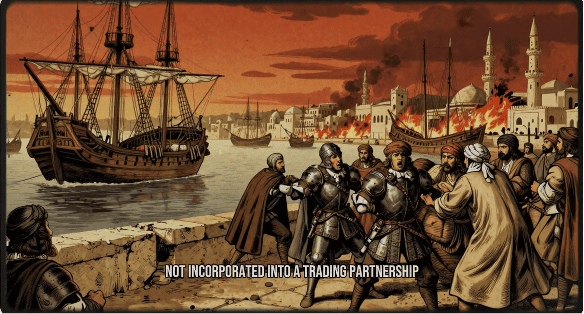
This campaign of terror was enabled by a decisive military-technological edge. Portuguese carracks and caravels, built for the volatile Atlantic, could weather conditions that would swamp the region’s dominant dhows and junks. More critically, they were floating artillery platforms. Mounting heavy, cast bronze cannon that could fire broadsides, Portuguese ships could engage and destroy enemy vessels from distances at which Asian ships, armed with lighter anti-personnel weapons, could not effectively retaliate. This was not a marginal advantage but a revolutionary one, allowing a small number of ships to dominate sea lanes and enforce their monopolistic decrees (Panikkar, 1959).
Thus, the Portuguese model fused three elements: parasitic capital capture, systematic terrorism against civilian commerce, and asymmetrical naval technology. This trinity allowed a peripheral European kingdom to violently reroute the world’s richest trade flows, establishing a blueprint where economic dominance was achieved not through market efficiency, but through calibrated, technologically-enabled brutality.
The conventional narrative of Europe’s rise has long been characterized by what the geographer Blaut (1989) critiqued as “Eurocentric diffusionism”—a paradigm that attributes global change solely to Europe’s intrinsic superiority and its diffusion of ideas outward. Blaut challenges this, arguing that Europe was not inherently more advanced than Africa or Asia in the 15th century, and that its outward expansion was driven by “mundane” geographical and economic factors, not racial or civilizational destiny. This critical framework provides a necessary foundation: it displaces teleological explanations and redirects analysis toward the specific, contingent mechanisms through which one peripheral European kingdom achieved disproportionate global impact.
That mechanism demonstrates that it was a uniquely potent fusion of state and commercial enterprise. Historians like Sanjay Subrahmanyam (2012) identify the period from the 1480s to the 1520s as the apogee of “Portuguese royal mercantilism.” Under Kings João II and Manuel I, the Crown directly orchestrated trade and exploration, seeing it as the “obvious key to prosperity” from its strategic Atlantic position. As Subrahmanyam notes, this mercantilism was “a necessary condition for putting into effect messianic plans,” explicitly linking commercial capital to holy war. This is vividly illustrated by King Manuel I’s 1485 appeal to the Pope, framing the exploration of Africa as a project for the “enormous accumulation of wealth and honour for all the Christian people” (Crowley, 2015, p. 12).
This returns us to the critical ideological driver. As Panikkar (1959) conclusively argued, the Portuguese enterprise was “undoubtedly animated by the spirit of the great Crusades—essentially an anti-Islamic spirit.” Vasco da Gama’s historic voyage, therefore, was not a purely geographic or commercial endeavour. It was the strategic execution of a crusading mercantilism: circumnavigating Africa to outflank Islamic powers, seizing control of the Indian Ocean’s trade routes, and redirecting the “fabled wealth of the East” to fuel a Portuguese—and by extension, a Christian—global project (Crowley, 2015).
Thus, the Portuguese case cannot be explained by Eurocentric myths of innate superiority, nor by economic determinism alone. It was the contingent, violent synthesis identified in this article: a royal-mercantilist engine funded by state capital, a crusading ideology that justified exterminatory violence, and a military-technological edge that made that violence effective.
This reveals the central paradox of early colonialism. While it failed to independent development in the colonies, rather it generated an immense and foundational accumulation of capital for Europe. The plunder of New World gold and silver, combined with the monopolized profits from spices and textiles, alongside the emerging plantation economies, provided a colossal infusion of wealth (Siddiqui, 2024b). This capital was not hoarded but was relentlessly reinvested into further expansion, technological innovation, and state finance, “certainly boost[ing] the development of capitalism” in its mercantile phase.
The contrast with Asia was absolute. As European capital expanded, Asian economies were systematically deconstructed. Indigenous manufacturing was destroyed, access to capital and technology was restricted by colonial policy, and wealth was siphoned to the metropolis through brutal violence, racialized governance, and enforced tribute. The Portuguese model thus established a fundamental pattern of early modern globalization: not the diffusion of progress, but the violent transfer of wealth and the deliberate underdevelopment of one region to fuel the ascendance of another (Siddiqui, 2025b).
V. State, Corporate Violence and Political Economy
The enduring impact of Portuguese expansion must be understood not merely in terms of its violence, but through its institutional limitations. The Estado da India functioned as a redistributive enterprise; it traded primarily to monetize and justify its military dominance, channelling the profits of coercion directly into the Crown’s coffers. A fundamental institutional shift occurred only with the arrival of the Dutch and English joint-stock companies in the 17th century. As Panikkar (1959) notes, this innovation effectively reversed the relationship between ‘profit’ and ‘power.’ Whereas the Portuguese state used trade to fund violence, the Companies—as associations of private capital—themselves wielded violence, thereby internalizing protection costs and creating a self-sustaining engine for commercial imperialism.
The Portuguese achievement was, in itself, extraordinary. For nearly a century—from Vasco da Gama’s voyage in 1498 until the Dutch rounded the Cape of Good Hope in 1596—they held a monopoly on the direct sea route to Asia. This prominence is rendered more surprising by Portugal’s profound constraints: a tiny population incapable of large-scale settlement abroad, and limited material resources for shipbuilding and armament (Mathew, 1979).
Economic historian Angus Maddison (2006) identifies three key advantages that help explain this paradox. The first was strategic geography: Portugal’s location at the exit of the Mediterranean granted it a pivotal role in Atlantic navigation. Recent study by Acemoglu et al. (2005) confirms the significance of such Atlantic-facing geography, though this advantage was not Portugal’s alone. The second was systematic Crown sponsorship. Beginning with Prince Henry the Navigator, the Portuguese monarchy consistently directed resources and expertise toward maritime exploration, transforming it into a sustained state project. Third advantage was technological-military proficiency—specifically, the development of the caravel and advanced naval artillery, which provided the tools to enforce their will upon the high seas.
Yet, possessing these advantages, Portugal made a decisive strategic choice: to exploit its privileged position through systematic violence rather than open commerce. Faced with the embedded networks of Asian traders, they opted for elimination over competition. This choice underscores that their model, while pioneering, was an extractive dead end. It was left to the joint-stock companies of rival powers to institutionalize the fusion of capital and coercion, thereby laying the foundational structures of a truly global capitalist system. As Maddison notes: “research on navigation technology, training of pilots, and documentation of maritime experience in the form of route maps with compass bearings (rutters) and cartography” (Maddison, 2006, p. 59).
This worldview was personified in King Manuel I (r. 1495–1521). His ambitions were a seamless fusion of the messianic and the mercantilist: to locate the mythical Christian kingdom to inflict a decisive defeat upon Islam, and to economically strangle the Muslim world by blockading the Red Sea spice route. The ultimate goal was to forcibly reroute all Asian commerce into the holds of Portuguese caravels, thereby transforming Lisbon into Europe’s supreme commercial entrepôt. Trade was not the objective but the means and the prize of holy war.
Where the Estado da Índia ultimately stalled, the Dutch and English joint-stock companies thrived. Scholarly consensus identifies three key institutional characteristics that enabled this success, directly addressing the systemic failures of the Portuguese model.
First, the corporate format revolutionized capital formation. By pooling investment from a broad spectrum of merchants and gentry, companies like the VOC (Dutch East India Company) and EIC (English East India Company) amassed financial resources on a scale unattainable by the Portuguese Crown, whose perennially strained treasury limited fleet sizes and strategic reach. The corporate structure enhanced this attractiveness through limited liability, managerial transparency, and investor participation, creating a trusted and renewable financial engine.
Second, this structure effected a decisive separation of capital from direct state control. The Portuguese enterprise was, from its inception, a state-led monopoly where financial and strategic decisions remained subject to dynastic politics and crusading ideology. In contrast, the joint-stock companies, though chartered by the state, operated with significant autonomy, governed by directors accountable to shareholders focused on commercial return. This allowed for agile, profit-driven decision-making.
Third, and most critically, the companies internalized a logic of productive, expanding trade rather than static extraction. The Portuguese model of selling cartazes (protection) was a classic rent-seeking enterprise, subject to diminishing returns as resistance grew and markets were disrupted. The joint-stock companies, while brutally violent, when necessary, primarily sought profit through the management and growth of commodity flows. Their profits could be reinvested into a growing business—in larger fleets, permanent factories, and political infrastructure—creating a cycle of increasing returns and sustained expansion. Thus, where Portugal sold coercion, the companies built a self-financing commercial empire, thereby laying the institutional foundations for global capitalism (Siddiqui, 2022).
This institutional failure had devastating human and economic consequences, vividly captured in the historical record of those who bore its brunt. As one Arab chronicle from the Hadhramaut recorded with bitter clarity upon first contact: ‘the vessels of the Franks appeared at sea en route for India, Hurmuz, and those parts. They took about seven vessels, killing those on board and making some prisoner. This was their first action; may God curse them.’ This was not an isolated incident but a systematic strategy. The contemporary Egyptian historian Ibn Iyas details how, by 1507, over twenty Portuguese warships had penetrated the Red Sea, attacked Indian merchant vessels and seized their cargo. This economic warfare prompted the unprecedented military response of a joint Mamluk-Gujarati fleet under Ottoman command, signalling the coalescence of a regional counterweight.
Thus, the Portuguese legacy in the Indian Ocean is one of profound contradiction. They pioneered the European model of armed maritime monopoly, catalysing a flow of capital that helped fuel the rise of the West. Yet, they did so through a system of institutionalized predation that ravaged existing economies and, ultimately, contained the seeds of its own decline. They demonstrated the destabilizing power of fusion between crusading ideology, state enterprise, and naval technology, but their rigid political institutions prevented the evolution towards the more durable, corporate capitalism of their successors. In the end, the Estado da India stands as a pivotal but transient force: a violent shock to the Afro-Eurasian world system that reshaped the pathways of global wealth, not by building a new order of production, but by mastering, for a century, the brutal arts of extraction and disruption (Blaut, 1989).
While the crusading ethos defined Portuguese violence in the Indian Ocean, its policy was not devoid of commercial pragmatism. By the second half of the sixteenth century, the relative decline of the pepper monopoly prompted a critical strategic pivot. The Estado da India found new prosperity in the South China Sea, ingeniously exploiting political conditions to create the lucrative Goa-Macao-Nagasaki “triangular trade.” This circuit, which exchanged Chinese silks for Japanese silver, was only possible because the Portuguese filled the “dangerous economic vacuum” created by the Ming dynasty’s prohibition on direct trade with Japan. This adaptation revealed a capacity for opportunistic, intermediary commerce that complemented their militarism.
Thus, the Carreira da India—the gruelling, six-month sea route—ushered in more than an era of eastern colonialism; it forged the first links in a truly global economic circuit. The giant ships, eagerly awaited in Lisbon, now connected the silver mines of Japan and the Americas with the spice markets of the Moluccas and the silk workshops of China. In this, Vasco da Gama’s voyage answered Christopher Columbus’s. Where Columbus, seeking the Indies, accidentally claimed a New World for Spain, da Gama successfully charted the course for Portugal to connect these worlds. Their combined actions created the architecture of the first global empire, one built on a volatile but potent fusion of crusading violence, naval technology, and a hard-headed grasp of intercontinental arbitrage (Siddiqui, 2020).
This commercial awareness was present from the outset. Although the Portuguese conquistadors lacked the strength to challenge great centralized empires directly, they successfully transformed the Indian Ocean into a “theatre of political action” where naval power dictated economic access. Their ideology, dominated by a military-feudal ethos, possessed a second, crucial dimension: a keen understanding of commerce as an engine of wealth, learned from observing the success of Venice, Genoa, and Mediterranean Muslim cities. This was articulated plainly by apothecary Tomé Pires in his Suma Oriental (1515). Dedicating his work to King Manuel I, Pires promised to describe not only Asian kingdoms but “the dealings and trade they had with one another, without which they could not exist”—a clear recognition of the interconnected, commercial nature of Asian power.
The Portuguese strategy of armed monopoly did not go uncontested. Its disruptive effects prompted direct responses from major regional powers, whose motivations highlight what was at stake. The Mughal Emperor Akbar’s conquest of Gujarat in 1572 was a pivotal event, driven by dual imperatives. Primarily, it was an economic calculation to seize control of the region’s numerous ports and capture the profits of the lucrative Indo-Persian maritime trade. Secondarily, it carried a profound religious-political duty: to secure the sea routes from Surat to Jeddah, thereby safeguarding the Hajj pilgrimage for his subjects—a core obligation of a Muslim sovereign. Akbar’s move was thus a direct challenge to the Portuguese stranglehold over the very arteries of commerce and faith.
The nature of that stranglehold was one of highly organized, state-sanctioned piracy. The Portuguese did not merely attack ships; they instituted a comprehensive regulatory regime of the seas. No vessel could sail without their permission, and defiance resulted in destruction. The only alternative to attack was to purchase a cartaz—a “safe conduct” pass that functioned as a protection racket. This system extended beyond mere taxation into deep control over trade composition. A pass issued in 1613 to a ship of the King of Bijapur, for instance, meticulously dictated what could be carried, forbidding not only lucrative spices like cinnamon and pepper but also strategic goods like metals and timber, and even prohibiting the transport of passengers from specific regions like Turkey and Abyssinia.
This reveals the Estado da India not as a mere predator, but as an extractive bureaucracy. The cartaz system was a legalistic instrument of economic warfare, designed to cripple competitors, control strategic materials, and politically fragment the Indian Ocean world by dictating who could move where and with what. Akbar’s conquest of Gujarat represented a formidable attempt to break this system from a position of terrestrial empire, underscoring that the Portuguese “theatre of political action” was defined by constant negotiation, resistance, and the relentless imposition of a coercive maritime order (Chaudhuri, 1992).
The enduring impact of Portuguese predation is searingly captured in contemporary accounts. The French physician-traveller François Bernier, who spent twelve years (1656–1668) at the Mughal court, reported that Portuguese and other Christian corsairs continued to ravage Bengal decades after their regional military power had waned. He describes a relentless campaign of terror: “They scoured the neighbouring seas in light galleys… entered the numerous arms and branches of the Ganges… and, often penetrating forty or fifty leagues up the country, surprised and carried away the entire population of villages… made slaves of their unhappy captives and burnt whatever could not be removed.” This testimony underscores that the Portuguese legacy was not merely one of disrupted trade routes, but of profound human devastation—a practice of slave-raiding that terrorized coastal populations long after their imperial center had ossified.
Bernier’s observations extended beyond this violence to a sophisticated critique of political economy, offering an indirect commentary on European statecraft. He meticulously described the paradox of Mughal wealth: “although the Great Mughals is in receipt of immense revenue, his expenditure being much in the same proportion, he cannot possess the vast surplus of wealth that most people seem to imagine.” For Bernier, true state power lay not in spectacular extraction but in sustainable governance. He defined the “effectively rich” king as one who, “without oppressing or impoverishing his people,” could fund his court, build public works, maintain defence, and—crucially—accumulate a strategic reserve for unforeseen wars. This model of a fiscally rational, accumulation-oriented state stood in stark contrast to both the extractive frenzy of the Portuguese and the distributive, consumption-heavy model of the Mughal elite.
Thus, the history of the 16th and 17th centuries presents a stark dialectic. On one hand, the Portuguese, with religious zeal and superior weapons, forged the first long-range empire through extreme violence. Their cry of “Santiago!” as they swept through multicultural Malacca in 1511 epitomizes a model of conquest that valued plunder over production. On the other, observers like Bernier identified the principles of a more durable state power, one based on systematic accumulation and sustainable governance rather than predatory extraction. The triumph of the Dutch and English joint-stock companies lay in their synthesis of these elements: they harnessed the violent, exclusionary tactics pioneered by Portugal within a corporate framework designed for Bernier’s ideal of perpetual accumulation. In doing so, they unlocked the transformative potential that had eluded the Estado da India, channelling the immense capital flows of early modern globalization into the foundations of the modern capitalist world-system.
Thus, as Crowley (2015) notes, their “swashbuckling” penetration achieved a stunning and bloody dominance, creating “the first Western-dominated world empire since Alexander the Great.” This was Act One in the rise of the West—a thrilling and unlikely victory forged from religious zeal, technological asymmetry, and strategic brutality. Yet, as this analysis has shown, their Estado da India remained a redistributive, extractive enterprise, an institutional dead end that thrived on violence but could not innovate. Its true historical significance lies in the precedent it set: it demonstrated that immense global wealth could be captured through militarized monopoly, and in doing so, it established the violent template upon which the more durable, corporate structures of Dutch and English capitalism would later be built. The Portuguese did not invent global capitalism, but they pioneered the system of armed extraction that made its ascent possible.
Thus, the rise of the West, inaugurated by Portugal, was not an inevitable historical tide. It was the triumph of a particular, brutal logic of accumulation-by-force over a model of hegemonic diplomacy and managed trade (Siddiqui, 2025c). The Chinese withdrawal created a geopolitical space, but it was the Portuguese who filled it with forts, artillery, and a system of terror. Their legacy, therefore, is not merely that of the first global maritime empire, but of the architects of a new and violent world order, one where economic integration would be permanently yoked to military domination—a defining feature of the capitalist world-system that their successors would inherit and expand.
The Portuguese arrival in the Indian Ocean constituted a profound and violent rupture. To the sophisticated politics of Asia, Portugal appeared as a cultural and commercial backwater, its initial trade offerings pathetic and revealing of material poverty. Yet, this marginal European kingdom possessed a decisive, asymmetrical advantage: a suite of maritime and military technologies—the armed carrack, heavy naval artillery, and transoceanic navigation—that had no equivalent in the region. More critically, they arrived animated by a crusading mentality that fused religious zeal with unlimited political ambition. This combination baffled Asian rulers, whose conflicts operated within established norms; the Portuguese demonstrated a terrifyingly limitless capacity for cruelty and a strategic objective not of integration, but of total domination.
Under the first two Viceroys, Francisco de Almeida and Afonso de Albuquerque, this agenda was executed with startling speed and efficacy. They established a network of fortified trading posts from Sofala to Malacca, seizing the strategic chokepoints of the Indian Ocean world. The Treaty of Saragossa (1529) formally confirmed this Portuguese dominance, codifying their monopoly. Their primary goal was clear: to dominate the spice trade, particularly pepper, by forcibly bypassing and dismantling the traditional Red Sea routes controlled by Arab, Venetian, and later Ottoman intermediaries.
The result was the creation of the Estado da India, a maritime empire that, for nearly a century, transformed a previously open and polycentric trading system into a militarized, state-controlled monopoly. This was not an evolution of commerce but a coercive integration of global exchange. The Portuguese did not introduce capitalism to Asia, but they pioneered its most essential and brutal prerequisite: the use of state-backed maritime power to violently redirect global resource flows, impose monopolistic control, and accumulate capital through systematic extraction rather than market competition.
Thus, the Portuguese achievement was foundational yet incomplete. They demonstrated the world-altering potential of fusing Atlantic seafaring technology with a relentless, expansionist ideology. They forged the first global circuit of extraction, connecting Asian spice markets to European capital via a chain of armed enclaves. Their model, however, remained institutionally stunted—a redistributive crown enterprise doomed by its own rigidities. It was left to the joint-stock companies of the Dutch and English to refine this template, institutionalizing its violence within a corporate framework capable of perpetual accumulation. In this light, the Portuguese Empire was Act One in the drama of Western ascent: a shocking, bloody prologue that established the rules of a new game—one where global wealth would be pursued not through tribute or diplomacy, but through the calculated application of terror and the barrel of a naval gun (Disney, 2009).
Emerging from a 14th century “age of crisis” marked by the Black Death, civil war, and famine, Portugal turned to maritime trade as a vital source of revenue. Strategic investments in naval technology and the adoption of Arab sailing knowledge enabled the creation of an ocean-going fleet, equipped with ship-mounted cannons that provided a decisive military advantage.
Driven by the desire to access the vast wealth of the Indian Ocean spice trade directly—bypassing Venetian and Arab intermediaries—Portugal pioneered a sea route to India. Upon arrival, however, they found themselves commercially marginal, their goods deemed inferior within the established networks dominated by Muslim and Hindu merchants.
Unable to compete, Portugal chose to conquer. Leveraging superior naval gunnery, they seized key ports like Goa and Malacca, winning decisive victories such as the Battle of Diu (1509) that broke rival naval power. Their strategy was explicitly aimed at destroying the “Muslim mercantile stratum.” They established the Estado da India not as a traditional trading enterprise, but as a coercive, redistributive monopoly. This system was enforced through state-sanctioned piracy, the mandatory cartaz (trade pass), and the systematic terrorization of merchant shipping.
While this created the first long-range European maritime empire and violently rerouted the global spice trade, its nature was extractive rather than productive. The Portuguese operated a “protection racket” on a oceanic scale, controlling rather than creating commerce. Their hegemony, though challenged by the Ottomans and later eclipsed by the Dutch, marked the brutal inception of European colonial dominance in Asia, transforming a polycentric trading zone into a theatre of militarized profit.
VI. The Great Metamorphosis: Systemic Shifts and the Rise of Global Capitalism
The trajectory is clear: a change in the locus of global power became irrevocable from circa 1500. The logic pioneered in the Indian Ocean—where technology was revolutionised not for its own sake but for control, and workers (both enslaved and wage) were organised for export-oriented production—paved the way for capitalism’s successive metamorphoses (Siddiqui, 2018).
The system evolved from its mercantile origins, through manufacturing, into industrial and now financial capitalism, which dominates the world order today. The Portuguese, in their relentless crusade for monopoly, did not just discover a sea route; they helped forge the very tools of economic and geopolitical dominance that would shape the modern world.
The period from the 15th the century onward witnessed a concatenation of transformative shifts, collectively constituting what the historian Michel Beaud (2001) termed the “great turning point in world history.” This systemic transformation was not driven by any single event, but by their synergistic interaction. Its core elements included: the European “discovery” and colonisation of the Americas; the Industrial and technological revolutions; the aggressive expansion of world trade and the division of global resources among a handful of competing European powers; successive revolutions in transport and communication; the rise of powerful joint-stock corporations; and the establishment of integrated monetary and financial networks.
Crucially, the capital that fuelled this metamorphosis was not generated solely through incremental trade. As the Portuguese precedent illustrates, a foundational source was violent accumulation: the profits from the transatlantic slave trade, the systematic loot of colonies, and the mercantilist plunder of established trade networks (Siddiqui, 2020b). This capital was not hoarded but was relentlessly poured back into further expansion, financing new voyages, new technologies, new weapons, and new conquests, creating a self-reinforcing cycle of extraction and investment.
Thus, while merchants and commercial societies existed across the globe, it was specifically within Western Europe that these elements fused into a new, expansive, and ultimately dominant system. The unique European alchemy combined the profit motive with the state-backed military enterprise, the corporate structure with imperial ambition, and technological innovation with coercive labour systems. This potent fusion is what we recognize as capitalism in its formative, mercantilist phase—a system born not as a peaceful development and market transactions, but in the fortified ports of the Indian Ocean, brutal military force, and the plantation economies of the Atlantic world. Its logic, first operationalised by powers like Portugal, would come to organise global production and exchange for centuries.
According to Beaud (2001:14): “The Crusaders were the opportunity for the formation of considerable fortunes, notably the legendary one of the Templers. Commerce, banking and finance flourished first in the Italian republics of the thirteen and fourteenth centuries, and then in Holland and England. With the invention of the printing press, progress in metallurgy, the employment of water power, and the use of carts in the mines, the second half of fifteen century was distinguished by a clear advance in the production of metals and textiles…and in the navigational techniques allowed for the opening up of new maritime routes… Capital, more abundant merchandise, sailing ships, and weapons: these were means of expansion for commerce, discoveries, and conquests”.
Further Beaud (2001:14) noted: “states battling for supremacy, merchants and bankers encouraged to enrich themselves: these are the forces which inspired trade, conquests, and wars; systematized pillage; organized the traffic in slaves; and locked up to vagabonds so as to force them to work…the “great discoveries” enters at a junction of this twofold dynamic: in 1487 rounded the Cape of Good Hope; in 1492 Columbus discovered America; in 1498 Vasco De Gama, having skirted Africa, arrived in India. A great hunt after wealth-trade and pillage began.”
VII. Conclusion
Portugal’s legacy is thus dual-edged. It created the prototype for the long-range, armed maritime empire and laid the logistical and psychological groundwork for European expansion. Yet, its model—based on redistribution, protection rackets, and systematic violence—proved to be an institutional dead end. The true transformation of this coercive framework into a dynamic capitalist world-system would be the work of its successors, the Dutch and English joint-stock companies.
What Portuguese found was not a void to be discovered, but a sophisticated, interconnected commercial cosmos. Muslim and Hindu polities, though rivals, maintained a relatively harmonious balance of power. Critically, the Indian Ocean was largely a demilitarized zone of commerce, where free trade and a pragmatic tolerance held sway. Navies existed for policing, not for the systematic annihilation of merchant traffic.
The Portuguese intrusion into the Indian Ocean appears especially radical when contrasted with the Ming dynasty’s maritime expeditions of the early fifteenth century. While both projected power across vast maritime spaces, they embodied fundamentally different models of political economy and imperial practice. The Ming voyages, particularly those led by Zheng He (1405–1433), operated within a tributary framework that prioritized diplomatic recognition, ritual hierarchy, and imperial prestige over commercial monopolization or territorial control. Chinese naval power functioned primarily as a symbolic instrument of order, and despite its scale and occasional coercion, it neither sought permanent bases nor attempted to restructure existing trade networks.
By contrast, the Portuguese arrival at the turn of the sixteenth century marked a decisive rupture. Driven by mercantile capitalism, religious militancy, and an emerging conception of maritime sovereignty, the Portuguese pursued domination rather than participation, employing naval artillery, fortified enclaves, and regulatory mechanisms such as the cartaz to control circulation and exclude competitors. The contrast reveals that European ascendancy in the Indian Ocean was not inevitable or technologically predetermined but the result of deliberate choices about how commerce, power, and coercion could be fused at sea. The Portuguese voyages thus represent a critical turning point, signalling the transition from a largely pluralistic maritime order to one increasingly shaped by coercive imperial intervention.
My finding affirms this synthesis while emphasising its operational form: in Portugal’s case, mercantilist theory supplied the rationale for trade monopolies, while crusading ideology legitimised their enforcement through systematic violence directed at Muslim traders and their commerce. The Portuguese response to South Asia was not to integrate, but to forcibly control and dominate.
About the Author
 Dr. Kalim Siddiqui is an economist specializing in International Political Economy, Development Economics, Trade and Economic Policy. Since 1989, he has been teaching economics at various universities in Norway and the UK. Dr. Siddiqui’s research interests encompass a wide range of topics, including political economy, international trade, and economic history, South Asia, and emerging economies. He has presented papers at international conferences across numerous countries, reflecting his global engagement in the field. His scholarly pursuits span six broad domains: Political Economy, Development Economics, Economic History, Economic Policy, Globalization, and International Trade. Dr. Siddiqui has made significant contributions to research in areas such as trade policy, globalization, and political economy. His work has been published in chapters of edited books and articles published in peer-reviewed journals. For inquiries, Dr. Siddiqui can be reached at: [email protected]
References
- Acemoglu, D., Johnson, S., and Robinson, J. (2005) “The Rise of Europe: Atlantic Trade, Institutional Change, and Economic Growth” American Economic Review, 95(3), 546-579.
- Al-Salimi, A.R. and Staples, E, (2015) “Reflections of a Muslim-Portuguese maritime world in a sixteenth-century Portuguese” Proceedings of the Seminar for Arabian Studies, 45:321-327.
- Beaud, M. (2001) A History of Capitalism, 1500-1980, New York: Monthly Review Press.
- Blaut, J.M. (1989) “Colonialism and the Rise of Capitalism” Science & Society 53(3): 260-296, Fall.
- Chaudhuri, K. (1992) “The Portuguese Maritime Empire, Trade, and Society in the Indian Ocean During the Sixteenth Century” Portuguese Studies, 8:57-70.
- Crowley, R. (2015) Conquerors: How Portugal Seized the Indian Ocean and Forged the First Global Empire, London: Faber & Faber
- Disney, A. R. (2009) A History of Portugal and the Portuguese Empire: From Beginnings to 1807, Cambridge: Cambridge University Press.
- Kindleberger, Charles (1996) World Economic Primacy: 1500 to 1990, New York: Oxford University Press
- Mathew, K.S. (1979) “Portuguese Trade with India and the Theory of Royal Monopoly in the 16th Century” Proceedings of the Indian History Congress, 40:389-398.
- Panikkar, K.M. (1959) Asia and Western Dominance: A Survey of the Vasco da Gama Epoch of Asian History, 1498-1945, London: G. Allen & Unwin.
- Siddiqui, K. (2025a) “Ibn Khaldun and the Dynamics of Social and Economic Transformation” World Financial Review, September.
- Siddiqui, K. (2025b) “Decolonisation and Economic Sovereignty: The Bandung Conference and the Making of the Global South” World Financial Review, June.
- Siddiqui, K. (2025c) “The United States’ Future in an Imperial Mirror: Lessons from Britain, Spain, Abbasids, Rome, and Beyond” World Financial Review, November.
- Siddiqui, K. (2024a) “The Multinational Corporations, Capitalism, and Imperialism: The Case Study of East India Company” World Financial Review, July.
- Siddiqui, K. (2024b) “Economic Drain from India during the British Rule” World Financial Review, December.
- Siddiqui, K. (2022) “Capitalism, Imperialism, and Crisis”, European Financial Review, June/July.
- Siddiqui, K. (2020a) “The Political Economy of Famines under Colonial India: A Critical Analysis” World Financial Review, July/August.
- Siddiqui, K. (2020b). “The Political Economy of the Slave Trade, Capital Accumulation and the Rise of Britain” World Financial Review, January/February.
- Siddiqui, K. (2018). “Capitalism, Globalisation and Inequality” World Financial Review, November/December.
- Siddiqui, K. (1989). “Colonialism, Hunger and Backwardness in the Developing Countries” Materialisten, (in Norwegian) no.3-4:111-135, Oslo.