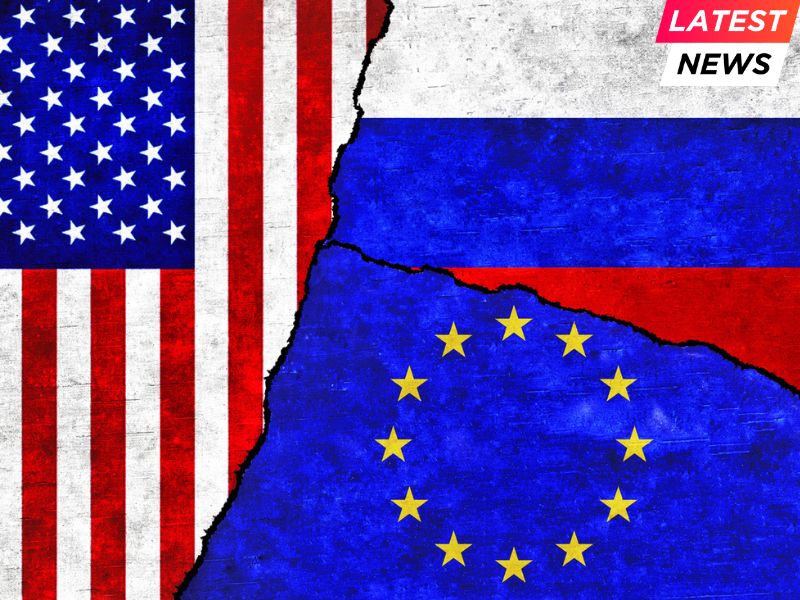
Growing tensions between Washington and its European allies are reshaping the geopolitical landscape, creating new strategic openings for Moscow as it seeks to weaken support for Ukraine. Statements from the White House, combined with a recently issued national security strategy, have triggered concern across European capitals and created fresh leverage for Russia in an already volatile information environment.
The latest friction stems from comments made by US President Donald Trump, who sharply criticised European governments for their immigration policies and labeled them “weak” and “decaying.” He argued that Russia holds the “upper hand” in its war on Ukraine and urged Ukrainian President Volodymyr Zelensky to “start accepting things” in negotiations. “He’s going to have to get on the ball and start accepting things, you know, when you’re losing,” Trump said in an interview.
These remarks came shortly after Washington released a national security strategy that faulted “European officials who hold unrealistic expectations for the war.” The document claims that those leaders are blocking a viable path toward a peace deal and argues that “a large European majority wants peace, yet that desire is not translated into policy, in large measure because of those governments’ subversion of democratic processes.”
Berlin responded swiftly. German Chancellor Friedrich Merz challenged the assertions, saying the strategy contained elements that were “comprehensible,” others that were “understandable,” but also parts that were “unacceptable to us from a European perspective.” He stressed that Europe does not require Washington’s guidance to “save democracy.”
While the statements have strained trans Atlantic relations, they have been welcomed in Moscow. Kremlin spokesman Dmitry Peskov praised the strategy, calling it “consistent with our vision,” and later noted that “the nuance we see in the new concept certainly appeals to us. It speaks of the need for dialogue and building constructive, good relations.”
Russian officials and figures close to the Kremlin have seized on the moment. Kirill Dmitriev, CEO of the Russian Direct Investment Fund, amplified Trump’s remarks on X and highlighted the warning that “Europe has to be very careful” and that it “is going in some bad directions … very bad for the people.” His posts echoed Trump’s comments following the European Union’s 140 million dollar fine against X for violating content rules. Elon Musk responded by calling for the abolition of the EU.
Despite Russia’s own record of suppressing opposition and blocking platforms such as Facebook and X, Moscow continues to weaponise Western debates to undermine European unity. Analysts see a deliberate strategy aimed at eroding EU support for Kyiv and raising doubts about NATO’s cohesion.
This dynamic has become familiar. Earlier in the year, European officials reacted with shock when US Vice President JD Vance criticised Europe at the Munich Security Conference. Russian state media celebrated those remarks, just as it celebrated harsh statements directed at Zelensky during his White House visit.
This week, Zelensky has been traveling across Europe to secure commitments from the United Kingdom, France and Germany, as well as key institutions in Brussels. Yet Russian messaging has intensified in parallel. Hardline political scientist Sergey Karaganov stated in a broadcast interview that Russia was “at war with Europe, not with a miserable, pitiful, misled Ukraine.” He added that the conflict would continue “until we smash Europe, morally and politically.”
Such rhetoric mirrors more formal warnings from the Kremlin. Before meeting Trump’s envoys Steve Witkoff and Jared Kushner in Moscow, President Vladimir Putin declared that Russia was prepared for confrontation if necessary. “We are not planning to go to war with Europe. I have already spoken about this a hundred times, but if Europe suddenly wants to go to war with us and starts, we are ready right now,” he said.
The combination of Washington’s harsh criticism of European policy and Russia’s aggressive posture has alarmed analysts who track trans Atlantic stability. For European business leaders and policymakers, the widening divide raises questions about future coordination on sanctions, defense spending and energy security. As diplomatic tensions escalate, the geopolitical uncertainty risks shaping investment decisions and long term economic planning across the continent.
Related Readings: