The Eurosatory defence expo in Villepinte, France has long been known for impressive displays of the latest tanks, but the 2026 edition showcased unmanned systems and drones along with a gamut of long-range missiles from Ukrainian companies and European ones looking to equip armies for current and future conflicts.
In his Eurosatory keynote address, EU Defence and Space Commissioner Andrius Kubilius explained the importance of the event: “Eurosatory is the best place for industry and military to meet. Two key partners for deterrence… Eurosatory is a colossal defence market place. Thousands of defence companies, big and small, come here from all around the Europe: primes and startups; big names and new kids on the block.”
With 2,600 exhibitors (+28%) from 67 countries, this year’s expo held increased importance given the geopolitical context and demonstrated a shift in focus. Faced themselves with a growing threat from Russia, European military leaders are using insights from Ukraine’s fight to shape their own procurement decisions. Tony Osbourne and Robert Wall from Aviation Week argue that, “Moscow’s war in Ukraine has provided a key lesson for European military planners: Their forces need to be able to threaten command centers, logistics hubs, air bases and missile sites deep in Russian territory, at a range of up to 2,500 km (1,553 mi.), without relying on aircraft operating in contested airspace to strike those targets.”
Following battlefield experiences over the past two years in the Middle East and especially in Ukraine, manufacturers representing Europe’s and Ukraine’s ‘primes and start-ups’, came to Eurosatory to show off their latest low-cost and exquisite systems capable of hitting far into enemy territory.
Ukraine’s Presence and Influence
The number of Ukrainian exhibitors at Eurosatory went from 5 companies in 2024 to 80 this year, with participants hoping to secure export contracts. This includes Fire Point, one of Ukraine’s most prolific defence companies, who presented their latest systems including the upgraded FP-1 drone whose range increased from 1,650 to 2,700km, the new FP-2 drone that has a more limited range (370km) but can now carry a 200-kilo warhead and the company’s FP-5 Flamingo cruise missile with an alleged 3,000km range. Flamingo missiles have reportedly been used nine times against Russian targets and although its efficacy is still being determined, it was revealed at Eurosatory that the missile is guided by a system from Safran.
The Bars family of cruise missile drones used in strikes against Moscow on May 17th and June 18th was also on display (manufacturers’ identity is secret). It appears the drones have a range of up to 1000km and include variants carrying 22, 60, and 105 kg warheads. German Defence Minister Boris Pistorius and Ukrainian Foreign Minister Andrii Sybiha signed an agreement for the drones to be produced jointly with Germany, with speculations pointing to Diehl Defence as a possible partner for German production.
New European Products on Display
Such agreements to produce Ukrainian technology in Europe are significant, but so are the offers from European companies striving to meet the needs of today’s battlefield. One such company is newcomer Destinus, based in the Netherlands with branches in Germany, Switzerland, France, Spain, and Ukraine. At Eurosatory 2024, the company was barely present, but this year had its own stand showcasing its Ruta Block 1 missile (300km range, 150-kilo payload) and its Ruta Block 2 (700 km range and 250-kilo payload). Destinus also formed a joint venture (Rheinmetall Destinus Strike Systems) with Germany’s Rheinmetall to develop the Ruta Block 3 missile with a range of up to 2000km and a 250-kilo payload that is expected to be tested in 2027.
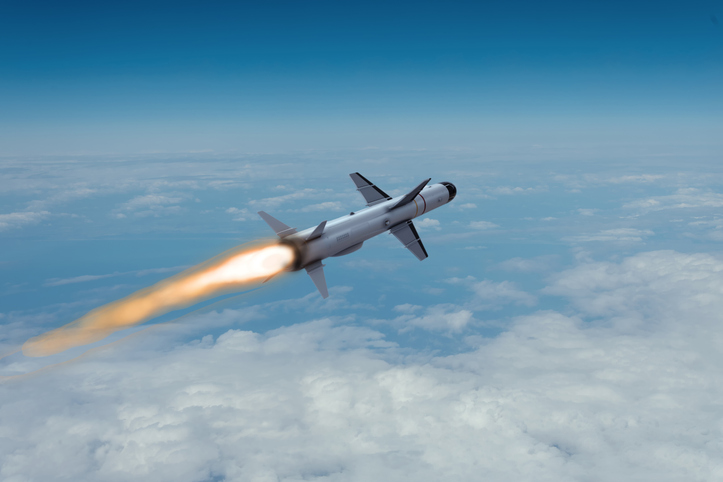
The lion’s share of attention, however, was directed towards MBDA’s stand where the Ground-Launch System (GLS) consisting of four canisters fitted at the back of a trailer for its Land Cruise Missile (LCM) was displayed. LCM, operational by 2029, is the land version of its combat-proven Naval Cruise Missile (NCM). The LCM can be moved into a new location and ready to fire in 15 minutes and quickly moved before the enemy can retaliate: a “shoot-and-scoot” capability that has proven crucial in Ukraine. MBDA showed the new AI-based FastTrack planning tool for the NCM and LCM that, taking into account the cartography and the tactical situation, generates multiple options for cruise missile trajectories under a few minutes for human operators to choose from.
The stand also revealed the NCM-LCM Mk2 upgrade that will be available in 2030. The NCM and the LCM (1000km+ ranges) are the same missile just with different launchers (from frigates and submarines versus ground-launched) and the Mk2 provides significant upgrades including stealth features and additional guidance methods to avoid GPS jamming and spoofing systems. A complementary product was also unveiled: Deluge, previously ‘One Way Effector’, a low-cost, mass-produced long-range loitering munition. In some scenarios, combining Deluge to neutralise and saturate enemy defences with LCM or NCM to eliminate hardened targets increased the ability of the raid to penetrate air defences, a combination that has proven crucial in Ukraine and the Middle East.
NCM/LCM gives armies the ability to strike simultaneously from submarines, ships and vehicles on land and MBDA said it is open to European collaboration. Sweden might be interested after recently selecting Naval Group to produce its four future frigates that have the capacity to launch NCM missiles (Greece is apparently equipping Themistokles, the last of its four new frigates, with them).
Or Poland who ordered new A-26 Saab submarines that don’t come equipped with a long-range strike option. Naval Inspector Vice Admiral Jarosław Ziemiański said the Navy was doing everything to ensure “adequate capability against all threats we currently foresee, as well as future ones.” Poland’s Chief of the General Staff Gen. Wieslaw Kukula confirmed the country’s pursuit of long-range strike weapons, saying, “I can only assure you that a great deal is already happening in this area and we will be opening a major program dedicated specifically to this solution, here in Poland as well.”
Poland’s Polska Grupa Zbrojeniowa (PGZ) recently announced a partnership with American Anduril to produce Barracuda-500M cruise missiles but given their low payload (45-kilos) and 500km range, they seem more suited to use as saturation munitions than for eliminating high-value, heavily-defended targets. For that, Kukula and Commander Łukasz Rumkowski, Poland’s new ‘Submarine Squadron’ commander, might consider the NCM/LCM Mk2 option that could rapidly provide the new submarines with “offensive teeth”. Industrial groups capable of offering encapsulated-missile technology are very scarce, and the other available option, the Tomahawk, faces significant export restrictions given the priorities of the US Department of Defense following Operation Fury.
Other countries that will probably be interested in the various products on display at Eurosatory include the 12 NATO states— Denmark, Estonia, Finland, France, Germany, the Netherlands, Norway, Romania, Spain, Sweden, Turkey and the United Kingdom – that recently signed a joint statement at the NATO Summit in Ankara committing to invest a collective €50 billion through the Deep Precision Strike Capability Investment Initiative.
Sam Cranny-Evans, editor of Calibre Defence, argues the choice of systems and missiles within the initiative will be important as, “… any attempt to deliver a deep precision strike will have to be survivable against layered and now experienced Russian air defences. Yes, cheaper systems have a role to play, as demonstrated by Ukraine. However, they complement and support high-end systems by soaking up air defender bandwidth.” Fortunately, promising options were presented at Eurosatory 2026 that can fill both those needs.