Achieving success in the world of business is always started by having solid foundations that your vision and ideas can grow from. Insufficient planning and lack of self-belief will lead to failure. Fortunately, these fundamentals are simple to lay down and, once they are there, you will be removing a large amount of worry and stress from your life and you can concentrate on moving forward. Here are five ways to ensure business success.
Budget
Having the cash to sustain your business through its early stages is vital. You will be unlikely to be making much in profit, and what you do make will be going towards helping your business grow. Don’t skip areas out because you think they’re of little consequence, small amounts very quickly add up and could lead to you having a shortfall in cash. You can also opt for virtual credit card Philippines which is equipped with software to track down your expenses and to identify if expenses are beneficial to your business. If cashflow is a problem and you hold an unneeded insurance policy, you can take a look at a guide online that will tell you everything you need to know about selling the policy for immediate cash.
Believe in Your Vision
Believing in yourself and what you do is essential for any walk of life. If you don’t have full confidence, you are not going to put in full effort. For a business to go anywhere, it needs an owner who has absolute determination to make it succeed. This self-belief will bring you through all the inevitable obstacles you will face along the way, as well as making it easier to sell your ideas to others. Keep any goals in mind as motivators whether you want to generate more money for retirement, help advocate for a social issue, or simply bring a concept to your community that you believe it needs, stay hungry and focused on your vision.
Plan
Now that you have belief, get that down on paper. Your planning should not skip any part of your business and should also look at any eventuality. Things do and will go wrong, so you must be ready for that to happen and have options to get things back on track. Solid, thorough planning is evidence of your belief in your vision and what you want to achieve through your business idea.
Network
Networks help to solve problems. As we keep being reiterating, you will face problems so having people there who can help you solve these problems is absolutely vital. Your network will also contain experienced people who can give you advice when times are difficult. Having a large network will allow your business to grow and get your brand known through word of mouth. Go to conventions and trade shows and start meeting people.
Find Investors
Once your business starts to grow, you will need to find investors to keep your business on track financially, while also having the potential to keep growing. Investors can range from friends and family to local businessmen who like what you are trying to achieve. You also have the option of crowdfunding where you can be more creative in how you sell your vision. Remember that you must have the above foundations in place before you start looking for investors, or they won’t look twice. Believe in your vision and plan properly and they will be eager to support you.
On-page SEO, aka optimizing your web pages for search engine crawlers to find and rank them higher in search results, is one of the most important factors that will get you more organic website traffic. If done right, it can be an incredibly effective strategy to help your website rank well—which leads to more visitors. Here is how it is done.
1. Treat Every Page On Your Website As A “Landing Page”
The first step to on-page SEO is to understand that every page on your website should be treated as a “landing page”, the same way Google treats it. Every web page should have one main topic and focus on providing targeted information related to what you are trying to rank for—i.e., the keyword you are targeting for this particular page. For each web page of content that you create, ensure that they contain the main keyword/target phrase at least once in the article body (and preferably within the title tag too)—e.g., if your business sells hats online, you would want to include keywords like, “online hat shop” and phrases like “buy hats online” on this page. You can use on-page SEO services from Stellar SEO and see how to improve what you have already done with your brand. The next step is to ensure that your content as a whole covers the topic you are trying to rank for. What we recommend doing with most web pages is to make sure they contain the main target keyword at least once in the first paragraph of text (often referred to as the ‘Natural Title Tag’), and again within 50 words or so—and then use variations of it throughout the rest of your text.
2. Add High Quality, Relevant Images
An additional way to help your website rank is to ensure that you are using images that are related to the topic you are trying to rank for. For example, if your website is about “historic homes”, then high quality images that describe “historic homes” or have historic homes in them help tell Google what your content is about. These photos should come from reputable sources specifically relating to the topic of your website, and not randomly pulled from other sites on the web. Images can be a powerful marketing tool when used correctly, and engaging with them will help you create more interest in what you’re trying to sell. It is always best to make sure the images you use on your website come from reputable sources (like Unsplash) and are relevant to the page you want to rank for. If they don’t, Google will likely not rank your site as highly as it could if this was done properly. But, if you are using images that do not come from a reputable source, or are not relevant to the page itself, it can be an easy way for Google to drop your ranking.
3. Internal Linking Provides Context to Your Content
Another way to improve your on-page SEO is through internal linking. When using internal linking, you are essentially directing traffic within your website by pointing out content that you deem relevant (or that fits with what the page you’re trying to rank for). Internal links help provide context to your web pages and show Google that there is more information or resources they can learn about related topics on your website. It also helps drive users into other parts of your website where they can learn more about what you have to offer, making it a win-win situation for everyone involved. If done correctly, this technique can be used as a great way to “link juice” between web pages on your own site—which will help Google understand how each page on your site is related to each other. Similar to internal linking, crosslinking also helps provide context about what you are trying to rank for by directing users within your website. What crosslinking does is create a network between pages of relevant content by telling Google that these two web pages are linked together through some commonality between them.
4. Build Authority of Your Website
The next thing you need to look at is the authority of your website. This is important because it shows Google that you have a lot of trust and authority in your given industry. In order to build the authority of your website, you need to make sure it looks as professional as possible—which starts with looking at its overall performance from an SEO standpoint. There are a number of ways you can do this by looking at everything from page speed to loading speed. Another thing that is critical to understand about authority and relevancy is the fact that it often starts with your domain registration. If your website addresses look as though they were purchased on a domain reseller site, then Google will more than likely weigh those results lower because of their lack of trust in them. In addition to how relevant your content is, the overall performance of your website also helps signal to Google how quickly it responds, and the global availability (i.e., if users outside the US or UK can access it).
5. Schema Markup Can Help Your Rankings
Schema markup is a way for you to mark up your website content in a way that Google can understand more easily. This will help your website rank higher on results pages because it shows Google how your webpages are structured and what types of information they contain (i.e., who published the page, contact details, etc.). It is done using microdata which tells search engines what certain parts of content mean; for example what an author of a blog post looks like, where the “latest posts” feed of a site is located or even basic event information like dates and locations. This can be useful in both identifying your own website’s structure, and determining whether you should mark up certain content on other sites that you want to get indexed by Google (and likely ranked better).
On-page SEO is a very important factor in the overall performance of your website. Without it, you are leaving Google with little to no information about what your website means. If done correctly, on-page optimization can help you get more traffic quickly. So, if you want your website to rank well, then you need to make sure that you know what on-page SEO is and how best to optimize it.
Hello there. How was your 2021? Was it everything you were expecting? Have you traveled? Or in your country everything was closed? And if it was closed, what were you doing the whole year? If you are reading this, I guess I already know the answer – you were creating some good old music. Am I right? Maybe you have even tried to upload it. Spotify, right? Yeah, that’s what I have thought. Spotify now is the best place for a young and novice musician to start his career. Of course, not only his, but also her career, we are not sexist. And how is your music doing? Good? Bad?
Well, I think I know what you can do – you can try using Spotify promotion services. Wait, wait, wait, don’t close the article – I am not trying to sell you anything. I am just stating facts. According to my data, the number of musicians that have started using promotion services have increased by 24.8% since the last year. Such a huge growth in one year. Do you know why?
I will tell you why – isolation. Musicians are sitting home, people are sitting home, and not every usual person thinks about listening to music in such desperate times. So the number of active listeners maybe stayed the same, but the amount of time people really spend listening to the music has decreased, hence more attention needs to be gained by a musician. End it is not as easy as it once was now to publish your music and get recognition for it. Even before these epidemics, it wasn’t that easy. And now, when everyone went online for their work and social life, the amount of effort and musician has to give is outstanding. Now you can’t just upload a track and wait for success, like you could have done five years ago. Now you have to promote it, to guide it to success. Social media, ads, music promotion – all those methods are your tools in this war for popularity. So, are you winning now?
Yes, music promotion doesn’t seem like a good option, but it really is. So many musicians have become popular just because they started promoting their music at the right time. And now it is the right time for you to do it also, because every year there will be more creators, and the competition will be higher. So you need to establish your audience and your popularity as soon as possible and buy some of the cheapest Spotify plays. You simply can’t wait for your followers and fans to appear naturally, which will usually take about 3 to 5 years of active music releases. Of course, if you are a music genius, it will take less, but what are the chances that you are a music genius? I am not trying to undermine your creativity, but just simply asking questions. What do you think, can your music use some popularity boost? Just look at the number of musicians that started using the promotion, the number speaks for itself – it is the thing you have to do now. And you are a small musician, right? You don’t create the rules of the game, you just play the game by the rules that were created by bigger players. And those are the rules of a music industry nowadays, not only on music streaming services, but in real life.
Essay writing services have been sprawling over the internet for the past few years. And why not? The service has been gaining popularity because of its immense importance in a student’s and professional’s academic life.
However, although the competition has risen, the process of finding a reliable service over the internet has become harder because of an enormous number of service providers out there. Students, and whoever wants to order an essay, face a great deal of trouble in trusting new, even old, websites because of several reasons, such as:
You never know what you are ordering online
There is always a privacy risk
You can be cheated on by your chosen service
There are several other reasons, however, we will not mention them because this is a list that highlights the solutions to these problems so that you do not have to be worried about having a foul experience with your essay writer service.
The good news for you is that everything is not bleak. There are essay writer services, such as https://essaywriter.vip/ that are serious with their expectations and dedicated to serving their clients in the best way possible.
To make things easier for you in your quest of searching and purchase the best essay writer service on the internet, we have compiled a list of certain key factors that you should take into consideration to increase your chances of hiring a service that is professional, and will get your job done without any hiccups, as was promised earlier.
It Is All About the Writers
Think of writers as drivers of your taxi. If the writer is incompetent, you will get late to your journey because he will drive slow because he did not know the way, hence, he was confused and out of his sort.
Similarly, your essay writer is the deciding factor when it comes to the success of your essay. The best essay services will assign you an essay writer that has a proven track record, background knowledge and qualifications in your ordered field, and is cooperative.
Your essay writer should not be afraid of constant progress check-ups and communication because this is your right since online essay writing is a difficult task involving mistrust. So, before you hire a service, make sure that your essay writer is effective and competent based on the points that we mentioned above.
Guarantees Are Key
When it comes to the best essay writing services, the vast majority of them provide guarantees on their website that can be viewed by internet traffic. These guarantees are extremely important, and if your shortlisted website features them on their website, you are in luck because these guarantees act as leverage for you if your essay writing service does not live up to its expectations.
Some of these guarantees offered by online essay writing services include:
An unlimited amount of rewrites as long as the customer is not satisfied
24/7 communication with the team and the writer
Editing and proofreading
Complete protection of your anonymity
Work to be delivered in accordance with the deadline
These crucial pointers are determinants of a great essay writing service, and for your knowledge and better understanding, we will go through each one of them by expanding them and discussing them more.
Unlimited Rewrites
After your essay is written, the complete work is not complete by then. Your paper has to go through a stringent check where everything is cross-checked to identify and fix any mistakes or discrepancies. As long as you are not satisfied, you have the right to order as many rewrites.
24/7 Communication
We already know the risks and anxiety associated with online ordering, especially when your grade and college GPA is on the line. Hence, your service should be available to answer all of your queries at any given time. Leaving you in the dark can be one of the foulest things a service can do to you.
Editing and Proofreading
After the writing process is completed on your paper, the editing and proofreading team goes over the entire paper to identify any mistakes or loopholes in your paper. Editing and proofreading are important factors, in determining the success of your paper. Your shortlisted service should provide editing and proofreading because without this, there will be no rewrites and the ‘work in progress’ on your paper will never be completed.
Anonymity and Deadline Strictness
Obviously, your privacy protection should also be one of your service’s top-most priorities because a leak of your information can cause you a lot of trouble. Anonymity is offered by almost every service whether good or bad, as it is their staple and primary objective to protect the identities of their valued customers.
Deadlines are critical. If the work is not completed by the deadline, there will be no time to edit and proofread it, hence, it will create a time lag that will cause you a significant amount of trouble. So, your service should be professional enough to maintain deadlines because it is the bare minimum that they can do for you.
Check Reviews
You will find several reviews on the internet on your chosen website on reviewing platforms. It is your duty to do some homework on your service to get more clarity and a true picture of its performance and efficiency.
Conclusion
We know and understand that online essay writing can be a tedious task because identifying the best services out of numerous others is like picking a needle out of a haystack. However, rest assured, if you view your chosen service with respect to the factors that we have mentioned above, you will substantially increase your probability of hiring a service that is efficient and competent.
All you have to do is be consistent with the details you provide them about your assignment and maintain a continuous conversation with them; this way, you will get more involved with the decision making process.
Do you dream of traveling the world or relaxing on the beach, scrolling throughonline dating sites, sipping on champagne, and paying for everything via passive income? You can make this dream a reality by following our NFT passive income guide!
NFTs and Passive Income Explained!
NFTs are tokens hosted on the blockchain. These tokens allow you to own digital assets such as art, music, and even real estate in the metaverse. Passive income is the income earned through little to no labor and requires limited maintenance. As blockchain technology develops, people are now able to generate passive income by owning NFTs. A good niche website design will help you a lot in this case. You can design your WordPress website from a NFT developer. Check out below some of the top NFT passive income examples.
1. Staking NFTs to Earn Passive Income
A great way to earn passive income at home is to stake your NFTs. Staking is where you pledge your NFTs to a blockchain network, and as a reward for doing this, the blockchain will pay you cryptocurrency, which you then can trade, swap, sell or collect. While your NFTs are staked, you cannot sell or move them. You need to lock up a certain percentage of tokens to process transactions quickly and increase the network’s security. To strengthen the network, NFT holders are incentivized to stake their NFTs by a promised reward in the form of cryptocurrency.
Staking is one of the most popular passive income ideas for NFTs because investors still retain ownership rights of their NFTs, and they can earn an income while holding their NFTs. The downside to this passive income strategy is that while your NFT is staked and you can’t sell it, the price of your asset may drop significantly, resulting in heavy loss. However, if you plan to hold your NFTs for many years, staking is a great way to generate a yield.
2. Renting Out NFTs to Make Passive Income
One of the latest NFT passive income trends is renting out NFTs to gamers! There are now multiple games where players can rent NFTs, which enhance their gaming experience. These NFTs can include weapons that help players defeat powerful enemies, tools that help them scale a mountain or build a house, or skins to make players’ characters look cool.
The great thing about this strategy is that the transaction is all automated via smart contracts. You simply enter the duration you want to rent out your NFT and the cost, and the blockchain will automatically find you a renter, making it a great passive income for beginners. Gaming experts are predicting that soon major games will feature NFTs, and renting or purchasing them will be essential if you want to enjoy a game fully.
As NFTs continue to rise in price, many gamers cannot afford to own one. This is where you can earn a huge yield by renting them out. In this scenario, everyone wins, as the gamers get to enjoy their game fully, and you get to earn a completely passive income from your NFT. The downside to this strategy is that if your NFT code can only be used in one game and when that game loses popularity, there may be no one willing to rent your NFT. This is why you need to buy NFTs with multiple use cases, and that are so famous that numerous developers will want to feature them in their game.
3. Earn a Passive Income via NFT Royalties
An incredible way to earn a passive income is with NFT royalties. NFT royalties work similarly to royalties for other creative assets such as music, films, and art. Every time someone uses your NFT or sells your NFT, they have to pay you a percentage. The awesome thing is these royalties are built into a smart contract, so every time a transaction gets executed on the blockchain, you will receive your royalty automatically!
The most common form of NFT royalty is a percentage charged every time an NFT is sold. The most common royalty is between 5% and 10%. For example, if your NFT is sold for $5,000 and you have a 10% royalty, you will receive $500. Every time your NFT is sold, you will continue to receive royalty payments, and these passive income payments will continue to rise as the asset appreciates.
Conclusion
If you pull out your passive income calculator, you can quickly see that the returns you can receive on NFTs are much higher than traditional passive returns from equities or real estate. If you try out our recommended strategies, you will be on the fast track to automating your passive income! Please comment below on what passive income NFT strategies you are using and how profitable they are. Here’s an ultimate guide to NFTs that’s very helpful to learn more.
The global AI market was valued at 62.35 billion in 2020. And the market is expected to expand with a CAGR of 40.2% between 2021 to 2028.
And the banking and financial sector accounts for 20-25% of the global economy.
Now it is unlikely that a market as big as banking and finance would not catch up on a trend as widespread and revolutionary as AI.
In fact, even before the pandemic ushered in an era of technological revolution, the banking sector had started adopting AI for both front and back-office tasks.
So, what (and how much) are the benefits of using AI for banks?
What does the market look like in 2022?
What do the experts see becoming a reality in the years to come?
Find answers to all the questions right here.
Artificial intelligence in the banking world – Going by the numbers
Before we move any further, let’s take a look at what the numbers have to say about the use and impact of artificial intelligence in the banking sector
A McKinsey report suggested that by using AI, the banking sector can gain an additional $1 trillion dollar in value.
With the application of AI, banks can save an estimated $447 billion by 2023. Out of that, $416 billion of savings will come from AI use in the front and middle office.
A whopping 80% of banks in an OpenText survey of financial survey professionals said they were highly aware of the potential benefits of AI.
75% of banks with over $100 billion in assets have already begun implementing AI strategies. For banks with less than $100 billion in assets, the percentage was 46%.
Joint research by the National Business Research Institute and Narrative Science in 2020 concluded that 32% of banks have started leveraging AI technologies like predictive analytics and voice recognition to get a competitive edge in the market.
Benefits of AI in banking
The numbers make it clear that AI is gaining traction in the banking world. But the banking industry’s fascination with artificial intelligence is not just because AI is in-vouge. The primary benefits of AI in banking include
Better service response
Elimination of human errors and biases
Greater scope for personalization
Enhancement in customer trust and satisfaction
Facilitation of the concept of banking-from-home
Due to these benefits, stakeholders are exploring and experimenting with more innovative and newer ways of leveraging artificial intelligence, Big Data, and machine learning for banks.
Top applications of AI in banking
Artificial intelligence has potentially limitless use cases, in general, and even if we specifically talk about the banking sector.
Optimist forecasters dream of days when AI would completely take over the banking world and our entire banking system would be run by these intelligent machines.
While that is still a far-fetched dream, here are 5 applications of AI in banking that we can see in action in 2022.
Take a look.
1. AI cyber security against financial fraud
In 2020, over 290,000 cyber security issues were reported by the banking sector. That makes it important for banks to take not just responsive but proactive measures. They need to nip cyber security vulnerabilities in the bud and protect employees and customers from financial fraud. And AI is helping with that.
Denmark’s largest bank, Danske Bank, has replaced its old rule-based fraud detection system with an AI-powered algorithm. The deep learning tool now helps the bank cut down the risk of financial fraud by 50%. The solution also reduced false positives by 60% resulting in less frequent false alarms.
Also, Amazon purchased an AI cyber security startup, harvest.AI recently. This further solidifies the fact that the use of AI in cyber security and financial fraud prevention has serious potential.
2. AI-powered chatbots for seamless customer interaction
Chatbots are one of the most-used applications of artificial intelligence, not just in banking but across the spectrum.
Once deployed, AI chatbots can work 24*7 and be available for customers. In fact, in several surveys and market research studies, it has been found that people actually prefer interacting with bots instead of humans. This can be attributed to the use of natural language processing for AI chatbots. With NLP, AI chatbots are better able to understand user queries and communicate in a seemingly humane way.
An example of AI chatbots in banking can be seen in the Bank of America with Erica, the virtual assistant. Erica handled 50 million client requests in 2019 and can handle requests including card security updates and credit card debt reduction.
3. Personalized banking for higher customer retention
Digital-savvy banking customers today need more than what traditional banking can offer. With AI, banks can deliver the personalized solutions that customers are seeking.
An Accenture survey suggested that 54% of banking customers wanted an automated tool to help monitor budgets and suggest real-time spending adjustments. AI can make that, and a lot more, possible.
Now one might wonder if customers would be willing to take advice from a bot? Well, 44% of people said they are ‘very willing’ to accept computer-generated banking advice. Thus, this AI use case in banking is actionable with decent acceptance levels at present.
Practical application of AI-powered personalized banking can be seen at the TD Bank Group. They have made public their plans to integrate Kasisto’s AI technology into their mobile app. The solution would give customers real-time support and insights into their spending patterns.
4. Transparent loan and credit decisions with artificial intelligence
Most banks are still relying on credit scores, credit history, and references to ascertain a prospect’s creditworthiness. This process is not just painstaking and time-consuming but also not transparent. With the use of AI in making loan and credit decisions, banks can reduce manual grunt and increase transparency. Also, with data-backed insights offered by AI solutions, banks can cut losses and make more profitable decisions.
While examples of uses of AI in the banking industry for such decision-making are not many, some banks are now using AI to find creditworthiness reports about people with limited credit histories. Also, such systems can alert banks about possibly risky spending behavior and patterns of their clients.
5. AI ensuring ethical frameworks
Ethical considerations are becoming more prevalent across the board, especially in the financial world. This is because customers are becoming more aware and are taking charge of how they want their data to be used.
Artificial intelligence can greatly help banks develop ethical frameworks for data processing and build customer trust.
HSBC can be seen as a market leader in this sphere. HSBC is the first financial services company to have created an AI and data ethics principle. They have also partnered with the Monetary Authority of Singapore and the Alan Turing Institute to develop a framework for the ethical adoption of AI in banking.
Challenges that need to be tackled in 2022
While the benefits and use cases of artificial intelligence in banking are plenty, the path ahead is not without its fair share of challenges. The key challenges plaguing the AI niche in banking include
Customers and employees in tier II and tier III cities across the globe are showing unwillingness to adapt to AI-enhanced methods. The initial inertia against moving away from conventional practices needs to be overcome.
There seems to be a disconnect between what the customers want banks to offer and the solutions banks put in place. Proper data and marketing understanding is required to bridge this gap.
Regulatory requirements and compliance pressures are proving to be a limiting factor for the adoption of AI by banks. For example, net banking and online transactions come under the ambit of privacy regulation and thus, compliance becomes inevitable.
The workforce of the banking sector is not yet skilled enough to work with advanced AI tools and software. Upskilling efforts need to be taken by banks.
With that, we can conclude that the future of AI in banking looks promising and 2022 could be an inflexion point where banks stop playing around with AI and experimentative efforts transform into something that’d yield tangible results.
On 3 December 2021, amid the global surge of the Omicron variant, the China-Laos Railway (CLR), under construction since 2016, launched its maiden run from and toward its two termini at Kunming, capital city of Yunnan province in south-western China, and Vientiane, capital city of Laos. In more ways than one, the CLR is an unprecedented cross-border rail project in terms of scale, length, connected places, construction type, and potentially massive regional impact. These features exemplify the growing influence of the Belt and Road Initiative (BRI) along its six large-scale economic corridors and their key sub-corridors. In this essay, I explore the connective effects of the CLR using combined evidence on its late construction and early operation to illustrate the BRI’s broader “corridor-ising” impact.
On 3 December 2021, Chinese President Xi Jinping and Lao President Thongloun Sisoulith, both also General Secretaries of the two countries’ ruling parties, appeared simultaneously on two giant screens to call the China-Laos Railway (CLR) into its inaugural run from Kunming and Vientiane toward each other (see Figure 1). Xi lauded the CLR as an iconic project under the Belt and Road Initiative (BRI), launched in 2013, that will open up new spaces for trade and development along the train route. He added his hope that a number of Lao students studying rail engineering in Shanghai would apply their learning to driving and maintaining the CLR. Thongloun thanked China for ending the era of “no trains” that turns landlocked Laos (the only such country in Southeast Asia) into “land-linked” as a result of connecting with the BRI as a docking node. He added that the CLR marks a milestone in the infrastructure development of Laos.1
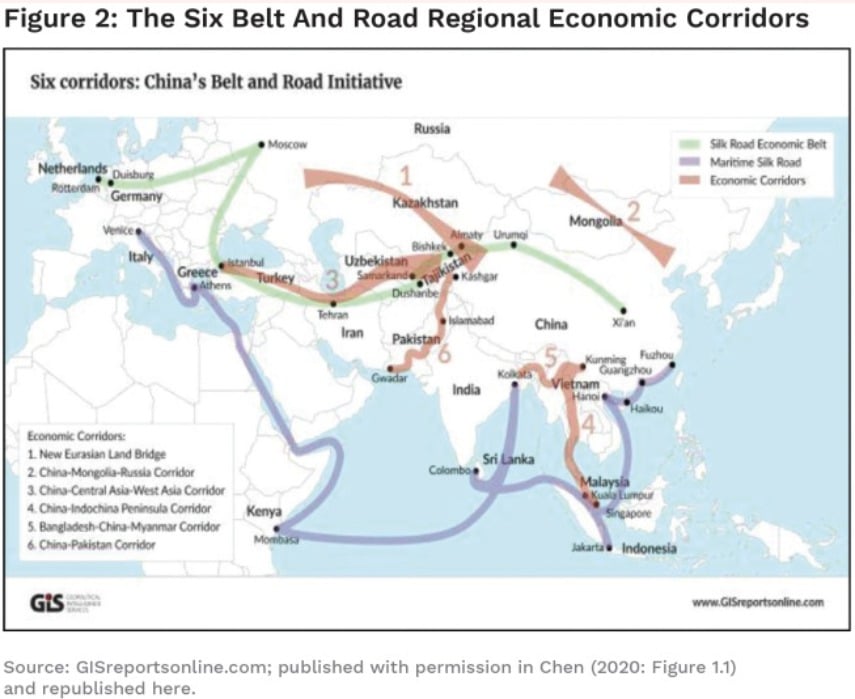
The CLR’s ceremonial opening aside, this highest official blessing conveyed the historic importance that both China and Laos attach to the CLR for what it is planned and projected to deliver, not only for both countries but also beyond their linked national territories. As the CLR’s regional impact is surfacing, the broader force motivating the CLR has become more noticeable along the BRI’s six economic corridors extending from China to its neighbouring countries and far beyond (see Figure 2). The China-Indochina Peninsula Corridor (No. 4 in Figure 2) includes the China-Laos Economic Corridor, whose connective spine is the CLR. The BRI corridors have unleashed an era of corridor-ising regionalisation, adding new trans-local dimensions to the geography of economic globalisation, carrying important geo-economic and geopolitical repercussions. Are the BRI corridors really new? As they take shape and exert influence near and far, it is important to look at their intellectual origin, if it exists, to understand their unfolding impact.
Corridor-isation, Old and New
While regional development along an urban-economic corridor is not new, corridor-shaped regionalisation has taken on new and larger scales involving more powerful actors since the BRI. By promoting six cross-border economic corridors stretching from deep inside China to nearby and faraway countries and cities, the Chinese government has activated some latent conditions and forces spread along given and newly built transport corridors to produce previously non-extant opportunities and challenges for local and regional development.
Corridor-ising regionalisation could be traced back to the emergence of urban and metropolitan extensions beyond local administrative boundaries in advanced economies in the early 1960s, if not earlier. Linear pattern and transport infrastructure are two defining features of urban corridors, which often involve two other axes – of economic development and urbanisation – as a tripartite bundling that links two or more city-regions. Besides their generic linear structure, urban corridors exhibit such network attributes as poles at either end, nodes between two poles, and intermediate points serving as secondary hubs. These salient features also reflect the vertical and horizontal relations of some regional and global infrastructure-led economic systems of a corridor shape.
Georg, Blaschke, and Taubenböck (2016) identified 67 urban corridors in the world (see Figure 3). They are typically between 400 km and 1,200 km long and 70 to 200 km wide, with a length-to-width ratio of between four and ten. They are generally shorter than the six BRI corridors, as the China-Pakistan Economic Corridor (No. 6 in Figure 2) runs over 3,000 km from Gwadar, Pakistan to Kashgar, Xinjiang, although the width of the BRI corridors is numerically vague, due to a lack of clear measuring criteria. About 95 per cent of those 67 urban corridors begin and end within national territories, such as the classic case of the Boston-Washington (BosWash) corridor along the US eastern seaboard (No. 12 in Figure 3), while all six BRI corridors span multiple national borders and remote border cities. In addition, approximately 60 per cent of the 67 urban corridors are anchored to and pass through two or more major national and international centres and their relatively well-integrated immediate hinterlands in advanced economies, like the so-called “Blue Banana” corridor through several Western European countries (No. 57 in Figure 3).However, the six BRI corridors traverse mostly less developed countries and cities with their surrounding regions. Finally, most urban corridors are market-induced with very limited formal national and subnational planning and relatively little intercity or trans-local coordination. The BRI corridors, however, are purposely initiated by the Chinese state and its planned and built infrastructure projects across international boundaries.
Rail Development as China’s Statecraft
Urban and economic corridors cannot develop sustainably without powerful and supportive transport infrastructure as their backbones. The BRI corridors, for most of their sections, have been shaped by Chinese-built large-scale transport infrastructures, including bridges, ports, roadways, and railways that connect Chinese and international cities and regions across borders. Of these types of transport infrastructures, railway development and construction has taken on the largest-scale and most powerful role in linking cities in China’s national urban system and across its diverse regional spaces with increasing cross-border connections. By the same token, China’s rail development manifests three components spanning its domestic-international divide that empower the BRI corridors and a number of their sub-corridors.
The first strength of China’s rail development “going global” originates from its domestic root of technological learning. In the 1990s, the Chinese government’s targeted investment in high-speed train (HST) bundled technology ushered in the first stage of rail development featuring technology accumulation before 2004. It laid a solid foundation for older HST technology, while still trailing international leaders. During the second stage (2004-8), China focused on importing and digesting technologies from European and Japanese rail companies and succeeded in incorporating them into the manufacturing of Chinese trains that could run at over 200 km per hour. The innovation-focused third stage (2008-12) led to the construction of faster trains, culminating in the introduction of the CRH (China Rail High-Speed) 380 train to the Beijing-Shanghai line, which could top 400 km per hour. Since 2012, China has improved HST design and production to its own integrated standard, which resulted in completing a number of long rail lines through varied climatic and topographic terrains (Xu 2017). China has also begun to “export” train development such as the CLR.
Secondly, China has gained tremendous experience and expertise from having built an extensive national system of freight and passenger train routes, including a massive intercity high-speed train network reaching a total length of around 40,000 km by the end of 2021. In 2016, the Chinese government unveiled a more ambitious goal of completing eight vertical (north-south) and horizontal (east-west) HST trunk routes covering much of the country, except a portion of the western region (Chen 2021a). China reached a peak of HST construction after launching the 2,298-km Beijing-Guangzhou line in 2012, the world’s longest HST route at the time, through complex subtropical terrains, followed by the 2,258-km Shanghai-Kunming line through long tunnels and over elevated bridges in the mountainous south-west in 2016. I made the 11-hour journey on this last route in 2018 and passed over the world’s longest concrete-arch rail bridge over the vast gorge separating Yunnan and Guizhou provinces. This combination of experience and expertise has prepared China well for building the CLR over its own challenging topographic terrains.
The Chinese state’s capacity for financing, designing, and constructing railways as a package, reinforced by the growing domestic overcapacity, provides a third advantage in building an overseas large-scale infrastructure project like the CLR. Financing infrastructure projects in developing countries has been a top priority and strategy for the BRI since 2013. Technological learning and upgrading in China’s HST sector has enabled its rail engineering companies to design rail operating systems to high international standards that can also be adapted to accommodatingthe siting conditions and challenges in other countries. Extensive HST construction has nourished a large and long domestic supply chain for construction equipment and materials, and thus enhanced the integrated capacity of China’s state companies to build rail projects outside China in a coordinated and efficient manner.
Technological learning and upgrading in China’s HST sector has enabled its rail engineering companies to design rail operating systems to high international standards that can also be adapted to accommodating the siting conditions and challenges in other countries.
Those three components together render rail development a competitive statecraft of the Chinese state that enables the generally successful delivery of large-scale transport infrastructure projects like the CLR. This rail development statecraft allows China to anchor and extend rail-driven economic and logistics connections to cities and regions along and adjacent to the BRI corridors. One major example is that China has, since 2013, spun a large number of freight train routes connecting several logistics hubs and, indirectly, many other cities across its coastal and interior regions and a myriad of European cities and regions, as I documented recently in this magazine (Chen 2021b). In another case, China built the 760-km Addis Ababa-Djibouti Railway (ADR) in 2017, linking landlocked Ethiopia and Djibouti and its deep-water port on the Red Sea (Chen 2020). Yet neither is comparable to the CLR in terms of the high stakes associated with its construction cost, connective power, consolidating effect on the economic fortune of Laos, and consequential Southeast Asian regional impact, especially in light of the Regional Comprehensive Economic Partnership (RCEP) of 10 ASEAN countries and five other members, including China, becoming effective on 1 January 2022.
The CLR’s High Stakes, Long Reach, and Strong Connectivity
The idea for the CLR germinated in 2010. Due to domestic politics involving China’s Minister of Transportation, the CLR did not move forward until the end of 2014, when the two governments signed the agreement before the ground was broken for the project in 2016. With an ambitious and complex design, the CLR would carry passengers at 160 km per hour and freight at 120 km per hour on standard-gauge tracks in one electrified system across two national territories, with a future extension to Thailand. The government of Laos has placed the CLR at the heart of its economic development strategy for unlocking its landlocked position through the CLR’s transformational domestic and transnational connections that can foster trade, tourism, and other economic flows.
Against the Lao government’s optimistic view of the CLR’s long-term economic benefits, the limited research on the CLR has been more critical of its financing and the negative construction-related effects on labour, livelihood, and the environment. Concerns about the CLR’s heavy debt burdens have emerged from Laos’s share of the overall cost of $5.9 billion, relative to $4.9 billion for building the ADR. Laos is responsible for providing $1.79 billion of capital, including debt liability of $1.06 billion and equity investment of $730 million, $480 million of which had to be borrowed from the Eximbank of China (Chen and DiCarlo 2021). Related to this huge hanging debt, the Lao state, as the sovereign debtor, failed to put the equity together on time, which led to importing more Chinese workers to replace the Lao workers who had been promised to carry out the work on the project (W. Chen 2020). The CLR also suffered from a lack or lag of monetary compensation for land acquisition and environmental protection for the affected villages along its route due to: 1) the disconnect between the enforcement of environmental standards of China’s international development and that of the Lao government; and 2) discrepancies between the Lao central government’s vision for the CLR as a national priority and the provincial and district governments’ obscure roles in setting compensation rules and implementing them (DiCarlo 2020; Suhardiman et al. 2021).
This critical work is confined to the CLR’s pre-operation time, before 3 December 2021, and is thus unable to address its early post-operation situation. Using some combined information about the CLR’s late construction and early operation, I explore the CLR’s different consequences at the local, regional, national, and transnational levels.
Construction-Related Impact
The CLR stretches a little over 1,000 km, with about 600 km from Kunming to Mohan on the border with Laos, and around 420 km from Vientiane to the town of Boten, bordering Mohan. It has 24 passenger stations along the China segment and 10 stations for the Lao segment, and 22 of these stations also include freight yards and logistics depots. The CLR passes through 93 tunnels and over 136 elevated bridges within China, and 75 tunnels and 165 bridges inside Laos over its hilly north, with a few of those bridges resembling the long and high bridge on the Shanghai-Kunming Railway noted earlier. The length of all the tunnels and bridges adds up to 712 km, which accounts for 76.5 per cent of the CLR’s entire route. These construction challenges suited the rich expertise and experience that the Chinese builders brought over from having built so much HST-driven transport infrastructure at home. For example, rail engineering and hydropower drilling companies used specialised heavy equipment to drive the 17.4-km long Wanhe Tunnel, the CLR’s longest, near the city of Yuxi south of Kunming.
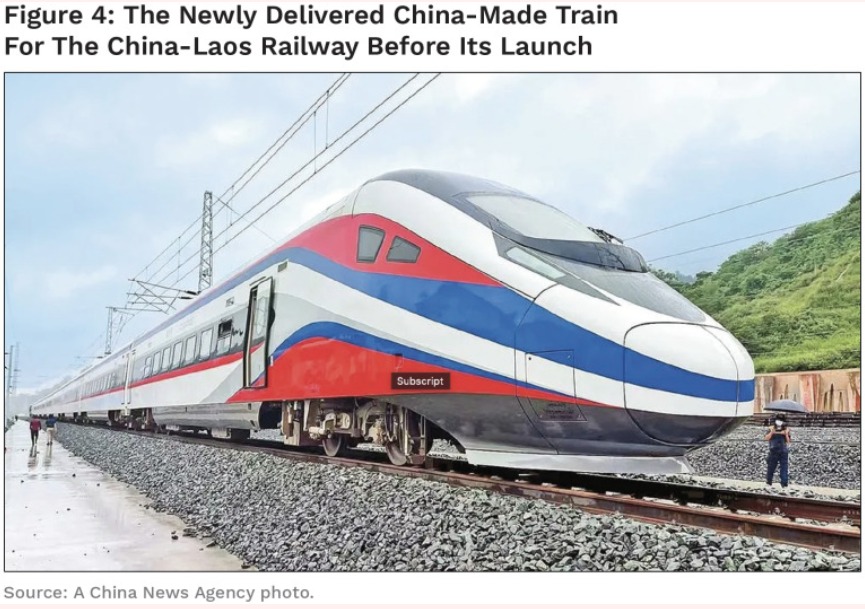
To electrify the track, the Chinese builders have completed 937 km of high-voltage lines linking 2,220 transmission towers snaking through the border, with several hundred inside Laos. Chinese engineers used the high-low combination of legs to erect some transmission towers without felling larger patches of trees.2 To run the 1,677-km electrified train operating system, Chinese engineers and workers put in twenty 115-kilovolt power lines over 257 km, through 11 substation intervals, with 10 traction substations into the Laos State Grid,3 while the train’s operating power comes from Laos’s abundant hydropower sources. The CLR train was designed based on the mature technology of China’s older Fuxing bullet train to meet the CLR’s requirements of slower speed, larger capacity, and lower maintenance cost. In the meantime, China has recently moved on to the newest, smart Fuxing HST that can run at 350 km/hour on such major routes as Beijing-Shanghai and Beijing-Guangzhou.Jointly manufactured by two subsidiaries of the China Railway Rolling Stock Group Cooperation, which ranked 349th among the Global 500 in 2021, the CLR train was delivered in the red, blue, and white colours of Laos’s national flag before its launch (see Figure 4). It symbolises a technological adaptation to national sovereignty and identity.
The CLR is an economically and logistically transformative transport artery that opens up Laos from its landlocked position to a land-linked one, while also allowing landlocked Yunnan province to access the sea through Laos and Thailand. The CLR shortens the train trip between Vientiane and Boten to three hours from two days, while reducing the journey from Mohan to Kunming to 5-6 hours. This means that a traveller can depart either Vientiane or Kunming in the morning and reach the opposite terminus by evening, under normal border-clearing conditions, or accomplish the whole trip overnight. Since goods used to be transported slowly between China and Laos by road, only good for small quantities, or by expensive air shipping, the CLR is now the happy medium carrying larger quantities of goods, especially time-sensitive agricultural goods, more cost-effectively.5
The CLR created over 110,000 jobs in Laos cumulatively, including many Laos among the 6,000 engineers and workers putting up the power transmission system at its peak. The CLR also subcontracted the use of local construction materials worth around $80 million. Its extended benefits from the construction included 2,000 km of water irrigation along the CLR’s feeder roads and around 3.1 million square meters of green space around the train stations and along the train route. In addition, as part of the CLR, the Chinese government has set up the Laos Rail Vocational Skills Academy in Vientiane. Currently under construction, this academy integrates facilities for administration, training, and residence, taking up 33,000 square metres of construction space. It has already begun to train Lao train drivers and engineers, some of whom had already received basic training in China before the CLR began operation.6 This marks the short- and longer-term transfer of knowledge and skills from China to Laos to create and sustain localisation of the CLR operation.
Early Post-Operation Impact
As these construction-related benefits have sunk in, the early post-operation impact via the CLR’s connective capacity has surfaced from a ramping-up of its operating schedules. By 2 January 2022, just one month after its launch, the CLR had run 64 passenger trains with 45,800 passengers from both Kunming and Vientiane to the border, still under the pandemic closure for human crossings. By January 17, 2022, 153 freight runs in both directions carried nearly 59,500 tons of cargo valued at $175 million and covering around 100 types of products7,and many of freight trains crossed the border after clearing rigid custom and pandemic controls.
While trains from Kunming to the border town of Mohan were full of passengers, especially those travelling during the 2022 New Year Day holiday, there were long lines of Laos buying tickets at the Vientiane Station, where all boarding signs and train schedules are available in Lao, Chinese, and English. The on-site queuing for tickets raises a need for an online portal for selling tickets. The second- and ordinary-class tickets for the Vientiane-Boten trip cost around $30 and $21, respectively, not cheap relative to Laos’s average income. The brisk ticket sales thus far bode well for a sustainable demand for the CLR passenger train. Booking orders for freight wagons in both directions have also remained high.8 Given this early evidence of the CLR’s successful launch, the Lao president gave an optimistic 2022 New Year greeting, proclaiming that Laos had garnered a global spotlight for the CLR, and encouraging the country to use this railway fully to benefit the national economy.9
The on-site queuing for tickets raises a need for an online portal for selling tickets. The second- and ordinary-class tickets for the Vientiane-Boten trip cost around $30 and $21, respectively, not cheap relative to Laos’s average income.
Laos’s agricultural sector, with 60 per cent of its work force, stands to benefit much from the CLR. The Chinese government recently agreed to import larger amounts of Laos’s main exports, such as rubber, cows, rice, cassava, and tropical fruits, like bananas and oranges, that could be transported efficiently as bulk cargo by the CLR. The paved feeder roads to the CLR stations from nearby villages in northern Laos allow local farmers to tractor rice, cows, and fruit to the stations for shipping to China. In 2021, Laos’s exports to China as its largest trading partner were led by bananas, worth $225 million, followed by rubber, cassava, sugar cane, and water melons. With a new bilateral agreement, Laos is planning to export 50,000 tons of orange-like fruits, worth $50 million, to China in 2022. These exports are critical to sustaining Laos’s overall exports of $26.5 billion during 2016-20, with an annual growth of 10.10 per cent.9 As the CLR reduces the Vientiane-Kunming shipping cost by 40-50 per cent, Laos’s export of corn to China is projected to grow 20 per cent annually from the base of $1.7 billion in 2019 (World Bank 2020). The CLR helps sustain the momentum of Laos’s exports to China.
The CLR is also facilitating bilateral trade from the Chinese side. Guangzhou-based Asian Potash International Co., which owns the mining rights to a large potash mine in Gammon province, south-east of Vientiane, quickly booked the first freight train from Vientiane to ship locally manufactured potash fertiliser to China, and can use the return train to transport materials and equipment from China to expand local mining and manufacturing in Laos. With growing demand for its potash products in Yunnan and neighbouring Guizhou province, this company is planning to expand production for the regional market in south-western China and will save considerable time-cost over sea shipping between southern China and Laos via Cambodian and Thai ports, principally Sihanoukville and Bangkok.11 A Yunnan-based rubber company has also taken advantage of the early CLR freight train to move its processed rubber from Vientiane to China. Since 2005, this company has invested $156 million in 21 rubber-producing bases as a substitute for opium, covering 18,150 acres and employing around 6,000 Lao workers. The company shipped around 4,000 tons of rubber to China during the first month of the CLR’s operation and planned to ship 50,000 tons annually. This improved mode of transportation will facilitate increased production and employment.12 The CLR is capable of generating greater connected economic pay-offs to spur production-trade ties across the China-Laos border.
While anchored by both Kunming and Vientiane, the CLR has been driven by the much bigger and stronger Chinese economy and demand from and via Kunming. Through the first ten days of the CLR’s operation, under pandemic-mandated border closure, 253 bidirectional passenger trains ran inside China, and 78 international freight trains from China crossed the border, relative to only 24 bidirectional passenger trains inside Laos and 23 freight trains over the border into China. The daily number of passenger trains between Kunming and Mohan grew from 17.5 to 25.5 and the number of daily passengers rose from an average of 20,000 to 30,000, with a cumulative number of over 300,000 passengers up to 16 December 2021, considerably more than the corresponding number inside Laos.13 These lopsided numbers align with the Lao government’s rosy projection of around 10 million passengers, mostly from China, taking the CLR annually (Chen 2018). With Laos opening the border to international tourists, including from China, at the beginning of 2022, and China’s likely loosening of outbound international travel, the CLR is expected to draw more Chinese tourists over the border to such destinations as the UNESCO-designated cultural and Buddhist heritage sites in Luang Prabang in northern Laos. While demand for the CLR stemming from resumed inbound tourism will help the Lao government pay towards its large construction loan over time, time will tell if the current uneven distribution of passenger flows in China’s favour will become more balanced if more Laos and Southeast Asians take the CLR to visit China in the future.
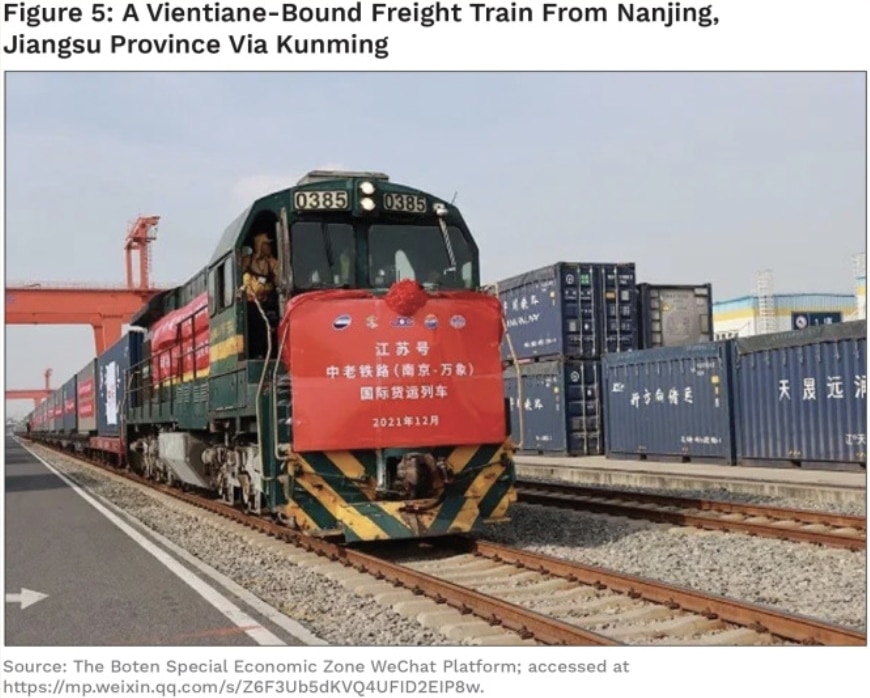
The CLR has also begun to draw trade cargo from strong cross-city and trans-regional economic and transport origins within China to the China-Laos trading dyad, and between China and Southeast Asia as the RCEP became effective on 1 January 2022. Besides upgrading its own cross-border trade and logistics connections with neighbouring Southeast Asia, Kunming has secured high-speed train and expressway links with China’s major coastal and interior provinces and cities like Shanghai, Hangzhou, and Chengdu in recent years. These fast transport connections have channelled export cargoes to ride the CLR from Kunming. By 31 December 2021, 380 domestic freight trains had carried 150,000 tons of cargo from Shanghai, Guangzhou, and even Beijing to Kunming bound for Southeast Asia.14 Thus far, four freight trains destined for Vientiane have run from Shenzhen, Nanjing, Chengdu, and Huaihua, Hunan province to and via Kunming (see a Nanjing-Vientiane train in Figure 5). The CLR’s shipping network has reached nine provinces and 15 major cities within China while connecting indirectly to Thailand, Cambodia, Singapore, and other Southeast Asian countries beyond Laos.15
This growing cargo flow from the rest of China via Kunming and from Kunming to Vientiane and other Southeast Asian markets is also broadening to include more products from more sources with the aid of more sophisticated shipping technology. On 27 December 2021, a freight train of 21 wagons with cold-chain containers left the city of Yuxi near Kunming for Vientiane. It carried various fresh vegetables in 20 containers and fresh flowers in the one other container, the latter a distinctive export from Yunnan, weighing over 300 tons and valued at approximately $206,000.16 The CLR’s cargo content is poised to diversify further and thus enrich trade along the CLR route and beyond. This will smooth and strengthen the longer and wider movement of goods between China, Laos, and Southeast Asia along the China-Indochina Peninsula Economic Corridor (see Figure 2).
Even if Kunming and Vientiane work together to link both passenger and freight movements along the CLR, they may still fall short of their combined potential, unless the CLR is seamlessly docked with the planned China-Thailand High-Speed Railway linking Kunming to Bangkok, especially with the RCEP being effective. Currently, the Laos-Thailand train connection is confined to the old metre-gauge track left by the French colonialists between the Thanaleng rail station on the Lao side, away from the Vientiane station, the CLR’s terminus south of the city, and the Nong Khai station and land port on the Thai side of the border defined by the Mekong River. On 7 December 2021, the fresh vegetables that arrived on a CLR freight train had to be picked up at Vientiane by 33 Thai trucks from Nong Khai to be forwarded to the rest of Thailand.17 While this saved a lot of shipping time and cost compared with road-only transport from China to Laos and then to Thailand, it represents an argument for the creation of a direct and smooth Laos-Thailand rail connection.
The Thai government supports the building of a 5.35-km metre-gauge rail line from Thanaleng Station to northern Vientiane, already 70 per cent completed, for improved near-border transport. This solution, however, still misses a direct link to the CLR, even though the Thai government is planning to build a new railway bridge next to the Thai-Lao Friendship Bridge over the Mekong in anticipation of the forthcoming direct train traffic from the CLR to the China-Thailand Railway. This is more urgently needed given the busy Nong Khai border port, which saw $2 billion worth of exports and $204 million in imports during 2021, with over 6,000 person exits and 7,000 person entries every day before the pandemic.18 Given this busy border crossing, the CLR can stimulate more road-based cross-border trade and people movements between northeast Thailand and Vientiane and its surrounding region across the Mekong River, even before a direct Laos-Thailand cross-border train connection.
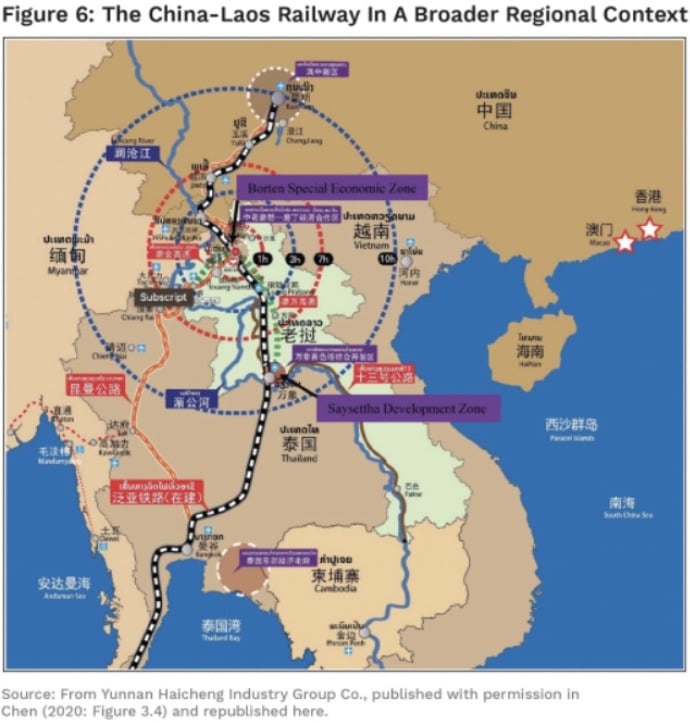
Designed to run at 180 km/hour over 250 km within Thailand, the high-speed railway will ultimately connect Bangkok to Nong Khai, where it will be seamlessly docked with the CLR. Despite a signed MOU in 2014, the agreed division of labour between China and Laos in building the Thai segment of the railway has been slow, due to a military coup. After some progress in 2018, disputes between China, Thailand, and Laos about the project’s financing limited its construction to the first phase and section between Bangkok and Nakhon Ratchasima, with the entire route to be finished and operational by 2028. This sustains the missing link through Thailand for the CLR to connect to Malaysia and Singapore, as envisioned by the Trans-Asian Railway network (see Figure 6), to which 18 Asian countries signed up in 2006. In the meantime, the CLR will not reach its full regional connective and economic potential until a few years from now.
From the CLR to the China-Laos Economic Corridor and Beyond
Through its early period in operation, the CLR has largely lived up to its expected role in stimulating and supporting trade and travel along the emerging China-Laos Economic Corridor (CLEC). To foster larger and heavier movements of goods and people along the CLEC and beyond, the CLR needs the completion and growing function of the Boten Special Economic Zone (BSEZ) bordering China as a central node that can effectively bridge and facilitate the flow of goods and people between Kunming and Vientiane (see Figure 6). Occupying 16.4 square km and close to completion by a Yunnan-based real estate developer, the BSEZ is a new city with designated and specialised roles in international finance, trade, light manufacturing, logistics, and other economic sectors, where around 300,000 people are projected to work and live locally. With the CLR’s launch, the BSEZ has begun to meet the logistics and warehousing needs for through cargo, although its passenger station has yet to open fully, due to China’s rigid pandemic border control. In addition, a growing number of Chinese companies have partnered with the Lao government and businesses in light manufacturing, agri-business, and duty-free shopping, while exploring opportunities in financial services and e-commerce in the BSEZ. As the CLR picks up speed and runs more evenly and frequently, the BSEZ is well positioned to both process more freight and passenger flows and play a strong role in extending trade and development benefits along the CLEC. At the CLR’s southern terminus, near Vientiane Station, the Saysettha Development Zone (see Figure 6), jointly developed and operated by Chinese and Lao provincial and municipal government and private companies, also uses the CLR to ship assembled or lightly manufactured export products. These two special zones fit the logic of bracketing a train-driven corridor, like the CLEC’s Lao segment.
Finally, the CLR also runs a spur line to regional geopolitical dynamics. In conjunction with the BSEZ, the CLR enriches China’s rail development statecraft into a broader bundling of infrastructure construction and delivery through the BRI. It offers both connective (the CLR) and sited (the BSEZ) support to the CLEC and its broader role in strengthening the BRI corridor from China to Southeast Asia. As the converging benefit of zero tariffs under the RCEP takes effect, the CLEC brings China, Laos, and other RCEP members closer together for trade and investment under the world’s largest free-trade agreement. This presents a looming challenge to the Biden administration, for which Laos is a foreign policy blind spot after President Obama visited there in 2016 and sent his Secretaries of State, Hilary Clinton in 2012 and John Kerry twice in 2012 and 2016,19 when the ground was being broken for the CLR. In tightening the China-Laos bond via the CLEC, the CLR has become a winning drive for China in terms of strengthening its hand to compete with the United States in the Indo-Pacific.
Professor Chen Xiangming’s latest interview with the Belt and Road Institute in Sweden.
Xiangming Chen served as the founding Dean and Director of the Center for Urban and Global Studies at Trinity College in Connecticut from 2007 to 2019. He is currently Director of the Urban Studies Program and Paul E. Raether Distinguished Professor of Global Urban Studies and Sociology at Trinity College, a guest professor at Fudan University, Shanghai, and an adjunct professor at the Graduate School of the Shanghai Academy of Social Sciences. He has published extensively on urbanisation and globalisation, with a focus on China and Asia, and conducted policy research for the World Bank, the Asian Development Bank, and the OECD.
Acknowledgement
I thank Southida Somchanmavong ’24 at Trinity College for translating pieces of information from Laotian into English and for sharing her grounded insights about the China-Laos Railway. I am also grateful to the Regional Studies Association for supporting my recent work on China’s Belt and Road Initiative, with which this essay is connected, and to the Paul E. Raether Distinguished Professorship Fund at Trinity College for continued research support.
Footnotes
1. “President Xi Jinping and President Thongloun attend the opening ceremony for launching the China-Laos Railway,” The Yunnan Province Website, 3 December 2021; accessed at https://mp.weixin.qq.com/s/S5aSoZAq2qLpowdgyB7Srg.
“’Built by China’ going global,” Xiangming Chen, Global Insight, Chicago Council on Global Affairs, 2 December 2021; accessed at https://www.thechicagocouncil.org/commentary-and-analysis/blogs/built-china-going-global.
‘The China-Laos Railway has electricity’, The China BRI Website, 1 September 2021; accessed at https://mp.weixin.qq.com/s/gkuWm1zaq1DdG9JOHGDyLw.
“China deployed 1,191 sets of Fuxing HST by the end of 2021,” The Train Track World WeChat Platform, 20 January 2022; accessed at https://mp.weixin.qq.com/s/AYf8cF9o9OMmyo7j-P3V3Q.
“Agricultural trade between China and Laos to double after rail link opens,” Global Times, 1 December 2021; accessed at https://www.globaltimes.cn/page/202112/1240426.shtml.
“The CLR uses all Chinese standard,” The Train Track World WeChat Platform, 3 December 2021; accessed at https://mp.weixin.qq.com/s/Is0RfAAGajrRwj7XHdKfvw.
“The China-Laos Railway has entered a smooth ride,” The Boten Special Economic Zone WeChat Platform, January 21, 2022; accessed at https://mp.weixin.qq.com/s/4Y-f0C-D0i-BzoAE2NyJaA.
“The CLR’s early dividends through its first month of operation,” The China BRI Website, 4 January 2022; accessed at https://mp.weixin.qq.com/s/QzbHCQzq-oI1vuY-viOGjQ.
“President Thongloun Sisoulith summarizes 2022’s opportunities and challenges for Laos,” The Vientiane Commercial Office of Yunnan Province WeChat Platform, 7 January 2022; accessed at https://mp.weixin.qq.com/s/8S47GMMa5djgcroMptHM1g.
“Laos’s exports reach $26.5 billion with annual growth of 10.9% during 2016-20,” The Vientiane Commercial Office of Yunnan Province WeChat Platform, 5 November 2021; accessed at https://mp.weixin.qq.com/s/JDWQFuxrd-UDLIQjX4od9g.
“Benefiting from the CLR to expand production of potash fertilizer,” Sina.com, 15 December 2021; accessed at http://stock.finance.sina.com.cn/sm poi8tu59/index.phtml.
Same as Note 19.
“New records for the CLR’s passenger and freight trains,” The Boten Special Economic Zone WeChat platform, 17 December 2021; accessed at https://mp.weixin.qq.com/s/QMTYTdroxEL3XIAZPhJf3A.
“The New Year’s first international freight train on the CLR,” The China BRI Website, 2 January 2022; accessed at https://mp.weixin.qq.com/s/YlCgYGnbgaDPsA5qG5ooYg.
Same as Note 7.
“The CLR launches the international cold-chain freight train,” The Yunnan Province Website, 27 December 2021; accessed at https://m.yunnan.cn/system/2021/12/27/031841652.shtml.
“The CLR is the new engine and accelerator for cross – border connection and economic cooperation,” The China BRI Website, 16 January 2022; accessed at https://mp.weixin.qq.com/s/VWN8oRpbPmxqWU3aPKTg.
Same as Note 17.
“Time for America to play offense in China’s backyard,” Foreign Policy, Derek Grossman, 12 January 2022; accessed at https://foreignpolicy.com /2022/01/12/biden – cambodia – laos – southeast – asia – strategy – geopolitics/.
References
Chen, Wanjing Kelly. 2020. “Sovereign Debt in the Making: Financial Entanglements and Labour Politics Along the Belt and Road in Laos.” Economic Geography 96 (4): 295-314. https://doi.10.1080/00130095.2020.1810011.
Chen, Wanjing Kelly and Jessica DiCarlo. 2021. “Laos–China Railway on the People’s Map of Global China.” A Technical Report. September.
Chen, Xiangming. 2018. “Globalization Redux: Can China’s Inside-Out Strategy Catalyze Economic Development Across Its Asian Borderlands and Beyond.” Cambridge Journal of Regions, Economy and Society 11 (1): 35-58. doi: https://doi.org/10.1093/cjres/rsy003.
Chen, Xiangming. 2020. with Julie Tian Miao and Xue Li. The Belt and Road Initiative as Epochal Regionalisation. United Kingdom: Routledge and the Regional Studies Association.
Chen, Xiangming. 2021a. “Reconnecting Eurasia: A New Logistics State, the China-Europe Freight Train, and the Resurging Ancient City of Xi’an.” Eurasian Geography and Economics (published online September 17). https://doi.org/10.1080/15387216.2021.1980075.
Chen, Xiangming. 2021b. “Connectivity, Connectivity, Connectivity: Has the China-Europe Freight Train Become a Winning Run?” The European Financial Review (August/September): 3-17.
DiCarlo, Jessica. 2020. “Off the Tracks: Grounding Development Finance and Safeguards Through Land Compensation on the Laos –China Belt and Road Corridor.” Global China Initiative Working Paper 13. Boston: Global Development Policy Center, Boston University.
Georg, Isabel, Thomas Blaschke, and Hannes Taubenböck. 2016. “A Global Inventory of Urban Corridors Based on Perceptions and Night-Time Light Imagery.” International Journal of Geo-Information 5 (233): 1-19. doi:10.3390/ijgi5120233.
Suhardiman, Diana, Jessica DiCarlo, Oulavanh Keovilignavong, Jonathan Rigg, and Alan Nicol. 2021. “(Re)constructing State Power and Livelihoods Through the Laos-China Railway Project.” Geoforum 124: 79-88. doi.org/10.1016/j.geoforum.2021.06.003.
World Bank. 2020. “From Landlocked to Land-Linked: Unlocking the Potential of Lao-China Rail Connectivity.” World Bank, Vientiane; accessed at https://openknowledge.worldbank.org/handle/10986/33891.
Xu, Fei. 2017. Across the Belt and Road Initiative: China’s Global High-Speed Train Strategy. (In Chinese.) Shanghai: People’s Press of Shanghai.
Work is no longer what it used to be; there is a changing paradigm and it affects every sector, industry and every aspect of the corporate world. Whether small or big, none is left out. There has been a massive increase in the level of technological advancement between the 20th and 21st century and this is not limited to the tech world alone but affects so many other areas, changing the way in which many organizations now carry our their activities and reducing the need for human involvement.
With the global trends in recent times, especially with the worldwide pandemic that keeps evolving daily, it is certain as well that the normus changing yet again as organizations shift from the regular working pattern to explore other possibilities such as hybrid work all in a bid to ensure survival and continued success.
The popularity of the remote format opens new team scaling opportunities for tech businesses. To avoid hiring freezes, companies seek EOR services that can handle hiring international specialists without additional tax burden related to establishing a local entity. That approach also allows to hire representatives of new and rare professions faster.
Combining all these changes, it really will not be long before many of the tasks being performed in present day would become fully automsted. 2022 is that year where more disruptive innovations are unveiled and many organizations are rising up to the challenge. Changes are bring made to job requirements, some positions entirely scrapped and new ones created to fit into the unique system of each company.
With the constant evolving, it is imperative, therefore, for employers to keep themselves abreast of such changes and adapt as required. Cognizance needs to be taken of the trends affecting now and the future, and plans made ahead to easily fit into such changes. It is imperative that employers will be able to adapt to these changes. This way, employees will have a better working environment that can increase their productivity. Get to know more about this from Top Employers.
Trends in various sectors and industries
There are various transformations taking place across many sectors and these need to be closely monitored by organizations and employers of labour to note how it affects their success, morale of their staff, profitability, cost of running and many other areas. Some of the trends in some sectors are discussed below.
Manufacturing
There has been rapid development in how products are manufactured. Organizations in this sector constantly have to adapt to changing technologies. One of such is the advent of the 3D printing machines that have aided the rapid recreation of equipment. This however requires a certain level of expertise and most employers will find that there would be an increase in their investments in their employees if they are to be able to recruit the right talents.
Automation is also another vital aspect of this sector. Many organizations were already embracing automated machines prior to the pandemic. With the increased risk of infection, and the struggle to curb the spread of COVID-19 and its many variants, more companies are shifting to automation and there is barely any need for human efforts with most of these machines allowing for remote control. There is even still the possibility of a reduction in need for labour in the physical maintenance of the machines. Employers are more in need of strategies to keep up with the change.
Healthcare
Remote healthcare has been in existence prior to now. It however gained more prominence during the pandemic as there was limited access to health infrastructures and doctors. Most individuals turned to the internet and the limited number of healthcare software available at the time, with about 48% of physicians in the US stating they treated patients virtually during the covid period as against 18% of them in 2018. With the certainty that circumstances will not be changing anytime soon, and the fact that many consumers are now much more comfortable with obtaining health services virtually, there would be a reduced need for the physical position, while expert skills will be required.
Organizations that also specialize in the production of wearables for monitoring health will also require more skilled talents in programming such gadgets. Employers would need to combine technology and knowledge of their staff together effectively, to ensure maximum productivity. They would also need to keep up with the boost in business by constantly generating newer ideas and strategies. This sector is also influencing the level of priority placed on employee wellness as it has developed the means whereby organizations are able to properly monitor the health of workers to prevent burnout.
Education
The use of AI in aiding learning is gaining grounds fast. There has been an upsurge in the number of online schools and courses available to learn from. This means that employees will no longer find it difficult to obtain certifications and skills to enable them to deliver well in the right setting. According to a report by Coursera, its users reached 189 million in 2021, signalling that more people are recognizing the need to augment professional and non-professional skills. This will further increase the competitiveness of organizations in attracting the best talents and give more leverage and power to the employees.
Finance
The finance industry is among the leading industries in the use of technology and digital softwares. Fintech companies are gaining more visibility everyday. The fast adapting from traditional banking involving physical buildings to banks without branches and virtual banks has made it easier for employers to cope with the changes brought about by the pandemic. Remuneration of staff is relatively easy and organizations are able to cut down on some banking-related expenses. This however requires that an organization be at the forefront of the use of technology or it would have a hard time navigating the world of internet banking.
Specific to the finance sector, as a result of increased automation, is the need for less people to work behind machines and computers in different organizations. What is the urgent requirement there now is talents with enough skill to supply trusted solutions to financial problems that cannot be handled by pure algorithm or models.
Customer service
In the past, customer care services comprised of employees who were constantly responding to the needs and requests of different categories of customers. In recent times, there has been the embrace of the use of chatbots, which are basically AI programmes to interact with and respond to the query of users. This has reduced the need for human staff and communication skills in this regard. However, communication and interpersonal skills are still very much relevant to employers of labour, especially where teamwork is a must. Where employees cannot be totally removed from the communication front, the use of AI to improve the connection has been of tremendous advantage to organizations as it has helped boost the efficiency of such processes.
All these trends discussed above have had diverse effects on how work is being done presently and how it will be done in the future. There shall be further discussion on salient areas of employment and workplace Culture and environment that will change the future of work and how organizations can prepare for such a future in 2022.
Some Important Stats and facts
About 44% of people around the world believe that the most important aspect of a job is the security it offers.
Technological advancement will continue to have a huge impact on how we work, even 10 years from now.
There are different opinions by different categories of employees and employees on what would have the biggest impact on work in the next ten years, including increasing need for environmental and economic efficiency, work-life balance necessities, and the need for diversified careers and organizations.
Traditional employment is gradually fading away, as skills sell faster than resumes now.
More than 50% of employers and managers believe that working in an office increases the performance of workers.
Organizations will fight to recruit and keep the best talents with the increased mobility of employees. This means human resource will most likely constantly be under pressure.
Employers will begin to value the input and opinions of their workers more. Ethics and values will be placed above profits eventually.
Employees and customers will begin to hold more power in dictating the direction organizations will take. This, however, will still not impede some large corporations from taking center stage.
Areas influencing the future of work and how employers can be prepared
Inclusivity and diversity
The workplace has become a place that showcases the uniqueness of individuals from different walks of life. In a typical organization, one might find Indians, Africans, whites and other people from other countries and cultures working together. Diversity also includes the gender makeup of an organization. Nowadays, one would find that women can now occupy positions that were originally given to only men.
Gradually, organizations are deleting from resumes, information that they feel might lead to bias in the recruitment process such as nationality, age, gender, race, religion and even grades. It is now more focused on having a workforce that is diverse in every way. This change precludes the increase in innovations and unique concepts that has will lead to the advancement of many organizations.
A diverse workforce creates the issue of inclusiveness. How involved do the employers allow the workers to be in the company? Do they create an atmosphere where everyone feels needed and valued for their opinions? More than employing people from across the globe, it is essential for an organization to find a balance in how employees are treated within the organization. Areas that employers need to take note of that can result in inclusivity bias include wages, work flexibility, bonuses and compensations paid to new or existing staff, etc. Employers should ensure that performance evaluation and rewards are merit-based and not based on the biases of managers or top executives.
Remote working/hybrid work
The pandemic has led to a lot of changes in how work is expected to be carried out and where. Prior to 2020, most organizations believed that having employees work from a central location or in an office setting motivated and increased their performance. However, in 2020, during the global lockdown, there was a radical shift in thinking that saw about 90% of the world workforce working from home and other remote locations. The individuals who found themselves still working out of home were majorly health workers and emergency respondent workers. Despite the relaxation of the lockdown rules and the gradual return to normalcy, most organizations have realized that remote working is not going away anytime soon.
Employers are now looking for ways to include remote working as a working norm. More and more individuals find themselves working from the comfort of their homes or working fewer days in the office. Some organizations have introduced the concept of ‘hybrid work’ that allows for a combination of working in the office and from home. Hybrid work is an working model that is designed around the employee. It allows workers to make the decision of where they want to work. This model might have resulted from the recruitment of talents during the pandemic, in locations other than the primary location of the business and coupled with the inability to move around.
Remote working and hybrid work promotes inclusivity, well-being and flexibility of work. However, employers are increasingly concerned about how to monitor the performance of workers that they cannot physically see. This problem is easily resolved as hybrid work is technology-based and the activities of workers can easily be tracked especially on an intranet network of the organization. This means that employers need to be updated on the evolving technologies and ensure that their staff are adequately trained to make use of such technology. Unless this is done there would be a breakdown in the system, inevitably leading to unproductivity and failure of the organization.
Employee health and wellness
In the new era of work, employers are getting more involved in the work-life balance of the employees. They will try to understand their workers better by using wellness as a metric. A Gartner survey in 2020 discovered that 94% of organizations invested significantly in wellness programs. There has also been the introduction of healthy foods into the meal system of many companies with top companies such as Google pioneering this change.
In 2022, this change is expected to continue with organizations introducing more wellness and health programs to cater for different aspects of employees’ health such as mental, physical, financial health to enable them more easily predict the performance and motivations of workers. There will be major collaborations between employers of labour and the firms in the fitness industry to promote the health values of organizations. Organizations should be prepared to invest heavily in this as it is usually capital intensive to the organization.
Automation
The world is fast becoming an automated one, with most repetitive and easy tasks now being managed by robots and machines. Research shows that close to 65% of repetitive managerial work will be automated by 2025, and as more organizations shift towards the use of technology in running basic processes, there will be an increase in demand for individuals with interpersonal relationships and teamwork skills. Not all processes can be automated and there would be an increase in the need for employees to interact together and brainstorm ideas instead of sitting with computers all day.
In addition to people skills, employers would need to begin to train their staff to view AI as more than a tool but also as a co-worker that is highly capable but still imperfect in some areas. The use of AI will also lead to a reduction in the number of needed job positions leading to redundancy of workers. Organizations will need to be adequately prepared to compensate staff in the long run.
Sustainability
There are rising concerns from the public on how organizations utilize resources, especially non-renewable resources and also require the effect of organizational activities on the environment in general. This has made organizations more conscious of how efficiently and smartly they use resources. Employers now understand that their impact goes beyond just financials, they are also responsible for protecting the environment and improving society. Organizations are exploring ways of creating products and services that protect the environment and improve the living of consumers and employees alike. Steps are being taken to reduce the carbon footprints of employees, and stringent laws are being put in place by the government to ensure that organizations comply with ethical standards.
In future work, there would be increased flexibility in organizational structures, and a broader link between the behaviour of people in an organization in relation to society and the success or failure of such organizations. Employers would need to restate their values and use this to attract the best candidates. Financial benefits alone is no longer enough to attract talents, the organization must prove itself capable of impacting society positively. Care must also be taken by employers to see that the strict laws put in place do not hinder creativity and innovations.
Knowledge recruitment
Traditional employment based on certificates and positions is gradually fading away. A lot of major positions and job titles are being scrapped and replaced with skill based titles. Full-time employment is gradually being abandoned for freelancing. This will pose a major challenge to organizations that rely on the stability of employees in the organization. Most freelancers do not stay on a job for long and employment is trending towards being more contract-based. A survey has indicated that HR professionals expect at least 20% of their workforce to be contractual or temporary staff. There would be greater challenges faced by employers in recruiting and retaining staff as individuals are having more freedom to change jobs at any time. Organizations might need to rework their compensation schemes to attract talents that are willing to stay and grow with the company.
For the existing staff of companies, the need to keep them abreast of changing job demands is necessary. As job demands change, the required skills also change. There is an expected shift in about 48% of core skills required to perform in a workplace. Analytical thinking, active learning, human and technological skills are in growing demand to keep businesses running and employers must be ready to invest in training new and existing employees or risk being ousted from the competitive market. As a result, organizations must be at the forefront of developing their staff, through the onboarding of new recruits, frequent workshops and probably the provision of funding for employees to take up courses to improve their skills.
Conclusion
The future of work is not far off, it is now. Organizations, employers and managers must not cease to think of new ways of adapting to change. Planning ahead for the long term is critical to ensuring the continued survival of any organization whether growing or already established. Leaders within organizations should anticipate change and create possible solutions to various probable challenges. Change may be hard to predict but is unavoidable. In creating a workforce that is capable of delivering, wehireglobally is a global employer of records that specializes in helping organizations with the recruitment of the best talents from all around the world. Wehireglobally also helps with the onboarding of new employees into an organization’s system. We can help you recruit and retain your employees with the best onboarding process using new hire onboarding software and create a comprehensive payroll system on your behalf.
Do you own a business? Are you looking to expand your reach and find new customers? If so, this blog post will provide you with an easy guide to understanding B2B and how it can benefit your business. It will also cover everything from what B2B is to the different types of B2B transactions. So whether you’re just starting in business or you’re looking for ways to improve your current operations, this blog post is for you!
What Is B2B?
B2B, known as a business-to-business, is a specialized form of business that deals with the buying and selling of goods and services between companies. It includes all types of transactions such as financial, consultancy, or otherwise. If you went from one company to another searching for a potential client or supplier, chances are it was a B2B transaction. This is the most common form of a business transaction as it allows companies to save money by finding mutually beneficial deals that can boost their businesses.
How Does B2B Work?
There are many different ways that a B2B structure can work. However, the general idea is that the company provides goods and services for businesses while allowing them to purchase wholesale products. Therefore, this will enable companies to focus less on buying and more on what they do. As a result, their businesses can grow without worrying about where their supplies are coming from. This is how B2B works and why it’s been successful for so long.
How To Use B2B In Your Business
There are many different ways to take advantage of B2B marketing. One way is by reaching out to other businesses and offering them a good deal. This could be through contacting companies online or even using your company’s network to make connections. You can potentially save thousands of dollars and find valuable supplies for your business simultaneously!
Tips for Conducting Successful B2B Sales
Use Customer Relationship Management (CRM) Software.
CRMs are software programs used to help manage customer relationships by implementing sales, marketing, support, and service. CRM systems record information about contacts in your database that can be easily sorted into reports for analysis. You can then use this information to generate leads or improve sales.
Offer Incentives to Buyers.
When you’re trying to attract customers to purchase your products, you should always offer incentives. With Singapore courier services, customers can get discounts on products or services. Offering shipping services from anywhere in the world also makes you more attractive to new customers. Customers will appreciate anything that lowers their costs without sacrificing quality, and they keep coming back for more when they know you’re willing to work with them.
Offer Expert Advice.
When it comes to B2B transactions, you need to establish yourself as a valuable source of information. You can do this by offering expert advice in your industry that helps your customers save money and find suppliers. This gives you an advantage compared to other B2B businesses and will help you gain their trust over time.
Offer Guarantees.
Customers want security when it comes to making purchases online. This is why you should offer guarantees on any products or services you sell. You can do this by providing a refund, credit, free replacement, or repair if they don’t meet your standards for quality and excellence.
The Benefits Of B2B
There are numerous benefits associated with utilizing a B2B structure for your business. Some of the most prominent include :
It allows you to save money on purchases that can increase profits
You can find suppliers that meet your company’s unique needs and requirements It gives you access to a larger market of potential business partners
You can find the materials you need for your company’s operations
B2B transactions are one of the most common business types; therefore, it is easier to understand how they work than other business types.
How B2B Is Different
Understanding how a B2B structure differs from other business types is essential. It’s also crucial to know what makes it different from the average business. Here we will take a look at some of the significant differences and similarities between B2B and other businesses:
Similarities:
The basic idea is the same for all businesses: you purchase supplies and services to use in your business.
You can find suppliers or buyers through a B2B structure.
Differences:
Most businesses aren’t selling their products to other companies; they’re selling their products directly to consumers. Therefore, this makes a B2B transaction more focused on purchasing than selling.
Businesses that use a B2B structure allow other companies to purchase their products at wholesale rather than retail prices.
It’s vital to understand how B2B structures operate. This will help you conduct successful transactions and ensure you’re getting the most out of your business. You can also find more tips on optimizing your business-to-business sales online.
Before traveling to another country for work or pleasure, one of the first things you might want to do is research the local laws and regulations. The laws in your destination could be different from the ones back home, and you might inadvertently commit transgressions that could land you in serious trouble. Actions permitted at home could be a definite no-no in a foreign country. For instance, a basic thing like flying with edible items could be banned for aliens entering their country. Here’s some more info on how to avoid getting arrested when traveling.
Check Government Resources
Statistics show that more than 3,000 Americans are incarcerated each year in foreign countries. The U.S. Department of State–Bureau of Consular Affairs has an official travel advisory, alerts, and other details like local laws and customs to ensure the security and safety of US citizens traveling abroad. Take the time to check their website for the destination you intend to travel to, and comply with the rules. For instance, if you’re visiting Dubai, remember to wear clothing that extends below the knees and refrain from playing loud music in public or using profanity when speaking. Driving under the influence of alcohol or drugs is an offense that could land you in prison right away.
Check with Your Rental Landlords
If you’re planning on staying in a private home for the trip, check with the landlord for vital information you should have. Most people use vacation rental software to provide details like the attractions and facilities nearby and might have tips on conducting yourself while in their city. Even if they don’t, reach out to them and request the dos and don’ts to follow. They’ll happily oblige because it is in their interests that you have a wonderful time and stay safe on your tour.
What if You Get Arrested
The American government is committed to assisting its citizens in foreign locations and will ensure that you get “fair and humane” treatment. Accordingly, if you get arrested, request the police officers to contact the local US consulate or embassy right away. Keep in mind that Article 36(a) of the Vienna Convention on Consular Relations of 1963 mandates local officers to contact the defendant’s consulate only if the accused expressly requests it. The embassy will connect you with a trained criminal defense lawyer who’ll represent you in court and provide an overview of how the local judicial system works. You can count on the embassy to inform your loved ones back home about the situation.
Whatever may be the charges, you will have to face the proceedings per the country’s laws. The consulate will ensure that you get any medical care you need along with books, vitamins, and dietary supplements. They’ll also monitor your living conditions and prevent threats of abuse. Rest assured that regular updates of your case will be sent to the Department of State. But, that’s just about the extent of the support you can expect from the American authorities.
Typically, drug crimes are the most severe. Anyone found guilty of carrying on their person, using, or trafficking illegal drugs can expect prosecution, fines, and jail terms.
What to Do Next
Having informed the US embassy, your next step is to retain a lawyer. Also, request the law officers to provide you with a list of your legal rights in writing. Your family can assist you with funds and info through the consulate. However, whatever fees, medical costs, and other expenses you incur will have to be paid out of your pocket. Don’t expect the consulate to represent you, demand your release, or prove that you’re innocent of the charges. If you need translators to communicate, you’ll make your arrangements. Though, certain countries may provide you with trained people to understand the proceedings.
Getting arrested and accused of crimes in a foreign country can leave you confused and terrified of the consequences. Your best bet is to avoid such situations, but if they do happen, you can rely on the local consulate to assist you in finding an experienced lawyer to help.
By Terence Tse
CFOs are evolving into AI-driven transformation orchestrators, balancing finance, technology, and strategy while upskilling teams, managing risks, and driving measurable business value.
A key insight from this year’s AI for CFOs event, organized...
The World Financial Review uses cookies to improve site functionality, provide you with a better browsing experience, and to enable our partners to advertise to you. Detailed information on the use of cookies on this Site, and how you can decline them, is provided in our Privacy Policy and Terms and Conditions. By clicking on the accept button and using this Site, you consent to our Privacy Policy and Terms and Conditions. ACCEPT
Privacy & Cookies Policy
Privacy Overview
This website uses cookies to improve your experience while you navigate through the website. Out of these cookies, the cookies that are categorized as necessary are stored on your browser as they are essential for the working of basic functionalities of the website. We also use third-party cookies that help us analyze and understand how you use this website. These cookies will be stored in your browser only with your consent. You also have the option to opt-out of these cookies. But opting out of some of these cookies may have an effect on your browsing experience.
Necessary cookies are absolutely essential for the website to function properly. This category only includes cookies that ensures basic functionalities and security features of the website. These cookies do not store any personal information.
Any cookies that may not be particularly necessary for the website to function and is used specifically to collect user personal data via analytics, ads, other embedded contents are termed as non-necessary cookies. It is mandatory to procure user consent prior to running these cookies on your website.