The ECB recently launched a consultation process for the design of the future euro banknotes, in order to prepare for the printing of billions of new banknotes that will circulate in the Eurozone and well beyond. This event is a major industrial and technical challenge, and just the second time the euro has been redesigned since its launch. With this in mind, we talk to Eric Boissonnas, CEO of KBBS, about what technically makes a banknote, over and above its design.
The decision to print money is taken at State-level. What is the life cycle of a banknote, and on what basis is the decision taken to print new ones?
The decision to print new banknotes is taken when the current banknote series needs to be renewed, following a change of design or simply due to the need to reinforce their security. Apart from these “technical” considerations, the number of banknotes printed each year depends on the demand for the banknotes, which is growing at an annual rate of 2 to 3% worldwide, despite certain disparities; while the number of banknotes is falling slightly in advanced economies, it is rising sharply in some fast-growing emerging countries, where up to 95% of commercial transactions can be carried out in cash. However, there are exceptions; in the United States, a country that has a high level of innovation in terms of payments, almost 20% of households are underbanked. They do not have access to all banking services and are therefore dependent on cash.
How do banknotes work their way into the hands of consumers, and what is their life-span?
Once printed, banknotes go through a cash cycle which can last from several months to several years, during which they may change hands several hundred times per year, and even countries. Banknotes are printed at the request of a central bank, who then distributes them to commercial banks. These commercial organisations are entrusted with the responsibility to make banknotes available to citizens via range of mechanisms such as bank branches or cash dispensers. Banknotes are then used by the public for payment in a variety of contexts. Finally, the banknotes are collected from retailers and securely transported to sorting centres for fitness and authenticity validation. Banknotes that are deemed fit for recirculation are returned to commercial banks for reissuing and unfit banknotes are either destroyed on site or returned to the Central Bank for destruction.
This is the standard process in industrialised countries. In countries with less dense commercial banking networks, the process is more decentralised and, paradoxically, often extremely local in naturel. For example, it can draw on the telecommunications networks and mobile money transfer applications, with the shops themselves handling the distribution and circulation of cash, as demonstrated by the success of M-Pesa on the African continent. These short distribution channels also have the benefit of reducing the environmental footprint of transporting cash, making cash transactions more sustainable than digital payment that rely on connectivity and data centres to process transactions.
Banknotes reflect the identity and culture of a nation. How do the players in the sector adapt to these specific features and changes?
From a technical point of view, the graphical or aesthetic content of a banknote has no impact on the printing infrastructure, even if there are layout constraints that must be taken into account between the design elements and security features. The latter are essential for enabling authentication by people or automated cash acceptance technologies, such as those found in certain retail stores. But overall, we can print any design with our equipment. Imagination is the only limit. We should also remember that banknotes play a role in terms of conveying the “brand image” related to the history and identity of a nation, as in Latin America, for example, where personalities linked to the wars of independence are often represented on the notes. In fact, Latin American enjoys an incredibly rich heritage in terms of portraying cultural and historical symbolism via the visual narrative found in their banknotes.
Banknote design work is carried out upstream, either by the central bank, specialist printers or independent companies. KBBS also has acknowledged expertise in this area, with teams dedicated to supporting our customers, including during the design phases; we provide a comprehensive end-to-end service, from design conceptualization and development, training and maintenance right through to to the management of the machines at the end of their lives.
People instinctively understand that banknotes are not just a product like any other, because confidence is such a critical factor for the long-term viability of cash. What is this confidence built on?
Above all, this confidence is based on the certainty that the banknote is a reliable medium of exchange exchange (legal tender), whose value is guaranteed by a central bank and a Government, or a group of States. This confidence is also based upon trust; an acknowledgement by the public that the banknote is genuine. Creating such high levels of public confidence and trust is the result of decades of innovation aimed at combatting the counterfeiting of banknotes, in which we play a leading role. The printing quality delivered by our equipment represents a major challenge for counterfeiters. Despite the availability of high resolution digital printing technologies on the open market, criminal fraternities are technically incapable of replicating the visible, and invisible, printed charateristics present on banknotes printed on our machines. This exceptional level of quality is the absolute hallmark of banknote printing and is only acheivable when using dedicated banknote printing equipment. Commercial printing technology cannot reach these levels of precison and excellence. Today, only few people have had a fake banknote in their hands or suffered any prejudice due to a counterfeit note. ECB statistics show that only 13 fake banknotes were seized per million notes in circulation in 2021 and 2022.
Above and beyond the aspects that make banknotes forgery-proof, cash is intuitively simple to use and easily accessible, and it is accepted virtually everywhere. Using cash also guarantees privacy; a banknote cannot be hacked and it does not collect your personal data, unlike your smartphone.
How many banknotes are produced worldwide, and how much does it cost to make them?
It is estimated that around 160 billion banknotes are printed around the world every year. A typical country consumes around twenty banknotes a year per inhabitant. For example, meeting the needs of the Eurozone required the printing of around 6 billion banknotes in 2022, bearing in mind that a printing line produces at least 500 million banknotes a year.
The cost depends on the security specifications required by the client central bank and the number of notes printed each year; printing 1,000 notes costs an average of €50 around the world. But some banknotes, such as the Swiss Franc, are more expensive to produce. However, the unit cost at the end of the production chain should not be the only assessment criterion. Often, a higher cost means a more sophisticated banknote, with a longer life-span. For example, KBBS prints security features with very precise tolerances, which enable the banknotes to be authenticated several hundred times, at lower cost, while reducing the need for secure transport and the associated environmental impact. They are ‘hidden’ additional costs, which are often higher than the production costs themselves.
What is the precise cost of managing banknotes (supply, distribution, etc.)?
Commercial banks have certain costs linked to their duty to make cash available: the maintenance and provision of ATM networks, fund transfers, storage, protection and handling of cash, etc. All these essential stages in the circulation of cash require specific infrastructures and organisation; in a developing country, the cost of circulating banknotes is around 70 times higher than the cost of producing them. However, this ratio rises to 200 times the production cost in highly developed countries, where the life cycle is far more complex. Hence the importance of producing banknotes that are as durable as possible, while complying with cash cycle requirements.
What are the objectives and technical challenges involved in producing banknotes?
To maintain public confidence in a currency, we need to stay ahead of counterfeiters from a technological point of view. By devoting 15% of our revenues to innovation, we help to neutralise the counterfeiters’ “business model”. If a fake note costs more to manufacture than its face value or nominal value, there is no point in counterfeiting it. At the same time, the increasingly widespread use of advanced publice features and automated banknote processing interfaces means that counterfeit notes are detected much earlier than before.
It should be noted that printing banknotes is nothing like conventional printing; we are one of the few companies that design and manufacture printing equipment exclusively for the legal-tender production sector. All the consumables involved in this process and the supply chain itself is banknote-specific and highly sceure. The sale of all these ‘ingredients’ that go into making a banknote is closely monitored. As part of the S-Print initiative, Interpol maintains a database of industrial intaglio printing machines, a process reserved for security printing.
Technically speaking, the offset presses we design and distribute are capable of developing a printing precision to the micron, while printing all the colours in a single pass, with simultaneous front and reverse side printing. Our machines are industrially produced to the highest standards of efficiency and quality. The supply and spare parts chain is also scrupulously controlled, with continuous traceability between us and the certified end user. Today, our machines are used in the production of the vast majority of the world’s banknotes.
How have you organised yourselves to cope with such stringent industrial requirements, in a niche sector where production runs are limited?
Our highly technical professions must avoid two potential pitfalls, namely over-engineering – where engineers are overly creative and come up with products that far exceed the real needs of customers and the real operational requirements of the business – and “craftsmanship”, where there is a risk of undermining the industrial consistency of notes in circulation. Banknotes must be produced in large volumes to meet demand and have exactly the same characteristics throughout a series lasting between 7 and 10 years.
Drawing on feedback from some of our customers, and driven by our Group’s CEO, who comes from the automotive industry, we have reorganised our Austrian factory over the last few years, in order to take our assembly lines to the cutting edge of the most advanced industrial processes, with systematic quality control at every stage. This has enabled us to further improve productivity, thanks to the simultaneous development of our training centre, which has unrivalled expertise and is open to our customers from all over the world.
Over the last 70 years, these specific industrial skills, and the emphasis we place on innovation have enabled us to provide our customers with the most efficient printing platform on the market, in terms of print quality, productivity and reliability. This means our customers benefit from optimised production costs, such as savings on consumables and very low machine down time, and above all, unrivalled quality and security in terms of the finished product. KBBS is also the sole owner of certain printing or application technologies that have become essential for modern banknotes. It is also very important for our customers to be able to manage increases in printing volumes, notably in order to meet the growing demand in many countries, or to prepare for the launch of a new series, without compromising quality.
In the realm of professional networking, mastering strategies for effective connections is paramount. First impressions, much like dating, are crucial in order to forge useful and lasting connections. Techniques such as impactful introductions, active listening, and embracing authenticity can go a long way in establishing trust and attracting like-minded professionals to your network.
In today’s fast-paced professional landscape networking events have become essential gatherings for individuals aiming to expand their professional circles and seize new opportunities. However, approaching these events with the right mindset and employing effective strategies is crucial for making lasting impressions and establishing meaningful connections. Much like navigating a busy market armed with business cards, attendees move from one group to another seeking the best the place has to offer. But the dynamics of networking events go beyond mere trading; they resemble speed dating, where initial impressions and mutual interest set the stage for successful connections.
The desire to leave a lasting impression on others, whether in personal or professional contexts, is deeply rooted in our evolutionary inclination to form strong bonds within our social circles. This innate drive, forged in ancient times, was driven by the need for group belonging as a means of protection and survival. In today’s world, success in our careers and social interactions is similar to our ancestors’ survival. Seeking recognition and validation from our peers has led to the evolution of networking events into the contemporary equivalent of historical alliances.
While the foundation of creating impactful impressions lies in scientific principles, effectively translating these principles into practice demands a mastery of social skills. Here, are a few strategies to maximize your networking potential.
The Mic Technique: Crafting Compelling Introductions
Networking often involves interacting with strangers in formal settings. This situation is akin to public speaking, wherein you present yourself or your ideas to gain endorsement from your peers so gaining public speaking leadership skillsis key for networking. The mic technique is powerful for making a strong initial impression in larger groups. The mic technique is powerful for making a strong initial impression in larger groups. When introducing yourself to the group, mentally visualize standing on a stage (or in front of a live radio microphone). This technique can yield many benefits: it encourages you to be succinct and choose your words carefully, enhances your message, and fosters a composed delivery, capturing your audience’s attention effectively.
Accurate Pronunciation: A Gesture of Respect
Workplaces and social circles are becoming increasingly diverse, reflecting changing attitudes towards culture and identity. Many individuals from varied backgrounds choose to retain their original names instead of adopting anglicized versions. Accurate pronunciation of these names, or at the very least, making a sincere effort to pronounce them correctly, signifies respect and reinforces their sense of identity. This gesture reinforces their identity and self-worth. Actively requesting assistance with the pronunciation of unfamiliar or challenging names can be the simplest yet most impactful way to convey respect and foster a positive connection.
Effective Pauses: Harnessing the Power of Timing
Think about your favourite, most unforgettable movie scenes or speeches. Would you describe them as impactful and moving? If you revisit them, you’ll likely discover that their resonance and profundity can be attributed to well-timed pauses in the delivery. Brief pauses preceding and following critical ideas create emphasis and significance. This not only allows the audience to absorb the message more attentively but also projects confidence and authority on the speaker’s part.
Crucially, these pauses help speakers to avoid filler words like “um” and “er,” which often signal weak communication and insufficient preparation.
Expressive Gestures: Speaking Beyond Words
An analysis of past TED talks revealed that highly viral speakers utilized an average of nearly 465 hand gestures, while less popular speakers employed only half that number. Surprisingly, even without sound, speeches with more hand gestures were deemed more trustworthy and charismatic by test participants, as opposed to those with fewer gestures. This emphasizes that the delivery of a message carries more impact than the content itself. Another study highlighted that incorporating hand gestures boosted the perceived value of spoken messages by sixty per cent.
When addressing a small group synchronize your hand movements with your verbal communication. Gestures indicate intent. Employing them effectively and purposefully can cultivate trust and credibility among your peers.
Active Listening: The Key to Genuine Engagement
Constructive interactions and positive impressions hinge on effective listening. This is particularly true in small group settings like networking events. To genuinely connect with others, practice active listening by closely observing the person you wish to engage with. While we often associate listening with our ears, engaging visual listening by closely observing the speaker with your eyes adds depth and nuance to your understanding. Consistent eye contact demonstrates that you are engaged and invested in the conversation. Such engagement not only conveys authenticity but also lays the foundation for meaningful connections.
Memorable Introduction: Going Beyond the Basics
Networking often entails exchanging basic information such as names, professions, and interests. Elevate your introduction by incorporating a unique detail or a colourful anecdote. This sets you apart, sparking interest and leaving a lasting memory. Infusing humour or sharing a professional story adds depth and impact to your introduction, instantly creating a positive impression.
Many leaders in the world of business and sports stand out for employing this approach. Businessman Richard Branson once greeted a gathering with “Hi, I’m Richard Branson, and I once dressed up as a female flight attendant on one of my airlines just to entertain the passengers and fulfil a bet.” And Steffi Graf added impact with: “I’m Steffi Graf, and my backhand is so fierce that it has its own fan club.”
Embracing Authenticity: Standing Out by Being Yourself
Authenticity, often touted as a virtue in personal growth literature, holds immense significance in professional networking. Remaining true to yourself, even if it means challenging norms or expressing unconventional ideas, is increasingly valued in today’s world. While the fear of rejection or criticism may still deter some, being authentic acts as a powerful filter to attract like-minded professionals and genuine connections. Networking events offer a platform to embrace your authentic self, fostering conversations around novel ideas and beliefs.
By mastering techniques like strategic communication, active listening, and authentic self-expression, you can harness the true potential of networking events. As the business landscape evolves, your ability to create meaningful connections will continue to be a cornerstone of success.
Nishtha Chughis a member of Toastmasters International, a not-for-profit organisation that has provided communication and leadership skills since 1924 through a worldwide network of clubs. There are more than 400 clubs and 10,000 members in the UK and Ireland. Members follow a structured educational programme to gain skills and confidence in public and impromptu speaking, chairing meetings and time management. To find your nearest club, visit www.toastmasters.org
In today’s digital age, establishing an online presence has become a key factor in determining a business’s success. Without a strong online presence, companies risk losing out on countless potential customers who rely heavily on the internet to find products and services.
This is where digital marketing comes in. Digital marketing is a cost-effective way to reach a wider audience, increase brand awareness, and generate sales. However, not everyone is equipped with the knowledge and skills needed to run a successful digital marketing campaign.
This is where understanding the fundamentals of digital marketing comes into play. In this blog post, we will be discussing the key components of digital marketing that are essential for online visibility.
From search engine optimization to social media marketing, we will explore the tools and strategies required to effectively promote your business online. Regardless of whether you’re a small business owner or a marketing professional, this post will provide you with the foundational knowledge needed to establish a strong online presence and increase your visibility.
Define your target audience clearly
Defining your target audience is crucial for every aspect of your digital marketing strategy. Without a clear understanding of who your audience is, you will struggle to create content that resonates with them and as a result, fail to drive traffic to your website. To avoid this, take time to research and identify your target audience.
This will help you to create a buyer persona, a semi-fictional representation of your ideal customer. The buyer persona will help you understand your target audience’s pain points, interests, behaviors, and demographics. Once you have defined your target audience, you can create tailored content, campaigns, and messaging that speaks directly to them.
In summary, defining your target audience is the foundation of your online visibility strategy, and it’s essential to get it right to achieve your marketing goals.
Establish a strong online presence
Establishing a strong online presence is a crucial step in any digital marketing strategy. With the majority of consumers using the internet to research products and services before making a purchase, it is essential to have a robust online presence that accurately represents your brand.
This includes having a well-designed website that is optimized for search engines, engaging social media profiles, and consistent branding across all online channels.
Due North, a team of digital marketing experts in Australia, cannot stress enough that to establish a strong online presence, it is vital to understand your target audience and tailor your content and messaging to their preferences and interests. By investing in your online presence, you can increase brand recognition, attract new customers, and ultimately drive revenue growth for your business.
Optimize your website for SEO
Optimizing your website for search engine optimization is a crucial step in achieving online visibility for your business. By implementing effective strategies, you can improve your website’s ranking on search engine results pages (SERPs) and attract more organic traffic to your site.
One of the first steps in optimizing your website for SEO marketing is conducting thorough keyword research and incorporating relevant keywords throughout your website’s content. Additionally, ensuring that your website is user-friendly and has a fast loading speed can also positively impact your website’s SEO.
By regularly monitoring and analyzing your website’s performance metrics, such as bounce rate and click-through rate, you can make informed decisions and continuously improve your website’s SEO.
Leverage social media platforms effectively
Social media platforms are an essential tool for any digital marketer looking to increase online visibility for their brand. However, simply creating a social media profile for your business is not enough. It is crucial to leverage these platforms effectively to reach your target audience and achieve your marketing goals.
One key strategy is to consistently post high-quality content that is relevant and engaging to your audience. In addition, utilizing hashtags, tagging relevant accounts, and partnering with influencers can also increase your reach and engagement.
It is also important to analyze your social media metrics regularly to understand what content is resonating with your audience and adjust your strategy accordingly. By leveraging social media platforms effectively, businesses can significantly increase their online visibility and reach their target audience more effectively.
Track and analyze your results
One essential aspect of digital marketing is tracking and analyzing your results. Without accurately measuring the impact of your efforts, you won’t know what’s working and what’s not. Tracking allows you to identify which channels, campaigns, and tactics generate the most traffic, engagement, and conversions.
This information is critical for making data-driven decisions and optimizing your strategies to achieve better results. Fortunately, there are various tools available for tracking and analyzing your website, social media, email, and other digital marketing activities.
These tools provide valuable insights into your audience, behavior, interests, preferences, and more, allowing you to refine your messaging, targeting, and positioning. Remember, tracking without analyzing is useless, so make sure to regularly review your data and draw meaningful conclusions that lead to actionable insights.
Overall, digital marketing is an essential component of any business strategy in today’s highly competitive online marketplace. By understanding the fundamental principles and practices outlined in this article, businesses can enhance their online visibility and reach their target audience more effectively.
Implementing a well-planned digital marketing strategy that incorporates search engine optimization, social media marketing, content marketing, and other key tactics can help businesses establish a strong online presence and achieve their marketing goals. With the right approach and tools, businesses can maximize their online potential and stay ahead of the competition in the digital age.
We live in the middle of a digital revolution, which can be seen in many different fields of our lives. When talking about businesses, we are witnessing how artificial intelligence, and more broadly technology, are being implemented in this sector through tasks such as data analysis, customer behavior analysis, and data collection. This article will provide an overview of how this revolution has impacted small businesses.
Online Presence and Access
In the business sector, we are seeing a change in how this field operates. And even when talking about small businesses, we can see how the digital revolution was implemented in many different areas. For one thing, this revolution has made it possible for small and local businesses to reach a wider audience thanks to the tool of online marketing and e-commerce platforms.
Small businesses have also started using social media platforms such as Facebook and Instagram, or even e-commerce platforms such as Amazon and Etsy, as a highly cost-effective way to promote products and services and engage with customers creatively and functionally while maintaining an online presence.
Efficiency and Productivity of Small Businesses
A vast range of tools and technologies has been made available for small businesses, and these tools are helping them increase their efficiency and productivity in their sector. These businesses use tools like cloud-based software and technological storage solutions to access data remotely.
Thanks to this, they have often removed or reduced the need for physical storage space. This kind of tool helps improve collaboration, and it can even be helpful in the task of saving space, resources and even become more sustainable. Additionally, digital payments have been implemented in this sector, and that made it easier for small businesses to process transactions and manage their finance while reducing the need for manual processes and needless and overtly complicated paperwork.
Enhanced Customer Experience
The digital revolution has also allowed small businesses to provide a more personalized customer experience. This aspect is present in many different facets of business, including online casinos, where a deposit and spins bonus could be an example of personalization of customer experience.
Such a bonus adds value for customers and makes them feel seen and appreciated. It can also make it more entertaining to play casino games. Several technological tools, such as online chatbots and automated customer service, have enabled small businesses to provide customer service all day, every day, without relying on human labor if not necessary.
Now There’s More Competition
Thanks to all these new tools that can be used easily by small businesses, the field has seen an increase in competition. This is because many new companies are created every day, creating a competitive environment, even in the sector of small businesses.
This makes it crucial for small companies and businesses to invest in digital infrastructure, stay on top of their game, and always be up-to-date on the latest technological tools. The digital revolution is changing the field of business, making it more competitive and fast-paced for big and small companies alike.
Maintaining a credit card can be a great way to boost your spending power as a consumer. Not only do credit cards allow you to access extra funds every month, but they can also provide you with the opportunity to earn additional points or rewards with every purchase you make. And on top of all of this, using your credit card responsibly can also have a positive impact on your consumer credit score.
All said and done, however, signing up for a credit card is still a major financial decision and as such, it’s not a step that should be taken lightly. You should do thorough independent research into all the credit providers available to you before settling on any single credit card. It’s also a good idea to gain a strong understanding of the credit spending process.
Here are some of the other top five considerations you should make before you sign up for your own personal credit card.
1. Read up on what’s expected of you as a credit cardholder
First, it’s important to keep in mind that there are a wide variety of credit cards out there. For instance, you could sign up for a no annual fee credit card with larger interest rates, or you could sign up for a card with a $199 annual fee that also happens to offer longer 0% interest periods or more attractive rewards. With the immense variety of credit options available to consumers nowadays, the single most important thing that you can do when looking for a credit card is to simply understand what responsibilities you’ll have to bear as the cardholder.
How long is your card’s statement period in relation to your interest free period? How are your minimum repayments calculated? Are there late fees or other charges that you need to be mindful of? Being aware of all of these factors can help you avoid unexpected or unforeseen charges.
There are even credit cards that you may have to pre-qualify for or put a security deposit down for before you actually get to start spending. Being aware of what your credit provider wants from you as a consumer can help you make sure that you’re using your credit card in all the right ways.
2. Understand the relationship between your credit card and credit score
Although it’s true that responsible credit spending has the power to improve your credit score, it’s important to remember that there are ways for credit spending to damage your credit rating too. For example, spending too close to your credit limit every month can actually have a negative impact on your credit score. Similarly, failing to make your minimum repayments can also hurt your credit score, and once that damage is done, it can be tricky to build your rating back up again.
But why does this matter? Or to rephrase, what’s the value of having a strong credit score anyway? Truth be told, having a healthy credit score is actually very important, as a stronger credit score can help you qualify for larger loans in the future. If you have ambitions to be a homeowner later in life, having a strong credit score can help you secure a home loan that’s large enough for you to purchase your dream home.
Similarly, if you’ve ever dreamt of starting your own business and are planning to take out a business loan in the near future, having a strong credit score can help you secure the funds that you’ll need to set your company up for success. So keep these ambitions in mind whenever you spend with your credit card, just so you can improve your chances of cultivating a strong credit score with every purchase you make.
3. What do you want from your rewards program?
Of course, you can get more from your credit card than just a strong credit score. As we mentioned, credit cards are also accompanied by rewards programs that allow cardholders to earn points with every purchase that they make with their credit account. And when it comes to selecting the right credit card to suit your spending needs, considering the rewards programs that are available to you is a great way to help you get all the perks you’d want.
Are there card providers that can offer you discounts at your favourite stores with all your hard-earned card points? And may you even be able to redeem points for travel purchases like flights and accommodation, allowing your credit spending to help you shave precious dollars off of every vacation in your future? These are the kinds of perks that you should be looking out for!
In reviewing the rewards programs of multiple credit card companies, you’ll also increase your chances of finding a card that aligns perfectly with your consumer needs and lifestyle. So be sure to do plenty of research here and read up on all the rewards programs that are available to you.
4. Review the extras that are available with your credit cards
It’s also worth mentioning that rewards programs aren’t the only perk you may be able to experience when you sign up for a credit card. A lot of credit card companies have partnerships with other big brands, which may allow you to enjoy ‘free’ extras with your credit account.
For example, if your credit card is able to offer you discounts on things like club memberships or accommodation rates at a particular hotel chain, then these nifty perks should also be considered when finding the right credit card to fit your needs. If you travel often or are already spending a bit of money on a club or gym membership, securing these credit card extras may help you save hundreds of dollars annually without you even needing to adjust your lifestyle.
Just keep in mind that even if a credit card does have an extensive list of ‘free’ extras, you’re more likely to be making up for these ‘free’ perks elsewhere in your card arrangement. Some credit cards that have extras may have higher interest rates or a larger than average annual fee so that the costs balance out.
5. Develop strategies for spending with your credit card
Finally, it’s important to remember that there are risks with owning a credit card, just as there are risks with maintaining any kind of financial asset. Credit cardholders may fall victim to credit card fraud or find discrepancies in their card statements. And whilst these risks can easily be rectified or addressed, resolving them can still be quite a headache.
On top of this, credit cardholders also run the risk of accidentally falling into debt if they don’t use their credit card conscientiously. Because of this, cardholders are required to practise consistently savvy spending habits and maintain a balanced approach when it comes to utilising their credit cards.
With that, you’ll want to develop strong strategies for your credit spending before you even get your credit card. Find ways to stay firmly under your credit limit every statement period and outline exactly how you’d like to use your card personally. Do you want to use your credit account to help pay off household bills? Or is it only for larger expenses, allowing you to earn a maximum number of points on luxury purchases? Understanding just how you’d like to use your card and sticking with these strategies can help strengthen your chances of walking away with a credit history that works to your advantage.
All things considered, being a conscientious credit cardholder is really all about maintaining discipline and an awareness of the ‘big picture’. After all, even though some may consider using a credit card as spending somebody else’s money, all of those repayments are returned to you in the end. This makes credit accounts a more dynamic way of spending your own money and taking total ownership over your own finances. So long as you view this financial asset like it’s wholly your own, you should find that your credit cards can work for you rather than against you.
The year 2023 marks the tenth anniversary of the Belt and Road Initiative (BRI), a transcontinental connectivity project launched by China in 2013 to foster infrastructure development and trade growth, plus other activities for promoting international cooperation, such as cultural exchange. However, Western media coverage generally portrays the BRI as a Chinese-government-led strategy to project geopolitical influence, even with the intention of gaining advantage in developing infrastructure projects via so-called “debt-trap” diplomacy. As this narrative hangs on very sketchy evidence, academic research on the BRI as a geopolitical campaign overlooks the extensive geo-economic structure of connectivity shaped by the BRI’s first decade.
In a simplistic view, the BRI’s geo-economic connectivity appears linear and long via the extent and reach of the Silk Road Economic Belt and the twenty-first-century Maritime Silk Road. The real and realised mix of new connections, however, has been wider and more dispersed. These connections have taken form as part of the BRI’s six main economic corridors and a score of sub-corridors emerging near or extending from the six main corridors (see numbers 1-6 vs 7-10 in table 1). They have unfolded a new era of corridor-centric global geo-economic connectivity via webs of transport and other infrastructural pathways between and among pairs of, or multiple, cities and their surrounding regions. The China-Laos Railway (CLR), anchored at each end to the cities of Kunming, capital of China’s Yunnan province, and Vientiane, capital of Laos, strings together around 20 cities and major towns across southwestern China and central Laos.
Source: Compiled by the author
The BRI (sub-)corridors vary considerably in length. While the CLR stretches around 1,000 km, the longest China-Europe freight train route between the Chinese city of Shenzhen and the German city of Duisburg is over 13,000 km. While these train-enabled transport corridors span international boundaries to reach a cross-regional scale, a large number of corridors have formed at the local level and short length via Chinese-built bridges, expressways and light rail lines that create and facilitate connectivity across and within cities and their neighbouring territories. Examples include the Pupin Bridge across the Danube in Belgrade, the expressway around Nairobi and the Orange subway line in Lahore. Although these run for only a varied number of few kilometres, they function as critical commuting or transport corridors to foster new and more efficient local-regional flows of people and goods for improving livelihood.
Urban and economic corridors have been around a long time. The BRI-induced regional economic corridors, however, exhibit new features relative to such recent disruptive dynamics as fragmenting economic activities, vulnerable supply chains, great-power competition, and the war in Ukraine, with its resultant economic sanctions against Russia.
In the age of digital global connectivity, these material corridors appear conventional. At a time of growing economic fragmentation and a potential for supply-chain decoupling due to intense nationalism and great-power rivalry, the BRI-induced corridors, regardless of their length, provide a new round of physical connectivity to strengthen trade and other exchanges across a large number of places across regional boundaries. These corridors collectively add up to a wave of regionalising forces and local developments from “the middle and below” vs the distributed power of the global economy and national polity. They produce new horizontal opportunities for trade and economic growth originating and spilling over from inside China to its neighbouring regions and farther beyond.
Against the prevailing narrative of the BRI as a top-down strategy to spread China’s geopolitical influence, I see the BRI’s impact through its first decade as emanating “from the middle out and bottom up” via transport-enabled corridors traversing a large number of regions within and across national territories. In this essay marking the BRI’s tenth anniversary, I explore the features of the BRI-centric connectivity with a look at the early consequences of a new China-anchored land-sea corridor across three linked cross-border regional contexts.
Toward Corridor-Centric Connectivity
Urban and economic corridors have been around a long time. The BRI-induced regional economic corridors, however, exhibit new features relative to such recent disruptive dynamics as fragmenting economic activities, vulnerable supply chains, great-power competition, and the war in Ukraine, with its resultant economic sanctions against Russia.
The early scholarship on corridors focused on urban-regional corridors in the 1960s. It identified linearity and transport infrastructure as two defining features of urban corridors, which were tied to the dual axes of (sub)urbanisation and economic development linking two or more cities and the territorial spaces between them. Besides their linear structure, urban corridors take on such network-like attributes as poles at both ends and secondary nodal points between the two poles, with any branches and points as spin-off lines and lower-level places, respectively. The “BosWash” (Boston-Washington DC) corridor along the eastern seaboard of the United States qualified as a prototype for the pioneering study by geographer Jean Gottmann in the early 1960s.
Fast-forwarding to the early 2010s, a broad comparative study identified 67 urban corridors around the world. Around 95 per cent of those began and ended within national territories like the BosWash corridor. Approximately 60 per cent of the 67 urban corridors were anchored to and pass through two or more major national and international centres and their relatively well-integrated immediate hinterlands in advanced economies. They were typically between 400 km and 1,200 km long and 70 to 200 km wide. Almost all of these corridors were shaped largely by market-based forces of urban, economic, and transport growth, with limited national and subnational planning and inter-city coordination.
The CEFT has not been all smooth. The hurdles include the pandemic-induced supply chain disruptions, occasional traffic congestion at a small number of crucial border crossings like Małaszewicze, Poland, and lagging logistical infrastructure at a few hubs along some routes to support efficient train crossings.
Despite a partial temporal overlap, the BRI-enabled regional corridors since 2013 differ from the existent urban corridors in several respects. First and most obviously, the BRI corridors have been initiated or driven by China. While geographically fuzzy, the BRI corridors range widely in overall length and degree of linearity, with the China-Europe freight train route between Shenzhen and Duisburg topping 13,000 km, while the China-Laos Economic Corridor defined by the CLR runs for 1,000 km between Kunming and Vientiane. The BRI corridors cover a large mix of developing countries and their cities with their diverse regional hinterlands, and thus contain less spatial coherence than older urban corridors in developed countries. The BRI corridors also encompass a larger number of smaller and marginal places featuring greater uneven geographical development.
In addition, the BRI corridors cross a good number of international borders, which act as generic geographical barriers for the transport of traded goods. On the other hand, the BRI corridors span land and sea boundaries and thus allow landlocked countries and cities to access maritime trade, as exemplified by the CLR, which helps reduce the friction of the barrier effect of borders. Finally, some BRI corridors are “docked” into one another and form distinctive segments of longer corridors, such as the China-Central Asia freight train routes and the Western China Land-Sea Corridor anchored to and channelled by the megacity of Chongqing.
Given the BRI’s recency, it is a little early to take a full inventory of all corridors and sub-corridors that can be directly or indirectly attributed the BRI, although their numbers may approximate 30. It is, however, quite clear that the BRI has directly shaped six main economic corridors extending from different points or parts inside China out into its neighbouring Asian territories to reach Europe and the Middle East (table 1).
Table 1 also lists four sub-corridors (numbers 7-10) that have spun off the six main corridors. These sub-corridors span and cross multiple countries (II). They are also anchored to key cities or nodal hubs and linked by other cities along the generally linear geographies covered (III). Finally, these corridors are distinguished by their key freight train route and its links to other modes of transport as the scope and strength of their logistical connectivity (IV).
While these BRI-enabled corridors and sub-corridors are young and still taking shape, their key geographical and compositional features provide solid grounding for their formation and development, as well as their growing impact as they expand. More importantly, in looking back at these corridors, I see them as critical to understanding the essence of the BRI and its cumulative impact over the past decade.
The Western China Land-Sea Corridor as Impactful New Connectivity
I chose Corridor No. 9 to examine for two important reasons. First, the Western China Land-Sea Corridor (NLSC) bridges three of the BRI main corridors (Nos. 1, 3 and 4) to allow a separate but joint look at how these corridors have become connected into a new and longer corridor channelling greater trade flows. In other words, the corridor is both “sub” and “super”, in that it connects three existing corridors for a combined analysis. Second, the NLSC is anchored to and channelled by Chongqing, which occupies a nodal position beyond any pair of typical two termini between any single corridor and their roles in land-sea intermodal shipping.
The steady China-Europe freight train
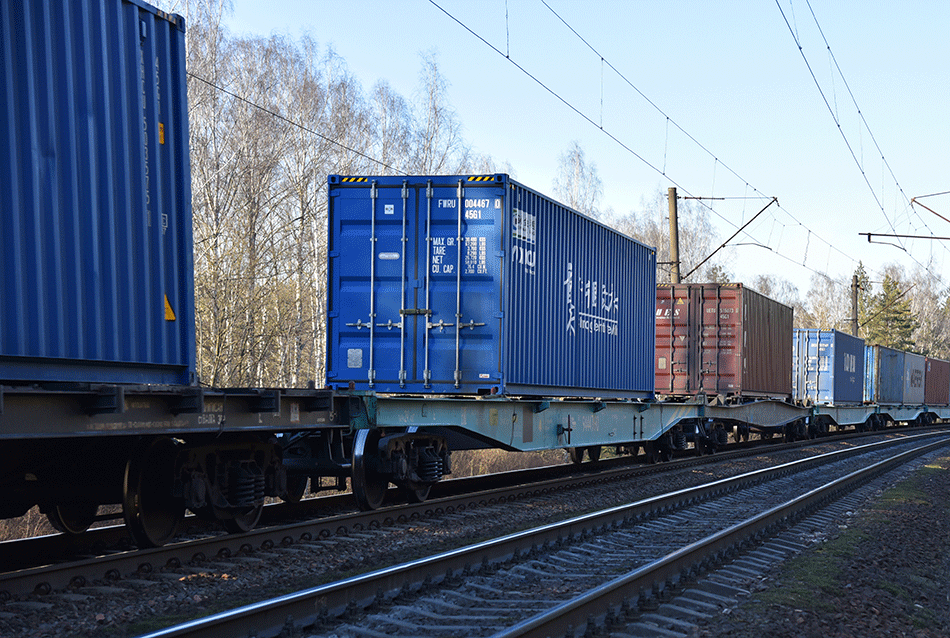
The BRI’s first decade is temporally almost coterminous with the China-Europe Freight Train (CEFT), which made its maiden journey from Chongqing to Duisburg in 2011. If that inaugural run portended trade and logistical connectivity embodied by the BRI, the CEFT has exceeded its little-recognised potential for becoming a transcontinental transport network spanning Eurasia. From one single route to a handful of routes and about 80 trains, with only one train from Europe back to China by 2013, the CEFT grew rapidly over the ensuing decade. The number of CEFTs reached 16,000 in 2022, with a cumulative number of 73,000 trains since 2011. These trains run on 82 routes between over 100 Chinese cities and 216 cities across 25 European countries and a number of Central, East, West and Southeast Asian countries bordering or near China. They carried 6.9 million containers with cargo worth over $400 billion and covering more than 50,000 types of goods by July 2023. During the first half of 2023, 2,754, 1,563, and 4,324 freight trains ran through the CEFT’s Eastern, Central, and Western corridors, respectively, along the China-Kazakhstan, China-Mongolia, and China-Russia borders. This total of 8,641 trains carrying 936,000 containers was up 16 per cent and 30 per cent over the same period of 2022 and anticipates the total number of trains and containers to surpass last year’s figures by the end of 2023.
Khabarovsk, far East, Russia.
The CEFT has not been all smooth. The hurdles include the pandemic-induced supply chain disruptions, occasional traffic congestion at a small number of crucial border crossings like Małaszewicze, Poland, and lagging logistical infrastructure at a few hubs along some routes to support efficient train crossings. The most disruptive challenge emerged when the war in Ukraine broke out. The West-imposed sanctions on Russia, including the Russian railways, raised risks that led some China-based European and US manufacturers to suspend shipping by the CEFT. The German carmaker Audi, which has extensive supply chains to China, stopped using the Trans-Siberian Railway linking the Eastern and Central routes to the Western route to enter East-Central and Western Europe.
Yet this downturn did not last long. July and August of 2022 saw new records of 1,517 and 1,601 trains, respectively, the latter of which was up 21 per cent in year-over-year growth. The city of Duisburg, leading all European cities, began to process a comparable number of trains from China in June 2023. This recovery has benefited from more freight trains switching to land-sea intermodal shipping by crossing the Caspian Sea, Azerbaijan, Georgia, and Turkey into Europe, which is known as the CEFT’s Southern Corridor, or the Middle Corridor more broadly.
In July 2023, the southern Chinese city of Guangzhou launched the intermodal “China-Kyrgyzstan-Uzbekistan” service from the Great Bay Area to Tashkent via Kyrgyzstan.
Given its geographical coverage, the CEFT has basically formed the arteries of the BRI’s main Corridors 1 and 3 (table 1), more the former than the latter. Moreover, the CEFT’s steady run, with its resilience through the Ukrainian crisis, has solidified the spatial foundation and form of Corridors 1 and 3. As the CEFT has steadied its operation, it has dealt with such financial and logistical challenges as sanction-induced risk of account settlement by introducing the RMB as an alternative currency to the US dollar. Some companies have set up overseas warehouses at or near main hubs to spread risks and plan better for processing future cargoes.
In a recent improvement starting on 1 July 2023, the Chinese city of Xi’an, capital of Shaanxi province and the highest-ranked city in sending and receiving CEFTs, regularised two scheduled services to Duisburg on Wednesday and Saturday each week, up from once a week. This regularised schedule has removed the unpredictability of stopping at the two border crossings between China and Kazakhstan and Belarus and Europe in order to switch from standard to wider gauges and then back to reach any European or Chinese destination. This shortens the time of travel along the entire route to 11.5 days, from 14-16 days. The return train also started on a new and similarly harmonised schedule, leaving Duisburg for Xi’an on 27 June 2023 and arriving on 9 July. These improvements further refine and strengthen the China-European freight train corridor, a timely accomplishment for the BRI’s tenth anniversary.
The accelerating China-Central Asia freight train
For much of the past decade, the CEFT has been key to sustaining Corridor No. 1, which technically links the Chinese eastern port city of Lianyungang and Rotterdam across the full length of Eurasia. Yet the CEFT contains the China-Central Asia freight train as a partial but integral set of routes with their termini and connected cities. This has not only helped consolidate the shipping and trade orientations and functions of Corridor No. 1 but also accentuates the China-Central/West Asia segment of Corridor 3 (table 1). The China-Central Asia freight train has differentiated itself from the CEFT as a shorter and more focused shipping network recently, with more freight trains arriving in and departing from Central Asia, in the wake of the Shanghai Cooperation Organisation Summit in Samarkand in September 2022, and especially since the first China-Central Asia Summit in Xi’an in May 2023.
Earlier on, during the past decade, the China-Central Asia freight train mostly ran from China to Europe and back through Kazakhstan, with a relatively small number of trains terminating in Kazakhstan’s commercial centre and former capital of Almaty, located 350 km from the China-Kazakhstan border. The benefit resulting to Kazakhstan from strong freight train links with China was largely confined to border-crossing fees and the limited logistical growth of its small border cities like Altynkol, facing Horgos and Dostyk opposite Alashankou. More recently, the China-Central Asia freight train has broadened across Central Asia in two ways. First, it has expanded rail connections beyond Kazakhstan to Kyrgyzstan, Uzbekistan, and Turkmenistan. With its feasibility study being completed in May 2023, the planned China-Kyrgyzstan-Uzbekistan Railway linking Kashgar and Tashkent, the capital of Uzbekistan, through Jalalabad, Kyrgyzstan is moving faster toward construction, with a targeted completion in 2026 (see map 1). This new railway will shorten freight train shipping from China to Europe and West Asia/Middle East by 900 km, creating the shortest rail route between China and Europe.
Map 1: The route of the planned China-Kyrgyzstan-Uzbekistan Railway
Source: The Economist, 6 September 2022
The second expansion has involved intermodal shipping from more Chinese cities along additional routes and border crossings. In July 2023, the southern Chinese city of Guangzhou launched the intermodal “China-Kyrgyzstan-Uzbekistan” service from the Great Bay Area to Tashkent via Kyrgyzstan (see photo 1). The train switched to trucking at the border crossing of Irkeshtam in the Kashgar region and then reverted to train at Osh, Kyrgyzstan, before reaching the destination of Tashkent. A logistics company based in Xinjiang planned to organise 25 freight trains from the Great Bay Area along the China-Kyrgyzstan-Uzbekistan route by the end of 2023. Also in July 2023, an identical train service was launched by the industrial city of Langfang in Hebei province and reached Tashkent after 6,000 km and 12 days. It marked a new shipping route between the Beijing-Tianjin-Hebei mega-region and key Central Asian cities.
These two new routes represent a growing number of China-Central Asian intermodal freight connections between such cities as Shanghai, Zhengzhou (Henan province), Xi’an, and a number of smaller cities across China and Almaty, Bishkek (capital of Kyrgyzstan), and Tashkent in Central Asia. The world’s only major double-landlocked country, Uzbekistan has benefited considerably from these new freight routes leading to maritime shipping via eastern China. These new transport links have further elevated the importance of Central Asia in both Corridors 1 and 3 (table 1).
Photo 1: The Great Bay Area’s inaugural intermodal freight train for the “China-Kyrgyzstan-Uzbekistan” route departed Guangzhou on 4 July 2023
The dynamic China-Laos railway
As the China-Central Asia freight train broadens China’s logistical connections to the west, another new freight (and passenger) railway line along the China-Indochina Peninsula Economic Corridor (No. 4 in table 1) has created rapidly growing shipping ties between China and Laos, and Southeast Asia more broadly. Launched into operation on 3 December 2021, the CLR has, over just 18 months, become the transport backbone of the China-Laos Economic Corridor, a sub-corridor (No. 7, table 1). In other words, the CLR has played a key role in creating and shaping a dynamic sub-corridor between China and Laos from the BRI’s No. 4 main corridor.
Photo 2: The president of Laos, Thongloun Sisoulith
Source: Nikkei Asia photo, reprinted in the source in Note 12
By 2 January 2022, one month into its operation, the CLR ran 50 freight trains in both directions, carrying nearly 50,000 tons of cargo, some of which crossed the border after clearing rigid customs and sanitary control procedures during the COVID-19 pandemic. In the period 1 January-13 April 2023, the number of CLR freight trains reached 1,130, averaging 11 trains a day, up 122 per cent over the same period of 2022. The freight carried amounted to 1.18 million tons. The number of shipped goods rose from less than 100 to over 2,000. By 18 April 2023, the cumulative amount of shipped cargo on the CLR reached 18.8 million tons, which comprised 14.6 million tons within China, 4.2 million within and beyond Laos, and over four million of both segments across the China-Laos border. By 3 June 2023, 18 months after the CLR went into operation, its shipped cargo surpassed 12 million tons, while its cumulative number of passengers topped 16.4 million, which accelerated after the international passenger through-train service began on 13 April 2023 with easy and fast visa clearing across 12 lanes at the border crossing.
Starting out as a joint venture between Chongqing and Guangxi province, the NLSC has expanded to include six more provinces with eight equity ownerships that involve seven regional stockholding companies and one overseas company in Laos.
Through channelling economic and human movements along the China-Laos Economic Corridor, the CLR has transformed the Laotian economy and society. The CLR has greatly facilitated not only China-Laos bilateral trade based on their comparative advantages but also larger and broader flows of traded goods between China and ASEAN, especially since the fortuitous timing of the Regional Comprehensive Economic Partnership (RCEP), which became effective on 1 January 2022. The CLR has sent more machinery, household electronics, and fresh flowers (mostly from Yunnan province) to Laos and beyond, while Laos has exported more metal ore and minerals, cassava, tropical fruits, and other agricultural goods to China. The CLR’s cold-chain freight cars allow reliable shipping of such time-sensitive goods as fresh flowers and fruit. It has cut the cost of shipping between Kunming and Vientiane by 40-50 per cent.
On the passenger side, the CLR has stimulated greater tourism and other purposes of cross-border travel. While passenger trains within China average about 42 per day, due to its larger population and higher demand and income levels, the increased interest in travel on the Laotian side, including Thailand, has raised the average number of trains from one to six and as many as 10 each day.
By the conventional evidence on flows, the CLR has transformed landlocked Laos to a newly land-linked country capable of funnelling greater trade between China and Southeast Asia. Moreover, the CLR has created over 110,000 jobs in commerce, logistics, and tourism along the route, and hired over 3,500 employees just for the railway. Encouraged by the CLR, the Boten Special Economic Zone on the Laotian side of the border crossing has drawn 768 resident firms with cumulative registered capital of $1.6 billion. Laos’s very first rail system, the CLR has recently earned the laudatory comment of Laotian President Thongloun Sisoulith that this new railway is his country’s pride (see photo 2).
Connecting Multiple Corridors
As more freight trains run between China and Europe, Central Asia, and Laos with extensions to Southeast Asia, the economic and logistics corridors and sub-corridors linking them have become connected into a new land-sea corridor (NLSC) through Western China (No. 9 in table 1) that ties cargo flows across multiple domestic and international boundaries. Led by China and in operation since 2017, the NLSC is the most integrative of all BRI-enabled corridors in that it ties three distinctive freight systems across Eurasia – Europe, Central Asia, and Southeast Asia – into a longer and more extended multimodal shipping route featuring the central nodal, connective, and consolidating roles of Chongqing in and through southwestern China (see map 2).
Map 2: The Western China New Land-Sea Corridor (NLSC)
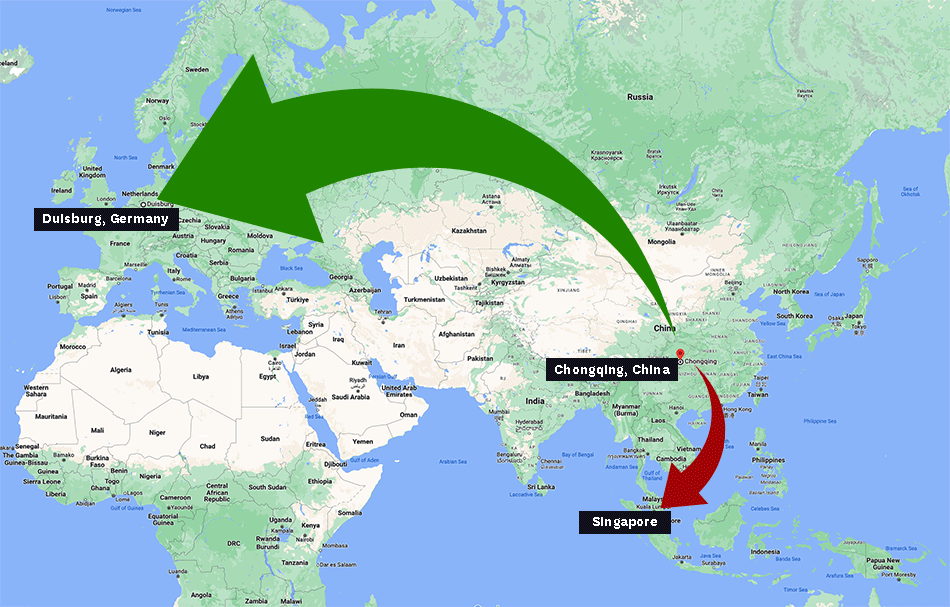
Starting out as a joint venture between Chongqing and Guangxi province, the NLSC has expanded to include six more provinces with eight equity ownerships that involve seven regional stockholding companies and one overseas company in Laos. Now covering 12 western provinces, the NLSC network reaches 116 shipping stations across 60 cities in 18 provinces. Its shipping network radiates out to 393 ports in 119 countries and regions. In 2017, the NLSC processed 178 rail-sea intermodal freight trains from Europe and Central Asia to maritime Southeast Asia, especially Singapore, via the ports of Guangxi province. The number of trains soared to 8,820 in 2022, a 50-fold increase, and also included trains carrying containers from Southeast Asia by sea to Europe, Central Asia, and beyond that also involves trucking. This rapid growth also contains more trains and trucks shipping goods from more Chinese cities in both directions. In the first half of 2023, the NLSC carried 424,000 containers, 10.5 per cent more than the first six moth of 2022.
On 5 July 2023, the Gansu provincial subsidiary of the NLSC sent a train from the capital city of Lanzhou to the city of Kashgar, from where the cargo was switched to trucks that exited China at the border crossing of Irkeshtam and reached the city of Osh, Kyrgyzstan. There, the cargo was reloaded on to a freight train to reach Mazar-i-Sharif in northern Afghanistan as the destination. This inaugural run marked the beginning of the “China-Afghanistan Express”, an extension from the “China-Kyrgyzstan-Uzbekistan” intermodal route, which will be a more direct and effective shipping link when the planned China-Kyrgyzstan-Uzbekistan Railway is completed (see map 1). On 13 July 2023, the NCLS and the city of Kashgar formalised an agreement to strengthen cooperation on channelling more intermodal, rail-road services between Western China and Central Asia in order to deepen their trade and logistical relations.
On 7 July 2023, a freight train left the megacity of Chengdu, near Chongqing, for Budapest, Hungary. It carried car parts and components from Thailand that had departed on 1 July and arrived in Chengdu via the CLR, before the rail journey to Budapest, where the freight train arrived on 17 July 2023. This trip of 17 days from Thailand to Hungary saved nearly 20 days and 20 per cent of the cost relative to the road-rail and road-sea routes of the past. This route represents the combined use of the CLR’s “Lancang-Mekong Express” and the “Chengdu-Europe Express” freight services. It now runs three days a week on a regular schedule covering the journey between Vientiane at one end and a number of European cities in as few as 15 days at the opposite end of Eurasia. On 15 July 2023, the NCLS and the ASEAN Federation of Forwarders Association (AFFA) of the International Federation of Freight Forwarders Associations (FIATA) signed a MOU to strengthen cross-Eurasian logistics through resource- and information-sharing, with the primary goal of enhancing China-ASEAN regional economic integration.
The NLSC’s anchor and central hub, Chongqing, has benefited the most from a wider and more efficient set of direct or through shipping routes, featuring more integrated rail-rail, rail-sea, and rail-road links. Chongqing recently sent a freight train loaded with local industrial parts to Kunming, from where a CLR freight train carries the cargo to the town of Padang Besar in northern Malaysia bordering southern Thailand via the metre-gauge track from Vientiane to Bangkok. The trip took only 13 days, cutting the time required by the traditional land-sea or river-sea shipping along the Yangtze River by 40 per cent. This rail corridor has created a new logistics opportunity for Chongqing’s local companies to export more to overseas markets, avoiding the unpredictable problem of Yangtze’s uneven water levels during either its dry or flooding season via traditional river-sea shipping to and from an eastern seaport to Southeast Asia.
The Broader Implications of Corridorisation
Yangtze River in Chongqing
As the BRI has created a global buzz about building more infrastructure in the global South and China’s capacity of delivering it at scale and speed, the BRI-enabled economic and logistics corridors and sub-corridors stand out as its most geographically distinctive and impactful feat. By connecting over 200 cities across Eurasia and beyond that otherwise would not be linked in this manner, this corridorisation has unleashed large trade and cargo flows among more parties and places, diverting some from the slower, albeit lower-cost, maritime shipping routes. The BRI corridors have reshaped urban-regional positions and relations across Eurasia by adding logistical functions to small and previously marginal cities like Horgos and Alashankou on the China-Kazakhstan border and Boten on the China-Laos border. Furthermore, the BRI-induced corridorisation has carved a set of shipping pathways for trade flows through multiple crossings along China’s domestic/international divide. This produces multifaceted economic spillovers from “the middle out and bottom up” that spreads some development benefits to cities and regions neighbouring and farther beyond China.
While more shipping connections among more places are generally desirable, corridor-centric connectivity can have a double-edged effect. As they link more localities in a linear fashion, corridors call for growing usage, greater integration, and effective governance. If demand for more shipping along these corridors does not materialise, it may lead to some wasteful infrastructure investment and development and stimulate cut-throat competition on shipping prices among more rival logistics corridors. As more subnational governments and private businesses enter more corridors as players or participants, how would they cooperate with one another to facilitate more efficient processing of freight trains and trucks through more border crossings and reduce inter-local differences that may not be easily resolved by bilateral or multilateral national agreements?
While the NLSC has done quite well in facilitating connected cargo flow around Europe, Central Asia, China, and Southeast Asia, it needs to be better in fostering even faster and smoother coordination of customs clearance, standard compatibility, and other governance matters. The NLSC’s new five-year plan for 2023-27 aims to address these challenges more purposefully and strategically.
As the BRI marks its first decade of existence, it has brought a score of economic and logistics corridors into existence that will continue to serve their purpose of moving more traded goods across Eurasia and beyond. But this is not enough. As partially documented earlier, these BRI corridors carry broader implications that include stimulating more urbanisation and industrialisation along the railway and intermodal routes, creating potential economic agglomeration and fostering greater regional integration. At a time of partial global economic fragmentation and even decoupling, the BRI regional corridors form a timely countering force with and through their wider and stronger logistical connectivities for greater cross-border trade flows.
Acknowledgement: This article draws partly on my talk at the Asian Studies Center of Boğaziçi University, Istanbul on 25 May 2023, a public lecture sponsored by the Centre for Advanced Security, Strategic and Integration Studies at the University of Bonn and Friedrich Naumann Stiftung on 23 June 2023, and a presentation at the workshop on “The 10th Anniversary of the Belt and Road Initiative” at the University of Bonn and the Academy of International Affairs of North Rhine-Westphalia, Germany on 7 July 2023. The research undergirding this article is supported by the Paul E. Raether Distinguished Professorship Fund at Trinity College, Connecticut, USA.
Xiangming Chen served as the founding Dean and Director of the Center for Urban and Global Studies at Trinity College in Connecticut from 2007 to 2019. He is currently Director of the Urban Studies Program and Paul E. Raether Distinguished Professor of Global Urban Studies and Sociology at Trinity College, a Guest Professor at Fudan University, Shanghai, a Visiting Professor at Duke Kunshan University, China, and an Associate Fellow at the Center for Advanced Security, Strategic and Integration Studies (CASSIS) at the University of Bonn, Germany. He has published extensively on urbanisation and globalisation with a focus on China and Asia, and conducted policy research for the World Bank, the Asian Development Bank, UNCTAD, and OECD.
Notes
Jean Gottmann, The Megalopolis: The Urbanized Northeastern Seaboard of the United States. The MIT Press, 1964.
Georg, Isabel, Thomas Blaschke and Hannes Taubenböck. “A Global Inventory of Urban Corridors Based on Perceptions and Night-Time Light Imagery”. International Journal of Geo-Information 5 (233): 1-19, 2016. doi:10.3390/ijgi5120233.
When many investors think about investing, they often consider investing in the stock market. While nothing is wrong with this, if you are passionate about your local community, it’s always good to dedicate a portion of your portfolio to support your local projects and help your community thrive.
Thankfully, there are several ways you can invest in your local area. These ways include:
Enterprise investment schemes
An enterprise investment plan (EIS) is a government effort to help small or medium-sized enterprises attract investment by granting tax relief.
While an average investor does not require these schemes, they can be beneficial in terms of lowering your tax liability. EISs provide three types of tax relief:
You can claim up to 30% income tax relief on EIS investments.
You can defer capital gains tax by reinvesting a gain from selling other assets in EIS shares.
You can leave them to your heirs tax-free if you have held them for at least two years at the time of death.
In a perfect case, those investing in EISs take advantage of all three characteristics, implying that they only risk a small amount of their investment. Future losses can also be deducted from income taxes.
If you are considering investing in EISs, you should use a specialist fund or provider, which will provide you access to various local companies to invest in.
Due to the illiquidity of EIS investments, it may take some time for the provider to deploy your money and even longer before you receive the requisite certificate to claim tax relief, so plan accordingly.
Furthermore, EIS investment will not necessarily target your local area if done through a provider. Also, an EIS manager, like your adviser, will charge you fees, so inquire first.
Crowdfunding sites and local investor networks are also good places to check, as they are the most direct way to target a certain geographic area.
To get the most from EIS, familiarize yourself with the EIS scheme’s regulations and requirements. This involves understanding the eligibility requirements for EIS investments and their associated tax advantages. The restrictions may differ from country to country, so be sure you understand the unique regulations in your area.
You also should do thorough due diligence on the company or companies under consideration. Examine their business model, management team, financials, potential for growth, competitive landscape, and industry trends.
Consider getting professional assistance or interacting with experienced investors who can provide insights and assist in evaluating the investment opportunity.
Lend your money to local businesses
While EISs are an equity-based investment, you can lend money to local businesses. This is possible through peer-to-peer platforms, which frequently invest in property-secured loans.
Although peer-to-peer lending does not provide the same tax benefits as an EIS, earnings are tax-free if invested through an innovative financial savings account (IFSA).
In the case of peer-to-peer and equity crowdfunding platforms, in addition to investment risks, you should be aware that if the platform you use goes insolvent, your money is often not insured by the Financial Services Compensation Scheme.
Thankfully, the Financial Conduct Authority regulates firms, as client assets must be safeguarded.
So to be safe, you should find regulated local firms such as those running a local fashion blog, magazine, or any other local business. You bear no project risk when you lend directly to a regulated firm.
The likelihood of a firm defaulting on its debt is low, making this investment less risky than ordinary peer-to-peer financing.
When you do this, you have a reasonable middle ground: you still receive a sense of “tangibility” because the money is utilized for specific projects within your local area, and enjoy a lower level of risk.
If you aren’t keen on getting your money back and are merely charitable, you can contribute the interest back, and approximately 10% of the money is routinely returned to the firm so that it can handle more projects.
Support a community shares project
Supporting a community shares initiative is another way to invest in your community. Community shares are utilized when a group seeks to buy a local establishment, such as a pub, to save it from closure or to keep it independent. As an investor, you can contribute small sums and own a piece of the action.
Most investments, whether made through an EIS provider, a crowdfunding site, or a peer-to-peer lender, are extremely illiquid. Some platforms feature secondary marketplaces where investments can be traded.
Selling an asset typically takes around a week. However, there is no guarantee that you will be able to get the money back promptly, if at all if you need it before the investment expires.
This is especially true for non-transferable community shares. You cannot sell your stake to another investor; you must return it to the company if its finances are strong enough to buy you out.
Furthermore, some community share issues do not qualify for EIS status, and the rate of return they provide is flexible.
Always consider the community enterprise’s possible impact on the local community. Assess how their social, environmental, and economic objectives connect with your principles. You also should look for evidence of the enterprise’s track record of fulfilling its goals.
As mentioned above, some risks come with investing in community shares. Assess the hazards associated with the company and the industry in which it works.
Consider market demand, competition, regulatory hurdles, and the possibility of financial loss. Determine your risk tolerance and make an educated decision.
Parting shot
These are some of the ways you can invest in your community. Just like with any other investment, diversification is key. To mitigate risk, consider spreading your investment among various options and sectors.
It is strongly advised that you speak with a financial advisor or tax specialist familiar with local investments. They will assist you in understanding the tax consequences, assessing prospective prospects, and determining your risk tolerance. A professional will also offer advice for your financial circumstances and investing objectives.
In the vast universe of entertainment and gaming, the casino industry has always been a cornerstone. From the dazzling lights of Las Vegas to the elegant halls of Monte Carlo, brick-and-mortar casinos have mesmerized patrons for generations.
Yet, with the rapid rise of technology, a new player has entered the field: mobile casinos. As smartphones become ubiquitous and technology integrates deeper into our daily lives, the world of gambling is undergoing a paradigm shift. This article delves into the economic advantages of mobile casinos compared to their traditional counterparts.
Overhead and Operating Costs
Brick-and-Mortar: The cost of running a physical casino is immense. From renting or purchasing prime real estate to paying utility bills, security, and staff salaries, expenses can skyrocket. Additionally, ongoing maintenance and the need to constantly refresh interiors to keep patrons engaged adds to the budget.
Mobile Casino: On the other hand, the overhead costs for a mobile casino are significantly lower. Apart from server and software development costs, the bulk of expenses pertain to licensing, compliance, and marketing. The absence of physical infrastructure and reduced staffing needs naturally tilt the scales in favor of mobile platforms.
Accessibility and Market Reach
Brick-and-Mortar: One of the main limitations of a traditional casino is its fixed location. Patrons need to physically visit, which often involves travel expenses and time. This inherently limits the customer base to those within a feasible traveling radius or those willing to make a vacation out of it.
Mobile Casino: Mobile platforms, however, are accessible from anywhere, anytime. This global reach allows them to tap into a much larger customer base. With just an internet connection and a device, players from various geographical locations can engage in gaming, thereby increasing potential revenue streams.
Adaptability and Innovation
Brick-and-Mortar: Changing a game or introducing a new one in a physical casino can be a lengthy process, involving the acquisition of new machines or table setups.
Mobile Casino: For mobile platforms, introducing new games or features is often as simple as a software update. For instance, consider the buzz created by FanDuel’s BlackJack. The flexibility of the digital platform allowed it to quickly introduce and promote this game, attracting both seasoned players and novices alike.
Such adaptability allows mobile casinos to swiftly respond to market demands, keep players engaged, and stay ahead in the competitive landscape.
Environmental Impact and Sustainability
Brick-and-Mortar: The environmental footprint of a traditional casino can be significant. Think about the energy consumption, waste production, and the carbon footprint of patrons traveling to and from the location.
Mobile Casino: While data centers powering mobile platforms do consume energy, the overall environmental impact is comparatively less. Fewer resources are used, and there’s a reduction in associated travel emissions. This makes mobile casinos a more sustainable choice in the long run.
Data-Driven Strategies
Brick-and-Mortar: While traditional casinos do employ customer tracking and loyalty programs, the depth and immediacy of data collection can be limited.
Mobile Casino: The digital nature of mobile casinos allows for real-time data collection. This rich data enables platforms to tailor experiences, promotions, and games to individual users, improving engagement and maximizing revenues.
Business Continuity
Brick-and-Mortar: Physical casinos are vulnerable to a variety of disruptions, from natural disasters to global pandemics. Such events can halt operations for extended periods.
Mobile Casino: Mobile platforms are inherently more resilient. Even in situations like lockdowns, players can still access and enjoy the services. This resilience ensures a steadier revenue stream and a business model less prone to external disruptions.
Real-Time Engagement and Personalized Player Experience:
Brick-and-Mortar: The ambiance and experience offered by a physical casino are undeniably unique. The real-time interactions with staff, the tactile feel of chips, and the cacophony of slot machines create a sensory experience.
However, personalizing this experience for each patron can be challenging. While loyalty programs and VIP experiences offer some degree of personalization, it’s often limited to a select group of high-rollers.
Mobile Casino: The virtual realm provides a level of individual customization that’s hard to match. Mobile casinos can offer real-time rewards, bonuses, and promotions based on a player’s activity.
With the power of artificial intelligence and machine learning, these platforms can analyze a player’s preferences, betting habits, and gaming history to offer tailored game suggestions or time-sensitive bonuses. This real-time engagement fosters loyalty and ensures players remain engaged, enhancing their overall experience and, in turn, increasing the platform’s retention rates.
Conclusion
The economic advantages of mobile casinos over traditional brick-and-mortar establishments are profound. Reduced overheads, global reach, adaptability, and data-driven strategies make the digital model incredibly appealing from a business standpoint.
While the charm and experience of traditional casinos will always have a place in the hearts of many, it’s hard to ignore the winds of change. The convenience and adaptability of mobile platforms, coupled with their economic benefits, indicate that the future of gambling might very well be in the palm of our hands.
The UAE is currently navigating a period of change in economic law. In January 2022, the UAE government’s Ministry of Finance announced that it would introduce a federal corporate tax on net profits in 2023.
Now that this law has been introduced, it’s important to know its impact on potential investors in the UAE and get some reassurance that Dubai (and the wider UAE) remains an excellent investment destination.
What is the new law and when does it come into effect?
The UAE’s new corporate tax law is called Federal Decree-Law No. 47 of 2022 and it applies to all corporations and businesses operating in the UAE outside of free zones.
After June 1, 2023, all businesses that fall within the scope of the law are subject to the new tax rule from the beginning of their next financial reporting year. In reality, this affects most businesses in the UAE, especially those owned by overseas investors.
In summary, the law requires payment of 9% of taxable income over AED 375 000 and 0% below this threshold. Read more below to learn about this law, including its reliefs and exemptions.
What are the details of Federal Decree-Law No. 47?
The new corporate tax law applies to profits; that is, income minus various deductions. Deductible expenses may include administrative expenses, cost of goods, depreciation, and other expenditures. For a full understanding of what deductions your business may be able to deduct while complying with Federal Decree-Law No. 47 of 2022, you would need to contact a tax agent in the UAE.
Entities currently exempt from this new UAE corporate tax include government and government-controlled entities, qualifying investment funds, extractive and non-extractive natural resource businesses, qualifying public benefit entities, and qualifying private pension or social security funds.
Remember that this is a corporate tax only so there is still no tax on private incomes from employment, property and other investments. Small and medium enterprises may benefit from the tax relief program for revenues less than AED 3 million.
How has this law changed the investment landscape?
For a long time now, the UAE has been a very attractive destination for investors. It has consistently offered good returns because of its strong economy, stable politics and social structure, favorable location and excellent infrastructure.
The UAE has long-established itself as a global business and financial hub. It has welcomed international investors with open arms and there are more than 30 free zones in the nation that welcome 100% foreign ownership of businesses.
The UAE’s tax-free incentive has also been a big draw. Until recently, there was no tax on profits on almost all business types, so Dubai and the other emirates were considered tax havens.
So, what has changed? Is the UAE still a good option for international investors?
Let’s find out.
1. Streamlined taxation practices
For some time now, the UAE has sought to put itself in line with best international practices in terms of taxation while also diversifying its state income.
This began with the introduction of 5% value added tax (VAT) in early 2018 and was followed by Country-by-Country Reporting (CbCR) regulations in 2019. This new corporate tax law aligns the UAE with international markets.
The law is designed to minimize the compliance burden on businesses. Less burdensome reporting standards are applicable to businesses with an income of less than AED 50 million. In addition, cash basis accounting may be used by businesses with an income of less than AED 3 million.
These requirements are likely to be a consideration for investors when comparing corporate tax rates in other potential markets. Paying corporate tax in the UAE rather than individual income tax may be applicable and preferable to many investors.
2. Financial efficiency
The change in UAE tax law has wide-reaching implications for businesses. It may be that operational and financial changes need to be made to existing UAE businesses to ensure that there is a minimal tax burden placed on them while ensuring compliance with all laws and regulations.
3. Low rates of corporate tax
While moving from 0% to 9% is a big jump, the UAE still offers one the lowest rates of corporate tax in the GCC region, amongst developed nations and other key financial hubs. For example, the average rate of corporate tax amongst EU countries is 21%. Also, UAE free zones are still subject to 0% corporate tax.
These are all factors that potential investors may wish to consider in light of the UAE corporate tax reform.
For more information on the tax and reporting burdens your investment may be subject to, it’s vital that you talk to tax consulting services in the UAE.
Personal finance is the foundation of our financial stability, enabling us to efficiently handle our finances and make educated choices regarding expenditure, savings, and investments. With Saudi Arabia experiencing significant economic growth and a vibrant society, individuals must equip themselves with essential personal finance knowledge to confidently manage their finances and thrive in the ever-changing financial environment.
Regardless of your career stage, whether you’re a recent graduate, a growing family, or approaching retirement, having a grasp of personal finance concepts is crucial to successfully reach your financial aspirations. Let us embark on this journey to understand the basics of personal finance in Saudi Arabia, empowering ourselves to make sound financial decisions and unlock a path towards financial freedom and stability.
I. The Importance of Budgeting
A. Tracking income and expenses
One of the fundamental pillars of money matters in the specific area is tracking your income and expenses. Tracking your income sources and expenditures is fundamental in gaining a clear understanding of your financial standing and making informed decisions about your money. Diligently tracking your income and expenses provides valuable insights into your financial landscape. It helps you evaluate your spending behavior, discover opportunities for cost reduction, and make informed choices about saving and investing your money.
B. Creating a personalized budget
A budget serves as a financial roadmap, outlining your income allocation for various expenses such as housing, transportation, food, education, and entertainment.
Building a budget in Saudi Arabia necessitates a thoughtful consideration of the country’s distinctive cost of living, cultural values, and individual financial targets. For instance, in a country where family and social obligations hold significance, budgeting for celebrations, weddings, or religious events may be a priority.
C. Balancing expenditure and savings
Maintaining a healthy balance between spending and saving is a key aspect of wealth management in the targeted region. Saudi Arabia offers several avenues for saving, such as opening a savings account at a local bank or utilizing government-sponsored savings programs. By allocating a portion of your income towards savings, you create a safety net for unexpected expenses and work towards achieving your long-term financial objectives.
II. Strategies for Saving Money in the region
A. Establishing emergency funds
Building an emergency fund is a crucial step in personal finance, regardless of where you reside, including Saudi Arabia. This fund acts as a financial safety net to cover unexpected expenses such as medical emergencies, car repairs, or sudden unemployment.
In Saudi Arabia, it is advisable to establish an emergency fund that takes into account the unique cost of living, healthcare expenses, and any additional factors specific to your circumstances. By setting aside a portion of your income regularly, you can gradually build a robust emergency fund, providing you with peace of mind and financial security.
B. Setting aside funds for short-term and long-term goals
In Saudi Arabia, it is important to identify your financial goals and allocate funds accordingly. Consider the rising costs of education and housing, as well as the potential inflation rates, to set realistic savings targets. By breaking down your goals into manageable chunks and consistently saving towards them, you can make steady progress and achieve your aspirations.
III. Managing Debt Wisely in the locale
A. Responsible borrowing practices
Managing debt wisely is a crucial aspect of navigating personal finances. While borrowing can be necessary for major expenses such as purchasing a home or financing education, it is important to practice responsible borrowing. This involves borrowing only what you can afford to repay, considering your income and financial obligations.
B. Avoiding common debt traps
Saudi Arabia, like any other country, has its share of common debt traps that individuals should be aware of and avoid. These traps may include excessive use of credit cards, taking on high-interest loans without proper assessment, or engaging in impulsive spending beyond one’s means.
IV. Tailoring Personal Finance Strategies to the Saudi Arabian Context
Cultural and societal factors impacting personal finance decisions.
Cultural and societal factors hold considerable influence over financial choices within the local context, shaping individuals’ personal finance strategies. The concept of family and community support is deeply ingrained, and individuals often prioritize meeting familial obligations or participating in social events.
Understanding these cultural factors is crucial in tailoring personal finance strategies. Balancing personal financial aspirations with fulfilling social obligations is crucial for a well-rounded approach to managing finances. By incorporating cultural considerations into financial planning, individuals can align their financial decisions with their values and maintain harmony within their social and familial networks.
To summarize, having a grasp of the fundamentals of personal finance in Saudi Arabia is essential for individuals aiming for financial stability and success in achieving their objectives. By embracing budgeting, saving, investing, and debt management principles tailored to the Saudi Arabian context, individuals can take control of their finances. Strategic saving, exploring investment opportunities, and responsible borrowing contribute to long-term financial health. Mastering personal finance empowers individuals to navigate the economic landscape, achieve aspirations, and build a secure future in Saudi Arabia.
By Terence Tse
CFOs are evolving into AI-driven transformation orchestrators, balancing finance, technology, and strategy while upskilling teams, managing risks, and driving measurable business value.
A key insight from this year’s AI for CFOs event, organized...
The World Financial Review uses cookies to improve site functionality, provide you with a better browsing experience, and to enable our partners to advertise to you. Detailed information on the use of cookies on this Site, and how you can decline them, is provided in our Privacy Policy and Terms and Conditions. By clicking on the accept button and using this Site, you consent to our Privacy Policy and Terms and Conditions. ACCEPT
Privacy & Cookies Policy
Privacy Overview
This website uses cookies to improve your experience while you navigate through the website. Out of these cookies, the cookies that are categorized as necessary are stored on your browser as they are essential for the working of basic functionalities of the website. We also use third-party cookies that help us analyze and understand how you use this website. These cookies will be stored in your browser only with your consent. You also have the option to opt-out of these cookies. But opting out of some of these cookies may have an effect on your browsing experience.
Necessary cookies are absolutely essential for the website to function properly. This category only includes cookies that ensures basic functionalities and security features of the website. These cookies do not store any personal information.
Any cookies that may not be particularly necessary for the website to function and is used specifically to collect user personal data via analytics, ads, other embedded contents are termed as non-necessary cookies. It is mandatory to procure user consent prior to running these cookies on your website.





 Nishtha Chugh