Selling a house is always a difficult decision for a multitude of reasons. On one hand, it may be connected with the joy of moving to a new house. On the other hand, you most probably need to find a family that will be willing to buy your house, accepting your price without attempting to significantly lower its value. Before the process of selling your house, consider making a few financially savvy modifications to your house and increase the amount you would like to receive for your property for future home selling.
Build an extension to increase space
One of the greatest issues lots of families need to face is the lack of space, both for storage or even for primary purposes, like eating together with their family, organising a movie night, or simply playing with their kids.
It’s not so easy to rebuild the house that you are going to sell anyway, but building an extension can significantly increase its value, even up to 15%. Choose which room in the house needs renovation or expansion of the space, or swap the functions of the rooms. An extension is a perfect place for an open-plan kitchen connected to your living room, with a glass roof to increase the amount of daylight.
If your house is suitable for a family with kids, think about building an extension that will serve as a playroom. Or how about transforming the extension into a winter garden, which will amaze the most demanding clients coming to your house? Consult a homebuyer financial adviser on how to invest wisely to prepare your house for future selling.
Parking Space
It might come as a surprise that selling a house with off-street parking could allow you to ask buyers for an additional £50,000. Given the challenge of finding parking in congested areas, a dedicated parking space can be considered one of the most significant advantages of a real estate property.
In the era of electric cars, the presence of electric vehicle charging facilities can further enhance the value of your property. As electric cars gain popularity, homeowners increasingly desire such amenities.
Renovate and refurbish the rooms
One of the most costly renovations at home is in the kitchen and bathroom, due to the cost of tiles, equipment, and furniture. These two rooms are also the most assessed ones by buyers, as they are aware of the awaiting responsibilities in case they don’t like the decor or furniture.
Start with replacing outdated appliances with modern and more ecological ones, and get rid of stained tiles to create a modern and stylish look. A full refurbishment of the kitchen is assessed for a £15,000 increase in your home value, while the bathroom can add up by 3 to 5%.
A garden as a home oasis
Focusing on the interior of the house cannot let you forget about the exterior. According to the survey by the Times, the value of the house can be increased by 2 to 3% by the work you do in the garden.
Start with simply cleaning it up, removing unnecessary and broken things, sweeping the leaves, and getting rid of old plants. Mow the grass, trim the bushes, and make your garden look neat and well-kept. Look at your door and the front of your house in the eyes of the potential buyer. Do they look attractive, or the person will feel negative about the house in the few first seconds in front of your property?
If there is a patio, think about creating a cosy sitting place there, with chairs, pillows, pot plants, and lots of candles around.
Resale Value: Making Financially Savvy Choices for Future Home Selling
Selling a house is always a difficult decision for a multitude of reasons. On one hand, it may be connected with the joy of moving to a new house. On the other hand, you most probably need to find a family that will be willing to buy your house, accepting your price without attempting to significantly lower its value. Before the process of selling your house, consider making a few financially savvy modifications to your house and increase the amount you would like to receive for your property for future home selling.
Build an extension to increase space
One of the greatest issues lots of families need to face is the lack of space, both for storage or even for primary purposes, like eating together with their family, organising a movie night, or simply playing with their kids.
It’s not so easy to rebuild the house that you are going to sell anyway, but building an extension can significantly increase its value, even up to 15%. Choose which room in the house needs renovation or expansion of the space, or swap the functions of the rooms. An extension is a perfect place for an open-plan kitchen connected to your living room, with a glass roof to increase the amount of daylight.
If your house is suitable for a family with kids, think about building an extension that will serve as a playroom. Or how about transforming the extension into a winter garden, which will amaze the most demanding clients coming to your house? Consult a homebuyer financial adviser on how to invest wisely to prepare your house for future selling.
Parking Space
It might come as a surprise that selling a house with off-street parking could allow you to ask buyers for an additional £50,000. Given the challenge of finding parking in congested areas, a dedicated parking space can be considered one of the most significant advantages of a real estate property.
In the era of electric cars, the presence of electric vehicle charging facilities can further enhance the value of your property. As electric cars gain popularity, homeowners increasingly desire such amenities.
Renovate and refurbish the rooms
One of the most costly renovations at home is in the kitchen and bathroom, due to the cost of tiles, equipment, and furniture. These two rooms are also the most assessed ones by buyers, as they are aware of the awaiting responsibilities in case they don’t like the decor or furniture.
Start with replacing outdated appliances with modern and more ecological ones, and get rid of stained tiles to create a modern and stylish look. A full refurbishment of the kitchen is assessed for a £15,000 increase in your home value, while the bathroom can add up by 3 to 5%.
A garden as a home oasis
Focusing on the interior of the house cannot let you forget about the exterior. According to the survey by the Times, the value of the house can be increased by 2 to 3% by the work you do in the garden.
Start with simply cleaning it up, removing unnecessary and broken things, sweeping the leaves, and getting rid of old plants. Mow the grass, trim the bushes, and make your garden look neat and well-kept. Look at your door and the front of your house in the eyes of the potential buyer. Do they look attractive, or the person will feel negative about the house in the few first seconds in front of your property?
If there is a patio, think about creating a cosy sitting place there, with chairs, pillows, pot plants, and lots of candles around.
Syukuro Manabe and Klaus Hasselmann were awarded shares of the 2021 Nobel Prize in Physics for scientific work that is both understandable by non-scientists and critical to humanity’s recognition of risks born of human-induced climate change. We now know what they could not know when they started their work – the climatic changes that they revealed are irreversible in human timescales and they produce extreme events that are persistently increasing in frequency and potentially catastrophic intensity.
In October of 2021, Syukuro Manabe and Klaus Hasselmann were awarded a shared “Nobel Prize in Physics” with Giorgio Parisi for their “groundbreaking contributions to our understanding of complex systems”.1 In announcing their award and preparing an accessible document explaining their selection,2 the Prize Committee refocused the world’s attention on climate change by rewarding Manabe and Hasselmann more specifically for their “physical modelling of Earthʼs climate, quantifying variability and reliably predicting global warming”.
Ah! Wonderful. Finally, a physics award for something whose immediate importance to humanity can actually be understood by much of humanity in real time. The award is also reassuring to those who recall that an earlier Prize Committee had already awarded a share of the “Sveriges Riksbank Prize in Economic Sciences in Memory of Alfred Nobel” to William Nordhaus in 2018 “for integrating climate change into long-run macroeconomic analysis”.3
The statistically significant Hasselmann “fingerprint” of human activity is the gap between the turquoise and orange ranges that started around the turn of the century.
This essay was designed to complement the documentation of the physics award provided by the Nobel Committee4 with contextual commentary that places their enormous contributions about the evolving role of climate modelling and climate science in the global discourse over at least three fundamental questions:
What do we actually know about the possibility and causes of a changing climate?
How can we possibly know those things without being able to run controlled experiments on a parallel planet where humans do not emit greenhouse gases?
And, so what if they do? Why has responding to climate change risk been called humanity’s greatest challenge?
The answers to these questions complicated, to be sure, but they can certainly be informed by a series of applied lessons (highlighted below in italics) drawn from the long careers of both pre-eminent scientists (and Nordhaus, for that matter).
1. Public discourse about climate risk is not new to the 21st century.
The modelling work that brought Manabe the Prize emerged in 1967 with the publication of Manabe and Wetherald5; Hasselmann started his work on climate change “fingerprints” in 1976.6 Nordhaus’s seminal work on the economics of climate change appeared in 1991.7 Enough said. Climate change is not the product of a recent and still speculative conspiracy from a small wing of the scientific community.
Manabe, for example, started down his path to the Prize by demonstrating that concentrations of CO2 could affect temperatures from the earth’s surface up to the atmosphere’s boundary with space, i.e., from the low-altitude troposphere up through the high-altitude stratosphere. He created and exercised a simple linear model in the 1960s that could, on the basis of then current but limited data and computer power, correlate the radiation balance of the planet, not only with respect to surface temperatures, but also with respect to the vertical transport of air masses for different concentrations of CO2.
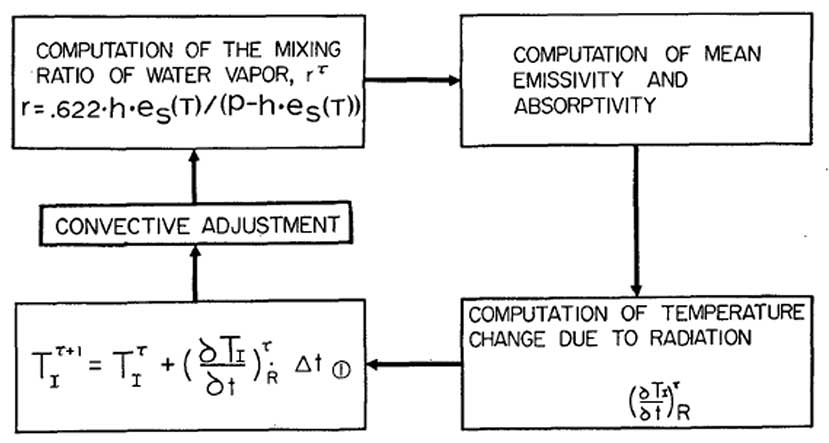
Figure 1 Flow chart for the numerical time integration.
Figure 1 duplicates figure 2 in Manabe and Wetherald. It is their schematic of the modelling structure with which they were able to substantiate an intricate and new story. Incoming solar radiation heats the earth to a degree that is regulated by outgoing infrared heat radiation at a rate that depends positively on atmospheric concentrations of carbon dioxide. Latent heat warms the surface of the earth and thereby creates hot air that rises by convection into the upper regions of the atmosphere. This rising air transports water vapour skyward, but it does not stay aloft as a greenhouse gas. Instead, it condenses and falls back to earth when it reaches the colder upper regions of the stratosphere, and the condensation process itself cools its immediate environs.
2. It is possible and many times advantageous to use models to produce empirical estimates of critical climate parameters.
This sign-switching behaviour along the atmosphere’s vertical temperature gradient was news back then. So, too, were model-based estimates predicting that stratospheric temperatures would fall more than 2.25oC starting at an altitude of about 20 km at the same time as lower tropospheric temperature would rise by about 2.36oC at the surface if atmospheric concentrations of CO2 doubled from 300 ppm to 600 ppm. He could therefore report an estimate of an essential parameter called “climate sensitivity”b that currently lies just below the low end of the most recent distribution from the 2021 contribution of Working Group I to the Sixth Assessment Report of the Intergovernmental Panel on Climate Change (IPCC).8
Has the “falsifiable” prediction of discernable sign-switching across the atmospheric temperature column held up over time? Yes. At a time when the National Aeronautics and Space Administration was reporting that concentrations of CO2 were already 50 per cent higher than they were at the cusp of the industrial revolution (as opposed to 17 per cent higher than pre-industrial levels in 1967),9 the IPCC was concluding that:
“The troposphere has definitely warmed since at least the 1950s, and it is virtually certain that the stratosphere has cooled.
It is extremely likely that anthropogenic forcing, both from increases in greenhouse gas concentrations (combined with the depletion of stratospheric ozone) was the main driver of upper stratospheric cooling since 1979.
It is very likely that global mean stratospheric cooling will be larger for scenarios with higher atmospheric CO2 concentrations.”
These conclusions were reported with very high confidence, even though the National Oceanographic and Atmospheric Administration (NOAA) had long asserted that CO2 accounts for only 0.041 per cent of the atmosphere.10
3. Explanations of patterns in observed climate data are just as powerful in conducting “falsification” tests of a causality proposition for climate variables as the more usual explanations of observed trends.
To explore this insight explicitly, it is convenient to ask how well alternative explanations of a climate phenomenon have been doing in predicting both warming trends and associated patterns in other climate indicators. Not well, it turns out; they frequently cannot explain the associated patterns. For example, natural climate variability has never been able to explain Manabe’s sign-switching pattern for atmospheric temperatures, because temperatures at all levels of the atmosphere would have to warm in tandem, regardless of CO2 concentrations, for that explanation to hold water. Volcanoes, to take another proposed alternative from the 1960s, also fall well short of the mark, because their effects on temperatures are transient and also failed to switch signs along the vertical temperature gradient.
The value of focusing attention on attribution work about patterns as well as trends is one of the most important lessons to be drawn from Hasselmann’s pioneering research on what he calls “fingerprinting” – work from which a fourth lesson was born in 1976:
4. Human activity is the primary cause of detected warming, and so humanity itself is implicated directly as the source of nearly every climate change risk that it now faces.
Figure 2 Change in average annual global surface temperature. The jagged dark line tracks averages of observed temperature data. The coloured regions show simulated distributions using human and natural factors (pale orange) and only natural factors (turquoise). All three span the period 1850-2020.
Figure 2 replicates figure SPM.1 from the IPCC’s Sixth Assessment Report; it is the latest version of the iconic figure that has grown from Hasselmann’s rigorous analysis of the climate system. The jagged dark line running through the pale orange region represents average estimates of the anomalies in observed annual surface temperatures relative to the 1850-1910 average. The orange region reflects the inner-quartile range of temperature estimates for multiple runs of an ensemble of climate models that are driven by all of the hypothesised natural factors that affect temperatures and the additional forcing caused by the observed history of human factors – most notably, emissions of greenhouse gases like CO2. The turquoise region reflects results from the same collection of natural variation drivers from runs that omit all additional forcing from human factors.
What does this visual portrait of a well-founded counterfactual experiment tell us? Quite a bit, actually:
Manabe started his work during a climate era that was bookended by relatively high temperatures early and a rapid cooling episode caused by the Agung volcano. The 1970s were the start of a long-term positive trend in temperature anomalies that reached approximately 1.2oC by 2021.
The orange range spans the observed temperature averages for the entire series, but the turquoise range loses touch around 1980.
The turquoise range also loses touch with the orange range around the turn of the last century.
It is, though, the last insight on this list that has changed how humanity should think about the source of the warming that has been spreading climate risk around the world at an increasing rate for more than five decades. The statistically significant Hasselmann “fingerprint” of human activity is the gap between the turquoise and orange ranges that started around the turn of the century. Support for its interpretation is, with very high confidence, born of the simple fact that the observations line has meandered within the orange range for the entire 171-year historical record.
The statistically significant Hasselmann “fingerprint” of human activity is the gap between the turquoise and orange ranges that started around the turn of the century.
The Selection Committee for the 2021 Nobel Prize in Physics has done the planet a great service. By placing the imprimatur of the Nobel Prize on the work of Manabe and Hasselmann, they raised the credibility of one last simple lesson:
The earth is warming. Climate will change even more. Blame humanity.
Their work leads us to understand why the haiku is true, but there is now one important postscript that lies beyond the scope of their science: The poor will suffer most.
This article was originally published on 11 August 2022.
Gary Yohe is the Huffington Foundation Professor of Economics and Environmental Studies, Emeritus, at Wesleyan University in Connecticut. As a senior member of the Intergovernmental Panel on Climate Change and convening lead author of multiple chapters and Synthesis Reports from 1997 through 2016, he shared the 2007 Nobel Peace Prize; and he served as vice-chair of the Third U.S. National Climate Assessment. e-mail: [email protected] website: gyohe.faculty.wesleyan.edu
Nordhaus, W. 1991. “To slow or not to slow: the economics of the greenhouse effect”. The Economic Journal 101:920-37. https://www.jstor.org/stable/2233864
Intergovernmental Panel on Climate Change (IPCC) 2021. Climate change 2021 The physical science basis Summary for Policymakers.https://www.ipcc.ch/report/ar6/wg1/#SPM .
Nordhaus, W. 1991. “To slow or not to slow: the economics of the greenhouse effect”. The Economic Journal 101:920-37.https://www.jstor.org/stable/2233864
Gene therapy is one of the most fascinating areas of biotechnology, both in terms of the signals of success that are being made in the field right now and the possibilities that lie ahead.
The developments in technology that have made it possible to change the human immune system, control the distribution of nucleic acid, and define the scope of human genome manipulation have sparked the development of entirely new subfields within the field of a medical study.
Recent advances in gene therapy have provided a platform upon which further generations of technology can be built. The potential of gene therapy is the primary subject of this article.
How Gene Therapy Works
Sometimes a gene is defective or missing in all or in part from birth, or a gene might change or mutate as an adult. Any of these differences can interfere with the production of proteins, leading to illnesses or other health issues.
Depending on the issue at hand, scientists can use gene therapy to accomplish a variety of goals. They can add genes to help the body fight or treat disease, switch off genes that create issues, or replace a gene that causes a medical condition with one that doesn’t.
Scientists utilize a “vector,” genetically tailored to convey the gene, to directly introduce new genes into cells.
For instance, viruses can be utilized as vectors since they naturally possess the ability to transfer genetic material into cells. However, a virus must first be altered to remove its capacity to spread an infectious disease before being utilized to deliver therapeutic genes into human cells.
Cells inside or outside of the body can be modified using gene therapy. A doctor will perform the procedure within the body by injecting the vector containing the gene directly into the area of the body that has damaged cells.
In gene therapy, which modifies cells outside of the body, a patient’s blood, bone marrow, or other tissue can be removed, and in platforms like lentiviral vector company, particular cell types can be isolated. These cells are then provided with the vector containing the interest gene.
After being allowed to multiply in the lab, the cells are injected back into the patient, where they continue to grow and finally have the intended effect.
How Gene Therapy is Going to Change the World
Next-generation technologies are significantly increasing the impact of such medications on treating human disease, even while it is fascinating to think about how these early gene therapy triumphs might be generalized to other conditions and patient populations.
For instance, the immunological response to foreign transgenes and their products continues to be a major barrier to wider deployment. As a result, some of the most significant research will take place in the near future in immune system management.
In the near future, it will also be necessary to replace some expensive treatments for specific conditions with less expensive ones. The ability to evaluate the safety profiles of the treatment has been greatly exceeded by the rate of technological progress in genes.
According to current regulatory frameworks, a sizable sample of patients is necessary to demonstrate the treatment’s safety and effectiveness. For both common and unusual disorders, new genetic medicines will be created in the future. Similar to biologics, gene treatments are anticipated to experience major advancements in the years to come.
This article was originally published on 27 July 2022.
Current US protectionist policy proposals respond to the idea that international trade harms the manufacturing sector. Such a response ignores the positive role that trade agreements and other special trade programs play in actually creating a level of competitive advantage for various industries in specific markets. The article examines how trade policies impact industry competitiveness internationally.
Several US trade deals have been under attack for negatively affecting the US manufacturing sector in terms of its trade balance with the global market. The reason being is that production and employment have shifted to overseas markets with lower labour wages, which, in turn, results in lower production costs. In response, there have been calls for protectionist trade policies and withdrawing from signed trade deals, as in the case of the Trans-Pacific Partnership (TPP) agreement. The underlying argument behind these policy proposals is misleading, because it ignores those cases in which an industry many not be globally competitive but is highly competitive in specific markets.
For instance, China is the number one exporter of textiles to the global market. However, in countries throughout Central America and the Caribbean, such as the Dominican Republic, apparel manufacturers mainly import the more expensive US textiles. This trend leads to the following question: why are some industries, which are not globally competitive, highly competitive in specific markets, although lower costs suppliers from other countries exist? The answer cannot be found in commonly accepted market and firm-based explanations alone. Instead, it is worthwhile to acknowledge other factors such as: 1) historical trade rules set under trade preference programs and trade agreements and 2) bargaining power within a trade relationship (Jackson 2016).1
The increase in the number of US trade deals from only two by the 1990s – US-Israel free trade agreement (1985) and the North American Free Trade Agreement (NAFTA) (1994) – to 14 agreements with 20 countries demonstrates the significance of these rules in shaping competitiveness. If market conditions and firm strategy were the key factors that determined an industry’s ability to compete in general, then trade programs and agreements would not be important. However, through the use of special duty and quota-free market access, these trade programs and agreements provide a competitive advantage that an industry probably would not enjoy in any given market.
Industry competitiveness is measured by market share. In the case of textiles, the United States exported $14 billion worth to the world in 2015, which makes it the fourth top exporter to the global market. The US share of the global textile export market reached 4.8%, a decline from 7.1% in 2000, according to a 2016 World Trade Organization report. US operator costs per hour reached slightly under $20 in recent years.
The increase in the number of US trade deals from only two by the 1990s — US-Israel free trade agreement (1985) and the North American Free Trade Agreement (NAFTA) (1994) — to 14 agreements with 20 countries demonstrates the significance of these rules in shaping competitiveness.
China, on the other hand, is the number one exporter of textiles to the global market. In 2015, China exported $109 billion worth of textile to the global market. China accounts for 37% of textile exports to the world, a large increase from only 4.6% in 1980. Per a 2015 Werner International report, Chinese operator costs reached almost $3 per hour.
Market-based models, which include a focus on cost-competitiveness, would assume that apparel manufacturers in the Dominican Republic, for example, would purchase most of their textile inputs from the lower cost suppliers in China. However, an opposite outcome emerges upon examination of Dominican apparel sourcing behaviour, as well as that of apparel manufacturing throughout the rest of the Caribbean Basin.2 In 2015, the Dominican Republic, a top Caribbean Basin apparel exporter to the United States, imported 60% of its textiles from the United States compared to only 12% from China. More specifically, the US share of Dominican textile imports of cotton (HS 52), man-made staple fibres (HS 55), and knitted or crocheted fabrics (HS 60) ranged from 58% to 74%. China led in the specific textile category of wool, yarn, and woven fabric (HS 51)3 with a 73% share of Dominican imports of this item.
The US competitive advantage in the Dominican textile market goes as far back as the 1980s. In 1986, President Ronald Reagan established a Special Access Program known as 807A or Super 807, which refers to the tariff code provision under the Tariff Schedule of the United States that provides Guaranteed Access Levels (GALs) to Caribbean Basin producers. The GALs afforded Dominican apparel manufacturers special access to the US market in the form of higher quotas than originally allowed under its predecessor, 807. The duty-free provision of 807 remained under 807A. The ability to export a greater amount of apparel duty-free to the US market was quite significant for Dominican producers, because textile and apparel exports from developing to developed countries faced strict quotas under the 1974 Multi-fibre Arrangement (MFA).
Simultaneously, US textile producers benefitted from this special access program, because the GALs required the use of US formed and cut fabric in Dominican apparel in order for Dominican producers to enjoy unlimited quotas altogether. At the same time, the GALs did not provide US textile producers with duty-free access to the Dominican market. Nevertheless, the GALs created an incentive for Dominican apparel manufacturers who sought access to the US market to purchase mainly US textiles.
Another program established in 2000, the Caribbean Basin Trade Partnership Act (CBTPA), expanded US textile’s access to the Dominican apparel market and enhanced the benefits to Dominican apparel exporters to the United States. The CBPTA granted Dominican apparel exports to the United States duty-free access, provided that these exports consisted of US-cut fabric and, now, US yarn. Two years later, the Trade Act of 2002 added textiles dyed in the United States to the list of required inputs.
Following the implementation of these unilateral special access programs, US textile exports to the Dominican market increased from $75 million in 1993 to $464 million in 2003. Furthermore, US share of Dominican imports of textiles increased from 44% in 1993 to 81% in 2003.
The rules within the aforementioned trade programs, as well as the decision to reauthorise their benefits, are made by the United States. Therefore, the United States, a key trading partner for the Dominican Republic, has the power to shape the textile and apparel trade relationship between the two countries.
Another set of rules were established in 2004 when the Dominican Republic signed a trade deal with the United States, which became a part of the US-Central American Free Trade Agreement and is currently known as the Dominican Republic-Central American Free Trade Agreement (DR-CAFTA). Unlike the aforementioned trade access programs, the DR-CAFTA is a reciprocal trade agreement, in which all member countries enjoy duty and quota-free access to each other’s markets. For example, US textiles also enjoy duty-free access to the Dominican Republic and five Central American (Guatemala, El Salvador, Honduras, Nicaragua, and Costa Rica) markets. Additionally, apparel exports from the Dominican Republic and the five Central American countries can enter the US market duty-free, provided that they consist of textiles from DR-CAFTA member countries, not just the United States. Furthermore, DR-CAFTA is an agreement that emerged from formal negotiations between the United States, the Dominican Republic, and the participating Central American countries and was approved by the legislative branches in all seven countries. Following the signing of DR-CAFTA, US textile exports to the Dominican Republic actually dropped from $552 million in 2004 to $437 in 2015. The US share of Dominican textile imports decreased from 80% to 60% during the same period. Nevertheless, US textiles continue to account for the majority of Dominican textile imports.
The case of US-Dominican textile and apparel trade illustrates the importance of political economic factors in determining industry competitiveness in particular markets.
DR-CAFTA still exemplifies how these rules and bargaining power shape the ability for a country’s industry to be highly competitive in specific markets, albeit, not globally competitive. For instance, even with an emphasis on reciprocal treatment within DR-CAFTA, US textiles continue to dominate Dominican textile imports. This reality is due to the fact that the Dominican textile industry remains underdeveloped as a result of long-term incentives to purchase and use US textiles.
Whereas the actual DR-CAFTA textile and apparel rules involved negotiations between the United States and the Dominican Republic, negotiators for the latter country had minimal bargaining leverage. The US-Dominican trade talks involved a process referred to as “docking” onto the Central American agreement. A 2004 US Government Accountability Office report reads, “Although CAFTA will require 1 year to complete, the USTR [Office of US Trade Representatives] expects that docking the Dominican Republic onto the agreement will take considerably less time.” In other words, the rules as they apply to textile and apparel trade between the United States and the Dominican Republic are very similar to the earlier rules established between the five Central American countries and the United States. Therefore, little room existed for an in-depth negotiation, even though many Dominican producers preferred more flexible rules that would allow them to purchase yarn and fabric from lower cost manufacturers anywhere in the world. The Dominican Republic moved forward with DR-CAFTA, since the main focus of its apparel exporters was to maintain special access to the US market in the face of increased and fierce competition from China. By this time, China had joined the World Trade Organization and the MFA textile and apparel quotas were set to expire by January 1, 2005.
In sum, historical trade rules set by special access trade programs and agreements as well as bargaining power shape the decisions of importers in different markets. As a result, regardless of an industry’s ability to compete globally, exporters enjoy a competitive advantage that has been created in specific markets. The case of US-Dominican textile and apparel trade illustrates the importance of political economic factors in determining industry competitiveness in particular markets. Incorporating these factors into foreign trade policy discussions have the potential to lead to a more effective strategic approach to providing firms and industries with the 21st century tools that they need to compete in specific markets around the globe.
This article was originally published on 30 May 2017.
Sarita D. Jackson, Ph.D.is the founder, president and CEO of the Global Research Institute of International Trade (GRIIT), a think-tank/consulting firm emphasising trade policy analysis and advising businesses on using these policies to compete in the international market. Dr. Jackson also teaches business courses in the Department of Business, Management, and Legal Programs at UCLA Extension and in the Jack H. Brown College of Business and Public Administration at California State University San Bernardino. Her book, It’s Not Just the Economy, Stupid! Trade Competitiveness in the 21st Century, was published in 2016 by Cambridge Scholars Publishing.
Reference
1. Jackson, S. D. (2016). It’s Not Just the Economy, Stupid! Trade Competitiveness in the 21st Century. United Kingdom: Cambridge Scholars Publishing.
2. Caribbean Basin is a term used to describe the Central American and Caribbean countries that are eligible to receive the benefits offered by the Caribbean Basin Initiative (CBI), a piece of legislation implemented in 1984 to provide preferential access to the US market for select goods. Textile and apparel were not included in the CBI.
3. HS refers to the Harmonized System, which sets an international classification standard for products and is used to determine import duty rates in countries around the world.
Do Israel’s ongoing military actions in the territory of the Gaza Strip have parallels in classic colonial behaviour, including the apartheid regime of South Africa? For Kalim Siddiqui, the evidence is clear.
I. Introduction
On 7 October 2023, Hamas militants broke out of the blockaded Gaza Strip, broke through the supposedly impregnable barriers, and attacked Israeli military bases and Jewish settlements, leading to the death of 1,200 people. This is what is now known about this horrific attack and massacre by Hamas militants. The Netanyahu government’s reaction has been full of revenge, rather than soul-searching. It seems that his government was looking for an opportunity to attack people in Gaza. We must understand that the occupiers cannot fight for self-defence against occupied people.
More than 1.8 million people, which is about 80 per cent of the Gaza population, have been driven from their homes, 20,600 Palestinians, including 8,000 children and 4,000 women, have been killed since October 7, and about 40,000 have been injured and 300 families have lost 10 or more members of their families. Over 6,000 are missing, many buried under the rubble. Israel has dropped more than 25,000 tonnes of explosives on Gaza, equivalent to the atomic bombs dropped on Hiroshima and Nagasaki in 1945. In the West Bank, more than 280 Palestinians have been killed since 7 October, and more than 3,000 injured, although the area is not controlled by Hamas. A leaked Israeli Ministry of Intelligence document of 13 October 2013 calls for the forcible and permanent transfer of 2.3 million Gaza residents to Egypt’s Sinai Desert.
In the mainstream US media, Israel is immune from criticism, for example on June 8, 1967, the USS liberty, an unarmed navy research ship, was attacked by Israeli fighter jets. The media coverage of attack was very little and lacked any critical analysis on the incident. Israeli attack resulted in the death of 34 people and 171 injured. The USS liberty was attacked by Israeli fighters and soon afterwords also torpedoed by the Israeli gunboats, while the USS liberty was in international waters, outside Egyptian coast in the Mediterranean Sea. It was a clear sunny day, whether conditions were very good. The US media did not criticise Israel for this incident, which could have provoked US attacks against Egypt.
Killing innocent people cannot be condoned, but we must understand the behaviour of caged people who have been dehumanised for decades, living under occupation and siege. In 2005, Israel withdrew from Gaza, but supported division among Palestinians and allowed money to be transferred from Qatar and others to Hamas in Gaza. Afterwards, Hamas was elected in Gaza and wanted to have an airport and a seaport, but Israel would not allow it.
The prime objective of the 7 October attack by Hamas was to break the blockade and to reignite the debate on the Palestine issue as, prior to this, there was a move to accept Israel by Saudi Arabia and other countries by ignoring the key issue in the region. And now the two-state solution is back in the international news. Another objective was to free thousands of Palestinians from Israeli prisons, especially women and children. A further factor was the desecration of the Al-Aqsa Mosque, the third-holiest shrine of Islam, by Israeli soldiers. They started beating the Palestinian worshippers while they were praying inside the mosque. It seems that the Hamas attack was well planned and achieved all of its key goals. Israel is fully exposed, with their mass killing of women and children and relentless dropping of bombs on Gaza.
Israel withdrew from Gaza, but supported division among Palestinians and allowed money to be transferred from Qatar and others to Hamas in Gaza.
Intellectual honesty is crucial to reaching the truth. In occupied land, Israel is making life extremely difficult for Palestinians and hopes they will finally leave. Let us briefly explain Gaza. Gaza is a narrow coastal strip where about 2.3 million people live between the Mediterranean, Israel, and Egypt, with an area measuring 365 square kilometres, or 141 square miles. In 2005, the Israeli army is said to have formally dismantled settlements and withdrawn from the Gaza Strip. But instead of having actual occupation, Israel imposed a blockade and exercised effective control of Gaza. All access points to the Gaza Strip are controlled by Israel, with the exception of the Rafah crossing with Egypt, which coordinates with Israel to manage it. Gaza’s entire population depends on Israel for their basic supplies of food, water, and electricity. Their ability to travel, within and outside Gaza, depends on Israeli permits. That is why the Gaza Strip is often referred to as “the world’s largest open-air prison”. People are trapped and brutalised, and nearly 60 per cent of children in Gaza are malnourished and living under inhuman conditions, so that the residents of Gaza have every right to break this siege (Amnesty International, 2022).
Israel’s attack is the last desperate measure of a settler colonial project that foolishly thinks, as many settlers’ colonial projects have in the past, that it can crush the resistance of an indigenous population with genocide. But even Israel will not get away with killing on this scale. A generation of Palestinians, many of whom have seen most, if not all, of their families killed and their homes and neighbourhoods destroyed, will carry within them a lifelong thirst for justice and retribution.
Israel is the world’s tenth-largest arms exporter, while its high tech and weapons are sold to an estimated 130 nations, including military dictatorships in Asia and Latin America. Israeli had weapons sales of US$12.5 billion last year. It has built a close relationship between its military internal security surveillance, intelligence gathering, and law enforcement agencies and many countries, which explains the support Israel receives for its genocidal campaign in Gaza.
At present, Israel is the strongest military power in the region and its conventional forces are far superior to its Arab neighbours. The US always makes sure to do everything to support Israeli military superiority over its neighbours. And it is the only country with nuclear warheads. Egypt and Jordan have signed peace treaties with Israel. Gulf monarchies have already normalised relations with Israel, and Saudi Arabia is trying find any excuse to recognise Israel, despite Israel’s continued occupation of land taken in the 1967 Israel-Palestine war and increasing human rights violations in the occupied territories. Saudi Arabia and other Gulf monarchies fear that annoying the US could lead to freezing their dollar assets, which amount to trillions of dollars in the US banks (Siddiqui, 2020a), and hostility with the West could endanger their hold on power and the status quo, while Iraq and Syria have been devastated by US invasions and civil wars.
We must examine the Palestinians’ plight and suffering since the Zionist settler project was installed in the first quarter of the 20th century. The neighbouring Arab dictatorial regimes were created and supported by the British as neocolonial outposts in the naturally rich Middle East region. Arab countries’ reaction to the Palestine misery and desperation has been limited to mild condemnation and mere lip service, rather than any concrete measures to end the Israeli blockade of Gaza (Chomsky, 2015). All Arab rulers have long abandoned the Palestinian people. Egypt wants the status quo, so the country continues to receive US aid. The Arab states are very dubious about their commitment to Palestine. Their words and deeds do not match, their condemnation of Israeli aggression is largely rhetorical, and they are quite happy to compromise the Palestinian struggle. There is a lot of animosity and conflict among them. For instance, Egypt hates Hamas because Hamas was born out of the Muslim Brotherhood, and General Sisi took power in Egypt with the full blessing of the US and the neighbouring Arab countries, and it was seen by them to be essential to prevent a Muslim Brotherhood government from running Egypt.
The Palestinian conflict could become a regional war and may turn into a world war, leading to mutually assured self-destruction (MAD). Therefore, it is important to critically examine this conflict and provide an alternative policy for peace. Looking at the past hundred years of experience of the developed countries (i.e., the North), there is little hope. But the Global South (former colonies) can stand up in support of Palestinian people (Siddiqui, 2020b; also Siddiqui, 2024) and their struggle for self-determination and the return of refugees (Pappé, 2006). Although UN Resolution 194 clearly says that Palestinian refugees have the right to return home, in 1948 and 1967 Palestinians were forced to leave their homes. As Pappé argues, “Denying people the right of return to their homeland, and at the same time offering this right to others who have no connection to the land, is a model of undemocratic practice” (Pappé, 2017). Israel was created by then-imperialist power Britain to serve imperial interests in the region, and later the US extended its full financial and military support in favour of the colonial settler project. Of course, instability and war in the Middle East also benefited greatly the defence industries in the West to sell and test their weapons, who have gained strong lobby groups and corrupted the Western governments and institutions.
Moreover, the genocide in Gaza is a century-long policy of ethnic cleansing of Palestine, and it is true for all settler colonial projects to steal land, water, and natural resources. Genocide lies at the core of Western imperialism. It is the dominant block of Western domination, and it is not unique to Israel or the earlier Nazi regime, but it is a building block and key ingredient of Western domination. When those under occupation do not submit and continue to resist occupation, then Israel claims the moral superiority to be doing good to all and claiming to spread democracy, freedom, and equality to all, but in reality never meant to grant these to the oppressed. Israel’s colonial project was founded on lies that Palestine was an empty land. At present, Israel’s stealing of natural resources includes land, water, and natural gas on the Gaza marine coast, which could contain 1 trillion cubic feet of gas, and it does have other, huge natural resources.
During the early 20th century, the British wanted to establish a little “Ulster”, loyal to serve imperial interests in the Middle East region, which had the shortest land route to South Asia, to control naturally rich resources in the region. The British divided Palestine without asking the native people who lived there (Said, 1980).
The Oslo peace process did not promise to create a viable sovereign Palestinian state, but instead accepted the creation of a regional autonomy for Palestinians in which they would have autonomy over the territories of 21 per cent of the West Bank. The Palestinians were given power to look after their security and policing the population, but with no sovereignty (Khalidi, 2013). Over the past two decades, the Palestinian authority has been concerned with policing and had the responsibility to maintain law and order, but the Israeli police can raid Palestinian houses any time without any consent from Palestinian authority (Pappé, 2017).
The continuous rise in the settler population in the occupied lands of the West Bank and East Jerusalem and the construction of a 709-km separation wall, which divides the Palestinian territories into 12 disconnected geographical areas, had destroyed any prospect of establishing a viable Palestinian state. Moreover, on the West Bank, the Israelis have built 100 checkpoints and 400 temporary obstructions to make Palestinian mobility nearly impossible. And hence the territorial fragmentation has destroyed any possibility of the emergence of a viable Palestinian state.
Figure 2: Israeli settlers in the Occupied Territories.
Figure 3: Illegal Israeli Settlements, 1972-2018.
For more than a decade, the long negotiations between Israel and Palestine have remained at a stalemate, but even during the 1990s Oslo peace, Israel continued to expand settlements in the occupied lands (see Figure 1 and Figure 2). Even former President Jimmy Carter (2006) emphasised that the Oslo interim agreement was an apartheid solution, not for an independent Palestinian state. The US has talked about a two-state solution but has so far been unwilling to put any pressure to end the expansion of settlements and remove separation barriers on Palestine lands or dismantle check points and remove bypass roads only for settlers (see Figure 3). “And therefore, we should acknowledge that the Oslo process was not a fair and equal pursuit of peace, but a compromise agreed to by a defeated, colonised people” (Pappé, 2017).
Israeli democracy is only for Jews, not for Arabs who are Israeli citizens and face discrimination. Moreover, these Israeli Arabs constitute 22 per cent of the country’s population within Israel. Another four million Arab Palestinians live in occupied lands and regularly face discrimination and even attack and harassment by settlers. “The litmus test of any democracy is the level of tolerance it is willing to extend towards the minorities living in it. In this respect, Israel falls far short of being a true democracy” (Pappé, 2017).
Israeli’s siege, discrimination, and apartheid policy had made Palestinian life miserable and in 2021, the West Bank and Gaza per capita income was less than 13% compared to Israel and since then their income has even fallen further (See Figure 4). Furthermore, many years of isolation has left the Gaza’s per capita income even much less than the West Bank’s, due to the Israeli-imposed blockade and bombings. (See Figure 5).
Figure 4: Per capita income in Israel and West Bank/Gaza, 1995-2023
Source: Author; data from World Bank
Figure 5: Economic Differences between the West Bank and Gaza.
Source: IMF, 2023
At Camp David, Israel offered the Palestinian delegation the very small and vague promise that most settlers would be allowed to stay under Israeli jurisdiction, while Israel would be able to retain all of East Jerusalem and de facto control over Masjid-Aqsa, and also most of the water aquifers and productive lands in the West Bank. The Palestinians were offered a fragmented West Bank, no access to water, and the land would be divided into three regions separated from each other by Israeli territories (Carter, 2006). Even after the failure of Camp David in 2000, Arafat was flexible and continued to talk with Israel, but it ended when Ariel Sharon came to power.
The misery and hardship began for the Palestinian people in 1948 with the expulsion and flight of the 750,000 Arab population (Pappé, 2006), which has been described as “Nakba”, or catastrophic. European colonies, too, have experienced dramatic change in people’s lives after colonisation. For example, India, Indonesia, Vietnam, Egypt, and Kenya have been profoundly affected by colonialism (Siddiqui, 2022a), and not colonisers or their society.
British intervention began with Sykes-Picot Agreement (1916) and the Balfour Declaration (1917) were aimed to serve imperial interests, which completely ignored the Palestinian peoples and their rights (Siddiqui, 2019). In 1922, League of Nations formally approved British Mandate to control over Palestine, this Mandate incorporated the Balfour Declaration which provided an opportunity to the establishment of a Jewish home in Palestine. Moreover, Britian had concerned over the security of the Suez Canal and sea route to India. In the 1920s it was viewed that Zionist settlers would best serve the British imperial interests.
While in the US, on 10 November 1945, the Arab diplomats from four countries met with the US President Truman and drew his attention to the growing crisis in British-administrated Palestine in the Middle East. President Truman responded to their concerns over US policy regarding Palestinian and said, “I am sorry, gentleman, but I have to answer to hundreds of thousands who are anxious for the success of Zionism: I do not have hundreds of thousands of Arabs among my constituents” (Said, 1980). Prior to the Second World War, US presidents did not lift a finger to save those Jews who could have been saved before they were murdered by the Nazis.
Since the discovery of oil, Saudi Arabia has been too dependent on the US for its security, defence, and diplomatic support and was unable to raise questions about US policy in the Middle East. Saudi Arabia remained a staunch supporter of the US, irrespective of what it has done to the Palestinians (Siddiqui, 2019).
In December 1948, the US voted with a large majority in favour of General Assembly Resolution 194, which promised that the 750,000 Palestinian refugees who had fled their homes due to Israeli militia terror would have the right to return, and they would be compensated for their losses. However, since then, the US has never made any serious effort or put pressure on Israel to see that this resolution is implemented.
II. Israeli Aggression Against Innocent Civilians
It makes little sense when Israel is massacring Palestinians and starving them and bombing their schools and hospitals. Israel’s response to 7 October is not selective to go after Hamas, rather than punishing the whole Palestinian population. Gaza is a very densely populated area and Hamas is integrated within the population and it has no land to build military bases away from Gaza. They have built tunnels under the whole of Gaza. This is a way to protect themselves from Israeli bombing. It is due to the small geographical area (The Guardian, 2023).
Israel claimed that underneath Al Shifa hospital a Hamas command centre was located and operated through network of tunnels but, once they occupied the hospitals, they could not prove it and no such network was found, and their claim was a big lie. Under the pretext of Hamas using these facilities, Israel has bombed several hospitals and schools and thousands of civilians have died (The Financial Times, 2023).
Gaza is a very densely populated area and Hamas is integrated within the population and it has no land to build military bases away from Gaza.
The US is shipping huge amounts of US weapons to Israel to be dropped to kill Palestinians. Youth views on Palestine and Israel are changing and the American people are taking part in rallies in large numbers to oppose Israel’s bombing on Gaza. President Biden’s approval rate fell sharply during the Gaza war, with people disapproving of his uncritical support of Israel. Israel claims that if Hamas is eliminated, then there will be peace between Israelis and Palestinians, but why there was no peace before 1987 when Hamas was not there?
Israel should not be seen as a democratic state, as its policy towards Palestine is far from democratic norms and the world ought to consider taking concrete measures to impose economic, financial, and diplomatic sanctions against Israel’s inhuman and undemocratic policy towards the indigenous population, i.e. Palestinians, as was the case with apartheid South Africa in the 1980s.
The world in general and Arab countries in particular have failed to stand up to Israel’s aggression against occupied people through concrete actions. The deep-seated Palestinian tragedy encapsulates almost all forms of human suffering that oppressors could possibly inflict on their victims and, thus, it is a sort of textbook written in victims’ blood. These crimes vary from settler colonialism, uprooting the indigenous population, military occupation, racism, and the daily humiliation of Palestinians, which naturally evokes violence against injustice and oppression.
Under such circumstances, a two-state solution is not a realistic possibility. Israel is determined to create a Greater Israel that includes Gaza, the West Bank, and East Jerusalem, only for Jews. The problem Israel is facing that there are nearly 7.3 million Israeli Jews and also there are approximately 7.3 million Palestinians inside the Greater Israel. And that creates huge difficulties for Israel to achieve its goal of making the country exclusively for Jews. They cannot have a meaningful democracy when there are the same number of Palestinians as Jews, so that Israel is unwilling to accept a two-state solution. The current Netanyahu government is not in favour of pursuing a two-state solution. In fact, Israel is not interested on such an idea after the Camp David talk between Arafat and Barak failed in 2000. The crisis can only be solved politically, not militarily. Israel is an apartheid state, as Human Rights Watch, Amnesty International, and leading human rights organisations inside Israel produced major reports referring to Israel as an apartheid state. It cannot claim to be democratic when Palestinians, half of its population, do not have equal rights.
The United Nations Declaration of Human Rights on equality is celebrating 75 years this year, but irony is that, in the same year, Nakba and apartheid were legalised in Israel with the full support of Western countries, while hypocritically talking about equality and the rule of law for all. Human Rights Watch notes, “About 6.8 million Jewish Israelis and 6.8 million Palestinians live today between the Mediterranean Sea and Jordan River, an area encompassing Israel and the Occupied Palestinian Territory (OPT), the latter made up of the West Bank, including East Jerusalem, and the Gaza Strip. Throughout most of this area, Israel is the sole governing power; in the remainder, it exercises primary authority alongside limited Palestinian self-rule. Across these areas and in most aspects of life, Israeli authorities methodically privilege Jewish Israelis and discriminate against Palestinians. Laws, policies, and statements by leading Israeli officials make plain that the objective of maintaining Jewish Israeli control over demographics, political power, and land has long guided government policy. In pursuit of this goal, authorities have dispossessed, confined, forcibly separated, and subjugated Palestinians by virtue of their identity to varying degrees of intensity” (Human Rights Watch, 2021).
Since 1967, Israel has facilitated the transfer of Jewish settlers to occupied territories and granted them a superior status compared to Palestinians living in the same area, for instance regarding civil rights, access to land, and freedom to move, and to build extend houses. While Palestinians have a limited degree of self-rule in parts of the occupied territories, in fact Israel retains full control over the borders, airspace, the movement of people and goods, security, and the registry of the entire population (Chomsky and Pappé, 2010).
The Israeli Knesset in 2018 passed a law with constitutional status affirming Israel as the “nation-state of the Jewish people”. The government also took measures to ensure Jewish domination, including a state policy of “separation” of Palestinians and Jews between the West Bank and Gaza, which prevents the movement of people and goods for Palestinians within the occupied territories and “Judaisation” of areas with significant Palestinian populations, including Jerusalem, as well as Galilee and the Negev. The aim is to maximise Jewish control over land, push Palestinians outside, and restrict their access to land and housing (Amnesty International, 2022).
Hamas is a group which operates within Greater Israel, and Gaza has been under siege and totally under Israeli control for more than 17 years. Hamas is a resistance movement, not a state, and operates as a group inside Israel. Hamas is not a threat to Israel’s existence as portrayed by the Western media (Finkelstein, 2018).
III. Lobby and Interest Groups
The US has a special relationship with Israel that has no parallel in the recent past, and no matter what Israel does, the US endorses it. Without US military and economic aid and diplomatic support, Israel cannot survive. The pro-Israel lobby group is very powerful in the US and works very hard to push the US to support Israel. The lobby group has enormous financial power and, because of this, they are able to formulate the US policy to benefit Israel. The American Israel Public Affairs Committee (AIPAC) is the largest pro-Israel influence in the US and has been effectively lobbying the US political elites, government officials, and media. Another major lobby group, Christians United for Israel (CUFI), expresses unequivocal support for US security assistance to Israel.
These pro-Israeli lobby groups in the US are very powerful and push policy exclusively to favour Israel, preventing the US from taking a firm stand in support of a two-state solution. Mearsheimer and Walt (2007: 311) argue that in the US, government officials compete to “outdo their colleagues by showing that their pro-Israel credentials are stronger than the next guy’s”. US officials who worked in the White House, such as Dennis Ross, Martin Indyk, and many more, are known to be Zionists and staunch supporters of Israel’s expansionist policy. These very people were appointed as top advisors in the White House and also to negotiate with the Palestinians. The lobby is to convince individuals and organisations to push US policy in a pro-Israel direction and to support Israel no matter what the country does (Mearsheimer and Walt, 2007).
The Israel lobby even encouraged the US to go to war with Iraq and sought to convince the Bush administration to attack Iraq well before the 9/11 attack. Israeli lobbying to influence US policy has been very successful, as Khalidi (2013: 45) states: “Both Israeli and its outspoken American supporters have gone so far to the right that American ‘support for Israel’ is now taken by them to mean unquestioning support for expanding colonisation of West Bank and Arab East Jerusalem.”
Israel has been the largest recipient of US direct military and economic assistance, receiving US$3 billion in direct assistance annually, nearly 20 per cent of total US foreign aid and worth more than $500 annually for every Israeli citizen.
Since the 1973 Arab-Israeli War, Israel has been the largest recipient of US direct military and economic assistance, receiving US$3 billion in direct assistance annually, nearly 20 per cent of total US foreign aid and worth more than $500 annually for every Israeli citizen. This is striking, since Israel is a developed country with a per capita income higher than that of Spain. The US subsidises Israel with billions of dollars of annual aid and Israel uses this money against Palestinians in occupied territories, reducing the indigenous Arab population through forcing them to leave their homes, transferring the Arab population and crushing their national uprising.
Moreover, the US aid is given to recipient countries for military purposes, which requires that the aid should be spent in the US, but Israel is allowed to use 25 per cent of the aid to subsidise its own defence industry. Israel is not supposed to provide accounts for where the money is being spent and has used the US money to fund building settlements in occupied lands in West Bank, which the US has recognised as illegal. Israel has also access to top weapon technology from the US, such as Black Hawk helicopters and F-16 jets. The US also gives Israel access to intelligence which it even denies to NATO allies and turned a blind eye to Israel’s acquisition of nuclear weapons.
Now that a large proportion of Gaza’s population is starving and there is no international pressure or any sort of accountability, there is no evidence that the US is putting any pressure on Israel to change its policy. Regarding influencing and shaping US policies on the Middle East, two prominent US academics, namely Mearsheimer and Walt (2007), argue that Israeli lobbying dominates US Middle East policy. They emphasise that US support for Israel is destructive and serves little to safeguard its interests. The Israeli lobby group spends a huge amount of money in the form of electoral contributions, and they also have a huge influence on the mass media and ensure that the mainstream Western media coverage on Israel favours Israeli government views. Prominent US-based think tanks such as the American Enterprise Institute, Brookings, and others always project Israel as a democratic state and try to hide its crimes against Palestinians. These institutions are very biased against Palestinians, and they dominate public discourse in the US. Moreover, there are a large number of Jews in the US Congress and Senate, and top government advisors in the White House who are known for their sympathies for Israel.
It seems that Israel needs a strong lobby in the US to protect the country’s existence during the growing support for Palestinians, especially in the Global South. Israel still has support among the elites in the Global North.
During the peace talks in Oslo, it was revealed that the US is not a neutral broker. Edward Said (2007) was very critical of peace talks between the Palestinian leader Yasser Arafat and the Israeli Prime Minister, Yitzhak Rabin. He denounced the accord as “an instrument of Palestinian surrender, a Palestinian Versailles”. In his view, an old, exhausted, and weak Palestinian leadership had succumbed to American and Israeli blandishments and pressure. Said (2007) wrote, “This was a declaration made by a European power … about a non-European territory … in a flat disregard of both the presence and wishes of the native majority resident in that territory.” Edward Said argued that criticism of Zionism should not be equated with anti-Semitism, nor the struggle for Palestinian rights conflated with support for the Saudi royal family and other Arab tyrannies (Said, 2007).
Indeed, the US has cemented its alliance even closer with Zionists and become a junior partner. The Oslo peace process was an attempt to incorporate the conquered land taken during the 1967 Arab Israeli War into Israel, while giving a limited autonomy and self-governance to the Palestinians, without any provision of sovereignty. The Oslo process failed but created an illusion of something genuine taking place, but it was simply helping to restructure the Israeli occupation. The aim was to place the Palestinians nominally outside of Israeli responsibility, though Israel would maintain control of the land and the supposedly “autonomous” areas (Khalidi, 2013).
The Palestinian Authority was to administer in the education and health of Palestinians while acting as their main interface with the Israeli state and army. Israel’s approach was, thus, to quote Israeli economist Arie Arnon, “neither two nor one”. They wanted neither a one-state solution, where Israelis and Palestinians would be part of a single political entity, nor the emergence of an independent Palestinian state alongside Israel. Instead, there was constant vacillation between the two alternatives. It seems that, under the current circumstances, a one-state solution, in which all citizens have equal rights in a single polity rather than struggling for a separate state, is the only democratic solution available to resolve the conflict between the Palestinian and Israeli people.
IV. A Century-Long Colonial Settler War
Settler colonialism is a form of exogenous domination typically organised or supported by an imperial authority. Settler colonialism was especially prominent in the colonial empires of the European powers between 1600 and 1945. The settling of the Boers in South Africa, and European colonialisation and expansion in the Americas are classic examples of settler colonialism. Settler colonialism is an ongoing system of power that perpetuates the genocide and repression of indigenous peoples and cultures. Essentially hegemonic in scope, settler colonialism employed violence to establish continuous settler occupation, exploiting lands and resources with which indigenous peoples had had a long relationship. Settler colonialism includes interlocking forms of oppression, including racism, ethnic supremacy, and superior weapons. This is because settler colonisers are Euro-centric and assume that European values are inevitably morally superior to those of the Palestinian ethnic population.
The 18th and 19th centuries had witnessed the emergence of two different paradigms of colonialism. The first of these, of which India was the classic example, involved the conquest of countries which then was the world’s largest economy and exporter of cotton textiles and spices, had a history of established central administrations that were sustained by established systems of surplus extraction, and the replacement of those old administrations by colonial regimes. The essence of this colonialism was, apart from finding a market for European goods at the expense of local craftsmen, the expropriation of this surplus and its shipment back to the metropolis (i.e., Britain) in the form of commodities that the metropolis needed. There was very little migration of European population to India and other colonies which were already well populated and whose location in the tropics discouraged such migration from the temperate location of the metropolis.
The other paradigm, of which the US was the classic example, involved the conquest of territories where the local population was driven out of their land, which was occupied by settlers from the metropolis. The essence here was migration from the metropolis and the taking over of the land (and other assets) from the local inhabitants, who were either decimated or herded into “reservations”, such as in North America. I shall call these paradigms “expropriative colonialism” and “settler colonialism” respectively.
The essence here was migration from the metropolis and the taking over of the land (and other assets) from the local inhabitants, who were either decimated or herded into “reservations”, such as in North America.
The difference between the two consisted in the fact that, in one case, colonialism took away the products of the land; in the other case, it took away the land itself. This, however, had an important implication: in the first case, it needed the local population to work on the land; if it expropriated too large a portion of the products of the land, then the local population got starved, as occurred in British India in the form of the recurring famines. But then it also had to take some ameliorative measures so that enough people survived to produce the surplus that it needed to expropriate. In the case of settler colonies, however, there was no such compelling need to preserve a local population, especially if the scale of immigration from Europe was large enough. Settler colonialism, therefore, was typically associated with ethnic cleansing, and often with genocidal ethnic cleansing.
There was another important feature of settler colonialism. It tended to be expansionary, in the sense that the land occupied by the settlers kept expanding. This happened when there was continuing immigration into the region; but it happened even otherwise, until either a natural limit was reached to the land that could be occupied, or the boundaries of a strong adjacent state presented an obstacle to any further occupation.
All this, one would have normally thought, belonged to the past. While imperialism remains a reality under capitalism, colonialism is no longer a brutal occupation, as was the case in the 18th and 19th centuries in the Global South (Siddiqui, 2018). However, Israel is a classic example of settler colonialism in the contemporary period. The Jews had been a persecuted religious and ethnic minority for centuries in Europe, and Britain passed the Aliens Act in 1905 to deny entry to Jewish immigrants escaping persecution from Eastern European countries. In contrast, Jews had lived for thousand years in the Arab countries in peace and harmony, and they were always considered to be part of Arab land and culture. Historically, Jews had lived among Arabs as equal citizens, without any fear and some Jews even were part of the ruling elites in Morocco and other Arab countries. The persecution of Jews reached its horrendous proportions in the Holocaust in Germany by the Nazis. They were encouraged by the British to migrate to Palestine and were able to set up the Zionist state of Israel in 1948. Soon, immigrant Jews started to display all the features of settler colonialism, from its intrinsic expansionary tendency, with armed settlers from the country being encouraged to move to newer areas like the West Bank and the Gaza Strip, to its propensity for ethnic cleansing and, now, even resorting to genocide.
All settler colonialism is characterised by a regime of apartheid. Israeli settler colonialism would not have taken off without the solid backing of Western imperialism. For imperialists, it is first of all a way of overcoming all sense of guilt over centuries of persecution of Jews. Imperialist countries are absolving themselves of guilt at the expense of the Palestinian population. And for the Israeli Right, the centuries of persecution, and above all the Holocaust, provide a kind of cover for settler colonialism. Any criticism of this colonialism and its associated phenomena, like apartheid, expansionism, ethnic cleansing, and even genocide, is immediately branded as “antisemitism”, which makes it obviously abominable because of its association with the history of pogroms and, more recently, with Nazism.
The conflict between the Palestinians and Israel, which has reached a terrifying crescendo with the savage obliteration of Gaza, is the outcome of a 100-year colonial occupation by Jewish Zionists in Israel backed by major imperial powers, starting with the British and, a century later, with the United States. This century-long assault by Israel has one objective – to force an indigenous people from their land. According to Khalidi (2021), the first is the British support for Jewish Zionists during the British occupation of Palestine from 1917 and 1939. The second declaration of war is the 1947-48 Nakbeh, or catastrophe, when Zionist militias ethnically cleansed 750,000 Palestinians from historic Palestine and carried out a series of massacres. The third is the 1967 war, when Israel seized the West Bank, East Jerusalem, and Gaza and expelled another 250,000 Palestinians. The fourth declaration of war on Palestine was Ariel Sharon’s invasion of Lebanon and the siege of Beirut, followed by the departure of the Palestine Liberation Organisation (PLO) fighters to Tunisia and the 1982 massacre at the Sabra and Shatila refugee camps. Arab leaders failed to offer meaningful support to the Palestinians. In fact, these leaders often colluded with Israel to weaken the Palestinian resistance movement (Khalidi, 2021).
In December 2000, US President Bill Clinton invited both Israel and Palestinian leaders to a meeting to resolve the Palestinian-Israeli conflict. There were few major issues between Israel and Palestine to be resolved. Where was the border line to be drawn between Israel and Palestine? The Palestinians accepted the UN position that the border line should be drawn where it was before June 1967, meaning that the whole of the West Bank, Gaza, and East Jerusalem would form an independent Palestinian state beside Israel. All international bodies including the International Court of Justice and UN General Assembly accepted, while Israel rejected this proposal and wanted to keep all these occupied lands. Israel did not accept the right of the Palestinian refugees and descendants since 1948 and 1967 to return home. International law states that refugees have the right to return to their homes after the cessation of hostilities. On these major issues, the Palestinians were ready to make concessions, but not the Israelis. Bill Clinton and his wife Hillary do not tell the truth about the negotiations between Israel and Palestine. Every year in the UN General Assembly, the Palestine issues are brought up and the whole world, i.e., 190 countries, vote in favour of the Palestinian position, while a handful of member countries such as Israel, the US, Pulao, and tiny Pacific islands vote in favour of Israel. Israel and the US are totally isolated in the UN General Assembly.
Indeed, Israel is not an imperialist power like Britain, France, Germany, or the US, but it is very much an outpost and a product of imperialism. Unless we understand the historical background of Israel and Palestine, we will not be able to comprehend what is happening today in the current round of the Israel-Palestine conflict. The brief account from Marx’s analysis of capitalism to Lenin’s theory of imperialism may serve as a useful backgrounder, to bring forth the awareness that imperialism is still alive and kicking in the world today. What we are witnessing in Gaza or are going to witness in Gaza is another destructive war launched by imperialism, just as imperialism launched its war against Afghanistan, Iraq, Syria, Libya and destroyed these countries and reduced it to rubble.
Israeli aggression is ideologically motivated and aimed at driving the Palestinians from their lands. So, Israel systematically cut down their olive trees, as they are the source of livelihoods throughout Palestine. They force Palestinians off their land and homes, occupying and illegally using them. This process has accelerated. They have little choice but either to face daily humiliation and live in poverty or stand up and fight. After 7 October in the West Bank, within eight weeks, 270 Palestinians, including 56 children, were killed by the Israeli security forces and armed settlers.
I would like to state that Palestinians are occupied and the Israelis are occupiers and colonisers. The US itself was British colony and the American people fought to free their countries in 1776. British had enriched themselves by plundering the colonies in the past. When Europeans invaded America, they annihilated the natives, as Israel is doing in the 21st century and it is all before the media and press.
Zionism is based on an ethnic supremacy state. Ethnic cleansing is an operation where one ethnic group is replaced by force by another group. Zionism wants to have as much of the Palestinian territories with as few native inhabitants as possible. The Palestinian struggle is for liberation and the fight against occupation. There is a difference between the violence of a colonising power and the violence of colonised people. Israel was created by force of colonialism and imperialism (Chomsky and Pappé, 2010).
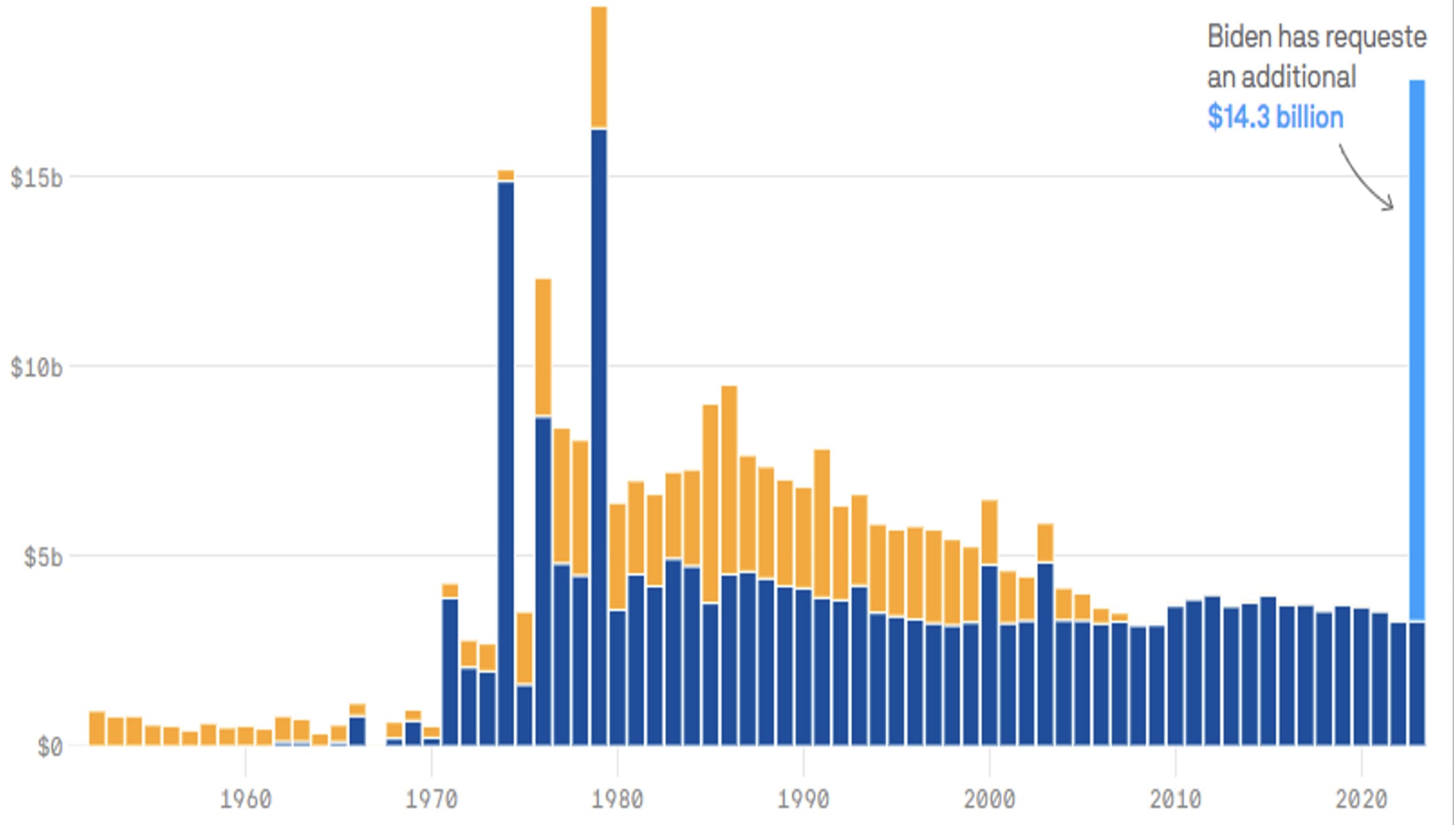
The stacked column Figure 6 shows the annual US aid to Israel from 1951 to 2022, categorised by whether it was economic or military aid. The majority of aid given since the 1960s has been military aid, which is around $3.3 billion per year, except in 1974 and 1979, when it was more than $15 billion. Economic aid has historically been less than $5 billion per year, and has fallen to less than $1 billion per year since 2004. In 2023, Biden requests an additional $14.3 billion in aid.
Figure 6: US economic and military aid to Israel, 1951–2023
Israel’s two-tier criminal injustice system is itself one of the most blatant examples of its version of apartheid. Only Jewish Israelis, including settlers, are subject to ordinary civilian or even criminal law; all Palestinians are subject instead to a separate system of military law, in which soldiers and military tribunals become judge, jury, and executioner. The documented conviction rate for Palestinians post-arrest is 99 per cent. Moreover, under Israel’s military law, any Palestinian, including children, can be seized for pre-trial “administrative detention” and held for up to 75 days without being charged. During this time, detainees are vulnerable to physical and verbal abuse, including torture, beatings, solitary confinement, forced confessions, and being denied visitors for weeks or months on end.
Since 1967, the Israeli military has arrested and detained nearly 800,000 Palestinians, equivalent to 20 per cent of the entire Palestinian population and 40 per cent of all males. This means that virtually every Palestinian family has members who are currently, or have been, imprisoned, and that the struggle against the insidious Israeli penal system is indistinguishable from the Palestinian struggle for freedom. As a result, periodic hunger strikes by prisoners have long been one of the most common and widely practised forms of Palestinian popular resistance, with mothers and other family members, activists, and organisations expressing solidarity through protest marches (Khalidi, 2013).
Regarding the arrest of children by Israel, it is a unique human rights abuse. Israel is the only country in the world that systematically prosecutes, each year, between 500 and 700 children as young as 12 in military courts. Children in detention are subjected to physical and psychological torment, separation from parents or lawyers, beatings, solitary confinement, and forced confessions. Indeed, Israel’s criminal injustice system permeates Palestinian families, making their daily lives a state of siege. The process of carrying out detentions normalises human rights violations that brutalise entire families and communities. Soldiers routinely make raids at night, enter houses with dogs and lasers looking for “suspects”, traumatise children, and take people away to unknown detention sites. In one case in 2021, a 17-year-old Palestinian boy with life-threatening medical conditions was ordered rearrested by the military prosecutor and sentenced to six months of administrative detention for allegedly throwing stones.
Israel has advanced and technological surveillance – cameras, biometrics, spyware embedded in social media apps, drones – to control dissent and what it sees as the pervasive threat of terrorism. However, the important customer for these technologies seems to be often authoritarian governments and also being used on Palestinians by local militarised police forces. This surveillance and the militarisation of daily life haunt Palestinian children at every turn: the constant fear of night raids or the arrest of parents, siblings, and friends; the confinement to restricted neighbourhoods or crowded streets of refugee camps, without any space to play; above all, the need for constant vigilance. Soldiers, for instance, can harass girls walking to school and even enter their classrooms and arrest their teachers.
VI. Conclusion
The real issue is not what Hamas did on 7 October 2023, but what the source of the violence is. Millions of Palestinians have been oppressed for years, and they are fighting with whatever means they have. This will go on unless we ask why violence erupted in the first place. This is a massive plan of killing and ethnic cleansing. The pretext of Israel is to take revenge for what Hamas did on 7 October and to create a new reality for the Palestinians, i.e., a new Nakba, and a horrifying chapter for the ongoing Nakba the Palestinians are suffering. During the on-going bombing of Gaza, the Israel troops are also attacking aggressively into the West Bank to carry out Nakba in the Occupied Palestinian Territory. Tanks have been moved into Palestinian towns such as Jenin, intimidating the Palestinian population to encourage them to give up the possibility of building a peaceful life in the West Bank.
Israel’s indiscriminate bombing of Gaza has continued for more than eight weeks now, including hospitals, ambulances, schools, university, and water cleaning facilities, indicating that Israel wants to destroy infrastructure.
The study has found that Israel’s aggression on the occupied territories shows how the colonisers ignore all human norms and increase terror with the hope that the colonial people will end their resistance against occupation. I am confident that the Israeli colonisers will be forced to end their occupation and the Palestinian people will be victorious to achieve freedom, peace, and sovereignty, where all people can live in peace, harmony, and prosperity, irrespective of their faiths. History has proved that the occupiers were wrong and that their brutal military force to intimidate the people will fail. The same military terror was adopted by colonisers in India, Indonesia, Vietnam, Algeria, South Africa, Afghanistan, Iraq, and many more. But, in the end, they were forced to end their occupation. Palestine is a tragedy for all the Global South and shows the brutality of imperialism and colonialism imposed by the North (Siddiqui, 2018).
The African National Congress in South Africa struggled for equal political rights for all its inhabitants, irrespective of their colour, when the white racist minority government wanted to segregate black people into Bantustans that would be declared “sovereign states”, but Nelson Mandela firmly rejected it. Mandela served 27 years in jail and Western countries described him then as a terrorist. Now we all know that it is completely wrong and incorrect to describe his struggle for freedom and equal political and civil rights for all who live in South Africa as terrorists.
The Palestinian civil society began campaigning to Boycott, Divestment and Sanctions (BDS) against Israel in 2005 and it has gained strength globally. It is argued that Israel has created an apartheid state that needs to be dismantled, which requires international support in favour of building equal rights for all its citizens.
Arab leaders have sold out to the US in terms of security, finance, and economy and seek Western support for their survival and the stability of their regimes. The rich Arab countries deposit their money and invest in property in the West. At present, the US has 27 military bases in Arab countries and these countries cannot afford to kick the US military bases out and take action in support of the Palestinian struggle for sovereignty and self-determination.
Dr. Kalim Siddiqui is an economist specialising in International Political Economy, Development Economics, International Trade, and International Economics. His work, which combines elements of international political economy and development economics, economic policy, economic history and international trade, often challenges prevailing orthodoxy about which policies promote overall development in less-developed countries. Kalim teaches international economics at the Department of Accounting, Finance and Economics, University of Huddersfield, UK. He has taught economics since 1989 at various universities in Norway and the UK.
Khalidi, R. (2013) Brokers of Deceit: How the US Has Undermined Peace in the Middle East, Boston: Beacon Press.
Khalidi, R. (2021) The Hundred Years’ War on Palestine: A History of Settler Colonial Conquest and Resistance, 1917-2017, New York: Metropolitan Books.
Mearsheimer, J. and Walt, S. (2007) The Israel Lobby and U.S. Foreign Policy. New York: Farrar, Straus, and Giroux.
Pappé, I. (2006) The Ethnic Cleansing of Palestine, Oxford: Oneworld Publications.
Pappé, I. (2017) Ten Myths about Israel, New York: Verso Books.
Said, E. (1980) The Question of Palestine, Routledge & Kegan Paul.
Said, E. (2007) The End of the Peace Process: Oslo and After, New York: Vintage Book.
Siddiqui, K. (2018) “Imperialism and Global Inequality: A Critical Analysis”, Journal of Economics and Political Economy, 5(2): 266-91.
Siddiqui, K. (2019) “Challenges and Importance of Institutions in the Developing Countries”, World Financial Review, May-June, 56-65.
Siddiqui, K. (2020a) “Can Global Imbalances Continue? The State of the United States Economy”, Argumenta Oeconomica Cracoviensia, 23(2): 11-32.
Siddiqui, K. (2020b) “Prospects of a Multipolar World and the Role of Emerging Economies” World Financial Review, November-December, p.65 – 77.
Siddiqui, K. (2021) “The Study of International Political Economy”, World Financial Review, July-August, 46-56.
Siddiqui, K. (2022a) “British Imperialism, Religion, and the Politics of ‘Divide and Rule’ in the Indian-Subcontinent”, World Financial Review, January-February, 89-109.
Siddiqui, K. (2022b) “Capitalism, Imperialism, and Crisis”, European Financial Review, June-July, 16-32.
Siddiqui, K. (2023) “The New Cold War: Struggle for Global Domination” (parts 1 and 2), World Financial Review, July-August, 6-17.
Siddiqui, K. (2024) “Neocolonialism: An analysis of international factors on the development of the Global South”, World Financial Review, December-January, 2-11.
The Financial Times (2023) “How the loss of entire families is ravaging the social fabric of Gaza”, 13 December, London.
The Guardian (2023) “The war in Gaza has been an intense lesson in western hypocrisy”, 27 November, London.
In today’s fast-paced world, financial needs can arise unexpectedly, and having access to quick and hassle-free funds can make a significant difference. Instant loans have emerged as a convenient solution for individuals facing urgent financial challenges. These loans provide rapid access to funds, often within a few hours, helping borrowers address immediate needs without the lengthy processes associated with traditional loans.
What are Instant Loans?
Instant loans, also known as quick loans or payday loans, are short-term, unsecured loans designed to meet urgent financial requirements. Unlike traditional loans that may involve extensive paperwork and a lengthy approval process, instant loans are characterized by their swift application and approval procedures. These loans are typically small in amount and are intended to cover immediate expenses until the borrower’s next paycheck.
Key Features of Instant Loans
Speedy Approval
Instant loans are renowned for their rapid approval process. Many lenders offer online application options, allowing borrowers to submit their loan requests from the comfort of their homes. The approval time can be as short as a few minutes, and funds are often disbursed quickly.
Minimal Documentation
Unlike traditional loans that may require a plethora of documents, instant loans generally have minimal documentation requirements. Typically, borrowers need to provide proof of identity, income, and bank account details.
Short-Term Nature
Instant loans are intended to address short-term financial needs. Borrowers are expected to repay the loan amount, along with any associated fees or interest, by their next payday.
Unsecured Nature
Instant loans are unsecured, meaning borrowers are not required to provide collateral to secure the loan. This aspect expedites the loan approval process but may result in higher interest rates to compensate for the increased risk for the lender.
Accessible to Individuals with Varied Credit Scores
While traditional loans may have strict credit score requirements, some instant loan providers consider a broader range of credit scores. This makes instant loans more accessible to individuals with less-than-perfect credit histories.
Common Uses of Instant Loans
Emergency Expenses
Instant loans are often used to cover unexpected expenses such as medical bills, car repairs, or home maintenance.
Utility Bills
When faced with the imminent threat of utility disconnection, individuals may turn to instant loans to ensure essential services are not interrupted.
Overdraft Protection
Instant loans can serve as a quick solution to avoid overdraft fees or bounced checks, providing a temporary financial cushion.
Debt Consolidation
Some borrowers use instant loans to consolidate smaller debts, streamlining their financial obligations.
Conclusion
Instant loans play a vital role in providing individuals with timely financial assistance during unforeseen circumstances. While they offer quick relief, it’s essential for borrowers to use them responsibly and be aware of the associated costs. Before considering an instant loan, it’s advisable to carefully review the terms and conditions, ensuring that the repayment schedule aligns with one’s financial capabilities. When used prudently, instant loans can be a valuable tool to navigate short-term financial challenges.
Concealed Carry Weapon (CCW) insurance has become an essential consideration for responsible gun owners who wish to protect themselves legally and financially in the event they have to use their firearm in self-defense. The primary purpose of CCW insurance is to provide coverage for legal fees, bail, and other associated costs that may arise from a self-defense incident. It’s crucial to understand the fundamentals of CCW insurance before diving into a comparison between two prominent providers, CCW Safe and USCCA.
CCW insurance typically covers expenses such as criminal defense, civil defense, and even psychological support after a self-defense incident. This type of coverage is not a replacement for regular homeowners or renters insurance, as it specifically addresses the unique legal challenges that can arise from using a firearm for self-defense.
Exploring CCW Safe Coverage
CCW Safe is one of the leading providers of CCW insurance, offering comprehensive coverage designed specifically for gun owners who carry concealed weapons. The company prides itself on providing immediate assistance after a self-defense incident, ensuring that their members have access to legal representation from the very beginning.
One notable aspect of CCW Safe’s coverage is its emphasis on unlimited criminal and civil defense coverage. This means that members don’t have to worry about hitting coverage limits during the legal proceedings following a self-defense incident. The company also provides coverage for legal representation during critical stages, such as investigations and grand jury proceedings.
In addition to legal coverage, CCW Safe offers a range of benefits, including coverage for psychological support and counseling. This recognizes the emotional toll that a self-defense incident can take on individuals, ensuring that members have access to resources to help them cope with the aftermath.
Another key feature of CCW Safe is its nationwide network of experienced attorneys. This network is crucial in providing members with legal representation that understands the local laws and nuances of each jurisdiction. Having a knowledgeable attorney familiar with the intricacies of self-defense laws in a specific area can significantly impact the outcome of a case.
Evaluating USCCA’s CCW Insurance
The United States Concealed Carry Association (USCCA) is another prominent player in the CCW insurance landscape. USCCA offers a comprehensive self-defense shield that goes beyond legal coverage, incorporating educational resources, training, and a community of like-minded individuals.
One standout feature of USCCA’s coverage is its focus on education and training. Members gain access to a variety of training resources, including online courses and articles, to enhance their knowledge and skills related to self-defense and firearm usage. This emphasis on education aligns with USCCA’s mission to promote responsible gun ownership.
In terms of legal coverage, USCCA provides members with a significant amount of protection for criminal and civil defense, as well as coverage for damages in the event of a civil judgment. The coverage extends to both criminal and civil proceedings, offering a comprehensive solution for legal expenses.
USCCA’s self-defense shield also includes coverage for lost wages and psychological support. This multifaceted approach aims to address the various challenges individuals may face after a self-defense incident, recognizing that the impact goes beyond legal implications.
In conclusion, both CCW Safe and USCCA offer robust CCW insurance coverage, but their approaches differ in certain aspects. The choice between them ultimately depends on individual preferences, priorities, and the specific features that align with the policyholder’s needs. The subsequent sections will delve deeper into a detailed comparison of the coverage, costs, and user experiences of CCW Safe and USCCA to help gun owners make an informed decision.
Coverage Comparison: CCW Safe vs. USCCA
When it comes to selecting the best CCW insurance for your needs, a thorough comparison of CCW Safe vs USCCA insurance plan is essential. Both providers offer extensive protection, but the nuances in their policies can significantly impact your overall experience and the level of security they provide.
CCW Safe’s unlimited criminal and civil defense coverage sets it apart. This means that, regardless of the length or complexity of legal proceedings, CCW Safe members won’t face sudden coverage limits that could leave them exposed. This comprehensive coverage extends to all stages of legal proceedings, including investigations, grand jury hearings, and trials.
On the other hand, USCCA also provides substantial coverage for criminal and civil defense, including coverage for damages in civil judgments. While not unlimited, the coverage limits offered by USCCA are substantial and can provide a considerable buffer against legal expenses.
In terms of additional benefits, both CCW Safe and USCCA offer coverage for lost wages and psychological support. These features recognize the holistic impact of a self-defense incident on an individual’s life, addressing not only the legal aspects but also the emotional and financial repercussions.
Considering the coverage aspects, individuals should weigh the importance of unlimited legal coverage provided by CCW Safe against the additional training resources and holistic approach to self-defense offered by USCCA.
Key Features of CCW Safe
CCW Safe’s key features extend beyond its comprehensive legal coverage. The nationwide network of experienced attorneys is a notable strength, ensuring that members have access to legal representation with a deep understanding of local laws and legal nuances. This can be crucial in navigating the complexities of self-defense laws that can vary significantly from one jurisdiction to another.
The emphasis on immediate assistance is another standout feature of CCW Safe. Members can expect swift access to legal representation from the moment they need it, ensuring that they are not left alone to navigate the legal complexities that follow a self-defense incident. This proactive approach can be a comfort to individuals who may find themselves facing legal scrutiny.
Additionally, CCW Safe’s coverage includes psychological support and counseling. This acknowledges the emotional toll that a self-defense incident can take on an individual, recognizing the importance of addressing mental health aspects alongside legal considerations.
Understanding the key features of CCW Safe is crucial for individuals seeking a comprehensive CCW insurance solution that prioritizes legal protection and provides additional support beyond the courtroom.
Key Features of USCCA
USCCA distinguishes itself through a multifaceted approach to CCW insurance. Beyond legal coverage, USCCA places a significant emphasis on education and training. Members gain access to a wealth of resources, including online courses and articles, designed to enhance their knowledge and skills related to self-defense and responsible gun ownership.
The training-centric approach aligns with USCCA’s broader mission to promote responsible gun ownership. For individuals who value continuous learning and skill development, USCCA’s emphasis on education can be a compelling factor in their decision-making process.
In terms of legal coverage, USCCA provides robust protection for criminal and civil defense, as well as coverage for damages in the event of a civil judgment. While the coverage limits are not unlimited, they are substantial and can offer significant financial protection against legal expenses.
Similar to CCW Safe, USCCA’s self-defense shield includes coverage for lost wages and psychological support. This comprehensive approach recognizes that the aftermath of a self-defense incident goes beyond legal considerations, encompassing the emotional and financial challenges individuals may face.
Cost Analysis: CCW Safe vs. USCCA
Cost is a significant factor in choosing the right CCW insurance, and a detailed analysis of the pricing structures of CCW Safe and USCCA is crucial. The cost of CCW insurance is often influenced by coverage limits, additional benefits, and the overall value proposition provided by each provider.
CCW Safe’s pricing reflects its unlimited legal coverage and comprehensive benefits. While the premium may be relatively higher, the unlimited nature of the coverage can be a significant advantage for those concerned about potential legal expenses exceeding coverage limits.
USCCA, with its focus on education and training, offers a competitive pricing structure. The coverage limits, though not unlimited, are substantial, providing a balance between affordability and comprehensive protection. The inclusion of training resources as part of the package adds value for those looking to continuously improve their self-defense skills.
When evaluating the cost of CCW insurance, individuals should carefully consider their budget, the level of coverage they require, and the additional benefits that align with their priorities. It’s essential to strike a balance between affordability and the comprehensiveness of the coverage provided.
In conclusion, the choice between CCW Safe and USCCA depends on individual preferences, priorities, and the specific features that align with the policyholder’s needs. A careful consideration of the coverage, key features, and cost analysis can guide individuals in making an informed decision that ensures their legal and financial protection in the event of a self-defense incident.
Customer Experiences and Reviews
Examining customer experiences and reviews is a critical step in determining the effectiveness and reliability of CCW insurance providers like CCW Safe and USCCA. Real-world feedback from individuals who have had to utilize their coverage provides valuable insights into the responsiveness, transparency, and overall satisfaction with each provider.
CCW Safe has garnered positive reviews for its prompt assistance and comprehensive legal coverage. Members often highlight the immediate access to experienced attorneys, which can make a significant difference during the stressful aftermath of a self-defense incident. Additionally, the unlimited nature of the coverage has reassured many policyholders, preventing concerns about hitting coverage limits during lengthy legal proceedings.
USCCA, known for its training-centric approach, has received praise for its educational resources and community engagement. Members appreciate the emphasis on continuous learning and the supportive community that fosters responsible gun ownership. Positive reviews also highlight the effectiveness of USCCA’s legal coverage and the overall value provided through a combination of education and comprehensive protection.
Analyzing customer experiences and reviews offers prospective policyholders valuable perspectives to consider when evaluating CCW Safe and USCCA. Real-world accounts can provide insights into the effectiveness of the coverage, the level of support offered, and the overall satisfaction of members.
Choosing the Best CCW Insurance for Your Needs
Selecting the best CCW insurance ultimately depends on individual needs, preferences, and priorities. As potential policyholders navigate through the details of CCW Safe and USCCA, it’s crucial to assess personal requirements and align them with the features offered by each provider.
Considerations should include the importance of unlimited legal coverage versus the value of educational resources and training opportunities. Individuals may prioritize immediate legal assistance, comprehensive coverage, or a combination of legal and educational benefits. Examining one’s own priorities can guide the decision-making process toward the provider that best aligns with individual needs.
Additionally, budgetary constraints play a significant role in choosing the right CCW insurance. While both CCW Safe and USCCA offer competitive pricing, individuals must balance the cost against the level of coverage and additional benefits provided. A careful evaluation of the cost structures and the perceived value of the coverage can help in making a well-informed decision.
Final Verdict: CCW Safe vs. USCCA
In the final analysis, determining whether CCW Safe or USCCA is the best CCW insurance depends on individual circumstances and preferences. For those who prioritize unlimited legal coverage, immediate legal assistance, and a nationwide network of experienced attorneys, CCW Safe may be the preferred choice. On the other hand, individuals who value a holistic approach to self-defense, including education, training, and substantial legal coverage, may find USCCA to be the better fit.
Ultimately, the decision hinges on a careful assessment of personal priorities, budget considerations, and the specific features offered by each provider. It’s advisable for potential policyholders to thoroughly review the terms and conditions, customer feedback, and pricing structures of both CCW Safe and USCCA before making a final decision. Whichever provider is chosen, having CCW insurance is a responsible step towards ensuring legal and financial protection in the event of a self-defense incident.
Looking for monetary policy dissertation help becomes inevitable when you come across challenges when assessing a monetary policy in your research work.
The bedrock of any economic policy of a nation is its monetary policy, and all financial sectors in the country are affected by any kind of shift in such policies. Due to devising successful policies, the Federal Reserve Board, as mentioned in Forbes, has a record of keeping the unemployment rate at a low of 3.5% to 4.5%.
There are different components that need to be taken care of when writing a dissertation on such topics. In this article, we have made sure to tell you about such important factors.
Coming back to the topic, several students feel stuck when writing such dissertations. If you are facing such problems, you can hire dissertation help services.
What is the Brief Idea of Monetary Policy?
According to the Bank of England, monetary policy can be defined as an action in which the central bank of a country or the government can impact the decisions of what money belongs to the economy and how much it costs to borrow it. The monetary policy of the land affects the inflation rate and maintains the best rate suitable for the economy of the region.
Here’s how the Reserve Bank of Australia explains the objectives of the monetary policy of a country:
How to Write Monetary Policy Dissertation?
To effectively write monetary policy dissertations, you first need to pick an interesting research topic for your work. Once you have finalised the topic, you should sort out the structure of your papers. The layout of your dissertation shall be dictated by your university, and if you are confused, you should ask your supervisors.
There are 10 crucial components of a monetary policy dissertation that you must ensure in your work. The detail of such components is given below:
1. Reserve Requirements
The Federal Reserve Board regulates the reserve requirements and decides the amount of cash that banks must have on hand at any time to comply with the banking regulations. During your monetary policy dissertation writing, highlight the factors that regulate the reserve requirements of a country. By lowering the amount of cash, banks can lend more money. The same can go inverse if the requirement is raised.
2. Open Market Operations
As mentioned in a report by Forbes, the Federal Reserve Board can buy and sell the government securities, such as bonds and Treasury bills. When it buys the securities, it effectively increases the supply of circulating money. You should highlight the workings of such open market operations in your monetary policy dissertation, particularly in the abstract chapter.
3. Direct Credit Control
Sometimes, the Central Bank instructs the Deposit Money Banks on the maximum rate of credit lending or the amount of loans that can be given to different economic areas. It also decides the liquid asset ratio, issue credit guarantees, and interest rate caps for the working of banks.
In this way, the existing savings are allocated, and investment is instructed to the designated channels. The literature review of your papers will shed light on this aspect of your work. You can ask for help from monetary policy dissertation writers in case you feel stuck during the process.
4. Lending Credit by the Central Bank
The Central Bank can sometimes lend credit to different Deposit Money Banks and hence affect the reserve levels in the country. In this way, it affects the monetary base of a region and controls the economic conditions of the country. According to the paper titled What Are The Instruments Of Monetary Policy? it depends on the level of development in a country.
When writing the literature review of your dissertation on monetary policy, make sure that you have studied and included the lending credit rate of your country in the papers.
5. Interest Rate
The Central Bank also gives money to other commercial banks and Deposit Money Banks at a favourable interest rate, which is termed a minimum discount rate. Such a rate sets the foundation for a large domain in the money market that impacts the supply of credit, investment, and savings.
The image by Economicshelp.org shows how monetary policy meets its goals using the interest rates in a certain region. You can add more charts like this in the methodology of your papers to make your perspectives clear to readers.
6. Moral Suasion
When the central bank gives a permit or license to banks and operates their banking system, it can gain advantages from such moral suasion. It can also persuade different banks to go down different paths, such as credit expansion or applying contractionary monetary policy.
This way, it can impact the supply of money for the government bonds. The bank lending rates can also be controlled by using moral suasion methods, which can particularly affect the findings of your work.
7. Exchange Rate
The balance of payments can be achieved through the maintenance of a company’s exchange rate. By buying or selling the foreign exchange, the bank, in action, ensures that the level of exchange rate does not impact the domestic money supply in unwanted directions.
In your dissertation on Monetary Policy, you should tell the readers that moral suasion and prudential guidelines are more like supervision instruments for the qualitative assessment of the work.
8. Prudential Guidelines
A good dissertation consists of all the aspects of a country’s monetary policy. The Central Bank may ask the other banks in writing to take care of the monetary policy factors in a way that results in the achievement of certain outcomes.
The guidelines may include giving decision-making rights to the banks and taking away some discretion from the bank management systems.
9. Discount Rate
In the literature review of your dissertation, discuss the discount rate of the school of economics that is applicable to your work. Typically, when an economy is humming on all cylinders, the discount rates will be higher, but when the economy goes into a slump, the Federal Reserve Board lowers the interest rates to increase lending activities to clients.
10. Public Service Announcements
When applying a country’s monetary policy, a central bank can announce its general outlook to the financial markets and the general public. Such announcements show the impact of monetary policy elements on the economy and direct it in the way it wants. Keep in mind to check if any such announcements are impacting the methods applied and the results of your work on monetary policy.
Monetary Policy Dissertation Topics
A good topic marks the onset of an impressive monetary policy dissertation. Some of the best ideas that can give you researchable questions for your papers are the following:
Monetary policy and nonbank finance
A discussion of monetary policy operational frameworks of central banks
The effectiveness of macroprudential policy and its relation with financial supervision
The coordination of the monetary and fiscal policy
A discussion of the effectiveness of the non-conventional monetary policy
If you think there is a need for help, you can buy monetary policy dissertation online from dissertation writing services. It can make writing a complete dissertation easier for you.
Conclusion
You must ensure that these 10 components are present in your monetary policy dissertation. A good dissertation writer thoroughly reviews his paper before the final submission to the supervisor. Make sure that you have conducted complete research on the financial markets of the countries you are analysing in your dissertation.
Lastly, you can also hire dissertation help services to fine-tune your papers, as they are well-designed to refine a dissertation for monetary policy students. The Academic Papers UK is the best of all monetary policy dissertation writing services online.
Making sure the air you breathe is safe and clean is just as important to creating a warm and healthy home environment as adding furnishings and comfort. Of the many available tactics, using air filters—especially the 20x20x1 size—stands out as a straightforward but effective way to dramatically improve indoor air quality. By absorbing and eliminating impurities that may harm your health and well-being, these filters are essential to the purification of the air that circulates through the HVAC system in your house.
We will examine in this blog how 20x20x1 air filters actively enhance indoor air quality by acting as silent protectors. You can better appreciate their significance and how they help create a healthier space for you and your loved ones by being aware of their workings, advantages, and effects on your home environment. These filters play a crucial role in creating a clean, comfortable indoor environment by lowering allergens, improving respiratory health, and cleaning the air. Let us explore the intricacies of these filters’ operation and the many benefits they provide for improving the quality of the air you breathe daily.
Importance of Indoor Air Quality
Air filters play a much more significant role in HVAC systems than just blocking airborne particles. They are the unsung heroes of the complex network of HVAC systems. Their purpose is to act as watchful gatekeepers, placing themselves in a way that allows them to catch and contain pollutants that sneak into your home’s air currents.
These filters are important because they can serve as protectors of indoor air quality. Air filters, which are designed as essential parts of HVAC systems, are active protectors against the infiltration of pollutants rather than merely passive fixtures. Out of all the different sizes that are offered, the 20x20x1 air filter stands out as a dimension that can be easily and thoughtfully incorporated into a wide variety of residential HVAC setups.
These filters, which function at the centre of the airflow in your house, act as guardians at the nexus of health and comfort. They are made with precision from materials with pleated details or dense fibres to act as sophisticated sieves that effectively block passage. These filters work like a painstaking dance as air passes through the system, capturing particles that would otherwise be free to roam around and clog your living areas.
The 20x20x1 air filter is more than just a standard size; it is compatible and adaptive with a wide range of residential HVAC configurations. Its dimensions are carefully calibrated to nestle comfortably into a variety of air handling systems, guaranteeing a pleasing balance between usability and appearance.
Within this seemingly unassuming frame lies a powerhouse of filtration capability. These filters serve as the frontline defence against a barrage of potential threats to indoor air quality. Dust particles, pollen, pet dander, mould spores, and even microscopic organisms find themselves intercepted and confined within the fibres of these filters, preventing their free dispersion and safeguarding the sanctity of your indoor air.
In essence, air filters are not passive fixtures; rather, they are steadfast guardians that continuously purify the air in your house. The 20x20x1 measurements also represent a promise—a promise of thorough filtration, compatibility, and steadfast commitment to preserving the integrity of your interior space.
Significance of 20x20x1 Air Filters
These filters are made especially to remove a variety of airborne pollutants with efficiency:
Particle Filtration: Made of pleated materials or thick fibres, 20x20x1 air filters form an efficient barrier that catches dust, pollen, pet dander, mould spores, and even some bacteria and viruses as air flows through.
Enhancing Indoor Air Quality: These filters stop dangerous particles from circulating throughout the house by absorbing these pollutants. The act of filtering these particles greatly improves the quality of indoor air and lowers the possible health risks that come with breathing them in.
Key Benefits Offered By 20x20x1 Air Filters
1. Reduced Allergens and Improved Air Quality
These filters stand as stalwart defenders against airborne allergens, intercepting and containing various triggers such as pollen, dust mites, and pet dander:
Effective Allergen Capture: The precision-engineered design of 20x20x1 merv 13 air filters ensures the efficient capture and containment of allergens. This significantly reduces their presence in the indoor environment, alleviating allergy symptoms and respiratory discomfort for occupants.
Purified Air Circulation: By trapping allergens and preventing their circulation, these filters actively contribute to purifying the air within your home. This process significantly improves indoor air quality, creating a healthier and more comfortable living space for you and your family.
2. Maintenance of a Cleaner Indoor Environment
Apart from purifying the air, these filters contribute to maintaining cleaner surfaces throughout your home:
Reduced Dust Accumulation: With fewer airborne particles circulating, there is a noticeable decrease in dust settling on surfaces such as furniture, floors, and countertops. This translates to a cleaner living space, reducing the frequency of cleaning tasks and enhancing overall tidiness.
Enhanced Aesthetic Appeal: A reduction in dust accumulation not only improves indoor air quality but also enhances the aesthetic appeal of your home by maintaining cleaner and more presentable surfaces.
3. Enhanced HVAC System Performance
Beyond air quality improvements, these filters play a pivotal role in optimizing the performance of HVAC systems:
Preventing Buildup: By effectively capturing dust and debris, these filters prevent their accumulation within the HVAC system. This maintenance reduces the strain on equipment, ensuring proper airflow and contributing to the system’s efficiency.
Extended Equipment Lifespan: The efficient functioning of 20x20x1 air filters translates into a prolonged HVAC equipment lifespan. Reduced strain on components and improved airflow contribute to a more durable and long-lasting system.
4. Improved Respiratory Health
The impact of cleaner air extends to fostering better respiratory health, particularly for individuals with existing conditions:
Reduced Respiratory Issues: Cleaner air quality significantly reduces the risk of respiratory irritations, exacerbations of asthma, and other respiratory conditions. This leads to improved overall respiratory health, promoting a better quality of life for occupants, especially those with pre-existing respiratory concerns.
Final Words
Adding 20x20x1 air filters to HVAC systems is a practical way to greatly improve the quality of indoor air. These filters effectively collect allergens and particulates in the air, resulting in better respiratory health, cleaner air, and cozier living conditions. To optimize the efficiency of your home’s filters and guarantee optimal indoor air quality, you must perform routine maintenance and timely replacements.
In a world where convenience reigns supreme, voice search has emerged as the unsung hero of online queries. No more typing, just talking. As a content writer navigating the vast landscape of digital marketing, it’s crucial to stay ahead of the game. Voice search is not a passing trend—it’s the future, and finding the best SEO company to guide you through this dynamic landscape is essential. Here’s how you can seamlessly blend the power of voice search into your marketing mix.
1. Understand the Rise of Voice Search
Voice search is no longer the fantasy of sci-fi enthusiasts. It’s a reality shaping the way users interact with search engines. With the proliferation of voice-activated devices like smart speakers and virtual assistants on smartphones, users are now asking questions instead of typing keywords. As a content creator, adaptability is your best friend.
2. Long-Tail Keywords Take Center Stage
Forget the short, snappy keywords that ruled the SEO landscape. Voice searches are conversational, reflecting the way people naturally speak. Opt for long-tail keywords that mimic real conversations. Instead of “best smartphone,” think “What’s the best smartphone with a great camera?” Long-tail keywords not only align with voice search but also cater to specific user intents.
3. Local SEO Matters More Than Ever
Picture this: someone strolling down the street searching for the nearest coffee shop using voice commands. Local businesses, take note. Optimize your content for local searches by including location-specific keywords. Ensure your business information on Google My Business is accurate and up-to-date. Voice searches often have a local intent, so be the answer to someone’s “near me” query.
4. Snippets Snatch the Spotlight
Featured snippets, those bite-sized morsels of information that appear at the top of search results, are the holy grail of voice search. Craft concise and informative snippets that directly answer common user questions. When your content claims that coveted position, voice-activated devices pull information directly from your page, making you the go-to source for quick and reliable answers.
5. Mobile Optimization Is Non-Negotiable
Voice search and mobile devices go hand in hand. Ensure your website is mobile-friendly to accommodate the increasing number of users performing voice searches on their smartphones. Google’s mobile-first indexing prioritizes mobile-friendly sites, giving you an extra nudge up the search rankings. A seamless mobile experience is not just a bonus—it’s a necessity.
6. Create Conversational Content
As voice search leans towards natural language, your content should follow suit. Craft blog posts, articles, and product descriptions in a conversational tone. Imagine you’re chatting with a friend, not delivering a formal lecture. Inject personality into your writing while maintaining relevance and clarity. Engaging content that resonates with users is your ticket to success in the voice search era.
7. User Intent is Your Guiding Light
Understand what users want when they voice their queries. Are they seeking information, looking to buy, or simply navigating to a location? Tailor your content to match user intent. If someone asks, “What’s the best running shoe for beginners?” your content should not only recommend a product but also provide valuable insights for beginners.
8. Embrace Schema Markup for Rich Results
Schema markup is the secret sauce that enhances your content’s visibility in search results. Take advantage of schema markup to provide context to search engines about your content. This not only improves your chances of getting featured in rich results but also enhances the overall user experience.
In the ever-evolving realm of digital marketing, adapting to new trends is not a choice but a necessity. Voice search is here to stay, and those who seamlessly integrate it into their SEO strategy will undoubtedly reap the rewards. Stay ahead of the curve, embrace change, and let your content resonate with the voices of the future.
By Terence Tse
CFOs are evolving into AI-driven transformation orchestrators, balancing finance, technology, and strategy while upskilling teams, managing risks, and driving measurable business value.
A key insight from this year’s AI for CFOs event, organized...
The World Financial Review uses cookies to improve site functionality, provide you with a better browsing experience, and to enable our partners to advertise to you. Detailed information on the use of cookies on this Site, and how you can decline them, is provided in our Privacy Policy and Terms and Conditions. By clicking on the accept button and using this Site, you consent to our Privacy Policy and Terms and Conditions. ACCEPT
Privacy & Cookies Policy
Privacy Overview
This website uses cookies to improve your experience while you navigate through the website. Out of these cookies, the cookies that are categorized as necessary are stored on your browser as they are essential for the working of basic functionalities of the website. We also use third-party cookies that help us analyze and understand how you use this website. These cookies will be stored in your browser only with your consent. You also have the option to opt-out of these cookies. But opting out of some of these cookies may have an effect on your browsing experience.
Necessary cookies are absolutely essential for the website to function properly. This category only includes cookies that ensures basic functionalities and security features of the website. These cookies do not store any personal information.
Any cookies that may not be particularly necessary for the website to function and is used specifically to collect user personal data via analytics, ads, other embedded contents are termed as non-necessary cookies. It is mandatory to procure user consent prior to running these cookies on your website.