Home Blog Page 147

Rising Expectations of Fed Rate Cut Cause Dollar Volatility

The U.S. dollar experienced volatility amid rising speculation about a significant Federal Reserve rate cut in 2024. Market participants are increasingly betting that the Fed might implement a more substantial rate reduction than previously anticipated. This speculation has led to fluctuations in the dollar’s value as investors adjust their expectations. The uncertainty surrounding future monetary policy is contributing to the dollar’s instability, influencing global currency markets. Analysts are closely monitoring economic indicators and Fed signals to gauge the likelihood of a major rate cut and its potential impact on the dollar and broader financial markets.

Related readings:

us china europe (1)

De dollarisation

British-Pound-vs-US-Dollar-768x502

How Can You Build a Strong Financial Foundation with Smart Budgeting and Saving?

Learn How You Can Create a Reliable Financial Foundation By Strategically Budgeting and Saving Cash!

Having a stable financial foundation is critical for many different reasons. Not only can it help you maintain your livelihood expenses, but it can also be a good starting point for reaching the goals you have for the future. Whether it’s buying the house of your dreams, getting into college, or earning more money, you can only accomplish your objectives if you have a financial footing to build your wealth. 

According to Fox Business, nearly two-thirds of middle-class Americans have financial problems due to the ongoing inflation hitting nationwide. While managing yourself during this financial crisis is challenging, it can be even more threatening if you didn’t grow your income over time and had the necessary funds ready to survive. But don’t worry if you don’t have a proper financial foundation! It’s never too late to start saving money and building an economic roadmap to help you stay secure amidst any recessions.  

Of course, having financial stability will require you to put in some work. If you dedicate yourself and follow the appropriate steps to save money, you can see how your income will blossom and shape a fruitful future! However, you must be patient with the process and remain consistent in order to succeed with this economic plan.  

Continue reading to see how you can build a strong financial foundation with smart budgeting and saving money today:

1. Start Your Foundation with Realistic Financial Goals

Before you create your financial foundation, having some objectives that will motivate you to save money every day can be helpful. As mentioned previously, you can establish financial goals to purchase a future home or go to school, but you can also start an economic footing for other ends, like saving for retirement, paying all of your debts, or traveling for a long trip.  

Of course, organizing objectives you can realistically accomplish is essential when preparing your financial foundation. Don’t set impractical goals that your income won’t satisfy, and avoid disappointment by creating reasonable expectations. In order to determine what goals are easy to achieve, you must review your current finances and pick an amount you can afford. If you aim to pay off your debts, you can establish the total you want to fulfill and set a timeline that you can comfortably work with each month. If your debt goal is pretty significant but you don’t have the funds to cover them sooner, you can start with small amounts you can pay until you reach that desired total.  

It’s worth mentioning that your financial foundation can also help you cover short-term goals, like paying for an auto title loan, saving for a house down payment, or buying a used car. Depending on how much you’re saving, you can use your funds to pay for various objectives instead of sticking with one. However, being realistic with your objectives also means you have to limit your spending. Don’t spread your money frivolously if you can’t afford multiple expenses to avoid falling into more debt.

2. Choose an Effective Budget Plan

After you set realistic financial goals, it’s time to pick a budget system that will help you build your financial foundation. However, finding the most effective technique is essential in acquiring the best results and working smart towards your desired future.  

Here’s a look at some popular budgeting plans that many people use when it comes to saving money: 

  • “Pay Yourself First” Method
  • The 50/30/20 Rule
  • Zero-Based Budgeting System
  • No-Budget Budget
  • The Envelope or “Cash-Stuffing” Technique

Review each of the aforementioned methods and pick a plan that suits your preferences. Whatever technique you use, it’s important to stay consistent with your strategy in order to save plenty of money over time! If you have any questions on how to save cash effectively, you can contact a financial expert online to acquire any suggestions you can use.

3. Prepare an Emergency Fund

While creating a budget plan is vital in shaping a strong financial foundation, it’s essential to be ready for any emergencies. A sudden, unexpected expense can quickly throw off your budget and derail any progress you’ve made if you don’t have any contingency plans. 

That’s why it’s recommended that you open a savings account (if you don’t have one already) and deposit funds that can be used for these kinds of situations. Some experts suggest depositing 3 to 6 months’ worth of expenses into your savings, but it’s important to put an amount that doesn’t interfere with your budget. You can simplify the process of saving money for an emergency fund by setting up automatic payments from your checking account. Ensure you keep track of your account’s progress and continue saving after you meet your savings goal.

4. Grow Your Income By Making Smart Investments

A good way to stabilize your financial foundation over time is to invest your money in assets that can help you boost your income. If you choose an investment with high returns, you can potentially increase your finances exponentially and get closer to achieving your financial goals. Of course, investing in an asset comes with an added risk of losing money when it loses market value. However, you can reduce your potential losses if you have a diversified portfolio that can keep you afloat if one of your investments goes down. 

Consider making safe investments in different assets like a high-yield savings account, dividend stock funds, or certificates of deposit (CD) to grow your income. If you’re new to investing, you can always speak with a financial advisor today for guidance on the right decisions to make within this complex business.

5. Remain Constant with Your Savings

Perhaps the most important part of building a strong financial footing is to keep track of your savings. Ensure you remain consistent throughout your savings journey and adapt to any changes when necessary. If you face a financial situation, you can always research solutions online to stay on track and continue building your income. You can always ask a friend or family member to motivate you to save money and hold you accountable when you’re straying off the path.  

What’s important is that you stay consistent with your financial plan and work towards your objective. Keep tabs on your spending and limit the amount of purchases you make on unessential items. If needed, you can link automatic payments with your savings account to remain on your trajectory of establishing a firm financial foundation. 

Conclusion ─ Start Building Your Strong Financial Foundation By Being Smart with Your Money

Following the aforementioned steps can help you create a stable financial base for the rest of your life. You must set realistic goals when building your foundation, adhere to a budget plan to save money, and remain consistent each month to achieve your objectives. But don’t forget how essential it is to have funds reserved for an emergency situation and find profitable investments to maintain your income. That way, you won’t have to deal with a financial issue that will knock your plans down a step or two. 

Don’t hesitate to speak with a financial advisor from LoanMart if you need help building a strong financial foundation. They may be able to provide useful tips that can help you grow your income and live the comfortable life you have in mind.

How to Fight for as Much Financial Gain during Divorce

By Yonatan Levoritz

Divorce can be the right choice but often leads to significant financial repercussions and a profound impact on standard of living. One study showed that following a divorce, men see their standard of living drop by 20%, while women may experience a decline of nearly 50%. Given the potential for financial setbacks, it’s crucial for those going through divorce to focus on long-term economic stability and avoid common pitfalls that could result in unnecessary hardships once the divorce is finalized.

The Immediate Stakes                                                               

Divorce mechanics are overwhelming, with asset division and custody-related finances significantly altering economic status. Emotional decision-making during this period can exacerbate financial errors. While emotions will often run high, it is essential to approach the divorce process with a business mindset, evaluating the cost-benefit ratio of every decision made during litigation. Resources should be allocated wisely, as expenditure during this period may not be easily recouped post-divorce. 

The Long-Term Financial Implications

Long-term financial planning and retirement stability are crucial during asset division.

Divorce often leads to changes in money management behaviors. For instance, following a divorce, men generally take on more investment risk, while women shift to a more conservative investment approach. Both approaches may be reasonable, but they can have significant long-term consequences if done without careful deliberation. Understanding changes to risk tolerance can help individuals delineate the emotional reactions from rational decision-making. 

Maintaining Focus During Emotional Turmoil

Divorce litigation is emotionally draining and can lead to fatigue, clouding judgment and resulting in rushed, short-sighted settlements. Managing emotions effectively is essential to avoid rash decisions. To help maintain focus, it can be helpful to focus on self-care, including engaging in regular exercise, participating in social activities, and seeking professional counseling. People can make more informed and beneficial financial decisions when they are in the right emotional space to focus on long-term gains rather than short-term litigation tactics. 

Planning for a New Future

Financial planning should start during the divorce and continue to be adjusted after the divorce is settled. A comprehensive financial analysis can help prepare for potential budget adjustments and ensure that all aspects of the settlement are addressed. Acknowledge new economic realities and set realistic goals to avoid debt and unaffordable housing, ensuring financial stability. A divorce planning agency or financial planner can provide guidance on how to adjust to the new reality.

Commonly Overlooked Assets

A fair divorce settlement requires accounting for all assets. Overlooked assets can lead to an inequitable division. Here are some areas that are often overlooked:

  • Cryptocurrency: Digital currencies like Bitcoin and Ethereum may not be immediately apparent during asset division. Cryptocurrency holdings can be substantial and should be evaluated carefully.
  • Retirement Accounts and Pensions: These can include 401(k)s, IRAs, and other retirement savings plans. It’s essential to understand the rules for dividing these accounts and the tax implications.
  • Stock Options and RSUs: Employees may hold stock options or Restricted Stock Units (RSUs) that need to be addressed. Valuing these assets and understanding the vesting schedules can add complexity to asset division.
  • Income-Generating Real Estate: Rental properties or other income-generating real estate should be evaluated for their current market value and income potential.

Creating a comprehensive inventory of all assets is vital. Collect all financial documents, including bank statements, investment account statements, and retirement account summaries. Consider hiring professionals to appraise complex assets, such as business interests, real estate, or high-value collectibles.

In high-net-worth cases, conducting a lifestyle analysis can provide insights into the financial value of lifestyle variables. This differs from money tracing, which focuses on identifying hidden assets. A lifestyle analysis involves:

  • Review Spending Patterns: Analyzing historical spending patterns can help identify assets that may not be immediately evident.
  • Assess Quality of Life: Understanding how lifestyle choices translate into financial value can assist in achieving a fair settlement.

Financial Impact of Custody Decisions

Custody decisions can have significant financial implications that are often overlooked during divorce proceedings. The cost of child support, additional expenses related to children’s needs, and the potential impact on one’s ability to work and earn can all affect financial stability.

Child custody responsibilities, including child support, can substantially impact both parties’ finances. Additionally, the costs of maintaining separate households and providing for children’s extracurricular activities and medical needs must be factored into the overall financial planning.

Custody arrangements can also affect one’s ability to work and earn a living. For instance, a parent who gains primary custody may face higher childcare costs or need to adjust their work hours, which can impact their earning potential. Conversely, a parent who provides financial support may face increased pressure to maintain a higher income to meet child support obligations. 

The emotional strain of custody battles can cloud judgment and lead to decisions that might not be in the best financial interest of either party. To achieve an equitable outcome, it’s crucial for both parties to manage their emotions effectively and focus on what is best for the children. Emotional regulation strategies, such as seeking therapy or counseling and maintaining open communication with the ex-spouse, can help in reaching fair and balanced custody arrangements that support both the children’s well-being and financial stability. These strategies often have a cost, but ensuring children are raised in a financially secure and supportive environment can far eclipse the short-term cost of counseling.

Building a Support System

A support system of financial planners, attorneys, and counselors is invaluable, aiding informed decisions and stress management for better financial outcomes.

Emotional support from friends and family can also help in maintaining financial focus. Balancing personal support with professional advice is important, as divorce trauma can lead to poor financial decisions if not addressed.

Considerations for Older Adults

Divorce among older adults, or “grey divorce,” brings unique financial challenges. Older adults may struggle to recover lost retirement savings, making it vital to understand how divorce affects retirement accounts, Social Security, and health insurance. Planning for a fair share of assets and considering all costs for a comfortable post-divorce life is essential.

Older individuals should also be aware of the responsibility for splitting medical fees until the divorce is finalized. This consideration can significantly impact financial planning and should be factored into the overall settlement strategy. 

Plan for Better Days Ahead

For anyone undergoing the complex and burdensome process of a divorce, reviewing your financial situation with a professional can provide valuable insights and guidance. Personalized advice from legal and financial experts helps in making informed decisions for long-term stability.

Divorce is undoubtedly challenging, but with careful planning and strategic financial management, it is possible to overcome these difficulties and emerge with a stronger, independent future.

About the Author

Yonatan Levoritz is the founder of Levoritz Law Firm, an award-winning New York City-based family law practice renowned for its expertise in litigation, appeals, and comprehensive divorce support. With a deep understanding of all facets of divorce and family law, Yonatan excels in navigating complex child custody disputes, spousal support, asset protection, property division for both married and non-married couples and legal separations. His firm also provides expert guidance on child support and crafting sound pre-marital agreements.

Beyond family law, Yonatan’s holistic legal approach extends to civil, criminal, business, and matrimonial law, as well as appellate advocacy, estate planning, and elder law. His multidisciplinary expertise positions him as a sought-after legal commentator on these intricate and multifaceted issues.

AI Literacy and the GARTNER’s “Trough for Disillusionment.”

By Luca Collina

Introduction

I am pleased to have completed the course “Instructional Design Foundations and Applications” offered by Illinois University at Coursera. This course, among other things, revealed that literacy’s key objective is vital for a learning program.

Certificate

AI literacy?

The first thing I noticed was that there is a little bit of confusion about the following definitions:

AI literacy / Ai education / Ai training.

AI literacy consists of AI education and AI training. AI education is typically about AI theory – e.g., methods and problem-solving processes via computer-based tools that emulate human cognitive ability; on the other hand, AI training focuses on applying what one has learned so far to solve practical problems of everyday life or achieve specific goals. The importance of executives seeking excellence in AI and leadership becomes evident. Today’s programs might not be entirely fulfilling executives’ need1s.

The recent survey by the European Business Review (EBR)2 reveals an increasing need for flexible executive education programs. Based on this requirement, future programs will likely incorporate deeper education about artificial intelligence and machine learning to improve learning (practice) outcomes ( i.e. Decision-making).

Another study conducted by TEBR3 (The European Business Review) also puts forward the following findings:

  1. Personalised training and development: Increasingly, those who enrol for executive courses prefer a program tailored to their Thus, institutions are being encouraged to design more tailored programs to meet this requirement.4
  2. Experience-Based Learning: Easy access to applications such as simulations, projects among others, has also increased executives’ interest in practical training rather than just theory.5

The Coursera Job Skills of 2024 Report6 points to the growing urgency of AI skills in the business world. The issue is that, as they matter most, a significant variance is visible in the effectiveness of executive courses on deploying AI. This variance demands a kind of learning under which theoretical knowledge combines with business in a way that develops AI literacy.7

In a related vein, Gartner8 pointedly said that leaders must learn the distinctions of AIs. ‘Everyday AI covers productivity improvements (I have called it Business as Usual). In contrast, ‘Game-Changing AI’ — which I have called Transform AI — covers innovation (product and business model), the latter of which leaders must learn about. This is another area that has been considered in the development of the course program.

A gap analysis

While programs like those offered by qualified providers give foundational and intermediate knowledge in leadership and AI, they fall short of addressing the practical application of AI in strategic decision-making. For example, the Job Skills of 2024 Report9 reveals that while AI skills are in high demand, only a fraction of executives feel adequately prepared to implement AI in their organisations. This gap indicates that, though valuable, existing courses may lack the depth or specificity needed for advanced business leaders.10

If we evaluate the explosion of the course opportunities offered so far, it can be said that they were supporting executives, swimming in the hype waves. From technical courses for development and programming to explanations for machine learning, AI, and, recently, Gen-AI. Plus, organisational approaches for adoption and implementation. Reminding (only) the connections with business goals, ROI, and other business-related links to innovative technology.

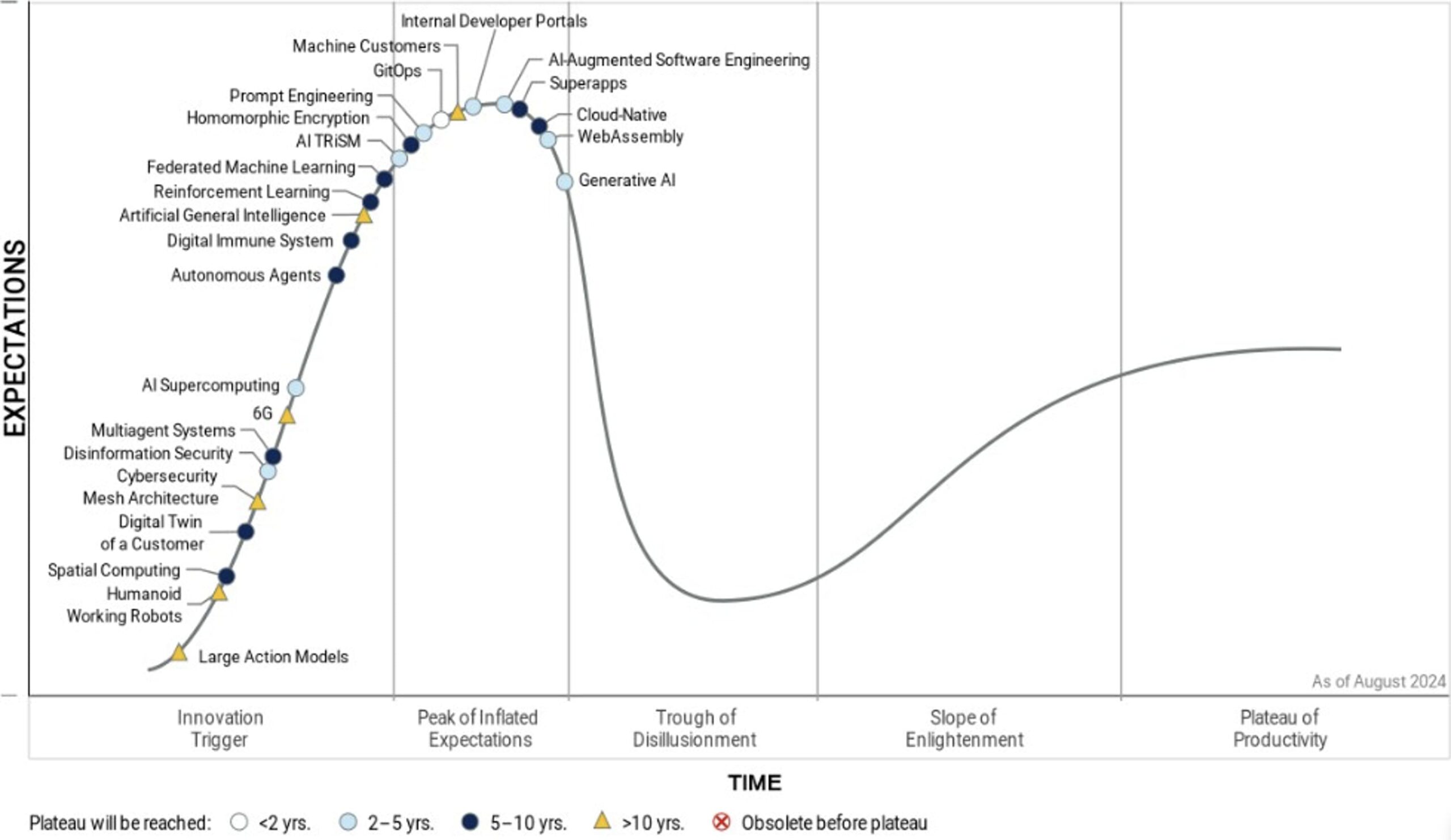
A new phase in the GARTNER Hype cycle confirms that a NEW AI literacy is required.11

In this infographic, GARTNER Hype Cycle shows that Gen Ai is beyond the hype (finally) and has started the Trough of Disillusionment.12

Gartner
Source: Gartner (August 2024)

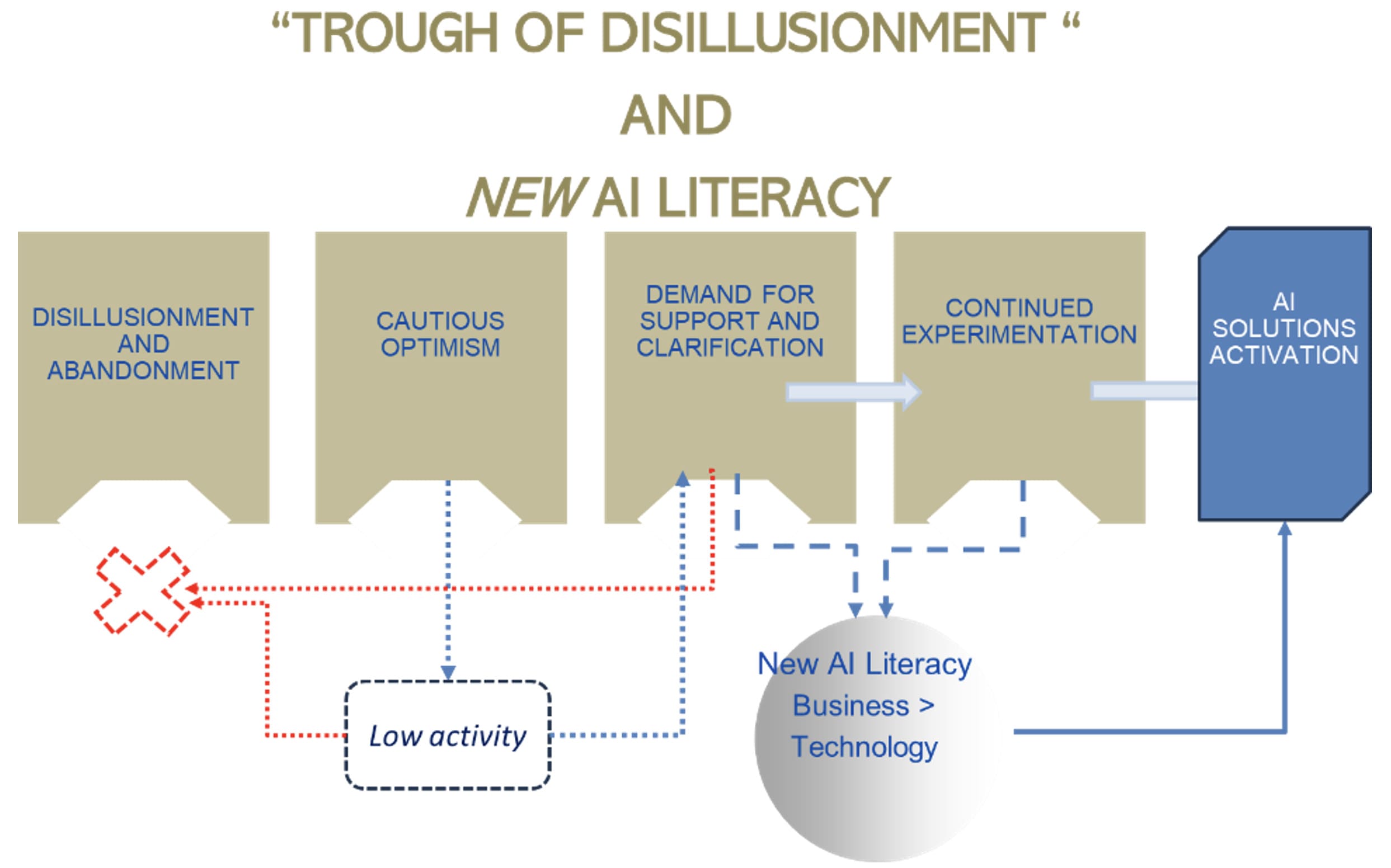
GARTNER shows us that new technologies in this period generally are grown but need to be more stable. Let’s see more detailed cases related to possible companies’ behaviour:

  • Disillusionment and Abandonment: Those unhappy would rather not use it at all. They may return to what they did before or wait for better options.
  • Cautious Optimism: others might reduce their reliance on technology while keeping the benefits they get from it. They look for progress observed before a full commitment is made.
  • Demand for Support and Clarification: Other unhappy customers may require further help and less biased personnel. Before investing more, they may also want concrete examples of successful cases.
  • Continued Experimentation: In the end, some will still insist on using it for exploration or research purposes (even after the hype has hurt them), mainly those who initiated its use. In this case, they keep refining its use in close collaboration with its developers.13

New AI literacy

New AI literacy-Why?

The different behaviours during this phase also bring different needs for AI Literacy.

Businesses that need a cooling moment to reflect upon and be supported in clarifications to then move to continuous experimentation, while those companies that continue to experiment and, luckily, proceed with AI solution activations are more likely to need to connect TECH more effectively with the business aspects that should benefit from AI adoption. This is also because they can speed up the implementation and activation of AI features.

How AI and Skills Growth Is Linked to the Trough of Disillusionment

The Gartner Hype Cycle’s concept of the “trough of disillusionment” is necessary in understanding why companies go through both dips and peaks when they are implementing certain technologies such as AI. This stage is characterised by the hype fading away and limitations of a technology coming into play, creating frustration and disillusionment in most cases. At this point, businesses may decide to stop using that technology, continue using it cautiously or solicit additional assistance to exploit its full potential. It, therefore, serves as an important time in the business cycle for organisations to invest in staff-training programs that would drive a higher-level understanding of AI. During this period an organisation may choose to invest in courses focused on advanced AI techniques to ensure that they keep abreast with the changes in technology.14

AI Literacy and Instructional Design

Looking back over the course materials, especially focusing on sections that pertain to instructional theories and models, there seems to be much stress laid on creating systematic well-structured learning experiences meant to foster both concept comprehension skills as well as practical application proficiency. Instructional methods such as behaviourism, cognitivism as well as constructivism are very critical in the design of a course for companies that are in this trough of disillusionment phase.

Targeting AI Capability Growth During the Trough of Disillusionment

Critical elements for inclusion in a course designed for this period include:

  • Behaviourist Approaches: Focus on clear, measurable outcomes that help executives and employees understand AI concepts (e.g., defining what AI can realistically achieve) and develop specific skills through repetition and reinforcement.15 16
  • Cognitivist Strategies: Integrate methods that help learners connect new AI knowledge to existing business practices, aiding in the internalisation of AI principles and the strategic application of AI in decision-making processes.17
  • Constructivist Techniques: Encourage experiential learning through simulations, real- world projects, and collaborative problem-solving exercises, ensuring that executives can apply AI insights directly to their specific business contexts.18

Summing up

Moving Beyond the Trough of Disillusionment

For these companies to cope with AI adoption-related problems like a trough of disillusionment, there’s an urgent need to create an entirely new AI literacy, which goes hand in hand with practical business acumen. Through AI educational programs that focus on theory and practice and executives’ and senior managers’ needs, organisations undergoing disillusionment can eventually reinvent themselves as they move to the next steps in AI progression.

About the Author

luca

Luca Collina is a transformational and AI Business consultant at TRANSFORAGE TCA LTD. York St John University awarded him the Business – Postgraduate Programme Prize and CMCE (Centre for Management Consulting Excellence-UK) for his paper in Technology and Consulting Research Prize. Author/External Collaborator of CMCE. 

References

  1. Desai, (2023). EXPLORING BUSINESS SCHOOLS’ ROLE IN ARTIFICIAL INTELLIGENCE EDUCATION. Technology & Innovation
  2. TEBR Survey Report Part 2-Navigating Executive Education Preferences and Needs in Contemporary Leadership
  3. https://europeanbusinessreview.com/navigating-executive-education-preferences-and- needs-in-contemporary-leadership-part-i-revealing-the-executive-education-hotspots/
  4. Salazar-Gomez, A. , Bagiati, A., Minicucci, N., Kennedy, K. D., Du, X., & Breazeal, C. (2022, October). Designing and implementing an AI education program for learners with diverse background at scale. In 2022 IEEE Frontiers in Education Conference (FIE) (pp. 1-8). IEEE.
  5. Bagiati, , Gómez, A., Radovan, J., Kennedy, K., & Breazeal, C. (2022). Learning journeys for scalable AI education: an MIT – USAF collaboration. Towards a new future in engineering education, new scenarios that European alliances of tech universities open up.
  6. https://coursera.org/skills-reports/job-skills/get-report
  7. .Cetindamar, , Kitto, K., Wu, M., Zhang, Y., Abedin, B., & Knight, S. (2022). Explicating AI literacy of employees at digital workplaces. IEEE transactions on engineering management, 71, 810-823.
  8. https://www.gartner.com/en/conferences/na/symposium-us/conference-resources/mary- mesaglio-gen-ai utm_campaign=EVT_NA_2024_SYM34_BB_E3_NetnewDB_GenAI&utm_medium=email&utm_   source=Eloqua
  9. https://www.coursera.org/skills-reports/job-skills/get-report
  10. Chetty, (2023). AI literacy for an ageing workforce: Leveraging the experience of older workers. OBM Geriatrics, 7(3), 1-17.
  11. Desai, (2023). EXPLORING BUSINESS SCHOOLS ROLE IN ARTIFICIAL INTELLIGENCE EDUCATION. Technology & Innovation.
  12. https://www.gartner.com/en/newsroom/press-releases/2024-08-21-gartner-2024-hype-cycle- for-emerging-technologies-highlights-developer-productivity-total-experience-ai-and-security
  13. Perach, S., & Alexandron, G., 2022. A Blended-Learning Program for Implementing a Rigorous Machine-Learning Curriculum in High-Schools. Proceedings of the Ninth ACM Conference on Learning @ Scale.
  14. Dencik, J., Goehring, B., & Marshall, A. (2023). Managing the emerging role of generative AI in next-generation Strategy & Leadership, 51(6), 30-36.
  15. Srinivas, , Sharma, S., & Ravindran, B. (2017). Dynamic action repetition for deep reinforcement learning. AAAI Conference on Artificial Intelligence, 2133-2139.
  16. Sharma, S., Lakshminarayanan, A., & Ravindran, B. (2017). Learning to Repeat: Fine Grained Action Repetition for Deep Reinforcement ArXiv, abs/1702.06054.
  17. Borges, , Laurindo, F., Spínola, M., Gonçalves, R., & Mattos, C. (2020). The strategic use of artificial intelligence in the digital era: Systematic literature review and future research directions. Int. J. Inf. Manag., 57, 102225.
  18. Chang, , Chang, M., Chiu, B., Liu, C., Chiang, S., Wen, C., Hwang, F., Wu, Y., Chao, P., Lai, C., Wu, S., Chang, C., & Chen, W. (2017). An analysis of student collaborative problem-solving activities mediated by collaborative simulations. Comput. Educ., 114, 222-235.

IBM Cuts 1,000 Jobs and Closes Labs in China Amid Escalating Geopolitical Tensions

IBM is the latest Western company to scale back operations in China, cutting over 1,000 jobs and closing its China Development and Systems Labs amid rising geopolitical tensions between the U.S. and China. This decision comes as U.S.-China relations strain over technologies like AI and green tech, pushing American firms to reassess their future in the Chinese market. IBM, which has a long history in China dating back to 1934, has seen its revenue in the country drop significantly last year. The company plans to shift research work to other global locations.

Related Readings:

image1

China

The Psychology of Money – How Emotions Influence Our Financial Decisions?

People perceive finances as purely logical; thus, deciding to budget or invest is rational. In reality, emotions play an immense role in financial decisions, which then get rationalized afterwards. It is hard to keep money matters devoid of emotions, even though we know it’s essential to make smart financial choices. Whether we agree or not, our feelings influence the financial decisions we make each day. Hence, understand the psychology of money and how emotions affect our behaviours so that we may make wiser and more conscious choices about our money.

The Emotional Side of Money

Money is not just a medium of exchange; it’s a symbol of security, success, and even love. Because of that, it’s too easy for emotions to get involved. Perhaps, in times of anxiety or uncertainty about the future, we are more likely to save excessively or hoard money at the cost of security. Frustration or stress causes us to spend impulsively as a means of release, often followed by feelings of buyer’s regret.

Our upbringing and experiences also determine our emotional relationship with money. If you grew up in an environment where money was tight, you would probably start living with the fear of financial insecurity, the outcome of which might lead you to make too conservative financial decisions. On the other hand, if money was ample but poorly managed, you might be more careless with money.

The Philanthropy Foundation, Stefan Soloviev, knows that most decisions are emotional. That’s why all their resources go into causes dear to their hearts: balancing informed financial planning with heartfelt giving. Whether you’re investing, spending, or donating, the more aware you can be about the emotional features of money, the better equipped you are to make those decisions that will support financial and personal goals.

The Role of Fear and Greed

Two of the most controlling feelings in financial decisions are fear and greed. These emotions are especially uncontrolled in investing, where the fear of losing money may lead one to sell off investments prematurely and lock in losses rather than waiting for any recovery. On the other hand, greed can drive a person into excessive risk-taking by chasing high returns without necessarily considering the potential downside.

Most financial decisions are driven by fear and greed, especially in the stock market. In the middle of a market decline, most investors give in to fear by frantically selling stocks they bought for long-term goals. Mass selling can further drive the prices low and even create a panic. On the other hand, a booming market can be controlled by greed in which investors pile into speculative assets to drive their prices up to unsustainable levels. The bubbles thus formed burst with tragic losses.

How Does Emotion Affect Our Spending?

Emotions are said to play a huge role in spending behaviour. Retailers are aware of this, and it is often linked to designing marketing strategies that touch our feelings. Sales, limited-time offers, and exclusive deals are supposed to make us act now because we might miss out on such an offer and make it harder to resist temptation.

Emotional spending usually occurs when people try to overcome boredom, loneliness, or sadness. For instance, they may give themselves something special after a bad day at work, even though their budget doesn’t call for it. Such expenditures may elevate their mood for some time but will undoubtedly result in regret and financial strain in the long run.

Manage your Emotions to Make Better Financial Decisions

So, how can you manage your emotions to make better financial decisions? Understand what your emotional triggers are. Notice when certain situations arise that make you spend impulsively or take foolhardy risks with your money. Once you know these, you can develop strategies to manage such triggers by setting a spending limit, automating your savings, or seeking expert advice from a financial advisor.

Another powerful approach is paying more attention to long-term goals than short-term feelings. Keeping your financial goals in mind will make the decisions based on reason easier to create and work within your strategy. Suppose anything happens to you, such as the fear of market fluctuation; you remind yourself that investment is a long game and abide by your plan.

Conclusion

Money is considered a rational aspect of life – numbers on a page, dollars in your wallet, transactions in a bank account, but deep down, money is deeply connected with our emotions. The key to financial well-being lies in understanding the psychology of money and all those underlying emotions. Understand how emotions influence behaviour and help many individuals work their way onto a path which leads them to control those emotions and make more informed choices with their money.

Understanding the Applications of 40 foot Open Top Containers

In the realm of shipping and logistics, versatility is key. This is where the 40 foot open top container comes into play, offering a flexible solution for a wide range of applications. Pelican Containers, a leader in the container industry, provides these containers, which are designed to transport and store goods that are too tall or bulky for standard containers. Let’s delve into the applications of these containers and understand why they are a preferred choice for various industries.

What is a 40-foot Open Top Container?

A 40-foot open top container is essentially a standard shipping container without a solid roof. Instead, it has a removable cover, usually made of tarpaulin, which can be easily taken off to load or unload goods. These containers have the same dimensions as a standard 40-foot container in terms of length and width but offer flexibility with height due to their open-top feature.

Key Applications

Oversized Cargo

The primary advantage of 40-foot open top containers is their ability to accommodate oversized cargo. Items such as machinery, industrial parts, and construction materials often exceed the height limitations of standard containers. The open top allows for these items to be loaded from above using a crane, making the process much more straightforward and efficient.

Bulky Items

Apart from height, some goods might simply be too bulky or awkwardly shaped to fit through the doors of a standard container. Again, the open top container solves this problem, allowing for goods like large sculptures, automotive parts, or pre-assembled structures to be easily placed inside.

Heavy Loads

The structure of open top containers is designed to bear heavy loads. This makes them ideal for transporting heavy commodities like steel coils, marble blocks, or heavy machinery. The ease of loading such heavy items from the top or sides significantly reduces the risk of damage during the loading and unloading process.

Waste and Scrap Materials

Open top containers are also commonly used for transporting waste materials and scrap metal. The absence of a roof makes it easier to dump these materials into the container for transport to recycling or disposal facilities.

Agricultural Products

For certain types of agricultural products that need to be loaded by conveyor belts or need space to extend vertically, open top containers provide an excellent solution. They enable efficient loading and unloading while protecting the goods with a cover during transport.

container2
Photo from https://pelicancontainers.com/product-catalog/40ft-open-top-containers

Advantages of Using 40-foot Open Top Containers

  • Flexibility in Loading: The ability to load goods from the top or sides offers unparalleled flexibility.
  • Versatile Use: From industrial goods to waste materials, these containers can handle a wide variety of cargo types.
  • Secure Transportation: Despite their open top, these containers ensure the safety and security of the goods with their robust design and the protective tarpaulin cover.
  • Cost-Effective: By accommodating oversized or bulky items, these containers can reduce the need for specialized transport solutions, making them a cost-effective option.

Conclusion

The 40-foot open top container is a testament to the innovation in the container industry, catering to specific needs that standard containers cannot meet. Its versatility and efficiency make it an indispensable tool for many sectors, including construction, agriculture, and manufacturing. Pelican Containers https://pelicancontainers.com/ is proud to offer these containers, understanding their significant role in the smooth operation of global trade and logistics.

Distributing Power Safely: The Importance of Switchboard Design and Maintenance

Electricity powers nearly every aspect of our daily lives, and the safe distribution of this energy is important. At the heart of any efficient electrical system lies the switchboard—a critical component that ensures the smooth and safe distribution of electricity throughout residential, commercial, and industrial settings.

The design and maintenance of switchboards are crucial in preventing electrical hazards, optimizing performance, and ensuring reliability. Understanding the importance of these aspects can lead to better safety standards and efficiency in energy usage.

The Role of Switchboards in Electrical Systems

Switchboards serve as the central hub for electrical distribution in any building. They house circuit breakers, fuses, and other control devices that manage the flow of electricity from the main power source to various circuits within the facility. By doing so, switchboards not only distribute power efficiently but also protect the electrical system from overloads and faults.

A well-designed switchboard can significantly enhance the safety and performance of an electrical system. It ensures that power is evenly distributed and that appropriate safety devices protect each circuit. This prevents potential hazards such as electrical fires, equipment damage, and even personal injury. Therefore, the design phase of a switchboard must consider several critical factors, including load calculations, component ratings, and compliance with relevant electrical standards and codes.

Key Elements of Effective Switchboard Design

  1. Load Calculation: Accurate load calculations are essential to determine the capacity of the switchboard and to select the appropriate size and rating of components. This ensures that the switchboard can handle the electrical load without overheating or failure.
  2. Component Selection: Using high-quality components that are rated for the specific application is crucial. This includes selecting circuit breakers, fuses, and other protective devices that can effectively manage and isolate faults.
  3. Layout and Accessibility: The layout of the switchboard should facilitate easy access for inspection, maintenance, and emergency operations. Proper spacing between components helps in dissipating heat and reducing the risk of electrical faults.
  4. Safety Features: Incorporating safety features such as insulation, grounding, and proper labeling is essential to prevent accidental contact with live parts and to ensure safe operation and maintenance.
  5. Compliance with Standards: Adhering to local and international electrical standards and codes ensures that the switchboard is developed and installed to meet safety and performance needs.

The Importance of Regular Maintenance

Even the best-designed switchboards require regular maintenance to ensure their continued safe operation. Over time, components can wear out, connections can loosen, and environmental factors such as dust and moisture can impact performance. Regular inspection and maintenance can identify potential issues before they escalate into serious problems.

  1. Routine Inspections: Regular visual inspections can help identify signs of wear, damage, or overheating. This includes checking for loose connections, corrosion, and the condition of insulation.
  2. Testing and Calibration: Periodic testing of protective devices, such as circuit breakers and fuses, ensures that they will perform perfectly in the event of a fault. Calibration of meters and other instruments maintains accuracy and reliability.
  3. Cleaning and Environmental Control: Keeping the switchboard clean and free of dust and debris helps prevent overheating and electrical faults.
  4. Upgrades and Replacements: As technology advances and electrical demand increases, upgrading components or the entire switchboard may be necessary to maintain safety and efficiency.

Benefits of Partnering with Reputable Energy Brands

Partnering with reputable energy brands for switchboard design and maintenance offers numerous benefits. These companies provide high-quality components that meet stringent safety standards, ensuring reliability and longevity. They also offer expert advice and tailored services to optimize system efficiency and safety. Established brands have access to the latest technological advancements and innovations, continually improving their products through research and development. This enhances energy management and sustainability.

The importance of balanced switchboard design and maintenance is crucial. A well-designed and maintained switchboard is the cornerstone of a safe and efficient electrical system. Partnering with reputable energy brands helps ensure reliable power distribution, minimizes risks and enhances overall system performance.

References

The Benefits of Hyper-Flexibility

By Dr. Gleb Tsipursky

In the post-pandemic landscape, flexible work arrangements have become a central topic in organizational management discussions. However, the Allen Institute in Seattle, Washington, has taken this a step further with its hyper-flexible approach. I recently conducted an interview with Petra Smith, the Executive Director of People & Culture at the Allen Institute, to gain insights into the benefits and challenges of their hyper-flexible work model.

A Tailored Approach to Flexibility

Petra Smith oversees a diverse team at the Allen Institute, including learning experience and development, core human resources, and diversity, equity, inclusion, and belonging (DEIB). When asked about their approach to flexible work, Smith explained that hyper-flexibility has been crucial for their organization.

“After the pandemic, we decided not to mandate a fixed in-office schedule. Instead, we left the decisions about the level of flexibility to individual teams and leaders to meet their business needs,” Smith said. This approach allows each team to design what works best for them, both in terms of their work and the individuals on the team.

Benefits of Hyper-Flexibility

Smith highlighted several significant benefits of their hyper-flexible approach:

  • Customized Work Arrangements: By avoiding a one-size-fits-all model, the Allen Institute allows for customized work arrangements that cater to the specific needs of different teams and individuals. This flexibility can lead to greater buy-in from team members, as they feel their personal needs and circumstances are considered.
  • Enhanced Engagement and Retention: Flexibility often results in happier team members, which translates to higher engagement levels. “Happier team members lead to better work and acceleration of our mission,” Smith noted. This, in turn, leads to longer retention and less turnover.
  • Work-Life Balance: By allowing team members to meet their personal needs alongside their professional responsibilities, the Allen Institute hopes to foster a healthy work-life balance, further contributing to employee satisfaction and productivity.

Addressing Collaboration and Onboarding Challenges

Managing teams in a hyper-flexible environment requires a unique set of skills. Smith emphasized the importance of training and resources for leaders to navigate this landscape effectively.

However, implementing a hyper-flexible work model is not without its challenges. Smith acknowledged that maintaining effective collaboration, particularly in a hybrid environment, can be difficult. To address this, for her team, Smith organizes an in-office day once a month, dedicated to all-staff meetings and other collaborative activities. “We ensure people don’t feel like they’re coming in just for a two-hour meeting,” Smith explained. This day is packed with engaging activities to encourage serendipitous interactions that foster creativity and innovation.

The Allen Institute has also implemented various strategies to make the workplace inviting and engaging. They run a bi-weekly seminar series called the Allen Hour, sometimes followed by a social hour, allowing employees to interact and engage in a relaxed setting. Additionally, they have physical spaces that encourage casual interactions with a cafe and coffee bar and host various social activities to build a strong sense of community.

Moreover, “our six affinity groups host a growing number of social, educational and cultural events that provide opportunities for learning and connection. This creates a more inclusive and welcoming environment,” Smith shared.

Managing teams in a hyper-flexible environment requires a unique set of skills. Smith emphasized the importance of training and resources for leaders to navigate this landscape effectively. The Allen Institute offers a learning series for new managers and leaders, equipping them with the tools they need to manage hybrid teams successfully.

“We provide guidelines, workflows, and prompts to help leaders manage performance, productivity, and individual needs effectively. Our People & Culture business partners also connect with leaders regularly to offer support,” Smith elaborated.

Mentoring and Onboarding in a Hybrid World

Mentoring and onboarding new employees can be challenging in a hyper-flexible environment. The Allen Institute has developed several initiatives to address this. They conduct an onsite orientation for new employees, followed by a week-long onboarding program that includes significant in-person interactions.

While they don’t have a formal mentoring program beyond their internship and post-baccalaureate programs, they are looking to expand mentoring opportunities across the organization. “We have cohorts for new employees, especially those joining from different parts of the world, to help them build connections and integrate into our community,” Smith said. Smith and I had an extensive discussion on how to set up an effective mentoring program based on my experience helping clients figure out their flexible work models, and she found the insights I had to share beneficial for her work.

The Future of Hyper-Flexible Work at The Allen Institute

Looking ahead, Smith is optimistic about the future of hyper-flexible work at the Allen Institute. She believes that as leaders become more adept at managing hybrid teams, the institute will continue to thrive under this model.

“Our goal is to make the workplace a place where people want to come, rather than enforcing any mandates. This approach will remain a part of our culture and fabric,” Smith concluded.

The Allen Institute’s hyper-flexible work model provides a compelling example of how organizations can adapt to the changing landscape of work. By prioritizing individual and team needs, fostering a strong sense of community, and equipping leaders with the necessary skills, the institute has created an environment where flexibility enhances both employee satisfaction and organizational performance. As more organizations look to navigate the complexities of hybrid work, the insights from Petra Smith and the Allen Institute offer valuable lessons on the benefits of hyper-flexibility.

About the Author

Dr. Gleb Tsipursky

Dr. Gleb Tsipursky was named “Office Whisperer” by The New York Times for helping leaders overcome frustrations with hybrid work and Generative AI. He serves as the CEO of the future-of-work consultancy Disaster Avoidance Experts. Dr. Gleb wrote seven best-selling books, and his two most recent ones are Returning to the Office and Leading Hybrid and Remote Teams and ChatGPT for Thought Leaders and Content Creators: Unlocking the Potential of Generative AI for Innovative and Effective Content Creation. His cutting-edge thought leadership was featured in over 650 articles and 550 interviews in Harvard Business ReviewInc. MagazineUSA TodayCBS NewsFox NewsTimeBusiness InsiderFortuneThe New York Times, and elsewhere. His writing was translated into Chinese, Spanish, Russian, Polish, Korean, French, Vietnamese, German, and other languages. His expertise comes from over 20 years of consultingcoaching, and speaking and training for Fortune 500 companies from Aflac to Xerox. It also comes from over 15 years in academia as a behavioral scientist, with 8 years as a lecturer at UNC-Chapel Hill and 7 years as a professor at Ohio State. A proud Ukrainian American, Dr. Gleb lives in Columbus, Ohio.

Labor Day 2024: The Condition of the American Working Class Today

By Jack Rasmus

On Labor Day this writer typically sums up the condition of the American working class over the past year. This national election year it is perhaps useful to review not only the past year but what has happened since the last election in 2020. How has the American worker fared the past four years—in terms of wages, benefits, inflation and jobs? How have their unions, now a mere 10% of the labor force, also fared during the period of recovery since the deep Covid era recession of 2020, the uneven recovery of 2020-21 that followed, and the past thirty months of what has been a modest economic growth.

A salient feature of the past thirty months after the US economy finally fully reopened after Covid in 2022 is that the growth in US GDP has not been all that impressive given the massive fiscal and monetary stimulus of 2020-22. That stimulus in fiscal terms included about $4 trillion in government spending programs and tax cuts from the April 2020 ‘Cares Act’ through the early 2021 ‘American Relief Act’. In addition to that $4 Trillion fiscal stimulus, the US central bank, the Federal Reserve, provided an additional $4 Trillion of monetary stimulus to banks, investors, and businesses small and large from March 2020 until March 2022. Theoretically, this monetary stimulus in the form of Fed direct purchase of bonds from investors and virtually zero interest rates during that two year period should have provided a massive boost to real investment, production and employment. Another almost $1 trillion was provided by the Fed (and FDIC) to prevent a crash in the regional banking system from March 2023 to the present. That’s a total of around $9 to $10 trillion in fiscal-monetary stimulus. 

On top of that amount the Biden administration pushed through Congress in 2022 another approximately $1.7 trillion in mostly subsidies and tax cuts to corporations in the form of the Infrastructure Act, the Chip & Modernization Act, and the (misnamed) Inflation Reduction Act.

In total that’s all more than $10 trillion in economic stimulus during and immediately after the Covid recession in 2020.  The economy began recovering slowly in late 2020 as it reopened in stages, sometimes with false starts and stops. It wasn’t until 2022 that the US economy had fully reopened. Only then can the $10 trillion plus fiscal-monetary stimulus be considered for its effects on growing (not reopening) the US economy. But the 2022-24 economic recovery record, even when measured in GDP terms, has not been all that impressive given the magnitude of the $10 trillion stimulus of 2020-22.

Throughout all of 2022, that is the first full year of recovery (i.e. not counting reopening from the shutdown period that ended in 4th quarter 2021), US GDP adjusted for inflation rose year on year in 2022 by an annual average of only 1.9%. In 2023 it rose by another 2.5%. And so far in the first half of 2024 by an annual average of 2.2%. (These stats source: Bureau of National Affairs ‘National Income and Product Accounts’, Table 1.1.1, https://apps.bea.gov revised 8-29-24)

That’s hardly an impressive performance of US economic growth given the more than $10 trillion in fiscal and monetary stimulus injected into the economy by Congress and the Federal Reserve bank since 2020!

So how did American workers fare during this roughly four year period in the wake of what has been the most massive fiscal and monetary stimulus effort in US economic history? And how have American unions done during the recovery from recession period, during which historically union membership, union jobs and union wages have tended to recover as well?

Wages

The US government defines wages in a number of ways. So it’s important to be clear on the definition. There’s Hourly Wages that are actually wages and salaries of all the roughly 167 million employed in the US labor force. Then there’s Weekly Earnings, which are hourly wages or salaries times the hours worked in a week. A subset of both hourly wages and weekly earnings is estimated for the roughly 110 million or so private sector Production and Non-Supervisory Workers (add about another 20m employed as teachers, state & local and federal government).

It is further important that their hourly wages or weekly earnings are adjusted for inflation, i.e. are real hourly and weekly, keeping in mind that the inflation adjustment using the Consumer Price Index (or Fed’s Personal Consumption Price Index) does not account for price rises associated with interest rates at all (which is just the price of money). Nor does it adjust for taxes and government fees. Or increases in their contributions to their benefit and pension plans. In addition, the two main US inflation indexes contain a host of assumptions and methodologies that can be shown to result in an under-statement of actual inflation. But that’s another story for another article. We’ll assume ‘real’ wages or earnings is adjusted using the government’s CPI or PCE inflation indexes.  But the point is these points mean the wage gains noted below are actually less than reported in government stats.

Nevertheless, the wage data show American workers have not fared very well since 2020 and even over the past year. Which means that $10 trillion plus stimulus went into the bank accounts of others, not American workers as a whole.

So what have been their real wage gains since 2020? As well as during the past year, July 2023 thru July 2024?

The best indicator is Real Median Weekly Earnings. That is adjusted for inflation using government inflation indexes and uses the midpoint of those employed, not the average. Averages skew the number to the to—i.e. those with high earnings get higher wage increases compared to those at the middle or below.

Real Median Weekly Earnings in the 4th quarter of 2020 were $376 per week. As of end of 2nd quarter 2024 last month, they were $368. (Table 1, Median Weekly Earnings of Full Time Workers, Usual Weekly Earnings of Wage & Salary Workers, Bureau of Labor Statistics, July 2024). Remember, that’s for Full Time Workers only, which is about 120 million private sector workers in the US civilian labor force of 168 million. So it doesn’t count the 38 million who are part time or independent unincorporated contractors. Also, that $368 is, as noted, under-adjusted for inflation per the government’s indexes. It’s also not take home pay which means it’s before workers pay for a higher share of benefits costs, higher taxes, and government fees (auto registrations, etc.).

What about the past year, not just the past four years?

Before adjusting for inflation (called nominal wages), Average Weekly Earnings for Full Time Workers rose July 2023 thru July 2024 from $1,160/week to $1,199/week for a gain of only $39 which is about 3.3%. (Source: US Weekly Earnings for Wage & Salary Workers 2nd Quarter 2024, Bureau of Labor Statistics, July 2024).

But that’s not adjusted yet for inflation. Plus it’s also an average for all 168 million in the labor force so those with higher pay got more than the Median. Adjust for inflation and Median and it wipes out any gain in weekly earnings over the past year as Table 1 noted in the paragraph above shows: inflation adjusted Median Weekly Earnings for Full Time Workers was $365/week in July 2023 and in July 2024 was still $365/week. Make a further adjustment to include the 38 million part time and contract workers and you get numbers for Weekly Earnings still less.

What about Weekly Earnings for the subset of the 168 million US labor force—i.e. the approximately 119 million US private sector Production and Non-Supervisory Workers. No higher paid managers and higher salaried tech, finance and other professionals in this group. Their real average weekly earnings rose from $972 in July 2023 to only $980 in July 2024. Again, however that’s an ‘average’ and for full time employed not part time or contract. At the Median and below, including part time, it’s less than $8/week gain over the past 12 months.

In summary with regard to wages, the American worker has not benefited at all from the $10 million plus fiscal-monetary stimulus. Real Weekly Earnings are flat to contracting. And take home pay’s even less.

One can’t say the same for shareholders of corporations. Since 2020, the Fortune 500 corporations alone distributed more than $5 trillion in stock buybacks and dividends to their shareholders, according to annual reports in the Wall St. Journal. This year 2024 should be a record of more than $1.5 trillion.

Jobs

What about the jobs picture? The Biden administration likes to brag it created 15 million jobs. That fiction is perpetrated by most of the mainstream media as well as mainstream economists who should know better (and likely do).

During 2020 about 35 million Americans were unemployed at some point during that year. The economy reopened haltingly in late 2020 and again in 2021. As it did the 12 million who were still jobless at the end of 2021 steadily returned to their jobs in 2022 and beyond. These 12 million jobs were not ‘created’. They existed in February 2020 and most were still there by end 2021. Workers simply returned to jobs that were there, not to net new jobs that were ‘created’. 

According to the St. Louis Fed’s FRED database, there were 106.5 million Production & Non-Supervisory Workers in the labor force in February 2020. That 106.5 was not reached again until July 2022.

If one looks at the July 2022 Employment Situation Report of the Bureau of Labor Statistics there were 158.2 million workers employed in July 2022, compared to 161.2 employed in the US economy in July 2024. So roughly only 3 million have been actually ‘created’.

It is important to also note that the vast majority of the net new jobs created have been part time, temp, gig and contractor jobs. In the past 12 months full time jobs in the labor force has fallen by 458,000 while part time jobs have risen by 514,000. (Source: Table A-9 Employment Situation Reports, Bureau of Labor Statistics, July 2023 and July 2024)

Ever since the end of the Covid recession the US economy has been churning out full time jobs and replacing them with part time, temp, gig and independent contractor jobs.

The jobs reports over the past year are revealing as well. They continually reported monthly job gains of around 240,000.  But the Labor Department just did its annual revisions and found that for the period March 2023 thru March 2024 it over-estimated no fewer than 818,000 jobs! The Wall St. Journal further reported that up to a million workers have left the labor force due to disability from Covid and long Covid related illnesses. Neither of those statistics are factored into the government’s unemployment rate figures.

Which brings us to another convenient mis-reporting of jobs data. The government has two jobs surveys. One is for large establishments (and not really a survey but a partial census of sorts). Another is a true survey. The first is called the Current Establishment Survey (CES). The second The Current Population Survey (CPS).

The media typically picks up the total monthly employment gain figures from the CES; the second CPS is the source of the monthly unemployment rate statistic.  The first is an estimate of total employment gains; the second the unemployment rate.

The problem is there are more than just one unemployment rate in the monthly CPS. There’s the rate for full time workers only. Last month that rate called the U-3 was 4.3%. But the unemployment rate that includes involuntary part time workers and workers discouraged from working and haven’t looked in four weeks or a year, called the U-6 rate was 7.8%. Moreover, neither reflect the recently adjusted 818,000 jobs over-reported. Or the millions who were so discouraged they left the labor force altogether. They’re still presumably without a job, at least most. But for purposes of calculating either unemployment rate by the government they don’t exist and their numbers are excluded from the calculation of unemployment. Those numbers are about 5 million since Covid. If they were included, the unemployment rate would be easily more than 10% today.

Last month the government estimated the CES employment number was 114,000. That compares with an average of 240,000 each month over the past year. It shocked even the myopic mainstream economists and the media. It was their favorite cherry picked jobs number and it came in well below healthy levels. There are at least 100,000 new entrants to the labor force every month looking for work, due to population growth, immigration, and elderly returnees to work. The fastest growing age segment of the labor force is those over 65 years old who can’t make it on social security or meager pensions any more.

It will therefore be interesting to see if on September 5 the monthly jobs report for August continues to reflect a weakness in the favored CES employment report. But if one were considering the other CPS jobs report which better catches small business employment trends, it would be clear for some months now that the labor market is quite weak. It’s just that that weakness is now spilling over from small businesses in the CPS to the larger caught by the CES.

Working Class Debt in America

Another indicator of the state of the working class in America is the level of debt load it is now carrying.  The last quarter century of poor wage increases has been offset to a degree by the availability of cheap credit with which to make consumer purchases in lieu of wage gains and decently paying jobs. Actually, that trend goes back even further to the early 1980s at least.

Household US debt is at a record level. Mortgage debt is about $13 trillion. Total household debt is more than $18 trillion, of which credit card debt is now about $1 trillion, auto debt $1.5 trillion, student debt $1.7 trillion (or more if private loans are counted), medical debt about $.2 trillion, and the rest installment type debt of various kind.

American households carry probably the highest load of any advanced economy, estimated at 54% of median family household disposable income. And that’s rising.

Debt and interest payments have implications for workers’ actual disposable income and purchasing power.  For one thing, interest is not considered in the CPI or PCE inflation indexes and thus their adjustment to real wages. As just one example: median family mortgage costs since 2020 have risen 114%. However, again, that’s not included in the price indexes. Home prices have risen 47% and rents have followed. But workers pay a mortgage to the bank, not an amortized monthly payment to the house builder.

One should perhaps think of workers’ household debt as business claims on future wages not yet paid. Debt payments continue into the future for purchases made in the present, and thus subtract from future wages paid.

The State of Unions in America

In periods of recovery from recessions, as jobs are restored or created, union membership typically rises some. But not in the 21st century and not since the end of the Covid recession.

Since 2020 union membership has declined. There were 10.8% of the labor force in unions in 2020. There are 10.0% at end of 2023 which is about half of what it was in the early 1980s. Unions have not participated in the recovery since Covid, in other words, at least in terms of membership. Still only 6% or 7.4 million workers of the private sector labor force is unionized, even when polls and surveys in the past four years show a rise from 48% to 70% today  in the non-organized who want a union.

In the past year in absolute numbers union membership has risen by just under 200,000 in private industry which has allowed union membership to remain at 6% of total employment in that sector. In the public sector union membership over the past year has declined by about 50,000.

Some private sector unions have reversed in recent years the decades long dark years of concession bargaining. Recently the Teamsters union under new leadership made significant gains in restoring union contract language, especially in terms of limits on temp work and two tier wage and benefit structures. The Auto workers made some gains as well. But most of the private sector unionization has languished. And over the past year it has not changed much.

About half of all Union members today are in public sector unions. There is has been difficult for Capital and corporations to offshore jobs, displace workers with technology, destroy traditional defined benefit pension plans, or otherwise weaken or get rid of workers’ unions. The same might be said for Transport workers whose employment is also not easily offshored, but is subject to displacement by technology nonetheless.  But overall union membership has clearly continued to stagnate over the past year as it has since 2020.

The Artificial Intelligence Threat to Workers & Unions

Union membership as a percent of the total labor force will likely start to decline once again, at least in the private sector, as the Artificial Intelligence technology revolution takes hold. Recently Goldman Sachs bank research has estimated 300 million jobs world wide will be lost due to AI. These are mostly simple decision making jobs, in service as well as manufacturing. AI will displace these jobs and probably soon. So available jobs as well as union membership will be severely impacted.

The early trend is already observable for union membership and jobs in the recent Writers and TV-Movie sector union contract negotiations. The unions did not fare well. Workers job in general will be severely impacted by this latest tech trend. Several hundred billion dollars a year is being invested in AI, which is mostly about raising productivity by getting rid of workers. That investment is estimated to rise to nearly $1 trillion before the end of the decade.

Summary

The foregoing accumulation of data and statistics on wages, jobs, debt and unionization in America this Labor Day 2024 contradicts much of the hype, happy talk, and selective cherry picking of data by mainstream media and economists. That hype is picked up and peddled by politicians and pollsters alike.

But the fact is those selectively chosen statistics are often contradicted by other government stats that are left unmentioned. US statistics are like the bible in a sense. One can find whatever data in it one wants.

But selective referencing—while ignoring other data—is a form of lying. And there’s a lot of it going around this Labor Day 2024 by politicians of both parties, with their media complicit, and their crew of mainstream economists in tow.

About the Author 

jack_rasmus

Jack Rasmus is author of the recently published book, ‘The Scourge of Neoliberalism: US Economic Policy from Reagan to Trump’, Clarity Press, 2020. He publishes at Predicting the Global Economic Crisis

EDITOR'S PICK OF THE WEEK

CFO's new mandate. CFO explaining the presentation

The Performance and Transformation Orchestrator: The CFO’s New Mandate in the Age of AI

By Terence Tse CFOs are evolving into AI-driven transformation orchestrators, balancing finance, technology, and strategy while upskilling teams, managing risks, and driving measurable business value. A key insight from this year’s AI for CFOs event, organized...

WISE DECISION MAKER GUIDE

POWER INFLUENCERS

Emerging Trends

The Future of Global Trade