Home Blog Page 141

The Future of E-Commerce: Trends Shaping Online Shopping 

By Ashley Nielsen

The e-commerce landscape is rapidly evolving, driven by technological advancements and shifting consumer expectations. As online shopping becomes increasingly integral to our daily lives, several emerging trends are poised to redefine how we interact with digital marketplaces. From the integration of artificial intelligence and augmented reality to the rise of voice commerce and sustainable practices, the future of e-commerce promises to bring unprecedented levels of personalization, convenience, and efficiency. Understanding these trends is essential for both consumers and businesses looking to navigate and thrive in this dynamic environment. 

AI and Machine Learning 

AI and ML provide increasingly sophisticated personalization options. AI algorithms analyze consumer data to offer tailored product recommendations, predict shopping behaviors, and enhance the overall shopping experience. Machine learning models can refine these recommendations, learning from user interactions to improve accuracy and relevance. This level of personalization boosts customer satisfaction and drives higher conversion rates and increased sales. 

Beyond recommendations, AI-powered chatbots and virtual assistants transform customer service by providing instant, 24/7 support. These tools can handle a wide range of inquiries, from order tracking to troubleshooting, thereby improving customer engagement and reducing the workload on human support staff.  

Voice Commerce 

Voice commerce is rapidly gaining traction as smart speakers and voice-activated devices become more prevalent in households. Consumers increasingly use voice commands to search for products, make purchases, and track orders, which presents a new frontier for e-commerce businesses. Optimizing for voice search involves adapting content and product listings to align with natural language queries and conversational tones, ensuring that voice interactions are smooth and accurate. 

The convenience of voice commerce also presents opportunities for personalized shopping experiences. Voice assistants can remember user preferences, suggest products based on previous purchases, and provide tailored recommendations, making the shopping process more intuitive.  

Omnichannel Experiences 

A seamless omnichannel experience is becoming crucial for e-commerce businesses as consumers increasingly expect a unified shopping journey across various platforms. Integrating online and offline experiences involves ensuring that customers can easily transition between browsing on a website, shopping in-store, and interacting with a brand through social media or mobile apps. This approach enhances customer satisfaction by providing a consistent and cohesive brand experience.  

To achieve this, retailers invest in technologies and strategies that connect different touchpoints, such as synchronized inventory systems, cross-channel promotions, and unified customer service. An effective omnichannel strategy improves the shopping experience and boosts brand loyalty to drive repeat business.  

Sustainable and Ethical Shopping 

As awareness of environmental and social issues grows, consumers increasingly seek out brands that prioritize sustainability and ethical practices. E-commerce businesses are responding by adopting eco-friendly packaging, reducing carbon footprints, and ensuring fair labor practices throughout their supply chains. Transparency about these efforts is also a key factor in attracting and retaining conscientious shoppers. 

Companies are also leveraging certifications and partnerships with sustainability organizations to build trust and credibility with their audience. By promoting sustainable products and practices, e-commerce businesses not only meet consumer demand but also contribute to broader environmental and social goals. As sustainability becomes more integrated into the core values of brands, it will likely play a significant role in shaping future e-commerce trends. 

Social Commerce 

Social commerce has transformed how we shop by integrating purchasing opportunities directly into social media platforms. Features like shoppable posts, in-app checkout, and live-streaming sales make it easier for users to discover and buy products without leaving their social feeds. This trend leverages the social influence of user-generated content and influencer partnerships to drive engagement and sales. 

Social commerce also enables brands to connect with their audience authentically and encourage participation. By engaging with customers through comments, direct messages, and live interactions, businesses enhance brand loyalty. As social media platforms continue to evolve and introduce new shopping features, the role of social commerce in e-commerce will likely expand, offering new avenues for growth and customer engagement. 

Mobile-First Shopping 

The rise of mobile commerce is driving e-commerce businesses to prioritize mobile-first strategies. As more consumers use smartphones and tablets for shopping, optimizing websites and apps for mobile devices is crucial for providing a seamless user experience. This includes ensuring fast load times, intuitive navigation, and responsive design to accommodate various screen sizes and operating systems. 

Mobile-first shopping also involves leveraging mobile-specific features such as push notifications, for example, notifying users of a women’s shoe sale, location-based offers, and mobile payment options to enhance convenience and engagement. By focusing on mobile optimization, e-commerce businesses can capture a growing segment of the market and provide a more accessible and enjoyable shopping experience. As mobile technology continues to advance, its influence on e-commerce will only become more significant. 

Advanced Logistics and Delivery 

Innovations in logistics and delivery are transforming the e-commerce industry by enhancing efficiency and speed. Technologies such as automated warehouses, robotics, and drone deliveries are streamlining the fulfillment process, reducing delivery times, and lowering costs. These advancements not only improve operational efficiency but also meet the growing consumer demand for faster and more reliable shipping options. 

Additionally, electronic signature systems play a crucial role in the logistics and delivery process. By allowing for the digital signing of delivery receipts, returns, and other critical documents, these systems enhance the speed and security of transactions. They help reduce paperwork, minimize errors, and provide a clear digital record of agreements and approvals. As e-commerce continues to evolve, the integration of electronic signatures will likely further streamline logistics operations and improve the overall customer experience. 

The E-Commerce Technological Revolution 

As we look ahead, it’s clear that the future of e-commerce will be shaped by a convergence of innovative technologies and evolving consumer preferences. The trends outlined—ranging from advanced AI and mobile-first strategies to sustainable practices and electronic signature systems—highlight a shift towards more personalized, secure, and efficient online shopping experiences. Businesses that stay ahead of these trends and adapt to the changing landscape will not only meet the expectations of today’s savvy consumers but also position themselves for long-term success in an increasingly competitive market. Embracing these changes will be key to unlocking new opportunities and driving growth in the ever-expanding world of e-commerce.

About the Author

Ashley Nielsen earned a B.S. degree in Business Administration Marketing at Point Loma Nazarene University. She is a freelance writer who loves to share knowledge about general business, marketing, lifestyle, wellness, and financial tips. During her free time, she enjoys being outside, staying active, reading a book, or diving deep into her favorite music.  

The World Bank and Neoliberalism: Continuity and Discontinuity in the Making of an Agenda

By Howard Stein

Since the latter part of the 1990s the World Bank has increasingly claimed its main focus is on poverty reduction and development. Among other things, the Bank introduced poverty focused loans, a commitment to debt reduction with support for the reallocation of spending toward health and education, the expansion of more domestically generated poverty reduction support papers and comprehensive development frameworks. Below, Howard Stein argues that despite some diversification in its agenda, the Bank is still promoting policies that continue to support its three-decade-old commitment to neoliberalism, which arguably works against its purported commitment to poverty reduction.

“Even where neoliberal policy measures have succeeded in stimulating economic growth, growth’s benefits have not gone to those living in “dire poverty,” one-fourth of the world’s population”1(Jim Kim, 2000)

On July 1, 2012, Jim Kim, the new president of the World Bank was sworn in. The background of Dr. Kim was dramatically different than any previous Bank president. Dr. Kim is the first World Bank president without a background in politics or finance. He is also the first who has both a Ph.D in Anthropology and a Medical Degree and has a strong history of working on health issues in the developing world. The above quote indicates a healthy skepticism aimed at neoliberal policies, which have been a central core of the World Bank agenda since the early 1980s.2

Where did these policies come from? How have they changed over time? What has happened to the neo-liberal agenda under the Kim presidency? 

Origins of Neoliberal Policies

During the 1950s and 1960s, the World Bank needed to establish its credibility on global markets which it used to finance its operations. The Bank built a fairly non-controversial portfolio and lent roughly 60% of its funds to low-risk infrastructural focused projects like roads and dams. Given its priorities, the Bank was dominated by engineers and finance experts.

During the 1970s, the focus began to change. Under the presidency of McNamara, the World Bank shifted its priorities toward income distribution, basic needs, and poverty reduction. During the decade, lending to infrastructure fell to around 36%. At the same time the allocation to agriculture and social areas rose to 41% compared to 17% in the 1960s.

Under the direction of neoliberal policies, African economies followed their static comparative advantage and increasingly relied on the export of unprocessed raw materials, with limited benefit to the broader population.

Since the new lending required more country-specific knowledge, the Bank became increasingly reliant upon economists. Toward the end of the decade, there was some concern among the economists in the Bank that too much economic growth was being sacrificed to reach social goals. Moreover, the economics profession was becoming both increasingly conservative and critical of most forms of state intervention in the economy, including the types that have been historically supported by the World Bank. In addition, a series of events, including the election of right-wing regimes in the US and the UK (Reagan and Thatcher), the appointment of A.W. Clausen, a staunch conservative, as president of the Bank and the hiring of Anne Krueger, a hard-line neo-liberal, as chief economist led to a major shift in the agenda. After 1980, the new approach known as structural adjustment or neoliberalism was introduced and became dominant in the Bank and in international policy circles.

Neoliberalism has multiple definitions and has been described in the literature as an ideology, philosophy, doctrine, assertion and a theory. Despite the differences there is generalised recognition of a common policy paradigm, which assumes that growth and development will arise from conservative monetary and fiscal policy, liberalisation and privatisation of economies. Each of these policy positions arise from distinct neo-classical economic theories, and each has serious flaws both at the theoretical level and in practice in promoting growth, poverty reduction, income equality, and the structural change in economies needed for development.

For example, in the area of trade, the World Bank actively encouraged countries to follow their static comparative advantage (export the product they can produce with relatively greater efficiency) through the removal of trade restrictions, privatisation or closing down of state industries and the curtailment of state expenditures in vital areas needed for competitive manufacturing such as roads, education, health care and power generation. Local industries could not compete with the inflow of goods from more advanced countries, leading to de-industrialisation and unemployment.

Sub-Saharan African countries were a main focal point of the World Bank neoliberal agenda. From 1980-90, SSA countries received 31 adjustment loans, which comprised roughly 50% of all loans in this category allocated worldwide during that period. By 1995, in Sub-Saharan Africa, 37 countries had received structural adjustment loans.3 During the 80s and 90s GDP growth fell dramatically as compared to the 70’s. The share of manufacturing in GDP fell from 21% in the 1970s to only 12%.4   By 1999 poverty levels rose to nearly 60% of the population from roughly 53% in 1981 with an additional 170 million people living on under a $1.25 per day on the continent south of the Sahara.5

Under the direction of neoliberal policies, African economies followed their static comparative advantage and increasingly relied on the export of unprocessed raw materials, with little value added and limited benefit to the broader population. By 1995, 87% of all exports were in primary commodities. With some recovery in commodity prices, and the growth and expansion of oil and gas and other minerals in SSA there was some rise in economic growth after 2002. However, there is little sign of the kind of structural transformation associated with development. The export share of primary commodities rose to an astounding 93% by 2012, with the share of manufacturing falling to just 6% of GDP by 2010.6 In many African countries few people, other than the elites of a country and foreign direct investors, are able to share in the benefits of resources, such as oil, compared to the employment opportunities and linkage effects of sectors like manufacturing.7

Evolution of the World Bank Policy and Neoliberalism

While there were some innovations in the World Bank policy in the 1980s and 1990s under Wolfensohn, the Bank began to refocus on the issue of poverty which was largely ignored by the Bank after the 70s. The Bank replaced structural adjustment loans with poverty support credits for poor countries and development policy loans for middle-income countries. They supported the reduction of debt for the poorest countries through the HIPC (highly indebted poor country) initiative including the generation of country poverty reduction support papers, which outlined the poverty focused usage of funds released from debt servicing. They also introduced the comprehensive development framework (CDF). CDF undertook a more holistic approach to development, which emphasised the importance of including social and human dimensions into development strategies along with the typical macroeconomic and financial considerations. Despite the broadening of the agenda, the neoliberal agenda continued and was extended in the Wolfensohn era.

Neoliberalism and “Doing Business”

In 2002, Wolfensohn launched the Doing Business Reports (DB) which has become a World Bank standard for ranking country progress globally on regulatory impediments, a central neoliberal focal point.8 The focus was on property rights, licensing and dismissing labor. In 2006, DB measured the number of procedures and the amount of time to start a business, to register property, to obtain licences, and to enforce contracts. They also generated an employment index focusing on the ease of hiring and firing employees, another index on the protection of investors and a third on the time to close a business.9   Through the Wolfowitz and Zoellick presidency DB continued to expanded with not only global comparisons but also regional comparisons and individual reports. DB has come under heavy criticism both in the literature and from internal evaluations. The 2008 Independent Evaluation Group argued:

“It measures selected dimensions of the regulatory environment, some of which are bound to be irrelevant in some countries. It notes the costs of regulation but not the benefits. Seven of DB’s 10 indicators presume that lessening regulation is always desirable, whether a country starts with a little or a lot of regulation…the policy implications are not self-evident, since regulations deliver benefits as well as costs. What is good for a firm (or firms) may not be good for firms at large, or the economy and society as a whole. The right balance for any country is a matter of political choice.”10

Little has changed under the Jim Kim regime. A 2013 Independent panel review was also rather critical of the DB’s particularly in its usage of cardinal country specific measurements to generate ordinal global level rankings:

Inevitably, aggregation relies on strong built-in assumptions, making it an inherently value-laden practice. The act of ranking countries may appear devoid of value judgment, but it is, in reality, an arbitrary method of summarising vast amounts of complex information as a single number. Changing the weight accorded to a particular indicator can easily change an item’s ranking. The composite measures used in the Doing Business report are also misleading because they are only partial measures that ignore the social benefits of regulation.11

Given their weaknesses, the Panel recommended curtailing their usage because they were greatly influencing national policies. Governments were motivated by the potential reward of higher investment and foreign aid. Despite this, the 2014 Doing Business rankings were not altered.

“Doing Business” in Agriculture

Moreover, the Bank has not only maintained the status quo on Doing Business reports under Kim but has now expanded into the domain of agriculture at the request of the G8 which is supporting foreign investment in land aimed in part to further the interests of global agro-processing in Africa (Stein et al, 2013). In 2013, the World Bank launched Benchmarking the Business of Agriculture (BBA). BBA builds on the Doing Business methodology and is expected to become a mainstream evaluation tool. The focus is on “key legal and regulatory issues” covering “land, finance, seed, fertilizer, transport and markets.” In late 2013, BBA pilot studies were underway in 10 countries, to be scaled up to 40 countries in 2014 and eventually to 80 countries.12

Reforms under the rubric of DB have already encouraged large scale investment and arguably “land grabbing” at the expense of local populations in some African countries. For example, Liberia introduced 39 reforms to “ease business” between 2008 and 2011 attracting large scale investors from Europe and Southeast Asia in areas like palm oil and rubber. Investors have acquired roughly 1.5 million acres taking away farms, resources and livelihoods from thousands of local people. The new BBA is likely to further facilitate the investor acquisition of land.13

The BBA document places a heavy emphasis on the need for secure property rights through formal institutions like “land registries or registries of deeds” aimed at “designing property rights that support efficient land use… as a necessary condition for increased investment in agriculture and economic growth”.14 The argument is not new, but has been part of the Bank’s neoliberal agenda for a number of decades.15 Evidence exists that formalisation can further spur the dispossession of land by both increasing the spread of land markets which can disfavor the rural poor as well as supporting efforts by the state to carve land out of existing villages for reallocation to investors.16


Conclusions

There is little doubt that compared to the hard-core neoliberalism of 1980s and 1990s, over the past decade and a half, the World Bank has softened its image and expanded its agenda with a greater focus on social spending and poverty reduction. Still, after nearly three decades, neoliberal policies are still a central component of the World Bank agenda despite strong evidence that they exacerbate poverty and contribute to dispossession.

The article was first published on July 28, 2014

About the Author

Howard Stein is a Professor in the Department of Afro-American and African Studies at the University of Michigan, and also teaches in the Department of Epidemiology. His most recent books are Beyond the World Bank Agenda: An Institutional Approach to Development (University of Chicago Press, 2008), Good Growth and Governance in Africa: Rethinking Development Strategies (Oxford University Press, 2012) co-edited with Joseph Stiglitz, Akbar Noman, and Kwesi Botchway and Gendered Insecurities, Health, and Development in Africa (Routledge, 2012) co-edited with Amal Fadlalla. He was also the principal co-author of the United Nations Economic Commission for Africa, Economic Report for Africa 2014, Dynamic Industrialization in Africa: Innovative Institutions, Effective Processes and Flexible Mechanism. Since, 2008, Professor Stein has been actively engaged in a research project on property right formalisation, institutional transformation and poverty alleviation in rural Tanzania.


References

1. Kim, J. Y., Millen, J. V., Irwin, A., & Gershman, J. eds. Dying for Growth: Global Inequality and the Health of the Poor. Common Courage Press. Monroe, Maine, 2000.

2. See Bazbauers, Adrian Robert. “The Wolfensohn, Woflowitz, and Zoellick Presidencies: Revitalizing the Neoliberal Agenda of the World Bank.” Forum for Development Studies, Vol. 14, No. 1, 2014 and Stein, Howard. Beyond the World Bank Agenda: An Institutional Approach to Development. University of Chicago Press. Chicago, 2008

3. Stein, 2008. op. cit.

4. K.S. Jomo and Rudiger von Arnim. ”Economic Liberalization and Constraints to Development in Sub-Saharan” in Akbar. Noman, Kwesi. Botchwey, Howard. Stein and Joseph Stiglitz eds. Good Growth and Governance in Africa: Rethinking Development Strategies. Oxford University Press, Oxford, 2012.

5. Chen, Shaohua and Martin Ravaillion.“The Developing World is Poorer than we Thought but no Less Successful in the Fight Against Poverty.” World Bank Policy Research Paper, No. 4703, August, 2008.

6. United Nations Conference on Trade and Development “Online Statistics” http://unctad.org/en/pages/Statistics.aspx.

7. United Nations Economic Commission for Africa. Economic Report for Africa 2014, Dynamic Industrialization in Africa: Innovative Institutions, Effective Processes and Flexible Mechanisms http://www.uneca.org/publications/economic-report-africa-2014

8. Bazbauers.2014 . op. cit.

9. World Bank. Doing Business in 2006.

10. World Bank Independent Evaluation Group “Doing Business: An Independent Evaluation: Taking Measure of the World Bank-IFC Doing Business Indicators.” 2008

11. World Bank. “Independent Panel Review of the Doing Business Report.” June, 2013 http://www.dbrpanel.org/sites/dbrpanel/files/doing-business-review-panel-report.pdf

12. World Bank. “Benchmarking the Business of Agriculture, FAQ.” 2014 http://bba.worldbank.org/faqs

13. Martin-Prével, Alice. “Corporatizing Agriculture: World Bank’s Ranking Facilitates Land Grabs.” Bretton Woods Bulletin. May, 2014

14. World Bank. “Snapshot Background Note on Access to Secure Property Rights on Land.” 2014

http://bba.worldbank.org/~/media/GIAWB/AgriBusiness/Documents/Snapshot_WBBBA_Land.pdf

15. See for example, Feder, Gershon and D. Feeny (1991) “Land Tenure and Property Rights: Theory and Implications for Development Policy” The World Bank Economic Review. Vol. 5, No. 1, 1991 and Feder Gershon et al. Land Policies and Farm Productivity in Thailand.World Bank Publications. Washington, D.C., 1988.

16. See Martin-Prével, op. cit., 2014. Between 2009 and 2013 anthropologists Kelly Askew, Rie Odgaard and geographer Faustin Maganga and myself undertook a NSF sponsored study to investigate the impact of property right formalisation and poverty in 20 villages in Tanzania. We found little evidence that formalisation had a positive impact on poverty (eg. farmers were unable to use their titles for collateral for loans) and considerable evidence of rising conflict, deepening poverty and inequality, exclusion of women and pastoralists and rising landlessness in some villages. See for example Stein, Howard, Faustin Maganga, Rie Odgaard, and Kelly Askew “Land Struggles in Tanzania: Dispossession by Formalization?” Paper Presented at European Conference on African Studies, Lisbon, Portugal, June, 2013.

 

Chinese Stocks Rise Amid Economic Support Skepticism

Chinese stocks closed higher on Wednesday, though gains were trimmed as concerns persist about the effectiveness of recent economic support measures. The CSI 300 Index increased by 1.5% at the close after rising as much as 3.4% earlier in the day. Meanwhile, the Hang Seng China Enterprises Index saw its advance reduced to 0.5% from a peak of 3.4%.

Investor skepticism about Beijing’s ability to revive the economy remains strong, especially given the lack of details on policy implementation. “The policies don’t really address the root problems facing the real economy,” stated Shen Meng from Chanson & Co. Although the recent stimulus package, which includes liquidity support and a potential stock stabilization fund, has sparked hopes for future improvement, market watchers caution that previous rallies have been fleeting.

JP Morgan strategists noted that short covering may have fueled the recent rally, as short sales dipped below average levels. Despite the uncertainties, some experts believe that coordinated policy efforts could signal an economic upturn in 2025, highlighting value opportunities in Chinese equities.

Related Readings:

Stock market

China’s Central Bank

China

How Sentiment Analysis Became a Core Component of Stock Market Success for Retail Investors

Using sentiment towards stocks and shares is an essential tool for retail investors to use in gaining a more holistic understanding of Wall Street. But is it possible to keep up with the high-power insights at the disposal of some of the market’s biggest analytical machines? 

There are many ways that market sentiment can be used as a fundamental analysis tool for institutions the size of hedge funds and day traders alike. With a sharp focus on the treasure trove of social media and automation technology, our capabilities in understanding the direction that markets are taking have been given a shot in the arm over recent years. 

As much as 75% of hedge funds frequently use news and social media feeds as part of their investment process, while 80% of investors are keen to access more alternative data sources in general, such as private company data, logistics insights, and evaluated pricing, which are particularly sought after. 

Monitoring different news and analyses, including information freely available on social media, has become imperative for retail investors when learning how to trade stocks. In a landscape that’s been made more dynamic with the emergence of AI and the proliferation of social media, sentiment analysis is more important than ever before. 

The Evolution of Institutional Sentiment Analysis

For Wall Street’s most resourceful institutions, like hedge funds, sentiment analysis has evolved way beyond identifying retail trends and listening in on r/WallStreetBets. 

As early as 2015, hedge funds were using satellite imagery to access real-time data to generate a series of metrics. One leading sentiment-based analysis saw satellite images of parking lots belonging to major retailers to analyze foot traffic and predict sales volumes ahead of official earnings releases. 

Today, sentiment analysis can be fine-tuned using primary data to anticipate stock market performance with great accuracy. Eagle Alpha, an alternative data provider firm, has suggested that parking lot car counts using satellite imagery can forecast same-store sales growth with a correlation that’s as high as 0.9.

Is it Possible to Trade Sentiment?

So, what about retail investors? Is it possible for all traders, even those who lack the resources of hedge funds, to make trades based on sentiment insights? 

Sentiment enjoys a particularly close relationship with trading volume, which can help to offer insights into rising and falling interest. It’s this market volatility linked to sentiment that can cause significant fluctuations in company share prices that retail investors will be capable of taking advantage of. 

The most effective way of trading sentiment is to detect fluctuations before trading volume peaks, as this will help traders make the most of short-term price movements surrounding specific stocks or wider exchange-traded funds (ETFs). 

Sentiment in the Age of Artificial Intelligence

To accurately gauge sentiment, retail investors would have to be adaptable enough to constantly monitor unstructured social media data and react at a rapid pace to changing attitudes towards a stock. While this is virtually impossible to carry out manually, artificial intelligence can help to empower traders to autonomously monitor for key sentiment changes. 

Utilizing the power of natural language processing (NLP) and machine learning (ML), AI services are growing in sophistication to provide real-time insights into social media sentiment. This analysis can interpret the emotions of users and their respective opinions regarding financial news, brand trust, and other factors that could impact stock market performance. 

While these tools can be expensive, ranging into thousands of dollars, they can significantly benefit day traders who could use ML insights to adapt quickly to market conditions and execute trades before wider markets catch up with new trends. 

Navigating Social Media Sentiment

We’ve also seen use cases emerge for manual social media sentiment analysis. Mihai Tanase, a senior professional engineer and data analytics enthusiast, utilized Reddit’s API to extract data from stock market-focused subreddits like r/WallStreetBets, r/Stocks, and r/StockMarket to access valuable sentiment insights. 

Using a process that examined 200 posts and 20 comments before refining it to 50 daily posts to maintain the relevance of the analysis, Tanase focused on titles and selftexts to seek out emerging sentiment trends. 

With the help of WordCloud’s Library and a Sentiment Intensity Analyzer, Tanase was capable of identifying positive sentiment toward certain stocks due to the prevalence of terms like ‘market’ and ‘higher’ and how they can point to stronger buying interest. 

The approach was deemed to be effective when utilized alongside wider analytics tools to quickly identify unusual sentiment trends that could be used to shape a short-term trading strategy. 

Gauging Sentiment

There are also plenty of metrics that can be used to gauge more generalized sentiment towards stocks as it’s taking place. Notably, the Volatility Index (VIX) offers real-time insights that represent the implied volatility of Wall Street stocks over the coming 30 days. Using options prices as a foundation, the index reflects the consensus view of future expected stock market volatility. 

Additionally, the Bullish Percent Index (BPI) measures the percentage of stocks of certain exchanges that appear to be gathering short-term price momentum. 

When compared and contrasted with primary sentiment analysis on social media and other alternative data sources, these tools can be excellent in aligning findings against the wider market consensus to discover fresh trading opportunities. 

The Path to Informed Decisions

For retail investors, understanding sentiment towards stocks is one of the biggest challenges faced in keeping up with their institutional counterparts. However, with the right tools and market knowledge as a foundation, it’s possible to gain powerful insights into the direction that sentiment is taking toward stocks and act accordingly. 

By incorporating sentiment analysis with your wider trading strategy, it’s possible to outpace your competitors and get the most out of your approach to executing trades. This can help form a sustainable platform to grow your Wall Street acumen.


Can I Play Online Poker in Australia for Real Money?

The simplest way to answer this is yes, you can play online poker for real money in Australia, and it’s easier than you might think!

Whether you’re a seasoned player or just getting started, the online poker scene has plenty of options to suit your style.

From exciting cash games to amazing tournaments, you’ll find opportunities to test your skills and maybe even win big.

Curious about where to begin or how to choose the best platform? Keep reading to find out!

What Makes the Best Australian Poker Sites

When it comes to finding the best Australian poker sites, several factors come into play to make your experience smooth, fun, and rewarding.

First, look for variety in game options – the best sites will offer everything from Texas Hold’em to Omaha and more, catering to different skill levels and preferences.

Next, consider the user interface and mobile compatibility. A top-tier site should be easy to navigate and work seamlessly on both desktop and mobile, allowing you to play wherever you are.

Security and trustworthiness are also very important to consider. You want to know your money and personal details are safe, so check that the site has solid encryption and a good reputation among players.

Bonuses and promotions can boost your gameplay, so look for sites offering competitive welcome bonuses, loyalty programs, or regular tournaments to keep things exciting.

Lastly, make sure customer support is available and responsive – if you run into any issues, you want them solved quickly and efficiently. These features combined make a great poker site worth your time.

Most Popular Poker Variants in Australia

Not sure which poker games you want to play? Take a look at the most popular poker variants for Australian players below:

Texas Hold’em

Texas Hold’em is by far the most popular poker variant, not just in Australia but worldwide. It’s the game you’ll most likely find when exploring online poker Australia.

Each player is dealt two private cards, and five community cards are revealed in stages. The goal is to make the best five-card hand using a combination of your two cards and the community cards.

What makes Texas Hold’em so exciting is the balance of skill and luck, as well as the strategic betting rounds that can change the outcome of a hand in an instant.

Omaha

Another highly popular poker variant in Australia is Omaha, which shares similarities with Texas Hold’em but offers more cards and more complex decision-making.

In Omaha, each player receives four private cards instead of two, and the game also uses five community cards. However, you must use exactly two of your private cards along with three community cards to make the best hand.

Seven-Card Stud

Before Texas Hold’em became the global standard, Seven-Card Stud was the most popular poker variant. In this game, players are dealt seven cards throughout the hand – three face-down and four face-up.

There are no community cards, and the goal is to make the best five-card hand out of the seven dealt. Seven-Card Stud requires patience and a keen eye for your opponents’ upcards, making it a great choice for more strategic players in the online poker Australia scene.

Razz

Razz is a variation of Seven-Card Stud, but with a twist – the goal is to make the lowest possible hand rather than the highest. In Razz, straights and flushes don’t count against you, so the best possible hand is A-2-3-4-5.

This lowball format adds a unique challenge and is a favorite among seasoned players looking for a change of pace from the usual high-hand games.

If you want a variety while playing at the best Bitcoin casinos Australia, Razz is a refreshing alternative to the more traditional poker variants.

Five-Card Draw

If you’re new to poker, Five-Card Draw is a great place to start. It’s one of the simplest forms of poker and is often how many players first learn the game.

Each player is dealt five private cards, and after a round of betting, you have the chance to exchange any number of your cards for new ones in hopes of improving your hand.

The simplicity of the Five-Card Draw makes it less intense than other variants but still a fun option for players of all skill levels in online poker Australia games.

Whether you’re into Texas Hold’em, Omaha, or looking for a unique game like Razz, the variety of poker options ensures there’s always something exciting for every player.

Plus, with the rise of cryptocurrency, the best Bitcoin casinos Australia now offer these poker variants, allowing for quicker and more secure transactions.

How to Choose the Right Australian Poker Site

Choosing the right poker site can make all the difference in your online gaming experience. With so many options available, here are a few key factors to consider:

  • Game Variety: Look for a site that offers a wide range of poker variants, from Texas Hold’em to Omaha and even lesser-known games like Razz or Seven-Card Stud. A good site will cater to both beginners and experienced players, providing cash games, tournaments, and sit & go options. The best online casinos Australia often have excellent poker sections with plenty of game variety to keep things interesting.
  • Bonuses and Promotions: When signing up for an Australian poker site, take advantage of welcome bonuses, deposit matches, and other promotions. These can give you extra funds to start playing and help extend your gameplay. Many of the best online casinos Australia also offer poker-specific bonuses that can enhance your experience, such as tournament tickets or rakeback deals.
  • User Experience and Mobile Compatibility: A smooth, user-friendly platform is essential. Look for sites with clean interfaces and mobile apps that allow you to play on the go. The best poker sites will have seamless functionality on both desktop and mobile, ensuring you can enjoy the action wherever you are.
  • Security and Trustworthiness: You want to play on a site that protects your personal and financial information. Look for poker platforms that use encryption and have a solid reputation for security. Many of the best online casinos Australia ensure their poker offerings are backed by strong safety measures and have excellent player reviews.
  • Payment Options: Make sure the poker site supports a variety of payment methods that work for you, whether it’s credit cards, e-wallets, or even cryptocurrency. The best online casinos Australia offer multiple payment options, including fast withdrawals and easy deposits, so you can manage your funds with ease.

By considering these factors, you’ll be able to find the perfect Australian poker site to suit your needs and start playing confidently.

Ready to Play Online Poker in Australia?

Now that you know what to look for in a poker site and have an idea of the most popular variants, you’re ready to dive into the exciting world of online poker Australia.

Whether you’re aiming for a casual game or competitive tournaments, there are plenty of options tailored to suit every player’s preferences.

With secure platforms, generous bonuses, and a variety of poker games to choose from, you’re all set to enjoy online poker.

No matter which site you choose or which variant you play, please always remember to gamble responsibly.

DISCLAIMER: 18+ only. The information on this site is for entertainment purposes only. Online gambling comes with many risks. Players are advised to gamble responsibly and only use funds they can afford to lose.

Gambling laws and policies vary from one region to another. Some sites mentioned in this review may not be accessible in your area. Always check your local laws to find out whether it’s legal.

If you believe that you are developing a gambling problem or know someone who does, reach out to www.gamblinghelponline.org.au or call 1800 858 858.

China’s Central Bank Unveils Major Rate Cut to Revive Economy

China’s central bank slashed its one-year policy loan rate by 30 basis points to 2%, marking the largest cut since the introduction of the medium-term lending facility (MLF) in 2016. This move is part of a broader stimulus package aimed at reviving confidence in the world’s second-largest economy and addressing deflationary risks. The yuan surged past the 7-per-dollar mark for the first time in 16 months, and Chinese stocks rallied. The People’s Bank of China (PBOC) is also expected to reduce the seven-day reverse repurchase rate and implement reserve requirement ratio (RRR) cuts to inject long-term liquidity, helping China achieve its 5% annual growth target.

Related Readings:

China

high inflation

5 Hot Startups to Keep You Warm in the Upcoming Winter

Winter days are fast approaching, staying warm isn’t just about cozy sweaters and hot cocoa – it’s also about keeping up with the hottest startups that are heating up the business world today. Keeping up with the latest developments is crucial in a market that is continuously changing, with new concepts and creative businesses emerging as the leaders of change. Whether you’re an entrepreneur looking for inspiration or a consumer eager to explore the latest trends, these startups offer solutions that will not only keep you warm but also push the boundaries of what’s possible.

These five startups are leading the charge into the colder season with a fire in their engines. Their visionary approaches are reshaping industries, promising to make the winter of 2024 anything but dull. In this listicle, we spotlight the most exciting startup companies that are poised to make a significant impact in the months ahead. Keep an eye on them, as they might just be the next big thing to heat up your winter!

1. Firefly

Firefly is a cloud asset management company founded in 2021, specializing in simplifying multi-cloud complexity for enterprises. Their core offering, the cloud asset management solution, is powered by Infrastructure-as-Code (IaC) and designed to assist teams like Platform Engineering, DevOps, and Site Reliability Engineers (SREs). Firefly’s platform offers a comprehensive lifecycle management approach, including real-time cloud scanning, policy enforcement through AI-driven Policy-as-Code (PaC), self-service provisioning, governance, drift management, and backup capabilities. 

Firefly’s platform integrates seamlessly with existing cloud infrastructures, providing tools for real-time monitoring and management of assets. Users can perform self-service deployments without needing extensive coding knowledge, enhancing operational efficiency and reducing potential errors. This holistic approach to cloud management not only streamlines processes but also supports enterprises in maximizing their cloud investments​.

2. Blings

Blings, co-founded by Yonatan Schreiber (CEO) and Yosef Peterseil (COO), is leading the charge in innovation, revolutionizing the way businesses connect with their audiences through its advanced AI-powered MP5 technology. Blings is redefining the possibilities of customer engagement, particularly in the Food & Beverage sector through seamlessly incorporating real-time data, personalization, and interactivity into dynamic video content. Their platform enables enterprises to craft highly personalized, interactive experiences that not only captivate customers but also foster loyalty and deliver measurable outcomes, setting a new benchmark for digital marketing innovation.

Moreover, their unique MP5 video platform allows businesses to create tailored video content that adapts in real-time based on user data and behavior. This interactivity transforms passive viewing into an engaging experience, making it possible for companies to track user interactions and improve conversion rates significantly. With this, Blings enables users to maximize their video investments, ultimately driving customer retention and engagement​.

3. Vendict

Vendict is a forward-thinking leader in compliance and risk management solutions, dedicated to reshaping the way businesses approach and cultivate their relationships with vendors. It harnesses the power of advanced AI and combines it with expert-driven insight, enabling organizations to streamline vendor interactions. It automates repetitive tasks and drastically reduces the time and cost of compliance, ultimately empowering businesses to focus on what truly matters.

Their AI-driven platform transforms how industries handle IT products and processes which helps teams contribute their true value without being bogged down by administrative tasks. With a mission to enhance operational efficiency, Vendict is setting a new standard in modern business compliance and security practices.

4. Rocket Money

Rocket Money, formerly known as Truebill, is a top-tier personal finance app aimed at assisting users in achieving their financial goals by simplifying cash flow management, spending tracking, and savings goal establishment. Available as a mobile app and online platform, Rocket Money effortlessly connects to external bank accounts, enabling users to monitor their income, bills, and expenses with ease.

With a user base of 3.4 million, Rocket Money delivers in-depth insights into personal finances while offering features for subscription management, bill reduction, budget creation, and automated savings. This comprehensive platform ultimately helps users save both time and money.

5. Stable Auto

Stable Auto is a leading company in the rapidly expanding EV charging industry, utilizing data-driven insights to assist organizations in planning and building the critical infrastructure needed for an all-electric future. Their Evaluation Engine analyzes over 70 variables to accurately predict the ROI of EV charging stations, accounting for factors like utilization and energy costs. 

Moreover, Stable Auto supports the rapid deployment of EV infrastructure by calculating energy costs, utilizing available rebates, and providing real-time operational data. Their platform is designed to de-risk investments in EV charging, ensuring that users can achieve higher returns and effectively navigate the evolving market landscape. With a dedicated team and an innovative approach, Stable is paving the way for the future of electric vehicle infrastructure.

What is a Mining Pool, and How Does It Work?

Cryptocurrency mining has evolved significantly over the years, transforming from a hobbyist activity to a highly competitive industry. As the complexity of mining grows, individual miners find it increasingly challenging to achieve profitability. This is where mining pools come into play. What is mining pool, and how does it work? Let’s discuss these and other questions in this article.

What is Mining, and What is a Mining Pool?

Mining is the process by which cryptocurrency transactions are verified and added to the blockchain. Miners use computational power to solve complex mathematical problems in order to mine Bitcoin and other cryptocurrencies. Successful miners receive a block reward, which includes newly minted coins and transaction fees.

Over time, the mining process has become increasingly complex. Many crypto assets have become hard to mine, so miners have been fighting to obtain mineable cryptocurrencies.

The difficulty of the mathematical problems that need to be solved increases as more miners join the network and as more blocks are mined. This heightened complexity requires more advanced and expensive mining equipment, such as specialized ASIC (Application-Specific Integrated Circuit) machines, which can cost thousands of dollars.

Additionally, the energy consumption required for mining has surged, leading to higher operational costs. These challenges have made it difficult for individual miners to compete and become profitable on their own. Consequently, mining pools emerged as a solution to these difficulties, allowing miners to pool their resources and share the rewards.

A crypto mining pool is a collective group of cryptocurrency miners who combine their computational resources over a network. By working together, these miners increase their chances of successfully mining a block and receiving a reward. The reward is then distributed among the pool members based on their contribution to the mining process.

How Does it Work?

Mining pools operate by pooling the computational power of all members. When a pool successfully mines a block, the reward is shared among the participants. The distribution is typically proportional to the amount of work each miner contributed, measured in shares. Here’s a detailed description of the mining process in a pool:

  • Joining a pool. Miners join a pool by connecting their mining hardware to the pool’s server. This connection allows them to contribute their computational power to the pool.
  • Work assignment. The pool server assigns smaller, manageable tasks to each miner. These tasks involve finding solutions to parts of the mathematical problem needed to mine a block.
  • Submitting shares. Miners work on their assigned tasks and submit proof of their work (called shares) back to the pool. Shares are easier to find than a full-block solution and serve as proof that the miner is contributing to the pool.
  • Solving the block. When a miner in the pool finds a solution to the full block problem, the block is added to the blockchain, and the pool earns the block reward, which includes the transaction fee reward.
  • Reward distribution. The pool distributes the block reward among its members based on the number of shares each miner submitted. This ensures that each miner is compensated fairly according to their contribution.

Advantages and Disadvantages of Mining Pools

Advantages:

  • Increased profitability. Mining pools allow individual miners to combine resources, increasing their chances of earning a cryptocurrency reward. This collaboration makes it easier for smaller miners to become profitable.
  • Steady income. Pools provide a more consistent income compared to solo mining. While solo miners might wait longer to solve a block, pool members receive more regular payments.
  • Reduced variance. By participating in a pool, miners experience less variance in their earnings. This stability can be particularly beneficial in the volatile crypto market.

Disadvantages:

  • Most mining pools charge a fee for their services. These fees can eat into the miners’ profits, especially if they are not mining large amounts of cryptocurrency.
  • Large mining pools can lead to centralization, which goes against the decentralized nature of cryptocurrencies. This centralization can also increase the risk of a 51% attack (a pool that controls over 50% of the network can initiate a 51% attack on this network).
  • Dependency on pool operator. Miners depend on the pool operator for the fair distribution of rewards and proper management. Any mismanagement or fraud by the operator can affect all members.

Mining pools have become an essential part of the cryptocurrency mining landscape. By pooling resources, crypto miners can increase their chances of earning a block reward and achieve a more stable income. However, it is crucial to consider the potential disadvantages, such as fees and centralization. Understanding how mining pools work can help miners choose the best approach to maximize their profitability in the competitive world of crypto mining. Popular mining pools continue to attract miners, but it is always advisable to research and select a pool that aligns with individual goals and offers fair distribution policies.

The Strengths of a Handshake Culture

By Dr. Gleb Tsipursky

In an era dominated by digital interactions, some companies still hold steadfast to the traditional values of face-to-face communication. O’Neil Franso, Corporate VP of HR at H.W. Kaufman Group, a multinational insurance parent company, shared how their “handshake culture” integrates with the modern hybrid work model when I interviewed him.

Embracing Hybrid Work Without Losing Personal Touch

Franso emphasizes H.W. Kaufman Group’s dedication to maintaining personal interactions with clients, a principle they call “handshake culture.” Before the pandemic, the company didn’t practice much remote work. However, COVID-19 forced a shift, and they had to adapt quickly.

“We believe in a handshake culture, meaning face-to-face interactions with our clients. COVID-19 forced us to embrace remote work and navigate a hybrid schedule,” Franso explains. Initially, the company expected to revert to in-person work after the pandemic. However, they soon recognized the benefits of hybrid work, which now plays a crucial role in their operations.

“We emphasize the value of being in person but also recognize the quality that comes from allowing people the flexibility to work from home,” Franso adds. This flexibility has proven essential for attracting and retaining talent, ensuring a better work-life balance, and maintaining productivity.

Attracting Talent Beyond Geographic Boundaries

One of the significant advantages of hybrid work for H.W. Kaufman Group has been the ability to attract talent irrespective of location. “Remote work allows us to get the talent regardless of location,” Franso says. This flexibility enables the company to find the right people for the job, even if they are not based in major metropolitan areas.

We emphasize the value of being in person but also recognize the quality that comes from allowing people the flexibility to work from home.

By leveraging remote work, the company has found success in reducing the need for frequent travel, thus enhancing productivity. “It allows people to travel more and accomplish business targets that we otherwise wouldn’t if we were chained to our physical desks,” Franso notes.

Flexibility as a Tool for Employee Well-being

The shift to hybrid work has also brought numerous benefits to employees. “Flexibility allows a better work-life balance, helping us attract and retain talent and manage burnout,” Franso says. Employees can avoid lengthy commutes, stay closer to their children, and work at their peak productivity without distractions.

Interestingly, this flexibility has also resonated with clients who face similar challenges. Franso shares that clients appreciate the alignment in working hours, often engaging with employees late at night when both parties are working from home. This shared experience has fostered stronger connections and enhanced client relationships.

Investing in Physical Spaces for Collaborative Work

Unlike some companies that have reduced their real estate footprint, H.W. Kaufman Group has taken a different approach. They invest in creating better physical spaces to meet the diverse needs of their employees. “We’re furnishing fantastic physical spaces for our people, recognizing that most employees want to come into the office at least part of the time,” Franso explains.

The emphasis on in-person interaction supports collaboration, osmosis, and training, enhancing the overall client experience. “It wasn’t about saving money on real estate. In fact, we probably ended up investing more to create better spaces for people to come in,” Franso says.

Addressing Managerial Challenges in a Hybrid Environment

The most meaningful communication is nonverbal—facial expressions, body language. You can’t get that in a chat or text message.

The transition to hybrid work has not been without challenges, particularly for managers adapting to new styles of supervision. “Understanding the needs of our people and managers and then creating common ground is probably the biggest challenge,” Franso acknowledges.

To address this, H.W. Kaufman Group encourages more frequent one-on-ones and video meetings with cameras on to facilitate effective communication. “The most meaningful communication is nonverbal—facial expressions, body language. You can’t get that in a chat or text message,” Franso explains. Video meetings help replicate the in-person experience, allowing for better performance evaluation and feedback.

Supporting Junior Employees Through Structured Mentorship

For junior employees, who often need more exposure to experienced colleagues, the company emphasizes in-office interactions. “Our less experienced employees and newer employees are asking for more days in the office to learn and overhear conversations,” Franso says.

H.W. Kaufman Group has implemented buddy programs and continuous mentorship beyond initial onboarding. Managers are trained to understand the type of mentorship needed and either provide it themselves or assign a team member. “We find that when you assign mentors during onboarding, they become lifelong collaborators,” Franso notes.

The Future of Flexible Work

Looking ahead, H.W. Kaufman Group sees the future of flexible work as fluid and evolving. “It requires active management, research, trial and error, and flexibility to adapt to changing business needs,” Franso explains. The company remains committed to creating schedules that fit their business objectives and stakeholder needs.

“There’s no one-size-fits-all solution. It requires work, commitment, and grit,” Franso concludes, highlighting the importance of finding the right talent aligned with this mindset.

In a world where remote work is becoming the norm, H.W. Kaufman Group’s handshake culture offers a balanced approach, integrating the best of both in-person and remote work to foster strong client relationships and employee well-being. The focus on balancing employee experience with client needs reflects a theme I always emphasize with my clients when helping them overcome the frustrations of implementing hybrid work models, and I’ll be citing Franso’s words as a great example of how to achieve such balance.

About the Author

Dr. Gleb Tsipursky

Dr. Gleb Tsipursky was named “Office Whisperer” by The New York Times for helping leaders overcome frustrations with hybrid work and Generative AI. He serves as the CEO of the future-of-work consultancy Disaster Avoidance Experts. Dr. Gleb wrote seven best-selling books, and his two most recent ones are Returning to the Office and Leading Hybrid and Remote Teams and ChatGPT for Thought Leaders and Content Creators: Unlocking the Potential of Generative AI for Innovative and Effective Content Creation. His cutting-edge thought leadership was featured in over 650 articles and 550 interviews in Harvard Business ReviewInc. MagazineUSA TodayCBS NewsFox NewsTimeBusiness InsiderFortuneThe New York Times, and elsewhere. His writing was translated into Chinese, Spanish, Russian, Polish, Korean, French, Vietnamese, German, and other languages. His expertise comes from over 20 years of consultingcoaching, and speaking and training for Fortune 500 companies from Aflac to Xerox. It also comes from over 15 years in academia as a behavioral scientist, with 8 years as a lecturer at UNC-Chapel Hill and 7 years as a professor at Ohio State. A proud Ukrainian American, Dr. Gleb lives in Columbus, Ohio.

Beyond Algorithms- Integrating AI Literacy and Technical Solutions to Combat and Win Bias

By Luca Collina and Roopa Prabhakar 

Off we go again – another explanation about the AI

AI is now the focus of technology world with its pervasive influence. Technology is driving business growth and labour markets, and changing job processes in firms. Like it or not, AI has proved to stay. 

There is an increasing number of organisations that are leveraging on this trend to make AI help them work faster and smarter. It is fast transforming industries. 

So, artificial intelligence matters; it changes everything without officials’ consent. Let us now proceed with a clarifying l analysis of BIASES. 

Defining AI Bias

There are several definitions of AI biases, many of which have already been discussed in  business and academia. The aim here is to classify them based on their origin and impact  on AI. It helps to understand the root cause and later to see what not-specialists have available to check and monitor. 

AI bias is the concept in which AI systems render unfair decisions due to various factors. This occurs because either the data used to train an AI is inherently unfair or the individuals responsible for creating it are motivated by prejudice. In case of any form of  bias is detected with respect to some aspect relating to an individual element of our lives, there exist certain deep-rooted prejudices among us that can be seen and detected across different levels throughout society, culminating in structural inequalities if not  injustices themselves. This is a reason why two types of root causes are highlighted: 

Social (Systemic Inequalities) Sources 

Social hierarchies and inequalities  

Technical (Data) Sources;  

As for technical bias, the data sets used with ML for training carry historical,  representation, and measurement biases and systemic inequity. 

The combination is called Socio-technical biases

Rationale for Addressing Biases 

Here is a quick reminder about the type of biases in AI it is worth showing:

  • Measurement bias occurs when incorrect data are employed to comprehend a particular issue. For example, when deciding who can progress in life, if we only consider their financial ability, we might be wrong because wealth is not the only factor that determines success. (Lopez, 2021). 
  • Aggregation Bias is when all the information is put together, and details about minorities can be overlooked. For example: you might not learn about abject poverty in a whole country if you examine just this population as entire. (ibid) 
  • Learning Bias: The AI learns from its prior knowledge. When this prior knowledge contains unjust ideas, the AI can still adopt these new ideas. In such cases, this does not do away  with old problems. (Blatz, 2021) 
  • Labelling Bias: Misclassification bias refers to any mistake in giving labels to information. It is possible that people who are responsible for labelling may either make errors or impose their personal opinions when performing this task, which results an AI can employ these inappropriate tags for decision-making. (Jackson, 2024) 
  • Selection Bias happens when there is not enough representation of some subjects in the data used for teaching artificial intelligence. For example, although face scanning systems work well on people with white skin, others who have black skin might not be scanned correctly because they were not sufficiently sampled into the system. (Manyika, Silberg and Presten, 2019) 

Implications of AI Biases 

Problems of AI Bias from an Ethical Perspective 

One of the greatest challenges facing AI is bias. AI can be discriminative, disadvantaging  many individuals, which is worse, especially during important decision-making processes  like job recruitment or healthcare provision. Fairness demands that no man should be  preferred over another in this context because it all goes back and supports old unfair scripts. Such institutions whose systems are flawed using it may encounter legal  skirmishes with them being taken to court. 

Influence of AI Bias on Community Development and Wealth Creation 

Unjust AI has negative implications on society as well as economics. It becomes difficult  for these individuals to live when they experience such challenges. These include  acquiring education on an employment basis or even providing good health facilities within  their regions. When AI keeps on repeating past errors about persons’ identification, it  normalises discrimination, resulting in mistrust towards it. That way, people ended up not trusting AIs even more. 

Concrete Cases of AI Bias 

For instance, a woman could not get the same job opportunities she deserved as men do  because, at some point, a certain artificial intelligence system discriminated against her.  On one occasion, AI rejected minority groups’ loan applications more often than they did  for other categories. Others were not as effective in diagnosing some medical conditions  among patients from specific ethnicities, which led to more sick people (unfortunately, to be continued). 

Approaches to Bias Mitigation in AI -Technical Solutions 

Fortunately, there are tools that can aid in fixing it. The tools are designed to detect and  mitigate bias in AI systems. 

Below is a list of some of the tools. They have been built user-friendly to facilitate usage by  varied individuals, including data professionals, researchers and consultants. A few check  whether AI treats all users fairly, while others assist in reducing bias within an AI model. There are also tools for understanding fairness in both design procedures as well as outcomes. 

They utilise various approaches to improving AI systems. 

They utilise various approaches to improving AI systems. 

Tools Overview 

  • Fairness Indicators (Tensorflow,2023) Tool to evaluate fairness in ML models by checking biases in demographic groups. AI Fairness 360 (IBM, nd) Open-source toolkit to detect and reduce bias in ML models. Fairlearn (Microsoft, nd) Toolkit to detect and mitigate bias in ML models. 
  • Model Cards (Google, nd) Templates to document ML model performance, including fairness and bias. Ethical AI Toolkits (Pymetrics, nd) Tools to check for bias in AI systems, especially in hiring or decision-making.

AI Literacy: Education and Practical Training 

While technical tools are important, they cannot be fully effective without widespread AI  literacy. This crucial aspect involves: 

Education: 

  • Understanding the fundamentals of AI and machine learning 
  • Recognizing different types of bias and their sources 
  • Learning to critically evaluate AI systems and their outputs 
  • Developing skills to interpret AI decisions and their potential impacts Fostering an ethical mindset in AI development and deployment Practical Training: 
  • Hands-on experience with bias detection and mitigation tools 
  • Case studies and real-world scenarios 
  • Ethical decision-making exercises in AI development 

Ongoing Monitoring and Auditing 

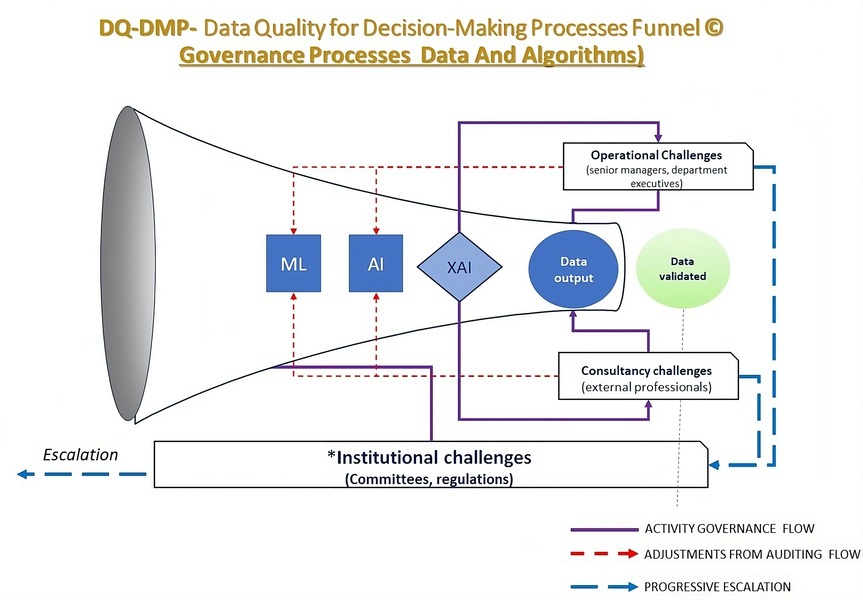
Implementing regular audits and continuous monitoring of AI systems to detect and  address bias over time is GOVERNANCE. We proposed a model called DATA QUALITY FUNNEL ©, where algorithms and output monitoring can be organised within companies and with external consultants too, including Institutional Challenges– Risk assessments and Monitoring (Consultancy  challenges and operational Challenges) 

Data Quality - Enhanced

Institutional Challenging: Institutions, by creating committees, including AI specialists  and non-executive directors, may establish overarching rules to guide decisions with both  artificial intelligence technology and human expertise.  

Consultancy Challenging: These challenges may be tackled by external professionals  who utilise critical assessment to produce more substantial and sustainable outcomes  through independent and impartial opinions. 

Operational Challenging: These challenges are for the operations staff who watch  directly how the AI systems work on tasks. They can run checks and raise issues about  problems to rectify algorithms and improve them through an escalation process, but they  don’t intervene in modifying the algorithms.” (Collina, Sayyadi & Provitera, 2024) 

Summing up 

In order to efficiently mitigate bias in AI, companies should incorporate AI education  within their main operations and put up comprehensive structures governing the  technology. The future of AI does not exclusively depend on its level of technical  advancement but also on our capacity for responsible and ethical governance. 

It intimidates developing a stage where AI literacy becomes part of an organisation by  truth and life employees can use to question AI systems critically (analyse tricklingly) from within addressing its source due to this environment norm. 

The Internal regulations and accountability systems form the foundation of this process while ensuring that bias is proactively identified and corrected requires transparent procedures for monitoring and auditing AI decisions. Businesses should also ensure that there is always an attitude of “continuous improvement” within themselves where evaluation of technical measures cannot be used. 

AI Literacy Programs 

Make AI literacy programs the norm: have regular employee training sessions on AI  basics, including its ethical connotations and how to deal with bias in the workplace. 

Internal Governance Structures 

The establishment of a system of governing similar to the Data Quality Funnel® that  incorporates continuous bias audits as well as persistent monitoring ought to be  developed. 

Continuous Feedback Loops 

It is better to use both external consultants and internal monitoring and feedback  systems, which refine AI systems in real-time, thus making them robust over time. 

By marrying AI literacy with strong internal governance mechanisms, organisations can move beyond just addressing personal prejudices to becoming pioneers of responsible AI innovation.

About the Authors

Roopa Prabhakar Roopa Prabhakar holds a master’s degree in Electronics & Communication Engineering and has over 20 years of experience in data & analytics and currently serves as a Global Business Insights Leader at Randstad Digital. She specializes in modernizing & migrating legacy technology towards AI-enabled systems, bridging traditional IT roles with AI-powered functions. As an independent researcher, Roopa focuses on gender bias in AI, informed by works from UN Women and the World Economic Forum. She is actively building a “Women in AI “community and champions “Women in Digital initiatives” within her company, aiming to increase female representation in AI and provide support for women in technology. Roopa is passionate about promoting ethical practices that address historical biases against women and continues to upgrade her skills to contribute positivity to the AI landscape.


lucaLuca Collina’s background is as a management consultant He has managed transformational projects, also at the international level (Tunisia, China, Malaysia, Russia). He now helps companies understand how GEN-AI technology impacts business, use technology wisely, and avoid problems. He has an MBA in Consulting, has received academic awards, and was recently nominated for Awards 2024 by the Centre of Management Consultants for Excellence. He is a published author. Thinkers360 named him one of the Top Voices, Globally and in EMEA in 2023, and currently is among the 10# thought leaders in Gen-AI and 1# in Business continuity. Luca continuously upgrades his knowledge with experience and research to transfer it. He is ready to launch the interactive courses on “AI & Business” In September 2024.

References

  1. Blatz, J. (2021). Using Data to Disrupt Systemic Inequity. Stanford Social  Innovation Review. Available athttps://ssir.org/articles/entry/using_data_to_disrupt_systemic_inequity [Accessed 8 Sep. 2024
  2. Collina, L., Sayyadi, M. & Provitera, M., 2024. The new data management model:  Effective data management for AI systems. California Management Review.  Available at: https://cmr.berkeley.edu/2024/03/the-new-data-management model-effective-data-management-for-ai-systems/ [Accessed 04 Sept. 2024].
  3. Google (nd) Model Cards. Available at:  https://modelcards.withgoogle.com/about (Accessed: 9 September 2024). 4. IBM (nd) AI Fairness 360. Available at: https://aif360.res.ibm.com/ Accessed: 9  September 2024 
  4. Jackson, A. (2024). The Dangers of AI Bias: Understanding the Business Risks. AI  Magazine. Available at: https://aimagazine.com/machine-learning/the-dangers of-ai-bias-understanding-the-business-risks [Accessed 9 Sep. 2024].
  5. Lopez, P. (2021). Bias does not equal bias: a socio-technical typology of bias in  data-based algorithmic systems. Internet Policy Review,[online] 10(4). Available  at: https://policyreview.info/articles/analysis/bias-does-not-equal-bias-socio technical-typology-bias-data-based-algorithmic [Accessed: 7 Sep. 2024].  
  6. Manyika, J., Silberg, J. and Presten, B., 2019. What AI can and can’t do (yet) for  your business. Harvard Business Review. Available at: https://hbr.org/2019/01/what-ai-can-and-cant-do-yet-for-your-business [Accessed 10 Sep. 2024]. 
  7. Microsoft (nd) Fairlearn: A toolkit for assessing and improving fairness in AI.  Available at: https://fairlearn.org/ (Accessed: 9 September 2024).
  8. Pymetrics (nd) Audited & Ethical AI. Available at:  https://www.pymetrics.ai/audited-ethical-ai (Accessed: 9 September 2024).
  9. TensorFlow (2023) Fairness Indicators. Available at: https://www.tensorflow.org/tfx/guide/fairness_indicators (Accessed: 9  September 2024).

EDITOR'S PICK OF THE WEEK

CFO's new mandate. CFO explaining the presentation

The Performance and Transformation Orchestrator: The CFO’s New Mandate in the Age of AI

By Terence Tse CFOs are evolving into AI-driven transformation orchestrators, balancing finance, technology, and strategy while upskilling teams, managing risks, and driving measurable business value. A key insight from this year’s AI for CFOs event, organized...

WISE DECISION MAKER GUIDE

POWER INFLUENCERS

Emerging Trends

The Future of Global Trade