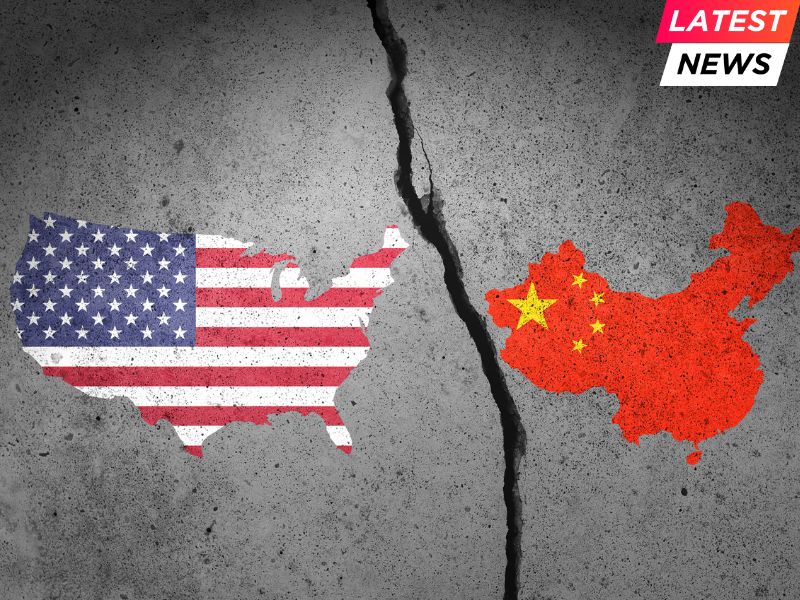
U.S. Treasury Secretary Scott Bessent has warned Beijing that its sweeping new export controls on rare earths and other critical minerals could push the United States and its allies to sever economic ties with China.
Speaking at a joint news conference with U.S. Trade Representative Jamieson Greer on Wednesday, Bessent cautioned that China’s latest policy risked isolating the world’s second-largest economy. “If China wants to be an unreliable partner to the world, then the world will have to decouple,” Bessent said. “The world does not want to decouple. We want to de-risk. But signals like this are signs of decoupling, which we don’t believe China wants.”
Beijing announced last week a new regime for rare earths and critical minerals that would require non-Chinese companies exporting products containing even trace amounts of these materials to obtain government approval. The move, scheduled to take effect in December, has drawn sharp criticism from Washington and its allies, who say it threatens global supply chains.
President Donald Trump has responded by threatening to impose an additional 100 percent tariff on Chinese imports by November 1 if Beijing proceeds with the export restrictions.
Greer said the measures represent more than just a trade response. “While China has taken a number of retaliatory trade actions against the United States, Europe, Canada, Australia and others in recent years, this move is not proportional retaliation,” he said. “It is an exercise in economic coercion on every country in the world.”
Both Bessent and Greer stressed that the United States has urged Beijing to halt implementation of the controls, warning that they could destabilize the global economy.
Sara Schuman, a former top U.S. trade negotiator for China, said the controls jeopardize progress made earlier this year in Geneva, where both countries reached an agreement aimed at easing tensions. “The ball is now in China’s court. Will it return to the Geneva agreement and rollback these [rare earth] restrictions, or choose to weaponise the global supply chains it dominates?” said Schuman, who now leads the trade and economic security practice at Beacon Global Strategies. “China’s answer to this question over the next two weeks will have broad strategic implications for years to come.”
Greer added that the restrictions would give China leverage over the global economy and technology supply chains. “This will impact artificial intelligence systems and high-tech products, but even regular consumer items like cars, smartphones and potentially even household appliances,” he warned.
Beijing has defended its decision, claiming it was a response to what it calls “punitive measures” imposed by Washington since the two sides held a fourth round of trade talks in Madrid last month. The U.S. has dismissed that argument, saying China appeared to have planned the export regime long before the Madrid meeting.
Bessent and Greer also took aim at Li Chenggang, a senior member of China’s trade delegation, accusing him of behaving unprofessionally during an unannounced visit to Washington in August. According to Bessent, Li was “very disrespectful” and threatened “global chaos” if the U.S. followed through on its plan to impose port fees on Chinese vessels docking in American harbors. The policy went into effect this week. “Perhaps he has gone rogue,” Bessent said.
Despite the growing friction, Bessent expressed hope that dialogue could prevent further escalation. He said he expected President Trump to meet Chinese President Xi Jinping during the Asia-Pacific Economic Cooperation summit in South Korea on October 29, calling it a potential “opportunity to reset the tone.”
“I’m optimistic that we can de-escalate,” Bessent said. “But if China moves ahead, we will respond.”
Analysts believe Beijing’s strategy may be aimed at pressuring Washington to relax its own export restrictions on semiconductors and chip technology. When asked if the U.S. would consider such a trade-off, Bessent declined to comment, saying, “I’m not going to pregame what the negotiations are going to look like.”
He added, however, that one key question would be whether China delays the rollout of its export controls.
The U.S. and China have repeatedly postponed tariff deadlines since agreeing to a ceasefire in their trade war earlier this year. The current 90-day window for talks is set to expire in mid-November, heightening pressure on both sides to reach a compromise before the confrontation escalates further.
Related Readings: