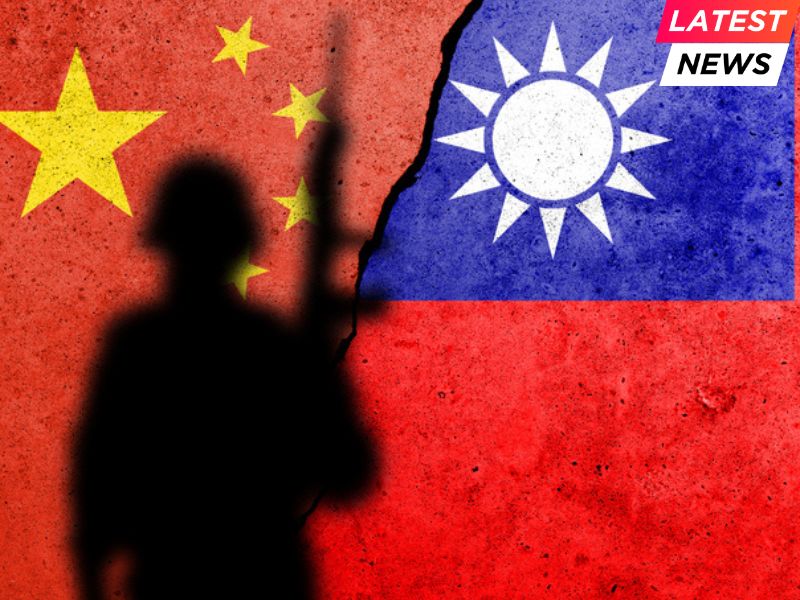
China’s military mobilized army, navy, air and rocket forces around Taiwan for two days of extensive exercises, signaling what Beijing called a “serious warning” against any move toward Taiwanese independence and against “external” interference.
The drills, named “Justice Mission-2025,” were designed to test combat readiness and practice the “blockade and control of key ports and critical areas,” according to China’s Eastern Theater Command. Authorities said the exercises included live-fire operations and rocket launches.
Taiwan’s Coast Guard confirmed that rockets fired on Tuesday landed in waters near the island. The drills disrupted civilian life, triggering flight delays and cancellations across Taiwan over the past two days.
Taipei sharply criticized the exercises, accusing Beijing of “military intimidation.” Taiwan’s defense ministry said it was “fully on guard” and would “take concrete action to defend the values of democracy and freedom.”
The latest maneuvers come as China continues to increase military pressure on Taiwan, which Beijing claims as its territory despite never having governed it. Analysts say the drills appear aimed at rehearsing ways to restrict access by foreign militaries to the region.
Taiwan’s defense ministry reported that China deployed 130 warplanes and 22 naval vessels around the island in the 24 hours since Monday. That figure marks the second-highest number of Chinese aircraft detected near Taiwan, after a record set in October 2024. Of those sorties, 90 crossed the median line in the Taiwan Strait and entered Taiwan’s air defense identification zone.
In response, Taiwan’s military said it scrambled fighter jets, dispatched naval ships and activated coastal missile systems to monitor and counter the activity.
The timing of the drills follows recent developments that have angered Beijing. Earlier this month, Washington and Taipei announced what could become one of the largest U.S. arms sales to Taiwan, while Taiwan’s president is pushing for approval of a historic special defense budget.
Asked about the drills, U.S. President Donald Trump said he was not concerned, citing his relationship with China’s leader. “I certainly have seen it, but he hasn’t told me anything about it. I don’t believe he’s going to be doing it,” Trump said, referring to a possible invasion of Taiwan.
Meanwhile, tensions have also risen between China and Japan following remarks by Japanese Prime Minister Sanae Takaichi about a potential response if China used force against Taiwan.
Civil aviation authorities in Taiwan said more than 6,000 travelers were affected as of Tuesday noon, with 76 domestic flights canceled and 14 delayed.
China’s Eastern Theater Command defended the drills as necessary. “This exercise serves as a serious warning to ‘Taiwan independence’ separatist forces and external interfering forces,” spokesperson Shi Yi said Monday. “(It) is a legitimate and necessary action to safeguard national sovereignty and maintain national unity.”
China’s Defense Ministry later urged other countries to abandon what it described as attempts to “use Taiwan to contain China,” warning against “challenging China’s resolve and will to defend its core interests.”
Taiwan’s presidential spokesperson Karen Kuo said the drills “blatantly undermine the security and stability status quo of the Taiwan Strait and the Indo-Pacific region” and “openly challenges international laws and order.” President Lai Ching-te added that Beijing’s repeated military pressure “falls far short of what is expected of a responsible major power.”
The situation unfolds as Taiwan seeks to bolster its defenses. A proposed $11.1 billion U.S. arms package includes HIMARS rocket systems, missiles, drones and artillery, with parts expected to be funded through a proposed $40 billion special defense budget that remains stalled in Taiwan’s legislature.
China’s military exercises have grown increasingly complex in recent years, with analysts noting a stronger focus on simulated blockades. Notices from China’s Maritime Safety Administration outlined seven exercise zones for live-fire drills on Tuesday, prompting experts to describe the operation as a “de facto” blockade inside the Taiwan Strait.
It remains unclear how long the drills will continue. China’s Eastern Theater Command said naval and air units would maintain combat readiness patrols and announced temporary closures of airspace and maritime zones around Taiwan during daytime live-fire activities.
Related Readings: