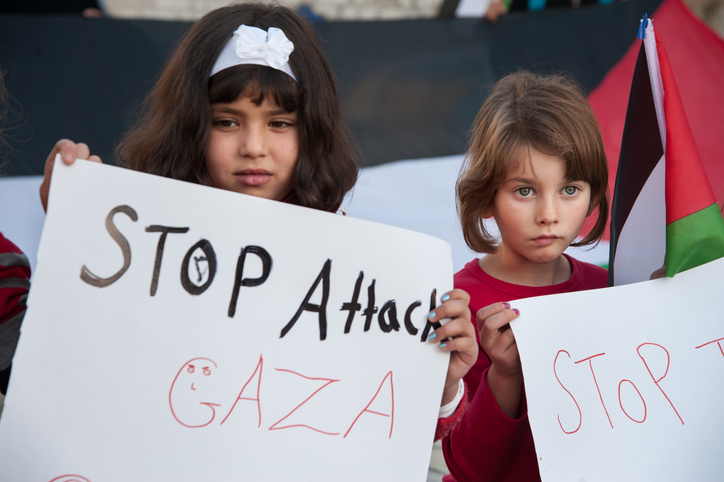
From Gaza and beyond, Israeli authorities and security forces have deliberately targeted Palestinian children. It is the topic of a new UN report.
When I was working on The Fall of Israel (2024) and particularly The Obliteration Doctrine (2025), what I found most repulsive was the targeting of children in the Gaza Strip. By 2024, the testimonies of health professionals on location indicated that the deaths of many children in Gaza were not just collateral damage, but outcomes of deliberate, targeted actions.
The testimony of Dr. Feroze Sidhwa, a young American trauma and general surgeon who had volunteered in Palestine including the European Hospital in Khan Younis, was particularly compelling. “I’ve seen violence and worked in conflict zones,” Sidhwa said. “But of the many things that stood out about working in a hospital in Gaza, one got to me: Nearly every day I was there, I saw a new young child who had been shot in the head or the chest, virtually all of whom went on to die.”
The statement of Dr. Sidhwa, who subsequently became one of the endorsers of my book on The Obliteration Doctrine, was supported by dozens of other remarkable and courageous medical volunteers in Gaza. These testimonies, in turn, have been supported by many reports of multiple international NGOs and multilateral organizations.
So, the latest report of the UN Independent International Commission is hardly new. Nonetheless, it is among the most consequential documents to emerge from the Gaza war. Its conclusion is stark: Israeli authorities and security forces have deliberately targeted Palestinian children. These actions, the Commission argues, constitute genocide, crimes against humanity, and war crimes.
The Commission’s findings
The Commission’s report concludes that the deliberate targeting of Palestinian children is not incidental collateral damage but part of a recurring pattern of conduct. In line with the Genocide Convention, it argues that such actions are a key indicator of genocidal intent because they strike at the future existence of the Palestinian people.
According to the inquiry, more than 20,000 Palestinian children were killed between October 2023 and October 2025, representing roughly 30 percent of all fatalities, while over 44,000 were injured. Even after the October 2025 ceasefire, children reportedly continue to be killed and maimed.
The Commission cites cases involving sniper fire, quadcopter drones, precision-guided munitions, and high-yield bombs used in densely populated civilian areas. It argues that the nature of these weapons systems often allowed operators to identify their targets, including whether they were children.
Israel has rejected the findings as biased and defamatory.
Regardless of political positions, the significance of the report lies in its accumulation of evidence, legal analysis, forensic testimony, and witness accounts. It represents one of the most comprehensive international investigations yet conducted on the impact of the war on children.
It is a condemnation that casts a long dark shadow over the entire Israeli war government and its international collaborators, arms suppliers and financiers.
Children and the logic of genocide
In The Obliteration Doctrine, I showed that modern warfare in Gaza evolved beyond traditional military objectives toward the destruction of the social foundations of Palestinian existence. The Commission’s findings reinforce this interpretation.
Historically, genocide scholars have emphasized that attacks on children occupy a unique place in genocidal campaigns. The 1948 Genocide Convention identifies not only direct killing but also the infliction of conditions calculated to destroy a protected group. In Gaza, famine served the same genocidal function as starvation in the Warsaw ghetto.
Children embody demographic continuity, cultural reproduction, and collective future. Consequently, systematic violence against children has appeared repeatedly in cases later recognized as genocide, from the Armenian genocide to Rwanda.
The Commission explicitly states that targeting children attacks “the very capacity of the Palestinian people to exist and determine their future.” Its findings connect killings to broader patterns: destruction of schools, hospitals, pediatric facilities, neonatal care units, food systems, and water infrastructure.
That’s the ultimate objective: the genocide and ecocide of Palestine, its culture and children. Israel’s devastation of Lebanon follows in the footprints.
From an empirical perspective, the cumulative effect is measurable. Public-health research consistently demonstrates that childhood exposure to mass violence produces lifelong deficits in physical health, educational attainment, psychological resilience, and economic productivity.
Israel did not triumph in Gaza. Moral darkness did.
Human cost beyond death statistics
Death tolls alone understate the catastrophe. The Commission reports more than 44,000 wounded children.
Gaza now reportedly has one of the world’s highest concentrations of child amputees. Thousands face permanent disability from burns, blast injuries, spinal trauma, vision loss, and neurological damage. Worse, Israel has denied treatment to thousands of Gazans who lost limbs in Israeli attacks.
Research from conflicts in Syria, Iraq, Afghanistan, and Bosnia demonstrates that severely injured children often experience decades of adverse outcomes.
Rates of post-traumatic stress disorder, depression, anxiety disorders, and developmental impairments can remain elevated throughout adulthood. Educational interruptions reduce lifetime earnings. Family structures collapse under caregiving burdens.
The Commission also documents starvation, disease outbreaks, displacement, and collapse of medical services. Such conditions affect not only present survival but the health of future generations through malnutrition, impaired fetal development, and maternal health crises.
The result is not merely a humanitarian emergency. It is the systematic destruction of human development on a societal scale.
The ultimate question raised by the UN report is therefore not only what happened to Gaza’s children. It is whether the international community is willing to preserve the principle that children remain beyond the reach of war itself.
For if that principle fails in Gaza, it will not survive elsewhere.
This is a highly abbreviated version of the original commentary that was released by Informed Comment (US) on June 26, 2026.
About the Author
 Dr. Dan Steinbock is an internationally recognized strategist of the multipolar world and the founder of Difference Group. He has served at the India, China and America Institute (USA), Shanghai Institutes for International Studies (China) and the EU Center (Singapore). He is also the author of The Fall of Israel and The Obliteration Doctrine. For more, see https://www.differencegroup.net