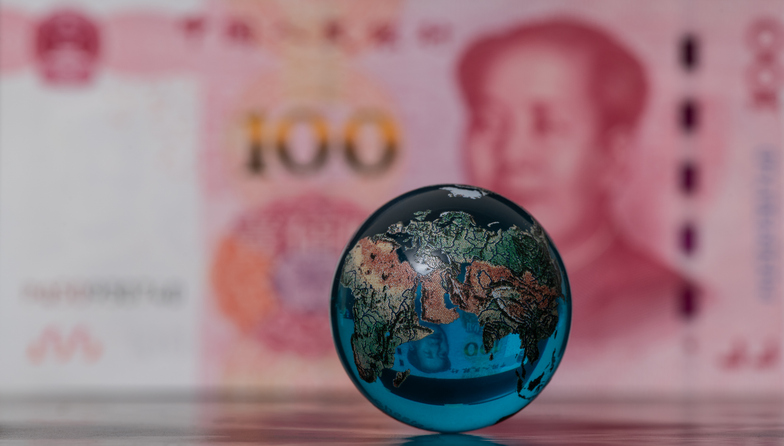
China is utilising Africa as a strategic testing ground for yuan internationalisation to challenge US dollar dominance and potentially bypass Western sanctions. While lower transaction costs benefit African debt management and international trade, the strategy faces risks from the yuan’s limited convertibility, domestic Chinese economic imbalances, and escalating US-Sino geopolitical tensions.
As part of efforts to expand its economic influence worldwide and strengthen its financial resilience, China is seeking to internationalise the yuan, increasingly using Africa as a testing ground for the ambitious strategy.
Attempting to vie globally with the US dollar is risky for Beijing as it could undermine its own economic model and restructure power dynamics in the country. Broader adoption of the yuan as a settlement currency might also leave China’s African partners – governments and companies alike – facing economic headaches.
China has long-standing, substantial economic ties with Africa, which, for Beijing, makes the region an optimal testing ground for its currency strategy. China is a significant lender and major trading partner for several countries on the continent. Its engagement is in part driven by a desire to source African commodities, such as critical minerals and agricultural products, but it is also credited with overseeing massive infrastructure development. The latter is linked to China’s ‘Belt and Road’ strategy to establish interconnecting business and transport corridors around the world.
While China’s economic ties with Africa have benefited a good number of African countries, many are paying back expensive dollar-denominated loans and local companies are using often-scarce dollars to import Chinese goods. So, for African governments and local commercial entities, it makes financial sense to step up use of the yuan, as its trading and interest costs are lower.
Challenging the dollar
Internationalisation of the yuan is a direct challenge to the primacy of the dollar and, by extension, US economic dominance. For a long time, the idea that the yuan could compete with the dollar as part of an alternative financial system has been dismissed by economists, and it continues to be so as we are nowhere near a point where the yuan could displace the dollar as the world’s primary reserve currency.
Greater adoption of yuan would lead to increased demand and therefore appreciation pressures. But China has traditionally kept the value of its currency low for two principal reasons, one financial and the other socio-political. Strong currency could undermine China’s manufacturing-based economic model that depends heavily on producing relatively cheap goods for developed and developing markets. At the same time, a stronger yuan would tilt domestic economic power away from exporters and manufacturers to importers and consumers. That might upset a carefully-managed balance between sectors of the economy – disruption which, in turn, could lead to domestic tensions.
Cautious approach to yuan globalisation
While a transfer of financial muscle from certain economic groups to others might be inevitable, there are limits to the pace at which it can proceed, as there is an entrenched belief in China that any kind of change is bad if it happens too quickly and threatens the functioning of the state.
China, however, seems prepared to manage such risks in order to achieve its broader strategic goals. Internationalisation of the yuan would enable it to wield substantially more economic influence worldwide. At the same time it would also make China more resilient by creating an alternative system to circumvent potential Western sanctions. And what we have been seeing over the last year or so is that China has taken steps, albeit gradual, to begin this process.
African testing ground
With its moves to promote yuan adoption in Africa, an attempt is now underway to see how direct yuan competition with the dollar might play out, not least in China. Over the past year, a number of countries, notably Kenya, have been considering or have recently converted their dollar-denominated debt to China into yuan. And the Bank of Zambia confirmed this year that it now allows mining companies to settle mining royalties in yuan.
But there is a downside to all of this. While debt-for-currency swaps could enable countries to manage their debt burden more effectively, the yuan’s limited convertibility is an issue and the IMF has warned about risks around fluctuations in the yuan’s exchange rate.
At the moment, Beijing has zero-tariff deals with dozens of African countries (which come into effect in May 2026). With some domestic industries already concerned that they will be squeezed out of their own home markets by a flood of cheap Chinese goods, yuan adoption would probably exacerbate this effect by reducing transaction costs. There is also a risk that states focused on yuan-denominated trade with China will find it harder to pursue stuttering African economic integration, especially since central to the process is the use of local African currencies via cross-border payments systems.
Prospects for western investors
For multi-nationals with commercial interests in Africa, the gradual adoption of the yuan also has costs and benefits, but decision-makers should be able to adjust their business strategies to mitigate the former.
On the plus side, multi-national subsidiaries in Africa importing Chinese components might see lower transaction costs, as they will not have to convert local currency into dollars and then into yuan. These subsidiaries may also be able to access more convenient yuan-denominated loans to expand domestically and regionally, and would also gain from any Chinese financing of local logistical infrastructure.
Yet while there are opportunities, there is significant risk for multi-nationals operating in Africa. With the increasingly adversarial nature of US-Sino relations, corporates exporting to America from countries deemed by Washington to be too closely engaged with China might find themselves subject to higher US tariffs and other economic restrictions. So business strategies need to take particular heed of the elevated political risks of commercial ties with African countries deep within the Chinese economic sphere of influence.
It’s too early to say whether China’s efforts to expand yuan usage in Africa will persuade it to accelerate the process on the continent and extend it to other regions. In the relatively short time the African test has been underway, the signs are that it is proceeding well. But associated problems, for Beijing and its partners, are more likely to be felt over a longer period of time, as yuan adoption in Africa works through local economies and China itself. Chinese officials will be closely monitoring this, very much aware that while they are eager to expedite the experiment, they must be alert to unintended consequences.
About the Author
 Barbara Kelemen is Associate Director for Geoeconomics and Global Risks at Dragonfly from Dow Jones, based in New York. She specialises in geopolitics, trade, security, and markets, with expertise in political risk and macroeconomics. Previously Head of Asia at Dragonfly, she is a CEIAS research fellow and has published widely on China and global affairs.