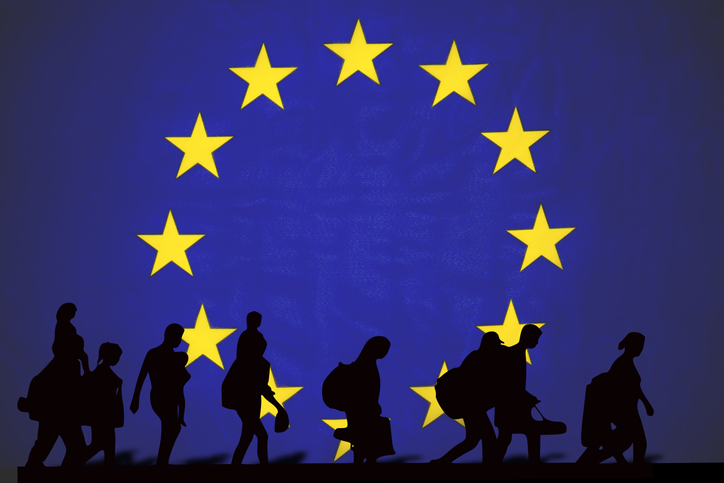
The article presents the case about the irregular migration from Middle East and North Africa (MENA) region to the EU. It argues that the two-pronged approach, a balance of idealism and pragmatism the EU is enacting for 10 years, is unfortunate and inevitable due to real-life conditions. This piece concludes with the need for refinement in EU’s approaches to overcome its “unfortunate” status.
Human kind and the collectives it built created various constructs on the natural space Earth provided. History is a witness on how time and time again, these collectives have fought for the spaces they rendered meaning and worth for. Today in the time of neoliberalism and high geopolitical tensions, property and border delineation are part of tangible space management. This creates desirable and undesirable places that in turn dictate the migratory patterns of human beings.
However, such delineations also create limitations of movement regardless of the desire of a collective to move. An owner of a land shall not allow anyone to commit trespassing without legal repercussions. In state and regional organization matters, aliens are not allowed to enter another country without proper documentation and reason. This perpetual pattern reflects the case that EU faces with irregular migration from the Middle East and North Africa (MENA) region. Upon observation of this case, the EU’s approach is unfortunately but inevitably “business-as-usual” then and now.
Through the Mediterranean They Cross
It has been 10 years since EU was first bolstered by the large numbers of irregular migrants crossing the Mediterranean. Due to factors such as poverty and armed conflicts across the MENA region, desperate people have crossed the sea in improvised boats, often at the hands of illegal entities and human traffickers. As a response, the EU securitized the issue wanting to control the flow of irregular migrants. Through the European Border and Coast Guard Agency (FRONTEX), it conducted border control operations to prevent human trafficking and other related crimes. Compensating the opinion that FRONTEX operations disregard the human rights of irregular migrants, the EU through the Fundamental Rights Agency (FRA) monitor and ensure the rights of irregular migrants. Moreover, it also assured that the root causes of irregular migration are addressed through Official Development Assistance (ODA). This is seen as a way of externalizing the crisis. However, critical eyes tend to question EU’s handling of it. These lens, upheld mostly by NGOs, pertain to international laws and treaties as their rationale for making their stand.
This crisis does not only involve state and non-state actors. Looking at the deeper picture, this crisis has its individual human dimensions. The EU is a far attractive land in which opportunities lie abound for these would-be irregular migrants, making it their essential motivation. On the other hand, the reaction of EU citizens in various states are mixed depending on their location, ideologies, and experiences. Doing its best to uphold liberalism, these views are considered by the EU in its decision-making process.
Overall, it can be said that the influx of irregular migrants is an issue that creates various perspectives, testing EU’s integration project and making a uniform way of thinking a challenging one if not impossible. This is the “business-as-usual” approach of the EU to irregular migration from MENA. It reflects the combination of diversity and complexity, outcome of adherence to democratic values, as well as the practical need to secure itself. Furthermore, it can be considered as “usual” now due to the fact that ten years later, the game is still the same.
Today: Unfortunately “Business-as-Usual”
Ten years later, this picture still remains a reality in general which reflects the approach’s unfortunate status. Irregular migration from MENA continuous to be securitized by the EU. The map of the Middle East remains to have a handful of tangling yarns connecting all sides of its armed conflicts. Northern Africa remains to be prone to undemocratic institutions and a haven for human traffickers. Meanwhile, the EU’s fortress is as high as ever as its member-states look to improve FRONTEX operations. It continued and innovated its operations and tactics. For one it already has its own Standing Corps by the virtue of Regulation (EU) 2019/1896 which means it already has its own uniformed service personnel. This is still occurring side by side with its efforts to contain the root causes of irregular migration through the New Pact on Migration and Asylum which is also deemed as questionable by NGO advocates.
Adding more negatives on how it deals with the MENA region, this “business-as-usual” approach of EU seems to have an inconsistent effectivity. Throughout the last decade the number of irregular crossings provide an inconclusive take on the action. We can look at the latest data from this year and compare it to the previous three years. Despite the general trend of falling numbers in terms of irregular crossings across the union on the first half of 2025, the Central and Western Mediterranean routes present climbing numbers. These routes are directly in front of the MENA region. There is a 12% and 19% increase on crossings for both routes compare to the same half last year. Even as 2024 show general decrease for both routes, it should be pointed out that the numbers are coming from the strong surges of 2022 and 2023. There are of course other factors and reasons to consider. But these numbers are primarily consulted to see the effectivity of the approach currently. For the EU, this may present a hypothesis/trend moving forward that contradicts its intentions.
Discussing what lies ahead further, this is also unfortunate for another reason: external factors that would not cease to exist in the future. Most evident of these factors is a harbinger of future crises that will not recognize any political boundaries: climate change. The drastic changes in the atmosphere can dictate migratory patterns in the coming decades especially in the MENA region. This in turn may result in further irregular migration to EU since the expected trend will be migration from low- to high-altitude locations.
Into the Inevitable Future: Balanced Idealism-Pragmatism
This “business-as-usual” approach of the EU regarding irregular migration from MENA may indeed be unfortunate but it is inevitable. It is inevitable due to what the future will bring. The EU needs to continue fortifying its borders for security measures regarding irregular migration but must also cooperate and struck policies with third countries involved due to multiplier crises like climate change.
Despite the fact that the criticisms on the issue’s securitization bears merit, it is undeniable from the ground that there are also compelling reasons from the outside for doing this. On the other hand, its cooperation and funding with other states are needed since there are issues like climate change that may exacerbate irregular migration. Looking at it in this perspective, there is no point abandoning the union’s approach which is two-pronged. This approach is the not the balance of realism-liberalism per se, but of idealism-pragmatism. The EU will reserve its right to protect its borders and citizens against any threat it sees, but it should mind itself that there are occurrences from beyond that despite manifesting tangibles cannot be controlled. The EU must accept that it will involve itself with problems abroad while it solves its own.
In the end, the “business-as-usual” approach can overcome its unfortunate status through refinement. It has no choice, for as already mentioned, the currently unfortunate is also inevitable. The union’s bastion of liberal-democratic values must be satisfied and balanced with the practical necessities of managing security. The need for balance will present itself in different contexts and circumstances in the future that involves irregular migration, climate change, and the MENA region. The EU needs to adapt in all of these. It needs to accept that as they have the right to protect their house, they must also be mindful of what is occurring beyond their fences. For disregarding the external may result to a larger crisis altogether that will definitely hit home hard.
About the Author
 John Louis B. Benito, LPT, MA– Accomplished the Master of Arts in International Studies Major in European Studies Program at De La Salle University in Manila, Philippines from 2021-2024. Currently he is a part-time lecturer and the Service Learning Coordinator under the Department of International Studies also at De La Salle University. His research interests, articles, and academic publications revolves around international migration, critical security, the outer space, sustainable development, and securitization.