By Giacomo Prandelli
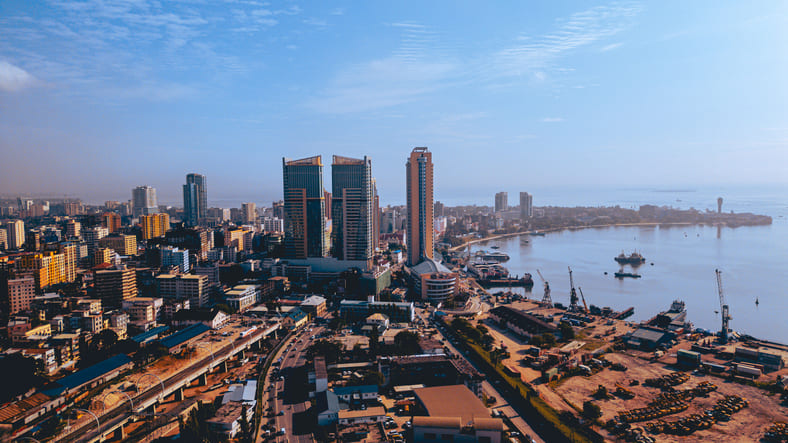
Tanga means ‘sail’ in Swahili. For centuries the aptly named port on Tanzania’s northern coast sent its dhows out heavy with ivory and enslaved people, a trade that both built the Swahili world and left its mark on it. Today Tanga is catching a very different wind. On 7 August the governments of Tanzania and Uganda signed a memorandum of understanding with the Bahrain arm of Vitol to turn the port into a regional energy hub, with potential investments – including storage and logistics facilities – potentially exceeding $20bn.
The Vitol MoU is only the latest venture to dock at Tanga as Tanzania seeks to build out its energy sector into a major regional and perhaps even continental player. The East African Crude Oil Pipeline (EACOP) – a 1,443km heated line designed to carry around 246,000 barrels a day of Ugandan crude to Tanga – is more than 80% complete. First exports are expected around October, handing Tanzania transit revenue and a ready-made logistics anchor. Storage, blending and bunkering could later supply refined products inland to Rwanda, Burundi and eastern Congo, while offering a competitive alternative to Kenyan routes. Despite ESG criticism and financing headwinds, the infrastructure is now close enough to completion to shape East Africa’s crude and product flows for decades.
Momentum is building. Aliko Dangote, Africa’s richest industrialist and an established player in Tanzanian cement, used a June meeting with President Samia Suluhu Hassan to propose a 2,000MW power plant, a urea fertiliser complex, new port works and an 812km southern transport corridor. Offshore, Tanzania’s estimated 57 trillion cubic feet of recoverable gas underpin the proposed $42bn Lindi LNG project with Shell, Equinor and ExxonMobil, a development Equinor’s own modelling suggests could lift national GDP by close to 7% a year.
With the completion of the Julius Nyerere dam, Tanzania’s government is targeting 8,000MW of domestic energy production by 2030. The timing is not accidental. The Iran war that erupted in February and closed the Strait of Hormuz, pushed Brent crude up by about 70% within weeks. For a continent that imports more than 70% of its refined fuel, the shock was immediate: pump prices doubled in Somalia, fuel queues stretched for days in Ethiopia, and diesel rose by more than half in South Africa. The Africa Finance Corporation warns the continent is heading for an 86m-tonne fuel shortfall by 2040. Tanzania has identified a gaping hole in the region’s energy market and rushed to fill it.
Get the infrastructure right and energy becomes a growth engine, not just an export. The Gulf states offer the obvious template: economies that turned hydrocarbon geography into trading floors, logistics networks and industrial cities, capturing value at every stage instead of shipping raw barrels and importing the finished goods.
Tanzania is well placed to do exactly that. Its coast faces the Arabian Peninsula and the Gulf, the natural direction of travel for the capital and hub economics it hopes to attract. Inland, a growing transport network reaches deep into Central and Southern Africa. A new electrified Standard Gauge Railway of some 2,600–2,800km links Dar es Salaam to Mwanza on Lake Victoria before stretching toward Rwanda, Burundi and the DRC. The government is targeting a jump in rail’s share of cargo from the low single digits toward 30% by 2030. Meanwhile, the revived TAZARA line runs 1,860km south to Zambia’s Copperbelt. A $1.4bn Chinese-backed overhaul is expected to lift freight capacity into the 2–3m-tonne-a-year range and cut transit times for copper and cobalt from the Copperbelt to Dar es Salaam by several days. That hands Dar es Salaam and Tanga a claim on two of the region’s richest freight markets at once.
Investors have been quick to move. Tanzania registered a record $11bn of new projects in 2025, the highest total since independence. Fitch expects around 6% growth in both 2026 and 2027, driven by the railways, the pipeline and wider infrastructure, provided debt dynamics remain manageable. The ports are following suit: Dar es Salaam handled nearly 28m tonnes in 2024/25, its highest total on record as improved rail links and logistics planning began to bite.
There are risks of course. Mega-projects such as EACOP and Lindi LNG face volatile global cycles, climate-policy pressure and scrutiny from civil society and financiers. Governance and contract enforcement must keep pace if value is to be retained onshore rather than lost to leakages. And as energy transition finance is increasingly tied to low-carbon trajectories, Tanzania will have to show how hydrocarbon-led industrialisation fits alongside renewables, regional power trade and efficiency measures.
Nevertheless, the energy build out is a strong proof point for President Samia’s Vision 2050: the 25-year plan for a $1 trillion economy, $7,000 per-capita income and a decisive shift from exporting raw materials to adding value at home. Energy is the engine beneath that ambition. Tanzania cannot industrialise, process its own crops and minerals, or climb from lower-middle to upper-middle income without reliable, affordable, home-grown power.
Centuries ago, Tanzania’s wealth sailed away from Tanga and over the horizon. This time, if the contracts follow the ambition and the execution matches the plans, that value can stay ashore.
About the Author
Giacomo Prandelli is commodities trader and founder of The Merchant’s News.