French authorities are in a frantic race to recover priceless Napoleonic-era jewels stolen in what officials are calling the most audacious museum robbery in more than a century. The theft, which unfolded in broad daylight at the Louvre Museum in Paris, has shocked the nation and drawn condemnation from President Emmanuel Macron, who called it “an attack on a heritage we cherish.” He vowed that those responsible “will be brought to justice.”
The meticulously planned operation began around 9:30 a.m. when four masked men executed a coordinated heist at the world-renowned museum. Two suspects arrived on Yamaha T-Max scooters, while two others, disguised in yellow and orange vests, parked a truck equipped with a lifting platform outside the museum on Quai François Mitterrand. Witnesses quickly alerted police after noticing the suspicious activity.
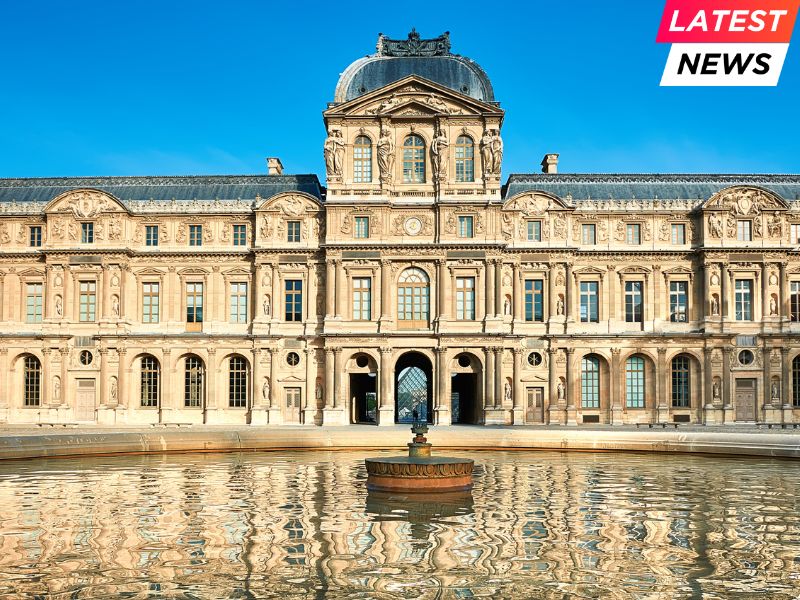
Using the lift, two thieves climbed to a second-floor balcony of the Apollo Gallery, which houses France’s crown jewels. Armed with an angle grinder, they cut through a window and stormed into the gallery, smashing two display cases and seizing eight historic pieces of jewelry, including diamond and emerald tiaras, necklaces, and earrings once worn by French royalty.
Paris Prosecutor Laure Beccuau told CNN affiliate BFMTV that the thieves, though unarmed, threatened museum guards with the angle grinders during the robbery. She said investigators have not ruled out possible foreign involvement and are exploring “all lines of inquiry.”
The Ministry of Culture later released the full list of stolen items, which includes a tiara, necklace, and sapphire earring worn by Queen Marie-Amélie and Queen Hortense; an emerald necklace and earrings belonging to Empress Marie-Louise; the “reliquary brooch”; and the tiara and large corsage bow brooch of Empress Eugénie. Authorities have opened an investigation into “aggravated theft by an organized gang and criminal conspiracy to commit a felony,” led by the Brigade de Répression du Banditisme (BRB) under the Paris Public Prosecutor’s Office.
As alarms sounded, five museum staff members quickly implemented emergency protocols, helping evacuate nearly 2,000 visitors. Tour guide Ryan el-Mandari recalled hearing what sounded like “stomping” on the windows before staff ordered everyone to leave. No injuries were reported.
The robbers escaped the scene within minutes, descending the ladder with their loot and speeding away on scooters along the Seine. A security guard prevented them from setting fire to their truck before they fled. Police later recovered two angle grinders, a blowtorch, a walkie-talkie, and a fuel-soaked blanket left behind. Among the debris, officers also found the damaged crown of Empress Eugénie, featuring 1,354 diamonds and 56 emeralds, apparently dropped during the getaway.
Interior Minister Laurent Nuñez revealed that the heist lasted only seven minutes, calling it the work of a “very experienced and well-prepared team.” Paris Center Mayor Ariel Weil told reporters that the operation appeared to have been conducted by “extremely well-trained robbers.” He added, “They planned this meticulously, obviously,” noting that he couldn’t recall a theft of this magnitude at the Louvre since Leonardo da Vinci’s Mona Lisa was stolen in 1911.
Investigators continue to comb through CCTV footage and analyze evidence collected from the abandoned truck, which was still parked outside the museum with its ladder propped against the balcony.
The Louvre remained closed Monday “for exceptional reasons” as officials assessed the damage and strengthened security measures. French Justice Minister Gérald Darmanin admitted that the theft exposed serious lapses in museum security. “What is certain is that we have failed,” he said. “The French people all feel like they’ve been robbed.”
Art crime expert Christopher Marinello, founder of Art Recovery International, warned that time is running out to recover the treasures. “The thieves may melt down the metals or recut the stones if they want quick cash,” he said. “We need to break up these gangs and find another approach, or we’re going to lose things that we are never going to see again.”
As police track leads across France and beyond, the Louvre heist has reignited global debate over the vulnerability of cultural heritage sites — and the high price of losing history in plain sight.
Related Readings: