The United States has introduced fresh tariffs on imports from more than 90 nations after President Donald Trump’s deadline to finalize trade agreements expired.
Canada faces an increase on select goods, with tariffs rising from 25% to 35%. Prime Minister Mark Carney said he was “disappointed” by the move, although most Canadian products remain exempt under an earlier accord.
Mexico avoided immediate increases, with higher duties delayed for another 90 days. Brazil was hit hardest, as Washington imposed a 50% levy on its exports.
Trump first unveiled the tariff plan in April, sparking uncertainty in global markets. He later postponed implementation to give countries such as the UK time to negotiate trade deals.
“These measures are less severe than the president initially threatened,” said the deputy economics editor.
Under the new rules, U.S. importers must pay the additional duties to the government, and analysts warned the costs are likely to be passed on to consumers.
From misplaced physical files to sophisticated cyberattacks, your sensitive financial information is a prime target for thieves and fraudsters looking to exploit any weakness.
The consequences are devastating, because one slip-up can lead to catastrophic financial loss and damage to your business’s reputation.
In fact, IBM reports the average cost of a data breach in the financial sector is now $4.35 million. This staggering figure shows just how high the stakes really are.
The good news is that you can effectively safeguard your assets. A comprehensive security strategy protects you from these growing and expensive threats.
In this guide, I’ll walk you through exactly how to secure financial documents. We’ll cover proven strategies for digital files, physical records, online accounts, and more.
By the end, you’ll have a clear, actionable plan to protect your most critical information and achieve true financial peace of mind.
Let’s get started.
1. Secure Your Digital Documents
Your digital files are not safe.
Storing financial records on cloud platforms without extra security leaves your most sensitive business information dangerously exposed.
The biggest problem is that unsecured third-party software tools create silent vulnerabilities. You might not know your financial data is at risk until a breach actually happens.
Verizon found 30% of breaches involved third-party vendors, showing the tools you trust can be your weakest link.
This exposure puts your assets on the line. Here is how you can begin to fix this issue.
Prioritize encryption and strict access controls.
Implementing strong encryption for your files, both when they are stored and when they are being sent, is your most critical defense.
This ensures that even if a data breach occurs, the stolen information remains completely unreadable and therefore useless to any would-be attackers.
I recommend using the best personal document management software with built-in, end-to-end encryption. It’s a fundamental part of securing financial documents and complements the strategies you’ll use later to protect your online accounts. Experience the best CA document management tool with Suvit, ensuring safe, organized, and quick access to critical financial documents from anywhere.
Consider it your digital safe.
By adopting this proactive measure, you effectively transform your vulnerable digital records from a significant liability into a securely managed and protected business asset.
2. Safeguard Your Physical Records
Paper records can be a huge liability.
These physical files are often forgotten but can be easily stolen, lost in a disaster, or simply misplaced.
When you need a critical document, you could find it’s gone for good after a simple office incident like a water leak or misfiling.
Tech.co reported a breach exposing Over 64 million job applicants’ information from one security flaw. This shows how vulnerable unsecured data is.
Protecting physical files is as vital as securing your digital documents, which we covered just before this.
Here’s how you can lock them down.
Start with a fireproof, waterproof, and lockable filing cabinet or safe for your most critical original documents like deeds or contracts.
For less sensitive but necessary paperwork, a simple locked cabinet in a secure room should be your absolute minimum standard.
I also recommend creating a strict shredding policy for any documents past their retention period. Properly securing financial documents means not keeping them longer than you legally need to.
This simple habit greatly reduces your risk.
This approach combines physical barriers with a clear disposal process, which is a powerful defense against both internal theft and external data exposure.
3. Protect Your Online Accounts
Are your online accounts truly secure?
Compromised online accounts give thieves direct access to your most sensitive financial information and business assets.
Many people reuse passwords, creating a domino effect. If a single account is breached, all connected financial accounts become vulnerable to attack.
The FBI reports that 22% of all data breaches stem from phishing attacks. This reveals how one bad click can expose your financial life.
This digital vulnerability makes it essential to build a stronger defense for your most important online accounts.
Here is how you lock them down.
Actively protecting your online accounts creates a powerful first line of defense. It prevents unauthorized access to the business software holding your documents.
Always enable multi-factor authentication (MFA) on your financial platforms. This simple step adds a crucial security layer that stops attackers even if they steal your password.
You should also use a unique, complex password for each account, stored in a trusted password manager. This is a highly effective method for securing your financial documents.
It makes your defense nearly impenetrable.
This combination of MFA and strong password hygiene dramatically reduces your vulnerability, protecting your assets from common cyberattacks like phishing and credential stuffing.
4. Monitor Your Financial Activity
Ignoring your accounts is a huge risk.
Unauthorized transactions can go unnoticed, exposing your business to significant losses and leaving your operations vulnerable to fraud.
This isn’t just about losing money. A breach can disrupt your workflow, and recovering from the damage takes immense effort, hurting your company’s reputation.
In fact, IBM reports that 70% of data breaches cause major operational disruptions. This shows the fallout goes far beyond the initial financial hit.
Failing to watch your accounts is a serious oversight, but there’s a straightforward way to get ahead of the problem.
You need to monitor everything actively.
This means regularly reviewing bank statements, credit card reports, and other financial accounts for any signs of suspicious activity or human error.
Setting up automated alerts for large transactions or unusual logins is a simple, proactive step you can take to stay informed about your finances.
Properly securing financial documents involves using software with real-time monitoring. This helps you catch red flags before they escalate into major problems for your business.
This provides you with immediate peace of mind.
By keeping a close eye on your accounts, you create a powerful defense system that protects your assets and ensures your business maintains its operational stability.
5. Understand Asset Protection Strategies
What if your business gets sued?
A lawsuit or data breach could put your entire business at risk, not just the data.
Without a plan, your personal and business assets can get entangled, making everything vulnerable in a legal dispute. This is a very common oversight.
It’s vital to build a protective wall around your company before it’s too late.
This is where asset protection comes in.
Asset protection involves legally structuring your business and personal finances to shield them from creditors, lawsuits, and other major financial threats.
This proactive approach goes beyond securing documents. It creates a legal fortress around your most valuable business and personal property.
For example, forming an LLC or corporation separates business liabilities from your personal wealth. This strategy is central to securing financial documents by protecting the assets they represent.
It legally separates you from your business.
By understanding these strategies, you’re not just protecting files. You are safeguarding the entire financial health and long-term future of your organization.
Conclusion
Protecting your assets is non-negotiable.
The threats to your financial data are constant and evolving. For your small business, a single oversight can lead to devastatingly costly consequences.
And the danger is accelerating. The FBI reports that cybercrime losses increased 22% between 2022 and 2023. This shows that the threat is only growing more intense for every business owner like you.
But you now have a plan.
The five strategies I’ve shared give you a clear, actionable roadmap to defend your most critical information from these modern threats.
From digital encryption to physical safes, you now have a multi-layered defense system. Knowing how to secure financial documents is your best shield against crippling financial and reputational harm.
Choose just one of these methods to implement this week. Taking that first simple step is the key to locking down your assets for good.
Overspending is something almost everyone struggles with at some point. You start with good intentions, set a budget, and then somehow find yourself spending more than you meant to. The reasons for this are not always as simple as poor planning or lack of discipline. People overspend for a variety of interconnected reasons that go much deeper. For some, the consequences of overspending lead them to seek out solutions like debt consolidation to get things back under control. But before it gets that far, it helps to understand why overspending happens in the first place.
The Emotional High of Spending
For many people, spending money is tied directly to emotions. When you make a purchase, especially something you want rather than need, your brain releases feel good chemicals like dopamine. This temporary rush can create a habit of shopping for emotional comfort. You might not even realize you are doing it. Whether it is stress, boredom, sadness, or even happiness, spending becomes a way to cope with emotions. The problem is that the short term satisfaction fades quickly, but the financial consequences stick around.
The Influence of Social Pressure
We live in a world where it is easier than ever to see what other people are buying and doing. Social media is full of perfectly curated images of vacations, designer clothes, new cars, and fancy dinners. This constant exposure creates subtle pressure to keep up with others. Even if you logically know you cannot afford the same lifestyle, it is easy to convince yourself that one small splurge is harmless. Over time, these little indulgences can add up and lead to serious overspending.
The Trap of Easy Credit
Credit cards and financing options make it incredibly easy to buy things you cannot afford right away. When you do not have to hand over actual cash, spending feels less real. You swipe a card, click a button, and the item is yours. The delayed payment disconnects the spending from the immediate impact on your bank account. Eventually, multiple balances and minimum payments stack up, and that is often when people turn to Debt Consolidation as a way to simplify and reduce their monthly payments.
The Illusion of Future Income
A common justification for overspending is the belief that you will catch up later. Maybe you are expecting a bonus, a tax refund, or a new job with higher pay. This confidence in future income can lead you to spend money you do not currently have, assuming you will cover it soon. While sometimes these plans work out, unexpected expenses or changes in income can leave you struggling to cover bills you thought would be easily paid.
Poor Financial Education
Many people simply never learned how to manage money. Basic financial skills like budgeting, saving, and understanding interest rates are not always taught in school or discussed at home. Without a solid understanding of how quickly debt can snowball, people may not realize the true impact of overspending until it is too late. Misunderstanding how interest compounds can lead to huge credit card balances that feel impossible to pay off.
Advertising and Consumer Culture
Every day, you are surrounded by messages encouraging you to buy. Ads promise happiness, success, and status through products and experiences. Sales tactics like limited time offers and fear of missing out play on your emotions, nudging you to spend even when you know you should not. This constant push to consume makes it difficult to resist buying things you do not need.
Lifestyle Creep
As people earn more money, their spending often increases to match. A small raise might lead to a slightly nicer car, a bigger apartment, or more frequent dining out. This gradual increase in spending is known as lifestyle creep. Because it happens slowly, it can go unnoticed until you realize that despite earning more, you are still living paycheck to paycheck. Without careful attention, lifestyle creep can easily lead to overspending and debt.
Convenience and Technology
Technology has made spending incredibly convenient. With online shopping, automatic payments, and mobile apps, buying something takes only a few seconds. Subscriptions renew automatically, and digital wallets make purchases almost effortless. This ease of spending reduces the friction that used to make people think twice before buying. The less you have to actively engage in the payment process, the easier it becomes to spend beyond your means.
Lack of Clear Financial Goals
When you do not have clear financial goals, it is harder to stay motivated to save and budget. Without a defined purpose for your money, spending can feel more appealing in the moment. Setting specific goals, like saving for a house, building an emergency fund, or planning for retirement, gives you a reason to resist unnecessary spending. Goals help you see the trade off between instant gratification and long term rewards.
Breaking The Overspending Cycle
The good news is that overspending habits can be changed. Start by tracking your expenses to understand where your money is going. Create a budget that includes room for both needs and a reasonable amount of wants. Identify emotional triggers that lead to spending and find healthier ways to cope with those feelings. If debt has already become a problem, options like Debt Consolidation can help you simplify payments and reduce interest, making it easier to regain control. Most importantly, set clear financial goals that keep you focused and motivated to stay on track.
Overspending is often the result of a mix of emotions, habits, and external influences. Understanding why you overspend is the first step to changing your behavior. With awareness, planning, and discipline, you can break the cycle and build a healthier financial future.
A massive 8.8 magnitude earthquake off Russia’s far eastern coast triggered tsunami waves that began striking US shores on Monday, prompting urgent evacuations across the Pacific. The tremor, tied for the sixth strongest ever recorded, set off alerts for nations across the region, including US Pacific states.
In Hawaii, waves reached the islands within hours. “It will not hit one beach, it will wrap around the islands,” Gov. Josh Green warned, urging immediate evacuations from coastal zones. Honolulu’s mayor echoed the call, telling residents to “take action now” and move to higher ground.
Tsunami waves have also hit Alaska, Russia and Japan, with authorities ordering evacuations in vulnerable areas. Officials advised residents under alert to follow emergency instructions and prepare to move inland quickly as the situation unfolds.
As the UK grapples with one of the most challenging interest rate environments in recent memory, property buyers and investors are turning to alternative financing methods to secure deals and maintain momentum. One of the fastest-growing solutions is the Bridgeloandirect bridge loan, a flexible and short-term financing option that has become a lifeline for those needing to act quickly in a competitive and often unpredictable market.
Whether it’s seizing a below-market-value property, covering gaps in a property chain, or unlocking funds tied up in pending sales, bridging finance is helping property transactions stay on track even as borrowing conditions tighten.
Let’s take a closer look at how bridging loans are reshaping property finance in the UK and why they’re more relevant than ever in today’s high-interest climate.
The Macroeconomic Landscape: Rates and Reaction
In response to rising inflation, the Bank of England raised interest rates multiple times throughout 2023 and 2024, bringing the base rate to levels not seen since before the global financial crisis. As of mid-2024, mortgage rates have settled well above the ultra-low levels seen during the 2010s, and traditional lending criteria have become increasingly stringent.
Buyers, especially those with complex financial circumstances or time-sensitive deals, are finding it harder to meet affordability checks or complete transactions before financing windows close. Developers, too, are under pressure, often unable to wait through the long approval timelines required by high street lenders.
Enter bridging loans, a financial instrument that, though not new, has taken on renewed significance in this environment.
What Is a Bridging Loan?
A bridging loan is a short-term loan, typically secured against property, that helps “bridge” the gap between the purchase of a new property and the sale of an existing one, or before a long-term financing solution is finalised.
Key characteristics include:
Term length: Typically 1-18 months
Speed: Can be arranged in days rather than weeks or months
Security: Usually secured against property or land
Use cases: Property purchases, refurbishments, auction finance, chain breaks, inheritance delays, and more
The appeal lies in its flexibility. Bridging loans are often used by seasoned investors, property developers, and increasingly, by private buyers who need agility in a time-constrained market.
Why Bridging Loans Are Surging in Popularity
1. Faster Completion Timelines
In a high-interest economy, delays can be costly. With bridging loans, borrowers can access funds within days, allowing them to move quickly when opportunities arise, particularly important for auction properties or distressed sales.
2. Less Bureaucracy
Unlike traditional mortgages, which require extensive credit assessments, income checks, and underwriting reviews, bridging lenders are primarily interested in the property’s value and the strength of the exit strategy. This makes bridging loans accessible to borrowers with non-standard income or credit histories.
3. Competitive Advantage
In a market where cash buyers often dominate, those who use bridging finance can present offers that are nearly as attractive as cash, giving them leverage in negotiations and increasing the likelihood of closing deals.
4. Mitigating Chain Break Risk
With housing chains notoriously prone to collapse in slower markets, a bridging loan offers a safety net. Buyers can proceed with a purchase even if their own sale is delayed, preventing deals from falling apart at the eleventh hour.
Regulatory Support and Market Confidence
While bridging finance once carried a reputation for risk, the sector has matured significantly. Increased regulation and oversight have brought more transparency and consumer protections, while professional standards across lenders have improved.
According to the UK Financial Conduct Authority (FCA), lenders who offer regulated bridging loans must meet the same standards as traditional mortgage providers when lending on a borrower’s primary residence. This includes affordability checks, clear terms, and proper disclosure of fees.
Additionally, the growing number of specialist brokers and platforms has made the bridging market more competitive, reducing interest rates and increasing product options for borrowers.
Real-World Use Cases: Bridging Loans in Action
Buying Before Selling
A family in Surrey found their dream home but hadn’t yet sold their current property. Their mortgage application would only be approved post-sale. A bridging loan allowed them to purchase the new home and repay the loan upon sale of the first property.
Renovation Projects
A property investor in Manchester acquired a run-down commercial building with the intention to convert it into flats. Traditional lenders wouldn’t approve a mortgage due to the building’s condition. A bridging loan provided the necessary funds for purchase and refurbishment, with an exit strategy tied to the sale of the finished units.
Probate Delays
An heir to a valuable estate in Bristol used a bridging loan to pay inheritance tax due before the assets from the estate were liquidated. The flexibility of bridging finance helped avoid penalties and legal complications.
While bridging loans offer undeniable speed and flexibility, they are not without risk. Borrowers must be confident in their exit strategy, whether that means refinancing, selling a property, or releasing equity.
Some key considerations include:
Higher interest rates compared to standard mortgages
Shorter repayment periods
Potential fees, including arrangement, valuation, and legal costs
Repossessions if repayment terms aren’t met
That’s why it’s critical to work with a reputable broker and seek independent financial advice. Not every borrower will be suited to bridging finance, but for the right deal and with the right preparation, it can be an invaluable tool.
Looking Ahead: A Tool for a Shifting Market
As the UK property market continues to adjust to inflation pressures, changing buyer behaviours, and affordability constraints, bridging loans are likely to play an even larger role, especially among developers, landlords, and investors operating in niche or time-sensitive segments.
They’re not a substitute for long-term financing, but they are a bridge, literally and figuratively, between uncertainty and opportunity. For buyers and investors willing to think outside the box and act decisively, the Bridgeloandirect bridge loan may be the key to unlocking growth in an otherwise cautious market.
Navigating today’s dynamic financial markets requires more than just access; it demands the right tools, education, and platform flexibility. Whether you’re just stepping into the trading world or looking to expand your portfolio with multi-asset exposure, Finstera presents a structured, well-supported approach tailored for modern traders.
This Finstera review uncovers how the trading environment supports traders at all levels with intuitive technology, expansive market coverage, and a strong focus on personalized education.
Stepping into Trading with Finstera’s Beginner-Friendly Hub
Finstera introduces a welcoming gateway into trading with its Finstera Trading Hub, designed especially for beginners. This space is tailored to help new traders ease into the markets without intimidation. The interface is sleek, simple, and offers one-click trading, giving first-time users the confidence to take their first steps in a real-time trading environment.
Backed by MetaTrader 5 (MT5), traders benefit from reliability and performance while engaging in live trades across numerous financial instruments.
Intuitive Platform with Advanced Market Access
A highlight of this brokerage is the seamless trading experience it delivers. The platform features an intuitive dashboard, real-time data streams, customizable alerts, and advanced charting tools for in-depth market analysis. Finstera’s platform architecture blends power with ease of use, offering a rich environment for traders who rely on precision and control.
Explore a wide range of over 300 financial assets, featuring CFDs on currency pairs, digital currencies, global indices, raw materials, precious metals, energy markets, and shares.
This multi-market access means traders can shift strategies fluidly while maintaining all operations within one centralized account.
Real-Time Insights and Transparent Trading Conditions
Openness and clarity are central to this brokerage’s approach. By providing real-time market data, it keeps traders informed about global developments. The platform is designed to ensure equitable trading terms, featuring tight spreads and ultra-fast trade execution. These features create a more secure and responsive environment, particularly beneficial for those aiming to take advantage of rapidly changing market conditions.
Mobile Trading on the Move
Finstera extends its platform with dedicated apps for iOS and Android, allowing users to trade seamlessly on the go. The mobile apps mirror the desktop experience, ensuring full access to trading tools, account management, and educational resources anytime, anywhere.
Education as the Core of the Trading Journey
In this Finstera review, a key strength lies in the platform’s premium forex education and one-on-one coaching. Finstera offers:
In-depth video tutorials
Downloadable eBooks
Daily market analysis
Economic calendars for better timing
Personalized coaching with trading experts
Finstera’s commitment to education ensures that traders not only learn the markets but also learn how to trade confidently within them. The support from a dedicated account manager adds a personal layer, tailoring learning paths to fit individual goals and risk appetites.
Secure and Streamlined Funding Experience
Simplicity extends into the funding experience. Our Finstera review outlines a four-step deposit system that focuses on clarity and security:
Reach out for assistance via phone, email, or live chat.
Receive guided support from Finstera’s team.
Get immediate deposit confirmation once funds arrive.
Begin trading with peace of mind.
Payments are managed through secure, regulated channels, and client funds are held in segregated accounts, aligning with financial security best practices.
Power Up Your Trades with a 100% Deposit Bonus
A standout feature in this Finstera review is the 100% deposit bonus, which allows traders to double their capital from the start. The process is simple:
Create an account and deposit funds
Instantly receive bonus funds equal to your deposit
Combine funds to execute larger or diversified trades
Withdraw profits as you grow your trading potential
This offer empowers traders to explore new strategies, scale their positions, and manage risks with increased flexibility.
Market Diversity That Matches Your Strategy
Finstera’s asset variety makes it a flexible hub for all trading styles. This Finstera review showcases the platform’s broad exposure across global markets:
Forex Trading: Engage with major, minor, and exotic pairs at competitive leverage up to 500:1.
Indices: Trade global benchmarks like the S&P 500, DAX, and Dow Jones.
Cryptocurrencies: Access over 300 crypto pairs, including popular and emerging tokens.
Metals & Commodities: Trade precious metals like gold and silver, plus agricultural and energy resources.
Energies: Dive into the energy sector with CFDs on oil, gas, and other market movers.
With this array of options, traders can shift their strategies to align with news, volatility, or long-term trends.
Timing the Markets Like a Pro
Market timing is critical. Finstera addresses this with a detailed trading schedule guide, providing insights into session open/close times across seasons. This information allows traders to:
Enter trades during peak liquidity
Avoid unnecessary exposure during low-volume sessions
Better align strategies with economic data releases
Having access to these resources empowers smarter decision-making and more precise execution.
Personalized Support Every Step of the Way
Finstera differentiates itself by offering client-centric service. Every account holder benefits from personalized attention via:
Dedicated trading experts
Tailored strategy sessions
Guidance on funding, platform navigation, and execution
Support is readily available through phone, email, and live chat, making it easy to resolve questions or seek strategic insight as needed.
Lightning-Fast Withdrawals, Anytime
Withdrawal flexibility is crucial, and our Finstera review confirms that users can enjoy:
Swift withdrawal processing
Secure transactions
Clear communication during every step
With funds stored safely and segregated from operational accounts, traders can rest assured that their capital remains protected.
Designed to Help You Meet Your Financial Goals
Finstera presents trading not just as an activity, but as a means toward long-term achievement. The platform’s tailored coaching programs, ongoing education, and comprehensive asset access are all geared toward supporting users in reaching their financial milestones.
Pros and Cons of Finstera
Pros
User-Friendly Platform for All Levels The intuitive layout makes it easy for beginners to get started, while advanced tools cater to experienced traders.
Access to Over 300 Trading Instruments From forex and stocks to crypto and commodities, traders enjoy diverse opportunities all in one place.
Powerful MetaTrader 5 (MT5) Integration MT5 compatibility ensures reliable performance, fast execution, and access to professional-grade features.
Educational Resources and Personalized Coaching Extensive learning materials and one-on-one mentorship provide ongoing support for trading development.
100% Deposit Bonus for New Traders Traders can instantly double their capital and expand their trading capacity from day one.
Secure, Hassle-Free Funding and Withdrawals A guided deposit process and timely withdrawals ensure confidence at every stage of the financial journey.
Mobile Trading on iOS and Android Stay connected to the markets from anywhere with a well-designed and responsive mobile app.
Dedicated Account Support Personalized guidance from trading experts helps align strategies with individual financial goals.
Real-Time Market Insights Live updates, economic calendars, and expert analysis keep traders informed of market conditions.
Cons
Variety of Features May Require Exploration With so many tools and asset classes available, new users may need a little time to explore everything the platform offers, but helpful guidance is always available.
Bonus Terms Require Reading While the 100% deposit bonus is a great advantage, users should take a moment to review the terms to understand how to maximize the offer fully.
No Demo Account Mentioned While the platform offers many educational resources, some new traders might prefer a demo account option to practice first.
Final Word: A Robust, All-In-One Platform for Traders Worldwide
To summarize this Finstera review, the platform offers a blend of simplicity and power, ideal for traders seeking growth, guidance, and a wide choice of markets. From its seamless MT5 experience to personal mentorship and flexible deposit systems, Finstera is structured to support long-term trading development without adding unnecessary complexity.
Its neutral and functional approach makes it a compelling space for traders who want control over their strategies while benefitting from premium educational content and real-time insights.
Whether you’re exploring forex, diving into crypto, or hedging with commodities, Finstera equips you with the tools to operate confidently in any market condition.
The photos in the article are provided by the company(s) mentioned in the article and are used with permission.
The United States and China have opened a new round of negotiations in Sweden, raising hopes that the two largest economies could prolong their 90-day trade war pause. The discussions are being led by U.S. Treasury Secretary Scott Bessent and Chinese Vice Premier He Lifeng.
The current truce, which temporarily lowered tariffs imposed by both sides, expires on August 12. Since January, Washington and Beijing have raised import duties on each other to more than 100%.
Last week, Bessent said the talks were in “a very good place,” hinting that another three-month extension was possible. The South China Morning Post reported that both governments are expected to agree on a second pause.
The negotiations come shortly after President Donald Trump announced a framework trade deal with the European Union and finalized a “massive” agreement with Japan. Washington has also reached separate tariff arrangements with the UK, Indonesia, and Vietnam.
Technology exports remain a central issue in the U.S.-China dispute, especially high-end chips used in artificial intelligence. According to the Financial Times, Washington has temporarily frozen restrictions on these exports to avoid disrupting talks and to help Trump secure a meeting with Chinese President Xi Jinping later this year.
While no major breakthrough is expected this week, analysts say extending the truce could help stabilize global trade and prevent another wave of tariffs.
The article presents the case about the irregular migration from Middle East and North Africa (MENA) region to the EU. It argues that the two-pronged approach, a balance of idealism and pragmatism the EU is enacting for 10 years, is unfortunate and inevitable due to real-life conditions. This piece concludes with the need for refinement in EU’s approaches to overcome its “unfortunate” status.
Human kind and the collectives it built created various constructs on the natural space Earth provided. History is a witness on how time and time again, these collectives have fought for the spaces they rendered meaning and worth for. Today in the time of neoliberalism and high geopolitical tensions, property and border delineation are part of tangible space management. This creates desirable and undesirable places that in turn dictate the migratory patterns of human beings.
However, such delineations also create limitations of movement regardless of the desire of a collective to move. An owner of a land shall not allow anyone to commit trespassing without legal repercussions. In state and regional organization matters, aliens are not allowed to enter another country without proper documentation and reason. This perpetual pattern reflects the case that EU faces with irregular migration from the Middle East and North Africa (MENA) region. Upon observation of this case, the EU’s approach is unfortunately but inevitably “business-as-usual” then and now.
Through the Mediterranean They Cross
It has been 10 years since EU was first bolstered by the large numbers of irregular migrants crossing the Mediterranean. Due to factors such as poverty and armed conflicts across the MENA region, desperate people have crossed the sea in improvised boats, often at the hands of illegal entities and human traffickers. As a response, the EU securitized the issue wanting to control the flow of irregular migrants. Through the European Border and Coast Guard Agency (FRONTEX), it conducted border control operations to prevent human trafficking and other related crimes. Compensating the opinion that FRONTEX operations disregard the human rights of irregular migrants, the EU through the Fundamental Rights Agency (FRA) monitor and ensure the rights of irregular migrants. Moreover, it also assured that the root causes of irregular migration are addressed through Official Development Assistance (ODA). This is seen as a way of externalizing the crisis. However, critical eyes tend to question EU’s handling of it. These lens, upheld mostly by NGOs, pertain to international laws and treaties as their rationale for making their stand.
This crisis does not only involve state and non-state actors. Looking at the deeper picture, this crisis has its individual human dimensions. The EU is a far attractive land in which opportunities lie abound for these would-be irregular migrants, making it their essential motivation. On the other hand, the reaction of EU citizens in various states are mixed depending on their location, ideologies, and experiences. Doing its best to uphold liberalism, these views are considered by the EU in its decision-making process.
Overall, it can be said that the influx of irregular migrants is an issue that creates various perspectives, testing EU’s integration project and making a uniform way of thinking a challenging one if not impossible. This is the “business-as-usual” approach of the EU to irregular migration from MENA. It reflects the combination of diversity and complexity, outcome of adherence to democratic values, as well as the practical need to secure itself. Furthermore, it can be considered as “usual” now due to the fact that ten years later, the game is still the same.
Today: Unfortunately “Business-as-Usual”
Ten years later, this picture still remains a reality in general which reflects the approach’s unfortunate status. Irregular migration from MENA continuous to be securitized by the EU. The map of the Middle East remains to have a handful of tangling yarns connecting all sides of its armed conflicts. Northern Africa remains to be prone to undemocratic institutions and a haven for human traffickers. Meanwhile, the EU’s fortress is as high as ever as its member-states look to improve FRONTEX operations. It continued and innovated its operations and tactics. For one it already has its own Standing Corps by the virtue of Regulation (EU) 2019/1896 which means it already has its own uniformed service personnel. This is still occurring side by side with its efforts to contain the root causes of irregular migration through the New Pact on Migration and Asylum which is also deemed as questionable by NGO advocates.
Adding more negatives on how it deals with the MENA region, this “business-as-usual” approach of EU seems to have an inconsistent effectivity. Throughout the last decade the number of irregular crossings provide an inconclusive take on the action. We can look at the latest data from this year and compare it to the previous three years. Despite the general trend of falling numbers in terms of irregular crossings across the union on the first half of 2025, the Central and Western Mediterranean routes present climbing numbers. These routes are directly in front of the MENA region. There is a 12% and 19% increase on crossings for both routes compare to the same half last year. Even as 2024 show general decrease for both routes, it should be pointed out that the numbers are coming from the strong surges of 2022 and 2023. There are of course other factors and reasons to consider. But these numbers are primarily consulted to see the effectivity of the approach currently. For the EU, this may present a hypothesis/trend moving forward that contradicts its intentions.
Discussing what lies ahead further, this is also unfortunate for another reason: external factors that would not cease to exist in the future. Most evident of these factors is a harbinger of future crises that will not recognize any political boundaries: climate change. The drastic changes in the atmosphere can dictate migratory patterns in the coming decades especially in the MENA region. This in turn may result in further irregular migration to EU since the expected trend will be migration from low- to high-altitude locations.
Into the Inevitable Future: Balanced Idealism-Pragmatism
This “business-as-usual” approach of the EU regarding irregular migration from MENA may indeed be unfortunate but it is inevitable. It is inevitable due to what the future will bring. The EU needs to continue fortifying its borders for security measures regarding irregular migration but must also cooperate and struck policies with third countries involved due to multiplier crises like climate change.
Despite the fact that the criticisms on the issue’s securitization bears merit, it is undeniable from the ground that there are also compelling reasons from the outside for doing this. On the other hand, its cooperation and funding with other states are needed since there are issues like climate change that may exacerbate irregular migration. Looking at it in this perspective, there is no point abandoning the union’s approach which is two-pronged. This approach is the not the balance of realism-liberalism per se, but of idealism-pragmatism. The EU will reserve its right to protect its borders and citizens against any threat it sees, but it should mind itself that there are occurrences from beyond that despite manifesting tangibles cannot be controlled. The EU must accept that it will involve itself with problems abroad while it solves its own.
In the end, the “business-as-usual” approach can overcome its unfortunate status through refinement. It has no choice, for as already mentioned, the currently unfortunate is also inevitable. The union’s bastion of liberal-democratic values must be satisfied and balanced with the practical necessities of managing security. The need for balance will present itself in different contexts and circumstances in the future that involves irregular migration, climate change, and the MENA region. The EU needs to adapt in all of these. It needs to accept that as they have the right to protect their house, they must also be mindful of what is occurring beyond their fences. For disregarding the external may result to a larger crisis altogether that will definitely hit home hard.
John Louis B. Benito, LPT, MA– Accomplished the Master of Arts in International Studies Major in European Studies Program at De La Salle University in Manila, Philippines from 2021-2024. Currently he is a part-time lecturer and the Service Learning Coordinator under the Department of International Studies also at De La Salle University. His research interests, articles, and academic publications revolves around international migration, critical security, the outer space, sustainable development, and securitization.
Since fall 2023, Israel has engaged in genocidal atrocities in Gaza. So, why hasn’t the Genocide Convention been used to preempt the violence? Why has the Convention proved ineffective since its creation? The West’s long struggle against the Genocide Convention is one of the central questions of my new book, The Obliteration Doctrine.
The International Criminal Court’s (ICC) track record in the past two decades suggests a substantial gap between its broad mandate and very limited resources and state support. There is a sharp difference between the activities of the ad hoc tribunals and the ICC.
In the case of the tribunals, influential governments, mainly the permanent members of the UN Security Council, while committing time and funds to backing what they perceive as international justice, have focused on selected conflicts based on their national interests. Led by the United States, the countries bankrolling these tribunals supported them politically and militarily.
But it hasn’t been a free lunch. Leaning on mainly the West, the victors of 1945, this cooperation generated results, but it made the tribunals highly reliant on U.S. political support, intelligence and NATO-led forces.
The implementation deficit
The Tribunal for the former Yugoslavia convicted nearly 90 individuals, including senior political and military officials. Similarly, the Rwanda Tribunal ultimately convicted more than 60 individuals, almost two-thirds of those charged with crimes.
Even though the ICC itself has extensive jurisdiction, it has weak political support. For this reason, the Court seems to have moved cautiously when it began operations in 2003. It acted when the country in question explicitly requested court intervention (Congo DR, the Central African Republic, Uganda) or when the UN Security Council authorized the role of the court.
However, this pattern changed around 2010, when the ICC Prosecutor launched an investigation in Kenya. It was the first undertaken without explicit state support.
In the subsequent years, the ICC initiated several investigations that led it to be contested by several non-member states, including Russia (Georgia, Ukraine), Libya, Myanmar, US (Afghanistan), and Israel (Gaza). In the process, the number of active investigations soared to 17, but the results, at least in terms of trials and convictions, were few.
In over more than 20 years, the Court has secured convictions in just 4 cases, and most of its arrest warrants have been without effect. Compare that with the former Yugoslav Tribunal’s track-record of 161 indictments, 90 convictions and sentences in less than seven years.
Ad Hoc Tribunals and the ICC: Indictments and Convictions SOURCE: The Obliteration Doctrine (data from ICTY, ICTR, ICC)
Strings attached
In several ICC cases, such as Sudan, Libya, Palestine, Burundi, Myanmar, and the Philippines, the prosecutor has lacked access to the territory in question or faced significant obstacles in taking investigative steps in the country. The ICC Kenya case, which occurred without explicit state support, is illustrative. After three years, the ICC charges were dropped in 2015 for lack of evidence.
Yet, the track record of the ICC shows it can be quite effective when prosecution has strong political backing. When the primary funders of the ICC and most permanent members of the UN Security Council have been in consensus, the Court’s implementation capacity has been boosted by abundant resources, as evidenced by the ICC arrest warrants for Russian leaders in 2023–24.
The warrant against Russian President Putin was the first against the leader of a permanent member of the UN Security Council. Unsurprisingly, the ICC enjoyed maximum cooperation and resources in Ukraine. Then again, as the Trump administration initiated its peace talks between Russia and Ukraine in spring 2025, the ICC’s role was largely ignored.
Given its current trajectory, the ICC is likely to continue to go after a few high-profile cases. In those that are aligned with the interests of the West, the Court’s ambitious rhetoric is more likely to be backed up with adequate resources and boosted implementation. But in other cases, the colossal gap between stated objectives and actual achievements weakens the prospects of prosecution.
Four ICC scenarios
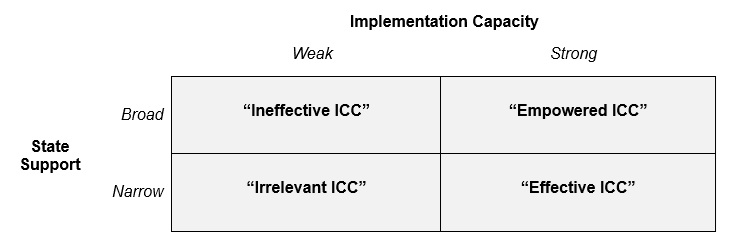
In principle, there are four possible ICC scenarios, based on state support and implementation capacity. When the Court has broad support and implementation is strong, it is truly empowered. Such an ICC has not existed yet and is unlikely to exist in the foreseeable future because the national interests of its constituent member-states tend to trump the Court’s universalist predilections.
When the ICC has narrow support but strong implementation capacity, it can be quite effective, as evidenced by the ad hoc tribunals (or the model the U.S. initially proposed to the Court). In this scenario, things get done but outcomes reflect self-interested policies vulnerable to allegations of politicization.
The current ICC seems to represent a reverse scenario. When nominal broad support is coupled with weak implementation, the ICC is likely to prove ineffective; high on rhetoric, but weak in execution.
The worst scenario would be a Court with both diminished state support and low execution capacity. Over time, it would translate to irrelevance. Distressingly, in the absence of major changes, this is where the current ICC may find itself, if the ongoing geoeconomic and -political divides continue to penalize global prospects.
Four Scenarios SOURCE: The Obliteration Doctrine
ICC’s untenable position
Obviously, great powers, particularly the permanent members of the UN Security Council, seek to influence such scenarios. As a result, the current ICC, overshadowed by its great ambitions but weak implementation capacity, is in an untenable position. The more it promotes universalistic objectives with narrow state support, the feebler it appears.
Instead of complying with the Court’s warrants, countries downplay them. The states signal they may not respect them in the future or openly defy them for domestic political reasons. After the warrants for PM Netanyahu and his ex-minister, Polish leaders welcomed Netanyahu’s visit, as did their Hungarian peers. Germany hedged its bets. French officials stressed a state had “obligations under international law with respect to the immunities of States not party to the ICC.”
Typically, the ICC’s four convictions have all been against citizens of member countries, whereas its cases against non-member state nationals have yielded almost nothing. Despite deposing indicted leaders, such as Sudan’s Omar al-Bashir, their successors have pulled back from cooperating with the Court.
Is there a way out?
A potential though unlikely U.S.-led scenario would be for the UN Security Council, armed with the sparingly used Article 16 of the Rome Statute, to temporarily freeze court investigations into the conduct of non-member state individuals. But even those US observers who regard it as a potential trajectory consider it unlikely.
Toward a multipolar scenario
With the rise of China and the Global South, the above foundational conditions have dramatically changed in the past eight decades. In effect, the broadest state support and most effective implementation can only be actualized in a trajectory marked by multipolarity reflecting the existing global economic, political and military conditions—not those that prevailed 80 years ago.
In the multipolar scenario, the ICC trajectory would no longer be based on the West’s unipolarity. The UN Security Council and its permanent members could retain their role, but it should be augmented by the new conditions of multipolarity; that is, the increasing role of the world’s largest emerging and developing economies.
The history of human rights law is the story of the progressive efforts of the Global South to hold the West fully accountable for the pledges consistently and systematically violated. Certainly, the West doesn’t have a monopoly on genocides, but the latter are inherent in its colonial legacies, its efforts to dilute the scope of the Genocide Convention in the late 1940s and the suppression of genocide prosecutions through the Cold War and the post-9/11 wars.
From the standpoint of the Global South, the appeal of the South African genocide case against Israel is, at least in part, in that it highlights the role of colonial atrocities as a prelude to the killing of six million Jews in Europe and subsequent millions in the Middle East, Asia, Africa and elsewhere.
Realistically, the only long-term solution to ensure appropriate inclusive global governance is to accommodate the role of emerging and developing economies in the existing international regime.
The current regime is a relic of the 1945 “victor’s justice.”
For a copy of The Obliteration Doctrine: Genocide Prevention, Israel, Gaza, and the West by Clarity Press, click here. Available also via Amazon US, Amazon Canada, Amazon UK, Barnes & Noble, Indigo, Bookshop etc. Available already as pdf and e-book, the book will be released on August 1.
The author of The Fall of Israel (2024) and The Obliteration Doctrine,Dr. Dan Steinbockis an internationally-renowned visionary of the multipolar world and the founder of Difference Group. He has served at the India, China and America Institute (US), Shanghai Institutes for International Studies (China) and the EU Center (Singapore). For more, see https://www.differencegroup.net
The companies that are outpacing their competitors in today’s volatile market have one thing in common: they’re deploying generative AI not just faster, but smarter. That’s the core insight from Kevin Oakes, co-founder of the Institute for Corporate Productivity (i4cp), a leading HR research organization with a sharp focus on what separates high-performing organizations from the rest. According to Oakes in his interview with me, the most successful companies aren’t dabbling in Gen AI—they’re operationalizing it across their enterprises. And it’s paying off.
From Experimentation to Enterprise-Scale Integration
i4cp’s latest research, Workforce Readiness in the Era of AI, reveals that only 11% of companies have fully integrated Gen AI across their organizations. These companies are not just experimenting or cautiously researching—they’ve woven Gen AI into both internal operations and customer-facing functions. The result? Superior business outcomes. These mature adopters consistently rank highest in i4cp’s performance index, which measures revenue growth, profitability, and market share.
This correlation is no coincidence. While some may argue that high performers simply have the resources to embrace cutting-edge technologies, Oakes makes a compelling case that Gen AI adoption itself is a driver of success. “The strong are getting stronger,” he explains, “but embracing Gen AI is also pushing companies into that high-performance category.”
Maturity Begins With Training—Especially at the Top
One of the clearest differentiators between leaders and laggards in Gen AI adoption is how they approach workforce training. Oakes notes a surprisingly common shortfall: most companies only train a small segment of their workforce on Gen AI. High-performing companies, in contrast, begin with their leadership. “Oddly enough, leadership is often overlooked,” says Oakes, “but top firms ensure CEOs and senior leaders are not just educated on Gen AI—they’re active users.”
“Oddly enough, leadership is often overlooked,” says Oakes, “but top firms ensure CEOs and senior leaders are not just educated on Gen AI—they’re active users.”
From there, the training expands organization-wide. Effective approaches blend asynchronous courses, instructor-led workshops, and peer mentoring. The training content itself progresses from fundamentals—data security, responsible use, AI ethics—to advanced topics like workflow integration and output evaluation.
In top-performing organizations, leaders sometimes even teach the courses themselves, a strategy borrowed from Jack Welch’s GE playbook. This not only boosts executive fluency in Gen AI but sends a powerful cultural signal: this matters.
Creating a Culture of Co-Creation, Not Compliance
Another hallmark of Gen AI success is how companies handle automation decisions. Too often, automation initiatives are top-down edicts. Instead, i4cp finds that the best organizations empower employees to identify which parts of their roles should be automated.
This approach does two things. First, it taps into the deep, often tacit knowledge employees have about their own workflows—what’s repetitive, what’s draining, what’s ripe for AI assistance. Second, it cultivates buy-in. “Now they’re contributing,” Oakes emphasizes. “It’s a co-creation mentality in the culture as opposed to being told.”
This collaborative method is especially critical in addressing the widespread fear that Gen AI will displace jobs. Oakes acknowledges the legitimacy of these concerns—Gen AI is replacing some roles—but points to a silver lining. “Organizations are adapting. They’re reallocating human brainpower to areas that have long been neglected,” he says.
Curiously, i4cp discovered that the more training employees received on Gen AI, the more their fears about job loss increased. It’s a paradox driven by awareness—those who understand the technology best also grasp its full potential to disrupt. Still, Oakes remains optimistic, drawing parallels to the early days of the internet. “We had the same fears. Over time, they dissipate as we learn how to use the tech to our advantage.”
Communication: The Missing Link in Many Organizations
If there’s a single failure point common to many Gen AI initiatives, it’s communication. “Most companies haven’t articulated a Gen AI strategy internally,” Oakes observes. That leaves employees in the dark—unsure of how the technology will be used, how it will affect their roles, or what the company’s intentions are.
Clear, transparent communication is essential. From executives down to department managers, everyone should understand the strategy and their role within it. Oakes dismisses simplistic motivational slogans—such as “you won’t be replaced by AI, but by someone using AI better”—as too often sounding like veiled threats. Instead, he advocates for open dialogue and honest, ongoing conversations about how Gen AI fits into the company’s future.
Guardrails, Governance, and Getting Smart About Risk
The risks of Gen AI—data privacy, hallucinations, bias—are real. But so is the opportunity. The companies leading the pack aren’t ignoring the dangers; they’re addressing them head-on through proactive training and governance.
Basic training includes guardrails around responsible use, and many firms are adopting internal large language models or deploying Gen AI within walled-off applications to mitigate exposure. “We got smarter about risks with the internet, with smartphones—we’ll do the same with Gen AI,” says Oakes. “It just feels scarier because it’s new and powerful.”
Indeed, the most forward-looking organizations are turning this moment of uncertainty into an opportunity to capture market share and build a competitive edge.
Metrics That Matter
When it comes to measuring Gen AI’s impact, usage is the first metric that matters. Companies are beginning to track who is using Gen AI, how frequently, and to what effect. This baseline data not only encourages familiarity, but also helps correlate usage with productivity gains.
Companies are beginning to track who is using Gen AI, how frequently, and to what effect.
Other meaningful metrics include department-level performance improvements and workforce well-being. “If you’re freeing up time from rote tasks, you’re probably improving mental and even physical health,” Oakes notes. Many of the same indicators used to measure culture—like engagement scores or turnover rates—can also be used to assess Gen AI’s organizational impact.
Looking Ahead: From Generative to Agentic AI
The future of Gen AI lies in something even more autonomous: agentic AI. “It’s a dumb name,” Oakes jokes, “but agentic AI is going to be performing many tasks on behalf of organizations.” These AI agents will execute complex workflows independently, and their rise will force companies to rethink job design and risk frameworks yet again.
While few companies have deployed agents at scale today, Oakes warns that by this time next year, every leader will need to know what they are—and how to use them responsibly. “We’ll be talking about ethical issues, unintended consequences, and probably a few monsters in our systems,” he quips. “But the first step is getting familiar.”
For now, the lesson is clear: companies that want to stay competitive need to move quickly from curiosity to capability. The era of experimentation is closing. The era of enterprise-scale Gen AI has begun. And the strongest players are already surging ahead.
By Danny Leipziger
China cannot continue to rely on exports to drive its growth, but what are the alternatives?
China ran a $1.2 trillion trade surplus last year, and despite admonitions from the IMF to rely...
The World Financial Review uses cookies to improve site functionality, provide you with a better browsing experience, and to enable our partners to advertise to you. Detailed information on the use of cookies on this Site, and how you can decline them, is provided in our Privacy Policy and Terms and Conditions. By clicking on the accept button and using this Site, you consent to our Privacy Policy and Terms and Conditions. ACCEPT
Privacy & Cookies Policy
Privacy Overview
This website uses cookies to improve your experience while you navigate through the website. Out of these cookies, the cookies that are categorized as necessary are stored on your browser as they are essential for the working of basic functionalities of the website. We also use third-party cookies that help us analyze and understand how you use this website. These cookies will be stored in your browser only with your consent. You also have the option to opt-out of these cookies. But opting out of some of these cookies may have an effect on your browsing experience.
Necessary cookies are absolutely essential for the website to function properly. This category only includes cookies that ensures basic functionalities and security features of the website. These cookies do not store any personal information.
Any cookies that may not be particularly necessary for the website to function and is used specifically to collect user personal data via analytics, ads, other embedded contents are termed as non-necessary cookies. It is mandatory to procure user consent prior to running these cookies on your website.

























 For a copy of The Obliteration Doctrine: Genocide Prevention, Israel, Gaza, and the West by Clarity Press, click

 Dr. Gleb Tsipursky