If you have a future project that needs financing, unforeseen bills, or even tuition, you may be able to access financing through unsecured loans. These loans don’t require collateral, such as your home, to get the funds. The standards for qualifying for and applying for one of these loans are typically less stringent than secured loans, and many lenders offer to fund the same or the following business day.
What Is an Unsecured Loan?
These loans can be borrowed without pledging any collateral. They are also referred to as good faith loans or signature loans. Personal loans, student loans, and credit card advances without collateral are common unsecured loans. The application process for unsecured loans is typically less stringent than for secured ones. You can acquire these loans from a wide variety of lenders, including traditional lenders, online lenders, and lenders sponsored by the government.
Pros of unsecured loans
No collateral required
No risk of losing assets
Fast access to funds
Fewer borrowing restrictions
Competitive rates for those with strong credit
How Do Unsecured Loans Work?
You will need to apply to a bank, credit union, or online lender specializing in personal loans to obtain an unsecured loan.
If successful, the funds allotted will be deposited into your account in a single transaction. After then, the loan will be repaid by you in equal monthly installments spaced out over the agreed-upon duration of the repayment term.
In most cases, monthly payments are set, meaning they will neither increase nor decrease throughout the loan’s duration.
How to Qualify for an Unsecured Loan?
You can become eligible for an unsecured loan if you keep a credit score, a borrowing history, and an income that are all satisfactory. To the consumers’ relief, options like seedcash loans for unsecured loans are geared at helping those with poor credit scores.
Loans that do not require collateral to be placed as security are known as unsecured loans. This indicates that you will not be required to give up a valued item to have your application accepted. These loans are made available to borrowers based on their credit history, previous borrowing experience, and commitment to repay the loan. This indicates that an unsecured loan application and approval process may be more stringent. However, this is subject to the particular loan terms and the lending institution.
On the other hand, a loan that is secured by collateral is referred to as a secured loan. Loans from pawn shops, title loans, vehicle loans, and mortgages are some common types of loans. When it comes to these loans, the only way to have your application accepted is to put up some collateral. This indicates that if the borrower cannot repay the loan, the lender has the right to seize the borrower’s vehicle and sell it to recoup the money they loaned.
Take Away
There are still options available if you seek an unsecured loan but have less than excellent credit and want to pursue those options. A personal loan with installment payments is one option that many people choose. Personal loans without collateral are offered to individuals with low credit scores who are in urgent need of financial assistance.
Compared to payday loans, they typically provide a larger amount of money and a longer period to repay the loan. The best news is that even if you have poor credit, you should still have a good chance of being approved for one of these loans.
Having generated over $20 billion in revenues in 2020 and forecasted to grow by at least 30% by 2025, online gaming accounts for the biggest share of the global digital media market revenues, boosted by both an ever-increasing demand for games and the notorious pandemic forcing millions of fans of outdoor fun – as well as lovers of online casinos like Maneki Kasyno – look for digital avenues of entertainment.
Surprisingly enough, Polish gaming is one of the strongest in Europe. While COVID-19 was wreaking havoc all over the world, closing millions of brick-and-mortar businesses, Polish game developers were pumping out games – and quality ones – like there’s no tomorrow. With about 500 new releases annually and just as many development studios, the Polish game production employs over 10,000 people and spearheads the European game dev field.
Having postponed press conferences and game releases and switched to remote working models, Polish game developers show impressive numbers. In 2017, online games generated $91 million in revenues; in 2020, the revenues grew to $127 million; in 2025, the numbers are expected to reach $170 million.
But how come Polish gaming is so robust and resilient? To understand it, we may have to dig deeper into the history of game development as well as popular gambling myths in Poland. Before that, though, let’s give some credit to Anna Rosak, the co-author of this piece and a brilliant gambling & gaming writer from KasynoHEX.
CD Projekt Red to Lead the Scene Since 2007
It won’t take long to spot the three undisputed leaders in the Polish game dev market – PlayWay, Ten Square Games, and CD Projekt Red – but that’s the latter that unambiguously leads the pack and that paved the way for all other companies by developing its renowned The Witcher Series (three main series, two expansion packs, and a spin-off) and the most recent Cyberpunk 2077.
Speaking of the latter, the red-hot title was released on 10 December 2020 to become the fastest-selling PC game everwith 13.7 million copies being sold by the end of 2020, generating over $550 in revenues, which is three times more than The Witcher 3’s launch gathered in its first year.
At the time of writing, the top-5 Polish companies are valued as follows:
CD Projekt Red – €8.66 billion.
Ten Square Games – €887 million.
PlayWay – €736 million.
11 Bit Studios – €268 million.
Creepy Jar – €175 million.
The Market Matures and Diversifies
Just like any other young market, the Polish gaming market matured along with the players, changing and diversifying preferences. Over 16 million Polish gamers play all types of games on mobile phones, computers, and consoles, being catered by about 500 development studios and 10 thousand people working in all kinds of studios:
10 large-scale companies employ over 200 people each.
400 small-scale companies employ less than 16 people each.
As for the young game dev talents, they have pretty good prospects. There are over two dozen programming courses in Poland along with annual meetings like Central & Eastern European Game Awards, DD Awards, and Poznan Game Arena Expo and Game Industry Conference.
eSports
Whether it’s just watching eSports on Twitch or doing it professionally, eSports is popular among Poles. The number of professional players and viewers totaled 1.4 million in 2019 and is growing fast, making eSports a decent alternative to classic sports. Wages-wise, the highest-paid professional eSports player, Nisha (Michał Jankowski, DOTA 2), has made close to $1 million in his career, followed by Neo (Filip Kubski, Counter-Strike) and TaZ (Wiktor Wojtas, Counter-Strike).
The Unique Place to Shine
It looks like Poland is a perfect springboard for young developers – and a good place to remain for that matter. On the one hand, the Land of Fields has a few all-star game dev companies with a strong undisputed leader; on the other hand, everyone willing to work in a small team will have this chance as well. To add to that, the export-oriented nature of the market makes it possible to cater to more developed countries and therefore earn more than it would be possible by serving the domestic market only.
Awash with game dev degree courses, game dev universities, and experienced programmers to share their knowledge, it’s no wonder Poland is the cradle of European gaming.
With a plethora of online casinos available, players have a lot to choose from. An online casino operator usually invests in high-end marketing techniques to attract as many people as they desire. And now, what players see online is that they don’t have to go through the conventional process of signing up.
They can easily look for an easy and simplest option to deposit money to get started. Let’s be honest, there are various factors that combine to make a good casino. Below, we have mentioned some of them for you to know:
Design
The design has a strong impact on the audience. After all, an attractive design will easily attract players. On the contrary, if a casino has an off-guard design or doesn’t look that amazing, it won’t appeal to the people approaching it. But why? In reality, online casino games have to look appealing.
Since they aren’t land-based casinos, players look for an overall experience at an online casino. And since the competition is at an all-time high, casino owners are going the extra mile to ensure players have an amazing experience. For instance, if you wish to play blackjack online, you will look for an online casino that has an amazing design and good quality graphics for sure.
Choice of Games
Today, almost every online casino offers a plethora of games for the player to choose from. And why not? Every player wants to have an amazing experience in a gambling game. The more games a casino offers, the easier it is for them to acquire the player’s interest. Secondly, if you have planned to play various games, look for a casino that offers a plethora of online games to place.
Nowadays, it is important that you stay home and try your luck with free money. When you spend some time on a casino platform, they will even provide incredible discounts and promotions. Ideally, you have to sign up and get started.
Easy Withdrawals
This factor is of utmost importance. The less paperwork and time it takes to withdraw winnings, the customers will get more loyal with time. After all, a player will play at a casino that hardly takes a few minutes to withdraw their innings. On the other hand, a casino that requires additional documents will be discarded by the gamblers.
Having that said, the withdrawal procedures should not be neglected under any circumstance. After all, nobody wants to engage with a fraudulent website. This is where customer support of an online casino is pivotal for its success. The compliance teams have to be as responsive as they can.
Variety of Payment Options
Just like any regular game, players should have a choice of payments too. Therefore, the more they offer, the higher the deposit that you will receive. Nowadays, online casinos are going the extra mile to equip players with a plethora of payment options. And rightly so, since it has emerged as the need of the hour. A typical online casino will offer payment through cryptocurrencies, bank cards, and e-wallets.
The more the number of payment options, the easier it is for anyone to join the online casino. However, if an online casino offers a certain mode of payment to the players, they will lose out on a chance to attract other gamblers.
Live Chat Support
Effective support is one of the main reasons for players to come back to online casinos frequently. After all, it is of great service to manage service 24/7 and solve any issues in the easiest ways. Ensure your support managers are always hands-on with the live chat inquiries. They have to be responsive between the first 60-90 seconds. After all, some players can be very demanding.
Thus, it’s important that you choose an online casino based on the quality of its live chat support. Let’s suppose if you don’t find a certain online casino responsive, it’s best to ignore them.
Bonuses and Promotions
Today, there is no casino without free spins and bonuses. Almost every casino will offer free money in the beginning to attract players. And since the competition is at an all-time high, almost every online casino has incredible benefits to offer. Check out new Australian online casino, and you will be astonished to see the plethora of casinos offering free bonuses in the beginning.
So always look for an online casino that offers amazing bonuses and promotions. Now is a good time to check out the options online and make the right choice.
Gold prices recently fell by over 1.5% to their lowest since April 2020, CNBC reports. Spot gold dipped by 1.6% to $1,643.51 per ounce, following a previous 1.8% drop to $1,640.20 earlier in the year, while U.S. gold futures are now at $1,651, a 1.8% drop. Gold’s fall follows an “unrelenting rally in the U.S. dollar” which comparatively hit a 20-year high as a result of the Federal Reserve’s action to control surging inflation. “This should see (gold) prices trading broadly sideways over the rest of the year,” comments Fitch Solutions.
A vulnerable short-term investment
“We’re seeing relentless dollar strength here and that’s going to keep gold vulnerable in the short term,” said Edward Moya, senior analyst with OANDA. “The economy is clearly heading towards a recession. The risks of a hard landing are elevated and this has been just continuing to drive flows into the dollar, which has been bad news for gold.” Gold is particularly vulnerable to increasing interest rates, which boost the dollar and increase the value of higher-yielding investments, while sending gold lower.
Diversifying portfolios with gold
Despite recent volitarity, gold can still be a valuable addition used to diversify portfolios, which in turn helps lower investment risk. “In general, although each investor’s situation is unique, we believe a 3-5% allocation to gold products would seem adequately sized to capture the benefits of holding gold as an asset class,” advises Imaru Casanova, deputy portfolio manager/senior gold analyst at VanEck. While purchasing physical gold at spot price – the metal’s current base price at this exact moment in time, rather than some future price – usually involves paying a slight premium, investors can take steps to avoid this. Purchasing gold with cash in-person removes the need for pricy middlemen and therefore eliminates the extra premium.
Other precious metals following suit
“Gold and the other semi-investment metals like silver and platinum will likely continue to remain under pressure until the market reaches peak hawkishness,” comments Ole Hansen, Saxo Bank’s head of commodity strategy. Aside from gold, other precious metals also experienced a decline. Spot palladium, in particular, decreased by 4.8% to $2,066.01, platinum by 4.8% to $856.81, and silver by 4% to $18.86 per ounce.
Ultimately, “weakness in bullion is very likely to persist due to monetary tightening that makes gold costlier to hold,” notes Gnanasekar Thiagarajan, director at Commtrendz Risk Management Services. “However, recession fears and any escalation in the Russia and Ukraine conflict could support prices.”
Financial management is crucial to your company because it shows the proper allocation and management of acquired funds. This practice gives you a clear direction when planning your finances and helps you invest in organizational growth.
To help manage your business finances, you need to create separate corporate expense cards, so you can monitor income and expenditure. These assets will help you control your monetary spending and avoid issues in the finance department. In turn, you can improve employee productivity, as well as prevent organizational problems, such as excessive spending and personal expenses disguised as business expenses.
Read on to learn about the benefits of using business expense cards for your financial strategy.
• Finance Control
Effective finance regulation significantly contributes to the cash flow implementation of your company. When you have a proper control structure, you can plan the cash inflows and outflows. As a result, you can successfully handle acquired capital and allocate it properly so that operational activities will continue running.
With the help of business expense cards from subscription services, such as Weel, you have the power to set custom budgets. In addition, you can develop spending rules that your staff should follow. Thus, employees will become more mindful of their habits instead of spending on unnecessary items mindlessly.
• Early Fraud Detection
Accounting fraud often happens when your staff tries to manipulate your organization’s financial health. They’ll try to hide profits and consider them as their own or miscalculate the balance to conceal losses. For instance, your employees may commit fraudulent acts, like failing to record expenses or overstating revenue, for their benefit.
To prevent these costly behaviors, you must use tools, such as corporate expense cards with an early fraud detection feature. Instead of letting your internal auditor investigate suspected fraudulent instances, using this tool will allow you to detect suspicious transactions within your organization automatically. In the case of stolen cards, thieves won’t be able to use them because they’ll have to enter two-factor authenticated codes before accessing the card.
• Real-Time Data For The Finance Department
Transparency is essential to your business because it helps you gain your investors’ trust. When you can show them accurate transparency reports, they’ll continue to provide financial support that will aid in business expansion. Aside from this, you can show transparency reports to prospective business partners during project proposals.
The problem with company cards is that recurring and pending payments can be processed later even if you keep track of credit statements regularly. Consequently, keeping abreast of budgets becomes difficult.
So, to activate financial transparency within your organization, you must use business expense cards that will provide you with real-time data. Business expense cards record every payment that’s made, including proof and managerial approval of purchase. Therefore, a financial controller can log in and check all company spending at any moment, which is assorted by expense category, team, and so on.
• Elimination Of Employee Expense Reports
Expense reports are time-consuming and cast doubt on your organizational data. Furthermore, this traditional method puts an unnecessary monetary burden on your staff, especially whenever they have to use their finances for business transactions abroad. Rather than returning to their daily tasks after having a business-related conference abroad, they have to process these audits, which affects their productivity.
To eliminate inefficient employee expense reports, you must provide your staff with business expense cards. Once you do so, they can purchase supplies for your company without using their own money. Rather than waiting for reimbursements, they can use assets for corporate transactions with a set daily spending limit to avoid overspending.
• Paperless Receipt Storage
Keeping official receipts is vital in bookkeeping because receipts serve to legalize your transactions and ensure that your business stays compliant with tax laws and regulations. When you store the original copies of these documents properly, you can protect your organization from abusive vendors that claim you haven’t paid for their services. Instead of paying for fraudulent claims repetitively, you can use files as proof that you completed the transaction and as protection from financial and legal trouble.
With the help of business expense cards, you can easily store the receipts. Most card providers come with a mobile app where you can enable your employees to take images of these documents. After that, they can save the files next to their most recent payment to ease the payment reconciliation process. Then you can also save duplicates of the receipts through cloud storage, so you’ll always have backups in case of file corruption.
Key Takeaway
As an entrepreneur or a business owner, you must always find innovative ways to improve productivity. A reliable approach to achieve greater efficiency is to apply for business expense cards.
When it comes to styling demi fine jewelry, there are a few things you need to consider. The first is what type of outfit you’re wearing. Demi fine jewelry looks best with casual outfits, so avoid pairing it with formal wear. Let’s take a look at some specific pieces.
Demi Fine Necklaces
There are a few things to consider when styling demi fine necklaces. First, consider the necklace’s overall length. Demi fine necklaces typically fall around or just below the collarbone, so they should be styled accordingly.
You’ll also want to consider the necklace’s width. Demi fine necklaces are typically narrower than other styles, so they should be styled with other delicate pieces. In addition, these necklaces are often lightweight, so the weight of the necklace should be balanced with your overall look.
Finally, consider the necklace’s color and texture. Demi fine necklaces typically have a delicate color and texture, so they should be styled with other pieces that match or compliment those features.
Demi Fine Earrings
Piercing the ears is one of the oldest and most popular forms of body modification. While there are many different styles, there are a few things to consider when styling demi fine earrings.
For example, it is important to consider the type of outfit you are wearing. If you are wearing a casual outfit, then a simple pair of studs is the best choice. If you are wearing a more dressy outfit, then you may want to choose a pair of dangly ones instead.
Finally, it is important to consider the type of occasion you are attending. If you are attending a formal event, then you should choose a more elegant pair of earrings. If you are attending a more casual event, then you can choose a more fun and festive pair.
Demi Fine Bracelets
When it comes to styling demi fine bracelets, there are a few things to keep in mind. First, it’s important to think about the other jewelry you’re wearing. If you’re going for a more subtle look, then demi fine bracelets are a great way to add a touch of personality without going too over the top. You can also use them to add a pop of color to an otherwise monochromatic outfit.
Another thing to keep in mind is the overall shape of your outfit. If you’re wearing a flowy dress or skirt, then you’ll want to choose a bracelet that has a more delicate design. On the other hand, if you’re wearing something more structured, then you can go with a bracelet that has a bolder design.
Finally, it’s all about your personal preference. Feel free to mix and match different designs and colors to create a look that’s uniquely you.
Demi Fine Rings
When it comes to styling demi fine rings, there are a few things to keep in mind. First and foremost, it’s important to find the right ring for your finger size and fashion sense. These rings are typically smaller and more delicate than traditional rings, so finding the right one is key.
If you’re looking for a more fashion-forward look, demi fine rings can also be worn with bolder styles. For example, if you’re wearing a sequin dress, a demi fine ring can add a touch of sparkle and glamour. Or, if you’re wearing a printed dress, it with a simple design can help to balance out the look.
No matter what your style, demi fine jewelry is a great way to add a touch of personality to your look. So, if you’re looking for a simple, elegant piece, or something a little more flashy, these styles are a great option.
We are in the “working age,” meaning that we spend most of our waking hours at work, either sitting at desks or using computers for extended periods. Therefore, employers are responsible for influencing various areas of employee health and lifestyle, from eating habits to physical activity.
Employees who work in an atmosphere that fosters health and well-being enjoy healthier lives. A healthy workplace is one in which individuals succeed in their job assignments, feel fulfilled, and maintain their physical and mental health.
In this piece, we’ll look at some ideas for keeping the workplace healthy and some benefits of working in a healthy lifestyle. Let’s dive in.
What do you need to do?
As the employer, you must assess your safety and health system to determine which components are solid and which require improvement. In this part, we will look at some strategies you might use at work to adopt a healthy lifestyle.
Make a decision.
Put as much effort into your dedication to safety and health as you do to your other company operations. Include workplace safety and health measures in your company strategy and ensure you integrate them into all aspects of the organization.
Encourage employee involvement in safety and health training courses to understand what to do in the event of an injury. Before delivering suitable medication, they must be able to providebasic first aid. Either way, it’s advantageous to have your team enrolled in a first aid and CPR course to cover all bases and be ready if accidents occur.
Teamwork.
Reducing loneliness and isolation at work boosts morale and keeps productivity stable. And you can do this by making excellent cooperation a corporate culture. Making all resources available to employees who are feeling isolated will assist you in reducing the effects on corporate performance.
Take frequent breaks.
Taking frequent pauses, even when you are busy, is a crucial thing you can do to stay focused and productive. Working smart entails taking regular breaks, which allows you to leave the workplace on time and improves your work-life balance.
Take medical leave if you need it.
Forcing your staff to work when they are unwell is selfish, and you risk transferring germs to your coworkers and lengthening their healing time. Make sure your team has medical allowances or is covered by medical insurance so they may have affordable medical consultation and treatment.
Identify and eliminate dangers.
To discover dangers before you can control, analyze accident and sickness data or look for trends in the kind of injuries or illnesses, equipment, and time of day or shift. After identifying the dangers, devise a strategy to address them, and ultimately, assess the adjustments to ensure that you have resolved the problem.
What are the benefits of a healthy lifestyle at the workplace?
Offering your employees resources to assist them better all aspects of their lives through an employee health and well-being program has many advantages, including:
Increased productivity.
Employees who are physically and psychologically better frequently have less anxiety about their health issues, they feel their best, and they can do their jobs at their best, enhancing total productivity.
Assist in decreasing healthcare expenses.
A healthy lifestyle at work contributes to decreased healthcare expenses, promotes employee physical activity, and offers opportunities for healthy food and workplace health rewards. Furthermore, employees are sick and injured less frequently, resulting in cheaper insurance expenses for the organization.
Improve employee retention.
As an employer, caring for your staff increases their likelihood of staying with your firm, which is a benefit. This is because they understand that the firm is concerned about their well-being and strives to keep them psychologically and physically well.
Encourage a healthy way of life.
A workplace healthy living program provides incentives and means to track many aspects of employees’ health, from what they eat to their medicine. Following all of these aspects of an employee’s health allows them to see where they need to adjust to maintain a healthy lifestyle.
Boost employee engagement.
Providing a healthy lifestyle allows employees to participate more actively in their careers. While providing the opportunity stimulates engagement with one another since they feel better and can focus more easily.
Conclusion
Promoting a healthy lifestyle at work helps a firm flourish by assisting its workers in adjusting to their new working environment and increasing productivity. Furthermore, encouraging a healthy lifestyle at work makes them feel appreciated and understand their value to your organization.
Hokodo provides “buy now, pay later” solutions to the B2B market, enabling business customers to benefit from instant, frictionless, interest-free payment terms. A leader in the field in the UK, Hokodo is currently expanding into continental Europe. Here, co-founders Louis Carbonnier, Richard Thornton, and Sami Ben Hatit reveal how three friends came together to set up and operate the company.
What brought you to the idea of Hokodo and what other experiences led up to your founding Hokodo, along with your co-founders?
”Hokodo was created because there was a glaring gap in the market,” explains Louis. ”Having worked with Richard (Thornton, co-founder and co-CEO) for several years in the embedded finance space, helping big banks and insurers to sell financial services at the point of need, I moved on to join Allianz Trade (fka Euler Hermes), the leading provider of trade credit insurance. Euler Hermes provides a great product for supporting credit terms but, after a while, I began to notice a few shortcomings.
“Firstly, it’s so complex that a sophisticated finance department is required to manage the product, and so only large corporates can benefit from it. Secondly, working on a 48-hour cycle, it’s designed for offline trade, so it excludes the e-commerce market by default. At this point, I began investigating whether there was an alternative, a financing or lending model for B2B that all businesses could access.
”I mentioned it to Sami (Ben Hatit, co-founder and CTO) and we started to prototype some BNPL APIs. Then Richard came on board and, once we’d agreed we were on to something new and exciting, Hokodo was born.”
Hokodo has multiple co-founders. To some entrepreneurs, this can be difficult, as they may want full control over the vision of the company. How did your founders come together and how do you work well together?
“Louis and I met and became friends while studying at college,” explains Sami. “We had shared interests and remained friends as we went our separate ways into the world of work, sharing experiences and ideas. So, for us, starting a business together was almost a natural progression.”
“We had shared interests and remained friends as we went our separate ways into the world of work, sharing experiences and ideas. So, for us, starting a business together was almost a natural progression.”
“And I met Richard later on when we were both employed at Oliver Wyman,” adds Louis. “As a young professional, Richard’s work ethic and attitude made a huge impression on me. I recall a particular consulting engagement where we had finished nearly all the work our client had requested in a much shorter time than had been allocated. Many of Richard’s peers would have stretched out the final tasks in order to squeeze every penny from the client but, instead, he chose to return some of their cash and move on to the next job.
“When it came to setting up Hokodo, deciding to bring Richard and Sami on board wasn’t a difficult choice for me. We all have different skill sets and experiences, and any Hokodian will tell you we are very different people! But this works in our favour, rather than against it, allowing us to focus on the areas where we excel, while knowing the other areas are well taken care of.”
There has been a lot of noise recently around BNPL. What makes Hokodo stand out from the rest of the BNPL space?
“Our real point of differentiation is that Hokodo meets all the requirements of B2B merchants,” says Louis. “So, they have one provider managing the end-to-end process – from checkout, through credit scoring and fraud detection, to financing, payment, and collections. This means that merchants don’t have to worry about the admin or the credit checking. They can simply concentrate on business growth, leaving Hokodo to handle the rest. Our other advantage is the geographical reach of our platform, which already serves the six largest European markets – with more to come very soon.”
Hokodo has recently raised funding. As an entrepreneur and, more specifically, a tech entrepreneur, what advice would you give to other entrepreneurs who are wanting to raise investment in their startup?
“At Hokodo, we’re lucky to have completed our raise when we did,” says Richard. “Given the current economic climate and impending recession, tech entrepreneurs everywhere should be aware that raising investment is going to be very tough for the foreseeable future. Investors are going to be much more conservative with their money. Therefore, being able to demonstrate profitability will be more important than ever.”
“As investors continue to tighten their purse strings, only the startups with the best tech and a unique proposition are going to have what it takes to survive,” adds Louis. “My advice for any entrepreneur is to ensure that you invest in your tech stack and make sure that the product you’re taking to market has a unique edge which pushes it ahead of the competition or incumbents.”
Innovations in technology are constant in almost every industry, but what changes have you seen specifically in the fintech/paytech space in recent years? How has this changed the way you run your business?
“We’ve seen many marketplaces and e-commerce operators in the B2C space turn to various forms of embedded finance in recent years,” says Sami. “They’re looking to satisfy the financial needs of their customers in a streamlined way. And they have a range of options to choose from now – digital wallets, PayPal, and “buy now, pay later” options, as well as the more traditional methods.
This is turning the payments space into an entry point for many additional financial services, and you can take Hokodo as an example of that.
“As consumers, we are all used to seeing and using these embedded finance tools at the point of purchase, but they’ve been absent in B2B trade until very recently. Now we’re beginning to see them come through, often connected to the checkout via an API. The more businesses that see these solutions when making trade purchases, the more receptive they become to products like ours.
“Embedded finance works by coming in at the point of need, adding value to the buyer journey. This is turning the payments space into an entry point for many additional financial services, and you can take Hokodo as an example of that. While clients perceive us as a deferred payment method, we actually aggregate many services.
“To manage deferred payments, we need to provide instant credit checks, fraud detection, collections, insurance against non-payments (aka credit insurance), and financing. Previously, these have been services that would operate independently. But by amalgamating them, we are streamlining the entire system for sellers, as well as their customers. We give our clients one single API to manage the whole trade credit cycle.”
There are many companies that have made big names for themselves in the consumer BNPL space. Do you believe it’s harder to be heard in the B2B space? What particular challenges do you face?
“Being heard in the B2B space isn’t necessarily harder than in the B2C space,” says Louis. “But the challenges around marketing, communications, and PR are certainly very different in B2B. At Hokodo, we think of ourselves as a ‘B2B2B’ because our clients are businesses (merchants and marketplaces), but their clients – the ones choosing to pay using Hokodo’s solution – are also businesses. So, we need to create communications and content which speak to two different groups of customers.
“One of the main reasons that B2C BNPL providers like Klarna have made such a huge name for themselves and created such strong brands is just the fact that they’ve been operational for longer than Hokodo and its peers, so have been able to spend more time and resources on their marketing than we’ve yet had the chance to do.”
What are you most proud of about Hokodo? What have been some stand-out moments and successes?
“For me, it’s the Series B fundraise,” says Richard. “Securing €37 million in funding at what has been something of a turbulent time in terms of global finance, was a real show of confidence in our product and our team.”
“Yes, it’s the team that has to take a lot of credit for the strength of Hokodo,” says Louis. “So that’s probably what I’m most proud of at this stage. We’ve built a team – currently of about 80 people – all of whom are exceptional in their own way. And they’ve all shown such commitment to the business.”
“It’s the solution itself for me,” adds Sami. “Creating an end-to-end tech, credit, and analytics stack that has proven so effective is a massive achievement.”
Lastly, what do you see for the future of B2B BNPL and what does this mean for Hokodo?
“We don’t claim to have a crystal ball,” says Richard. “However, we can make an educated guess about where B2B BNPL is heading. In the short term, things are going to be tough – in B2B BNPL, in B2C BNPL, and for businesses in general. You’ll have seen that many B2C BNPL players are currently struggling to stay afloat financially. These hits are going to be made worse by the fact that we’re almost certainly heading towards a recession and that fintech funding has rapidly dried up over the first half of 2022.
“As if that isn’t enough to deal with, government scrutiny is also increasing and, while this is mostly focused on protecting consumers who are using B2C BNPL, it remains to be seen how impending regulation might impact B2B lenders like Hokodo. However, this is not entirely bad; these conditions will result in consolidation and the disappearance of weak business models.”
“Longer term, things look brighter,” adds Louis. “Trade credit has been the payment method of choice in B2B trade for hundreds of years, and it’s here to stay, optimised for e-commerce in the form of B2B BNPL. The continued need for innovative, digital-first payment solutions will support the growth of BNPL companies – as long as they are able to operate on a global scale.”
Louis Carbonnier– is a co-founder and co-CEO of Hokodo where he leads the commercial strategy and product development of the company’s B2B “buy now, pay later” solution. Louis was previously the head and founder of the Digital Agency at Euler Hermes, the world’s leading trade credit insurer and part of the Allianz Group. Louis started his career in strategy consulting at Oliver Wyman, where he was a principal in the financial services practice.
Richard Thornton– is a co-founder and co-CEO of Hokodo, where he leads the back office functions, including risk analytics, operations, finance, and legal. Richard was previously the Group Chief Risk Officer and then Group COO at the global (re)insurer Aspen. Richard started his career working as an economist at the Bank of England before spending 14 years working in strategy consulting at Oliver Wyman’s financial services practice.
Sami Ben Hatit – is a co-founder and CTO at Hokodo, where he leads and oversees the technical architecture and engineering team. Sami was previously the CTO at Euler Hermes digital agency after a career in software engineering.
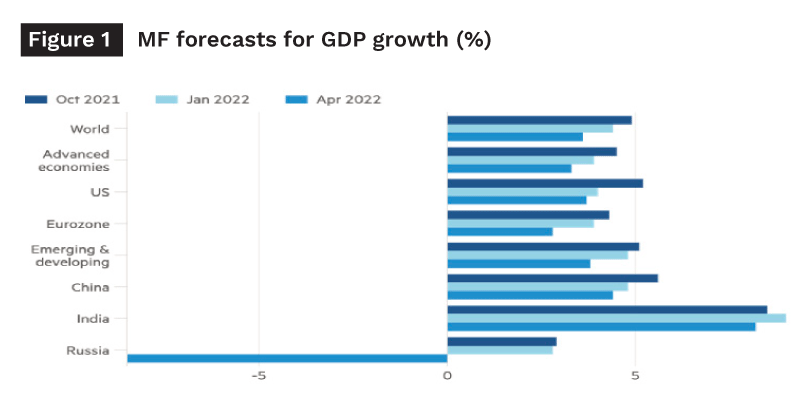
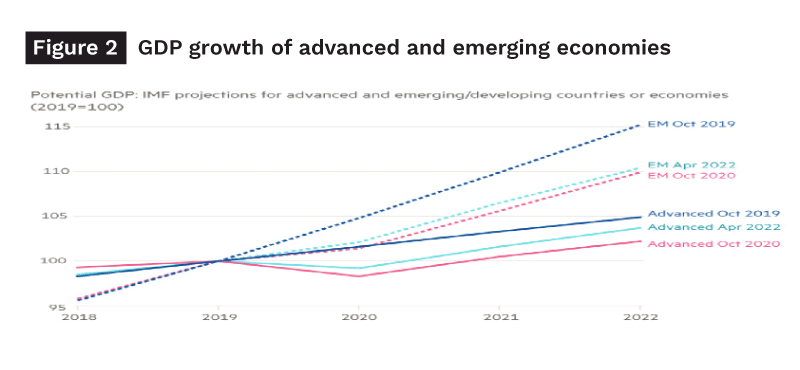
The International Monetary Fund (IMF) in its latest assessment of the world economy has downgraded prospects for economic growth and also expects higher inflation. The IMF Report (2022) notes: “Global growth is projected to slow from an estimated 6.1 percent in 2021 to 3.6 percent in 2022 and 2023. This is 0.8 and 0.2 percentage points lower for 2022 and 2023 than projected in January. For 2022, global economic growth has been reduced from 4.5 percent to 2.5 percent. Beyond 2023, global growth is forecast to decline to about 3.3 percent over the medium term” (see figures 1 and 2).
Source: IMFSource: IMF
The IMF report forecasts that inflation will rise now to nearly 6 per cent annually in the advanced economies and 9 per cent in the developing countries (as indicated in figure 3). This is the result of higher commodity prices and other supply shortages. As Jason Furman of Harvard’s Kennedy School insists, this inflation is “demand-driven and persistent”. As in the 1970s, strong demand could sustain a wage-price spiral as workers seek to maintain real incomes (cited in Wolf, 2022).
Source: Refinitiv, Consensus Economics
For the UK, too, the growth forecast remains low for 2022 and this is expected to continue into the whole of next year, with growth averaging zero over those twelve months. Moreover, soaring energy prices will push the UK economy into recession later this year. The annual rate of inflation in the UK is currently 7 per cent. The Bank of England expects inflation to rise to double digits by September 2022. The Bank of England raised interest rates from 0.75 per cent to 1 per cent in April 2022 to combat rising inflation, but there is no guarantee that it will be enough to bring commodities prices down. In short, the UK economy is being hit by a series of shocks. The upheaval caused by a succession of lockdowns to contain COVID-19 has been followed by the war in Ukraine, which has further inflamed the market price of gas, oil, and a series of other vital commodities (Siddiqui, 2022).
The ongoing war in Ukraine is raising the risk of global food shortage and the possibility of famine, as exports of foodgrains, fertilisers, and energy have been disrupted. As a result of this, the prices of essential commodities have risen sharply. It seems that the global economy is heading towards an economic recession. These events remind us of the vulnerability of food supply and food availability, particularly in poor countries.
António Guterres, secretary-general of the UN, said on 26 May 2022 that the conflict in Ukraine, coming on top of existing pressures on food prices, “threatens to tip tens of millions of people over the edge into food insecurity followed by malnutrition, mass hunger and famine”. Therefore, it is crucial for a country to pursue the policy of “food self-sufficiency” and “food sovereignty” (Siddiqui, 2021a).
There are several critical factors that would push the global economy into a deep recession. For example, in recent months in the United States the sharp rise in prices of essential commodities is adding the risk of stagflation in the economy, which is expected to be heading into deep recession by 2023. In the EU countries, costs and the prices of commodities are rising, while the situation is worse in many developing countries, where food crises are looming. If such a large economy as that of the US is heading towards recession, this will adversely affect the global economy and have an even more severe impact on the developing countries, who happen to be food importers as well. According to Robin Brooks, chief economist of the Institute of International Finance, the confluence of these shocks suggests the world economy is already in trouble. “We’re in another global recession scare now, except this time we think it’s for real” (Financial Times, 2022).
The IMF report forecasts that inflation will rise now to nearly 6 per cent annually in the advanced economies and 9 per cent in the developing countries.
Financial markets are showing signs of a looming crisis. The MSCI world index of equities fell more than 1.5 per cent in the past week, more than 5 per cent in May, and more than 18 per cent since a peak in early January. Mr Joshi, the chief strategist at BCA Research, notes: “The last time that the ‘everything sell-off’ star alignment happened was in early 1981 when Paul Volcker’s Fed broke the back of inflation and turned stagflation into an outright recession.” He further says, “The US National Bureau of Economic Research defines a recession as ‘a significant decline in economic activity that is spread across the economy and that lasts more than a few months’” (cited in Giles, 2022).
There is no doubt that wars add to economic crises. For instance, the Vietnam War created a huge adverse impact on US public finances and, during the Korean War, prices rose sharply. The present war in Ukraine seems to be no exception and this war directly involves oil and gas, while Ukraine is also an exporter of food grain. This will raise the prices of vital commodities worldwide and hit people in poor countries hard (Wolf, 2022). In most countries, the central banks are now planning to raise interest rates in the coming months to counteract rising prices. This would reduce aggregate demand and push the world economy towards higher unemployment and stagnation.
However, the US Federal Reserve, which sets interest rates, claims that it will have little impact on the real economy. The current Fed chairman, Jerome Powell, argues that this is because of a money wages push, which in turn arises because people expect inflation to occur, and this increases interest rates. Money wages lag behind price rises, meaning that real wages decline. This means that inflation is due to the money wage push. As people expect abatement of inflation, this will end the money wage push and thus bring down inflation. This adjustment will remain confined to the sphere of expected prices and a slowdown in the economy will be short-lived. Such arguments are incorrect. It is said that the current inflation is due to the Ukraine war, which has created scarcities of essential commodities. This explanation is far from the whole truth and the war may cause price rises.
There is little evidence that any disruption of supplies has taken place in the US market due to the Ukraine war. But the key reason that commodity prices have risen faster than wages in the US is owing to an autonomous increase in profit margins. There might be some shortages because of supply chain disruptions due to the pandemic, but the rise in prices is more pronounced and seems to be due to MNCs’ speculative behaviour. This may also be due to the easy availability of credit with the policy of quantitative easing until recently, as well as the US Federal Reserve keeping interest rates at near zero, which created a liquidity overhang. Therefore, Keynes supported the “socialisation of investment” to avoid the Great Depression eighty years ago, and an active fiscal policy along with an appropriate monetary policy. This will mean subservience of financial capital to the needs of the whole of society. However, the free flow of capital is an important component of the current neoliberal globalisation and any control over capital movements is not acceptable to international finance (Siddiqui and Armstrong, 2017).
II. Looming Economic Recession
Here, I would first like to define economic recession and describe past recessions. The IMF and World Bank prefer to characterise a global recession as a year in which the average person experiences a drop in real income. They highlight 1975, 1982, 1991, 2008, and 2020 as the dates of the previous five global recessions (Siddiqui, 2019a; also, 2019b).
Recessions can happen for various reasons, and they are generally associated with rising unemployment and falling household incomes and spending. During the mid-1970s, recession was driven by oil price shocks and industrial disputes. Meanwhile, the recession of the early 1980s stemmed from high inflation and interest rates (Dahle and Siddiqui, 1989). And the early 1990s recession was sparked by high interest rates, falling house prices, and an overvalued exchange rate. The recession of the 2008 financial crisis was due to excessive credits, a mortgage crisis, and high interest rates, alongside excesses and imbalances in the banking and real estate sectors (Siddiqui, 2020a; also, 2019c).
A recession can have a devastating impact on people’s everyday finances, as low-income households witness a decline in incomes and loss of employment. For example, in the US and the EU, the wealthiest 1 per cent recovered from the 2008 crisis at a pre-crisis level within a few years, while it took much longer – around 2017 – for the bottom half of the wealth distribution in the West to regain pre-crisis wealth levels (Economist, 2022). This assumes that the government in these countries relies on monetary policy, not fiscal policy. The rich mostly prefer monetary policy to fiscal policy as a policy tool of macro-stabilisation, because monetary policy tends to benefit the rich disproportionately as they hold most of the assets whose price rises, while the poor rely on “trickle-down”.
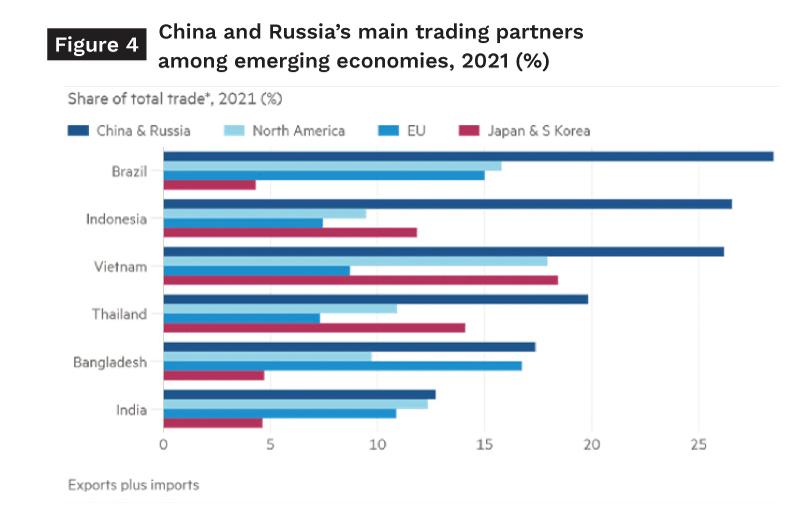
During the Ukraine war, the US has imposed sanctions against Russia. However, besides being a major global supplier of oil and gas, Russia is also an important supplier of foodgrains and fertilisers, and any sanctions will not only increase the prices of these commodities but also disrupt their supply (see figure 4). However, unlike Russia, China is an economic superpower and it is wrong to ignore the Chinese economy and its prospects in the near future (Siddiqui, 2020b). The Chinese economy is the second-largest and its performance will have a major impact on the global economy. As figure 5 shows, Chinese output and consumer spending has declined in 2022 compared to the previous year. The contraction of its output will have a major impact on raw material imports and thus adversely affect income and employment in many developing countries. At this critical juncture, cooperation with China is needed to resolve the increasing foreign debts of the developing countries. Recent statistics reinforce concerns about the Chinese economy’s growth prospects for 2022-3. China accounts for 19 per cent of the world’s total output, and it is now the largest world trading and foreign investor country. So the rest of the world cannot ignore its recovery and economic performance, after it overcomes COVID-19, especially because of its impact on global supply chains and its imports of goods and services from the rest of the world (Siddiqui, 2020c; 2020d).
Source: IMF, 2022Source: IMF, 2022
For example, with COVID-19 lockdowns ending, ships are queuing outside Chinese ports and industries. But recently, its retail sectors have started to contract. Retail sales had fallen 11 per cent by April 2022, while industrial production was down 3 per cent. China’s home sales also dropped more in April 2022 compared to April 2019, when its economy went into reverse, despite the People’s Bank of China loosening monetary policy to encourage borrowing and spending.
In the US, the other global economic powerhouse, the economy is still suffering from the legacy of the pandemic and an excessive fiscal stimulus that arguably ran the economy too hot and generated high inflation, even with modest energy price rises. The US Fed has now moved decisively into a phase of tightening monetary policy to slow growth and bring inflation down. The Fed chair, Jay Powell, stated last month that the Fed would continue to raise interest rates until it saw that inflation was returning to the 2 per cent target. He was not concerned about rising unemployment. Many in financial markets think that with such a policy alone, it might be hard to achieve low inflation. Krishna Guha from the Global Policy and Central Bank Strategy, based in Washington, warns, “Bringing inflation under control without a recession and large increase in unemployment. . . will be challenging.”
During the COVID-19 crisis, we saw that the big, rich corporations were able to increase their wealth and assets disproportionately. There is a need to scale down rising inequality within countries.
The Bank of England now expects “a major recession” from late 2023 to early 2024, according to a recent note to investors entitled, “Why the coming recession will be worse than expected,” although the bank predicts that the economy could pick up in mid-2024. Perhaps things will get worse before they get better. The other powerful economic block, namely the EU, is not showing good signs either. Inflation reached 7.6 per cent in May 2022 and prices in the EU are rising much faster than incomes, as a result adversely impacting living standards. Rising prices will reduce spending and overall household demand and, thus, economic recovery from the pandemic seems to be far away. Already, the recent forecast from the European Commission expects stagnation in late 2022.
The European Commission expects the economy to get over this difficult period and return to normal growth of about 0.5 per cent by August 2022, but economists think that the crisis will have a longer effect. Christian Schulz, an economist at Citi, says that the official forecasts appear too optimistic and it is more likely there will be “virtually no growth for the rest of the year”. If Europe is facing difficulty in adjusting to much higher energy prices, then the developing countries will find it even harder to deal with the sharp rise in food prices, which account on average for more than 30 per cent of expenditure in developing countries.
Currently, Sri Lanka is facing economic collapse and bankruptcy. However, the country has faithfully followed the IMF’s recommendations for several years, including tax reductions on foreign investors, investing disproportionately in infrastructure and export-led growth, while ignoring the domestic agriculture and industrial sectors. The government hoped that the increased concession to the rich would lead to higher investment and the economy would grow, but this miracle did not happen. Now, Sri Lanka has made some dire choices, also faced by many other poor countries, when it decided last week to default on its foreign debt for the first time. This, it said, was necessary to use its hard currency to import fuel, food, and medicine.
India, meanwhile, intensified the foodgrain problems in other emerging economies by reneging on a pledge not to ban the export of grain this week. Due to the ongoing war in Ukraine, wheat prices in India rose again and are up more than 60 per cent within the last three months.
Ukraine and Russia together constitute about 30 per cent of the world’s total wheat exports. Many poor developing countries are heavily dependent on food imports, and foodgrain supplies are being disrupted due to the conflict in Ukraine. Moreover, the war itself is affecting the cultivation of land and production of foodgrain. Ukraine alone accounts for 30 per cent of the world’s maize exports, which is also the staple crop consumed in Africa.
Russia is also the main supplier of chemical fertilisers for many developing countries. Fertiliser is an important input of the “Green Revolution” technology and the disruption of its supply from Russia will have a severe impact on its prices; and a reduction in the supply of fertilisers would adversely affect foodgrain output in the developing countries. Prior to the Ukraine war, on 10 February 2022, and soon after the start of the war, on 10 April, within such a short period foodgrain prices alone rose by 17 per cent (see figure 6).
Source: FAO
The most vulnerable countries are those that have witnessed civil wars, such as Afghanistan, Congo, Mali, Nigeria, Somalia, Yemen, Sudan, and South Sudan. These counties have had a history of conflicts and long-term political instability and poor governance. Thus, their vulnerability to famines and loss of life has been affected by the disruptions in domestic food production. So, it is rooted in and related to poverty and the prevailing domestic crisis. These countries also had debt crises and were forced to adopt neoliberal economic policies, including trade liberalisation and the abandonment of “food self-sufficiency”, under IMF pressure. As a result, these countries experienced a sharp fall in per capita foodgrain output from the mid-1990s (Siddiqui, 2019d).
The free trade policy is backed by the World Trade Organisation, which is based on David Ricardo’s policy of “comparative advantage” (Siddiqui, 2018), meaning that the developing countries should abandon achieving food self-sufficiency. “Free trade” in agricultural commodities is fully supported by mainstream economists in the name of efficiency and competition (Gallaghar and Robinson, 1953). However, the mainstream economic policy is also known as neoclassical orthodoxy. On such views, Joan Robinson, a prominent Keynesian economist, said: “One of the main effects of the orthodox traditional economics was … a plan for explaining to the privileged class that their position was morally right and was necessary for the welfare of society” (Robinson, 1937: 76).
We should mention here that, at present, the advanced capitalist countries have a surplus in food grains and are looking for overseas markets. The poor tropical countries have been advised by the IMF to produce cash crops for exports to earn foreign exchange, repay their foreign debts, and overcome the foreign exchange crisis. As a result, these countries neglected their foodgrain production, and resources were moved into the cultivation of cash crops. All these culminated in a situation where they began to increase imports of foodgrains and the advanced countries were able to get rid of their surplus.
Neoliberal capitalism is defined so as to explain the phase of capitalism where restrictions on the global flows of capital and products are removed. As a result, such development leads to the centralisation of capital. The capital is allowed to take advantage of low wages and produce and sell to the global market. The role of the state is changed, so that, instead of defending the interests of most of the population, including workers and farmers, it becomes the defender of the interests of foreign investors and, further, this means the withdrawal of state support from farmers and petty producers.
It is widely recognised that economic stagnation and the long-term decline in growth have led to an extraordinary increase in economic inequality, which has been emphasised by Thomas Piketty’s book Capital in the Twenty-First Century. These two issues, namely deepening stagnation and growing inequality, have created a severe crisis in the mainstream economist theories.
During the Great Depression, unemployment in the US rose to 25 percent in 1934. It was in this context that Keynes became critical of the neoclassical orthodoxy in his well-known book The General Theory of Employment, Interest and Money (1936). He attacked the notion of Say’s Law that “supply creates its own demand”. He did not accept the notion that full-employment equilibrium exists in the long run. Instead, Keynes contended, “When effective demand is deficient, there is under-employment of labour in the sense that there are men who are unemployed who would be willing to work at less than the existing real wage.”
The recent globalisation and the collapse of the Soviet Union and the integration of Eastern Europe and China into the advanced capitalist economies saw the multinational corporations (MNCs) taking advantage of cheap resources and expanding global markets, and establishing global value chains as the dominant form of capitalism in the twenty-first century. In recent years, we have witnessed not only consumer goods and high tech, but capital equipment and advanced research, being produced in several countries or regions, integrated through global value chain production. For instance, according to the International Labour Organisation, between 1999 and 2018, employment via global value chains increased from nearly 300 to 500 million, constituting one in five jobs in the world (World Development Report, 2020).
The global value chain productions represent the latest form of monopoly capital in the twenty-first century. Now this is how surplus value is created and captured from workers in the developing countries, where there is a large pool of unemployed people who are hired by MNCs based in the advanced economies at low wages and to make higher profits. This exploitation is called by the mainstream economists “value-added”. The current globalisation and free trade and capital movements allow MNCs to take advantage of wage differentials and intensify the exploitation of workers and resources in the developing countries (Suwandi, 2019; Siddiqui, 2020e; Lin and Ha-Joon, 2009).
The World Development Report (WDR) claims that “global value chains” are helping the developing countries’ economic development by raising incomes, employment, and living conditions (WDR, 2020). However, in reality, most developing countries have witnessed rising income inequalities and unemployment, and intensification of the exploitation of their workers.
There is little evidence that any disruption of supplies has taken place in the US market due to the Ukraine war. But the key reason that commodity prices have risen faster than wages in the US is owing to an autonomous increase in profit margins.
The “global value chains” are based on David Ricardo’s “comparative advantage trade” theory, which assumes that free-market transactions take place between companies with no power differentials. According to the report, encouraging the development of participation in global value chains is the road to more jobs and sustainable growth. For example, the WDR (2020: XII) notes, “Participation in global value chains can deliver a double dividend. First, firms are more likely to specialise in the tasks in which they are most productive. Second, firms can gain from connections with foreign firms, which pass on the best managerial and technological practices. As a result, countries enjoy faster income growth and falling poverty.” The report further emphasises that “global value chains boost incomes, create better jobs and reduce poverty… that global value chain-led development generates mutual gains for lead firms (concentrated in developed countries) and supplier firms (concentrated in developing countries)” (WDR, 2020: 3).
The comparative advantage theory is based on mainstream economists’ assumptions of perfect competition. On this notion, Joan Robinson has noted that perfect competition is most unrealistic for the present phase of capitalism and such an assumption is a myth and capitalist competition is characterised by the tendency toward monopolistic competition (Robinson, 1937). The “free trade theory” ignores the fact that the MNCs wield unprecedented economic power over the workers and suppliers in the developing countries. The increased competition to attract foreign investors and to facilitate higher profits leads to lower wage rates. Contrary to the claims, the “comparative advantage” theory does not provide mutual gains to all trading countries.
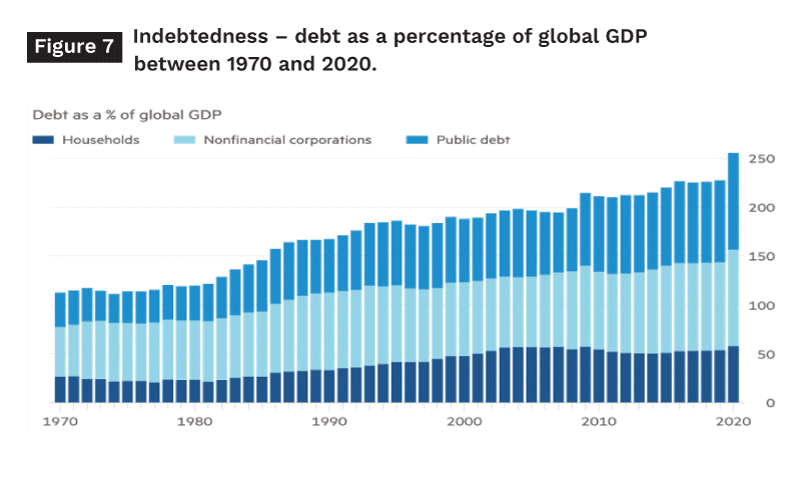
The upshot is that the world economy is now in a debt trap (see figure 7). Levels of debt and equity valuations are so high that central banks cannot tighten monetary policy without posing a serious threat to economic stability. In short, the world economy now carries explosive levels of debt and is in a debt trap. However, despite the sharp rise in Asia’s share of global GDP, especially due to the Chinese and East Asian economies (Siddiqui, 2021b), Europe and North America dominate in terms of top leading global companies and investment in R&D. The advanced economies are defined as high-income and have a disproportionately greater share of the global GDP. According to the IMF, these countries will still account for 57 per cent of global output, against China’s 19 per cent, at market prices in 2022. They also issue all the main reserve currencies (see figure 8). China holds more than US$3 trillion in foreign currency reserves, while the US holds none. But the US can print them. Moreover, the advanced economies, led by the US, are not just a strong economic power but also have the largest and most modern armies.
During the COVID-19 pandemic, there was a huge contraction of the global GDP and a rise in unemployment. In fact, even before the pandemic, the global economy was already slowing down. Ever since the global financial crisis of 2008 following the collapsed housing bubble, the world economy never fully recovered. There were short-term recoveries but these lasted for a short period and did not experience steady, smooth upward growth.
Since the late 1990s, the growth rates of Asia’s economies are faster than the West and are most likely to become the dominant economy of the world (Siddiqui, 2016; also, Siddiqui and Armstrong, 2017). The Asian countries constitute nearly 60 per cent of the world’s population. According to the IMF, the average real output per head of these Asian economies will increase from 9 per cent of that of the advanced economies in 2000 to 23 per cent in 2022. This upward trend will most likely continue in the coming years.In the past, we have ample evidence that the level of “financial fragility” is dangerously high in much of the West, especially the US and the UK, and China, too, reflecting very high levels of wealth and income inequality, now combined in the West with the pandemic crisis.
During the COVID-19 crisis, we saw that the big, rich corporations were able to increase their wealth and assets disproportionately. There is a need to scale down rising inequality within countries. Beyond strengthening regulation of finance, business and political leaders must stop being so mulishly unquestioning of billionaire wealth and act to reduce it. And a progressive and inclusive policy is needed to increase real income support for vulnerable households and more progressive taxes on income, wealth, and profits.
At present, inflation continues to soar and the increasing cost of living hits households across the nation. Most economists are predicting another recession by next year. It will mean a phase of both high unemployment and inflation. To combat inflation, the US and the UK will most likely adopt the tightening cycle of monetary policy. The risk of recession, worsened by defaults and financial disruption, could be high. In addition to this, it seems that the economic recession would have worse implications due to growing tensions between Russia, China, and the West. Due to the current war in Ukraine, the key affected areas are economic sanctions, disruption in trade, rise in commodity prices, financial instability, and economic uncertainty. It is obvious that, under such circumstances, global cooperation seems to be very important. However, the rising tensions and conflicts will push toward economic collapse and the destruction of the environment.
Dr Kalim Siddiqui is an economist, specialising in International Political Economy, Development Economics, International Trade, and International Economics. His work, which combines elements of international political economy and development economics, economic policy, economic history and international trade, often challenges prevailing orthodoxy about which policies promote overall development in less developed countries. Kalim teaches international economics at the Department of Accounting, Finance and Economics, University of Huddersfield, U.K.. He has taught economics since 1989 at various universities in Norway and U.K.
References
Dahle, T. and Siddiqui, K. (1989). “World Economy Heading Towards Recession”, Bergens Tidende, (in Norwegian) 3 July, Bergen, Norway
Lin, J. and Ha-Joon, C. (2009) “Should Industrial Policy in Developing Countries Conform to
Comparative Advantage or Defy It?” Development Policy Review, 27(5): 483-502.
Robinson, Joan. (1937). Essays in the Theory of Employment, New York: Macmillan, p.176.
Siddiqui, K. (2016). “Will the Growth of the BRICs Cause a Shift in the Global Balance of Economic Power in the 21st Century?” International Journal of Political Economy, 45(4): 315-38.
Siddiqui, K. and Armstrong, P. (2017). “Capital Control Reconsidered: Financialization and Economic Policy”, International Review of Applied Economics 32(6): 1-19, March.
Siddiqui, K. (2018a). “U.S. – China Trade War: The Reasons Behind and Its Impact on the Global Economy”, World Financial Review, Nov/Dec, p.62-8.
Siddiqui, K. (2018b). “David Ricardo’s Comparative Advantage and Developing Countries: Myth and Reality”, International Critical Thought, 8(3): 1-28.
Siddiqui, K. (2019a). “Financialisation, Neoliberalism and Economic Crises in the Advanced Economies”, World Financial Review, May-June, 22-30.
Siddiqui, K. (2019b). “Government Debts and Fiscal Deficits in the UK: A Critical Review”, World Review of Political Economy, 10(1): 40-68.
Siddiqui, K. (2019c). “The US Economy, Global Imbalances under Crapitalism: A Critical Review”, Istanbul Journal of Economics 69(2): 175-205.
Siddiqui, K. (2019d). “Economic Transformation of China and India: A Comparative Political Economy Perspective”, Asian Profile, 47(3): 243-59.
Siddiqui, K. (2020a). “The US Dollar and the World Economy: A critical review”, Athens Journal of Economics and Business. 6(1): 21-44.
Siddiqui, K. (2020b). “The Rise of the Chinese Economy and Growing Concerns in the United States”, World Financial Review, Sept/Oct, 40-9.
Siddiqui, K. (2020c). The Impact of Covid-19 on the Global Economy, World Financial Review, May-June, 25-31.
Siddiqui, K. (2020d). “Prospects of a Multipolar World and the Role of Emerging Economies”, World Financial Review, Nov/Dec, 65-77.
Siddiqui, K. (2020e). “Globalisation, International Trade and the Developing Countries”, European Financial Review, August/September, 60-71.
Siddiqui, K. (2021a). “Agriculture, Sustainable Development, and the Government Policy in the Developing Countries”, World Financial Review, Jan.-Feb., 44-59.
Siddiqui, K. (2021b). “Can 21st Century be an Asian Century?”, Asian Profile, 49(1): 1-19, March.
Siddiqui, K. (2022). “Problems of Inflation, War in Ukraine, and the Risk of Stagflation”, European Financial Review, April/May, 5-13.
Suwandi, I. (2019). Value Chains: The new economic imperialism, New York: Monthly Review Press.
The government of each country has a different opinion on the online betting legislation. While some countries have legalized online gaming, others go all out to make it out of law. You can also see a vast variety of approaches to online gambling in the countries that are situated on the same continent.
The United States is an excellent example for such regulatory laws within one country. The fact of the matter is that each state has its own set of rules. And that’s what makes it pretty difficult to understand the federal rules. As has been said athttps://en.wikipedia.org/wiki/Online_casino, online gambling is completely legal in some states and can be accessed by anybody there. Quite a few jurisdictions join their efforts at collecting money from legal gaming websites. So, let’s start from the online gambling regulation in the USA.
Gambling laws in the USA
When it comes to the US, gambling activity is legal on a federal level there. It means that each state can regulate it on its own, both in the real world and the online sphere.
Gambling is a term that supposes the ability of individuals to place wagers on sporting events and games of chance. Thus, the list of states that allow online gambling is quite long. Each one regulates this sphere in different ways. For instance, currently, twenty states permit their residents to wager on sporting events via the internet. But most of them are not as libertarian when it comes to casino and poker sites.
The most progressive states in America for internet wagering are New Jersey,Pennsylvania, Michigan, West Virginia and Nevada.
Canadian gambling laws
Whether Canadians are interested in Internet gambling or live poker, they are free to do so with no restriction from the government. Actually, Canada has gained a reputation of being friendly to gamblers. Therefore, many online poker players who weren’t able to access most online gaming sites from the US, have moved to Canada over the past decade. That is why Canada has become one of the fastest growing online poker markets out there.
All provinces provide their own gambling laws. Some of them allow you to start playing at the age of 18, while others don’t allow gambling until a person turns 19. Provinces are also launching their own online casino gaming sites in order to get generous revenue benefits and give citizens the alternative to international sites. As you can see, provinces have stayed away from providing major restrictions for players or prohibiting them from choosing a gambling site. They can even benefit from playing atworld-famous crypto casinos.
European and British Gambling Laws
Online betting is permitted for the majority of nations throughout Europe. Some governments have banned it completely, while others have established appropriate authorizing structures. Great Britain is a sample of the second kind of country. Internet gambling over there isn’t only safe and easy with plenty ofinstant withdrawal casino sites, but also absolutely legal. They even created the Gambling Commission that establishes rules for all gambling sites.
Furthermore, there are other nations in the EU that have incorporated the same model as the UK. The licensing requirements are severe in France. But if a company meets them, it may serve French consumers. Despite that fact, casino games are prohibited at the moment. As minimum, they have clear legislation because in other countries things are way too indefinite.
Gambling regulations in Germany
Gambling regulations in Germany are quite difficult but still evolve in a big way. As of 2021, all states are bound by an Interstate Treaty. It standardizes regulations and opens the door to their licensing. Thus, each state has its own set of regulations.
Because of the Treaty, sports betting licenses and the Internet gambling market are available for Germans. However, each state has its own rules for opening betting shops and other brick-and-mortar facilities for land-based gambling.
Some kinds of betting are limited with the amount of money players can wager. It’s done in order to prevent individuals from wagering too much. Bookmakers are regulated in the number of markets that they may provide, and slot machines are limited with a “per-spin” fee.
Gambling laws in Australia and Oceania
Gaming in Australia is quite restrictive. Only sports betting and lottery-style games are allowed to be offered to Australian citizens at the moment. Casino games and online sports streaming betting are prohibited. However, if such online gambling sites aren’t under the laws of the local area, there are no laws that prohibit Australians from accessing them.
Online sports betting is directly regulated in New Zealand. In 2003, the government of New Zealand enacted new legislation to ensure that its rules were absolutely clear. The law specified that using foreign web based sites is lawful. For instance, they are allowed to play atonline casino Philippines websites. Advertising on them, however, is prohibited.
African Gambling Laws
There are a few countries in Africa that have established laws on Internet gambling, and South Africa is not one of them. Land-based betting is legal there and comes in a variety of forms. Casinos are legal for a fair number of countries.
Gambling Legislation in China
Nowadays, gambling in China is strictly illegal. Both online and offline wagering are illegal and punishable by fines and imprisonment. This goes for both players and operators. The China government even attempts to block access of their citizens to online casinos by using the Great Firewall of China.
Of course, the Chinese people don’t always pay attention to these decrees. The online gambling market in China is massive, despite the government’s attempts to protect people from themselves. Many websites welcome Chinese players with open arms.
Conclusion
Keeping up with the evolution of casino laws in your country is of the essence. While many countries permit offshore gambling, which allows players to interact with gaming companies that are situated overseas, these companies may also be the subject to laws & rules. When compared to other nations, European countries tend to have softer casino and gambling legislation.
By Terence Tse
CFOs are evolving into AI-driven transformation orchestrators, balancing finance, technology, and strategy while upskilling teams, managing risks, and driving measurable business value.
A key insight from this year’s AI for CFOs event, organized...
The World Financial Review uses cookies to improve site functionality, provide you with a better browsing experience, and to enable our partners to advertise to you. Detailed information on the use of cookies on this Site, and how you can decline them, is provided in our Privacy Policy and Terms and Conditions. By clicking on the accept button and using this Site, you consent to our Privacy Policy and Terms and Conditions. ACCEPT
Privacy & Cookies Policy
Privacy Overview
This website uses cookies to improve your experience while you navigate through the website. Out of these cookies, the cookies that are categorized as necessary are stored on your browser as they are essential for the working of basic functionalities of the website. We also use third-party cookies that help us analyze and understand how you use this website. These cookies will be stored in your browser only with your consent. You also have the option to opt-out of these cookies. But opting out of some of these cookies may have an effect on your browsing experience.
Necessary cookies are absolutely essential for the website to function properly. This category only includes cookies that ensures basic functionalities and security features of the website. These cookies do not store any personal information.
Any cookies that may not be particularly necessary for the website to function and is used specifically to collect user personal data via analytics, ads, other embedded contents are termed as non-necessary cookies. It is mandatory to procure user consent prior to running these cookies on your website.