Home Blog Page 557

6 Things You Should Never Do When Your Business Is Facing Huge Losses

Businesses go through tough phases all the time. There’s no doubt about it. It could be because of changes in the industry, or it could be due to a drop in sales and revenue. 

Data from the U.S. Bureau of Labor Statistics (BLS) shows that every year, around one in five businesses fail. By their fifth year of operation, almost 50% of U.S. businesses fail. Regardless of what caused your business to lose money and experience losses, there are things you should never do in such situations.

Here’s a quick look at these things and why you must avoid them given the circumstances:

Panic

Panicking is never the answer. When your business is facing a crisis, it’s easy to get overwhelmed and start making decisions without thinking them through. Resist the urge to panic, and don’t do anything hasty or rash. Your best bet is to stay calm and make sure you’re being realistic in assessing your situation, and then take an honest look at your options. 

For example, if you’re struggling financially but don’t want to give up on your business, consider liquidating assets instead of selling off all of your stock at once.

This can help keep some cash flowing into operations while giving you enough time to recover from financial losses without going under completely. It also allows for more flexibility than other options, like filing bankruptcy or declaring bankruptcy protection.

A good example of resisting the urge to panic in such times can be the recent case of Adidas terminating their contract with American rapper Kanye West. The company is to suffer a loss of around 250 million Euros for this course of action. Yet, they deem it to be necessary and are calm about it. 

Behind the scene, of course, Adidas has its top executives working out ways to recover from this loss and move forward much stronger. 

Blame Someone

Blaming someone else for your losses is never helpful. It’s an inefficient use of time and energy, and it won’t solve your problem or help you move on from it. Instead of making excuses for yourself or pointing fingers at others, take responsibility for the situation at hand and learn from it. 

Practicing humility in times of hardship is one of the core teachings in The Book of Philippians. That’s why devoted Christians running businesses and suffering financial losses never point fingers at others for selfish ambitions. 

Instead, they take responsibility for their own circumstances and work out ways to deal with them accordingly. Anyone suffering from such financial losses can learn a thing or two from the text in the Book of Philippians.

Whether you’re a devoted believer or from an entirely different faith, it’s never wise to put the blame on others in such tough situations. 

Stop Investing in Your Business

It’s easy to get caught up in the day-to-day tasks of running a business and forget about what is really going to help your company succeed. The truth is that you need to invest in your business if you want it to succeed. It’s simply not possible for anyone to build a successful company without investing time, energy, money, and other resources into their venture.

It would be nice if every decision you made was perfect, but we know that can’t happen all the time. When things go wrong with your business, look at these mistakes as learning opportunities instead of letting them discourage you. 

Deny That It is Happening

If you can’t change the past, your business will be in trouble. To prevent this from happening, you need to look forward and be realistic about what is going on with your company. Never try to gaslight yourself into believing that all that’s happening isn’t real or will pass away without any effort from your end. If there were any factors that led up to this point (like bad management or poor decision-making), try to learn from them and make sure they do not happen again in the future.

When facing losses, it’s easy to become overwhelmed by all of the things that could go wrong instead of focusing on what needs to be done now. Asking others how they would handle similar situations can also help generate creative solutions. However, keep in mind that nobody else knows exactly what’s going through everyone else’s head. 

Hide Your Losses

Honesty and transparency are important when it comes to dealing with losses in your business. You should be honest with yourself about the factors that contributed to these losses. Once you’ve figured out what went wrong, start working on ways to prevent similar problems from happening in the future.

The emotional aspects of facing up to losses can also be overwhelming for some people. Be sure not only to take care of yourself during this period but also to reach out for help if necessary. Whatever you do, don’t hide the losses from anyone, especially your investors. As history would suggest, these things don’t remain hidden for long and eventually backfire.

Even recently, a businessman in Detroit is facing charges for hiding losses from over a hundred of his investors. He was losing millions while assuring his investors of positive returns. As it now stands, hiding the losses has backfired on him, and he is now dealing with multiple lawsuits filed against him.

Give Up

Never, ever give up on your dreams and aspirations. If your business is struggling through hard times, you have to keep moving forward and pushing through it. Don’t let the thought of failure or success stop you from doing what’s right for your company or yourself as an individual.

If your business is facing huge losses, keep a cool head, take action and learn from the situation. There are many ways to deal with this situation, but it is important that you pick your options wisely and don’t do anything without assessing the situation first. 
The Top 5 Cryptocurrency Exchanges Available in 2022

Despite a significant dip this year and a string of setbacks in recent years, cryptocurrency is still a popular asset – the demand and hype for which is still spreading like wildfire. In 2022, Bitcoin is among the top Google searches, coming out on top over TikTok, NFL, and even Apple.

There are currently more than 20,000 known cryptocurrency projects and over 300 million cryptocurrency owners worldwide – over 20% of them situated in the US. To get in on the action in this crazed trend, you need to use the best cryptocurrency exchange. Over 500 exchanges currently saturate the crypto market, and our job is to direct you to the one that suits your needs best.

Best Crypto Exchanges in 2022

Best-Crypto-exchange

1. Binance – Best Exchange Overall

Was there ever any doubt? Binance is the big daddy of crypto exchanges; it is currently the world’s largest crypto exchange, with the highest user volume and an average daily trade volume of $10 billion – more than 8 times higher than the second-largest trade volume.

Apart from being the largest crypto exchange, it also hosts an impressive amount of coins – more than 350 cryptocurrencies. While also offering very low Maker-Taker fees at 0.1% per transaction that decreases as your trade volume increases, it’s also a very cheap option.

Out of the few downsides to this platform, one is the notable lack of the option to purchase using a credit card, along with some of its services being unavailable in a few US states.

2. Coinbase – Best Exchange for Beginners

One of the largest and most well-known exchanges in the US, Coinbase has one of the most accessible interfaces to use and get used to, with extensive amounts of educational material in the exchange itself, providing information from blockchains to platform security features. Debuting on the public market last year, Coinbase cemented the legitimacy of the crypto market.

With a straightforward sign-up process to make it as easy as possible to get into the action, and an interface that makes navigating that action a breeze, Coinbase lowers the entry threshold for crypto trading by quite a bit. With its comprehensive learning materials that users are encouraged to use through the Coinbase Earn program, along with the platform’s extensive security features and wide selection of cryptocurrencies, it’s the perfect starting point for beginners.

The only thing holding the exchange back from absolute glory is its needlessly complex fee structure. That caveat couples nicely with its higher-than-market average fees, making the charges side of this outlet its only pitfall.

3. Crypto.com – Best Exchange for Security

Crypto.com stands out at the top of the cryptocurrency hill – it is one of the largest crypto exchanges globally. What sets it apart from the rest of the herd, however, is its airtight security.

Most crypto exchanges worth their price in upkeep have to feature a solid cybersecurity infrastructure, but Crypto.com goes above and beyond to provide you the feeling of knowing your assets are safe. The platform is ranked first in the Cybersecurity Ranking and Certification Platform’s top 100 exchanges, making it the most sought-after by people worried about security.

Employing measures like offline cold storage, regulated custodian bank accounts for traditional currency, regular software peer-review, and multi-factor authorization, Crypto.com doesn’t slack off when it comes to security features.

The goodies don’t stop there. Offering very low transaction charges if your account is funded with cash transfers, a large selection of over 250 crypto assets, and a non-custodial DeFi wallet, Crypto.com is as good an option as any and trumps the pack when it comes to security.

Every armor has its chink, though. As a trade-off for providing such impeccable security, the platform has to sacrifice another aspect. This sacrifice comes in the form of expensive credit and debit card purchases and the lack of crypto-to-crypto trading options.

4. Kraken – Best Exchange for Experienced Traders

Founded in 2011, Kraken is one of the oldest crypto trading platforms. With all that experience comes the knowledge to make a platform that’s solid all around. With some of the lowest fees in the crypto market, Kraken Pro -Kraken’s professional-grade trading platform- is one of the best platforms out today.

Kraken offers more than 180 crypto coins. While an impressive number in itself, the main appeal of the exchange is its tailoring towards more experienced traders. The Pro dashboard provides customizable chart analysis tools, detailed insights into order books, and spot trading, and it is also one of the few exchanges to offer margins and futures trading.

What holds this particular medium back is its lack of account funding options – quite a considerable pitfall in the crypto business – and its unavailability in some US States.

5. Bisq – Best Decentralized Exchange

Bisq follows the essence of Bitcoin, and perhaps that is why so many people prefer it to other centralized exchanges. Built on open-source software, the design for Bisq is available publicly for FREE.

Bringing the easy interfaces and extensive coin support of centralized exchanges to a decentralized environment without limiting currency support is a feat worthy of praise. That may be the reason why the Bisq community goes as far as to fund the open-source project using its savings.

Not needing a third party to conduct crypto transactions or requiring users to submit their personal information while also boasting powerful security features, such as multi-signature and a security deposit system, we can see why it’s a favorite among Bitcoin fans looking to trade with other currencies, especially altcoins like Cardano or Dogecoin. Along with its availability of a wide variety of payment methods, Bisq is a solid choice.

However, the mobile version of the platform falls extremely short since it only acts as a notification bell. Another negative aspect to consider is the fact that you can only trade with Bitcoin or BSQ.

Conclusion

Whether you’re a newbie still wet behind the ears or a veteran of the crypto scene, the most important thing when stepping into this realm is to know what you’re looking for.

crypto exchange

Everyone has their objectives and their own needs. Most exchanges cater to specific needs, so there will never be any clear-cut answer as to which platform is objectively the best. Whether you’re looking for low fees, more payment options, higher trading volumes, or a more vast selection of trades to pursue, remember your goal and choose your platform accordingly.

The Top Cash Registers to Use for Small Businesses in 2022

The finest cash registers are easy to set up, moderately priced, and provide the functionality your company needs to function. 

After all, a needlessly complex system might make checkout difficult for both you and your consumers.

Standard electronic cash registers frequently function just fine for brick-and-mortar companies that merely need to accept payments. 

However, if you need more company administration tools, think about a point-of-sale (POS) system with register features. Here are some of the top cash registers for small companies.

Square POS

The Register from Square is the epitome of what we love about POS systems. It boasts a sleek style that is similar to the iPad’s, a large touchscreen, and an adjustable mount that is substantial and reminds one of Apple’s iMac desktop PCs.

In these days of social distance, it even offers an optional customer-facing card reader and display that connects smoothly to the rear of the mount or may be positioned further away on a tabletop.

Square will provide you with an almost unmatched range of features. Cash and gift cards can be accepted in addition to credit, debit, contactless, and chip payments. 

Even within Square’s software, you can generate and send invoices. Even if your internet connection disappears, Square features an offline option allowing you to continue taking payments. 

If it so happened that you do not have the funds to buy a cash register, you can afford to take 1 hour loans online and in a short time use this money with the new cash register. Read the terms of the loan carefully to pay it off on time.

Sharp XE-A207

The Sharp XE-A207 is jam-packed with beneficial features that are uncommon in other devices at a comparable price point. 

Up to 25 clerks’ identifying information may be stored in the register, which is perfect for managing a busy bar with plenty of personnel. The 2,500 PLU storage should be more than adequate to hold all of your barcoded items.

The Sharp XE-A207 features outstanding support for credit card readers and is best-in-class for bars. 

Additionally, there is a handy QuickBooks Pro connection option to make accounting simple for you, although Sharp doesn’t offer any expert assistance for configuring it. Cash registers also help the government fight against illegal money laundering. 

Therefore, whose device will work not only for you but also for the benefit of society? There is no better choice if you feel comfortable with internet troubleshooting (there is a wealth of assistance information accessible).

Clover Station Duo WiFi

Two displays are included in the Clover Station Duo WiFi, one for consumers to use and one with a credit card reader embedded in it. 

The touchscreen is used for entry. In addition, there are add-ons, all linked to the Clover POS software, including a barcode scanner and cash drawer.

You may handle orders and inventory, as well as staff and clients, using the Clover Station Duo WiFi and the original software. A restaurant or retail establishment may be easily managed using the system’s capabilities. 

The default receipt type is a digital one, but you can get extras like a kitchen display system and a receipt printer separately. You may perform simple reports using Clover to assist you to decide what products and salespeople are most successful as well as the final day’s results. 

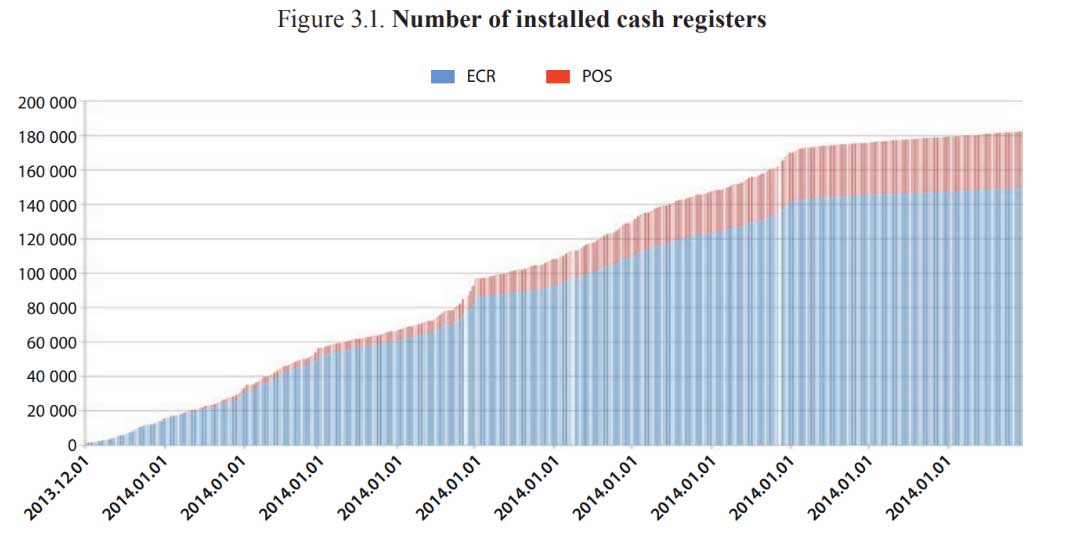
If we look at the graph compiled in 2018 for the Forum on Tax Administration, we will see that the number of installed cash registers is steadily increasing. 

This suggests that they are an indispensable element in business.

Cash-Register---Figure

PCR-T280 Casio

The PCR-T280 Casio electronic cash register offers an excellent range of sales capabilities for around $100 if all you need is a primary cash register to process payments wherever you sell. 

Additionally, it is portable because of its 11-pound weight. This little Casio cash register, accessible on Amazon and through the majority of office and retail supply firms, has a reputation for delivering dependable performance for both small stores and temporary market vendors.

Its functions include adding products, calculating sales, adding taxes, processing and recording cash and check payments, printing receipts, keeping track of user logins, and printing daily sales totals. 

This cash register is a simple device. The Casio PCR-T280 is the portable, small cash register you need to accomplish this. 

Sam4s ER-180u

The Korean electronics company Sam4s split from Samsung in 2003. As a result of some venerable manufacturers giving up on the ECR market, Sam4s is swiftly overtaking the competition on a worldwide scale. 

It asserts that 15% of the global cash register market is supported by the goods it sells in 70 different nations. 

Users may rest assured that customer service and replacement components will be offered for a very long time.

Sam4s’ entry-level economic register is the ER-180u. To serve the tiniest stores, this little register is simplified. Since the 180u lacks any connections for an integrated card reader, it functions best for cash-only transactions. 

It is particularly ideal for small companies with a limited crew because there are just 10 supported cashier profiles. 

Lightspeed

Lightspeed provides cloud-based solutions for the retail and hospitality industries if you’re having trouble picking the correct cash register for your small business. 

The latter option offers delivery and dine-in services with a top POS system.

You have a choice of an iPad or a desktop hardware kit, and both packages come with a printer for receipts, a cash drawer, and a scanner.

Due to its simple UI and simplified functionality, the restaurant POS system is renowned for its usability. The program is expandable as well, allowing it to expand along with your company. 

Along with the Lightspeed community and informative video lessons, Lightspeed’s exceptional support staff is also accessible 24/7 to provide a helping hand.

Toast

The POS system at Toast makes it simple to alter menus, keep tabs on tables, divide checks, add tips, and implement discounts. 

You may also manage several locations, handle online orders, and track staff sales.

The Toast, a tap-to-pay device, a router, and built-in software are all included in the starter kit. Hardware upgrades are possible, such as the inclusion of a cash drawer, a kitchen display screen, and an order printer.

Toast has a free plan that may be used with one or two terminals, but this registration bundle is only accessible with a $69 per month software package.

Conclusion

You should carefully examine your demands and spending limit when selecting a cash register for a small retail store. 

It’s possible to get away with employing a basic till or cash register if your firm is very tiny.

Beyond Speculators and Whales: Decentralized Finance for the 99% 

By Manuel Rensink

Decentralized finance (DeFi) is on the verge of a major paradigm shift. Since its inception, blockchain development has been recognized worldwide for its open-source approach to problem-solving and stunning innovation. DeFi, the conceptual decentralization of financial controls, has proliferated, reflecting the ambition of many blockchain “purists” to achieve complete disintermediation of traditional incumbents through “trustless” automation of financial processes. Recent developments, however, have illustrated that complete disintermediation may be illusory, as the absence of responsible individuals/ organizations may be unattractive when things go wrong. What is emerging from this cycle of growth is a stage of innovation that, while acknowledging the need for prudent controls and risk management, is no less exciting in its promise to embody the ethos of decentralization and enhance global accessibility to assets and markets. As DeFi enters this exciting next phase, we have the opportunity to ensure the system benefits all those who choose to interact with it. Society is conceptualizing the capital markets of tomorrow; the work that will build the open and democratized markets of the future has already begun.  

Today: Market Volatility and Regulatory Activity 

The current DeFi and crypto crisis wiped out 60% of the total value locked (TVL) in DeFi. With TVL estimated at approximately $70 billion at the time of writing, the contraction is both clear to see and difficult to fully comprehend without recourse to overly simplified and often pre-conceived narratives. The promise of agile finance and infrastructure free of unnecessary friction remains alive, but users are reckoning with the reality that easy DeFi yields and incentive-fueled DeFi token offerings (IDOs) came with risks that must be mitigated to unlock the promise of blockchain. 

It should be clear that the market has been calling out for regulation for some time. Volatility levels that came to characterize the 2022 bear market ignited a flurry of regulatory activity in the sector, with regulators focusing on crypto, stablecoins, and DeFi protocols through know-your-customer (KYC), anti-money laundering (AML), and risk management. But, while 2022 saw regulators come to the table with newfound focus, this work was already long in progress. 

The Dawn of Convergence  

Right-sized regulatory activity has the potential to add much-needed muscle to the digital assets space, and recent moves by governments, regulators, and businesses are ushering in nothing short of a new age in digital assets. This new age will be defined by the convergence of traditional institutional finance and DeFi in a manner that requires everyone to take meaningful steps toward each other. The innovation we’ve seen in crypto could imbue future capital markets with innovation and never before seen financial speed. For the first time in history, we can make assets both smart and relevant – assets that contain within themselves the systems and policies by which they are governed. 

This infrastructure has demonstrated a remarkable capacity for unlocking liquidity across existing fragmented markets. Introducing regulated digital assets to such a platform could offer people the best of both worlds: dynamic, agile, and responsive global liquidity combined with the confidence that comes with responsible oversight.  

Tomorrow: 3 predictions for the future of DeFi 

  1. Enhanced Transparency and Risk-Management: At the core of any regulatory regime is disclosure, risk measurement, market credit, and operational risk management. As DeFi advances, protocols will become more transparent to their users, not by simply referring to smart contract code but by providing detailed risk disclosures, analytics, and active (semi) automated risk management: Protocol-level hedging and insurance mechanisms.    
  2. New sources of yield and the emergence of true business models for DeFi protocols: Protocols are notoriously bad at capturing value and rely almost entirely on speculation in their protocol tokens. Governance tokens will be replaced with security tokens offered to investors in the protocol and used both for governance (voting) and dividend distribution. These dividends will be based on  PoS staking and liquid staking revenues. The move to PoS by Ethereum will further accelerate the trend towards a multi-trillion decentralized fixed-income market. We also expect real-world asset (RWA) integrations like gold, and other digitally-native securities like credit portfolios.  
  3. Integration of DeFi into banking and FinTech: Financial institutions are attracted by the efficiencies, composability, and global connectivity of DeFi protocols, while DeFi protocols are interested in the vast client bases of banks and web2.0 companies. This merging will truly take it into the mainstream, fundamentally improving people’s lives in the process. Individuals will see better and cheaper access to savings and credit. On the business side, companies will similarly benefit from better financing options and processing speeds, bootstrapping financial agility, and freedom. 

The opportunity presented by DeFi in this moment is the possibility to create a financial ecosystem that works for all who choose to engage with it. For many across the world, that means improved banking services. For many more, it means access to services for the first time. Put simply, a DeFi that works for everyone – not just speculators and whales. 

About the Author

Author---ManuelManuel Rensink is the Director of DeFi Innovation at Securrency, oversees strategy and business development focusing on industry partnerships and commercialization of the firm’s IP in the areas of digital assets, identity management, and exchange protocols. He has over 20 years of experience in institutional capital markets across all major asset classes on both the buy and sell side. Prior to Securrency, Manuel worked as a strategy consultant; Head of MENA at index and analytics firm MSCI (NYSE: MSCI) in Dubai, and Head of EMEA at JPMorgan spin-off RiskMetrics Group (NYSE: RMG) in London.  

Boost Your Marketing Strategy With These Tips

A marketing strategy can make you feel isolated, like you are shouting in a crowded room and no one is paying attention.

Any brand or company can achieve success with a solid marketing plan. A sound strategy will direct you toward your objectives, whether you want to use Hootsuite Alternatives to increase engagement on social media, attract new customers, or enhance your brand’s reputation.

Your company’s values, value proposition, and key demographics should all be included in a strong marketing plan, among other essential components. It should also utilize both offline and online marketing techniques. Nevertheless, even the most effective plans can become stale over time. You can learn about the most effective marketing techniques in this article and advice on how to use them.

What is a marketing strategy?

A company’s action plan for attracting new customers and retaining existing ones is known as its marketing strategy. A successful marketing strategy includes your unique value proposition, market research, target market, messaging, and the most effective marketing channels for your target audience. It also specifies the goals and objectives to be achieved as candle boxes demonstrate your aims. The four Ps of marketing will also be part of your marketing plan:

  • Price: The price of your goods and why.
  • Product: The goods you will sell and how they differ from things already on the market.
  • Promotion: How you’ll expose your interests to your intended market.
  • Place: Where you will conduct product sales.

Your marketing strategy should demonstrate how you will outperform your rivals and sustain a competitive edge over time. Unfortunately, if you don’t have a marketing strategy, you might develop the bad habit of attempting random tactics and wasting time and money on unsuccessful endeavors. Strategy means the goals you choose and the actions you take to achieve them make up your strategy. If you are looking for an effective coach to support you in developing and achieving your goals then you can visit Stratechi.com which is one of the best free resources to start your market strategies. So here are some pointers for maintaining the freshness of your marketing plan:

Create a plan.

The next step is creating a plan. This is where you define what you want to achieve, your goals, and how you’ll meet them. Before starting your marketing plan, a few best practices will come in handy:

  • Take a broad view. It keeps you concentrated on what matters most when you have a clear vision of what success looks like for your company.
  • Focus on your objectives and goals. When things don’t go as planned, it’s simple to lose focus and veer off course without clear business goals or objectives (which they never do). Clearly defined targets make it much easier for everyone involved to evaluate how well your campaign was carried out.

Set clear goals and metrics.

First things first:

  • Define the problem.
  • Clearly define your goals and metrics.

It would be best if you didn’t start with a solution without identifying the problem first. The same is valid for marketing strategies—you should make sure you’re going to be using your money in the right way before you spend it. Think about what you want to achieve and how much time, effort, and money will be required to reach those goals before committing to anything else (e.g., “I want my business’s website traffic to increase by 30% over the next year”).

Improve your website design

The first thing you need to do is improve your website design. This is the front door of your online business, so it’s essential to use a responsive design that is easy on the eyes and easy to navigate. Ensure your images are relevant to your company and focus on simplicity and clarity in appearance and content when designing your site. If you run a HVAC and plumbing business, then a great HVAC website design will help your business flourish. Implementing these simple changes can enhance the user experience for visitors across your website.

Build a solid SEO strategy.

SEO is a strategy that can help you increase the visibility of your website on search engines. You can use SEO as an additional tool for building brand awareness, or you can use it as the primary marketing strategy for your business.

SEO is not an overnight success. It’s a long-term process that takes time and effort to see results, but it has significant payoffs in terms of traffic to your site and improved ranking in search engine results pages (SERPs).

Research competitors.

Use a tool like SEMrush to determine who ranks for your keywords. This will give you an idea of what your competitors are doing and show where they are lacking in their SEO strategy.

You can also use this tool to check their social media presence, find out who the influencers are in your industry, and learn about their marketing budget.

Comparing yourself against competitors is a great way to determine where there’s room for improvement and how much effort it will take for you to reach them.

Create a mobile responsive design.

When designing your website, make sure that the layout of each page is responsive to the device being used. This means that no matter what device someone is on, their experience will be consistent and easy to navigate.

To test this feature: navigate to your site from a smartphone or tablet. If it doesn’t change at all when you resize your browser window, then you have a mobile responsive design.

Implement social media strategies.

Social media is a great way to reach your target audience. Social media marketing is essential to any marketing strategy, as it helps you build brand awareness and trust with customers. It can also drive traffic to your website, which will help boost your sales revenue.

Visual marketing is critical today.

Visual marketing is essential to your marketing strategy today. Visual content can help you make a better first impression and engage the reader with your message. If you’re not sure how to create visual content, or if you want some ideas for new ways to use it in your marketing efforts, here are four tips:

  • There are different kinds of visual content that can be posted on social media. You can make videos, infographics, memes, slideshows etc.
  • Ensure that visuals are relevant to your words in the text-based copy on your site or social media page.
  • Ensure your visuals are applicable across all devices: desktop computers, mobile phones, tablets (etc.).
  • Use vital design elements like color palettes and fonts consistently across all of your visuals so they appear cohesive when viewed together as part of an overall brand identity system.

This brings us to the end of the

Conclusion

Marketing your business takes time, but it is effective when done correctly. Whether you’re trying to attract new audiences or keep your current clientele, the above-discussed strategies are effective for all small and neighbourhood businesses. To see results, all that is necessary is a little execution and knowledge.

It’s okay if some tactics are more effective than others. You should experiment with each one to determine which one suits you the best. After that, you’ll be able to spend more on effective marketing techniques and do so with less effort. In addition, visual marketing has become extremely important today so consider making changes or additions to your site design to look more appealing visually appealing (such as adding photos). Lastly, verify that all pages on your site have been optimized for mobile users (and if not, then fix them!)

Unexpected Effects of Inflation

Inflation, which is the rise in prices over time, decreases purchasing power, especially when wages are stagnant. As of September 2022, consumer prices were up 8.3 percent for the year, and they may increase even more before the end of the year. 

Beyond increased consumer prices, inflation can have other effects as well, both direct and indirect. Let’s look at a few ways that inflation could impact your finances. 

Savings are worth less

You might think of inflation in terms of how it affects your income and spending power, but it also affects the money you’ve saved up. When prices go up, the value of your money goes down. This means that the same amount of money can buy less than it could a year ago. Over time, inflation can have a significant impact on the purchasing power of your savings. 

Higher interest rates

One of the more unexpected effects of inflation is it can lead to higher interest rates. When inflation is high, the Fed often responds by raising interest rates in order to manage it. This can have a ripple effect on the economy and may lead to higher borrowing costs for businesses and consumers alike. 

Increased interest rates may mean new loans, such as mortgages, will carry a higher interest rate and it will cost more per month to borrow the same amount of money. This may cause some homebuyers to accelerate their search and try to lock in a rate while it’s still relatively low. Higher interest rates also affect refinancing. If you’re thinking of refinancing your student loans, for example, it may be a good idea to look into student loan refinancing before interest rates get even higher. 

Debt can have a bigger impact due to increased costs 

Inflation can also indirectly affect your monthly loan payments. Although your monthly loan payments will likely stay the same (unless you have a variable-rate loan and interest rates change), increased costs of goods and services can make fixed costs like debt or rent feel like a bigger burden on your budget. For example, when your grocery and utility costs are increasing, making your $150 monthly student loan payment may mean you have to cut your budget elsewhere or dip into your savings.  

If you’re worried about how inflation may affect your ability to make monthly payments, it’s worth considering refinancing loans, such as student loans, for a potentially better rate. In a rising rate environment, it may be smart to refinance sooner rather than later before future increases occur. Of course, every situation is different, so be sure to compare your options and choose the loan option that’s right for you.

Keeping an eye on inflation

Inflation can have some unexpected effects. It can lead to higher interest rates, which can lead to increased borrowing costs. It also causes the value of money to decline, making it harder to afford existing costs as well as save for retirement or other long-term goals. It’s important to stay aware of the potential effects of inflation so you can adjust your budget accordingly and stay on track to achieving your financial goals.

How to Choose Balsamic Vinegar of Modena?

Balsamic Vinegar of Modena is today a very well-known ingredient in kitchens all around the world. Chefs are familiar with its unique sweet and sour flavor and the many, sometimes very original uses in shaping unique dishes. 

But Balsamic Vinegar of Modena has also made its way to the homes of many that have been enchanted by its tangy and complex notes and syrupy texture.

What may not be common knowledge is the fact that there are many different types of Balsamic Vinegar, and while some may be cheap, choosing the right product can represent a revolution in any kitchen.

Where does Balsamic Vinegar come from?

This very dark vinegar, typically concentrated and with intense and unique flavors comes from Modena, Italy. In fact, it is commonly known as Balsamic Vinegar of Modena

Records first show it to be around thousands years ago. Traditions surrounding the production of Balsamic Vinegar of Modena are as old and many have survived the industrialization process, meaning that today we can enjoy a Traditional Balsamic Vinegar of Modena that carries a long history of unique and well-kept heritage. 

What types of Balsamic Vinegar of Modena are there?

When it comes to different types of Balsamic Vinegar of Modena, there is a little secret that will help anyone choose the best product. Europe has long ago established the D.O.P. denomination (Denominazione di Origine Protetta) for products that have defining characteristics owed to the place where they come from. 

Balsamic Vinegar has two main D.O.P. in Italy, the Traditional Balsamic Vinegar of Modena D.O.P. and the Traditional Balsamic Vinegar of Reggio Emilia D.O.P. 

These Traditional D.O.P. Balsamic Vinegar can be expensive, going up to a few hundred dollars a bottle. What the average Joe can find in the supermarket is known as Balsamic Vinegar of Modena IGP (or in Italian, Aceto Balsamico di Modena IGP). The IGP, also PGI, denomination shows that the Balsamic Vinegar was indeed produced and aged in Modena, Italy, assuring the customer of the quality of the product they are buying. 

All the same, don’t be fooled. The word Balsamic Vinegar does not define an authentic product. The DOP and IGP certifications, on the other hand, guarantee the authenticity of the product linked to Italy and Modena.

Is there really that big of a difference?

YES.

When we are talking about Traditional Balsamic Vinegar of Modena, there are many regulations in place to assure the flavor of the final product is consistent and probably quite like what it used to be hundreds of years ago. D.O.P. denominations are known for being strict down to the point of defining what type of wooden barrels Balsamic Vinegar should age in.

The denomination Traditional Balsamic Vinegar of Modena D.O.P.  guarantees a product made with typical Modena grapes, aged for at least 12 years and bottled in the Modena area.

IGP is another denomination that, while a bit more flexible, still links the Balsamic Vinegar of Modena to the land where producers have been working on it for centuries. 

Still wondering why this matters? In Modena, Balsamic Vinegar is made from a combination of wine vinegar and a reduction of grapes, called grape must. Places like Acetaia Leonardi, offer tours of their facilities, where they grow their own Trebbiano and Lambrusco vineyards, and where the whole process of production of Balsamic Vinegar of Modena is explained step by step. 

Acetaia Leonardi’s Balsamic Vinegar of Modena is one of the most well-known in the area and can be found all around the world. The best part? Their products are made respecting the family traditions that go back hundreds of years, guaranteeing the quality of the Balsamic Vinegar that ends on your table.

Conclusion

Choosing the right Balsamic Vinegar of Modena can make a huge difference in how your dishes are received, it can add flavor to your life and a tangy note that otherwise wouldn’t exist. Balsamic Vinegar of Modena is unique in its texture and flavor, so choosing a denomination, like Dop and IGP, will guarantee you get the best quality Balsamic Vinegar

A No-code Route to the Ideal E-commerce Platform: Interview with Liam JE Gerada, founder and CEO of Krepling

If all goes according to plan, there will come a point when an e-commerce business will outgrow the possibilities offered by some of the big-name e-commerce platforms, for example requiring greater flexibility, automation or scalability. Enter Krepling, with their no-code, “composable” platform for e-commerce. Co-founder and CEO Liam Gerada gives us the background.   

It’s great to have you on board, Mr Gerada. Thank you for your time. Firstly I’d like to ask you a bit about yourself. How did Krepling come about and what makes you passionate about your company?  

In early 2017, my co-founder and I sold our e-commerce startup to start Krepling. Having worked in the e-commerce space, and having worked and built stores on platforms like Nacelle and Shopify, we developed a deep passion and unique world view on e-commerce driven by deep non-technical insights.  

E-commerce has evolved to something far more than simply buying and selling on the web. For us as merchants, e-commerce was really centred around our own making and vision for the products we wanted to sell and the brand we wanted to create. This meant us building a presence that was beyond a simple store front and utilising complex purchasing flows and integrations and services from across the web. 

Unfortunately for us, when we had our own online site, e-commerce enablement was not incentivised, nor could it lend this degree of flexibility to merchants. With other platforms, integrations are often tightly coupled to individual e-commerce services. Merchants are forced to go the engineering route to compete in the modern markets, and most engineers also understand the challenges that tight coupling presents. 

That’s why we decided to build the world’s first no-code, composable platform for e-commerce. No code and automation fundamentally enable merchants (and developers) to build their ideal e-commerce from scratch with clicks instead of code.  

You started your company with your brother. What was that like and what advice do you have for others going into business with their family?  

Merchants are forced to go the engineering route to compete in modern markets, and most engineers also understand the challenges that tight coupling presents.

My brother and I were always closely working on projects together. We had built a startup together and worked closely on solving problems even prior to that. My advice for any builder or early-stage founder when hiring or finding a co-founder (be it family or not) is that there is no future in working with individuals who do not identify with the mission, the product, and the problem one is looking to solve. People who care a great deal about a problem are usually inclined to do great work. 

As technology advances, particularly in Web 3.0, what has changed and will continue to change for e-commerce merchants?  

Today, merchants continue to maintain complex ecosystems leveraging many integrations and services. The reason for this is simply the fact that consumers have evolved their purchasing behaviour; we now buy products through social media, the web, email, and even SMS. How a purchasing decision is made has also changed drastically. We now rely on a multitude of factors that may impact how we decide to purchase a product or not. As a result, merchants need to keep up, and they are doing that through a larger ecosystem of integrations from across the e-commerce stack in order to reach their customers more effectively. This includes things such as newsletters, complex marketing operations, improving conversions, offering more payment solutions, expanding to new markets and making the most relevant buying options available to their customers, loyalty and rewards programmes, shipping calculations, and many, many more. 

This presents an enormous challenge in today’s market. How do merchants take complex, dynamic, and ever-evolving strategies and translate these into beautiful and centralised e-commerce experiences? Well, the answer is they don’t and they tend to make major compromises or pay a fortune in development fees. 

Big names in the e-commerce space, such as Shopify, have taken up quite a lot of space for quite some time. What sets Krepling apart and what makes Krepling different?

We view platforms like Shopify and co. as the first big step to a wider world of online selling. In a world that has continued to evolve over time, one thing has become very clear: one platform can’t solve all the needs of a merchant. The needs of a merchant have become far too complex over time, simply because the consumer of today has evolved drastically since 2004. 

At Krepling, we have embraced this concept, and so have many other headless and developer-focused platforms in recent times. What sets us apart from all other players in the space is how we are tackling the very problem. We have bet heavily on “no-code”, automation, and integrations as a means to reach broader consumer demographics, expand to bigger markets, grow bottom-line revenue, and many other problems, some of which I have already mentioned. 

We’ve split Krepling into three core product areas to solve the most varied and sophisticated e-commerce flows, and unified them to allow brands to solve these problems and compete with the billion-dollar brand of the world with a few simple clicks.

Being an employee is changing. With labour shortages, flexible working, and countries trialling the four-day work week, many are saying that the power is now in the hands of the job seeker. What is Krepling doing to stay competitive in the job market, seek the best talent, and retain its current staff? 

To be candid and to the point, we’re hiring people who care and giving them the means to make a difference. We’ve also adopted the idea of becoming cult-driven instead of credential-driven. We hire people based on what they care about. If someone applying to Krepling has never really been deeply obsessed about something before, it would be a pretty bad bet to think that Krepling will be their first. 

The reality of the current work environment at big tech is that engineers come in at 9 a.m. and finish at 6 a.m. The result is that very little meaningful work is carried out at large corporations. The culture is simply not what it should be. 

The reality of the current work environment at big tech is that engineers come in at 9 a.m. and finish at 6 a.m.

We offer most perks that live up to the trends of Silicon Valley, such as flexible work hours, open desk layout, lack of office attire, etc. But it’s not what our culture is built around. No perk should give talent a meaningful indication of the company’s culture. We strive to have our company culture centred around people who care about a product and mission, and that is what we look for when hiring. 

The COVID-19 pandemic undoubtedly had an effect on retailers. However, it had some positive effects on e-commerce. How has COVID affected Krepling and the online marketplace? Do you think it’s had lasting effects on this space?  

We were just coming out of pre-product when the pandemic hit. As you can imagine, the result was almost instantaneous hyper-growth, but we were sceptical about how the industry would respond post-pandemic. The result was pretty interesting and is still playing out today. There is no doubt that the pandemic was an accelerator of what we would consider “baseline trends”. These were trends that most could predict, such as an increase in consumer expenditure online, and greater adoption of online selling. However, the direct effect on consumer behaviour was something we also as a team overlooked. The next few years are going to be very exciting for the industry, and I remain a firm believer that consumer behaviour is going to heavily affect business adoption patterns online.              


You started your company at a young age. How has this shaped you into who you are as a leader? What advice do you have for young entrepreneurs?

The best piece of advice I can offer to young founders is to focus on things you are excited about. I think it’s a tried and true method. In any industry, there are old-school problems, which in turn present bottlenecks. Focus on the bottlenecks.  

What are you most proud of about Krepling? Do you have a particular moment that you feel most proud about? 

I am very proud of the connections and culture we have built as a company. I think it’s something that we often overlook, but that gives meaningful attributing factors that even have a direct effect on elements like growth and revenue.

Lastly, what do you see as the next steps for Krepling, and how are you going to make this happen? 

I think everything is going to get faster and things are going to begin happening faster. The technology in our industry is improving faster than anyone could imagine and we’re really excited about the future. We think that automation technology and the application of AI in commerce are going to change the daily lives of consumers as much as the act of purchasing a product online did. It is our goal to keep very close to these exponential change curves. 

Executive Profile

Liam JE Gerada

Liam JE Gerada, founder and CEO of Krepling. Krepling is a no-code platform that enables merchants and retailers to build and scale their e-commerce operations through a microservice-based approach. Krepling’s platform enables merchants to build their front and backend e-commerce operations and integrate with the ‘best-of-breed’ applications to create rich buying experiences, automate marketing-based operations, and sell products in a borderless environment.

Why Are Electric Scooters so Popular?

Online casinos like icecasino.eu.com rose in popularity quickly, and so did electric scooters. The reason? Technology and demand. For a time, both of these were obscure, but when technology made them easier to make. The demand also shot up. Today, let us take a specific look at electric scooters and why they are so popular.

1. They Require No Effort

Electric scooters, unlike bicycles, do not need pedaling. One thing that makes people stay away from biking is that they are too tedious to use. Most bikers are also health-conscious, but not all people are like that, so they use scooters. 

On an electric scooter, all you have to do is step on it and let it roll. By the time you get to the office, you are not tired at all. If you bike the usual way, you would be too sweaty once you get to the office, which is not exactly something you want to do. 

Biking also requires a lot of gear, like biking shoes. On a scooter, you do not need to use sporting gear like that — you only need a helmet to keep yourself safe.

2. They Are Economical 

Scooters are economical — they consume a small amount of power. Contrary to what some people say, these scooters do not consume a lot of power, so your electric bill is just minimal. It is still a lot more cost-efficient than gasoline.

Apart from saving on power, scooters do not require parking fees. If you ride a bike, you may not have a free parking area — you must pay a fee. The same thing goes for cars and motorized scooters.

Studies show that electric scooters cost only about $4 per year for every 1,456 miles. On average, the cost of charging an electric scooter is about six cents per week and 25 cents per month. 

A scooter with a range of 25 kilometers has an average cost of about $0.64 per 100 kilometers. If one compares that cost to a car, the electric scooter can save you about 60% on gasoline.

3. They Make You Mobile

Electric scooters allow mobility. You can use them on roads and even in tight spaces within the city. They are popular because it allows people to move with ease when they are on the go. 

You cannot have the same mobility as a car or a motorcycle. A motorcycle or a bike is still bulky. An electric scooter can fit anywhere that your body can fit. If it can’t, but your body can, then just fold it or carry it with you for the time being. 

You can also use electric scooters inside malls if you want. However, pay attention to the mall’s rules. Some do not allow any vehicle for use inside the mall, as you can get people hurt.  

As far as mobility, electric scooters are also efficient. Technology today allows for efficient batteries that can deliver enough power to easily carry the weight of the scooter and its passenger.

You can even extend the range of your scooter if you couple it with another battery. It is possible for some models nowadays. In addition, you can buy an extra battery that you can lug around if you want. These batteries are not heavy — you can even put them inside your bag. 

4. They Are Environmentally Friendly 

Electric scooters, of course, are environmentally friendly, especially if your power comes from a renewable energy source. You can get a solar generator and plug your electric scooter from there if you want.

Even if you get your power source from a coal-powered electrical system, you are still helping the environment. For one, you do not pollute the air — you have almost zero carbon emissions when you use your scooter. Since it has no exhaust, people will not get sick from soot and fumes. 

5. They Are Compact 

Electric scooters are popular because they are compact. Most of them are foldable, and it is easy to store them. 

Here are some places where you can keep your scooters:

  • Under the bed
  • Inside a cabinet
  • Under your office cubicle
  • In a luggage section in a mall or grocery store.

Electric scooters are not that heavy, either, so you can lug them around if you are inside an establishment where you cannot use them. Overall, you do not need huge parking spaces to keep them. 

The thing is that they can also be easily stolen, as they are small, and people can just carry them with ease. The trick is to ensure that you put them in a secure location.

Electric scooters are great for the environment — they do not have fuel emissions like gas-powered motorcycles, yet they can take you far. The only downside, of course, is that these scooters do not have charging stations. If you run out of power, there is nowhere you can charge.

Is Renting A House Better than Selling? 

There are numerous causes for a homeowner to consider moving. In any case, you still need to make a decision regarding what to do with your current home. Should you sell house or rent out? Depending on your financial situation, you might find it more advantageous to rent it out than to sell it.

Let’s look at the things to think about, including the costs, if you’re stuck in the “Should I sell the house or rent out?” issue.

Renting versus selling my home: which is better?

There are advantages and disadvantages to both options, so the choice shouldn’t be made lightly. Selling your home, for instance, can net you money right away, but renting will enable you to increase your equity as property values rise and generate income from your tenants. Examine the next situations to decide whether to sell the house or rent it out.

When to Sell Your House

  • If you require the money to purchase your new home

Selling your current home is the greatest option to access the equity there if you need to do so in order to access the funds needed to purchase a new home. In this manner, you can use the money from the sale of your house to pay for your new down payment.

  • When you don’t want to become a landlord

It can be difficult and time-consuming to manage a rental property. Are you capable of performing some repairs yourself and handy? If not, do you have a list of reasonably priced contractors you can contact quickly? Think about if you want to hire a third party to handle things in place of taking on the additional responsibilities of being a landlord, which includes interviewing potential renters and handling issues, among other things.

  • If you qualify for capital gains tax breaks

If you make money when you sell your house, you might be entitled to deduct up to $250,000 in capital gains from your taxes (or $500,000 for married couples). This only applies if the house was your primary residence for at least two of the previous five years.

When should you rent a home?

  • If your relocation is transient

You might want to consider renting out your home if your relocation is only temporary and you want to move back to your existing city in the future. Having a place to live when you return can provide you with some security and peace of mind, and it might be less expensive than selling your current house and buying a new one later.

  • If you anticipate an increase in local home values

It’s hard to predict the housing market’s future with perfect accuracy. In light of this, you might be able to anticipate accurately. If you anticipate that the value of your existing residence will rise within a few years or less, you might want to think about renting it out right now and selling it later to benefit from appreciation.

Costs to compare between renting and selling

Costs are involved whether you want to sell the house or rent out. The ability of the rental income to pay the mortgage and maintenance is one of the most crucial factors to consider. If you consider renting it out then you have to reconstruct the home in a better way to get more rent. 

Examine what comparable homes are charging and compare that to the expenses of owning and managing the property — mortgage payments, maintenance, repairs, taxes, and even hiring a property management company — to calculate how much rental income you can anticipate generating. From there, you can determine if you’ll be able to cover your costs plus some.

Conclusion

You’ll probably need to spend money on a few services to get your house ready to sell. These can include making any required repairs and improving the property’s curb appeal.

Depending on your financial situation and lifestyle choices, you should either sell the house or rent out. Consider your financial status, whether you want to return to your current place soon, and whether you’re interested in becoming a landlord as these factors can influence your choice.

EDITOR'S PICK OF THE WEEK

CFO's new mandate. CFO explaining the presentation

The Performance and Transformation Orchestrator: The CFO’s New Mandate in the Age of AI

By Terence Tse CFOs are evolving into AI-driven transformation orchestrators, balancing finance, technology, and strategy while upskilling teams, managing risks, and driving measurable business value. A key insight from this year’s AI for CFOs event, organized...

WISE DECISION MAKER GUIDE

POWER INFLUENCERS

Emerging Trends

The Future of Global Trade