By Joseph Mazur
The Geneva Convention permits states to defend themselves under the right to use force in expectancy of an armed attack by another state. That right could then validate invading under a covert pursuit of national interests. Rewording the UN Charter articles of war could tighten ambiguities so offenders could be held more criminally accountable.
My lifelong good friend, Tadatoshi Akiba, Former Mayor of Hiroshima, who has received many peace awards as a star leader in the global campaign for complete nuclear disarmament, inspires me to ask the questions I am asking about war and guides me through the complexities of international law and military prophecies.
With over forty-two ongoing wars, two of which are raging in this relatively new century, we are witnessing uncomfortable realities of historical confusion. How many of us know what makes war legal or illegal? How many of us spend time searching through war records to reach the bottom level of causes? A genuinely balanced and thorough understanding of the laws of war is not simple. We vote for our chiefs and rely on their judgments as if they understand the reasons for going to war. We take positions of approval based on who and what persuades us to follow the polemics of warfare influenced by murky evidence and trendy sociopolitical ideology.
How is it otherwise when rational people excuse and support brutality in warfare? How is it otherwise when 23 percent of young Americans believe that the Holocaust is a myth?[1] And how is it otherwise when so many among us cannot answer the simple yes-or-no question: Is war legal?
I asked myself that question. My answer is complex and troubling.
Towards the end of the Second World War, my father was in the 20th infantry division of the US Third Army that had established a bridgehead on the Seine near Fontainebleau. While the Germans were in retreat, fleeing Paris, I was a toddler, too young to know anything about war. The movies I watched soon after the war when tickets were 25 cents are now forgotten, but the newsreels preceding them are as fresh as ever. In one, the President talked about feeding the starving Europeans. In another, there were air views of devastated cities in massive rubble and ruin. Of course, I didn’t know who Truman was and hardly grasped the meaning of the word president, but in those years, my thoughts were of my father and whether he would ever come home.
Towards the end of the Second World War, my father was in the 20th infantry division of the US Third Army that had established a bridgehead on the Seine near Fontainebleau.
He had the courageous two-man job of furtively tailing German Panzers to splice military transmission wires soon after they were cut by caterpillar treads so that George Patton’s 3rd Army could communicate with Omar Bradley’s 12th. For that, he received a Bronze Star Medal for his gallantry in action and a Purple Heart for his wounds. In mid-August, Bradley gave the Germans an escape route out of Paris to save Patton’s outnumbered troops from a major assault. My father was justifiably proud to say that his brave splicing saved hundreds of American lives. “And German lives too,” he would add with inflection. But the other stories, the ones of horror, were reserved for later times of my life when I could understand more about what war is in all its cruelty and suffering. I heard about his battle buddy, Winslow, who died from a grenade explosion that took off his face.
When the war ended, my father did not immediately return home. He re-enlisted for another year to become a driver for the military governor of the Allied-occupied zone in Germany. Some years after he finally did return, he told me about US prisoners of war (POWs) who were beaten and forced to work for Germany and that many were tortured and killed while on death marches. They were brutalities a growing child could not process in any compass of sanity. He also said that some wars just had to be fought and that that one certainly had to be. True. And so, remembering those words as an adult, I wondered why wars are so inhumane and yet legal.
I learnt they are not! Legal, that is.
As of this writing, more than 42 wars and so-called “armed conflicts”[2] on four continents are happening at the expense of an average of (166,000) deaths per year and 3,287,478 cumulatively for just six of the more than forty-two ongoing wars.[3] Even with those appalling numbers, we have some encouraging statistics: the number of military and civilian deaths from all the wars that have happened in the last 78 years is less than one-quarter of those who died in WWII.[4] Still, we kill each other in large numbers. Do those numbers matter? Why do we kill at all?
War, peace, time, and patience
Of course, I have no answers to any impossible questions.
One might say that war is just a primate thing going as far back as the late Upper Paleolithic era, some 13,000 years ago, an era of nomadic hunting when the scarceness of big game called for combat in the wild. But warfare declined a few thousand years later in the Mesolithic age when the last glacial period ended to permit the domestication of plants. Domestication required a shift from a nomadic life of hunting large game to a more domesticated life of hunting small game and harvesting wild plants. There was no need for weapons of war. Furthermore, according to the anthropologist Keith F. Otterbein, a cross-cultural researcher on the history of war, “For domestication to occur the more desirable wild seeds needed to be planted, harvested, and planted again and so on. Many generations of seed replanting and many generations of people in the same location were required for domestication to occur.”[5]
One might say that war is just a primate thing going as far back as the late Upper Paleolithic era, some 13,000 years ago, an era of nomadic hunting when the scarceness of big game called for combat in the wild.
Domestication requires peace. Groups at war would displace each other through killing, burning settlements, looting stored foods, and destruction. It took many generations of seed replanting and many generations of people in a fixed, stable location for farming to succeed. In Mesoamerica, large corncobs evolved only after two thousand years of wild seed ancestors of corn. If warfare had continued or risen anew in those areas and in those times, the domestication of plants would never have started. Domestication endurance permitted feuds and rivalries that turned to battles. And so, we are now in the 21st century with a history of warfare horrors—some blatantly breaking international laws and others confirming my father’s maxim that “some wars just had to be fought.”
When we talk about law, we mean a set of rules regulating human behaviour and considering the designs and concerns of a benevolently balanced society. By that, rules must permit rights with obligations to adhere to them, thereby respecting individuals while punishing those who infringe on their principles. International law carries the caveat that its standards are not exclusively aligned to be about individual citizens but rather more about nation-states. As Voltaire once quipped, “It is forbidden to kill; therefore, all murderers are punished unless they kill in large numbers and to the sound of trumpets.”[6]
Modern international law follows jus gentium (“law of nations”), conceived as international law going back to the ancient Roman legal system. It was designed to be enforceable for all nations, yet, with no formal binding legislation, it simply relied on a mutual understanding between nations following traditions, customs, and precedents based on Roman and common law. In principle, it was to be a humanitarian code of conduct “common to the whole human race” and distinguished from “the law of nature”, which the emperor Justinian proclaimed to be “that which nature teaches to all animals.”[7] All animals know their enemies as well as their strengths. They fight to defend themselves when attacked. That is the unwritten law of nature explicitly applying to war—my father’s judgment, too. He considered some past wars to be naturally defensive, forces of necessity that every animal has. “Don’t bulls have pointed horns to stab and hooves to kick with?” he would say.
International law carries the caveat that its standards are not exclusively aligned to be about individual citizens but rather more about nation-states.
So far, without world parliaments other than the United Nations, there are no world laws other than ratified treaties. The Romans had their laws of warfare, as did the Greeks.[8] And all along, for more than two thousand years of past wars, treaties of principle were somewhat followed. Through all the wars of medieval and Renaissance times, there had been genuine attempts to create articles and ordinances of how wars could be legally conducted. None had achieved any legal court-certified hold. All had failed to pass any of the moral tests of civilian protection or military behaviour. But, as brutal as they were in warfare, the Romans did have a sense of military discipline.[9]
All wars have costs. Every war that has ever been fought — even those between far-off geographies — harms the populations of both the invaders and defenders.[10] Besides the obvious toll on lives and destruction, there are the weakening strengths of supply chains as well as goods and services. Sometimes it is air quality that damages health. Sometimes it is the economy, and in rare cases, it is communal guilt of neglecting moral values that contribute to a decline in public morale. Other ramifications often include starvation, forced and sheltering relocation, and even civilian massacres spawned by the stresses of battle. They are, of course, illegal by Geneva Convention Protocols, but then again, so is war.[11]
Connecting the dots from head to feet in modern warfare
Wars are different now because the battles are attacks from a distance. Learning to fight from a distance has been the ambition of war tacticians ever since the second century BC when (myth or not) Archimedes used bronze reflecting mirrors to concentrate the sun’s rays to set ablaze Roman warships in the battle of Syracuse. In the past century, more than 50 percent of war-related deaths were of non-combatants. Indiscriminate civilian casualties expanded in WWI due to new arrivals on the battlefield; first came the reconnaissance biplane and the submarine, then the Zeppelin airship that carried and dropped bombs, and then more sophisticated planes that could fly low enough for the pilot to lift and toss a bomb from the air.[12] WWII introduced the aircraft carrier. The Vietnam War had the gunner helicopter that could fly low and hover over suspicious things that moved on the ground. And now, Ukraine has developed the sea drone, an unmanned speedboat capable of stealthily targeting strategic sites. Wars do have that tendency to accelerate innovation. Warfare changes dramatically when an assailant can attack a victim from such a distance that faces cannot be distinguished as belonging to humans.
Wars do have that tendency to accelerate innovation.
I picture that notion as a reminiscence of a scene from The Third Man, a British film noir set just after WWII in which the characters Harry Lime and Holly Martins are at the top of the Riesenrad, the giant Ferris wheel in Vienna, talking about victims of a scheme to water down stolen penicillin to make it go further. Lime answers, “Victims? Don’t be melodramatic. Look down there (he points). Tell me. Would you really feel any pity if one of those dots stopped moving forever? If I offered you twenty thousand pounds for every dot that stopped, would you really, old man, tell me to keep my money, or would you calculate how many dots you could afford to spare? Free of income tax, old man.”
Spears, slingshots, and even guns were once handy in battles when enemies were within visual range. We now have the tank, just a mobile big gun crewed by a semi-protected crew. And from that came the rocket that now can be robotically calibrated to hit an enemy far beyond any visible scope. Advances in weaponry have not stopped and never will. Every advance of weaponry since the trench warfare of WWI has been to kill from a greater distance than was possible before, so soldiers (who now begin their basic training on simulators) would feel as if they were just stopping the movement of dots rather than combatting things with legs and faces.
Some wars just have to be fought
In 1946, the U.N. General Assembly recognized genocide as an international crime and called for the creation of a binding treaty to prevent the killing of ethnic, racial, or religious groups. That treaty, The Convention on the Prevention and Punishment of the Crime of Genocide (CPPCG) — known as the Genocide Convention — was established in 1948 to outlaw atrocities like the Holocaust and the Armenian Genocide. It was the first international human rights treaty and the first legal channel to label genocide as a crime.[13] Since the treaty reflects customary law, all states and private armies are bound by the Genocide Convention. And yet, since then, there have been more than 285 distinct battles resulting in more than 50 mass murders of almost 12 million combatants and 22 million noncombatants.[14]
The Genocide Convention declares genocide a crime by violation of forcefully transporting children of one national group to another (by the UN definition of genocide) as prosecutable.[15] Private citizens and political leaders who think they have sovereign immunity are not exempt.[16] The difficulty with bringing genocide cases to court, however, is that international law requires proof of an organised plan or policy to intentionally destroy a national, ethnical, racial, or religious group.[17] Proof, though, has a problem: war almost always brings collateral damage to blur the line between intent and accidents. But in 2002, the International Criminal Court (ICC) in The Hague adopted the Rome Statute, a treaty-based set of humanitarian laws regarding war crimes under which public and private individuals could be tried and sentenced.
Although ICC’s prosecutorial powers are weak since it has few means of capturing defendants, it has already, under its Rome Statute authority, unexpectedly issued numerous arrest warrants, including one for Putin for unlawful deportation and transfer of children to the Russian Federation and for his failure to control his military in committing criminal acts. That said, the warrant for Putin warned of a stern consequence; he could not join the summit of the BRICS nations in South Africa, a country that is a signatory to the Rome treaty that would be obliged to arrest him.
The problems of war illegitimacy
As we head further into the twenty-first century, force should cease to be an acceptable method of settling differences between states. Article 2 of the UN Charter signed in 1945, declares: “All Members shall settle their international disputes by peaceful means in such a manner that international peace and security, and justice, are not endangered.”[18] And though all member states must accept sovereign equality, sadly, too many do not. So, we have international rules of war behaviour with hardly any means of enforcement. Wars happen despite being outlawed by the Charter because there are exceptions through loopholes in defence rights against legal or illegal attacks. Article 2 goes on to say, “Nothing contained in the present Charter shall authorize the United Nations to intervene in matters which are essentially within the domestic jurisdiction of any state or shall require the Members to submit such matters to settlement under the present Charter.”[19]
War is NOT legal; defence is. Since the Charter permits a country to defend itself, shielding against an attack invariably escalates to excuses for a broader war that cannot quickly end.
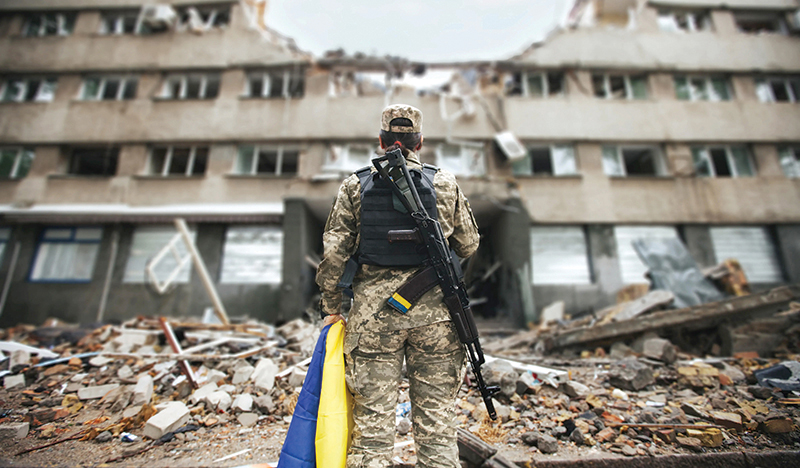
We welcome the Charter’s rules protecting states and vulnerable persons affected by wars but are troubled by its acceptance of internal armed clashes, even those started by external sources. It is a doctrine of self-defence against an armed attack by any member state of the UN. But that doctrine is partial to jus ad bellum (right to war), a set of international principles for establishing when military force is permissible. While the Charter constrains states from engaging in armed conflict in an attempt to maintain international peace, it also challenges its aims because it leaves open the question of whether a country can start a war under a claim of preemptive self-defence.[20] That challenge is tied to the question of what constitutes an imminent armed attack. Is it evidence of a planned attack, backed by sound objective intelligence, or is it just a belief that it is already happening? Discounting domestic conflicts undermines the Charter’s war illegitimacy statute by allowing the use of force in internal clashes. Moreover, it permits collective action force by member states that “maintain or restore international peace and security.”[21] Force, therefore, is not entirely outlawed since states maintain the right to defend their territory in response to attacks portraying international conflicts as internal matters, as Russia has with its “Special Military Operations” label for its invasion of Ukraine, declaring it an internal armed conflict initiated and carried out by pro-Russian separatists fearing “Ukrainian Nazis and fascists.” Russia played the same game with its invasion of Georgia in 2008. Such false narratives excuse invasions and avoid incrimination by the ICC.
Member states of the UN know how to circumvent possible indictments under the UN Charter. They use Articles 2 and 51, which give member states the right to self-defence. “Nothing in the present Charter,” Article 51 says, “shall impair the inherent right of individual or collective self-defence if an armed attack occurs against a Member of the United Nations, until the Security Council has taken measures necessary to maintain international peace and security.”[22]
The problem lies beyond just the language of the Charter; its wording is. Anne Applebaum’s recent post in The Atlantic implies its ineffectiveness, or should I say unenforceability. “In the more than seven decades since [the Articles] were written,” she wrote “these documents have frequently been ignored. The UN Genocide Convention did not prevent genocide in Rwanda. The Geneva Conventions did not stop the Vietnamese from torturing American prisoners of war, did not prevent Americans at Abu Ghraib from torturing Iraqi prisoners of war, and do not prevent Russians from torturing Ukrainian prisoners of war today.”[23]
Almost every war since the Charter ratification signing has started under the façade of a semi-internal conflict to avoid prosecution by the ICC. Under schemes to escape criminal violations, they were called “transnational non-international armed conflicts,” titles (recall Desert Storm and Enduring Freedom) that are more appropriate for interventions involving capturing terrorists or non-state armed groups than for full-force invasive conflicts. Excuses for modern-day invasions are made possible by the wording of Articles 2 and 51, which permit states to defend themselves. Defend from whom, though? Wars can almost always have a veneer of internal conflict perpetrated by an external power to invade and yet to avoid indictments over war crimes.
That is the overarching problem with Articles 2 and 51. They give states the right to use force in expectancy of an armed attack by another state. Countries must have permission to defend themselves, yes, but that right often becomes a jus ad bellum justification for invading while exploiting that right in pursuit of their national interests.[24]
Wars can almost always have a veneer of internal conflict perpetrated by an external power to invade and yet to avoid indictments over war crimes.
Non-state actors (likely to be terrorist groups) causing trouble in one state can be an excuse for an invasion by another under the pretense of the latter’s necessary defence. Thirty-seven years have passed since the last effective Geneva Convention Protocol was signed, though not fully ratified. Reforms to that protocol are needed to tighten legal language that recognises the advancement of weapons and tightens ambiguities enabling war legitimacy. But protocols and all their amendments are only as good as their strength of control. Some countries have been interpreting them as alternatives to Geneva Convention practices by claiming to adhere to jus ad bellum, a theory doctrine that affords using force against a supposedly non-conflicting state in response to an armed attack. Called the “unwilling or unable” doctrine, it surfaces as moral law about when military force is justifiable against terrorist groups.[25] As a quasi-law interpretation of international law, it permits a victim state to use force against a territorial state only if the victim state can assess whether the territorial state is unwilling or unable to quell the threat itself.[26]
It is time to negotiate for word changes to eliminate gaps and regulate or ban colossally inhumane weapons.
None of that will happen because the difficulties are beyond the issue of permitting countries to defend themselves. One is the commanding body of just a few people deciding when, where, and how to go to war. Aside from a few totalitarian dictators with dreams of imperial conquest, that group is most likely to be military commanders, government bureaucrats, and intelligence specialists motivated by moral concerns, yet dutifully and submissively working to further national interests with the decision made only after reviewing the prospects of how many young people the military can afford to lose under the best scenario. It’s always a number realistically far too low, but it is just a number, not a human value — more what I would call Riesenrad dots, those dots of people seen as specks from the extraordinary height at the top of the Ferris wheel in Vienna. No doubt, those in charge of appraising the potential success of war through views of military necessity consider morality earnestly and are aware of natural and international law, humanity, and inevitable terrors; however, when approaching an ultimate decision, there is no other way of thinking about it—war entails killing in large numbers, though no longer to the sound of trumpets. So, any decision to go to war must balance the justification of military necessity with intelligent plans to bar foreseeable horrors.
Besides those headwind difficulties, there are other challenges. Making and enforcing international treaties is against the interests of influential players such as arms dealers and governments looking for expansions of resources or authoritarians who believe that their citizens always need an enemy, seeing war as a means to increase repressions, dampen information, and eliminate voices of dissent.
In the US, those are players — to put it genteelly — who have militant outlooks driven by historic partialities. The military is one, but so are the political power elites who make the elusive rules. Even in a democracy, politicians (aside from those with a few marginal voices) know that an overwhelming number of their constituents would generally not favour war. But they also know that those same citizens want some semblance of the legality of war to be available for necessary wars and defence. Again, they believe some wars just have to be fought.
Along with arms dealers, mercenaries are also a part of the problem, and so are self-serving hawk politicians pressing for more and more military funding for unspecified reasons. Forever, there will be fiery militarists and imperialists, people with loopy power goals of triumphal territorial expansion. They are the random oddities of human nature/nurture evolution. That is why we need humanitarian international law to build a peaceful future.
The pointlessness of immorality
Almost all past wars have been pointless, unnecessary, and morally indefensible. My father would not agree; few who fought in one would. But that was the past when one enlisted for patriotic duty or hopes of career advancement. Future wars will be different, though. We are beginning to face slim diplomatic chances of a negotiated settlement advanced by pressures of powerful offices, forces that are now stronger than ever because governments can hire mercenaries to fight. Russia has its Wagner Group (a murky band of hired fighters), or should I say had before its leader, Yevgeny Prigozhin, was assassinated, and the US has Academi (formerly Blackwater), private armies operating beyond laws and treaties. It’s hard to know how those mercenary groups function because, in most countries, they operate illegally under the radar. Private armies are not new, Carthage employed them against Rome in the First Punic War, and they probably go back much further than even the epic wars brought to life by the Homeric poets. Today, they are no different from clandestine cartels without detectible links to a government. Future wars will become outsourced so that corporations can employ warriors to invade or defend, neither knowing nor caring what they are doing. They will become athletic teams to cheer, equipped with guns, bombs, tanks, and fighter jets. Those private players will have a supplying industry of arms dealers willing to sell to anyone as they lobby to convince governments to start wars they say they can win, even when they know they can’t.
By the standards of the ICC, illegal warfare aggressions are violations that could result in prosecutions and imprisonments. But their measures present a broader problem: killing civilians is not necessarily a war crime under the excuse of collateral damage. The Rome Statute of the ICC, which declares that every state has a duty to investigate criminal liability for those responsible for international crimes, recognises the possibility of collateral damage that could occur during an attack on a military target. For that Statute to have any accountability, it must demonstrate that the investigated crimes were part of a systematic strategy, not necessarily about, as Masha Gessen reported in her August 2022 New Yorker article on the war in Ukraine, “the person who pulled the trigger.”[27] The investigators would need to show a chain of command through subordinates ultimately leading to the military top brass command.
Another problem with war, among the many already mentioned, is that it is like a game, yet not a game. A game has rules of engagement and strategies that almost always involve some luck. Wars, too, have rules, but they are open to interpretation. Players could be confused, and there are so many contradictory emotional variables among the players, such as the morale of troops, the effectiveness and balance of equipment, the size and camouflaging of the battlefield, and the choice and cleverness of a winning strategy that avoids legal responsibilities. Wars depend on generals who are humans with the human conditions of emotions and belief in plans that involve competing visions of martial dreams. In the end, real people die, and after casualty numbers mount, parties will come to what they will call a peace table, trying to understand what the bloody war was all about and ready to agree on deals that could have been established before the first assault was launched. Like a game, war is a gamble, a chance event that never has a guaranteed outcome.

We face a choice: continue waging wars as we have been for millennia spending gazillions of dollars that otherwise could be used to eliminate the causes of wars or persuade the UN to refine, toughen, and enforce international laws of war in the order of an outright ban that could lead to a war-free world. A small advance in the direction of a ban, even if it doesn’t come close to ideal, could be, like the founding of the Red Cross two centuries ago, the “supreme humanitarian achievement of the [twenty-first] century.”
A ban on war is a challenge over many problems, beginning with interpretations of the moral code and ending with the influences surrounding the self-interests of formidable players. The whole notion of war comes from insanity. There was a time when mighty countries could take what they wanted from the weak. Colonialism started in the 15th century, and by the nineteenth, it had run most of its course when almost the entire world divided itself by wars of expansion that killed more than a hundred million people for what — slaves, minerals, tea, and spices? War was accepted then, almost as a right of conquest. We fought two world wars in the last century and learned some hard lessons after half the world was devastated by the playground antics of commanding fools and crackpots. The question for the 21st century is whether the UN will continue to permit the inhumane foolishness to continue without consequences. Banning war involves a change in international laws (in particular, Articles 2 and 51) that close loopholes of defence excuses and offer an ironclad notification of warning that war is banned, both by invasion and red-flag defence pretexts. The consequences of ignoring a ban must come from the ICC imposing austere penalties in the form of international trade sanctions involving all members of the UN Security Council. With those consequences, wars will not only be riskier on the battlefield but also more costly to GDPs at home.
Is it possible that (aside from short-lived skirmishes between neighbouring states that could settle disputes at the International Court of Justice) all wars could end in this millennium? I cannot answer that, but that goal is gallant. We ended government condoned slavery. Why can’t we end wars? Headwinds for a ban will always come from motivations of dominating actors and agents who live by self-interests; however, in a free society, some intelligent officers live in a world of facts that can show benefits from a ban on wars.
My father did come home. Fifteen million did not.[28]
The article was first published on December 12, 2023
About the Author

Joseph Mazur is an Emeritus Professor of Mathematics at Emerson College’s Marlboro Institute for Liberal Arts & Interdisciplinary Studies and a science writer. He is a recipient of fellowships from the Guggenheim, Bogliasco, and Rockefeller Foundations, a science journalist, and the author of eight acclaimed popular science books. His latest book is The Clock Mirage: Our Myth of Measured Time (Yale).
References:
- https://www.claimscon.org/millennial-study/
- https://www.icrc.org/en/doc/assets/files/other/opinion-paper-armed-conflict.pdf
- https://acleddata.com/curated-data-files/#regional
- Deaths from the Ukraine/Russia War are not yet counted, though we know that the number of deaths from both sides will be astoundingly high.
- Keith F. Otterbein, How Wars Began (College Station, Texas: Texas A&M, 2004)
- Dictionnaire philosophique
- Emer de Vattel, The Law of Nations: Or, Principles of the Law of Nature, Applied to the Conduct and Affairs of Nations and Sovereigns, with Three Early Essays on the Origin and Nature of Natural Law and on Luxury, Trans. translated by Thomas Nugent (Indianapolis: Liberty Fund, 2008) 6.
- https://brill.com/edcollchap/book/9789004473218/BP000004.xml?language=en
- https://scholarship.law.upenn.edu/penn_law_review/vol100/iss5/3/
- David Petraeus and Andrew Roberts, Conflict: The Evolution of Warfare from 194Ukraine, (New York: Harper, 2023).
- Alexander B. Downes, Targeting Civilians in War (Ithaca, New York: Cornell University Press, 2008) 1.
- The number of civilian casualties in WWI is between 6 and 13 million, close to 47% of all deaths due to the war.
- https://legal.un.org/avl/pdf/ha/cppcg/cppcg_ph_e.pdf
- Barbara Harff, “No Lessons Learned from the Holocaust? Assessing Risks of Genocide and Political Mass Murder since 1955,” American Political Science Review, Vol. 97, No. 1 (February 2003): 57.
- https://ucdp.uu.se/
- https://www.un.org/en/genocideprevention/genocide.shtml
- ibid.
- https://legal.un.org/repertory/art2/english/rep_orig_vol1_art2_1_5.pdf
- https://www.un.org/en/about-us/un-charter/chapter-1
- Craig Martin, Challenging and Refining the “Unwilling or Unable” Doctrine, 52 Vanderbilt Law Review 387 (2021) pp. 394-7. Available at: https://scholarship.law.vanderbilt.edu/vjtl/vol52/iss2/3
- ibid. UN Charter 7.
- https://www.un.org/en/about-us/un-charter/full-text#:~:text=Article%2051,maintain%20international%20peace%20and%20security.
- https://www.theatlantic.com/international/archive/2023/10/israel-war-hamas-terrorism-ukraine-russia/675590/
- https://legal.un.org/counsel/Bethlehem%20-%20Self-Defense%20Article.pdf
- https://bpb-us-e1.wpmucdn.com/campuspress-test.yale.edu/dist/8/1581/files/2016/09/35-1-blum-lesser-evil-2eedsck.pdf
- Michael Walzer, Just and Unjust Wars 127–33 (4th ed. 2006), and Larry May, War Crimes and Just War 3–8 (2007).
- Masha Gessen, “The Prosecution of Russian War Crimes in Ukraine,” The New Yorker (August 8, 2022).
- https://www.nationalww2museum.org/students-teachers/student-resources/research-starters/research-starters-worldwide-deaths-world-war



 Dominic Ashley-Timms























































Why Are Wars Legal? By International Law, Waging War Itself is a War Crime. Why do we think it is not?
By Joseph Mazur
The Geneva Convention permits states to defend themselves under the right to use force in expectancy of an armed attack by another state. That right could then validate invading under a covert pursuit of national interests. Rewording the UN Charter articles of war could tighten ambiguities so offenders could be held more criminally accountable.
My lifelong good friend, Tadatoshi Akiba, Former Mayor of Hiroshima, who has received many peace awards as a star leader in the global campaign for complete nuclear disarmament, inspires me to ask the questions I am asking about war and guides me through the complexities of international law and military prophecies.
With over forty-two ongoing wars, two of which are raging in this relatively new century, we are witnessing uncomfortable realities of historical confusion. How many of us know what makes war legal or illegal? How many of us spend time searching through war records to reach the bottom level of causes? A genuinely balanced and thorough understanding of the laws of war is not simple. We vote for our chiefs and rely on their judgments as if they understand the reasons for going to war. We take positions of approval based on who and what persuades us to follow the polemics of warfare influenced by murky evidence and trendy sociopolitical ideology.
How is it otherwise when rational people excuse and support brutality in warfare? How is it otherwise when 23 percent of young Americans believe that the Holocaust is a myth?[1] And how is it otherwise when so many among us cannot answer the simple yes-or-no question: Is war legal?
I asked myself that question. My answer is complex and troubling.
Towards the end of the Second World War, my father was in the 20th infantry division of the US Third Army that had established a bridgehead on the Seine near Fontainebleau. While the Germans were in retreat, fleeing Paris, I was a toddler, too young to know anything about war. The movies I watched soon after the war when tickets were 25 cents are now forgotten, but the newsreels preceding them are as fresh as ever. In one, the President talked about feeding the starving Europeans. In another, there were air views of devastated cities in massive rubble and ruin. Of course, I didn’t know who Truman was and hardly grasped the meaning of the word president, but in those years, my thoughts were of my father and whether he would ever come home.
He had the courageous two-man job of furtively tailing German Panzers to splice military transmission wires soon after they were cut by caterpillar treads so that George Patton’s 3rd Army could communicate with Omar Bradley’s 12th. For that, he received a Bronze Star Medal for his gallantry in action and a Purple Heart for his wounds. In mid-August, Bradley gave the Germans an escape route out of Paris to save Patton’s outnumbered troops from a major assault. My father was justifiably proud to say that his brave splicing saved hundreds of American lives. “And German lives too,” he would add with inflection. But the other stories, the ones of horror, were reserved for later times of my life when I could understand more about what war is in all its cruelty and suffering. I heard about his battle buddy, Winslow, who died from a grenade explosion that took off his face.
When the war ended, my father did not immediately return home. He re-enlisted for another year to become a driver for the military governor of the Allied-occupied zone in Germany. Some years after he finally did return, he told me about US prisoners of war (POWs) who were beaten and forced to work for Germany and that many were tortured and killed while on death marches. They were brutalities a growing child could not process in any compass of sanity. He also said that some wars just had to be fought and that that one certainly had to be. True. And so, remembering those words as an adult, I wondered why wars are so inhumane and yet legal.
I learnt they are not! Legal, that is.
As of this writing, more than 42 wars and so-called “armed conflicts”[2] on four continents are happening at the expense of an average of (166,000) deaths per year and 3,287,478 cumulatively for just six of the more than forty-two ongoing wars.[3] Even with those appalling numbers, we have some encouraging statistics: the number of military and civilian deaths from all the wars that have happened in the last 78 years is less than one-quarter of those who died in WWII.[4] Still, we kill each other in large numbers. Do those numbers matter? Why do we kill at all?
War, peace, time, and patience
Of course, I have no answers to any impossible questions.
One might say that war is just a primate thing going as far back as the late Upper Paleolithic era, some 13,000 years ago, an era of nomadic hunting when the scarceness of big game called for combat in the wild. But warfare declined a few thousand years later in the Mesolithic age when the last glacial period ended to permit the domestication of plants. Domestication required a shift from a nomadic life of hunting large game to a more domesticated life of hunting small game and harvesting wild plants. There was no need for weapons of war. Furthermore, according to the anthropologist Keith F. Otterbein, a cross-cultural researcher on the history of war, “For domestication to occur the more desirable wild seeds needed to be planted, harvested, and planted again and so on. Many generations of seed replanting and many generations of people in the same location were required for domestication to occur.”[5]
Domestication requires peace. Groups at war would displace each other through killing, burning settlements, looting stored foods, and destruction. It took many generations of seed replanting and many generations of people in a fixed, stable location for farming to succeed. In Mesoamerica, large corncobs evolved only after two thousand years of wild seed ancestors of corn. If warfare had continued or risen anew in those areas and in those times, the domestication of plants would never have started. Domestication endurance permitted feuds and rivalries that turned to battles. And so, we are now in the 21st century with a history of warfare horrors—some blatantly breaking international laws and others confirming my father’s maxim that “some wars just had to be fought.”
When we talk about law, we mean a set of rules regulating human behaviour and considering the designs and concerns of a benevolently balanced society. By that, rules must permit rights with obligations to adhere to them, thereby respecting individuals while punishing those who infringe on their principles. International law carries the caveat that its standards are not exclusively aligned to be about individual citizens but rather more about nation-states. As Voltaire once quipped, “It is forbidden to kill; therefore, all murderers are punished unless they kill in large numbers and to the sound of trumpets.”[6]
Modern international law follows jus gentium (“law of nations”), conceived as international law going back to the ancient Roman legal system. It was designed to be enforceable for all nations, yet, with no formal binding legislation, it simply relied on a mutual understanding between nations following traditions, customs, and precedents based on Roman and common law. In principle, it was to be a humanitarian code of conduct “common to the whole human race” and distinguished from “the law of nature”, which the emperor Justinian proclaimed to be “that which nature teaches to all animals.”[7] All animals know their enemies as well as their strengths. They fight to defend themselves when attacked. That is the unwritten law of nature explicitly applying to war—my father’s judgment, too. He considered some past wars to be naturally defensive, forces of necessity that every animal has. “Don’t bulls have pointed horns to stab and hooves to kick with?” he would say.
So far, without world parliaments other than the United Nations, there are no world laws other than ratified treaties. The Romans had their laws of warfare, as did the Greeks.[8] And all along, for more than two thousand years of past wars, treaties of principle were somewhat followed. Through all the wars of medieval and Renaissance times, there had been genuine attempts to create articles and ordinances of how wars could be legally conducted. None had achieved any legal court-certified hold. All had failed to pass any of the moral tests of civilian protection or military behaviour. But, as brutal as they were in warfare, the Romans did have a sense of military discipline.[9]
All wars have costs. Every war that has ever been fought — even those between far-off geographies — harms the populations of both the invaders and defenders.[10] Besides the obvious toll on lives and destruction, there are the weakening strengths of supply chains as well as goods and services. Sometimes it is air quality that damages health. Sometimes it is the economy, and in rare cases, it is communal guilt of neglecting moral values that contribute to a decline in public morale. Other ramifications often include starvation, forced and sheltering relocation, and even civilian massacres spawned by the stresses of battle. They are, of course, illegal by Geneva Convention Protocols, but then again, so is war.[11]
Connecting the dots from head to feet in modern warfare
Wars are different now because the battles are attacks from a distance. Learning to fight from a distance has been the ambition of war tacticians ever since the second century BC when (myth or not) Archimedes used bronze reflecting mirrors to concentrate the sun’s rays to set ablaze Roman warships in the battle of Syracuse. In the past century, more than 50 percent of war-related deaths were of non-combatants. Indiscriminate civilian casualties expanded in WWI due to new arrivals on the battlefield; first came the reconnaissance biplane and the submarine, then the Zeppelin airship that carried and dropped bombs, and then more sophisticated planes that could fly low enough for the pilot to lift and toss a bomb from the air.[12] WWII introduced the aircraft carrier. The Vietnam War had the gunner helicopter that could fly low and hover over suspicious things that moved on the ground. And now, Ukraine has developed the sea drone, an unmanned speedboat capable of stealthily targeting strategic sites. Wars do have that tendency to accelerate innovation. Warfare changes dramatically when an assailant can attack a victim from such a distance that faces cannot be distinguished as belonging to humans.
I picture that notion as a reminiscence of a scene from The Third Man, a British film noir set just after WWII in which the characters Harry Lime and Holly Martins are at the top of the Riesenrad, the giant Ferris wheel in Vienna, talking about victims of a scheme to water down stolen penicillin to make it go further. Lime answers, “Victims? Don’t be melodramatic. Look down there (he points). Tell me. Would you really feel any pity if one of those dots stopped moving forever? If I offered you twenty thousand pounds for every dot that stopped, would you really, old man, tell me to keep my money, or would you calculate how many dots you could afford to spare? Free of income tax, old man.”
Spears, slingshots, and even guns were once handy in battles when enemies were within visual range. We now have the tank, just a mobile big gun crewed by a semi-protected crew. And from that came the rocket that now can be robotically calibrated to hit an enemy far beyond any visible scope. Advances in weaponry have not stopped and never will. Every advance of weaponry since the trench warfare of WWI has been to kill from a greater distance than was possible before, so soldiers (who now begin their basic training on simulators) would feel as if they were just stopping the movement of dots rather than combatting things with legs and faces.
Some wars just have to be fought
In 1946, the U.N. General Assembly recognized genocide as an international crime and called for the creation of a binding treaty to prevent the killing of ethnic, racial, or religious groups. That treaty, The Convention on the Prevention and Punishment of the Crime of Genocide (CPPCG) — known as the Genocide Convention — was established in 1948 to outlaw atrocities like the Holocaust and the Armenian Genocide. It was the first international human rights treaty and the first legal channel to label genocide as a crime.[13] Since the treaty reflects customary law, all states and private armies are bound by the Genocide Convention. And yet, since then, there have been more than 285 distinct battles resulting in more than 50 mass murders of almost 12 million combatants and 22 million noncombatants.[14]
The Genocide Convention declares genocide a crime by violation of forcefully transporting children of one national group to another (by the UN definition of genocide) as prosecutable.[15] Private citizens and political leaders who think they have sovereign immunity are not exempt.[16] The difficulty with bringing genocide cases to court, however, is that international law requires proof of an organised plan or policy to intentionally destroy a national, ethnical, racial, or religious group.[17] Proof, though, has a problem: war almost always brings collateral damage to blur the line between intent and accidents. But in 2002, the International Criminal Court (ICC) in The Hague adopted the Rome Statute, a treaty-based set of humanitarian laws regarding war crimes under which public and private individuals could be tried and sentenced.
Although ICC’s prosecutorial powers are weak since it has few means of capturing defendants, it has already, under its Rome Statute authority, unexpectedly issued numerous arrest warrants, including one for Putin for unlawful deportation and transfer of children to the Russian Federation and for his failure to control his military in committing criminal acts. That said, the warrant for Putin warned of a stern consequence; he could not join the summit of the BRICS nations in South Africa, a country that is a signatory to the Rome treaty that would be obliged to arrest him.
The problems of war illegitimacy
As we head further into the twenty-first century, force should cease to be an acceptable method of settling differences between states. Article 2 of the UN Charter signed in 1945, declares: “All Members shall settle their international disputes by peaceful means in such a manner that international peace and security, and justice, are not endangered.”[18] And though all member states must accept sovereign equality, sadly, too many do not. So, we have international rules of war behaviour with hardly any means of enforcement. Wars happen despite being outlawed by the Charter because there are exceptions through loopholes in defence rights against legal or illegal attacks. Article 2 goes on to say, “Nothing contained in the present Charter shall authorize the United Nations to intervene in matters which are essentially within the domestic jurisdiction of any state or shall require the Members to submit such matters to settlement under the present Charter.”[19]
War is NOT legal; defence is. Since the Charter permits a country to defend itself, shielding against an attack invariably escalates to excuses for a broader war that cannot quickly end.
We welcome the Charter’s rules protecting states and vulnerable persons affected by wars but are troubled by its acceptance of internal armed clashes, even those started by external sources. It is a doctrine of self-defence against an armed attack by any member state of the UN. But that doctrine is partial to jus ad bellum (right to war), a set of international principles for establishing when military force is permissible. While the Charter constrains states from engaging in armed conflict in an attempt to maintain international peace, it also challenges its aims because it leaves open the question of whether a country can start a war under a claim of preemptive self-defence.[20] That challenge is tied to the question of what constitutes an imminent armed attack. Is it evidence of a planned attack, backed by sound objective intelligence, or is it just a belief that it is already happening? Discounting domestic conflicts undermines the Charter’s war illegitimacy statute by allowing the use of force in internal clashes. Moreover, it permits collective action force by member states that “maintain or restore international peace and security.”[21] Force, therefore, is not entirely outlawed since states maintain the right to defend their territory in response to attacks portraying international conflicts as internal matters, as Russia has with its “Special Military Operations” label for its invasion of Ukraine, declaring it an internal armed conflict initiated and carried out by pro-Russian separatists fearing “Ukrainian Nazis and fascists.” Russia played the same game with its invasion of Georgia in 2008. Such false narratives excuse invasions and avoid incrimination by the ICC.
Member states of the UN know how to circumvent possible indictments under the UN Charter. They use Articles 2 and 51, which give member states the right to self-defence. “Nothing in the present Charter,” Article 51 says, “shall impair the inherent right of individual or collective self-defence if an armed attack occurs against a Member of the United Nations, until the Security Council has taken measures necessary to maintain international peace and security.”[22]
The problem lies beyond just the language of the Charter; its wording is. Anne Applebaum’s recent post in The Atlantic implies its ineffectiveness, or should I say unenforceability. “In the more than seven decades since [the Articles] were written,” she wrote “these documents have frequently been ignored. The UN Genocide Convention did not prevent genocide in Rwanda. The Geneva Conventions did not stop the Vietnamese from torturing American prisoners of war, did not prevent Americans at Abu Ghraib from torturing Iraqi prisoners of war, and do not prevent Russians from torturing Ukrainian prisoners of war today.”[23]
Almost every war since the Charter ratification signing has started under the façade of a semi-internal conflict to avoid prosecution by the ICC. Under schemes to escape criminal violations, they were called “transnational non-international armed conflicts,” titles (recall Desert Storm and Enduring Freedom) that are more appropriate for interventions involving capturing terrorists or non-state armed groups than for full-force invasive conflicts. Excuses for modern-day invasions are made possible by the wording of Articles 2 and 51, which permit states to defend themselves. Defend from whom, though? Wars can almost always have a veneer of internal conflict perpetrated by an external power to invade and yet to avoid indictments over war crimes.
That is the overarching problem with Articles 2 and 51. They give states the right to use force in expectancy of an armed attack by another state. Countries must have permission to defend themselves, yes, but that right often becomes a jus ad bellum justification for invading while exploiting that right in pursuit of their national interests.[24]
Non-state actors (likely to be terrorist groups) causing trouble in one state can be an excuse for an invasion by another under the pretense of the latter’s necessary defence. Thirty-seven years have passed since the last effective Geneva Convention Protocol was signed, though not fully ratified. Reforms to that protocol are needed to tighten legal language that recognises the advancement of weapons and tightens ambiguities enabling war legitimacy. But protocols and all their amendments are only as good as their strength of control. Some countries have been interpreting them as alternatives to Geneva Convention practices by claiming to adhere to jus ad bellum, a theory doctrine that affords using force against a supposedly non-conflicting state in response to an armed attack. Called the “unwilling or unable” doctrine, it surfaces as moral law about when military force is justifiable against terrorist groups.[25] As a quasi-law interpretation of international law, it permits a victim state to use force against a territorial state only if the victim state can assess whether the territorial state is unwilling or unable to quell the threat itself.[26]
It is time to negotiate for word changes to eliminate gaps and regulate or ban colossally inhumane weapons.
None of that will happen because the difficulties are beyond the issue of permitting countries to defend themselves. One is the commanding body of just a few people deciding when, where, and how to go to war. Aside from a few totalitarian dictators with dreams of imperial conquest, that group is most likely to be military commanders, government bureaucrats, and intelligence specialists motivated by moral concerns, yet dutifully and submissively working to further national interests with the decision made only after reviewing the prospects of how many young people the military can afford to lose under the best scenario. It’s always a number realistically far too low, but it is just a number, not a human value — more what I would call Riesenrad dots, those dots of people seen as specks from the extraordinary height at the top of the Ferris wheel in Vienna. No doubt, those in charge of appraising the potential success of war through views of military necessity consider morality earnestly and are aware of natural and international law, humanity, and inevitable terrors; however, when approaching an ultimate decision, there is no other way of thinking about it—war entails killing in large numbers, though no longer to the sound of trumpets. So, any decision to go to war must balance the justification of military necessity with intelligent plans to bar foreseeable horrors.
Besides those headwind difficulties, there are other challenges. Making and enforcing international treaties is against the interests of influential players such as arms dealers and governments looking for expansions of resources or authoritarians who believe that their citizens always need an enemy, seeing war as a means to increase repressions, dampen information, and eliminate voices of dissent.
In the US, those are players — to put it genteelly — who have militant outlooks driven by historic partialities. The military is one, but so are the political power elites who make the elusive rules. Even in a democracy, politicians (aside from those with a few marginal voices) know that an overwhelming number of their constituents would generally not favour war. But they also know that those same citizens want some semblance of the legality of war to be available for necessary wars and defence. Again, they believe some wars just have to be fought.
Along with arms dealers, mercenaries are also a part of the problem, and so are self-serving hawk politicians pressing for more and more military funding for unspecified reasons. Forever, there will be fiery militarists and imperialists, people with loopy power goals of triumphal territorial expansion. They are the random oddities of human nature/nurture evolution. That is why we need humanitarian international law to build a peaceful future.
The pointlessness of immorality
Almost all past wars have been pointless, unnecessary, and morally indefensible. My father would not agree; few who fought in one would. But that was the past when one enlisted for patriotic duty or hopes of career advancement. Future wars will be different, though. We are beginning to face slim diplomatic chances of a negotiated settlement advanced by pressures of powerful offices, forces that are now stronger than ever because governments can hire mercenaries to fight. Russia has its Wagner Group (a murky band of hired fighters), or should I say had before its leader, Yevgeny Prigozhin, was assassinated, and the US has Academi (formerly Blackwater), private armies operating beyond laws and treaties. It’s hard to know how those mercenary groups function because, in most countries, they operate illegally under the radar. Private armies are not new, Carthage employed them against Rome in the First Punic War, and they probably go back much further than even the epic wars brought to life by the Homeric poets. Today, they are no different from clandestine cartels without detectible links to a government. Future wars will become outsourced so that corporations can employ warriors to invade or defend, neither knowing nor caring what they are doing. They will become athletic teams to cheer, equipped with guns, bombs, tanks, and fighter jets. Those private players will have a supplying industry of arms dealers willing to sell to anyone as they lobby to convince governments to start wars they say they can win, even when they know they can’t.
By the standards of the ICC, illegal warfare aggressions are violations that could result in prosecutions and imprisonments. But their measures present a broader problem: killing civilians is not necessarily a war crime under the excuse of collateral damage. The Rome Statute of the ICC, which declares that every state has a duty to investigate criminal liability for those responsible for international crimes, recognises the possibility of collateral damage that could occur during an attack on a military target. For that Statute to have any accountability, it must demonstrate that the investigated crimes were part of a systematic strategy, not necessarily about, as Masha Gessen reported in her August 2022 New Yorker article on the war in Ukraine, “the person who pulled the trigger.”[27] The investigators would need to show a chain of command through subordinates ultimately leading to the military top brass command.
Another problem with war, among the many already mentioned, is that it is like a game, yet not a game. A game has rules of engagement and strategies that almost always involve some luck. Wars, too, have rules, but they are open to interpretation. Players could be confused, and there are so many contradictory emotional variables among the players, such as the morale of troops, the effectiveness and balance of equipment, the size and camouflaging of the battlefield, and the choice and cleverness of a winning strategy that avoids legal responsibilities. Wars depend on generals who are humans with the human conditions of emotions and belief in plans that involve competing visions of martial dreams. In the end, real people die, and after casualty numbers mount, parties will come to what they will call a peace table, trying to understand what the bloody war was all about and ready to agree on deals that could have been established before the first assault was launched. Like a game, war is a gamble, a chance event that never has a guaranteed outcome.
We face a choice: continue waging wars as we have been for millennia spending gazillions of dollars that otherwise could be used to eliminate the causes of wars or persuade the UN to refine, toughen, and enforce international laws of war in the order of an outright ban that could lead to a war-free world. A small advance in the direction of a ban, even if it doesn’t come close to ideal, could be, like the founding of the Red Cross two centuries ago, the “supreme humanitarian achievement of the [twenty-first] century.”
A ban on war is a challenge over many problems, beginning with interpretations of the moral code and ending with the influences surrounding the self-interests of formidable players. The whole notion of war comes from insanity. There was a time when mighty countries could take what they wanted from the weak. Colonialism started in the 15th century, and by the nineteenth, it had run most of its course when almost the entire world divided itself by wars of expansion that killed more than a hundred million people for what — slaves, minerals, tea, and spices? War was accepted then, almost as a right of conquest. We fought two world wars in the last century and learned some hard lessons after half the world was devastated by the playground antics of commanding fools and crackpots. The question for the 21st century is whether the UN will continue to permit the inhumane foolishness to continue without consequences. Banning war involves a change in international laws (in particular, Articles 2 and 51) that close loopholes of defence excuses and offer an ironclad notification of warning that war is banned, both by invasion and red-flag defence pretexts. The consequences of ignoring a ban must come from the ICC imposing austere penalties in the form of international trade sanctions involving all members of the UN Security Council. With those consequences, wars will not only be riskier on the battlefield but also more costly to GDPs at home.
Is it possible that (aside from short-lived skirmishes between neighbouring states that could settle disputes at the International Court of Justice) all wars could end in this millennium? I cannot answer that, but that goal is gallant. We ended government condoned slavery. Why can’t we end wars? Headwinds for a ban will always come from motivations of dominating actors and agents who live by self-interests; however, in a free society, some intelligent officers live in a world of facts that can show benefits from a ban on wars.
My father did come home. Fifteen million did not.[28]
The article was first published on December 12, 2023
About the Author
Joseph Mazur is an Emeritus Professor of Mathematics at Emerson College’s Marlboro Institute for Liberal Arts & Interdisciplinary Studies and a science writer. He is a recipient of fellowships from the Guggenheim, Bogliasco, and Rockefeller Foundations, a science journalist, and the author of eight acclaimed popular science books. His latest book is The Clock Mirage: Our Myth of Measured Time (Yale).
References: