Filing a car injury lawsuit can feel like a big task. Each step of the car injury legal process requires careful attention and patience. Where do you start, and how can you ensure success?
Knowing the steps involved can make it simpler and less stressful. From gathering evidence to negotiating, each phase has its purpose.
Understanding this process will help you make informed decisions and pursue fair compensation. Here, we’ll walk through each step to help guide you.
Gathering Evidence and Documentation
In any car injury lawsuit, evidence is crucial. Right after the accident, it’s vital to collect all the information you can. This includes:
photos of the accident scene
medical records
repair estimates
Eyewitness statements and police reports are also key pieces of documentation. It can strengthen your case. By organizing this information, you’ll have a clearer understanding of your case’s foundation.
Filing the Lawsuit and Understanding Legal Requirements
Filing your lawsuit requires submitting a complaint to the court. It outlines your case and the damages you are seeking. It’s vital to understand deadlines, known as statutes of limitations, which vary by location.
Filing within this period is crucial to moving forward. Working with a lawyer can clarify the necessary steps. It ensure all paperwork is accurate.
This step sets the stage for the lawsuit. It puts the process officially in motion and ensures that the legal requirements are met.
Pre-Trial Discovery and Information Sharing
Both parties provide material and supporting documentation throughout the pre-trial discovery stage. At this point, both parties can have a greater understanding of the other’s position. The case is clarified through:
written inquiries
called interrogatories
depositions
Medical records, accident reports, and witness statements are reviewed to strengthen the arguments. The discovery phase may also include expert testimony. It can provide more insights.
Negotiating a Settlement
Many car injury lawsuits are resolved through settlement negotiations before reaching trial. Settlement discussions allow both parties to agree on compensation without the need for a lengthy trial.
In San Diego and other regions, settlements are often preferred due to their quicker, less costly resolution. Lawyers from both sides discuss potential compensation, including medical expenses, lost wages, and other damages.
Reaching an agreement that satisfies both parties can lead to a fair resolution and avoid the uncertainty of a trial. Settlements provide closure and help both sides move forward more quickly.
Preparing for Trial (If Necessary)
If a settlement isn’t reached, the case moves to trial. Trial preparation includes presenting evidence, preparing witnesses, and creating a strong argument for your case. During the trial, each side presents its case before a judge or jury.
The goal is to prove liability and damages, which requires strong evidence and clear arguments. Trials are more time-consuming but can lead to higher compensation if successful.
Having an experienced legal team can make a significant difference in the trial’s outcome. Trials offer a final decision, ensuring both sides present their best case.
Learn the Car Injury Lawsuit Process
Understanding the car injury lawsuit process can make the journey smoother. Each step, from evidence collection to trial preparation, plays an essential role. Navigating the process with clear knowledge helps build a strong car accident settlement claim.
Taking each phase seriously and following it carefully can secure a fair outcome. The car injury lawsuit process is complex, but knowing each step ensures you’re prepared. By staying informed and seeking guidance, you can pursue the compensation you deserve.
Did you find this article helpful? If so, check out the rest of our site for more informative content.
Gannett, the owner of the largest newspaper chain in the U.S., announced that its over 200 publications, including USA Today, will refrain from publishing presidential endorsements ahead of the November 5 election. Instead, Gannett will allow its local outlets to endorse candidates at the state and local levels if they choose.
Lark-Marie Antón, Gannett’s chief communications officer, emphasized the importance of local decisions, stating, “America’s future is decided locally – one race at a time.” The decision to abstain from national endorsements was made last year by Kristin Roberts, Gannett Media’s chief content officer, who informed newsrooms but did not initially publicize the decision.
This move aligns Gannett with other major outlets, such as the Los Angeles Times and The Washington Post, which also opted out of presidential endorsements for the 2024 election. The decision has drawn criticism, particularly from former USA Today opinion team member David Mastio, who expressed disappointment, citing the significance of character and credibility in this year’s election.
Dealing with injuries and medical bills after an accident can be overwhelming. On top of physical and emotional trauma, you may also face lost income and struggle to keep up with expenses. Understanding your options for economic compensation through a personal injury claim is crucial. With the help of a qualified personal injury law firm, you can get the assistance you need to handle medical bills and lost wages.
The Frequency and Costs of Accidental Injuries
Accidental injuries are unfortunately quite common in the United States. There are 39.5 million personal injury cases requiring medical treatment annually, or about 126.3 cases per 1,000 people. With so many accidents happening, the costs add up. A person is accidentally injured every second in the United States, and one dies every three minutes from an accidental injury. The economic cost of motor vehicle crashes alone in the US is estimated at $242 billion per year.
Medical Expenses
One of the first concerns after an injury accident is paying for medical treatment. This includes hospital fees, ambulances, medications, devices like crutches or wheelchairs, physical therapy, and more. The costs vary widely depending on the severity of injuries and the length of recovery time. But medical bills from even a minor accident can easily reach thousands of dollars.
For serious injuries like broken bones, traumatic brain injuries, or severe lacerations, medical expenses can skyrocket to tens or hundreds of thousands of dollars. Long hospital stays, surgeries, specialists, and medications make costs add up quickly. Medical malpractice claims, while less frequent, often result in larger settlements, averaging $242,000 due to extensive medical expenses.
Lost Income
In addition to medical bills, lost income is another major financial consequence of accidents. Missing work due to injuries leaves you without your usual wages. How much income you lose depends on factors like:
Your wage rate and hours worked
How much time you miss due to the accident
Whether you had paid sick leave or disability benefits
Those severely injured may be unable to work for months or even permanently disabled. For people living paycheck to paycheck, a few weeks without wages can mean falling behind on rent, car payments, childcare, and other critical expenses. Lost income compounds the financial turmoil that accidents create.
Pursuing Compensation
The good news is that you don’t have to bear the medical costs and lost income alone. Pursuing a personal injury claim allows you to seek compensation for economic damages from the at-fault party and their insurance company. With an experienced personal injury law firm on your side, you can maximize your claim settlement and get the money you need to cover your accident-related costs.
Get Help Today
The aftermath of an accident leaves so much uncertainty and stress. Getting experienced legal help alleviates some of the burden. A qualified personal injury law firm understands how to prove liability, document damages, negotiate skillfully, and take your case to trial if needed. With an attorney on your side, you can focus on healing while pursuing the settlement amount you deserve.
In today’s financial world, stock market news constantly influences investor sentiment, market movements, and financial decisions. While it is essential to stay updated, understanding the significance of key market indicators within this news is even more critical. For investors in India, having the ability to break down stock market news and identify the important indicators can be the difference between successful and ineffective investment decisions. By gaining insights into these signals, you can make more informed choices on an online trading platform, aligning your portfolio with market trends.
In this blog, we will explore some of the key indicators you should focus on in stock market news and how they can guide your investment strategy.
Index movements: The market’s pulse
One of the most reported pieces of stock market news revolves around the movement of indices like the BSE Sensex and NSE Nifty. These indices serve as the overall barometer of the market’s health. When the index moves up or down, it reflects the cumulative performance of the top companies listed on the stock exchange.
By tracking these indices on an online trading platform, investors can gauge the general sentiment in the market. A rising index indicates positive sentiment, while a falling index might signal negative market conditions. While index movements give an overview, they shouldn’t solely guide your decisions. Instead, use them to understand the broader market context before focusing on sector-specific news.
Company earnings reports: Financial health check
When analysing stock market news, one of the most important indicators to consider is a company’s quarterly earnings report. These reports provide a snapshot of a company’s financial health, including its revenue, profits, and expenses. Earnings reports can significantly impact stock prices; a company that posts strong profits may see its stock price rise, while a company that reports losses could experience a decline.
You can track upcoming earnings reports and adjust your investments accordingly. Positive earnings reports often indicate a company is performing well and may be worth holding or buying. However, negative earnings reports should be scrutinised to understand if the issue is temporary or part of a longer-term trend before making decisions.
Macroeconomic data: The big picture
Another crucial indicator in stock market news is macroeconomic data. This includes reports on inflation rates, GDP growth, interest rates, and unemployment levels. In India, announcements from the Reserve Bank of India (RBI) on monetary policies or updates on inflation are particularly influential on market movements.
Investors should follow these indicators closely, as they affect the overall economic environment in which companies operate. For example, a hike in interest rates may result in reduced borrowing and slower economic growth, negatively affecting companies that rely on loans for expansion. On the other hand, low inflation and high GDP growth often signal a thriving economy, which can be beneficial for most sectors.
Sector performance: Narrowing down the focus
While broad market movements give you an overall picture, sector-specific performance is a more focused indicator. Stock market news often highlights how different sectors, such as IT, pharmaceuticals, banking, or FMCG, are performing. By focusing on these reports, you can better align your investments with the sectors that are performing well.
For instance, during a boom in the technology sector, stocks of companies within this space may offer higher returns. Conversely, if a sector like oil and gas is experiencing a downturn due to falling global oil prices, you may want to avoid increasing your exposure to it.
Stock valuations: Is it the right time to buy?
Valuation metrics like the Price-to-Earnings (P/E) ratio and Price-to-Book (P/B) ratio are commonly discussed in stock market news. These indicators help investors assess whether a stock is fairly priced, overvalued, or undervalued. A lower P/E ratio could indicate that a stock is undervalued and potentially a good buying opportunity, while a higher P/E ratio might suggest that the stock is overvalued and could see a correction.
By leveraging the analytical tools available on many online trading platforms, you can calculate these ratios and make informed decisions about when to buy or sell a particular stock.
Global cues: International impact on Indian markets
Indian markets are not isolated from global developments. International stock market news, especially from major economies like the United States, China, and the European Union, can have a direct impact on Indian stocks. For example, trade wars, geopolitical tensions, or monetary policy decisions by the Federal Reserve often cause ripples across global markets, including India.
Expert opinions: A balanced perspective
Expert opinions, analyst reports, and stock ratings frequently feature in stock market news. While it’s important to be cautious about relying too heavily on expert predictions, these reports often provide valuable insights into market trends and stock performance. Analysts who follow specific sectors or stocks closely may offer perspectives that you might not have considered.
That said, investors should always do their own research and use their online trading platform to cross-check expert opinions with actual data before making decisions. Relying solely on analyst recommendations without understanding the fundamentals can lead to risky investments.
Making smart investment choices with key indicators
Understanding stock market news is not just about following headlines; it’s about recognising key indicators that directly impact your investment decisions. By paying attention to market indices, company earnings, macroeconomic data, sector performance, stock valuations, and global cues, you can filter out unnecessary noise and focus on what truly matters.
For investors looking to invest in mutual funds online or directly trade in stocks, Ventura provides a comprehensive online trading platform equipped with all the tools needed to track these key indicators. With Ventura, you can make data-driven decisions and navigate the stock market with confidence, ensuring that your investments align with both short-term market trends and long-term financial goals.
Dual diagnosis refers to someone having both a substance use disorder and a mental health condition.
Dual diagnosis treatment addresses both conditions simultaneously for better recovery outcomes.
Finding dual-diagnosis addiction treatment near me ensures local, accessible care and ongoing support.
Therapy and medication are key components of effective dual diagnosis treatment.
Contact Virtue Recovery Las Vegas at 725-777-5685 to find local dual-diagnosis treatment options for addiction recovery.
Introduction
When a person is dealing with both a substance use disorder (SUD) and a mental health disorder, such as depression or anxiety, it’s called a dual diagnosis. This combination is more common than you might think, and treating both conditions simultaneously is crucial for lasting recovery.
Suppose you’re searching for dual-diagnosis addiction treatment near me. In that case, this guide will help explain what dual diagnosis is, why it’s essential to treat both issues together, and how local treatment options can make your journey to recovery smoother.
What is Dual Diagnosis?
Understanding Co-Occurring Disorders
Dual diagnosis occurs when someone has both a substance use disorder and a mental health disorder. These two issues often feed into one another, creating a difficult cycle. For example, someone struggling with depression might turn to drugs or alcohol to cope, which can then make their mental health symptoms worse.
Some common combinations of co-occurring disorders include:
Alcoholism and depression
Anxiety and opioid addiction
PTSD (Post Traumatic Stress Disorder) and substance abuse
In dual-diagnosis cases, it’s essential to treat both the addiction and the mental health condition at the same time. If one condition is left untreated, the other may worsen, making it harder to recover fully.
Why is Dual Diagnosis Treatment Important?
Treating Both Addiction and Mental Health Issues
Dual diagnosis treatment is essential because it focuses on a person’s physical and mental health. Without addressing the underlying mental health condition, recovery from addiction can be much more difficult. For example, if someone is treated for addiction but their depression isn’t addressed, they might return to substance use to cope with their unresolved mental health struggles.
Dual diagnosis treatment, like the Las Vegas treatment programs offered by Virtue Recovery in Las Vegas, integrates care for both issues, improving recovery outcomes. Patients learn how to manage their mental health symptoms while also receiving support to overcome substance abuse.
Improved Recovery Outcomes with Dual Diagnosis Care
Studies show that people with co-occurring disorders benefit from integrated care. By treating both the mental health condition and the addiction at the same time, individuals are less likely to relapse and more likely to stay on track in their recovery.
Getting the right combination of therapy, medication, and support can make a huge difference in a person’s ability to manage both conditions and achieve long-term sobriety.
Benefits of Dual Diagnosis Addiction Treatment Near Me
Access to Comprehensive Local Care
Finding dual diagnosis treatment near me means that I can access care close to home. This local approach is beneficial because it allows for easier follow-up visits, regular check-ins with your healthcare provider, and convenient support from family and friends.
A familiar environment can also help recovery, especially with a robust local support system. Virtue Recovery Las Vegas provides comprehensive dual-diagnosis treatment programs that offer medical and emotional support to help you stay on the path to recovery.
Personalized Treatment for Co-Occurring Disorders
A significant benefit of dual diagnosis treatment is that it’s personalized to meet your unique needs. Every person’s experience with addiction and mental health is different, so it’s essential to have a treatment plan that addresses both issues at the same time. Local programs are designed to provide individualized care, including therapy sessions and medication management tailored to each patient’s situation.
What to Expect in Dual Diagnosis Treatment
Therapy and Counseling for Co-Occurring Disorders
Therapy is a big part of dual diagnosis treatment. Different types of therapy are used to help individuals understand the connection between their mental health and substance use. Common therapies include:
Individual therapy: One-on-one counseling sessions with a therapist to explore personal challenges and develop coping strategies.
Group therapy: A supportive environment where individuals share their experiences and learn from others facing similar struggles.
Family therapy: Involving family members in treatment strengthens relationships and builds a support system.
Cognitive-behavioral therapy (CBT) is often used in dual diagnosis treatment to help individuals identify and change negative thought patterns that contribute to both addiction and mental health challenges.
Medication Management for Mental Health and Addiction
In many cases, medications are used to manage both mental health symptoms and addiction. For example, someone with depression and opioid addiction might receive antidepressants to help stabilize their mood, along with Medication-Assisted Treatment (MAT) to reduce cravings for opioids.
The combination of medication and therapy gives patients the tools they need to manage their symptoms and work toward recovery.
The Road to Recovery with Dual Diagnosis Treatment
Ongoing Support and Aftercare
Recovery from a dual diagnosis doesn’t happen overnight. It’s a long-term process that requires ongoing support. After completing a treatment program, individuals often continue with outpatient care, where they attend therapy and receive support from their treatment team while living at home.
Support groups like Alcoholics Anonymous (AA) or Narcotics Anonymous (NA) can also play a crucial role in ongoing recovery, providing a community of people who understand the challenges of both addiction and mental health.
Staying Connected to Your Recovery Team
It’s essential to stay connected to your treatment team after leaving an inpatient or outpatient program. Regular check-ins with healthcare providers, ongoing therapy, and participation in support groups can help prevent relapse and ensure that you continue to manage both your mental health and addiction effectively.
Conclusion
Dual-diagnosis addiction treatment is essential for individuals who are facing both a substance use disorder and a mental health condition. Treating both issues at the same time through therapy, medication, and support can greatly improve recovery outcomes and reduce the risk of relapse.
If you or a loved one is struggling with both addiction and mental health issues, consider contacting Virtue Recovery Las Vegas at 725-777-5685 to find dual diagnosis treatment near me. Their comprehensive programs can help you take the first step toward lasting recovery.
FAQs
What is dual diagnosis?
Dual diagnosis refers to when someone has both a substance use disorder and a mental health disorder, like depression or anxiety.
What therapies are used in dual diagnosis treatment?
Common therapies include individual, group, family, and cognitive-behavioral therapy (CBT) to help manage both conditions.
Can medications be part of dual diagnosis treatment?
Yes, medications are often used to manage both mental health symptoms and cravings related to addiction, such as antidepressants and Medication-Assisted Treatment (MAT).
Cloud based banking systems offer new avenues for end users to enjoy a variety of services. Customers now engage with banks on a higher level since the cloud based core banking system became prominent. This tool has eliminated the need for borders between traditional banks and fintech firms in the ever evolving financial world. We now depend on digital services more often and enjoy better customer experience. This article uncovers how a cloud based core banking system ensures better customer experience.
Cloud Based Banking Systems Offers Improved Customer Experience
Cloud technology enhances customer experience in the following ways:
Improved fraud detection capabilities
The banking sector is usually faced with fraud and other scams perpetrated by bad actors. Having the option of cloud based banking systems in the financial sector has made it a lot easier to detect and neutralize fraud. The type of fraud that is common in the finance sector includes identity theft. Identity theft can mean filling out a loan application with a false name.
Fraud in the finance sector can also mean creating bogus bank accounts, using your accounts to launder money, insider trading, and avoiding taxes. Cloud technology can detect the above types of fraud by surfing through millions of data from multiple sources within a blink of an eye. With cloud banking systems, financial services firms can now detect malicious activity and stop it before it leads to serious damage. The fact that your fraud detection is now advanced ensures that your customers enjoy better services.
It enhances your customer relationship
Financial houses can now depend on cloud based banking systems to store their customer information in a central location. The tool used for this purpose is the CRM cloud technology system. This tool is used to manage client data in a consolidated space thus improving the relationship between the customers and the bank. The modern day banks are expected to know the needs of their clients. Companies that know what they are doing must know what customers expect of them and with cloud based banking systems, financial institutions can offer their customers personalized services. A personalized service will make it a lot easier to manage the expectations of customers and know what clients need.
Cost saving
Most financial services firms especially banks have always spent a lot to store data for decades. With cloud systems, banks and financial houses can save cost when it comes to data storage. Cloud systems offer financial institutions pay-as-you-go pricing. Which means, instead of making one time enormous payments for data storage, you can pay according to your usage.
Cloud technology providers make the work easier for banks by helping to handle the management of their maintenance and administration teams. This automatically cuts the cost of acquiring equipment, and installing IT infrastructure. It can also reduce the workload on your IT team thus ensuring smoother run operations and happy customers in the end.
It offers banks scalability
Scalability may be the main upside of cloud banking systems. With this tool, financial institutions can be elastic in their infrastructure and services according to what their customers need without making any huge upfront payments or investments in additional hardware. The option of scalability makes financial houses more flexible regarding how they adapt to the ever-evolving state of the market and based on the needs of customers.
This technology has completely changed how businesses handle customer experience by offering financial companies that handle data storage flexibility when it comes to consumer interactions. For example, a cloud-based CRM tool can help banks to properly analyze the behavior of their customers, get data on market patterns, and optimize their customer engagement protocol.
Better access to banking solutions
Cloud banking systems offer customers greater access to financial services. Even the employees of banks can benefit from this feature. With cloud systems, banks can easily gain access to key banking features like customer data anytime and from any location. This can be done via multiple devices like a computer, smartphone, or a tablet. Offering greater access, helps banks offer better customer experience and improves the efficiency of their operations
Conclusion
Cloud banking systems have revolutionized customer experience by providing financial houses with enhanced accessibility, better security, scalability, cost saving, and personalized services. When you leverage this technology, you’ll offer your clients a seamless experience.
The 16th BRICS Summit in Kazan, Russia, marks a pivotal moment for the group as it aims to make significant progress in cross-border payments, alternative payment systems, and dedollarization. Russia’s reliance on the US dollar for trade has shifted dramatically, with 90% of its trade with China now conducted in local currencies. This reflects a broader trend of dedollarization, a long-term strategy for BRICS, though challenges may arise from differing priorities between China and India. Despite these challenges, the group could find consensus on key global issues, such as the Palestinian conflict.
China has also made substantial investments in major infrastructure projects across Africa, strengthening its influence on the continent. This stands in contrast to the United States, which has offered no new development policies for Africa, instead promoting a neoliberal model focused on foreign capital and low-value goods exports.
Established in 2006 by Brazil, Russia, India, and China, with South Africa joining in 2010, BRICS was formed to foster economic cooperation and challenge the dominance of Western economies. In January 2024, the group invited several new members, including Egypt, Ethiopia, Iran, Saudi Arabia, and the UAE. With these additions, BRICS now represents 3.5 billion people—approximately 45% of the global population—and accounts for 28% of global GDP. Furthermore, with key oil suppliers like Russia, Iran, Saudi Arabia, and the UAE, BRICS controls 45% of the world’s crude oil production, solidifying its growing influence on the global stage.
Reshaping the Global Economic Landscape
The recent inclusion of nations such as Saudi Arabia, the UAE, and Iran into BRICS is transforming the global economic order and challenging the G7’s long-standing dominance. BRICS members are aiming to expand their economic and geopolitical influence by reforming international financial systems and reducing reliance on the US dollar. The group’s expansion not only strengthens its collective bargaining power but also signifies a shift in the global economic center of gravity towards the Global South. As BRICS now accounts for 45% of the world’s population, its economic and geostrategic importance will continue to rise.
BRICS membership has the potential to enhance regional cooperation among countries already involved in regional forums. (Siddiqui, 2023b) The numbers are telling: the Global North’s share of world GDP fell from 57.3% in 1993 to 40.6% in 2022. The US’s share of global GDP (measured by purchasing power parity, or PPP) also shrank, from 19.7% to 15.6% during the same period—despite its continued monopoly privileges. In 2022, the combined GDP (by PPP) of the Global South, excluding China, surpassed that of the Global North.
The Global Economic Shift
In recent decades, the global economy has undergone radical changes. In 2000, the economies of the G7 were roughly ten times larger than those of the BRICS. However, the global financial crisis of 2008 hit advanced economies hard, reducing their overall output and leading to long-term growth declines. By 2023, the GDP of advanced economies had shrunk to about a third of what it once was. Projections indicate that by 2030, their share could further decrease to just one-tenth. In contrast, the aggregate economic power of the BRICS nations is expected to surpass that of the G7 in terms of GDP.
Challenging the West’s Economic Dominance
The West comprises only a tenth of the world’s total population, yet it dominates all international financial institutions and shapes global rules in its favour. This unequal power dynamic dates back to the colonial era but is now being challenged by the rapid economic growth of developing countries, whose share of global GDP continues to rise. (Siddiqui, 2024)
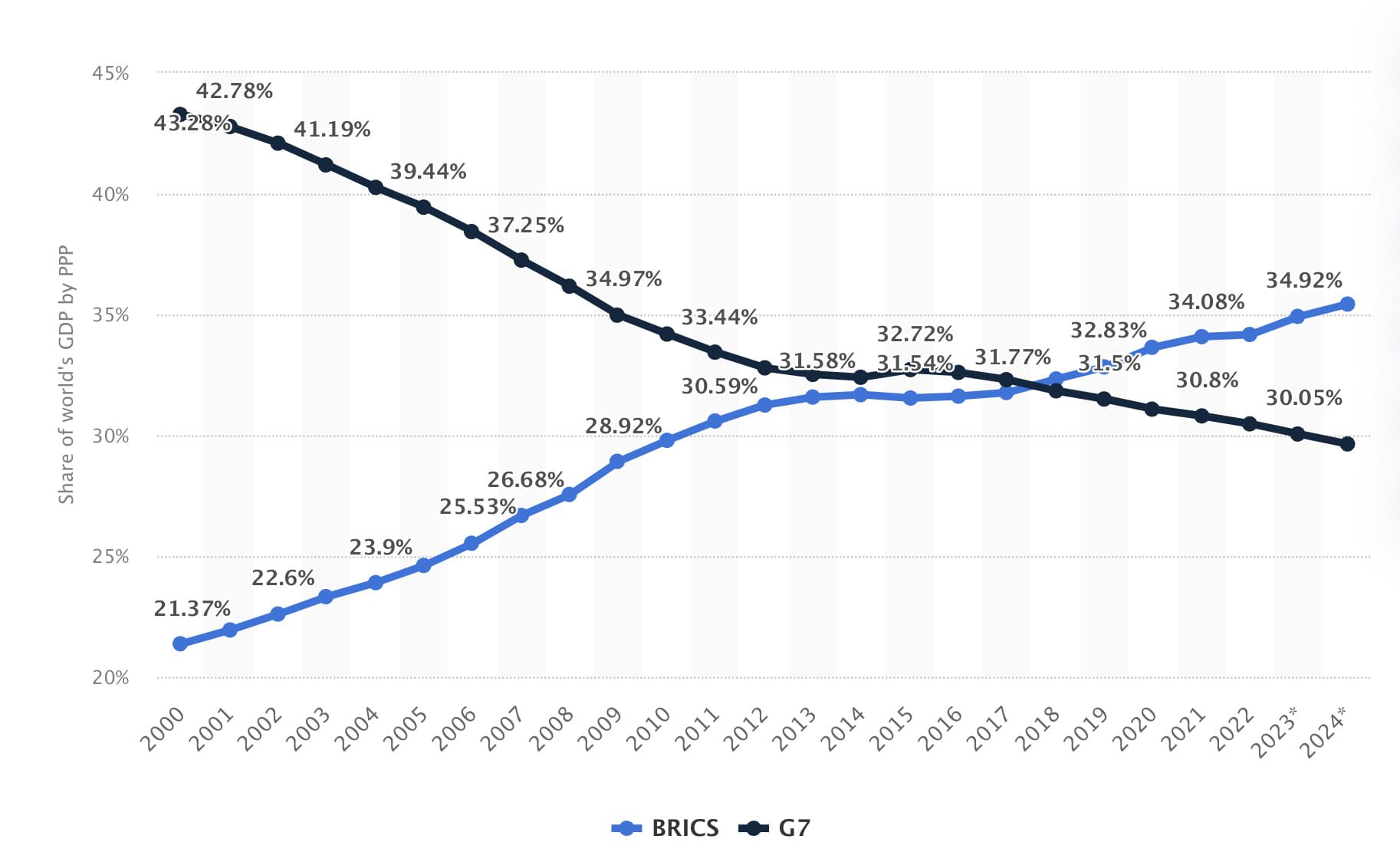
BRICS countries surpassed the G7 in terms of global gross domestic product (GDP) measured by purchasing power parity (PPP) in 2018 (See Figures 1 and 2). By 2024, the gap had widened further, with BRICS accounting for 35% of global GDP, compared to the G7’s 30%. According to the International Monetary Fund (IMF), the BRICS bloc will collectively hold 32.1% of global GDP by 2023, a sharp increase from 16.9% in 1995 and notably more than the G7’s share of 29.9%.
Figure 1: The Share of Global Output Growth Contribution Between G7 and BRICS (in PPP), 2000-2024.
Despite BRICS’ rise, the US dollar continues to wield enormous financial power in international markets. Although de-dollarization efforts have gained momentum, fully dislodging the US dollar from its dominant position will take time. The dollar’s share in global reserves has slightly declined in recent years, partly due to changes in how gold is categorized under the Basel III framework. In 2020, gold was reclassified as a less risky asset by the IMF and World Bank, prompting central banks to diversify their reserves. Nevertheless, as of 2023, around 60% of global central bank reserves are still held in US dollars, with 20% in euros.
The US dollar remains the world’s most traded currency, involved in nearly 90% of all foreign exchange transactions. (Siddiqui, 2020b) Since 1944, the dollar has been the dominant currency for foreign exchange reserves, currently making up 60% of global reserves, compared to the Chinese renminbi’s 3%. The dollar’s strength lies in its liquidity, wide acceptance as a medium of exchange, and freedom from capital controls, unlike the more tightly regulated currencies of China, Russia, India, and South Africa. However, BRICS countries are increasingly using local currencies for bilateral trade, gradually reducing their reliance on the dollar and their exposure to foreign exchange volatility. (Siddiqui, 2021)
Learning from the Past to Build the Future
Understanding history is crucial to shaping a prosperous future. As the saying goes, “the key to the future lies in the past.” Historically, Asia’s share of global GDP plummeted from 60% in 1820 to just 20% by the 1950s. This sharp decline coincided with the colonization of Asian countries by Western European powers, which impoverished the region. Once self-sufficient and exporters of finished goods, these economies were transformed into suppliers of raw materials, resulting in widespread illiteracy, malnutrition, hunger, and poverty.
After World War II, European colonial powers became economically and militarily weakened, while the United States emerged as the leader of global capitalism. Many colonies gained independence in the post-war period, but the colonial system was soon replaced by a neocolonial structure. (Siddiqui, 1989) Developing countries remained dependent on the West for trade, technology, and finance. In the 1980s, the West engineered a debt crisis in the developing world: as global oil prices surged, the US raised interest rates, causing foreign debt repayments to skyrocket. Many developing nations faced crippling debt crises and were forced to borrow more from international financial institutions just to service their existing debts. (Siddiqui, 2024)
Western Neoliberalism and Its Impact
Since the 1980s, Western economic policy has shifted towards neoliberalism. Unlike earlier forms of capitalism, neoliberalism involved relocating metropolitan capital from advanced economies to poorer countries in order to exploit their low wages and reduce production costs for the global market. This shift marked the end of state intervention in “demand management,” which had been a cornerstone of the post-war economic policy known as the “Golden Age” of capitalism.
Despite the long struggle for independence by developing countries, Western hegemony—particularly that of the United States—continues. However, global power dynamics are changing. The US has seen its control weaken in critical areas such as financial markets, science and technology, and the exploitation of natural resources in developing countries. Yet, in other domains, such as control over information and media narratives, the West still holds a firm grip. The US and NATO also maintain a significant military advantage over much of the developing world. For example, the US and European countries account for nearly 70% of global military spending. Many developing nations fear US influence, given its extensive network of foreign military bases and its ability to destabilize or overthrow governments, impose sanctions, and cripple economies—instilling a fear of retribution.
BRICS and the Potential for South-South Cooperation
Over the past few decades, the BRICS nations have achieved remarkable economic growth. However, their political influence in global governance has not kept pace with their economic transformation, particularly given their growing share of the global economy and international trade. (Duggan, et al 2021) The BRICS bloc is highly diverse: India, for instance, has the world’s largest and fastest-growing population (Siddiqui, 2019b), while Russia’s population is in decline. China is a manufacturing powerhouse, while the Middle East, with the inclusion of nations like Saudi Arabia and Iran, supplies much of the world’s oil and gas. Brazil boasts a vast agricultural and industrial base.
This diversity provides the BRICS countries with an opportunity for South-South cooperation, where they can leverage their unique strengths to create a new, multipolar global order. (Siddiqui, 2020a) Through cooperation, these nations can amplify their voices in international forums and drive reforms in global governance systems that have historically been dominated by the West. (Duggan, et al 2021)
Figure 3: Expanded BRICS GDP in trillions of US dollars.
The dramatic growth of BRICS economies can be attributed to their increasing participation in global trade, as well as intra-BRICS trade. In 2010, the total trade volume of BRICS countries amounted to US$4.7 trillion. By 2018, this figure had risen to US$6.8 trillion—an increase of 1.4 times. In contrast, the total trade of G7 countries increased from US$10.8 trillion in 2010 to US$13 trillion in 2018, an increase of only 1.2 times. This shows that BRICS nations are increasing their global trade involvement at a faster pace than the G7. In 2010, BRICS accounted for 14.7% of global trade, while G7 controlled 33.8%. By 2018, BRICS’ share had grown to 17.1%, while the G7’s share had decreased to 32.7%.
In recent years, trade between BRICS countries has grown significantly. For example, in 2000, Brazil and China traded US$2.3 billion annually. By 2019, they were trading nearly US$1 billion every 72 hours, reflecting a fiftyfold increase in trade in just 20 years. Similarly, China-India trade rose 28 times, from US$3 billion in 2000 to US$85 billion in 2019. Overall, intra-BRICS trade volumes increased from US$459 billion in 2010 to US$684 billion in 2019. In comparison, trade between the US and the EU (which includes most G7 members) increased from US$409 billion in 2010 to US$625 billion in 2019.
Most economists predict that US economic growth will continue to slow, as it has for the past 30 years, while Asian economies—especially China and India—are expected to rise steadily over the next decade. BRICS countries have not only boosted exports but have also increased the share of manufactured goods in their exports, which demonstrates their growing capacity to produce goods that are in demand globally. However, despite this progress, the share of manufactured exports among BRICS nations averages 48%, compared to 66% for the G7 (See Figure 4). This gap highlights the advantage the G7 still holds in terms of advanced manufacturing capabilities.
While BRICS is gaining economic momentum, the G7 still enjoys key advantages. The G7 consists of rich Global North nations with higher average incomes, greater productivity, and lower unemployment rates. Historically, these nations have dominated the global economy and set trade and economic rules in their favour.
In 2022, the US had a nominal GDP of US$23.1 trillion, while the other G7 economies saw more modest figures: Japan (US$5.1 trillion), Germany (US$3.8 trillion), the UK (US$2.8 trillion), France (US$2.7 trillion), Italy (US$2 trillion), and Canada (US$1.7 trillion). BRICS nations, by comparison, have experienced economic growth, but there are notable discrepancies in their performance. In 2022, China’s nominal GDP was US$16.3 trillion, significantly higher than that of its BRICS counterparts. India, Brazil, and Russia had GDPs of US$3 trillion, US$1.8 trillion, and US$1.8 trillion, respectively, while South Africa’s GDP was much lower at US$351 billion (See Figure 3)
The BRICS group aspires to play a larger role in global governance, driven by the growing disparity between the influence of developing countries in the global system and their ability to participate in that system. As the economic power of developing economies expands and global power shifts toward the Global South, this imbalance becomes increasingly evident. For example, the UN General Assembly reflects this shift, with developing countries moving toward greater cooperation through South-South initiatives. The current global governance system, however, is in crisis, and efforts to reform institutions like the International Monetary Fund (IMF), World Bank, and World Trade Organization (WTO) have largely failed. (Duggan, et al 2021)
Yet, rising inequality and divergent growth rates among developing nations have emerged as significant challenges. While some East Asian countries, including China and India, have experienced rapid economic expansion, many African and Latin American nations have faced slower growth and rising external debt over the past two decades. Trade imbalances are increasing, and even where trade in manufactured goods has grown, much of this is linked to global supply chains, with limited value added by developing economies. The primary gains continue to accrue to headquarters-based activities in advanced economies (UNCTAD, 2018). Moreover, foreign direct investment (FDI) in developing countries remains concentrated in extractive industries and labour-intensive sectors, which often have low environmental standards. This has led to poor governance, low productivity, high unemployment, and rising social inequality.
Economic integration and South-South cooperation among the Global South (former colonies) have long concerned the West. In the 1970s, when developing countries called for a “New International Economic Order” (NIEO), the West strongly opposed it. Five decades later, the Global South is once again organizing and demanding a greater voice in global governance. (Siddiqui, 1985)
Despite its challenges in shaping the global agenda, BRICS remains the most comprehensive multilateral platform for promoting the interests of the developing world through enhanced South-South cooperation. This cooperation has led to rapid economic growth and deepening economic ties among developing nations. By 2011, exports between developing countries had surpassed their exports to advanced economies (WTO, 2019). The potential for higher growth rates, trade liberalization, and greater industrial cooperation within the Global South appears stronger than with the Global North.
Since 2000, the G7’s share of global GDP (measured by purchasing power parity, PPP) has declined from 43% to 30%, while the original five BRICS countries’ share has increased from just over 21% to 35% during the same period. When measured in nominal US dollars, the G7 still holds a higher share at 43%, but the gap between the two groups is narrowing. With the addition of countries that have applied to join BRICS, the group’s share of global GDP is set to rise significantly. Furthermore, the recent expansion of BRICS, which now includes Egypt, Ethiopia, Iran, Saudi Arabia, and the United Arab Emirates, marks what Chinese President Xi Jinping described as a “historic” moment. This expansion is expected to generate trillions of dollars in additional output, bringing BRICS’ total output to US$29 trillion and accounting for 28.4% of global GDP.
The US economy alone accounts for more than 25% of global economic output, with the European Union contributing approximately another 17%. When combined with other advanced economies such as Canada, the UK, Australia, and Japan, the total GDP of these countries constitutes about 45% of the global economy. Despite this, BRICS countries, though currently characterized by lower per capita incomes, are experiencing much faster economic growth compared to the G7 nations, a trend expected to continue until 2050.
However, there are significant disparities in the economic performance of the BRICS members. For example, China’s economy dominates the group, with a GDP of $18 trillion, accounting for roughly 63% of the BRICS’ total GDP. India’s per capita GDP ($2,389) is less than one-fifth of China’s ($12,720) and one-sixth of Russia’s ($15,345). This gives China disproportionately greater leverage within the group. While India is the second-largest BRICS economy, China’s economy is more than five times larger in terms of GDP.
China and India are two of the world’s leading emerging economies. As of 2022, China and India are the 2nd and 4th largest economies globally on a nominal basis (see Table 1). On a purchasing power parity (PPP) basis, China ranks 1st and India 3rd. Together, these countries account for 21% and 26% of the world’s total wealth in nominal and PPP terms, respectively, and they jointly contribute to over half of Asia’s GDP.
In terms of sectoral GDP composition in 2022, China’s GDP was made up of agriculture (8.3%), industry (39.5%), and services (52.2%). For India, the composition was agriculture (14.9%), industry (23%), and services (61.5%). (The Economist, 2023)
Table 1: China and India’s Macroeconomic Indicators in 2022.
China
India
Population
1.43bn
1.43bn
GDP growth (%)
4.7
5.6
GDP per head (US$)
13,680 (PPP: 23,460)
2,430 (PPP: 8,810)
Inflation (%)
2.9
5.2
Budget balance (% of GDP)
-4.2
-6.0
Source: The Economist, 2023, p.103.
To address the infrastructure needs of member countries, the BRICS established the New Development Bank (NDB) in 2015. By 2022, the bank had provided loans totaling $32 billion to developing countries for infrastructure projects, with a focus on funding sustainable development. However, under the leadership of Dilma Rousseff, the former president of Brazil and current director of the NDB, the bank has made it clear that it will not provide loans for debt servicing. This stance means that BRICS member countries will continue to rely on institutions like the International Monetary Fund (IMF) for financial support, often accompanied by the implementation of “structural adjustment programs” that enforce neoliberal reforms and austerity measures.
The global financial crisis of 2008 marked a pivotal moment for G7 countries and also had a significant impact on developing economies. Unlike previous crises in Latin America (1980s) and East Asia (1997), which were region-specific, this crisis originated on Wall Street—the epicenter of global capitalism. In November 2008, the U.S. invited G20 finance ministers, including those from emerging economies, to discuss the global economic crisis. This marked the first time that emerging economies were included in the global governance and economic management discussions, which had previously been dominated by Western countries.
In recent years, particularly following U.S. sanctions on Russia and the removal of Russian banks from the SWIFT payment system, BRICS members such as China, Russia, and Brazil have developed alternative settlement platforms. These platforms provide alternatives to the Society for Worldwide Interbank Financial Telecommunication (SWIFT) payment system, signaling a shift toward greater financial independence from Western-dominated institutions.
Conclusion
The study concludes that the global economy and governance are gradually shifting towards a multipolar world—a positive development for the Global South, signaling a potential end to Western dominance and hegemony. Over the past three centuries, inequality has been deeply entrenched through slavery, wars, and both colonial and neo-colonial policies.
The erroneous belief that international trade benefits all nations equally, based on the assumption of full employment of all factors of production (including labour), both before and after trade, was a myth propagated by colonizers in the 19th century. It claimed that trade merely reshaped production towards comparative advantages, but this oversimplified view ignored the realities of exploitation and underdevelopment in many regions.
The neoliberal economic order, characterized by relatively unrestricted flows of goods, services, and capital, was built on the bourgeois argument that trade benefits all. However, after the 2008 collapse of the American housing bubble, which triggered a global financial crisis and prolonged overproduction, this narrative began to unravel. Advanced economies increasingly adopted protectionist measures to shield their industries from imports, contradicting the free-trade ethos of neoliberalism.
The last few decades have witnessed a significant transformation in the global economy. In 2000, the G7 economies were ten times larger than those of the BRICS. However, the 2008 financial crisis in advanced economies significantly reduced their output, leading to a long-term decline in growth rates. By 2023, the GDP of these advanced economies had shrunk considerably. It is predicted that by 2030, their share in the global economy will further decrease, while the BRICS nations are expected to surpass the G7 in terms of GDP.
The BRICS group is now striving to improve the stability, reliability, and fairness of the global financial system through the increased use of local currencies, alternative financial arrangements, and alternative payment systems. This shift signals a broader transformation toward a more balanced and inclusive global order, with the BRICS countries playing a leading role in shaping this new landscape.
Dr Kalim Siddiqui is an economist specialising in International Political Economy, Development Economics, International Trade, and International Economics. His work, which combines elements of international political economy and development economics, economic policy, economic history and international trade, often challenges prevailing orthodoxy about which policies promote overall development in less-developed countries. Kalim teaches international economics at the Department of Accounting, Finance and Economics, University of Huddersfield, UK. He has taught economics since 1989 at various universities in Norway and the UK.
References
Niall Duggan, N., Hooijmaaijers, B.and Arapova, E. (2021) “The BRICS, Global Governance, and Challenges for South–South Cooperation in a Post-Western World”, International Political Science Review, 43(4).
Siddiqui, K. (2024) “Neocolonialism: An analysis of international factors on the development of the Global South” World Financial Review, December-January. pp.2-11.
Siddiqui, K. (2023a). “De-dollarisation, Currency Wars, and the End of US Dollar Hegemony” World Financial Review, August-September, pp.2-14.
Siddiqui, K. (2023b). “The Political Economy of Shanghai Cooperation Organisation (SCO) and the Growing Regional Multilateral Ties” World Financial Review, February-March, pp. 2-14.
Siddiqui, K. (2021) “The Bilateral Swap Agreements and the Demise of US Dollar” World Financial Review, September-October, pp.56-64.
Siddiqui, K. (2020a) “Prospects of a Multipolar World and the Role of Emerging Economies” World Financial Review, November-December, p.65-77.
Siddiqui, K. (2020b). “The US Dollar and the World Economy: A critical review” Athens Journal of Economics and Business. 6(1):21-44. January.
Siddiqui, K. (2019a). “One Belt and One Road, China’s Massive Infrastructure Project to Boost Trade and Economy: An Overview” International Critical Thought. 9(2): 214-235.
Siddiqui, K. (2019b). “A Century of India’s Economic Transformation: A Critical Review” Journal of Perspectives on Financing and Regional Development, 7(1): 1-22, Jan.-Feb.
Siddiqui, K. (2016). “Will the Growth of the BRICs Cause a Shift in the Global Balance of Economic Power in the 21st Century?” International Journal of Political Economy 45(4):315-338.
Siddiqui, K. (1989) “Neo-Classical Economic Theory: A critical perspective”, Klassekampen, (in Norwegian) August 31& September 1, Oslo, Norway
Siddiqui, K. (1985) “South-South Economic Co-operation and its Future Prospects”, Bergens Tidende, October 4, Norway.
United Nations Conference on Trade and Development (UNCTAD) (2018) Trade and Development Report 2018: Power, Platforms and the Free Trade Delusion. New York, NY: United Nations.
Republican presidential candidate Donald Trump headlined a rally at New York’s Madison Square Garden on Sunday, using the iconic venue to intensify his campaign’s closing arguments against Democratic opponent Kamala Harris. Trump’s speech centered on immigration, promising to launch “the largest deportation program in American history” if elected, labeling certain migrants as “vicious and bloodthirsty criminals.”
The event opened with controversial remarks from allies, including former New York City Mayor Rudy Giuliani, who accused Harris of siding with “terrorists” in the Israeli-Palestinian conflict, and comedian Tony Hinchcliffe, who insulted Puerto Rico, sparking outrage on social media. Senior campaign adviser Danielle Alvarez stated that these remarks do not reflect Trump’s views.
Trump, rejecting comparisons to a 1939 pro-Nazi rally at the venue, claimed, “This is called Make America Great Again, that’s all this is.” Musk, supporting Trump’s bid, echoed this sentiment, advocating for significant federal budget cuts.
The rally contrasts with Harris’s own high-profile campaign events, with 30,000 attendees joining her and Beyoncé in Houston on Friday. Harris continues her outreach to Puerto Rican voters, promising investment and reform as president. Polls remain close as the candidates vie for battleground state votes ahead of the November 5 election.
In this Xlence Review, we provide our readers with proper information regarding the full range of services provided by this company. Xlence is an international forex and CFD brokerage that recently emerged in the trading space, and received high praise for offering exceptional trading services, rich educational content and outstanding client support.
Why Trade with Xlence?
Here are just a few reasons why traders tend to choose Xlence:
Flexible Leverage up to 1:1000 means you get the most out of your trading and the market.
Low Spreads help traders trade for less across the world’s most popular trading markets.
Fast Execution is key when trading in a fast-paced environment and guarantees that orders are processed at the best rates.
Hassle-Free Deposits and Withdrawals is another important aspect of trading and one that many Xlence reviews focus on. We believe the broker delivers on its promise of fast and seamless deposit and withdrawal options. Most online Xlence reviews have commented on this excellent and seamless service.
Dedicated Customer Support: Xlence’s team is knowledgeable and very friendly and this has become obvious from our team as well as traders we have talked to.
Xlence Review: Products Available for Trading
Xlence offers a broad selection of financial instruments across six major asset classes, allowing traders to diversify their portfolios:
Clients have access to over 80 financial instruments in the Forex market that include: major, minor, as well as exotic pairs. These come with low spreads and round-the-clock trading access making Forex a favourite among active traders.
For beginners as well as those who seek more means to diversify their trading portfolios, Xlence offers CFDs on metals, including gold, silver and palladium. The broker maintains relatively small bid–ask spreads and short order processing time which is crucial in highly liquid markets.
Along with Forex and metals, Xlence offers trading in such indices as S&P500, FTSE-100, Dow Jones, Nasdaq 100, etc. Trading indices provides the trader with a great opportunity to participate in the global markets and potentially profit from movements of global indices.
Xlence provides CFDs of energy commodities for example oil and natural gas besides agricultural products such as cocoa, coffee and sugar. These assets offer possibilities to mitigate risk and diversify one’s portfolio.
Regarding shares, Xlence offers share CFDs on market leaders such as Tesla, Amazon and Netflix, as well as other enterprises and global brands. Traders can trade CFDs with very reasonable and transparent prices.
Finally, Xlence offers a number of futures in commodity, index, and energy sectors. The leverage is adjustable and all conditions are clear, and futures traders can enjoy long-term trading and diversify their portfolios.
Xlence Review: Account Types
Many Xlence Reviews focus on the broker’s accounts and there’s a reason for that. Xlence offers a range of account types that cater to different trading styles and preferences offering a balance between flexibility and efficiency:
Xlence Essential Account
Ideal for beginners, the Essential account offers superb trading conditions with floating spreads starting from 1.1 pips on EUR/USD and 0.23 pips on gold. There are no commissions except for specific futures trades. Leverage is flexible, up to 1:1000, and the stop-out level is set at 20%.
Xlence Prime Account
For traders looking for more competitive spreads, the Prime account offers reduced spreads starting from 0.9 pips on EUR/USD and 0.18 pips on gold. Leverage remains up to 1:1000, and clients benefit from a dedicated account manager for personalized support.
Xlence Deluxe Account
The Deluxe account is designed for more active traders, offering even lower spreads (as low as 0.6 pips on EUR/USD) and enhanced support. Like the Prime account, leverage remains high at 1:1000, and commission is waived on most products.
Xlence Ultimate Account
For professional traders, the Ultimate account provides the tightest spreads (starting from 0.4 pips on EUR/USD) and the highest levels of customer service, including a dedicated manager. This account is tailored for traders who require the best trading conditions.
Across all accounts, traders can enjoy a minimum lot size of 0.01, flexible leverage, and the option to trade in various base currencies.
Spreads
Xlence gives traders an opportunity to work with very tight spreads that will lower the trading costs and boost the traders’ potential income. Xlence offers 4 account types: Essential, Prime, Deluxe, Ultimate; it provides low spreads on EUR/USD as low as 0.7 pips. Such low spreads imply high liquidity and, in turn, low volatility, which make trading costs effective for traders. Having a higher level of account enables traders to get even more competitive spreads and minimise their costs even further.
Xlence Review: MT4 Trading Platform
Available across multiple devices—including Windows, macOS, iOS, and Android—MT4 offers real time market prices, advanced charting tools and integrated third-party software tools for automated trades. The platform is available on desktop and mobile devices or accessed through a web browser so you can trade on the go.
Xlence Review: Educational Resources
No Xlence review would be complete without a section on this broker’s educational resources and tools. Xlence places a strong emphasis on trader education, offering a wide array of resources to help clients improve their trading skills:
Xlence Academy:The Xlence Academy is packed with educational courses designed to deepen traders’ knowledge of market fundamentals, technical analysis, and trading strategies. These resources are accessible to all clients, ensuring that everyone has the tools needed to excel.
Economic Calendar:Xlence also provides an economic calendar to keep traders informed of key market-moving events, helping them plan their trades more effectively.
Conclusion
This Xlence Review tried to offer an objective overview of this broker, outlining carefully all its products and services. Xlence offers a comprehensive trading environment suitable for traders of all levels. From its flexible leverage options and competitive spreads to its advanced platforms and educational resources, Xlence has everything you need to excel in the world of trading.
All trading involves risk. It is possible to lose all your capital.
Elon Musk, CEO of Tesla and SpaceX, has pledged to give away $1 million a day until the November 5 election to voters who sign his political action committee’s petition backing the Constitution. The initiative, tied to Donald Trump’s presidential campaign, has sparked concerns among election experts and officials.
Musk’s PAC, supporting free speech and gun rights, requires participants to be registered voters, raising legal questions. Election law experts argue that offering financial incentives to registered voters may violate laws prohibiting payments for voter registration.
Pennsylvania Governor Josh Shapiro expressed concerns over the dark money flowing into the state and its potential impact on voters. Some experts believe the giveaway skirts close to illegal voter incentives.
Musk’s PAC has been touring key battleground states, pushing voter registration and promoting Trump’s candidacy, while critics debate the legality of this unconventional campaign strategy.
By Terence Tse
CFOs are evolving into AI-driven transformation orchestrators, balancing finance, technology, and strategy while upskilling teams, managing risks, and driving measurable business value.
A key insight from this year’s AI for CFOs event, organized...
The World Financial Review uses cookies to improve site functionality, provide you with a better browsing experience, and to enable our partners to advertise to you. Detailed information on the use of cookies on this Site, and how you can decline them, is provided in our Privacy Policy and Terms and Conditions. By clicking on the accept button and using this Site, you consent to our Privacy Policy and Terms and Conditions. ACCEPT
Privacy & Cookies Policy
Privacy Overview
This website uses cookies to improve your experience while you navigate through the website. Out of these cookies, the cookies that are categorized as necessary are stored on your browser as they are essential for the working of basic functionalities of the website. We also use third-party cookies that help us analyze and understand how you use this website. These cookies will be stored in your browser only with your consent. You also have the option to opt-out of these cookies. But opting out of some of these cookies may have an effect on your browsing experience.
Necessary cookies are absolutely essential for the website to function properly. This category only includes cookies that ensures basic functionalities and security features of the website. These cookies do not store any personal information.
Any cookies that may not be particularly necessary for the website to function and is used specifically to collect user personal data via analytics, ads, other embedded contents are termed as non-necessary cookies. It is mandatory to procure user consent prior to running these cookies on your website.