Global share markets surged on Monday following a breakthrough in trade discussions between the United States and China, with President Donald Trump declaring a “total reset” in economic terms after high-level talks over the weekend in Switzerland.
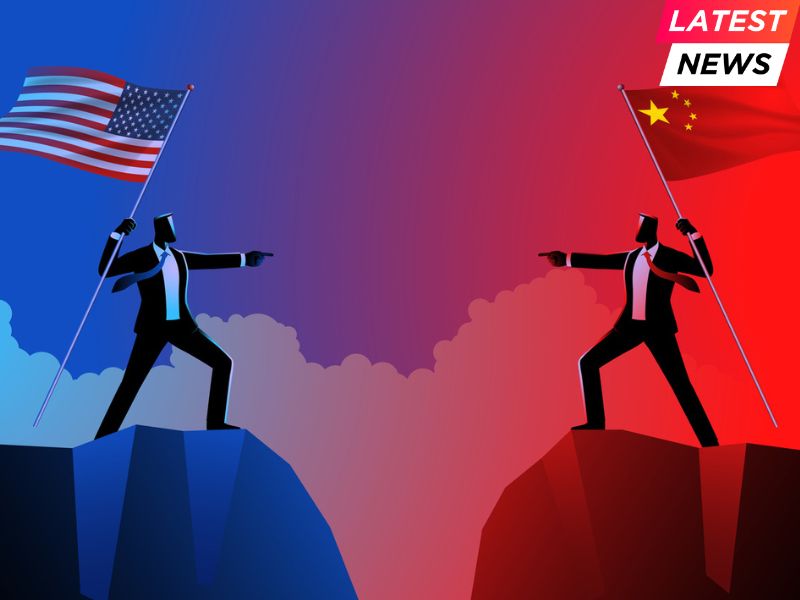
The agreement significantly lowers tariffs on both sides, easing tensions that have rattled investors for months. Washington will reduce its sweeping tariffs from 145% to 30%, while Beijing will cut its retaliatory rates on American imports from 125% to 10%.
Though many of the levies are suspended rather than removed entirely, President Trump said he expects further progress within the next three months. “We’re not looking to hurt China,” he said, noting the economic strain Chinese factories had been experiencing. “They were very happy to be able to do something with us.”
Trump also signaled a possible phone call with Chinese President Xi Jinping by week’s end.
Wall Street responded swiftly to the news. The S&P 500 rose more than 3.2%, the Dow Jones Industrial Average gained 2.8%, and the Nasdaq soared 4.3%, erasing losses from the sharp downturn following the April 2 tariff hike, dubbed “Liberation Day” by the White House.
Under the revised agreement, the US is suspending the steep tariff imposed on Chinese goods during that campaign and lowering the universal import tariff to 10%. However, it is retaining an extra 20% levy on specific goods like fentanyl to press Beijing on curbing the illegal drug trade.
China, in turn, pledged to suspend or eliminate various non-tariff barriers while confirming that retaliatory tariffs introduced in response to the US escalation will also fall to 10% for now. Sector-specific duties on items such as steel and automobiles, however, will remain in place.
The deal arrives as early economic indicators pointed to declining trade activity. US ports had seen a notable drop in scheduled Chinese shipments, while Chinese manufacturers were beginning to cut jobs as American orders slowed.
China’s Ministry of Commerce described the agreement as a meaningful step toward resolving differences and strengthening cooperation. Business leaders echoed cautious optimism.
Tat Kei, who operates a personal care appliance factory in Shenzhen, welcomed the relief but warned that uncertainty remains. “I don’t think this is the end of it… not by a long shot,” he told the BBC.
Elaine Li of Atlas Ways, a consultancy supporting Chinese firms with international growth, urged companies to prepare for future volatility. “The best they can do is build a moat around their company before the next round of tariffs arrives,” she said.
Retail and tech giants led the US stock surge. Target, Nike, and Home Depot posted sharp gains, while Amazon, Apple, Nvidia, and Meta all moved higher. European markets followed suit, with Denmark’s Maersk and Germany’s Hapag-Lloyd—both major shipping firms—jumping 12% and 14% respectively.
Maersk called the development “a step in the right direction” and expressed hope for a permanent settlement that would bring long-term stability for global trade partners.
The US National Retail Federation praised the outcome. “This temporary pause is a critical first step to provide some short-term relief for retailers,” said president Matthew Shay.
The International Chamber of Commerce described the pact as a signal of willingness to avoid deeper economic fragmentation. “We hope this agreement lays the foundation to lift the cloud of trade policy uncertainty,” said deputy secretary-general Andrew Wilson.
Meanwhile, gold prices dipped 3.1% to $3,223.57 per ounce as investors shifted away from safe-haven assets amid the improving trade outlook.
Related Readings: