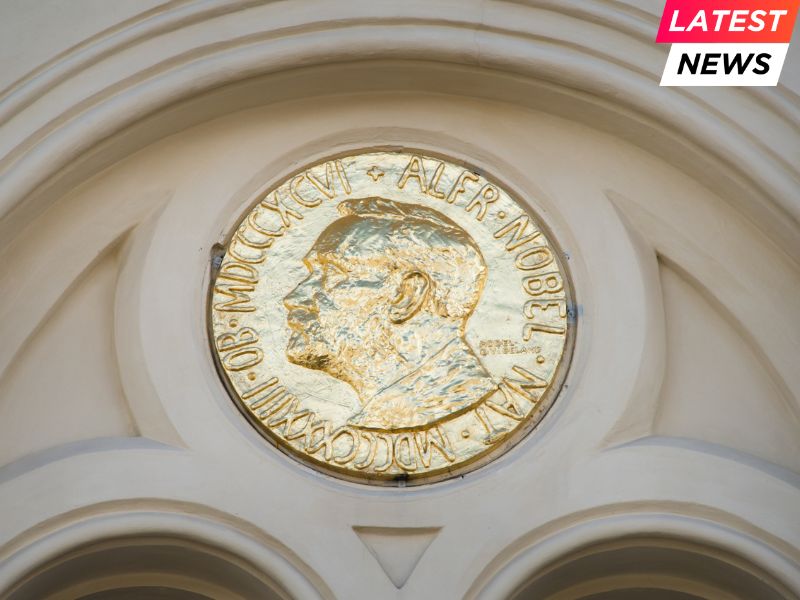
Venezuelan opposition leader María Corina Machado has been awarded the 2025 Nobel Peace Prize for her unwavering commitment to democracy and human rights in her home country. The Norwegian Nobel Committee announced the honor on Friday, praising her for keeping “the flame of democracy burning amid a growing darkness” in Venezuela.
Machado, who has lived in hiding since last year’s disputed election, was recognized “for her struggle to achieve a just and peaceful transition from dictatorship to democracy.” Born in Caracas in 1967, she trained as an industrial engineer before entering politics. In 2002, she founded Súmate, a civic organization that promotes political participation and monitors elections.
Known for her belief in “ballots over bullets,” Machado has long championed nonviolent resistance to authoritarian rule. The Nobel committee described her as “one of the most extraordinary examples of civilian courage in Latin America in recent times.”
Upon receiving the call from Oslo, Machado said she was overwhelmed. “Oh my god … I have no words,” she said after being awakened in the middle of the night. In a statement, she dedicated the award to the Venezuelan people, calling it “a recognition of what we have achieved together and a reminder of what still remains.”
Although the White House criticized the Nobel Committee for overlooking President Donald Trump’s peace efforts, Trump himself congratulated Machado after speaking with her by phone. “The person who actually got the Nobel Prize called today, called me and said, ‘I’m accepting this in honor of you,’” Trump told reporters.
Machado confirmed the conversation, expressing gratitude for U.S. support. “We are deeply grateful to President Trump,” she told El País. On X, she wrote, “We are on the threshold of victory, and today more than ever we count on President Trump, the people of the United States, the people of Latin America, and the democratic nations of the world as our main allies in achieving freedom and democracy. Venezuela will be free!”
Tensions between Washington and Caracas have intensified in recent months. According to U.S. officials, Trump’s administration is pursuing a broader strategy aimed at isolating President Nicolás Maduro, including economic sanctions and naval operations targeting alleged “narco-trafficking” vessels off the Venezuelan coast.
Machado’s journey toward democratic reform has been marked by setbacks and danger. Freedom House reports that Venezuela’s institutions have deteriorated sharply since 1999, with political repression deepening under Maduro’s rule.
In 2024, Machado sought to challenge Maduro in the presidential race but was barred from running. She later backed Edmundo González Urrutia and mobilized volunteers to ensure transparent elections. Both candidates claimed victory, but the government-controlled electoral body declared Maduro the winner with 51.95% of the vote. Opposition observers reported “suspicious” data patterns, suggesting widespread irregularities.
Machado insisted that her team had proof that Maduro lost “in a landslide to Edmundo, 67% to 30%.” Writing in The Wall Street Journal, she said her group had secured “receipts obtained directly from more than 80% of the nation’s polling stations.” The Nobel Committee commended her for ensuring that “the final tallies were documented before the regime could destroy the ballots and lie about the outcome.”
The Biden administration also concurred that there was “overwhelming evidence” Maduro had lost. Following the disputed vote, the Venezuelan government cracked down on dissent, with Human Rights Watch reporting killings, torture, and disappearances of activists.
Since then, Machado has operated underground, reemerging briefly during mass protests in early 2025. Speaking from an undisclosed location, she told CNN that the regime had “lost total touch with reality and lost its social base,” but insisted that millions of Venezuelans remain committed to democratic change. “Everyone in Venezuela is afraid of losing our freedom or even our lives,” she said. “But above all, we are committed to make the truth prevail and get a transition to democracy peacefully.”
Announcing the award, Jørgen Watne Frydnes, chair of the Nobel Committee, said Machado’s courage exemplifies the values Alfred Nobel envisioned. “She has brought her country’s opposition together. She has never wavered in resisting the militarization of Venezuelan society. She has been steadfast in her support for a peaceful transition to democracy,” Frydnes said.
Her ally González celebrated the decision, saying the prize honors “peace, a fundamental element in our campaign.” He called Machado “an upright, brave and courageous political figure.”
Analysts view the award as a symbolic stand for global democracy. Karim Haggag, director of the Stockholm International Peace Research Institute, said the committee “clearly chose to highlight democracy as a priority area” amid a global decline in democratic norms. Nina Græger, director of the Peace Research Institute Oslo, added that the award is “above all, a prize for democracy,” emphasizing that “research shows democracy is an important precondition for peace.”
Last year’s Peace Prize went to Nihon Hidankyo, a Japanese organization of atomic bomb survivors, underscoring the Nobel Committee’s focus on global threats such as nuclear proliferation. This year, the emphasis has shifted toward defending democracy in the face of authoritarian resurgence.
The Nobel Peace Prize carries a cash award of 11 million Swedish kronor, or roughly $1 million, and will be presented in Oslo in December. However, Frydnes said it is uncertain whether Machado can attend due to security concerns. “It’s a question of security. It’s too early to say. We always hope to have the laureate with us in Oslo, but this is a serious security situation which needs to be handled first,” he said.
For many Venezuelans, Machado’s recognition marks both validation and motivation. As she said in her acceptance statement, “This prize is not mine alone. It belongs to all who continue to believe in ballots over bullets. Our fight is not over, but this gives us hope that the world is watching.”
Related Readings: