



This study challenges conventional catch-up narratives, arguing that Global South underdevelopment stems from systematic subordination through unequal exchange. Dr Kalim Siddiqui demonstrates how imperialist appropriation transfers labour and resources from the South to the North, amounting to approximately €16.9 trillion in wage-equivalent value in 2021. This structural dependence constrains convergence, while ending appropriation would require fundamental changes in labour and resource extraction in the Global North.
Introduction
The “Global South” is a critical and geopolitical framework used to describe former colonial and low-income economies primarily located in Africa, Latin America, and most of Asia, rather than a strict geographic designation of countries in the Southern Hemisphere. The existence of vast poverty in the Global South highlights how historical colonialism, unequal trade, and modern capitalist globalisation maintain systemic gaps in wealth, power, and resources between wealthier nations (the Global North) and the former colonies (the Global South).
Unequal exchange theory argues that international trade systematically transfers wealth, labour and resources from the Global South to wealthy industrialised nations in the Global North. Britain, for example, extracted cotton, opium, grain, timber, tea and countless other commodities from its colonies, relying on the coercive exploitation of Global South labour through enslavement and indenture. This colonial appropriation was fundamental to Europe’s industrialisation and helped finance the expansion and industrial development of European settler colonies, including Australia, New Zealand, Canada and the United States, which subsequently adopted similarly imperialist orientations towards the Global South (Patnaik, 2018; Siddiqui, 2021).
The study by Hickel; Sullivan; and Zoomkawala (2021) demonstrates the scale of unequal exchange between the Global North and Global South. Using exchange-rate differentials, they estimate that in 2017 the Global North appropriated commodities from the Global South valued at approximately US$2.2 trillion in Northern prices, expressed in constant 2011 dollars. Their historical analysis further shows that value transfers through unequal exchange reached approximately 7.1% of Global North GDP in 2011 and 8.8% of Global South GDP (measured at purchasing power parity) in 2004. By 2017, these transfers still represented approximately 4.7% of Northern GDP and 3.6% of Southern GDP. These findings illustrate how unequal international price structures facilitate the systematic transfer of value from Southern economies to Northern economies, reinforcing global economic inequalities.
The underlying cause of this drain is unequal exchange rooted in wage differentials, rather than exchange-rate differentials per se; the drain is also evident in global average prices as well as Global North prices. Both the intensity of exploitation and the scale of unequal exchange increased significantly during the ‘Structural Adjustment Programmes’ imposed by the IMF/World Bank since the 1980s (Crossa and Reyes, 2026).
The theory of unequal exchange was advanced by Emmanuel (1972), whose work challenges traditional free-trade and Marxist theories of imperialism. He rejected Ricardo’s trade theory. Emmanuel argued that David Ricardo’s classical theory of ‘comparative advantage’—which claims that trade naturally benefits all trading partners—cannot explain how wealthy nations grow rich at the expense of poorer ones (Siddiqui, 2024).
Unlike later theorists who blamed productivity gaps, Emmanuel argued that international trade systematically transfers value from low-wage nations in the Global South to high-wage nations in the Global North primarily because of pre-existing wage disparities. Capital moves freely across borders, equalising the rate of profit globally, while labour does not move freely. Consequently, goods produced by low-wage labour trade below their true value, while goods produced by high-wage labour trade above it (Siddiqui, 2016).
Emmanuel suggested that this hidden transfer of wealth enables the Global North to maintain high living standards and welfare states for its own working class, thereby complicating traditional notions of global working-class solidarity (Foster and Clark, 2026).
Samir Amin’s theory of unequal exchange describes a hidden, systemic transfer of value from the Global South (the periphery) to the Global North (the core) through international trade. Amin (1977) argued that inequality between countries is driven primarily by the deep wage gap between core and periphery rather than by differences in worker productivity. Workers in peripheral countries are paid significantly lower wages for equivalent, often labour-intensive, output, allowing capitalists to extract higher surplus value (Siddiqui, 1994).
Peripheral countries export cheap raw materials and labour-intensive goods while importing expensive manufactured goods and technology from the core. This maintains a misleading monetary trade balance while draining real value and resources from the Global South. Rosa Luxemburg argued that the system produces global economic polarisation, enriching the core and locking peripheral nations into dependency and underdevelopment (Siddiqui, 2015).
Raúl Prebisch’s analytical framework and the associated theory of trade relations also known as unequal exchange have been adopted not only by followers of the Latin American dependency tradition stemming directly from Prebisch but also, though often with extensive modifications, by scholars such as Emmanuel, André Gunder Frank, and Samir Amin.
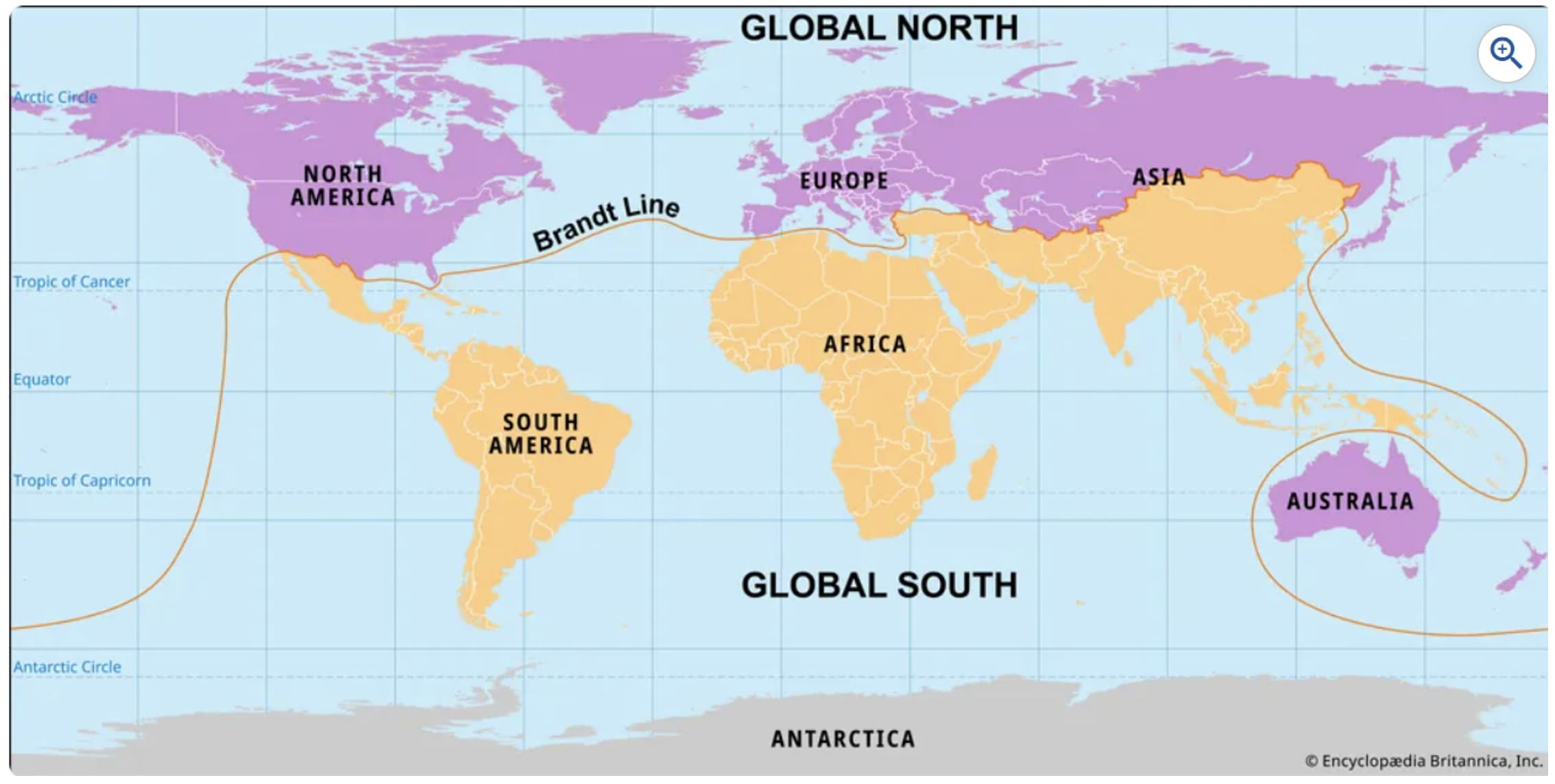
The Global North–Global South framework is an approach to understanding and analysing disparities in economic prosperity, development, and international power among countries worldwide. It gained increasing prominence in response to criticisms of earlier classification systems, particularly the Three Worlds model and the dichotomy between developed and developing countries. The terms Global North and Global South (See Figure 1) are frequently used interchangeably with classifications such as more-developed and less-developed countries, including in the discourse of the United Nations and other international organizations.
Broadly speaking, this framework distinguishes between countries that have historically enjoyed greater economic prosperity and political influence and those that have experienced comparatively lower levels of development and global power. Importantly, however, this binary classification does not correspond directly to the geographical division between the Northern and Southern Hemispheres.
Figures 1: Map Showing the Global North and the Global South.
Source: https://www.britannica.com/topic/Global-North-and-Global-South
Emmanuel’s critique of David Ricardo’s classic theory of international trade—and of its modern neoliberal versions, which claim that all parties benefit from exchange—builds on Karl Marx’s theory of value, an uncompleted work in Capital Volume IV. Emmanuel’s book (1972) Unequal Exchange: A Study of the Imperialism of Trade, focuses on circulation—international trade—rather than on the sphere of production, where the exploitation of labour is understood to occur.
The theory of unequal exchange is grounded in the Marxist concept of value. Historically developed capitalism has polarised the world-system into a centre and a periphery with correspondingly high and low wage levels. This difference in the price of labour entails a value transfer hidden in the price structure when commodities are exchanged between the centre and the periphery (Siddiqui, 1994).
In the 21st century, neoliberal globalisation has transformed the global economy. The development of productive forces—computers, mobile phones, the Internet, the standard shipping container, and new logistical systems—made it possible to control and manage production globally. The distance between the place of production and the market became less relevant. In pursuit of higher profit, industrial production was outsourced on a massive scale from the Global North to low-wage countries in the Global South (Crossa and Reyes, 2026).
For instance, in the 1950s, industrial goods accounted for only 15 percent of the combined exports of all so-called Global South countries. By 2024, that figure had risen to more than 75 percent. This shift resulted from the organisation of industrial production of all kinds—from high-tech electronics and automobiles to washing machines, televisions, and designer clothing—into global production chains stretching from the Global North to the Global South and back again. Financing and control of the entire process, as well as research and development, remained in the Global North.
Automobiles, for example, are often produced across multiple countries in the Global South, wherever conditions for profitability are most favourable, before final assembly. Value transfer therefore occurs not only through international trade but also through intra-company pricing across different stages of production. Low wages in the Global South not only raise the overall rate of profit but also shape the prices of goods produced there.
In mainstream economics, the formation of a smartphone’s market price along the production chain is often illustrated through the so-called smiling curve of value added. Here, value added is understood in conventional price terms as the additional costs and returns generated at each stage of production. It is typically highest at the beginning of the chain, where research and development, design, and financial management—largely concentrated in the high-wage economies of the Global North—take place. It then falls during manufacturing, where low-paid labour in the Global South produces the physical commodity, before rising again through branding, marketing, and sales, also concentrated in the Global North. This final stage is particularly revealing, since retail workers in the North are often among the lowest-paid employees in their respective economies.
Unequal exchange thus enables the Global North to appropriate and consume a disproportionate share of the world’s natural resources, securing greater control over their use. Through the capitalist market, the Global South is compelled to reproduce historical inequalities rooted in colonialism while pursuing forms of economic development that are often environmentally and socially unsustainable (Siddiqui, 2021).
In recent decades, labour migration has emerged as another form of unequal exchange. Under neoliberal globalisation, increasing numbers of people from the Global South have been compelled to seek employment in wealthier countries, a trend rooted in the unequal economic relations between North and South (Siddiqui, 2020b). Although mainstream economists portray migration as the free movement of labour, this perspective overlooks its historical foundations in economic coercion, dispossession, and displacement. These processes date back to European colonial expansion, driven by military superiority and advances in navigation (Siddiqui, 2026). Colonialism sought to enslave populations, occupy territories, and seize control of their resources for the enrichment of European powers.
Following the Second World War, European colonial powers were weakened, while anti-colonial struggles across the Global South, alongside the changing international balance of power, accelerated decolonisation. However, political independence did little to overcome the structural inequalities inherited from colonial rule. Former colonies were left with widespread poverty, low literacy and productivity, limited domestic savings, and minimal industrial development. They also lacked the capital and productive capacity needed to achieve greater self-sufficiency in industrial goods and food production and reduce their dependence on imports.
Furthermore, former colonial powers actively sought to obstruct independent industrialisation in their former colonies. Benefiting from overwhelming economic, military, and technological advantages, they continued to dominate the newly independent states. Thus, unequal exchange persisted in a new form: neo-colonialism, through which formal political independence coexisted with continued economic subordination.
Theoretical Debate
David Ricardo assumed that capital was internationally immobile and developed his Theory of Comparative Advantage to explain the benefits of international trade (Siddiqui, 2018). He argued that countries gain from specialising in and exporting goods for which they enjoy a comparative advantage relative to other goods. However, differences in productivity and labour intensity mean that international exchange may be unequal in terms of the labour embodied in traded commodities: some countries obtain more labour in exchange for less, while others give more labour than they receive (Siddiqui, 2021).
Marx recognised this asymmetry in the Grundrisse, arguing that two countries could exchange according to the law of profit and both gain, while one systematically defrauds the other: “One of the nations may constantly appropriate for itself a part of the surplus labour of the other, giving nothing back for it in exchange.” Similarly, in Capital, Volume III, he observed that the privileged country “receives more labour in exchange for less”, thereby securing “surplus profit”, while the poorer country “gives more objective labour than it receives.”
The neoclassical defence of free trade was subsequently challenged by Arghiri Emmanuel (1972) in his influential study Unequal Exchange, which opened an extensive debate on international trade, imperialism, and the relationship between the working classes of advanced capitalist economies and imperialist structures. Amin summarised the limitations of Ricardo’s theory of comparative advantage, arguing that it establishes only that, given existing differences in productivity, trade may benefit both countries, even when the exchange itself is unequal (Siddiqui, 2024).
Emmanuel did not primarily develop his analysis within the framework of imperialism theory. Rather, his abstract model assumed conditions of free competition rather than monopoly capital. Nor did he begin with class-based production and accumulation, although both featured in his analysis. Instead, he treated wages as an independent variable (Foster and Clark, 2026).
In Imperialism and Unequal Development (1977), Amin argued that Emmanuel’s approach was vulnerable to criticism because the restrictive assumptions of his model prevented him from addressing the fundamental determinants of unequal exchange. In particular, Emmanuel treated wages as an independent variable rather than relating them dialectically to the historical development of production and accumulation, differences in productivity, and the exploitation of peripheral workers through international trade. Against this approach, Amin introduced the concept of world value, arguing that labour engaged in the production of internationally traded commodities must be understood within an international system of value formation (Amin, 1977).
The central theoretical problem in Emmanuel’s analysis was how to account for historically produced differences in the development of productive forces and labour productivity across the world economy (Siddiqui, 2023). Amin therefore advanced a historically grounded conception of unequal exchange that went beyond wage differentials and rejected any simple causal relationship between wages and productivity. As he argued, the products exported by the periphery are significant, in economic rather than merely natural-resource terms, “to the extent that the difference between the returns to labour is greater than the difference between the productivities.” (Foster and Clark, 2026).
Amin departed from Emmanuel’s tendency to treat wage levels as the primary determinant of productive forces, labour productivity, and accumulation. Whereas Emmanuel’s framework associated high wages with unequal exchange, Amin argued that higher wages in developed capitalist economies were historically the outcome of economic development. He further maintained that workers in the Global North benefited from imperialist exploitation through unequal exchange.
In the twenty-first century, multinational corporations (MNCs) have become increasingly powerful through the scale of their global operations and the concentration of capital under their control. They have relocated much of industrial production to the Global South, often outsourcing manufacturing to independent suppliers. This enables them to exploit lower wages while externalising production costs and shifting part of the environmental burden of manufacturing onto poorer countries.
Estimates for 2022 indicate that the Global North appropriated a net total of 826 billion hours of embodied labour from the Global South, across all skill categories, through the largely invisible labour embedded in global commodity production. This appropriation was equivalent to $18.4 trillion in wages at Global North wage rates, more than twice the estimated amount in 1995. Moreover, wage disparities across skill categories widened considerably between 1995 and 2022, with workers in the Global South earning 87–95 per cent less than equally skilled workers in the Global North.
The broader theoretical approach to unequal exchange, which explains uneven development within the world capitalist system through differences in the organic composition of capital, offers important analytical insights. It helps account for the concentration of scientific knowledge, technological capabilities, and innovation in imperialist economies, rather than peripheral countries. Despite the internationalisation of production, advanced capitalist economies continue to maintain comparatively high levels of gross capital formation, while peripheral economies remain constrained by weaker investment capacities, limited technological development, and lower levels of capital accumulation. These structural inequalities are also reflected in substantial disparities in research and development (R&D) expenditure between advanced and less-developed economies (Crossa and Reyes, 2026).
From this perspective, global capitalism reproduces international inequalities through the transfer of value between core and peripheral economies, shaped by differences in their organic compositions of capital and positions within the international division of labour. However, reducing unequal exchange to disparities in the technical conditions of production provides only a partial explanation. The international wage hierarchy is equally important: substantially lower wages in peripheral economies enable capital to exploit international differences in labour costs, even where productivity levels and production processes are comparable.
Globalization, Exploitation, and Unequal Exchange
Drawing on a panel dataset covering 120 sectors across 164 countries over the period 1990–2023, Rotta (2027) develops a novel empirical framework for estimating exploitation rates, defined as the ratio of unpaid to paid labour time, and examines the hypothesis that globalization promotes their convergence. By integrating the Leontief input–output model with the New Interpretation of Marxian value theory, the study distinguishes between value production and value realization and investigates their distinct implications for the dynamics of global exploitation. Using comprehensive input–output data, it provides what appears to be the most extensive empirical investigation of exploitation rates to date.
As Rotta (2027) observes, “While most value is produced in peripheral regions, value realization is concentrated in the core. Unequal exchange, manifested through value transfers from high- to low-exploitation activities, conceals the global hierarchy of labour” (Rotta, 2027).
This argument can be situated within the classical Marxian theory of unequal exchange. From this perspective, core economies, characterized by higher organic compositions of capital and greater labour productivity, tend to sell commodities at prices above their values, while peripheral economies tend to sell them below their values. Differences in the organic composition of capital and productivity thus contribute to the international redistribution of value from less-developed to advanced economies, reinforcing structural inequalities between the core and the periphery.
However, the transfer of value cannot be explained solely through uneven technological development or productivity differentials. International wage disparities constitute another central mechanism of unequal exchange, enabling capital to appropriate a greater share of value produced in peripheral economies. From this perspective, the transfer of value from the periphery to the core also reflects the persistent hierarchy of wages within the global capitalist system.
Neither the organic-composition-of-capital approach nor the wage-differential approach, considered in isolation, adequately explains these international asymmetries. The former cannot fully account for the presence of highly productive, capital-intensive sectors within peripheral economies, while the latter overlooks the structural heterogeneity of dependent capitalism. Peripheral economies are characterised by the coexistence of sectors with high organic compositions of capital and productivity levels alongside extensive low-productivity activities marked by limited capital accumulation and persistently weak investment.
Marx and Unequal Exchange
In contrast to the political economists who preceded him, many of whom regarded international trade based on productive specialization as mutually beneficial for the countries involved, Marx recognized that international economic relations could enable some countries to appropriate a greater share of surplus value than they produced. Since the circulation of commodities does not, in itself, generate new value, the discrepancy between the value produced in a country and the profits appropriated by it must be understood in terms of the redistribution of surplus value generated elsewhere. In this regard, Marx observed in the Grundrisse:
“Not only individual capitalists, but also nations may continually exchange with one another, may even continually repeat the exchange on an ever-expanding scale, without for that reason necessarily gaining in equal degrees. One of the nations may continually appropriate for itself a part of the surplus labour of the other, giving back nothing for it in the exchange” (Marx, 1973, p. 872).
Marx in Capital Volume III argued that, through international trade, “the privileged country receives more labour in exchange for less” (Marx, 1993, p. 345). This formulation points to the possibility that international exchange can involve an unequal transfer of labour time, whereby countries with privileged positions in the world market appropriate value generated in less-developed economies. In this sense, foreign trade can function as a mechanism through which value, understood as socially necessary labour time, is transferred from dependent economies to more advanced capitalist countries.
Within Marxist debates on the dynamics of the world market, one of the most influential explanations of unequal exchange draws on the international equalization of profit rates. Across different branches of production, organic compositions of capital vary considerably, reflecting differences in the proportions of constant and variable capital employed in production. These differences also entail variations in the amounts of surplus value produced by individual branches, since, other things being equal, sectors with higher organic compositions of capital employ relatively less living labour and therefore produce less surplus value in relation to their total capital. As Marx explains, owing to these differences in the organic composition of capital, “the rates of profit prevailing in the different branches of production are accordingly originally very different” (Marx, 1993, p. 257).
International Wage Differentials and Unequal Exchange
Unequal exchange, in this theoretical perspective, is rooted in international wage differentials and the possibility for capital to exploit comparatively cheap labour forces across national borders. Just as wages vary over time within a given country, the world economy is characterized by substantial and persistent wage disparities between countries. These international differences in wage levels provide a basis for the appropriation of additional surplus value through the direct exploitation of workers in foreign countries by internationally mobile capital.
The implications of national wage differentials for the analysis of international value transfers are significant. First, investments of equal magnitude in variable capital can purchase substantially different amounts of labour power—and, consequently, command different quantities of labour time—in different countries. Second, since wage differentials are associated with variations in the rates of exploitation, workers in different national economies may produce different amounts of surplus value. These differences depend not only on wage levels but also on labour productivity, the length of the working day, and the intensity of labour, among other factors.
According to Emmanuel and Amin, international differences in wages can sustain unequal exchange and the transfer of value even in the absence of significant differences in the organic composition of capital between core and peripheral economies. In other words, from this perspective, unequal exchange in international trade does not primarily result from differences in capital composition or labour productivity, but rather from persistent international wage differentials, particularly the substantially lower wages prevailing in peripheral economies.
This argument rests on the asymmetry between the international mobility of capital and the restricted mobility of labour. Whereas capital circulates relatively freely across national borders, facilitating the internationalization of production, the diffusion of technology, and competition among capitals, labour remains largely constrained by national borders. Consequently, although capital mobility tends to promote the international equalization of productivity and competitive conditions, wages continue to be determined predominantly within national institutional and socio-economic frameworks (Crossa and Reyes, 2026).
However, explaining international value transfers exclusively through wage differentials raises important questions about the structural characteristics of peripheral economies. In particular, it overlooks the coexistence of highly productive, capital-intensive sectors with extensive low-productivity activities characterized by limited capital accumulation. Consequently, an adequate explanation of unequal exchange must account not only for international wage disparities but also for the structural heterogeneity and uneven development of productive forces within dependent economies.
John Smith has rigorously challenged interpretations that explain international wage differentials primarily in terms of variations in labour productivity, arguing that such explanations effectively reproduce the central assumptions of neoclassical economics. As Smith (2016, p. 37) observes, this line of reasoning is “astonishingly indifferent to and accepting of bourgeois economists’ argument that international wage differentials merely reflect international differences in labour productivity.” For Smith, the persistence of global wage hierarchies cannot be adequately explained by productivity differentials. Rather, it is rooted in the structural constraints governing the transnational mobility of labour, which constitute a crucial mechanism through which imperialist exploitation is sustained. As he further explains:
“Wages paid to workers in the South are affected by factors that have no bearing on or relevance to the productivity of these workers when at work, factors arising from conditions in the labour market and more general social structures and relations affecting the reproduction of labour power, including the suppression of the free international movement of labour and the emergence of a vast relative surplus population in the Global South” (Smith, 2016, p. 132).
In Imperialism in the Twenty-First Century, Smith develops this argument by identifying the super-exploitation of labour in peripheral economies as a fundamental material basis of contemporary imperialism. He emphasizes the profound geographical restructuring of global production, noting that “a very large and growing proportion of the workforce in many global value chains is now located in developing economies” and that the “gravity of much of the world’s industrial production has shifted from the North to the South of the global economy” (Smith, 2016, p. 101). This transformation, he argues, is driven largely by capital’s search for cheaper labour, as “the capitalists’ anxiety for ultracheap workforce [is] a crucial determinant of the global change in production” (Smith, 2016, p. 36).
From this perspective, the geographical relocation of production to the Global South does not necessarily translate into an equalization of wages or an improvement in the relative position of peripheral workers within the global economy. Instead, the international division of labour enables transnational capital to exploit persistent wage disparities and structural inequalities in labour markets. Global value chains thus become important mechanisms through which surplus value produced by workers in the South is appropriated by capital based predominantly in the North (Suwandi, 2019).
The coexistence of highly productive, capital-intensive sectors with extensive low-productivity activities characterized by limited capital accumulation suggests that international value transfers cannot be understood solely through differences in national wage levels. Rather, they must be situated within a broader analysis of the interaction between wage hierarchies, differences in productivity, and the uneven structural composition of peripheral economies.
An earlier critique of unrestricted free trade came from Friedrich List (1841), who argued that economically backward countries could not industrialize without protecting emerging manufacturing industries from competition with more advanced economies. Development economics often treats List as an early critic of free-trade ideology, noting that Britain industrialized behind protectionist barriers before preaching free trade to others—”kicking away the ladder.” (Siddiqui, 2025a) In his view, removing trade barriers under conditions of unequal industrial development would prevent late industrializers from building productive capacities and would widen the economic gap over time (Gallagher and Robinson, 1953).
During the 1950s, the contributions of Raúl Prebisch and Hans Singer (1950) further advanced this debate by drawing attention to the long-term deterioration in the terms of trade of primary-commodity-exporting countries relative to industrialized economies. Among the principal explanations for this tendency was the asymmetry in market power between industrial manufacturers, whose exports were often controlled by monopolistic or oligopolistic firms, and primary-commodity producers, who generally operated under more competitive market conditions and possessed limited bargaining power. These structural differences contributed to an unequal distribution of the gains from international trade (Siddiqui, 2025b).
From List’s critique of unrestricted free trade to the structuralist arguments of Prebisch and Singer, and subsequently to Emmanuel’s theory of unequal exchange, a common question emerges: under what conditions does participation in the international division of labour reproduce or deepen economic inequalities between nations? The Marxist perspective adds a further dimension to this debate by examining how international trade and the mobility of capital facilitate the redistribution of surplus value across national boundaries. Accordingly, the central issue is not simply whether international trade generates aggregate gains, but how these gains are distributed and how the underlying structures of production and exchange reproduce the unequal relationship between core and peripheral economies (Foster and Clark, 2026).
The Historical Evolution of Imperialism and Contemporary Global Capitalism
The historical development of imperialism can be broadly divided into four successive phases. The first began in the sixteenth century and extended into the early nineteenth century, with colonial plunder, territorial conquest, and the use of direct coercion constituting its defining features. The second phase, which encompassed much of the nineteenth century, was characterized by the commercial expansion of metropolitan capitalism into colonial territories, driven by the demand for raw materials for metropolitan industries and the search for markets for manufactured goods. The third phase, extending from the final decades of the nineteenth century into the early decades of the twentieth century, corresponded to what Lenin famously described as the ‘highest stage of capitalism’. It was marked by the growing concentration and centralization of capital, the expansion of monopoly capitalism, and the increasing importance of capital exports from imperialist countries. According to this periodization, imperialism entered its fourth and current phase during the 1930s.
One of the defining characteristics of contemporary imperialism is the deeper integration of the bourgeoisie in the Global South into the structures and processes of capitalist globalization. The contradictions between domestic bourgeois classes and metropolitan capital have consequently become less pronounced than they were in the immediate postcolonial period. Following decolonization, for example, bourgeois classes in many countries of the Global South pursued strategies of import substitution, protected domestic markets through trade barriers, and sought to insulate their economies from international financial flows. Today, however, these same classes have become increasingly integrated into global production and financial networks and have largely embraced neoliberal policies, further consolidating their incorporation into the global capitalist system (Siddiqui, 2025b).
Under the prevailing international trading and financial arrangements, adjustment pressures tend to fall disproportionately on deficit countries rather than surplus countries. Instead of requiring surplus economies to expand domestic demand and increase imports, the burden of adjustment is often imposed on deficit economies through policies aimed at reducing domestic absorption, particularly consumption and investment. A contraction in domestic demand reduces both domestic output and imports, thereby narrowing the current account deficit and, correspondingly, reducing the current account surplus of trading partners. However, this adjustment mechanism generates contractionary effects that extend beyond the deficit country. By reducing aggregate demand, it depresses global output and employment while constraining consumption across the world economy.
Contemporary imperialism is characterized not simply by the transfer of value from peripheral to core economies, but by the institutional and structural mechanisms through which this transfer is sustained. These include the internationalization of production, the integration of Global South bourgeoisies into global capital accumulation, the persistence of international wage hierarchies, and the asymmetric adjustment of international payments imbalances.
Global Production Networks, Labour Fragmentation, and the Declining Labour Share
The persistent restrictions on the international mobility of labour, alongside the increasing freedom of capital to move across national borders, have further expanded the possibilities for unequal exchange and the international appropriation of value. More importantly, this process has intensified the segmentation and stratification of the global workforce through the geographical externalization of production and the proliferation of precarious and unprotected forms of employment. The process of capital accumulation is also accompanied by the growing concentration and centralization of capital, which have reached historically significant levels in contemporary capitalism.
Although competition remains an important feature of international production, it increasingly takes place within production networks organized and coordinated by large multinational corporations. These corporations exercise considerable control over geographically dispersed production processes, establishing hierarchical relationships with suppliers and subcontractors across different countries. Competition among suppliers is deliberately intensified to reduce the costs of components, intermediate goods, and production tasks. In practice, this competitive pressure is frequently transmitted down production chains through the suppression of labour rights, wage reductions, and the deterioration of working conditions. At the lower tiers of global production networks, women workers and workers in informal, precarious, and non-wage employment are disproportionately represented.
The recent ILO Global Wage Report provides important evidence of these developments in global wage dynamics. Episodes of elevated inflation pushed real wage growth into negative territory in many parts of the world, although some recovery has occurred since 2023 as inflationary pressures have eased. Of the 160 countries examined in the report, approximately 60 per cent revised their minimum wages; nevertheless, these adjustments were insufficient to fully compensate for the loss of purchasing power caused by inflation. More broadly, the declining share of wages in value added and GDP across many economies reflects the growing divergence between labour productivity and real wage growth. Even in high-income countries, labour productivity increased by an average of approximately 29 per cent over the past two and a half decades, whereas real wages rose by only 15 per cent. This divergence contrasts sharply with the experience of the post-war social-democratic settlement, during which the wage and profit shares of national income remained relatively stable over extended periods. Such stability was supported by institutional arrangements and collective bargaining mechanisms that facilitated a more balanced distribution of productivity gains between labour and capital.
Taken together, these developments suggest that contemporary global capitalism is characterized not only by persistent international wage disparities but also by the increasing fragmentation of labour and the concentration of economic power. The internationalization of production has enabled capital to exploit differences in wages and labour-market regulations across countries, while simultaneously weakening workers’ bargaining power through subcontracting, outsourcing, and the expansion of precarious employment.
The contemporary dynamics of capitalist accumulation therefore require an analytical framework capable of integrating international wage hierarchies, uneven productive development, and the unequal distribution of productivity gains. Such an approach makes it possible to understand unequal exchange not as an isolated feature of international trade, but as an integral mechanism of the reproduction of global capitalist inequalities.
Under neoliberal capitalism, it becomes increasingly evident that wage determination is fundamentally a political and institutional process rather than a simple reflection of labour productivity. Large segments of the informal workforce, lacking institutional protection, collective bargaining power, and effective political representation, remain particularly vulnerable to exploitation. Their weak bargaining position enables employers to suppress wages and impose precarious working conditions, irrespective of the productive contribution of these workers.
Persistent wage disparities between workers in different countries further reveal the asymmetrical nature of globalization. The internationalization of capital has facilitated cross-border investment and competition, promoting a tendency towards the equalization of profit rates across national economies. As a result, capital owners and wealthy investors have become increasingly integrated into a global system of accumulation, allowing them to pursue comparable returns across different geographical locations.
By contrast, restrictions on the international mobility of labour have enabled national wage differentials to persist and, in some instances, widen. This asymmetry allows internationally mobile capital to exploit differences in wages and labour-market institutions across countries, while workers in the Global South remain constrained by national borders and the structural conditions of their domestic labour markets.
Consequently, capital can use the dispossession and economic vulnerability of workers in peripheral economies to offset the institutional constraints and higher labour costs encountered in more advanced capitalist countries. In this way, the global integration of capital, combined with the restricted mobility of labour, reproduces international wage hierarchies and facilitates the appropriation and redistribution of surplus value from the Global South to the Global North.
In September 2023, addressing the United Nations General Assembly, Brazilian President Luiz Inácio Lula da Silva observed that the world’s richest 10 percent are responsible for nearly half of global carbon emissions, while the most vulnerable populations in the Global South bear a disproportionate share of the losses and damages caused by climate change. This contrast highlights a central dimension of global inequality: those who have contributed least to the climate crisis often suffer its most severe consequences.
The BRICS grouping has likewise sought to challenge aspects of US dominance within the global financial system. Its efforts include diversifying away from reliance on the US dollar and the Society for Worldwide Interbank Financial Telecommunication (SWIFT) payment system, as well as establishing alternative financial institutions, most notably the New Development Bank. With its expanded membership, BRICS has increasingly positioned itself as a potential counterweight to the G7 and other Western-dominated forums. Although its members have divergent interests and do not constitute a unified political bloc, the grouping reflects broader efforts among emerging economies to expand their influence over the institutions and rules governing the global economy.
At the same time, changes in the distribution of global economic power complicate conventional understandings of the Global South as a uniformly subordinate and politically marginal bloc. Between 1990 and 2020, one important measure of inequality between countries—the global Gini coefficient—declined, suggesting a degree of economic convergence across national economies. Countries such as India, Indonesia, and Brazil, traditionally classified as part of the Global South, have accumulated sufficient economic and political influence to emerge as regional or global powers.
Emerging economies have also sought to reshape global governance through alternative or complementary institutions such as BRICS, while pursuing greater influence within established forums such as the G20. Nevertheless, the growing power of some Global South economies should not be mistaken for the disappearance of global hierarchies: significant inequalities persist both within countries and in the distribution of economic and political power across the international system.
In recent years, China’s rapid economic growth, technological advances, and capacity for innovation have significantly enhanced its political and international influence. The US views China as a strategic challenge to its hegemony and to the existing imperialist order.
China is making rapid advances in emerging technologies, including artificial intelligence, quantum computing, and robotics. In several fields, it has emerged as a leading power and is challenging established US technological advantages. Efforts to prevent China from accessing or developing advanced technologies have so far failed to halt its progress.
Among the capitalist countries of the Global South, many of which maintain close relations with the US, there is a growing tendency to adopt more independent positions in pursuit of their national interests. This tendency is reflected in the expansion of BRICS and in efforts to strengthen regional cooperation. The strategic understanding between China and Russia is another important factor.
The Shanghai Cooperation Organisation, BRICS, and other initiatives for cooperation among countries of the Global South reflect the search for alternatives to a world order dominated by the US.
The movement towards multipolarity does not eliminate the contradictions among the participating countries, nor does it mean that all of them share an anti-imperialist outlook. Nevertheless, these developments indicate that the international balance of power is becoming more complex and less concentrated in the hands of a single hegemonic power.
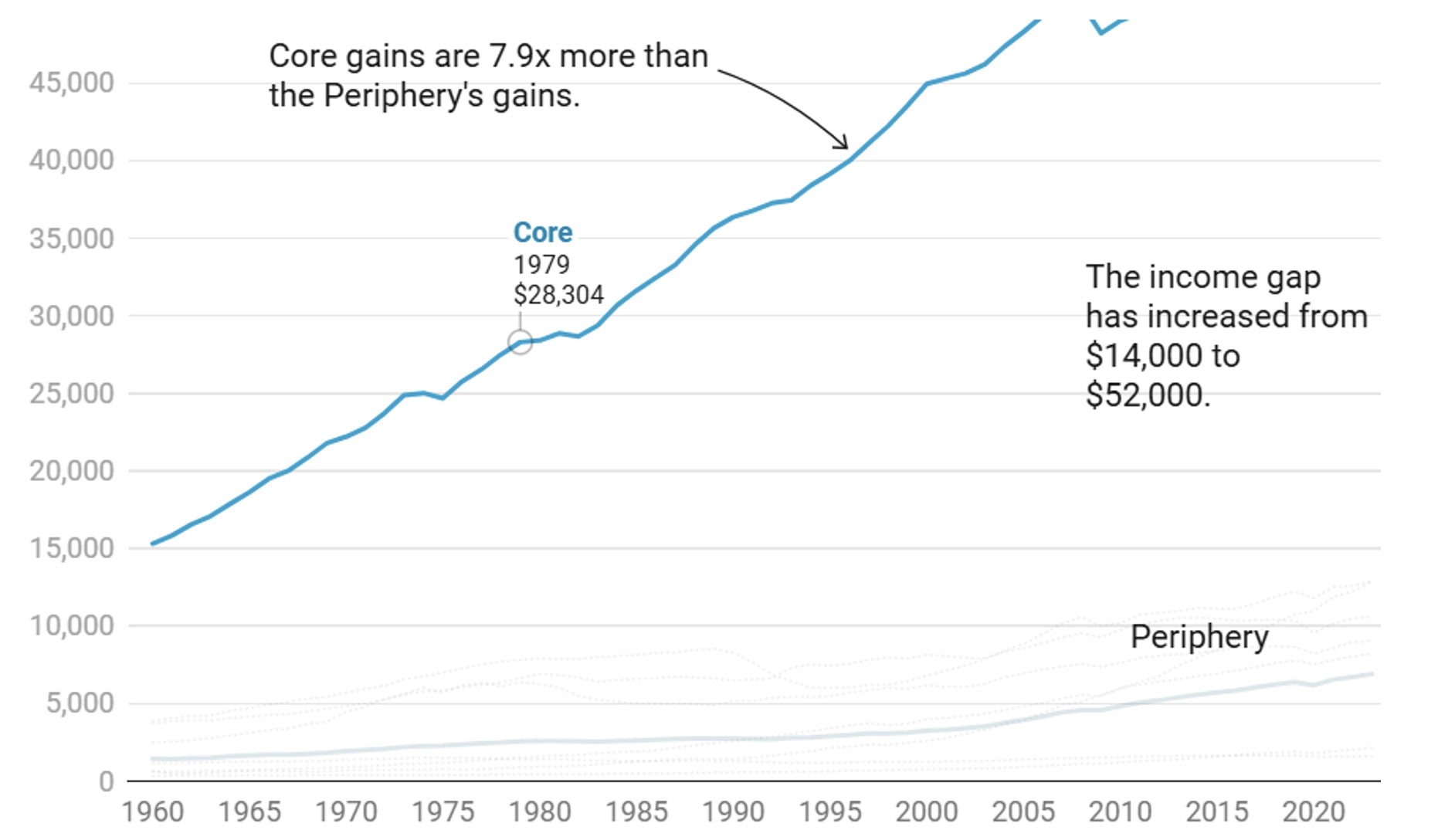
The dynamics of unequal exchange illustrated in Figure 2 help explain the persistence of global inequality between 1960 and 2022. Mainstream economic perspectives often portray the Global South as “lagging behind” the Global North, with development understood as a process of eventual convergence. However, as dependency theory and theories of imperialism suggest, such convergence is structurally constrained by a global economic system premised on the appropriation of resources and value from the Global South.
Figure 2: Global Inequality Global inequality: core vs. periphery, GDP per capita in 2023 US$.
Source: https://globalinequality.org/unequal-exchange/; (World Inequality Database)
Conclusion
This study demonstrates that the drain of labour and resources from the Global South remains a defining feature of the postcolonial world economy. Wealthy nations continue to depend on imperial forms of appropriation to sustain their high levels of income and consumption. Unequal exchange theory explains how economic growth in the Global North is underpinned by the net appropriation of Global South labour and resources through unequal prices in international trade. The analysis confirms that unequal exchange is a significant driver of global inequality, uneven development and ecological breakdown.
Unequal exchange also operates through the appropriation of labour across different skill levels and economic sectors, extending beyond the extraction of raw materials and low-skilled labour to encompass highly skilled workers and productive activities in agriculture, manufacturing, mining, and services. Hickel, Lemos, and Barbour (2024) estimate that, in 2021, the Global North net-appropriated approximately 826 billion hours of labour from the Global South, equivalent to €16.9 trillion when valued at Northern wage rates. This finding demonstrates how imperialist appropriation systematically undervalues Southern labour while enabling Northern economies to capture a disproportionate share of the value generated through global production, thereby reinforcing structural inequalities in the international division of labour and global patterns of accumulation.
These patterns of unequal exchange make a substantial contribution to aggregate consumption in the Global North: empirical evidence indicates that more than one-third of the labour consumed in the Global North is net-appropriated from the Global South. Were this imperial appropriation to cease, consumption levels in core economies would decline substantially. To sustain existing levels of consumption, these economies would need to intensify domestic resource extraction and increase domestic working time. This underscores the extent to which Global North prosperity and consumption depend not on internally generated wealth alone, but on the appropriation of labour and resources from the Global South.
Despite the considerable heterogeneity encompassed by the term Global South, its analytical and political significance lies in a common historical and structural condition: an international political economy that reproduces colonial relations, entrenches global hierarchies and constrains the possibilities for self-determination. From its inception, the concept sought to bring diverse historical experiences and political struggles into a shared framework of critique and collective action, while advancing a fundamental realignment of the global order. This project entails an agenda centred on agrarian reform, public investment, industrial development, economic sovereignty and democratic control over finance.
About the Author

Dr. Kalim Siddiqui is an economist specializing in International Political Economy, Development Economics, Trade and Economic Policy. Since 1989, he has been teaching economics at various universities in Norway and the UK. Dr. Siddiqui’s research interests encompass a wide range of topics, including political economy, international trade, and economic history, South Asia, and emerging economies. He has presented papers at international conferences across numerous countries, reflecting his global engagement in the field. His scholarly pursuits span six broad domains: Political Economy, Development Economics, Economic History, Economic Policy, Globalization, and International Trade. Dr. Siddiqui has made significant contributions to research in areas such as trade policy, globalization, and political economy. His work has been published in chapters of edited books and articles published in peer-reviewed journals. For inquiries, Dr. Siddiqui can be reached at: [email protected]