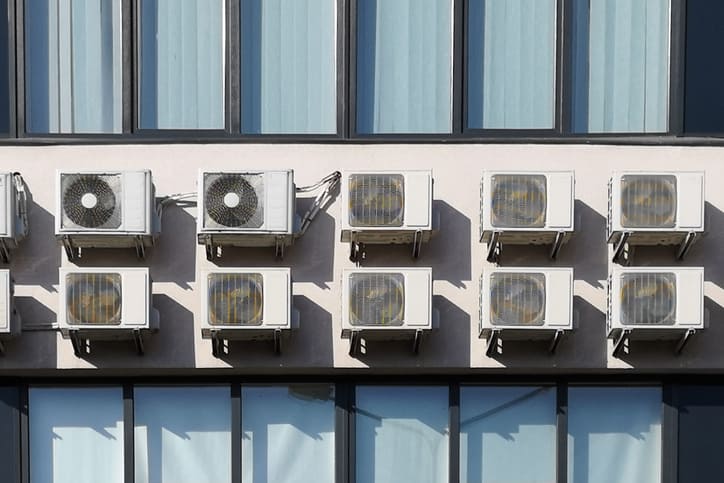
Air conditioning is now a standard part of modern HVAC systems, built into how we design homes, offices, and entire cities. What started as a breakthrough for comfort and safety has quietly become a default solution for temperature control. But the real question isn’t whether HVAC cooling works, it’s whether we’ve begun relying on it in place of smarter design, adaptation, and resilience.
Are We Seeing Overuse of Air Conditioning
The issue isn’t simply “people use AC too much.” The deeper concern is the overuse of air conditioning as a built-in assumption. We now design buildings expecting mechanical cooling to fix everything. We’re not just seeing behavioral overuse, we’re seeing design dependency. So the overuse isn’t just personal preference. It’s architectural and systemic.
Modern homes are often tightly sealed, built with large glass surfaces, poorly shaded, and designed without cross-ventilation. Buildings are now constructed assuming mechanical cooling will compensate for poor orientation, excessive glass, lack of shading, and minimal airflow strategy. AC isn’t supplementing design, it’s replacing it.
Instead of using passive cooling like shade, airflow, and insulation strategy, we rely on mechanical cooling as the default solution. That creates a cycle: hotter cities lead to more AC use, which expels more heat outdoors, which makes cities even hotter. That feedback loop fuels the overuse of air conditioning at scale. When architecture stops solving climate, machines take over.
Can You Overuse an AC?
When indoor comfort standards drop to 68-70°F in summer, people physiologically adapt to cooler indoor climates. Humans are adaptable, and when we live in narrow temperature bands (68-72°F year-round), our thermal tolerance shrinks. Mild heat feels intolerable, tolerance to warmth decreases, and natural temperature swings feel “wrong.” That’s how comfort baselines shift.
It already has, but the deeper shift is biological. Over time, we don’t just prefer cooler air, we lose flexibility.
The bigger risk isn’t health panic headlines claiming air conditioning bad for health. The real issue is resilience. Overdependence reduces our ability to function during power outages, extreme weather, or grid strain. That’s where the conversation about overuse belongs.
Is Air Conditioning Bad for Health
The idea that air conditioning bad for health is a common narrative, but it’s oversimplified. Air conditioning itself isn’t harmful – a lack of proper air conditioner service is.
AC protects people from heat stroke, sleep disruption, and cardiovascular strain during heat waves. It reduces heat-related illness, improves sleep quality, lowers humidity and mold growth, and improves filtration when filters are clean. In fact, many measurable health effects of air conditioning during extreme heat are positive, especially for vulnerable populations.
Concerns about the effects of air conditioning on health usually stem from dirty filters, mold inside ductwork, extremely low temperatures, neglected AC maintenance, very dry indoor air, poor ventilation, and static environments. When air is over-dried or recirculated without fresh intake, discomfort follows, not because cooling is inherently dangerous, but because the indoor ecosystem is poorly managed.
Blaming AC entirely feeds the “air conditioning bad for health” myth. The system isn’t the problem, neglect and imbalance are.
Effects of Air Conditioning on Health Indoors
The effects of air conditioning on health depend entirely on how the system is operated. Reduced heat stress, lower humidity that limits dust mites and mold, filtered airborne particles, and a more stable indoor environment for asthma sufferers are clear benefits.
Negative outcomes appear when systems are mismanaged. The real health effects of air conditioning become noticeable when humidity drops too low, airflow is too aggressive, or temperatures are set unnaturally cold. Dry eyes, throat irritation, sinus congestion, headaches, and muscle stiffness usually result from imbalance, not from cooling itself.
Very cold indoor environments can trigger subtle vasoconstriction, increase muscular tension, and create low-level thermal stress. This is why people in overly cooled offices report fatigue or brain fog. These are contextual effects of air conditioning on health, not evidence that cooling technology is inherently unsafe.
Long-Term Health Effects of Air Conditioning
There’s no strong evidence that AC causes serious long-term disease in healthy individuals. In fact, during extreme heat events, the measurable health effects of air conditioning include lower mortality rates and reduced hospitalizations.
The better long-term question is about adaptation. Repeated claims that air conditioning bad for health often miss the bigger issue: reduced environmental resilience. If we never experience moderate warmth, our acclimatization capacity declines.
Long-term behavioral patterns may include reduced outdoor heat exposure, lower heat tolerance, increased sedentary indoor time, and chronic dryness sensitivity. These are subtle effects of air conditioning on health, but they relate more to environmental narrowing than to pathology. The conversation isn’t about illness, it’s about adaptability.
Signs of Overuse of Air Conditioning
The overuse of air conditioning isn’t about runtime hours. It’s about context and dependency.
Setting temperatures below 70°F during summer, feeling cold indoors while it’s hot outside, running cooling during mild evenings, or keeping windows closed year-round are lifestyle signals. Complaints of dryness or constant indoor chill may reflect the excessive use of air conditioner, not a flaw in the technology itself.
Forget thermostat numbers. Look for perception shifts: temperature shock when stepping outside, viewing 75°F as “too hot,” or rarely using passive airflow strategies. These patterns suggest dependency.
A practical test: if you need a sweater inside in August, the system may be compensating more than necessary, a subtle form of overuse of air conditioning.
When Excessive Use of Air Conditioner Becomes a Habit
The excessive use of air conditioner becomes a habit when the thermostat is the first response instead of the last. Lowering the temperature the moment it feels slightly warm removes seasonal awareness from daily life.
Instead of adjusting clothing, using ceiling fans, opening windows at night, shifting activity timing, or using shading strategically, we default to mechanical cooling. That shift marks the difference between comfort management and dependency.
Over time, that automatic response reinforces both physiological narrowing and behavioral reliance, a quieter but more meaningful outcome than headlines claiming air conditioning bad for health.
Is the Overuse of Air Conditioning a Modern Problem
The overuse of air conditioning reflects how we design buildings and cities. Sealed glass towers in hot climates, identical indoor temperatures year-round, aesthetics prioritized over passive cooling, these choices drive reliance.
At the urban scale, the excessive use of air conditioner systems increases heat rejection into city streets, intensifying urban heat islands and further raising demand. That loop isn’t about individual preference; it’s structural.
Air conditioning is one of the greatest public health inventions of the last century. The discussion isn’t whether it’s good or bad. The measurable health effects of air conditioning during heat waves are lifesaving. The challenge is designing systems where it isn’t the only strategy.
The future isn’t less cooling, it’s smarter cooling: insulation, shading, passive-first design, zoned systems, ceiling fans, moderate setpoints (74-78°F), humidity balance, and fresh air integration. That’s a far more intelligent conversation than framing it as simply “air conditioning bad for health.”