By Ali Ciftci, Axel André Schmidt, and Michael Palocz-Andresen
This article explores how AI-driven monitoring systems can help reduce nitrous oxide (N₂O) emissions in agriculture. By integrating sensor data, predictive algorithms, and real-time analytics, the study highlights how intelligent technologies can support sustainable farming practices and contribute to global climate change mitigation efforts.
Introduction
Nitrous oxide (N₂O) is a potent greenhouse gas often overshadowed by carbon dioxide and methane. In reality, N₂O persists for decades in the atmosphere and has a global warming potential ~298 times that of CO₂. It is also currently the single largest ozone-depleting emission. Despite its low concentration (~335 ppb), N₂O’s climate impact is disproportionately large and steadily rising due to human activities (about +1 ppb per year). Agriculture produces nearly 60% of anthropogenic N₂O, so unchecked emissions from expanding agriculture could jeopardize climate goals and ozone recovery. Clearly, mitigating N₂O from farming is crucial and requires deeper understanding, better monitoring, and more effective management of its sources.
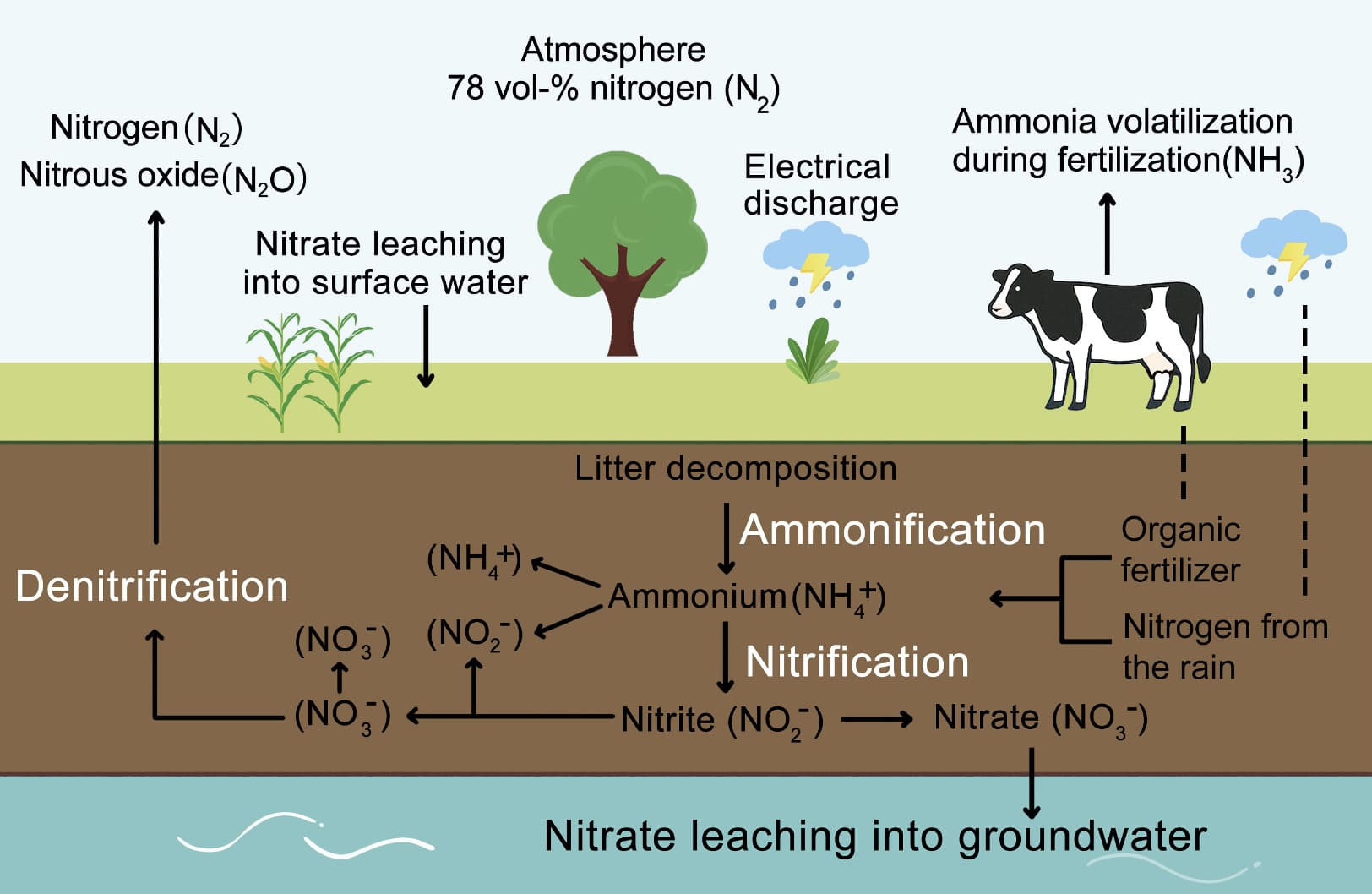
Agriculture’s outsized N₂O emissions stem from intensive nitrogen use and soil management practices. When soils receive heavy nitrogen inputs (e.g., synthetic fertilizer or manure), soil microbes produce N₂O through the natural processes of nitrification and denitrification. During nitrification, ammonia is oxidized to nitrate with N₂O released as a byproduct; during denitrification, nitrate is reduced under oxygen-poor conditions and N₂O is emitted as an intermediate gas. Figure 1 illustrates the agricultural nitrogen cycle and these microbial pathways that generate N₂O under different soil conditions. Applying large nitrogen doses greatly accelerates emissions: roughly 2–2.5% of nitrogen applied to fields is eventually lost as N₂O gas, meaning even small inefficiencies in fertilizer use can have significant climate repercussions. Additionally, around 14–17% of N₂O arises indirectly when nitrogen leaches or volatilizes from fields and later converts to N₂O off-site. This shows that nitrogen management in one field can influence emissions regionally via water and air.
Regional and farm-level differences (soil type, climate, cropping system) strongly affect N₂O emission rates. For instance, soil properties like texture, moisture, and organic matter determine how much N₂O is produced or retained: wet, poorly aerated soils favor denitrification (more N₂O), whereas well-drained soils emit less per unit nitrogen. Management choices also matter: deep incorporation of crop residues can increase emissions compared to shallow tillage, and heavy irrigation or rainfall soon after fertilization often triggers emission spikes when abundant nitrate and moisture coincide. Conventional high-input farms tend to emit more N₂O than organic farms using slower-release inputs, although the lower yields in organic systems (often ~25% less) partly explain their lower emissions. The key insight is that no universal mitigation strategy exists, as N₂O reduction must be tailored to local conditions. Less intensive farming systems naturally emit less N₂O than intensive “hot spots” (e.g., heavily fertilized corn belts). Therefore, site-specific strategies, adjusting fertilizer rates, timing, and soil management to the particular crop, soil, and climate, are essential. Digital tools and AI can analyze local data to guide such fine-tuning, as discussed later. First, however, it is necessary to examine how N₂O emissions are measured and why traditional methods often fail to provide a full picture.
Figure 1: Nitrogen cycle in agriculture showing the processes of nitrification, ammonification, and denitrification as the main sources of nitrous oxide emissions.
Limitations of Traditional N₂O Measurements
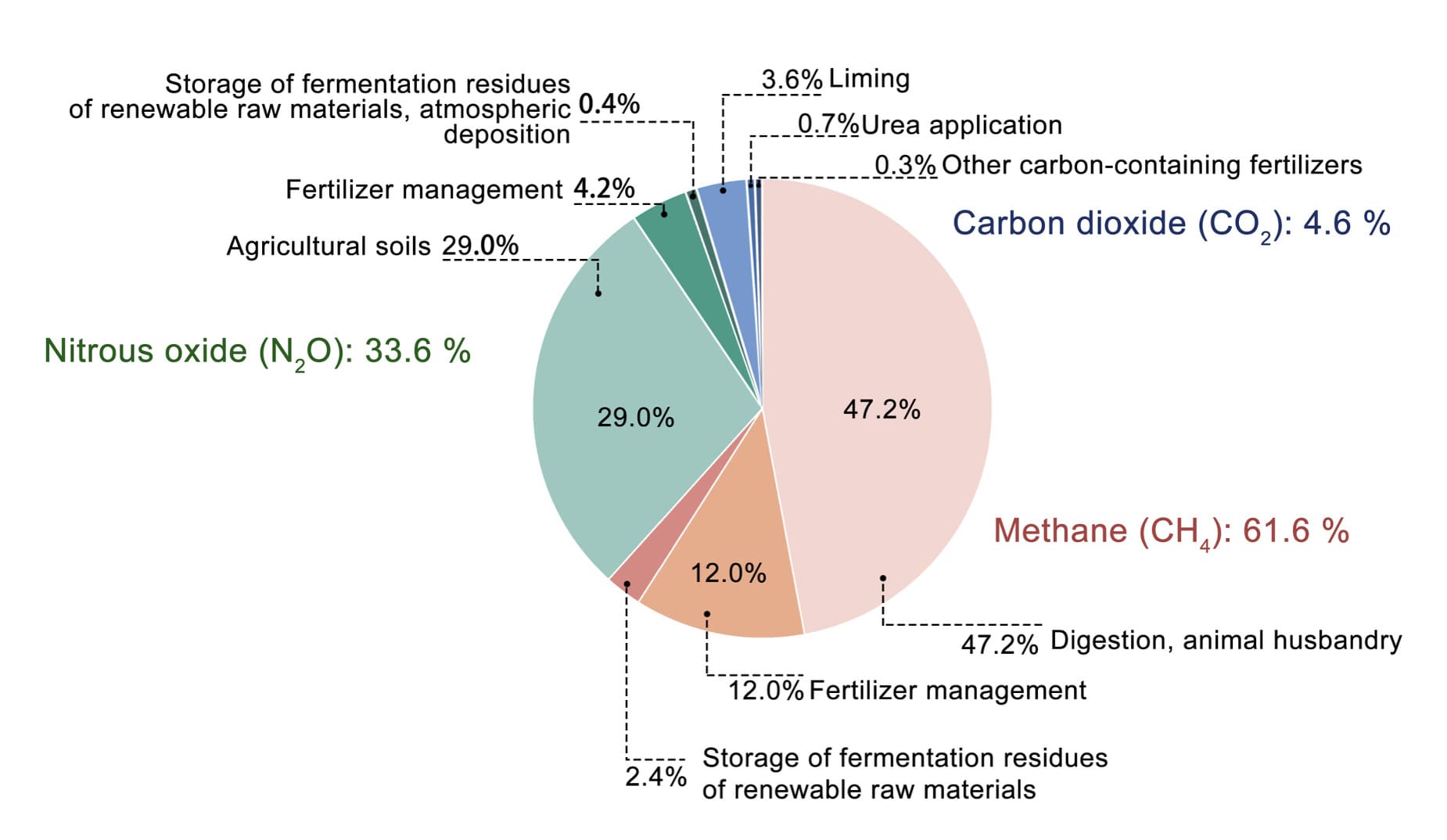
Tracking nitrous oxide from farm fields is notoriously challenging because emissions are highly episodic and spatially variable, even though N₂O constitutes a significant share of agriculture’s greenhouse gas emissions (Figure 2). Traditional measurement techniques each capture part of the picture, but none alone provide continuous, large-scale, cost-effective monitoring. Gas flux chambers (closed chambers placed over soil) are considered a gold-standard research method for point measurements. They yield precise N₂O flux data by trapping gases over a short period (usually minutes or hours) for laboratory analysis (e.g., gas chromatography). Chambers have been essential for understanding emission processes, but their drawbacks for broader use are significant: they cover only tiny areas (often < 1 m²), require labor-intensive manual sampling, and cannot be left unattended for continuous monitoring. It is impractical to deploy enough chambers to represent an entire farm or to catch brief emission bursts at odd hours. Although static chambers are excellent for controlled studies, they are considered “hardly suitable” for routine monitoring on large farms [1].
Figure 2: Shares of greenhouse gases in agricultural emissions in 2022, calculated in CO₂ equivalents.
For continuous on-site measurements, scientists have developed stationary in-situ gas analyzers that automatically measure N₂O concentrations in real time, for example, by using infrared spectroscopy. However, such systems are extremely expensive, require careful maintenance, and their coverage is limited to the immediate vicinity of the instrument. High upfront costs and uncertain returns remain major barriers for most farms, especially smallholders, which prevents the wider adoption of advanced N₂O sensors.
A third approach relies on remote sensing to infer N₂O emissions from proxy indicators rather than direct measurement. Researchers use drones and satellites to map factors correlated with emissions, such as soil moisture or crop stress, instead of measuring N₂O directly (which is difficult at low atmospheric concentrations). For example, drone imagery can identify wetter field zones or nitrogen-stressed crop areas that correspond to higher N₂O losses. Satellite instruments (e.g., TROPOMI on ESA’s Sentinel-5P) can detect atmospheric N₂O variations, but currently at a coarse spatial resolution (several kilometers). Remote sensing provides broad coverage and full automation, as a drone can survey an entire farm in hours, and satellites continuously scan the globe, with far lower cost per area than dense ground-sensor networks. The limitation is that these methods yield indirect estimates, and their accuracy depends on models to translate sensor data (e.g., a wetness map) into actual N₂O flux, introducing uncertainty. Still, the technology is advancing rapidly. Experimental drone-mounted N₂O sensors are in development, with prototypes able to take multiple readings per second to map emission hotspots, which could soon allow drones to automatically capture emission bursts after fertilizer or rainfall events. For now, remote sensing remains a complement rather than a replacement for ground-based measurements.
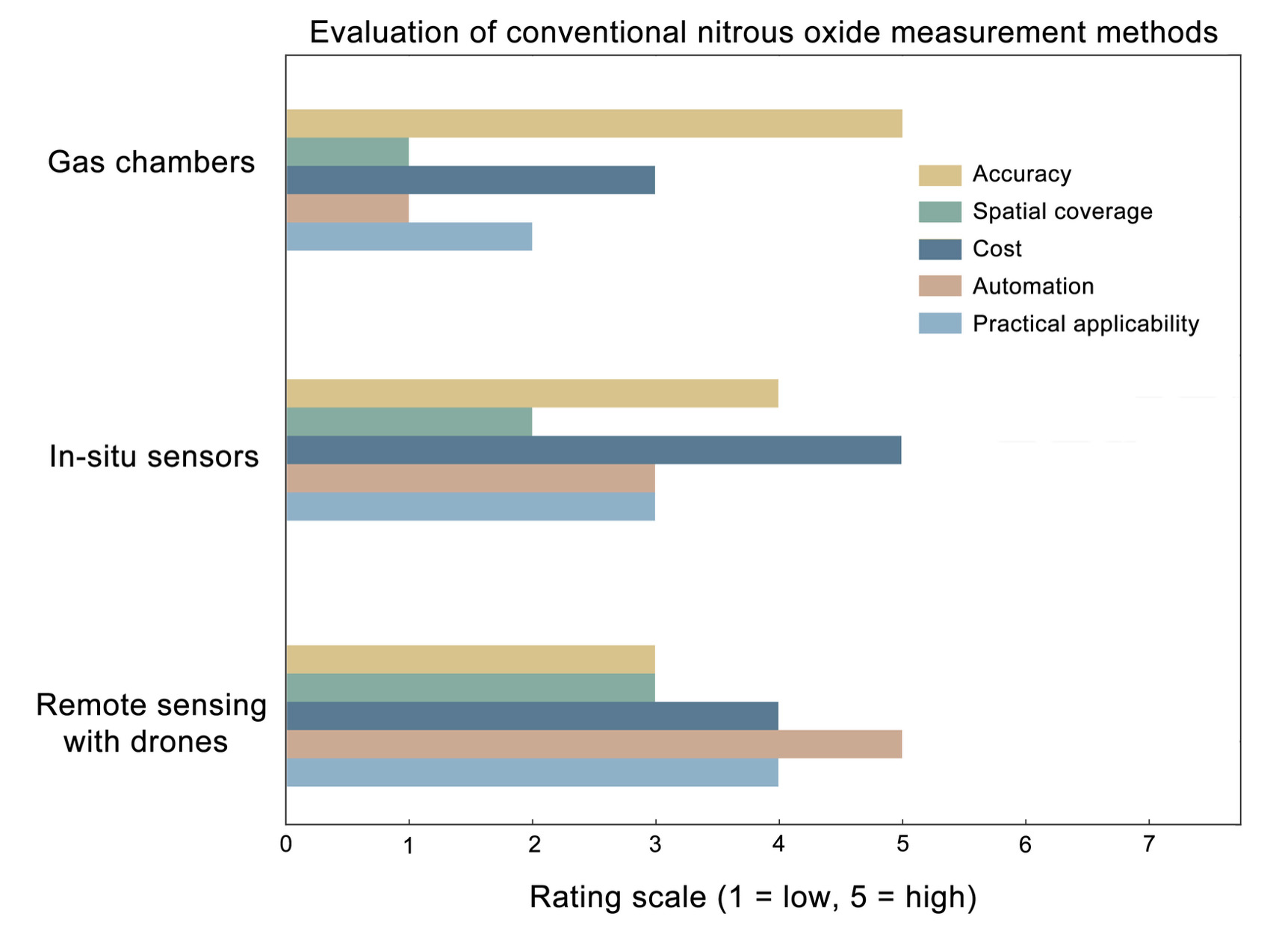
Figure 3 compares these conventional N₂O measurement methods across key criteria. Chambers score highest in accuracy (laboratory analysis yields very precise data) but lowest in area coverage and automation. In-situ sensor stations provide excellent accuracy and full automation, but they have very high cost and limited spatial coverage. Drones and satellites can cover large areas with full automation at moderate cost, but provide only indirect or lower-accuracy estimates. No single traditional method performs well across all dimensions. This is why emerging “smart farming” technologies are being developed: by integrating data from multiple sources and applying artificial intelligence, farmers can overcome many of these limitations. The next sections describe how sensor networks and AI models can revolutionize N₂O monitoring and mitigation.
Figure 3: Evaluation of N₂O measurement methods by key criteria: accuracy, coverage, cost, automation, and applicability (scale 1–5).
AI-Powered Monitoring: Sensors and Models
Advances in sensor technology and artificial intelligence (AI) are converging to provide smarter ways of monitoring and reducing agricultural N₂O emissions. Modern Internet of Things (IoT) sensor networks enable continuous, real-time collection of a wide range of field data, far beyond what single gas analyzers or occasional sampling could achieve. For example, microclimate stations can record dozens of environmental parameters (soil moisture, temperature, humidity, rainfall, etc.), many of which directly influence N₂O production in soils. These solar-powered, wireless sensors are networked across the farm, streaming data to a cloud platform. The rich data gives farmers unprecedented visibility into field conditions. A network of soil moisture probes, for instance, might reveal that certain low-lying parts of a field stay waterlogged after rain, which are prime conditions for denitrification and N₂O bursts. With IoT monitoring, such emission hot spots can be detected and managed, whereas previously they might have gone unnoticed between periodic manual measurements. Moreover, real-time data enables real-time response. If sensors detect factors that typically precede an N₂O spike, such as high soil nitrate after fertilization combined with an impending rainstorm, an AI system can alert the farmer or automatically adjust operations. For instance, it might recommend delaying a fertilizer application if heavy rain is forecast, or splitting one large fertilizer dose into two smaller ones. Such timely interventions were impossible with traditional after-the-fact measurements.
Crucially, sensor data alone is not enough, it is the AI-driven analysis that turns data into actionable insight. Machine learning (ML) models have proven highly effective at modeling the complex, nonlinear processes driving N₂O emissions. By training on historical data (weather, soil readings, management events, and measured N₂O fluxes), ML algorithms learn how various factors interact to influence emissions. A standout approach is deep learning for time-series data; in particular, bidirectional long short-term memory (BDLSTM) neural networks have outperformed simpler models in predicting N₂O flux. A stacked BDLSTM (bidirectional long short-term memory) was found to achieve significantly higher accuracy than a conventional neural network when forecasting field N₂O emissions, thanks to the BDLSTM’s ability to “remember” prior states in the time series (soil conditions, weather events, etc.) leading up to an emission [2]. In practice, an effective AI solution may employ multiple models in tandem. Figure 4 illustrates a conceptual architecture of such an AI-based system. At the base is the IoT sensor network (soil probes, weather stations, possibly drone imagery) feeding into a cloud-based data platform for data integration and storage. On top is the machine learning layer, often an ensemble of models serving different roles. For example, a BDLSTM might handle time-series prediction of N₂O flux; a random forest model could perform feature selection or classification tasks (identifying the most important drivers); and a convolutional neural network (CNN) might be used if image data (like aerial photos) are incorporated. Finally, the top layer is an output interface, such as a dashboard or mobile app, that delivers the AI’s insights to the farmer. This includes visualizations (e.g. graphs of current and forecasted emissions) and concrete recommendations or alerts (for instance, warning about potential emission spikes or suggesting optimal fertilizer timing). By linking all these components, AI systems not only monitor N₂O but can also help control it, even automatically actuating equipment (like irrigation or variable-rate fertilizer applicators) in response to predictions.
Integrating remote sensing data can further enhance these AI systems by adding a “big picture” view to the detailed ground data. Combining on-site sensor measurements with satellite or drone observations (e.g., in Germany’s NaLamKI project) yielded deeper insight into soil and crop status and improved N₂O emission predictions [3]. For example, a drone-based vegetation index map could help the AI model pinpoint where crops are nitrogen-stressed, indicating excess soil nitrogen likely to be emitted as N₂O. Such data fusion enables more comprehensive analysis than any single data source alone. Moreover, certain parameters, especially soil moisture and nitrogen availability, explain over 80% of the variability in N₂O flux [4]. Including these key factors in the models is therefore crucial for high predictive accuracy.
With robust models in place, AI systems can provide site-specific recommendations to help farmers mitigate emissions. For instance, if a particular field section stays persistently wet, the system might advise applying a nitrification inhibitor there to suppress N₂O formation. Importantly, studies indicate that many AI-optimized practices create a win-win, reducing greenhouse gas emissions while improving economic returns by optimizing input use and avoiding waste. In sum, AI and IoT are equipping farmers with “smart” tools to continuously monitor nitrous oxide and respond proactively, ushering in a new era of climate-smart agriculture. The following case study demonstrates how such a system works in practice.
Figure 4: System architecture of an AI-based emission monitoring system.
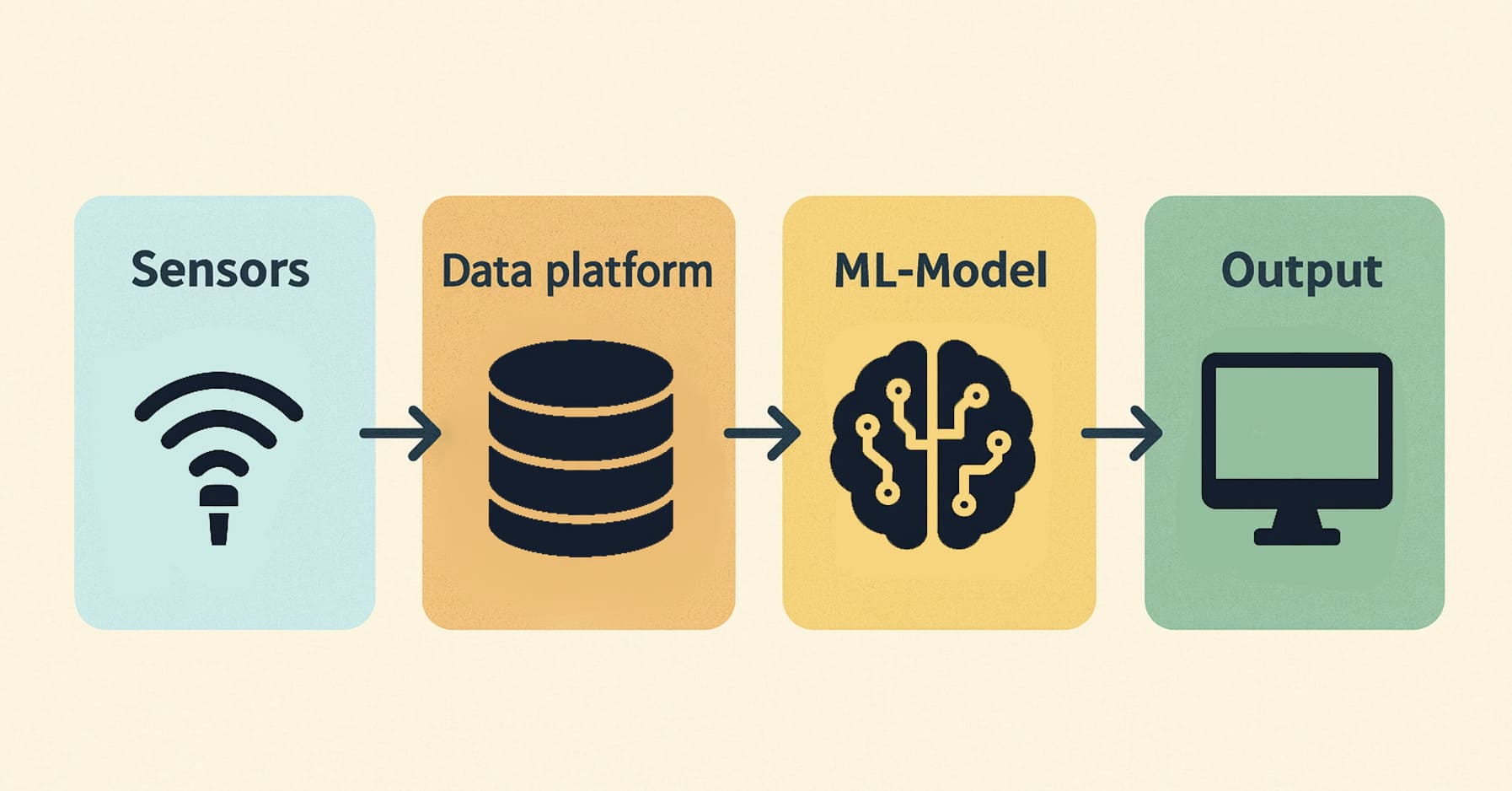
Smart Farming Pilot: AI in Action
To test AI-based N₂O mitigation in a real-world setting, this study implemented a smart farming pilot on a medium-sized farm (~100 ha) in northern Germany. The farm grows corn and wheat, crops with high nitrogen demand that can lead to significant N₂O emissions. Selected fields were instrumented with IoT sensors (including soil moisture and temperature probes and N₂O gas analyzers) recording data every 15 minutes, along with a local weather station logging rainfall and other conditions. All data streamed into a central machine learning system that estimated N₂O flux (kg N per hectare per day) and forecast short-term emission spikes, essentially providing an “emissions weather report” for the farm.
The AI model also incorporated agronomic knowledge by inferring unmeasured factors. For example, it deduced soil oxygen status from the combination of soil moisture and temperature (warm, waterlogged soils indicate low oxygen), and estimated soil nitrate levels from fertilizer application records plus sensor data. These variables strongly influence N₂O production, so including them improved predictions. The AI engine combined two complementary approaches: a process-based soil nitrogen balance model to track nutrient pools, and a data-driven model (Gradient Boosting Regression) to identify patterns in the sensor readings. This ensemble achieved high accuracy, in validation it explained over 50% of the variability in weekly N₂O emissions, whereas traditional simulations captured under 20%. In other words, the AI approach more than doubled predictive power compared to conventional methods, demonstrating the value of blending agronomic expertise with machine learning.
The system’s main purpose was to detect impending N₂O emission peaks and enable the farmer to prevent them. As expected, the largest N₂O spikes occurred after major fertilizer applications followed by heavy rain. The AI was configured to anticipate these scenarios. If the model predicted a big spike, for example, detecting that a planned fertilization would coincide with an incoming storm, it would trigger adaptive management responses. The farmer received alerts and recommendations via a dashboard to adjust operations in time. For instance, in one case the system forecast an emission surge due to an impending downpour; the farmer split the fertilizer dose, applying part immediately and postponing the rest until after the rain, thereby reducing nitrate losses. In another case, the AI warned of high N₂O risk in warm, wet soil, and the farmer applied a nitrification inhibitor with the fertilizer to suppress N₂O formation.
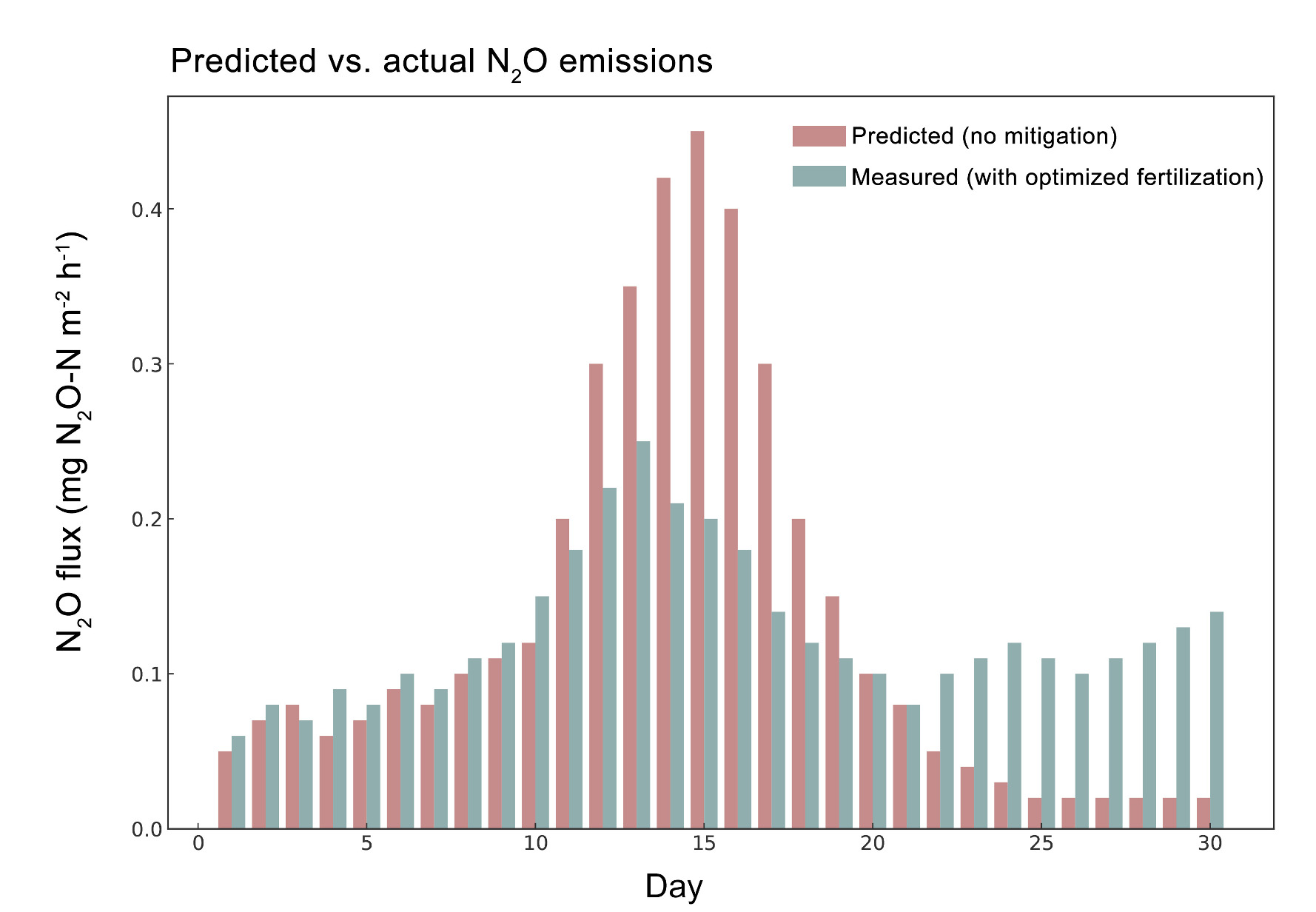
These proactive interventions proved highly effective. Measured N₂O emissions in the AI-managed fields were significantly lower than they would have been under usual practices. The red bars in Figure 5 show the model’s forecast of a large emission spike if fertilization had occurred normally before a heavy rain (no mitigation). The blue bars show the measured N₂O emissions when the farmer followed AI recommendations (splitting/delaying fertilizer to avoid the rain and using an inhibitor). The mitigated scenario shows a much smaller peak, about 50% lower, demonstrating how adaptive management prevented a major N₂O burst. Across the pilot, fields managed with AI guidance emitted roughly 30% less N₂O on average than control fields, with no loss of yield. This confirms that sustainability and productivity can be aligned. Moreover, the results echo broader findings that improved nitrogen management (applying the “4R” principles of right source, rate, timing, and placement) can significantly cut N₂O emissions without hurting yields. In summary, the pilot provided a compelling proof of concept: AI-driven monitoring and adaptive management can substantially reduce nitrous oxide emissions on real farms while maintaining crop productivity.
Figure 5: Predicted vs. actual N₂O emissions in the Smart Farming Pilot. Red bars: forecast without mitigation. Blue bars: emissions after AI-guided intervention. Adaptive management reduced the emission peak by ~50%.
Conclusion
This study shows that AI-supported systems can be powerful enablers of climate-smart agriculture. By integrating field sensor data, remote imagery, and agronomic knowledge, AI models can monitor and actively reduce nitrous oxide emissions. In our pilot project, this AI-driven approach reduced N₂O emissions by about 30% on average without compromising yields, proving that sustainability and productivity can be aligned.
Significant technical, economic, and data governance challenges remain. AI relies on consistent data, but farm IoT sensors often produce patchy or unreliable data, and many farms lack the necessary internet or power infrastructure. Modeling N₂O’s variable emissions is also difficult, as data gaps can contribute up to 93% of uncertainty in N₂O estimates [5]. Economically, the high upfront cost for sensors is a major barrier, especially for smaller farms, as costs are immediate while savings accrue over time. Finally, data governance must be resolved. Farm data is sensitive, and strong cybersecurity is essential, as farms are susceptible to cyberattacks [6]. Farmers need systems built on trust, transparency, and compliance with privacy regulations like GDPR.
Policymakers have a pivotal role in overcoming these hurdles through subsidies and supportive regulations. Momentum is building as hardware becomes cheaper and AI-systems offer clear co-benefits, such as reducing fertilizer runoff and saving costs. Looking ahead, emerging concepts like a digital twin of the farm will allow farmers to test interventions virtually, and AI will streamline automated emissions tracking for carbon credits. Embracing and scaling these technologies responsibly will be essential to meet the dual challenges of feeding a growing world population while stabilizing the global climate.
About the Authors
 Ali Ciftci is currently studying Business Informatics and Social Media & Information Systems at Leuphana University Lüneburg, where he began his academic journey in 2022. His interests lie in the intersection of innovative digital technologies, environmental systems, and artificial intelligence. Through his academic and project work, he focuses on how information systems can be used to support sustainability and enable digital transformation in the agricultural and environmental sectors.
 Axel André Schmidt is a graduate of Applied Physics from University of Hamburg, 1994/95 he developed a sophisticated online-oil-spill-in-water-monitor and joined DECKMA Hamburg GmbH, a well successful company on manufacturing oil-in-water measuring equipment for marine and industrial applications, respectively. Since 1996 he is head of research and development and generates not only the whole fleet of oil-in-water measuring instruments but also turbidity-meter and the first online micro plastics monitor based on Raman-scattering, worldwide. He is member of NEL´s Environmental Club (UK) since 2001, supports the club by several presentation, regularly. Moreover, he gives guest lectures on sustainable mobility at Leuphana University Lüneburg, since 2022.
 Michael Palocz-Andresen is a full professor at the BUAP in Puebla 2022-2024. He has been working as a full professor for Sustainable Mobility since 2018, supported by the DAAD at the TEC Instituto Tecnológico y de Estudios Superiores in Mexico. He became a full professor at the University West Hungary till 2017. Currently, he is a guest professor at the TU Budapest, the Leuphana University Lüneburg, and at the Shanghai Jiao Tong University. He is a Humboldt scientist and instructor of the SAE International in the USA.
References
- Ogle, S. M., Breidt, F. J., Easter, M., & Paustian, K. (2008). Modeling nitrous oxide emissions from agricultural soils: Statistical calibration of the DAYCENT model. Ecological Modelling, 219(3–4), 208–219.
- Lin, X., He, Y., Jin, L., & Ma, W. (2022). Data-driven modeling of nitrous oxide emissions in agriculture using deep learning methods. Environmental Modelling & Software, 150, 105323.
- Eitner, C., & Müller, F. (2021). Nachhaltige Agrarentwicklung im digitalen Zeitalter: Chancen und Risiken. Springer.
- Saha, D., Basso, B., & Robertson, G. P. (2021). Machine learning improves predictions of agricultural nitrous oxide (N₂O) emissions from intensively managed cropping systems. Environmental Research Letters, 16(2), 024004.
- Taki, T. (2018). Remote sensing and GIS applications in agricultural monitoring. In A. K. Sahu (Ed.), Precision Agriculture Technologies (S. 45–67). Academic Press.
- Kaack, L. H., Donti, P. L., Strubell, E., Kamiya, G., Creutzig, F., & Rolnick, D. (2022). Aligning artificial intelligence with climate change mitigation. Nature Climate Change, 12(6), 518–527.