By Aaron Arvid Bohn, Pauline Schwalbe and Prof. Dr. Michael Palocz-Andresen
The automotive industry stands at a crossroad, facing the dual challenge of rising transformation costs and urgent demands for sustainability. One promising response is Generative Design (GD). By optimizing structures with unprecedented efficiency, GD can reduce material use, cut manufacturing costs, shorten development cycles, and enable mass customization. All while advancing environmental objectives. Yet, its impact extends beyond engineering. Generative Design reshapes socio-economic dynamics, influencing employment, consumer behavior, and market accessibility. Crucially, its future will be determined by political policies. In the following, the impact of GD on these domains shall be investigated with SWOT analysis.
Introduction
In 2023, the global automotive sector was valued at around $2.6 trillion, a scale comparable to the GDP of the world’s 8th largest economy [1]. But this weight comes at a price: road transport consumes nearly half of global oil demand and produces 16% of greenhouse gas emissions. The environmental costs extend further, with the industry accounting for 8% of mining-related deforestation and requiring thousands of liters of water to produce a single vehicle [1]. At the same time, Europe’s once-dominant manufacturers are losing ground. Since 2017, the region’s market share has fallen by more than 13%, while newcomers – 18 additional original equipment manufacturers (OEM) and 50 new brands since 2018 – push aggressively into the industry with innovation and ecological positioning [2]. This dual pressure of environmental accountability and intensifying competition raises a crucial question: can technologies such as Generative Design help the automotive sector transform sustainably while staying competitive?
Definition of Generative Design and Comparison to Traditional Product Development
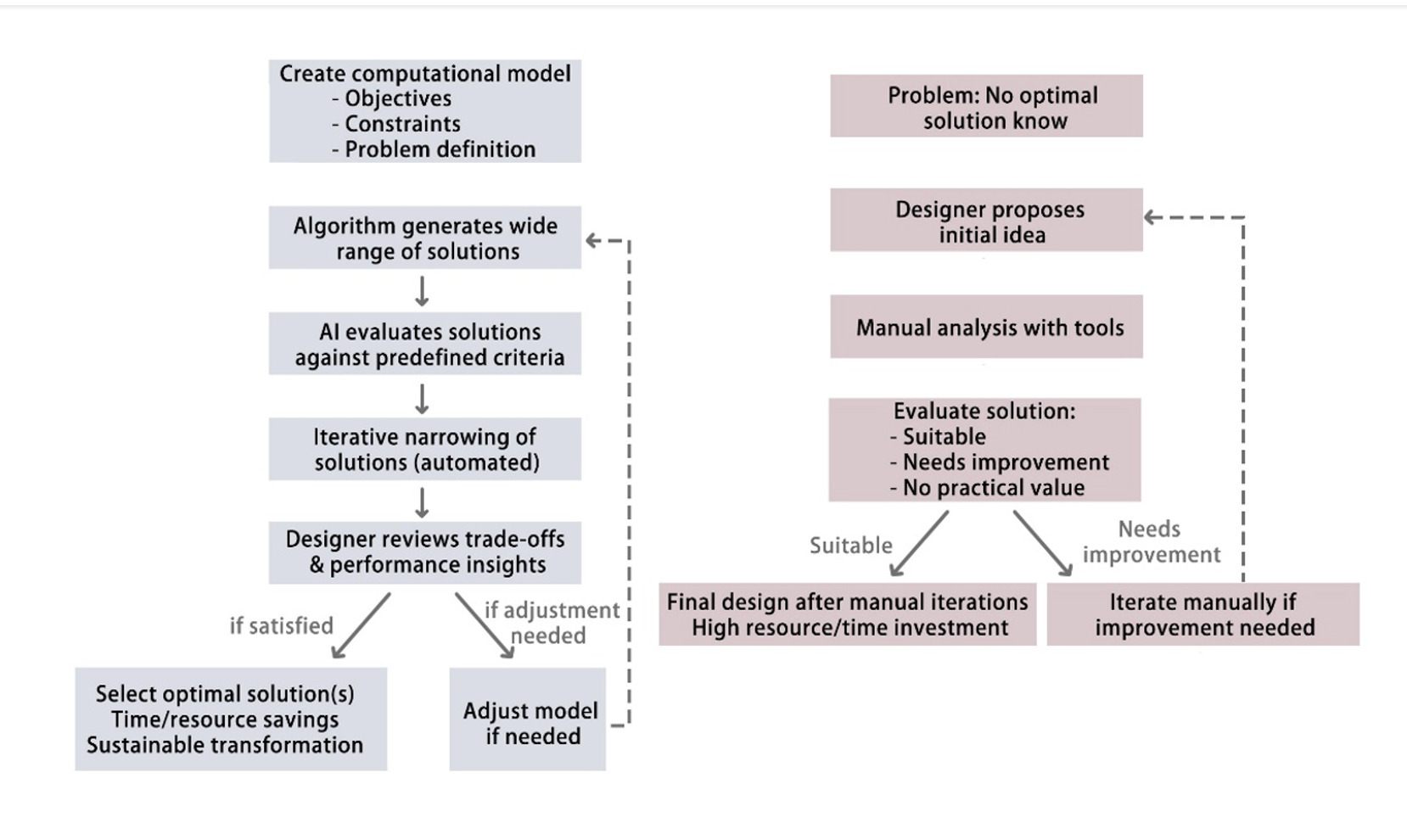
Most frequently, the starting point in product development is that the designer is unaware of the optimal design solution. Therefore, the designer introduces an idea and analyses the design through the usage of various tools. The manual analysis helps to ascertain if the product solution is suiting, requires improvement or has no practical value. This approach might work for well-known problems; however, it is inefficient for new problems due to a large quantity of possible design proposals or a lack of experience [3].
In contrast to traditional development, Generative Design in computer-aided design (CAD) is an (AI-) algorithm-driven, iterative design process. The process consists of three features: computational model, generation and design evaluation. First, in the GD process the designer has to create the computational model. Within the model the engineer determines the design problem, the objectives and constraints. Following, the algorithm of the model generates a broad spectrum of designs [3]. Moreover, determined by the designer’s predefined criteria, the AI-algorithm evaluates and narrows the solutions in an iterative process. Due to the great quantity of solutions, the designer can gain knowledge about the behavior and performance of each product design and their respective trade-offs. Based on that knowledge, the designer may adjust the computational model. Finally, the designer is able to choose from a great variety of optimal design solutions based on objective performance and subjective preference, saving time and further resources [3]. Consequently, Generative Design allows for a more efficient, less resource intensive and enhanced sustainable transformation with greater product design precision.
Figure 1: Generative Design’s Product Development Process
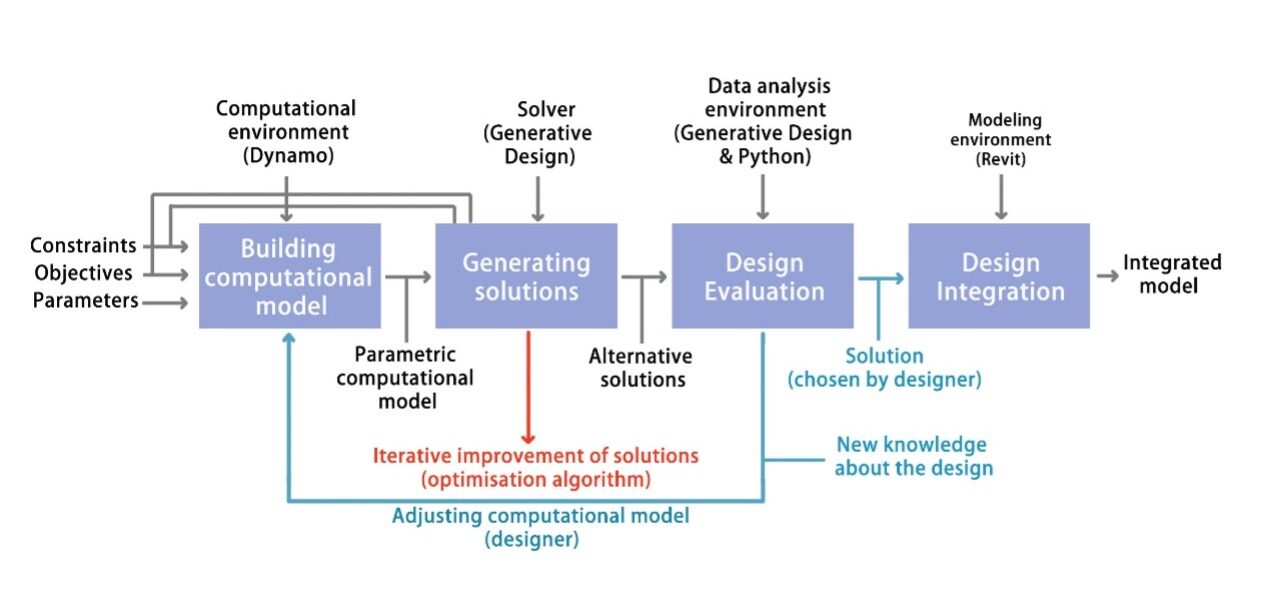
Figure 2: Comparison between Generative Design (left) and traditional design (right) process
Volkswagen: Modernizing the 1962 Microbus
In 2019 Volkswagen’s Innovation and Engineering Centre California collaborated with Autodesk to modernize components of the 1962 Type 2 Microbus. Volkswagen’s engineers employed the Autodesk Fusion 360 GD software to redesign the wheels, steering wheel, rear-bench seat supports, and mirror mounts. The results were promising. For instance, the redesigned wheels were 18% lighter than conventional ones. Moreover, GD significantly reduced the development time from around 1.5 years to just months. According to Andrew Morandi, senior product designer at Volkswagen Group, the project revealed an unexpected degree of material savings. Additionally, he stated that Generative Design can drive fundamental changes in the automotive industry [4].
However, between 2020 and 2025, Volkswagen has not publicly reported any further GD projects. Recent research demonstrates that GD can achieve up to 30% weight reduction in components compared to traditional design approaches, while simultaneously improving rigidity and strength. Such reductions can translate into a decrease of approximately 3.5 g/km in CO₂ emissions and an increase in vehicle range of around 2.8 km [5]. These insights illustrate the substantial potential of Generative Design to drive sustainable transformation in the automotive industry, even if its application at Volkswagen remains limited to showcase projects.
Figure 3: The modernized 1962 Microbus – Orange Parts are conceptualized by Generative Design

The Socio-Economic Impact of Generative Design
Generative design is often framed narrowly as a way to cut material and weight, compress development, and tailor vehicles to new mobility trends. Yet sustainable transformation hinges on socio-economic forces in a multi-trillion-dollar and multi-million-job sector under pressure from cultural shifts, environmental demands and urbanization [6]. A SWOT analysis clarifies how GD affects jobs, competition, and market access – not just products.
Strengths – Socioeconomic Advantages of Generative Design
Generative design lowers costs and widens access to mobility, while enabling practical personalization. McKinsey estimates GD can shorten R&D by 30–50%, cut part costs up to 20% and reduce weight 10–50% [6]. Lighter parts shrink batteries and fuel use, lowering lifetime running costs. This makes vehicles more affordable if savings are priced through. Moreover, because GD generates multiple validated alternatives, customization becomes scalable – customers can co-create selected parts via simple Generative Design interfaces – without undermining unit economics [7]. In sum, GD functions not only as an efficiency tool but as a market-expansion lever that supports sustainability, reduces total cost of ownership, and differentiates the customer experience in the automotive industry.
Due to pressing issues such as climate change and continuing protests environmental awareness has become increasingly important for automotive companies. Environmental sustainability is now a decisive purchase factor: In 2024, 64% of consumers ranked it among their top three buying criteria and the share willing to spend more money on environmental-friendly products significantly increased from 35 to 54 percent [6]. Generative design gives OEMs a pragmatic way to meet the environmental demand while decreasing costs, weight and R&D time: By algorithmically exploring manufacturable options, GD enables part consolidation and lightweight structures that reduce material use and energy needs over a vehicle’s life. Fewer parts and lighter assemblies simplify supply chains, support localized production with 3D printing, and can lower total cost of ownership – making “green” features more accessible if savings are priced through. The resulting net effect is that Generative Design helps OEMs deliver measurable environmental gains while competing on affordability, performance, and personalization. Thus, Generative Design could promote a sustainable transformation within the automotive industry by increasing vehicle performance, fostering a greener and leaner value chain, and consequently meeting the environmental demands of automotive customers.
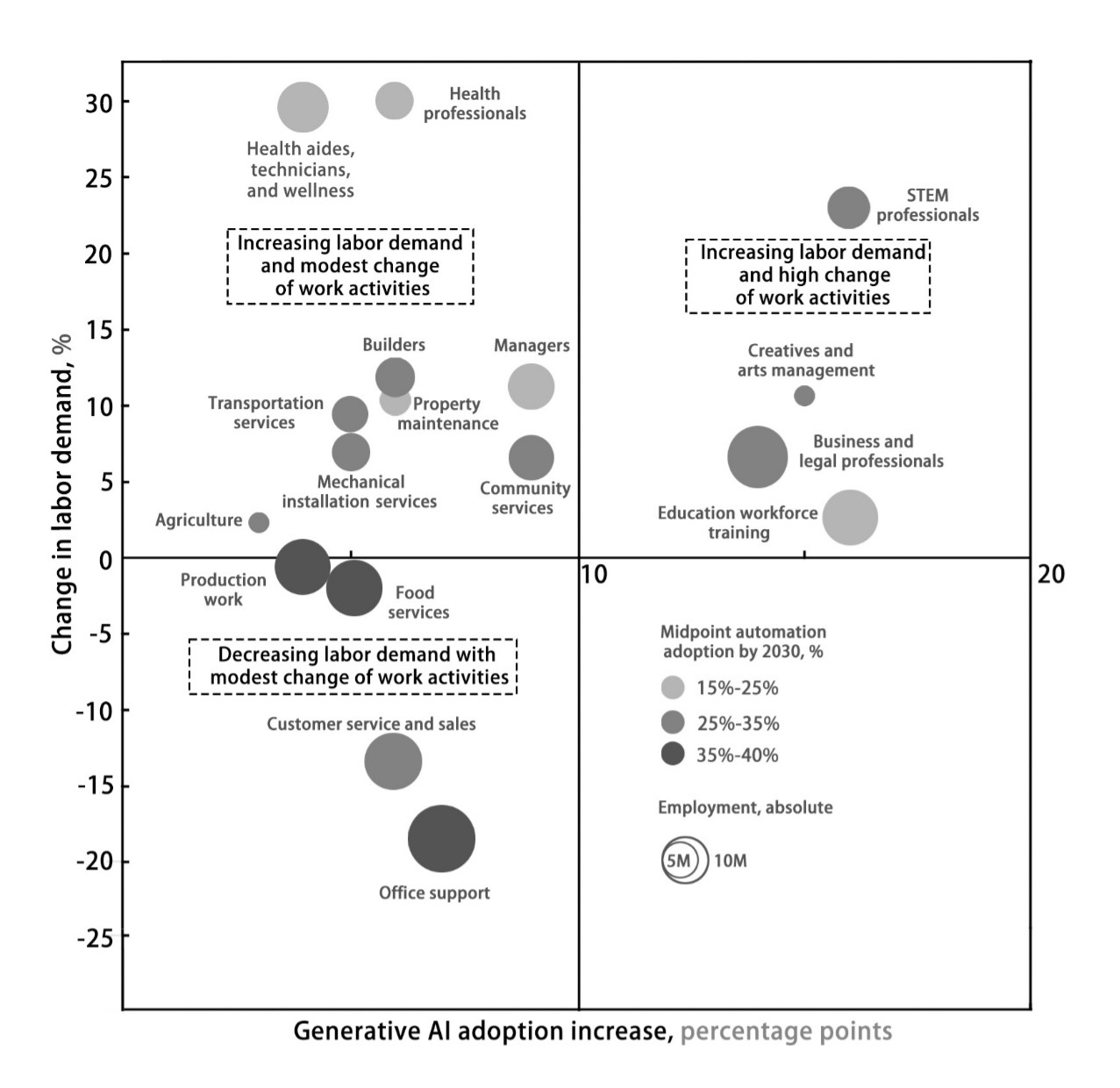
Labor markets remain volatile, with little sign of long-term stability. Workforce strategy is now a first-order risk for automakers: in the U.S. alone 2.1 million manufacturing jobs could go unfilled by 2030 [3]. By offloading routine exploration and evaluation to algorithms, GD augments engineers – speeding iteration, freeing time for higher-value problem solving, and enabling human-in-the-loop co-creation that attracts digital-savvy talent (Figure 4). As a result, GD can ease hiring pressures and help close the projected gap. Yet GD in manufacturing also requires deep skills in simulation, optimization, and additive manufacturing – raising training costs. These investments, however, build a resilient, future-ready workforce and align with the industry’s sustainable transformation. That combination turns training into a recruiting signal rather than a cost center, especially in tight labor markets.
Figure 4: The Impact of Generative AI on labor demand and work activities
Weaknesses – Socioeconomic Challenges of Generative Design
Generative Design requires powerful computing infrastructure and expensive software: Training and running generative AI for GD models leads to a consumption of large amounts of electricity and water. For instance, training a generative AI model as GPT-3 can consume up to 1287 MWh of electricity and emit 553 t of CO2. Furthermore, cooling the data centers requires roughly 2 liters of water per kWh. MIT researchers note that global data-center electricity consumption reached 460 TWh in 2022 and could more than double (1287 TWh) by 2026 [8]. Therefore, while Generative Design might significantly reduce vehicle emissions, its training-related footprint may contribute to pollution. In addition, electricity costs and expensive license fees for the software can be prohibitive, especially for small and medium-sized automotive suppliers, possibly increasing vehicle prices and reducing affordability for lower-income consumers.
Moreover, Generative Design often produces highly complex, organic geometries that can be difficult to assess with existing safety certification frameworks. Validating such unconventional components can lead to regulatory challenges, additional testing requirements, delays in development and a potentially prolonged market entry. Furthermore, those complex geometries demand comprehensive testing and extensive simulations to ensure compliance with real-world conditions and safety standards, amplifying expenditures and time. Consequently, the lack of established safety certification frameworks of GD parts can introduce bureaucratic hurdles, regulatory uncertainty and costly validation procedures within the automotive industry.
As mentioned earlier, the manufacturing sector faces a significant skills shortage [9]. Generative design can partially offset these constraints by automating repetitive design work and redeploying engineers to higher-value tasks. However, adoption raises the skills threshold and requires sustained investment in reskilling – e.g., simulation, optimization, additive manufacturing – and in ongoing system updates [10]. Without this investment, firms risk widening internal skill gaps and compressing lower-skill roles even as productivity improves. Managerially, GD can stabilize schedules and support margins – if capability building is funded at pace with deployment; otherwise, benefits concentrate while segments of the workforce are left behind. Thus, Generative Design may negatively affect employment rate in the automotive industry, especially in the lower-skilled segments.
Opportunities – Socioeconomic Enablers of Generative Design
Manufacturing is already grappling with a deep structural skills gap [9]. Instead of viewing GD’s training needs as a cost, automakers can use them to build future talent pipelines – partnering with universities and technical institutes to co-design curricula, expand internships, and launch public-private reskilling programs. Such collaborations shift training from isolated budgets to shared investment, cutting costs and accelerating productivity while cushioning the impact on lower-skill roles [10]. When tied to hiring and measurable proficiency outcomes, these partnerships turn upskilling from a burden into a competitive advantage, driving a more agile and sustainable transformation across both industry and education.
By 2050, about 68% of the world’s population will live in cities, up from today’s regional rates ranging from 43.5% in Africa to 83.6% in North America [11]. Consequently, increasing urban concentration will significantly shape human culture, society and health. In addition, such forecasts may correlate with the rising demand for compact and energy-efficient vehicles. Automotive companies must incorporate such forecasts into their planning for their transformation in order to remain competitive across the industry. This issue is an opportunity for the automotive sector to include Generative Design in their production processes, as GD enables rapid design of lightweight, space-efficient vehicles tailored to congested urban areas while meeting environmental requirements and diverse demographic needs.
Threats – Socioeconomic Risks of Generative Design
Although many consumers value sustainability, inflationary pressures have reduced the perceived importance of sustainability by 6 percentage points compared to 2022 [6]. If this consumer trend continues, GD may lose one of its most significant competitive advantages. Additionally, consumers could resist the adoption of GD-generated organic designs which might be perceived as unaesthetic and reduce sales. Moreover, the unconventionally designed components might undermine consumers’ trust in safety and environmental performance as potential customers may lack understanding of the evidence-based benefits. Consequently, Generative Design faces the risk of consumer skepticism, which could hinder its contribution to the sustainable transformation of the automotive industry.
The implementation and training of Generative Design could also threaten equality in access to technology and markets, as GD requires costly licenses and heavy computing power, adoption could cluster around large OEMs and well-financed suppliers – widening the access and market gap for smaller firms. Thus, reduced competition may decrease innovation, which is often driven by market diversity. Greater market concentration also risks limiting the benefits of GD for consumers, particularly in low-income regions, if cost savings are retained by OEMs rather than passed on through reduced prices. In the context of pressing inflation and high interest rates restricting vehicle financing, Generative Design may therefore improve efficiency for major OEMs while simultaneously reducing accessibility for smaller enterprises and low-income consumers. Consequently, GD could drive a sustainable transformation for dominant industry players, but without careful redistribution of benefits, it risks reinforcing inequality and limiting its broader socio-economic contribution.
Socioeconomic SWOT Conclusion
Overall, the SWOT analysis highlights that GD holds significant potential to support the sustainable transformation of the automotive industry by reducing costs, enabling customization, and aligning with environmental and urban mobility demands. At the same time, high infrastructure costs, regulatory hurdles, consumer skepticism, and the risk of market concentration present substantial barriers. These dynamics illustrate that the impact of GD on sustainable transformation is not predetermined but will depend on how effectively industry actors, policymakers, and educators address the socio-economic challenges while leveraging the opportunities.
Political perspective of Generative Design
To create a sustainable framework, which guides the process of the usage of Generative Design, the political perspective plays a key role. Regulations, industrial policies and digital strategies determine whether GD becomes an important part of the automotive’s green transformation. Especially, the influence of the automotive biggest region – the European Union – on decisions about GD takes crucial part. Politics need to balance the potential of GD as well as considering the possible threats.
Strengths – Political advantages of Generative Design
From a political perspective, GD has the advantage of being aligned with Europe’s most ambitious climate policies. The long-term target of climate neutrality by 2050 is set by the European Green deal and the Fit-for-55 package aims for a 55 percent reduction in greenhouse gas emissions by 2030 compared to 1990. This includes a ban on new combustion engine cars by 2035 [12]. Therefore, the pressure to deliver lighter and more efficient vehicles is gaining importance every day. GD offers a practical solution: Its algorithm-driven process can design components that use less raw material, improve energy efficiency and reduce overall vehicle weight. At the same time, the technology dovetails with another EU initiative: a regulation on circularity in vehicle design. This draft regulation would set strict requirements for reusability, recyclability and recoverability of materials in cars. Taking a closer look at trading and industrial policies, Generative Design fosters competitiveness and innovation. Furthermore, large-scale programs like GenAI4EU offer funding, infrastructure and collaborative ecosystems that promote the application of Generative Design [12].
Weaknesses – Political challenges of Generative Design
Yet political momentum does not erase the limitations. GD’s reliance on massive computational resources is responsible for a high usage of resources. Data centers already account for around seven percent of global electricity consumption, a figure that could rise to 13 percent by 2030 if growth continues unchecked [13]. Beyond energy, economic barriers also lead to a challenge. Large producers may integrate GD into their design processes, but small and medium-sized suppliers, which form the backbone of Europe’s automotive sector, face steep costs for software, cloud services and workforce training [14]. If these companies are left behind, GD could deepen structural divides in the industry rather than create a cooperating field.
Opportunities – Political enablers of Generative Design
Despite the challenges, Europe is pushing and investing heavily towards technologies like GD. The AI Continent Action Plan and GenAI4EU are designed to provide the infrastructure, funding and collaborative networks that industries need to adopt advanced digital tools [12]. These initiatives are not abstract policy documents; they translate into AI factories, data hubs and cross-border ecosystems that lower the barrier for firms wanting to experiment with GD. Politically, they also send a signal: the EU does not want to be a passive observer in the global AI race but an active player that shapes standards and builds capacity. For GD, this means there is real institutional backing for integration into industrial practice. The opportunity for GD lies in becoming a showcase example of how digital innovation can deliver environmental results.
Threats – Political risks of Generative Design
Alongside the identified opportunities, the adoption of Generative Design within the automotive industry encounters threats. Efficiency improvements may lead to increased production or consumption, undermining climate objectives. Moreover, if data centers continue to rely on non-renewable electricity, the increased computational load could raise overall emissions [13]. A second threat is geopolitical. GD depends on high-performance chips and cloud services, markets where European firms remain dependent on US and Asian suppliers. If trade tensions escalate or export restrictions are imposed, automotive companies could find themselves cut off from the very resources they need to scale GD [14]. This raises an uncomfortable concern for policymakers: whether Europe can build its own secure supply of digital infrastructure.
Political Excursion SWOT Conclusion
The political environment around GD has two faces. On the one hand, climate laws and circular economy ambitions clearly encourage GD’s adoption. On the other hand, the high energy demands of computing, the structural barriers facing smaller suppliers and global dependencies cast long shadows. GD embodies the EU’s twin goals of decarbonization and digitalization – but whether it becomes a tool of sovereignty or another story of dependency will depend less on the algorithms themselves and more on the political choices that frame them.
Summary: Generative Design as a Driver for Sustainable Change
Efficiency, Customization and Policy Alignment
Generative design algorithms can radically lighten and streamline vehicles. By eliminating unnecessary components and optimizing materials, GD reduces weight and production costs while speeding up product development. These gains align neatly with policy frameworks such as the EU’s Green Deal and Fit for 55: lighter parts cut carbon emissions across both manufacturing and use, and mass customization makes sustainable products more accessible. In partnership with initiatives like GenAI4EU, Generative Design also supports regional economic development and stimulates high skill job creation through upskilling programs.
Energy Footprint, Market Access and Talent Gaps
The environmental benefits of GD come with caveats. Training and running AI driven design models is energy intensive; global data center electricity demand could double within this decade as larger generative models proliferate. High software license fees and computing requirements may limit adoption to major OEMs and large suppliers, raising barriers for smaller firms and widening market concentration. In addition, a persistent skills shortage means that without coordinated reskilling, low skill roles could compress while new digital roles go unfilled. Consumer skepticism about unconventional GD shaped components and global chip dependencies add further friction.
Outlook: Pathways for Maximizing GD’s Contribution
Whether GD accelerates sustainable transformation within the automotive industry depends on proactive leadership. With following these suggested interrelated pathways, GD can deliver on its promise of more efficient, affordable and sustainable mobility for a rapidly urbanizing world and transform the automotive industry into a more sustainable era:
- Decarbonize the computational backbone: Training and running GD models are energy hungry; without intervention, their footprint threatens climate goals. Transitioning data centers to renewable power and mandating green energy for AI workloads will be critical. Incentives such as tax breaks for companies using low carbon compute, coupled with efficiency targets for algorithms and hardware, ensure digital efficiency doesn’t come at the planet’s expense. Incorporating environmental impact assessments for digital tools into corporate strategy keeps sustainability at the core of every deployment.
- Democratize access through targeted support: Generative design’s high license and compute costs currently make it the preserve of large OEMs. Targeted subsidies and tax incentives for small and midsized firms, along with shared public-private AI hubs, can democratize access and narrow competitive gaps. Such hubs pool resources and expertise, enabling smaller suppliers to meet stringent AI safety requirements and participate in knowledge exchange without incurring prohibitive costs.
- Build future ready skills: The promise of GD hinges on a capable workforce. Universities can update engineering curricula to include Generative Design, AI and additive manufacturing, while automotive firms offer internships and on the job training that blend academic theory with practical experience. National and EU level funding for reskilling, especially in regions vulnerable to job losses, will scale open-source curricula and ensure that expertise is widely available rather than concentrated in a few hubs. AAAS’s open-source curricula can be localized and scaled across Europe to ensure that Generative Design expertise is widely available and thus narrowing the gap.
Conclusion: GD’s Role in a Sustainable Automotive Transformation
Generative Design holds the promise of leading the automotive industry into a greener era of designing and production, but its realization hinges on a complex interplay of socio‑economic and political factors. By addressing weaknesses and threats through coordinated action and seizing available opportunities, stakeholders can position Generative Design as a cornerstone of sustainable transformation. The next decade will determine whether GD’s impact extends to the entire industry or remains confined to isolated innovations.
About the Authors
 Aaron Arvid Bohn studies Psychology at Leuphana University Luneburg with a focus on Business Psychology. He has gathered practical experience through positions at AIDA Cruises, Joe Public in South Africa, and at the Ministry of the Interior of Mecklenburg-Vorpommern. Alongside his studies, he is engaged as a project controller at Contact & Cooperation e.V. and is a member of the Hanseatic Finance Club.
 Pauline Schwalbe studies International Business Administration & Entrepreneurship and Business Psychology. In her studies, she focuses on the intersection of entrepreneurial strategies and organizational psychology. She has gained practical experience as a working student in the retail sector, served as Head of Sales at a student consultancy, and broadened her intercultural competence during a stay in the USA as an Au Pair.
 Prof. Dr. Michael Palocz-Andresen is a guest professor at BUAP Benemérita Universidad Autónoma de Puebla. From 2018 to 2021, he worked as a Herder-professor supported by the DAAD at the TEC de Monterrey in Mexico. He became a full professor at the University of West Hungary 2005- 2017. Currently, he is a guest professor at the TU Budapest, the Leuphana University Lüneburg, and the Shanghai Jiao Tong University. He is a Humboldt scientist and instructor of the SAE International in the USA.
References
[1] World Economic Forum (2024): The nature-positive role of the automotive sector. From: Link (Retrieved: 14.08.2025)
[2] Deubener, H., Michor, L., Patschke, N. et al. (2025): European automotive industry: What it takes to regain competitiveness. From: Link (Retrieved: 14.08.2025)
[3] Gradisar, M., Klinc, R., Turk, Z., Dolenc, M. (2022). Generative Design methodology and framework exploiting computational models. From: Link (Retrieved: 15.08.2025)
[4] Autodesk (2019): Autodesk collaborates with Volkswagen Group on Generative Design in electric showcase vehicle. From: Link (Retrieved: 20.08.2025)
[5] Rouane, H., Tayane, S., Mohamed, E., Gaber, J. (2024): Generative Design case study for eco-efficient vehicles: Lower emissions and greater range. From: Link (Retrieved: 16.09.2025)
[6] von der Gathen, A., Hagenbeek, O., Eckert, N. B., & Ibisevic, M. (2024): Sustainability 2024: Navigating consumer behavior From: Link (Retrieved: 31.08.2025)
[7] Autodesk (n.d.): GENERAL MOTORS: Driving a lighter, more efficient future of automotive part design: THE FUTURE OF MAKING THINGS. From: Link (Retrieved: 26.09.2025)
[8] Zewe, A. (2025). Explained: Generative AI’s environmental impact. From: Link (Retrieved: 01.09.2025)
[9] National Association of Manufacturers (2021): 2.1 million manufacturing jobs could go unfilled by 2030. From: Link (Retrieved: 31.08.2025)
[10] Morandini, S., Ghiringhelli, C., & Nardon, L. (2023): The impact of artificial intelligence on workers’ skills: Upskilling and reskilling in organisations. From: Link (Retrieved: 05.09.2025)
[11] United Nations, Department of Economic and Social Affairs, Population Division (2019): World urbanization prospects: The 2018 revision. From: Link (Retrieved: 07.09.2025)
[12] European Union (2025): European approach to artificial intelligence | Shaping Europe’s digital future.
[13] Gailhofer, Peter; Braungardt, Sybille; Herold, Anke; Köhler, Andreas R.; Schemmel, Jan Peter; Scherf, Cara- (2021): The role of Artificial Intelligence in the European Green Deal. From: Link (Retrieved: 10.09.2025)
[14] Lamy, Pascal; Fabry, Elvire; Gonzalez, Arancha; Köhler-Suzuki, Nicolas (2025): The Road to a New European Automotive Strategy: Trade and Industrial Policy Options. From: Link (Retrieved: 10.09.2025)