
By Kate Vitasek and Ellen Waldman
Preventing disputes can help you protect two of your company’s most important assets, money and time.
As Benjamin Franklin wrote of fire-threatened Philadelphia in 1736, “An ounce of prevention is worth a pound of cure.” The maxim also applies to contractual conflicts.
But what does dispute prevention actually look like? And how can you incorporate it for your company?
That question is being addressed by research thinktanks such as the International Institute for Conflict Prevention and Resolution and the University of Tennessee’s Global Supply Chain Institute. This article shares proven mechanisms for preventing costly contract disputes.
Before we dig in, let’s look at some compelling research on the cost and time associated with contract disputes.
The High Costs of Managing Disputes
Many people associate dispute costs with third-party fees-lawyers, paralegals, accountants, claims consultants, and other experts. In actuality, there are many other costs that contribute to the high cost of managing disputes.
There are soft costs involved, too. Research by a CPR Dispute Resolution Services task force outlined seven cost categories for managing disputes such as lost profits and diversion of company resources.
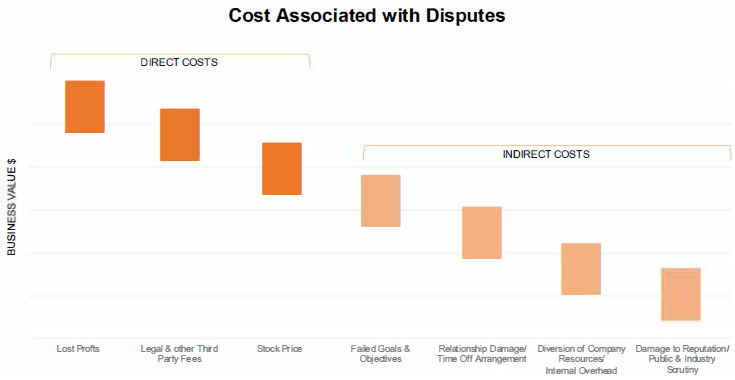
While managing the cost of disputes is one thing, it is important to consider the fact that disputes also cause other disruptions such as consuming time. An Association of Corporate Counsel study found:
- Nearly half—46%—of in-house counsel reported that the length of litigation was increasing, versus only 8% citing that it was declining.
- Seventy-two percent of employment and labor disputes last longer than one year, and 71% of breach of contract disputes last longer than one year, with 22% taking more than two years.
Simply put, the more time people spend working on disputes, the more they are not spending in value-added activities that can positively impact the organization.
Avoiding a Vicious Cycle
The good news is there are proven tactics companies can take to diminish the likelihood of facing these headaches. The authors of the book Preventing the Dispute Before It Begins: Proven Mechanisms for Fostering Better Business Relationships outline eighteen mechanisms and provide compelling case studies of how they are being used in practice.
One of lessons? Recognizing that dispute prevention comes well before your dispute resolution team gets involved. In fact, good dispute prevention practices start as early as when you are looking to select a business partner and thread through both the contract development and contract management aspects of business relationships.
Below are three dispute prevention tactics that can help companies resolve conflicts before they turn into full-blown disputes.
Partnering
Partnering uses team-building tactics to help build a strong, collaborative working relationship among contracting parties. Partnering is a deliberate undertaking between parties to ensure they align on the purpose of the contract, their mutual objectives, expectations and values, the risks they are likely to confront, conflicts that may arise, or any other issues that will portend a better relationship.
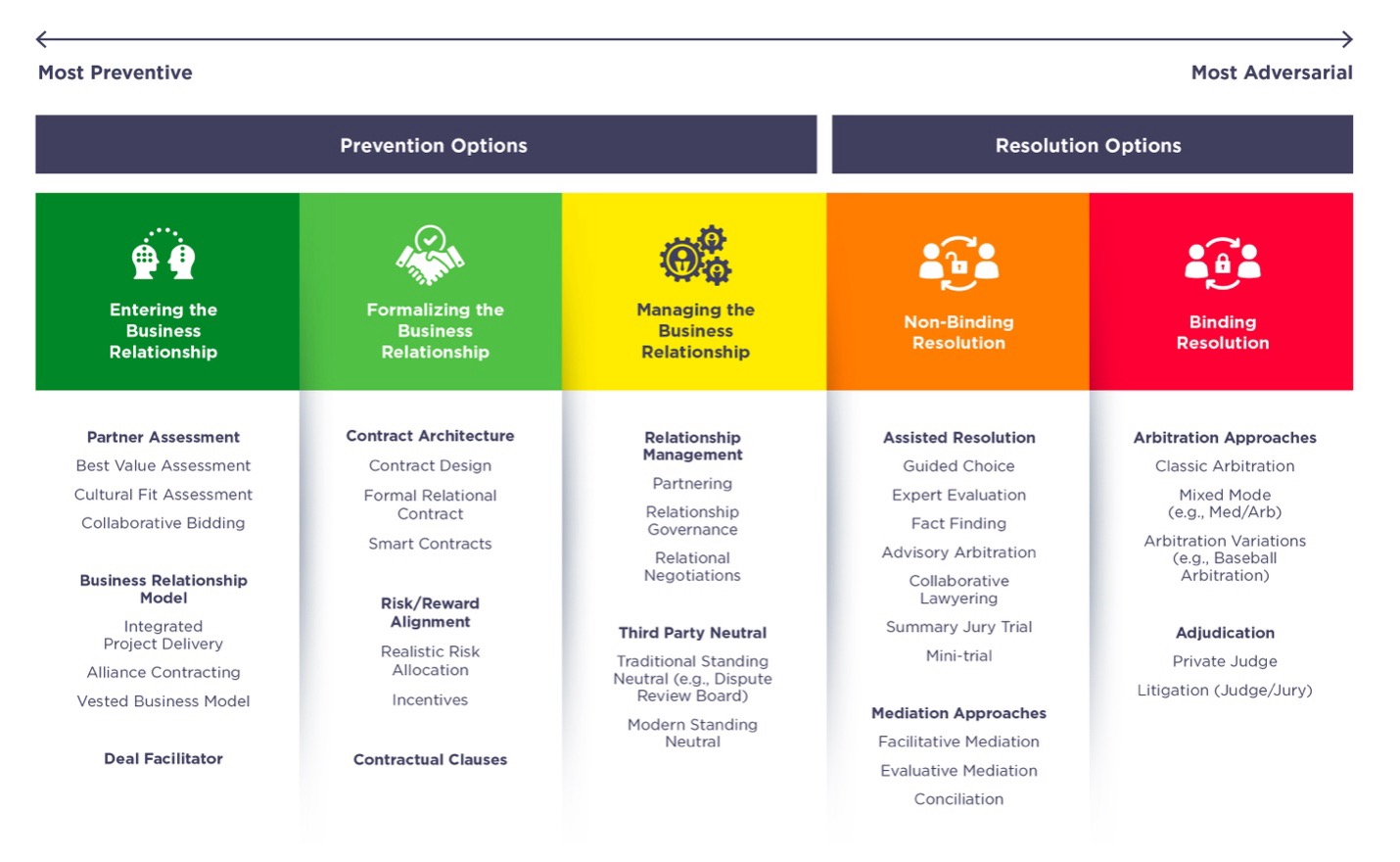
Partnering often involves workshops with key stakeholders. For example, contracting parties may hold a retreat among key personnel involved in the project/relationship. The expected benefits from partnering activities include improved efficiencies and cost-control, increased possibilities for innovation, continued quality improvement of goods and services, and reduced likelihood that conflict will escalate to dispute.
The typical steps commonly found in partnering include:
- Commitment During Contracting: The process begins when two or more organizations contract to work together and agree to use partnering
- Post-Contract Planning: Stakeholders select a facilitator, stakeholders, and the agenda and time for the initial partner meeting
- Kickoff Workshop: The participants establish their commitments and build a team culture. The parties establish a formal charter, identify key issues and risk management strategies, and develop a dispute management plan and processPeriodic Partnering Meetings: Monthly or quarterly “refresher” meetings to review progress and objectives to allow for adjustments
- Close-Out Workshop: Final evaluations and lessons learned to ensure improved processes in the future, along with recognition of individual contributions
Traditionally, partnering is considered a post-contract signing mechanism. However, in recent years, partnering has extended to pre-contract signing with the use of a deal facilitator, who helps contracting parties develop their contract.
Deal Facilitator
Using a neutral party to resolve disputes is commonplace. But an interesting spin proving to be effective at preventing disputes is to leverage a third party for help in deal development, too. The third party—often referred to as a deal facilitator or deal mediator—is engaged by contracting parties to help them collaboratively negotiate the specific deal terms.
That role is especially important when considering that business deals, especially large and complex ones, can be fraught with difficulties.
One study found at least 40 percent and up to 70 percent of all joint ventures are estimated to fail.[1] Key reasons are miscommunication and misunderstandings between the parties, which lead to mistrust and cause the negotiations to reach an impasse. The use of deal facilitators is intended to overcome these obstacles.
Using a deal facilitator can help contracting parties to create fair and balanced agreements that work for both parties, in turn, reducing contractual issues.
When contracting parties use a deal facilitator, the neutral has no incentive to obtain any specific terms of benefit to a particular party. For this reason, the deal facilitator can engage in “reality testing” of proposals and positions. For example, a deal facilitator can help a party who is opportunistically seeking terms that may generate distrust or resentment to see the benefit of adopting more even-handed terms that promote business harmony and the long-term health of the relationship.
Vancouver Island Health Authority (Island Health) and South Island Hospitalists Inc. (SIHI) turned to a neutral deal facilitator when their contract negotiations reached an impasse. Negotiations had grown so tense team members described negotiations as broken, bullying and even toxic. The deal facilitator led key stakeholders from both organizations through a three-day “alignment” workshop and a series of workshops to help the parties repair their damaged relationship and ultimately work through a win-win contract.
The results? A total trust turnaround with team members used words like collaborative, transparent and trusting to describe the relationship post contract signing.
Realistic Risk Allocation
Risks are inherent in virtually all commercial activities. Realistic risk allocation is an integral part of risk management that starts at the planning phase in any business relationship and includes the process of fairly allocating risks among the parties.
When businesses identify, understand, anticipate, assess, analyze, and learn to manage risks, they can create a significant source of value for the contracting parties through risk reduction. The goal is to consciously not shift risk to the “weaker” party to “win” the negotiation, but rather to intentionally identify and analyze potential risks in a relationship and assign each risk to the party that is most capable of managing, controlling, or insuring against that risk.
Each time a risk is appropriately allocated, a source of potential conflict diminishes.
Realistic risk allocation helps prevent problems by assigning each potential risk of the business relationship to the party best able to manage, control, or insure against the particular risk.
That process involves a four-step joint risk assessment:
- Step 1: Identify Risks
- Step 2: Analyze, Prioritize, and Estimate the Cost of Risks
- Step 3: Fairly Allocate Risk
- Step 4: Joint Planning and Mitigation
The result of following these steps is cost avoidance and/or real cost reductions associated with reduced risk.
The Bottom Line? It is Your Bottom Line.
Making the shift to dispute prevention does not just make intuitive sense; there is a bottom-line business case for adopting upstream dispute prevention mechanisms.
Simply put, it brings value to all parties involved.
About the Authors
 Kate Vitasek is an international authority for her award-winning research and Vested® business model for highly collaborative relationships. Vitasek, a Faculty member at the University of Tennessee, received the Thinkers50 Breakthrough Idea Award in 2025 and was lauded by World Trade Magazine as one of the “Fabulous 50+1” most influential people impacting global commerce. She has written nine books.
 Ellen Walman served as a law professor for 27 years and has published more than 25 articles and is a co-author of the book Preventing the Dispute Before It Begins: Proven Mechanisms for Fostering Better Business Relationships. Most recently she served as the Vice President of Advocacy and Educational Outreach at the International Institute for Conflict Prevention and Resolution (CPR), offering thought leadership in the realm of mediation and dispute prevention.
Note
[1] Patricia E. Farrell & Dan Bova, The 7 Deadly Sins of Joint Ventures, Entrepreneur (Sep. 2, 2014), https://www.entrepreneur.com/business-news/the-7-deadly-sins-of-joint-ventures/236987.