By Eva Kelmendi
Europe’s semiconductor ambitions will depend on securing not only chip supply chains, but also the digital infrastructure and technologies underpinning its future resilience.
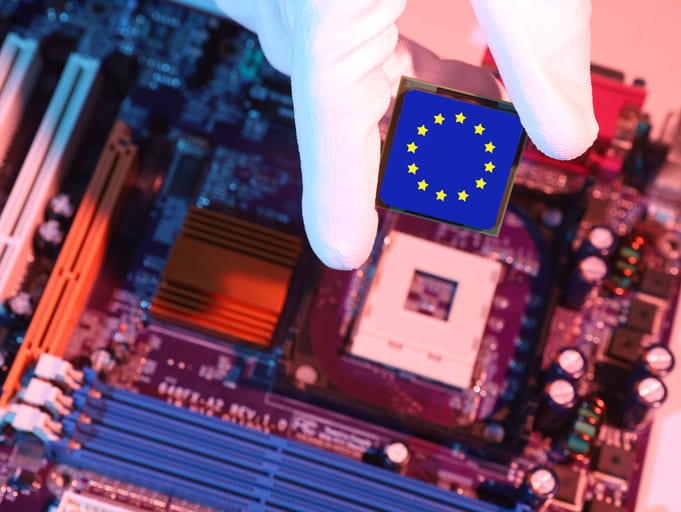
As part of its continuing campaign to secure its own semiconductor supply chain and de-risk from Chinese supply, the European Union has proposed a Chips Act 2.0, following up on the original Chips Act adopted in 2023. Last September 27 countries signed the Brussels Declaration, agreeing to the need for an updated Chips Act that includes five objectives to achieve semiconductor market independence by 2030. The new legislation emphasizes the need to secure each level of value added from the most advanced chips needed for AI development to those of lower-tier capacity for everyday appliances, automobiles, and telecommunications infrastructure.
Europe’s Semiconductor Vulnerabilities
The lack of European technological resilience became especially apparent when the 2020-22 Covid-era “chip crunch” highlighted structural dependencies on East Asian supply chains. European manufacturing was again strained when President Biden announced chip export controls in late 2022, and when China imposed rare earths export bans in April and October 2025. EU manufacturers are dependent on China and Taiwan for chips below 28nm; however, for chips above this threshold, other inputs in chip making like the rare earths, high-performance magnets, or intermediate processes like polishing and wet-processing still stem from China. This sort of diversified dependence on China is even more consequential, increasing risks across value chains for both the tech needed for AI and data centre development and everyday electronics and communications products.
From Chip Fabs to the Wider Technology Ecosystem
EU companies face an array of dependencies along the lower-tier of semiconductors. The new Chips Act recognizes this, seeking to create chip-adjacent resilience by incentivizing Europe-made packaging for AI accelerators, Massive MIMO technology for 5G, and wide-band-power-gap devices. This would shift the focus from fabrication companies like ESMC in Germany or STMicroelectronics’ chip plant in Italy, and move it towards empowering industries like Sweden’s Ericsson, which builds its own in-house telecommunications chips, or France’s Mistral, which aims to power its own compute. The diversification of the Chips Act is especially important now as Europe risks losing its ASML-led monopoly on extreme ultraviolet lithography for chip-making.
Securing Europe’s 5G Infrastructure
Efforts for de-risking from China have not only been incorporated through EU financing but also through import bans on making use of Huawei and ZTE technology. The US finalized its ban on the companies in 2022, labelling them national security threats. The EU followed suit but implementation has been slow and uneven across member states, with 17 countries unable to feasibly sever ties due to tech dependencies. Whether a security threat or not, Chinese companies pose dependency traps to European manufacturing: NVIDIA’s GPUs may still outperform Huawei’s Ascend NPU models, but for less-intensive needs, Huawei’s technology offers a reliable and cheaper alternative that Western equivalents.
Where EU companies face tight margins across an incredibly competitive market, import bans without cheap replacements can seriously impact revenues. When Greece switched to 4G in 2013, Huawei was the cheapest partner for Wind Hellas, providing almost all of Greece’s radio access network (RAN). Now Nova Telecommunications uses the exact same equipment across Greece and Cyprus.
The Balkans as Europe’s Strategic Frontier
Huawei’s competitive market integration is especially true for EU-accession candidates that have been seeking to both create attractive economies and comply with EU reforms. That dynamic produces a unique opportunity for EU border states to facilitate the EU’s de-risking goals. Telekom Srbija Group, for example, is responsible for building out 5G infrastructure across the Western Balkans. Without company efforts, which have been supported by financing from the EU and the US EXIM Bank, Serbia would likely still rely on Huawei products for expansion of its 5G network. Instead, Western loans stipulate Ericsson and Nokia products. Both companies are supporting the future transition to 6G, for which they will need advanced AI chips, and they both play a role in shaping the extent to which the EU and its accession countries rely on Chinese technology.
Working with Western companies instead of Huawei brings an added future benefit to the European Union in the realm of AI. Telekom Srbija Group, for example, hopes to become a driver of Serbia’s own emerging AI ecosystem, and chief executive officer Vladimir Lučić has argued that Serbia could develop into a major European AI centre by combining 5G networks with sovereign cloud platforms. Transitioning EU-accession candidates away from Huawei now means securing Europe’s AI future through secure data infrastructure, engineering talent, and access to advanced GPU capacity through international partnerships, including discussions with US institutions and global technology companies.
Surveying the other frontrunners in the Western Balkans telecommunications ng enlargement process, Albania and Montenegro, Vuk Vuksanovic, foreign policy expert at King’s College London, stated recently that while these countries may “not entirely replace or end partnerships with companies like Huawei, but deny them projects regarding the 5G spectrum.” That could mark a critical turning point: while the EU has sought change in the region, operators like Crnogorski Telekom, One Crna Gora, One Albania, and M:tel Montenegro still rely heavily on Huawei or ZTE equipment.
China’s Influence at Europe’s Periphery
EU-adjacent countries, such as those in the Balkans, act as strategic markets for the EU, functioning either as a potential weak point or as one well poised to protect broader European goals. China has warned the EU not to pursue state-led economic competition through the Chips Act or the proposed EU cybersecurity law, which would further reduce Chinese tech imports. Beijing has also responded by focusing itself on adjacent markets, turning them into a hybrid battleground for Europe’s economic independence. As the EU tries to decouple from China, Balkan telecom infrastructure could become a major weak point. Following the deal to no longer make use of Huawei equipment, for example, Telekom Srbija Group, and CEO Vladimir Lučić became targets of a cyber-attack originating from Russia, further highlighting ongoing challenges to European goals.
Turning De-Risking Into Digital Resilience
Banning Huawei and ZTE at a time when AI development is strongly encouraged leaves European innovators with fewer options. The European Chips Act 2.0 seeks to ameliorate the discrepancy; however, some countries, like Cyprus, Austria, and Hungary, are still nearly fully dependent on Chinese components. Thus, weak points across the Balkans and existing dependencies within EU countries themselves compound the risks from Chinese market dominance.
Europe’s chip strategy must also focus on existing critical infrastructure that every digital industry relies on. How EU-adjacent countries handle 5G expansion and telecommunications innovation will determine the EU’s goals for decoupling critical supply chains from China. Decoupling will be even more challenging for countries which have already fully integrated Huawei ecosystems. Europe must get ahead now, especially as China seeks to expand its influence from chips and rare-earths to the AI models that run on them. Multifaceted challenges stand in the way of a Chips Act 2.0, heightening economic rivalries with China, but also creating immense opportunity for investment, EU expansion, and home-grown technological innovation.
About the Author
 Eva Kelmendi is an Albanian-born analyst based in the UK, with experience working alongside civil society organisations focused on the Balkans and Eastern Europe. Her work centres on governance, political freedoms, and institutional accountability, with particular attention to democratic standards and the rule of law. She holds an MA in Human Rights from University College London (UCL).